Introduction
The daily cycles of light and dark are internalized in individuals as circadian rhythms such as the sleep-wake cycle, their existence allows the synchronization of biological and behavioral processes to the environment.Reference Walker, Walton, DeVries and Nelson1 The loss of synchronization produces circadian rhythm disorders, which are defined as alterations caused by abnormalities in the timing, its driving mechanisms, or a gap between the endogenous rhythm and environment.
Sleep disorders are a public health concern. They have a strong impact on quality of life; mental and physical health; and vehicle or work accidents. The diagnosis of sleep disorders including circadian rhythm sleep disorders (CRSD) carried out according to the criteria of the International Classification of Sleep Disorders.2 CRSD generated high costs for health services and high rate of accidents associated.
Delayed sleep phase disorder (DSPD) is defined as a significant retard of >2 hours in sleep onset to the time socially adequate, usually with diurnal sleepiness (see Table 1).2 The etiology is related to factors such as the expression of PER 1, PER 3, ARTL2, and CLOCK genes that modify the chronotype in hereditary way and can be present in entire families.Reference Hida, Kitamura and Katayose3, Reference Patke, Murphy and Onat4 Alterations increase the risk of mental illnesses,Reference Ebisawa, Uchiyama and Kajimura5 and contribute to a deficit of melatonin at the beginning of the night.Reference Aoki, Ozeki and Yamada6 In addition, some environmental factors have been related to DSPD, including work or school schedules and a high exposure to artificial light at night.Reference Uchiyama, Okawa and Shibui7

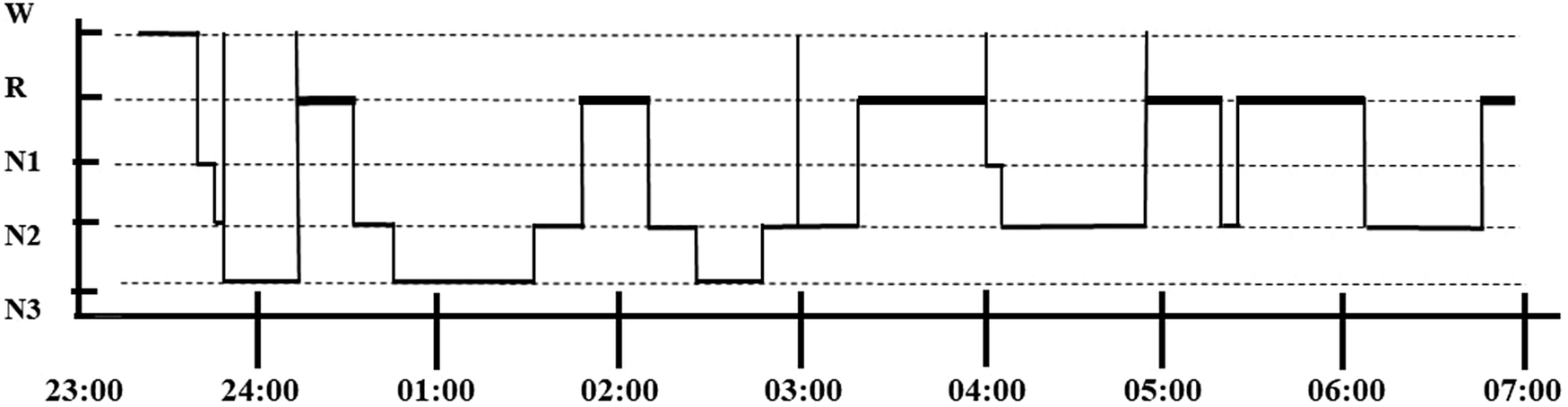
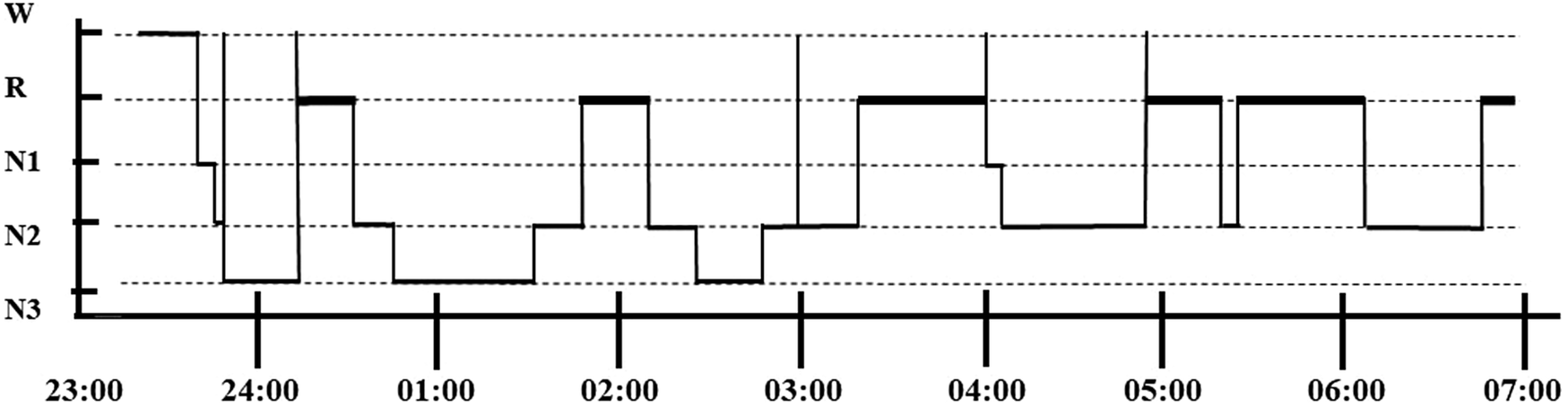
The main complaint reported by patients with DSPD is a delay in their sleep schedule compared to what is socially accepted (see Figures 1 and 2), increased sleep latency, shortened subjective sleep time, and daytime sleepiness, and is also associated with being single, financial difficulties, parents divorced, obesity and sedentarism.Reference Sivertsen, Harvey, Gradisar, Pallesen and Hysing8 It has also been linked to the practice of home schooling and home office, such as what happened during the coronavirus pandemic (COVID-19).
Typical hypnogram of delayed sleep phase syndrome showing sleep onset until 2 a.m., causing the sleep period extend beyond 9 hours in the morning. In horizontal plane time in hours, in vertical column behavioral functional states: N1, non-REM sleep stage 1 (light sleep); N2, non-REM sleep stage 2 (light sleep); N3, non-REM sleep stage 3 (deep sleep); R, rapid eye movements (REM) sleep; W, wake.

Typical hypnogram of the sleep-wake cycle of a healthy subject, showing brief sleep latency after 23.00 hours, normal distribution of the sleep states, and some brief awakening through the night. In horizontal plane time in hours, in vertical column behavioral functional states: N1, non-REM sleep stage 1 (light sleep); N2, non-REM sleep stage 2 (light sleep); N3, non-REM sleep stage 3 (deep sleep); R, rapid eye movements (REM) sleep; W, wake.
DSPD has been related to some comorbidities such as cystic fibrosis,Reference Jensen, Jones, Kartsonaki, Packer, Adler and Liou9 breast cancer,Reference Ancoli-Israel, Liu and Marler10 diabetes, and cardiovascular diseases.Reference Marcheva, Ramsey and Buhr11 It has a comorbidity with other sleep disorders, such as insomnia and obstructive sleep apnea.
Evaluation and diagnosis of DSPD
Diagnosis of DSPD can be carried out by identifying sleep habits, bedtimes, and waking times (comparing days off with respect to school or work days). Objective diagnosis is carried out by actigraphy and can be complemented with sleep diaries and clinical interviews,2 salivary melatonin,Reference Bonmati-Carrion, Middleton, Revell, Skene, Rol and Madrid12 and peripheral white blood cell transcriptome of melatonin.Reference Laing, Möller-Levet, Poh, Santhi, Archer and Dijk13
Epidemiology of DSPD
Prevalence of DSPD is difficult to estimate because of the different definitions of the problem, different diagnostic criteria, and disparity of measurements. Before the COVID-19 pandemic, in a study in Norway, DSPD reached a prevalence of 0.17% in the general population, with a prevalence of 8.9% in patients with an evening chronotype.Reference Sivertsen, Pallesen, Stormark, Boe, Lundervold and Hysing14
DSPD is frequent in adolescents, studies from Norway and Australia showed a prevalence of 8.4% and 1.1%, respectively,Reference Saxvig, Pallesen, Wilhelmsen-Langeland, Molde and Bjorvatn15, Reference Lovato, Gradisar, Short, Dohnt and Micic16 with a higher percentage in girls than boys (3.7% and 2.7%, respectively). Among the adult population, DSPD is inversely associated with age, students aged 18 to 22 years had a prevalence of 3.6% compared to 2.0% in students aged 29 to 35 years.Reference Sivertsen, Pallesen, Stormark, Boe, Lundervold and Hysing14
The COVID-19 outbreak
The social restrictions that were implemented in response to the COVID-19 pandemic, changed lifestyles in society, work, school, and family, which lead to symptoms of sleep disorders. As an initial effort, the International COVID-19 Sleep Study aims to explore the effects of COVID-19 pandemic on various aspects of sleep and circadian rhythms.Reference Partinen, Bjorvatn and Holzinger17
Objective
The aim of this review was to search for the relationship between DSPD and COVID-19 during the pandemic, and its mental health and metabolic implications.
Operational definitions
For the purpose of this review, the DSM-5 definition criteria for Generalized Anxiety Disorder or Anxiety were as follows: excessive anxiety and worry (apprehensive expectation), difficulty to control the worry, association to restlessness, fatigue, difficulty for concentration, irritability, muscle tension, and sleep disturbance.18 For major depressive disorder (MDD) or depression, criteria of DSM-5 were as follows: depressed mood, loss of interest/pleasure, weight loss or gain, insomnia or hypersomnia, psychomotor agitation or retardation, fatigue, feeling worthless or excessive/inappropriate guilt, decreased concentration, thoughts of death/suicide, and others.18
Overweight and obesity were defined as disorders marked by an abnormally high, unhealthy amount of body fat. (ICD-10).19 Metabolic syndrome was met using the following criteria: central obesity with a waist circumference >80 cm in females or >90 cm in males, hypertriglyceridemia >150 mg/dL, high-density lipids <50 mg/dL in females or < 40 mg/dL in males, type II diabetes mellitus (DM), family antecedent of DM, gestational DM, or clinical evidence of insulin resistance, with acanthosis nigricans, nonalcoholic fatty liver disease, or fasting glycemia >110 mg/dL (ICD-10).19 DM was defined as a group of metabolic diseases characterized by chronic hyperglycemia resulting from deficits in insulin secretion, insulin action, or both (ICD-10).19
Method
Articles addressing “DSPD” and “COVID-19” from scientific journals were identified searching for its mental and metabolic consequences. Search was performed in scientific journals. Articles were selected in 3 phases: by title, by abstract, and full text, and were discussed among authors and discrepancies were commented until consensus was reached. The systematic review was performed in PubMed and Google Scholar. In Pubmed, the search with DSPD descriptor found 10 039 articles, whereas 10 articles associated with COVID-19 were discovered. In Scholar Google, search with DSPD descriptor disclosed 40 700 articles, whereas 27 articles associated with COVID-19 were found. A critical narrative review of the DSPD and COVID-19 relationship in mental and metabolic topics was performed.
Results
Sleep and COVID-19 pandemic
It has been reported that sleep onset, offset, and mid-time were delayed on work days but not on free days. Sleep duration was increased on work days, and social jet lag was reduced during the lockdown.Reference Tahara, Shinto and Inoue20 Studies reported that participants slept longer and later during lockdown weekdays and exhibited lower levels of social jet lag noting that while this seems to be an overall improvement of sleep conditions, chronotype was also delayed under lockdown.Reference Leone, Sigman and Golombek21
In an online study, Bottary et alReference Bottary, Fields, Kensinger and Cunningham22 during the first wave of COVID-19 found data suggesting DSPD reduced jet-lag and social sleep restriction. Similarly, with an online survey it was found a pronounced shift toward later sleep combined with an increase in sleep duration, these changes were not more pronounced in adolescents than in young adults and seemed to occur mostly during weekdays. Teenagers also report an improvement in daytime sleepiness and subjective sleep quality, while young adults reported an increase in sleep difficulties associated with sleep onset, nocturnal and early morning awakenings, and nightmares.Reference Ramos-Socarras, Potvin and Forest23
Mental health and its relationship with CRSD and DSPD
The COVID-19 pandemic and the confinement have produced significant stress, anxiety, and worries for fear of being infected, job loss, financial problems, and uncertainty about the future.Reference Morin, Carrier, Bastien and Godbout24 In India, we found symptoms of depression and stress, moderate levels of anxiety among males and females, and elevated levels of stress, anxiety, and depression among students and healthcare professionals.Reference Rehman, Shahnawaz and Khan25 Examining the effects of different forms and levels of restrictions on anxiety and depression, it was found that stronger lockdown restrictions, results in reduction of social contacts, perceived changes in lifestyle associated with 31.1% of increase in study of participants exceeding the cutoff score for a diagnosis of depression, 21.2% exceeding the cutoff for anxiety, and 13.1% having had fear.Reference Benke, Autenrieth, Asselmann and Pané-Farré26
Evidence of relationship between circadian rhythm disorders and mood disturbances, as sleep has been linked to emotional regulation.Reference Palmer and Alfano27 According to the DSM 5,18 MDD is characterized by alterations in mood, sadness, or irritability that is accompanied by at least one of the following alterations: sleep cycle, sexual desire, appetite, anhedonia, slowing of speech or actions, crying, and suicidal thoughts. It has also been described that depressive disorders are associated with various neurobiological alterations like hyperactivity of the hypothalamic-pituitary-adrenal axis, altered neuroplasticity, and altered circadian rhythms.Reference Fang, Tu, Sheng and Shao28 Sleep disturbance is the most prominent symptom in depressive patients, leading to the hypothesis that sleep problems are not an epiphenomenon of depression, but rather a predictive symptom.Reference Fang, Tu, Sheng and Shao28 Sleep architecture in MDD includes short rapid eye movement sleep latency (REM latency), increased REM sleep, and reduced slow waves sleep; evidencing strong relationship between sleep and depression.Reference Vadnie and McClung29 Considering the relationship between circadian rhythm disruption and the pathophysiology of depression, it has been hypothesized that pharmacological and nonpharmacological strategies affect circadian rhythms could lead an improvement in depressive symptoms.Reference Satyanarayanan, Su, Lin and Su30
Recent discovery of new antidepressant melatonergic substances may improve depression symptoms. That is, it has been evaluated whether 25 to 50 mg of agomelatine and psychoeducation are associated with the circadian realignment in young people with depression. After the intervention, depressive symptoms significantly reduced the timing of dim light melatonin onset (DLMO), shifted 3.6 hours earlier, sleep onset was shifted 28 minutes earlier, and total sleep time increased 24 minutes. Authors reported a strong correlation between relative improvements in depression severity and degree of shift in DMLO.Reference Robillard, Carpenter, Feilds, Hermens, White and Naismith31
It has been proposed that stress-induced perturbation of the serotonin system that disrupts circadian processes and increases susceptibility to depression.Reference Daut and Fonken32 This could explain in part, the relationship between circadian rhythm disorders and mood disturbances.
Anxiety disorders have also been related to DSPD. For example, catastrophic thinking is considered symptom of anxiety, and patients with DSPD are frequently concerned about their ability to function academically, followed by the effect of poor sleep on their ability to attend school, and consequences from their peers or teachers.Reference Danielsson, Markström, Broman, von Knorring and Jansson-Fröjmark33 Some individuals only suffer a delayed sleep phase (DSP), while others fulfill the criteria for the diagnosis of DSPD, obtaining higher frequency of a psychiatric symptom, worry, rumination, and elevated levels of anxiety.Reference Danielsson, Markström, Broman, von Knorring and Jansson-Fröjmark33
COVID-19 caused a greater predisposition of patients to develop of CRSD, including a 1.5-fold increase in DSPD. CRSD were associated with increased trait and anxiety state mediated by the neurotropic nature of SARS-CoV-2 and the quarantine associated with the COVID-19 pandemic.Reference Boiko, Skrypnikov, Shkodina, Hasan, Ashraf and Rahman34
As for MDD, agomelatine (a melatonergic MT1 and MT2 receptor agonist) has been used as a pharmacotherapy in anxiety disorders, for example, in patients with obsessive-compulsive disorder (OCD). A literature review showed that 7/10 patients reported sleep and/or circadian disruptions before the treatment, and they experienced a 46% to 90% reduction in OCD symptoms.Reference Coles and Goodman35
Metabolic consequences of DSPD
Obesity, type 2 DM, cardiovascular diseases, hypertension, and dyslipidaemias are strongly related to sleep disorders and complicate severely COVID-19. Effect of DSPD on metabolism remains insufficiently studied. We could infer that DSP have similar disturbances to those reported under circadian misalignment (eg, social jetlag, shift work disorder) or sleep restriction.
Although subjects with DSPD are typically unable to fall asleep before 2 a.m., they are not always able to sleep late the next day to complete the required 8 hours of sleep. Several studies have demonstrated that sleep restriction (<7-6 hours/night of sleep) is associated with metabolic impairment. A study performed on 1024 volunteers described that those with short sleep had lower circulating leptin levels and higher body mass index.Reference Taheri, Lin, Austin, Young and Mignot36 Accumulated evidence indicates that sleep loss is associated with increased hunger and preference of high-calorie diet.Reference Nedeltcheva, Kessler, Imperial and Penev37 These alterations have been corroborated in animal models.Reference Forcina-Martins, Soares-Marques, Tufik and D’Almeida38
Sleep restriction is a risk factor for glucose intolerance and insulin resistance, and is an important components in development of type 2 diabetes.Reference Spiegel, Knutson, Leproult, Tasali and Van Cauter39 In healthy young men, 8 days of sleep restriction (4 hours time in bed/night) decrease insulin sensitivity and lead to glucose intolerance.Reference Buxton, Pavlova, Reid, Wang, Simonson and Adler40 Another study revealed that 2 nights of restricted sleep (2:45-07:00) in unmedicated adequate-weight men also led to glucose intolerance by reduced insulin sensitivity.Reference Schmid, Hallschmid and Jauch-Chara41 Sleep restriction during a single night induced glucose intolerance and decrease insulin sensitivity (sleep allowed from 1:00 to 5:00),Reference Sweeney, Peart, Kyza, Harkes, Ellis and Walshe42 and increased insulin levels (sleep allowed from 03:00 to 07:00).Reference Wilms, Chamorro and Hallschmid43
The circadian component of sleep regulation is crucial in the development of metabolic disturbances, mainly in glucose control. Thus, sleep loss decreases insulin sensitivity independent of the timing of sleep restriction. Late-night sleep loss impairs the physiological rise of cortisol, which increases after glucose intake, this could induce insulin resistance via cortisol alteration.Reference Wilms, Chamorro and Hallschmid43
Recently, the role of the suprachiasmatic nucleus in maintaining lower glucose levels during the resting phase has been described.Reference Rodríguez-Cortés, Hurtado-Alvarado, Martínez-Gómez, León-Mercado, Prager-Khoutorsky and Buijs44 Thus, circadian misalignment could be one of the pathways by which social jetlag or shift work are associated with glucose impairment and why resynchronizing the circadian pattern of eating is able to reduce the effects of those conditions on metabolism.Reference Toyoura, Miike, Tajima, Matsuzawa and Konishi45
Treatment of DSPD
Behavioral therapy
Cognitive-behavioral therapy for insomnia such as bedtime restriction, stimulus control, cognitive restructuration, and relaxation could be integrated into the treatment of DSPD.Reference Jansson-Fröjmark, Danielsson, Markström and Broman46 DSPD may require behavioral therapy to modify some habits that may perpetuate the disorder and maintain good therapeutic results, as well as to break dysfunctional beliefs. Cognitive behavioral treatment for insomnia (CBT-I) is usually used as an adjuvant, such as phototherapy, or pharmacotherapy. There is no evidence on the effectiveness of CBT-I as the single therapy in DSPD.Reference Richardson, Micic, Cain, Bartel, Maddock and Gradisar47
Chronotherapy
It is theorized that individuals with DSPD can retrain certain rhythms. To shift their circadian dysfunction, they will need to progressively delay their sleeping time until they reach the desired sleep-wake schedule (usually 3 hours every 2 days), in accordance with good sleep hygiene, adjusting social events, diet, and exercise.Reference Alvarez, Dahlitz, Vignau and Parkes48 Due to the lack of controlled-randomized studies, the evidence for this therapy is limited to case series. Flexible schedule is required since it may interrupt daytime activities, such as school, work, and so forth.
Phototherapy
Off-time light exposure suppresses the nocturnal release of melatonin. Evening light suppression is recommended in patients with DSPD by minimizing or dimming indoor light. Blue light filtering or amber lenses can be used from sunset to bedtime.Reference Esaki, Kitajima and Ito49 Exposure to morning light can be beneficial promoting a greater increase in phase advancement in conjunction with evening light withdrawal and the use of melatonin. Preferably, natural light is used after awakening instructing the patient to go outside or sit behind a bright window for 30 minutes. In winter, light therapy can be used, the most studied treatment is a light with a brightness of 10 000 lux, indicated for 30 minutes after awakening at a distance of 30 to 50 cm. Combined therapy has shown greater results than one method alone.
Melatonin
The American Academy of Sleep Medicine suggests that children and adults with DSPD should be prescribed melatonin at a time between 7 and 9 pm. Melatonin has a good safety profile with few adverse effects, which include headache and nasopharyngitis. The drug reprogramming the internal circadian cycle and promoting sleep.Reference Aoki, Ozeki and Yamada6 Studies have shown effectiveness in phase advancement at doses of 0.3 to 5 mg of melatonin. It appears that time of administration has a greater impact than dose. A 0.5 mg of melatonin 10 to 12 hours before the midpoint of sleep achieves the greatest amount of phase advance.Reference Chua, Hauet-Richer, Swedrowska, Ingham, Tomlin and Forbes50 Also, it has been reported that a prescription of 1, 2, or 4 mg of ramelteon or ramelteon and 15 mg of suvorexant improve symptoms of DSPD.Reference Takeshima, Shimizu, Ishikawa and Kanbayashi51
Discussion
Main findings
One of the main consequences of the COVID-19 pandemic is the DSPD, associated to insomnia, mental health alterations such as depression and anxiety, and metabolic alterations such as insulin resistance and type 2 DM, as was set in evidence in this review. During the pandemic, symptoms of sleep disorders, mental and metabolic illness increased in prevalence. These have important interactions between alterations and have several implications in the pandemic context.
Clinical implications
Evidence of close relationship between depression-anxiety and CRSD should be considered, since sleep disorders have been associated with increased risk of depression. Thus, it is important to improve sleep quality in patients with symptoms of DSPD during pandemic to reduce the risk of mental illness.
Furthermore, it has been identified that sleep deprivation and CRSD are risk factors for metabolic disorders such as decreased sensitivity to insulin; these conditions are risk factors for type 2 diabetes. Prevalence of type 2 diabetes in 2019 in a global age-standardized prevalence rate, stood at 5282.8/100000 in adult population in one study that search the spatial-temporal patterns of incidence, mortality, and attributable risk factors from 1990 to 2019 among 21 world regions.Reference Nanda, Sharma, Mubarik, Aashima and Zhang52 In countries with a high prevalence of diabetes such as Mexico, the prevalence of type 2 diabetes is 10.3% for adult women and 8.4% for adult men.53 However, it is possible that in the period after the COVID-19 pandemic, there will be an increase in the prevalence of type 2 DM, in part as a consequence of the increased prevalence of sleep disorders, such as DSPD. This hypothesis deserves future research and follow-up. It is therefore essential to implement public health policies aimed at improving sleep quality in order to reduce their possible consequences on mental and metabolic health.
New hypothesis
Catastrophic information and isolation during the pandemic of COVID-19 set individuals with an increased level of anxiety. Along with the continuity of the outbreak and the apparition of new variants of the virus and successive waves of the disease, anxiety becomes a chronic condition that maintains individuals expectant and alert, increasing levels of excitation that result in DSPD. Increased levels of chronic anxiety may result in augmentation in circulation levels of cortisol and adrenaline that alter the carbohydrates metabolism, that in a long-term period may result in insulin resistance, metabolic syndrome, and diabetes type 2.
Study and close follow-up in individuals with DSPD to determine the exact time when sleep and metabolic changes become pathologic, deserve more research in order to know the natural history of the alteration, and give subjects an early treatment and generate preventive measures of prevention.
Strengths and limitation
The main strength of the systematic review is the novelty of the topic, addressing the need for identification, diagnosis, and therapy of DSPD during the COVID-19 pandemic. Previously, symptoms of DSPD had been strongly neglected or had not received enough attention.
Weaknesses in our review were articles included were mostly series of few participants. This was becasue the topic is new and there is no many original articles or systematic observations related to the topic. In the reviewed articles, there was little additional information about other pathological conditions, medications, sleep habits, or comorbid disorders.
We highlight the need of improve methodology to increase knowledge about the occurrence of DSPD in subjects during the COVID-19 pandemic, which would be very useful in determining the possible weight of each confounding factors. According to our observations, in the clinical evaluation of subjects with DSPD, it is important to ask about other sleep disorders beyond insomnia, apnea, and periodic limb movements, which cause sleep deprivation and are also contributors factors of DSPD.
Despite these limitations, literature reviewed showed that DSPD could be frequent in subjects during the pandemic of COVID-19. However, our study design did not allow us to conclude if DSPD is significantly more frequent during COVID-19 pandemic. But suggest that the relationship between different factors such as changes in neural systems functioning, comorbid sleep disorders, medication, stress, carbohydrates metabolic control, and antecedents of DSPD in childhood or adolescence are essential to the understanding of the problematic of DSPD in individuals during the COVID-19 pandemic.
Conclusions
During COVID-19 pandemic many subjects change their habits and suffering of DSPD, this condition set subjects to suffering of more mental health alterations, such as anxiety and depression, and of metabolic disorders, such as hyperlypidemia, insulin resistance, and type 2 DM. Thus, it is necessary to design projects for early identification and treatment of DSPD during and after COVID-19 pandemic.
Financial Support
The study has no external funding than participant institutions.
Author Contributions
Conceptualization: U.J.-C.; Data curation: U.J.-C., N.B., H.B.Á.-G., G.M.-A., A.B.-M., R.S.-M., A.P., H.A.M.-A.; Formal analysis: U.J.-C., N.B., H.B.Á.-G., G.M.-A., A.B.-M., R.S.-M., A.P., H.A.M.-A.; Investigation: U.J.-C., N.B., H.B.Á.-G., G.M.-A., A.B.-M., R.S.-M., H.A.M.-A.; Methodology: U.J.-C., N.B., H.B.Á.-G., R.S.-M., A.P., H.A.M.-A.; Validation: U.J.-C.; Writing—original draft: U.J.-C., N.B., H.B.Á.-G., G.M.-A., A.B.-M., R.S.-M., A.P., H.A.M.-A.; Writing—review and editing: U.J.-C., A.P.
Disclosures
The authors do not have any conflicts of interest.