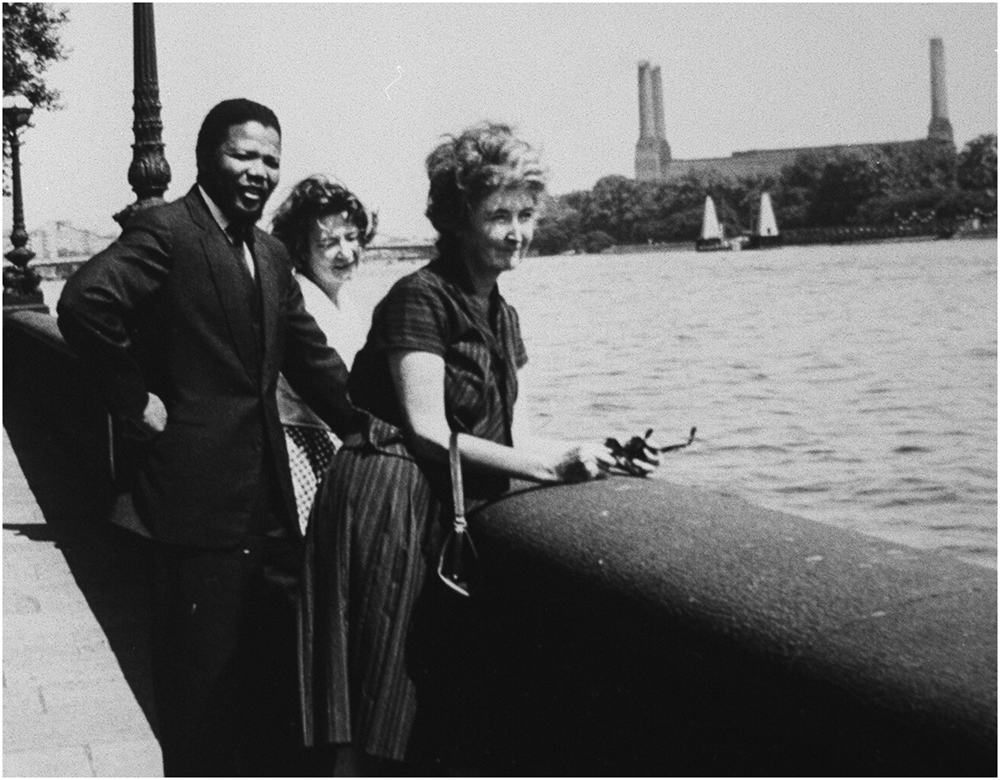
I sat in the wood-paneled, aging Senate House Special Collections manuscripts room in London on a darkening day late in 2016. These were the last minutes remaining of months spent using the papers of the South African political exile Ruth First, my last moments to glance into boxes I had committed to the category “return to, sometime.”Footnote 1 One box was very light, and I almost assumed it empty. Something moved me to open it anyway, and in the single file that lay there was a small bound volume—the second half of First's Filofax address book, of a kind known to those of us of a certain age who did not start out our friendships or meet our lives’ contacts as owners of cell phones.Footnote 2 As I leafed through it, the names I had seen in the archive drifted back, notated in First's intense script: British and American historians associated with the Communist parties and the New Left and some feminists of her era—of 1960 and after—along with those of African National Congress (ANC) figures Winnie Mandela and Adelaide Tambo and of several friends of privilege from Johannesburg who had gone over, gone rogue, gone anti-apartheid.Footnote 3 One of the latter, Mary Benson, had been a friend since their meeting in 1953 in Johannesburg; she was photographed in 1962 with fellow South African activist Freda Levson and their guest, a young Nelson Mandela on the lam (Figure 1).
Nelson Mandela in London, 1962, with Freda Levson on his left and Mary Benson on his right. Credit: Mary Benson Estate, Sygma/Getty Images.

It was Mandela's last visit to London before most of the rest of his lifetime was spent imprisoned on Robben Island.Footnote 4 A network of First's family and friends leapt off the address book's pages. Here lay the pattern of her life in an ordered form, a remnant of the A–Z of politics, friendship, romance, and family that flowed from Southern Africa to the British metropole, to the United States, to Europe, down into the Sahara, across to the Middle East, south into the frontline states of the proxy wars, back to London again, and back and forth to Dar, to Lusaka, to Harare, and to Maputo in newly independent Mozambique. The diary's front page remained, bearing two addresses: Lyme Street in Camden and her university center in Maputo.Footnote 5
The metaphorical weight of that small diary rests on my present book project, its subject the importance of exiled and expatriate lives in postwar London, here signified by the biblical warmth of fire illuminating the paths of those in motion at night and the cover of cloud to guide movement by day.Footnote 6 In pursuing those who sought refuge and became exiled in London after the Cold War, the historian of our neo-liberal age wrestles with the fate of polities and states once led by many returning from abroad, fates now uncertain and often turned.Footnote 7 We gauge the impact of the former British Empire upon our own time, many scholars in the field using innovative archival strategies. So much has now been done to map virtually anonymous histories that the necessity of turning back toward known and well-documented individual lives seems urgent. Postwar immigration, social movements, state surveillance in metropole and colony, and structures of social policy form a universe much more understood than it was a decade ago. In this framework of scholarship, whither those of greater privilege and notoriety? Whither the still living? And whither the sources of these actors’ individual, less public lives and words, hidden in plain sight? Of what bearing are their more intimate remarks and private vernaculars “as if spoken,” often undigitized, unquantifiable, untextable, untweetable? Their papers, if extant, are sometime referenced only as diplomatic archives. For the living, in many instances there are words as yet unspoken, but not to be uttered on Skype, not necessarily able to be found and recorded in London, not easily parsed. Yet must we not listen? Must we not hear and attempt to interpolate?
This sampling of language derives both from institutional archives and from the inspiration of testimony taken in South Africa, India, Trinidad and Tobago, and the United Kingdom between 2005 and 2019. I turn to the spoken words (and words written as if spoken) of four individuals and some of their associates, whose lives moved across the political culture of the metropolis and much of the globe. Their motion also affords us glimpses of the archive of “late empire” and the “global postwar,” from which the mammoth crossroads, the secure and unsafe haven that is London, is inseparable.Footnote 8
Ruth First
Ruth First's husband, Joe Slovo, wrote of her, “She was a woman of style and elegance, both in wit and vanity. She was a comrade whose intolerance of hypocrisy and humbug won her the respect even of those who were discomfited by the razor sharpness of her thrusts.”Footnote 9 Born in 1925, First was the daughter of Latvian and Lithuanian Jewish immigrants to South Africa who were founding members of the first South African Communist Party. Her father, Julius, and her mother, Tilly, were lifelong Soviet enthusiasts; Julius First was a successful furniture manufacturer able to sustain a comfortable, moneyed existence in Johannesburg and to help fund the London exile that they and Ruth First, Joe Slovo, and their three daughters later undertook.
First completed a bachelor's degree in social studies at the University of the Witwatersrand, where her fellow students included Nelson Mandela. She edited the South African Guardian in the late 1940s, and several other organs of the dissenting press, marrying the young communist leader Joe Slovo, a child immigrant from a Lithuanian shtetl family. His father was a fisherman who became a food vendor and truck driver in Johannesburg. Slovo wrote to First years later of his aunt's disputes with his mother-in-law, the loyal Stalinist Tilly First: “Arguments are unavoidable since poor old Bertha doesn't really grasp the essentials of Proletarian Internationalism, and even if she did, she would prefer chicken soup with lokschen.”Footnote 10 The start of a career in left-wing journalism led First to acts of investigation that crystallized her radicalism, notably her collaborative work in uncovering the story of farm labor, and the buried remains of farm workers on a potato farm in Bethal, Mpumalanga. Writers for Drum Magazine and their accomplices posed as tourist landscape photographers, afterward evading pursuit.Footnote 11 This kind of experience left a frisson sharper than the catechisms at home.
The First-Slovos partook of conventional privilege in Johannesburg before fleeing to London. Benson recalled their household in speaking with journalist and writer Don Pinnock: “They also, during the fifties, had this tremendous social life, for which they were sometimes criticized … for all their politics, they never, either the C[ommunist] P[arty] or the ANC, or liberals or anyone, sufficiently allowed for how ruthless the Afrikaner nationalists were. They took it all much too lightly, I think, in the fifties. Their security was always desperately lacking in any real feeling of the potential cleverness or cruelty of the police and state. So they were continually caught out.”Footnote 12
First was a Treason Trial defendant from 1956 to 1961, and she was banned in the wake of the 1960 Sharpeville massacre upon her return from a reporting trip to South West Africa, the former Namibia. In the wake of the 1963 arrests of key communist and activist figures at the Liliesleaf Farm in Rivonia, she was imprisoned for 117 days under the Detention Law, the first white woman to be detained under its new provisions; during that time she attempted suicide.Footnote 13 In 1964, she followed Slovo into exile in London
The Slovo-First narrative is well known as a trope of anticolonial, anti-apartheid, and antiracist achievement, and even as a case of post-Stalinist probity and ecumenism on the part of former orthodox communists, seasoned in struggle. They resided in London when it was a way station of the Cold War and a base for supporters of the international anti-apartheid campaigns, among growing circles of African students and white British activists, as well as exiles from all racial backgrounds, and, importantly, many in the ANC and South African Communist Party (SACP) elites. Leading ANC figures Oliver and Adelaide Tambo lived in Muswell Hill. SACP theoretician Harold Wolpe and feminist scholar AnnMarie Wolpe, both at Essex University, were neighbors of the Tambos. The future South African president Thabo Mbeki studied at Sussex University, his brother Moeletsi Mbeki attended York University, and both were active in London.Footnote 14
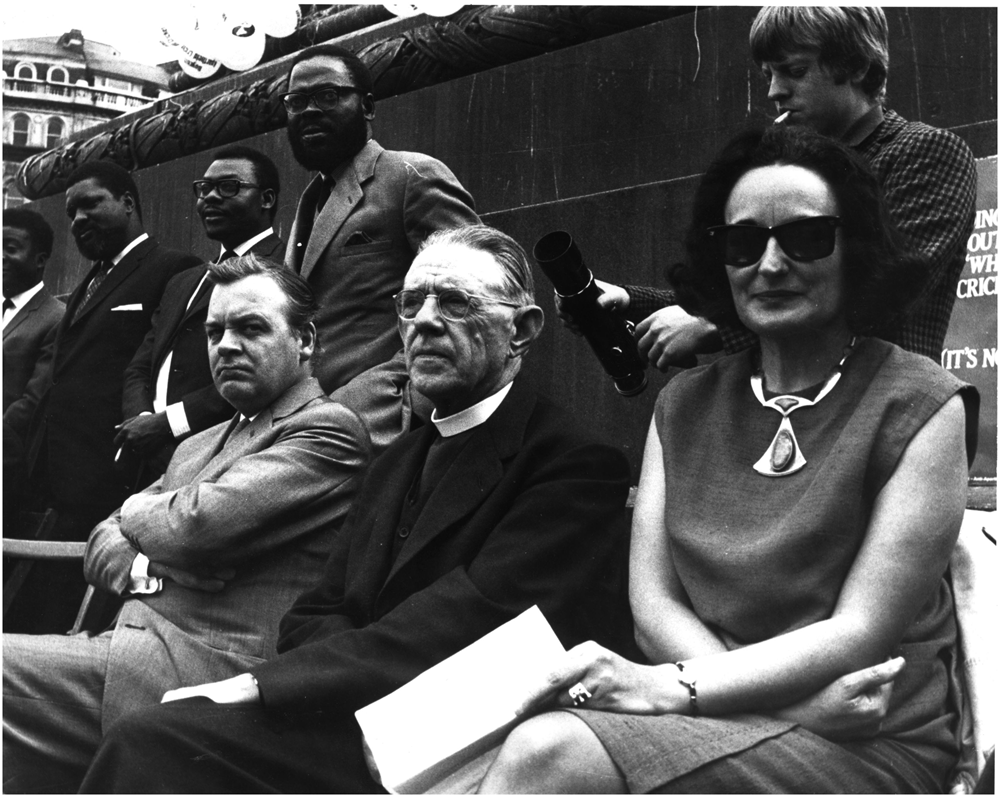
First's engagements across the anti-apartheid spectrum of UK- and European-wide events were ubiquitous (Figure 2). Benson reported that First authored the base text for an Oxford sanctions speech delivered by Oliver Tambo in the early 1960s.Footnote 15 First continued her investigative writing in African studies, enduring daunting early years in London.Footnote 16 Indeed, a 1970 Guardian interview with First by the British writer Auriol Stevens is titled “The Loneliness of the Long Distance Revolutionary.”Footnote 17 After studying in 1966 at the London School of Economics, and a brief posting at Manchester University, First accepted a position in the Department of Sociology of Development at Durham University from 1973, for six years, conducting research on Libya, investment in apartheid, and Mozambique.Footnote 18 But in 1977, after residing in Camden and commuting to Durham while visiting Africa repeatedly, her intermittent globe-trotting led her to a more committed post at Eduardo Mondlane University in Maputo, Mozambique. There she became professor and director at the Centro for African Studies, headed by the Goan Mozambican social scientist Aquino de Bragança. She resigned from Durham two years later.
Ruth First at an Anti-Apartheid rally in London, June 1965. On her right is the former Bishop of Johannesburg, Ambrose Reeves. On his right is the British actor Patrick Wymark. Credit: Keystone, Hulton Archive/Getty Images.

How does the deep archive allow First and her family and associates to speak in ways that enhance and complicate that known framework? What role did First's existence as a London exile play in her life's passages? In 1964, the year of her London arrival, First had written of the African continent, “I need to be able to go back there, to be useful with the problems of more than southern Africa. Africa's closeness to London (via the Empire tradition, and ways and means, and the press, and the sheer geography of communications) is one of the few reasons for being in England, I still feel.”Footnote 19 She wrote soon after to a friend in South Africa, “We live very parochial London suburb lives here when we're not busy, and tourists who stay a week have seen more than I.”Footnote 20 In a series of shifts to resolve the sense of being distant from energizing and urgent struggle, First envisioned the necessity of her work addressing Portuguese Africa: “But I have not Portuguese, which seems essential, as would visits to Lisbon at least, then Mozambique and Angola,” foretelling her later commitments. She felt the greenness of her expertise in the face of a host of options that exile posed for her.Footnote 21
Those recounting First and Slovo's married life speak of its arguments, of Slovo's greater orthodoxy, and First's increasing and voiced doubts about Stalinism. Their mutual and widening commitments to African liberation movements and to the armed struggle politics forged by the ANC and the SACP offered grounds for their unity in difference. Slovo would recall those involved in the early articulation of the turn to armed struggle, conveying its presumptive and unpracticed origins, and the controversy that has followed its undertaking: “This venture … found us ill-equipped at many levels. Among the lot of us, we did not have a single pistol. No one we knew had ever engaged in urban sabotage with homemade explosives.”Footnote 22 First's friend, the Durban lawyer Rowley Arenstein, spoke of a “streak of authoritarianism in her and a streak of sectarianism that carried her right through.”Footnote 23 She was more pro-Palestine Liberation Organization, Slovo less so. She supported Tito, while Slovo was closer to the Soviet world, visiting Moscow regularly, and Havana, as did many ANC and SACP activists.Footnote 24 They included some drawn from the trade union movement who had never traveled outside of South Africa before, as well as student leaders like Thabo Mbeki, who led important delegations from London to the former Eastern Europe and trained for months in Moscow. Mary Benson recalled the SACP trips to Russia and East Germany during which Lillian Ngoyi (the first woman elected to the ANC executive) and others “were treated with such respect and really had a terrific time, whereas the West simply never did a thing like that. There was no way. It was very, very short-sighted.”Footnote 25
Five years after her arrival in London, the kudos of academic life extended to First in the United Kingdom, she commented to Auriol Stevens in the Guardian, “I feel rather academic in Britain.”Footnote 26 Her papers show her increasing fluency in progressive and left academic and extra-academic circles, with references to figures like the Cambridge Africanist Jon Lonsdale, Eric Hobsbawm, Christopher Hill, Edward Thompson, Thomas Hodgkin, Ralph Miliband (with whom she studied at the London School of Economics), and Marion Kozak.Footnote 27 She knew the feminist historians Sheila Rowbotham and Hilary Wainwright; one of her closest friends was Rosalynde Ainslee of the Women's Press in Shoreditch. Though Mary Benson would aver that First had not been a feminist, their mutual friend, fellow South African communist Rica Hodgson, deported to London in 1963, took the opposite view.Footnote 28
First became increasingly involved in political and academic work on the European and African continents, commuting between many points and London and leading her into research and investigative areas of new and presumed or assumed expertise. In Libya, she encountered Muammar Gaddafi, whom she privately likened to “a boy with a bag of tricks.”Footnote 29 The First-Slovo integration into a kind of brains trust of the left, as European-based, “broad-minded” Marxist authorities on many things, did not fail to manifest itself in private admissions of skepticism and impatience with the cult of the international NGO (nongovernmental organization) “expert” left. This was its own protracted proxy war, pitting the urgency of political action against quasi-academic, highly theorized development and planning efforts. Many of those involved were later to find themselves in new governments, Slovo prominently included, as the transitions in power on the continent transpired.Footnote 30
These anticipatory efforts were perhaps more than the exiled left intelligentsia had bargained for, to judge from their satirical portrayal of the 1980s conference milieu and its labored policy debates. Slovo typically wrote to First from a trip to Congo in 1975, “One intriguing malicious thought I can't resist expressing though, is that a big compound ought to be built in which Afro-Asian institute personnel and the great development studies pundits of the west ought to be put together out of sight and hearing to exchange their irrelevancies.” He added for good measure, “In case your ego antennas are up, I'm not referring to you.”Footnote 31 While sending along her mail, he wrote to her of Kenyan leader Jomo Kenyatta's predicaments: “I also enclose the Kenyatta installments you wanted. Once again, poor Africa.”Footnote 32 He wrote of the visit of the South African prime minister John Vorster to the Zambian president Kenneth Kaunda, mentioning “the smiling, almost hand-holding picture of K and V. What price black brotherhood, if this escalating series of sell-outs remains unanswered? As the old Jewish saying goes, ‘with friends like these, who needs enemies.’ What do people down your way think about it all?”Footnote 33 There were many left critics of Slovo in particular, both in London and on the internationalist, “Third World,” post–Bandung Conference circuit. The South African anti-apartheid exile communities themselves were steeped in factional dispute, as was the movement at home and in the exile zones of Africa. These divisive battles caused Slovo irritation and evoked his disparagement. He privately satirized the preoccupation with them, taunting First with mimicry: “Watch out for the Trots. In fact, if you keep a mango pit in one hand and the tail of a gerbil in the other, no harm can befall you in their presence! Now you know the secret of my consistency.”Footnote 34
A month later, First wrote to Slovo from Dar es Salaam regarding the southern African conundrum:
I just wish I had more confidence in our collective, organizational ability to read a political situation with real political understanding and skill. Devotion and dedication are fine qualities in cadres, but god they need constant politicizing, and the level of discussion is often so abysmal. Never mind about the ANC's blind adherence to all policies Soviet which lose it certain sympathies here with the kind of “Left” for which you have no respect; but additionally there is so much inane clumsy policy expression of support for the struggle against apartheid on a too-moral basis, and the assumption that because one was first in the field, one will always, in the nature of things, be in the lead. I share your anxiety about “reorganization” in time.Footnote 35
These exchanges bear within them a watchful and knowing admission of the depth of Cold War stratagems and their distance from innovative and critical thought and practice, a nervousness about the fate of the SACP-ANC tap dances and alliances in the proxy wars, and a puzzlement over exile and its longer-term consequences.
In the years of Margaret Thatcher's regime, London served as a space for organizational schisms, for agitation, and for surveillance of those who were admitted to the country only to find themselves under the nose of the respective security forces. The British government served as a prop to the apartheid state, continuing its military and diplomatic intrigues in the southern African context. First tired of London, yet when she made her way back to Mozambique, she expressed fears of her incompetence in serving the wider struggles of the region from the Centro. She wrote from her teaching post in Maputo to her daughter, Shawn Slovo, in New York, about Mozambique's reminiscent qualities, both exasperating and familiar: “And of course, [there is] the man-retainer who does the shopping and cooking and washing up, and clothes washing and ironing. Not a good relationship to re-discover, but physically comforting.”Footnote 36 She reported to Ros Ainslee in early 1979 on her academic project, linked explicitly to the Mozambican Frelimo regime and its staff: “The course with its research projects and its capacity to feed the Ministries is a good idea, but oh how ill-equipped we are … no translators except amateurs; my Portuguese frightfully inadequate to the point I despair of ever improving”; in the same breath, she once more defended her domestic arrangements: “It's awkward being a member of the employing classes again, but almost indispensable if you have a long working day.”Footnote 37 A year later, she thanked Shawn Slovo for sending her clippings from the New York Times, noting the constraints of Independent Mozambique's media: “The papers here are unmitigated propaganda, of course, and about things like water-pipes and groundnut production, and meetings about issues like that.”Footnote 38
First and her university unit's colleagues were comrades of the governing Frelimo regime; they had long ago consigned the established postwar diplomatic bodies of the United Nations to the category of unworkable, ineffective, and moribund entities paralyzed by the Cold War. Yet they moved fluidly between the celebrity of the “Third World” regimes and the institutional and NGO culture of Western-based international diplomacy. In 1977, when she had begun to consolidate her commitment to revolutionary Mozambique, First described to Joe Slovo both her estrangement with and proximity to the West's leading international “conflict-solving” body: “Have been spinning this week between the Centro and the UN Conference on Namibia and Zimbabwe, which is like all UN conferences—insupportable—but somehow there's a morbid fascination to check that nothing will really happen there … All the real ‘Business’—deals and payola, happens in corridors and corners.”Footnote 39 First was no stranger to UN work; she had reported to various offices of its African operations while still on the continent, and worked for it from London in her early years of exile. Her remarks to Slovo had deep roots in these past years, and in her prior passionate interest in and critique of the early 1960s UN Namibian debates and resolutions, which she had written about in her book South West Africa, before her London exile. She had been disappointed by the UN's absence of solid commitment to the plight of deeply exploited Namibia, the former German South West Africa; the South African state had refused to place the territory under international trusteeship in the late 1940s. In 1963, First wrote of the UN resolution adopted in 1948, stating that it had “asked gently for annual information on the territory, till agreement was reached with the UN; and Mrs. Pandit, for India, characterized the resolution which was passed, after vigorous debate, as lifeless.”Footnote 40
We turn now to Mrs. V. L. Pandit and to her ties to London and global activism where she was a formidable player in diplomacy, polemic, and the dynastic politics of exile.
V. L. Pandit
The United Nations is not easily dismissed from the history of political exile and refuge in London, nor from the history of anti-apartheid contestation. Ruth First accepted a post with the UN Commission on Human Rights in 1972, the year before her appointment at Durham, and seven years before Mrs. Pandit came to sit upon it. The diplomat and political figure Vijaya Lakshmi Pandit, twenty-five years Ruth First's senior, was born in Allahabad on 18 August 1900, the sister of Jawaharlal Nehru.Footnote 41 Their father was the Kashmiri barrister Motilal Nehru, a president of the Congress Party, and their mother was Swaruprani Thussu, a member of a prominent Kashmiri Brahmin family. Mrs. Pandit was privately educated and held no formal degrees. Her husband was the barrister and classicist R. S. Pandit, who died in prison in 1944. Mrs. Pandit herself served prison terms for political dissent in 1932–33, 1940, and 1942–43 during the Quit India movement. She and R. S. Pandit had three daughters, one of them the writer Nayantara Sahgal.
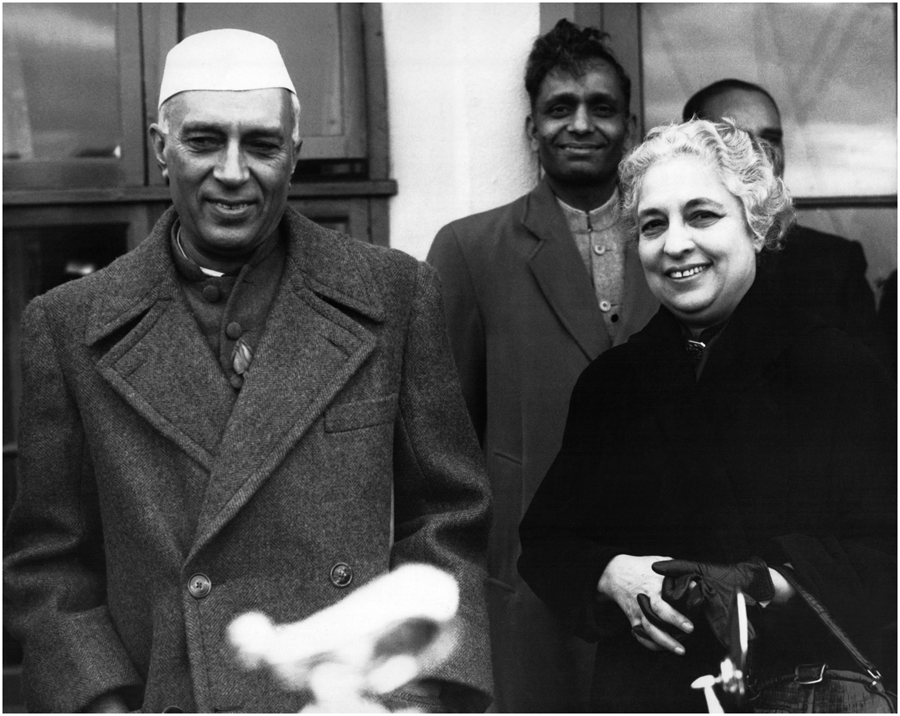
In 1936, Mrs. Pandit became a Congress Party Cabinet member, a year after election to a municipal board. In that year, she was also elected a United Provinces provincial legislator in British India and at Independence was named the first woman cabinet member. She was at the top of the ladder of Indian diplomacy in the Nehru era, serving as independent India's first ambassador to the Soviet Union from 1947 to 1949 and as ambassador to the United States and Mexico from 1949 to 1951. She was elected to the Indian Parliament in 1951 and then served as high commissioner in London and ambassador to Ireland from 1955 to 1961 during both the Suez and Hungarian crises and concurrently served as ambassador to Spain from 1958 to 1961 (Figure 3). She led the Indian delegation to the United Nations three times: 1946–1948, 1952–53, and then through 1954 as president of the General Assembly, the first woman and the first Asian to hold the post. She left her post as Indian high commissioner just before Ruth First's and Joe Slovo's early years in London, but in 1978 became the Indian representative to the UN Human Rights Commission, continuing her outspoken work on anti-apartheid.Footnote 42 Her granddaughter Gita Saghal said of her, “I recall her being very forthright, having a sense of humor, moving at lightning pace, sitting up straight—very straight; not tolerating any cant and generally being impatient with superstition although she was a religious person … [with] an absolute impatience with anything to do with the norms around caste or marriage. Somebody came to her saying, ‘you must find my daughter a husband.’ I remember she sort of rolled her eyes and said, ‘Is your daughter a cow?’”Footnote 43
Jawarhalal Nehru and High Commissioner Mrs. V. L. Pandit in London, December 1956. Credit: Keystone-France, Gamma-Keystone/Getty Images.

In 1946, Nehru committed the newly ruled country to the equality of treatment of Indians anywhere in the world and explicitly opposed the treatment of South Asian-South Africans in the context of India's opposition to apartheid.Footnote 44 Mrs. Pandit's own early and constant antipathy to the apartheid regime and her crucial role in diplomacy launched in the UN and from London and abroad, linked her irreducibly to the South African exile community and to the diverse South Asian diaspora in Britain and throughout the former empire, political divisions notwithstanding. A vast archive of her life and work graces the Nehru Memorial Museum and Library at Teen Murti in Delhi.Footnote 45
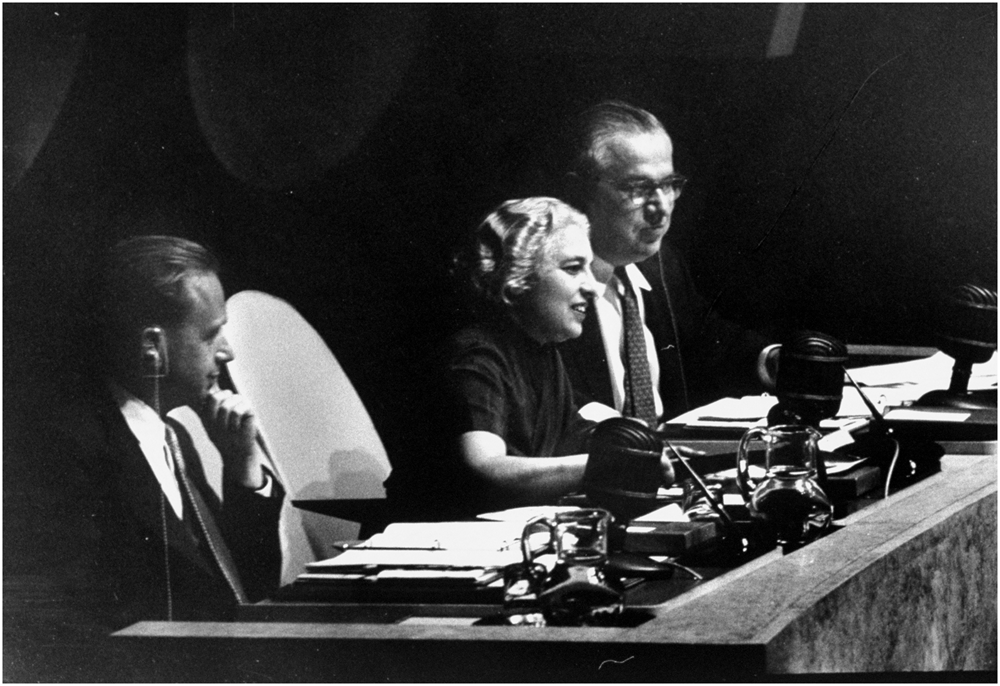
At the 1945 San Francisco Conference of the UN, Mrs. Pandit had signaled her forthcoming struggle with the South African prime minister, Field Marshall Jan Christian Smuts, writing that liberation for Smuts “means liberation only from the Japanese but never from the British or the Dutch.”Footnote 46 As she prepared to do battle at the UN in New York the next year, Mrs. Pandit's field notes revealed her sentiments: “F. M. Smuts thinks that the only right of the Indians which deserves recognition is to live as glorified coolies in his Ghetto paradise, and this right he has not deprived the Indians of.”Footnote 47 In 1946, the Indian UN delegation led by Mrs. Pandit, motivated opposition to the use of Article 2(7) that stipulated noninterference in member states’ domestic matters involving “internal rights abuses” and won this struggle with a majority of two-thirds.Footnote 48 The move sought to protect and serve the Indian South African minority, explicitly not taking on the full apparatus of the South African apartheid state. In 1948, Mrs. Pandit wrote to Krishna Menon, Indian high commissioner to the UK: “The South African question has sprung into prominence again with [the South African prime minister D. F.] Malan's announcement regarding the amendment of the Asiatic Land Tenure and Indian Representation Act. We shall have to fight much harder on this issue than we did last year.”Footnote 49 For Mrs. Pandit and her inner circle, this will “to fight” extended to the issue of India's continued membership in the Commonwealth. A close aide wrote to her before India agreed to remain, “I wonder what we decide? … With all of their colonialism and racialism, it does not seem to be the proper place for us. Is the Irish business, by any chance, intended as a model for us to follow?” (Figure 4).Footnote 50
Mrs. Vijaya Lakshmi Pandit, at the United Nations in 1953. On her right is Dag Hammarskjöld; on her left, Soviet representative Jacob A. Malik. Credit: Lisa Larsen, The LIFE Picture Collection/Getty Images.

As the protracted struggle to oppose apartheid wore on unsuccessfully across decades of Mrs. Pandit's diplomatic and UN career, she recalled that Smuts had promised that her initial rhetorical victory and the subsequent piecemeal UN resolutions on the South African question would prove “hollow.” She now acknowledged the truth of his words, reflecting, “for year after year the verdict of the UN has been ignored … there has been a more rigid enforcement of all discriminatory laws in South Africa.”Footnote 51 From 1960, the UN had passed resolutions against aspects of apartheid policy, Britain and the United States, often with French support, blocking more profound steps. Both the United States and Britain opposed the latter taking extensive economic measures as late as 1988.Footnote 52 In 1962, Ruth First's friend Mary Benson was called before the newly appointed UN Apartheid Committee—the first South African woman to offer testimony. In these years, figures like J.B. Priestley and Canon Collins, with whom Benson worked, approached Mrs. Pandit for support for the Campaign for Nuclear Disarmament (CND). Theirs was an interlocking network.Footnote 53
At the September 1963 plenary of the UN, Mrs. Pandit spoke repeatedly against the apartheid state:
Let us not forget that it was racial policies that led to the Holocaust of 20 years ago … The Continent of Africa is aflame with fires of freedom. We cannot and will not let our brothers in South Africa languish and perish in conditions which our organization has pledged to outlaw … [The] Government of South Africa has made a virtue of its brutal and senseless policies from one hideous act to another … Some have gone to the gallows during the current session of the Assembly … zealots of racism gain strength and supremacy there … They are determined to convert that land into a valley of death. The comparison with Nazi Germany is inescapable.Footnote 54
The anti-apartheid movement drew support from the Congress Party and the Indian Left, even as Pandit championed its cause abroad in a time of fragile “Third World” solidarities. In 1964, the year of Nehru's death, Slovo and First's comrade Molvi Cachalia set up an ANC office in Delhi. Cachalia and his brother, Yusuf Cachalia, key members of the ANC South African Indian cadre, spent time in London thereafter.Footnote 55 Official Indian diplomatic support for anti-apartheid continued, in a global context in which ostensible “Afro-Asian” solidarities were beset by conflicts and fissures.Footnote 56
In the mid-1970s, Mrs. Pandit made a startling break with her government at home in India, now led by her estranged niece Indira Gandhi, who in 1975 declared a state of emergency that lasted for two years. In a decision that had adherents among the British and London South Asian communities, Mrs. Pandit dissented from what became known as the “Gandhi Emergency.”Footnote 57 She spoke to a New York Times reporter in 1976 in Dehra Dun in deeply provocative terms: “If there are no civil liberties and no dissent, then where is the democracy we fought for? … [India] is far more repressive today, in many ways, than it was under the British … One can't govern simply by clapping into jail everyone who disagrees … I was in British jails three times … But when they came for us, it was with a warrant, and in the daytime, not in the middle of the night, the way it is being done now in India.”Footnote 58 In 1977, Mrs. Pandit resigned from the Indian Parliament, leaving the Congress Party for the Congress for Democracy, which later fused with the Janata Party. Her opposition to her niece contributed to Indira Gandhi's subsequent electoral defeat, which was followed by Gandhi's political revival and her assassination in 1984. Mrs. Pandit remained in seclusion in the Himalayan foothills for the remainder of her life, her pen serving as her voice. Some others among her family members left the country.
The Gandhi Emergency deeply affected the lives of young South Asian radicals in exile and expatriate existences. I turn to two of their number, of the generation younger than Mrs. Pandit and Ruth First.
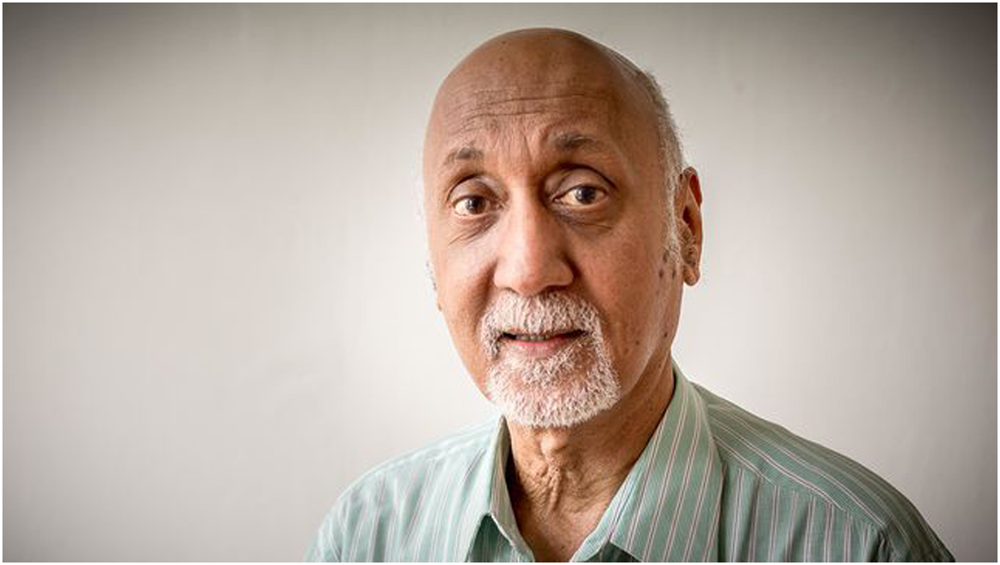
Achin Vanaik
Achin Vanaik, born in India in 1947, more than twenty years Ruth First's junior, arrived in England in 1964, sent from India to a public school in Suffolk—three years after Mrs. Pandit completed her stint as India's UK high commissioner and the same year as First arrived in London (Figure 5). Vanaik's father was in the Indian Foreign Service, and Vanaik's early years were spent on his family's diplomatic postings to China, the United States, and Ghana. The brush with the Nkrumah era in Ghana left its mark on what was then a young man's liberal conscience; he was “appalled” by the embassy and merchant Sindhi communities’ attitudes toward blacks in West Africa. Vanaik is today retired professor of International Relations and Global Politics and the former head of the Department of Political Science at Delhi University.
Achin Vaniak. Credit: Courtesy of Pamela Philipose.

We spoke at his home in Delhi in 2013. Vanaik recalled the predominance of Indo-Caribbean West Indians in the London and British political scene to which he attached himself in the early 1960s. His engagement with that community was the central experience of his years in the metropolis.Footnote 59
He began his narrative in Suffolk, where he was first called a “wog” in school. He and another student of color, the son of the Guyanese ambassador, were given nicknames: he was called “Abdul” (for his turban), and his Guyanese contemporary was called “Sambo.” Vanaik described the attitude he found there: “You should be grateful that we allowed you to come here to get yourself educated … assume the greatness of British imperial character, assume the civilizing mission of British colonialism, and surprise that I could speak English so well, but at the same time … a condescension, a patronization.”Footnote 60 He was repeatedly challenged to take his turban off. It was once knocked off in public on the way into the dining hall: “You get habituated and they get habituated to you … but what did not change was that dominant attitude of patronization, of discrimination, of taking for granted the kind of language that they would use … experiences … which became stronger after two years, when I was a bus conductor [in London and] I had to find a bedsit for myself.”Footnote 61 In Suffolk winters, he worked at a Corona bottling factory and in the post office, while living in the Norwich YMCA, and made contact with the local Indian Association. He planned to enter Bristol University and found a conductor's job in London covering “the different routes from Putney to the Zoo and Camden Town, from Peckham to Hounslow, and then … to Epsom and Roehampton.” He worked in Bishops Park in Putney and made contact with privileged South Asian friends of his father's. “I used to read either the Guardian or the London Times as a bus conductor … So the passengers … would see me reading … and even by the sort of accent of English that I was speaking … they'd know that I had some level of education.”Footnote 62 Forsaking religious commitment, he removed his turban for good. He found a bedsit owned by an Englishwoman willing to rent to him; her spouse was partly Indian. He read in the Wandsworth Library, slipping into the wider milieu of the London left of the mid to late 1960s. As a political scientist, he estimates that the far left groups outside the British Communist Party (CBGB) in his time could loosely boast ten thousand members in a larger periphery of one hundred thousand.Footnote 63
At Bristol, he took an economics and statistics degree and then joined an accountancy firm as an articled clerk, grudgingly and under parental pressure. He found the work was not for him and, given his desire to return to India and to accumulate some money quickly, he became a croupier in London, later promoted to inspector, working nights, and remaining in the city until the Gandhi Emergency in India.
Most of his friends and contacts were West Indians. Vanaik recalls adjusting his speech to imitate and incorporate elements of West Indian slang, appropriating the symbols of Black Power and following the American Black Power movement: “Unlike today, where, in the universities … people … [are] seeing themselves as Hindus and Sikhs and Muslims … [are] having a Muslim society and all that … [we had] a Third World Society … those of us who were radicalized, we'd see ourselves as black … we'd call ourselves black.”Footnote 64 He visited his parents in Malaysia, Sweden, and, Poland, the trips contributing to his radicalization, but he was not yet a Marxist. Attractions to China and to the Vietnamese struggle were predictable allegiances for many ex-patriate Indians in the years surrounding 1968. At Bristol, he immersed himself in antiracist, black power, and anticolonial literature. Major influences included James Baldwin, Stokely Carmichael, Frantz Fanon, and Aimé Césaire's writings on négritude. He joined the Afro-Caribbean circles of activists who were running alternative community organizations; at times, he also tutored for the Free University of Black Studies in Gower Street, whose funding came from the World Council of Churches in Geneva, a key player in the South African conflict: “We realized … that there were a lot of inarticulate, uneducated black people, who used to come to Hyde Park, and used to look at us because we were expressing what they felt. And only after you began to speak, you began to sense that there was this kind of social role.”Footnote 65
Vanaik's own notion of expertise was already evident. He recalled “a certain tension between Indo-West Indians and Indians from the sub-continent … a small tension … They'd be, say ‘we're West Indian’, and they had this, their own sense that the Indians are too meek … to stay [t]here. That didn't apply to me because I was speaking in Hyde Park and all that.” Aside from a few personal relationships, he said, “I didn't really have that much contact with whites.” Most of those of color whom he knew were working class in background, unlike himself. His involvement with “the Left in Britain was always mediated through [his] association … with Black Power or Asian Socialist Forum … [and] with the white left, was minimal.”Footnote 66
Vanaik described the South Asian arrivals to Britain of his era of the late 1960s and 1970s, especially those arriving in the Midlands, as engaged in
a collective struggle against racism … people from Bangladesh—Sylhet, and Punjab, from the rural areas and other areas, coming to Britain to work in working class jobs and so on. You had also those who were educated from East Africa—Uganda, Kenya, who came to England because of Idi Amin, and, others who were expelled … they had British passports, and they often experienced downward social mobility, which meant that from being teachers and professionals, or, having shops or whatever, huge numbers of them had to go into working class environments.Footnote 67
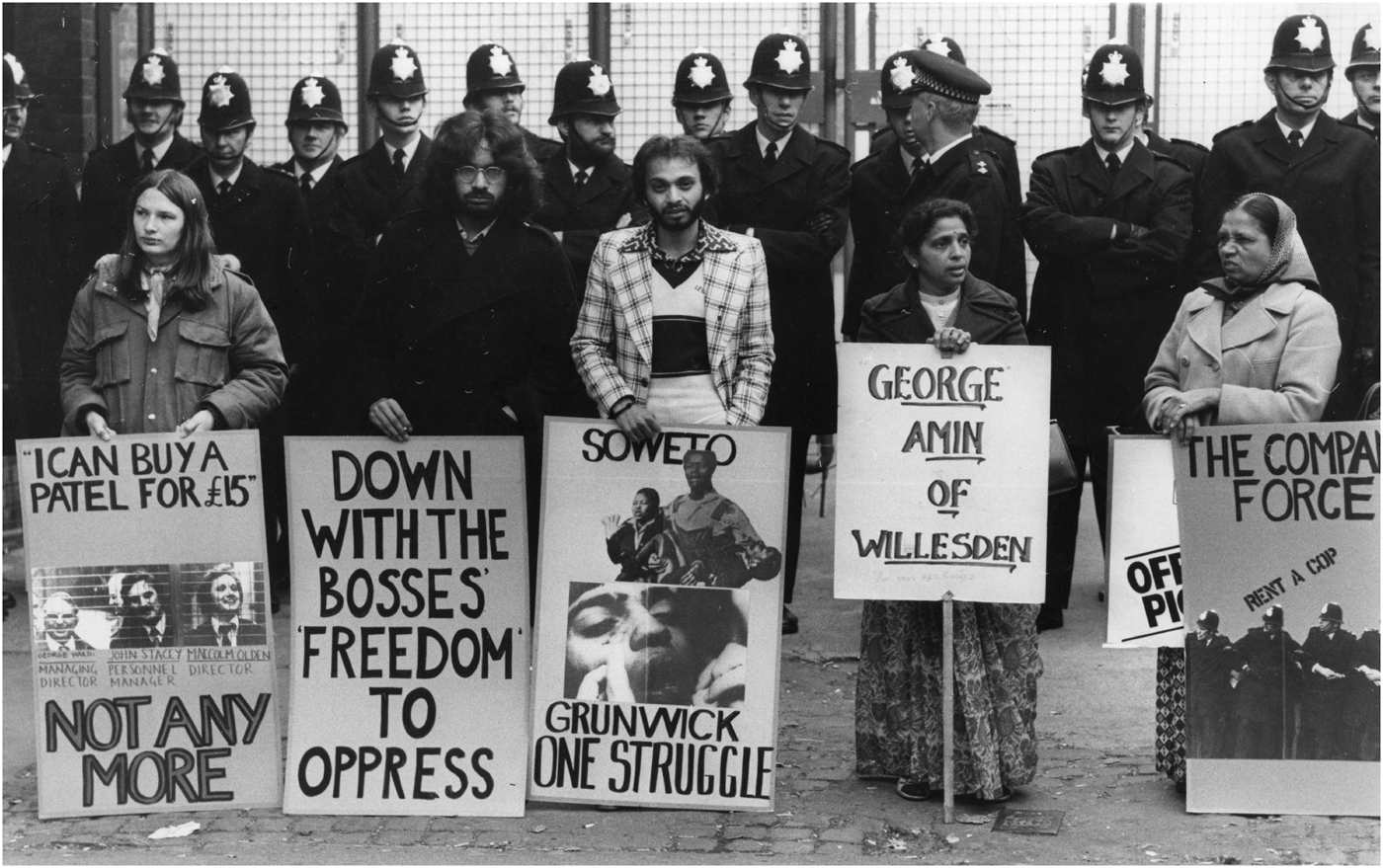
He identified a key component of the leadership of this diaspora: “Much of the collective struggle was also led by East Africans, who, because they were more articulate, had a certain education, but were in a working class background, became mobilizers of the English Asian community [in England].”Footnote 68 He cited the case of the Grunwick labor action at a film-processing lab in Willesden between 1976 and 1978. This famed confrontational labor dispute involved thousands of trade unionists and police violence. It witnessed the use of a paramilitary unit in a strike and resulted in more than five hundred arrests. Most Grunwick workers were immigrant South Asian women. The final routing of the strike was a deep blow; it had been an historic instance of ardent labor solidarity across racial lines (Figure 6).
Grunwick strikers, Willesden, London, June 1977. The middle placard reads: “Soweto-Grunwick, One Struggle.” Credit: Evening Standard, Hulton Archive/Getty Images.

But in the years before Grunwick, when Vanaik was still enmeshed in the politics of Black Power, he recalled that “black power … black nationalism, scorned the white-dominated far Left in Britain's idea of ‘white and black unite and fight’, also taken up by the queer movement and the women's movement and so on.”Footnote 69 He experienced his “own movement away from that … my ultimate dissatisfaction … with the limitations of black nationalist politics.”Footnote 70 But he had also observed among those Indians in West Africa known to him through his parents “racial discrimination by Indians, toward Africans,” signaling the pressures on his own affiliations. He reported the absence of women activists in his circles:
They were negligible … [in] the Black Power movement, [and] the Free University for Black Studies, almost non-existent, or totally dominated, not just in terms of the leadership but also in terms of meetings we'd have … [Occasionally] would come … the partners of some of the leaders … this contradiction of … many of the partners being white and being known and supporting the Black Power movement …You kept them in the background … Wives [of activists] played the role of occasional organizers of events, sympathetic … but … not out front there, at the meetings … After all, somebody has to take care of the house and the home, so they're taking care of the home, while in the evenings you're having meetings in another part of London; somebody has to be at home … they've got kids and all the rest of it … As a generalization that I understood from many who came [there] and experienced racism … you had to survive, and surviving meant that you had to survive emotionally as well … I can't talk about the white-dominated Left, but I can certainly talk about the anti-racist, male-dominated Left … we were all extremely shameful in our treatment of women … many among the males became womanizers … it was seen as an expression of your strength … Macho-ness … It's only later that one came to realize (and you really need[ed] to treat women like shit) … you're actually debasing yourself, not just them … this was a profound, profound limit … obviously, of this whole … so, one began to question.Footnote 71
He later added, “I was unlike the others who were immigrating to England. I never wanted to stay on,” having explained:
My trajectory … was quite common to a lot of people who have come from the former colonial world: you go to Britain, you first get radicalized by the racist issue; the anti-racism then makes you want to understand “why racism?”; then you link it to the question of colonialism, “why colonialism?”, linked to the question of capitalism and imperialism … Then you have the impact of the feminist movement here, and I was reading a lot, and I was … getting dissatisfied with simply the limits of black nationalism and all that … And in 1973, at the same time … I said, I don't want to study any further, let me make as much money as I can, quickly as possible, then come back to India.Footnote 72
Hence, having abandoned chartered accountancy, he took up his croupier and inspectors’ jobs, mostly at Mayfair clubs belonging to the Curzon House Group—the Curzon House Club, the International Club, the Palm Beach Casino, and Crockfords in Mayfair.
The Gandhi Emergency inspired movement away from India to exile for some, but Vanaik went to Bombay where he joined others who were politically close to the British Trotskyist Left. They tried to foment strike activity in a hopelessly repressive environment, cut off from their leadership in London who expelled them. Vanaik returned only briefly to Britain: “I went straight to the unemployment benefit, and … at the same time [was] moonlighting to earn some money,” cleaning houses and selling items in markets.Footnote 73 He explained,
I come back [to London] with the intention of just raising enough money to come back to India for good. So that was my case, but that anti-racist work, [my friend] Suresh [Grover] and we all agreed [upon] … [we thought] our base is—we are all in complete solidarity with the anti-racist struggle generally, but we are Asians, we speak Hindi Punjabi, right? We have to work at the grassroots, and in order for us to be effective at the grassroots, it'd be stupid for us not to work, at least one or two of us, even though many of us are living outside, to at least work in Southall. So then Suresh said, okay, he's going to work in Southall … and he got immediately involved in the Southall Blair Peach issue, and stayed in Southall. He had made earlier connections and all, and ever since he's been in Southall.
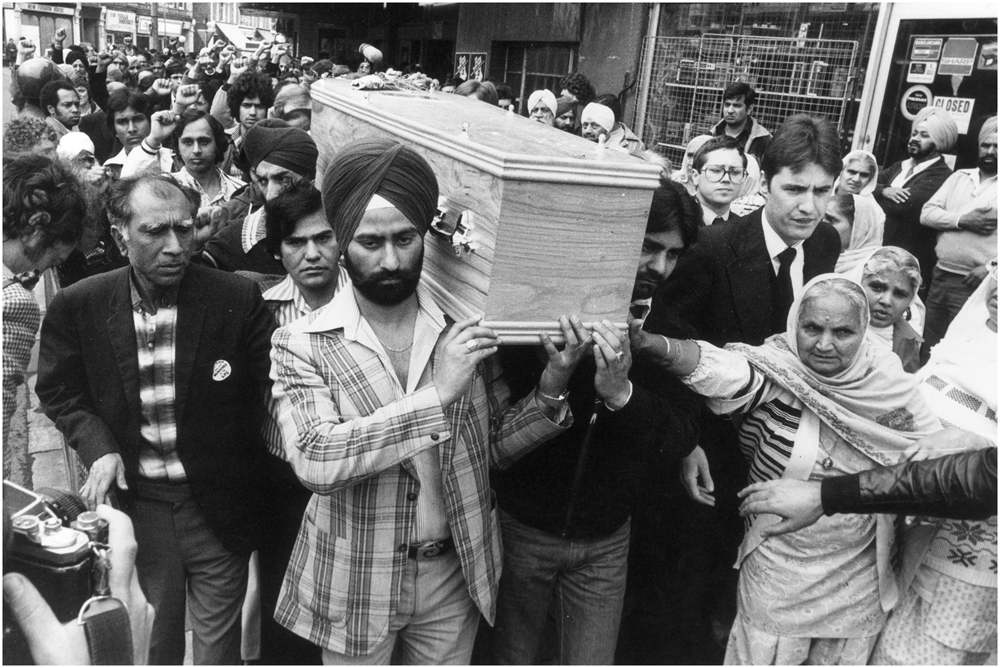
Blair Peach was a New Zealand schoolteacher, presumed killed by police while participating in an Anti-Nazi League demonstration in Southall against the right-wing National Front on 24 April 1979.Footnote 74
Suresh Grover
Though we first met in Soho in 2013 at Achin Vanaik's suggestion, Suresh Grover and I did not speak properly until the short, dark days of 2016, when I was in the Ruth First archive. We spoke in his workplace in Vauxhall and then for many hours over the course of several days in his home in Southall. Grover is one of the leaders of the Monitoring Group, a prominent legal advocacy collective whose formal purposes are succinctly stated: “A. To promote good race relations; B. To advance race relations by means of education and awareness-raising; C. To relieve the needs of those who are distressed or suffering violence or harassment” (Figure 7).Footnote 75 Grover's engagements in Southall immediately after he returned from work in India had led him to the formation of the older Southall Monitoring Group. That path crossed not only Vanaik's and the troubled zones of Afro-Asian solidarity before and after the Gandhi Emergency but traversed the terrain of the South African exiles’ work in London.
The Monitoring Group. From the left: Akala, Esther Stanford-Xosei, Martha Osamor, Peter Herbert, Suresh Grover, and Stafford Scott. Credit: Courtesy of Jagdish Patel.

Grover began:
My father and mother would be the second wave of very large [groups of] migrants coming in from South Asia. The first were students, academics before the war; then, people who took part in the independence struggle, political activists from lawyers to academics who settled [here], who were critical of the [Indian] independence notions in Britain, because they became critical of how the independence struggle had evolved and how it compromised with the British in so many different ways. So my father really is a product of the hemorrhage that takes place in the Independence, the Partition … he and my mother … were born and brought up in what is now part of Pakistan …. they saw an incredible loss of life and violence around them during the Partition, and my mother especially took the horrendous life-threatening journey from Pakistan to Delhi, no relatives at all, lost a huge amount of property, and my father met my mother in very unusual circumstances when he was in his forties.Footnote 76
The family went to East Africa, and Grover was born in Kenya in 1954. When circumstances there deteriorated for them, they went on to England. Grover's father had been a middle-class salaried employee, but when they arrived in Nelson, Lancashire, he and Grover's mother went to work in factories. As a linguist and a person of advanced education who voted Tory until the 1984 miners’ strike, Grover's father helped lead the Indian community of Nelson through the 1960s, 1970s, and 1980s, during the first decades of Grover's childhood and youth.
Grover's panoramic testimony on the fate of the South Asian British communities of the North and the Midlands is ornate and informative. He narrates the successes and failures of years of radicalization of the South Asian British as they worked alongside militant white trade unionists, the drop in radical consciousness that would accompany the loss of jobs in the Thatcher era, the return of many to religious communalism of all types as factory jobs diminished, the brushes with violent racism that he experienced as a young man, and his descent, green from Lancashire, into the white-led London left and music scene of the early 1970s.Footnote 77
In London, he teamed up with Achin Vanaik, now a “left-wing internationalist,” coming under the influence of the British Trotskyist formation, the International Marxist Group, and its sister organizations in Paris, where they also spent time.Footnote 78 They were not Indian Congress enthusiasts; instead, they shared an early exposure to the budding Afro-Asian networks of solidarity and watched the intermittent collapse of Indian democracy from afar; Vanaik always planned to go back to India, while Grover was recruited to do so. In this way, their fates became linked to those of Mrs. Pandit and her shifting legacy, and ultimately to the twists and turns of anti-apartheid street politics and high politics in the United Kingdom and in India.
After the failed attempt at fomenting revolution in India and alienation from the International Marxist Group's sister organization in in India, Suresh returned “home” to London, his health crushed, taking residence in Southall just as the infamous murder of the New Zealand schoolteacher Blair Peach once again mobilized the South Asian community of record (Figure 8). This was the leading sector of radical British-South Asian politics in what had been a largely white working-class and lower-middle-class hamlet as yet untouched by Heathrow in the interwar years: Southall.
Blair Peach funeral, Southall, London, June 1979. Credit: Mike Lawn, Hulton Archive/Getty Images.

In 1983, in this mélange of political shifts that left disunity in the South Asian communities to the extent that unity had existed around a social democratic commitment before the 1970s, Suresh met a South Asian émigré who remains his fellow activist, the writer and filmmaker Gita Saghal, Mrs. Pandit's granddaughter and Nehru's grandniece. Gita Saghal first arrived in England in 1972 and is a graduate of the School of Oriental and African Studies at the University of London. She, too, had been in India intermittently at the time of the Emergency, when her grandmother Mrs. Pandit and aunt Mrs. Gandhi, experienced their political schism. Gita Saghal became a member of the Southall Black Sisters organization, founded in 1979, and settled in Britain permanently in 1983.Footnote 79
In this context, Suresh and others began to create the earliest Monitoring Group in Southall, “a unique model of political resistance uniting justice campaigning, legal tools and community organizing to expose State brutality and racism,” providing resources for Asians, Afro-Caribbeans, Africans, and others, through which they might seek redress for run-ins with the police and with various forms of racial discrimination in their everyday lives.Footnote 80 This forerunner of the present Monitoring Group began in London, and then its work spread around the country. Grover's special commitment became families in mourning.
The Monitoring Group members had all been part of various Afro-Asian attempts at unified campaigns. Suresh spoke to me candidly about the deep divisions and cultural distance between Asians and black communities in Greater London and the times when joint action had seemed most possible (Figure 9). One instance of unity had been the motion around South Africa, to which he had been deeply committed:
My memory is etched with South African struggles throughout my formative political experience, from ’76 Soweto … within the black political culture, linking our struggles, supporting them when necessary … Different tenets were developed, run by the Communist Party first of all, then much more … by people on the far Left; then, by black activists themselves … to make it untenable for Thatcherism to keep on supporting that apartheid regime … [there grew] more vocal support for exiles in this country … Oliver Tambo's wife was part of Camden Black Workers’ Group.Footnote 81
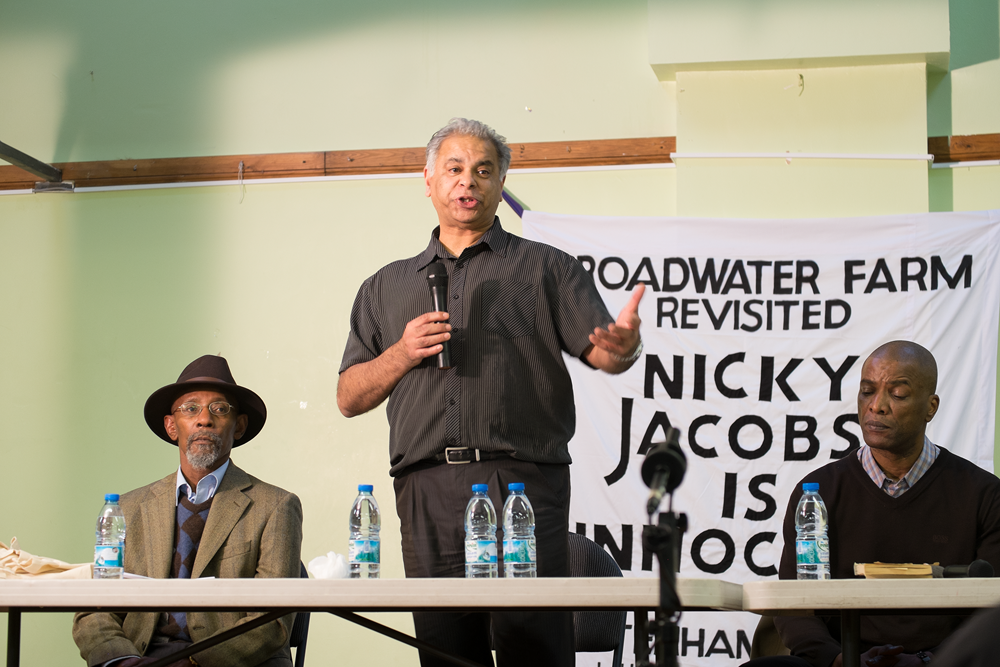
Suresh Grover addresses a meeting in Tottenham, London, in 2014 on the upcoming trial of Nicky Jacobs for the murder of a policeman on the Broadwater Farm housing estate in 1985. To his right is his fellow activist, the writer Stafford Scott; to his left, the eminent Jamaican poet Linton Kwesi Johnson. Jacobs was acquitted. Credit: Courtesy of Jagdish Patel.

Grover termed South Africa the “pivotal struggle in global politics … even more important than India, when situated within our lived experience … there was not self-debate about the role of Mandela, the role of [the] ANC … [about] whether it [the ANC] would be able not just to make a political revolution but economically [to] change the system.”Footnote 82 He still believes that “the election of the ANC, the freedom for Nelson Mandela, is one of the biggest emancipatory moments in human history.”Footnote 83
Ruth First
In March 1981, before the South African victory of which Grover spoke, Ruth First again corresponded about her return to independent Mozambique where she led the teaching and research unit of Mondlane University in Maputo (Figure 10). While she saluted John Le Carré’s portraits of the Cold War murderous espionage era, she wrote to Shawn Slovo that she did not feel vulnerable to South Africa where she now was, in free Mozambique: “I feel quite safe. And we are.” Two months’ later she mused, “Where to be, what really to do? … Can you understand when I say with feeling that I could not drag myself back to Durham … how could I tolerate those long over-four-hour journeys four times a week to have a civilized weekend in London, especially when the civilization often failed [?].” In Maputo, she wrote, “the work is good, and something new is growing, but it's not a full life, so cut off, family-wise, culturally. Hard to know.”Footnote 84 While “social revolution [is] in progress, change can be both devious and slow and interrupted.”Footnote 85 In June 1982, she wrote again to Shawn Slovo, “I can't stomach England these days, all at the mercy of Mrs. Thatcher and the Pyms and the Notts, and now the Pope. Can you imagine what it must be to live midst all that, and pay for it when the tax man collects, and the health service grinds down more, and the schools and colleges, too[?]”Footnote 86 In writing of the Falklands, she raved, “The South Africans, via their radio, are cock a hoop. They're laughing at Britain complaining that they are supplying Argentina, and quite rightly too, considering what Britain supplied that is now being aimed back at her. E. P. Thompson waxed most eloquent about all this, but even his high indignation blows nowhere.”Footnote 87
Ruth First in Mozambique. Credit: Courtesy of Gillian Slovo/Ruth First Papers.

First's father, Julius, had died in London where her mother, Tilly First, was still living. Joe Slovo remained immersed in the armed struggle politics of the combined forces of the ANC and the SACP, with profound support from the Soviets.Footnote 88 Their three children were now women, spread across the globe, often suffering setbacks and finding places for themselves in dissenting arts communities. First and her colleagues kept trying to make the Maputo Centro of African Studies work. She juggled her nostalgia for South Africa, her hatred of its regime, and the allure of metropolitan culture and her repugnance with it, as well as the presumption of her expertise in everything from development economics to rural cooperative housing and African elites’ monetary behavior in the transitions to independence.Footnote 89 A steady entourage of South African activists and those from the fractured liberation movements of the African continent, with a sprinkling of Euro-visitors, passed through the Centro, where First received the greatest amount of mail. She was a most-known person, a jefe.
On 17 August 1982, as she chatted with co-workers and visitors in her office, a colleague teased her about the number of letters sitting in her university box. She went to get the mail, came back, and began to open an envelope. The letter bomb exploded; it was in a packet wrapped in diplomatic paper very familiar to her, bearing the imprint of the UN offices in Swaziland. Slovo arrived minutes later and would comment on first seeing the Italian shoes that had been one of her hallmarks, worn on this day of her martyrdom.Footnote 90 In 2006, my companion James A. Miller and I visited the quad and the building where it happened, the setting reminding us of the University of the West Indies regional campus blocks at St. Augustine outside Port of Spain, started in 1960. Renamed in honor of Frelimo's Mondlane in 1976, the Maputo campus originated with the Portuguese in 1962. We stood transfixed at its impassive ordinariness, its familiar and unmistakable functionalism.
The British government's representatives in southern Africa were flummoxed. How could they manage to say nothing in sympathy over this assassination of one half of the most vilified white couple operating in their sphere of influence? The documents in the British National Archives at Kew—not an archive we ought to forget—show the self-congratulatory delusion that hit as news of the moment of death came across the wireless. First, “An explosion at faculty of arts … 15:00 today … One female member of the ANC reported dead and five other persons injured. Preliminary reports indicate a letter bomb.” Then, a second memo: “As you will have heard over the BBC, the dead woman was Mrs. Ruth First, wife of Jo Slovo, ANC and SACP leader.”Footnote 91 But she was not, after all, a British citizen. A response to a query from the British consulate offices in New York City warned, “Ruth First and her husband Joe Slovo are regarded by the South African Government as having been leading enemies of South Africa. Whatever our view about Ruth First, it would be seen by the South African Government as a hostile act if we gave formal expression of support for her work for the ANC by signing a condolence book,” though the book in question had not identified a presumed perpetrator.Footnote 92
Then the panic set in: “I have just been told that Miss First was a British citizen. We have no record here of her registration, or of her having been given a passport. Miss First was born in South Africa of Lithuanian [sic] parents but she spent some time in Britain during the sixties working, inter alia, as a lecturer in sociology at Durham University. It is conceivable that she became a citizen by registration during this time, particularly as a British passport would be more useful than a South African one. Grateful you inform me as to her status by telegram as HMG [Her Majesty's Government] and I are being accused of indifference to her death.”Footnote 93 And indeed, the “passport by declaration” application from 1976 was found under the name “Ruth Slovo.”Footnote 94
No statement was immediately issued by the British authorities. The family had not asked for help. But on 29 September, a Foreign and Commonwealth Office official wrote to Robert Hughes, chairman of the Anti-Apartheid Movement, citing the words the British ambassador to Mozambique used in comments on the event, replicating the line agreed upon within the Foreign and Commonwealth Office: “I was quite horrified at the news of the death of Miss First, and particularly by the manner in which she was killed. My Government have consistently condemned such acts of terrorism no matter by whom they are carried out and against whom directed.”Footnote 95 In October, a Maputo British official, upon further questioning from London, opined as to why he had not attended First's funeral and reported on his investigation into which countries’ officials had been present in the crowd of three thousand mourners. Only two nations, India and Yugoslavia, were represented at the ambassadorial level. Cuba, the German Democratic Republic, the USSR, the Netherlands, and Hungary sent their diplomats. The official stated that he had been told of the ceremony only ten minutes’ before its start by resident British activists, but admitted, “It is probable that I would not have attended the funeral even had I been told in time because at that time (23 August), I had no idea that Miss First was British.”Footnote 96 First's assassin, the provocateur and spy Craig Williamson, later confessed to sending the letter bomb while working for the South African Security Branch in Pretoria. He remains free and living in South Africa.Footnote 97
Suresh Grover
Nelson Mandela was released from prison in South Africa in 1990, eight years after Ruth First's assassination. When Suresh Grover and I turned back to talk about Afro-Asian solidarities, we conversed about his day-to-day advocacy work for the Monitoring Group in the early 1990s. In 1993, Grover's colleague, the London attorney Imran Khan, took on the case of the family of the black South London teenager Stephen Lawrence, murdered at a bus stop on his way home from a library on 22 April 1993. Lawrence's murder, more than any other in postwar British history, has played a profound role both in unraveling the failures and delays of the police and state to prosecute in a highly racialized case and in exposing the flaunting of the law by extremist white youth, identified as the perpetrators.Footnote 98
But the case also became the focal point for some fragile but significant common action, especially on the part of Afro-Asian networks, deeply frayed by the various hierarchies and differing trajectories of fragments of their communities. They had often operated separately in political struggles and faced conflict in electoral loyalties since the Thatcher-Major era, in the context of an atrophying organized labor movement. Grover lamented, “When we spoke of black politics [within the] Asian/South Asian diaspora, people could sympathize with international struggles like South Africa, and be horrified that you have somebody like Nelson Mandela being imprisoned for twenty-eight years, but they [themselves] were racially stereotyping people living in Tottenham only ten miles away from them, simply because they were black and, [there was] the demonization that the media created, and, their own prejudices that exist about Jamaican culture.”Footnote 99
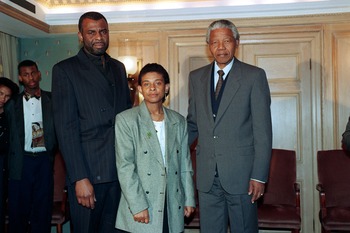
Nevertheless, as the Stephen Lawrence case progressed, the desire of the family and their defenders to be as visible as possible and for the police and government indifference to be relentlessly exposed became more and more decisive. The legal team issued a startling invitation. Nelson Mandela was in England in May 1993, in the city where his journey thirty years earlier had brought him into contact with Mary Benson and Freda Levson, when they strolled along the Thames to see the Houses of Parliament and Westminster Abbey nearby, and were photographed by the Daily Mail. Mandela was asked and agreed to visit the Lawrence household (Figure 11). Grover recalled, “[He] makes a statement: ‘Black lives are as cheap in this country as in South Africa …’ It's a working class family living in a three bedroom house in Eltham … it's an area where the B[ritish] N[ational] P[arty] had its headquarters; you've three previous murders, racist murders [there], before Lawrence.”Footnote 100 Though there was a flurry of media interest, at the time no charges were leveled. Still, the meeting was remarkable, indelible for some.
Nelson Mandela, right, meets Neville and Doreen Lawrence, parents of Stephen Lawrence who had been murdered two weeks earlier in South-East London, June 1993. Credit: Fiona Hanson–PA Images/PA Images/Getty Images.

Conclusion
These narratives lead us to our own time. As they convey the pressure upon London's political communities and infrastructures from exiled and resident individuals and groups of diasporic activists concerned with the matrix of global and domestic postwar circumstances, they inform our present perceptions. We consider anew the election of London mayor Sadiq Khan, the Brexit conundrums, and the articulations by and around the victims of the Grenfell Tower fire, with whom Suresh Grover and the Monitoring Group continue to work at this writing in 2019.Footnote 101 As scholars, we seek to unravel larger truths that lie behind these events, to understand the histories of what Joe Slovo called “racial upbringings” as they inform thought and action.Footnote 102 The peoples, nations, and communities that populate the metropolis, though construed in different ways, cannot be cut off at the head. That is, those who formed and form the elites of educated and privilege within diverse political communities that arrived in London from “outside,” and those who became leaders from among these disparate communities, who were also often educated, remained the brokers and conduits of many thousands of immigrants and residents who did not speak to the media, who did not attend meetings and rallies except intermittently, who did not perhaps speak English, who were worshippers, musicians, factory workers, nurses, bus conductors, students—as others are today. These “elites” were the agents of radical noblesse oblige, the agents of their parents’ and grandparents’ histories. As historians, we ignore the archive of celebrity and notoriety, and indeed of politicians and the civil servants who watched them, at our peril. Those whites and persons of color, British and émigré and exile advocates, who interacted with hundreds of constituents, allies, and critics among the complex migrant communities, have left a long paper trail in need of examination. The living can still converse. They bespeak the need for new metropolitan histories.Footnote 103
If we seek to address the wider geopolitical foundations of what is identified as the rise of a new global, populist Right, we also cannot ignore its manifestations in the Global South, where a generation further than ever from a UK background has been in power, or come to power—Jacob Zuma and Narendra Modi both cases in point. The “expertise” of their left and liberal predecessors was deployed in political compromise.Footnote 104 Unfulfilled popular aspirations survive the martyrs and icons now gone. In this struggle to avoid new failures in states that are in urgent crises, we trace lives partly led in the British metropole, searching for threads to the present (Figure 12). London absorbed talent even as it failed to let talent flourish; it witnessed the championing of the values of the social democracy even as it failed to deliver the hoped-for benefits and saw a wealth gap increase beyond imagination. It encouraged immigrants and visitors, only to suppress their rights over time. These dynamics deserve our scrutiny; they influence outcomes in the global zones that saw power transferred to new hands. We must look for difference and complexity of views and for ideational struggle, not conceiving of “immigrants” or “migrants” as an undifferentiated mass, not allowing scholarship to be subsumed within the language of the contemporary Right—not bowing to a kind of ontological presumption.Footnote 105
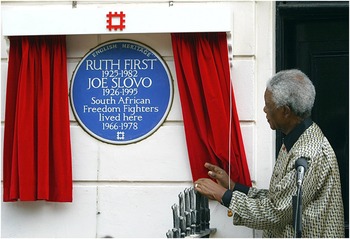
Former South African president Nelson Mandela unveils a plaque in July 2003 on the house once occupied by Ruth First and Joe Slovo, 1966–78, 13 Lyme St., Camden, North London. Credit: Odd Anderson, AFP/Getty Images.

The archive held in common that is glanced at here shows the richness of sources, both preserved and available in spoken language, that help us comprehend these dilemmas as well as the commonality of political predicaments across global terrains. We reap benefits from the study of the articulations and aspirations of those who took shelter in the metropolis, seeking to change its political complexion forever, even as they endured its inequalities, some unto death—these, the twin burdens of refuge and exile.