INTRODUCTION
Crayfish plague, caused by the oomycete Aphanomyces astaci, is arguably one of the most deadly invasive parasites of freshwater ecosystems worldwide (Lowe et al. Reference Lowe, Browne, Boudjelas and De Poorter2004; DAISIE, 2009). The pathogen is thought to have been first introduced into Europe (Italy) in 1859, and has subsequently spread throughout most of the continent (reviewed by Alderman, Reference Alderman1996; Holdich, Reference Holdich, Holdich and Sibley2003). In the second half of the 20th century the spread of A. astaci throughout Europe was facilitated by the movement of non-native North American (henceforth referred to as American) crayfish (reviewed by Alderman, Reference Alderman1996; Holdich, Reference Holdich, Holdich and Sibley2003). Whilst American crayfish are often asymptomatic carriers of the pathogen, in native European crayfish infection is usually fatal (Unestam and Weiss, Reference Unestam and Weiss1970; Diéguez-Uribeondo et al. Reference Diéguez-Uribeondo, Temiño and Múzquiz1997; Bohman et al. Reference Bohman, Nordwall and Edsman2006; Kozubíková et al. Reference Kozubíková, Petrusek, Ďuriš, Martín, Diéguez-Uribeondo and Oidtmann2008; Oidtmann, Reference Oidtmann2012). Therefore, preventing the spread of this pathogen in regions with populations of highly susceptible hosts is a conservation priority.
One of the main American crayfish species responsible for spreading A. astaci in Europe, the signal crayfish (Pacifastacus leniusculus), was first introduced into the UK from Sweden during the 1970s for aquaculture (e.g. Holdich and Reeve, Reference Holdich and Reeve1991; Alderman, Reference Alderman1996; Holdich et al. Reference Holdich, Rogers, Reynolds, Gherardi and Holdich1999, Reference Holdich, James, Jackson and Peay2014). This corresponded with mass declines in Britain's historically abundant native white-clawed crayfish (Austropotamobius pallipes) (see Holdich and Reeve, Reference Holdich and Reeve1991; Holdich and Sibley, Reference Holdich, Sibley, Brickland, Holdich and Imhoff2009; Holdich et al. Reference Holdich, Palmer, Sibley, Brickland, Holdich and Imhoff2009, Reference Holdich, James, Jackson and Peay2014; James et al. Reference James, Slater and Cable2014), to such an extent that since 2010 they have been categorized as endangered (IUCN, 2015). Whilst it was widely considered that reductions in native crayfish were, at least partially, due to the transmission of A. astaci from signal crayfish, screening and detection of this pathogen in the UK did not occur until the early 1980s (Alderman, Reference Alderman1996). One of the first suspected outbreaks of plague in the UK was recorded from the River Lee, Thames catchment, England in 1981 (Alderman, Reference Alderman1996). The pathogen has since been reported in native crayfish from several other sites in England as well as Wales and Ireland (Alderman et al. Reference Alderman, Polglase, Frayling and Hogger1984, Reference Alderman, Holdich and Reeve1990; Holdich and Reeve, Reference Holdich and Reeve1991; Alderman, Reference Alderman1996; Lilley et al. Reference Lilley, Cerenius and Söderhäll1997; Holdich, Reference Holdich, Holdich and Sibley2003). However, these reports have been based on pathogen morphology and disease symptoms in native European crayfish. Given that there are no morphological features that distinguish A. astaci from non-pathogenic Aphanomyces species (Royo et al. Reference Royo, Andersson, Bangyeekhun, Múzquiz, Söderhall and Cerenius2004; Oidtmann, Reference Oidtmann2012), molecular confirmation is essential (Oidtmann et al. Reference Oidtmann, Geiger, Steinbauer, Culas and Hoffmann2006; Vrålstad et al. Reference Vrålstad, Knutsen, Tengs and Holst-Jensen2009). The only reports in the scientific literature of A. astaci detection in the UK using molecular methods are from another introduced crayfish species, Orconectes cf. virilis (see Tilmans et al. Reference Tilmans, Mrugala, Svoboda, Engelsma, Petie, Soes, Nutbeam-Tuffs, Oidtmann, Rossink and Petrusek2014), which is restricted to a single catchment (James et al. Reference James, Thomas, Ellis, Young, England and Cable2016).
Gaining a comprehensive understanding of A. astaci distribution in the UK is essential for native crayfish conservation. It is generally considered that the only way of ensuring the sustainability of white-clawed crayfish in the UK is through the establishment of isolated ‘Ark Sites’ free from non-native crayfish and at low risk of their invasion (Peay, Reference Peay, Brickland, Holdich and Imhoff2009). Resources for implementing such conservation measures are, however, limited and so the selection of native crayfish populations for translocation needs to be a well-informed process. Native crayfish populations in close vicinity to A. astaci-infected invasive crayfish populations are at higher risk of extirpation than those neighbouring uninfected ones (Söderbäck, Reference Söderbäck1994; Westman et al. Reference Westman, Savolainen and Julkunen2002; Schulz et al. Reference Schulz, Smietána, Maiwald, Oidtmann and Schulz2006; Dunn et al. Reference Dunn, McClymont, Christmas and Dunn2009; Schrimpf et al. Reference Schrimpf, Maiwald, Vrålstad, Schulz, Śmietana and Schulz2013). Co-existence of native crayfish with invasive crayfish for several years has been observed in the absence of A. astaci (see Söderbäck, Reference Söderbäck1994; Westman et al. Reference Westman, Savolainen and Julkunen2002; Schulz et al. Reference Schulz, Smietána, Maiwald, Oidtmann and Schulz2006; Dunn et al. Reference Dunn, McClymont, Christmas and Dunn2009; Schrimpf et al. Reference Schrimpf, Maiwald, Vrålstad, Schulz, Śmietana and Schulz2013). Therefore, it is of greater urgency to translocate native crayfish populations at high risk of A. astaci transmission, than those in close proximity to uninfected invasive crayfish.
Here, we used quantitative PCR (qPCR) to assess the prevalence and intensity of infection with A. astaci in 23 populations of invasive signal crayfish in England and Wales. Using these data in combination with long-term white-clawed crayfish distribution records (James et al. Reference James, Slater and Cable2014) we identified native crayfish populations at high risk of infection with A. astaci (determined by their proximity to an A. astaci-infected signal crayfish population). Given that A. astaci genotypes differ in virulence (Makkonen et al. Reference Makkonen, Jussila, Kortet, Vainikka and Kokko2012; Becking et al. Reference Becking, Mrugała, Delaunay, Svoboda, Raimond, Viljamaa-Dirks, Petrusek, Grandjean and Braquart-Varnier2015), when possible, we also genotyped the strain of A. astaci.
METHODS
For this study, invasive signal crayfish (P. leniusculus) from the UK were screened for the presence of A. astaci using similar molecular methods in two separate laboratories: the Centre for Environment, Fisheries and Aquaculture Science, Weymouth, UK (Cefas); and Charles University, Prague, Czech Republic (CUNI). At all sites, signal crayfish were captured from rivers and ponds using baited traps. Upon collection, animals were transported to the laboratory and humanely euthanized by exposure to chloroform vapour or freezing at −80 °C, before being stored individually in falcon tubes containing 95% molecular grade ethanol. Samples collected between September 2009 and July 2010 from 17 sites were processed at Cefas (n = 8–30 animals per site), whereas those harvested during May–September 2014 were analysed at CUNI (n = 20–30 animals per site, Table 1).
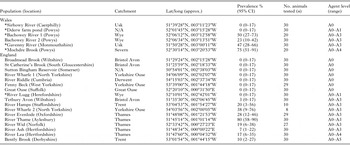
Prevalence (95% CI) and infection intensity of Aphanomyces astaci in 23 populations of invasive signal crayfish (Pacifastacus leniusculus) from the UK, where infection intensities are reported as semi-quantitative agent levels (Vrålstad et al. Reference Vrålstad, Knutsen, Tengs and Holst-Jensen2009): uninfected (A0–A1) and infected (A2–A5).

*Animals were processed in Charles University (Prague).
From each crayfish, a section of tail fan and soft abdominal cuticle were harvested for A. astaci screening. For animals processed in CUNI soft cuticle from two limb joints and any sections of melanized cuticle were also collected and pooled (Svoboda et al. Reference Svoboda, Strand, Vrålstad, Grandjean, Edsman, Kozák, Kouba, Fristad, Koca and Petrusek2014). At Cefas tissue samples from the tail fan and soft abdominal cuticle were analysed separately (mean: 60 and 78 mg of tissue per host sample for the tail fan and soft abdominal cuticle, respectively). For these samples, tissue disruption was conducted in fast prep tubes containing lysis matrix A (MP Biomedicals, Cambridge, UK) and DNA subsequently extracted using the Qiamp DNeasy Biorobot investigator kit (Qiagen, Hilden, Germany), according to the manufacturer's guidelines. At CUNI, for each animal, all collected tissue samples were amassed (40–50 mg per host sample) and ground together in liquid nitrogen. DNA was then extracted using DNeasy tissue kit (Qiagen, Hilden, Germany) in accordance with manufacturer's instructions.
All samples were tested for A. astaci presence with the TaqMan MGB qPCR as described in Vrålstad et al. (Reference Vrålstad, Knutsen, Tengs and Holst-Jensen2009) with the following slight alterations at Cefas and CUNI, respectively: an elongation of the decontamination step from 2 to 5 min (Tuffs and Oidtmann, Reference Tuffs and Oidtmann2011), an increase in the annealing temperature from 58 to 60 °C and decreased synthesis time from 60 to 30 s (Svoboda et al. Reference Svoboda, Strand, Vrålstad, Grandjean, Edsman, Kozák, Kouba, Fristad, Koca and Petrusek2014). At Cefas and CUNI qPCRs were run on a Step one Plus real-time cycler (Applied Biosystems) and an iQ5 BioRad thermal cycler, respectively. Negative controls were used in every step of the procedure; these remained negative in all cases. The amount of A. astaci DNA in each sample was estimated based on the calibration curve of a set of standards. At Cefas the quantity of pathogen DNA in these standards ranged from 1 ng to 10 fg, in a 10-fold dilution series. At CUNI four standards were included containing 3 × 410, 3 × 48, 3 × 44 and 3 × 42 PCR forming units (PFU) of pathogen DNA. At Cefas each sample was run in triplicate and an average taken when calculating pathogen DNA concentrations. At CUNI each isolate was run twice, undiluted and a 10-fold diluted replicate to test for inhibition that may affect the efficacy of pathogen detection (Vrålstad et al. Reference Vrålstad, Knutsen, Tengs and Holst-Jensen2009; Strand et al. Reference Strand, Holst-Jensen, Viljugrein, Edvardsen, Klaveness, Jussila and Vrålstad2011). Based on the strength of the PCR signal, we assigned the relative level of A. astaci infection to semi-quantitative agent levels (A0–A7; according to Vrålstad et al. Reference Vrålstad, Knutsen, Tengs and Holst-Jensen2009; Kozubíková et al. Reference Kozubíková, Vrålstad, Filipová and Petrusek2011). Samples designated as A2 or higher were considered positive for A. astaci presence. These data were used to determine the prevalence of A. astaci in the studied populations, and its 95% confidence intervals. Confidence intervals were calculated using the function ‘epi.conf’ included in the library ‘epiR’ (Stevenson et al. Reference Stevenson, Nunes, Sanchez, Thornton, Reiczigel, Robison-Cox, Sebastiani, Solymos, Yoshida, Jones, Pirikahu, Firestone and Kyle2013) for the statistical package R version 3·2 (R Core Team, 2013).
Pathogen genotyping was only conducted for A. astaci-infected crayfish that were tested at CUNI (samples had been processed at Cefas before microsatellite genotyping became available for A. astaci). As most of these crayfish harboured relatively low infection intensities (A2–A3), pathogen genotyping was only possible for crayfish from one population, the Mochdre Brook (Wales). From this population, pathogen DNA from one crayfish (harbouring an A3 agent level infection) was analysed using nine A. astaci-specific microsatellite markers (Grandjean et al. Reference Grandjean, Vrålstad, Diéguez-Uribeondo, Jelić, Mangombi, Delaunay, Filipová, Rezinciuc, Kozubíková-Balcarová, Guyonnet, Viljamaa-Dirks and Petrusek2014). Genotyping was attempted for another crayfish from this population but, presumably due to the relatively small amount of pathogen DNA present, this was un-successful. Prior to genotyping the sample was concentrated using a Concentrator Plus 5305 (Eppendorf) to increase pathogen DNA concentration. The results were compared with the A. astaci reference strains described in Grandjean et al. (Reference Grandjean, Vrålstad, Diéguez-Uribeondo, Jelić, Mangombi, Delaunay, Filipová, Rezinciuc, Kozubíková-Balcarová, Guyonnet, Viljamaa-Dirks and Petrusek2014).
We assessed native white-clawed crayfish populations at potential risk from the 13 signal crayfish populations where we detected A. astaci using recent (2009 onwards) native crayfish distribution records (Craybase database, James et al. Reference James, Slater and Cable2014). In this regard, we are aware that it is not possible to declare those signal crayfish populations where the pathogen was not detected as uninfected. As such it should be noted that in the context of native crayfish risk assessment the purpose of this study is only to show where A. astaci definitely is present (or has been recently) and highlight surrounding native crayfish populations potentially at risk of disease. For these purposes, sites where A. astaci was detected were mapped and any native crayfish populations, not already exposed to signal crayfish, within a 7·5, 10, 12 or 15 km aerial radius were recorded. Locations harbouring native crayfish were searched for within the signal crayfish records contained in Craybase (7166 in total, James et al. Reference James, Slater and Cable2014), and only those not already invaded were considered for risk assessment purposes. Buffer zones (i.e. 7·5, 10, 12 and 15 km) were selected on the basis that the average rate of signal crayfish population expansion along a river in the UK has been estimated as 1·5 km year−1 (Bubb et al. Reference Bubb, Thom and Lucas2004; although it should be acknowledged that the rate of signal crayfish dispersal is faster in other European countries, e.g. Hudina et al. Reference Hudina, Faller, Lucic, Klobucar and Maguire2009; Weinländer and Füreder, Reference Weinländer and Füreder2009). Therefore, we presume that populations within 7·5 km of each other are predicted to come into contact within 5 years, providing that they inhabit connected waterbodies. These analyses were performed using ArcGIS version 10·3 mapping software.
RESULTS
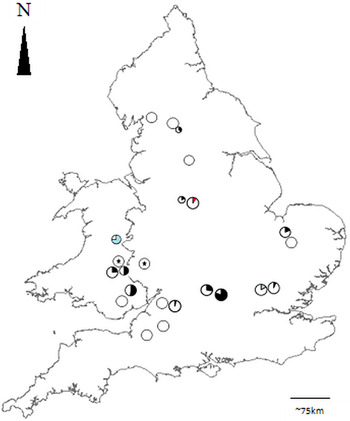
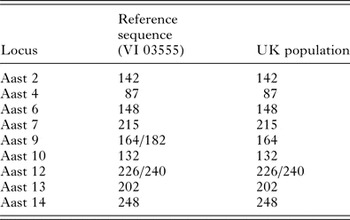
Aphanomyces astaci was detected in 56·5% (13 out of 23) signal crayfish populations from Wales and England (Table 1, Fig. 1). Among the infected populations, prevalence ranged from 3 to 80% at generally low infection intensities (agent levels A2–A3) with the exception of Mochdre Brook in Wales, and Bently Brook and River Lee in England (Table 1, Fig. 1). At two sites, trace amounts of pathogen DNA (below the limit of detection for the methods used i.e. agent levels A1) were detected in tested isolates from single crayfish specimens (Table 1, Fig. 1). The agent level A1 should not be considered as a reliable detection of A. astaci (Vrålstad et al. Reference Vrålstad, Knutsen, Tengs and Holst-Jensen2009) but such observations should raise concern about its potential presence in these populations. A multilocus microsatellite genotype of A. astaci was only obtained from the Mochdre Brook signal crayfish population. This was identical to the reference axenic culture of the genotype group B strain at eight loci, but was homozygous rather than heterozygous at the Aast9 locus (Table 2).
Location of the invasive signal crayfish populations tested for Aphanomyces astaci in the current study using qPCR. For each population, the percentage of crayfish tested that were infected with A. astaci (i.e. the pathogen prevalence) is shown using a pie chart, with the shaded portion of each chart representing infected individuals, and the diameter of the circle the sample size (n = 8–30). Black shading indicates that the highest infection intensity (reported as semi-quantitative agent levels, see Vrålstad et al. Reference Vrålstad, Knutsen, Tengs and Holst-Jensen2009) detected was A3, blue A4 and red A5. White circles show populations where the pathogen was not detected at any level (A0). Circles containing black stars represent those populations where trace levels of the pathogen (A1) were amplified. As an infection intensity of A1 is considered below the limit of detection for the method used (Vrålstad et al. Reference Vrålstad, Knutsen, Tengs and Holst-Jensen2009), these populations are classed as uninfected; although the possibility of them harbouring A. astaci at a low prevalence remains.

Comparison of allele sizes of nine microsatellite loci from the reference strains of the Aphanomyces astaci genotype group B (Grandjean et al. Reference Grandjean, Vrålstad, Diéguez-Uribeondo, Jelić, Mangombi, Delaunay, Filipová, Rezinciuc, Kozubíková-Balcarová, Guyonnet, Viljamaa-Dirks and Petrusek2014) and an A. astaci-positive signal crayfish (Pacifastacus leniusculus) from a UK population (Mochdre Brook).

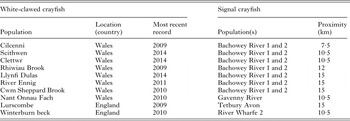
As we were only able to test a fraction of the signal crayfish populations in the UK (see James et al. Reference James, Slater and Cable2014 for detailed distribution information) for A. astaci, comprehensively assessing the risk this pathogen poses to native crayfish in the UK was beyond the scope of the current study. Nevertheless, we located ten native crayfish populations (confirmed extant at some time point between 2009 and 2014) within 15 km of an A. astaci-infected signal crayfish population (Table 3). Of these, the population in River Cilcenni, South Wales, was closest (within 7·5 km) to infected signal crayfish (Table 3). These infected crayfish from the Bachowey River were also within 15 km of an additional six extant native crayfish populations (Table 3). Due to the low spatial resolution of the river network data available it was, however, often not possible to determine if the waterbodies harbouring these native and invasive crayfish populations were connected.
Location and year of the most recent record of native white-clawed crayfish (Austropotamobius pallipes) populations (data from CrayBase: James et al. Reference James, Slater and Cable2014) in close vicinity to an Aphanomyces astaci-infected invasive signal crayfish (Pacifastacus leniusculus) population.

DISCUSSION
Using molecular diagnostics, we provide the first comprehensive study of A. astaci prevalence in invasive signal crayfish populations from England and Wales. Whilst this affirms the perceived role of A. astaci causing native crayfish declines (Holdich, Reference Holdich, Holdich and Sibley2003), not all signal crayfish populations tested appeared to be infected. In fact, A. astaci was only detected in just over half (57%) of the tested UK signal crayfish populations, and within these populations the prevalence varied between 3 and 80%. While we cannot definitively declare those populations where we did not detect A. astaci as uninfected, our data show that, among signal crayfish populations, pathogen prevalence varies widely. Our findings contradict the traditional assumption that all American crayfish are carriers of A. astaci (see Cerenius et al. Reference Cerenius, Bangyeekhun, Keyser, Söderhäll and Söderhäll2003), but are in agreement with other DNA-based studies focusing on distribution and prevalence of this pathogen. Recently, populations of American crayfish, in which A. astaci had not been detected, were reported in other European countries (Kozubíková et al. Reference Kozubíková, Filipová, Kozák, Ďuriš, Diéguez-Uribeondo, Oidtmann and Petrusek2009; Skov et al. Reference Skov, Aarestup, Sivebaek, Pedersen, Vrålstad and Berg2011; Filipová et al. Reference Filipová, Petrusek, Matasová, Delaunay and Grandjean2013; Schrimpf et al. Reference Schrimpf, Maiwald, Vrålstad, Schulz, Śmietana and Schulz2013; Tilmans et al. Reference Tilmans, Mrugala, Svoboda, Engelsma, Petie, Soes, Nutbeam-Tuffs, Oidtmann, Rossink and Petrusek2014). The situation in the UK seems to almost mirror that reported from France, with 53% (24 out of 45) of signal crayfish populations being infected with A. astaci and the pathogen prevalence ranging from 8 to 80% (Filipová et al. Reference Filipová, Petrusek, Matasová, Delaunay and Grandjean2013).
In the current study, microsatellite genotyping revealed the presence of an A. astaci-positive DNA isolate congruent with the reference genotype group B strain (Grandjean et al. Reference Grandjean, Vrålstad, Diéguez-Uribeondo, Jelić, Mangombi, Delaunay, Filipová, Rezinciuc, Kozubíková-Balcarová, Guyonnet, Viljamaa-Dirks and Petrusek2014) at eight of the nine loci tested. Such intra-genotype group variation has been reported previously (Grandjean et al. Reference Grandjean, Vrålstad, Diéguez-Uribeondo, Jelić, Mangombi, Delaunay, Filipová, Rezinciuc, Kozubíková-Balcarová, Guyonnet, Viljamaa-Dirks and Petrusek2014; Mrugała et al. Reference Mrugała, Kawai, Kozubíková-Balcarová and Petrusek2016), therefore, it is likely that the DNA isolate from the UK belongs to genotype group B. This is perhaps unsurprising given that, within Europe, group B strains of A. astaci were first isolated from invasive signal crayfish in Sweden (Huang et al. Reference Huang, Cerenius and Söderhall1994), which is considered as the country of origin for most signal crayfish introduced into the UK during the 1970s and 1980s (Holdich et al. Reference Holdich, Rogers, Reynolds, Gherardi and Holdich1999). Isolation of this highly virulent strain of A. astaci (see Makkonen et al. Reference Makkonen, Jussila, Kortet, Vainikka and Kokko2012) may explain the mass mortalities of native white-clawed crayfish in the UK following the introduction of signal crayfish (e.g. James et al. Reference James, Slater and Cable2014). Although chronic A. astaci infections have been observed in other white-clawed crayfish and other native European crayfish (e.g. Jussila et al. Reference Jussila, Makkonen, Vainikka, Kortet and Kokko2011; Pârvulescu et al. Reference Pârvulescu, Schrimpf, Kozubíková, Cabanillas Resino, Vrålstad, Petrusek and Schulz2012; Kokko et al. Reference Kokko, Koistinen, Harlioğlu, Makkonen, Aydin and Jussila2012; Schrimpf et al. Reference Schrimpf, Pârvulescu, Copilaş Ciocianu, Petrusek and Schulz2012; Kušar et al. Reference Kušar, Vrezec, Ocepek and Jenčič2013; Maguire et al. Reference Maguire, Jelić, Klobučar, Delpy, Delaunay and Grandjean2016), these may be caused by the less virulent strains from the ‘old’ genotype group, A (Makkonen et al. Reference Makkonen, Jussila, Kortet, Vainikka and Kokko2012). The ability to identify A. astaci strains and their virulence would help inform risk assessment for native crayfish populations in the future, although better characterization of all A. astaci genotypes is required before this can be exploited fully.
Given that the long-term conservation of native crayfish in the UK is generally considered to be dependent upon the translocation of animals into ‘Ark Sites’ (Peay, Reference Peay, Brickland, Holdich and Imhoff2009), and that resources for implementing such measures are limited; targeting removal of native crayfish populations at the greatest risk of extirpation is critical. Native European crayfish can co-exist with American crayfish for extended periods of up to 30 years in the absence of A. astaci (see Westman et al. Reference Westman, Savolainen and Julkunen2002; Schulz et al. Reference Schulz, Smietána, Maiwald, Oidtmann and Schulz2006; Dunn et al. Reference Dunn, McClymont, Christmas and Dunn2009; Skov et al. Reference Skov, Aarestup, Sivebaek, Pedersen, Vrålstad and Berg2011; Schrimpf et al. Reference Schrimpf, Maiwald, Vrålstad, Schulz, Śmietana and Schulz2013), but are often rapidly extirpated if this pathogen is present (e.g. Holdich and Reeve, Reference Holdich and Reeve1991; Vennerström et al. Reference Vennerström, Söderhäll and Cerenius1998; Bohman et al. Reference Bohman, Nordwall and Edsman2006; Kozubíková et al. Reference Kozubíková, Petrusek, Ďuriš, Martín, Diéguez-Uribeondo and Oidtmann2008). Therefore, native white-clawed crayfish populations in close vicinity to A. astaci-infected signal crayfish are predicted to be at greater risk of local extinction than those neighbouring uninfected signal crayfish. Considering that only a portion of the signal crayfish populations existing in the UK were screened in the current study, and of these only around half were infected with A. astaci, increased testing for this pathogen is needed to comprehensively assess native crayfish populations at greatest risk of disease transmission. Nevertheless, for the 13 signal crayfish populations where we detected A. astaci we identified one white-clawed crayfish population recorded since 2009, located within 7·5 km. This native crayfish population inhabits the Cilcenni within the Wye catchment, South Wales, and was most recently detected in 2009. Given its proximity to infected signal crayfish, we recommend that translocating a subset of individuals from this population into an ‘Ark Site’ is considered as a priority, although we acknowledge that increased screening of signal crayfish for A. astaci may reveal other native crayfish populations at greater risk of extirpation. Determining the exact order of translocation priority for the ten native crayfish populations within 15 km of an A. astaci-infected signal crayfish population is beyond the scope of the current study. For extant populations, factors that should be considered when assessing translocation priority include: proximity to infected crayfish, connectivity of water bodies housing native and infected invasive crayfish (particularly considering the ability of the pathogen not only to be transmitted via spores in the water, but potentially also with fish; Oidtmann et al. Reference Oidtmann, Heitz, Rogers and Hoffman2002; Svoboda et al. Reference Svoboda, Mrugała, Kozubíková-Balcarová and Petrusek2017), prevalence of A. astaci in the nearest infected crayfish population, density of crayfish present in the native crayfish and neighbouring infected signal crayfish population, and whether any barriers in the environment exist that may prevent animals from either population dispersing. Additionally, as native crayfish populations can be rapidly extirpated by crayfish plague, surveying to confirm the persistence of populations under consideration for translocation should always be a pre-requisite.
Within the UK, this is currently the only comprehensive study that uses molecular methods to confirm the presence, and determine the prevalence of, A. astaci in invasive signal crayfish populations. The current study also provides the first record of A. astaci genotype group B (known to contain virulent strains) from signal crayfish in the UK. The presence and prevalence of A. astaci, however, varied between populations. Although we cannot definitively declare those signal crayfish populations where we did not detect A. astaci as uninfected, our findings show that pathogen prevalence can vary from very low to very high. Therefore, from a conservation perspective, the risk posed to native crayfish from different invasive crayfish populations may be asymmetric. As such, considering A. astaci prevalence data will improve risk assessments for native crayfish populations. Based on our findings we recommend increased A. astaci screening, using appropriate pathogen-specific molecular methods, of non-native crayfish populations in the UK, to fully assess the risks to native crayfish and target populations for translocation. As part of this, those populations where we detected trace levels (i.e. below the limit of detection) of A. astaci should be re-tested to ascertain whether they are harbouring a low prevalence infection.
ACKNOWLEDGEMENTS
We thank S Morgan, G Richardson, R Mitchell, J Vukić, R Šanda, J Svoboda and N Iliescu for laboratory and field assistance, and J Vokurková for technical support. A Ellis, C Farmer, M Frayling, N Handy, I Hirst, K Edwards, T King, A Pierre, D Rogers and J Stansfield provided the animals tested by Cefas. Thanks also to the anonymous reviewers who commented on a previous version of this manuscript.
FINANCIAL SUPPORT
This study was funded by the Worshipful Livery Company of Wales, Charles University in Prague and Cardiff University. The work undertaken at Cefas was supported by Defra projects FB001, FB002 and F1172.