Introduction
Recent studies of migration have been captive to powerful disciplinary narratives. On the one hand, too many anthropologists wed the analysis of migration to narratives of modernity or progress (not, it should be noted, processes of modernization) [Gardner and Osella 2003]. On the other hand, too many developers and environmentalists tie migration to narratives of decline, loss, de-peasantisation and the creation of ‘ecological refugees’ [Gadgil and Guha 1995] or a new itinerant proletarian underclass bivouacking under plastic sheets on the urban fringe [Breman Reference Breman1996] (Mosse et al., Reference Mosse, Gupta and Shah2005).
The theoretical perspective on the phenomenon of migration began by understanding it as a positive outcome of the economic process of development (Todaro, Reference Todaro1976; Vijay, Reference Vijay2005). Over time, migration came to be associated with deprivation and vulnerability (see Breman, Reference Breman1996; Mukherji, Reference Mukherji2001). The perception of migrants now differs strikingly from their image as rational economic agents, able to judge differences in rewards between home and destination; they are now seen as victims of various kinds of deprivation generated by the capitalistic transformations (De Haan, Reference De Haan2000). Irrespective of their presumptions, studies on migrants' status have typically been based on income poverty and employment indicators as salient parameters of assessment. While the physiological and biological consequences of migration to urban areas have been studied considerably, the relationship between migration and mortality (or other health outcomes) has been little researched (Stephenson et al., Reference Stephenson, Matthews and McDonald2003). This leaves us with a gap since migration is now increasingly associated with deprivation while development is being redefined as long-term capabilities governed by freedom from morbidity and malnutrition, among others (see Mukherji, Reference Mukherji2001, Reference Mukherji2006; Sen Reference Sen1981, Reference Sen, Griffin and Knight1990). Even if they are on a par with urban non-migrants in terms of income indicators, migrants may remain excluded from important support systems due to several inward and outward barriers (Srivastava & Sasikumar, Reference Srivastava and Sasikumar2003; Stephenson et al., Reference Stephenson, Matthews and McDonald2003; Desai, Reference Desai and Sandu2003). This would be especially true for migrants from lower economic strata and during the early phases of in-migration. Besides, their background status is also likely to have some influence on their position in the new environment. Moreover, there are several ways in which migrants could suffer in terms of indicators of well-being beyond income. This paper attempts to make a comparative study of the incidence of malnutrition between migrants and non-migrants on the one hand and between rural migrants and urban migrants on the other. The empirical study is based on the Mumbai metropolitan city – known to absorb the largest number of migrants in India every year (Census of India, 2001). The objective is to identify the role of migration and migration pattern behind child and maternal undernutrition in Mumbai through a statistical analysis based on a simple theoretical framework. The paper is organized into four sections. Section one is a review of the literature and develops a conceptual framework on this issue. Section two elaborates on the data and methodological procedures. The results of the exploratory and regression analyses are discussed in sections three and four respectively. Finally the paper ends with concluding remarks in section four.
Evidence on migrants and deprivation in cities: developing the framework
Evidence on migrants and deprivation creates contrasting pictures, though some of the variation can be attributed to studies' contextual factors. Several studies have portrayed migrants as vulnerable and deprived when compared with the native population, while others refute such relative disadvantage that migrants might face by their very status (see Yap, Reference Yap1977; Goldscheider, Reference Goldscheider and Goldscheider1983; Mukherji, Reference Mukherji2000, Reference Mukherji2001, Reference Mukherji2006; Mendola, Reference Mendola2006; Kundu & Sarangi, Reference Kundu and Sarangi2007).
One image of migrants (to urban areas) portrays them as masses of poor, landless, illiterate and unskilled agricultural labourers and small farmers and other operatives from backward states, who tend to make quantum jumps towards big metropolises such as Calcutta, Mumbai and Delhi, bypassing small local towns, small cities and district headquarters, which fail to give them even a minimum level of employment (Mukherji, Reference Mukherji2000). According to this image it is the poor who participate in migration and, due to lack of livelihood opportunities, they fall pray to the extreme exploitative conditions of the urban informal sector (Breman, Reference Breman1996; Desai, Reference Desai and Sandu2003). Unlike in Western countries, where rural-to-urban migration is associated with a vertical shift in the labour force, labour migration in low-income countries such as India occurs from the rural peasant sector to the urban informal sectors, as spatial manifestation of underdevelopment and poverty, which compounds further poverty and human misery (see Mukherji, Reference Mukherji2000, Reference Mukherji2006; Srivastava & Sasikumar, Reference Srivastava and Sasikumar2003).
The other side of the argument disagrees that migrants are the vulnerable among the urban population. It is argued that the poorest people in rural areas often lack the resources to migrate, and those who do migrate are members of better-off households, in terms of land ownership, assets, productivity and social networks (see Goldscheider, Reference Goldscheider and Goldscheider1983; De Haan, Reference De Haan2000; Mendola, Reference Mendola2006). When ‘pull factors’ dominate, the destitute may literally be too poor to move, but when ‘push factors’ such as war or famine are at work, the destitute may be forced to migrate (Bienen, 1984). In addition, average income and unemployment rates for migrants and urban natives of comparable age, education and sex have been found to be very similar (Yap, Reference Yap1977; Kundu & Sarangi, Reference Kundu and Sarangi2007). Thus, migrants in urban areas are not necessarily among the poorest – even though images of rickshaw pullers, rag pickers and prostitutes suggest differently (De Haan, Reference De Haan2000).
Deprivation in terms of health and nutrition well-being among migrants has received relatively little attention. There are many studies on this issue in developed countries such as the United States of America, the Netherlands and Australia (Brussaard et al., Reference Brussard, Van Erp-Baart, Brants, Hulshof and Lowik2001; Cason & Anastasia, Reference Cason and Anastasia2004; Misra & Ganda, Reference Misra and Ganda2007), where the issue obviously has an entirely different character. Whereas in developed countries migrants witness a nutrition transition due to the particular ‘Western’ lifestyle, in developing countries like India the nutrition issue is more of chronic deprivation. It is this chronic deprivation owing to migration status in urban centres of developing countries that needs thorough examination. There are few influential studies on the relationship between rural–urban migration and mortality trends in the context of less developed countries (Brockerhoff, Reference Brockerhoff1990; Reference Brockerhoff1995, Brockerhood & Eu, Reference Brockerhoff and Eu1993, Bender et al., Reference Bender, Rivera and Madonna1993; Tam, Reference Tam1994, Stephenson et al., Reference Stephenson, Matthews and McDonald2003). Brokerhoff Reference Brockerhoff(1995), in his analysis of Demographic and Health Survey data from seventeen countries, found that the survival prospects of rural–urban migrants are higher than those in their rural place of origin, and that the survival prospects of rural–urban migrants remained below those of urban non-migrants. The implication thus is that migrants gain through migrating to urban areas but remain vulnerable as compared with urban non-migrants. Stephenson et al. Reference Stephenson, Matthews and McDonald(2003) analysed infant mortality rate among children of migrant mothers in India. Though migration status does not come out as a direct determinant of child mortality, the relationship between migration and mortality is well explained by differences in socioeconomic status between rural–urban migrants and urban non-migrant groups. There is a conspicuous difference between socioeconomic parameters of rural–urban migrants and urban non-migrants, which leads to differential outcomes for infant mortality among the children of respective categories. Tam Reference Tam(1994) and Bender et al. Reference Bender, Rivera and Madonna(1993) compared rural migrants with rural and urban non-migrants in terms of health-seeking behaviours and analysed the difference between the availability of health services for migrants and non-migrants. Bender et al. Reference Bender, Rivera and Madonna(1993) also identified a relatively higher level of risk of morbidity among migrant children owing to their rural origin. Thus rural migrants fare better as compared with people of rural origin, but remain worse compared with the native population in the destination areas.
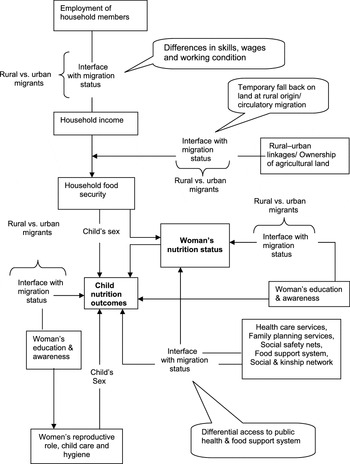
Broadly, two observations can be made from available studies in this area: first, the evidence presents a conflicting picture regarding the relative status of migrants in terms of income and employment indicators, i.e. migrants are not a homogenous category (De Haan, Reference De Haan2000), and second, although there has been little research on the health outcomes of migrants, the available findings support a significant role of migration status. It is relative deprivation owing to different socioeconomic endowments, including availability of public services, that is likely to make migrants vulnerable as compared with the urban non-migrant population in cities. However, the issue of ‘malnutrition outcomes’ per se remains unaddressed from the perspective of migrants. This paper specifically explores the relationship between migration pattern and malnutrition outcomes. On the basis of the review of literature, a conceptual framework on maternal and child nutrition outcomes has been developed and the subsequent econometric analysis is based upon this framework (see Fig. 1).
Framework on nutrition outcome in urban areas.

An attempt has been made to incorporate the various ways through which migration status mediates maternal and child nutrition outcomes. There are several visible and invisible ways in which migrants could be disadvantaged relatively. Migrant workers have been known to have faced discrimination in wages, work quality and working conditions because of their migration status (Srivastava & Shashikumar, Reference Srivastava and Sasikumar2003; Vijay, Reference Vijay2005). One of the most important ways in which migrants are disadvantaged is differential access to government-supported food security and health programmes for administrative reasons, such as delays in issuing beneficiary cards etc. (see Srivastava & Shashikumar, Reference Srivastava and Sasikumar2003). In addition, depending on their background, migrants may or may not possess the skills and education required in urban areas, putting them in a disadvantaged position. This happens especially with rural migrants in big cities who end up in a huge informal sector offering low wages. Their living conditions are poor, and education and awareness of child care practices, health behaviour and hygiene are equally low (Brockerhoff, Reference Brockerhoff1990; Brockerhoff & Eu, Reference Brockerhoff and Eu1993). Bias against women and girl children is also likely to be more conspicuous among people of rural origin, further affecting the nutrition outcome of females.
These disadvantages are especially prevalent during the early period of in-migration to a host city. In the words of Goldsheider Reference Goldscheider and Goldscheider(1983), the differential health (and other well-being) outcomes between rural–urban migrants and urban non-migrants are suggested to be the product of migrants' difficulties in assimilating into the new urban environment. Poorer migrants, especially from rural areas, take time to assimilate into the urban environment, due to unfamiliarity and lack of access to basic public support and kinship network system (Stephenson et al., Reference Stephenson, Matthews and McDonald2003). Due to this and many other channels as identified in Fig. 1, migrants' status may be lower as compared with that of non-migrants in the city.
Area of study, data and methods
India's migrant population is concentrated in a few popular destinations (see Sivaramakrishnan et al., Reference Sivaramakrishnan, Kundu and Singh2005). Mumbai city is one of the most attractive, and absorbs the largest number of migrants in the country, with the majority (66%) of all-duration migrants having arrived from rural areas during last decade, as against just 33% from urban areas (Census of India, 2001). Even though the overall evidence on migrants' status in urban areas is quite fragmented, the views on the kind of urbanization Mumbai is witnessing and the situation of migrants in the city are more or less cohesive (see Mukherji, Reference Mukherji2001, Reference Mukherji2006; Desai, Reference Desai and Sandu2003). This makes Mumbai appropriate for the study of the status of migrants. In this study, the relative vulnerability of the migrant population in the metropolitan setting of Mumbai is examined in terms of malnutrition outcomes.
The data were obtained from the second round (1998–99) of the National Family Health Survey (NFHS), conducted every five years by a team of agencies under the aegis of the Ministry of Health and Family Welfare (MOHFW), Government of India (Ministry of Health and Family Welfare, 1998–99a, b). The NFHS data primarily focus on reproductive health, family planning, infant and child nutrition, maternal and child health and the utilization of health services provided to mothers and children. The sample for Mumbai city is comprised of 481 cases of children below three years of age corresponding to married women/mothers in the age group of 15–45 years, their partners and respective households. To measure child malnutrition, three well known indicators are considered in this analysis, viz. stunting, underweight and wasting. However, for multivariate analysis ‘stunting’ is considered as the dependent variable since it is known to be the best measure of long-term deprivation and cumulative deficient growth (see UNICEF, 1994). Defined in terms of height and age ratio, stunting indicates the long-term cumulative consequence of an inadequate diet, poor nutrition and feeding practices as well as frequent infection and illness owing to an unhealthy environment. It is also an appropriate measure of vulnerability caused through food and nutrition insecurity since it is associated with functional impairment that persists later in life (Milan et al., Reference Milan, Ali and Underwood2002; Nojomi et al., Reference Nojomi, Tehrani and Abadi2004; Mamabolo et al., Reference Mamabolo, Alberts, Steyn, De Waal and Levitt2005). Underweight, i.e. inadequate weight for a given age, is helpful in understanding shifts in nutrition status over time, while wasting is a measure of weight inadequacy for a given height of a child (see Gray et al., Reference Gray, Cossman and Powers2006). For women, nutrition status is measured in terms of Body Mass Index (BMI), whereby a BMI lower than 18 kg/m2 is an indication of undernutrition among women as per the norms of the World Health Organization (see Summary Report, NFHS II).
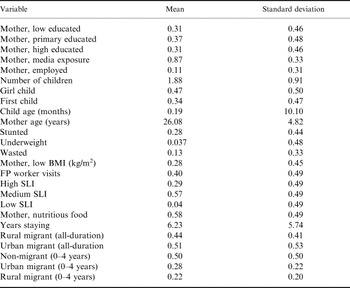
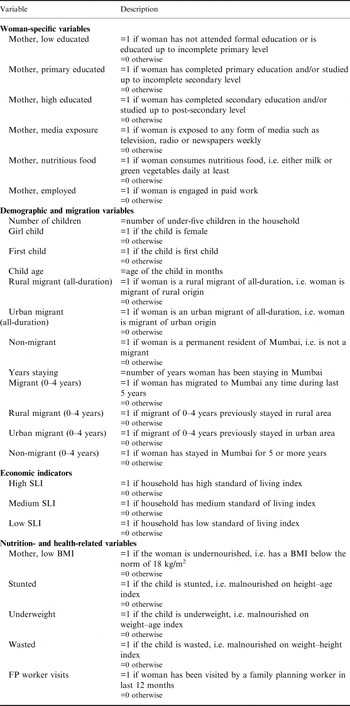
A list of variables included in the analysis is given in Table A1 in the Appendix. These include a wide range of variables on household economic status, mothers'/women's education level, migration status and socio-demographic indicators.
Defining migration
The NFHS does not provide data on the migration characteristics of households but it is the only nationwide dataset with extensive coverage of child and reproductive health. Therefore, following earlier works in related areas (Bender et al., Reference Bender, Rivera and Madonna1993; Brockerhoff, Reference Brockerhoff1995; Stephenson et al., Reference Stephenson, Matthews and McDonald2003), migration-related information was extracted on the basis of two variables in the NFHS data, viz. the number of years the respondent (woman/mother in this case) has been staying in Mumbai and the place of previous residence of the respondent. For the present analysis, migrants are defined in two ways:
(1) All-duration migrants, i.e. women who have been staying in Mumbai for any number of years but are not from Mumbai originally. In terms of all-duration, around 95% of the sample women come into the category of migrants and only 5% are non-migrants. Hence instead of categorizing migrants as ‘migrants’ and ‘non-migrants’, only origin-based categorization of migrants as ‘rural’ and ‘urban’ migrants was made. ‘Years of stay in Mumbai’ was used as another variable to understand the role of adaptation of in-migrants in Mumbai.
(2) Migrants of 0–4 years' duration, i.e. those who came to Mumbai at any point of time during the last five years. It is expected that migrants would be more vulnerable during the early period of migration and with time they would gradually assimilate into the new environment and the relative disadvantage might narrow down. In terms of origin, migrant women were classified into rural and urban migrants depending upon their previous place of stay.
Modelling the relationships
Food and nutrition security, especially in a rural context, have been studied extensively and most studies are based on Becker's (1981) model on household's utility maximization including variables on labour, unearned income as well as health behaviour and nutrition production (see Behrman et al., Reference Behrman, Pollak and Taubman1986, Reference Behrman, Deolalikar and Wolfe1998 and Behrman, Reference Behrman1988). The estimation methods used are multivariate regression techniques, of logit or probit (see Behrman et al., Reference Behrman, Deolalikar and Wolfe1998; Glewwe et al., Reference Glewwe, Koch and Nguyen2002; Smith et al., 2003; Behrman & Skoufias, Reference Behrman and Skoufias2004; Alderman et al., Reference Alderman, Behrman and Hoodinott2004; Chandrasekara et al., Reference Chandrasekara, Silva and Wijesinghe2005; Block, Reference Block2007). These studies differ from each other in terms of selection of variables, which has important implications since there is a strong inter-dependence among socioeconomic variables. Mother's nutrition status has been found to be a salient determinant of the nutrition level of infants (Milan et al., Reference Milan, Ali and Underwood2002; Buckley, Reference Buckley2003; Mamabolo et al., 2004). However, due to its probable endogenous character, it has been suggested that it be omitted from the model in order to avoid distorted results (Smith et al., 2000).
Given the crucial reproductive link between mother and child, this paper makes an attempt to incorporate the endogenous character of mother's nutrition in the model rather than omit the variable. For this, the recursive bivariate probit model, which is a specific case of the bivariate probit model, was adopted. This is a special case since the endogenous variable appears on the right-hand side of the second equation while the other endogenous variable (y) does not appear on the right-hand side of any equation (Greene, Reference Greene1997). The success of this model, however, requires an efficient instrument that must fulfil three criterion, viz. it should be a significant predictor of the variable to be instrumented, there should be more than a trivial relationship between the instrument and the instrumented variables and it should not be correlated with the outcome variable (Greene, Reference Greene1997). This model can be represented as:


where Y a=1 if the child is stunted and 0 otherwise; Y b=1 if the mother has a BMI below the prescribed norm and 0 otherwise; Z is a vector of factors that could determine the nutrition level of the mother; X is a vector of factors that could determine the nutrition level of the child; α and β are constant terms in equations (1) and (2) respectively; μ and γ are coefficients of explanatory variables in equation (1); ϕ is the coefficient of explanatory variables in equation (2); and ε a and ε b are error terms in equations (1) and (2), respectively.
The error terms ε a and ε b follow standard normal bivariate distribution and are expected to be correlated with parameter ρ. In case the endogeneity test given by Wald's (Rho) ρ fails (i.e. is insignificant), two separate models can be estimated based on simple univariate binomial probit methods, using maximum likelihood as the estimation criterion (see Greene, Reference Greene1997). This univariate probit model for women and children is expressed respectively as:


where, Y a=1 if the child is stunted and 0 otherwise; Y b=1 if the mother has a BMI below the prescribed norm and 0 otherwise; X is the vector of variables that could determine the nutrition level of the child; Z is the vector of variables that could determine the nutrition level of the mother; α and β are constant terms in equations (3) and (4) respectively; γ is the coefficient of explanatory variables in equation (3);ϕ is the coefficient of explanatory variables in equation (4); and ε a and ε b are error terms in equations (3) and (4) respectively.
Pattern of migration and malnutrition in Mumbai
Table 1 gives the summary of the variables included in the empirical analysis. Of the 481 households included in the present analysis, around 29% and 57% belong to the categories of high standard of living (HSLI) and medium standard of living index (MSLI) respectively, while only 4% belong to the low standard of living category (LSLI). The standard of living index (SLI) is a summary measure that the NFHS report calculates on the basis of different scores assigned to certain variables on availability of basis amenities and assets by households. These variables include type of housing, toilet facility, source of lighting, cooking fuel, cooking place, ownership of agricultural land, ownership of irrigated land, ownership of house, ownership of livestock and ownership of durable goods.
Descriptive statistics of the variables

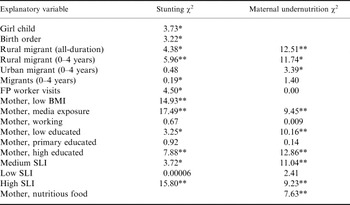
Results of χ2 test of independence between dependent variables and various explanatory variables

* 5% and
** 1% levels of significance.
With reference to mothers'/women's background characteristics, around 87% of them have regular exposure to media, i.e. either television, radio or newspapers. Only around 11% of women/mothers are employed currently in any paid work, which is very low. This may be due to the very low age of their children, which is on average 18–19 months. Around 40% of the women have been visited by a family planning worker, who is a government worker trained to disseminate information on family planning, reproductive health and child care. The proportion of female children among the total population of children below three years of age is 47%. The percentages of underweight, stunting and wasting among children below three years of age in Mumbai are around 37%, 28% and 12% respectively. It is noticeable that the incidence of underweight children in Mumbai is considerably higher than that in urban India, which is around 32% (NFHS II). The percentage of women with low BMI is around 28%.
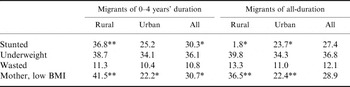
Table 3 gives the migration pattern of the women in the sample on the basis of place of origin and duration of stay in Mumbai. Of the 481 women, around 95% are migrants of all-duration. Around 44% of the migrant women of all-duration are of rural origin, i.e. their previous place of stay was a rural area, while approximately 51% are urban migrants, i.e. their previous place of stay was an urban area. From the NFHS-II data, women migrants comprise a large proportion of Mumbai's population. Even on the basis of 0–4 years' duration of stay, 50% of women have in-migrated from other places (Table 3). The proportion of urban migrants in the total population is higher than that of rural migrants both in terms of all-duration as well as 0–4 years' duration. The high proportion of migrant women could also be due to the marriage-related migration of women. The NFHS II includes all women migrants, irrespective of their motive for migration.
Pattern of migrants by duration and origin (percentages)

Table 4 gives the results of χ2 tests of independence (performed on frequency data) between migration status and various malnutrition indicators and also the percentage of malnourished population in each of the migration categories. The results of the χ2 tests show that stunting and women's undernutrition are significantly associated with migration status, and the incidence of these two indicators is much higher among rural migrants as compared with urban migrants. The incidence of maternal undernutrition and child stunting among migrants of 0–4 years is around 30% and 31% respectively while among migrants of all-duration it is around 27% and 28% respectively. Overall, the proportion of stunting and low BMI among women is highest in the category of rural migrants and lowest in the category of urban migrants, while the condition of non-migrants appears to fall somewhere between. It is interesting to note that neither underweight nor wasting (indicators of short-term deprivation) are found to be associated with women's/mothers' migration status from the χ2 test, though the incidence of these indicators is insignificantly higher in the case of rural migrants of both durations.
χ2 test of independence between malnutrition and migration indicators

* 5% and
** 1% levels of significance for association between the malnutrition indicator and corresponding migration category by χ2 test of association.
Determinants of malnutrition: the role of migration status
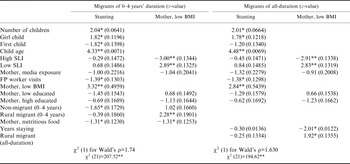
The regression analysis was done using the robust method of White's heteroskedasticity-corrected standard errors. The selection of right-hand side variables for this analysis relied on the significance of their association with the dependent variables as per the χ2 test (see Table 2 for detailed results). The results for the bivariate recursive regression model are given in Table 5. Due to lack of information on the pre-marital health and socioeconomic background of women, the only available variable that appears to be eligible for instrumentation of women's undernutrition is their consumption characteristics (see Table A1 in the Appendix for a definition of the variable). However, the variable ‘mother consumes nutritious food’ meets only two of the criteria of a good instrument discussed earlier, while the last one is strongly violated. Women's consumption is significantly correlated with child's stunting. Also, this variable is found to be correlated with several of the right-hand side variables. Consequently, we have a weak instrument resulting in biased results. The test of Wald's ρ (Rho) is insignificant rejecting endogeneity of women's/mothers' nutrition status or any correlation between the error terms of the two equations (Table 5). Hence, two separate univariate probit models were estimated to identify the determinants of maternal and child malnutrition.
Results of bivariate recursive regression on maternal and child undernutrition

Standard errors are in parentheses.
* 5% and
** 1% levels of significance.
Marginal effect is calculated at the mean of the explanatory variable and for dummy explanatory variables; it measures the effect of change from 0 to 1.
Determinants of child stunting
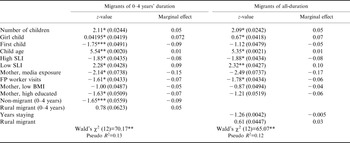
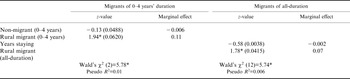
Table 6 gives estimates from the probit model on child stunting controlling for several biodemographic and socioeconomic factors. To begin with the variable of prime interest, mother's migration status (of 0–4 years' duration) comes out as a significant determinant of stunting among children aged below three years. In terms of migration of 0–4 years' duration, children of non-migrant mothers have around 9.2% lower probability of being stunted as compared with the children of urban migrant mothers. The variables on migration of all-duration are not significant in the model (Table 6). Hence, the model was re-estimated with migration status as the only right-hand side variable (Table 7). This makes migration status for all-duration also significant at the 5% level in the model. Inclusion of various socioeconomic variables makes migration status for all-duration relatively insignificant in the model on child stunting, as shown in Table 6.
Probit results for child stunting

Standard errors are in parentheses.
* 5% and
** 1% levels of significance.
Marginal effect is calculated at the mean of the explanatory variable and for dummy explanatory variables; it measures the effect of change from 0 to 1.
Probit results for child stunting with migration variable only

Standard errors are in parentheses.
* 5% and
** 1% level of significance.
Marginal effect is calculated at the mean of the explanatory variable and for dummy explanatory variables; it measures the effect of change from 0 to 1.
The impact of all-duration migration status on child nutrition outcome is explained through the difference between socioeconomic characteristics of migrants and non-migrants on the one hand and rural and urban migrants on the other, as found by Stephenson et al. Reference Stephenson, Matthews and McDonald(2003) in their study on the effect of migration status on infant mortality rate. Irrespective of maternal and other socioeconomic characteristics, children of urban migrants and non-migrants are less vulnerable to nutrition insecurity. Comparable results have been found by Brockerhoff Reference Brockerhoff(1990) in his analysis of child survival among migrants in Senegal. From Table 7, for the model with the migration variable only, the child of a rural migrant of 0–4 years' duration has a 11.5% higher probability of being stunted compared with that of an urban migrant, while the child of a rural migrant mother of all-duration has a 7.3% higher probability of being stunted as compared with non-migrants and urban migrants. A lower probability of stunting among children of all-duration rural migrants compared with those of 0–4 years' migrants also implies a positive impact of the length of stay in Mumbai on level of malnutrition, confirming the theoretical prepositions on migrants' assimilation into the environment of the host place (Goldscheider, Reference Goldscheider and Goldscheider1983).
It is noticeable that even when all socioeconomic and demographic variables are controlled for, migration status for 0–4 years remains significant in the model, and the child of a non-migrant has a lower probability of being stunted (Table 6). Thus, when migration is considered in terms of shorter duration, migrants' children are more vulnerable to nutrition insecurity.
Apart from migration, demographic variables come out as significant determinants of stunting among pre-school children. A higher number of under-five children in the household increases the probability of stunting among small children by around 5%. This is due to the time-intensive character of pregnancy and child care (see Wolfe & Behrman, Reference Wolfe and Behrman1982). An increase in a child's age by one month increases the probability of his/her being stunted by 5% due to increasing need for a diversity in food as the child grows after six months, which sometimes remains unmet as breast-feeding is not supplemented with an adequate diet. Further, a girl child has around 7% higher probability of being stunted compared with a male child with similar background characteristics. This re-establishes the presumption on intra-household inequalities on the basis of sex bias against women (see Agarwal, Reference Agarwal1994). Birth order is not significant in the case of all-duration migration.
An interesting finding is the significance of the variable ‘FP worker visits’, indicating that children of mothers who are visited (at least once a year) by a family planning worker have a lower probability of being stunted by around 7%. The direct effect of this variable is likely to come through information and awareness on reproductive care, which family planning workers are supposed to impart during each visit. Indirectly, the variable would also reflect, on average, access to an effective public health care system, which would obviously have a positive impact on health and nutrition outcomes. Family planning workers work for the municipal health system, and their significance can have important implications for the understanding the relatively disadvantaged status of migrants in health terms. Such government services are usually provided to permanent residents, who are required to have government-issued health cards or another proof of identity. Therefore, poor migrants, especially during the early period of in-migration in Mumbai (or anywhere), remain uncovered by these support systems and consequently are likely to be disadvantaged. Household's standard of living is another variable significantly affecting the probability of stunting among children below three years of age. The importance of standard of living for child nutrition outcomes underscores the role of basic amenities, and for nutrition outcomes income matters inasmuch as it provides access to these necessities in addition to food. For child nutrition outcome, mother's education has a dominating influence and the children of mothers who are educated to higher level have a lower probability of being stunted of around 7% compared with those of primary-educated mothers, though the latter does not make much difference compared with uneducated mothers (Table 6).
Determinants of maternal undernutrition
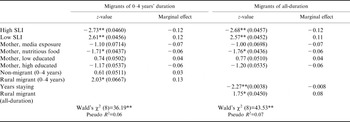
Table 8 gives the estimates of the univariate probit model on determinants of undernutrition among mothers in the age group of 15–45 years. Migration status appears to be a significant determinant of undernutrition among women. Rural migrant women in Mumbai have a significantly higher probability of being undernourished as compared with urban migrant and non-migrant women. In case of migration of 0–4 years, rural migrant women have a 12% higher probability of having a low BMI as compared with urban migrant women. However, rural migrant mothers of all-duration have a 7.8% higher probability of being undernourished as compared with urban migrant women in Mumbai. Also, as the years of stay in Mumbai increase, the probability of women having a low BMI declines slightly by 0.87% for each additional year (Table 8). Both these findings re-establish the role of the assimilation process by which migrants adapt to their new environment and their relative disadvantage gradually diminishes (Goldscheider, Reference Goldscheider and Goldscheider1983). The types of adaptation of greatest importance to child health or survival would, of course, be those associated with maternal child care behaviour, quality-of-life facilities and fertility (see Brockerhoff, Reference Brockerhoff1990). Rural migrants, however, are the most insecure and vulnerable in terms of child and maternal nutrition insecurity.
Probit results for maternal undernutrition

Standard errors are in parentheses.
* 5% and
** 1% levels of significance.
Marginal effect is calculated at the mean of the explanatory variable and for dummy explanatory variables; it measures the effect of change from 0 to 1.
Apart from that, household's standard of living and consumption of nutritious food has a positive effect on women's nutritional status. Those mothers who consume nutritious food regularly have more than a 6% lower probability of having a low BMI compared with women who do not have a regular intake of nutritious food (Table 8). Although women's education and media exposure were found to be significantly associated with women's undernutrition from the χ2 test of independence, these variables were not significant in the probit model. In all likelihood, women's education level and household's standard of living index are expected to move in a similar direction and are significantly associated with each other.
Discussion
On the basis of the findings from descriptive and multivariate analyses given above, four major points are observed vis-à-vis determinants of child and maternal malnutrition in Mumbai and the role of the migration pattern in this.
(1) Migration status is a significant determinant of undernutrition among children and their mothers. The incidence of stunting and women's undernutrition is significantly higher in the case of migrants (Table 4). The gap between migrants and non-migrants is mostly captured by the acute disadvantage of rural migrants, while urban migrants are almost at comparable level with non-migrants in Mumbai. From both exploratory and multivariate analyses it is evident that migrants of rural origin form the most vulnerable category in Mumbai. This can be explained through the relatively higher incidence of illiteracy, gender discrimination, ignorance and poverty among people who have come from rural areas. These findings also confirm the identification of risk of poor maternal and child health due to rural origin (Bender et al., Reference Bender, Rivera and Madonna1993, Stephenson et al., Reference Stephenson, Matthews and McDonald2003). In addition, this underscores the need to understand migrants as more than a homogenous category.
(2) As the years of stay in Mumbai increases, migrants learn to assimilate to the new environment and their relative disadvantage compared with non-migrants goes on declining. Rural migrants also fare worse than urban migrants in Mumbai because of the greater difficulty in assimilation as compared with urban counterparts since previous exposure to the urban environment and way of life matters for the assimilation process (see Brockerhoff, Reference Brockerhoff1990). However, irrespective of the length of stay in Mumbai, rural migrant mothers and their children continue to fare worse in terms of nutrition outcome as compared with non-migrants as well as urban migrants.
(3) The high incidence of child stunting and maternal undernutrition among rural migrants points towards acute capability deprivation among them. Stunting is an indicator of long-term cumulative growth deficiency, which is known to cause functional impairment in later adulthood (see UNICEF, 1994). Also, since there is higher level of stunting among girl children, their situation is likely to deteriorate further due to their reproductive role. In addition, undernutrition among women would have an inter-generational effect to the extent that these women are likely to be future mothers. Thus, the rural migrant population is not only nutritionally insecure at present, but is likely to be perpetually malnourished and vulnerable.
(4) Apart from migration status, child-specific demographic factors, women's education, standard of living, media exposure among women and local health services are significant variables behind nutrition outcomes among women. It is a combination of these factors that actually mediates the impact of migration status on malnutrition outcomes. For stunting, the difference in nutrition outcomes of migrant and non-migrant children on one hand and rural migrant and urban migrant children on the other is partially explained through differences in socioeconomic endowment of these categories.
Conclusion
This paper addresses the persistent research gap on the issue of migrants and nutrition insecurity and draws considerably upon several works reiterating the need to develop a better understanding of urban health issues (see Brockerhoff et al., Reference Brockerhoff1995; Haddad et al., Reference Haddad, Ruel and Garrett1999; Stephenson et al., Reference Stephenson, Matthews and McDonald2003). Though migration is a well-researched topic, most of the work in this area focuses on poverty, work, environment and other physiological aspects of the phenomenon. Also, these studies tend to consider migrants as a homogenous group and end up with conflicting findings on the status of migrants (see De Haan, Reference De Haan2000). The main objective of the present paper was to study the role of migration in malnutrition in Mumbai city. Using NFHS data, this paper tried to identify the determinants of malnutrition in Mumbai and examine the role of migration status in it. The study focuses on maternal undernutrition and stunting among children below three years of age.
The study found that migration status does affect maternal and child nutrition outcomes in Mumbai. However, not all migrants are necessarily vulnerable; rather it is those of rural origin who are more likely to be disadvantaged in terms of nutrition insecurity, whereas the situation of urban migrants is almost comparable to that of non-migrants. The worse status of rural migrants can be explained through the high prevalence of women's illiteracy, negligence towards women's health, ignorance, low skill and gender discrimination in rural areas. These factors are salient determinants of nutrition and health among people but fare miserably in rural areas. Among other socioeconomic variables, standard of living, sex and age of the child are also significant determinants of stunting among children. For women's undernutrition, standard of living and intake of nutritious food are main correlates.
While it would be a little premature to make strong generalizations on the basis of these findings, there are clear policy implications, at least for Mumbai and similar metro cities. There has been a tendency to perceive migration as a source of crisis in urban governance and policy-makers have been quite complacent towards the problems of migrants in urban areas. Nevertheless, migration is a natural process during the socioeconomic transformation of a country and can't be stopped without coercive measures, which is not feasible in a democracy. In addition, there is evidence that a city's migrant population makes a significant contribution to its economy, catering to its labour demands at cheaper cost (Srivastava & Sasikumar, Reference Srivastava and Sasikumar2003). Eradicating nutrition insecurity in Mumbai would require an inclusive strategy that accounts for the perspective of migrants, rather than seeing them as outsiders. As Stephenson et al. Reference Stephenson, Matthews and McDonald(2003) have suggested, these kinds of findings highlight the need to target migrants in the provision of health services. Extension of public food security and health care systems to migrants should be implemented with utmost urgency. In addition, awareness about reproductive health, child care, nutrition education on food habits and diet transition are general but very important requirements to improve the nutritional status of women and children in Mumbai, especially for those with rural backgrounds.
Appendix
List of variables used in the analysis