Introduction
The effect of government funding on the independence of nonprofit organizations (NPOs) is a prominent theme in the multidisciplinary literature on the American nonprofit sector. Especially since the dramatic expansion of the American welfare state in the 1960s, government agencies in the United States have contracted out a large portion of social service delivery to local NPOs, raising questions about how this system of “third-party government” may affect the behavior and priorities of recipient agencies (Salamon Reference Salamon1987). At issue in these discussions is not only the responsiveness of NPOs to their clients and beneficiaries but also the vitality of American civil society, which has long been associated with a strong “third sector” organized separately from business and government institutions (Skocpol Reference Skocpol2003).
By and large, the effect of government funding on NPOs has been perceived negatively: “Funds from government, whether as a partner, patron, or purchaser, are often viewed as inherently controlling, co-opting, and contaminating the mission of nonprofit organizations” (Kramer Reference Kramer1994: 35; see also Binder Reference Binder2007: 548; Marwell and Calabrese Reference Marwell and Calabrese2015: 1031). However, though scholars continue to cite these concerns, empirical assessments tend to show that the supposed detriments of public funding have been significantly overstated (Kramer Reference Kramer1994; Lu Reference Lu2016; Salamon Reference Salamon1995). Yet the fact remains that scholars and policy makers often view this type of revenue with a unique suspicion that it undermines the autonomy of NPOs (Allard Reference Allard2009: 99; Rushton and Brooks Reference Rushton and Brooks2007; Suárez Reference Suárez2010: 309).
I critique this suspicion in two ways: First, rather than treat the question of state influence over NPOs as a straightforward empirical one, I investigate why government funding has received so much attention in the first place. As part of this inquiry, I scrutinize underlying beliefs about NPOs by applying organizational theory to widespread assumptions about nonprofit behavior. Second, I adopt a historical perspective focusing on the periods preceding and coinciding with the increase in government funding in the American nonprofit sector, thereby interpreting such funding as a historical event with broad institutional repercussions rather than as an income stream affecting a given organization. This organizational and historical analysis is anchored in a study of the Community Chest, a cross-country network of welfare planning and fundraising federations that came to prominence in the United States after World War I and that eventually became today’s United Way. The Community Chest affords a valuable perspective on how the behavior of NPOs has been shaped by the web of interorganizational relations in which they are embedded (Wooten and Hoffman Reference Wooten and Hoffman2008). Although this is certainly not the first study of the Community Chest (e.g., Seeley et al. Reference Seeley, Junker, Jones, Jenkins, Haugh and Miller1957), my research emphasizes previously overlooked factors and details that challenge prevailing historical accounts of American civic culture and state–nonprofit relations.
Before proceeding, it is important to acknowledge that the moniker “nonprofit” includes a vast array of organizations holding tax-exempt status while being only nominally nonprofit in the designation’s conventional charitable sense. As elaborated later in this article, the Community Chest was a major stakeholder in the community-based human services subsector, which includes “local direct service providers such as soup kitchens, child care, and youth mentoring organizations, as well as [local affiliates of] large national organizations like the YMCA and YWCA, Boys and Girls Clubs of America, and the American Red Cross” (Boris et al. Reference Boris, de Leon, Roeger and Nikolova2010: 3). Consequently, the historical analysis in this article reflects trends among nonprofit (or voluntary) human service agencies and cannot be extrapolated to museums, private universities, and other NPOs outside of this subsector. That said, voluntary human service agencies are widely recognized as “the quintessential expression of the nation’s benevolent spirit” (ibid.) and are frequently the subject of discussion in literature on the nonprofit sector even when the more generic term nonprofit is used (Grønbjerg Reference Grønbjerg2001: 287). Furthermore, the human services subsector receives special attention in discussions of government–NPO relations because these organizations comprise the voluntary dimension of the all-important social safety net and receive more public financial support than any other nonprofit subsector. Thus, a study of the Community Chest is necessarily selective, but it also focuses attention on a cross-section of NPOs that are particularly relevant to concerns about governmental influence on nonprofit organizational behavior and the implications of such influence for American civil society.
An additional caveat concerns my conceptual treatment of NPO autonomy. Although much of the literature exploring the effect of government funding on nonprofit independence relates specifically to the extent of nonprofit advocacy activity (see Lu Reference Lu2016), a more general formulation of autonomy is what Grønbjerg (Reference Grønbjerg1993) calls “management discretion” (57). This term refers to the degree of freedom that nonprofit personnel have in deciding how to allocate organizational resources, whether on fundraising, administration, advocacy, or direct service provision. To be sure, the freedom to advance policy positions that run counter to the political status quo is a particularly salient feature of an independent civil society. However, a broader concern is the loss of management discretion due to what various authors have described as vendorism: “ceding control of the organizational mission to funding agencies when financial survival depends on providing what the government requests” (Rushton and Brooks Reference Rushton and Brooks2007: 89). This article addresses the fear of vendorism rather than the more specific concern surrounding the capacity of NPOs to pursue contentious advocacy activity.
The remainder of the article proceeds as follows. I begin by contextualizing the concern about government funding within an influential organizing framework that informs much of the research on the American nonprofit sector and that identifies NPOs as community-oriented entities. While this community orientation has been thought to distinguish NPOs from the hierarchical authority of state institutions, I use organizational theory to demonstrate how such an orientation can engender the very mechanisms of centralized control that have been considered alien and threatening to the nonprofit sector. I then instantiate these theoretical points with historical evidence supporting a resource dependence perspective on community control of nonprofit organizational behavior. The historical evidence shows that the community orientation of NPOs has historically hosted a fundamental tension between cooperation and autonomy, that the image of community was deployed by the social work establishment to justify hierarchical authority under nonstate auspices, and that the influx of government funding beginning in the 1960s promoted nonprofit independence by undermining this community-rooted system of control. The article ends by drawing out theoretical implications for our understanding of NPOs as tokens of civil society and as actors in the political economy of social welfare.
Theoretical Background
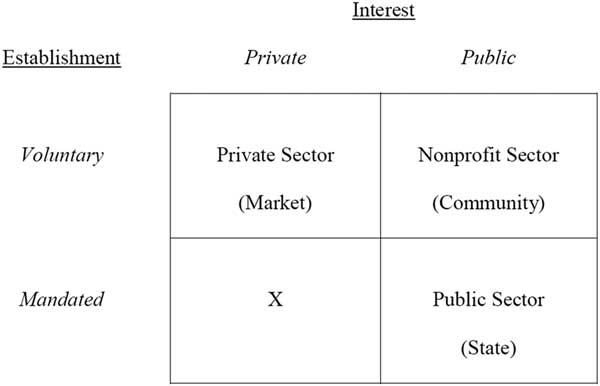
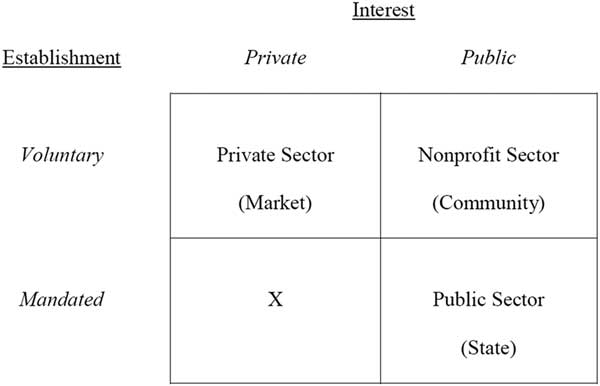
Skelcher and Smith (Reference Skelcher and Smith2015) note that much of the theory on the nonprofit sector is informed by a “state-market-community triptych,” a prevalent motif in the study of the institutional division of labor in modern economies (e.g., Edwards and Foley Reference Edwards and Foley1998; Miller Reference Miller1989; Offe Reference Offe2000; Van Tulder and Pfisterer Reference Van Tulder and Pfisterer2014). According to this schematic (see Figure 1), the state represents “hierarchical control,” the market signifies “dispersed competition,” and the community embodies “spontaneous solidarity” (Streeck and Schmitter Reference Streeck and Schmitter1985: 119). In their popular Tocquevillian rendering, NPOs fill the community slot, combining the free enterprise of business firms and the public goods provision of government organizations but excluding the less attractive aspects of the market and the state: greed and coercion (Prewitt Reference Prewitt2006: 356). It is this wholesome interaction of private initiative and public service that has led scholars and policy makers to celebrate the nonprofit sector for exemplifying “a general principle of societal constitution based on communal responsibility, social trust, and self-organization” (Anheier Reference Anheier2009: 1086).
Mapping the State-Market-Community Triptych.
This idealization of NPOs as “tangible, significant manifestations of community” has also led to unease over the blurring of sectoral boundaries (Smith and Lipsky Reference Smith and Lipsky1993: 22). Just as authors have raised questions about receipt of government money, so have they expressed concern about the increasing proportion of nonprofit revenues (particularly in the human services sector) derived from service fees, a financing method reminiscent of private-sector business methods and frequently conceptualized as a “penetration,” “colonization,” “infiltration,” or “invasion” of the market into the nonprofit sector (Eikenberry Reference Eikenberry2009: 583; Salamon Reference Salamon1995: 220; Scott Reference Scott2014: 252; Young et al. Reference Young, Salamon and Grinsfelder2012: 538).
These parallel literatures—one monitoring the state–nonprofit boundary and the other monitoring the business-nonprofit boundary—reflect a deep intellectual investment in the tripartite classification of society and in the ideal type of the charitable NPO as a visible outcropping of communal fellowship (Alexander Reference Alexander1987: 165). In fee-charging critics see NPOs sliding toward the private sector, with the risk of succumbing to “the temptations of individualism and commercialism” (Van Til Reference Van Til1990: 278). In reliance on government money, observers find NPOs drifting toward the public sector and potentially falling victim to co-optation by centralized bureaucracies, becoming nothing more than “dutiful implementers of public sector programs and priorities” (Frumkin Reference Frumkin2002: 10). Thus, public funding of NPOs continues to receive outsized attention because, in reducing the nonprofit sector to the delivery mechanism for government, such funding seems to blur the boundary between the hierarchical, centralized organization of the state and the voluntary, grassroots action of the community.
Yet one of the most striking features of the academic and professional literature on the blurring of organizational boundaries in the nonprofit sector is its lack of historical perspective (Morris Reference Morris2004: 275). Since the formalization of the study of the nonprofit sector in the mid-1970s (Barman Reference Barman2013), scholars in this discipline have maintained an overwhelmingly contemporary focus, seeking to make sense of emerging “hybridity” in the nonprofit sector while assuming that the nonprofit organizational form has been stable and distinct rather than inherently volatile (e.g., Doherty et al. Reference Doherty, Haugh and Lyon2014).Footnote 1 This assumption leads us to imagine a “social services sector that was once decentralized, independent, often informal, and voluntary” (Lynn Reference Lynn2002: 58). In the remainder of this section I lay the theoretical groundwork for calling this historical imagery into question.
Community and Cooperation
As the state-market-community triptych suggests, a fundamental concept in theories of why and how nonprofit sectors develop is that NPOs are oriented toward community needs rather than monetary gain (e.g., Hansmann Reference Hansmann1980). This emphasis on community needs can be interpreted not only in terms of goal orientation but also in terms of interorganizational relations. Because profit is assumed to be of relatively peripheral importance to nonprofits, they are typically considered distinct from conventional businesses in their pursuit of non-zero-sum objectives and, consequently, in their inclination to cooperate with other nonprofits sharing similar objectives. To use the parlance of recent institutional theory, the nonprofit sector is said to exhibit a “community logic” reflecting altruism, camaraderie, and a shared moral order, while the private sector is linked with a competitive and self-interested “market logic” (Crosby et al. Reference Crosby, Stone and Bryson2015: 43; Glynn and Raffaelli Reference Glynn and Rafaelli2013: 177). As a result, much of the literature on interorganizational relations among NPOs is framed by the belief that they are “supposed to be mutually supportive” (DiMaggio Reference DiMaggio2001: 24).
To be sure, no one argues that NPOs are purely cooperative, but it is noteworthy that accounts of competition in the sector often attribute competitive behavior to recent commercialization trends (discussed previously). In this rendering, competitiveness appears as a foreign influence resulting from resource pressures that oblige NPOs to “replace a benevolent spirit with a mindset of competition” (Eikenberry and Kluver Reference Eikenberry and Kluver2004: 136; see also Alexander et al. Reference Alexander, Nank and Stivers1999: 462; Brainard and Siplon Reference Brainard and Siplon2004: 439; Martin Reference Martin2000: 63; Sanders and McClellan Reference Sanders and McClellan2014: 70; Smith Reference Smith2012: 210; Young Reference Young2010: 59).
Because statements about NPOs are commonly packaged in an image of the nonprofit sector as a locus of values, authors have often depicted cooperation among these organizations as a sort of idealized state stemming from their cooperative character. Examples include “altruistic ‘habits of the heart,’” “the traditional value-orientation of nonprofits,” “a normative impetus away from competition,” “a cooperative culture,” “the pursuit of broader community interests,” and “a cooperative ethos” (Baum Reference Baum1999: 552; Bush Reference Bush1992: 404; Oster Reference Oster1995: 47; Rothschild and Stephenson Reference Rothschild and Stephenson2009: 801; Woolford and Curran Reference Woolford and Curran2013: 46; Young et al. Reference Young, Salamon and Grinsfelder2012: 527). The problem with this line of reasoning is that it presupposes a level of analysis focused on the individual NPO. In other words, cooperative inclinations in individual organizations are thought to aggregate up to cooperation among organizations. However, cooperative dispositions and alignment of interests are insufficient to bring about cooperation; at least as important are the administrative processes that maintain persistent networks of exchange and mutual adjustment (Gulati et al. Reference Gulati, Wohlgezogen and Zhelyazkov2012). Although cooperative dispositions at the organizational level may be a prerequisite for sustained relationships, cooperation depends ultimately on the interorganizational mechanisms that coordinate complementary activity. In the following text I argue that, given certain cooperative network structures, these interorganizational mechanisms may engender the centralized, hierarchical administration typically associated with the state.
Cooperation and Hierarchy
Community-oriented cooperation involves more than the self-interested search for bilateral exchange opportunities (e.g., space rental, client referrals); it implies a sense of collective obligation among numerous actors to an overarching social mission. In short, it is often believed that voluntary human service agencies should be motivated to serve the common good by a communal identity transcending narrow, organization-specific objectives (Irvin Reference Irvin2010; Kania and Kramer Reference Kania and Kramer2011). This affectively charged form of cooperation evokes the solidary organizational character traditionally associated with a “community logic,” but at the interorganizational level of analysis we find an arrangement that resembles the hierarchical control conventionally ascribed to the state, as this form of cooperation tends to materialize as a large, complex network demanding centralized management of coordination costs (Laumann et al. Reference Laumann, Galaskiewicz and Marsden1978: 467).
While independent dyadic exchanges can persist on trust and norms of reciprocity alone (Podolny and Page Reference Podolny and Page1998: 59), informal and broadly dispersed means of coordination are generally inadequate to maintain a multiplex web of interdependent actors collaborating simultaneously. These networks typically require centralized orchestration to facilitate communication and decision making among numerous participants because an arithmetic increase in the number of actors corresponds to an exponential increase in the amount of possible relationships (Provan Reference Provan1983: 81; Van de Ven Reference Van de Ven1976: 27). Hierarchical coordination is especially necessary when tasks cannot be easily routinized (Thompson Reference Thompson1967: 65). Because dynamic and multifaceted undertakings such as conducting local needs assessments and planning programs to fill service gaps can be only partially standardized at best, their coordination necessitates oversight by a focal agent vested with executive authority (Litwak and Hylton Reference Litwak and Hylton1962: 417).
To summarize, insofar as community-oriented cooperation involves diffuse, concerted, and functionally complex effort rather than a series of pairwise transactions, organizational theory suggests that subordination of individual actors to a centralized authority is necessary.
Centralization and Autonomy
Here we encounter a problem: As explained previously, private governance is a distinguishing feature of NPOs. The nonprofit community orientation entails both cooperative behavior and free enterprise. Again, it is instructive to consider what decades of organizational theory tell us about the implications of such independence.
While organizational scholars have set aside theoretical space accommodating the possibility of selfless alacrity for centralized coordination among independent actors, a venerable tradition of sociological research suggests that “this happy state of affairs unfortunately has little relevance to most important issues, which are usually highly controversial and in which the respective interests of the various parties do not coincide” (Warren Reference Warren1973: 358). The accumulated evidence illustrates what Selznick (Reference Selznick1953) long ago described as “the centrifugal tendencies” of organizations (155). Organizational theory indicates that “one of the major sociological functions of organizational independence is to promote autonomy” (Litwak and Hylton Reference Litwak and Hylton1962: 396). Moreover, when independent organizations acquiesce to centralized authority, the salient consideration is often resource procurement rather than camaraderie (Galaskiewicz Reference Galaskiewicz1985: 282). In accordance with the predictions of resource dependence theory (Pfeffer and Salancik Reference Pfeffer and Salancik1978), centrally coordinated cooperation will often require means of inducement, if not coercion. Levine and White (Reference Levine and White1961) put it most succinctly: “Theoretically, were all the essential elements in infinite supply there would be little need for organizational interaction and for subscription to co-operation as an ideal” (583).
In summary, while the classic “state-market-community triptych” in theories of the nonprofit sector associates the community orientation of NPOs with a historical synthesis of other-regarding cooperation and voluntary action, I highlight the necessity of conflict between centralization (due to the complexity inherent in managing community-oriented cooperation) and decentralization (due to boundary maintenance among separately constituted organizations). This theoretical starting point leads us to expect that if community-oriented cooperation was historically a mobilizing ideal in the nonprofit human services sector, then it should have also been an impetus for social control. Furthermore, if NPOs followed the organizational tendency to comply with such control mostly because of resource dependence, we should be attentive to how changes in resource environments have modulated the capacity of NPOs to operate as self-directed actors.
Methods
The Community Chest is a natural point of entry for historical analysis of cooperation among nonprofit agencies. This institution not only extolled cooperation as an indispensable organizing principle in social welfare provision but also documented the technical details of how cooperation is achieved as a viable interorganizational network structure. Additionally, before the expansion of the American welfare state in the mid-1960s, community chests were widely recognized as major players in voluntary social welfare planning and provision, sometimes described as the “unofficial governments” in the hundreds of cities in which they operated (North Reference North1931: 320).Footnote 2 As such, these organizations lend themselves to a historically informed, community-level perspective on questions of nonprofit autonomy.
Although the Community Chest has featured prominently in historical analyses of American charity, scholars have paid little attention to the administrative details of its organizational model. More typically, the Community Chest has been discussed in the context of social work’s professional development (Reisch and Wenocur Reference Reisch and Wenocur1986), elite influence in American communities (Clemens Reference Clemens2015: 11), and conflict among social movements (Barman Reference Barman2006; Brilliant Reference Brilliant1990). Accordingly, scholars have generally offered synoptic organizational descriptions of the Community Chest as part of a larger sociological story. I make a deeper historical dive to understand the power relations and incentive structures underlying cooperation under the Community Chest, as well as the material circumstances explaining changes in its organizational form.
As part of this effort, I have conducted a thorough reading of primary and secondary sources preceding the increase in government funding in the mid-1960s. I used two references to structure my initial search for material available online and for circulation among libraries:
∙ Bibliography with Notes on Social Work Finance and Publicity (Welfare Council of New York City 1930)—Published by the Welfare Council of New York City, this annotated bibliography cites and summarizes numerous articles, books, conference presentations, and fact-finding reports pertaining to financial federations, most prominently the Community Chest.
∙ Trends in Community Organization: A Study of the Papers on Community Organization Published by the National Conference on Social Welfare, 1874–1960 (Heath and Dunham Reference Heath and Dunham1963)—Prior to the 1960s, a primary focus of the social work practice area known as community organization was the coordination of community-based social service agencies. Heath and Dunham’s corpus enabled me to locate conference presentations reflecting trends in the development of the Community Chest movement and its forerunners.Footnote 3
My archival research was based on the following sources:
∙ United Way of America microfilms—When the United Way of America moved its headquarters from New York City to Arlington, it microfilmed its entire collection of archived documents. The digitized microfilm prints (nearly 60,000 scanned images) include budgeting manuals, bulletins, promotions, and various administrative records.Footnote 4
∙ Records of the United Way of Metropolitan Chicago at University of Illinois, Chicago; Records of the United Way of Philadelphia at Temple University; and Records of United Way of the St. Paul Area at the Minnesota Historical SocietyFootnote 5 —My research at these archives was supplementary to my review of documents published by the United Way headquarters. Because of time and financial constraints, I focused the bulk of my research on the period of increased government funding for social welfare (1965–80).
The Ideals and Demands of Community Organization
Charitable organizations in the nineteenth century relied on the state to obtain legal charters but were able to start up and expand independently once approved as corporate entities (Hall Reference Hall1992: 31). Among the results of this relative freedom from centralized legislative institutions was a substantial proliferation of benevolent associations accompanying rapid industrialization and urbanization during the turn of the twentieth century (Sutton Reference Sutton1990: 1392). This unchecked growth galled social service professionals, who believed that it exacerbated duplication of charitable effort and undermined economies of scale in service provision.
Concerted efforts to foster cooperation began with the “charity organization” movement. Working under the progressive mantra of bureaucratic efficiency, charity organization leaders attempted to restructure social service provision as a rationally planned and executed operation, encouraging resource sharing, administrative consolidation, and joint programming as components of a unified strategy for community improvement. Evidence of this cooperative ideal abounds: The motto of the New York Charity Organization Society was “United, an Army; Divided, a Mob.” The newsletters of the Children’s Bureau of Philadelphia and the Chicago Bureau of Charities were both titled Co-operation. Indeed, Frank Watson (Reference Watson1922) notes in his landmark treatise on charity organization that “coöperation has been the watchword of the [movement] since the beginning” (128). With the Russell Sage Foundation’s establishment of a department devoted to advancing the movement in 1909, charity organization was consecrated as the leading influence for social work professionalization (Hammack Reference Hammack1994), encoding the goal of cooperation in the emerging practice area of community organization (Kurzman Reference Kurzman1985: 96).Footnote 6
Community-Mindedness and Agency-Mindedness
Community organization’s emphasis on solidary dedication to the common good is a clear illustration of the nonprofit sector’s idealized cooperative heritage.Footnote 7 Notably, however, the proceedings of the National Conference on Social Welfare are filled with complaints about the immense difficulty of promoting cooperation among independent agencies, a project that social work pioneer Mary Richmond (Reference Richmond1901) described as “so stupendous that only workers of large faith and tireless patience can succeed in it” (307). While competitive behavior may seem odd for charities, it has long been understood that nonprofit founders, employees, and volunteers can obtain a profound sense of personal mission and accomplishment from their work, leading to strong attachments to their organizations. The resulting “jealous pride” and “zeal in promoting one’s own organization” can easily undermine cooperation with other groups (Steiner Reference Steiner1925: 40). As the director of the Indianapolis Charity Organization Society put it, “In the realm of benevolent effort every charity is the charity. Most special charities are doing a work which, to their promoters, is the cure of all social evils. I would say that the jealousies between charity societies exceed that of the members of church choirs, if it be possible” (Grout Reference Grout1900: 252). This documentary evidence leads historian Michael Katz (Reference Katz1996) to conclude that “virtually everywhere, individual charity organization societies were unable to overcome completely the suspicion, hostility, and rivalry of churches and local relief organizations” (83).
A review of policy discussions lends credence to Katz’s conclusion that cooperation was a tall order. For example, one recurring topic is the question of whether coordinating institutions should provide material relief to the needy in addition to arranging cooperation among other service agencies. Literature from the period suggests overwhelming agreement among charity organization advocates that providing direct assistance incites jealousy among other organizations and therefore undermines cooperation (for a review of this subject see Watson Reference Watson1922: 162). An additional topic of concern was public subsidization of charities. While scholars today attribute increased competitiveness in the nonprofit sector to greater scarcity in government funding (Smith Reference Smith2012: 210; Young Reference Young2010: 59), charity organizers pointed to government subsidization as a negative influence on cooperative efforts, arguing that a large, impersonal state bureaucracy is “too awkward to discriminate properly between the various and often competitive organizations that volunteer to act as distributors of its bounty” (Superintendent of Charities 1892: 11; see also Almy Reference Almy1912: 485; Dripps Reference Dripps1915: 469; Fetter Reference Fetter1901: 375; Richmond Reference Richmond1905: 845; Warner Reference Warner1894: 129).
Unfortunately, the absence of comprehensive ethnographic data makes it difficult to arrive at firm conclusions regarding the nature and extent of interagency cooperation, and excerpting isolated quotations generally does little more than suggest trends and illustrate sentiments. In the case of social work literature, however, there is a telling aspect of discourse on cooperation that is worth noting: In the 1930s the terms agency mindedness and community mindedness entered social work jargon as contrasting descriptions of organizational dispositions toward collaboration. One can find these two terms in a variety of sources, including local planning documents (e.g., Central Planning Board 1938: 28), national surveys (Johns and DeMarche Reference Johns and DeMarche1951: 217), and the Encyclopedia of Social Work (MacRae Reference MacRae1957: 187).
Community mindedness described a readiness to adjust programming and planning to other agencies’ services as part of a community-wide social service strategy. The concept appears in social work literature unambiguously as a positive characteristic. Agency mindedness, however, encompassed outright hostility to potential community partners but seems to refer more often to simple myopia in agency planning (for a summary see Kramer Reference Kramer1956: 58). Indeed, while early social work literature evinces plenty of frustration about “mutual throat-cutting” (Atwater Reference Atwater1940: 252), most of the complaints concern mere indifference to community-wide cooperation, a situation in which “co-operation between members of charitable organizations [means] nothing more than a feeling of cordiality” (O’Connor Reference O’Connor1913: 341). With the notable exception of one author who claims some positive qualities (Kapell Reference Kapell1950: 144), agency mindedness appears consistently as a negative characteristic (e.g., Mayo Reference Mayo1934: 246; Reference ReevesReeves 1940: 97).
The significance of the term agency mindedness lies less in its frequency than in its phrasing. The association between noncooperation and the legal boundaries of individual agencies underscores the fact that the field of community organization contended with more than just occasional ill will; the challenge was to overcome the tendency among independent charities to “think of themselves as fundamentally separate agencies, each with its own salvation to work out” (Buell Reference Buell1935: 3). As organizational theory would lead us to suspect, the combination of autonomy and cooperation represented not an organic expression of community sentiment but rather a conflict to be negotiated. In the following section, I argue that community chests emerged in part as a response to this conflict, introducing the critical ingredient of resource dependence to facilitate acquiescence to centralized authority.
The Advent and Function of the Community Chest
Recent historical scholarship on community chests emphasizes their fundraising function. In particular, authors have focused on how business elites in hundreds of American communities spearheaded the “financial federation” strategy of recruiting local charities into annual, consolidated fundraising campaigns, in which charities substituted a single joint appeal for independent solicitation. Under this arrangement, community members and local corporations contributed to an “undesignated fund,” empowering the chest to allocate the money according to community needs. Based on these facts, scholars generally describe the financial federation system of the past as a method of reducing fundraising costs for charitable agencies and of sparing donors the nuisance of constant appeals from multiple causes (e.g., Clemens Reference Clemens2010: 384; Morris Reference Morris2015: 111).
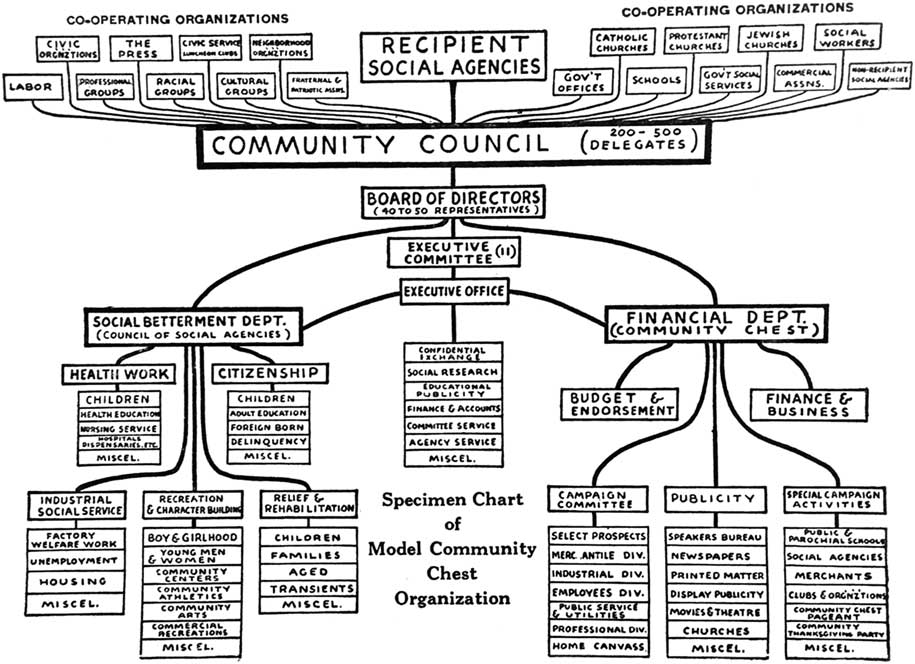
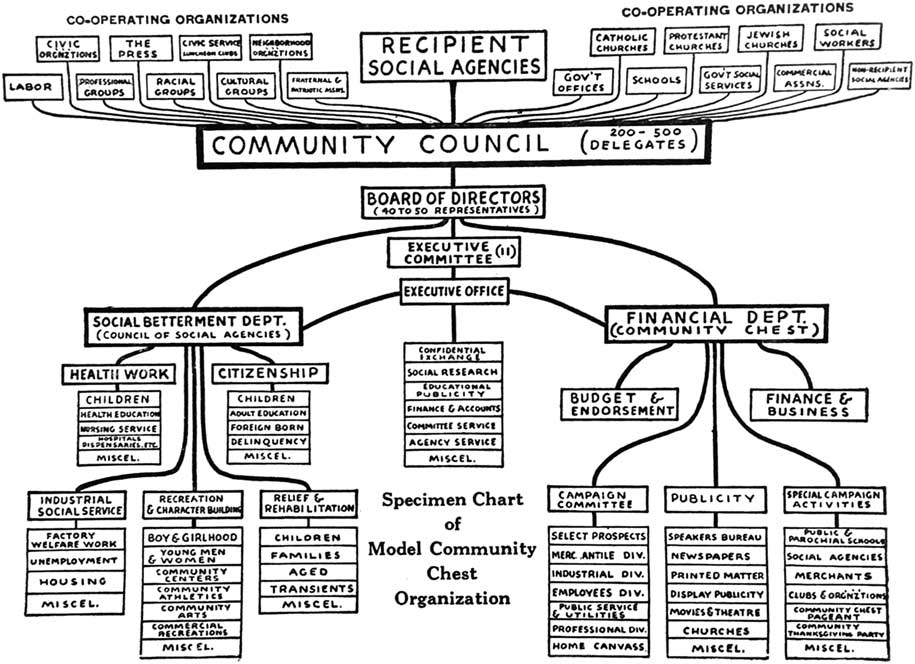
Yet a review of historical documents shows that many supporters of financial federation advocated “not federation for finances only, but for every phase of co-operative endeavor reaching fully into the field of social service” (Edlund Reference Edlund1919: 717). This insistence that financial federation involved more than monetary matters was not peculiar to a few advocates. A 1922 report by the Chamber of Commerce national office on the emerging community chest movement points out that “there seems to be a tendency on the part of federationists to minimize the financial” (Chamber of Commerce of the United States 1922: 23). Indeed, federation promoters were quite clear that the ideal community chest would facilitate not only economical fundraising but also collaborative community welfare planning. As seen in Figure 2, the organizational blueprint of the Community Chest incorporated both the financial affairs commonly associated with the “chest” title and a separate domain of “social betterment” planning executed by a council of social agencies (sometimes referred to as a central council or welfare council).
Early Multi-Divisional Chart of Community Chest. Source: Back cover of Leebron (Reference Leebron1924).
Growing out of the charity organization movement, welfare councils originally existed as models of cooperative service planning quite distinct from financial federations. Francis McLean (Reference McLean1917), the chief architect and evangelist of the council movement, stressed that these bodies consisted of organizations “bound together by cooperative rather than contractual relationships,” as contrasted with federations built on “joint money-raising” (216).Footnote 8 A key distinguishing feature of the council, then, was that it provided a forum for agency delegates to make nonbinding recommendations for local social service planning (Brilliant Reference Brilliant1986: 571–72). This distinction between contractual and voluntary relations reflects a vigorous debate between advocates of financial federation and advocates of the traditional council, which McLean described as a form of “moral federation” (McLean Reference McLean1917: 218).
Among the arguments in favor of financial federation was the lackluster performance of the councils, which had come to be seen by a growing number of social workers as “hollow organizations to which control has been denied” (Norton Reference Norton1916: 583). Without the advantage of enforceable decision making backed by contract, voluntary councils were perceived as lacking “the regularly established machinery” for comprehensive cooperation (Edlund Reference Edlund1919: 720). Cecil North (Reference North1931: 299) provides a telling summation of the state of knowledge in the early 1930s:
The councils of social agencies that existed in many cities previous to the inauguration of the community fund movement accomplished a great deal in the way of developing acquaintance among social workers and promoting good will among the agencies. But without any power of controlling action not many of them got far in changing the actual practice of agencies. Budgetary control gives to a council of social agencies the necessary power to enforce its decisions. (emphasis added)
Arthur Dunham, among the leading mid-century academic authorities on community organization, echoed this opinion on councils nearly three decades later, observing that “the welfare of the community seems to require some degree of centering of power to act for the common good, greater than the traditional council of agencies has had” (Dunham Reference Dunham1958: 148–49; emphasis added). Thus, many social work leaders arrived at the conclusion that intensive and multifaceted cooperation would not emerge spontaneously among independent, “agency-minded” organizations. Coordination demanded a hierarchical authority capable of wielding “the lure of the undesignated fund” (quoted in American Association for Organizing Charity 1917: 204).
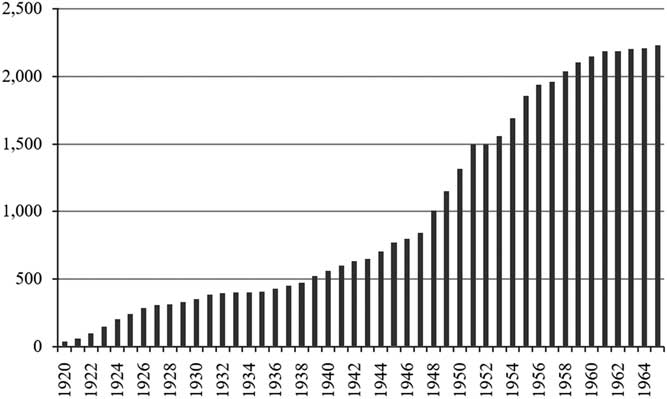
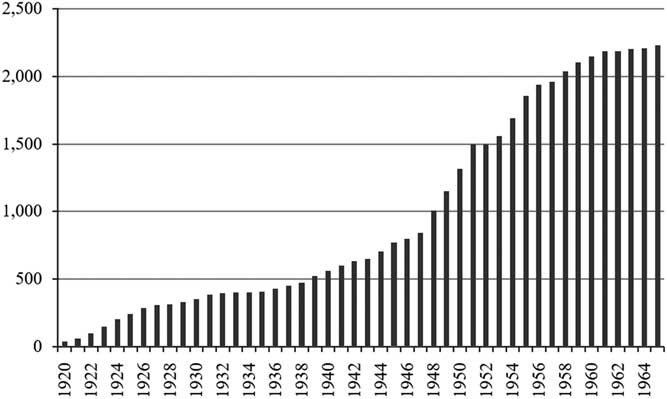
With the gradual acceptance of financial federation by the social work establishment and the backing of local business interests, community chests proliferated during the first half of the twentieth century, with many of them merging planning and finances into a single organizational apparatus (Walker Reference Walker1933: 1186). Consequently, the growth of the movement illustrated in Figure 3 signifies not only the expansion of consolidated fundraising but also the victory of the community chest philosophy of “concerted action through financial control” over the welfare council’s system of “concerted again by voluntary agreement” (1186).Footnote 9 Although the streamlining of local fundraising efforts was the primary impetus for the financial federation movement and remained a central feature throughout its existence, as the movement matured “financial federations began to talk less of saving the business man from the annoyance of many solicitations and more of social planning and standards of workmanship” (Watson Reference Watson1922: 436). By the 1930s the community chests and councils had become “the chief fundraising, planning, and public relations arms of voluntary social work” (Reisch and Wenocur Reference Reisch and Wenocur1986: 78).
Community Chest Campaigns. Source: United Community Funds and Councils of America 1965b: viii.
In light of the information presented, I argue that recent research overemphasizes economy in fundraising as the function of community chests. These federations did not represent simply a “movement of cooperating with others in fundraising” (Zunz Reference Zunz2012: 52); rather, they constituted a system of integrating fundraising efforts while enforcing coordination of service planning and provision through control over allocations. It is also worth noting that the principles of the welfare council seem to exemplify the idealized “community logic” of NPOs: a combination of voluntarism and esprit de corps. Historical evidence suggests that this model was ineffectual and quickly relegated to centralized power sustained by financial inducement.
The Logic of Deficit Financing
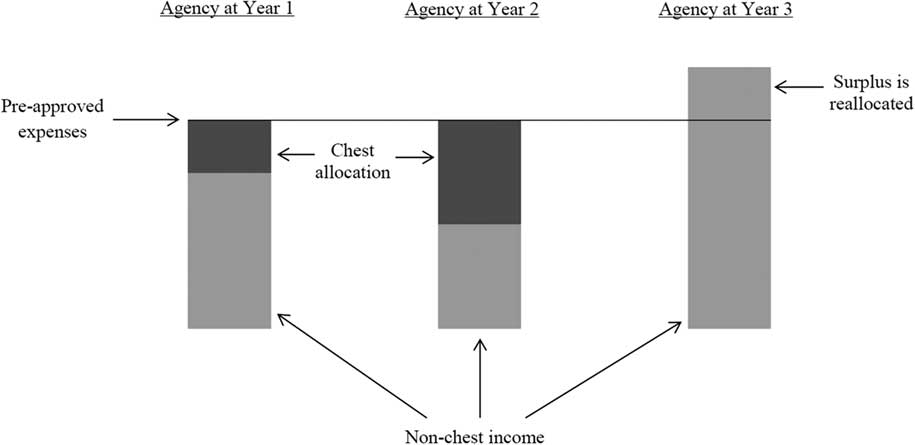
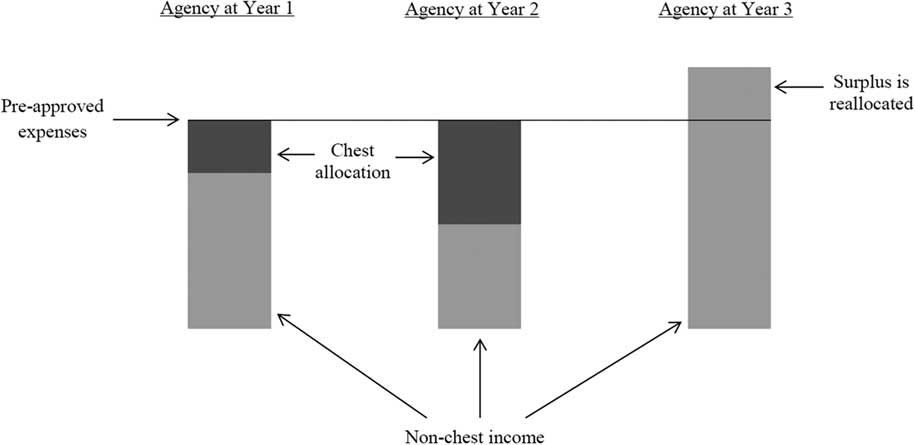
The mechanism underlying the community chests’ financial control was a budgetary framework known as deficit financing, whereby a chest distributed money earned through the annual campaign to its member agencies in amounts needed to cover the difference between a given agency’s preapproved operating expenses and its operating revenue from nonchest sources, such as client fees and member dues (individual fundraising was thought to undermine the consolidated campaign and was therefore prohibited). In other words, a local chest apportioned funds to balance its member agencies’ operating budgets, filling the gap between anticipated expenses and realized revenue (see Figure 4). If a given charity earned more than expected from nonchest sources, the surplus either reverted to a “family reserve fund” or was counted as part of the subsequent allocation, allowing the chest to redistribute the residual income rather than letting it remain in the “treasuries” of individual agencies (Dunham Reference Dunham1958: 175). Deficit financing was a basis for sharing resources and for enforcing centrally managed coordination. Under this system, participating agencies were assured balanced budgets in return for relinquishing their surplus, refraining from individual fundraising campaigns, complying with budgetary and salary regulations, and conforming to the community social service plan.Footnote 10
Deficit Financing Illustrated.
An important feature of deficit financing was that the entire network of organizations benefited when individual agencies earned revenue from nonchest sources. Extra money gained by an individual agency would mean a smaller deficit to be filled by the chest, leading to a smaller budget-balancing allocation for that organization but amounting to additional money for the collective reserve fund and for special project grants: “Thus the greater the amount of support each agency generates, as a result of carrying out its service program, the greater will be the pool of funds for all services in the community” (United Community Funds and Councils of America 1965a: 4). Such was the cooperative logic of deficit financing: Individual effort in procuring resources served community-minded rather than agency-minded interests. For this reason, chests encouraged member agencies to maximize income from service fees and member dues to spread the “deficit dollar” further (Ormsby Reference Ormsby1965: 333).
A second important feature of deficit financing was that it resembled an intraorganizational resource flow, whereby a central administrative unit can reallocate funds among functional divisions according to fluctuating priorities. The principle that individual agencies were subordinate to a community-service hierarchy also manifested in professional training at schools of social work, where chests and councils maintained an outsized influence (Johnson Reference Johnson1955: 108). Because of this influence, training in agency administration was subsumed in the broader curriculum of community organization, reinforcing the idea that individual agencies were units in a larger enterprise rather than independent enterprises (Spencer Reference Spencer1959: 26–27). Thus, in terms of their administrative coordination and their pedagogical influence, chests deployed “community” as a rallying call against agency mindedness and as a justification for restricting agency autonomy. Although chests extolled this system as “a voluntary sharing of sovereignty, in which all parties concerned recognize that overall needs and objectives transcend the interests of any one organization” (United Community Funds and Councils of America 1955: 7), the administrative demands of deficit financing are better understood in terms of the domination often ascribed to the state in current literature. In this case, however, the community served as the source of control, as summarized by sociologist Arthur J. Todd (Reference Todd1932: 479):
In so far as the community chest assumes … the function of community planning, it must necessarily adopt the principle that the interests of the community are paramount over the interests of individual agencies participating in the chest. There are no natural rights which a social agency is entitled to plead as against the ascertained rights and interests of the community.
The Impact of Public Welfare Spending
Contrary to notions of a halcyon communitarian past, I have shown that cooperation under the Community Chest existed in tension with the independence of NPOs and was contingent on material incentives. Moreover, while the image of community as a zone of autonomy motivates suspicion toward government funding, the case presented in this article shows that community served as the symbolic justification for a highly centralized and restrictive organization of social service financing and planning.Footnote 11 Smith and Lipsky’s (Reference Smith and Lipsky1993) often-cited claim that, because of government contracting, “nonprofit agencies have lost control over the central aspects of the way they provide services” (120) clearly does not take into account this important history of community-rooted control. In this section I take my critique one step further, arguing that government funding promoted organizational autonomy in the nonprofit sector.
Government Funding and the Dilemma of Deficit Financing
Although the annual campaigns of community chests (or United Ways, as they were increasingly called in later years) yielded increasing returns from the mid-1950s to the mid-1960s, United Way executives such as President Lyman Ford recognized that the Great Society heralded a significantly larger human services sector that would require much greater scope in financial resources:
Movement towards the Great Society means that our nation has decided to have the kinds of services needed by people and to have them in abundance. Some of these are services afforded by United Fund agencies. The question is not whether such services will be provided but whether the voluntary agencies will be able to keep pace with demands. (Ford Reference Ford1966: 11)
Keeping pace with demands clearly entailed tapping public funds, which represented the largest potential resource. Under deficit financing, however, acquiring government grants and contracts proved problematic. As explained previously, deficit financing created a relationship among agencies in which an individual organization’s efforts to earn money from nonchest sources benefited the entire network rather than that organization. Given the centrality of monetary incentives in financial federation, however, it is small wonder that deficit financing was widely recognized for its disincentive effects. By prohibiting the retention of earned income for an organization’s own use, deficit financing tended to dampen the entrepreneurial search for nonfederation revenue in the first place (Hathaway Reference Hathaway1951: 260; Kalamazoo County Community Needs and Resources Survey Committee 1969: 126; Kruse Reference Kruse1962: 80; McDonald Reference McDonald1961: 24; Tierney et al. Reference Tierney, Callahan, Hopkins and Janavitz1973: 12).
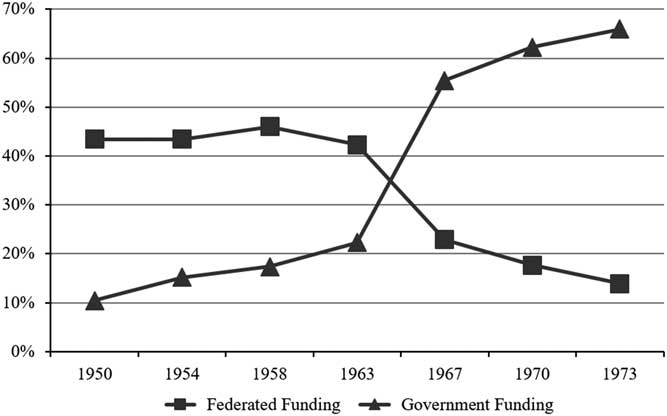
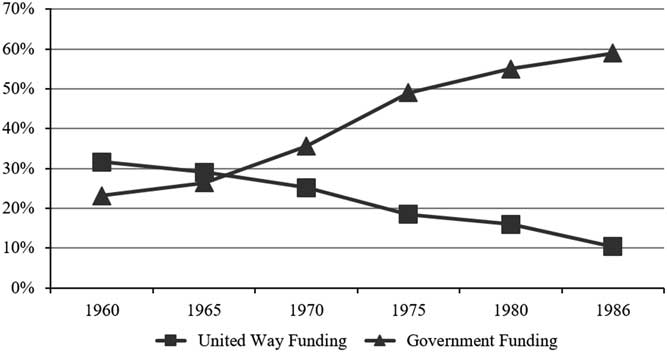
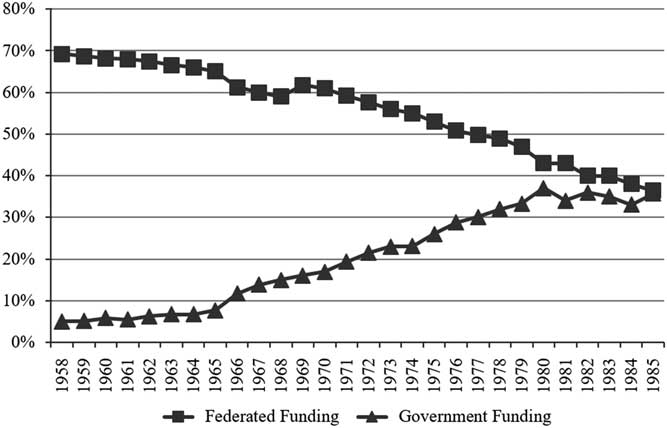
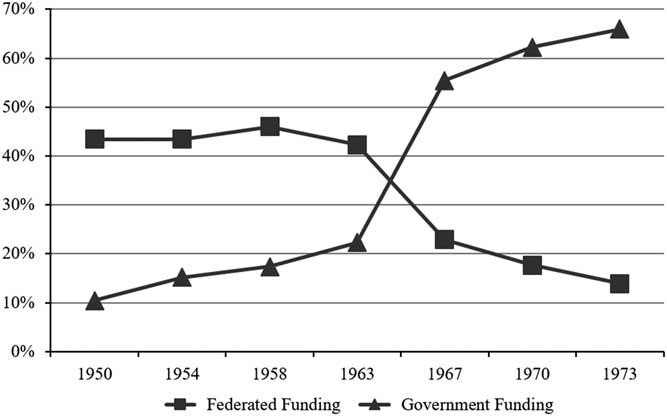
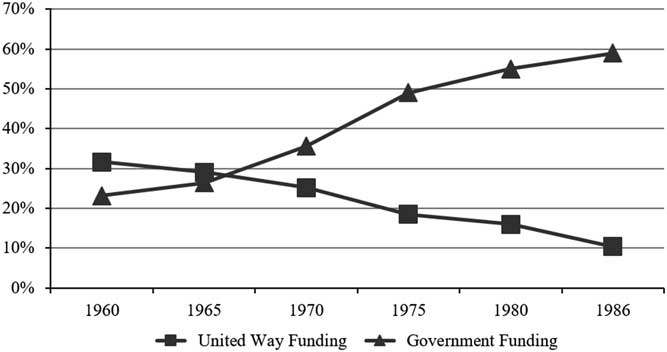
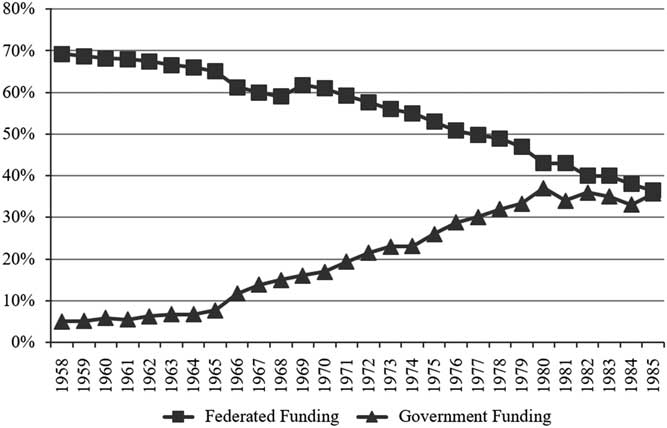
Because of its distinctive effects, deficit financing had long been connected to a status quo arrangement, in which “community planning bodies … merely ‘split up the pie in the same old way,’ innovating only with what new funds were available over and above this usual allocation” (Warren Reference Warren1965: 122). By the mid-1960s, the status quo was no longer sustainable, as the massive new pool of resources (see Figures 5–7) emboldened United Way–affiliated agencies to lobby for changes in the deficit financing system (note the highly symmetric appearance of the graphs in Figures 5–7, which shows that government funding was the primary source of new agency revenue). For example, the allocations committee of the United Fund of Philadelphia reported in 1961 that it was experiencing “pressures to retreat from [its] deficit financing role” due to grants issued by the Philadelphia municipal government (United Fund of the Philadelphia Area 1961: 3).Footnote 12 As another example, the Community Fund of Chicago began acquiescing to mounting agency agitation for greater independence as early as 1965, when the board decided to allow member agencies to retain $5,000 in year-end operating surplus (Community Fund of Chicago 1965a) and to seek government funds for proposals under the Economic Opportunity Act without requesting permission beforehand (Community Fund of Chicago 1965b).Footnote 13
Federated and government funding of NLN-affiliated voluntary nursing agencies (percent of aggregate income). Source: For 1950 and 1954, National League for Nursing 1956: 577; for 1958, National League for Nursing 1960: 274; for 1963, National League for Nursing 1965: 70; for 1967, National League for Nursing 1969: 41; for 1970, National League for Nursing 1972: 189; for 1973, National League for Nursing 1975: 2. Note: The category “Federated Funding” includes sectarian groups such as the Jewish Federation, but the overwhelming majority of funds derive from the United Way and its predecessors.
United Way and Government Funding of CWLA-Affiliated Voluntary Agencies (percent of aggregate operating income). Source: For 1960–75, Shyne Reference Shyne1978: 14; for 1980, Child Welfare League of America 1981: 5, 9; for 1986, Malm and Maza Reference Malm and Maza1988: 10, 24.
Federated and government funding of FSAA-affiliated voluntary agencies (percent of aggregate income). The category “Federated Funding” includes sectarian groups such as the Jewish Federation, but the overwhelming majority of funds came from the United Way and its predecessors. Source: For 1958–79, FSAA: various years; for 1980–85, Wellford and Gallagher Reference Wellford and Gallagher1988: 67.
Events in Philadelphia and Chicago reflected general trends, as evidenced by a manual on best practices for securing nonfederation income released by the United Way national headquarters in 1965. Acknowledging that “government is increasingly following the practice of making project grants to voluntary organizations” and that “agencies need more incentive for securing increased income from [non-United Way] sources,” the report encouraged local affiliates to “make agreements that would enable high priority or ‘growth’ agencies to have the direct benefit of all or part of such increased income” (United Community Funds and Councils of America 1965a: 10–11). Shortly thereafter, the national United Way organization established the Management and Community Studies Institute (MACSI) to guide federations through the transition to means of planning and allocations besides deficit financing (United Way of America 1977: 224).Footnote 14
By the mid-1970s, decentralization in financial federation networks was readily acknowledged and very clearly attributable to the influx of government funding for social welfare, as indicated by a 1974 memorandum circulated by the director of the United Way of Buffalo and Erie County:
Historical conditions and funding patterns have changed significantly, especially during the past two decades, with the emerging role of government in financing and providing community services a dramatic feature…. Given these circumstances, United Ways elsewhere have begun experimentation with alternatives to classic deficit financing. (Rabinowitz Reference Rabinowitz1975: 562)
In the same year, executive Stephen F. Keating proclaimed at a major organizational conference that “no longer can we shut our eyes to the fact of all the [non–United Way] dollars” and called for greater acceptance of the new situation:
At one time, our own movement lived and died on certain “truths” — “One campaign once and for all”; “Family of Agencies”; and “The Deficit Financing Principle.” In simpler times with lesser needs and smaller amounts of money involved, these immutable fundamentals were indeed real and practical. But I believe most of us would grant that new attitudes are emerging among most community leaders today. (Keating Reference Keating1979: 22)
There is no central and comprehensive archive of local budgeting manuals allowing for an analysis of how decentralization in budgeting policies diffused across the country over time. However, general purpose budgeting manuals published by the United Way headquarters and its predecessors confirm that major changes in budgetary policy had occurred by the mid-1970s. Whereas the 1931, 1942, 1955, and 1967 manuals treat the budget-balancing allocation essentially as orthodoxy (see note 10), the 1975 manual mentions deficit financing as one option among other allocation policies and also signals a reduction of other restrictions. For example, earlier manuals treat the remission of surplus revenue as standard practice, but the 1975 edition states that “in some instances, amounts accrued from unexpended appropriations and unanticipated revenues are transferred at year-end to a reserve fund, rather than treated as surpluses” (United Way of America 1975: 21; emphasis added).Footnote 15 The 1975 manual makes no mention of policies concerning individual fundraising, again suggesting substantial diminution of control over member agencies. Indeed, executive Paul Akana states in a memorandum circulated in 1976 that the latest manual indicates greater awareness of “the reality that agencies are independent, autonomous, separately organized entities—not only free to make their own decisions but perfectly capable of doing so” (Akana Reference Akana1979: 45).
In summary, the stability of deficit financing was predicated on a social context in which the Community Chest, or later the United Way, stood as a dominant financial player in the voluntary human services. The War on Poverty dramatically altered this social context, compelling the United Way to allow and even encourage member agencies to pursue government grants and contracts to remain a relevant player in the human services sector. However, supporting agencies in their pursuit of government funding required that United Ways compromise on traditional budgetary conventions of deficit financing to incentivize the acquisition of nonfederation revenue.Footnote 16
The lead alternative to deficit financing was a more market-oriented purchase-of-service system, whereby a local United Way would tie funding to specific services proposed or rendered. Because under purchase-of-service local affiliates would fund services rather than support balanced budgets for entire organizations, it followed that member agencies would be freer to fundraise and plan programs individually rather than restrain their autonomy as administrative units in a community welfare hierarchy. A local United Way would act more like a standard, community-based grantmaker, one funder among many in a larger philanthropic market and grants economy.
Discussion
The study of the nonprofit sector has been animated by a theoretical trinity of social domains in which the community stands for solidarity and grassroots organizing, the state symbolizes hierarchical control, and the market signifies competitive self-interest. Furthermore, the assignment of NPOs to the realm of community is not merely an analytical distinction. Because these organizations have long been thought to encapsulate civic vitality and social capital, their association with community dynamics reflects strong intellectual and ideological attachments to institutional expressions of voluntarism and communitarianism. As a result, government funding of NPOs receives special attention for the same reason that NPO reliance on service fees does: The blurring of sectoral boundaries causes concern over the loss of the nonprofit sector’s unique character and function.
With respect to government funding, concerns about the loss of nonprofit character entail an organizational level of analysis and implicitly presume a history of autonomous, voluntary action contrasting strongly with the state’s centralized instruments of control. Yet historical analysis is conspicuously wanting in this area of inquiry, and an understanding of nonprofit organizational character must consider the web of interdependencies in which all organizations operate. To advance a farther-reaching perspective, this article provides an overview of the emergence and decline of centralized finance in charitable interorganizational networks, specifically in the flagship philanthropic institution of the Community Chest. By adopting a historical and interorganizational frame of reference, I can scrutinize foundational assumptions about NPO behavior that inform present-day notions of normative state–nonprofit relations.
To review, I have shown that the community orientation of the nonprofit human services sector has been perfectly accommodating of hierarchical administrative structures. Faced with an intractable conflict between organizational autonomy and the ideal of intensive interorganizational cooperation, the Community Chest accomplished centralized service coordination by establishing resource dependence in the name of consensus and cohesion, using monetary incentives to manage tensions between independence and cooperation. I have also shown that the marked increase in government funding for social welfare beginning in the 1960s dramatically altered the resource environment of voluntary human service agencies, rendering centralized control through financial federation increasingly untenable. This last finding leads to a rather contrarian conclusion: In this particular historical case, government funding promoted nonprofit independence by undermining the authority exercised by local community institutions.
Implications
Although this article provides new historical dimension to organized charity in American society and challenges the narrative about the effect of government funding on NPOs, I have not presented any groundbreaking discoveries from the perspective of organizational theory. Instead, I have simply demonstrated that NPOs are subject to fundamental and uncontroversial rules of resource dependence in interorganizational relations. Emphasizing the resource environment and the conditions attached to resource flows rather than the presumed institutional significance of funding sources as posited by the state-market-community triptych, we find that public money can increase management discretion given the proper social context.
The major theoretical takeaway, then, is that the tendency to describe the nonprofit sector in lofty terms as a conduit for a community logic has obscured grounded organizational principles that have proven their predictive merit. A more conventional resource dependence perspective helps to normalize NPOs as agentic actors struggling to secure the resources and legitimacy that they require to survive in competitive and evolving environments (cf. Bromley and Meyer Reference Bromley and Meyer2017). Here I echo Nicole Marwell’s argument that scholars have focused excessively on community-based organizations as local sites of individual socialization and community integration while not paying enough attention to how these organizations are “actors embedded within broader economic and political fields” (Marwell Reference Marwell2007: 24). Likewise, the tendency to associate government funding with state domination has caused authors to overestimate the controlling influence of this resource stream while underestimating the transaction costs linked to other sources of funding.
Notably, there is growing attention to how private benefactors are driving agendas of community development (e.g., Arena Reference Arena2012; McQuarrie Reference McQuarrie2013), constituent representation (Levine Reference Levine2016), and public agency policy (Suárez and Esparza Reference Suárez and Esparza2015). This research presents an opportunity for scholars of nonprofit organizational behavior to take fuller account of how large private stakeholders may match or even exceed their public-sector counterparts in shaping the goals and strategies of grantees (Small Reference Small2006: 278). Greater sensitivity to the controlling influence of foundations, corporations, and other private grantmakers would enable a more nuanced community-level perspective on interorganizational relations in social welfare planning and provision.
An additional takeaway from this article follows a tradition of critical literature addressing the romanticization and theoretical underspecification of community (Brint Reference Brint2001). Because social scientists have shown a perennial tendency to sentimentalize local community dynamics (Thomson Reference Thomson2005), there is an ever-growing body of scholarship reminding us to take proper account of communities as incubators of hegemony. However, power in community settings is often conceptualized politically in terms of elite decision making or the pluralist jostling of local interest groups (see Collins Reference Collins2010) rather than in terms of emergent organizational processes stemming from the complexity inherent in collective undertaking. Indeed, to the extent that community chests have been discussed as instruments of social control, authors have concentrated on how elites at the helm of the movement determined the legitimate institutional parameters of charity by directing funds to those organizations that “reflected both the conservative interests of the business community and that appealed to the general population” (Barman Reference Barman2006: 23).Footnote 17 Of course, this aspect of control is extremely important, but focusing on it exclusively suggests that chests exercised their influence by withholding funds from specific organizations. As I have shown, the act of allocating funds played an equally important role in maintaining community control, specifically regarding the administrative project of building programmatic cohesion among autonomous charities.
This article invites us to consider how mechanisms of community control arise both politically through the competitive clash of interest groups or through the domination of elites and administratively through the unavoidable organizational complications of maintaining collectivity. Insofar as community involves a meaningful degree of cohesion among autonomous actors with particular agendas and priorities, hierarchy and domination will arise in part to manage the complexity inherent in orchestrating such integration. In this way, social control is integral to community, not just as a political eventuality but also as an organizational necessity.