Antimicrobial de-escalation, defined as narrowing antimicrobials according to spectrum of activity or stopping antimicrobial therapy completely, is a central tenet of antimicrobial stewardship (AMS). Reference Dellit, Owens and McGowan1 The principle is to target pathogens while limiting antimicrobial activity against nonpathogenic flora. Prolonged and/or unnecessary antibiotic use contributes to the development of antimicrobial resistance, adverse effects, and Clostridioides difficile infection (CDI). Reference Dellit, Owens and McGowan1,Reference Masterton2
Although assessing the impact of de-escalation remains paramount to AMS efforts, defining de-escalation can prove challenging. Reference Weiss, Zahar and Lesprit3 Defining de-escalation often requires chart review, although some automated methods have been pilot tested. Reference Moehring, Ashley and Davis4 Prior studies either focus on stopping specific antibiotic classes, such as agents targeting methicillin-resistant Staphylococcus aureus (MRSA) or Pseudomonas aeruginosa (PSAR), or group antibiotics into broad categories based on general spectrum of activity. Reference Moehring, Ashley and Davis4–Reference Kollef, Morrow and Niederman6 Although these methodologies approximate de-escalation, they fail to account for the full spectrum of activity provided by an antibiotic regimen, which has important implications for both the human microbiome and local resistance patterns.
Recently, spectrum scores have been used to quantify the antimicrobial spectrum of individual antibiotics. Reference Gerber, Hersh, Kronman, Newland, Ross and Metjian7 Accordingly, changes in daily spectrum score can be assessed to delineate both de-escalation and escalation; however, how this methodology compares with a “traditional” definition of de-escalation is unknown. The purpose of this study is to compare spectrum-score–based de-escalation to traditional de-escalation, defined as cessation of antimicrobials targeting PSAR or MRSA.
Methods
This study is a secondary analysis of a retrospective cohort study of patients admitted to Barnes-Jewish Hospital with nosocomial pneumonia between January 1, 2016, and December 31, 2019. Reference Ilges, Ritchie and Krekel8 Patients were enrolled if they met prespecified criteria for nosocomial pneumonia (Supplementary Appendix online). The index date of pneumonia diagnosis was labeled day 0, and all patients had to have had active orders for either anti-MRSA and/or anti-PSAR antibiotics on day 1 of study to be included. Patients were excluded if they were discharged or died prior to day 3 or if they met criteria for pneumonia within 48 hours of hospital admission.
Pharmacy-verified antibiotic orders of interest were captured for each day of admission. Anti-MRSA agents included vancomycin, linezolid, telavancin, tigecycline, and ceftaroline, and anti-PSAR antibiotics included all agents active against PSAR, excluding aminoglycosides. Spectrum scores were computed using a modified version of the Antimicrobial Spectrum Index. Reference Gerber, Hersh, Kronman, Newland, Ross and Metjian7,Reference Ilges, Ritchie and Krekel8 Spectrum scores were calculated for antibiotics ordered on day 0 and for each successive day following the index date of pneumonia diagnosis. When multiple antibiotics were ordered, the spectrum score of the respective agents were summed into a composite score. For example, a patient on vancomycin and cefepime received a score of 12 (7 points for cefepime plus 5 for vancomycin). The full details of the scoring system are available in the Supplementary Appendix (online).
Patients were divided into groups based on 2 definitions of de-escalation. Spectrum-score–based de-escalation was defined as any reduction in spectrum score on day 3 compared to day 1, and traditional de-escalation was defined as cessation of anti-PSAR or anti-MRSA therapies on day 3 compared to day 1. Patients not meeting these definitions of de-escalation were defined as non–de-escalation patients.
The performance of spectrum-score–based de-escalation was compared to traditional de-escalation as the reference standard. Clinical outcomes included in-hospital, 14- and 30-day mortality, 30-day readmission for pneumonia, antibiotic days, and new-onset CDI up to 90 days after admission.
Categorical variables were compared using the χ2 test. Continuous variables were compared using the Mann-Whitney U test. Positive percent agreement (PPA), negative percent agreement (NPA), positive predictive value (PPV), and negative predictive value (NPV) were calculated using standard methods. The 95% confidence intervals (CIs) were calculated using the Clopper-Pearson and standard logit methods for PPA/NPA and PPV/NPV, respectively. Significance was defined as a P value <.05. All data were analyzed using SPSS Statistics version 28 software for Windows (IBM, Armonk, NY).
Results
In total, of 1,812 patients meeting the enrollment criteria for nosocomial pneumonia were included in the study. Most patients had a diagnosis of hospital-acquired pneumonia (60.8%), and the remaining patients had ventilator-associated pneumonia. Figure 1 shows a comparison of de-escalation groups by classification method over time. More patients were classified as de-escalated using the spectrum-score–based method compared to the traditional method: 786 of 1,812 spectrum score (43.4%) versus 585 of 1,812 traditional de-escalation (32.3%). Traditional de-escalation resulted in a more substantial relative reduction in median spectrum score on day 3 vs day 1 compared to spectrum-score–based de-escalation: 64% vs 53%, respectively (Supplementary Table 1 online).
Mean spectrum scores over time by de-escalation definitions.

Percent Agreement of De-escalation Definitions

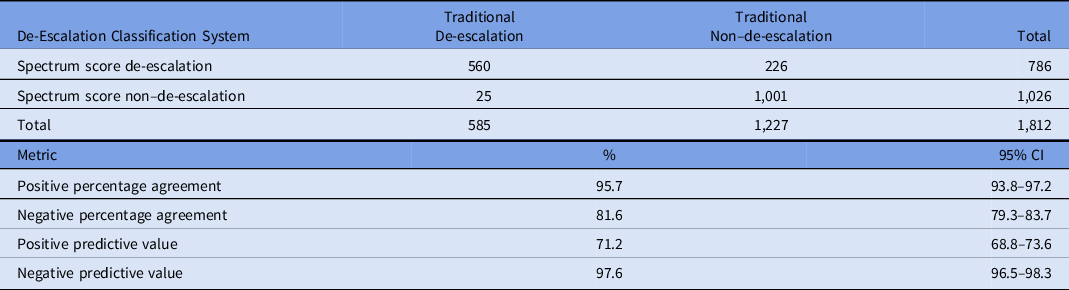
The performance of spectrum-score–based de-escalation compared to traditional de-escalation is shown in Table 1. Spectrum-score–based de-escalation had a high PPA (95.7%) and subsequently high NPV (97.6%) compared to traditional de-escalation. The NPA was 81.6% and the PPV was 71.2%.
Clinical outcomes are shown in Supplementary Table 2 (online). Outcomes were similar between de-escalation and non–de-escalation groups regardless of de-escalation classification, except antibiotic days from day 0 to 28, which was statistically significantly lower in the de-escalation cohort compared to the non–de-escalation cohort in both definitions: a median of 9 days de-escalation vs 11 days non–de-escalation (P < .001 for both comparisons). To 90 days after discharge, CDI was statistically significantly more likely among non–de-escalation patients compared to de-escalation patients in the spectrum-score–based grouping, but not in the traditional grouping.
Discussion
In this large cohort of patients with nosocomial pneumonia, spectrum-score–based de-escalation demonstrated a 95.7% PPA and 81.6% NPA versus a traditional definition of de-escalation. The high PPA and corresponding NPV of 97.6% indicate that this spectrum-score–based methodology is highly sensitive to detect de-escalation, at least when compared to stopping anti-MRSA or anti-PSAR antibiotics. Spectrum-score–based de-escalation may be considered a more comprehensive methodology for assessing changes to antimicrobials because smaller changes in antimicrobial spectrum can be accounted for as contributing to de-escalation.
Defining antimicrobial de-escalation is of considerable importance when operationalizing and refining AMS practices, as well as assessing programmatic improvements in utilization trends. An ideal definition of de-escalation would be objective, reproducible, clinically relevant, and easily applicable to both retrospective and prospective research. The lack of such a definition may be contributing to ambiguity regarding the benefits of de-escalation. The spectrum-score–based de-escalation definition outlined in this report appears to satisfy these criteria, but additional research is needed to confirm its reproducibility and clinical relevance.
The impact on patient flora is an important consideration when prescribing antibiotics because the risk of CDI varies by antibiotic class and spectrum of activity. A recent study by Brown et al Reference Brown, Langford, Schwartz, Diong, Garber and Daneman9 illustrates the relative risk of CDI by antibiotic regimen. Among 7-day courses of antibiotics with similar indications, broader-spectrum antibiotics, such as moxifloxacin (spectrum score, 9), ciprofloxacin (spectrum score, 7), and clindamycin (spectrum score, 4), resulted in significantly more cases of CDI than narrower-spectrum comparators such as amoxicillin (spectrum score, 2), nitrofurantoin (spectrum score, 0), and cloxacillin (spectrum score, 1). Reference Brown, Langford, Schwartz, Diong, Garber and Daneman9 Our findings are consistent with these data in that we detected a difference in CDI cases when de-escalation was defined by a reduction in spectrum scores but not by the traditional method. Accordingly, accounting for spectrum score may help inform prescribing decisions (all other factors being equal), although additional studies are needed to fully elucidate the utility of spectrum scores in predicting CDI.
Beyond assessing de-escalation and facilitating real-time antibiotic prescribing decisions, changes in spectrum score may also help identify escalations in antimicrobial therapy and prompt AMS intervention. To this end, spectrum-score systems can be embedded within electronic health records and calculated in real time. Rule-based systems may then be built to flag based on criteria informed by spectrum scores (eg, spectrum score increase > x points in 24 hours), which could inform prospective audit-and-feedback workflows. Cumulative spectrum score (summed by patients per unit per clinic per period time) could be used to measure antibiotic utilization, combining both utilization and relative spectrum of antibiotic prescribing. Yarrington et al Reference Yarrington, Wrenn, Spivey, Sarubbi, Anderson and Moehring10 recently showed how spectrum scores can illuminate antimicrobial prescribing patterns across space and time; higher-spectrum regimens were more commonly started overnight and on the weekends.
This study had 2 noteworthy limitations. First, spectrum-score–based de-escalation was compared to stopping broad-spectrum antibiotics, which is an imperfect reference standard. Future studies comparing spectrum-score methodologies to clinician assessment of de-escalation could further validate the utility of this technique. Second, we used fixed time points (ie, day 3 vs day 1) to assess changes in antimicrobial therapy. In theory, this allowed a day for teams to “settle” on an empiric regimen and 3 days for culture results to return and de-escalate therapy, but patients meeting criteria for de-escalation on or after day 4 would have been classified as non–de-escalation.
In sum, these data show that a spectrum-score–based method of defining de-escalation is a sensitive measure compared to a clinical reference standard. Further studies are needed to gain additional insights regarding the potentials of implementing spectrum score into routine clinical practice.
Supplementary material
To view supplementary material for this article, please visit https://doi.org/10.1017/ice.2022.207
Acknowledgments
The authors recognize Ryan Stevens, PharmD for his thoughtful review of the manuscript and editorial advice.
Financial support
No financial support was provided relevant to this article.
Conflicts of interest
All authors report no conflicts of interest relevant to this article.