Overview
Evidence that DNA and enzymes can be utilized to engineer high-performing materials stems from three main sources: (1) the study of biominerals (such as bones and seashells),Reference Mann1–Reference Weiner and Addadi4 which are nature’s proof of principle that high-performing ceramic composites can be produced from DNA-encoded processes; (2) the development of methods for designing new biomolecular-mineral interactionsReference Dickerson, Sandhage and Naik5–Reference Sarikaya, Tamerler, Jen, Schulten and Baneyx8 and demonstrations of the utility of these methods toward (for example) genetically engineering electronic devicesReference Dang, Yi, Ham, Qi, Yun, Ladewski, Strano, Hammond and Belcher9–Reference Nam, Kim, Yoo, Chiang, Meethong, Hammond, Chiang and Belcher12 and evolutionarily selecting semiconductor materials;Reference Bawazer, Izumi, Kolodin, Neilson, Schwenzer and Morse13 and (3) continuing innovations in DNA technologies,Reference Gibson, Glass, Lartigue, Noskov, Chuang, Algire, Benders, Montague, Ma, Moodie, Merryman, Vashee, Krishnakumar, Assad-Garcia, Andrews-Pfannkoch, Denisova, Young, Qi, Segall-Shapiro, Calvey, Parmar, Hutchison, Smith and Venter14,Reference Shendure and Aiden15 including advances in synthetic biology,Reference Cheng, Lu, Yarmush, Duncan and Gray16,Reference Channon, Bromley and Woolfson17 which are rapidly providing new toolkits for productively harnessing biomolecular systems.
Previous studies in biomineralization and biomimetic mineralization will be addressed, followed by a brief introduction to important biomolecular machines (i.e., ribosomes and polymerases) that are critical to cellular activity in natural and biotechnological systems. Advantages of DNA-based materials engineering approaches will then be introduced by way of comparison with robotic approaches to combinatorial materials discovery. Following this, key genetic engineering platforms will be presented, including polypeptide library screening,Reference Dickerson, Sandhage and Naik5,Reference Flynn, Lee, Peelle and Belcher6,Reference Sarikaya, Tamerler, Jen, Schulten and Baneyx8 nucleic acid library screening,Reference Rouge, Eaton and Feldheim7,Reference Feldheim and Eaton18 and in vitro compartmentalization.Reference Bawazer, Izumi, Kolodin, Neilson, Schwenzer and Morse13,Reference Tawfik and Griffiths19,Reference Griffiths and Tawfik20 The prospect of developing specialized synthetic biological toolkits for genetically evolving technology is discussed in the final section.
Biominerals and biomimetic materials chemistry
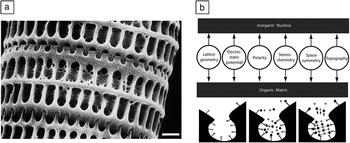
Biominerals are valuable model materials providing important lessons for synthesizing functional ceramic composites.Reference Mann1–Reference Weiner and Addadi4 They are highly diverse in their chemical compositions, structures, and functions. Examples of unique biomineral qualities include: increased fracture toughness in CaCO3-based red abalone shell by more than 3,000 times the geologic mineral, through the addition of a few percent of organics;Reference Belcher, Wu, Christensen, Hansma, Stucky and Morse21,Reference Heywood and Mann22 synthesis of single-crystal magnetite nanoparticles by bacteria, which feature tightly controlled sizes and are dominated by high energy crystal facets;Reference Meldrum, Mann, Heywood, Frankel and Bazylinski23,Reference Komeili24 fabrication of diatom silica cell walls, which are three-dimensional silica microforms with highly intricate nanopatterned structures (Figure 1a);Reference Morse3,Reference Hallegraeff25,Reference Hildebrand26 the formation of complex shapes from single-crystal calcite (CaCO3), resulting in structures that behave, for example, as optical lenses;Reference Aizenberg, Tkachenko, Weiner, Addadi and Hendler27 mineralized appendages in some marine crustaceans, composed of both calcium phosphate and calcium carbonate, which behave like highly damaged tolerant “hammers;”Reference Weaver, Milliron, Miserez, Evans-Lutterodt, Herrera, Gallana, Mershon, Swanson, Zavattieri, DiMasi and Kisailus28 and the utilization of brittle silica as the main component in flexible woven structures forming the skeletons of certain sea sponges.Reference Aizenberg, Weaver, Thanawala, Sundar, Morse and Fratzl29 Biomineral systems characteristically exhibit hierarchical architecture from the nanoscale to the micro- or macroscale, and include organic additives as important structural components (Figure 1). Relevant additives include a variety of biopolymers such as proteins and sugars, and can further include small organic species such as phospholipids.Reference Mann1,Reference Meldrum and Colfen2 These additives both control mineral formation and contribute to composite properties. Lessons garnered thus far from biomineral structure and function have inspired new strategies for modern materials engineering.Reference Studart30–Reference Brutchey and Morse32
(a) One of many examples of fascinating biominerals observed in nature. This is a silica diatom frustule (i.e., an intricate silica cell wall in single-celled algae) exhibiting hierarchical patterning from the nano- to microscale. Scale bar = 3 μm. Electron micrograph taken by G. Hallegraeff. Reprinted with permission from Reference 25. © 1988 CSIRO. (b) Simple schematics highlighting important mechanisms by which organic species control biomineralization, including (top) molecular recognition (i.e., matching of bonding patterns between the organic and inorganic phases) and (bottom) surface sequestration of metal species from solution to introduce localized supersaturation to initiate mineral nucleation. Schematic adapted with permission from Reference 1. © 2001 Oxford University Press.

The complexity found in biomineral structures is particularly significant considering that analogously complex inorganic materials serve as the basis of modern technology. In contrast to the formation of biominerals in places such as the cool environs of ocean water, today’s industrial environments still rely, some 164,000 years after the first technological use of fire,Reference Brown, Marean, Herries, Jacobs, Tribolo, Braun, Roberts, Meyer and Bernatchez33 on the application of heat as the main strategy for synthesizing functional inorganic materials. Thus, the prospect of mimicking biomineralization offers incentives in reducing the energy required for material synthesis, which can provide benefits in terms of both cost and environmental sustainability. Further, over the past three decades, materials scientists have been eager to uncover self-assembly and phase transformation strategies used in constructing these biological composites, hoping to expand the repertoire of available techniques for producing the next generation of self-assembled nanomaterials.Reference Mann34–Reference Song and Coelfen37
Since organic macromolecules are critical tools for biomineralization, a great deal of effort has focused on elucidating the physical and chemical mechanisms involved in organic-mineral interactions. Biopolymers can serve as organized and dynamic mineralization templates, often self-assembling to form higher-order scaffolds.Reference Mann1,Reference Brutchey and Morse32 Organic surface chemistries interact with metal species dissolved in aqueous media to increase local supersaturation and induce mineral nucleation in a site-specific manner. These nucleation sites, in turn, are molecularly configured to recognize (e.g., through electrostatic and stereochemical matching) specific crystal faces or compositional phases of the resulting mineral (Figure 1b).Reference Mann34 Through these interactions, biopolymers can control a crystal’s phase and orientation, morphology and alignment, and surface roughness and reactivity (e.g., toward adhesive integration into the overall composite).Reference Mann1,Reference Meldrum and Colfen2
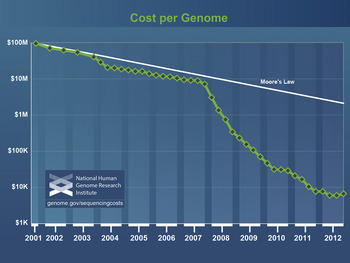
The majority of work in biomimetic materials chemistry has been conducted from a physical-chemical perspective, utilizing natural biopolymers or synthetic biopolymer surrogates as mineralization-influencing additives.Reference Meldrum and Colfen2,Reference Song and Coelfen37,Reference Nudelman and Sommerdijk38 A variety of organic reactants have been utilized in such studies, ranging from small molecule surfactants to large synthetic polymers. Similar studies focus on natural mineralizing biopolymers, which are usually obtained through purification from a living system or from biotechnological production as a single protein variant. An additional but less widely utilized set of strategies has focused on biomolecular engineering. It has proven possible to manipulate DNA sequence information and thereby influence subsequent in vitro (i.e., test tube-based or non-cellular) mineralization events. A major appeal of this biomolecular engineering approach is that it focuses on the same nucleic acid information system that drives biomineral evolution in nature. Such genetic approaches to new materials deserve particular attention in light of recent rapid advances in DNA technologies. These advances are occurring at a historic pace, as highlighted in Figure 2, which shows that biotechnological innovations are occurring faster in some respects than materials innovations for electronic technology. In this figure, genome-sequencing cost is used as a proxy for progress in DNA technology, while Moore’s law (which states that the number of transistors in an integrated circuit will double about every two years) is a proxy for progress in electronic materials. The steep drop in sequencing cost beginning in 2007–2008 corresponds to the commercial introduction of new technologies for sequencing DNA.
Summary of data from the National Human Genome Research Institute highlighting the rapid innovation of DNA technology by comparing changes in the cost to sequence a single human genome to Moore’s law. Reprinted with permission from Wetterstrand KA. DNA Sequencing Costs: Data from the NHGRI Genome Sequencing Program. Available at: www.genome.gov/sequencing costs. Accessed March 30, 2013.

While much progress has been made from studying physical-chemical aspects of biomimetic mineralization, important hurdles remain: most generally, the challenge of flexibly integrating nanoscale mineralization events into well-defined, hierarchically ordered, and high-performing macroscale products. As has been recently pointed out, a key missing link toward achieving such synthetic structures is the ability to mimic the far-from-equilibrium biochemical networks that drive biology.Reference Mann35 While achieving this level of biomimicry in completely synthetic materials is a valuable and challenging goal, it is very possible that this goal might ultimately be achieved by utilizing biology’s own resources. Synthetic biological advances offer exciting opportunities for directly evolving a new generation of hybrid materials.
Biopolymerization
Ribosomes are fascinating molecular machines composed of RNA and proteins that universally operate within cells to synthesize new proteins from genetic information (“protein expression”). The ribosome operates on two biopolymers simultaneously: It reads a strand of RNA while synthesizing a polypeptide. The RNA strand is pulled through the ribosome like a tape. As triplet sets (or “codons”) of A (adenine), U (uracil), C (cytosine), and G (guanine) components (e.g, AUG) become positioned at a key binding site within the machine, a certain amino acid specified by the positioned codon (e.g., AUG = methionine) is added to the growing polypeptide chain, which dynamically emerges from a different ribosomal site. The specific details of this process are beyond the scope of this article, and the interested reader is referred to a wealth of information available on this and other molecular biological processes.39–Reference Kim, Ganesan, Yang, Kulak, Borukhin, Pechook, Ribeiro, Kroeger, Eichhorn, Armes, Pokroy and Meldrum43
The key point here is that ribosomes and polymerases, which can polymerize new complementary strands of RNA or DNA from a DNA template, as well as a host of other useful biomolecular machines, are all readily available from nature to be used by biomolecular (and materials) engineers for new laboratory processes. If we are to “black box” the biomolecular details (as synthetic biologists are wont to do44), we can further summarize the above (already simplified) biomolecular process of protein expression as DNA in Ò protein out. A second key point is that DNA is becoming easier and cheaper to design, synthesize, manipulate, and insert into biomolecular “soups” that read it and synthesize proteins from it.Reference Gibson, Glass, Lartigue, Noskov, Chuang, Algire, Benders, Montague, Ma, Moodie, Merryman, Vashee, Krishnakumar, Assad-Garcia, Andrews-Pfannkoch, Denisova, Young, Qi, Segall-Shapiro, Calvey, Parmar, Hutchison, Smith and Venter14,Reference Shendure and Aiden15,Reference Alberts, Johnson, Lewis, Raff, Roberts and Walter40,Reference Green and Sambrook42,Reference Rothe, Surjadi and Power45–Reference Gulati, Rouilly, Niu, Chappell, Kitney, Edel, Freemont and deMello47 In practice, these soups include the internal machinery of living cells such as yeast or bacteria, but may also include in vitro transcription/translation mixes, which are water-soluble cellular extracts (e.g., from E. coli bacteriaReference Rothe, Surjadi and Power45) that include the polymerases and ribosomes required for conducting protein expression. As emphasized in the following section, it is now rather straightforward to experimentally produce millions of DNA variants, each of which encodes a unique polypeptide. The genetic platforms described in later sections rely on combining such artificial gene pools with the biopolymerizing protein expression machinery summarized previously.
The evolutionary advantage of DNA-driven routes to new materials
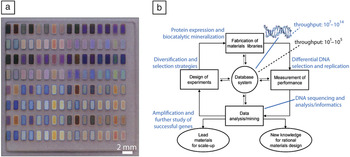
The key advantage of a biomolecular approach to hybrid materials synthesis is the potential to harness DNA-driven evolution. Conceptually, genetic evolution is a general algorithm for optimizing complex systems. Evolution is not strictly limited to biology, but rather concerns any information-driven process of change in which physical systems gradually acquire new environmentally adaptive characteristics over time. In fact, technological progress through history can be said to evolve in ways that broadly mirror natural biological evolution.Reference Ziman48,Reference Schick and Toth49 A large number of trial-and-error efforts are used to construct new materials, and information for building the most useful products is passed on to subsequent generations. While technological evolution utilizes human communication to propagate encoding information (through media that also evolved from spoken language to the printing press and Internet), biological evolution utilizes DNA as the encoding language. Initially inspired by the rapid trial-and-error processes facilitated by DNA systems,Reference Xiang, Sun, Briceno, Lou, Wang, Chang, Wallacefreedman, Chen and Schultz50 over the past two decades, a variety of laboratory-based materials evolution platforms have been developed in which combinatorial chemical reaction information is generated and stored in digital (i.e., computer-based) formats.Reference Potyrailo, Rajan, Stoewe, Takeuchi, Chisholm and Lam51 Populations of reactions or material elements are produced and screened with microfabrication or robotic systems (Figure 2).Reference Potyrailo and Mirsky52,Reference Richmond, Miras, de la Oliva, Zang, Sans, Paramonov, Makatsoris, Inglis, Brechin, Long and Cronin53 One of the first such examples of this approach involved vapor deposition of various metal precursors (Ba, Bi, Ca, Cu, Pb, Sr, and/or Y) through defined masks, leading to a combinatorial array of multi-metallic oxide structures (Figure 3a).Reference Xiang, Sun, Briceno, Lou, Wang, Chang, Wallacefreedman, Chen and Schultz50 The array was screened for material islands exhibiting superconducting behavior, which was found in films composed of BiSrCaCuO and YBaCuO. Many other types of combinatorial screens have since been employed to discover a wide range of materials, including metals, ceramics, and polymers.Reference Potyrailo, Rajan, Stoewe, Takeuchi, Chisholm and Lam51,Reference Potyrailo and Mirsky52 All such experiments share general design features in which exploration of reaction conditions is guided by database information stored in a computer (Figure 3b).
(a) One of the first examples of a platform for combinatorial materials discovery, explicitly inspired by the combinatorial power of biomolecular evolution.Reference Nudelman and Sommerdijk38 Each island is a material film, including a variable range of input metals (Ba, Bi, Ca, Cu, Pb, Sr, and/or Y) relative to the other islands. After metal deposition, the array was annealed to form solid oxides, which were then screened for superconducting properties. Reprinted with permission from Reference 50. © 1995 The American Association for the Advancement of Science. (b) Schematic of the modern approach to combinatorial materials development. Overlaid in blue are steps in biomolecular evolution that are analogous to the robot- and microfabrication-based summary shown in black. Adapted from Reference 52. © 2008 American Chemical Society.

Given the level of control currently possible over nature’s genetic code, DNA might now be considered a new medium for human language. This concept is underscored by the recent demonstration of a completely synthetic genome by Venter et al.Reference Gibson, Glass, Lartigue, Noskov, Chuang, Algire, Benders, Montague, Ma, Moodie, Merryman, Vashee, Krishnakumar, Assad-Garcia, Andrews-Pfannkoch, Denisova, Young, Qi, Segall-Shapiro, Calvey, Parmar, Hutchison, Smith and Venter14 In this work, the authors established a coding system that allowed them to include several quotes as combinations of A, T, C, and G in the synthesized genome (among these, “See things not as they are, but as they might be,” by OppenheimerReference Bird and Sherwin54). In the context of materials evolution, DNA offers four critical advantages as an information storage medium versus computer-based robotic screening platforms for materials discovery. These advantages are inter-related but can be identified separately. They include (1) superior screening throughput, (2) exploitation of biocatalytic performance, (3) gentle or “green” materials synthesis conditions, and (4) potential for orthogonal integration with other synthetic biological innovations as they emerge.
Superior screening throughput originates from the ease with which DNA information can be manipulated and expressed. In robotic screening systems, typical changes in a population involve adjustments in reactant input sources, levels, or combinations (e.g., changing the number and concentrations of input reagents between reaction wells). In DNA-driven screening, typical combinatorial changes involve adjustments to biopolymer chemistry. In the case of protein screening, changes at the DNA level can change the type or number of amino acids in the expressed protein (see the section on “Biopolymerization”), which changes the reaction potential of the protein. Amino acid changes exert effects by stabilizing or destabilizing secondary or tertiary protein structure or by introducing or removing bonding interactions (whether steric, electrostatic, hydrogen-bonding, or covalent) between the protein and a potential reactant (e.g., a mineral surface). Introduction of changes at the DNA level can be performed either through chemical synthesisReference Dang, Yi, Ham, Qi, Yun, Ladewski, Strano, Hammond and Belcher9,Reference Gugliotti, Feldheim and Eaton55 or through enzymatic operations on DNA in a test tube (e.g., by replicating DNA using a polymerase that is prone to error),Reference Arnold and Georgiou56 or by a combination of the two (e.g., by enzymatically fusing synthesized DNA fragments).Reference Gibson, Glass, Lartigue, Noskov, Chuang, Algire, Benders, Montague, Ma, Moodie, Merryman, Vashee, Krishnakumar, Assad-Garcia, Andrews-Pfannkoch, Denisova, Young, Qi, Segall-Shapiro, Calvey, Parmar, Hutchison, Smith and Venter14 Introduced diversity can be targeted to specific biomolecular regions (such as the active site of an enzyme) or randomized over the length of the biopolymer. Through these DNA-based approaches, it is straightforward to produce population diversities ranging from 107–1014 gene variants, depending on the particular biomolecular system used. In contrast, robotic and microfabrication approaches to combinatorial materials discovery are limited to screening from tens to thousands of conditions at most.Reference Potyrailo, Rajan, Stoewe, Takeuchi, Chisholm and Lam51 The throughput of DNA-based approaches is thus superior by several orders of magnitude (Figure 3b).
Some of the biocatalytic advantages of mineral synthesis are summarized in the previous section on biomimetic mineralization. Key biomolecular sites that interact with metals and induce mineralization have been described as functionally analogous to the active sites of enzymes;Reference Mann34 they stereochemically and electrostatically position substrates in dielectrically unique protein interiors to break or form specific bonds.Reference Benkovic and Hammes-Schiffer57 Some enzymes can catalyze in milliseconds reactions that, uncatalyzed, have half-lives longer than the age of the earth.Reference Wolfenden and Snider58 It is a result of this fine-tuned nanoscopic control and resulting biocatalytic power that complex inorganic composites (e.g., Figure 1a) can be synthesized from low temperature aqueous conditions. Biocatalysis and “green” synthesis are thus intimately connected. Genetic approaches should allow us to adapt material biocatalysis for synthesis of technological inorganic materials from water-based processes in laboratory and industrial settings. New biopolymers that are specifically evolved for materials engineering could then be incorporated with other synthetic biological innovations, a prospect that is further addressed in the final section of this article.
Platforms for genetically evolving biomolecule-material interactions
Biogenetic screening strategies all begin with diversification at the DNA level, but can vary in subsequent steps depending on the exact biomolecular library and material targets of interest. An initial DNA gene pool can be converted to libraries of RNA sequences, short polypeptides, or full proteins (e.g., enzymes), which are then directly screened for functionality. Alternatively, DNA genes can potentially be screened directly (i.e., without conversion to other biomolecular forms), thereby simultaneously contributing both information encoding and additional functionality. For example, many studies have developed DNA aptamers (i.e., specific target-binding sequences) for a range of small-molecule and biomolecular binding partners.Reference Wilson and Szostak59 In the context of materials research, thus far, only short polypeptides, RNA sequences, and enzymes have been screened to develop novel interactions with mineral targets. In the following subsections, these screening platforms will be summarized in order of evolutionary complexity at the level of material selection, moving from simple to the most complex criteria used for selection. The systems covered include screening of polypeptide libraries for mineral binding functionality,Reference Sarikaya, Tamerler, Jen, Schulten and Baneyx8,Reference Whaley, English, Hu, Barbara and Belcher60 screening of RNA libraries for material precipitation behavior,Reference Rouge, Eaton and Feldheim7,Reference Gugliotti, Feldheim and Eaton55 and screening of enzyme libraries for structured material synthesis.Reference Bawazer, Izumi, Kolodin, Neilson, Schwenzer and Morse13
Polypeptide screening with phage display and cell surface display
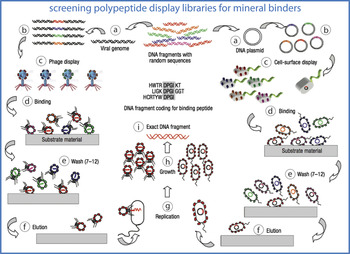
Biomolecular recognition is a key concept used in biology to construct complex three-dimensional structures such as biominerals.Reference Mann34 Shortly after biotechnology permitted new biomolecular recognition interactions to be developed (i.e., to evolve) in the laboratory, interest arose in utilizing these interactions for materials synthesis. The strategy was to first develop small biomolecules that bind tightly to inorganic targets, and then to use these biomolecules to direct inorganic nanocrystal assembly,Reference Sarikaya, Tamerler, Jen, Schulten and Baneyx8,Reference Whaley, English, Hu, Barbara and Belcher60–Reference Naik, Stringer, Agarwal, Jones and Stone62 thereby increasing the degree of nanoscale control that can be exerted in the construction of synthetic composites. The systems initially utilized in these efforts, following biotechnology that had been developed in the 1980sReference Smith63 and early 1990sReference Barbas, Kang, Lerner and Benkovic64 and that is still widely used, involved screening diverse libraries of short polypeptides. This screening technology relies on the synthesis of libraries of short strands of DNA molecules (less than 50 nucleotides in length), such that each individual DNA molecule’s sequence of A, T, C, and G components is generated at random (Figure 4).Reference Barbas, Kang, Lerner and Benkovic64 The synthesized set of randomized DNA is then recombined with (i.e., molecularly “stitched” into) a larger DNA sequence that does not vary, and that encodes a specific protein (Figure 4a). Each library gene then consists of a “carrier” protein sequence containing a particular short variant sequence of amino acids. Each library gene can be inserted into a respective single cell, within which many protein copies of that particular library sequence can be expressed (Figure 4b). Thus, each set of carrier proteins in respective cells exhibits the same structure as the carrier proteins in other cells, except for the short stretch of amino acids encoded by the variable DNA. Carrier proteins are chosen such that they present (“display”) the variable amino acid segment on a readily accessible region of a biological scaffold, such as at the surface of either a cell or a virus (“phage”) particle (Figure 4c).
An overview of phage-display and cell-surface-display polypeptide library screening to identify mineral-binding short polypeptides. (a) Chemical synthesis of random DNA library sequences; (b) insertion of the DNA library into genes encoding biological support structures; (c) expression of random polypeptides from library DNA sequences, such that the polypeptides are presented on the outside of virus particles (left) or cell surfaces (right); (d) exposure of the polypeptide library (via their biological scaffolds) to a target material; (e) non-binding polypeptides are washed away; (f) binding sequences are eluted (e.g., through more stringent wash conditions); (g) genes encoding mineral-binding polypeptides are replicated via viral infection (left) or cell replication (right); (h) DNA of individual mineral-binding polypeptide sequences are grown in high-copy number in viruses or cells and then (i) extracted and sequenced to determine the biochemical nature of the binding sequences. Reprinted with permission from Reference 8. © 2003 Nature Publishing Group.

The first examples of using such systems to select mineral-binding polypeptides were the use of a cell-surface display by BrownReference Brown65,Reference Brown66 and a phage display by Belcher et al.Reference Whaley, English, Hu, Barbara and Belcher60 In the case of a cell surface display, the support scaffold is a cell outer membrane protein, and in the phage display, the scaffold is a coat protein of a virus (i.e., a segment of the “protein shell” on the outside of a virus). Large populations of cells or virus particles, with each individual cell or particle displaying a unique set of short polypeptides, are exposed to the target material of interest (Figure 4d). Nonbinders are washed away (e.g., by immersing the virus-exposed material in a salt bath containing no viruses) (Figure 4e), tight binders are eluted (Figure 4f), and the DNA genes encoding these tight binders are amplified.Reference Sarikaya, Tamerler, Jen, Schulten and Baneyx8 The encoding DNA is physically associated with the scaffold system, either by being harbored within the associated cell or packaged inside the associated virus coat. Natural processes of either cell replication or viral infection are used to amplify the associated DNA (Figure 4g); viral infection involves the virus injecting its DNA into a cell, thereby commandeering cellular machinery to make new viruses. After multiple rounds of binding, washing, and amplification have been conducted to enrich a subset of tightly bound sequences, individual encoding DNA molecules can be scaled up (Figure 4h), extracted (Figure 4i), and sequenced to determine the corresponding polypeptide sequences.Reference Sarikaya, Tamerler, Jen, Schulten and Baneyx8,Reference Green and Sambrook42,Reference Whaley, English, Hu, Barbara and Belcher60,Reference Brown65
The evolutionary selection criterion utilized in this approach, tight binding of a polypeptide to a mineral surface, is simple relative to the selective screens described later (utilizing RNA and enzymes), but has thus far been taken the furthest toward synthesis of electronic devices.Reference Dang, Yi, Ham, Qi, Yun, Ladewski, Strano, Hammond and Belcher9,Reference Lee, Yi, Kim, Kang, Yun, Strano, Ceder and Belcher10,Reference Nam, Kim, Yoo, Chiang, Meethong, Hammond, Chiang and Belcher12 These devices are genetically encoded in the sense that at least one key material component is produced via DNA-encoded biomolecules, thereby permitting material (and thus device) properties to be changed by modifying the encoding DNA. For example, Belcher et al. have synthesized batteries,Reference Lee, Yi, Kim, Kang, Yun, Strano, Ceder and Belcher10,Reference Nam, Kim, Yoo, Chiang, Meethong, Hammond, Chiang and Belcher12 solar cells,Reference Dang, Yi, Ham, Qi, Yun, Ladewski, Strano, Hammond and Belcher9 and photocatalytic water splittersReference Nam, Magya, Lee, Kim, Yun, Park, Pollom, Weitz and Belcher11 with polypeptides isolated from phage display screening. This device biosynthesis did not involve the direct evolutionary selection of new material properties, but rather emerged from two key features of the phage system: (1) some of the short polypeptides, when incubated with relevant metal salts, provide a template for mineralization from solution,Reference Flynn, Lee, Peelle and Belcher6,Reference Feldheim and Eaton18,Reference Naik, Brott, Clarson and Stone67 and (2) mineralizing and material-binding polypeptides, once identified, can be controllably integrated via genetic engineering at various locations and in various copy numbers on the virus particle’s surface. By utilizing these features, nanoscale multi-phase inorganic composites can be constructed from virus templates. With this nanoscale control, structures can be formed that have not been demonstrated by other methods, such as the integration of well-dispersed carbon nanotubes (as electron carriers) in battery anodesReference Lee, Yi, Kim, Kang, Yun, Strano, Ceder and Belcher10 or in the mineral (TiO2) component of dye-sensitized solar cells.Reference Dang, Yi, Ham, Qi, Yun, Ladewski, Strano, Hammond and Belcher9 These new structures yield notable increases in materials performance.Reference Dang, Yi, Ham, Qi, Yun, Ladewski, Strano, Hammond and Belcher9,Reference Lee, Yi, Kim, Kang, Yun, Strano, Ceder and Belcher10
Screening RNA libraries for metal-precipitating sequences
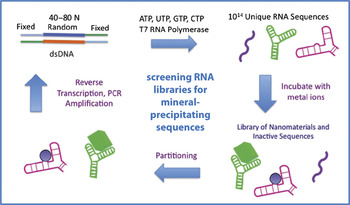
Gugliotti, Feldheim, and Eaton evolved RNA sequences that mediated metal reduction, resulting in precipitation of palladium nanoparticles from aqueous solution.Reference Gugliotti, Feldheim and Eaton55 Because this protocol utilized inter-conversion of DNA diversity with RNA diversity, only nucleic acid polymerases were needed as biomolecular machinery (i.e., no ribosomes were utilized for polypeptide synthesis). A DNA library (with a diversity of ∼1014) was generated by chemical synthesis and then converted to RNA utilizing RNA polymerases, as indicated in Figure 5. The RNA library was incubated with a palladium metal precursor, and successful metal-synthesizing RNA variants were recovered by isolating the precipitated nanoparticles by filtration and through particle-induced retardation of RNA gel migration. This particular strategy thus utilized RNA-mediated metal particle synthesis as a direct selection criterion (and also required tight binding of successful sequences to the synthesized particles). The pre-evolved starting pool of RNA produced precipitate under the reaction conditions studied, but the products were of undefined shape. After eight cycles of evolution (Figure 5), selected sequences were found to produce hexagonal nanoparticles, but it was unclear what specific selective pressures in the experiment contributed to this new particle morphology.Reference Gugliotti, Feldheim and Eaton55
Schematic summary of screening libraries of RNA sequences for specific sequences that induce precipitation of metal nanoparticles. Reprinted with permission from Reference 7. © 2011 Elsevier. Random DNA sequences are first produced through chemical synthesis and then converted to an RNA library with T7 RNA polymerase. After incubating the library with metal reactants, those yielding metal (e.g., palladium) nanoparticles are partitioned from non-functional background sequences (e.g., by pelleting the nanoparticles by centrifugation). Mineral-precipitating RNA sequences are converted back to DNA to amplify the functional sequences for further study.

In vitro compartmentalization
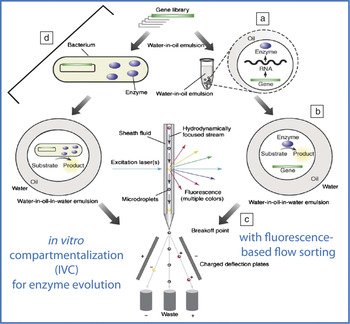
In vitro compartmentalization is an approach originally pioneered by Tawfik and Griffiths for conducting enzyme evolution outside the confines of living cells.Reference Griffiths and Tawfik20 In this method, diverse enzyme-encoding gene pools are added to an in vitro transcription/translation mix, which is then compartmentalized into water droplets in a water-in-oil emulsion (Figure 6a). Limiting dilution leads to partitioning of individual DNA molecules into distinct water droplets, and protein expression occurs in these droplets from the DNA templates. Enzyme activity then leads to a fluorescent signal within the droplet (Figure 6b), which can be isolated from non-fluorescent droplets using fluorescence activated cell sorting (FACS), a technique widely used to sort cells in biological research (Figure 6c). Droplets can also be used to encapsulate cells (Figure 6d)Reference Griffiths and Tawfik20 or plastic microbeads (Figure 7).Reference Bawazer, Izumi, Kolodin, Neilson, Schwenzer and Morse13,Reference Griffiths and Tawfik68
A general overview of two variations of in vitro compartmentalization (IVC). (a) In one IVC approach, the initial step involves emulsification of bacterial extracts in oil, thus forming artificial cells. (b) Biochemistry directed by a unique gene occurs within each droplet, including protein expression (e.g., of an enzyme variant) and activity of the expressed enzyme. (c) Active enzyme variants catalytically generate a fluorescent product. (d) In another approach to IVC, emulsion-compartmentalized cells are used to express and screen a protein library. In both IVC approaches, fluorescence activated cell sorting is used to fluorimetrically identify and sort those droplets bearing functional genes. This general approach has been mainly used to evolve enzymes catalyzing bio-organic reactions, but has been recently utilized to evolve inorganic materials as well (see Figure 7). Reproduced with permission from Reference 20. © 2006 Elsevier.

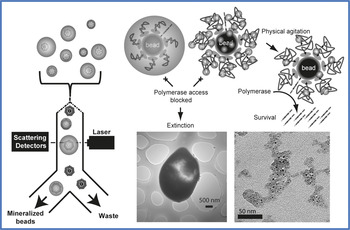
Schematic summary of a recent study in which in vitro compartmentalization was used to evolve new mineralizing genes. Adapted with permission from Reference 13. © 2012 National Academy of Sciences, U.S.A. Protein expression was conducted in water-in-oil emulsion droplets that included small plastic beads, leading to the coating of the beads with both genes and proteins from the diverse biomolecular library. The library was composed of variants of silicateins, a class of natural biomineralizing enzymes originally isolated from silica skeletons of marine sponges.Reference Bawazer, Izumi, Kolodin, Neilson, Schwenzer and Morse13,Reference Shimizu, Cha, Stucky and Morse71 Once coated with the silicatein variants, beads were mineralized via reactions with dissolved silicon or titanium species. Large beads were then sorted on the basis of light scattering. Among the sorted beads, only structures that allowed access to the DNA on bead surfaces ultimately survived. This introduced a selection pressure for a specific composite structure composed of small inorganic nanoparticles.

The ability to express enzymes in this droplet format is significant due to the unique biochemical activities that can be generated. Enzymes are 50 amino acids in length at minimum, and thus substantially larger than short polypeptides. Enzymes fold into precise three-dimensional shapes, presenting active site pockets that biochemically act on partner (substrate) molecules to efficiently break or form atomic bonds.Reference Wolfenden and Snider58 Three-dimensional enzyme structure formation on the nanoscale can further extend to higher-order constructs through self-assembly.Reference Murr and Morse69 Structural diversity is controlled by the primary amino acid sequence (and thus by the encoding DNA sequence) and presents huge potential for evolving new mineral-synthesizing biomolecular templates. Further, the impressive reaction rate enhancements associated with enzymes have not been achieved with polypeptides smaller than ∼10,000 kDa.Reference Hammes70 This suggests that a focus on enzyme evolution may be crucial for evolving highly complex systems in vitro.
Recently, in vitro compartmentalization has been utilized to evolve new silicon dioxide- and titanium dioxide-protein composites.Reference Bawazer, Izumi, Kolodin, Neilson, Schwenzer and Morse13 Silicateins, biosilica-synthesizing enzymes isolated from marine sponge skeletons,Reference Shimizu, Cha, Stucky and Morse71 were diversified to produce enzyme-encoding gene pools. Variant silicatein genes and expressed proteins were bound to the surface of plastic microbeads, which were also compartmentalized in the in vitro compartmentalization emulsion droplets. The enzyme-coated beads were then exposed to silicon- or titanium-containing mineral precursors, and enzymatic synthesis (i.e., silicatein-catalyzed hydrolysis of the precursors followed by silicatein-templated mineral deposition) occurred from surfaces of beads carrying active enzyme variants (Figure 7). Specific materials were selected by FACS, which allows the beads to be rapidly (∼10,000 beads per second) interrogated by light-scattering (in addition to fluorescence) to determine bead size and surface roughness (mineralized beads are larger and rougher than uncoated starting beads). Recovered genes from sorted beads were found to encode a composite structure of dispersed oxide nanoparticles on a self-assembled protein template. This structure was functionally relevant: it permitted, with gentle agitation of the beads, DNA polymerases to access the DNA on the bead surfaces, thus allowing gene replication to occur. This study demonstrated the first example of evolutionarily attaining a new inorganic material structure as a direct response to laboratory-defined environmental selection pressures.Reference Bawazer, Izumi, Kolodin, Neilson, Schwenzer and Morse13
Genetically evolved technology: A prospectus
Currently, the most mature and widely implemented approach for developing DNA-encoded materials is based on screening display libraries for mineral binding polypeptides (Figure 4).Reference Dickerson, Sandhage and Naik5,Reference Sarikaya, Tamerler, Jen, Schulten and Baneyx8,Reference Whaley, English, Hu, Barbara and Belcher60 Experimental reports and conceptual summaries detailing these approaches, while significant, remain focused on binding-based genetic screens. The opportunity for directly selecting material (and ultimately device-based) properties and performance from large populations of DNA-encoded structures has yet to be fully addressed. This key issue can be highlighted by considering the “partitioning” step indicated in Figure 5, in which laboratory-biomineralized materials are partitioned away from nonfunctional biomolecules. If the experimental goal was to select (for example) only subsets of metal particles with technologically valuable plasmonic properties for a specific application, how could the selection platform be redesigned? This general line of thinking motivated the silicatein evolution work with in vitro compartmentalization, which aimed to highlight the fact that function-based selections can be designed to evolve genetically tuned inorganic materials. In this case, the demonstrated evolved material (a mineralized shell around a plastic bead) and its function (remain stable during sorting and then readily fracture afterward to release encoding DNA) served only as a test case without direct electronic utility. In the future, how can such strategies be further improved, allowing technologically valuable materials and devices to be directly evolved with DNA? Solving this design challenge will be critical for the future development of genetically evolved technology.
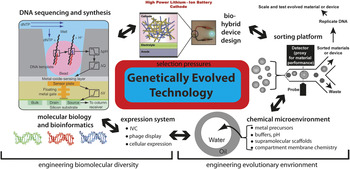
It is useful to classify developmental strategies toward new DNA-encoded materials into two broad categories: the engineering of biomolecular diversity, and the engineering of evolutionary microenvironments (Figure 8). Thus far, the tools available for addressing both of these categories have been primarily borrowed from biological and biomedical research. This available tool set is extensive, in terms of both biomolecular libraries (including DNA, RNA, short polypeptides, and enzymes; cellular and viral support structures; and bioinformatics tools for library construction), and screening and selection tools (such as bacterial culture methodsReference Green and Sambrook42 and FACSReference Herzenberg, Tung, Moore, Herzenberg and Parks72). An amazing breadth of work can be done at the biological-materials interface using this currently available tool set. However, to ultimately evolve semiconductor devices of the future, new materials-dedicated biotechnological systems must be developed. Input and investment from materials scientists most familiar with critical materials engineering and device performance issues will be required for the success of such cross-disciplinary efforts, in addition to the expertise of molecular biologists and biomolecular engineers.
A conceptual overview of basic experimental components that must be integrated to begin genetically evolving technology. The figure at the far left is a schematic overview of a recent semiconductor-based approach for rapidly sequencing DNA. Reprinted with permission from Reference 82. © 2011 Nature Publishing Group. New technologies for sequencing and synthesizing DNA will facilitate faster methods for producing library diversity and for characterizing genetically encoded materials. Beginning with known design parameters for hybrid (bioinorganic) electronic devices (e.g., the virus-encoded battery shown at the top) (Reproduced with permission from Reference 10. © 2009 The American Association for the Advancement of Science), it will be possible to build sorting instruments (far right) that differentially sort DNA-encoded materials based on device performance. Adapted with permission from Reference 13. © 2012 National Academy of Sciences, U.S.A. Each aspect of the presented workflow for genetically evolved technology would introduce some level of selection pressures on the final material. Future important challenges will involve controlling these pressures as much as possible such that the highest performing materials and devices can be evolved.

Given the vast resources already available for engineering biomolecular diversity, the area in need of the most development is the engineering of materials-specific evolutionary microenvironments. This will include the choice of chemical reaction environments (including the supplied metal precursor chemistryReference Feldheim and Eaton18,Reference Brinker and Scherer73 ), the selection of molecular scaffolds to support synthesis of higher-order structures (e.g., References 74 and 75), and the development of new controlled environmental pressures, for example in the form of cell sorting instruments that permit the differential reproduction of genes encoding only the highest performing materials. Only our imaginations limit the scope of such future instrumentation,Reference Bonetta76 which might include, for example, solar energy conversion-activated cell sorters or battery capacitance-activated cell sorters. The field of droplet-based microfluidics has already demonstrated flexibility in the development of sorting instrumentation.Reference Griffiths and Tawfik20,Reference Agresti, Antipov, Abate, Ahn, Rowat, Baret, Marquez, Klibanov, Griffiths and Weitz46,Reference Gulati, Rouilly, Niu, Chappell, Kitney, Edel, Freemont and deMello47 The controlled, mono-disperse water droplets produced by these microfluidic systems (at rates up to 10,000 Hz) are a logical starting point toward developing artificial cells that support genetically encoded materials functionality. Further, any feat of laboratory evolution that has been demonstrated with biological systems can, in principle, be harnessed for DNA-driven materials evolution, including flow systems for self-sustained continuous evolution,Reference Esvelt, Carlson and Liu77 and approaches for evolving multicellularity.Reference Ratcliff, Denison, Borrello and Travisano78 As new advances are made in microfluidics, synthetic biology, and materials research, new possibilities will emerge for sculpting synthetic environments that allow high performing materials to rapidly evolve.
The evolutionary design of new material-encoding genes will provide new capabilities for synthetic biology. By inserting such genes into re-engineered genetic circuitry, cells can eventually be designed to synthesize materials on cue, for example in response to light or heat, as has been demonstrated with other cellular functions.Reference Khalil and Collins79 This may ultimately lead to the creation of living, adaptive composite materials. If progress with DNA technology over the past decade is an indication, genetically evolved technology will eventually have a broad industrial and societal impact. Since the first sequenced drafts of the human genome were reported at the turn of the century,Reference Lander80,Reference Venter81 innovations in DNA technologies have been out-pacing analogous improvements in electronic transistors-per-chip as described by Moore’s law (Figure 2). This is a significant sign that biology will be key in shaping the evolution of 21st century technology.
Conclusion
Much of the recent progress in DNA technology has depended upon materials innovations. For example, as a recent advance over previous fluorescence-based techniques, ion-sensing transistors have been used to directly (electrochemically) read the letters of DNA (Figure 8, far left).Reference Rothberg82 In a poetic message emphasizing the power of silicon technology for advancing DNA systems, Gordon Moore’s genome was sequenced as the test sample in this report. The initial steps toward genetically evolved technology suggest that in the coming decades DNA technology will return the favor via biomolecular evolution, and ultimately provide powerful advances in semiconductor systems. Thus, 50 years after dramatic leaps in then-separate fields, Watson and Crick’s structure appears poised to bear fruit in a myriad of ways through its marriage with the electronic age. Further, from a broad evolutionary perspective, the rapid emergence of complex multicellularity during the Cambrian period included, and perhaps required, the widespread advent of biomineralization. Genetically evolved materials may offer similar structural growth opportunities for synthetic biology.
Acknowledgments
The author would like to thank Daniel Morse and Fiona Meldrum for invaluable guidance and gratefully acknowledges helpful discussions with colleagues at UC Santa Barbara and the University of Leeds. Many of the perspectives described above emerged from dissertation research conducted in the Morse Lab at UCSB, supported by the US Department of Energy Grant DEFG03–02ER46006. The author also thanks the UK Engineering and Physical Sciences Research Council for current funding.

Lukmaan Bawazer is a postdoctoral research fellow in the laboratory of Fiona Meldrum at the University of Leeds. After receiving his BS and MS degrees in materials science and engineering from Ohio State University, he studied with Dan Morse at the University of California–Santa Barbara, obtaining a PhD degree in biochemistry and molecular biology in 2010. Bawazer received a UC Systemwide training grant in biotechnology for his PhD research on directed laboratory evolution of biomineralizing enzymes. In 2011, he worked for six months as a visiting scientist in the lab of Andrew deMello at Imperial College, London, before moving to Leeds. He has recently given a TEDx talk on genetically evolved technology in Warwick, UK. Bawazer can be reached at the School of Chemistry, University of Leeds, UK LS2 9JT; tel. 44-113-343-8972; and email L.A.Bawazer@leeds.ac.uk.