INTRODUCTION
Forty-four years ago Congress enacted and President Johnson signed the Civil Rights Act, prohibiting racial discrimination in public accommodations and employment. Forty years have elapsed since 1968, when the assassination of Martin Luther King, Jr., prompted Congress to pass the Open Housing Law that proscribes racial discrimination in the housing market. There is much evidence of progress for African Americans. In 1965, just five Blacks served in Congress, but after the election of 2006, forty-three African Americans represented constituents in the House and the Senate (Amer Reference Amer2006). Prominent Blacks serve in the most prestigious positions in industry, government, and education. Two states elected African Americans as their governors, and the two individuals to most recently serve as U.S. Secretary of State have been Black. In the 1960s, a tiny fraction of those working in the most prestigious occupations were African American, but discriminatory practices that kept most Blacks from obtaining good jobs have lessened. Whether it is the president's cabinet, the board of directors of major firms, or the highly visible representatives of universities and charitable organizations, African Americans and women are now represented. These observations may suggest that we have created equal opportunities among racial groups, which King and the supporters of the three major civil rights laws of President Johnson's era pushed for.
But there is another side to the story. On most key economic indicators—income, poverty, earnings, and education—the Black-White gap has closed very little, if at all. To be sure, most economic indicators reveal considerable progress for Blacks, but there has also been much progress for Whites, so that African Americans continue to lag far behind. In 1970, the median income of Black families was $30,600 in 2006 dollars. By 2006, that median had grown to $38,100. But the median income of White households also went up; indeed, it increased more rapidly. In 1970, the Black median was 61% that of Whites; in 2006, only 59%. If we look at the economic status of children, we find some gains but also find persistently large racial gaps. In 1970, 44% of the nation's Black children under age eighteen lived in impoverished households compared to 12% of White children—that is, the poverty rate of Black children was 3.7 times that of White children. By 2006, the poverty rates of children of both races were lower than in 1970, but the Black rate was still 3.4 times that of Whites (U.S. Bureau of the Census 1973, 2007). In 1970, 65% of White households and 42% of Black households owned or were buying their homes. The racial gap in tenure actually grew larger, since in 2006 73% of White households and 45% of Black households were owners.Footnote 2
Few, in 1968, predicted that the new Open Housing Law would quickly bring about residential integration, but many assumed that Whites and Blacks would increasingly share neighborhoods. On the optimistic side, many rapidly growing metropolises in the West and South have seen pronounced drops in the residential segregation of non-Hispanic Blacks from non-Hispanic Whites since 1970. By 2000, large metropolises, including Dallas, Orlando, Phoenix, and Seattle, had levels of racial segregation that were moderate rather than severe. Those levels were in sharp contrast to the American Apartheid pattern that typified all of the nation's metropolises throughout most of the last century. But Black-White residential segregation declined little in the older, larger metropolises of the Northeast and Midwest. Metropolitan Chicago and Detroit have been among the top five locations in terms of Black-White segregation since 1960 and still rank there with segregation levels just a bit lower than twenty or thirty years ago (Iceland et al., Reference Iceland, Weinberg and Steinmetz2004; Logan et al., Reference Logan, Stults and Farley2004). The devastation of New Orleans by Hurricane Katrina reminded the nation of a demographic pattern that is convenient to forget but characterizes Chicago, Detroit, and many other U.S. cities: persistent Black poverty and extreme residential isolation. This moved President Bush to declare, on September 15, Reference Bush2005, in New Orleans' Jackson Square:
As all of us saw on television, there's also some deep, persistent poverty in this region, as well. That poverty has roots in a history of racial discrimination, which cut off generations from the opportunity of America. We have a duty to confront this poverty with bold action. So let us restore all that we have cherished from yesterday and let us rise above the legacy of inequality
(Bush Reference Bush2005).What is the best explanation for both racial progress and racial stagnation? One explanation is that racial discrimination, especially the blatant kind that once prevented Blacks from being hired for good jobs, denied them admission to schools, and barred them from most neighborhoods, has all but disappeared from U.S. society. Jim Crow, the strict racial segregation of earlier eras, is no longer enforced by either law or popular mores. From this perspective, the lack of progress on the part of so many African Americans, it has been argued, is due both to the consequences of history and to the failure of Blacks to take advantage of the opportunities that may now be provided by the “level playing field” that, some presume, has emerged since the 1960s.
A different view contends that while formal discrimination has declined, those institutionalized practices that for decades guaranteed advantages to Whites and diminished opportunities for Blacks continue to operate. Such practices, while not always discriminatory in design or intent, nevertheless have substantial consequences that maintain large racial disparities in educational attainment, occupational achievement, earnings, and residential location. No one states this view more pellucidly than Douglas Massey:
Not only did the civil rights legislation of the 1960s and 1970s fail to end racial stratification in the United States, but in some ways it gave birth to even more pernicious and intractable mechanisms of categorical inequality. Contemporary processes of discrimination are no less powerful in denying African Americans equal access to the nation's material, symbolic, and emotional resources, but they are less obvious and observable, allowing Whites the luxury of “plausible deniability” and permitting self-serving rationalizations that “blame the victim”
(Massey Reference Massey2007, p. 112).Consistent with Massey's argument, we suggest that race continues to be influential when people make decisions about where to live. Despite Whites' assertions that they endorse the ideal of racial integration in principle, we suggest that in subtle but effective ways, race—and a desire to avoid living with African Americans—continues to shape Whites' perceptions about housing options. These perceptions, we argue, are fundamentally racial and underpin decisions about housing that translate into persistent racial residential segregation.Footnote 3 It is these perceptions that are the focus of this paper. Specifically, we present evidence from a carefully crafted experiment revealing that when Whites briefly view a video showing a neighborhood and are then asked to rate its characteristics, the race of the residents shown in the video significantly influences respondents' perceptions of the neighborhood, quite apart from the quality of housing shown in the video.
BACKGROUND
Three explanations are frequently cited as causing persistent residential segregation. First is that Blacks and Whites continue to live in distinct neighborhoods because of racial discrimination in the marketing and financing of housing. There is extensive evidence that White and Black homeseekers are often treated differently in the housing market (Munnell et al., Reference Munnell, Tootell, Brown and McEneaney1996; Ross and Yinger, Reference Ross and Yinger2002). Three times—in 1977, 1989, and 2000—the U.S. Department of Housing and Urban Development conducted national investigations using pairs of similar White testers and Black testers to determine if real estate brokers and landlords treated prospective Black customers and White customers identically when they sought housing advertised in major newspapers. The most recent report—identified as HDS2000—concluded:
HDS2000 finds that discrimination still persists in both rental and sales markets of large metropolitan areas nationwide, but that its incidence has generally declined since 1989.
African American homebuyers—like renters—continue to face discrimination in metropolitan housing markets nationwide. White homebuyers were consistently favored over Blacks in 17 percent of the tests. Specifically, White homebuyers were more likely to be able to inspect available homes and to be shown homes in more predominantly White neighborhoods than comparable Blacks. Whites also received more information and assistance with financing as well as more encouragement than comparable Black homebuyers
(Turner et al., Reference Turner, Ross, Galster and Yinger2002, pp. iii–iv).Racial discrimination in the marketing of homes apparently contributes to persistent segregation even though these federal studies suggest a substantial shift from 1977 to 2000 toward more equitable practices on the part of brokers and landlords.
Second is the contention that residential segregation comes about because of Black-White differences in economic status. In 2006, White households had a median income of $51,700; Black households, only $32,100. Whereas 20% of White households reported $100,000 or more in income; for Black households, only 8% reported this level of income. This implies that Whites can typically afford housing in a wider array of neighborhoods than Blacks (U.S. Bureau of the Census 2007). Perhaps residential segregation results from racial disparities in economic status. Investigations using data from the 1960 to 1980 censuses unambiguously rejected that explanation, since they found that prosperous Blacks and prosperous Whites were as racially segregated from each other as low-income Blacks and low-income Whites were from each other (Denton and Massey, Reference Denton and Massey1988; Farley Reference Farley1977). Studies from more recent censuses suggest that economic differences between the races may play a modest role in residential segregation (Alba et al., Reference Alba, Logan and Stults2000; Fischer Reference Fischer2003; Krivo and Kaufman, Reference Krivo and Kaufman1999; Massey and Fischer, Reference Massey and Fischer1999; St. John and Clymer, Reference St. John and Clymer2000). They imply that Black-White differences in income can explain some but only a small component of residential segregation. Less is known about the consequences of the large racial gap in wealth holdings, but an investigation by Camille Zubrinsky Charles (Reference Charles2006) shows that it helps to explain some of the Black-White differences in tenure.
The third—and currently most popular—hypothesis seeking to explain racial residential segregation contends that it is the outcome of preferences. When surveys ask Whites whether they would consider moving into a neighborhood, their preferences are consistently linked to the density of African Americans living there. That is, Whites prefer neighborhoods with few Black residents over those where the African American population approaches majority status. In these hypothetical neighborhood studies, Blacks report a preference for racially integrated neighborhoods but ones with substantial numbers of African American residents (Charles Reference Charles2000; Reference Charles2006, pp. 125–130). Indeed, our studies of Detroit-area Blacks in 1976, 1992, and 2004 find a consistent preference for neighborhoods that are approximately fifty-fifty in racial composition (Farley et al., Reference Farley, Schuman, Bianchi, Colasanto and Hatchett1978; Farley et al., Reference Farley, Steeh, Krysan, Jackson and Reeves1994; Farley et al., Reference Farley, Couper and Krysan2006). But evenly balanced neighborhoods have far too high a density of Blacks to rank high in the preference order of most Whites. A lively debate emerged about the origins of these preferences. Some analysts focus on Whites and ask: Is White aversion to neighborhoods with more than a few African Americans rooted in traditional racial prejudices and a desire to isolate themselves from Blacks? (Ellen Reference Ellen2000; Taub et al., Reference Taub, Taylor and Dunham1984; Taylor Reference Taylor1979). Or do Whites object to integrated neighborhoods because they associate negative characteristics—crime and poor schools—with neighborhoods where Blacks live? (Harris Reference Harris1999, Reference Harris2001). The latter—referred to as the racial-proxy hypothesis—has been evaluated by a number of scholars, with some finding support (Harris Reference Harris1999, Reference Harris2001) and others not (e.g., Emerson et al., Reference Emerson, Yancey and Chai2001).
People who search for new housing may consider a variety of neighborhoods. They may seek the help of a real estate agent, carefully read advertisements for housing, and visit numerous websites that promote the sale and rental of homes and apartments. At almost all stages of their search, homeseekers obtain information about the quality and cost of housing in a neighborhood, its location, and its amenities. Quite likely they also learn much about the race of the people living in a neighborhood, especially if they drive through the location or are given a tour by a real estate agent. Does information about the race of a neighborhood's residents significantly influence how homeseekers judge the quality of that neighborhood, quite apart from the actual characteristics of the homes located in it? Do Whites who visit an upper-middle-class neighborhood make judgments about its crime rate or whether its home prices will go up or down based on the race of the residents they see? If Whites are “color-blind” and race makes no difference, then Whites will judge neighborhoods exclusively on the quality of the housing and amenities they see. If race makes a difference, we will find that the judgments about a neighborhood's characteristics depend not only on the quality of housing but also on whether they see White residents, Black residents, or a mix of Blacks and Whites living there.
Several previous attempts have been made to determine whether the race of a neighborhood's residents influences how the neighborhood is evaluated apart from its other characteristics. For the most part, these have been factorial experiments using vignettes and telephone interviewing. Respondents are asked to imagine a neighborhood and then are given information about that imaginary neighborhood, such as its crime rate, the quality of housing, and the race of the residents. They are then asked to evaluate the location as a place to live. By manipulating the characteristics of the neighborhood, investigators sought to determine the net effect of race (Emerson et al., Reference Emerson, Yancey and Chai2001; St. John and Bates, Reference St. John and Bates1990; Shlay and DiGregorio, Reference Shlay and DiGregorio1985). Typically, these studies report that the race of the residents of the imaginary neighborhood influences the judgments of the Whites who participated.
Our study takes a different approach and asks: When presented with a video image of a neighborhood, to what extent does race of the residents—above and beyond the social-class characteristics conveyed—shape the kind of community that Whites infer it is? Our experiment does for housing what two recent experimental studies have done for the labor market (Pager Reference Pager2003; Bertrand and Mullainathan, Reference Bertrand and Mullainathan2004). These studies demonstrate convincingly that race continues to operate in a subtle manner to provide greater opportunities to Whites than it provides to African Americans in the labor market. Devah Pager (Reference Pager2003) sent matched pairs of Black and White applicants to seek entry-level jobs that had been advertised in Sunday Milwaukee newspapers, thereby auditing the hiring practices of 350 employers. Black and White applicants were matched precisely with regard to age, sex, and information listed in their résumés. However, in one half of the audits, the tester (job applicant) reported that he had a criminal record, while in the other half of the audits, there was no mention of a criminal conviction. The dependent variable was whether the tester was called back for a second interview or got a job offer at the first interview. Even though Black and White applicants were matched with regard to their education and experience, only 10% of African Americans, but 26% of ostensibly identical White applicants, were called back for a second interview. Even more surprisingly, White applicants who reported a criminal record were more likely to be called for a second interview than were Black applicants with no criminal record. Quite likely, apart from the factual information the applicant presented and the interview itself, employers made assumptions about which applicants would be productive workers. Since the testers differed only in race, the employers' decisions were based on skin color.
Marianne Bertrand and Sendhil Mullainathan (Reference Bertrand and Mullainathan2004) took a different approach. They selected 1300 advertisements for white-collar job openings in Boston and Chicago newspapers and sent employers 5000 fictitious applications describing candidates' qualifications but not explicitly identifying their race. They determined which applications led to a call for an interview and which did not. The credentials listed on the résumé varied across a spectrum of skills and experiences, but there was a scientific matching with regard to one key variable, namely, the applicant's first name. Analyzing the names that Massachusetts parents assigned to their children about a quarter of a century ago, the investigators identified distinctively White first names: Allison, Emily, Brad, and Greg, as well as distinctively African American first names: Latisha, Aisha, Jamal, and Darnell. Résumés with White first names produced more favorable results than identical résumés with Black first names. Overall, White applicants, on average, had to send out ten résumés to get a call for a job interview, but Black applicants had to send fifteen. Employers, in this case, made assumptions about prospective employees on the basis of race, that is, the race suggested by a first name.
Quite likely the employers in both of these studies were knowledgeable about the requirements of Title VII of the 1964 Civil Rights Law and, presumably, if challenged, would deny that they discriminated on the basis of race. These are examples of what Nobel Prize–winning economists Edmond Phelps (Reference Phelps1972) and Kenneth Arrow (Reference Arrow, Ashenfelter and Rees1973) called “statistical discrimination.” In the absence of complete factual information about an applicant's capability, the employer made a judgment about a prospective worker on the basis of readily available information—the applicant's skin color or a first name that signaled their race. In this paper, we present evidence from a survey-based experiment revealing that a similar process may operate when individuals are considering a neighborhood. In particular, we test the following hypothesis:
Hypothesis 1: Controlling for the social class of the neighborhood, Whites will report that neighborhoods shown with exclusively White residents have more expensive homes, are better kept up, are safer, have homes that will appreciate in value more, and have higher quality schools than identical neighborhoods with exclusively Black residents. Identical neighborhoods with a mix of White and Black residents will be evaluated in between those with only White residents and those with only Black residents.
Building on this hypothesis, we further ask the question of who is more likely to be influenced by neighborhood racial composition. That is, stereotypes continue to be a salient aspect of race relations in the United States. Nobel Prize winner James Watson is one among several prominent individuals to seemingly endorse the stereotype that Blacks as a group tend to be less intelligent than Whites (Times of London 2007). He lost his appointment at Cold Spring Harbor's Laboratory after prominently arguing that he was gloomy about prospects for the development of Africa because both tests and personal experiences led him to conclude that there were racial differences in intelligence. Indeed, he speculated that within a decade a genetic explanation for this racial difference might be proven. Stereotypes have also been a salient—albeit sometimes subtle—feature of political campaigns (Mendelberg Reference Mendelberg2001). Beginning in the New Hampshire presidential primary in 1976, Ronald Reagan frequently mentioned an unnamed Chicago welfare queen:
She has 80 names, 30 addresses, 12 Social Security cards and is collecting veterans' benefits from four nonexisting husbands. And she is collecting Social Security on her cards. She's got Medicaid, getting food stamps and she is collecting welfare under each of her names
(New York Times 1976, p. 51).Ronald Reagan never mentioned this woman's race, but it is clear that he sought to remind voters of the image of Black women living off the taxpayers' dollars rather than working for a living, a practice he intended to stop. During the 1988 presidential campaign, candidate George Bush and his advisor, Lee Atwater, directed much attention to Willie Horton, an incarcerated Black man who, while on a temporary release from a Massachusetts prison, committed murder. While Republican officials denied it, it seems clear that they wished to remind voters of Black criminals and convey the idea that the Democratic candidate—Massachusetts Governor Michael Dukakis—was “soft” on violent offenders (Blumenthal Reference Blumenthal1990, pp. 264–265). Tali Mendelberg (Reference Mendelberg2001) argues persuasively that the use of race—hinging to a great extent on racial stereotypes—continues to shape the political arena. In the area of housing, there have also been several demonstrations that racial stereotypes influence the racial residential preferences of Whites (Farley et al., Reference Farley, Steeh, Krysan, Jackson and Reeves1994; Charles Reference Charles2006). In this paper, we therefore test the following hypothesis:
Hypothesis 2: Controlling for social class of the neighborhood, Whites who hold negative stereotypes about Blacks as a group will be more influenced in their neighborhood evaluations by the racial composition of the neighborhood they see in the video than will Whites who do not hold negative stereotypes about Blacks as a group.
DATA AND METHODS
Our data come from large surveys of randomly selected metropolitan Detroit and Chicago adults. The Detroit Area Study (DAS) and the Chicago Area Study (CAS) were multistage area probability samples of persons aged twenty-one and over living in households in Macomb County, Oakland County, or Wayne County, Michigan—including the city of Detroit—or in Cook County, Illinois, which includes Chicago. Using information from Census 2000, local areas were stratified by racial/ethnic composition. Neighborhoods with numerous Black residents or with racially mixed compositions were oversampled, as were Hispanic neighborhoods in Cook County. A total of 734 completed interviews were obtained in Detroit, for an overall unweighted response rate (AAPOR RR2) of 56%; in Chicago, there were 789 completed interviews, with a 45% overall unweighted response rate. All analyses use a weight that incorporates a selection weight and an adjustment for nonresponse (which was the inverse of the response rate in each primary sampling unit). Hispanic neighborhoods were oversampled in Chicago, but this analysis is restricted to non-Hispanic White respondents (total N = 609; 281 respondents from CAS and 328 respondents from DAS). The actual number of respondents ranged from 598 to 604 for the models presented in Tables 1 and 2, and the number of observations (video ratings) ranged from 1792 to 1812 across the models.
Interviews were carried out from April through October 2004 in Detroit and from August 2004 through August 2005 in Chicago. The same survey instrument was used in both sites, although some questions were tailored to specific local areas. The survey was primarily conducted as a Computer Assisted Personal Interview (CAPI). In the middle of the survey, the interviewer turned the laptop over to the respondent who was instructed in how to proceed through the questionnaire him/herself, so the interview became a Video Computer-Assisted Self-Interview (Video-CASI) (Couper Reference Couper2005).
Manipulation of Independent Variables
The first task in the Video-CASI part of the instrument was for respondents to view, on the laptop screen, a brief video—about thirty-five seconds in length. This was followed by seven questions in which the respondent rated, in private, the neighborhood he or she had just seen.Footnote 4 The respondent had the option of requesting that the video be shown as many times as they wished—though few respondents watched it more than once.
Thirteen videos were created showing five different neighborhood social-class levels: lower working class, upper working class, blemished middle class, unblemished middle class, and upper middle class. Several of the actual videos used may be seen at http://www.psc.isr.umich.edu/tmp/das/. We assume that respondents inferred the social class of the neighborhood by seeing the homes that were located there, how well they were kept up, the size of the lots, and other housing characteristics, such as the presence or absence of an attached garage and its size. For example, the blemished middle-class neighborhood had one unkempt home with a very visible boarded-up garage and another home where a pickup truck was being repaired in the driveway. The unblemished middle-class neighborhood had no such imperfections.
Four of the five neighborhoods had, in turn, three variants in terms of the racial composition of residents: (1) all White residents, (2) all Black residents, and (3) a mix of White residents and Black residents. The fifth neighborhood was used to obtain baseline information about how respondents rated neighborhoods. This video showed an upper-working-class neighborhood with no residents.
These videos were created specifically for this research. Five “residents” were shown in each video except the baseline one. These residents were actors hired for this project. For each version of a particular social-class neighborhood, the actors were shown doing exactly the same thing, but the activities of the residents varied from one neighborhood to another. The only difference for a specific neighborhood was the race of the residents. They were shown doing the routine activities you would find in most neighborhoods on a sunny, fall day: getting their mail, walking down the sidewalk, or chatting in a driveway. In every neighborhood there was one scene where three residents were shown talking to each other. The residents wore short-sleeved shirts and no hats to increase the likelihood that respondents could easily detect their skin color. Residents were dressed similarly and casually in all of the different neighborhoods. That is, we did not use attire to offer a clue to respondents about the economic status of the residents. Residents within all of the neighborhoods were approximately matched with regard to gender and age. The only difference in residents that respondents saw was their race.
Because some respondents might give generally positive evaluations to every neighborhood they saw, and others might give consistently negative evaluations, all respondents viewed an “empty” (no residents portrayed) upper-working-class neighborhood so that we could use the scores they assigned to this neighborhood to calibrate their evaluations of the target neighborhoods (those with residents). After viewing the “control” neighborhood, each respondent then saw the lower-working-class-, the blemished middle-class-, the unblemished middle-class-, and finally the upper-middle-class neighborhood.
Respondents were randomly assigned to the racial composition they saw for each of the different social-class levels. Racial composition varied across each video for every respondent; that is, each respondent saw only one neighborhood with exclusively White residents, one with exclusively Black residents, and one with a mix of Black residents and White residents.Footnote 5
Measures of Evaluation of Neighborhood Characteristics
Our dependent variables are the respondent evaluations of the characteristics of the neighborhoods they viewed. Specifically, immediately after viewing each neighborhood video, respondents were asked, via the laptop computer (and therefore in private), to rate the neighborhood in terms of home costs, property upkeep, safety, future property values, and school quality. For exact question wording and response options, see the Appendix.
Measures of Stereotypes
Our survey included a series of self-administered items measuring the endorsement or rejection of racial stereotypes using a subtle procedure. Respondents read instructions telling them that they would see a seven-point scale on the laptop's screen that they would use to rate each of several groups on several characteristics. They were first asked to rate “Whites in general on this scale.” A subsequent question similarly asked respondents to rate “Blacks in general on this scale.” The four traits used in this analysis are whether people in each group (1) tend to be intelligent or tend to be unintelligent; (2) tend to prefer to be self-supporting or tend to prefer to live off welfare; (3) tend to be involved with street crime or gangs or tend to not be involved with street crime or gangs; and (4) tend to do a good job of supervising their children or tend to do a bad job of supervising their children. To test hypotheses about the effects of endorsing stereotypes on reactions to neighborhood racial composition, we created a scale (STEREO) comprised of the four items. The values for the scale were generated by taking the difference between the scores the respondents gave for Whites as a group versus Blacks as a group for each characteristic. The scale is comprised of a sum of the differences for all four of these items but was then normalized to a mean of 0 and a standard deviation of 1. High values correspond to respondents who endorsed negative stereotypes of African Americans, vis-à-vis, Whites.Footnote 6 See the Appendix for the specific question wording used to gauge respondent stereotype endorsement.
Minimization of Social Desirability Pressures
Previous investigations of the residential preferences of Whites explicitly mentioned race or showed diagrams of imaginary neighborhoods with homes colored in White or Black. The respondents were required to state their preferences out loud to either a telephone interviewer or to an interviewer who sat with them in their home. In the current racial climate, Whites may come under social desirability pressures to give answers suggesting that they are very tolerant. Indeed, investigations of this topic show that these social desirability pressures for White respondents can be strong (Krysan Reference Krysan1998; Schuman et al., Reference Schuman, Steeh, Bobo and Krysan1997). The strategy used in this experiment minimizes these pressures. Respondents viewed a randomly selected video by pressing a key on the laptop—a video the interviewer did not see. Then they answered questions about the neighborhood, again in private on the computer. In addition, the task was not explicitly about race—the residents appear in the video only briefly, and are intended to be conveyed as incidental to the primary task of the respondent: to gauge the quality and desirability of the neighborhood itself. Both this indirect task, and the privacy afforded by the Video-CASI, worked to minimize social desirability pressures. Moreover, this video experiment was done early in the interview. Respondents had, at this point in the interview, been asked about their neighborhoods and their demographic characteristics, but they had not been asked about any racial issues. Nothing in the interview, at least to this point, emphasized our interest in studying the causes of racial residential segregation.
Analytic Approach
By using hierarchical linear models, we capitalized on the within-subjects experimental design of this study. We used SAS and its PROC MIXED procedure with restricted maximum likelihood (REML) estimation (West et al., Reference West, Welch and Galecki2007). The dependent variables are the ratings respondents gave to the five questions about the neighborhoods' qualities.
We fit three-level models. The first-level predictors—predictors with values that vary across the video conditions—are the experimentally manipulated characteristics. First is the social class of the neighborhood, which is a categorical variable (VIDCLASS) coded 1 = upper working class, 2 = lower working class, 3 = blemished middle class, 4 = unblemished middle class, and 5 = upper middle class, with the last being the reference category. The second manipulated variable was the race of residents (VIDRACE) coded 1 = White residents, 2 = a mix of Black and White residents, and 3 = Black residents.
The only second-level predictor in the models testing the first hypothesis is a predictor with fixed values for the respondent: the respondent's rating of the first video for each of the five dependent variables—that is, his or her evaluation of the upper-working-class neighborhood with no residents. This is used to adjust for respondent differences in the use of the rating scale. In the models testing Hypothesis 2, there is an additional second-level predictor: the score indicating the respondent's level of endorsement or rejection of racial stereotypes.
Finally, we include random effects associated with sampling error computing units (SECUs) at the third level to reflect the primary stage selection in the sampling design, since sampled respondents were nested within SECUs. SECUs correspond to census block groups within the sampled areas. This accounts for any clustering effects due to the complex design of the sample.
RESULTS
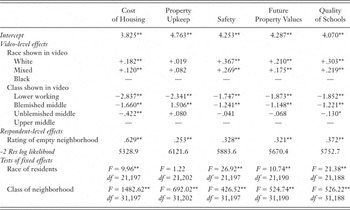
Table 1 reports coefficients from the models predicting Whites' evaluations of neighborhood characteristics. We show five columns of coefficients corresponding to the five dimensions of neighborhoods we asked respondents to evaluate. At the bottom of each column are the F tests measuring the significance of the two aspects of neighborhoods we manipulated in this experiment. Turning to the final numbers in the columns, we find that the evaluations Whites gave were strongly influenced by the quality of homes shown in the videos, independent of the race of the residents. In all five models, the independent effect of social class was significant at the 0.01 level. Considering the estimated cost of housing, White respondents gave an average score of 6.27 on a 1 to 7 scale (these least squares means are not shown) to the upper-middle-class neighborhood, falling just above the $200,000–$249,999 category. The adjusted least square mean for the lower-working-class neighborhood with its modest homes was 3.44, corresponding to about midway between the $60,000–$99,999 and $100,000–$149,999 categories. With regard to future property values, Whites assigned a score quite close to the “will increase a lot” point on the scale for the upper-middle-class neighborhood, but for the lower-working-class neighborhood, their assigned average score was at the midpoint between “will decrease a lot” and “will increase a lot.” Clearly, the quality of housing shown in the videos strongly influenced how the neighborhoods were rated.
Ratings of Neighborhoods Shown in Videos: White Respondents Only, Chicago and Detroit Area Studies

* Coefficient is significant at 0.05 level.
** Coefficient is significant at 0.01 level.
The key question is whether the race of residents influenced how Whites rated the neighborhood they saw—above and beyond the level of social class. The answer is yes for four of the five dimensions about which we asked. The F tests in Table 1 reveal that the race of residents portrayed in the neighborhood, independent of the neighborhoods' social class, had no significant influence on how Whites rated property upkeep. This is perhaps unsurprising since that is a characteristic that was visible in the videos the respondents were evaluating. But for each of the other dimensions, race of residents made a significant difference to Whites when they evaluated neighborhoods, independent of the quality of housing. The subtle information provided by the skin color of residents influenced how Whites evaluated the neighborhoods.
The middle panels of Table 1 show how evaluations differ by neighborhood social class and by neighborhood race, along with tests of significance. For social class, the parameters are deviations from the ratings that Whites gave to the neighborhood with the largest homes—the upper-middle-class location—so they are, with one nonsignificant exception, negative. For race, the parameters are deviations from the ratings that Whites gave to the all-Black neighborhood.
Hypothesis 1, about the effect of residents' race on Whites' evaluations of neighborhoods, is supported. For every dimension, except property upkeep, Whites who saw an all-White neighborhood ranked the neighborhood significantly more positively than Whites who saw the identical neighborhood with all Black residents. Consider the evaluation of schools. The videos suggested nothing at all about the schools serving a neighborhood, but when asked about their quality, Whites who saw neighborhoods with only White residents ranked the schools, on average, about 0.3 points higher on a 7-point scale than did Whites who saw only Black residents, a difference significant at the 0.01 level. Whites made a decision about the quality of a neighborhood's schools based on the race of the “residents” they saw in the videos.
We also hypothesized that Whites who saw a neighborhood with a mix of White residents and Black residents would evaluate the neighborhood more favorably than Whites who saw the same neighborhood with Black residents only. Once again the hypothesis was upheld: For all dimensions except property upkeep, Whites who saw a mix of White and Black residents ranked the neighborhood significantly more positively than Whites who saw only Black residents in the same neighborhood.
These models provide the expected information that the ratings Whites give neighborhoods depend strongly upon the quality of the housing they saw. But they also reveal that Whites' evaluations are significantly linked to the skin color of the residents. In the absence of any other information, Whites assume that neighborhoods where Blacks live have less expensive housing, are less safe, are less likely to appreciate in value, and have lower-quality schools than do identical neighborhoods with White residents. To some degree, this is consistent with the racial-proxy hypothesis; however, it illustrates an important caveat. The perceptions of these communities are above and beyond the visible social-class characteristics of the neighborhood. Respondents are told nothing about these features, but they make negative presumptions. These presumptions do not derive from visible social-class characteristics, but from merely the observed presence of African Americans in the neighborhood.
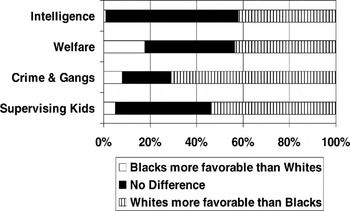
Race, per se, does impact Whites' housing-related evaluations. Another assessment of the role of racial prejudice in shaping housing matters comes from a test of our second hypothesis: To what extent do racial stereotypes predict which Whites are and are not influenced by neighborhood racial composition? To answer this question, we begin with a summary of the level of stereotyping among our respondents, as measured by our stereotype scale. Figure 1 describes the levels of stereotyping by showing the percentage of Whites who rated Blacks and Whites at the same point on each item, the percentage who rated Whites more favorably than Blacks, and the small percentage who rated Blacks more favorably than Whites. The traditional stereotype about Blacks tending to lack intelligence has frequently been challenged since the civil rights revolution. Perhaps it is not surprising to find that 57% of Whites rated Blacks and Whites at the same point on the “tend to be intelligent” scale. However, 42% of Whites said their own race tended to be more intelligent than Blacks. About the same percentage (44%) endorsed the belief that Blacks were more likely than Whites to “prefer to live off welfare.” The idea that Blacks tend to be more involved in crimes and gangs than Whites was endorsed by over 70% of Whites, and a majority of Whites (54%) also thought that Whites as a race tended to do a better job of raising their children than Blacks.
White Responses to Stereotype Questions, 2004 Chicago Area Study and Detroit Area Study.

Overall, 11% of White respondents, a nontrivial minority, consistently rejected racial stereotypes and rated Blacks and Whites at the same point on each of the four scales. However, endorsing negative racial stereotypes was more common. Indeed, 20% of White respondents ranked African Americans below Whites on all four items, 42% of Whites ranked Blacks lower than Whites on at least three items, and 66% of Whites ranked Blacks lower on at least two of the four items. On average, Whites placed their own race 1.0 point higher than they placed Blacks on each item. Whites whose stereotype score was one standard deviation above the mean typically placed Whites as a group 2.1 points ahead of Blacks as a group on each of the stereotypes we measured. Endorsement of various negative stereotypes about African Americans is quite widespread among Whites in our Detroit and Chicago samples.
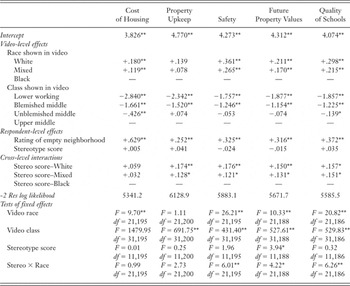
Turning to our test of Hypothesis 2, the panel at the bottom of Table 2 reports F tests showing the significance of the two variables experimentally manipulated in the videos: race of residents and housing quality, and the significance of two respondent-level variables pertinent to this hypothesis: endorsement of stereotypes and the interaction of stereotype endorsement with race of residents. Looking at the F test for stereotype endorsement (stereotype score), we see that it was insignificant for four of the five dimensions and only significant at the 0.05 level for the question about future property values.
Ratings of Neighborhoods Shown in Videos with Stereotype Score as an Additional Respondent Level Variable: White Respondents Only, Chicago and Detroit Area Studies

* Coefficient is significant at 0.05 level.
** Coefficient is significant at 0.01 level.
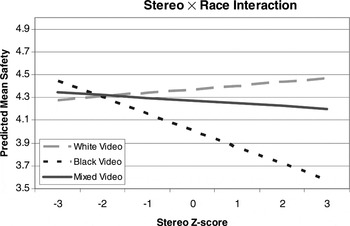
The hypothesis we are testing focuses, however, not upon the endorsement of negative racial stereotypes, per se, but how such an endorsement interacts with the race of residents to influence Whites' neighborhood evaluations. Examining the coefficients for the cross-level interactions (Stereo × Race) and the corresponding F tests, we find support for the hypothesis. As stereotype scores increase, so does the difference between the ratings Whites gave to neighborhoods with White and Black residents. For example, for those at the mean of the stereotype scale, the difference between the ratings of the White and Black neighborhoods is 0.36 for safety and 0.30 for school quality. For those scoring one standard deviation above the mean on the stereotype scale, the difference in the ratings of neighborhoods with White or Black residents increases to 0.54 for safety and 0.46 for school quality. This interaction effect was not significant (p > 0.10) for the question about the cost of housing and was marginally significant (p = 0.064) for the question about property upkeep, but was significant for the other dimensions of neighborhood quality. The mixed neighborhood again occupies a position between White and Black neighborhoods across all stereotype scores. Figure 2 is a visual portrayal of the interaction between race of residents and stereotype use for one of the dimensions—neighborhood safety. It shows that Whites who endorsed negative stereotypes about Blacks tended to see the Black neighborhood as much less safe than did Whites who saw the same Black neighborhood but did not endorse negative stereotypes.
Interaction between Stereotypes and Race of Video on Predicted Mean Safety of Neighborhood: White Respondents Only, Chicago and Detroit Area Studies

DISCUSSION AND CONCLUSION
Our video experiment demonstrates that race continues to significantly influence how Whites evaluate neighborhoods. We found that White respondents who saw a neighborhood with only Black residents evaluated it significantly more negatively than similar Whites who saw exactly the same neighborhood but with White residents. The skin color of our resident actors gave White respondents information they used to judge whether the homes were expensive or moderate in cost, whether the neighborhood was safe, whether the schools were good, and whether housing prices would likely go up or stagnate in the future.
Many Whites in racially divided metropolises, such as Chicago and Detroit, have, we presume, an image of Black neighborhoods as problem areas with lower-cost homes, poorly performing schools, and considerable risks of being robbed or assaulted. Perhaps unconsciously, Whites borrow from their perceptions of what they think a typical African American area is and negatively rank a neighborhood shown in a video when they see Blacks on the block. When shown the same neighborhood but with White residents, they offer more positive evaluations. Race of residents appears to code the neighborhood with regard to some of the most important characteristics people consider when thinking about where to live.
We find that not all Whites were similarly influenced by the race of a neighborhood's residents. Whites in our sample continue to frequently rank Blacks less favorably as a group than Whites as a group with regard to the items included in our modern stereotype scale: intelligence, preference to live off welfare rather than being self-sufficient, tending to be involved or not in crime and gangs, and tending to do a good or bad job supervising their children. We show that those Whites who more frequently endorse negative racial stereotypes were more strongly influenced by the race of residents than those who endorsed fewer of the stereotypes. Thus, not only are there quite a substantial number of Whites who still endorse negative stereotypes about Blacks, but these stereotypes have consequences: they increase the tendency to more negatively evaluate neighborhoods where Blacks live compared to the identical neighborhoods where Whites live.
Our study speaks to the debate about the effect of race, per se, on racial residential preferences, versus race as a proxy for other neighborhood characteristics. The race-as-proxy perspective argues, in essence, that the reason Whites avoid Black or racially mixed neighborhoods is because of the negative characteristics associated with those neighborhoods (Harris Reference Harris1999, Reference Harris2001). Thus, on the one hand, our study confirms this proposition: It is the case that Whites evaluate racially mixed and Black neighborhoods more negatively on a number of features that are likely important to prospective residents. But what our study reveals is that these perceptions are not based on observable features in the neighborhood and, moreover, that they are importantly shaped by negative racial stereotypes. That is, neighborhoods with the exact same observable characteristics are presumed by Whites to be lower-quality neighborhoods simply because of the race of the residents. Race may indeed be a “proxy” for other neighborhood features; but our study reveals that it is a “proxy” constructed in respondents' minds and shaped by their racial stereotypes. This suggests that when looking for housing, prospective White residents may be shown by a real estate agent, for example, a Black or racially mixed neighborhood that has many positive features. But these may not be sufficient to overcome their negative predispositions about the neighborhood. This is because the very perception of the features of the neighborhood is colored by the race of its residents. Thus, race, per se, has a stranglehold on how people think about and perceive neighborhoods—even neighborhoods that, on the face of it, are identical. The degree to which the mere presence of African American residents results in Whites downgrading a neighborhood on such key dimensions as safety, school quality, and future value, is the degree to which the presence of African American residents is likely to influence Whites' interests in considering a move into that neighborhood.
The “objective” characteristics—those that can be observed and that are constant across neighborhood racial composition—are apparently not sufficient, for at least some Whites, to overcome the stereotypes they hold about communities that have African American residents. As such, our study is a complement to recent studies that have compared objective neighborhood qualities to the residents' perceptions of those qualities. For example, Quillian and Pager (Reference Quillian and Pager2001) found that communities with a higher percentage of African Americans were perceived by their residents to have higher crime rates—net of their actual crime rates. And Sampson and Raudenbush (Reference Sampson and Raudenbush2004) report that independent and objective observations of neighborhood disorder (using a systematic social-observation technique) were a weaker predictor of residents' perceptions of the disorder in their neighborhood than were the racial, ethnic, and class compositions of the neighborhoods. Both of these studies highlight that the seemingly concrete and objective features of communities (e.g., crime rates or the amount of social or physical disorder) are to some extent socially constructed—that is, not based entirely on the reality of the conditions in the neighborhood. As Sampson and Raudenbush (Reference Sampson and Raudenbush2004) conclude, the manner by which these features of a neighborhood are socially constructed can be understood only in the context of the long history of racial oppression and discrimination that has resulted in pervasive patterns of racial inequality in the United States.
Like Sampson and Raudenbush (Reference Sampson and Raudenbush2004) and Quillian and Pager (Reference Quillian and Pager2001), our results are consistent with the notion that neighborhood evaluations are socially constructed. When identical neighborhoods are shown to respondents—and only the race of the residents varies—Whites nevertheless downgrade their evaluations of the features of that neighborhood when there are Black residents. As Sampson and Raudenbush (Reference Sampson and Raudenbush2004) note, it is of less importance for behavior what the actual “observed” levels of disorder are; if people act on their perceptions of “disorder” (or, in our case, expectations of poor schools, high crime rates, and declining property values), then a self-fulfilling prophecy may be set in motion that has important consequences for racial residential segregation.
Our study suggests that Whites hold a bias—conscious or unconscious—against neighborhoods with Black residents. As such, the notion that Whites use race as a “proxy” requires a more nuanced interpretation than sometimes proposed. It is not that Black and racially mixed neighborhoods necessarily have these characteristics; it is that Whites presume they do, even in the absence of any observable indicators. Simply the presence of Black residents is enough to trigger these expectations among Whites. A simple “racial proxy” argument would suggest that it is possible to overcome the negative perception of racially mixed or Black neighborhoods by providing information that demonstrates that the homes are well kept and the lot sizes large. But our data suggest that it may not be as simple as this. Furthermore, the effect of racial stereotypes on shaping neighborhood evaluations suggests that racial prejudice—and thus race per se—has a role in shaping racial residential preferences. Merely disentangling race from the other social-class characteristics may be insufficient. As Sampson and Raudenbush (Reference Sampson and Raudenbush2004) note:
Attempts to improve urban neighborhoods by reducing disorder … are admirable and may produce many positive effects…. Nevertheless, our results suggest that these steps may have limited payoffs in neighborhoods inhabited by large numbers of ethnic minority and poor people. The limitation on effectiveness in no way derives from deficiencies in the residents of such neighborhoods. Rather, it is due to the social psychological processes of implicit bias and statistical discrimination as played out in the current (and historically durable) racialized context of cities in the United States. In other words, simply removing (or adding) graffiti may lead to nothing, depending on the social context
(Sampson and Raudenbush, Reference Sampson and Raudenbush2004, p. 337).Following this logic, one might imagine that so long as a Black or racially mixed neighborhood has attractive features Whites will find them desirable. However, our data suggest that the process is more complicated, and that the ability to demonstrate to Whites that a Black or racially mixed neighborhood is “comparable” to a White neighborhood may be difficult; it may be that regardless of its objective features, because neighborhood qualities are partially socially constructed there will be an element of the trappings of the racialized context of the United States that will shape these perceptions.
Our investigation of the role of race in shaping neighborhood evaluations has other broader implications as well. High levels of racial residential segregation contribute to the geographic concentration of poverty and abet the persistent segregation of White students from Black students in schools. Despite the promise of the Supreme Court's 1954 Brown decision that it would lead to the rapid and thorough integration of the nation's public schools, by the 1990s, federal courts were backing away from earlier efforts to integrate schools; they began to accept school segregation that resulted from both within-district or between-district racial residential segregation. In a recent Supreme Court ruling, Chief Justice Roberts, writing for the Supreme Court's majority, overturned school integration strategies in Louisville and similar ones operating in Seattle. He wrote: “The way to stop discrimination on the basis of race is to stop discriminating on the basis of race” (Parents Involved in Community Schools v. Seattle School District 2007; Meredith v. Jefferson County 2007). Justice Breyer in his dissent emphasized the Court's retreat from Brown's promise of a nation where Blacks and Whites would attend the same schools. He went on to cite extensive empirical evidence showing that between 1991 and 2003, Black and White public school students became increasingly segregated from each other in twenty-eight states.
At first glance, Chief Justice Roberts's statement seems to be a succinct and Solomon-like statement that we should all strongly endorse. Indeed, any public figure who defended the use of race to decide who gets which jobs or who gets into some schools but not others would likely be condemned and fired. The civil rights laws of the 1960s, along with pervasive changes in our mores, now condemn purposive and obvious racial discrimination.
But does Chief Justice Roberts's statement reflect an understanding of how race currently operates to expand opportunities for Whites and limit opportunities for Blacks? We think his statement does not reflect how social processes now operate. Pager's (Reference Pager2003) experiment revealed that White applicants for entry-level jobs were preferred over Black applicants with identical credentials. Bertrand and Mullainathan's (Reference Bertrand and Mullainathan2004) experiment showed that a subtle racial clue (first name) significantly influenced who got a job interview. The American Community Survey in 2006 reported that 17% of White men, aged twenty-five to fifty-nine, were either unemployed or not seeking work. For Black men in the same age range, it was a much higher 29%. Indeed, in that year of general prosperity and low unemployment, only 65% of adult Black men held jobs; among Whites, it was a much higher 82%. We speculate that the huge difference in male employment does not result from those deliberate policies of excluding Blacks from jobs, policies that were common before the Civil Rights Act of 1965 was enacted. Some of the difference, quite likely, results from subtle and unconscious preferences employers have for White workers, which are linked to their negative views of how competent Blacks are.
Our findings, showing the subtle effects of race in the video experiment, suggest a similar process and have implications for the continuation of racial segregation in neighborhoods and, by extension, schools. The days of a massive White flight from neighborhoods shortly after the arrival of the first African Americans are largely over, and this contributes to the trend toward moderately lower levels of Black-White segregation. But Ingrid Ellen (Reference Ellen2000, chapter 7) demonstrates that Whites who move away from integrated neighborhoods typically move into neighborhoods where the density of Blacks is lower. If those White migrants who leave integrated neighborhoods are similar to respondents in our study, their search for new housing was likely influenced by the racial processes described in this article.
APPENDIX
Questions Used to Measure Evaluations of Neighborhoods in Video
1) Using the figures below, on average, what do you think a home costs in the neighborhood in the video? Even if you are not sure, make the best guess you can. Would you say …
1. Under $25,000
2. $25,000 to $59,999
3. $60,000 to $99,999
4. $100,000 to $149,999
5. $150,000 to $199,999
6. $200,000 to $249,999
7. $250,000 to $299,999
8. $300,000 or more
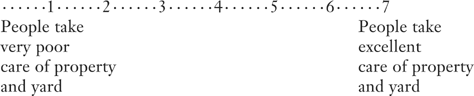
2) Second, how would you rate the neighborhood you just saw in terms of people taking care of their property and yard?

3) How about safety? How unsafe or safe do you think the neighborhood in the video looks like it would be?
4) How about property values in the neighborhood in the video? What do you think will happen to property values over the next five years?
5) How about the schools in the neighborhood in the video? What would be your best guess about the quality of the schools?



Questions Used to Measure Respondent Endorsement of Stereotypes about African Americans
Note: The first question (rich/poor) was not included in the stereotype scale. We include it here because it provides the introduction to the respondent about this set of questions. The subsequent four traits were used to construct the scale.
1) Now we have some other questions about different groups in American society.
Here is a seven-point scale on which the characteristics of people in a group can be rated. In the first statement a score of 1 means that you think almost all of the people in that group are “poor.” A score of 7 means that you think almost everyone in the group is “rich.” A score of 4 means you think that the group is not toward one end or another, and of course you may choose any number in between that comes closest to where you think people in the group stand.
Where would you rate Whites in general on this scale where 1 is poor and 7 is rich?
Where would you rate Blacks in general on this scale?
2) The next set of characteristics asks if people in each group tend to be intelligent or tend to be unintelligent.
Where would you rate Whites in general on this scale, where 1 means tends to be unintelligent and 7 means tends to be intelligent?
Where would you rate Blacks in general on this scale?
3) The next set of characteristics asks if people in each group tend to prefer to be self-supporting or if they tend to prefer to live off welfare?
Where would you rate Whites in general on this scale where 1 means tends to prefer to be self-supporting and 7 means tends to prefer to live off welfare?
Where would you rate Blacks in general on this scale?
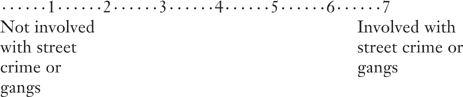
4) The next set of characteristics asks if people in each group tend to be involved with street crime or gangs or tend to not be involved with street crime or gangs.
Where would you rate Whites in general on this scale where 1 means tends to not be involved with street crime or gangs and 7 means tends to be involved with street crime or gangs?
Where would you rate Blacks in general on this scale?
5) The last set of characteristics asks if people in each group tend to do a good job of supervising their children or tend to do a bad job of supervising their children.
Where would you rate Whites in general on this scale where 1 means tends to do a bad job of supervising their children and a 7 means tends to do a good job of supervising their children?




Where would you rate Blacks in general on this scale?