1. Introduction
In the history of mathematics, it is exceptional to have access to “original” sources; that is to say, sources directly written or published by their authors. In the case of China, a large number of sources used today were published during the Qing dynasty (1644–1911). It is a well-established fact that present knowledge of Song dynasty (960–1279) mathematics derives from reconstructions made by Qing dynasty editors (Liu and Dauben Reference Liu, Dauben, Dauben and Scriba1993). It is generally accepted that Qing dynasty editors worked as philologists (Elman Reference Elman1984) but the techniques of these editors remain less well-known. How did the editors select and collate their sources? How did they reconstruct these texts? Did they modify or “improve” the original texts they worked with? The work of the famous Song dynasty writer Li Ye (1192–1279), republished by Li Rui (1773–1817), provides an illuminating case study. Li Rui is considered the most gifted mathematician of his time but his work as philologist is less well-known. His techniques of textual criticism and editorial choices merit (and will receive) explicit consideration. The reconstruction of Song dynasty mathematics occurred in a specific historical context, namely, during the reception of European sciences and mathematics in late imperial China (Hashimoto Reference Hashimoto, Jami, Engelfriet and Blue2001; Jami Reference Jami2012; Han Qi Reference Qi, Jami, Engelfriet and Blue2001). One of the concomitant effects of this transmission from West to East was a change in how modern historians read mathematical texts written in Chinese. This new perspective on texts may be biased by the editorial techniques used by Chinese editors who published these texts at the beginning of the nineteenth century. Sivin (Reference Sivin1973), Elman (Reference Elman2005), and Horng Wann-Sheng [Hong Wansheng] (Reference Wann-Sheng, Lin and Fu1993a, Reference Wann-Shengb) have described the reaction of certain scholars who attempted to show the “sinitude” of algebra, as opposed to “Western” mathematics. The texts available today are, in many cases, editorial products of this “Chinese”-oriented view. This raises several questions: Is this pro-Chinese approach reflected in textual criticism? If so, how? Can an understanding of this approach direct modern readings of medieval and ancient texts?
2. Context
a. The Eighteenth-Century Reading
In 1796, Ruan Yuan (1764–1849), director of education in Huangzhou and leader of the Qian-Jia School, sent copies of Li Ye's Ceyuan haijing (1248) and Yigu yanduan (1259) to Li Rui for collation and publication in a private edition entitled Collected Works of the Private Library of Knowing Our Own Insufficiencies, the Zhibuzu zhai congshu. This edition, most frequently used by historians today, indicates that both Li Rui and Ruan Yuan proofread these texts.Footnote 1 What is the context of such a publication? In what way was the proofreading done? First, the established research on Qing dynasty editorial policies will be reviewed and established as a backdrop for a detailed analysis of the particular philological techniques.
The Qian-Jia School dominated the academic community of the eighteenth-century Qing dynasty (1644–1911) (Elman Reference Elman1984; Horng Reference Wann-Sheng, Lin and Fu1993a,Reference Wann-Shengb; Liu and Dauben Reference Liu, Dauben, Dauben and Scriba1993). Sivin (Reference Sivin1973, 96n) defines schools as “special theories and techniques of a master, passed down through generations of disciples by personal teaching.” The Qian-Jia School owes its name retrospectively to the Qianlong emperor (1736–1795) and his successor, Jiaqing (1796–1820). In 1772, the Qianlong emperor initiated the compilation of the Siku quanshu (Complete Library of Four Treasuries) by ordering local and provincial officials to search, catalogue, and copy all rare and valuable manuscripts held in libraries. This imperial encyclopaedia is an enormous compendium of 3593 titles (Kent Reference Kent1987). Li Ye's mathematical works were first integrated into the Siku quanshu before being re-edited by Li Rui. The Qian-Jia School was founded by the scholar Gu Yanwu (1613–1279) of the late Ming and early Qing dynasties and Dai Zhen (1724–1777). The principal representatives of this school are considered to have been Yan Ruoqu, Qian Daxin, Duan Yucai, Wang Niansun and his son, Wang Yinzhi. All are famous for their works in philology, phonology, exegesis, and editions of classics. Dai Zhen was appointed by the Qianlong emperor in 1775 to the elite board of compilers of the Siku quanshu. Being well-versed in mathematics, Dai Zhen was in charge of the edition of the section on mathematics, including the works of Li Ye mentioned above. Dai Zhen was also the mentor of two of the scholars now considered representative of the Qian-Jia School, namely, Wang Yinzhi and Wang Niansun. The Qian-Jia School sought to revive ancient native Chinese texts. Scholars of the Qian-Jia School mainly pursued textual criticism and philological methods.
The historical actors named here held to the tenets of this school. Ruan Yuan led a branch of this school in Yangzhou, known as the Yangzhou xue pai. He came to know Dai Zhen's works and methods through Dai Zhen's disciples, Wang Niansun and his son (Wei Reference Wei2006, 44–46).Footnote 2 The “two Wangs,” as Qing intellectual historians called them, exposed the ideas and methodology of Dai Zhen, especially his empirical method for conducting research on phonetics and etymology. Ruan Yuan used the financial security of his position as a high ranking official to support scholarly studies in his leisure time. As an official examiner, he was aware of gifted candidates who had failed their exams and he hired them as his assistants to complete the scholarly work that he could not do because of the nature of his duties (Wei Reference Wei2006, 213).Footnote 3 Li Rui, himself a disciple of Qian Daxin,Footnote 4 was hired by Ruan Yuan in this way. Li Rui was considered the most influential mathematician – and perhaps historian – of the Chinese calendar and mathematics of his time. Although Li Rui is not considered a philologist, he was cognizant of contemporary attempts at the restoration of classical literature. Evidence suggests that he used textual criticism and philological methods to restore a mathematical treatise.
The Qian-Jia School's criticism and its “back to the origins” (Elman Reference Elman1984, 57) perspective were part of an attempt to revive classical thought and to restore the spirit of ancient China. In addition to this revival of the Classics through philology, mathematics also experienced a particular reworking in the Qing dynasty. Ruan Yuan structured his essays according to philological principles. Following Dai Zhen, he knew how important efforts at reconstruction would be for the study of the native scientific and technical traditions. The value of mathematics and astronomy was reaffirmed as a part of traditional education. Without a deep understanding of mathematics, passages of some Classics that dealt with technical, calendrical, and astronomical phenomena would be impossible to understand (Elman Reference Elman2005, 244–5). From the seventeenth century on, the content of mathematics was radically renewed: many scholars became interested in mathematical sciences because of their interest in the elements of “Western” scientific knowledge (Jami Reference Jami, Elman and Woodside1994). This context directed the philological reconstruction of Li Ye's works.
Western algebra was transmitted to China at the end of the seventeenth century and it was accepted by some Chinese mathematicians. This formal algebra was called “Borrowing the Root” (jiegenfang). This topic comprised the most novel object in the Jesuits’ tutoring of the Kangxi emperor (1662–1722) (Jami Reference Jami2012). The Jesuit Antoine Thomas (1644–1709) composed a pedagogical text, the Jiegenfang suanfa, a treatise on cossic algebra in which the unknown and its powers are represented by abbreviation in the equation. Thus acquainted with Western methods, Mei Juecheng (1681–1763) was the first to understand the forgotten ancient Chinese algebraic procedures of the Celestial Source (tian yuan shu) (Hoe Reference Hoe2008). He claimed that the tian yuan shu was the origin of Western algebra. Mathematicians of the Qianlong-Jiaqing period struggled to prove the anteriority and the efficiency of one procedure or another. In the context of this interest, the studies of mathematical texts from the Song-Yuan dynasties gained pre-eminence thanks to Li Rui's collation and critical commentary of Li Ye's Ceyuan haijing and Yigu yanduan, two important treatises on the algebraic procedure for setting up a quadratic equation: the aforementioned procedure of the Celestial Source. The oldest surviving work on polynomial algebra is contained in Li Ye's works, a fact which prompted interest in re-publishing these treatises. Horng Wann-Sheng (Reference Wann-Sheng1993b) has shown that most of the scholars of the Qian-Jia School made every effort to apply this procedure to as many problems in the mathematical texts as they could. Li Shanlan (1810–1882), for instance, considered Li Ye's Ceyuan haijing to be the most influential Chinese text he had studied before learning Western mathematics. Later, when he taught at the Beijing school of Foreign Language (Tongwen guan), Li Shanlan used the Ceyuan haijing to prepare students to master modern algebra (Tian Miao Reference Miao1999, 114–5) in order to show the efficiency of the method and to link the new algebra with Chinese tradition.
b. The Twentieth-Century Reading of Li Ye's Treatises
At present, the Ceyuan haijing by Li Ye stands as the oldest transmitted Chinese text that uses polynomial algebra in order to solve problems. It is evidence of the intense mathematical activity that seems to have developed in northern China during the Song and Yuan dynasties. Numerous studies analyzed this book and it is mentioned in every publication dealing with the history of mathematics in Chinese.Footnote 5 The Ceyuan haijing is famous for its highly technical presentation of the procedure of the Celestial Source, used to set up polynomial equations in one to four unknowns. Ever since its re-edition by the Qing dynasty editors, this treatise has been used to introduce this procedure (i.e., Li Shanlan) and, thus, could lead the reader to think that the topic of Li Ye's work was limited to the procedure of the Celestial Source. Consequently, the conventional wisdom has held that Li Ye's purpose is to make a sort of presentation of this procedure. Chemla has recently offered a new reading of this mathematical treatise (Chemla Reference Chemla2005 and Reference Chemla1993). She shows that the content of this book challenges definition. If read as separate formulas and problems, their algebraic content is obvious. Chemla argues that the grouping of formulas is meaningful and relies on mathematical knowledge not explicitly stated in the book. She reconstructs this system and argues that groups of formulas reveal Li Ye's mathematical preoccupations which had not been considered previously. She demonstrates that the content of the Ceyuan haijing exceeds the mere sum of all formulas and problems. In her analysis, the structure of the book reveals specific concerns of Li Ye. Chemla thus questions the definition of the content of ancient mathematical texts.
Although the procedure of the Celestial Source appears in other Chinese mathematical works, Li Ye provides the earliest reference to its use.Footnote 6 The absence of other sources has led some modern scholars to believe that Li Ye's works are “the first truly algebraic works in China” (Dauben Reference Dauben and Katz2007, 324). The identification of Li Ye's procedures from the Celestial Source as the foundation of Song dynasty polynomial algebra seems to be an undisputed fact. It is the quintessential “Chinese algebraic process of logically setting up algebraic expressions and finding a relation between these expressions to derive an equation” (Lam Lay Yong 1983, 243). On the basis of the existence of this procedure, historians describe the thirteenth century as the acme of algebra in China and exemplify algebra in China by this procedure alone (Li Yan and Du Shiran Reference Yan, Shiran, Crossley and Lun1987, chap. 5).Footnote 7 This procedure is essential to understand the form taken by algebra in China, yet Chemla shows that the procedure of Celestial Source is a tool which might not be the principal purpose of the treatise. The content of the treatise might be something else, just as might be the case concerning the other treatise by Li Ye, the Yigu yanduan. A systematic study of the Yigu yanduan reveals a specific order to the grouping of problems. These problems are ordered according to a combination of operations and type of mathematical objects. Thus, this treatise seems to pertain more to combinatorics than to a simple introduction to algebra.Footnote 8 Although this work is concerned with the procedure of Celestial Source, it supplies evidence of a different mathematical procedure. Surprisingly, this other procedure, the Section of Pieces [of Areas], tiao duan, has disappeared from works on the general history. This procedure plays a crucial role in understanding Li Ye's system of combinatorics (Pollet Reference Pollet2012).
c. Reading Yigu Yanduan
The Yigu yanduan, the Development of Pieces [of areas] [according to] [the Collection] Augmenting the Ancient [Knowledge],Footnote 9 was written in 1259 by Li Ye, and published in 1282 (Kong Guoping 1987, 166). It presents a list of 64 problems in three rolls. All the problems relate to the seemingly practical same topic: calculating the diameter or side of a field inside of which there is a pond. Each problem follows the same pattern and the treatise may be described as repetitive. However, the central topic of the Yigu yanduan is actually the construction and formulation of quadratic equations derived from problems about squares, rectangles, and circles. The peculiarity of this text is that it introduces and distinguishes two different methods for setting up quadratic equations. The first method is the aforementioned Celestial Source. The second is the procedure of Section of Pieces [of Areas]. This second procedure is used to establish quadratic equations by means of geometry. A third procedure, which also seems geometrical, is added to twenty-three of the problems under the title “old procedure,” jiu shu.Footnote 10 The difficulty in reading the Yigu yanduan is to clarify the relationship between the three procedures. Several interpretations were offered for why Li Ye assembled these different procedures together, and a preponderance of them suggests the primacy of the procedure of Celestial Source.
The Yigu yanduan has been interpreted by historians as an introduction to the Ceyuan haijing. By this interpretation, the text served as a mere popularization and thus remained in the shadow of the Ceyuan haijing. The book is still considered to be a list of simplified examples which show the procedure of the Celestial Source. The reasons for assuming such a subordinate status must be questioned in order to analyze the work done by its Qing dynasty editors. However, before the labors of the Qing dynasty editors are considered, the modern interpretations of this text and the relationship among its procedures must be examined.
Lam Lay Yong proposed two possible hypotheses for the composition of this text, either “the tian yuan was new and Li Ye took the opportunity to justify its algebraic reasoning by falling back upon the traditional equivalent geometrical meaning” or “as an equation derived using the old method through the tiao duan concept was not easy to understand, Li Ye used the tian yuan method to elucidate the origin of the tiao duan method and explain it by means of clear geometrical figures” (Lam Lay Yong Reference Lay-Yong1984, 264). That is to say, in the first case, the procedure of Celestial Source was new and needed to be demonstrated by a well-known ancient procedure from the Section of Pieces [of Areas]. Or, in the second case, the “old procedure” and its derived form in the Section of Pieces [of Areas] became obscure, may have been forgotten, and needs to be re-explained by means of the familiar procedure in the Celestial Source. For both hypotheses, the procedure of Section of Pieces [of Areas] is older than the procedure of the Celestial Source. In the first case, though, the Section of Pieces [of Areas] was well-known, while in the second hypothesis, the Celestial Source was the better-known one. The second hypothesis was proposed by Mei Rongzhao (Reference Rongzhao1966, 143), but Lam Lay Yong did not favor one over the other. Another study by Kong Guoping (Reference Guoping1999, 173, 197) also suggested that the Celestial Source was derived from the ancient geometrical procedure. All the historians agree on the anteriority of the geometrical procedure and on the focus on the Celestial Source.Footnote 11 The first to propose this interpretation was Li Rui himself. In his afterword to Yigu yanduan, he claimed admiration for the procedure of the Celestial Source. He also explained that due to the difficulties of the ancient procedure, Li Ye had written “the two books, Ceyuan haijing and Yigu yanduan, [in order] to give the groundings of the procedure [named] to set up the Celestial Source.”Footnote 12 He even justified the two characters “yan duan” of the title: “[the character] “development” (yan) stands for “development of the set up of the Celestial Source” and “piece” (duan) is for “look for this according to the Section of Pieces [of Areas].”Footnote 13 According to Li Rui, the yan duan demonstrates that the two procedures are equivalent and the purpose is to introduce the procedure of Celestial Source for perplexed readers.
In the twentieth century, the various translations of the four characters of the title, 益古演段, Yigu yanduan, reveal the multiplicity of interpretations of the status of the book. Was it a textbook, a theoretical treatise, or a text on applied mathematics? The oldest occurrence of the translation, “Exercises and applications improving the ancient methods,” was proposed by George Sarton (Reference Sarton1927, 627). This first translation shows that the Yigu yanduan was considered a kind of miscellany with practical objectives (e.g., surveying). Translations agree that the purpose was to improve an ancient method, and to distinguish the “old” from the “new.” For example, the title was later translated as “New Step in Computation” by Ulrich Libbrecht (Reference Libbrecht1973, 19) and by J-.N. Crossley in Li and Du (Reference Yan, Shiran, Crossley and Lun1987, 114). Lam Lay Yong (Reference Lay-Yong1984, 237) also proposed her own translation: “Old Mathematics in Expanded Sections” and more recently Liu and Dauben (Reference Liu, Dauben, Dauben and Scriba1993, 302) have proposed “Illustrations and Computations of Ancient Mathematics.”
Two recent translations into French suggest a different interpretation. They take into account that Li Ye, in his preface and title, refers to an older book entitled the Yiguji, 益古集 (Collection augmenting the ancient [Knowledge]), and that the expression “yan duan” names a type of procedure which serves as the topic of the treatise. Thus, the two French renderings are “Le yan duan (development des pieces d’aire) du Yiguji” by Annick Horiuchi (Reference Horiuchi2000)Footnote 14 and “Le déploiement des pièces d’aires pour la [collection] augmentant les [connaissances] anciennes” by Karine Chemla (2001).Footnote 15 But these two publications in French are not dedicated to the yigu yanduan. The former explains the procedure of Section of Pieces [of Areas] by means of a portion of the Yang Hui suanfa titled the Tian mu bilei chengchu jiefa written by Yang Hui in 1275. The latter analyzes the change in the use and meaning of the character tu, “diagram” from the Han dynasty through the Song dynasty. These two French renderings correspond to an interpretation given by Li Di. In 1999, Li Di (237–8), quoting Lan and Hong (Reference Lirong and Tianyang1985, 11–12), suggested that research on the procedure of the Section of Pieces [of Areas] might have been Li Ye's original objective in writing Yigu yanduan, but due to the variation in the approach, the procedure was not easy for Li Ye's contemporary readers to understand. Therefore, Li Ye decided to add more detailed solutions from the procedure in the Celestial Source. Li Di noticed that as a consequence, the Section of Pieces [of Areas] became secondary and even dispensable. Hence, he suggested further clarification of the Section of Pieces [of Areas].
Despite Li Di's interpretation and probing of the meaning of the title, the Yigu yanduan has been considered “a revision of a work for beginners in the ‘celestial element method’” (Li and Du Reference Yan, Shiran, Crossley and Lun1987, 114), a book “devoted to the method of tian yuan shu,”Footnote 16 or “an ‘introduction’ to the Sea Mirror of Circle Measurement” (Dauben Reference Dauben and Katz2007, 327). It is generally thought that Li Ye “took the opportunity to explain the tian yuan shu method in a less complicated manner after finding his first book (the Ceyuan haijing) too difficult for people to understand” (Ho 1978, 319). While the focus remains on the procedure of the Celestial Source, the procedure of the Section of Pieces [of Areas] is neglected, sometimes even published without diagrams (Dauben Reference Dauben and Katz2007, 329; Guo Reference Shuchun2010, 370–73) or alternatively not mentioned at all (Ho 1978, 313–320; Li and Du Reference Yan, Shiran, Crossley and Lun1987). There are several reasons for this absence.
First, the procedure of the Celestial Source was described at a higher level of difficulty and sophistication in the other major mathematical work by Li Ye, Ceyuan haijing. The Ceyuan haijing is said to be the distillation of Li Ye's studies on the Celestial Source, while the Yigu yanduan represents his effort to popularize the method (Mei Rongzhao Reference Rongzhao1966, 147; Lam Lay Yong Reference Lay-Yong1984, 247; Kong Guoping Reference Guoping1999, 173). The procedure of Celestial Source reported in the Yigu yanduan is too simple to attract much attention from historians. Therefore, the whole treatise has been considered simplistic.
Secondly, interpretations have focused on the Celestial Source because of its preface written by Li Ye. Here, he blamed mathematicians for their unwillingness to share their knowledge. He reproached them for writing in such an abstruse manner that mathematical knowledge was not revealed.Footnote 17 From this, scholars have inferred that Li Ye wrote the Yigu yanduan to correct the prevailing trend and to show how useful mathematical techniques such as the Celestial Source can be learned and mastered even by beginners. This interpretation of the preface is supported by the fact that a large proportion of the treatise repeats slight variations of the procedure of the Celestial Source and the remaining part contains mostly diagrams and small discourses on them.
The two characters 天元, tian yuan, however, never appear in the preface. On the contrary, only the characters 條段, tiao duan, Section of Pieces [of Areas], are mentioned. Li Ye wrote that he modified another treatise by adding diagrams:
A book entitled Collection Improving the Ancient [Knowledge] was compiled recently with reshaped [solutions to geometric problems of] rectangles and circles. It is indeed equivalent to work by Liu Hui and Li Chunfeng. However, I detest its reserved style, and hence add detailed diagrams of how to reshape the Sections of Pieces [of Areas]. Isn't it a great joy that the book will thus be accessible with basic knowledge from ten to hundred?Footnote 18
Indeed, the vocabulary denotes clarification, but none of the elements explicitly corresponds to the Ceyuan haijing or an a priori intention to render the procedure of the Celestial Source accessible to a large audience. In fact, whether the simplification of the procedure of Celestial Source was the main topic of the Yigu yanduan remains unknown. Chemla's reading of the Ceyuan haijing coupled with Li Di's interpretation suggest that the real content of the book and the author's intentions may be different but his intentions seem linked to his development of combinatorics (see Pollet Reference Pollet2012). Furthermore, the editorial choices made by Li Rui can be shown to have been a factor which leads to a refocusing on the procedure of the Celestial Source and the interpretation described above.
It is generally accepted that Li Rui took the Siku quanshu as his editorial model. However, he believed in the Chinese origins of algebra and thus diverged slightly from the Siku quanshu in this respect. Twentieth-century historians of science rely on the edition of Li Rui. His modifications may encourage specific interpretations which distort or hide the intentions of the author, Li Ye. What philological methods were applied to mathematical texts? Did Li Rui alter the text he used for his edition? What were these changes? Finally, do these transformations direct modern readings? In the following sections, the modifications made by Li Rui will be established and compared with his conception of mathematics to determine if they had influenced the modern interpretations of the development of algebra in China. In order to establish the types of modifications which Li Rui preferred, the edition made by Li Rui will be compared to the text found in the Siku quanshu which compiled the Yigu yanduan, a work by Li Ye.
3. Li Rui's Editorial Work
The Celestial Source procedure was already the object of commentaries of the Yigu yanduan by the end of the eighteenth century. These commentaries illuminated the procedure of the Celestial Source and may be the source of the interpretation of the Yigu yanduan as a collection of problems for beginners in the procedure of the Celestial Source. What were these commentaries? How are they articulated? Which source were they commenting on? To understand Li Rui's editorial work and the way he developed his commentary, the sources and the manner in which he collated them must be identified.
a. Commentaries on the Yigu Yanduan
The oldest available edition of the Yigu yanduan appeared in the eighteenth century, and this edition contains commentaries. An editor of the Imperial Encyclopaedia, the Siku Quanshu, added the first commentary, introduced by the character 案, an, “commentary,” in 1789. This commentary appears in two small columns inserted inside the text written by Li Ye and in a column at the end of the procedure. The author of this commentary remains anonymous, but could be Dai Zhen (Lam Lay Yong Reference Lay-Yong1984, 240) who, according to Li Yan (1955), also commented on the Ceyuan haijing. However, the absence of editorial notes in the Yigu yanduan puts this hypothesis into question. This commentary has three functions. First, it explains and interprets the procedure of the Celestial Source in the light of the procedure of Borrowing the Root. In addition to this commentary, each of the mathematical expressions from the problem 1 to the problem 4 is translated into other mathematical terms derived from this method.Footnote 19
For example: 
Augmenting this by self-multiplying yields  $\begin{array}{*{20}rl} {1600}& {tai} \\ {80}&\, \\ 1&\, \\\end{array}$
Commentary: That is the sum (併) of one thousand six hundred bu and eighty diameters of the pond and one square (平方).
The characters 平方, ping fang, never appear in Li Ye's vocabulary. This expression belongs to the specific vocabulary of the procedure called Borrowing the Root (Jami Reference Jami2012, 208; Tian Miao Reference Miao1999, 107). In this example, the expression presented by Li Ye can be transcribed in modern notation as 1600 + 80x + x2. The Siku quanshu edition preserves no marks for positive or negative signs. The commentator re-interprets the polynomial as a sum. He also re-interprets this sum geometrically in order to give a meaning to the polynomial and to link it with the statement of problem. The commentary also adds some supplements to clarify procedures, as in pb.24 and 43 where procedures for extracting the root are given. Finally, the commentary proposes alternative solutions to the procedure of the Section of Pieces [of Areas] for three problems (pb.38, 54, 56) because the editor found the procedure unclear. This part also proposes some corrections to diagrams (pb.53, 61). Only two notes correct characters, one in the preface, another one in the pb.63.
Nine years later, in 1798, Li Rui, added his own commentary to his edition of the mathematical part of the Zhibuzu zhai congshu. He refutes the mathematical interpretation of the commentary made in the edition of the Siku quanshu which equates the procedure of the Celestial Source and the procedure of Borrowing the Root (pb.1, 11, 40). He explains the way of writing and reading mathematical expressions (pb.1, 11), adds corrections to characters in editorial notes (see Table 1) and corrects some diagrams in the Section of Pieces [of Areas] (pb.38, 61, 62, 64). His text, however, focuses on the dissociation of the two procedures of Borrowing the Root and Celestial Source. He follows the Mei Juecheng who argues that the procedure of Celestial Source spawned that of Borrowing the Root but Li Rui maintains that the procedures are different (Horng Wann-Sheng Reference Wann-Sheng, Lin and Fu1993a, Reference Wann-Shengb). In particular, the setup and procedure of the Celestial Source differs between the two editions by Li Ye. The tabular formats are not presented in the same way. In the Yigu yanduan, the constant term occupies the top row while this term is in the lower row in the Ceyuan haijing. Nonetheless, both tabulations are vertical, while those in the Borrowing the Root, the setting is horizontal. This is an important difference. In Li Ye's work, the procedures involve only subtraction in the execution of an equation. Either two polynomials are subtracted from each other or a constant is subtracted from a polynomial. Because of this, Li Rui wrote that the procedure of Celestial Source differs from that of Borrowing the Root, which involved all the basic operations.Footnote 20
This commentary is precisely the portion of the Yigu yanduan which attracted the attention of later mathematicians. For instance, the Korean mathematician, Nam Pyong-Gil (1820–1869) wrote the Muihae, (Solutions of No Difference [between “Tian Yuan Shu” and “Jie Gen Fang”]) in 1855.Footnote 21 He copied four of the problems (pb.1, 7, 11b, 40) of the Yigu yanduan but removed all the diagrams and the Sections of Pieces [of Areas]. He kept the commentaries by the editor of the Siku quanshu and Li Rui but also added his own commentary to pb.7. Ying Jiaming (2010, 9) shows that by focusing on the art of Celestial Source only, Nam Pyong-Gil reinterpreted the treatise according to his contemporary assumption that Li Rui was wrong.
All commentaries described so far have focused on the procedure of the Celestial Source, due to the intensive debate concerning the achievements of Western and Chinese mathematics. That is, they have focused on the attribution of a Chinese origin to Western mathematics. The commentator of the Siku quanshu proposes that the two methods are identical. Li Rui, convinced of variation in early Chinese mathematics, claims that the two procedures are different. Nam Pyong-Gil argues that a synthesis of Chinese and European mathematical methods is possible. One effect of this debate is that the procedure of the Section of Pieces [of Areas] remained unconsidered during the eighteenth and the nineteenth centuries. The commentators invoked the procedure of Celestial Source as representative of “traditional” Chinese mathematics, either to legitimate “Western” algebra or to compete with the new form of algebra. Li Rui's vehement commentary on the procedure of Celestial Source nearly establishes a Chinese root of “Western” mathematics. Paradoxically, because the geometrical origin of this root is not addressed in the debate, the Section of Pieces [of Areas], ancestor of the Celestial Source, was ignored.
The chronological sequence of the commentaries suggests that commentators directly annotated their predecessor's work and used successive editions. Nam Pyong-Gil copied Li Rui's edition which in turn copied the Siku quanshu. The transmission of the source which receives commentary seems clear and simple. A closer look at the various editions of the Yigu yanduan shows that the situation is more complicated. The identification of source material is impossible because of small, but nonetheless instructive, modifications made to the texts. There are three types of modifications. The first concerns the literary composition, the second relates to the diagrams, and the third applies to the writing of mathematical expressions. They reveal the expertise and aims of the commentators.
b. Status of the Editions
There are several accessible complete editions of the Yigu yanduan, but they derive either from the one collated in the Siku quanshu in 1789 or the one in the Zhibuzu zhai congshu in 1798. All later editions of Yigu yanduan are copied from the critical edition made by Li Rui in 1798. Both the first edition of the Yigu yanduan and Li Ye's manuscript are lost; only Qing dynasty editions preserve insight into the content of the “original” treatise. An investigation of the manuscript tradition strongly questions what the term “original” means.
The version of the text inserted in the Siku Quanshu is based on the version of the Yongle Dadian compiled between 1403 and 1408, which is now lost (Kong Guoping 1987, 166–169). As Li Rui wrote in response to the Siku quanshu commentary, it is widely accepted that the Zhibuzu zhai congshu edition depended on only the edition of the Siku quanshu.Footnote 22 A copy of the text may have been provided by Ruan Yuan (Mei Rongrao Reference Rongzhao1966, 110). Hence, the source materials of Li Rui must be identified. The preface by Jiao Xun addressed to Wang Lai says: “In the year of Yi Mao (1795), I found the Yigu yanduan and the Ceyuan haijing. I sent them to Li Rui immediately. He was delighted and wrote an explanation and proofs for these two works.”Footnote 23 Jiao Xun and Wang Lai were mathematical contemporaries of Li Rui, also in the Qian-Jia School (Horng Wann-Sheng 1993; Tian Miao Reference Miao1999). This anecdote demands further explanation. Beyond the question of Li Rui's materials, were they provided by Jiao Xun or Ruan Yuan? Were they perhaps copied from the Siku quanshu? Finally, because these questions may have multiple answers, how did Li Rui select and compile the available sources?
Despite several available editions of the Yigu yanduan, the original composition remains shadowy. A gap of five centuries separates the first edition of the Yigu yanduan in 1282 (given its preface) and the editions during the Qing dynasty. A comparison of the editions of the Yigu yanduan, reveals that, although the editions look the same at first glance, they contain many differences. These differences are significant: they provide clues to what the text looked like before its insertion in the collection of the Siku quanshu, as well as an indication of how faithfully the editors reproduced the documents in their editions.
Li Rui wrote several editorial notes which clarify his materials. Before comparing these notes with the the Siku quanshu, the edition of the Siku quanshu which Li Rui used should be considered. There were originally seven copies of the Siku quanshu. These copies are named after the places in which they were stored: the wen yuan ge (1) was stored in the palace of the same name in the forbidden city of Beijing; the wen su ge was conserved in the Shenyang palace in the northern province of Liaoning; the wen yuan ge (2) Footnote 24 was kept in the ancient summer palace of Beijing; the wen jin ge was archived in the summer palace of Cheng-de; the wen zong ge was named after a temple of Zhenjiang in the southern province of Jiangsu; the wen hui ge was retained in Jiangsu; and the wen lan ge was housed in Hangzhou. Only four out of the seven original copies are still available, either in their entirety or in part: the wen yuan ge (1), the wen jin ge, the wen su ge, and the wen lan ge. Of these, the wen yuan ge (1) and the wen jin ge were reprinted in the twentieth century.
Because Li Rui lived in the province of Jiangsu, he might have had access to the wen zong ge, the wen hui ge, or even the wen lan ge edition. The first two collections disappeared in a fire in 1853. What remains of the wen lan ge is a partial reconstruction made in 1880 after the original edition was burnt in 1861. Thus, these sources have become inaccessible to modern scholars. The history of Li Ye's other work clarifies that the edition of the Ceyuan haijing was based on a copy made by Ruan Yuan of the wen lan ge (Mei Rongzhao Reference Rongzhao1966, 111). The latter could also be the source of the 1789 edition of the Yigu yanduan.
Because the actual edition of the wen lan ge is unavailable, the wen yuan ge and the wen jin ge editions of the Yigu yanduan were compared in order to establish what kind of gaps exist between the different editions of the Siku quanshu. The reprint was converted into a searchable database of 50,000 characters. Then, a word by word comparison was made with Li Rui's edition. The results of this comparison are reported in Tables 1 and 2. The editions on which the comparison was made are:
• The Zhibuzu zhai congshu with commentary by Li Rui, reproduced by Guo Shuchun (eds.) in Zhongguo kexue jishu dianji tonghui, Henan jiaoyu chubanshe, 1993, vol. 1.
• The original edition of the wen yuan ge Siku quanshu, which is available at Taiwan National Palace Museum, gugong bowuyuan.
• A reprint of wen jin ge Siku quanshu.
These editions will be cited as LR, WYG, and WJG, respectively.
c. Editorial Notes and Corrections
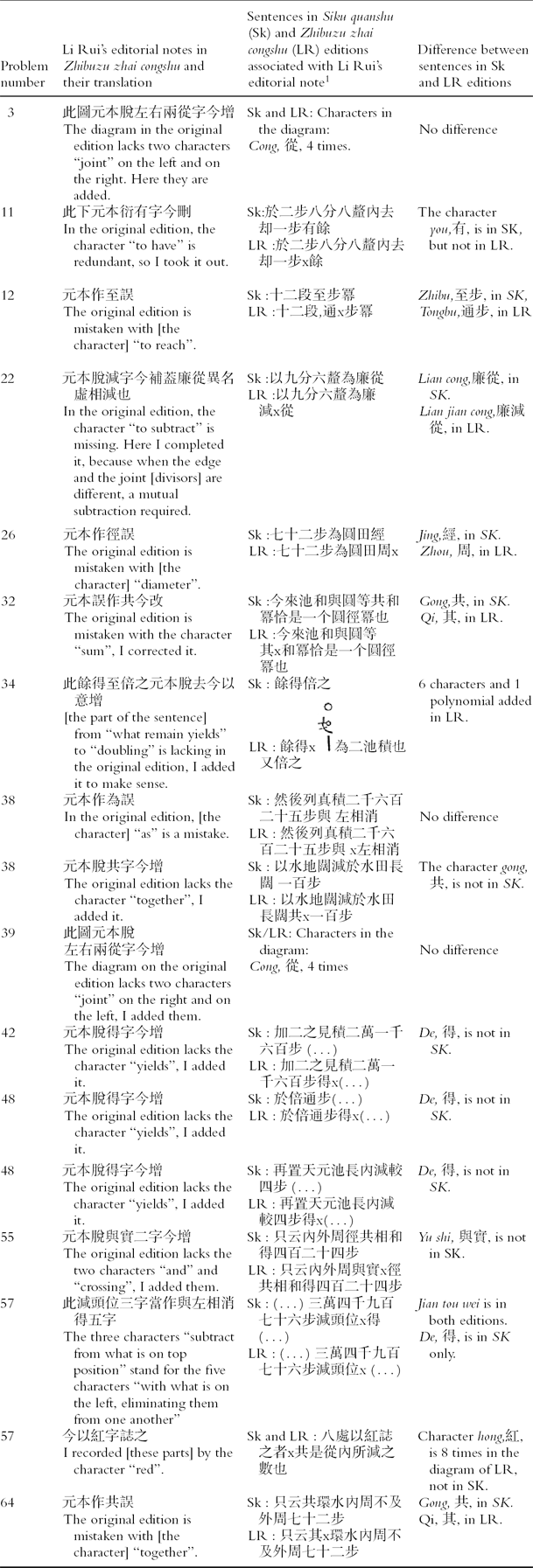
Li Rui added sixteen editorial notes to point out corrections made to the literary composition in the source material of his edition. There are no editorial notes in the Siku quanshu. Li Rui's editorial notes preserve insights into his philological reasoning. These notes do not suggest that the two editors had a different understanding of the text, but they reveal how Li Rui worked with the materials he collated. These notes also show his diligent editorial work and his philological skill. His mathematical labors are better placed in evidence by his edition of diagrams and mathematical expressions.
In some of the sentences, he indicates the modifications that were made to the text, but the passages remain identical in both editions of the Siku quanshu. If Li Rui says that he corrected some characters in one sentence, the sentence without any correction should be found in the Siku quanshu. For example, Li Rui wrote that he suppressed the character “to have,” you, 有: this character appears in both editions of the siku quanshu but not in the edition by Li Rui. The editorial note therefore agrees with the differences between the editions. Only three exceptions occur among the editorial notes. In pb.s 3 and 39, Li Rui claims that two characters are missing from the diagram, but the characters are not missing in any of the accessible Siku quanshu editions. In pb. 38, Li Rui says that the character wei, 為, is wrong and that he suppressed it. The character wei did not appear in any of the accessible Siku quanshu (see Table 1 Editorial notes). Thus, the editorial notes of Li Rui do not always match the text copied in the different editions of the Siku quanshu.
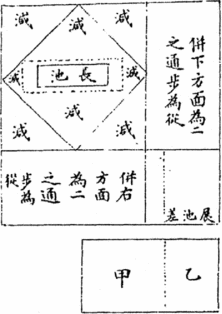
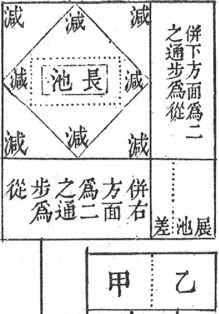
The editorial notes are interesting for another reason, though. In a note written by the editor of Siku quanshu to pb. 53, he mentions that he replaced the square in the diagram by a rectangle to make the reading easier. The diagram in the Siku quanshu edition does in fact contain a rectangle (part containing 甲 in fig. 1,). Although the same commentary appears in Li Rui's edition, his diagram contains a square (idem, in fig. 2).
Siku quanshu.

Li Rui's edition.
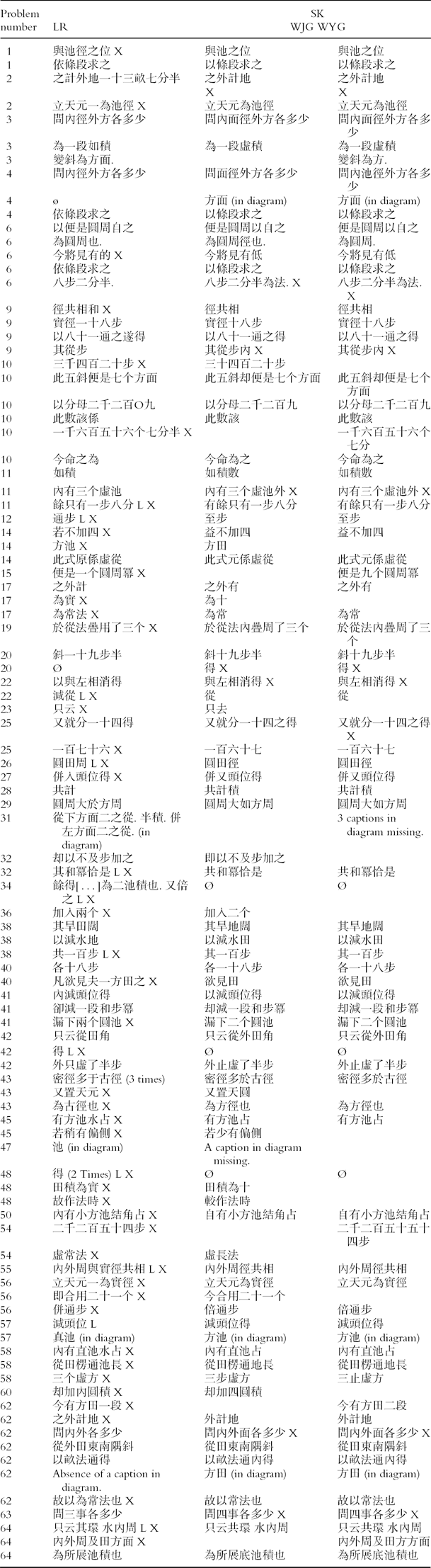
Beyond checking the different editorial notes, this comparison examines other differences that are not flagged by the editorial notes. Tables 1 and 2 in the appendix collect these differences. The edition by Li Rui and the two Siku quanshu editions diverge a total of 95 times. In 73 of these cases, WYG and WJG do not diverge. In only 3 cases do each of the three editions show a different version (pb.4; 6; 58). For 13 cases, WYG and LR agree, and in 6 cases WJG and LR agree.
Thus, the WYG copy is more reliable than the WJG. In fact, the WJG contains several mistakes that may be due to dictation: for example, 圓, “circle” appears instead of 元, “original” (pb.43); and 十, “ten” instead of 實, “dividend,” (pb.48). Some mistakes are orthographical: 十, “ten,” instead of 千, “thousand” (pb.10), or 去, “to go,” instead of 云, “to say” (pb.23). These two cases differ by only one stroke.Footnote 25 In the other 73 cases mentioned above, the WJG and WYG are identical and present differences with the edition by Li Rui.
Among the 73 cases in which the WJG and the WYG are identical to each other but differ from Li Rui's edition, 35 cases are due to synonymy. For example, 原 appears instead of 元, both of which are pronounced yuan and mean “original.”Footnote 26 Likewise, 以 appears instead of 依: both are pronounced yi and translated as “according to.” Other times, the syntax diverges, such as 一十八 in Siku quanshu instead of 十八 in LR, which in both cases means “eighteen.” In these 35 cases, the conclusion that one of the editions is mistaken is unwarranted – but the other 38 cases are indeed due to syntax or vocabulary mistakes. In 8 cases, the two editions of Siku quanshu are correct and LR is wrong. Therefore, in 30 cases, LR is correct and but WJG and WYG of the Siku quanshu is wrong. For example, in pb.25, we find the number 167 in the Siku quanshu instead of 176 in LR. In pb.43, LR reads 古徑, “diameter according the ancient lü” while the Siku quanshu reads 方徑, “side and diameter,” the latter being incorrect in both copies. Additionally, a sentence in pb.40 in LR is missing from the two Siku quanshu editions, while the same kind of absence in pb.34 is marked by an editorial note in LR. Among these mistakes, 16 are corrected in the editorial notes of LR. But why did Li Rui not include editorial notes on the other 14 mistakes?
From the evidence so far, Li Rui has two motivations: first, he responds to the commentary of the editor of the Siku quanshu to differentiate between the Celestial Source and Borrowing the Root; and secondly, he prepares a critical edition of the materials which he used. However, it is impossible to clearly identify his source materials. He could have used a copy of the Wen lan ge which differs from the text in the WJG and WYG. He could have had access to the “original” edition of the Wen lan ge, or perhaps to another edition of the Siku quanshu. Alternately, Li Rui could have consulted the Yongle dadian or a copy of it, although whether he had access to it remains unclear. Li Rui presumably copied and corrected the oldest edition of the Yigu yanduan that he could find and then he inserted the commentaries of the Siku quanshu as well as his own. At the very least, he collated two editions available to him. Thus, Li Rui might have had two different editions of Yigu yanduan at hand when he prepared the Zhibu zuzhai congshu edition. At this point, the Siku quanshu no longer resembles a uniform and unique book and the term “original” has increasingly less significance for any of the sources.
A second detail is worthy of mention: in his editorial notes, Li Rui indicates corrections by referring to the previous edition of the text written by Li Ye, consistently referring to it as yuan ben, 元本. The commentary of Siku quanshu uses another character to refer to the text which has been copied. The character, yuan, 原, is used by the editor of Siku quanshu in pb.s 53, 54, 61, 63. Both characters, 元 and 原, can be translated as “original.” The commentaries of different mathematical texts compiled in Guo Shuchun collections continue the practice of using the character yuan, 原, to refer to a text which is copied irrespective of its provenance.Footnote 27 Here, the connotation of “original” refers to the materials used as sources. In other texts for which the commentaries are attributed to Li Rui (Li Yan and Du Shiran Reference Yan, Shiran, Crossley and Lun1987, 232), such as the Chourenchuan, vol. 82, the editorial notes use the following characters: yuan ben, 元本, for Yuan dynasty editions; Ming ben, 明本, for ming dynasty editions, and Yuan ben, 原本, for the sources copied with no clearly identifiable provenance.Footnote 28 In his commentary on Ceyuan haijing, Li Rui systematically uses the character yuan, 元, for the same kind of corrections.Footnote 29 Furthermore, Li Rui the siku quanshu and a manuscript referred to as Yuanchaoben, 元抄本, for his edition of the Ceyuan haijing (Mei Rongzhao Reference Rongzhao1966, 110–111). This Yuanchaoben, 元抄本, belonged to Ding Jie (Kong Guoping 1987, 159) and contains the print of the seal of Ruan Yuan who provided documents to Li Rui. Mei Rongzhao estimates that this manuscript was written between 1310 (Yuan dynasty) and 1381 (Ming dynasty). This manuscript is still accessible at the Beijing National Library. The editorial history of Yigu yanduan conceivably followed a similar path and Li Rui may have consulted an edition from (or at least attributed to) the Yuan dynasty.
While such arguments are insufficient to prove that Li Rui did not read the Yongle dadian or a copy of the Wen lan ge, they are enough to question the origins of the sources for the surviving editions. However, Li Rui seems to have worked with specifically selected sources. He was not satisfied with the first available source and he did not directly reprint it. In total, 49,052 characters compose the Yigu yanduan, yet the discrepancies between the three editions amount to only 95 characters. The meticulousness of Li Rui's editorial notes suggests that his edition might be quite faithful to an older, albeit unknown, edition of Yigu yanduan. The precision and the quality of the work establish Li Rui as a talented editor. Although better known as a mathematician, he also worked simultaneously as a commentator, critical editor, and philologist.
Li Rui's textual criticism and philological analysis, however, have not directly guided perceptions of the Yigu yanduan. Nevertheless, Li Rui's methods show that he worked to rejuvenate Chinese mathematics. His work is a meticulous preservation and restoration of thirteenth-century mathematics based on textual criticism. Li Rui seems to have had a discernible agenda for this work. He wanted to be faithful to the oldest version of the text. To achieve this goal, he collected the most ancient documents he could find and corrected the discrepancies in an attempt to reconstruct the treatise as Li Ye composed it. In this way, a consideration of Li Rui's work underscores the fact that the “original” documents used by historians have already been reconstructed and interpreted.
d. Treatment of Diagrams
The high quality of Li Rui's work is demonstrated by the edition of diagrams, although this work is not immediately apparent. A careful comparison of the two collections of diagrams in the Zhibuzu zhai cong shu and the wen yuan ge Siku quanshu reveals very few differences among the diagrams of shapes. With the exception of the diagram for pb.3, the differences are explicitly mentioned by commentators, as in the example above (pb.53 in figs. 1 and 2). In fact, the two editors maintained exactly the same proportions when they reproduced diagrams. In order to analyze the reproduction of the diagrams, the Yigu yanduan must be understood to contain two different categories of diagrams: one attached to the statement of each problem, the other linked to the procedure of Section of Pieces [of Areas].
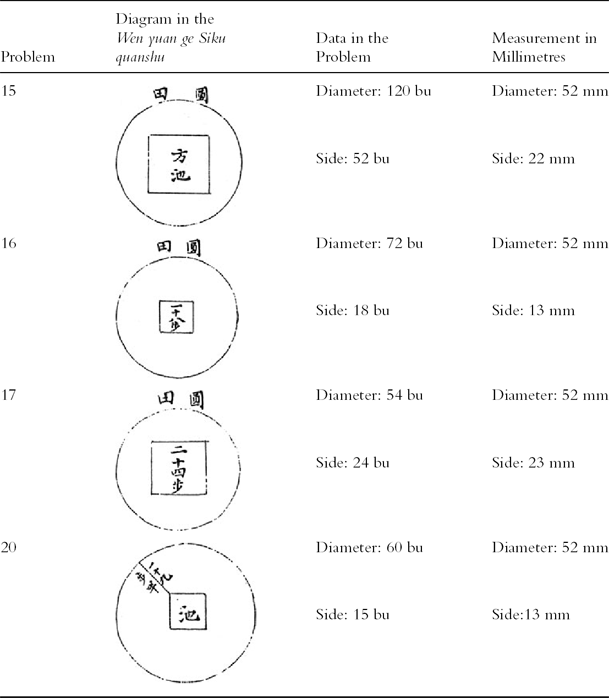
The pages of the Wen yuan ge edition of the Siku quanshu are larger than those of the Zhibuzu zhai cong shu edition. The first is a manuscript edition, while the second is a woodblock edition. Each woodblock contains the text of a whole page. Measurements of the dimensions of each diagram reproduced in the statement of problems of the original edition of the Wen yuan ge Siku quanshu preserved in the National Palace Museum in Taiwan confirmed that these diagrams were constructed in proportion with the data presented in the statement of problems.
Table I presents a sample of figures derived from the same category of problems: a square pond inside a circular field. In this selection, the dimensions of the square clearly change from one problem to the next, while the circle keeps the same dimensions.
Measurements and Data from Diagrams in the wen yuan ge edition of Siku quanshu.
Simple cross-multiplication of the bu given for one variable with the number of millimetres measured for the depiction of the other variable confirms that the measurements are proportional to the data given in the statement. This operation was performed on every diagram reproduced in the edition of Wen yuan ge Siku quanshu: all diagrams are proportional to their data. This process of confirmation has been repeated with data from other editions of the Siku quanshu and of the Zhibuzu zhai congshu. Although the same conclusion can be drawn, the Zhibuzu zhai congshu betrays a considerable loss of accuracy, perhaps owing to carving techniques or the skill of the carver. The dimensions of all editions of Siku quanshu differ from the edition by Li Rui, but the diagrams preserve the same proportions: the diagrams of Li Rui's edition resemble a reduction of the Siku quanshu with corrections (pb.3 and pb.38 below) added to diagrams. Obviously, the editors paid great attention to the dimensions.
Whereas the editors devoted considerable attention to the diagrams in the
statement of problems, the fidelity of the diagrams in the Section of
Pieces [of Areas] is less certain, as will be shown later for
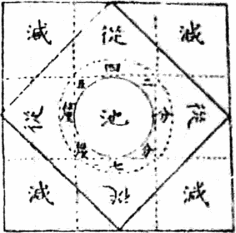
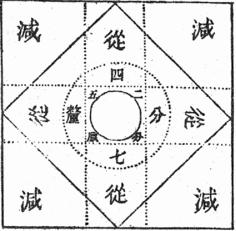
pb.38. The diagram of Section of Pieces [of Areas] for pb.3
varies significantly from the wen yuan ge Siku quanshu edition
and that of Li Rui. In the editions of the Siku quanshu, the
side of the expanded square and the diameter of the expanded circle reproduce
the dimensions of the diagram in the statement multiplied by 1.4 (Here,  $\sqrt 2 = 1.4$) (fig. 3). In
editions of the Siku quanshu (fig. 3) and the edition by Li Rui (fig. 4), the expanded circle is represented by dotted lines.
However, in Li Rui's edition, the central circle is smaller. In fact,
the dimensions of this circle represent the circle described in the statement,
but reduced exactly by 1.4 (fig. 4).
Thus, instead of squares marked by dotted lines, the figure has rectangles
(which contain the character 從). This mistake is not the result of a
problem of carving or technical drawing. Rather this error is due to
computation. This mistake in Li Rui's edition proves that he
specifically redrafted and measured the mathematical figures for publication.
Siku quanshu.
Li Rui's edition.
Clearly, the proportions are respected in diagrams and the diagrams correspond both to the data in the statement and the solution. Although proportions are respected, the ratios vary from one problem to another and no general law or pattern of repetition governs the ratios in the diagrams. However, 51 of the 65 diagrams from the statements in the wen yuan ge represent a geometrical figure inscribed within another figure and measure exactly 52 mm. The other 14 diagrams have different measurements due to their shape, chiefly two geometrical figures which meet at a point. The 52 mm standard probably represents an editorial constraint, and the other dimensions would be computed and drawn to match this value.
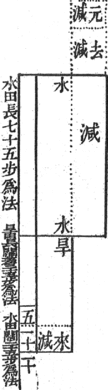
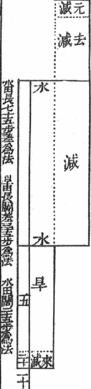
The second type of diagram presented in the Section of Pieces [of Area] presents greater challenges. Many of the diagrams represent areas which result from the multiplication of large numbers, or the results of the combination of several different areas. For diagrams like the one given in the statement, however, the dimensions are the same. Reproduced here are the diagrams of pb.38. The diagram on the right carries the following commentary by Li Rui:
the diagram on the right is wrong. To correct the signification (意), I added [a diagram] on the left. [The diagram on the right is wrong] because the black [line] stands for the original [area]. If one asks [the lengths and the widths of] the dry and the water fields, then a dotted [line] should stand for the original [area]. When one subtracts one piece that is the difference of the two widths, the piece “subtracted by going” and the piece “subtracted by coming”Footnote 30 should be equal. They are both the difference of the widths multiplied by the width of the dry [field] at the small [part] at the bottom of the real area.Footnote 31
Initially, the two diagrams look quite similar.
Diagram “on the left.” Corrected Diagram in pb.38, Li Rui's edition.
Diagram “on the right.” “Original” diagram in pb.38, Li Rui's edition.
Rather than recapitulate the details of the procedure, the corrections made by Li Rui may be more profitably highlighted. When Li Rui corrects parts on the new diagram, he changes the black line into a dotted line. The two areas marked by 減來, jian lai, and 減去, jian qu, are drawn the same size. In pb.38, one of the numbers 5, 五, at the bottom is placed differently, just under a small stroke. This stroke signifies the starting point of the width of rectangle, which is required for the computation of the polynomial. This number 五, visible in Li Rui's edition, does not appear in the accessible editions of the Siku quanshu. The stroke between 五 and 一十 in the original diagram leads to an ambiguity in the reading of the caption. It is not clear if the stroke is geometrical or a part of the character 二, er, “two.” When Li Rui corrected this diagram, he not only added some modifications in the caption and diagram, but he also changed the dimensions. The new dimensions reproduce exactly those of the diagram given in the statement, which is proportional to the data.
The editor of the Siku quanshu took a different approach to this diagram. He mentions that the diagram is faulty and proposes a different diagram for a different procedure. He explains that this procedure conforms to the “old procedure.” The commentator acts similarly several other times when diagrams are reconstituted and added by the editor of the Siku quanshu. Problem 56 is favored by historians to illuminate the “old procedure” because it is provided with a diagram titled “diagram and method of the old procedure”Footnote 32 (Xu Yibao Reference Yibao1990, 71; Kong Guoping 1987, 110; Kong Guoping Reference Guoping1999, 199). The commentator writes, however: “Now, I added one diagram and a meaning followed by an old procedure.”Footnote 33 The title of the diagram quotes characters from the commentary. The title is clearly an addition by the Qing dynasty commentator. This addition shows that both commentators were versed in the procedure of Section of Pieces [of Areas], but that they had different attitudes towards the procedure. Li Rui corrected the diagram, while the editor of the Siku quanshu supplemented it without correction. These attitudes can also be differentiated in the writing of polynomials, and the orthography of polynomials had consequences for the interpretation of Li Ye's text.
Measurement also constituted a standard practice in editing mathematical diagrams in the Qing dynasty. Editors of this time were well acquainted with the procedure of Section of Pieces [of Areas]. They were able to differentiate between what Li Ye qualifies as “old” and “new” procedures and they were able to direct the reading of the different solutions provided by the Section of Pieces [of Areas].Footnote 34 All this underlines that the eighteenth-century editions in China were made with careful precision, were concerned with faithfulness to the text, and displayed a willingness to reconstruct sources. Nonetheless, the practice of editing diagrams is not part of the commentators’ discursive practice. The geometrical procedure presents no difficulty to the commentators, both of whom mastered it. While the geometrical procedure is sometimes the object of correction, these corrections are never the object of discussion. Simply stated, because procedure is not troublesome, it does not merit debate. Thus, almost no commentaries explain it. The fact that the procedure was deemed self-evident may be one reason why the procedure of Section of Pieces [of Areas] was discarded by editors of the Qing dynasty, who were followed by modern readers. Thus, one procedure was overexposed, while the other was underexposed.
e. Treatment of Polynomials
Before describing the modification made by editors to polynomials and their equation, a few examples will establish how these expressions were presented.
Mathematicians of thirteenth-century China presented equations as a table of numerical coefficients organized vertically. This kind of representation was not new. In Chinese antiquity, coefficients of linear equations were also arranged in vertical columns (Chemla Reference Chemla1996). The characters 太, Tai, or 元, Yuan at the side of the array indicates the significance of the other numbers relative to the marked position. 太, Tai, and 元, Yuan mark polynomials and disappear after the equation is established.
This process may be illustrated by several examples from the Zhibuzu zhai
cong shu. The character tai in the upper row marks
the constant term. Thus,  is expressed in modern notation as 2700 + 252x +
5.88x2. Alternately, the character yuan indicates
the term in x. The expression
 corresponds to the modern notation 0x + 4x2. As a
place value system, the same sign in two different positions indicates two
different meanings. For example,
 corresponds to 14 + 1x but
 indicates 3780 + 228x + 1x2. In both these
examples, the number 1 occurs in the lower row but indicates two different
powers of x.
In fact, two place-value systems are in use. The first system records numbers; the second expresses polynomials and equations. In the two or three rows containing the coefficients of polynomials, the units occupy the column of units and tens appear in their own column. Li Rui describes this system in his commentary on pb.1:
On three ranks, upper, middle and lower, one strictly sets up and places the bu of each rank at the positions corresponding to each other. On the left of the bu are the tens, the hundreds, the thousands, and the ten thousands. On the right of the bu are the tenths, the hundredths, the thousandths, and the ten thousandths. When, under the [mathematical] expression, one marks down the character bu, then the positions marked it down as the bu. The positions in the rank above and below corresponding to this character bu are also bu. In the case [the character bu] is not written, hence, the final position on the right side is the bu. If on each rank, the last positions are not exactly right one above the other, then the last position on the left side of the first rank is the [position of the] bu. The positions one above the other on each rank corresponding to the last position are also the position of the bu.Footnote 35
This expression of quantities is confirmed by the examples above extracted from Li Rui's edition.
In the three accessible editions of the Yigu yanduan (WYG, WJG, and LR), several differences distinguish the expression of polynomials from equations. Nowhere in WYG or WJG are the polynomials aligned, but in LR the polynomials are always aligned. The editor of the Siku quanshu did not place numbers in strictly defined positions, that is: units, tens, etc. appear in a same column. In WYG and WJG, not only are the mathematical expressions not aligned, but they are sometimes even cut apart and written in two columns (see Fig. 7, Siku quanshu), which never happens in LR.
Siku quanshu.
Another difference separates the two editions. In Li Rui's edition of
the Yigu yanduan, negative coefficients are distinguished from
the positive ones by a diagonal stroke, as in  , which denotes 53824 – 464x –
0.47x2, in modern notation. The same notation for negative terms
appears in Li Rui's edition of the Ceyuan haijing.
This reoccurrence led historians to conclude that “Such a symbol is
met with in both works of Li Yeh. If we are not sure whether he was the first
Chinese who used the symbol, yet his works are perhaps the oldest writings
wherein it was made use of, that are transmitted to our time” (Mikami
Reference Mikami1913, 82). Yoshio Mikami, John
Hoe, Lam Lay Yong, Ho Peng Yoke and Mei Rongzhao all agree that Li Ye himself
“indicated negative quantities by drawing an oblique line over the
final digit of the number concerned” (Ho 1978, 315).
Surprisingly, however, in Yigu yanduan preserved in WYG and WJG, there is no trace of such notation, although diagonal strokes appear in the same editions of the Ceyuan haijing and the Ming edition. Why such disparity exists in the editions of Li Ye's works in the Siku quanshu remains unexplained.
Li Rui directly addressed the question of positive and negative notation in a commentary on pb.1.
In the mathematical expressions of the original edition (元本算式), positive or negative are not differentiated. According to Shen Gua, in the Dream Pool Essays: “in arithmetic, one uses red and black rod sticks to differentiate the negative quantity from the positive one.”Footnote 36 And again, in the Mathematical Treatise in Nine Sections by Qin Jiushao, in the diagram of the extraction of the root in the fourth roll, “the negative expressions are drawn in black, while positive expressions are drawn in vermilion,”Footnote 37 both conform to the explanations by Liu Hui in The Nine Chapters on the Mathematical Procedure who says that “red is for the positive expressions, while black is for the negative expressions.”Footnote 38 According to this, one knows that, at this period, mathematical expressions were probably drawn in red or black in order to differentiate them. But the copyists altered this [notation]. Now, following the example given by The Sea Mirror of the Circle Measurements, for every negative expression, one draws an oblique stroke to record it, so that all the positions of the expressions are easy to differentiate.Footnote 39
Indeed, the different editions show that Li Rui added a sign for negative quantities in the Zhibuzu zhai congshu edition of the Yigu yanduan but that this sign was not in the editions he was collating. This sign, however, was visible in the materials he used for his edition of the Ceyuan haijing.
The reasons for difference between the various editions of the works of Li Ye cannot be known. Either the positive and negative had been written in different colors, as Li Rui suggests, and technical or economical constraints of edition precluded the use of red color, or the material used by Li Rui for the editions of Ceyuan haijing and Yigu yanduan derived from different older editions which were not related to each other. Possibly, both reasons occurred in tandem. At the least, Li Rui did not observe any red ink in his source material. Admittedly, whether the signs in the original document produced by Li Ye conform to the Yigu yanduan or the Ceyuan haijing remains unknown.
Errors also frequently characterize the numeric tables in the edition of the Siku quanshu. Sometimes the number 1 is missing (pb. 10, 11, 24, 46) or digits are mistaken (pb.27: 1 instead of 2; pb.30: 21 instead of 43). Sometimes zeros are missing (pb.3 twice, pb.6 twice, pb.22 and pb.48 twice). The characters 步, bu, 太, tai and 元, yuan are sometimes missing in polynomials (pb.s 14, 53, 56, 59, 60, 61). In one of the polynomials of pb.23, tai is written instead of yuan. Sometimes the character bu is written directly in the sentence following the polynomial as if it were not part of the mathematical expression.
Li Rui insisted on the importance of these characters. Li Rui described the way Li Ye composed polynomial in his commentary on pb.1:
For all the mathematical expressions, the real area (i.e. constant term) is named tai ji (太極), then on its side one writes down the character tai (太). The empty quantity (i.e. terms in x) is named tian yuan (天元), and on its side one writes down the character yuan (元). One rank under the rank of tai, is the rank of yuan, and one rank under the rank of yuan is the rank of the square, which is self-multiplied. If the character tai is written down, the character yuan is not written, and if the character yuan is written down, the character tai is not written.Footnote 40
Indeed, as Li Rui mentioned, Li Ye added the character tai, 太, “extreme,” on the right in the upper row to indicate the constant term. Sometimes the character yuan, 元, “source,” appears instead. In these cases, the notation indicates the value is the coefficient of the first power of the unknown. These two characters are carefully written in Li Rui's edition but the editions of the Siku quanshu are not so meticulous. Just as in the case of positive and negative quantities, Li Rui's commentaries on the orthography of mathematical expressions should be interpreted as corrections and not descriptions of his source materials. Li Rui's edition can be interpreted as an attempt to reconstruct polynomials in their proper expressions. Li Rui took great care with mathematical notation, and the tables in the edition of the Zhibuzu zhai congshu are in fact a partial re-invention on the part of Li Rui. His re-invention is probably well founded but nonetheless shows that how polynomials and equations were written in the time of Li Ye remains a mystery.
Li Rui clarified the polynomials through his corrections. Li Rui presented these polynomials in distinct arrays, with negative coefficients clearly differentiated from positive coefficients. Moreover, it is easy to read the decimal quantities. Li Rui's editorial choices improve the legibility of the polynomials. As a result, the tabular setting for polynomials and equations appear as a finished and definitive product. These corrections contributed to a heated debate in which the two procedures, Borrowing the Root and Celestial Source were compared. As shown above, most authors have tended to focus on the first procedure, but the procedure of the Celestial Source occupies a large section of the various editions of the book. However, because the practice of reproducing diagrams is not discursive, commentaries, or editorial notes to diagrams are rare and the geometrical procedure was intuitively obvious for the commentators, the procedure of Section of Pieces [of Areas] was discarded. There is no written trace of any debate on the Section of Pieces [of Areas] because the procedure is “just” embodied in a collection of diagrams. These editorial choices probably contributed to the realization that the main topic of the Yigu yanduan is the presentation of procedure of the Celestial Source. Herein lies a reason for the peculiar portrayal of Chinese algebra.
Conclusion
The Qian-Jia scholars reconstructed and published mathematical treatises in order to establish the Chinese root of “Western” algebra that was introduced in China from the seventeenth century onward. The re-edition of the works of the thirteenth-century mathematician Li Ye played a part in this wider context of criticism. Li Rui, and his patron Ruan Yuan, both Qian-Jia scholars, published the works by Li Ye to demonstrate the primacy of Chinese mathematics. In the case of the Yigu yanduan, Li Rui carefully identified, compared, and corrected the sources available in his time. He drew precise diagrams by computing their dimensions according to the data of problems. He also re-constructed polynomials according to his idea of how polynomials should be represented. He also demonstrated why he thought they should be represented differently. He tried to accurately restore the text to his image of its ancient version. He did competent work as a philologist. However, we see that some of his editorial choices reflect his goals and prejudices, especially classicizing perspective. His editorial choices are not totally neutral.
Li Rui strove to present the algebraic procedure of Celestial Source as the ancestor of the Western Borrowing the Root method and to prove its efficiency. Despite the professed objective of giving the reader an accurate idea of “Chinese” mathematics, Li Rui illuminated only one of the two algebraic procedures presented by Li Ye in the Yigu yanduan, the procedure of the Celestial Source. His edition of the two masterpieces by Li Ye endeavors to set Chinese mathematics and Western mathematics in opposition by focusing on this procedure. This led him to neglect Li Ye's other geometrical method, the Section of Pieces [of Areas]. Thus, Li Rui reduced the work of Li Ye to a presentation of the procedure of the Celestial Source. Li Ye did not undertake the composition of the Yigu yanduan solely to the procedure of the Celestial Source. However, Li Rui's edition of Li Ye's works contributed to the formation of a particular image of algebra in China. In the case of the Yigu yanduan, it led historians to spurn this text as simply a book aimed at initiating beginners into the procedure of the Celestial Source. This perspective led the historians to consider only one of the forms of algebra presented therein. Consequently, these historians have paid little attention to Li Ye's geometrical work. Although the Qing editors mastered the other geometrical method presented in the Yigu yanduan, the latter remained in the shadow of non-discursive editorial practices. The case study of the edition by Li Rui demonstrates how difficult it is to separate the history of the transmission of a text from the history of its interpretation.
Table of editorial notes to the Zhibuzu zhai congshu edition
Table of differences between the two siku quanshu and the zhibuzu zhai congshu editions.1
GLOSSARY
Ruan Yuan, 阮元
Qian-Jia School, 乾嘉學派
Li Ye, 李冶
Ceyuan haijing, 測圓海鏡
Yigu yanduan, 益古演段
Li Rui, 李銳
Zhibuzu zhai congshu, 知不足齋叢書
Qianlong, 乾隆
Jiaqing, 嘉慶
Siku quanshu, 四庫全書
Gu Yanwu, 顧炎武
Dai Zhen, 戴震
Yan Ruoqu, 閻若璩
Qian Daxin, 錢大昕
Duan Yucai, 段玉裁
Wang Niansun, 王念孫
Wang Yinzhi, 王引之
Yangzhou xue pai, 揚州學派
Jiegenfang, 借根方
Kangxi, 康熙
Jiegenfang suanfa, 借根方算法
Mei Juecheng, 梅瑴成
tian yuan shu, 天元術
Li Shanlan, 李善蘭
Tongwen guan, 同文官
Tiao duan, 條段
Qin Jiushao, 秦九韶
Shu shu jiu zhang, 數書九章
da yan, 大衍
Zhu Shijie, 朱世杰
Si yuan yu jian, 四元玉鉴
si yuan shu, 四元術
jiu shu, 舊術
Yang Hui suanfa, 楊輝算法
Tian mu bilei chengchu jiefa, 田畝比類乘除捷法
Yang Hui, 楊輝
tu, 圖
Muihae, 無異解
Yongle Dadian, 永樂大典
Jiao Xun, 焦循
Wang Lai, 汪萊
The wen yuan ge (1), 文淵閣, Beijing gugong, 北京故宮;
the wen su ge, 文溯閣, Shenyang gugong, 瀋陽故宮, Liaoning, 遼寧;
the wen yuan ge (2), 文源閣, Beijing yuan ming yuan, 北京圓明園;
the wen jin ge, 文津閣, Cheng-de bishu shanzhuang, 承德避暑山莊;
the wen zong ge, 文宗閣, Zhenjiang jinshansi, 鎮江金山寺, Jiang-su, 江蘇;
the wen hui ge, 文匯閣, Yang zhou da guan tang, 揚州大觀堂;
the wen lan ge, 文瀾閣, Hangzhou, 杭州.
gugong bowuyuan, 故宮博物館
Chourenzhuan, 疇人傳
Ding Jie, 丁杰
Haidao suanjing, 海島 算經
Jiuzhang zuanshu, 九章算術
Wucao suanjing, 五曹算經
Xiahou Yang suanjing, 夏侯 陽算經
Meng qi bi tan, 夢溪筆談, by Shen Gua, 沈括
Shu shu jiu zhang, 數書九章 or Shu xue jiu zhang, 數學九章
Acknowledgments
This work was supported by the Mathematics Department at National Taiwan Normal University through a fellowship granted by the Taiwan Ministry of Education. Thanks are due to the members of the Academy of Sciences in Beijing for courtesies and insights in Beijing in 2010. Furthermore, a debt of gratitude is owed to Horng Wannsheng, Karine Chemla, and Alexei Volkov for advice and to Marion Dalvai for proof-reading.