

I. Introduction
Interdependence on the Old Continent goes beyond internal boundary-building and the establishment of self-centred compartments of governance, as happened in the past with the old Westphalian nation-states. Europeanisation relates to economic, political and social domains in countries sharing a common heritage and embracing egalitarian values of democracy and human rights. Nevertheless, the concept is far from precise. It is polysemic and subject to various degrees of understanding and interpretation. Europeanisation is rather a dynamic idea expressed in the erosion of state sovereignty and the gradual development of common institutions in Europe (for example, the Schengen Agreement, the Court of Justice and the euro) on the one hand, and the dissemination of policy paradigms, enhancement of social learning and collective mobilisation on the other. Europeanisation can also be regarded as a process which aims at making territorial subsidiarity consistent with democratic home rule within European framework legislation and continental institutions. This is the core argument of this article, which relates to the two main areas of analysis posed in this special issue: (1) the constitutional dimensions of independence and partnership, given the intersecting legal regimes involved; and (2) the power dimensions of independence given entanglement in a set of external relationships.
In broad terms, this article is concerned with how the global nature of political life forces a reconsideration of core constitutional concepts. Our spatial context of analysis takes into account the top-down and bottom-up implications of the observable trends of supra-nationalisation and decentralisation in Europe. In particular, the case study of Catalonia’s in(ter)dependence serves the purpose of highlighting the apparent contradiction of these two dichotomous political processes, which are to have long-term effects on the restructuring of European politics. Popular consultations on independence in Scotland and Catalonia took place after the financial crisis which was unleashed in 2007/08. As a consequence, serious questions have been raised about the capacity of formally independent states to carry out sovereign economic policies in the context of globalisation. In parallel to these developments, the process of Europeanisation brought to the fore the interdependence of EU economies and the need to work together in order to preserve the European social model.
The first part of this article focuses on the challenges of interdependence that European subsidiarity, multi-level governance and the preservation of the European Social Model (ESM) imply for stateless nations like Catalonia. Despite the diversity of institutional forms and manifestations, the ESM is an ‘umbrella’ conception based upon a project of collective solidarity and resulting from contemporary patterns of social conflict and cooperation on the Old Continent. During the twentieth century the rise of the welfare state, a European ‘invention’, allowed provision for the basic needs of citizens through income security, health care, housing and education. There is a widespread belief that a distinct European social model provides a collective unity and identity for most EU countries, in contrast to other systems where individual re-commodification or ‘social dumping’ are distinctive tenets of welfare provision (in the US and South Asia, respectively). As a common strategic goal, the European social model aims at securing sustainable economic growth together with the preservation of social cohesion (Scharpf Reference Scharpf2002, Adnett and Hardy Reference Adnett and Hardy2005, Jepsen and Serrano-Pascual Reference Jepsen and Serrano Pascual2005, Giddens Reference Giddens2006).
This article analyses both the EU and Spanish frameworks. A further review of concepts such as Europeanisation and decentralisation aims at elaborating on one of the central problems raised by this special issue: the meaning of independence in the context of intersecting legal regimes, or what it means to be ‘independent’ in a deeply entangled global economy and its political implications. The subsequent section concentrates on how the meaning of independence has been constructed in contemporary Catalonia, our case study in observation. Internal conflicts within Spain and the lack of territorial accommodation, together with a long-standing centre–periphery controversy, have fuelled claims for secession by some Catalan nationalists. The concluding remarks reflect on how ‘cosmopolitan localism’ can optimise both independence and interdependence in a global context.
The idea of ‘cosmopolitan localism’ mainly concerns medium-sized polities within or without the framework of a state in Europe. Thus, it can be detected in minority nations (e.g. Catalonia, Flanders, Scotland) and small nation-states (e.g. the Czech Republic, Luxembourg, Slovenia) as well as in regions and metropolitan areas (e.g. Brussels, Berlin, London, Milan). Particularly the latter seems to follow a pattern of recreating those political communities that flourished in the age prior to the discovery of the New World (Italian city-states, the Hanseatic League, principalities). However, and in contrast with the Renaissance period, there is now a common institutional tie inherent in the process of Europeanisation. The majority of EU peoples have internalised European institutions, albeit rather loosely and gradually. The European Court of Justice or the Schengen Agreement can be regarded as institutional steps advancing towards the idea of European supra-nationalisation. Even areas such as those concerning social policy and welfare development – the traditional domain of national intervention – are viewed from a supranational perspective in accordance with the European Social Model (Moreno Reference Moreno, Safran and Ramón2000).
Thus, ‘cosmopolitan localism’ can be regarded as a combination that is reflected in societal interests aimed at developing a sense of local community and in participating simultaneously in the international context. It further relates to power relations and competing legitimacies at the various local, national, regional and international levels, and can be regarded as a facilitator in the construction of ‘independence’ in practice. Along these lines, Catalonia can be seen as a stateless nation and a meso-community, which encapsulates the communion between the particular and the general based upon a strong collective identity.
II. Processes of Europeanisation and decentralisation
In a broad sense, Europeanisation refers to the process of institutional system-building among EU Member States as well as the practice of framing shared problems and assumptions, and the diffusion of procedures and policy paradigms. The unfolding of structures of governance at a supranational European level has been taking place through interactions among actors and policy networks whose operations have traditionally been confined to national arenas. As a supra-state political community, the European Union is a compound of policy processes, and Europeanisation implies that national, regional and local policies are to be partly shaped by considerations that go beyond the centrality of the Member States.
Developments around the turn of the millennium, and particularly since the outbreak of the 2007 financial crisis, have dramatically exposed the limitations of the nation state as a sovereign actor in global economics. Models of British ‘command-and-control’ majoritarian democracy, as well as of the Jacobin vertical diffusion of power, seem to be in terminal retreat, a development taking place in parallel to Europeanisation (Loughlin Reference Loughlin2007). In this respect, the institutionalisation of the European Union can be regarded as a compound of policy processes, which condition in no small measure the formal sovereignty of the Member States (Piattoni Reference Piattoni2010).
The constitution of a United States of Europe ought not to be considered the end objective of the process of Europeanisation. The neo-functionalist school of thought has generally adopted the view that universal progress requires a kind of integration, equivalent to cultural assimilation, along the lines of the ‘melting-pot’ experience (Glazer and Moynihan Reference Glazer and Moynihan1963). An alternative view of non-homogenising integration puts the emphasis on the historical, psychological and social characteristics of a plural Europe. From such a pluralistic perspective, European convergence can only succeed by taking into account both the history and the cultural diversity of the mosaic of peoples forming the Old Continent (Moreno Reference Moreno2003).
Within the EU, the ongoing rescaling of nation-state structures and political organisation is in line with Europe’s principle of territorial subsidiarity.Footnote 1 Processes concerning the ‘unbundling of territoriality’ are having a direct impact on citizens’ living standards and expectations (Hooghe and Marks Reference Hooghe and Marks2001; Kazepov Reference Kazepov2008). This crucial tenet of Europeanisation establishes that policy decision-making should be democratically located at the level closest to the citizen. In other words, the purpose of subsidiarity is to limit the power of central authorities by assuming the criteria of ‘proximity’ and ‘proportionality’. Furthermore, subsidiarity aims to provide a protective measure against overexpansion of European control in matters resting upon the jurisdiction and prerogatives of each layer of government. It also encourages co-ordination to manage growing interdependencies.
Political communities are constituted by individuals ruled and represented by the structures of a political system, whether supranational, national or sub-national (sub-state) (Easton Reference Easton1965). Political interdependence concords with the notion of multi-level citizenship, which can be conceptualised as a compound of collective attachments favouring both supranational legitimacy and sub-state democratic accountability in the implementation of public policies (Berg Reference Berg2007). Autonomy, devolution, and subsidiarity seek to accommodate institutional responses to the stimuli of the diversity or plurality of the polities involved. These often comprise local, regional and national political communities with differences in identity, history, language, or traditions, which are reflected in different party systems, channels of elite representation or interest articulation. In plural Spain, for example, a variety of political communities were constitutionally established at the meso-level after the inception of the 1978 Constitution (17 Comunidades Autónomas). Despite their differences in institutional arrangements and policy preferences for autonomy, they all embraced interdependencies and expressed a common aspiration to enhance ‘bottom up’ Europeanisation.
In Catalonia, claims to ‘top down’ territorial subsidiarisation of public policies have been put forward not only by nationalists, but also by federalists and other autonomists. There has been a long-term tradition in Catalan politics of requesting further home rule while participating actively in international trade and relations, according to the idea of ‘cosmopolitan localism’. Catalan meso-level entrepreneurs, social leaders and local intelligentsias have often adopted many of the initiatives and roles once reserved for ‘enlightened’ central elites who in the past held the reins of state power. The co-optation of regional elites to the central institutions of government has not been the exclusive route available for ‘successful’ political careers, as could have been the case of regionalised Italy (Moreno Reference Moreno2007).
Throughout Spain, meso-governments and local authorities have also felt that they do not need par force the rationalising intervention of central bureaucracies and elites in the exercise of their autonomy. In general terms, sub-state autonomous political communities in the EU enjoy economic and political security offered by supranational EU institutions, in a post-sovereignty era of progressive trans-nationalisation and increasing interdependence (Keating Reference Keating2001; Moreno and McEwen Reference Moreno, McEwen, McEwen and Moreno2005).
Territorial subsidiarity goes hand in hand with the second guiding principle of Europeanisation: democratic accountability. There cannot be any further development of politics in Europe if decisions are taken behind closed doors, as happens frequently in often opaque state-centred polities. Democratic participation and citizens’ involvement in public life is quintessential to the very preservation of the European Social Model (ESM). Multi-level citizenship is set to incorporate not only multiple memberships to European nations (state or stateless) and regions and localities, but also to integrate a common baseline – mixed and cross-bred in many instances – that conforms to the axiological pattern of the ESM. Above other considerations, the ESM appears to be a common value-system, which makes transnational solidarity possible (Gould Reference Gould2007). It also legitimises the redistribution of resources and vital opportunities characteristic of European welfare systems.
Convergence and political interdependence within the EU is not an incentive for internal boundary-building and the establishment of self-centred compartments of governance, as happened with the old Westphalia nation-states. In 1988, the Commission President at the time, Jacques Delors, went so far as to predict that at the end of the twentieth century 80 per cent of policymaking would be of EU origin, something which has proven to be an overestimation. However, at present Europeanisation reaches out to citizens on the Old Continent as a whole, and much of EU legislation has an impact on people’s daily lives. ‘Direct effect’ is the principle that EU law may, if appropriately framed, confer rights on individuals, which the courts of EU Member States are bound to recognise and enforce.Footnote 2
The struggle against fiscal evasion, to mention a pressing policy related to the financial crisis unleashed in 2007, is only inefficient if European countries and territories do not have a common stance (European Commission 2013). Following on the subsidiarity rationale, it is counterproductive to impede or curtail self-government in political communities such as Catalonia. But it is also unrealistic not to envisage an interdependent Europe without redistribution of income transfers between territories and multi-level citizenship (Ferrera Reference Ferrera2008).
The academic debate on whether decentralisation and subsidiarisation constrains redistribution is an unfinished one. Likewise, there are no consistent empirical findings that lend support to the proposed ‘positive sum’ arrangement by which the allocation of the functions of redistribution should be allocated to the macro levels (European, state) and those concerning the policy provision to the micro levels (regional, local). Concerning public spending in multi-tiered systems of government, there is a body of cross-national literature that has sought to understand the factors that influence levels of expenditure, as in the case of welfare policies and services (Hicks and Swank Reference Hicks and Swank1992). Such a literature has a long-standing trajectory but has often concluded that decentralisation constrains the expansion of public economies. Further rescaling can arguably have more powerful negative effects than any other institutional variable, and greater than factors such as the level of corporatism in decision-making, the nature of the electoral system, or a presidential system of government. However, decentralised countries with a long-standing record of public involvement, such as Australia or Canada, demonstrate a greater positive correlation between public spending and redistribution (Obinger et al. Reference Obinger, Leibfried and Castles2005).
In addition to the structure of the state – or a union of states such as the EU – redistribution may also be affected by the diversity of its internal composition. In this regard, it has been argued that the degree of redistribution is more limited when there is a high degree of heterogeneity. Public policies and spending designed to recognise and accommodate internal diversity are considered to be detrimental to the stability of those compound polities, with numerous consequences. They may have: (i) a crowding-out effect, diverting energy, money, and time to the recognition of diversity and legitimising asymmetries; (ii) a corroding effect, eroding transversal trust and solidarity amongst citizens living in different locations and milieus; or (iii) a misdiagnosis effect, with solutions shifting attention from individual inequalities to those emphasising territorial particularities between regions or nations (Moreno Reference Moreno, Suszycki and Karolewski2013).
However, the causal relationship between public spending and redistribution has not been empirically sustained. Multiculturalism and the welfare state, for instance, have correlated positively in the case of Canada (Banting and Kymlicka Reference Banting and Kymlicka2006). In fact, empirical studies on the interrelation of ethnic diversity within states, the production of public goods and the preservation of social cohesion have been inconclusive. Approximately half of those studies confirm (or refute) the hypothesis that diversity has a negative impact on social cohesion (Schaeffer Reference Schaeffer2013). In the same vein, the determinant most affecting the legitimacy of social solidarity and the redistribution of public spending – including those societies with a higher degree of internal heterogeneity – is the capacity and quality of government institutions as generators of social trust (Rothstein Reference Rothstein2015).
For meso-communities in decentralised countries, such as Catalonia, the form of devolution is an important area of analysis in assessing policy outcomes. Some findings point to the fact that countries in which responsibility for spending is decentralised, but responsibility for revenue-raising is centralised, tend to spend more than other countries, other things being equal. By contrast, in countries where both revenue-raising and spending are decentralised, expenditure levels appear lower (Rodden Reference Rodden2003). Allegations by Catalan nationalists that ‘Spain robs us’ channelled the complaint that Catalonia contributes ‘disproportionately’ to the general tax revenue and receives much less from the central treasury. It also claims that both tax collection and expenditure should be comprehensively decentralised as happens in the Basque Country and Navarre.
It is important to remember that, according to the concierto financial agreement with the Spanish authorities, the Basque and Navarre governments enjoy full fiscal autonomy in all taxes except VAT (regulated by the EU). This allows for considerable spending discretion and makes the system more accountable to its citizens. The fact that the Basque Country and Navarre (the two Comunidades Autónomas) do not contribute to the vertical equalisation scheme to provide equal public services all over Spain creates comparative grievance, particularly in Catalonia. As a richer Comunidad Autónoma Catalonia contributes a larger share of their revenues to poorer regions. This unequal economic imbalance is only sustainable, it has been argued, because the Basque Country and Navarra just represent together around eight per cent of the Spanish GDP (Colino Reference Colino2012).
In Spain, autonomy in public expenditure is viewed as part and parcel of political autonomy by both richer and poorer meso-communities. Autonomy is also a sensitive political issue in the articulation of the redistribution and transfer of funds from the former to the latter. As a constitutional principle, the ultimate goal of equalisation concerns the attainment of a common level of basic services, the procurement of citizenship rights, and an adequate distribution of the financial burdens. Most equalisation systems seek to redistribute fairly the available general financial resources, something which in the case of Catalonia and Spain has created no small amount of antagonism and confrontation. Criticisms are usually voiced by meso-governments when they feel that the equalisation system is too redistributive and lacks clear distributive criteria so as to motivate the subsidised and more deprived regions to improve their performance. The latter generally demand a higher level of public spending to empower them in catching up with other political communities. But redistribution may also come in the form of central public investments in large infrastructure projects, which may be discretionary and subject to criticism from the ‘donor’ territories. Some other national programmes under central state responsibility may enjoy a great deal of legitimacy, particularly in ‘recipient’ Comunidades Autónomas, as is illustrated by welfare expenditure concerning old-age pensions, social security benefits, or unemployment benefits (Moreno Reference Moreno, Suszycki and Karolewski2013).
As elsewhere, Europeanisation and decentralisation interact with each other in Spain on matters involving variables degrees of independence and interdependence in political decision-making. Policy choices are increasingly shaped by externalities generated globally. Concerning Catalonia, most questions at stake regarding in(ter)dependence relate to the degree of self-rule and shared rule. Late political mobilisation by Catalan nationalists has challenged processes of territorial rescaling, claiming the right of Catalonia to secede from the rest of Spain. Future developments will have consequences for territorial politics, particularly as regards the level of Catalonia’s self-government and co-decision with Spanish and European institutions to implement policies and political arrangements. The following section explores how the meaning of independence has developed in the context of Catalonia, as it relates to the challenges of Europeanisation and decentralisation. In order to gain insights into the ‘cosmopolitan localism’ of modern Catalanism, a review – even if succinctly – is carried out below. It aims to analyse the quest of Catalan independence within the Spanish context and in the midst of international dynamics and contemporary trends that promote further home rule at the sub-state level.
III. Catalonia and the quest for independence
Following developments in Scotland, which culminated in the popular vote on independence on 18 September 2014, Catalonia’s institutions of self-government promoted the celebration of a similar referendum. Even though it was declared illegal by the Spanish Constitutional Court, the Catalan Government of the Generalitat went ahead with the organisation of a public consultation, which finally took place ‘informally’ on 9 November 2014. A majority of 80 per cent of those who participated in the consultation voted for secession (‘Yes’ to both questions submitted to the electorate on self-determination).Footnote 3 Turnout was around 37 per cent of the registered voters.
As background information to the secessionist claims put forward in recent years in Catalonia, this section deals concisely with relevant historical development in modern Spain. Firstly, it needs to be pointed out that there has been a traditional lack of congruence – or a ‘non-congruence’ – between political and economic powers in Spain. Not only Catalonia but also the Basque Country, the two Northern peripheral Spanish communities with a powerful ethno-territorial characterisation, have remained as two of the three economically most dynamic territories of Spain, the third being the region of Madrid. This non-congruence has traditionally nourished centrifugal tendencies that emerged at the end of the nineteenth century from strong independent movements in both the Basque Country and Catalonia.
During the nineteenth century economic modernisation intensified internal divergences in Spain. As elsewhere in Europe, processes of industrialisation and ideologies of progress served to destabilise existing forms of order and promoted the achievement of new institutional formations (Buzan and Lawson Reference Buzan and Lawson2013). Catalonia’s industrial take-off speaks for itself. In 1862, 41 per cent of the power produced in Spain for industrial use was located in Catalan territory.Footnote 4 The demographic increase of the population of Catalonia between 1787 and 1857 was nearly 90 per cent (i.e. from 875,388 to 1,652,291 inhabitants). Such figures corresponded to 7.8 and 10.7 per cent of the total Spanish population, respectively.Footnote 5
The reaction of Spanish nationalism, which was deployed with policies of institutional centralisation during the Restoration (1876–1923), coincided with the loss of Spain’s status as a colonial power. In 1898, the Spanish-American War resulted in the relegation of Spain to the second tier of world politics, which gave impetus to Catalan nationalism. Furthermore, the establishment of universal male suffrage in 1890 had the notable effect of placing incipient Catalanisme squarely in the Spanish political scene. The disparity between Catalonia’s social structure and that of an impoverished rural Spain was an important factor in the rise of Catalan nationalism (Giner Reference Giner1980). Differences in socio-economic composition between Spain’s two major cities, Madrid and Barcelona, also became increasingly evident.Footnote 6 These elements fuelled a sense of hopelessness amongst members of the Catalan elite, who put their influence and electoral support behind home-rule parties.
On 14 April 1931 the Spanish Second Republic was proclaimed. On the same day the Catalan nationalist leader, Francesc Macià, of Esquerra Republicana de Catalunya (ERC), the pro-independence party which had won the local elections in Catalonia, declared the creation of the Republic of Catalonia within the framework of a Spanish Confederation. After negotiations with representatives of the central government, the Generalitat, Catalonia’s government of medieval origin, was re-established. Such compromise avoided the unilateral declaration of Catalonia’s independence. In spite of its short existence, the Second Republic (1931–39) contributed greatly to the resolution of ethno-territorial conflict in Spain. The most notable achievement was its design on the basis of a regional model, situated somewhere between a unitary and a federal state. This constitutional change led to statutes of autonomy for Catalonia, the Basque Country and Galicia, all of which later came to be known as ‘historical nationalities’.
The ethno-territorial issue played a crucial role in the process of political polarisation which led to the Spanish Civil War (1936–39), a conflict that also had international implications and was the prelude to World War II. Following the long dictatorship of General Franco (1939–75), the broad party political consensus that made the drawing up of the democratic 1978 Constitution possible, also brought with it an element of ambiguity in the formulation of the territorial organisation of the Spanish state. Catalan nationalists actively participated in the elaboration of the constitutional text which was widely supported in Catalonia.Footnote 7
In general terms, the overall process of home rule in Spain during the 1980s and 1990s succeeded in meeting the political aspirations put forward by 17 sub-state nationalities and regions which came to compose the federalising Estado de las Autonomías (State of Autonomies). Such aspirations were articulated around common cultural, historical, linguistic, and political facts that any person in those territories could assume and identify with, regardless of his or her origin, family homeland, or ancestral background. Some minorities of citizens identified exclusively along ethno-territorial lines (e.g. ‘I consider myself to be only Basque, Catalan or Galician’). They generally claimed political independence for their territories. However, two-thirds of all Spaniards expressed a ‘dual identity’ or ‘compound nationality’. This dual identity incorporated both regional and Spanish identities in various degrees and without apparent contradiction between them.Footnote 8
From the viewpoint of the powerful Basque, Catalan and Galician nationalisms, Spain ought to be constitutionally composed along linguistic lines, including the ‘historical nationalities’, as well as the rest of Castilian-speaking Spain.Footnote 9 Such sub-state nationalisms have always been more inclined to the establishment of confederal options of accommodation in Spain – or outright independence of their territories – rather than working out federal arrangements tout court (Moreno Reference Moreno2001).
In the mid-2000s, some 25 years after the beginning of the overall home-rule process, initiatives were taken by regional parliaments to reform their own constitutional laws (Estatutos de Autonomía) in order to gain more autonomy (Catalonia, 2006; Andalusia, 2006; Valencia, 2006; Aragon, 2007; Balearic Islands, 2007, Castille and Leon, 2007, and, later on, Extremadura, 2011). On September 27, 2002, the Lehendakari (President) of the Basque government made a statement before the Basque Parliament proposing a new Pact for Cohabitation (Pacto para la Convivencia) to be based on the free association and co-sovereignty between the Basque Country and Spain. According to the Lehendakari, Juan Jose Ibarretxe, the citizens of the Basque Country were entitled to self-determination. On September 11, 2008, the Spanish Constitutional Court rejected the possibility of holding a ‘sovereignty-association’ referendum along the lines of Ibarretxe’s proposals and similar to the one organised in Quebec in 1980.
Catalan political forces agreed on the need to reform the 1979 Statute of Autonomy. On 30 September 2005, the Catalan Parliament passed the proposal for a new constitutional law (Statute of Autonomy) with a vote of 120 deputies in favour and 15 against. The Statute draft was later negotiated with the Spanish Government. In the preamble of the new Statute, Catalonia was defined as a ‘nation’. A majority of Catalans approved it in the referendum held on June 18, 2006.Footnote 10 Some of the provisions of the new Statute were challenged by the conservative Popular Party (PP) and by neighbouring regions such as Aragon, Balearic Islands and the Valencian Community. On June 27, 2010, and after more than four years of deliberations, the Spanish Constitutional Court declared several articles of the new Statute to be unconstitutional. It also established that the self-definition of Catalonia as a nation had no juridical effects.
The ruling of the Constitutional Court of the 2006 Catalan Statute had repercussions not only in Catalonia but in the whole of Spain. In fact, the reform of Catalonia’s constitutional status within Spain had been regarded as a bilateral attempt to change indirectly the 1978 Constitution, which enshrined ‘solidarity between regions’ (Colino Reference Colino2009). A centralist view seemed to prevail in the Court’s decision, particularly among members who were regarded to be sympathetic with the views of the Popular Party. Renewed criticism in Catalonia on the Court’s sentence strengthened notably the political support for independence and greatly increased disaffection towards central state institutions. On 11 September 2012, on occasion of the Diada (Catalonia’s National Day), a big demonstration in the streets of BarcelonaFootnote 11 expressed the alienation of many Catalans from Spanish central institutions. When the President of the Generalitat, Artur Mas, sought to negotiate a new fiscal pact with Spanish President, Mariano Rajoy, by which Catalonia could receive more financial powers and fiscal revenues – to a level similar to the ones enjoyed by the Basque Government – the response by the PP central government was a plain refusal of any compromise. Distrust mounted between Spanish and Catalan Executives.
A renewed claim of the right to independence spread in Catalonia, where nationalists were able to mobilise increasing numbers of Catalans demanding independence. Nationalist parties and civil associations were very effective in articulating sentiments against Spanish central authorities and in favour of independence. Such feelings revolved mostly around identity politics, as Catalonia was not considered to be part of Spain and did not want to belong to it.
The context of the economic crisis initiated in 2007–08 provided the PP Spanish Government with new arguments for policy recentralisation, something which accentuated the climate of acrimony in Catalonia. Nationalists conveyed the idea that Catalonia would do much better on its own. Catalonia’s €200 billion GDP (20 per cent of Spanish total) is slightly higher than that of Portugal’s. With a population of 7.5 million inhabitants, around 16 per cent of the Spanish total, an independent Catalonia would rank demographically among the intermediate EU countries, but in the group of the most advanced world economies. Nationalist mobilisation sought to maximise the ‘window of opportunity’ created with the economic crisis by extending the idea that an independent Catalonia should avoid being exploited by the rest of Spain. The cliché allegation, ‘Espanya ens roba’ (Spain robs us) was coupled with a strategy of ‘Yes, we can’ for the achievement of independence.
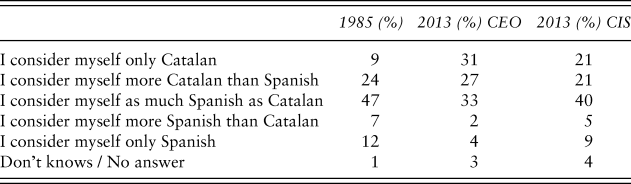
Not surprisingly, during the few years which followed the ruling of the Spanish Constitutional Court on the new Catalan Statute, the percentage of those who consider themselves to be ‘Only Catalan’ rose significantly. According to surveys carried out in 2013, much higher percentages of Catalans felt ‘Only Catalan’ as compared to data concerning the ‘Moreno question’ recorded in the mid-1980s (see Table 1). It can be deduced from these figures that the increase in Catalans’ exclusive self-identification as Catalans has been mainly reactive and has grown rapidly in recent times. Greater numbers of Catalans interpreted the refusal of the Spanish central elites to allow for a higher degree of Catalan home rule as a political humiliation of Catalonia. Figures on exclusive Catalan identity particularly increased after the rejection by the central Conservative Rajoy Government to decentralise further fiscal powers in 2012.
Responses in Catalonia to the ‘Moreno question’: ‘In which of these five categories do you include yourself?’ (1985 and 2013)

CEO: Catalan Centre of Opinion Studies.
CIS: Spanish Centre for Sociological Research.
Notes: (1) Percentages of 2013 are extracted from two different surveys (Spanish and Catalan), which used different methodological approaches to measuring data. The results are reproduced in two contrasting columns for illustrative purposes only; (2) Figures have been rounded to nearest full percentage.
Source: Moreno Reference Moreno2014.
At the end of 2015, nationalists supported the celebration of ‘plebiscite’ elections in Catalonia. The idea behind this proposal was for the Generalitat to declare independence if a majority of the members of the Catalan Parliament (MCPs) was to be elected from parties advocating secession in their political manifestoes. After the election, Catalan MCPs were expected to carry out the so-called DUI (Declaration of Unilateral Independence). The results of the Catalan Elections held on 27 September 2015 (with a turnout over 77 per cent of the registered electorate) were somewhat ambivalent. A majority of parliamentarians were elected in favour of independence (53 per cent), but it fell just short of 48 per cent of the popular vote. The newly-elected Catalan Parliament began the process of secession, after a pro-independence majority of Catalan parliamentarians voted in favour of initiating the process to establish the Republic of Catalonia (72 members of the electoral coalitions Together for Yes-JpS and Popular Unity Candidacy-CUP out of a total of 135 members of the Catalan Parliament). Soon after, the Spanish Constitutional Court suspended such a statement. After lengthy and difficult negotiations between the two pro-independence parties, a new President of the Catalan Government of the Generalitat was appointed.Footnote 12 A future scenario of civil disobedience to the Spanish legal order was very much under contention among the Catalan parliamentarians and between them and the Spanish institutions and parties.
All things considered, the social climate within Catalonia has already shown a certain level of political exhaustion. The effects of the economic crisis and the spending cuts introduced by the Catalan nationalist Government, for instance in social services, have combined with the exposure of corruption cases, such as the one concerning Jordi Pujol. The former President of the Generalitat during 1980–2003, and father figure of contemporary Catalan nationalism, confessed publicly in 2014 that he had been hiding money and assets abroad, away from the control of Spain’s tax authorities. This scandal became a source of criticism, also from the nationalist ranks, and contributed to cooling down the climate of euphoria promoted by those groups in favour of secession.
As in the rest of Spain, Catalonia has shown a very pro-Europe stance after the long Franco’s dictatorship (1939–75). A general climate of consensus was highly effective in legitimising the process of welfare-state development since the transition to democracy. The European Social Model has continued to be viewed as an embodiment of all of that Spain and Catalonia was not during the dictatorship. As a ‘master symbol’, Europe has been regarded by most of Catalonia’s social actors as the realisation of ‘civilization’ and ‘modernisation’. Europe has frequently been invoked so that symbolic rewards could be obtained without major contestation. Once again, the idea of ‘cosmopolitan localism’ was very influential in articulating a discourse of hybridisation between the particular (Catalonia) and the general (Europe) (Norris Reference Norris, Nye and Donahue2000).
Global entanglements induced by neoliberal globalisation and the EU crisis have also impacted claims for Catalan independence. The reluctance expressed by some big EU Member States, such as France, Germany or Italy, to allow a hypothetical seceded Catalonia to ‘automatically’ become a new EU country has had repercussions for secessionist nationalism. Future political developments in Catalonia combine with scenarios of political uncertainty in Spain. Therefore, prospects are more or less predictable, as is the interaction between law and political power, which is illustrated by Orakhelashvili in his article on the Kosovo case in this special issue.
IV. Concluding remarks: Consolidating ‘cosmopolitan localism’?
Independence and interdependence align themselves with the notions of self-rule and shared rule which combine in the various types of federal-like systems around the world (Moreno and Colino Reference Moreno and Colino2010). Far from being coherent and uniform, societies not only exhibit diversity but also develop mutually interdependent and interacting structures and cleavages. Parties have major impacts on intergovernmental relations and on the representation of territories in the statewide and EU institutions. In Spain, statewide parties co-exist with Catalonia-based parties at the sub-state level, and they also participate actively at EU levels. As could not be otherwise, inter-party competition is an important factor shaping political outcomes and policy decisions at the various intergovernmental instances where decisions are negotiated.
In the case of Catalonia, the 2010 ruling of the Constitutional Court on the reform of the 2006 Estatut d’autonomia, had a great impact on the frustrated expectations of a majority of Catalans who had endorsed the new Statute in a public referendum claiming more self-rule. A centralist view prevailed in the decision of a Court. Renewed criticism in Catalonia on the political bias expressed by the Court’s sentence has strengthened notably the political support for independence and has increased disaffection towards central state institutions (although it remains to be seen whether such a shift of mood is merely transitory or has a long-lasting impact).
Spain and Europe face a variety of challenges regarding how to integrate, rather than to assimilate, existing political communities with collective identities forged at the various levels of political legitimacy. If achieved by degrees of independence and interdependence, integration would avoid being seen as a superimposition upon the democratic interaction of communities with long-standing historical trajectories. As a European sub-state ‘partner region,’ or region with legislative powers, Catalonia furnishes inputs for the articulation of territorial subsidiarity and democratic accountability, the two principles upon which further Europeanisation rests. It also supports actively the preservation of the European Social Model with an active concern for the maintenance of welfare state institutions.
The supra-state institutional framework provided by the European Union has certainly reinforced sub-state identities. Decentralisation has become a major embedding factor in contemporary political life in Europe. The quest of meso-communities, such as Catalonia, to run their own affairs and to maximise their potentialities outside the dirigiste control of central state institutions is an observable trend on the Old Continent. The intensification of sub-state territorial identities is deeply associated with powerful material and symbolic referents to the past. In fact, the processes of bottom-up Europeanisation and top-down decentralisation have allowed a considerable extension of a type of European ‘cosmopolitan localism’, which is reflected in both societal interests: one aimed at developing a sense of local community, and the other one geared at participating simultaneously in the international context. There is, thus, a growing adjustment between the particular and the general.
All these processes in Europe are taking place in a long period of relative economic stability, after World War II, characterised by the absence of destructive conflicts between once powerful colonial nation-states. Some authors hold the view that together with globalisation the potential for a pessimistic scenario is just around the corner. The ever-latent possibility of rivalries between nation states, trade conflicts between world regions or the growth of religious fundamentalism and xenophobia are potentially explosive. Alternatively, a move towards a new form of civilisation capable of revitalising the congruence between unity and diversity, by means of political agreement, appears to be a reasonable challenge for consolidating ‘cosmopolitan localism’.