The World Health Organization and US Centers for Disease Control and Prevention (CDC) consider carbapenem-resistant Enterobacterales (CRE) an urgent threat to public health because of high transmissibility, limited treatment options, and significant mortality. 1-Reference Nordmann, Cuzon and Naas3 Although CRE is most commonly identified in the urine, most of the literature focuses on invasive infections from which CRE is isolated from a sterile site rather than bacteriuria. Reference Guh, Bulens and Mu4,Reference Satlin, Kubin and Blumenthal5 CRE bacteriuria, however, can have a high rate of relapse with bacteriuria and urinary tract infections, and further study on patient outcomes is needed. Reference Önal, Sipahi and Pullukçu6,Reference Pouch, Kubin and Satlin7
Patients with invasive CRE infections have a higher mortality than patients with CRE bacteriuria. In a meta-analysis of >20 studies, the pooled mortality for carbapenem-resistant Klebsiella pneumoniae bacteremia was 54%, but it was only 14% for urinary tract infections. Reference Xu, Sun and Ma8 Additionally, patients with CRE bacteremia are more than twice as likely to die in the hospital than those with a CRE urinary tract infection or colonization, making it imperative to understand which patients with CRE bacteriuria are likely to develop bacteremia. Reference Hauck, Cober and Richter9 The risk of subsequent bacteremia in patients with CRE bacteriuria in prior studies ranges from 0 to 15%, but its study has been limited to single hospital systems with limited follow-up. Reference Satlin, Kubin and Blumenthal5,Reference Pouch, Kubin and Satlin7,Reference Qureshi, Syed, Clarke, Doi and Shields10
In this study, we used active, population-based surveillance data to describe the epidemiology of patients with CRE bacteriuria in metropolitan Atlanta, Georgia, and to identify risk factors associated with developing CRE bacteremia in patients with prior CRE bacteriuria. We assessed the effect of urinary catheters, which are often placed and retained without a clear indication and are thus a potentially modifiable target to prevent the development of bacteremia in patients with CRE bacteriuria. Reference van, voor in’t Holt and Vos11,Reference Saint, Wiese and Amory12
Methods
Study population and design
Since 2011, the CDC-funded Georgia Emerging Infections Program (EIP) has conducted active, population- and laboratory-based surveillance of CRE in 8 counties of metropolitan Atlanta through the Multisite Gram-Negative Surveillance Initiative. Cases are identified by routine queries of laboratory automated testing instruments in the catchment area, including all carbapenem-resistant Escherichia coli, Klebsiella pneumoniae, K. oxytoca, K. (formerly Enterobacter) aerogenes, and Enterobacter cloacae isolated from a sterile site or urine culture.
We retrospectively created a cohort of patients with CRE first identified in a urine culture from January 1, 2012, through December 31, 2017. We excluded patients with CRE identified in any sterile site prior to having CRE identified in urine. To account for the CDC CRE definition change in 2016, we used a single CRE definition for the study period: resistant to at least 1 non-ertapenem carbapenem (ie, doripenem, imipenem, or meropenem MIC ≥ 4 µg/mL), and resistant to all tested third-generation cephalosporins (Supplementary Fig. 1 online). We defined subsequent bacteremia as a positive blood culture with the same CRE organism present in the index urine culture within 1 day to 1 year after the index CRE urine culture. We calculated the time to subsequent bacteremia as the difference in days between the first CRE urine culture and the first CRE blood culture.
Chart review and variable definitions
Epidemiologists in the EIP perform chart reviews for all cases of CRE and collect information on demographics, comorbidities including underlying urinary tract abnormalities, a patient’s residence (inpatient facility, LTACH, long-term care facility (LTCF), or private residence), the location at time of culture collection (inpatient facility, LTACH, LTCF, or outpatient clinic), risk factors for CRE including the presence of medical devices, whether the patient was in the intensive care unit (ICU) in the week prior to the urine culture, specimen source, and antibiotic susceptibility results. We calculated and dichotomized the Charlson comorbidity index (CCI) Reference Charlson, Pompei, Ales and MacKenzie13 based on the median. The presence of a medical device was defined as having an indwelling urethral or suprapubic urinary catheter, central venous catheter or other indwelling device (eg, endotracheal/nasotracheal tube, gastrostomy tube, nasogastric tube, tracheostomy, or nephrostomy tube) when the urine culture was obtained or in the 2 prior days. We captured 90-day mortality through Georgia Vital Statistics records.
Study objectives
The primary objective was to describe the epidemiology of patients with CRE bacteriuria in Atlanta and to determine whether urinary catheters increase the risk of subsequent CRE bacteremia within 1 year. The secondary objective was to identify additional risk factors associated with developing CRE bacteremia. In an exploratory analysis, we determined the proportion of patients with subsequent bacteremia that had similar CRE strains in both urine and blood cultures.
Pulsed-field gel electrophoresis
The Georgia EIP laboratory collects CRE urine and sterile site isolates from clinical laboratories in the catchment area when available. For patients with subsequent bacteremia for whom both the first urine and blood isolates were available (and in 1 case where a CRE urine isolate was available from 4 days after the initial isolate), we performed pulsed-field gel electrophoresis (PFGE) to determine strain relatedness. We adapted the CDC PulseNet PFGE protocol for E. coli, Salmonella, and Shigella spp 14 and used Xbal as the restriction enzyme. The gels were run in 0.5X TBE (Tris-borate-EDTA) on a CHEF Mapper (Bio-Rad, Hercules, CA) with an initial switch time of 2.2 seconds and a final switch time of 54.2 seconds at 6 volts and an angle of 120 degrees. We used BioNumerics version 7.6 software (Applied Maths, Kortrijk, Belgium) to assess relatedness between paired isolates using an unweighted-pair group method of arithmetic averages and Dice coefficients with band position tolerance and optimization set at 1.5%.
Sample size and power calculations
We anticipated that 50% of patients with CRE bacteriuria would have a urinary catheter and that 5% would develop subsequent bacteremia. Reference Sexton15 Medical devices can increase the risk of CRE acquisition with an odds ratio (OR) of 3.4–7.7, and patients with CRE rectal colonization and a urinary catheter have almost 5 times the odds of developing a CRE infection than those without a catheter. Reference van, voor in’t Holt and Vos11,Reference Borer, Saidel-Odes and Eskira16 Here, we used an OR of ~4 and estimated that 2.5% of patients without a urinary catheter and 9% of patients with a urinary catheter would develop subsequent bacteremia, requiring a sample size of 404 to achieve 80% power with an α of 0.05.
Statistical analysis
We calculated the yearly incidence of CRE bacteriuria in metropolitan Atlanta by dividing the number of new CRE bacteriuria cases by the US census bridged-race population estimates of the catchment area. For patients with a complete chart review, we compared patients with and without the presence of a urinary catheter using the χ2 and the Fisher exact tests as appropriate for categorical variables, and the Student t test for continuous variables. We performed univariable and multivariable logistic regression to estimate the association between urinary catheter and subsequent bacteremia. A complete description of model development is described in supplementary materials.
We performed 2 sensitivity analyses: (1) propensity score creation for the presence of a urinary catheter, with inverse probability weighting of this score in a logistic regression model to estimate the effect of urinary catheter on subsequent bacteremia and (2) cause-specific unadjusted proportional hazards model for subsequent bacteremia using death at 90 days as a competing risk. Patients who died or did not develop bacteremia within 90 days were excluded from the study. All analyses were performed using SAS version 9.4 software (SAS Institute, Cary, NC).
The Georgia EIP surveillance, data collection, and analysis were approved by the Emory University Institutional Review Board.
Results
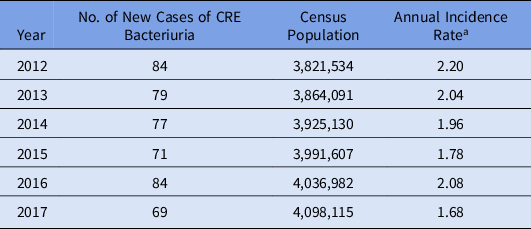
Between 2012 and 2017, we identified 464 patients with their first episode of CRE bacteriuria in metropolitan Atlanta. The number of new CRE bacteriuria cases per year was relatively stable, although the annual incidence appeared to modestly decline over the study period (Table 1 and Supplemental Fig. 2 online). The mean (SD) annual incidence rate over the 6 years was 1.96 (0.19) and ranged from 1.68–2.20 cases per 100,000 people in Atlanta. Most patients with CRE bacteriuria (318, 69%) had K. pneumoniae (Table 2).
Annual Number and Incidence Rates of Carbapenem-Resistant Enterobacterales Bacteriuria in Metropolitan Atlanta

Note. CRE, carbapenem-resistant Enterobacterales.
a Per 100,000 population.
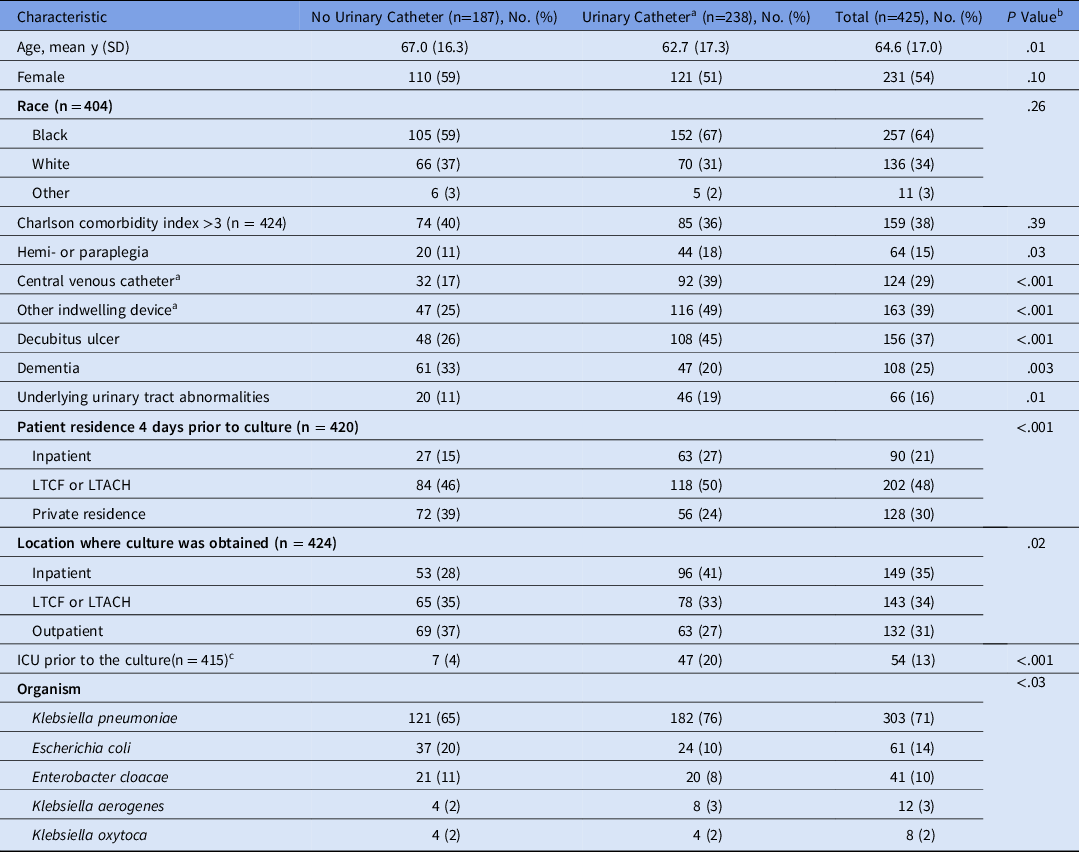
Demographics and Clinical Characteristics of Patients with Carbapenem-Resistant Enterobacterales Bacteriuria in Metropolitan Atlanta

Note. SD, standard deviation; LTCF, long-term care facility; LTACH, long-term acute-care hospital; ICU, intensive care unit.
a At the time culture was obtained or in the prior 2 calendar days.
b Comparison of patients with and without a urinary catheter.
c Any time in the 7 calendar days prior to the culture.
Among 464 patients, 425 (92%) had a complete chart review and were included in the final analysis. The mean (SD) age was 64.6 (17.0) years and 231 (54%) were female. Many patients were chronically ill; 159 (38%) had a CCI >3, and more than one-third had a decubitus ulcer. Medical devices were common: 238 (56%) had an indwelling urinary catheter (29 suprapubic and 209 urethral), 124 (29%) had a central venous catheter, and 163 (39%) had another indwelling device. Almost half (48%) resided in a LTACH or LTCF prior to the identification of CRE bacteriuria (Table 2).
Patients with urinary catheters were more likely to have central venous catheters (39% vs 17%; P < .001) or other indwelling devices (49% vs 25%; P < .001), to have a decubitus ulcer (45% vs 26%; P < .001), and to have underlying urinary tract abnormalities (19% vs 11%; P = .01). Patients with urinary catheters more commonly had a CRE culture obtained in an inpatient facility (41% vs 28%; P = .02) and had been admitted to the ICU in the week prior (20% vs 4%, P < .001) (Table 2).
Overall, 21 patients (5%) developed CRE bacteremia within 1 year. The median time to subsequent bacteremia was 34 days (interquartile range [IQR], 20–110), with a minimum of 2 and a maximum of 300 days. All but 1 patient with subsequent bacteremia had K. pneumoniae. Compared to all other CRE species combined, K. pneumoniae was significantly associated with subsequent bacteremia (unadjusted OR, 8.6; 95% CI, 1.1–64.4).
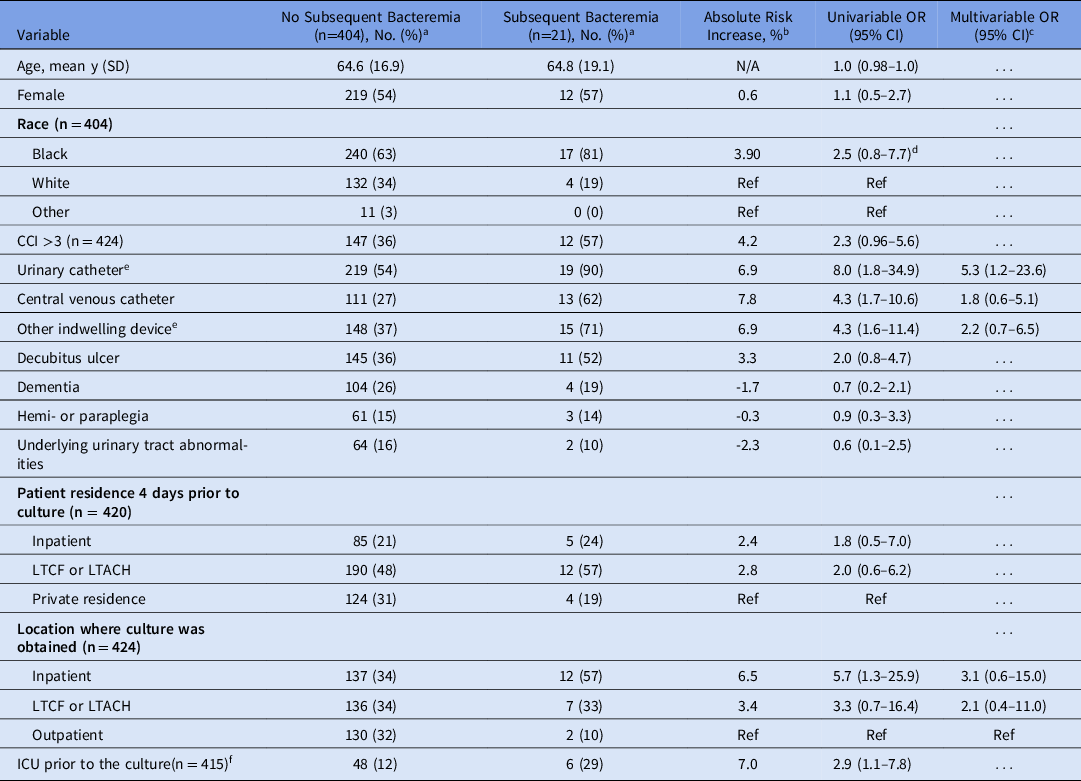
The presence of a urinary catheter (OR, 8.0; 95% CI, 1.8–34.9), central venous catheter (OR, 4.3; 95% CI, 1.7–10.6), or other indwelling device (OR, 4.3; 95% CI, 1.6–11.4) were all significantly associated with subsequent bacteremia in univariable analyses. Additionally, the odds of bacteremia increased if the CRE urine culture was obtained while the patient was an inpatient (OR, 5.7; 95% CI, 1.3–25.9) or had been in the ICU in the week prior to the urine culture (OR, 2.9; 95% CI, 1.1–7.8) (Table 3). In the multivariable model, having a urinary catheter significantly increased the odds of subsequent bacteremia (OR, 5.3; 95% CI, 1.2–23.6) after controlling for the presence of a central venous catheter, the presence of another indwelling device, and the location of culture collection (Table 3). This finding was confirmed in the first sensitivity analysis using inverse probability weighting. The odds ratio (OR) for urinary catheter was 7.1 (95% CI, 1.7–29.6). When accounting for death as a competing risk in the second sensitivity analysis, urinary catheters were also associated with subsequent bacteremia at 90 days (unadjusted hazard ratio, 5.6; 95% CI, 1.3–26.2).
Univariable and Multivariable Logistic Regression Assessing Risk Factors for Subsequent Bacteremia in Patients with Carbapenem-Resistant Enterobacterales Bacteriuria

Note. OR, odds ratio; CI, confidence interval; SD, standard deviation; Ref, reference; CCI, Charlson comorbidity index; LTCF, long-term care facility; LTACH, long-term acute-care hospital; ICU, intensive care unit.
a Subsequent bacteremia was defined as developing a blood culture with the same CRE organism present in the index urine culture, within 1 day to 1 year after the urine culture.
b Difference in risk of subsequent bacteremia between those with the variable of interest and those without the variable of interest.
c Final multivariable model created to estimate the association between urinary catheter and subsequent bacteremia. Blank cells indicate the term was not included in the model.
d Odds ratio was calculated for black race versus any other race.
e At the time culture was obtained or in the prior 2 calendar days.
f Any time in the 7 calendar days prior to the culture.
Paired urine and blood CRE isolates were available for 8 patients. Overall, 7 patients (88%) had paired isolates that were >90% similar on PFGE, and of those, 5 pairs (63%) appeared identical. The median (IQR) time to subsequent bacteremia was 31 (25–118) days in patients with highly related CRE strains (> 90% on PFGE). In the patient with <90% similarity on PFGE, the time to bacteremia was 101 days (Supplementary Table 2 online).
Discussion
The presence of a urinary catheter increased the odds of developing CRE bacteremia within 1 year by at least 5 times in patients with CRE bacteriuria, an absolute risk increase of almost 7%. This finding is consistent with prior literature demonstrating that urinary catheters and central venous catheters increase the likelihood of invasive CRE infection in those with rectal colonization. Reference Borer, Saidel-Odes and Eskira16,Reference Schechner, Kotlovsky and Kazma17 However, to our knowledge, this is the first study to investigate risk factors in patients with CRE bacteriuria, a common clinical scenario that does not involve obtaining rectal surveillance swabs. We did not differentiate urinary tract infections from colonization because it is challenging to do retrospectively and the mortality of patients with CRE urinary colonization is likely similar to that of patients with a urinary tract infection. Reference Hauck, Cober and Richter9
We estimated that the average annual incidence of CRE bacteriuria in metropolitan Atlanta per 100,000 population was 1.96 cases, which remained stably within the range of 0.5–2.93 infections reported in a recent systematic review of CRE in the United States. Reference Livorsi, Chorazy and Schweizer18 This estimate is similar to national data showing a flat trend for CRE from all culture sites during our study period, despite increasing broad-spectrum antibiotic use in US hospitals. 1,Reference Weiner, Webb and Limbago19-Reference Baggs, Fridkin, Pollack, Srinivasan and Jernigan22 Moreover, 5% of patients with CRE bacteriuria developed CRE bacteremia within 1 year. Although they are relatively rare, these events are clinically important because CRE bacteremia is associated with up to a 40% increase in mortality. Reference Xu, Sun and Ma8
Similar to findings from national CRE surveillance, Reference Guh, Bulens and Mu4 our study showed that patients with CRE bacteriuria have high frequencies of chronic illness and indwelling devices. CRE infections most commonly occur in patients with prior healthcare exposure, and those residing in LTACHs may be at the highest risk. Reference Livorsi, Chorazy and Schweizer18,Reference Logan and Weinstein23,Reference Lin, Lyles-Banks and Lolans24 Almost half of the patients in our study resided in an LTACH or LTCF 4 days prior to identification of CRE bacteriuria. However, only 34% had a culture obtained at an LTACH or LTCF, suggesting that patients may have been admitted to an inpatient facility prior to the culture being obtained. This finding highlights the interconnectedness of healthcare systems and demonstrates how multidrug-resistant organisms can be easily transferred between settings.
Both the Society for Hospital Medicine and the Society for Healthcare Epidemiology of America recommend minimizing the use of urinary catheters, daily assessments of necessity, and removing catheters when no longer needed as part of the Choosing Wisely campaign. Reference Bulger, Nickel and Messler25,Reference Morgan, Croft and Deloney26 Our findings support this approach as a critical aspect of caring for patients with CRE bacteriuria. Unfortunately, we could not capture how often urinary catheters were removed or how long catheters remained in place. This area deserves future attention since prior studies have suggested that urinary catheters may be removed in less than one-third of patients with CRE bacteriuria. Reference Satlin, Kubin and Blumenthal5 We suspect that the risk of subsequent bacteremia is related to how long a catheter remains in place, but how much risk each additional day confers is unknown. During a CRE outbreak in a South African hospital, each additional urinary catheter day was associated with a 7% increase in the odds of CRE acquisition. Reference de Jager, Chirwa, Naidoo, Perovic and Thomas27 Additional devices, including central venous catheters or other indwelling devices, also increased the risk of subsequent bacteremia in this study. Infection prevention strategies already employed at many hospitals to minimize medical devices should be particularly emphasized in patients with CRE bacteriuria as a means to decrease the risk of a future CRE bacteremia.
In an exploratory analysis, most patients with subsequent bacteremia had very similar strains of CRE in the blood and original urine culture. The small sample size limits our ability to draw conclusions, but this finding suggests that CRE bacteremia development in patients with prior CRE bacteriuria may be related to the prior bacteriuria episode. Thus, subsequent bacteremia may be more likely from incomplete treatment or persistence of colonization rather than from acquisition of a new CRE infection. Alternatively, patients may be re-exposed to the same CRE strain multiple times, particularly if they return to the same living environment.
Unexpectedly, patients with carbapenem-resistant K. pneumoniae bacteriuria had a higher risk of subsequent bacteremia compared to patients with other species of CRE. To our knowledge, K. pneumoniae has not been previously identified as a risk factor for subsequent bacteremia, but in vitro data suggest that multidrug-resistant K. pneumoniae may produce more biofilm than other drug-resistant Enterobacterales. Reference Ramos-Vivas, Chapartegui-González and Fernández-Martínez28 Biofilm production on urinary catheters could be one reason patients with K. pneumoniae may be at increased risk bacteremia, and this should be further investigated.
Strengths of this study include the use of active, population-, and laboratory-based surveillance data over 6 years, creating one of the largest cohorts of patients with CRE. This approach is advantegous over hospital-based surveillance studies because we could identify patients with subsequent CRE infections after discharge as long as the culture was obtained within the 8-county metropolitan Atlanta area. This study is the first to examine factors that may increase a patient’s risk for developing CRE bacteremia in an easily identifiable, high-risk group of patients—those with CRE bacteriuria—with urinary catheters, a potentially modifiable characteristic.
This study has several limitations. First, we were not able to assess how long a urinary catheter remained in place after diagnosis of CRE or whether the patient received antibiotics. Second, patients did not have routine surveillance cultures obtained nor were they prospectively followed. Instead, EIP data relies on automated laboratory queries to identify all patients with a CRE culture; therefore, case ascertainment can depend on clinical practice patterns that may vary across the spectrum of healthcare. Although we may have underestimated CRE bacteriuria, the generally low threshold for urinary cultures makes this less of a limitation than with cultures from other anatomic sites. Third, population-based surveillance may miss cases in nonresidents or those who travelled outside metropolitan Atlanta. Fourth, patients with and without urinary catheters were different, increasing the risk of confounding by indication. We attempted to account for this in a sensitivity analysis using inverse probability weighting, and we found that effect of urinary catheters on subsequent bacteremia remained. Fifth, in this fragile population, patients may die before the outcome of subsequent bacteremia. We adjusted for this using a Cox proportional hazard model with death as a competing risk. Finally, although this study was adequately powered to assess the effect of urinary catheters on subsequent bacteremia, the 95% CI was wide, and the degree to which urinary catheters increase the risk of bacteremia is difficult to interpret.
In summary, patients with incident CRE bacteriuria in Atlanta are chronically ill, frequently reside in healthcare facilities and have a high proportion of medical devices. Over half of the study cohort had a urinary catheter at the time of CRE bacteriuria, and this increased the risk of developing subsequent CRE bacteremia within 1 year. Future studies are needed to evaluate how often urinary catheters are removed or exchanged in this high-risk group, and interventions should focus on minimizing urinary catheter use whenever possible in patients with CRE. Urine cultures are frequently obtained in long-term care facilities, and targeted interventions in this setting may be particularly effective. Reference Toth, Khader and Slayton29 Lastly, additional research could assess whether biolfim burden, carbapenemase status or antibiotic therapy help explain our findings, and whether the risk of urinary catheters is consistent for patients with bacteriuria caused by other multidrug-resistant gram-negative organisms such as Pseudomonas aeruginosa.
Acknowledgments
We are grateful to all of the employees at the Georgia Emerging Infections Program who work tirelessly to collect and maintain these data. We also are thankful to Michelle Hargita Davis and Alex Page for their laboratory assistance.
Financial support
Surveillance of carbapenem-resistant Enterobacterales was funded through the Centers for Disease Control and Prevention Emerging Infection Program (grant no. U50CK000485). J.H.A. was supported by the National Center for Advancing Translational Sciences of the National Institutes of Health (grant nos. UL1TR002378 and TL1TR002382) as well as through the Centers for Disease Control and Prevention Emerging Infection Program (grant no. U50CK000485). She is currently supported by the Antibacterial Resistance Leadership Group fellowship (National Institute of Allergy and Infectious Diseases grant no. UM1AI104681). J.T.J is in part supported by the Prevention Epicenters Program of the Centers for Disease Control and Prevention (grant no. U54CK000164). The content is solely the responsibility of the authors and does not necessarily represent the official views of the Centers for Disease Control and Prevention or the National Institutes of Health.
Conflicts of interest
All authors report no conflicts of interest relevant to this article.
Supplementary material
To view supplementary material for this article, please visit https://doi.org/10.1017/ice.2020.1325