The absence of a subpulmonary ventricle in the univentricular Fontan circulation results in non-pulsatile low contributing to attenuated pulmonary artery growth, pulmonary endothelial dysfunction, increased pulmonary vascular resistance, and circulatory demise. This unique circulation, which lacks a subpulmonary cardiac power source, relies heavily on the peripheral muscle pump for venous return during exercise. We previously demonstrated that an important deficiency of skeletal muscle mass exists in these patients and that resistance training to augment the peripheral muscle pump improves peak exercise capacity, and stroke volume at rest and during exercise.Reference Cordina, O’Meagher and Karmali 1
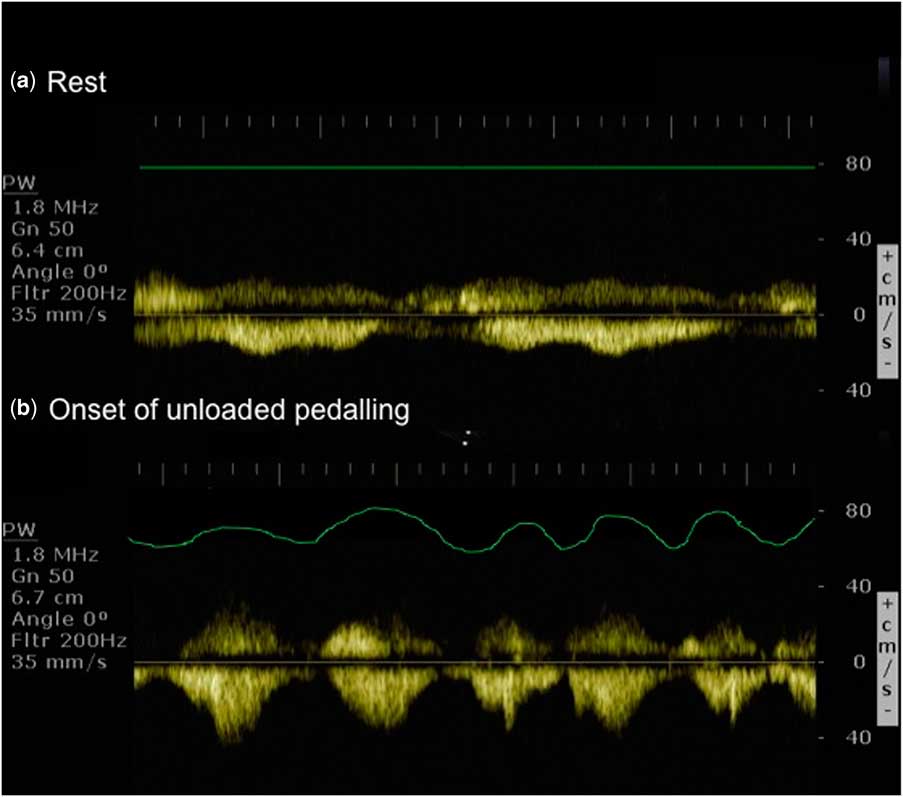
A 30-year-old woman with a Fontan circulation – total cavopulmonary connection – for pulmonary atresia with ventricular septal defect and hypoplastic right ventricle was assessed with echocardiography (CX50, S51 probe; Philips, Amsterdam, The Netherlands) using pulsed-wave Doppler within the intracardiac cavopulmonary connection on a semi-erect ergometer, at a 45° tilt. The electrocardiography leads were placed on the legs to detect leg movement instead of cardiac activity. At rest, non-pulsatile, low-velocity flow was demonstrated (Fig 1, panel A). During lower limb exercise, pulsatile flow with increased velocity was observed in the cavopulmonary pathway.
Pulsed-wave Doppler spectral trace measured within an intracardiac total cavopulmonary connection at the onset of semi-erect lower limb exercise demonstrating a marked change in flow velocity and pulsatility.

The peripheral muscle pump may not only aid venous return by simply pushing the volume back to the heart but also creates periodic pulsatile increases in flow. Regular exercise to maintain peripheral muscle bulk and improve pulmonary blood flow characteristics is probably crucial for a healthy Fontan circulation.
Acknowledgements
None.
Financial Support
This testing was supported by a grant from the National Health and Medical Research Council (NHMRC Project Grant 1047923). The authors acknowledge support provided to the Murdoch Children’s Research Institute by the Victorian Government’s Operational Infrastructure Support Program. Y.d’U. is a NHMRC Clinician Practitioner Fellow (1082186).
Conflicts of Interest
Y.d’U. is consultant for MSD and Actelion. The remaining authors have nothing to disclose.
Ethical Standards
The authors assert that all procedures contributing to this work comply with the ethical standards of the National Statement on Ethical Conduct in Human Research (Australia) and with the Helsinki Declaration of 1975, as revised in 2008, and has been approved by the Sydney Local Health District Ethics Committee.