Introduction
Toxocara spp. infection in humans occurs primarily as a result of the ingestion of infective eggs. As paratenic hosts, humans infected with Toxocara spp. will not release eggs into the environment (Smith et al., Reference Smith, Holland, Taylor, Magnaval, Schantz and Maizels2009). Definitive hosts, such as dogs, cats and foxes pass eggs in their faeces. In addition, once these eggs have been released by the definitive host, they require sufficient time under appropriate environmental conditions to develop to infectivity (Mizgajska-Wiktor & Uga, Reference Mizgajska-Wiktor, Uga, Holland and Smith2006). Toxocara spp. eggs can survive for several years in the soil, their tough outer shell reducing the effects of varying environmental conditions on their contents (Lloyd, Reference Lloyd, Lewis and Maizels1993; Gamboa, Reference Gamboa2005; Mizgajska-Wiktor & Uga, Reference Mizgajska-Wiktor, Uga, Holland and Smith2006). However, survival can be affected by various factors and most eggs will die within the first 6 months following deposition (Dunsmore et al., Reference Dunsmore, Thompson and Bates1984; Lloyd, Reference Lloyd, Lewis and Maizels1993).
Once deposition has taken place, the development of Toxocara spp. eggs is mainly dependent on temperature and humidity (O'Lorcain, Reference O'Lorcain1995; Stromberg, Reference Stromberg1997; Gamboa, Reference Gamboa2005). The optimum temperature, under laboratory conditions, for the development of T. canis eggs appears to be approximately 30°C, with higher temperatures resulting in egg degradation (O'Lorcain, Reference O'Lorcain1995; Gamboa, Reference Gamboa2005; Mizgajska-Wiktor & Uga, Reference Mizgajska-Wiktor, Uga, Holland and Smith2006). Moisture has also been found to be an important factor affecting the viability and development of Toxocara eggs, infective eggs more commonly being found in moist soils (Nunes et al., Reference Nunes, Sinhorini and Ogassawara1994; O'Lorcain, Reference O'Lorcain1994; Uga et al., Reference Uga, Ono, Kataoka, Safriah, Tantular, Dachlan and Ranuh1995, Reference Uga, Minami and Nagata1996, Reference Uga, Nagnaen and Chongsuvivatwong1997).
As soil is considered the primary route of transmission, most studies have addressed the development and survival of eggs in soil samples. Soil can greatly influence the survival of eggs by protecting them from direct sunlight and by maintaining a more stable temperature than air (Mizgajska, Reference Mizgajska2001). For example, eggs can survive over winter when air temperatures drop as low as − 29°C but only with the thermal effect of a blanket of snow, which raises the soil temperature to a milder − 0.2°C (Mizgajska, Reference Mizgajska2001). Eggs have also been found to survive under conditions where the sand temperature has risen to 56°C, however, the temperature at 3 cm below the surface can be as low as 37°C (Mizgajska-Wiktor & Uga, Reference Mizgajska-Wiktor, Uga, Holland and Smith2006). Toxocara spp. eggs are generally found no deeper than 3 cm, due in part to the activity of earthworms that carry the eggs from deeper in the soil profile to layers closer to the surface (Mizgajska, Reference Mizgajska1997). Considering the effect of soil on the development and survival of eggs, variation in soil type may significantly influence the risk of infection to humans (Nunes et al., Reference Nunes, Sinhorini and Ogassawara1994; Gamboa, Reference Gamboa2005). If variation in soil type can influence the development of Toxocara spp. eggs, other media, such as dog hair, in which these eggs have been found should also be investigated in more detail.
Both unembryonated and potentially infective eggs have been found in the hair of dogs (Wolfe & Wright, Reference Wolfe and Wright2003; Aydenizöz-Özkayhan et al., Reference Aydenizöz-Özkayhan, Yagci and Erat2008; Roddie et al., Reference Roddie, Stafford, Holland and Wolfe2008; Overgaauw et al., Reference Overgaauw, Van Zutphen, Hoek, Yaya, Roelfsema, Pinelli, Van Knapen and Kortbeek2009; Devoy Keegan & Holland, Reference Devoy Keegan and Holland2010). It is not possible to address whether the infective eggs present developed in situ or whether they were picked up from the environment (Roddie et al., Reference Roddie, Stafford, Holland and Wolfe2008; Devoy Keegan & Holland, Reference Devoy Keegan and Holland2010). In the survey carried out by Roddie et al. (Reference Roddie, Stafford, Holland and Wolfe2008), large numbers of unembryonated Toxocara spp. eggs were recovered from hair samples taken form the dorsum and peri-anal region. It is important to ascertain whether such eggs have the potential to develop to infectivity on the coat of a dog. The primary aim of this study was to investigate the potential for the development of T. canis eggs in dog hair under controlled conditions. Its suitability to these controlled conditions was to be compared to levels of development in soil. Secondly, we aimed to investigate the potentially differing levels of development, in vitro, in hair and soil under controlled temperature and water treatments.
Materials and methods
Preparation of egg doses
Unembryonated T. canis eggs were obtained from two sources; the uteri of adult female worms; and the faeces of experimentally infected dogs. Adult worms were obtained by dissection of euthanized dogs. These dogs were provided by the Dublin Society for Prevention to Cruelty to Animals (DSPCA). Once removed from the intestines the worms were washed and kept in distilled water at 4°C until required. The Institute for Parasitology, University of Veterinary Medicine, Hannover, Germany, provided the stock of unembryonated eggs which they had extracted experimentally from the faeces of infected dogs. Doses were prepared by mixing the stock solution of eggs in water with a magnetic stirrer until the mixture was homogeneous. To calculate the number of eggs in suspension, 10 μl of suspension was transferred to a slide and examined under a light microscope using the × 10 objective lens. Eggs were counted and checked to ensure no development had begun by scanning the entire slide. This was repeated for five 10-μl aliquots. The average number of eggs was then calculated and the appropriate calculations were carried out in order to determine the number of eggs in suspension. The appropriate volume was then taken from the stock and placed in a 1.5-ml micro-centrifuge tube.
Experimental design
Soil was collected from outside the Zoology Department, Trinity College, Dublin, and passed through a 1-mm sieve in order to remove large pebbles and debris. Hair was taken from four dogs of similar breed and hair type that had attended dog groomers. The hair samples used were processed according to the methods described by Overgaauw et al. (Reference Overgaauw, Van Zutphen, Hoek, Yaya, Roelfsema, Pinelli, Van Knapen and Kortbeek2009) and no eggs were found in the hair that was used. As a precaution, the hair was washed thoroughly with water over a 1-mm sieve, press dried with tissue and then allowed to dry overnight. Both the soil and the hair were then autoclaved at 150°C for 2 h in order to kill any undetected eggs that may have been present. Both hair and soil were placed in conical-bottomed, 50-ml tubes which were filled with either 2 g of soil or 0.5 g of hair.
Two pilot studies were carried out in order to determine a suitable set of test variables for the final experiment. Eggs for the pilot studies were obtained from the uteri of adult female worms. The first pilot study began in December 2009 and ended during January 2010. Each of 25 hair and 25 soil samples were seeded with approximately 340 eggs, in 0.5 ml of distilled water. The samples were stored in the lab, at ambient room temperature and humidity. These conditions were not controlled and large variations in temperature were observed due to the experiment taking place indoors, but during the coldest part of winter. Five samples of hair and soil were processed on days 3, 6, 9, 14 and 21 post-seeding. Eggs were found to develop but no embryonated eggs (containing fully developed embryos) were recovered. The second pilot study was carried out under controlled conditions for a longer period of time. Seventy hair and 70 soil samples were each seeded with 200 eggs in 0.5 ml of distilled water. Half of the hair and soil samples were kept in a temperature-controlled room at 28°C with a stable humidity of approximately 40%. The remaining hair and soil samples were kept in an incubator at 15°C with a humidity of approximately 50%. Both were exposed to 12-h light/dark cycles. Five hair and five soil samples were processed on days 3, 6, 9, 14, 21, 38 and 35, respectively. Eggs were found to develop but none reached the infective larval stage. The number of degraded eggs also increased over time, indicating the possible requirement for higher humidity or addition of water in the final experiment. Importantly, the pilot studies indicated that: the duration of the final experiment should extend beyond 5 weeks; the temperatures used were suitable to allow development in both hair and soil; and humidity was a possible factor affecting egg survival.
The stock of Toxocara eggs used in the final experiment was created by mixing the eggs from both sources: the dissected uteri of Toxocara adult females and the stock extracted from the faeces of experimentally infected dogs. This was done due to the large numbers of eggs required to carry out the experiment. The dose preparations were carried out on ice to prevent embryonation and the stock solution was checked to ensure development had not begun immediately prior to seeding of the hair and soil samples. The stock solution was divided by the number of doses required, 480 with an additional 10 doses. These extra doses were prepared in order to enable verification of the dosage prior to seeding. The stock created allowed for 490 doses of 250 eggs in 1 ml of distilled water.
In order to investigate the effect of temperature, two different incubators were used, one set at 10°C and the other at 20°C. These temperatures were chosen based on the mean daily maximum and minimum air temperatures for Ireland provided by Met Eireann, the Irish national meteorological service. Both incubators had a stable internal humidity of 50% ( ± 5%), which was monitored using internal hygrometers. Light was present in both incubators for 12-h on/off cycles. The effect of water on embryonation was investigated by weekly addition of water to some of the soil and hair samples, first on the day following seeding and then once a week on that day for the duration of the experiment.
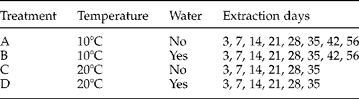
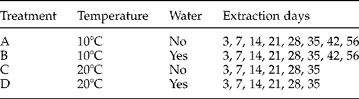
The above variables were investigated using four different treatment regimes (shown in table 1). A total of 60 hair and 60 soil samples were prepared per treatment to allow for removal of five samples of each on days 3, 7 and weekly for 10 weeks. Only ten samples could be processed daily and, as a result, the start point of each treatment was staggered by 1 day. Doses were prepared on Monday and refrigerated at 4°C. Treatment A was seeded on the same day, treatment B seeded on Tuesday and so on. This allowed the eggs under each treatment regime to have the same amount of incubation time before processing. Hair samples were processed using the method described by Overgaauw et al. (Reference Overgaauw, Van Zutphen, Hoek, Yaya, Roelfsema, Pinelli, Van Knapen and Kortbeek2009). Soil extraction was based on the method used by O'Lorcain (Reference O'Lorcain1994) and modified with methods described by Santarém et al. (2009) by using zinc sulphate (specific gravity 1.35) as the floatation solution. It was determined that sufficient data had been collected by week 5 for the 20°C samples and by week 8 for the 10°C samples.
Description of the four treatment regimes to which samples were exposed.
Statistical analysis
Data were expressed as the percentage of each stage recovered from samples for use in graphical representation. These percentages were transformed to proportions in order to perform statistical analysis. PASW 18, for Mac (see IBM SPSS, at http://www-01.ibm.com/software/analytics/spss/), was used to explore the effects of the experimental factors on the various categories. Data were checked for normality prior to testing and steps were taken, when appropriate, to ensure the data were normal, as described below. Egg recovery was investigated in soil and hair separately due to the different extraction methods used. Two generalized linear models (GLMs) were carried out to determine the effect of temperature, water and day on the rate of recovery in each medium. The numbers of unembryonated and embryonating eggs were explored using graphs and summary statistics. The focus of the statistical analysis of this experiment was on the final stage of development, embryonated eggs/developed larvae. Both temperature treatments were investigated separately in order to compare the levels of larval development, between the media, under similar conditions. An independent sample t-test was used to investigate the difference between the numbers of larvae found in hair and soil, on day 56 (the only day of larval development) in the watered 10°C sample. The 20°C samples were subjected to a GLM. Due to an absence of larvae, days 3 and 7 were excluded from the analysis, which succeeded in normalizing the data.
Results
Egg recovery
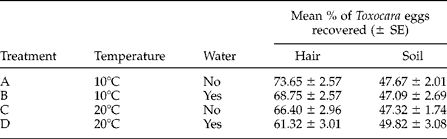
Over a period of 8 weeks, 320 hair and 320 soil samples were examined. The numbers of eggs recovered differed between hair and soil due to the different recovery methods used. The four different experimental treatments were seen to influence the success of egg recovery from hair, while recovery from soil remained relatively consistent. However, the method of extraction from hair had a consistently higher rate of recovery than extraction from soil (table 2). Day was the only main effect influencing soil recovery (F 7,112= 5416, P≤ 0.001), showing some reduction in recovery over the course of the experiment. The interaction between day and water was also shown to be significant (F 7,112= 3.20, P≤ 0.004), with the addition of water reducing recovery over time.
Mean recovery (± SE) of Toxocara eggs from hair and soil under each of the experimental treatments.
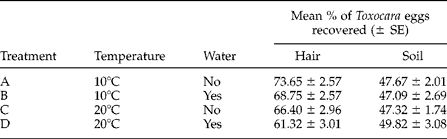
Recovery from hair was more heavily influenced by the experimental factors than that from soil, with all three main effects significantly affecting recovery. Temperature was found to be the most significant factor affecting recovery from hair, with lower numbers of eggs being found in the 20°C samples (F 1,112= 25.323, P≤ 0.001). As with soil, a significant reduction in recovery was observed over time (F 7,112= 15.227, P≤ 0.001). The GLM also revealed a decrease in recovery from watered samples (F 1,112= 5.784, P≤ 0.018). The higher temperature of 20°C as well as the addition of water was found to decrease recovery from hair over the course of the experiment (F 5,112= 5.500, P≤ 0.001; F 7,112= 2.827, P≤ 0.009; respectively). There was no significant interaction observed between temperature and water (F 1,112= 0.039, P≤ 0.845), the combined factors not effecting recovery. However, this relationship became significant over time (F 5,112= 2.330, P≤ 0.047), showing a greater reduction in recovery from the 20°C watered samples.
Overall egg development
At the beginning of the experiment, all samples were seeded with unembryonated eggs. These eggs began to develop, becoming embryonating eggs. The rate at which the eggs developed was found to be heavily dependent on temperature. The 20°C treatments were the fastest to develop, with over 40% of the eggs having commenced embryonation in all cases by day 3. Eggs were slower to develop in the 10°C samples, with embryonating eggs accounting for less than 30% of the recovered eggs on days 3 and 7. By days 14 and 21, most of the eggs recovered were embryonating in the 10°C treatments and this remained the case for the duration of the experiment, except for watered 10°C samples on day 56, when larvae had developed. Embryonating eggs accounted for the majority of eggs recovered on day 14 in the 20°C samples. The higher rate of embryonation resulted in eggs developing to the larval stage by day 14. For the duration of the experiment, embryonating and developed larvae were recovered in similar numbers from hair, while developed larvae accounted for the majority of eggs recovered from the soil samples at the same temperature. The levels of unusual or not viable eggs were found to be highest in soil and particularly so in the unwatered soil samples at both temperatures. These numbers of unusual or non-viable eggs were relatively low in hair samples in most cases. In the unwatered samples, the numbers of non-viable or unusual eggs appeared to increase over time, while watered treatments did not seem to show any obvious trends.
Embryonating eggs
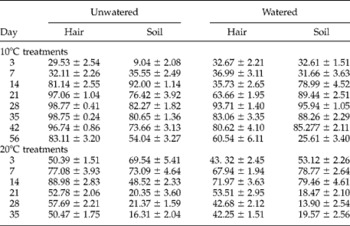
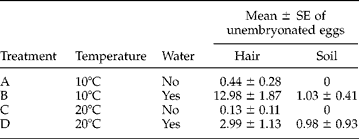
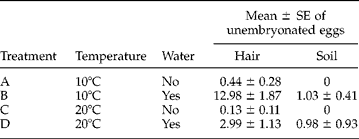
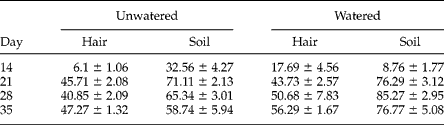
The unwatered 10°C samples were the slowest to develop. A large increase in the numbers of embryonating eggs was observed from day 14 (table 3), leaving few unenembryonated eggs in most samples (table 4). The numbers of unembryonated eggs are then seen to remain low in all cases except for the watered 10°C hair samples where they account for approximately 20% of the eggs recovered for the duration of the experiment. The maintenance of higher proportions of unembryonated eggs in watered 10°C treatments then had an effect on the proportions of embryonating eggs recovered. If the 10°C samples are compared, the watered samples have a lower proportion of embryonating eggs because unembryonated eggs still account for a significant proportion of the eggs recovered. In the unwatered samples, very few unembryonated eggs remain for the duration of the experiment, accounting for the higher proportion of embryonating eggs present. A clear trend is visible for the final 3 days of the 20°C treatment, where soil has consistently lower numbers of embryonating eggs in both watered and unwatered samples (table 3). This effect is mirrored in table 5, where soil samples have more larvae than hair samples in every case.
Effects of the treatments on the percentage of embryonating eggs found throughout the experiment.

Mean recovery (± SE) of unembryonated eggs for the final three recovery days in each treatment.
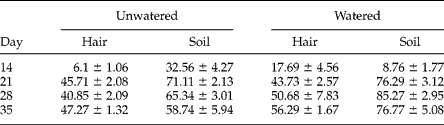
Mean proportions of larvae recovered from the 20°C treatments.
Developed larvae
Larvae were recovered from both of the 20°C treatments on day 14 and from the watered 10°C treatment on day 56. No larvae were recovered from the unwatered 10°C treatment for the duration of the experiment. In almost all cases, when larvae were recovered, more were recovered from soil than hair. This can be seen clearly in table 5, showing soil to have a greater mean recovery of larvae than hair in all cases except for one, on day 14 in the watered sample. On the only day of development in the 10°C treatments, soil samples were found to have more larvae than hair samples (t= − 7.094, df = 8, P≤ 0.001). The eggs from the unwatered soil samples were the fastest to develop, with their highest proportions being found on day 21. The eggs from watered soil samples were slower to develop but by day 21 they had the highest proportions of larvae, with their highest numbers being found on day 28. Interestingly, larval development in hair took longer to peak, with both watered and unwatered hair having their highest numbers of larvae on day 35. The watered hair samples had an increasing number of larvae over time, while the unwatered samples were more variable. The unwatered hair samples had the lowest numbers of larvae in almost all cases.
Results of the GLM showed that day was found to be the most significant factor affecting the number of larvae present (F 7,64= 190.429, P≤ 0.001), with a sufficient amount of time required to allow development to occur. This was followed by medium, with soil found to be more suitable for development than hair, significantly more larvae being recovered from soil (F 1,64= 173.808, P≤ 0.001). This relationship was also clear over time, soil having higher numbers of larvae in all cases but one (F 3,64= 10.415, P≤ 0.001). Overall, water was found to encourage larval development (F 1,64= 14.325, P≤ 0.018). This relationship is particularly obvious from day 21, with most watered samples possessing more larvae than their unwatered counterparts (table 5). Water did not have an effect over the development of larvae in hair and soil, overall (F 5,64= 0.520, P≤ 0.474); however, when considered over time, this relationship becomes significant, with water increasing the numbers of larvae present (F 7,64= 2.330, P≤ 0.001). In the unwatered samples, soil consistently had a higher number of larvae than hair. Both watered and unwatered hair samples possessed larvae at similar levels over the course of the experiment, although a rising trend is apparent for those hair samples that were watered. Unwatered soil samples were the quickest to develop but did not develop to levels comparable to the watered soil samples. The watered soil samples took longer to reach higher levels of development, but subsequently maintained significantly higher numbers of larvae than all other treatments.
Discussion
We have shown that the eggs of T. canis can develop fully in hair under controlled conditions. In the treatments where complete embryonation was successful, developed larvae accounted for a significant proportion of the eggs recovered. No attempt was made in this experiment to mimic the conditions of the coat of a dog as this was beyond the scope of the experiment. These findings indicate that embryonation may occur in dog hair. However, hair was found to have consistently lower numbers of developed larvae when compared with soil samples kept under the same conditions. In the above experiment, soil was a more suitable medium to allow embryonation to take place but embryonation in hair was still possible, and at relatively high levels under these controlled conditions.
Temperature was the most important factor affecting the overall levels of developed larvae recovered from samples. Larvae were recovered from all samples by day 14 under the 20°C treatments. Development in the 10°C treatments was much slower, with no fully developed larvae being observed until day 56. Increasing temperatures have been found to increase the rate of development of Toxocara eggs (Onorato, Reference Onorato1932; O'Lorcain, Reference O'Lorcain1995). O'Lorcain (Reference O'Lorcain1995) showed how Toxocara eggs, kept in dilute formalin solutions, at 30°C were fastest to develop to infectivity. This agreed with earlier work carried out by Onorato (Reference Onorato1932) and Okoshi & Usui (Reference Okoshi and Usui1968), who showed how eggs kept at 30°C contained embryonated eggs after 4 and 11 days of incubation, respectively. When kept at 37°C, however, eggs were found to develop more rapidly, but would ultimately not reach the later stages of embryonation, or degenerated before becoming infective (Onorato, Reference Onorato1932; O'Lorcain, Reference O'Lorcain1995). Our results would agree with higher temperatures increasing the rate of development.
The addition of water was also found to affect the levels of development significantly. The only samples from which developed larvae were not recovered were the 10°C, unwatered samples; neither medium yielded developed larvae. In contrast, for the watered samples, developed larvae accounted for over 20% and 60% of the eggs recovered from hair and soil, respectively. The addition of water was clearly an important factor encouraging the development of Toxocara eggs. In many soil surveys, increased moisture in the soil has often been found to result in higher numbers of fully developed, infective eggs being recovered (Nunes et al., Reference Nunes, Sinhorini and Ogassawara1994; O'Lorcain, Reference O'Lorcain1994; Uga et al., Reference Uga, Ono, Kataoka, Safriah, Tantular, Dachlan and Ranuh1995, Reference Uga, Minami and Nagata1996, Reference Uga, Nagnaen and Chongsuvivatwong1997). O'Lorcain (Reference O'Lorcain1994) found no difference in the prevalence of Toxocara eggs recovered from moist or dry soil samples. However, when only infective eggs were considered, significantly more developed larvae were recovered from moist samples. Sandy soils that don't hold moisture are found to be much less suitable for egg development (Nunes et al., Reference Nunes, Sinhorini and Ogassawara1994; Gamboa, Reference Gamboa2005).
Interestingly the addition of water affected development in soil and hair in different ways. In soil, added water seemed to lead to an initial reduction in the rate of development, with unwatered soil samples possessing significantly more developed larvae than watered samples on day 14. This relationship changed, with watered soil samples having significantly more developed larvae than their unwatered counterparts for the duration of the experiment. The watered soil samples also had a later peak of larval development, on day 28 as opposed to day 21 in the unwatered samples. This difference in the rate of development may possibly have been caused by the cooling effect of the water on the soil, as water was not heated to prior to its addition. The addition of water to the hair samples led to a greater recovery of larvae in almost all cases, indicating that moisture is an important factor to allow the development of Toxocara spp. eggs in on hair. Considering no larvae were recovered from the unwatered 10°C soil or hair samples, in comparison to a recovery of over 60% and 20%, respectively, in the watered 10°C samples, the addition of water had an important effect on larval development in both hair and soil at the lower temperature.
O'Lorcain (Reference O'Lorcain1994) showed that the recovery of infective Toxocara eggs from soil can be significantly affected by the ability of the soil type to retain water. Soil, wood-chippings and sand were examined for the presence of Toxocara eggs, and significantly more infective eggs were recovered from soil than from wood-chippings and sand. The watered hair samples achieved a higher level of embryonation than the unwatered hair samples, having approximately 10% more developed larvae in most cases. Watered samples also displayed a gradual increase in the number of larvae over the course of the experiment. The results for unwatered hair samples were more varied, increasing in numbers from day 14 to 21, then decreasing from day 21 to 28 before finally peaking on day 35. Water clearly increased the ability of larvae to develop in hair; however, differences in the levels of development were not as pronounced as those observed in soil, possibly indicating that hair is more effective at retaining moisture. Moisture is not only important to allow for development, it is also required to prevent desiccation and maintain the viability of the eggs.
Small numbers of unembryonated eggs were found in all watered hair and soil samples during the course of the experiment. This was not the case for unwatered samples, with soil possessing no unembryonated eggs after day 28. Most interestingly, comparatively high numbers of unembryonated eggs were recovered from the watered 10°C, hair samples from day 35 for the duration of the experiment. Unembryonated eggs are more commonly found in dog hair than developing eggs, and can be found in large quantities (Roddie et al., Reference Roddie, Stafford, Holland and Wolfe2008). Dog hair may display properties that are suitable to prevent Toxocara spp. egg degradation but do not promote development.
Most importantly, it has been shown that unembryonated T. canis eggs are capable of development in hair under controlled conditions. The rate of development is lower than that observed in soil, but remains biologically significant in terms of the overall numbers of larvae present. Temperature is responsible for the rate of embryonation, while moisture is essential for encouraging development and maintaining egg viability. The transmission of Toxocara spp. as a result of direct contact with a well-cared-for pet dog seems unlikely, due to the low numbers of eggs found on the hair of owned dogs. Despite the low risk presented by the presence of few infective eggs and low numbers of unembryonated eggs, the suitability of hair as a medium for development should not be ignored.
Acknowledgements
We thank Bayer Animal Health GmbH for funding the research and Roland Schaper for his support. The authors would also like to thank Peter Stafford for all of his practical assistance.