Introduction
As the third leading cause of disability globally (World Stroke Organisation, 2019), stroke has been conceptualised as a health event that can have a profound impact on everyday living for those who survive and those close to them (Daniel, Wolfe, Busch & McKevitt, Reference Daniel, Wolfe, Busch and McKevitt2009; Green & King, Reference Green and King2009). Psychosocial difficulties are among the most pervasive and long-term challenges following a stroke (Hackett & Anderson, Reference Hackett and Anderson2005; Teasdale & Engberg, Reference Teasdale and Engberg2005). Stroke survivors often experience reduced participation through a loss of employment and restricted leisure activities (Daniel et al., Reference Daniel, Wolfe, Busch and McKevitt2009; Northcott, Moss, Harrison & Hilari, Reference Northcott, Moss, Harrison and Hilari2016; Teasdale & Engberg, Reference Teasdale and Engberg2005). Wellbeing for those who survive stroke is poorer when compared with the general population (Wyller, Sveen, Sudring, Petterson & Bautzholter, Reference Wyller, Sveen, Sùdring, Petterson and BautzHolter1997) and post-stroke rates of depression are also estimated to be high in the order of 33% (Hackett & Anderson, Reference Hackett and Anderson2005; Hackett & Pickles, Reference Hackett and Pickles2014; Whyte, Mulsant, Vanderbilt, Dodge & Ganguli, Reference Whyte, Mulsant, Vanderbilt, Dodge and Ganguli2004). Some researchers have viewed stroke through a quality-of-life lens and have found stroke survivors to have a poorer quality of life than those in the general population (Opara & Jaracz, Reference Opara and Jaracz2010; Teasdale & Engberg, Reference Teasdale and Engberg2005).
Stroke not only has considerable repercussions for the person but also for significant others, particularly family carers (Draper & Brocklehurst, Reference Draper and Brocklehurst2007; Green & King, Reference Green and King2009; Thommesen, Wyller, Bautz-Holter & Laake, Reference Thommessen, Wyller, Bautz-Holter and Laake2002; Visser-Meily et al., Reference Visser-Meily, Post, Van De Port, Maas, Forstberg-Warleby and Lindeman2009). Carers report a range of adverse outcomes including high strain (Blake & Lincoln, Reference Blake and Lincoln2000; Draper & Brocklehurst, Reference Draper and Brocklehurst2007; Green & King, Reference Green and King2009), reduced quality of life (Opara & Jaracz, Reference Opara and Jaracz2010) and dissatisfaction with life as a carer (Visser-Meily et al., Reference Visser-Meily, Post, Van De Port, Maas, Forstberg-Warleby and Lindeman2009). High anxiety (Wilz & Kalytta, Reference Wilz and Kalytta2008) and burden (Thommesen et al., Reference Thommessen, Wyller, Bautz-Holter and Laake2002) are also frequently reported along with feelings of having limited support from family and friends (McCullagh, Brigstocke, Donaldson & Kalra, Reference McCullagh, Brigstocke, Donaldson and Kalra2005).
Given the psychosocial challenges following stroke and impact on carers, it is not surprising that researchers have uncovered changes in interpersonal relationships. Quantitative researchers have reported family functioning to be less effective (Clark et al., Reference Clark, Dunbar, Shields, Viswanathan, Aycock and Wolf2004; Daniel et al., Reference Daniel, Wolfe, Busch and McKevitt2009; King, Shade-Zeldow, Carlson, Feldman & Philip., Reference King, Shade-Zeldow, Carlson, Feldman and Philip2002; Northcott et al., Reference Northcott, Moss, Harrison and Hilari2016) with families experiencing increased conflict (Clark et al., Reference Clark, Dunbar, Shields, Viswanathan, Aycock and Wolf2004; Daniel et al., Reference Daniel, Wolfe, Busch and McKevitt2009) and difficulties with aspects such as problem solving, communication and role definition (Clark & Smith, Reference Clark and Smith1999). For couples, relationship problems were also reported in the quantitative literature, including reduced life satisfaction (Achten, Visser-Meily, Post & Schepers, Reference Achten, Visser-Meily, Post and Schepers2012; Carlsson, Forsberg-Warleby, Moller & Blomstrand, Reference Carlsson, Forsberg-Warleby, Moller and Blomstrand2007) and a deterioration in sexual relationships (Carlsson et al., Reference Carlsson, Forsberg-Warleby, Moller and Blomstrand2007; Daniel et al., Reference Daniel, Wolfe, Busch and McKevitt2009). For some couples, these difficulties lead to separation or divorce (Daniel et al., Reference Daniel, Wolfe, Busch and McKevitt2009). Friendships are also vulnerable, with stroke survivors having smaller social networks and fewer friends (Northcott et al, Reference Northcott, Moss, Harrison and Hilari2016) which can persist for the long term (Teasdale & Engberg, Reference Teasdale and Engberg2005).
It is evident from the quantitative literature that stroke is an event which can set in motion a complex array of psychosocial consequences and changes within interpersonal relationships. The significance of these interpersonal outcomes becomes apparent when one considers research focussing on the importance of interpersonal relationships in people’s lives (Aneshensel & Frerichs, Reference Aneshensel and Frerichs1982; Pinquart & Sorensen, Reference Pinquart and Sorensen2000). Having positive relationships has been associated with greater wellbeing (Cohen & Janicki-Deverts, Reference Cohen and Janicki-Deverts2009; Kop et al., Reference Kop, Berman, Gransar, Wong, Miranda-Peats, White and Rozanski2005). Conversely, social isolation has been associated with poor psychological and physiological health (Cohen & Janicki-Deverts, Reference Cohen and Janicki-Deverts2009; Umberson & Montez, Reference Umberson and Montez2010). These findings are echoed in the stroke literature where social support has been associated with health-related quality of life (Kruithof, Van Mierlo, Visser-Meily, Van Heugten & Post, Reference Kruithof, Van Mierlo, Visser-Meily, Van Heugten and Post2013; Lynch et al., Reference Lynch, Butt, Heineman, Viktorson, Nowinski, Peres and Cella2008; Mackenzie & Chang, Reference Mackenzie and Chang2002; Northcott et al., Reference Northcott, Moss, Harrison and Hilari2016) as well as recovery outcomes (Glass & Maddox, Reference Glass and Maddox1992). Conversely, a lack of social support has been associated with poor health compliance, higher depression and increased stress following stroke (Boden-Albala, Litwak, Elkind, Rundek & Sacco, Reference Boden-Albala, Litwak, Elkind, Rundek and Sacco2005). Further, Northcott et al. (Reference Northcott, Moss, Harrison and Hilari2016) found that reduced social networks, reduced contact with family and friends and impaired family functioning were associated with depression in this group.
An emerging breadth of qualitative research is also contributing to a more in depth understanding of the experience of stroke survivors in their relationships with others. Several researchers have synthesized qualitative accounts relating to interpersonal relationships following a stroke. Northcott et al. (Reference Northcott, Moss, Harrison and Hilari2016) used meta-ethnography to review both the quantitative and qualitative literature on social support, finding changes in roles, family functioning, friendships and social participation. Families experienced disruption relating to lost roles, changed routines, lost family activities, changed emotions and communication difficulties. These authors also described difficulties in maintaining friendships and social activities and described variables which led to improved functioning or increased disruption.
While these authors describe a range of experiences relating to relationships, their primary focus was on support which they conceptualised as functional support (the provision of support by another person including emotional support, tangible support, practical support, guidance or social companionship) and the structure of support which includes a person’s social network size and composition (Northcott et al., Reference Northcott, Moss, Harrison and Hilari2016). While this encompasses a range of aspects of interpersonal relationships, this definition does not include constructs such as connectedness or communication within relationships which were found in the review by Ford et al. (Reference Ford, Douglas and O’Halloran2018) to be important within interpersonal relationships. As such important components of the experience of interpersonal relationships after stroke may be missed by focussing solely on support.
A further study by Daniel et al. (Reference Daniel, Wolfe, Busch and McKevitt2009) systematically reviewed the quantitative and qualitative literature around the social impact of stroke on working age adults. These authors identified a range of changes such as a negative impact on family relationships, deterioration in sexual life, economic difficulties and deterioration in leisure activities. Authors in this study, however, focused solely on stroke survivors who were of working age, limiting descriptions of the experiences across the lifespan. The experiences of older stroke survivors are of high importance given that more than 40% of strokes occur in adults over the age of 70 (World Stroke Organisation, 2019). In addition, while qualitative literature was included in this review, detailed descriptions of experiences were not provided.
Two reviews focused on the consequences of stroke on spousal relationships. Thompson and Ryan (Reference Thompson and Ryan2013) reviewed qualitative literature around the consequences of stroke on spousal relationships, identifying four broad domains: coping and adjusting; role, identity and work; emotional issues and sexual function. Ramazanu, Loke & Chiang (Reference Ramazanu, Loke and Chiang2019) also completed a scoping review around couples coping with stroke in the community. These authors identified aspects around emotional challenges, role conflicts, coping strategies, decreased life satisfaction and change. While important facets of the experience of relationships was uncovered in these papers, these authors did not describe the impact of stroke on other relationships including relationships with children, friends, family broadly and other social contacts, all of which are known to be affected (Northcott et al., Reference Northcott, Moss, Harrison and Hilari2016).
Parenting was the focus of a recent review by Harris and Bettger (Reference Harris and Bettgert2018), who synthesized the findings of ten publications focussing on this area. Parents of young children who had a stroke found that residual stroke impairments impacted parenting significantly and described a range of experiences, however, these authors noted that literature in this area was limited.
Finally, Ford, Douglas and O’Halloran (Reference Ford, Douglas and O’Halloran2018) conducted a scoping review of qualitative research, focussing on the experience of close personal relationships from the perspective of people with aphasia post stroke. These authors discussed four overarching themes: people with aphasia experienced significant interpersonal disruption; there were factors which mediated the experience of relationships; connectedness was an important construct and that relationships were important for people with aphasia. While this review described important components of the experience, this article limited findings to people with aphasia and therefore does not reflect a description of the experiences of all stroke survivors.
This article aims to describe the experiences of those without aphasia. To date, no review has been conducted focussing broadly on a range of relationship types for people post stroke without aphasia, across the age range. A greater understanding of the experiences of stroke survivors without aphasia in their relationships with others is necessary, through a synthesis of this information, so that we may compare and contrast their experiences with the post-stroke experiences of those with aphasia and move towards a greater ability to support all stroke survivors.
Accordingly, this review aims to identify and thematically analyse qualitative literature which describes the experience of stroke survivors generally, with accounts relating to difficulties relating to aphasia excluded due to the previous review in this area (Ford et al., Reference Ford, Douglas and O’Halloran2018). For the purposes of this review, close personal relationships have been defined in line with the ICF (WHO, 2001) to include informal social relationships including friendships, family relationships and intimate relationships. Papers have been included from January 2000 to February 2021.
Method
A scoping review methodology was adopted to summarise the qualitative research relating to the experience of close personal relationships following stroke generally without aphasia. The scoping review is an increasingly prevalent method of summarising research (Levac, Colquhoun & O’Brien, Reference Levac, Colquhoun and O’Brien2010) and provides a rigorous and transparent method of mapping an area of research (Arksey & O’Malley, Reference Arksey and O’Malley2005). Munn et al. (Reference Munn, Peters, Stern, Tufanaru, McArthur and Aromataris2018) discussed factors which differentiate the need for a scoping review over a systematic review. These authors highlight that where results inform clinical practices and guidelines, systematic reviews are required, but where a review aims to map an area of research a scoping review is a useful approach (Munn et al., Reference Munn, Peters, Stern, Tufanaru, McArthur and Aromataris2018). As this article aimed to map research, a scoping review was selected as appropriate. This scoping review utilised the method described by Arksey and O’Malley (Reference Arksey and O’Malley2005) which was subsequently refined by Levac et al. (Reference Levac, Colquhoun and O’Brien2010) and Peters et al. (Reference Peters, Godfrey, Khalil, McInerney, Parker and Baldini Soares2015).
Data sources and search strategy
We conducted a systematic search across four databases: CINAHL/EBSCO (nursing and allied health), MEDLINE/Pubmed (biomedical sciences), Embase (biomedical research) and Psychinfo (American Psychological Association). Results were limited to peer-reviewed journals, which were written in English. Grey literature was not included given the strength of the yield, the fact that this article aimed to map an area of research and also to manage the number of citations. To coincide with the publication of the International Classification of Functioning, Disability and Health (WHO, 2001), and to limit findings to a manageable number of more recent publications, articles from January 2000 to February 2021 were included. A start date in line with this date was considered relevant as the ICF brought with it an increased focus on participation and hence interpersonal interactions (Piskur et al., Reference Piskur, Daniels, Jongmans, Ketelaar, Smeets, Norton and Beurskens2014). Keyword search terms are reported in Table 1. Following systematic database searching, the reference lists of all included articles were hand searched to find previously unidentified studies.
Search Terms

Screening of studies
For inclusion in the review, studies needed to contain data describing the experience of close personal relationships as defined above from participants who were 18 years or older at the time of the research and who had had a stroke. Studies which had either qualitative or mixed methods designs were included in the yield, with only the qualitative data from mixed methods studies being incorporated into the thematic analysis. Included studies needed to have qualitative data obtained by directly asking stroke survivors about their experiences and the perspectives of significant others were not included in the thematic analysis. The inclusion of stroke survivors rather than those with other forms of acquired brain injury has been adopted due to the varying social presentations which may occur secondary to traumatic brain injury and terminal conditions such as brain tumour. Due to the range of relationship types and age ranges covered by this review and the vast breadth of data uncovered, included articles have been limited to the peer-reviewed literature.
Inclusion Criteria:
-
Study describes an aspect of the experience of close personal relationships after stroke.
-
Experiences reported directly by stroke survivors.
-
Participants over the age of 18.
-
Qualitative or mixed methods design.
-
Peer reviewed.
-
English language.
The definition of close personal relationships for the purposes of this review was gained from the ICF and included: informal social relationships, such as friendships; family relationships, including relationships with parents and children; and intimate relationships with spouses and partners (WHO, 2001). In this review, experiences relating to informal relationships or casual acquaintances were not included in analysis. As the focus of this review was on the perspectives of stroke survivors generally, rather than experiences relating to aphasia, studies in which researchers focused solely on participants with aphasia were not included. In studies which included mixed cohorts, articles were only included where fewer than half of the participants had some degree of aphasia and comments relating to the experience of aphasia were not included in the thematic analysis. Finally, where the presence of aphasia was not clearly reported in papers, any comments relating to experiences relating to aphasia were not included.
As recommended by Levac et al. (Reference Levac, Colquhoun and O’Brien2010) reliability checks were conducted at title/abstract screening by two authors who independently reviewed results. Hundred percent agreement was reached on a representative sample of 60 studies for title/abstract review. In addition, thematic analysis was completed independently by two authors for eight of the included articles, with authors meeting to discuss emerging themes.
Charting the data
As outlined by Arksey and O’Malley (Reference Arksey and O’Malley2005), descriptive data relating to the included studies were charted alphabetically by the first author. Charted data included information about year of publication, country of origin, time post stroke, number of participants, age range and method of data collection.
Collating, summarising and reporting the results
This stage incorporates thematic construction and results in a narrative account of the reviewed literature (Arksey & O’Malley, Reference Arksey and O’Malley2005). Arksey and O’Malley (Reference Arksey and O’Malley2005) described a two-phase representation of the findings – a basic numerical analysis and a thematically organised review of the findings. In this review, we applied both methods; charting basic numerical data to describe study and participant characteristics and undertaking a thematic analysis to identify emerging themes in the literature. Both interview data included in published articles and themes identified by the authors were included in thematic analysis.
In 2006, Braun and Clarke described a six-step process for thematic analysis and this was adopted in this article to increase transparency and to provide a structured approach. Further development of Braun and Clarke’s method has occurred since Reference Braun and Clarke2006 with these authors coining the term ‘reflexive thematic analysis’ which highlights the need for acknowledgement of theoretical underpinnings and the researcher’s role in constructing meaning (Braun & Clarke, Reference Braun and Clarke2016). Braun and Clarke (Reference Braun and Clarke2016) assert that high-quality reflexive thematic analysis is not about following procedures, but about reflectively interacting with data through an analytic process. We have adopted a constructivist approach when engaging with data in this review, placing the researchers within the process and acknowledging the importance of the researchers’ background and experiences in interpreting meaning (Creswell, Reference Creswell2003).
Throughout thematic analysis, researchers met regularly to discuss emerging information and to collaboratively construct meaning from the emerging data. In addition, thematic analysis was conducted independently by two authors for eight of the included studies, with emerging thematic content discussed and agreed upon.
In line with scoping review methodology and the stated purpose of this article to map an area of research (Munn et al., Reference Munn, Peters, Stern, Tufanaru, McArthur and Aromataris2018), critical appraisal has not been conducted and as such all included papers have been given equal weighting through the analysis.
Results
This scoping review on the experiences of close personal relationships post stroke identified a final yield of 53 papers. The results of the search and screening processes are outlined in Fig. 1.
Flow of articles from initial identification through screening to final inclusion.

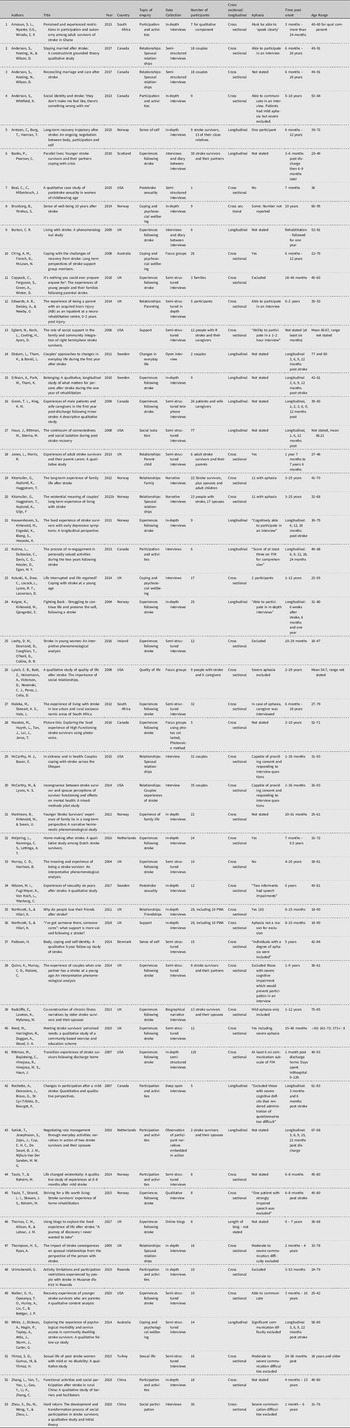
As detailed in Table 2, there has been an increasing focus on areas relating to interpersonal relationships following stroke since 2000. In the period from 2000 to 2009, there were 11 articles in which researchers uncovered information about close personal relationships, while in the period from 2010 to 2018, there were 42 articles, an almost fourfold increase. Researchers investigating these areas were from many countries, however, most commonly they were from the UK (n = 13), Canada (n = 7), USA (n = 8), Norway (9) and Sweden (3). There were two citations each derived from South Africa, Australia, China and Netherlands, and one each from Denmark, Ireland, Rwanda, Scotland and Turkey.
Study characteristics

While researchers in all included articles uncovered participant comments relating to interpersonal relationships, not all researchers asked directly about this construct. In only ten articles, participants were asked directly about their relationships, while relationship focused comments were derived when researchers asked about the experience of stroke generally (n = 20), participation and activities (n = 9), coping and psychological wellbeing (n = 4), sense of self (n = 2), post-stroke sexuality (n = 3), quality of life (n = 2), family life (n = 1), social isolation (n = 1) and support (n = 1).
Interviews were the most commonly used data collection technique, with researchers in 48 of the 53 articles using interview techniques. Of these, researchers in one study used telephone interviewing and researchers in two studies used a diary between interviews. Other data collection tools included observation of narratives embedded in action (n = 1), analysis of online blogs (n = 1) and focus groups (n = 3). The majority (n = 32) of studies adopted cross-sectional designs and of the 13 studies which included longitudinal designs, none were specifically focused on interpersonal relationships and all derived information about interpersonal relationships by asking about related constructs.
The number of participants in the studies ranged from one to 125. Stroke severity ranged from mild to severe, however, in many studies researchers did not state severity. Participants’ ages varied widely across studies, with three studies focussing only on retired participants and 14 studies on working-age participants. The remaining studies (n = 36) included participants across wide age ranges.
This review synthesized perspectives of participants with stroke but focused on experiences which did not relate to aphasia. As such, articles which comprised only participants with aphasia were not included. Where there were mixed cohorts (participants with and without aphasia) articles were only included where fewer than half of the participants had some form of aphasia and comments around the impact of aphasia were not included in the analysis. Most of the studies had only a few participants with aphasia, however, approaches to the inclusion of participants with aphasia were at times unclear. Some researchers stated that participants with mild aphasia were included but did not state numbers. In other cases, researchers stated that they only included those ‘able to participate in an interview’.
Thematic analysis
From the included studies, four overarching themes and 12 subthemes were identified, depicted in Fig. 2. The first overarching theme ‘social disruption’ related to significant changes within the social worlds and social opportunities of participants. The subthemes within this overarching theme were a disrupted social world; loss of social opportunities and shrinking social networks. The second overarching theme ‘changed relationships’ described the vast interpersonal relational changes seen following a stroke. Related subthemes were changed family relationships; changed spousal relationships and changed parenting relationships. The third overarching theme ‘relationships help’ captured the positives which relationships brought to stroke survivors’ lives. Related subthemes included a sense of belonging, support and relationships and a life worth living. The final overarching theme ‘coping with an altered social world’ reflected ways in which participants responded to changes, with subthemes including ‘emotions of stroke survivors’, ‘feelings about the reactions of others’ and ‘adjustment and relationships – a bi-directional construct’.
Summary of themes and subthemes

Social disruption
A disrupted social world
Following a stroke, many survivors experienced a profoundly disrupted social world (Amosun, Nyante & Wiredu, Reference Amosun, Nyante and Wiredu2013; Burton, Reference Burton2000; Northcott & Hilari, Reference Northcott and Hilari2011; Erikson, Park & Tham, Reference Erikson, Park and Tham2010); as noted by a participant in Maratos, Huynh, Tan, Lui and Jarus (Reference Maratos, Huynh, Tan, Lui and Jarus2016) ‘my social world is in shreds’ (p. 1058). Relationships were frequently mentioned as a concern (Rochette, Desrosiers, Bravo, St-Cyr-Tribble & Bourget, Reference Rochette, Desrosiers, Bravo, St-Cyr-Tribble and Bourget2007) and were subject to continuous change (Arntzen, Borg & Hamran, Reference Arntzen, Borg and Hamran2015). Meijering, Nanninga and Lettinga (Reference Meijering, Nanninga and Lettinga2016) commented that ‘overall, the composition of our participants’ social relationships, in terms of closeness, quality, function and structure, not only changed but also decreased drastically and against the will of stroke survivors’ (p. 40). Not all relationships became problematic, however, with some reporting that their relationships with others were strengthened (Leahy, Desmond, Coughlan, O’Neill & Collins, Reference Leahy, Desmond, Coughlan, O’Neill and Collins2016). Where negative changes were present, Lynch et al. (Reference Lynch, Butt, Heineman, Viktorson, Nowinski, Peres and Cella2008) reported that these changes had a deep impact and that many participants described loss in the context of their premorbid relationships (Coppock, Ferguson, Green & Winter, Reference Coppock, Ferguson, Green and Winter2018).
Loss of social opportunities
Participants reported that they had fewer opportunities to interact with others (Amosun et al., Reference Amosun, Nyante and Wiredu2013; Kuluski, Dow, Locock, Lyons & Lasserson, Reference Kuluski, Dow, Locock, Lyons and Lasserson2014; Northcott & Hilari, Reference Northcott and Hilari2011; Pallesen, Reference Pallesen2014; Rittman et al., Reference Rittman, Boylsteing, Hinojossa, Hinojosa and Haun2007; Zhou, Du, Weng & Zhou, Reference Zhou, Du, Weng and Zhou2020). Many described being unable to maintain their pre-stroke activity levels (Northcott & Hilari, Reference Hilari2011; Rittman et al., Reference Rittman, Boylsteing, Hinojossa, Hinojosa and Haun2007) and this disruption of social relational activities (Kuluski et al., Reference Kuluski, Dow, Locock, Lyons and Lasserson2014) and difficulty participating in social activities (Haun, Rittman & Sberna; Reference Haun, Rittman and Sberna2008; Northcott & Hilari, Reference Hilari2011; Rittman et al., Reference Rittman, Boylsteing, Hinojossa, Hinojosa and Haun2007) impacted relationships with others (Banks & Pearson, Reference Banks and Pearson2004). Some reported a new life that was more structured around the home (Meijering et al., Reference Meijering, Nanninga and Lettinga2016; Pallesen, Reference Pallesen2014; Zhang et al., Reference Zhang, Yan, You, Gao, Li and Zhang2018) and this could conjure either feelings of having a refuge, or a feeling of being locked up (Meijering et al., Reference Meijering, Nanninga and Lettinga2016).
Several factors underpinned this reduction in social opportunities. Some respondents described the impact of fatigue on socialising (Kuluski et al., Reference Kuluski, Dow, Locock, Lyons and Lasserson2014; Thompson & Ryan, Reference Thompson and Ryan2009) or on making conversation with others (Meijering et al., Reference Meijering, Nanninga and Lettinga2016). Other participants reported social withdrawal (Kitzmuller, Haggstrom, Asplund & Gilje, Reference Kitzmuller, Haggstrom, Asplund and Gilje2012b; Martinsen, Kirkevold & Sveen, Reference Martinsen, Kirkevold and Sveen2012; Northcott & Hilari, Reference Hilari2011; Rittman et al., Reference Rittman, Boylsteing, Hinojossa, Hinojosa and Haun2007) which was driven by fear (Kitzmuller et al., Reference Kitzmuller, Haggstrom, Asplund and Gilje2012b; Reed, Harrington, Duggan & Wood, Reference Reed, Harrington, Duggan and Wood2010), a desire to avoid questions (Martinsen et al., Reference Martinsen, Kirkevold and Sveen2012) and low self-esteem (Zhou et al., Reference Zhou, Du, Weng and Zhou2020). This social withdrawal was illustrated by a participant in Rittman et al. (Reference Rittman, Boylsteing, Hinojossa, Hinojosa and Haun2007), who stated ‘I’d rather stay by myself, you know, this is even gonna make it worse you know…. So I’ll crawl a little bit more in my hole again, and I’ll be more by myself… I dunno how the heck this is gonna work out, I’m gonna tell ya, because it’s kinda depressing’ (p. 27).
Shrinking social networks
Many reported shrinking social networks (Anderson & Whitfield, Reference Anderson and Whitfield2013; Kitzmuller et al., Reference Kitzmuller, Haggstrom, Asplund and Gilje2012b; Murray & Harrison, Reference Murray and Harrison2004; Northcott & Hilari, Reference Northcott and Hilari2011; Zhang et al., Reference Zhang, Yan, You, Gao, Li and Zhang2018) and in particular, the loss of friends (Murray & Harrison, Reference Murray and Harrison2004; Northcott & Hilari, Reference Northcott and Hilari2018; Pallesen, Reference Pallesen2014; Zhou et al., Reference Zhou, Du, Weng and Zhou2020). The majority of participants had fewer friends following their stroke (Pallesen, Reference Pallesen2014) and for some their social networks now comprised only their children and a couple of close friends (Meijering et al., Reference Meijering, Nanninga and Lettinga2016). Some reported that the change was gradual (Leahy et al., Reference Leahy, Desmond, Coughlan, O’Neill and Collins2016) with friends visiting initially and contact decreasing over time (Meijering et al., Reference Meijering, Nanninga and Lettinga2016). This loss of friends led to feelings of abandonment (Northcott & Hilari, Reference Hilari2011), grief and loneliness (Taule & Raheim, Reference Taule and Raheim2014; Taule et al., Reference Taule, Strand, Skouen and Raheim2015). One participant stated ‘And you lose all your friends, who you thought were your friends. You fell off the face of the earth it seems. I don’t know why, but it’s one of the hardest things I had to deal with’ (Anderson & Whitfield, Reference Anderson and Whitfield2013, p. 824).
Researchers identified contributing factors to the attrition of friendships following stroke. Northcott and Hilari (Reference Hilari2011) highlighted the loss of shared activities, reduced energy levels, poor mobility and unhelpful responses of others. Some felt uncomfortable and embarrassed seeing friends (Zhou et al., Reference Zhou, Du, Weng and Zhou2020). Participants in a study conducted by Reed et al. (Reference Reed, Harrington, Duggan and Wood2010) felt that their friends avoided them because of their disability. Some factors, however, were identified as being protective for retaining a friendship following stroke. These factors included the quality of the friendship before the stroke, living close by, having a ‘friends based’, rather than family-based social network and having a friendship which was not activity based (Northcott & Hilari, Reference Hilari2011).
Changed relationships
Changed family relationships
Relationships with family members were frequently subject to challenges and changes (Edwards, Daisley & Newby, Reference Edwards, Daisley and Newby2014; Egbert, Koch, Coeling & Ayers, Reference Egbert, Koch, Coeling and Ayers2006; Jones & Morris, Reference Jones and Morris2013; Kuluski et al., Reference Kuluski, Dow, Locock, Lyons and Lasserson2014; Kvigne, Kirkevold & Gjengedal, Reference Kvigne, Kirkevold and Giengedal2004; Martinsen et al., Reference Martinsen, Kirkevold and Sveen2012; Thomas, Allison & Latour, Reference Thomas, Allison and Latour2017). It was clear that a stroke was seen as a family challenge, as described by one participant ‘they (family) have had to learn to live with my deficits as well as myself and they’ve had to learn to adapt their lives.’ (Kuluski et al., Reference Kuluski, Dow, Locock, Lyons and Lasserson2014, p. 6). Participants struggled to maintain relationships with spouses, children and grandchildren (Kvigne et al., Reference Kvigne, Kirkevold and Giengedal2004) and stroke was noted to put severe stress on family relationships (Edwards et al., Reference Edwards, Daisley and Newby2014; Lynch et al., Reference Lynch, Butt, Heineman, Viktorson, Nowinski, Peres and Cella2008). There appeared to be a link between relationship stress in families and role changes (Egbert et al., Reference Egbert, Koch, Coeling and Ayers2006) with participants highlighting difficulties fulfilling their role in the family (Anderson, Keating & Wilson, Reference Anderson, Keating and Wilson2017b; Burton, Reference Burton2000; Ch’ng, French & McLean, Reference Ch’ng, French and McLean2008; Ekstam, Tham & Borell, Reference Ekstam, Tham and Borell2010; Kitzmuller et al., Reference Kitzmuller, Asplund and Haggstrom2012; Kvigne et al., Reference Kvigne, Kirkevold and Giengedal2004; Martinsen et al., Reference Martinsen, Kirkevold and Sveen2012; Taule & Raheim, Reference Taule and Raheim2014) and at times a feeling that their roles had been ‘taken over’ (Kvigne et al., Reference Kvigne, Kirkevold and Giengedal2004; Quinn et al., Reference Quinn, Murray and Malone2014). Some retreated from family life (Martinsen et al., Reference Martinsen, Kirkevold and Sveen2012).
Changed spousal relationships
Marriages or intimate partnerships were highlighted by many participants as important relationships which brought with them a higher commitment than other significant relationships (Anderson et al., Reference Anderson, Keating and Wilson2017b; Anderson, Keating & Wilson, Reference Anderson, Keating and Wilson2017; Northcott & Hilari, Reference Northcott and Hilari2018Q). One participant reflected on this sense of commitment, stating ‘it’s that “for better or for worse, richer or poorer, sickness and health.” I believed in those words, you know, and that’s what you do when you care about somebody’ (Anderson et al., Reference Anderson, Keating and Wilson2017, p. 393). Participants commented on the importance of the unconditional love they received from their partners (Maratos et al., Reference Maratos, Huynh, Tan, Lui and Jarus2016) and marriages were credited with producing a sense of connectedness (Haun et al., Reference Haun, Rittman and Sberna2008) and enhanced recovery following a stroke (Brunborg & Ytrehus, Reference Brunborg and Ytrehus2014; Kitzmuller et al., Reference Kitzmuller, Asplund and Haggstrom2012; White et al., Reference White, Dickson, Magin, Tapley, Attia, Sturm and Carter2014). The physical closeness of spouses was reported to provide a sense of reassurance (Northcott & Hilari, Reference Northcott and Hilari2018).
While significant challenges and changes were evident in intimate partnerships (Banks & Pearson, Reference Banks and Pearson2004; Green & King, Reference Green and King2009; Quinn et al., Reference Quinn, Murray and Malone2014; Pallesen, Reference Pallesen2014; Thompson & Ryan, Reference Thompson and Ryan2009), it is important to note that not all experiences were negative (Banks & Pearson, Reference Banks and Pearson2004). Some couples presented as united and described their relationship as being strengthened by the experience of stroke (Radcliffe, Lowton & Myfanwy, Reference Radcliffe, Lowton and Myfanwy2013). Anderson et al. (Reference Anderson, Keating and Wilson2017b) highlighted factors which appeared to be protective for couples, these included having an awareness of each other’s feelings, having adequate resources to fulfil roles and focussing on abilities rather than problems.
Undoubtedly however, negative changes did occur within marriages (Banks & Pearson, Reference Banks and Pearson2004; Green & King, Reference Green and King2009; Quinn et al., Reference Quinn, Murray and Malone2014; Thompson & Ryan, Reference Thompson and Ryan2009) and these changes had long-term impacts (Green & King, Reference Green and King2009). As noted by a participant in one study (Erikson et al., Reference Erikson, Park and Tham2010), ‘We have been different, you can say, a bit different. We are not as close to each other as we were before. We have become distanced’ (p. 834). Life as a couple was altered (Pallesen, Reference Pallesen2014) often with a disruption to a couple’s sense of their expected biographical life stage (McCarthy & Bauer, Reference McCarthy and Bauer2015) and a sense of increasing distance (Erikson et al., Reference Erikson, Park and Tham2010; Kouwenhoven et al., Reference Kouwenhoven, Kirkevold, Engedal, Biong and Hesooks2011). Participants reported struggling to maintain relationships with their spouses (Kvigne et al., Reference Kvigne, Kirkevold and Giengedal2004) and some relationships ended (Anderson et al., Reference Anderson, Keating and Wilson2017; Lynch et al., Reference Lynch, Butt, Heineman, Viktorson, Nowinski, Peres and Cella2008). Early on following a stroke, marriages were often noted to ‘take a back seat’ (Anderson et al., Reference Anderson, Keating and Wilson2017; Anderson et al., Reference Anderson, Keating and Wilson2017b) with the relationship being submerged by illness management (Anderson et al., Reference Anderson, Keating and Wilson2017). Over time, however, the participants refocused their attention on their marriages and an awareness of the relationship returned (Anderson et al, Reference Anderson, Keating and Wilson2017).
Challenges and conflict were frequently experienced (Anderson et al., Reference Anderson, Keating and Wilson2017; Kouwenhoven et al., Reference Kouwenhoven, Kirkevold, Engedal, Biong and Hesooks2011; McCarthy & Bauer, Reference McCarthy and Bauer2015; Radcliff et al., Reference Radcliffe, Lowton and Myfanwy2013) with some stroke survivors reporting being irritable (Thompson & Ryan, Reference Thompson and Ryan2009) and short tempered (Banks & Pearson, Reference Banks and Pearson2004) with their spouses. Conflict centred around issues such as tension around the caring role (Quinn et al., Reference Quinn, Murray and Malone2014; Radcliffe et al., Reference Radcliffe, Lowton and Myfanwy2013), making important decisions (Kitzmuller et al., Reference Kitzmuller, Asplund and Haggstrom2012) and expectations within relationships (Anderson et al., Reference Anderson, Keating and Wilson2017). One participant reflected ‘Oh there were lots of fights. I’d be crying my eyes out on the couch, watching him in the kitchen, doing all that he could and knowing he was not having an easy time with it. But, like sometimes that I hated him so bad ’cause he could just get up and leave; I didn’t have that choice’ (Anderson et al., Reference Anderson, Keating and Wilson2017, p. 393). How couples resolved conflicts appeared to differentiate those who were able to move forward and continue with a happy marriage versus those who divorced or continued in an unhappy marriage (Anderson et al., Reference Anderson, Keating and Wilson2017b).
Many participants cited changed intimacy in their relationships (Beal & Millenbruch, Reference Beal and Millenbruch2015; Green & King, Reference Green and King2009; Haun et al., Reference Haun, Rittman and Sberna2008; Jones & Morris, Reference Jones and Morris2013; Murray & Harrison, Reference Murray and Harrison2004; Nilsson, Fugl-Meyer, Von Koch & Ytterberg, Reference Nilsson, Fugl-Meyer, Von Koch and Ytterberg2017; Yilmaz, Gumus & Yilmas, Reference Yilmaz, Gumus and Yilmaz2015) with subsequent impacts on spousal relationships (Thompson & Ryan, Reference Thompson and Ryan2009) and feelings of isolation (Haun et al., Reference Haun, Rittman and Sberna2008). Changed intimacy was tied with a lack of time to focus on the relationship (Beal & Millenbruch, Reference Beal and Millenbruch2015) concerns around stroke recurrence (Nilsson et al., Reference Nilsson, Fugl-Meyer, Von Koch and Ytterberg2017; Thompson & Ryan, Reference Thompson and Ryan2009), medications (Yilmaz et al., Reference Yilmaz, Gumus and Yilmaz2015), the notion of a vulnerable body, not feeling comfortable in one’s own skin (Beal & Millenbruch, Reference Beal and Millenbruch2015) and self-consciousness (Thompson & Ryan, Reference Thompson and Ryan2009). Changed spousal dynamics and dependence on partners were also cited as impacting sexual relationships (Thompson & Ryan, Reference Thompson and Ryan2009). Changes were not always negative in relation to intimacy, however, with some reporting a focus on alternative forms of intimacy (Nilsson et al., Reference Nilsson, Fugl-Meyer, Von Koch and Ytterberg2017; Haun, Rittman & Sberna, Reference Haun, Rittman and Sberna2008) and a more mindful approach to intimacy (Nilsson et al., Reference Nilsson, Fugl-Meyer, Von Koch and Ytterberg2017).
Changed parental relationships
Parenting was a challenge for those with young children (Beal & Millenbruch, Reference Beal and Millenbruch2015; Egbert et al., Reference Egbert, Koch, Coeling and Ayers2006; Kuluski et al., Reference Kuluski, Dow, Locock, Lyons and Lasserson2014; Martinsen et al., Reference Martinsen, Kirkevold and Sveen2012; McCarthy & Lyons, Reference McCarthy and Lyons2015; Thomas et al., Reference Thomas, Allison and Latour2017; Walker et al., Reference Walker, Oyesanya, Hurley, Liu and Bettger2020). In the early phase, parents felt they were unable to spend time with their children due to hospitalisation (Edwards et al., Reference Edwards, Daisley and Newby2014; Walker et al., Reference Walker, Oyesanya, Hurley, Liu and Bettger2020) which was met with feelings of guilt and discomfort (Edwards et al., Reference Edwards, Daisley and Newby2014). A participant in Edwards et al. (Reference Edwards, Daisley and Newby2014) stated ‘sometimes feel sort of tight chested and anxious and umm the fact that I haven’t seen the kids for a while and you can feel the release of when you enjoy a cuddle with them, it’s a drug you need a fix of’ (p. 1705). Mobile phones and technology were useful tools for staying in touch during this period (Edwards et al., Reference Edwards, Daisley and Newby2014; Walker et al., Reference Walker, Oyesanya, Hurley, Liu and Bettger2020), however, some felt ignored by their children (Edwards et al., Reference Edwards, Daisley and Newby2014; McCarthy & Lyons, Reference McCarthy and Lyons2015).
Participants reported that over time their ability to engage with their children improved (Walker et al., Reference Walker, Oyesanya, Hurley, Liu and Bettger2020), however, there remained many things parents were unable to do for their children secondary to fatigue (Arntzen, Borg & Hamran, Reference Arntzen, Borg and Hamran2015), difficulty multi-tasking (Kuluski et al., Reference Kuluski, Dow, Locock, Lyons and Lasserson2014), short temperedness (Martinsen et al., Reference Martinsen, Kirkevold and Sveen2012) and physical and cognitive impairments (Martinsen et al., Reference Martinsen, Kirkevold and Sveen2012; Meijering et al., Reference Meijering, Nanninga and Lettinga2016). Parents had difficulties engaging in activities such as wrestling (Walker et al., Reference Walker, Oyesanya, Hurley, Liu and Bettger2020), picking children up (Edwards et al., Reference Edwards, Daisley and Newby2014), taking them out (Edwards et al., Reference Edwards, Daisley and Newby2014) and driving them around (Walker et al., Reference Walker, Oyesanya, Hurley, Liu and Bettger2020).
Many spoke of their loss of their role as a parent (Beal & Millenbruch, Reference Beal and Millenbruch2015; Coppock et al., Reference Coppock, Ferguson, Green and Winter2018; Kitzmuller et al., Reference Kitzmuller, Asplund and Haggstrom2012; Edwards et al., Reference Edwards, Daisley and Newby2014; Walker et al., Reference Walker, Oyesanya, Hurley, Liu and Bettger2020, Yilmaz et al., Reference Yilmaz, Gumus and Yilmaz2015) and a desire to feel like a parent again (Edwards et al., Reference Edwards, Daisley and Newby2014). Parents frequently spoke of difficulties with disciplining children and a loss of parental authority and equality (Edwards et al., Reference Edwards, Daisley and Newby2014; Walker et al., Reference Walker, Oyesanya, Hurley, Liu and Bettger2020). Parents who had had a stroke needed to ask for help (Edwards et al., Reference Edwards, Daisley and Newby2014; Kitzmuller et al., Reference Kitzmuller, Asplund and Haggstrom2012; Kuluski et al., Reference Kuluski, Dow, Locock, Lyons and Lasserson2014) and kids were exposed to different parenting styles, sometimes seeking things from their helpers rather than their parents (Walker et al., Reference Walker, Oyesanya, Hurley, Liu and Bettger2020). Changes were met with unease (Banks & Pearson, Reference Banks and Pearson2004) with Kitzmuller et al. (Reference Kitzmuller, Asplund and Haggstrom2012) reporting ‘these stroke survivors experienced mental pain, self-reproach, and sadness when they suddenly realized that their children had turned away from them’. (p. E4).
The experience of negative change was not universal however and some reported closer relationships with their children (Martinsen et al., Reference Martinsen, Kirkevold and Sveen2012) with some children displaying a role reversal, acting as a caregiver and being protective, which was viewed positively and strengthened the relationship (Walker et al., Reference Walker, Oyesanya, Hurley, Liu and Bettger2020).
Parents frequently felt concerned about psychological and educational impacts on their children (Edwards et al., Reference Edwards, Daisley and Newby2014; Kitzmuller et al., Reference Kitzmuller, Asplund and Haggstrom2012; Kuluski et al., Reference Kuluski, Dow, Locock, Lyons and Lasserson2014; Walker et al., Reference Walker, Oyesanya, Hurley, Liu and Bettger2020: Yilmaz et al., Reference Yilmaz, Gumus and Yilmaz2015) and wanted to protect them from the consequences of their stroke (Edwards et al., Reference Edwards, Daisley and Newby2014). One participant (Leahy et al., Reference Leahy, Desmond, Coughlan, O’Neill and Collins2016) stated ‘I want them to have a good childhood and not, “ah Mammy’s stupid leg,” we can’t do this’ (p. 674), and another reflected ‘it’s me who should be looking after them, you know, it’s a parental thing’ (Northcott & Hilari, Reference Northcott and Hilari2018, p. 2442).
Relationships help
A sense of belonging
Participants spoke about a sense of belonging or connectedness with others throughout the literature, with some authors characterising aspects of connectedness or isolation (Erikson et al., Reference Erikson, Park and Tham2010; Haun et al., Reference Haun, Rittman and Sberna2008; Kubina, Dubouloz, Davis, Kessler & Egan, Reference Kubina, Dubouloz, Davis, Kessler and Egan2013). Characteristics of feeling well connected included having adequate support (Rittman, Boysteing, Hinojosa & Haun, Reference Rittman, Boylsteing, Hinojossa, Hinojosa and Haun2007), intimate relationships with family and friends (Haun et al., Reference Haun, Rittman and Sberna2008) and feeling a sense of belonging through engaging in valued activities and sharing life (Erikson et al., Reference Erikson, Park and Tham2010; Kubina et al., Reference Kubina, Dubouloz, Davis, Kessler and Egan2013). Engaging with others in social groups was associated with social connection for some, with one participant noting enjoyment from ‘just being part of the group’ (Kubina et al., Reference Kubina, Dubouloz, Davis, Kessler and Egan2013, p. 238). In contrast to feeling connected, some participants reported feeling isolated (Haun et al., Reference Haun, Rittman and Sberna2008). Isolated participants were more likely to be unmarried, have fewer visits from family and friends and an inability to contribute (Rittman et al., Reference Rittman, Boylsteing, Hinojossa, Hinojosa and Haun2007).
Overall, it emerged that for participants to feel connected to others and have a sense of belonging, there was a need for them to remain connected to friends and family throughout their recovery (Haun et al., Reference Haun, Rittman and Sberna2008).
Support
Participants described the importance of the support they received from family and friends (Edwards et al., Reference Edwards, Daisley and Newby2014; Jones & Morris, Reference Jones and Morris2013; Kitzmuller et al., Reference Kitzmuller, Asplund and Haggstrom2012; Northcott & Hilari, Reference Northcott and Hilari2018; Pallesen, Reference Pallesen2014; Thomas et al., Reference Thomas, Allison and Latour2017; Walker et al., Reference Walker, Oyesanya, Hurley, Liu and Bettger2020; White et al., Reference White, Dickson, Magin, Tapley, Attia, Sturm and Carter2014). Family support in particular was discussed with Kitzmuller et al. (Reference Kitzmuller, Asplund and Haggstrom2012), highlighting the notion of the ‘family as a lifebuoy’ (p. E3). Support included practical (Satink et al., Reference Satink, Josephsson, Zajec, Cup, De Swart and Nijhuis-Van Der Sanden2016; Urimbenshi, Reference Urimubenshi2015), financial (Leahy et al., Reference Leahy, Desmond, Coughlan, O’Neill and Collins2016) and emotional support (Leahy et al., Reference Leahy, Desmond, Coughlan, O’Neill and Collins2016; Egbert et al., Reference Egbert, Koch, Coeling and Ayers2006) and was credited with helping to keep families together (Coppock et al., Reference Coppock, Ferguson, Green and Winter2018), bolstering confidence (Anderson & Whitfield, Reference Anderson and Whitfield2013) and instilling motivation and independence (Kitzmuller et al., Reference Kitzmuller, Asplund and Haggstrom2012).
Support was particularly important for parents who reflected on the help they received from family and friends who provided respite (Walker et al., Reference Walker, Oyesanya, Hurley, Liu and Bettger2020) and helped them to be a better parent (Edwards et al., Reference Edwards, Daisley and Newby2014). The vulnerability of single-parent families with no adult to take on additional load was noted by Martinsen et al. (Reference Martinsen, Kirkevold and Sveen2012).
Northcott and Hilari (Reference Northcott and Hilari2018) noted that support was most valued when it was part of a caring relationship and noted that feeling supported was tied with feeling connected. Further, connections with others were credited with helping participants cope (Brunborg & Ytrehus, Reference Brunborg and Ytrehus2014; Ch’ng et al., Reference Ch’ng, French and McLean2008; Kitzmuller et al., Reference Kitzmuller, Asplund and Haggstrom2012). One participant reflected on the support from family, stating ‘I think the biggest thing (my family) did was just let me know that they still love me and still accepted me for being who I am. So, finally, it’s gotten to the point we hardly think I had a stroke’. (Egbert et al., Reference Egbert, Koch, Coeling and Ayers2006, p. 51).
The experience of feeling supported was not shared by all participants however and it was noted by Rittman et al. (Reference Rittman, Boylsteing, Hinojossa, Hinojosa and Haun2007) that the physical presence of others didn’t necessarily lead to feeling supported.
Relationships and a life worth living
Participants frequently spoke about relationships with others as providing them with a quality of life (Anderson et al., Reference Anderson, Keating and Wilson2017; Brunborg & Ytrehus, Reference Brunborg and Ytrehus2014) and a sense of wellbeing (Brunborg & Ytehus, Reference Brunborg and Ytrehus2014). Spouses, in particular, were credited with adding to participants’ quality of life (Anderson et al., Reference Anderson, Keating and Wilson2017).
Significant others were often credited with giving stroke survivors a sense of purpose (Haun, Rittman & Sberna, Taule et al., Reference Taule, Strand, Skouen and Raheim2015) and a will to live (Kitzmuller et al., Reference Kitzmuller, Asplund and Haggstrom2012; Taule et al., Reference Taule, Strand, Skouen and Raheim2015). Those with young children felt motivated by wanting to see their children grow up (Kuluski et al., Reference Kuluski, Dow, Locock, Lyons and Lasserson2014) and families more generally gave participants a will to live (Kitzmuller et al., Reference Kitzmuller, Asplund and Haggstrom2012). As noted by one participant ‘yes, my relationship with family, we have gotten to know each other and it’s getting great, it’s great, I believe it… I got someone to live for’. (Haun et al., Reference Haun, Rittman and Sberna2008, p. 60).
Coping with an altered social world
Emotions of stroke survivors
A range of emotional responses to changed relationships following stroke were reported (Banks & Pearson, Reference Banks and Pearson2004; Jones & Morris, Reference Jones and Morris2013; Maleka, Stewart & Hale, Reference Maleka, Stewart and Hale2012; Northcott & Hilari, Reference Hilari2011; Taule et al., Reference Taule, Strand, Skouen and Raheim2015). Participants often felt fearful, for example of being rejected when others became fed up with their dependence (Martinsen et al., Reference Martinsen, Kirkevold and Sveen2012) or fear of being a burden (Taule & Raheim, Reference Taule and Raheim2014). Some felt fearful of falling short of others’ expectations and felt clingy and uncertain in relationships (Taule & Raheim, Reference Taule and Raheim2014). There was frequently a loss of confidence in relationships (Walker et al., Reference Walker, Oyesanya, Hurley, Liu and Bettger2020) and increased insecurity and feelings of vulnerability (Anderson et al., Reference Anderson, Keating and Wilson2017b, Kouwenhoven et al., Reference Kouwenhoven, Kirkevold, Engedal, Biong and Hesooks2011; Martinsen et al., Reference Martinsen, Kirkevold and Sveen2012; Taule et al., Reference Taule, Strand, Skouen and Raheim2015; Walker et al., Reference Walker, Oyesanya, Hurley, Liu and Bettger2020).
Participants also reported feelings of isolation at being abandoned by friends (Northcott & Hilari, Reference Hilari2011) or children (Maleka et al., Reference Maleka, Stewart and Hale2012). Some reported grief and loneliness due to a loss of contact with others (Taule et al., Reference Taule, Strand, Skouen and Raheim2015). Anger was often reported and close relationships with others often suffered as they bore the brunt of anger (Murray & Harrison, Reference Murray and Harrison2004; Walker et al., Reference Walker, Oyesanya, Hurley, Liu and Bettger2020) with one participant reporting ‘my anger was getting generated towards my daughter and people and others who were around me, you know what I mean? Whereas at one time I was laid back I am not now. I snap at everyone, you know what I mean. I tried to control it…’ (Murray & Harrison, Reference Murray and Harrison2004, p. 813).
Amongst a range of negative emotions, participants talked about hope for the future (Edwards et al., Reference Edwards, Daisley and Newby2014; Ekstam et al., Reference Ekstam, Tham and Borell2010). Those who were parents hoped to begin feeling like a parent again (Edwards et al., Reference Edwards, Daisley and Newby2014) and couples’ acceptance of a situation allowed them to envisage a future (Ekstam et al., Reference Ekstam, Tham and Borell2010).
Feelings about the reactions of others
In addition to managing their own emotions, stroke survivors dealt with perceived changes in the ways they were viewed by others. Many reported feeling stigmatised by others (Anderson & Whitfield, Reference Anderson and Whitfield2013; Rochette et al., Reference Rochette, Desrosiers, Bravo, St-Cyr-Tribble and Bourget2007). Others struggled with whether their spouses would still like them (Anderson et al., Reference Anderson, Keating and Wilson2017b) and some wondered whether they were still good enough to be loved by their grandchildren or respected by their colleagues (Taule et al., Reference Taule, Strand, Skouen and Raheim2015). One participant highlighted this, commenting ‘they’re going to look at one part of you and that’s the damaged frail part, too frail maybe to have a relationship with’ (Anderson & Whitfield, Reference Anderson and Whitfield2013, p. 824). For some, there was a perceived lack of empathy from spouses (Thompson & Ryan, Reference Thompson and Ryan2009) and children (Coppock et al., Reference Coppock, Ferguson, Green and Winter2018).
Adjustment and relationships – a bidirectional association
Given the vast array of changes experienced, there was an impetus for participants to adjust to their altered social words (Burton, Reference Burton2000; Erikson et al., Reference Erikson, Park and Tham2010) and the social changes they experienced (Burton, Reference Burton2000). Social adjustment occurred over time as participants increasingly focused on family and marital relationships post stroke (Green & King, Reference Green and King2009; Urimubenshi, Reference Urimubenshi2015). For many, after their return home, the process of re-entering the community began (Egbert et al., Reference Egbert, Koch, Coeling and Ayers2006) with participants rebuilding their social positions (Anderson & Whitfield, Reference Anderson and Whitfield2013) and negotiating continuously changing relationships with others (Arntzen et al., Reference Arntzen, Borg and Hamran2015). A need to renegotiate relationships on equal terms was apparent (Kvigne et al., Reference Kvigne, Kirkevold and Giengedal2004).
Relationships with others and adjustment appeared to represent a bi-directional association. Stroke survivors needed to adjust to changed relationships, but it also emerged that relationships with others mediated the process of more general adjustment following stroke (Anderson & Whitfield, Reference Anderson and Whitfield2013; Brunborg & Ytehus, Reference Brunborg and Ytrehus2014; White et al., Reference White, Dickson, Magin, Tapley, Attia, Sturm and Carter2014). Significant others assisted stroke survivors with a process of ‘reality readjustment’ as they got to know themselves again through interactions with others (Erikson et al., Reference Erikson, Park and Tham2010). Those around them provided participants with feedback (Haun, Rittman & Sberna, Reference Haun, Rittman and Sberna2008) and supported them to develop a new sense of self following their stroke (Kuluski, Dow, Locock, Lyons & Lasserson, Reference Kuluski, Dow, Locock, Lyons and Lasserson2014). Through acting and interacting with others, participants were able to find their purpose in life after their stroke (Erikson et al., Reference Erikson, Park and Tham2010) and in this way, the relationships both required adjustment and contributed to more general adjustment.
Discussion
This review of the qualitative literature uncovered 53 papers which describe aspects of the experience of close personal relationships from the perspective of stroke survivors, focussing on experiences of those without aphasia. The social worlds of stroke survivors are disrupted with the loss of social opportunities and shrinking social networks. Relationships with family, spouses, friends and children are changed and survivors need to adjust to an altered social world. Relationships are highlighted as helpful in providing a sense of belonging, support and a life worth living and survivors are challenged with dealing with strong emotions and adjusting to these changes. This scoping review provides a thematically analysed the description of experiences across a variety of relationship types for people post stroke without aphasia, which has not been done comprehensively to this point. Understanding the experiences of those without aphasia is important as a comparison to those with aphasia and in identifying different and similar experiences of these groups. Through a better understanding of changes to a range of relationships following stroke, we are better able to support our clients to experience more positive close personal relationships in clinical practice.
The first theme ‘social disruption’ described reported feelings that survivors’ social worlds had been disturbed. Subthemes identified participants reporting a loss of social opportunities, the loss of friends and at times withdrawing socially. This finding was also highlighted by participants with aphasia (Ford et al., Reference Ford, Douglas and O’Halloran2018) and as such appears to be a common experience following stroke with or without aphasia. It emerges that social disruption is not unique to stroke survivors and is also experienced following acquired brain injury (ABI) more generally (Clare et al., Reference Clare, Nellis, Whitaker, Martyr, Markova, Roth and Morris2012; Dikman, Machamer, Powell, & Temkin, Reference Dikman, Machamer, Powell and Temkin2003; Douglas, Reference Douglas2019; Douglas & Spellacy, Reference Douglas and Spellacy2000; Jourdan et al., Reference Jourdan, Bayen, Pradat-Diehl, Ghout, Darnoux, Azerad and Azouvi2016; Pozzebon, Douglas, & Ames, 2016; Reference Pozzebon, Douglas and Ames2018; Tate, Broe, Cameron, Hodgkinson & Soo, Reference Tate, Broe, Cameron, Hodgkinson and Soo2005) and also following chronic illness (Kvaal, Harding & Kvigne, Reference Kvaal, Halding and Kvigne2014; Rounds & Israel, Reference Rounds and Israel1985; Umberson & Montez, Reference Umberson and Montez2010; Umberson, Williams, Powers, Liu & Needham, Reference Umberson, Williams, Powers, Liu and Needham2006).
Stroke survivors report that changes to social networks happen against their will and are met with an accompanying sense of loss (Haun, Rittman & Sberna, Reference Haun, Rittman and Sberna2008; Maratos et al., Reference Maratos, Huynh, Tan, Lui and Jarus2016; Meijering et al., Reference Meijering, Nanninga and Lettinga2016). This may be relevant as researchers have found that it is not the size of social networks that mediates wellbeing and health outcomes but the satisfaction with social networks (Amieva et al., Reference Amieva, Stoykova, Matharan, Helmer, Antonucci and Dartigues2010; Barrera, Reference Barrera1986; Fuller-Iglesias, Reference Fuller-Iglesias2015; McDowell & Newell, Reference McDowell and Newell1996). Given this, it may be that such changes have a significant negative impact on outcomes for stroke survivors.
On closer examination of specific relationships, participants described a variety of experiences in their relationships with their families, friends, spouses and children with many changes reported. Relationships were challenged by stress, change and conflict and it was clear that stroke was perceived as a family concern. These types of issues are certainly supported in the quantitative research investigating stroke (King, Shade-Zeldow, Carlosn, Feldman & Philip, Reference King, Shade-Zeldow, Carlson, Feldman and Philip2002; Northcott, Moss, Harrison & Hilari, Reference Northcott, Moss, Harrison and Hilari2016; Visser-Meily et al., Reference Visser-Meily, Post, Van De Port, Maas, Forstberg-Warleby and Lindeman2009) as well as in the recent review of relationships for people with post-stroke aphasia (Ford et al., Reference Ford, Douglas and O’Halloran2018). Changed relationships therefore emerge as a consequence of stroke with or without aphasia, however, the greater breadth of research focussing on stroke without aphasia has afforded more detailed description of their experiences in this article.
Participants spoke about the feeling of being supported by significant others, which was characterised in this review as a positive outcome of relationships, a finding also reiterated by people with aphasia (Ford et al., Reference Ford, Douglas and O’Halloran2018). Support is clearly a fundamental facet of recovery following a stroke and has been tied with feelings of being cared for and loved (Haun, Rittman & Sberna, Reference Haun, Rittman and Sberna2008; Northcott et al., Reference Northcott, Moss, Harrison and Hilari2016), lower rates of depression (Douglas & Spellacy, Reference Douglas and Spellacy2000; Tahiri-Mechakra, Sunsunegui, Preville & Dube, Reference Tahiri-Mechakra, Sunsunegui, Preville and Dube2009), stronger sense of self (Douglas, 2012; Reference Douglas2013) and a higher quality of life (Hilari & Northcott, Reference Hilari and Northcott2006). In the general literature, it has been postulated that support mediates the experience of stress and distress (Robitaille, Reference Robitaille2011; Tahiri-Mechakra et al., Reference Tahiri-Mechakra, Sunsunegui, Preville and Dube2009) and following stroke has been tied with more favourable functional recovery (Glass & Maddox, Reference Glass and Maddox1992).
Support clearly emerges as an important component of psychosocial recovery following stroke, a range of other ABI and chronic illness more generally. In this review, however, support was spoken about in both positive and negative ways. While participants placed a high value on the support they received, some felt overprotected and that they were losing their social roles; as parents, as spouses and in their family. For many, role changes were accompanied by feelings of dependency, burden and negative emotions. This finding suggests that all support is not equal and in fact some researchers have found that support has the potential to increase psychological distress (Bolger, Zuckermman & Kessler, Reference Bolger, Zuckermman and Kessler2000; Trudel, Dargis-Damphousse, Villeneuve, Boyer & Preville, Reference Vassilev, Rogers, Blickem, Brooks, Dharmi, Kennedy and Reeves2013). The concept of overprotection has been highlighted by participants with chronic illnesses and stroke (Gabriel, Figueiredo, Jacome, Cruz, & Marques, Reference Gabriel, Figueiredo, Jacome, Cruz and Marques2014; Roing & Sanner, Reference Roing and Sanner2015; Northcott et al., Reference Northcott, Moss, Harrison and Hilari2016) and there exists at times a tension between wanting control and needing support from families (Roing & Sanner, Reference Roing and Sanner2015). It, therefore, emerges that there is a need for sensitivity in providing support which maintains the self-efficacy of the receiver (Maisel & Gable, Reference Maisel and Gable2009), and stroke survivors clearly place a high importance on contributing and fulfilling social roles (Pound, Reference Pound2011). These findings indicate that being supported needs to be balanced with allowing stroke survivors to have a sense of autonomy and contribution.
This review also identified an overarching theme of ‘coping with an altered social world’ with subthemes describing ‘emotions of stroke survivors’, ‘feelings about the reactions of others’ and attempts at adjustment following a stroke. Adjustment was not comprehensively described in the literature, however, there was a strong sense that adjustment processes were mediated through interpersonal relationships and that the two were intertwined. The directionality of this relationship was not clear in the literature, however, we postulate that a two-way relationship exists; where supportive relationships facilitate more successful adjustment and hence more positive outcomes and conversely that successful adjustment supports healthier relationships. This notion requires further investigation however.
In the literature describing interpersonal relationships following aphasia, a need for adjustment was also discussed, however, the idea of ‘adjustment through others’ did not emerge (Ford et al., Reference Ford, Douglas and O’Halloran2018). It may be that adjustment through interacting with others is a positive aspect of recovery which is not available to people with aphasia given their language difficulties. Alternatively, this may reflect a lack of in-depth research in the area for people with aphasia and further investigation is warranted.
In other chronic diseases, associations have been identified between interpersonal relationships and adjustment (Eggenberger et al., Reference Eggenberger, Meiers, Krumwiede, Bliesmer and Earle2011; Yorgason et al., Reference Yorgason, Roper, Wheeler, Crane, Byron, Carpenter and Higley2010). The mechanisms which facilitate this association may be numerous, however, two constructs described in the literature help to conceptualise the positive impact relationships have on adjustment. The construct of post-traumatic growth can be described as a process of growth after a significant and life-altering event (Rogan, Fortune & Prentice, Reference Rogan, Fortune and Prentice2013). Post-traumatic growth has been linked to social support following chronic illness (Adams, Reference Adams2015; Livneh & Antonak, Reference Livneh and Antonak2005; Zeligman, Barden & Hagedorn, Reference Zeligman, Barden and Hagedorn2016) and therefore perhaps connections with others facilitate greater personal growth following stroke and therefore more positive adjustment. Chronic disease self-care has also been described by a number of authors, and it has been noted that relationships with others may mediate components of chronic disease self-care (Vassilev et al., Reference Vassilev, Rogers, Sanders, Kennedy, Blickem, Protheroe and Morris2011; Vassilev et al., Reference Vassilev, Rogers, Blickem, Brooks, Dharmi, Kennedy and Reeves2013). It therefore emerges that through more positive relationships enhanced disease management occurs which is likely to result in more successful adjustment.
Given the challenges experienced in interpersonal relationships following stroke and the importance of these relationships, there is a need for clinicians to support stroke survivors to have more positive relationships. This need was highlighted by Beal and Millenbruch (Reference Beal and Millenbruch2015) who assert that health professionals should have a greater understanding of the relationship challenges experienced following stroke. Many patients feel that inadequate information was provided to them around this topic following their stroke (Rodgers, Bond & Curless, Reference Rodgers, Bond and Curless2001) and that health professionals showed little interest in their social lives (Taule, Strand, Skouen & Raheim, Reference Taule, Strand, Skouen and Raheim2015). They subsequently may return home feeling unprepared for family life (Zeligman et al., Reference Zeligman, Barden and Hagedorn2016). If health professionals are to affect change in this area of practice, greater understanding is needed.
Limitations of this study
This review adopted a scoping review methodology and followed processes outlined by Arksey and O’Malley (Reference Arksey and O’Malley2005) and Levac et al. (Reference Levac, Colquhoun and O’Brien2010). Scoping reviews have been identified as an appropriate method for mapping literature for dissemination (Arksey & O’Malley, Reference Arksey and O’Malley2005; Munn et al., Reference Munn, Peters, Stern, Tufanaru, McArthur and Aromataris2018), however, the inclusion of a quality appraisal in scoping review methodology is debated in the literature (Pham et al., Reference Pham, Rajic, Greig, Sargeant, Papadopoulos and McEwen2014). In this review, no attempt was made to evaluate the quality and thus weight of the evidence presented and as such results are intended to map the available literature rather than to guide clinical process (Munn et al., Reference Munn, Peters, Stern, Tufanaru, McArthur and Aromataris2018). Without a quality appraisal and assessment of risk of bias, there is a risk that studies of lower methodological rigour were given equal consideration to those of higher quality.
Articles were included which were published from January 2000 to February 2021, and this date was selected to coincide with the publication of the World Health Organisation’s ICF (WHO, 2001) which brought about an increased focus on social participation. We acknowledge however that this decision may have led to some experiential data being missed. We also acknowledge that although a comprehensive systematic search strategy was used, experiential data may not have been uncovered, particularly in the high volume of non-peer-reviewed sources that have not been accessed in this review to limit findings to a manageable number.
While this review identified key themes and subthemes regarding the experience of interpersonal relationships following stroke this scoping review has some limitations. Although 53 papers were included, researchers directly asked participants about their relationships in only ten. In the remaining articles, participants were asked about related constructs, such as quality of life, activities and the experience of stroke generally. While this speaks to the strong ties interpersonal relationships have with a range of facets of psychosocial functioning, it may be that the findings would be different if more studies had asked participants directly about their experiences of relationships. Further research focussing directly on this area is needed.
This article focuses on the experience of stroke survivors generally and has attempted to bring together experiences which do not relate to aphasia due to a recent review in this area and to allow for comparison of experiences (Ford et al., Reference Ford, Douglas and O’Halloran2018). While studies focussing on people with aphasia were not included, at times, it was difficult to ascertain the presence of aphasia given unclear reporting. In addition, some studies included a small number of people with aphasia and these were still included. When analysing these papers, if comments relating to the experience of aphasia were present, these were not included. This approach has been used in an attempt to focus on the experience of people without aphasia given the recent publication by Ford et al. (Reference Ford, Douglas and O’Halloran2018) around the experience of people with aphasia. We acknowledge that some reported experiences may have been provided by people with aphasia in our analysis.
Finally, this review incorporates literature from countries with variable social, cultural and economic structures. Given that data from various countries have been analysed together, it is possible that varying experiences may have been captured which relate to these social, cultural and economic conditions.
Recommendations for further research
There is a need for a greater understanding of the evolution of interpersonal relationships over time. There is a lack of longitudinal research focussing on the construct directly and therefore there is a lack of knowledge around how interpersonal relationships are experienced over time following stroke.
Stroke survivors describe a need to adjust and this process appears to be mediated through significant others. Further understanding is needed of the factors which support or inhibit this adjustment process over time.
Furthermore, there is a need for a greater understanding of the facets of stroke related impairments and how these impact interpersonal relationships. For example, it is known that aphasia may lead to more significant psychosocial impairments (Cruice, Worrall & Hickson, Reference Cruice, Worrall and Hickson2006; Hilari, Reference Hilari2011), however, the specific interpersonal difficulties following aphasia need further investigation (Ford et al., Reference Ford, Douglas and O’Halloran2018). In addition, the discrete contributions of difficulties such as fatigue, cognitive impairment and physical disabilities are not well understood.
Through thorough qualitative exploration of the experiences of relationships following stroke, we may gain a deeper understanding of how these variables impact interpersonal relationships. Through greater understanding, education of a range of health professionals can be conducted and strategies to support stroke survivors can be identified and included in practice.
Conclusion
This scoping review aimed to identify and analyse the qualitative research describing the impact of stroke without aphasia on interpersonal relationships. Stroke survivors without aphasia experience profoundly altered social worlds and interpersonal relationships with implications for broad psychosocial functioning. Changes are met with an array of responses and there is an impetus for attempts at adjustment.
Aspects of relationships and adjustment to changes are critical to stroke recovery and positive aspects of living with a disability. Through a greater understanding, we may better appreciate the challenges that people face, identify those likely to experience difficulties and better support them to have more positive relationships with others.
Financial support
This work was supported by an Australian Postgraduate Award Scholarship.
Conflicts of interest
The authors report no conflicts of interest.