In the decades following the arrival of the Black Death in County Durham, the rhythms of old village and estate institutions such as the local halmote court may have provided some sense of stability in a changing world. In fact, the first surviving records of the bishopric halmotes are from 1349, as the court met even as the disease ravaged the populace.Footnote 1 The Durham halmotes regulated much of rural life, administering the conveyance of land, hearing litigation, collecting seignorial dues, and enforcing agricultural bylaws, and at the heart of the court was its jury, drawn from the customary tenantry of each village.Footnote 2 Whereas studies of manorial juries elsewhere in England suggest broad participation and a jury that functioned as the “voice” of the village, the patterns of service in Durham indicate a different experience. If fewer, wealthier men monopolized membership on the jury, the concentrated control of such a critical organ in the functioning of estate and village would have had social and political repercussions. Consequently, County Durham poses an alternative to other studies that perceive a representative, egalitarian nature of manorial juries with concomitant implications for rural society.
Of course, the manor court was just the lowest level of court in the English countryside; aside from courts in towns and cities, there were many higher courts, from the county courts to King's Bench, most of which involved juries.Footnote 3 But for most men and women, the manor and hundred courts, or the halmotes in Durham, were the most common places where they encountered the law. Thus, this different view is important because the jury of these courts occupied an important place in English rural society, and historians have lauded it as one of the central institutions of that society. However, in approaching the jury, the historian must first address how local customs mediated standard practices—every study of the jury is a local study. In many ways, the jury was similar to that other widespread institution, the manor, as both derived from a bewildering assortment of older customs modified and, to an extent, homogenized in the centuries after the Norman Conquest. Locating the jury within the social and political dynamics of village and manor is complicated further because often there were multiple juries in such a court: the manorial jury for seignorial justice and the capital pledges for the View of Frankpledge, plus additional inquest or trial juries as necessary.Footnote 4
Although historians have opined regularly on the manor court's functions and competences in relation to customary and Common Law, the manorial jury itself and the men who served on it rarely have been the focus of thorough inquiry. George C. Homans observed that often there were twelve jurors and “an aristocracy of jurymen,” but subsequent studies have tended to cast the jury as more egalitarian, in outlook if not in composition.Footnote 5 Much of our knowledge of the manorial juror comes from studies of the Ramsey Abbey estates in Huntingdonshire, where the jury often figures as a means to understanding other facets of society or administration by permitting classification of families and individuals through officeholding. Even with differences between villages, the collective data suggest a general pattern of broad participation correlated with socioeconomic position and service in other village offices.Footnote 6 Whereas many jurors hailed from the more well-established families of manor or village, mechanisms such as frequent turnover in personnel have led scholars to interpret these manorial juries as being representative institutions.Footnote 7 For example, in Ellington, Sherri Olson found that the average juror served twice (between 1280 and 1350) and four times (between 1425 and 1485), patterns more conducive to a broad, inclusive approach to local administration.Footnote 8 In a subsequent study including the village of Upwood, Olson concluded that the juror “was rather a village spokesman, an instrument of the court in its communal/collective dimension, the most important mouthpiece for the ‘vox communitatis’ that overrode individual dissent or desire” and that this “suggests a roughly egalitarian relationship between jurors and most other men.”Footnote 9 Even if drawn from the more well-to-do tenants, studies like this suggest that the jury was the village voice.
However, the source material itself presents a challenge to the theory of a representative jury. For Upwood and Ellington, only 129 (17.82 percent) of the court rolls for the period studied have survived, and the longest continuous series is only four years, and this is a problem common to all the Ramsey Abbey villages.Footnote 10 With so few records, can it be said with certainty that the turnover rates were indeed high, since the jurors listed in the surviving records may well have appeared in the missing records? There may have been change from session to session or year to year but with the same men returned frequently if not consecutively. Additionally, if turnover is based on surname and family, this could mean that the leading families changed over time, that there was both upward and downward mobility as Razi has argued, or merely instability of surname.Footnote 11 If turnover was not as high as suggested, this has ramifications for the position of the jury and jurors in village society; perhaps they were not the village voice after all. Conversely, if the missing records contained jurors from more families, this would mean an even greater distribution of service and would challenge the classification of families on the basis of service. High turnover coupled with brief service would require greater participation from the entire village—perhaps the jury was the village voice. This is not to say that the institution of the jury in these villages must be different than described, but the qualifications from record survival leave the question of the jury-village relationship open.
Just as with the manor, the multiplicity of rural experience (not to mention of legal interpretation and custom) makes the search for a “typical” jury a foolhardy one. However, too little remains known about the manorial juries of medieval England, and previous findings demand further inquiry. A study of the halmote jury of late medieval Durham, crucially, provides a northern alternative to the focus on central and southern England (in particular the Huntingdonshire villages) that additionally is not nearly so troubled by the problem of record survival. Yet it may further muddy the waters of English socioeconomic history because of the nature of law and legal culture in County Durham.
I. The Durham Halmote Court
The political and legal peculiarities of Durham require consideration at the very outset. Durham was a county palatine, and, though limited, the bishops of Durham wielded an authority not found among other lords, save the king. Their privileges and conservatism helped insulate Durham from changes taking place elsewhere, particularly in the realm of law.Footnote 12 The local court system provides one example: In most of England there was both manor court and hundred, but in Durham it seems there was only the halmote.Footnote 13 Men holding free land of the bishop or prior had the right to attend and plead in their respective free courts, and men of other estates may have had similar rights, but for most tenants the halmote was their only choice, and the lords guarded this monopoly jealously.Footnote 14 Very few other “manorial” court records survive for the county, limiting any broad study to the two great ecclesiastical estates, the bishopric and priory main estates.Footnote 15 These compact, powerful lordships dominated the county and together comprised over one hundred settlements and farms in addition to further lands in surrounding counties and many ecclesiastical possessions in northern England. The concentration of holdings and the coterminous boundaries of settlement and lordship generated significant differences in the estates and their administrations compared with the more dispersed honours common elsewhere in England. Another effect was institutional homogeneity in each estate, producing a notable evenness in seignorial personnel, administration, and function, particularly as seen through the halmotes.
The halmote courts did not follow the practice of meeting every two or three weeks like a manorial court or once or twice yearly like a leet court; rather, they convened thrice yearly, in the spring, summer, and fall. For each tourn, the court officers (the steward for the bishopric and the bursar, terrar, and steward for the priory main estate) and attendants went on a circuit, traveling to a set number of central places to which the tenants from the surrounding vills came for justice.Footnote 16 In terms of the business heard there, the Durham halmote was a typical manorial court with leet jurisdiction as described by Maitland and many subsequent historians, even if nomenclature and underlying definitions—particularly of the manerium itself—differ.Footnote 17 One of the halmote's prime roles was the regulation of vill and estate, with the jury serving as the main provider of information through presentments, investigations, reports, and occasional declarations of custom. The presentation of failure to attend work services or to clean the mill chase, liability for dues such as suit of mill or merchet, and various other affairs related to the lord's rights over his lands and his tenants, all fell to the jury. Conveyance of customary land was recorded in the halmotes, and the court witnessed the occasional performance of homage by neifs (nativi, serfs by blood) and free men.Footnote 18 The halmote also had the minor regulatory competences common to the leet or hundred court, with the same jury presenting infractions of the Assize of Ale and minor acts of violence.Footnote 19 It regulated village and peasant agriculture through enforcement of bylaws. Finally, the halmote provided a forum for adjudicating interpersonal suits, primarily debts, trespasses, and broken contracts. In session, while village officers (mainly the reeve and pinder) and other estate and palatinate officials made occasional presentments related to their duties, the jurors held center stage.
An historian coming to the halmote records would in this regard find the Durham villages little different from those throughout England. This is true in the purpose of the jury as well: the jurors were information brokers, valuable and dangerous to lord and neighbor alike. Decisions by seignorial officers such as the steward or coroners often followed consultation with the jury. No matter how familiar the steward and other officers were with the vills and tenants, they could not reach sustainable decisions without advice. Some clue as to the nature of this information comes from assignments to the jurors to investigate issues between tourns, such as repairs on a watercourse or the bounds of lands. If the court relied on the judgment of the jurors on such matters, then it must have relied on them for other cases as well. The jury, qua jury, did not have a monopoly on information, but came close; as the reeve usually was a juror, this left only the minor village officers: the pinder, ale-tasters, collectors, and constables, whose offices limited their scope. Current or former jurors and their relatives sometimes filled these offices, further reducing the number of men able to proffer accusations of misconduct.
The halmote was a court for the local peasantry, free and servile, and these formed the majority of those present at a session. After all, it was their lands, their activities, and their disputes that comprised the majority of the business, and other than courts Christian (which the customary tenants were forbidden to use except for certain causes) there was no alternative. Many of those present attended because they owed suit of court, determined by their tenure; those who held customary lands owed suit at the halmote, and those who were free tenants owed suit to the appropriate free court. For certain tenures in the bishopric, this division was not clear-cut; some dringage tenures owed suit at the halmote, and others at the free court.Footnote 20 Free tenants who held customary lands owed suit at the halmote, although some chose to send an attorney or pay an annual fine to be excused. By the late fourteenth century, the suitors apparently had no real role in the court, and tenants in certain villages began to absent themselves on a regular basis. However, there were attendees other than suitors and peasants involved in litigation. For one, the halmote attempted to regulate activities of free tenants who did not owe suit of court, such as infractions of the Assize of Ale or failure to participate in communal works; although that competence could be challenged, it demonstrates the murky overlap of the different juridical spheres in the palatine.Footnote 21 Some free tenants chose to use the halmotes for minor matters or to make fine and relief for their lands. Those free tenants most concerned with proving their exemption from the halmotes were those less socially distinguishable from the customary tenants; knights and esquires did not feel tainted by taking up lands or pursuing the occasional debt in the court.
The records as we have them (books for the bishopric, rolls for the priory) were created some time shortly after the court or tourn from an original record, nearly all lost. Judging from one set of surviving paper records from the priory, the only omission from the halmote roll was material related to enforcement of weights and measures; otherwise, other than having been rearranged, the same material is present.Footnote 22 In the fifteenth century, conveyances on the priory main estate began to be recorded in a separate record, now called the priory halmote books, but for the period under consideration here the conveyances were kept in the court rolls too. The omissions from the bishopric halmote books cannot be determined, although it seems like some financial information was recorded elsewhere. And, naturally, the scribes relied heavily on the reader being able to complete formulae, especially in conveyances. Thus the specter of lost information remains. However, the consistency of the contents and even the regularity of the language throughout the period is some comfort, as it helps to differentiate the routine from the extraordinary.Footnote 23
The record proceeded vill by vill, with the name of the vill and a list of jurors at the start followed by a list of terse decisions, commands, and injunctions. The records are seignorial in nature and concerned with results more than procedure and points of law; they are a record of fines and damages, not of processes or legal reasoning. It is in the forms, procedures, and substance of the court business that the profound differences between the halmote and other local manorial courts emerge. For instance, in the rest of England debts of forty or more shillings required a writ and thus could not be heard in a manorial or hundred court, yet debts higher than this were litigated in the halmote.Footnote 24 The halmote was capable of declaring a man to be free and not a neif, but actions of naifty elsewhere were reserved to royal courts if the supposed neif claimed to be a free man.Footnote 25 There are other deviations, and although some might be attributable to the fluidity of customary law crossed with local variations, there are enough examples to cast substantial doubt that the halmote court possessed only normal manorial and leet competence.
The idiosyncrasies of the halmotes extended to procedures. One of the more striking and perplexing peculiarities of the halmote lies in the most basic functions of the halmote as a court: judgment and determination of punishment. The manner of judging guilt or innocence normally is unstated; compurgation was employed in rare cases, but for the most part, it seems that the lord's officials accepted the statements of the presenters. In some cases, the court record notes that the jury had been ordered to view or inquire as to a situation between tourns, but most presentments had no such history. If taken literally, these statements in the record are verdicts and indicate that the halmote jury was a self-informing jury at its purest.Footnote 26 There are exceptions, as when a case was decided “through the oath of the four jurors here in court and through examination of the tenants of the vills of Bishop Wearmouth, Tunstall, Ryhope, and Burdon who were there at the time.”Footnote 27 This case is unusual because the tenants living in the vills at the time were questioned, but the wording makes clear that they are not involved as suitors or the “homage” (homagium) but as providers of supplemental evidence (they are examined, not sworn); only the jurors are under oath. In instances when the halmote jury was enlarged, as when three of the four halmote jurors (the first juror being excused for an unstated reason) were joined by seven other men to decide a case, creating a jury of ten, the halmote jury still formed the core.Footnote 28 In most instances, the jury's role is omitted or prefaced with a simple “the jury presents,” leaving little trace in the record except those variations noted solely because of the unusual procedure (the reasons for which are never explained). The absence of a different inquest or trial jury employed on a regular basis suggests that the trial jury did not become an integral element in the halmotes as it did elsewhere.Footnote 29 The exceptions stand out as sore thumbs, yet even then they do not follow normal English procedures. Such irregularity of procedure carries over to functions, such as assessing damages and penalties. The customary amercement was sixpence (or a multiple thereof), but there is little mention of who set the amercements, fines, or damages. Affeerers as officers are not mentioned and there is almost no information about this process. There is one interesting case where the damages for a dilapidated mill were “adjudicated by all the husbandmen of Billingham”; however, the need to explain this decision implies that assessments were not normally made by the “suitors” or “homage,” as was done in early manorial courts.Footnote 30 The simplest and most plausible explanation is that these different functions of adjudication were performed by a single, small halmote jury.
The small size of the jury is critical. In Durham, four or five jurors represented each village, but in some villages there could be as few as three or as many as six jurors, and if a village was farmed out, only one or two men might be listed. These tiny juries run contrary to common practice in local courts, in which juries comprised twelve or more men from an assumption that twelve men were required to render a lawful verdict.Footnote 31 More often than not the village reeve was the first juror listed, so that the halmote jury is reminiscent of the reeve and four men who represented the village according to the Leges Henrici Primi.Footnote 32 That one of the jurors is also the reeve is not always indicated in the jury list itself, but the rest of the court business often allows for his identification.
As to how these men came to be jurors, little is known. The election of most village officers such as reeves and pinders, usually in the fall, appeared at the end of the court business for a vill. Such notices regarding a jury were extremely rare and associated with acute crisis or turmoil within a specific village; general elections across the estate did not occur, and no jury elections appear for Billingham or Norton in the periods under investigation.Footnote 33 That elections were recorded in certain instances underscores their absence elsewhere; why record these few elections but none of the rest, unless such an election was exceptional? The absence of elections coupled with the occasional amercement of a juror for failing to attend court suggests that the village chose the jurors before the court, perhaps presenting a facade of consensus and solidarity. Refusal to swear the oath and sit on the panel was almost unheard of, supporting the theory of a preselected jury.Footnote 34 Still, the matter remains of who selected the jury, and how. The data from the present study indicates that a small group dominated the selections; that each village across the estates trusted and liked the same men sufficiently to return them year after year strains credulity.Footnote 35 There is no correlation between change of seignorial officers and change in the jury, so the membership was not dependent on or influenced by estate dynamics.Footnote 36 In any case, the small size of the halmote jury and the questions hovering over its (s)election have significant ramifications for the dynamics of village and estate, and the possible links to earlier practices of the reeve and four men as representatives of the vill have momentous implications for the legal history of the county.
Gauging the age of these peculiarities, like the reeve and four men as jury, is difficult, and the evolution of the courts may never be established with any reliability. The earliest records of the halmote, four priory halmote rolls, are from 1295 to 1297, with two additional rolls from 1340 and 1345 and some lists of arrears from 1332–33, 1347, and 1356–58; otherwise, all surviving records date from 1349 or later.Footnote 37 This is a shaky basis on which to speculate on the pre–Black Death nature of the halmote, but it suffices as a point of comparison. The business before the court was the same, often recorded in the same language, and the courts appear to have functioned in the same ways: there are references to the four jurors (or to a reeve and three or four jurors) as if normal. Although the jury list for Billingham from 1345 does not survive, that from 1340 contains familiar names (John Sannderson, Gilbert Hardgill, John del Tonne, and Richard de Monkton) from later panels.Footnote 38 If there was a significant change in the practices and procedures of the halmote court and jury, it must have come in the rural transformations of the twelfth and thirteenth centuries and not as a result of the Black Death. Based on the general procedures, the halmote seems unaffected by the national legal transformations of those periods, and it does not fit the usual system found in later medieval English courts of separate presentment, inquest, and trial juries.Footnote 39 One panel served for every function in court, from presentment to inquest, and the absence of the View of Frankpledge avoided the need for tithingmen.Footnote 40 The halmote court and jury were both sui generis. Functions and competences were expanded as necessary, but the jury itself remained the same, and with much left unrecorded by the clerks or lost with other records, these uncomfortable aberrations must be accepted.
As with village and many estate officials throughout England, the halmote jurors’ role stuck them squarely in the center between the lord and their fellow tenants, pulled to both sides and forced to navigate a middle course. The cooperation of the jury with estate or palatine officers was paramount in running the estate successfully; persuading the jury to think of themselves as villagers first was vital if the tenants were to persevere against seignorial demands. This positioning emphasizes the composition of the jury. As noted, the structure of the halmote jury suggests a long history that deviated from the general development of English law. The absence of these changes concentrated responsibility into the hands of a handful of men; who those men were, and how frequently they served, should have been a weighty matter for lords and villagers alike.
II. Patterns of Service
The sheer volume of surviving records makes a comprehensive approach to investigating the jury hazardous, but happily the nature of the halmote court allows for generalizations as to its nature and competence. The broad homogeneity of the estates and halmotes enables a small sample to serve as typical for each estate, albeit at the cost of some of the variety of the Durham experience.Footnote 41
The neighboring villages of Billingham (par. Billingham) from the priory main estate and Norton (par. Norton) from the bishopric, both in southeastern Durham, are ideal for a study of this scope—not only are they representative of many Durham vills but in seignorial and agrarian organization they also are broadly comparable to villages elsewhere in England.Footnote 42 Both villages were old, core components of their respective estates, with a variety of tenures rendering a range of labor services to nearby manorial centers. Agriculturally, arable cultivation was prevalent but with a strong pastoral element. The population of each village consisted primarily of free men and women holding customary land along with small numbers of neifs tied to the land and an elevated class of (usually) nonarmigerous freeholders (liberi tenentes). Personal and tenurial classifications did not coincide; most peasants on the two estates were personally free and could leave their holdings at will, but their tenure limited their access to other courts. Otherwise, the practical distinction was social; the lords considered many freeholders to be part of the village and required them to participate in communal works, while the freeholders attempted to evade such services and elevate themselves above the ordinary villagers.Footnote 43 In terms of their sociopolitical history, both villages hewed to the middle of the road, being neither completely quiescent nor the scene of constant struggle.
The village of Billingham contained approximately 465 acres of village lands and 197 acres of demesne, and in 1396 there were sixty-nine tenants with fifty-nine different surnames (excluding the tenant of the mill, which often was farmed out with mills from the other Billinghamshire villages).Footnote 44 The tenurial structure was simple: a core of thirty-acre bondlands; a plethora of assorted holdings (some denoted as free) with and without tofts or cottages; pasture; and demesne lands. The population of Norton was smaller but the vill itself was considerably larger, with 1,554.5 acres held by fifty-three tenants (with forty-one different surnames), an average of more than three times as much land per individual tenant than in Billingham.Footnote 45 Norton's tenurial structure was more complex, with free lands, dringages, mallands, bondlands, and cotlands, in addition to demesne and “exchequerland.”Footnote 46 On both estates, by the second half of the fourteenth century works had been transformed into monetary rents and serfdom had declined, even if the priory continued to track its dwindling population of neifs into the late fifteenth century. The tenurial structure persisted, and the tenures had not been broken up, resulting in rampant subletting. There were stresses within the village concerning agriculture and, to a lesser extent, social control. The two villages are good sites for a study of the halmote jury because they were subject to both lord-tenant conflicts and tensions within the village, making them representative of the time.
However, the population of the villages is most critical to understanding the nature of the local jury. Although a full village reconstruction would be necessary to determine the full population, a sampling of surnames found in the court records suggests that each may have had up to twice as many surnames as were recorded in late fourteenth-century estate documents.Footnote 47 These population estimates are comparable to the Ramsey Abbey villages.Footnote 48 DeWindt estimated that fifty-two to seventy-three families populated Holywell-cum-Needingworth at various times in the fourteenth century, possibly making it smaller than Billingham and Norton; in Broughton, there were 128 village families recorded between 1288 and 1340, while for Upwood and Ellington the number of families that are “recoverable” range from 92 to 170 and 48 to 102.Footnote 49 Comparing the populations requires some inexactitude, but the number of surnames found in the rentals and samplings of court records for Norton and Billingham fall comfortably within those ranges. Differences between Durham and other juries must be due to factors other than village size.
For the period from 1349 to 1424, 251 whole or partial jury lists are extant from the two villages, for an overall survival rate of 54.80 percent, markedly higher than for any of the Ramsey Abbey villages studied thus far.Footnote 50 Focusing on three specific series of records drawn from that period yields an even better rate. For the village of Norton, there are near-continuous series for 1349 to 1362 and for 1388 to 1424.Footnote 51 For the first series, 37 of 42 jury lists survive (88.10 percent), and for 1388 to 1424, 99 out of 113 (87.61 percent), for a total of 136 out of 155 and an overall rate of 87.74 percent.Footnote 52 For Billingham, the majority of surviving juror lists come from the period 1364 to 1400, for which 97 out of 109 lists survive (88.99 percent).Footnote 53 For the three series combined, there are 233 out of a possible 264 lists, and the combined record survival rate rises to 88.26 percent. This strong rate of record survival permits an analysis of membership on the panel, opening a window onto the late medieval English village jury and its place in village society.
The names of jurors were extracted from the books and rolls; men with clear surname variances (such as del Well and Othewell, or filius Alexandri, fitz Alexander, and Sannderson) and scribal errors were consolidated into single entries.Footnote 54 It remains possible that some of these were two or more distinct individuals, but in most cases further evidence from the halmote records validates the identification, and the small size of the villages minimizes the chance of incorrect combination in the remaining cases. Nevertheless, when there is doubt that one individual appeared under multiple surnames, the greater number of individuals has been preferred so as to err on the side of wider participation.
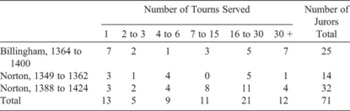
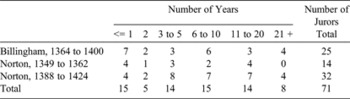
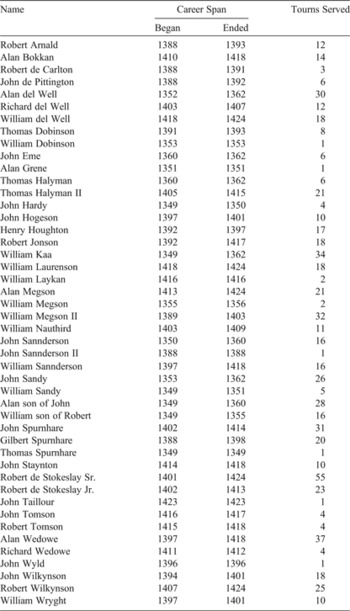
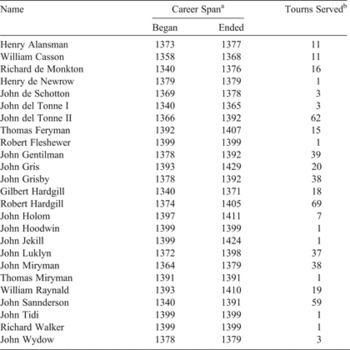
For Norton (see Appendix A), there are fourteen jurors in the first sample (1349 to 1362) and thirty-two in the later sample (1388 to 1424). The average number of tourns per juror was 14.33 (for the first period, 12.57 sessions and for the second, 15.09). The average career span, from first to last recorded court but not necessarily with continuous service, was 7.83 years (5.71 years for 1349 to 1362 and 8.75 years for 1388 to 1424). The lists from Billingham yield twenty-five jurors (Appendix B).Footnote 55 The average number of sessions per juror was 19.00 with an average career span of 9.67 years. Of these twenty-five jurors, eleven are known to have careers that began before 1364 or continued after 1400; inclusion of this extra service likely would skew rather than correct the trends in the data, as these men likely sat alongside other jurors with less service and their longer careers balanced out other jurors who sat for only a few tourns. Nonetheless, the longer careers of those men must be kept in consideration as an example of just how much and for how long some men served.Footnote 56 The distribution of service in the two villages, both in terms of overall number of sessions as well as in the span of a man's jury career, is seen in Tables 1 and 2.
Service on the Jury.

Source: TNA:PRO DURH 3/12–14 and DCM Priory Halmote Rolls, 1364 to 1400 passim.
Career Span (from first to last sitting).

Source: TNA : PRO DURH 3/12–14 and DCM Priory Halmote Rolls, 1364 to 1400 passim.
All told, the data bring the institution of the individual Durham juror into sharp focus, and three distinct types of juror are discernible. First is the temporary stand-in, who participated for a single tourn or perhaps a whole year but never again; only one-quarter of the men fall into this category. John Taillour of Norton exemplifies this type; he was added to the panel in the summer of 1423 specifically as a replacement for the absent Robert de Stokeslay.Footnote 57 Hurried co-option when a regular juror failed to show is a credible explanation for some of the other men who served for three or fewer tourns; only one man, John de Schotton of Billingham, spread his brief service out over more than three years. Alternatively, especially for those who served a single complete year, their experience may have dissuaded them from further activity. A few may not even belong in this group, only being included through the vagaries of record survival. Those who initiated their service near the end of the respective samples (five men in Billingham, one in Norton) may have had longer careers; were that the case, even fewer jurors would belong in this category.
On the other end of the spectrum are men who served frequently for or over a long period. Thirty-three (46.48 percent) of the jurors in the total sample served the equivalent of five or more years (sixteen or more tourns), and thirty-seven jurors (52.11 percent) had more than five years elapse between their first and last known appearances. It might not be too far off the mark to label these men as “professional” jurors, especially as so much work had to be done outside of the three tourns per year. They would have been well aware of village and estate dynamics, veterans of walking the fine line between obligation to lord and obligation to village. Even among these men, some stand out for their longevity; twelve men (16.90 percent) served thirty or more times, and eight (11.27 percent) had careers spanning more than twenty years.
The last group were men who were more than temporary jurors, but they did not make a career out of it; instead, their two to five years, either at once or spread out, offered a reasonable contribution towards the village and estate. This group furnished 28.17 percent of the overall sample; in Norton, 30.43 percent of the jurors were of this type, compared to only 20 percent in Billingham. Perhaps those who served for several years straight should be considered as belonging to the professional jurors, or maybe the jurors who served fewer than thirty tourns should be included here rather than as part of the professionals. Drawing a precise line between groups is both difficult and arbitrary, but the general distinctions are critically clear. The relative distribution runs counter to general assumptions that jury service was seen as burdensome and avoided when possible; here, it seems that service had its allure.Footnote 58
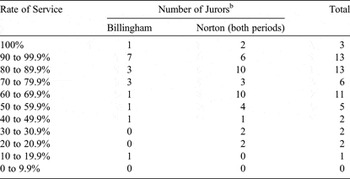
The main difference between the villages lies in the distribution of service over a man's career, as seen in Table 3. In Billingham, men were likely to serve either for only a short period or for the long term; most sat continuously, or nearly so. For example, Robert Hardgill appeared on the panel for every tourn from 1374 to 1400 for which a record survives; John Grisby served for thirty-eight and John Gentilman thirty-nine out of forty-one surviving sessions from 1378 to 1392. In Norton, there was a more even distribution of service in the years immediately following the Black Death, while later service skewed towards middle length or the long term. Concentration of activity varied, resulting in a different average career span as many of those who served longer periods had breaks in their service. Men such as Gilbert Spurnhare, William Laurenson, and William del Well sat continuously or nearly so, but others did not; one such was Alan Wedowe, who served five stints as juror (1397, 1398–1401, 1404–1409, 1412, 1416–1418). This is an extreme case, as few men served so frequently without doing so continuously, but it exemplifies the variety of the juror experience.
Rate of Service (over entire career.a)

Source: TNA:PRO DURH 3/12–14 and DCM Priory Halmote Rolls, 1364 to 1400 passim.
a Rate of service is the ratio of actual service to potential service, that is, the number of tourns a man served divided by the number of tourns for which he could have served but did not (corrected for missing or defective records). For example, William Kaa of Norton served thirty-four times and thirty-seven lists survive between his first and last appearance, so 34 ÷ 37 = 0.9189 for a service rate of 91.89%.
bOnly jurors who served more than once are included.
Although gaps in the record place limits on understanding the continuity of a man's service, it remains possible to assess the real frequency of juror activity. Table 3 displays the frequency with which a man served as juror during his overall career, excluding men who served only once to focus more directly on the regular jurors. Norton jurors were more likely to spread out their service, but looking at the overall nature of jury service, the two vills are not so different; forty-two (72.41 percent) of the jurors had a service rate of two out of three sessions or better. In Billingham, the average rate was 77.84 percent, with individual rates ranging from 10.71 to 100 percent. With Norton, the average rate was 71.59 percent, close to the rate for Billingham; for the first sample, from 1349 to 1362, the rate was 76.70 percent, while for 1388 to 1421, it was 69.65 percent. The lowest individual participation rate in Norton was 24.32 percent, and a juror in each period achieved a 100 percent service rate. Few of the regular jurors from either vill (but especially Billingham) had a participation rate of less than 50 percent; once made a juror, a man served regularly.
In both villages, some men appear to have spent much of their adult lives as jurors. In Billingham, John Sannderson served the longest, sitting fifty-nine times from 1364 to 1391 for a service rate of 75.64 percent; if he is the same as either or both of the two John Sanndersons who sat as juror in Norton, then the total number of sittings could rise to seventy-six. Of course, as a John Sannderson sat as juror in Billingham in 1340 and 1358, there could be two, three, or even four different men; even so, it suggests that we are still dealing with one family.Footnote 59 Furthermore, it is not impossible that a man could have served for such a long period, and the priory convened special juries with men aged sixty or more to determine specific questions.Footnote 60 That a single John Sannderson sat on the Billingham jury for what must have been nearly the whole of his adult life cannot be ruled out; even if these were two men, the other John Sannderson served for at least thirty-four years, providing a strong example of de facto hereditary membership.Footnote 61 Several men on both estates had long careers. Other long-serving Billingham jurors include John Luklyn, Robert Hardgill, and John del Tonne II (twenty-seven years each) and John del Tonne I (twenty-six years).Footnote 62 In Norton, Robert de Stokeslay Sr. served fifty-five times over twenty-four years, and Alan Wedowe served thirty-six times over twenty-two years. The lack of clear data about inheritance precludes certainty that these were individuals, but anecdotal evidence suggests that some of the men with twenty-plus-year careers were single individuals rather than a pair of men. Even if these careers represent two people (presumably one man dying or retiring and being replaced by a relative), this demonstrates a powerful familial grip on the position.
If each surname represents a family, then there were forty-one families in Norton recorded in Hatfield's Survey and a further twelve families that provided jurors, for a potential total of fifty-three families; in Billingham, fifty-nine families were listed in the 1396 rental plus two others that provided jurors, for a total of sixty-one families.Footnote 63 Not knowing how many families came and went before and after those documents were created complicates a calculation of the number of families that provided jurors as used in the analysis of the Ramsey villages.Footnote 64 Using only jurors and families listed in the respective documents, the Norton jurors represent 26.82 percent of the total families in that village and the Billingham jurors 37.29 percent. These are lower than found in four of the Ramsey Abbey villages: 51 percent (Holywell-cum-Needingworth), 47 percent (Broughton), 40 percent (Upwood), and 39 percent (Ellington).Footnote 65 The comparison between Durham and Ramsey Abbey is speculative, particularly as there is no clear method of calculating family participation for Durham; furthermore, as those Durham numbers are based only on jurors and tenants recorded in two records, the actual number of families who provided jurors must be smaller. This is especially true for Norton, as subletting was frequent on the bishopric estate.Footnote 66 The analysis suggests that family participation was lower in Durham, which with the assumption of nontenants as part of the village population indicates the Durham halmote jury was far less representative than most if not all Ramsey villages. To what extent and whether this may be interpreted as an oligarchy remains open to question, especially since there is no real agreement on what constitutes a village oligarchy.Footnote 67 Worth further consideration on this point, however, is that these numbers (for Durham and Huntingdonshire) do not reflect the rise and fall of families—at any given time there were only five jurors on a halmote jury, and they may have come from a much smaller segment of the village population.
III. The Durham Juror
Rather than a large pool of men feeding into an office with revolving membership, the halmote jury in Durham relied on or was dominated by a small coterie who served regularly and repeatedly, and so a knowledge of these men and their position in local society is critical. The jurors hailed from the customary tenantry (both free men and neifs), not the freeholders, and so landholding and not personal status functioned as the basic determinant of jury service.Footnote 68 Most of the Billingham jurors were free; only three from this period (John Sannderson, William Newbond, and William Raynald) were neifs.Footnote 69 The number of neifs, if any, on the Norton jury is indeterminable after the mid-1350s, as the bishop ceased tracking his unfree tenants. The absence of personal freedom as a stipulation for inclusion renders landholding a superior indicator of status and power in the village, especially as some freeholders attempted to disassociate from the village community. There are constraints in ascertaining the jurors’ holdings that prevent tracing of the changes in that status over time, from scribes referring to an “entire tenure” or “certain place” to the infrequency of the inheritance of customary land directly by the son. Only two complete documents survive that provide information on the men's holdings: a priory rental from 1396 and Hatfield's Survey of the bishopric estate from the early 1380s.Footnote 70 The documents are late enough to offer a snapshot of the jurors’ economic position after some stability had been reached in the wake of the Black Death. Combined with the conveyances recorded in the halmotes, these detail clearly the place of the jurors within the village. That they held office is not enough to place them among the village sociopolitical elite, but that a combination of economic standing and service equaled membership in the elite of the village is difficult to deny.
The holdings of twenty-two Billingham jurors can be recovered from the 1396 rental or from land transfers recorded in the halmote court rolls, giving an average holding of between 25.52 and 31.14 acres (depending on how the conveyances are interpreted) or approximately a standard Durham peasant holding of thirty acres. Eleven of these jurors held thirty acres or more, with four holding sixty or more acres, while eight held less than fifteen acres. Of the fifteen jurors appearing in the rental, the average holding was 30.39 acres with a combined total of nearly 456 acres of arable and pasture lands, plus other tenancies; that is, just over 20 percent of the tenants held more than two-thirds of the land.Footnote 71 The jurors serving at the time of the rental (Robert Hardgill, John Luklyn, William Raynald, Thomas Feryman, and John Gris) together held a third of the land associated with the village (just over 206 acres plus unmeasured tenures), and, courtesy of Robert Hardgill, a house by the manor gate, the common oven, the garden of the grange, and the manerium of Billingham itself.Footnote 72 Some of these men even participated in leasing the parish mills, as when John Sannderson, Robert Hardgill, and Thomas Robson leased the mills from 1379 to 1382 at £19 per annumFootnote 73
The holdings of thirty-five Norton jurors can be determined with Hatfield's Survey or the halmote books. The average holding was just over forty-five acres, half again as much as in Billingham.Footnote 74 Twenty-nine jurors had lands totaling thirty or more acres, with thirteen holding sixty or more, twice the standard customary holding. None had fewer than fifteen acres, or one bovate, at the height of their holdings. For the holdings of jurors derived from the halmote books, the acreages again should be treated as underestimates, based on recording practices. Eleven jurors are recorded in Hatfield's Survey.Footnote 75 At the time, these men held 642 acres, more than a third of the land in Norton, and averaging nearly sixty acres apiece.Footnote 76 Nine of them held thirty acres or more. The largest landholder of the group was Gilbert Spurnhare, who in addition to his six bovates held sixteen cottages and an associated sixty-one acres, possibly marking him as a landlord as well as a tenant. The smallest landholder of the eleven at the time, Thomas Halyman II, held only a cottage and three roods; however, by his death in 1416 he had accumulated over sixty acres.Footnote 77
These men were among the wealthiest of the customary tenants in terms of land, which often translated into their leasing “seignorial” holdings such as orchards and granges or the local mills. Individually, a Durham juror was not necessarily the biggest landowner in a village, and the men with the most land or most wealth did not always sit on the jury. Nevertheless, the jurors collectively would have been influential. This was even more pronounced in Billingham, where relatively more land was concentrated into fewer hands than in Norton. As prominent landholders in the village, the jurors wielded substantial social and economic power. They would have been foremost in determining agricultural bylaws. By virtue of their holdings, they could pasture more animals and employ more servants and laborers, possibly drawn from the less well endowed families in the vill. The natural question, unanswerable here, is whether their economic position determined or resulted from their jurorship.
It is tempting to employ the data on the halmote jurors to sort out the social structure of the village, but this implies a hierarchy that may not have existed. It is a slippery slope from this to conflation of political and economic status, and it would be presumptuous to assume any correlation between landholding and length of service. Some men who were jurors only once held as much or more land than career jurors. The office could give a man an edge in village and estate affairs, but it demanded considerable time, because gathering the information a juror needed in court required a good amount of activity outside the court. Perhaps the majority of jurors served a spell for any perks they might receive; or maybe out of a sense of community service, as there always have been men (and women) who shouldered communal burdens out of a sense of obligation. It may well have been that the ability to point to some service to the village was worthwhile or advantageous. Still, only those truly dedicated, interested, talented, or greedy and power hungry would seek to hold the office for longer.
Examining the panels from year to year and considering the jurors as a group reveals more about the relation of jury and village. Ultimately, although individual egos could shape events, there always were three to four other men on the jury to augment or quell those individual initiatives. The jury as an institution remained stable in the late medieval period, but there are interesting patterns in service. In both villages, juries seemed to shift every five or so years, and occasionally there would be a period of relatively high turnover sandwiched between stretches of stability. The transitions must have been smooth; juries were not reassembled from scratch on a yearly basis, and the incremental replacement of men provided valuable institutional continuity. Furthermore, a core of several men remained on the jury for a decade or more while their colleagues changed around them, hinting at a jury within the jury. For example, in Billingham, from 1364 to 1368, John Sannderson, Gilbert Hardgill, John del Tonne II, John Miryman, and William Casson were the jurors; after some shifts in 1368–1370, in 1371 that group returned but with Richard de Monkton replacing William Casson. John Luklyn took Gilbert Hardgill's place on the latter's retirement or death in 1371. Jumping forward to 1376, Gilbert Hardgill's son Robert joined the panel during a period of some instability. From 1380 to 1391, equilibrium was regained under the direction of John Sannderson, John del Tonne II, John Grisby, John Gentilman, Robert Hardgill and, occasionally, John Luklyn. The early 1390s were a period of increasing mortality, but three of the four men (including John Luklyn again) who joined Robert Hardgill as jurors in 1393 finished out the century with him.Footnote 78
In Norton, the pattern of stability then turnover was more pronounced, as might be guessed from the higher family participation. The period from 1349 to 1362 was surprisingly stable with little change in the men filling the office, which is remarkable given the events of the period.Footnote 79 From 1391 to 1397 there was stability, chiefly near the end of that period when three men served together for seventeen tourns, switching out the other jurors only once. The years 1397 to 1401 once again saw stable panels; there was some shifting, six men including two from the earlier jury served on most panels, although not always together. The period of 1401 to 1404 was unsettled, followed by five years of stable juries and then another period of turnover, with a panel serving only one or two years together. Then in 1418, Robert Wilkynson, Robert de Stokeslay Sr., William del Well, Alan Megson, and William Laurenson formed a panel that sat together until 1424; and perhaps beyond, because although no court books survive for 1424 to 1438, a Robert Wilkinson and Alan Megson were jurors in 1438.Footnote 80
As in Billingham, there appears to have been an inner circle, and it was not uncommon for a trio of jurors to serve five to ten years together even though their copanelists came and went. Consider these groupings: Alan Johnson, Alan del Well, William Kaa, and John Sandy served together as a group nineteen times. However, looking at them as a panel of four hides connections within the group over a broader period: del Well, Kaa, and Sandy served twenty-five times together; Johnson, del Well, and Kaa worked together for twenty-three tourns; and the duo of del Well and Kaa were jurors twenty-nine times together. This reveals how service overlapped, as men with experience worked alongside men gaining experience. This practice of a slowly changing nucleus supplemented by journeymen ensured continuity and stability in practice and custom, but it may have created an elite within an elite.Footnote 81 The dense web of interconnections suggests a closed body with limited, controlled membership with an existing panel co-opting a new man when necessary.
IV. Implications: The Jury and the Village Community
Despite belonging to different lordships, the experience of the jury in the two villages is overwhelmingly similar. The temporary, journeyman, and career jurors, the patterns of individual service, the social and tenurial background, and the slowly changing core of three or four men forms a general pattern. The only substantial difference arises in the scope of participation as measured in surnames. Among other things, this could reflect a different balance between tenants and nontenants that skews the family participation rate, or different sociopolitical dynamics within the two villages. In either case, this difference should not obscure the broad similarities in the halmote jury and jurors.
When assembled side by side, the patterns in the data—of individual juror, whole juries, and groups of jurors within multiple juries—point to the concentration of the jury in the hands of a few men, flatly contradicting the experience of the Ramsey villages of Upwood, Ellington, King's Ripton, and, to some extent, Broughton. This surely reflected or influenced social, economic, and political dynamics within the Durham village itself, and so the question of the relationship of the Durham halmote jury and its jurors to the broader village community must be considered. Did the jury represent the village to the lord, acting as a voice and drawing upon a wide pool of potential jurors, or was it more a tool of a narrow village oligarchy that served its own interests first and those of other villagers when expedient?
It is possible that the village trusted these men exceedingly and repeatedly returned them to power. Perhaps a desire for stability in these troubled times resulted in low turnover, with the villagers preferring a small, experienced cadre to handle village matters and negotiate with the lord. If the lords and the officers of the estates had any say in the choice of jurors, then they too embraced stability and the familiarity of working with the same men again and again. Such an arrangement need not be perfect, but merely functional: an adequate and discordant system that remained acceptable to lords and villagers.
While such a scenario is plausible, the officeholding, tenurial, and population data combined instead point to an oligarchy firmly in control of the village; if selection was more democratic, there should have been more frequent changes of personnel and a larger collection of officeholders. This holds true especially for Billingham, where fewer men and families served on the jury even though the tenant population was slightly larger than in Norton. Moreover, these were juries of four and five men, not twelve or twenty-four; and considering that jurors or ex-jurors could be found occupying other village offices, this was a significant concentration of power. This is all the more impressive when considering the potential subtenants, servants, associates, and other supporters; Gilbert Spurnhare of Norton alone could have mustered more than a dozen subtenants if he let out all of his cottages. At any give time, the affairs for each village were in the hands of a small group of men drawn from a small group of families, who held substantial tracts of customary land.
If an oligarchy controlled membership on the jury, which the absence of elections and progression of service suggests, then the only control that villagers and lords had on the jury would be through persuasion or coercion; lack of a vote did not translate into lack of influence. The evidence of social and political conflict in the villages supports such an assertion. One clear example comes from the bishopric estate during the feudal reaction of Bishop Hatfield. Richard Britnell concluded that the bishop's tenants were quite willing to collaborate with their lord, especially in deciding who would be forced to work vacant lands. The bishop's steward relied on the jury to inform him of who was capable of handling extra lands, and thus the jury worked together with the lord to solve a common problem by adding fresh burdens to their neighbors.Footnote 82 Some years later, as resistance to Hatfield's policies intensified, the bishopric peasants pressured and intimidated their leaders, including the jury, to turn against the bishop.Footnote 83 Six men dominated the panel of Norton in these years, with another three men serving from two to five times each. The personnel of the jury remained the same, but their policy changed as they were threatened, cursed, and perhaps even attacked (as happened in other villages) by their fellow villagers. Moreover, if the jury was appointed through collusion among a small group of tenants, the villagers’ wishes could have influenced their choices of who should remain or join the jury.
Lords also had little power to change the jury, and had less success with intimidation; jurors were fined for concealments and false presentments, but continued to serve. After Bishop Hatfield punished his officers and appointed a new steward, the juries continued to be recalcitrant, refusing repeatedly to provide lists of tenants.Footnote 84 On both estates, jurors as well as ordinary villagers ignored orders regarding tenures and services. Without the assistance of the jury, the effective power of the priory's officers decreased. Commands were reiterated constantly, with few results; when even a juror refused to comply with an order, what could be done about the other villagers? Take for example John Luklyn, a juror thirty-seven times in Billingham between 1372 and 1398. He was hounded until 1399 to repair his dilapidated tenure, a problem common on the estate and elsewhere in England. Despite multiple fines that climbed to half a mark (often reduced to sixpence and perhaps never collected at all), the repairs still were not made, making Luklyn's obduracy exceptional due to its scale and duration.Footnote 85 Perhaps Luklyn's resistance was strengthened or made possible by his position, but the priory was either unable or unwilling to bring him to heel.Footnote 86 As much of a problem as some jurors could be, from accruing penalties to sparking violence within the village, removal from the jury does not appear to have been an option.
For the lords, powerful jurors could be an asset as well as a thorn in their side.Footnote 87 As the bishopric and priory officials came to terms with the changed demographic and economic circumstances and further distanced themselves from the world of the peasantry, a strong jury and village oligarchy allowed some measure of control. The estate officials could develop a stable relationship with the jury by working with the same men repeatedly; the jury's management of information could provide valuable income through fines and amercements, and their land holdings made them valuable tenants and rent payers. Although direct evidence is lacking, it would not be amiss to speculate that the jurors profited from their position. Aside from collusion, resistance simply was not the first option for either jurors or the villagers. Britnell outlined three responses to Bishop Hatfield's program: obedience and confirmation of the bishop's authority; resistance and flight; and a middle way employing compromise.Footnote 88 Different villagers took different tacks, but the jurors throughout this period frequently worked with the lord and vice versa. Officials on both estates had to be wary when dealing with the jury, but often the relationship was in the lord's favor; the institution of the halmote necessitated this.
The villagers may not have been as sanguine regarding the concentration of power. The jurors were in a position to manipulate the village through presentment and enforcement, as well as through the establishment of bylaws.Footnote 89 This state of affairs, so vastly different from that articulated for the Ramsey villages, could have had a darker side; small groups of families have ruled through a combination of support and fear in other times and places. Through control of information, landholding, and partnership with the lord, a village jury could have a powerful grip on local society, leaving others with little recourse. Men and women outside of patron-client networks may have had little succor. Migration was an option, but it may have meant trading one tyranny for another, possibly even at the hands of the same men as it seems that some men (or their relatives) served on juries in other villages. Although unpalatable, the possibility that consent and cooperation were obtained through fear and intimidation cannot be overlooked; for many peasants, their already hard life may have been made harder still.
Numerous factors limited the potential for such abuse, however. An important factor that is difficult to interpret but should not be underestimated is the challenge of enforcement, a major problem on both estates. Control of the jury was not the same as control of the village; even if the jurors had wished to dominate the village, they could not command obedience and often were ignored and insulted. Their authority, even if backed up by the lord, was limited. Moreover, the jurors were not above law and custom; they were not immune from amercement, and many were defeated in their own litigation.Footnote 90 Within the jury itself, their solidarity was a fragile thing, and conflicts between jurors occur regularly in the business of court. One of the more extreme examples comes from Billingham where, after years of conflict, priory officials forced jurors Robert Hardgill and Thomas Miryman to find sureties at £20 each to keep the peace and to keep their associates in line as well.Footnote 91 In relation to the village, custom and morality could play a role, and a sense of duty or obligation could encourage restraint. By far the greatest check on the power of the jury was the social network of the juror himself: these were his neighbors, friends, relatives, tenants, and servants. If sentimentality were not sufficient, self-interest could be, as the interconnected nature of the late medieval village was not conducive to radical modes of individuality. On the priory estate there is evidence of a developing patron-client system; although the jurors might try to use bylaws for their own benefit, they would have had to protect their dependents or patrons as well, and if the jurors belonged to different networks, find a consensus or exchange favors.Footnote 92 Although not necessarily the voice of the village, the jurors were still a part of the community, and they could both represent and control. Monopoly does not require constant conflict between different strata within the village, especially in the presence of external pressures such as land shortage or seignorial exploitation.Footnote 93 Britnell elucidated how the bishopric communities shifted from internecine struggles over land and runaways to strong solidarity in the face of seignorial exactions.Footnote 94 The jurors shifted with the changing winds, from willing collaborators to leaders of the people in the battle against oppression. Surely such flexibility operated in other contexts as well.
Conclusions
The Durham halmote jury cannot necessarily be treated as a reflection of the village, but it should be seen as an institution in and of itself. Its size and the frequent inclusion of the reeve suggest the continuation of an older practice of village representation, consistent with other peculiarities in the procedures and competence of the halmote court itself. Together with the existence of only a single jury that served all normal functions in the court, this concentrated power at any one time into the hands of a few men. The patterns in membership on the jury show that this power was further concentrated among only a few individuals from the village, whose long careers resulted in a slow turnover of membership rather than replacement on a yearly basis. All this does not rule out a representative jury in the pattern of the Ramsey Abbey villages, but it strongly implies the presence of a village oligarchy or Homans's “aristocracy of jurymen.”Footnote 95 Of course, power and control do not automatically result in substantial conflict; thus, assuming an antagonistic relationship is uncalled for, but the potential for coercion cannot be dismissed. The institution of the Durham jury provided benefits and drawbacks for both lord and villagers, but in the end, both had little choice but to rely upon the halmote jury; there simply were no alternatives. The halmote jury was a flexible tool dependent on contemporary events and the personalities of the jurors, yet a powerful oligarchy apparently insulated to a great degree from village and seignorial pressure cannot but have had a profound influence on the social, economic, and political fabric of the village and estate in late medieval Durham.
Did Durham's unique history as an ecclesiastical palatinate shape its halmote juries to a significant degree? Certainly, the structure and powers of the halmote jury itself may have varied from local juries elsewhere, but the situation in Durham was not necessarily atypical. The number of jurors may not be as significant as it would appear; rather, the customs and politics that lay behind the pattern of officeholding—notably the slow turnover in jurors—were the more important factors, and these could be replicated easily outside the palatinate. That Durham halmote juries had only five or so jurors may have made monopolization easier, but a jury of twelve could be monopolized, too, while greater demand to hold the few offices could have led to higher turnover. The situation in Durham is not necessarily typical or unique, but it serves as an option alongside the rather different institution(s) of the jury in the Ramsey Abbey villages. If anything, the patterns of service of the Durham halmote jurors and the implications for village dynamics demonstrate the need for further study to understand how such power was wielded and the effects on rural life, in the villages of Durham and beyond.
Norton Jurors, 1349 to 1362 and 1388 to 1424.

Source: TNA:PRO DURH 3/12–3/14.
Billingham Jurors, 1364 to 1400.

Source: DCM Priory Halmote Rolls, 1340 to 1439 passim.
aService outside of the period is given, where known.
bNot including service outside of 1364 to 1400.