Introduction
Saudi English (also called ‘Arabicised-English’ by Al-Shurafa, Reference Al-Shurafa2009) is probably one of the least studied varieties among the ‘New Englishes’. This paper aims to provide an introduction to the main syntactic features of the variety. In order to do this I will use the list of features discernible in varieties of English world-wide as ascertained by two scholars working actively on the typology of the different Englishes, Kortmann & Szmrecsanyi (Reference Kortmann, Szmrecsanyi, Kortmann, Burridge, Mesthrie and Schneider2004). They use the term ‘angloversals’ for recurrent non-standard features widely found in English across the globe. This paper investigates three such ‘angloversal’ features which I believe to be widespread in Saudi Arabia: (a) #57: deletion of be; (b) #17: irregular use of articles; and (c) #53: invariant present tense forms due to zero marking for the third person singular (Kortmann & Szmrecsanyi Reference Kortmann, Szmrecsanyi, Kortmann, Burridge, Mesthrie and Schneider2004: 1146–7). This article also aims to study the effects of the Arabic substrate on the variety of English spoken in Saudi Arabia. The occurrence of the features is investigated among different strata in the society.
In his model of the three circles of English Braj Kachru (Reference Kachru1988: 5) placed Saudi Arabia in the ‘Expanding Circle’, since in his view Saudi English has not developed independent internal norms and relies, rather, on external norms.
Expanding Circle (Mesthrie & Bhatt, 2008; adapted from Kachru, Reference Kachru1988: 5).

Part of the ‘Expanding Circle Englishes’ (Kachru, Reference Kachru1988: 5), or EFLs (Mesthrie & Bhatt, Reference Mesthrie and Bhatt2008: 29), English in Saudi Arabia has administrative and public roles without the country having experienced formal colonization. Although English has no recognized official status in government, it has significant functions in domains such as the media, education and professional spheres. It also functions as a medium of communication with foreigners. English is taught as a foreign language; and is in fact the most important and most common foreign language in the country. Due to its liturgical status in Islam, Saudi Arabia receives over 2 million pilgrims yearly from around the globe. English is a lingua franca used to communicate with this mass of international visitors (UNESCO IBE, 2007). According to the census of 2004, of a population of over 27 million, more than 8 million are non-nationals, made up of Arabs as well as non-Arabs. English is the common language used to communicate with the non-Arabs. The non-Arab English speakers from India, the Philippines and others have a crucial role in Saudi society in which almost each Saudi family has two (foreign) workers: a babysitter and a driver. Since not all domestic workers are English speakers, Saudi families show a preference for workers from the Philippines because they speak English. The English introduced in the home in this way has a clear impact on both children and adults. Upper-class and educated middle-class families are proud of raising bilingual children in such a way that English is as important as Arabic (Al-Shurafa, Reference Al-Shurafa2010). At a more public level, English has become a requirement for job opportunities. The private sector and some governmental sectors require writing and speaking skills. Sectors like product management, sales, data analysis and secretarial tasks all require a good command of the English language. The increasing market need for English professionals has its influence on the Saudi education system as it becomes a necessity to produce graduates in English. The school is another important site for the growth of Saudi English, as English is increasingly taught not just as a foreign language and cultural and literary subject, but to satisfy the demands of the job market. Insufficient input from Standard English of the UK and US and the predominance of locally qualified English teachers have led to the social acceptance of the local communicative, pragmatic and pedagogic competence.
A local Saudi English with certain indigenous features has arisen, reflecting the Saudi culture. As Mesthrie & Bhatt (Reference Mesthrie and Bhatt2008: 10–11) note, there is cultural and linguistic continuity between a second language variety and indigenous languages. The new English has to blend into its surroundings. This paper aims to demonstrate this for the syntactic features outlined above and argues for substrate–superstrate interaction in determining the grammar of these features, i.e. the give and take between English as target language and Arabic as the speaker's L1. The variable presence of features often reflects a grammar that shares properties of both the mother tongue (i.e. Arabic) and Standard English. The substrate effect, as noted by Sharma (Reference Sharma2009), is more evident among ‘basilectal’ speakers – in this context people with not much formal education or exposure to standard English, but who nevertheless have occasion to use the language for work purposes.
Data
The data comes from 56 bilingual Saudis aged between 17 and 50 years, of equal numbers of males and females with three levels of education. The speakers in the sample were all born and raised in Saudi Arabia. Two kinds of data were collected: (a) recordings of spontaneous speech, and (b) interviews. The recorded data is based on 16 well-educated and professional speakers between the ages of 30 to 50 years. There were three categories of recorded data: conversations in business meetings (6 speakers), chat-shows from a Saudi TV English channel (5 speakers) and classes in government schools (with a focus on 5 English teachers). The business meetings involved 6 employees of a multinational company where English is the medium of administration and transactions. The participants were fluent in both English and Arabic and had working experience of between 5 and 15 years. They are well-educated, with bachelor's and master's degrees in the following fields: engineering, accounting and business administration. Permission to use the recorded material in an anonymous fashion was obtained from them. The recording material includes 3 business meetings that vary in length from approximately 1 to 2 hours each, representing a total of approximately 5 hours. The second set comprised 5 speakers interviewed on a Saudi TV English channel: three doctors, one government employee and one cook. Each recorded speech lasted 10 to 30 minutes, totalling approximately 2 hours of collected material. The third set involved 5 English teachers in governmental schools of different levels: two high schools and three intermediate schools. All the teachers were brought up in Saudi Arabia and acquired their English locally. The recorded data consists of five one-hour lessons. The recorded data collected from all three sets are written down in a Word document. The resultant corpus consists of over 15,000 words.
The second kind of data was interviews with two groups. The first group was 20 high school graduates who have not had English-medium school education but have had English as a school subject. Their ages range between 17 and 20 years. The second group was 20 male and female university graduates in their final year who had completed six levels of English-medium education. The age range is 23–29 years. Each interview lasted 10 minutes, producing on average 300 words. This yield may seem rather low, but is a reflection of the EFL context. The main topics discussed by the speakers were: an unusual incident or experience, a likable personality and an interesting topic they wrote an essay about in any course. The interviews were tape-recorded and fully transcribed. The total number of collected data is 12,000 words. The speaker sample of both kinds of data is shown in table 1.
Structure of the sample of speakers

Prominent in both sources of the data are three of what Kortmann and Szmrecsanyi (Reference Kortmann, Szmrecsanyi, Kortmann, Burridge, Mesthrie and Schneider2004: 1146–7) called ‘candidates for universals of new Englishes’, cited in the previous section. I found it necessary to break up their feature ‘irregular use of articles’ into two, viz. (i) definite article insertion and (ii) indefinite article omission. Percentages of these features in the database are given in table 2.
Percentage overview of occurrence of four salient syntactic features

I now turn to each feature in turn.
Deletion of be
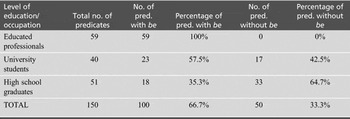
Table 3 shows the number of predicates with be and those in which be is expected in Standard English, but did not appear in the data base. Note that I have drawn no distinction between be as a strict copula (before adjectives and nouns) and auxiliary be (before Verb + -ing).
Speaker production of copular and auxiliary be in number and percentage

Table 3 suggests that copula-deletion is not a compulsory feature, rather variability of the copula is a feature of Saudi English. The above table shows a rate of 66.7% of be-realization and 33.3% of be-deletion. Educated professionals, on the other hand, show no tendency to drop the copula, as exemplified in (1). The tendency to drop the present tense copular verb occurs among less educated Saudi speakers, as exemplified in (2).
(1)
a. The course is an ongoing thing.
b. I agree that the symposium preparation is more important.
c. I am ready to discuss any points you have this week.
d. We are going into assigning a specialized firm to conduct the exercise of reengineering TSM.
(2)
a. They … not able to hear anyone.
b. They … planning to keep it a secret.
c. Public parks … the most important places in the city.
d. That … what our religion taught us to do.
e. My country … Saudi Arabia
f. My daughter, Sara, … sick.
Comparable sentences to (2) are produced by the same (lesser educated) interlocutors showing 100% phonetically realized copulas in past tense usage:
(3)
a. I was never interested in sports.
b. When my daughter was a toddler, she was insisting on having a pet.
c. Whenever I am free, I go to the gym.
d. Kuala Lumpur, London and Orlando were the most enjoyable cities I visited.
e. My father was extremely ill.
f. Be a positive person.
Beside the level of education, the realization of the copula is affected by substrate influence. Note that the 10 sentences in example sets (1) and (2) only show zero copula occurring in the present tense; a similar phenomenon is found in Arabic. In Arabic, a zero copula is used to indicate the present tense whether in its strict usage (before adjectives and nouns) or as auxiliary (before V), unlike the fully realized past tense copula.
Definite article insertion
The data show a tendency among less educated Saudi speakers to insert the definite article the in contexts where Standard English does not use it.
Speaker production of definite articles

In non-standard speech, Saudis tend to insert the definite article the, as shown by the examples below:
(4)
a. I prefer the fish.
b. The children are better when it comes to language learning.
c. I can understand the Tagalog as I visited the Philippines.
d. It was so difficult when all my children were affected by the measles.
e. I graduated from the school three years ago.
f. We took him to the Fakeeh hospital that is located in the Palestine Street.
g. The Thursday is the best day of the week, and the Hajj is the most spiritual month in the year.
h. The Hajj Eid is the occasion that the whole family is waiting for.
i. When it comes to football, my father is good in the playing.
j. From my opinion, the King Abdullah has the most effective personality.
k. Wait where you are; I'll come out to you immediately in the car.
The definite article the in Saudi English seems to have additional functions beside its function as a definite marker. These additional functions are demonstrated in the Saudi system (see Mesthrie & Bhatt, Reference Mesthrie and Bhatt2008: 51 for more details about the full list of functions that a New English can have in its non-standard system):
(i) Non-count abstract nouns and concrete mass nouns – e.g. the fish in (4a)
(ii) Plural count noun with generic reference – e. g. the children in (4b)
(iii) Names of languages, cities and countries – e.g. the Tagalog in (4c)
(iv) Names of diseases and ailments – e.g. the measles in (4d)
(v) Names of social and domestic institutions – e.g. the school in (4e)
(vi) Names of geographical areas, public institutions, buildings and streets – e.g. the Fakeeh hospital, and the Palestine Street in (4f)
(vii) Terms of parts of the day, week or year – e. g. the Thursday, and the Hajj in (4g)
(viii) Names of festive days and seasons – e.g. the Hajj Eid in (4h)
(ix) Expressions involving the –ing form of verbs used to refer to trades, professional or general activities as quasi NPs or gerunds – e.g. the playing in (4i)
(x) Names of persons when qualified by an adjective or a title – e.g. the King Abdullah in (4j)
(xi) References to means of transport – e.g. the car in (4k)
Here too the grammar of the substrate has an effect on Saudi English. In Arabic, ʔal- ‘the’ has four functions, indicated by El-Dahdah (Reference El-Dahdah1993: 100–1), Abdulhameed (Reference Abdulhameed2000: 135–6) and others:
(i) ʔal- for definiteness, introducing referential nouns that are known to both the speaker and hearer as in (12a).
(ii) ʔal- for generic interpretation as in (12b).
(iii) a relative ʔal- as in (12c).
(iv) a default ‘augmentative’ ʔal- introducing some proper nouns: names of persons (e.g. ʔal-faruːq), cities (e.g. ʔal-qaːhira ‘Cairo’), days (e.g. ʔal-ʔarbiʕaːʔ ‘Wednesday’),
These are exemplified in (5a) to (5d), respectively:
(5)
a. ʔaʕjaba-niː ʔal-faːʔizu
astonished-me the winner-NOM
‘The winner astonished me’
b. ʔal-ħuːt min ʔal-θadiyyat
the-whale from the-mammals
‘The whale is a mammal’
c. haːðaː hwa ʔal- tˠaːlibu
this he the-student-NOM
ʔal-qaːriʔu dars-a-hu
the-read.he-NOM lesson-ACC.his
‘This is the student, who read his lesson’
d. sa-ʔa-ðhab ʔila ʔal-madiːna
will-I-goto the-Madina
ʔal-χamiːsa ʔal-muqbila the-Thursday the-next
‘I will go to Almadina next Thursday’
In assessing whether there is a stable non-standard system for definite articles in Saudi English, we need to consider the frequencies shown in table 2. All speakers show some degree of definite article insertion. However, the table shows a less frequent usage of insertion among well educated professionals, in keeping with the trends in table 1. The reason for the more standard usage within this group has to do with regular use of English with native speakers of English from the UK or US. The high percentages of insertion for the groups of university students and high school graduates suggests that presence of the is the default at some level of second language acquisition, expressing a range of grammatical functions wider than that of standard English. Further progress in language acquisition involves learning to delete the definite article in certain contexts. A longitudinal study of some learners is a desideratum to demonstrate this hypothesized route of learning.
Indefinite article omission
A related syntactic feature of Saudi English is the dropping of the article a(n) in noun phrases, which are [indefinite] and [singular]. The a(n) drop takes place among speakers of all levels of education on a roughly 50-50 basis:
Speaker production of the indefinite article

The following examples are produced by the Saudi speakers:
(6)
a. When I grew older, I want to be … doctor.
b. I am facing … difficulty solving the problem.
c. It took me … long time to solve it.
d. Sara is … beautiful girl.
e. There is … person who has changed my life.
f. Jeddah is … clean place to live in.
The omission of the indefinite article in Saudi English also seems to show a substrate effect of the Arabic language. The zero article functions the same way as the zero article in Arabic. The zero article in Arabic is an [indefinite] marker:
(7)
a. ʔab-i tˠabiːbun
father-my-NOM doctor-NOM
‘My father is a doctor’
b. ʔaχaða-t minniː waqtan took-FEM from-me time-ACC
tˠwiːlun li-ħali-ha
long-ACC for-solve-it
‘It took me a long time to solve it’
The Saudi speaker, then, relies on his/her L1 system in which the lack of an article indicates indefiniteness.
Deletion of the third person singular -s
Deleting the third person singular –s is a further feature characterizing Saudi English. The number and percentages of the third person present verbs without the –s inflection are indicated in table 6. This time there is no difference between the three groups, which all hover just above a 50% rate of absence of –s.
Speaker production of present tense verbs

Example set (8) gives some relevant data:
(8)
a. My father always teach me how to discover my capabilities.
b. He believe in my skills.
c. She give me advices.
d. I like my daughter, Sara, when she sleep.
e. They don't concentrate when the teacher explain a new idea.
Accounting for the Arabic substrate effect, Arabic verbal sentences show a default third person singular morpheme on the verb:
(9)
a. ya-ðhab-uʔal-tˠaːlibu
3.PRES.MASC-go-SG the-student-NOM
ʔila ʔal-madrasati
to the-school-GEN
‘The student goes to school’
b. ya-ðhab-uʔal-tˠullaːbu
3.PRES.MASC-go-SG the-students-NOM
ʔila ʔal-madrasati
to the-school-GEN
‘The students go to school’
A third person singular marker (ya-…-u) appears on the verb irrespective of whether the subject is singular or plural, and the Arabic third person singular is therefore not comparable to the English –s morpheme. For there to be substrate influence on Saudi English we would expect the presence of –s with any subject NP, singular or plural. Hence the absence of –s should be explained by other factors than the speakers' first language. It is also not clear why the three groups identified by education and professional experience show the same rates of –s absence. This is a matter for future research.
Conclusion
This article has given a brief syntactic overview of the main features of an Expanding Circle English. The four features show different frequencies among speakers of the three levels of education. Both be-omission and the-insertion are infrequent among educated professionals, whereas both a(n)-omission, and verbal –s-omission have equal frequencies among all levels. I have argued that be-omission, the-insertion, and a(n)-omission are heavily influenced by the substrate Arabic language, but not verbal –s-omission. It is hoped that these observations will stimulate further acquisitional and educational research in the future.■
 MAATHER AL-RAWI is an assistant professor at King Abdulaziz University in Jeddah/Saudi Arabia, where she currently teaches Applied Linguistics and Syntax in the European Languages Department. She has a BA in English from the King Abdulaziz University and an MA and PhD in linguistics from the University of Leeds, UK. Her main areas of interest are the syntax of Arabic, English as a global language, and endangered languages in the Arabian Peninsula. Email: mmalrawi@kau.edu.sa