Introduction
Peritonsillar abscess is one of the most common deep neck space infections. Peritonsillar abscesses form pus lateral to the tonsil, and are typically located between the capsule of the palatine tonsil and the superior constrictor muscle of the pharynx.Reference Johnson, Stewart and Wright1 The development of antibiotics and early intervention for acute tonsillitis has diminished the incidence of peritonsillar abscess; however, this condition still represents a significant resource cost to laryngology departments.Reference Herzon and Harris2
While most peritonsillar abscesses resolve with simple medical and surgical management, inadequate peritonsillar abscess treatment may result in potentially life-threatening complications.Reference Petruzzelli and Johnson3 The most effective ways to prevent an abscess from spreading are needle aspiration, or incision and drainage, which have success rates of nearly 90 per cent.Reference Herzon and Harris2 Generally, adequate drainage and antibiotics can improve the condition of most patients.Reference Petruzzelli and Johnson3 However, in a recent study on the changing characteristics of peritonsillar abscess, 11 per cent of patients with peritonsillar abscess had more than one recurrence.Reference Marom, Cinamon, Itskoviz and Roth4 Most of these patients eventually have to undergo a delayed tonsillectomy. Thus, interval tonsillectomy or quinsy tonsillectomy are indicated in patients with a high risk of recurrent peritonsillar abscess.
According to a recent review, the recurrence rate of peritonsillar abscess varies from 9 to 22 per cent, and a prior history of recurrent tonsillitis and age of less than 40 years are known risk factors for recurrence.Reference Powell and Wilson5 However, most of the studies had a retrospective cohort design that did not cover follow-up periods, or were case-series reports.Reference Wolf, Even-Chen, Talmi and Kronenberg6–Reference Harris9 Therefore, additional high-quality evidence for predictors of recurrence could lead to better-informed treatment decisions regarding tonsillectomy.
We sought to identify the recurrence rate of peritonsillar abscess and to determine risk factors for recurrence. This was achieved by monitoring peritonsillar abscess patients (hospitalised in our department) during follow up.
Materials and methods
This study proceeded following approval by the institutional review board of the hospital.
Patients
We conducted a retrospective chart review of 198 consecutive peritonsillar abscess patients treated in the Kyung Hee University Hospital from February 2006 to December 2011. Patients who underwent interval tonsillectomy (n = 26) were excluded from the study. Analyses were conducted on the remaining 172 patients.
Data collections
Demographic, clinical, laboratory, radiographic and treatment data available at the time of diagnosis and during the post-treatment follow-up period were incorporated into a database. Data for the following clinical variables were collected: age, gender, past medical history, previous history of recurrent tonsillitis or peritonsillar abscess, symptoms at onset, unilateral or bilateral abscess, and duration of hospitalisation.
On the day of hospitalisation, blood sampling was conducted to evaluate inflammatory blood markers such as white blood cell count, erythrocyte sedimentation rate and C-reactive protein. All patients agreed to undergo contrast-enhanced computed tomography (CT) scanning on the day of admission (conducted using a GE 9800 scanner (GE Medical Systems, Milwaukee, Wisconsin, USA)) to assess the extent of the abscess. Non-ionic iodinated contrast agent (Ultravist1; Schering, Berlin, Germany) was administrated intravenously (a total of 100 ml, at a rate of 2 ml/second) and the CT slice thickness was set at 5 mm.
Recurrent tonsillitis was defined as recurrent acute episodes of tonsillitis (a minimum of five episodes in the past year). We defined extraperitonsillar spread as an abscess extending lateral or inferior to the superior pharyngeal constrictor muscle, based on the official CT report by the radiologist. Recurrent peritonsillar abscess was defined as the recurrence of abscess formation at the same site at least two months after initial treatment.Reference Petruzzelli and Johnson3
If clinical records were incomplete or post-treatment data were ambiguous, attempts were made to contact patients (by telephone survey) to confirm a history of recurrent peritonsillar abscess (up to the last day of the study).
Diagnosis and treatment
The diagnosis of peritonsillar abscess was based on physical examination findings and the existence of abscess as revealed by aspiration or incision and drainage findings. We performed needle aspiration, using an 18-gauge needle, in the area of an expanded peritonsillar space or in the most swollen area. Aspirated pus was collected for bacterial culture and antibiotic resistance testing.
When abscess was confirmed, we conducted incision and drainage, and provided sufficient, intravenously administered fluid and antibiotics for staphylococcus and oral anaerobic bacteria. When the abscess was too small or the location was too deep for incision and drainage, only aspiration was conducted; this was followed by the administration of intravenous fluids and antibiotics.
Statistical analysis
Univariate Cox proportional hazard regression analysis was used to identify predictors of recurrence. Multivariate Cox proportional hazard models were constructed in a stepwise fashion to include variables with either clinical or statistical significance on univariate analysis. Kaplan–Meier survival curves and the log-rank test were used to evaluate the probability of recurrence. For all analyses, a p value of less than 0.05 was considered to indicate statistical significance.
Results
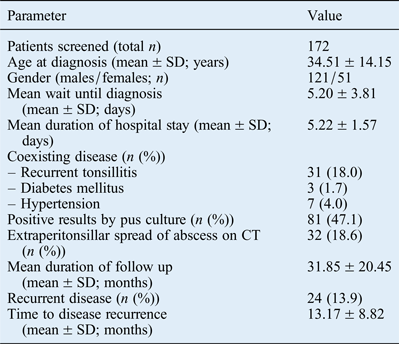
A total of 121 male patients (70 per cent) and 51 female patients (30 per cent) were included in this study. Mean patient age was 34.51 (±14.15 standard deviation) years. Thirty-one of the patients (18.0 per cent) had a history of recurrent tonsillitis, three (1.7 per cent) had a history of diabetes and seven (4.0 per cent) had a history of hypertension. The mean duration of follow up was 31.85 ± 20.45 months. According to CT scan findings, 32 patients (18.6 per cent) showed evidence of extraperitonsillar spread of the abscess (beyond the peritonsillar area). In total, 24 patients (13.9 per cent) suffered recurrence, and the mean time to recurrence was 13.17 ± 8.82 months. Patient characteristics are provided in Table I.
Patients' clinical characteristics

SD = standard deviation; CT = computed tomography
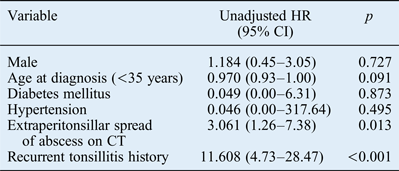
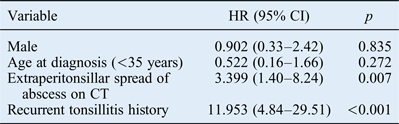
Univariate analysis indicated that extraperitonsillar spread on CT (p = 0.013; unadjusted hazard ratio = 3.061, 95 per cent confidence interval (CI) = 1.26–7.38) and a history of recurrent tonsillitis (p < 0.001; unadjusted hazard ratio = 11.608, 95 per cent CI = 4.73–28.47) were associated with peritonsillar abscess recurrence (Table II). Likewise, multivariate analysis indicated that extraperitonsillar spread (p = 0.007; hazard ratio = 3.399, 95 per cent CI = 1.40–8.24) and recurrent tonsillitis history (p < 0.001; hazard ratio = 11.953, 95 per cent CI = 4.84–29.51) were associated with peritonsillar abscess recurrence (Table III).
Univariate analysis of recurrence risk factors
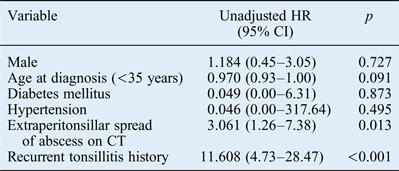
HR = hazard ratio; CI = confidential interval; CT = computed tomography
Multivariate model of recurrence risk factors
HR = hazard ratio; CI = confidential interval; CT = computed tomography
Kaplan–Meier curve analysis showed that patients with extraperitonsillar spread on CT (relative risk = 6.91; p = 0.009) and recurrent tonsillitis history (relative risk = 45.00; p < 0.001) had a high probability of developing peritonsillar abscess recurrence (Figures 1 and 2).
Kaplan–Meier curve analysis performed to compare the probability of being recurrence-free in patients with or without extraperitonsillar spread on computed tomography (relative risk = 6.91; p = 0.009).
Kaplan–Meier curve analysis performed to compare the probability of being recurrence-free in patients with or without a history of recurrent tonsillitis (relative risk = 45.00; p < 0.001).
Discussion
Peritonsillar abscess is one of the most common diseases in the field of otolaryngology. Despite the high incidence of peritonsillar abscess and the numerous publications, some aspects of the clinical management of this disease remain controversial, and there is little consensus on proper management.Reference Mehanna, Al-Bahnasawi and White10
There are many reports on the utility of needle aspiration or incision and drainage, but only the quinsy tonsillectomy or interval tonsillectomy are effective treatments for recurrent peritonsillar abscess.Reference Maharaj, Rajah and Hemsley11–Reference Nwe and Singh13 A tonsillectomy, considered a fundamental treatment for peritonsillar abscess, is effective for complete recovery and is known to reduce throat discomfort and recurrence rate.Reference Paradise, Bluestone, Colborn, Bernard, Rockette and Kurs-Lasky14 However, tonsillectomy carries the risk of serious, potentially fatal complications, and, after treatment, the patient usually faces some period of recovery. Thus, management with tonsillectomy should be preceded by strong indications.Reference Hoddeson and Gourin15 When developing an effective treatment strategy, it is important to carefully evaluate indications for tonsillectomy and to take risk factors for recurrent peritonsillar abscess into consideration.
Many studies of recurrent peritonsillar abscess have been performed, with recurrence rates varying from 9 to 22 per cent.Reference Powell and Wilson5 In a study of 290 patients treated for peritonsillar abscess, Kroenberg et al. reported that 22 per cent of patients experienced recurrences, and those aged under 40 years or with a previous history of tonsillitis were at greater risk for recurrence.Reference Kronenberg, Wolf and Leventon16 However, Wolf et al. reported an overall 5 per cent recurrence rate, and no significant relationship between peritonsillar abscess recurrence and a history of recurrent tonsillitis.Reference Wolf, Kronenberg, Kessler, Modan and Leventon17 The follow-up duration of these two retrospective cohort studies is unclear, and the authors were unable to calculate relative risks. Although it is not technically a meta-analysis, a paper by Herzon reported a peritonsillar abscess recurrence rate of 10 per cent in the USA, which is significantly different from the recurrence rate of 15 per cent reported in the rest of the world (p < 0.002).Reference Herzon and Harris2
In this study, we sought to identify risk factors for recurrent peritonsillar abscess via survival analysis using follow-up data. According to the univariate analysis, the existence of extraperitonsillar spread of the abscess on CT scan and a history of recurrent tonsillitis were statistically significant risk factors for peritonsillar abscess recurrence. Likewise, the multivariate analysis revealed that extraperitonsillar spread on CT and a history of recurrent tonsillitis were significantly related to recurrence.
In a recent report of patients' follow-up records, with follow-up duration of five years, young age and a history of previous tonsil infections were found to raise the probability of delayed tonsillectomy.Reference Wikstén, Hytönen, Pitkäranta and Blomgren18 However, for the first time, we report that extraperitonsillar spread on CT (abscess extension beyond the peritonsillar area that is lateral or inferior to the superior constrictor muscle) is an additional risk factor for peritonsillar abscess recurrence.
• In total, 172 patients who had been diagnosed and treated for peritonsillar abscess were evaluated at follow up
• Peritonsillar abscess recurred in 13.9 per cent of the patients
• Multivariate analysis indicated that extraperitonsillar spread on computed tomography (CT) and recurrent tonsillitis history were significant risk factors for recurrence
• Tonsillectomy may be indicated for treatment of peritonsillar abscess in patients with recurrent tonsillitis history or extraperitonsillar spread on CT
Stage and Bonding reported that in 2.3 per cent of 217 patients with peritonsillar abscess, the clinical picture was atypical, with inflammatory swelling of the pharyngeal wall below and behind the tonsil, oedema of the epiglottis, and a diffuse neck swelling on the side of the peritonsillar abscess.Reference Stage and Bonding19 The authors suggest that tonsillectomy is essential in such cases to ensure rapid and uncomplicated recovery. Monobe et al. argued that when the abscess is located at the inferior pole of the tonsil, the retropharyngeal space or medial parapharyngeal space could be involved.Reference Monobe, Suzuki, Nakashima, Tojima and Kaga20 In their study, abscess formation behind or inferior to the tonsil was encountered more frequently. In this respect, recognition of abscess location and extent of spread is important in patients with peritonsillar abscess.
This study is limited by the fact that patients who underwent tonsillectomy were excluded, which may have resulted in a selection bias. Our recurrence rate was 13.9 per cent; the exclusion of patients who underwent interval tonsillectomy might have raised the rate of recurrence. The retrospective design may have been another limitation. Prospective follow-up studies are necessary to identify and confirm risk factors.
Conclusion
In this study, the peritonsillar abscess recurrence rate was 13.9 per cent, and recurrence was associated with extraperitonsillar spread on CT and a history of recurrent tonsillitis. Multivariate analysis indicated that these were significant risk factors for recurrence of peritonsillar abscess. Our results suggest that tonsillectomy may be an appropriate course of treatment in peritonsillar abscess patients with extraperitonsillar spread on CT or a history of recurrent tonsillitis.