Introduction
Nutritional adversity is a public health problem that affects a significant part of the world population. 1 In addition, adverse conditions such as dietary restriction or malnutrition, during early life can impair health, causing metabolic and cardiovascular disturbance in adulthood. Reference Larson-Nath and Goday2–Reference Thornburg, O'Tierney and Louey5
Protein restriction during early life, for example during intrauterine development, can cause fetal growth restriction, increasing the risk of later cardiovascular events. Reference Swali, McMullen and Langley-Evans6 In experimental models and humans, intrauterine malnutrition leads to endothelial dysfunction in macro and microvessels. Reference Ceravolo, Franco and Carneiro-Ramos7–Reference Franco, Ponzio and Gomes9 In this way, the endothelial dysfunction caused by global nutrient restriction models is related to reduced nitric oxide (NO) synthesis and bioavailability, induced by reduced endothelial nitric oxide synthase (eNOS) activity or increased NO oxidation by superoxide anion derivate from nicotinamide adenine dinucleotide phosphate (NADPH) oxidase. Reference Sathishkumar, Elkins, Yallampalli and Yallampalli10 Moreover, it has been described that protein-restricted diets also favor the development of endothelial dysfunction, through mechanisms that involve oxidative stress. Reference Chisaka, Mogi and Nakaoka11
However, as far as we known, there are no reports on the endothelial outcomes of protein restriction during the peripubertal period. The literature shows that protein restriction during puberty can cause metabolic Reference de Oliveira Júlio, de Moura and Miranda12,Reference de Oliveira, Lisboa Pícia and de Moura13 and reproductive Reference de Oliveira Júlio, de Moura and Miranda12,Reference de Morais Oliveira, Lupi, Silveira and de Almeida Chuffa14 disorders in rats, demonstrating the importance of an adequate diet in the peripubertal period to homeostasis in adult life. In fact, it was recently described that protein restriction during peripubertal period can cause hypertension in adulthood, Reference Ferreira, Ribeiro and Peres15 however, as far as we know, the vascular function was not evaluated in this model. Therefore, the present study hypothesized that a protein-restricted diet (4%) during the peripubertal period in rats would cause aortic endothelial dysfunction in adulthood.
Materials and methods
Animals and dietary protocol
All experimental protocols were approved by the State University of Londrina and State University of Maringa Ethics Committees for Animal Research (CEUA/UEL: 144/2019 and CEUA/UEM:4833210519). Wistar male rats had free access to water and laboratory chow and were maintained at 21 ± 2°C in a 12:12 h light-dark cycle (lights on at 06:00 AM).
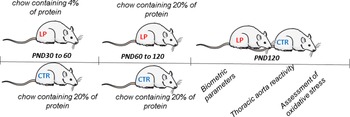
Wistar male rats were obtained at the central vivarium of the State University of Maringa, Brazil. On postnatal day (PND) 30, the rats were randomly assigned to two experimental groups: Low-protein diet group (LP, n = 20) or control group (CTR, n = 20). From PND30 until 60, the period related to the peripubertal phase of rats, Reference Marco, Adriani, Ruocco, Canese, Sadile and Laviola16 the LP group were fed with chow containing 4% protein, and the CTR group were fed with commercial chow containing 23% protein (Nuvital, Brazil). Reference De Oliveira, Grassiolli, Gravena and De Mathias17 The low-protein chow was prepared at the Laboratory of Cellular Biology at State University of Maringa, Brazil (constituents described in Table 1), as previously described. Reference Ferreira, Ribeiro and Peres15,Reference Almeida, Simões and Saavedra18 The experimental analysis was carried out at PND 120 (Fig. 1).
Schematic diagram illustrating the experimental design. CTR: control rats – feed with commercial diet; LP: low-protein rats – feed with a low-protein chow; PND: postnatal day.

Components of control and low-protein chow

The values of the components of the diet are presented proportionally to g kg−1 of diet and energy in kJ kg−1.
a The mixtures of mineral salts and vitamins that from the commercial (control chow) and reduced protein (low-protein) diets follow the recommendations of the American Institute of Nutrition, AIN 93.
Biometric parameters
Rats from both groups were anesthetized with sodium thiopental (40 mg/kg, i.p., Cristália, Brazil), and weighed (g). Next, white (perigonadal and retroperitoneal) and brown (interscapular) adipose tissues were removed and weighed, and the values expressed as tissue weight per 100 g of body weight. The left tibia was also removed, dissected, and the length (mm) of the wet tibia measured and used as a growth parameter.
Thoracic aorta reactivity
The rats were anesthetized with sodium thiopental (40 mg/kg, i.p., Cristália, Brazil) and four segments (5 mm) of the dissected thoracic aorta with (Endo+) and without (Endo−) endothelium were set up in tissue baths for measurement of isometric contractile force, as previously described by Higashi et al. 2018. Reference Higashi, Sartoretto and Echem19 The tissue bath contained modified Krebs-Henseleit solution (composition in mM: 130 NaCl, 14.9 NaHCO3; 4.7 KCl; 1.18 KH2PO4; 1.17 MgSO4-7H2O; 5.5 glucose; 1.60 CaCl2-2H2O e 0.026 EDTA – reagents were obtained from Labsynth, Brazil) at 37°C and pH 7.4, and gassed with 95% of O2 and 5% of CO2. Reference Higashi, Sartoretto and Echem19,Reference Ceravolo, Filgueira and Costa20 The integrity of smooth muscle cells was tested with potassium chloride (KCl, 90 mM; Labsynth, Brazil) and endothelial integrity was tested with acetylcholine (ACh, 3 μM, Sigma-Aldrich, USA). The endothelium was considered intact (Endo+ rings) if the ACh-induced relaxation was greater than 70%. Vessels exhibiting less than 5% relaxation in response to ACh were considered endothelium denuded (Endo− rings). In Endo + and Endo – aortic rings, cumulative concentration-effect curves to the vasoconstrictor phenylephrine (Phenyl, 1 nM – 100 μM, Sigma-Aldrich, USA) and to vasodilators ACh (1 nM–0.3 mM, E + rings) and sodium nitroprusside (SNP, 0.1 nM – 0.3 mM) were performed. The curves for the vasodilators (ACh and SNP) were constructed in aortic rings contracted with a submaximal concentration of Phenyl (a concentration that causes 60-80% of the maximum Phenyl response). Cumulative concentration-effect curves to Phenyl (1 nM–3 mM) were also performed in Endo+ in the absence or presence of non-selective cyclooxygenase inhibitor, indomethacin (10 µM, Sigma-Aldrich, USA), the antioxidant tempol (1 µM; Calbiochem, USA) or the NADPH oxidase inhibitor apocynin (1 µM; Sigma-Aldrich, USA) both incubated for 30 min. Reference Higashi, Sartoretto and Echem19,Reference Ceravolo, Filgueira and Costa20 For curves to Phenyl, ACh, and SNP, the maximal response (maxR) and the log of the drug concentration resulting in 50% of the maxR (pD2) were calculated using nonlinear regression analysis (GraphPad Prism software; Graph Pad Software, Inc., San Diego, CA).
Assessment of oxidative stress
The rats were anesthetized with sodium thiopental (40 mg/kg, i.p., Cristália, Brazil) and the thoracic aorta was removed, dissected, and cut with scissors. The aortic fragments were homogenized in phosphate-buffered saline and centrifuged at 3000 rpm for 20 min. Subsequently, the supernatant was separated and the protein concentration in each sample was evaluated using Brandford reagent. Reference Prasertsongskun, Sangduen, Suwanwong, Santisopasri and Matsumoto21 The concentration of thiobarbituric acid reactive substances (TBARS) was evaluated to determine the aortic lipid peroxidation, since decomposition of lipid peroxides results in the formation of TBARS. For the reaction, ferric chloride (1M FeCl3), ascorbic acid, trichloroacetic acid (TCA 2.8%), thiobarbituric acid (TBA 1.0%), and aortic homogenates or phosphate buffer pH 7.2 were added to a microplate. The microplate was subsequently placed in a water bath at 90°C for 15 min and then on ice to stop the reaction. The reaction was read spectrophotometrically at 535 and 575 nm Reference Guedes, Bosco and Teixeira22 in an absorbance microplate reader (SpectraMax Plux 384, Molecular Devices, USA), and the amount of TBARS was calculated using the formula: [TBARS] = (Abs 535 − Abs 575)/0.01 and expressed as nmol/mg of protein.
For evaluation of catalase activity, the aortic homogenate was applied in a microplate with the reaction medium (Tris-HCL Buffer 1.0 M; EDTA 5.0 mM (pH = 8) and H2O2 30 mM). The reading was performed in a spectrophotometer at 240 nm for 1 min with 15-s intervals (SpectraMax Plux 384, Molecular Devices, USA). After reading, blank and sample mean absorbance was obtained at the following points: 1, 15, 30, 45, and 60 s. The absorbance of all points evaluated was calculated as follows: (Abs in 1 s – Abs in 15 s) × 4; (Abs in 15 s –Abs in 30 s) × 4; (Abs in 30 s – Abs in 45 s) × 4; (Abs in 45 s – Abs 60 s) × 4 and the results presented as an average of these values. To assess the catalase activity, the following formula was used: AE = (Δ Abs/min) × (bucket volume/sample volume)/(extinction coefficient × protein concentration). Reference Aebi23
Statistical analyses
The results are shown as mean ± S.E.M. For data analysis, tests of normality (Shapiro-Wilk) and homogeneity of variances (Levene) were performed. Statistical analysis was carried out using one-way ANOVA or two-way ANOVA complemented with the Tukey post-test or using the student t-test. Significant values were considered when p < 0.05. The GraphPad Prism software (GraphPad Prism; v8.4.2, CA, USA) was used for statistical analyzes.
Results
Biometric parameters
The student t-test demonstrated that in LP adult rats (PND 120) body weight, and tibial length were lower than in the CTR group (Table 2; p < 0.05). However, no differences were observed in the weight of white and brown adipose tissues in the LP group when compared with the CTR group (Table 2).
Biometric assessments on adult rats

The weghts of organs and tissues were expressed as 100 g of body weight (g/100g). LP: rats exposed to protein restriction during peripubertal period and CTR: rats fed a commercial chow during peripubertal period. PND: postnatal day. Data expressed as mean ± SEM. n = 15 / group for body weight and n = 10 / group for other parameters. * p < 0.5 vs CTR (Student T-test).
Protein restriction in peripubertal period caused aortic endothelial dysfunction in adulthood
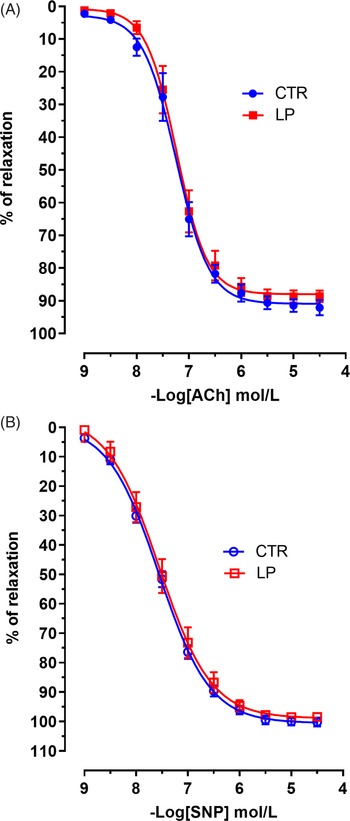
Phenyl caused contraction and ACh, and SNP caused relaxation both in a concentration-dependent manner in the aortic rings isolated from the different experimental groups. The two-way ANOVA indicated interactions between the factors: diet and endothelium (Table 3, Fig. 2; p < 0.05) in the maxR to Phenyl. The one-way ANOVA followed by the Tukey post-test demonstrated an increase of 65% in maxR to Phenyl in Endo+ aortic rings of LP rats compared with CTR rats (Table 3, Fig. 2; p < 0.001). Furthermore, in the Endo- rings, maxR and pD2 were similar between CTR and LP rats (Table 3, Fig. 2). The maxR and pD2 to Phenyl were increased in Endo- rings of CTR and LP rats when compared with their respective Endo+ rings (Table 3, Fig. 2, p < 0.0001). The responses to the vasodilators ACh and SNP were similar between CTR and LP aorta (Table 4, Fig. 3).
Cumulative concentration-effect curves to phenylephrine (Phenyl) in aortic rings with (Endo +) and without endothelium (Endo-) isolated from adult rats. LP: rats exposed to protein restriction during peripubertal period and CTR: rats fed a commercial chow during peripubertal period, n = 9–10. Data were expressed as mean ± SEM #p <0.05 vs maximal response in LP Endo +; *p <0.05 vs maximal response in CTR Endo + (two-way ANOVA, post-test: Tukey).

Cumulative concentration-effect curves to A) acetylcholine (ACh) (n = 8) and B) to sodium nitroprusside (SNP) (n = 10) in aortic rings of adult rats. LP: rats exposed to protein restriction during peripubertal period and CTR: rats fed a commercial chow during peripubertal period. Data were expressed as mean ± SEM of the percentage of relaxation in relation to the contraction caused by phenylephrine (3µM) (Student t-test).

Contractile response to phenylephrine in thoracic aortic rings with and without endothelium

Maximum response (maxR, gram of tension) and -log of the concentration of the agonist that causes 50% of the maxR (pD2) for phenylephrine in rings with (Endo +) and without endothelium (Endo-) of adult rats exposed to protein restriction (LP) or fed with commercial chow (CTR) during peripubertal phase. Data were expressed as the mean ± SEM, (n) number of rats/groups. *p < 0.05 vs CTR Endo +; # p < 0.05 vs LP Endo + (two-way ANOVA, post-test: Tukey).
Aortic response to acetylcholine and sodium nitroprusside

Maximum response (maxR, % of relaxion after contraction with phenylephrine) and -log of the concentration of the drug that causes 50% of the maxR (pD2) for acetylcholine (ACh) or sodium nitroprusside (SNP) in aortic rings of adult rats exposed to protein restriction (LP) or fed with commercial diet (CTR) during peripubertal phase. Data were expressed as the mean ± SEM % of relaxation in relation to contraction with phenylephrine (3 µM). (n) the number of rats/groups; Student’s t-test.
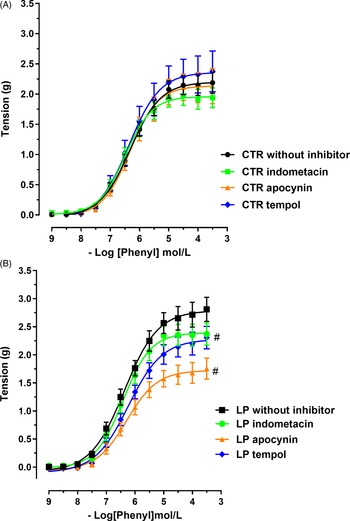
To evaluate the mechanisms involved in the increased contractile response in Endo+ aortic rings from LP rats, cumulative concentration-effect curves to Phenyl were performed in the presence of endothelium-derived constriction factors inhibitors. It was demonstrated that incubation with apocynin (NADPH oxidase inhibitor) or tempol (ROS scavenger) reduced (22 and 15% respectively) maxR to Phenyl in LP Endo+ rings when compared to LP Endo+ rings without inhibitors (Table 5, Fig. 4B; p < 0.0019). Additionally, the incubation of LP Endo+ rings with indomethacin (non-selective cyclooxygenase inhibitor) did not change maxR or pD2 to Phenyl (Table 5, Fig. 4B). In the CTR Endo+ aortic rings, incubation with indomethacin, apocynin or tempol did not alter the response to Phenyl when compared with CTR Endo + rings without inhibitors (Table 5, Fig. 4A).
Cumulative concentration-effect curves to phenylephrine (Phenyl) in aortic rings with endothelium incubated or not (without inhibitors) (n = 11) with apocynin 1µM (n = 7–8), indomethacin 10µM (n = 12–11) or tempol 1µM (n = 7) and isolated from adult rats fed with A) exposed to commercial diet (CTR) or B).

Apocynin and tempol, but not indomethacin, corrected in the increased contractile response in aortic rings with endothelium isolated from low-protein rats

Maximum response (maxR) and -log of the concentration of the drug that causes 50% of the Rmax (pD2) to phenylephrine in aortic rings with endothelium isolated from adult rats exposed to protein restriction (LP) or commercial chow (CTR) diet during peripubertal phase. (n) = number of rats/groups. Data were expressed as the mean ± SEM * p < 0.05 vs CTR without blocker; #p < 0,05 vs LP without inhibitor (one-way ANOVA, post-test: Tukey).
Oxidative evaluations in aortic tissue
The student t-test showed that aortic TBARS concentration was increased in the LP group (p = 0.032) and catalase activity was reduced in the aorta of LP rats (p = 0.014) when compared with the control group (Table 6).
The aortic lipid peroxidation and catalase activity

The aortic amount of malondialdehyde (MDA) and catalase activity in adult rats exposed to protein restriction or commercial chow (CTR) during peripubertal phase. (n) the number of rats/groups. Data were expressed as the mean ± SEM * p < 0.05 vs CTR (Student’s t-test).
Discussion
The present study demonstrated that protein restriction during peripubertal period caused aortic endothelial dysfunction in rats evaluated during adulthood. This result suggests that a poor protein diet during the peripubertal phase can favor the development of vascular diseases in the adult life.
Impairment of endothelial function with restrictive diets has been described in other phases of body development. For example, the endothelial modulation on vascular reactivity was compromised in adult offspring of Sprague-Dawley mothers fed with a low-protein diet (6 or 9% of casein) during pregnancy Reference Sathishkumar, Elkins, Yallampalli and Yallampalli10,Reference Grandvuillemin, Buffat and Boubred24–Reference Sathishkumar, Balakrishnan and Yallampalli26 and in adult offspring of Wistar rats fed during pregnancy with a global nutrition restriction diet. Reference Ceravolo, Franco and Carneiro-Ramos7,Reference Torrens, Hanson, Gluckman and Vickers27–Reference Oliveira, Akamine and Carvalho29 In addition, male Wistar rats fed with protein restrictive diet (6% of protein) from PND21 until three months of life presented endothelial dysfunction, characterized by reduced relaxation to Ach. Reference Maia, Batista and Victorio30 Thus, our results and those presented in the literature show that diets lacking protein or with global nutrient restriction impair vascular response, which, in general is characterized by endothelial dysfunction. Differences in responses to drugs that cause relaxation or contraction may be related to different species evaluated, the time when the diets are administrated, and/or the type of nutrients suppressed. However, our results indicate for the first time that protein restriction during the peripubertal period leads to aortic endothelial dysfunction in adult rats.
Reactive oxygen species are molecules involved in the control of vascular reactivity. Reference Ceravolo, Filgueira and Costa20,Reference Boulden, Widder and Allen31 The superoxide anion effectively impairs NO bioactivity via near diffusion-controlled bimolecular reaction. Reference Beckman, Beckman, Chen, Marshall and Freeman32 This yields peroxynitrite that can inactivate eNOS directly Reference Zou, Shi and Cohen33 or indirectly. Reference Kuzkaya, Weissmann, Harrison and Dikalov34
In fact, our study demonstrates that the increase in the aortic contractile response to Phenyl may be related to the exacerbated production of superoxide anion by the enzyme NADPH oxidase, since apocynin, an inhibitor of this enzyme, and the dismutation of superoxide anion by SOD mimetic (tempol) recovered the aortic endothelial modulation in LP rats. Similar findings have been described with the use of apocynin in the tail artery of rats subjected to post-weaning protein restriction (9%). Reference de Belchior, Angeli and Faria Tís35 Furthermore, it was shown that apocynin corrects endothelium dependent relaxation, both in mesenteric arterioles of adult offspring from mothers that received global nutrient restriction during pregnancy Reference Franco, Akamine and Rebouças36,Reference Franco, Arruda Réria and Fortes37 and in the thoracic aorta of adult rats that were subjected to protein restriction (6%) in the post-weaning phase. Reference Maia, Batista and Victorio30 These results suggest an important role of superoxide anion in the endothelial dysfunction caused by nutrient-restrictive diets.
Interestingly, in vascular cells superoxide anion is a source of hydrogen peroxide Reference Coyle, Martinez, Coleman, Spitz, Weintraub and Kader38 and here it was demonstrated that peripubertal exposure to protein restriction increases aortic lipid peroxidation and impaired catalase activity, suggesting that there is an increase in hydrogen peroxide in the aorta from LP rats. Similar results were recently described in the heart and brain of LP rats, by Ferreira et al., 2022. Reference Ferreira, Ribeiro and Peres15 The mechanisms by which hydrogen peroxide induces vascular dysfunction are not fully understood. Hydrogen peroxide does not contain an unpaired electron and is therefore less reactive than many other reactive oxygen species. Thus, mechanisms other than direct oxidant injury likely contribute to the effects of this compound in vascular cells. In this regard, hydrogen peroxide reacts with peroxidases, such as myeloperoxidase, to form highly reactive molecules, including HOCl Reference Zhang, Yang and Jennings39 and nitrosylating species. Reference Lakshmi, Nauseef and Zenser40 Additionally, in vascular smooth muscle cells, hydrogen peroxide activates NADPH oxidase, resulting in further production of superoxide anion, Reference Lakshmi, Nauseef and Zenser40,Reference Witting, Rayner, Wu, Ellis and Stocker41 which can cause the oxidation. Accordingly, the correction of aortic contractile response in LP rats by NADPH oxidase inhibition and tempol suggests that endothelial dysfunction caused by protein restriction during peripubertal phase is related to oxidative stress promoted by hydrogen peroxide and superoxide anion. However, herein the NADPH oxidase activity and superoxide anion concentration were not evaluated, been these a limitation of our study.
As described in the present study LP diet during peripubertal phase caused aortic endothelial dysfunction in adult rats, probably by a mechanism involving oxidative stress. In agreement with our findings, it has been described that exposure to low-protein diet in peripubertal phase causes hypertension, Reference Ferreira, Ribeiro and Peres15 also in many experimental models of hypertension, high blood pressure is associated with increased aortic contractility and oxidative stress. Reference Ceravolo, Fernandes and Munhoz42,Reference Leal, Aires and Pandolfi43 Further, under these condition, elevated blood pressure can modulate vascular reactivity and ROS generation by activating stretch-induced signaling pathways in endothelial and vascular smooth muscle cells. Reference Birukov44 Furthermore, aorta not only serves as a conduit during systole but also acts as a reservoir for blood. Aortic recoil during diastole pushes the remaining stored volume forward into the peripheral circulation. This elasticity allows the aorta to absorb the force of the blood as it is pumped from the heart and subsequently propelling it to downstream organs. In some diseases however (e.g., hypertension), this elasticity is lost due in part, by the reduced capacity of endothelial cells to modulate the vascular tone and aortic stiffening. In this case, aortic distending pressures can be increased and it can have deleterious hemodynamic consequences for delicate downstream organs and increases the risk for other cardiovascular diseases (e.g., myocardial infarction, heart failure, and stroke). Reference Zhang, Lacolley, Protogerou and Safar45,Reference Stanhewicz, Wenner and Stachenfeld46 Therefore, it is possible to suggest that protein restriction during peripubertal phase caused aortic endothelial dysfunction associated with increased oxidative stress which are very important risk factor in cardiovascular diseases-associated vascular dysfunction.
Herein, it was also confirmed that peripubertal protein restriction compromised body development, reducing body weight and growth, without interference in adipose tissue deposition. In fact, it was recently described, using the same protocol of protein restriction as the current study, that protein restriction during the peripubertal period reduced the food intake and growth in this phase. Reference Ferreira, Ribeiro and Peres15 This growth restriction is persistent thought adulthood and probably related with early caloric restriction. These findings confirm that the peripubertal phase is an important window for body plasticity and for interventions to prevent cardiovascular disease in the adulthood.
The results presented here are consistent with the hypothesis that a protein-restricted diet (4%) during peripubertal period causes endothelial dysfunction in adulthood, probably through a mechanism that involves oxidative stress. Understanding of endothelial alteration caused by protein restriction can favor the application of strategies, such as the population’s awareness of the importance of a diet with an adequate amount of protein in peripubertal phase for the prevention of cardiovascular diseases-associated vascular dysfunction in adulthood.
Acknowledgments
The authors are grateful to Ms. Fujiko Eliana Morinaga and Mr. Afonso de Azevedo Saiz for their technical support and help with the animal care.
Financial support
The study was financed by the Coordenação de Aperfeiçoamento de Pessoal de Nível Superior – Brasil – Finance Code 001 and Fundação Araucária de Apoio ao Desenvolvimento Científico e Tecnológico do Estado do Paraná (grant: 215/2022-PBA).
Conflict of interest
The authors have no conflicts of interest to declare.
Ethical standards
All experimental protocols were conducted according to the recommendations of the National Council for Animal Experimentation Control and with protocols approved by the Ethics Committee on the Use of Animals at the State University of Londrina and Maringá.