Implications
The day of weaning is particularly challenging both physiologically and psychologically for piglets, and the behaviour of piglets towards their environment and each other affects their overall welfare. One of the concerns for the pork industry is that confinement housing can detrimentally influence social behaviour; however, we found no differences in aggressive or non-aggressive social interactions. Piglets raised under the confinement system demonstrated more exploratory behaviour, whereas outdoor-raised piglets spent more time trying to escape the arena (jumping against the walls) and eating. Confinement and isolation are, therefore, likely to be more important stressors for outdoor-raised piglets, whereas a barren environment results in a greater drive for exploration for farrowing shed-raised animals. This study develops both quantitative and qualitative methods for assessing piglet behaviour and demonstrates the value of holistic assessment methods to improve welfare relevance of behavioural studies.
Introduction
Weaning of piglets is one of the most critical phases in the entire pig production cycle. Piglets experience substantial physical, physiological and affective challenges at weaning when they are removed from the sow, change their diet and are mixed into large groups. Increased fighting at weaning due to mixing unfamiliar piglets (Ewbank and Bryant, Reference Ewbank and Bryant1972) may lead to wounds, infection and abscesses, and a period of low feed intake resulting in poor weight gain or even weight loss and sporadically diarrhoea. Decreased disease resistance, coupled with the challenges of dietary change at weaning and setback in growth performance, can contribute to increased mortality (Gross and Colmano, Reference Gross and Colmano1969; Gross, Reference Gross1972). The behaviour of piglets at weaning therefore reflects their physical and physiological capacity to deal with the challenges of their new environment, as well as affecting how they develop socially.
In intensive pig husbandry, pigs are predominately housed in stimulus-poor environments (farrowing sheds), where opportunities for expression of species-specific behaviour are limited (De Jonge et al., Reference De Jonge, Bokkers, Schouten and Helmond1996). This is not ideal from a welfare point of view, as rearing environment in early life influences behavioural development, which consequently modifies responses of pigs to stressful environments in later stages of production (e.g. De Jonge et al., Reference De Jonge, Bokkers, Schouten and Helmond1996; Hillmann et al., Reference Hillmann, Von Hollen, Bünger, Todt and Schrader2003; Chaloupková et al., Reference Chaloupková, Illmann, Neuhauserová, Tománek and Vališ2007b). For example, De Jong et al. (Reference De Jong, Prelle, van de Burgwal, Lambooij, Korte, Blokhuis and Koolhaas2000) showed that barren housing conditions hampers the expression of normal behaviour, and piglets perform more manipulative social behaviour (e.g. biting and nosing of littermates) and develop more abnormal agonistic behaviour than piglets reared in an enriched environment. In contrast, pigs reared in enriched environments play more and are less aggressive in competition over food than pigs reared in farrowing crates (Chaloupková et al., Reference Chaloupková, Illmann, Bartos and Spinka2007a), and those farrowed in outdoor systems reach puberty earlier and have lower basal cortisol levels – suggesting that exposure to enriched environments in early life can increase resistance to stress in adulthood (De Jonge et al., Reference De Jonge, Bokkers, Schouten and Helmond1996).
Environmental enrichment may result in greater behavioural flexibility and lower reactivity towards unfamiliar stimuli (Leggio et al., Reference Leggio, Mandolesi, Federico, Spirito and Ricci2005), and a number of previous studies have demonstrated links between the rearing environment of piglets and behaviour at weaning. Previous studies report that, at weaning, undesirable behaviours (e.g. belly nosing, agonistic interactions and low feed consumption) are less frequent in outdoor-raised piglets (Webster and Dawkins, Reference Webster and Dawkins2000; Cox and Cooper, Reference Cox and Cooper2001), which spend more time walking and engage in play activity compared with indoor-reared piglets (Johnson et al., Reference Johnson, Morrow-Tesch and McGlone2001). The environment during rearing can also influence behavioural reactivity towards non-social challenges. For example, piglets raised in enriched and larger farrowing pens showed fewer signs of distress (e.g. vocalisations, locomotion) in a human-encounter test performed 3 days before weaning compared with piglets kept in barren farrowing crates (Chaloupková et al., Reference Chaloupková, Illmann, Neuhauserová, Tománek and Vališ2007b).
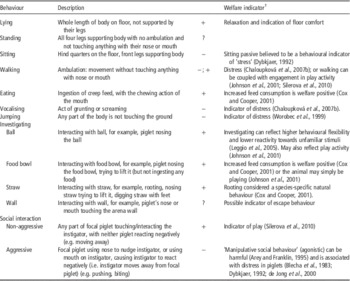
We therefore predicted that outdoor-raised piglets would show fewer behavioural indicators of stress (i.e. less sitting, vocalisation, jumping/escape attempts; more lying, eating and investigating the ball, food bowl and straw; Table 1) when isolated in a novel environment, would show less aversion towards a novel object (more time interacting with the ball) and be more interested in food (more time feeding). We also predicted that outdoor-raised piglets would be less aggressive towards non-siblings than farrowing shed-raised piglets. We tested these predictions by comparing the behavioural responses of 30 outdoor-raised and 30 farrowing shed-raised piglets. We compared quantitative and qualitative measures of behaviour in response to four challenges (isolation, a novel object, food or presence of another piglet) on the day of weaning.
Description of mutually exclusive behaviour categories used in time budget analyses

† − Indicator of negative welfare, + indicator of positive welfare, ? no evidence for the valence of the activity in the literature.
Methods
This study was approved by the Animal Ethics Committee at Murdoch University (Permit number R2574/13). Although we did not have access to a single farm that had both outdoor and intensive systems (as biosecurity issues require such industries to be run separately), we examined piglets from two farms owned by the same company that had the same genetics and general management. Animals were a mix of Landrace, Large White and Duroc. A total of 60 piglets were used (equal numbers of each sex), with 30 piglets from an intensive farm and 30 piglets from an outdoor farm. Piglets at both farms are weaned on a Thursday, when the piglets were between 21 and 28 days of age.
Outdoor piggery
This farm comprised 3500 sows, and weans an average of 1000 piglets per week. The farrowing paddocks (400 m2) each had nine sows, and each sow had an average of 8 to 10 piglets at weaning. The sows were introduced to the paddock a few days before their farrowing date and each selected one of the nine huts that were available. Fenders (~30 cm tall) were placed at the hut entrances to keep piglets in the hut until ~14 days of age, after which the fenders were removed, and the piglets were then allowed to interact with other piglets and sows in the paddock. The sows were fed from tall feeders, but piglets had access to spilled food on the ground as well as the freedom to move in and out of the farrowing paddock, and therefore access to adjacent paddocks. On the day of weaning, all animals were herded together, sows removed and piglets loaded onto a trailer. They were transported ~200 m to a sorting shed where they were vaccinated, injected and sorted by sex and size before they were filmed for this project.
Intensive piggery
This farm also comprised 3500 sows, and weans an average of 1350 piglets per week. Each sow had an average of 12 piglets at weaning, and piglets were tail docked, teeth grinded as per veterinary advice and given an iron injection within 24 h of birth. Creep feed was provided from ~10 days of age. Piglets were only allowed to interact with siblings and their mother during lactation; the first time they interacted with non-siblings was on the day of weaning, when all piglets were removed from their farrowing crates and herded along corridors to a holding area where they were sorted by size and sex and vaccinated before they were filmed for this project.
Footage collection and experimental challenges
Piglets were filmed on the day of weaning during exposure to a novel arena test (Forkman, Reference Forkman, Boissy, Salaun, Canaki and Jones2007). Video footage (Panasonic HC-V500M digital cameras, Panasonic Australia Pty Ltd, Macquarie Park, NSW) was collected of each focal piglet placed individually within an experimental novel arena. The experimental arena was made up of four sheets (each 0.9×0.9 m) of 5 mm-thick Corflute® (Corex Plastics Australia Pty Ltd, Dandenong South VIC), taped together at each side, with a hole cut into a corner of the box mid-way up one wall to access the arena for filming. Straw was scattered over the floor. Although Wemelsfelder et al. (Reference Wemelsfelder, Nevison and Lawrence2009) found that observers viewing exactly the same footage of 15 growing pigs interacting with a novel object, but digitally projected onto either an indoor or outdoor background, were not unduly affected by this background, we nevertheless ensured that only the Corflute walls were visible during filming to ensure that there were no visible differences in the environmental context of this footage (Fleming et al., Reference Fleming, Wickham, Stockman, Verbeek, Matthews and Wemelsfelder2015).
Each focal piglet was filmed for 20 min, commencing when it was placed in the experimental arena and then exposed to a sequence of ‘challenges’. The piglets were placed into the experimental arena and left for 5 min to settle-in (isolation challenge); a ball (novel object) was introduced at 5 min, creep feed in a feeder at 10 min and a size- and sex-matched ‘instigator’ piglet was introduced at 15 min (Figure 1). Justification for these specific challenges is as follows:
-
i. Challenge 1: isolation. Although domestic pigs are social animals, basic physiological effects of early isolation from mother and/or siblings are scantily investigated (Kanitz et al., Reference Kanitz, Tuchscherer, Puppe, Tuchscherer and Stabenow2004). Herskin and Jensen (Reference Herskin and Jensen2000) showed that isolation increased the occurrence of behavioural indicators of stress such as the frequency of pawing and escape attempts, as well as the decrease in frequency of play, and concluded that social isolation is a stressful event (compared with group-housed control). Therefore, the first challenge we used was to compare the piglets’ capacity to deal with being in isolation in a novel environment.
-
ii. Challenge 2: introducing a novel object. One indicator of coping ability is the fear of novelty; animals usually have conflicting motivations to avoid and to investigate stimuli, and the balance is strongly dependent on the magnitude of the novelty (Chaloupková et al., Reference Chaloupková, Illmann, Neuhauserová, Tománek and Vališ2007b). When supplied with basic necessities (food, water and shelter), domestic pigs in commercial production continue to express exploratory behaviours and preferentially select environments (pens) with novel objects to investigate (Stolba, Reference Stolba and Wood-Gush1984). Once they have overcome any fear of its novelty, the provision of a novel object, therefore, provides a stimulus that piglets may seek out and interact with.
-
iii. Challenge 3: introducing a food bowl and feed. Some animals may not immediately eat offered food when placed into a challenging environment, and instead may prioritise investigation of their environment or safety. In wild or semi-natural conditions, weaning of piglets is a gradual process involving a reduction in suckling and an increase in foraging activity and the ingestion of solid food (Jensen, Reference Jensen1988); piglets learn by imitating their mother or older group members (Stolba and Wood-Gush, Reference Stolba and Wood-Gush1989). This is in contrast with commercial piggeries, where piglets are weaned abruptly and interaction with the dam and piglets is usually limited due to the controlled environment within the farrowing crate (Apple and Craig, Reference Apple and Craig1992). Under these conditions, piglets face a challenge during weaning due to loss of the sow’s milk but possibly also due to exposure to novel feeders or solid food, with limited opportunity for previous social learning. We, therefore, elected to use exposure to a food bowl to test the responses of outdoor-raised and farrowing shed-raised piglets.
-
iv. Challenge 4: introducing a second piglet. Pigs are highly social animals, and therefore the company of another individual can influence their coping abilities. Piglets that have been raised in a socially enriched environment (i.e. where they have been allowed contact between litters during the suckling period) demonstrate more positive social interactions than piglets raised in single-litter farrowing systems. For example, there is decreased incidence of injuries (Pluske and Williams, Reference Pluske and Williams1996; Wattanakul et al., Reference Wattanakul, Stewart, Edwards and English1997; Kutzer et al., Reference Kutzer, Bünger, Kjaer and Schrader2009), greater hierarchy stabilisation (De Jonge et al., Reference De Jonge, Bokkers, Schouten and Helmond1996; Pitts et al., Reference Pitts, Weary, Pajor and Fraser2000; Hillmann et al., Reference Hillmann, Von Hollen, Bünger, Todt and Schrader2003; D’Eath, Reference D’Eath2005), reduced latency to approach an unfamiliar pig upon first contact (Hillmann et al., Reference Hillmann, Von Hollen, Bünger, Todt and Schrader2003) and also reduced levels of aggression (Erhard et al., Reference Erhard, Mendl and Ashley1997). The introduction of another piglet (social encounter test), therefore, tested the social interaction skills of these piglets.
Timetable for each piglet during filming, arrows indicate time points where a new challenge is added to the experimental arena (a) 1×1 m Corflute-walled box).

Time budgets
Time budget analysis was carried out for each individual focal piglet from the video footage. Scan samples were carried out every 15 s (making a total of ~20 observations per individual per 5-min challenge), and its behaviour was allocated to one of the 13 categories (Table 1). As a note, although there was no feeder in the arena for the first 10 min, there was spilt food within the straw that piglets were able to access; therefore, we recorded some feeding events during the first two experimental challenges.
The time budget data (counts of the incidence of each behavioural category) were transformed into proportions of the total number of observations. These proportions were then arcsine-square root transformed to meet the requirements of parametric analyses (Shapiro–Wilk test) and were analysed by repeated-measures ANOVA, with environment and sex as fixed independent factors and the incidence of each of the 13 behavioural categories (lying; standing; sitting; walking; eating; vocalising; jumping; investigating the ball, food bowl, straw or wall; and social interactions – non-aggressive and aggressive) under each challenge as the multiple dependent measures. Subsequent multivariate ANOVAs (one for each challenge separately) were followed by Tukey’s honestly significant difference (HSD) post-hoc analyses of each of the behavioural categories. We also recorded the latency until first social contact (min), and these values were BoxCox-transformed to meet the requirements of parametric analysis (two-way factorial ANOVA with environment and sex as independent factors).
Qualitative Behavioural Assessment (QBA)
In addition to quantifying the incidence of behaviour, qualitative behavioural expression can be used to reveal aspects of an individual’s interactions with its environment. QBA is a ‘whole-animal’ methodology based on the qualitative interpretation of the dynamic style in which animals interact with their environment (Wemelsfelder et al., Reference Wemelsfelder, Hunter, Mendl and Lawrence2000 and Reference Wemelsfelder, Hunter, Mendl and Lawrence2001). QBA describes not ‘what’ the animals do but ‘how’ they do what they do (Wemelsfelder et al., Reference Wemelsfelder, Nevison and Lawrence2009). This method relies on the ability of human observers to integrate perceived details of behaviour and context into judgement of animal ‘body language’, using descriptors such as ‘calm’, ‘tense’ or ‘content’. Such descriptive terms have an expressive, emotional connotation, and provide information that appears relevant to animal welfare (Dawkins, Reference Dawkins2015) and could be a useful addition to quantitative indicators. QBA has been used as part of behaviour assessments for a range of species including adult pigs (Wemelsfelder et al., Reference Wemelsfelder, Hunter, Mendl and Lawrence2000, Reference Wemelsfelder, Hunter, Mendl and Lawrence2001 and Reference Wemelsfelder, Nevison and Lawrence2009; Temple et al., Reference Temple, Manteca, Velarde and Dalmau2011; Rutherford et al., Reference Rutherford, Donald, Lawrence and Wemelsfelder2012) and piglets (Morgan et al., Reference Morgan, Pluske, Miller, Collins, Barnes, Wemelsfelder and Fleming2014). QBA scores are correlated with quantitative measures of behaviour (e.g. Stockman et al., Reference Stockman, Collins, Barnes, Miller, Wickham, Verbeek, Matthews, Ferguson, Wemelsfelder and Fleming2014 and references therein) and with physiological indicators relevant to welfare (e.g. heart rate, core body temperature, plasma glucose and the neutrophil : lymphocyte ratio; Stockman et al., Reference Stockman, Collins, Barnes, Miller, Wickham, Beatty, Blache, Wemelsfelder and Fleming2011 and Reference Stockman, Collins, Barnes, Miller, Wickham, Beatty, Blache, Wemelsfelder and Fleming2013; Wickham et al., Reference Wickham, Collins, Barnes, Miller, Beatty, Stockman, Blache, Wemelsfelder and Fleming2012 and Reference Wickham, Collins, Barnes, Miller, Beatty, Stockman, Blache, Wemelsfelder and Fleming2015). QBA scores can also reflect temperament (i.e. repeatable behavioural patterns) in cattle (Sant'Anna and Paranhos da Costa, Reference Sant’Anna and Paranhos da Costa2013).
Footage was edited using Corel Video Studio Pro X4 (Ottawa, ON, North America) into 30-s duration clips for each individual for each challenge (isolation, ball, food bowl and instigator); that is, a total of 240 clips. Footage from the isolation challenge was chosen from the middle of the challenge period (2 min 30 s to 3 min from the start of filming). Footage for the ball, food bowl and instigator challenges was chosen when the focal piglets first interacted with the object/instigator. When there was no interaction, footage was also chosen from the middle of the challenge period (7 min 30 s to 8 min for 14 piglets that did not interact with the ball, 12 min 30 s to 13 min for 20 piglets that did not interact with the food bowl and 17 min 30 s to 18 min for eight piglets that did not interact/touch the instigator). There was no audio for the footage shown to observers.
Eleven observers were recruited by word of mouth for this study. Each observer was provided with the footage electronically and they could complete the scoring sessions in their own time. Before commencing the study, they were each asked to complete a survey that asked details of their previous contact with farm animals and whether they believed that animal welfare is important.
We used a free-choice profiling (FCP) methodology for QBA, which relies on people generating their own descriptor against which to quantify the behavioural expressions of the observed animals (Wemelsfelder et al., Reference Wemelsfelder, Hunter, Mendl and Lawrence2001). FCP has been used extensively in the field of food science (Arnold and Williams, Reference Arnold and Williams1986) and is a powerful technique as it allows observers to generate their own terms that they feel comfortable using. It also prevents observers from projecting suggested criteria onto the animals or from being biased by the terms given to them. This assessment, therefore, consisted of two phases (term generation and quantification):
-
(i) For term generation, observers were shown 10 randomly selected clips, which showed individual and paired piglets showing a range of demeanours and exhibiting a range of actions (i.e. lying down, through to running and jumping against the arena walls), ensuring that the observers could generate a broad range of descriptive terms that would describe the full range of behaviour likely to be encountered. At the end of each clip, observers paused the video, allowing them to write down terms they felt described the expressive qualities of the observed animals. When individual observers used both positive and negative antonyms (e.g. ‘happy’ and ‘unhappy’), only the positive term was kept for use in subsequent scoring. These descriptive terms were then sorted alphabetically for each observer (to effectively randomise the presentation order of terms), and presented to observers with a 100-mm visual analogue scale adjacent to each term on an electronic spreadsheet (Microsoft Excel).
-
(ii) In the subsequent four quantification sessions, each representing one of the challenges (C) tested (C1: isolation, C2: ball, C3: food bowl and C4: instigator), observers scored the 60 randomly arranged video clips for each viewing session on these rating scales (a different copy for each session). Each of these four sessions ran for about 1 h. The experimental clips were ordered so that no two clips of the same sex/environment group were seen back-to-back. Observers were given detailed instructions on completing the sessions – that is, how to run the video and complete the datasheets of visual analogue scales, where they marked on the score sheets (the distance between 0=minimum to 100=maximum expression of each behavioural term) according to their impression of the intensity of the animal’s expression of each descriptive term for each clip. Observers could not be blinded to the different challenges (which were evident from the footage), but were not told about the experimental design or treatments (i.e. that there were outdoor-raised and farrowing shed-raised animals or that there were both male and female piglets).
The visual analogue scale scores were entered into individual observer Excel files (Microsoft Excel 2003, North Ryde, NSW, Australia). Observer scoring patterns for each viewing session (i.e. each experimental challenge) were analysed together in a single Generalised Procrustes Analysis (GPA) (GenStat software edition, VSN International, Hemal Hempstead, Hertfordshire, UK). This multivariate analysis determines common pattern in observer scores, assuming that even if observers use different variables (terms) for measurement, the distances between samples (pigs) will be comparable (Wemelsfelder et al., Reference Wemelsfelder, Hunter, Mendl and Lawrence2000 and Reference Wemelsfelder, Nevison and Lawrence2009). The percentage of variation in the data matrices explained by a consensus profile is summarised as the Procrustes Statistic, which is compared with the mean Procrustes Statistic calculated for 100 randomised data matrices using a one-sided Student’s t-test statistic (Wemelsfelder et al., Reference Wemelsfelder, Hunter, Mendl and Lawrence2000). Principal Component Analysis was then used to reduce the number of dimensions of the consensus profile to two or three principal dimensions. To allow interpretation of these GPA dimensions, representative terms for each GPA dimension were identified as those that were strongly correlated with each axis.
Piglets received a quantitative score on each of the GPA consensus dimensions. GPA dimension scores were BoxCox-transformed to meet the requirements of parametric analyses (Shapiro–Wilk test) and were analysed using two-way repeated-measures ANOVA for each of the GPA dimensions, with scores for the GPA dimension for each challenge as the repeated dependent variables, and with environment and sex as independent factors.
Comparison between quantitative behavioural scores and QBA scores
A Pearson’s correlation matrix was carried out comparing the arcsine squareroot-transformed time budget data and the BoxCox-transformed QBA scores. We acknowledge that these measures were generated from different time windows (time budget: 5 min, QBA: 30 s), which may make the correlations between quantitative and qualitative scores more conservative than could otherwise be achieved.
Results
Time budgets
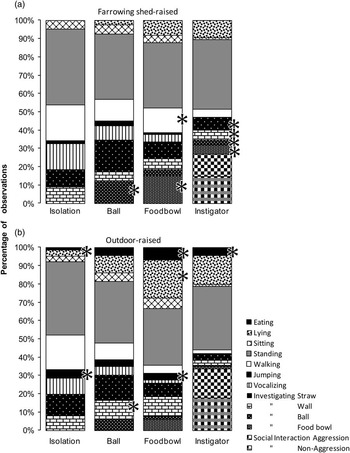
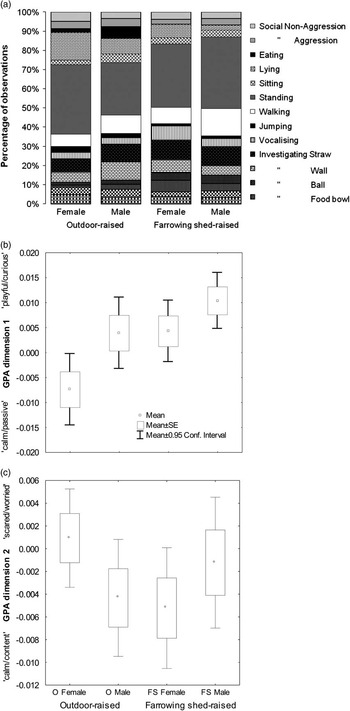
Repeated-measures ANOVA indicated that overall time budgets were influenced by the challenges that animals were exposed to (challenge main effect: F 3,672=4.90, P=0.003; Figure 2); when held in isolation (the first three challenges; total 15-min duration), both outdoor-raised and farrowing shed-raised piglets spent a greater proportion of their time vocalising, jumping against the arena walls and investigating their environment (straw, ball and food bowl), but were calmer in the presence of another piglet (more time eating and interacting with the arena walls). The raising environment significantly influenced the piglets’ overall time budget data (environment×behaviour category interaction: F 12,672=3.56, P<0.001). There was a significant influence of the sex of the animal (sex×behaviour category interaction: F 12,672=2.14, P=0.013) on the overall time budget data (Figure 3a) and a significant sex effect for behaviour in the presence of the food bowl (MANOVA).
Time budgets for (a) farrowing shed-raised and (b) outdoor-raised piglets exposed sequentially to four challenges on the day of weaning. Asterisks indicate a greater incidence of specific behaviours for that treatment group (data analysed within each challenge; statistical summary is presented in Table 2).

Comparison of overall (a) time budgets and (b), (c) qualitative behavioural expression. Please note that the y-axis labels for (b) and (c) are BoxCox-transformed, and therefore the values are not relevant.

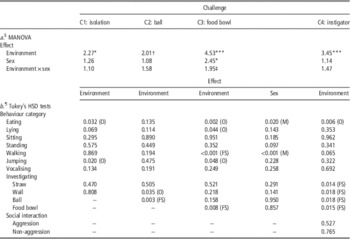
MANOVA results for each of these challenges are summarised in Table 2a, and subsequent Tukey’s HSD post-hoc analyses are summarised in Table 2b. MANOVAs indicated that there was a significant effect of raising environment on time budget data during isolation, presence of a food bowl and the presence of another piglet, whereas the result for the novel object (ball) challenge (P=0.053) also warrants discussion of these results (separate MANOVAs). During the isolation challenge, outdoor piglets spent more time eating food and jumped more compared with farrowing shed-raised piglets (Figure 2). When a novel object was subsequently introduced to the arena, farrowing shed-raised piglets spent more time interacting with the ball but less time investigating the walls compared with outdoor-raised piglets (Figure 2). When a food bowl was then placed into the experimental arena, outdoor-raised piglets spent more time eating, lying and jumping, but spent less time walking and interacting with the food bowl compared with farrowing shed-raised piglets (Figure 2); males spent more time eating and walking than females.
Summary of four separate MANOVA and Tukey’s HSD tests for time budgets

HSD=honestly significant difference.
Values are P-values; significant values are indicated where outdoor-raised piglets (O) or farrowing shed-raised piglets (FS) were more likely to perform this behaviour for the environment effects, or that males (M) were more likely to perform this behaviour for the effect of sex. Blanks (–) indicate that no action was performed during that time frame (e.g. the piglets could not show social interactions for the first three challenges, when they were in isolation).
§ Summary of four separate MANOVA for time budgets (one for each of the four experimental challenges; C1 to 4) with sex and environment as independent variables and all 14 behaviour categories as dependent variables. Numbers are F-values (*P<0.05, ***P<0.001).
¶ Summary of Tukey’s HSD tests for the time budgets for the effects of environment on each behavioural category in response to four challenges or the significant effect of sex in the food bowl challenge (the other challenges showed no significant sex effects).
†P=0.053, ‡P=0.057.
When a non-littermate was subsequently introduced, focal piglets spent 30% of their time interacting with the other piglet, and although half of this time (47%) was engaged in negative interactions (either pushing or biting or responding to being pushed or bitten) the levels of aggression were not different between farrowing shed-raised and outdoor-raised piglets. In the presence of their companion, outdoor-raised piglets spent more time eating food, but less time investigating straw, the walls, ball and food bowl compared with farrowing shed-raised piglets (Table 3; Figures 2 and 3). There was no significant effect of raising environment (F 1,56=0.01, P=0.899) or sex (F 1,56=2.09, P=0.154) on latency until first social contact; the environment×sex interaction was also not significant (F 1,56=0.18, P=0.671).
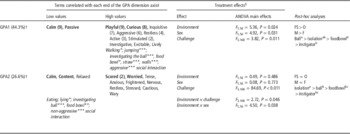
Terms used by observers to describe qualitative behavioural expression of piglets during the four challenges

GPA=Generalised Procrustes Analysis.
† The percentage of variation explained by each GPA dimension is shown in brackets.
‡ Terms that had 75% of the maximum absolute correlation value (Mardia et al., Reference Mardia, Kent and Bibby1979) are shown for each end of each GPA dimension axis. Term order is determined first by the number of observers to use each term (in brackets if >1), and second by weighting of each term (i.e. correlation with the GPA dimension). The first two terms for each dimension (used to label the axes on graphs, etc.) are indicated in bold. Italics indicates time budget categories that were significantly correlated with the GPA dimension scores (*P<0.05, **P<0.01, ***P<0.001); shown on the left- or right-hand column according to whether they were positive or negative correlations with this axis.
§ Summary of the main effects of factorial ANOVA for each GPA dimension. Letters link challenges that were not significantly different from each other for the posthoc analyses.
Qualitative behavioural analysis (QBA)
Among the 11 observers, 10 had some previous experience with farm animals (cattle, sheep, chickens and pigs), six had lived on a rural property before and all of them believed strongly that animal welfare is very important and that there was room for improvement of welfare in Australia. The 11 observers reached a consensus in their assessment of the qualitative behavioural expression of piglets: 38.72% of the variation in the data was explained by the consensus profile (the Procrustes Statistic), which differed significantly (16.98±0.187%; t 99=116.29, P<0.001) from the random profiles generated from the same dataset.
For GPA dimension 1, the terms ‘calm’ and ‘passive’ were correlated with the low end of the dimension axis, whereas ‘playful’ and ‘curious’ appeared at the high end of the axis. Repeated-measures ANOVA indicated significant differences with environment, sex and challenge for GPA1 scores (see Table 3 for statistics). Farrowing shed-raised piglets were scored as more ‘playful/curious’ than outdoor-raised animals, and males were scored as more ‘playful/curious’ than females (Figure 2b). Piglets were scored as more ‘playful/curious’ when presented with the ball and the least in the presence of the instigator. Scores for GPA dimension 1 were also correlated with the time budget scores (Table 3): animals scored as more ‘playful/curious’ also spent more time walking; jumping; investigating the ball, food bowl, straw and walls; and engaging in aggressive social interaction.
For GPA dimension 2, the terms ‘calm’ and ‘content’ were correlated with the low end of the dimension axis, whereas ‘scared’ and ‘worried’ appeared at the high end of the axis. Repeated-measures ANOVA indicated no significant differences with environment or sex, but a significant difference for the four challenges (see Table 3 for statistics). Piglets were scored as more ‘scared/worried’ when first placed in the arena (isolation challenge) and the least in the presence of the instigator. A significant challenge×environment effect reflected more ‘calm/content’ farrowing shed-raised animals in the presence of the ball, and an environment×sex interaction (Figure 2c) showed that outdoor-raised males were more ‘calm/content’ than farrowing shed-raised males, whereas the converse was true for females. Animals scored as more ‘scared/worried’ also spent less time eating; lying; investigating the ball and food bowl; and engaging in non-aggressive social interaction.
Discussion
We compared the behaviour of 30 outdoor-raised and 30 farrowing shed-raised piglets in response to four challenges (isolation, a novel object, food or introduction of another piglet) on the day of weaning. We had simplistically predicted that outdoor-raised piglets would show fewer signs of distress (Table 1) in response to our challenges, and did find significant differences in the responses of these two groups of piglets towards being held in isolation, their interactions with a food bowl and in the presence of a companion. Outdoor-raised piglets spent more time eating, but they also spent more time jumping against the arena walls (trying to escape). Farrowing shed-raised piglets spent more time interacting with their environment (e.g. sniffing, pushing, rooting under) and the food bowl itself, and their behaviour was interpreted as more ‘playful/curious’ compared with outdoor-raised animals. In general, both outdoor-raised and farrowing shed-raised piglets spent a greater proportion of their time investigating their environment (straw/ball/food bowl), vocalising, jumping, sitting and lying when they were held in isolation. Our isolated piglets were also scored (by QBA) as more ‘scared/worried’ and were most ‘calm/content’ when another piglet was introduced to the arena (when they spent more time eating and interacting with the arena walls). Importantly, in the presence of another piglet, there were no differences in level of aggression or qualitative behavioural expression between outdoor-raised and farrowing shed-raised piglets, while outdoor-raised piglets spent more time eating food and less time investigating their environment than farrowing shed-raised piglets. Below, we describe the behaviour of piglets in response to each of the four challenges and then outline some of the challenges of this study.
When kept in isolation, outdoor-raised piglets spent a greater proportion of their time eating food but also jumping (trying to escape from the experimental arena) compared with the farrowing shed-raised piglets. Jumping could be seen as form of agitation and distress (Worobec et al., Reference Worobec, Duncan and Widowski1999), and therefore reactivity, and may also reflect that these animals were not habituated to confinement. In contrast with our results, for a similar novel environment test, Hillmann et al. (Reference Hillmann, Von Hollen, Bünger, Todt and Schrader2003) reported that piglets from a group farrowing system showed less behavioural signs of distress and more explorative behaviour than individual farrowing system piglets, which showed more locomotion, agitated behaviour (e.g. jumping and raising against the surroundings) and more high-frequency vocalisations. However, both treatment groups tested by Hillmann et al. (Reference Hillmann, Von Hollen, Bünger, Todt and Schrader2003) were farrowing shed-raised animals, and increasing the social complexity of their environment through group farrowing still does not capture the environmental complexity experienced by outdoor-raised piglets.
We had predicted greater interaction with the ball for the outdoor-raised animals, on the basis of less fear and aversion to approaching a novel object for these animals (e.g. Beattie et al., Reference Beattie, O’connell and Moss2000). However, we found no statistically significant differences in the time budgets or qualitative behavioural expression of our piglet groups in response to the addition of a plastic ball into the experimental arena, and farrowing shed-raised piglets were scored as more ‘playful/curious’ overall compared with outdoor-raised animals. The novel object test not only detects neophobia (fear) but also motivation for exploration (seeking stimulus). It may be that our outdoor-raised pigs showed shorter latency to interact with the ball (as they would interact with a variety of objects in their environment on a day-to-day basis), but then ignored it, whereas the farrowing-shed-raised piglets showed a rebound effect (Dawkins, Reference Dawkins2015) and continued to be stimulated by the ball (spending more time spent in contact), as they are generally deprived of stimuli. Similarly, previous studies have found that pigs housed in a barren environment exhibit more exploratory behaviour both in a novel area and directed towards a novel object compared with enriched-housed pigs (Wood-Gush et al., Reference Wood-Gush, Vestergaard and Petersen1990; De Jong et al., Reference De Jong, Prelle, van de Burgwal, Lambooij, Korte, Blokhuis and Koolhaas2000). The provision of a novel object may, therefore, initiate either fear or curiosity, and the different results between studies may reflect the degree of novelty of the introduced object and the animals’ motivation for stimulus.
Outdoor-raised piglets spent more time eating creep feed compared with the farrowing shed-raised piglets, which were more interested in playing with the food bowl itself. Similarly, Oostindjer et al. (Reference Oostindjer, Mas Muñoz, Van den Brand, Kemp and Bolhuis2010) found that outdoor-raised piglets were more willing to touch the food compared with farrowing shed-raised piglets, whereas Cox and Cooper (Reference Cox and Cooper2001) recorded greater initial consumption of solid food in piglets reared in an outdoor system compared with indoor-reared piglets. Social learning may increase food intake due to the additional stimulus- and substrate-rich environments of outdoor systems, where the mother can show a range of foraging behaviours. Willingness to take solid food is important because as few as 50% of piglets consume their first meal within 24 h post-weaning, and 10% do not consume their meal until 48 h later (Lallès et al., Reference Lallès, Bosi, Smidt and Stokes2007). Animals that eat sooner post-weaning are, therefore, likely to be at a distinct advantage in terms of being able to adapt to the post-weaning environment.
We found no significant differences in social behaviour between outdoor-raised and farrowing shed-raised piglets in terms of the amount of time engaged in aggressive or non-aggressive social interactions (time budget analyses), latency till first social contact or the qualitative behavioural expression (QBA scores) of piglets. This result are in contrast with a previous study that found that piglets reared in a confinement system spent more time belly-nosing and displaying agonistic and oral-nasal behaviours directed towards penmates at and after weaning compared with outdoor-raised piglets (Hötzel et al., Reference Hötzel, Wolf and Costa2004). Our data also differ from the study by Hillmann et al. (Reference Hillmann, Von Hollen, Bünger, Todt and Schrader2003), who found that piglets reared in a group farrowing system were better adapted to social challenges at weaning compared with piglets reared in a single farrowing system, which showed longer latency until their first contact with an unfamiliar pig compared with group-farrowing piglets.
This study develops both quantitative and qualitative methods for assessing piglet behaviour and welfare and demonstrates the validity of comparing between methods to improve the welfare relevance of behavioural studies. The time budget data were correlated with qualitative behavioural expression scores, with animals scored as more ‘playful/curious’ or ‘calm/content’ also spending more time actively interacting with their environment. Male piglets also ate more in general and were scored as more ‘playful/curious’ than females (scored as more ‘calm/passive’). Similarly, Morgan et al. (Reference Morgan, Pluske, Miller, Collins, Barnes, Wemelsfelder and Fleming2014) compared quantitative scores with qualitative behavioural expression of piglets from individual or group-farrowing (‘socialised’) systems at weaning. They found that socialised male pigs spent more time lying, whereas females were more investigative, and these socialised animals were more likely to be described as ‘sleepy/tired/relaxed’ or ‘content/comfortable/relaxed’ than control pigs, suggesting that they adapt quicker to the new environment at mixing. The combination of time budgets and qualitative behavioural expression approaches, therefore, compliment and value add to animal welfare assessments.
In conclusion, weaning causes abrupt changes for young piglets, which are not only separated from their mothers but also have to cope with new solid food, a novel environment and often a new social group. One of the concerns for the pork industry is that confinement housing can detrimentally influence social behaviour; however, we found no differences in aggressive or non-aggressive social interactions in our two groups of piglets. The differences in engagement with their environment (investigation/exploration), attempts to escape the arena and readiness to eat under this novel environment reveal developmental differences in behaviour, although the welfare valence (i.e. whether they are positive or negative) of these behavioural components is not clear. The animals assessed were certainly healthy, but were they getting what they want? (i.e. what they will work for and find positively and negatively reinforcing; Dawkins, Reference Dawkins2015). We might conclude, therefore, that the use of individual behavioural markers does not readily translate into animal welfare measures, as there is a great deal of ambiguity in how these behavioural components may be interpreted. More holistic measures that address multiple aspects of how piglets engage with their physical and social post-weaning environment are, therefore, warranted.
This research identifies behaviour of piglets in a novel arena during isolation. It would be valuable to determine how these piglets respond to more individuals (as occurs when pigs are mixed into larger groups at weaning) and for a longer period of time than the 20 min tested in the present study. Or alternatively, do piglets respond differently at successive time points after weaning – for example, 24, 72 and 120 h – when patterns of behaviours and feeding are likely more developed? Such information, coupled with production data comparing outdoor-raised and farrowing shed-raised pigs through to finishing, is likely to make a valuable contribution to future housing and management of pigs.
Acknowledgements
The authors thank Gillian Bryant and the staff from Craig Mostyn Group, particularly Amy Suckling and Jorge Chorrez for their assistance. This study was funded by the Pork CRC Ltd. Australia, Australian Pork Limited and Murdoch University. They also thank the volunteers who helped out with assessing the footage of animals and Sarah Wickham for the use of her Excel macro worksheets.