





Complex financial decisions are never easy. Beyond the challenge of weighing financial trade-offs among options, people also struggle with trade-offs between the present and the future. Consider, for example, the question of when to begin claiming retirement benefits, a financially important decision that is mostly irrevocable once made. A person who claims early and receives lower payments cannot later change their choice for a better outcome. While a variety of interventions to guide individuals have been tested (Brown et al., Reference Brown, Kapteyn and Mitchell2016; Greenberg et al., Reference Greenberg, Hershfield, Shu and Spiller2023; Knoll et al., Reference Knoll, Appelt, Johnson and Westfall2015), many have been ineffective. Most interventions have focused on influencing decisions via information or framing targeted at the individual. In this research, we rely on a more social intervention and propose a new approach that asks individuals to consider others’ decisions, in the hope that doing so will affect their own decisions as well.
1. Choosing when to claim retirement income benefits
When to start claiming Social Security (SSA) benefits represents a complex financial decision for older Americans. American workers who have contributed to Social Security may receive retirement benefits starting at any age between 62 and 70. The longer someone delays claiming, the higher their monthly benefit will be for the remainder of their life. Thus, the trade-off is between claiming earlier and receiving smaller benefits sooner, versus claiming later and receiving larger benefits later. Importantly, once the choice to claim is made, it is nearly impossible to reverse. The claiming decision is important because U.S. workers above age 65 receive about 31% of their retirement income from Social Security (SSA, 2025). SSA benefits, which last as long as the claimant lives, provide valuable protection against outliving savings. Although the system aims for actuarial fairness on average, with a distribution of retirees claiming early at age 62 and others delaying until age 70, academic research suggests most Americans should wait until age 65 to claim benefits, and more than 90 percent should wait until age 70 (Altig et al., Reference Altig, Kotlikoff and Ye2023). One reason that many economists recommend delaying claiming as long as possible is that doing so allows workers to insure against the chance of running out of money in retirement, known as longevity risk (Shoven & Slavov, Reference Shoven and Slavov2014). Actual claiming behavior does not consistently align with these financial advantages, as many American workers claim earlier than what may serve their long-term financial interests (Shoven & Slavov, Reference Shoven and Slavov2014).
The SSA claiming decision is also fundamentally an intertemporal choice: early claiming means accepting smaller monthly benefits sooner rather than larger benefits later. Standard economic theory predicts that claiming behavior should depend on how individuals discount the future, and that early claiming ought to be more likely for those with high discount rates (Coile et al., Reference Coile, Diamond, Gruber and Jousten2002). Relatedly, time-inconsistent (i.e., present-biased) preferences predict earlier retirement (Merkle et al., Reference Merkle, Schreiber and Weber2024) and a preference for lump sums over annuities (Schreiber & Weber, Reference Schreiber and Weber2016), and research shows that individual differences in discounting predict SSA claiming intentions as well (Greenberg et al., Reference Greenberg, Hershfield, Shu and Spiller2023; Shu & Payne, Reference Shu and Payne2023).
In addition to influencing one’s own claiming decision, discounting may operate differently when the decision is made for someone else. Decision makers often choose less impulsively on behalf of others than for themselves (Albrecht et al., Reference Albrecht, Volz, Sutter, Laibson and Von Cramon2011; Ziegler & Tunney, Reference Ziegler and Tunney2012), although these differences may depend on factors such as framing (Neff & Macaskill, Reference Neff and Macaskill2021) and empathy (O’Connell et al., Reference O’Connell, Christakou, Haffey and Chakrabarti2013). Recommendations made for another person may therefore be less susceptible to present bias than choices made for oneself. Our experiments focus on intended claiming age as our primary measure. Research on interventions for claiming regularly relies on hypothetical rather than actual claiming age, using an intention measure like that used in the RAND American Life Panel (e.g., Brown et al., Reference Brown, Kapteyn and Mitchell2016; Knoll et al., Reference Knoll, Appelt, Johnson and Westfall2015; Liebman & Luttmer, Reference Liebman and Luttmer2015; Perez-Arce et al., Reference Perez-Arce, Rabinovich, Samek and Yoong2021). While findings based on a hypothetical measure may not directly translate to actual claiming choices, data from the Health and Retirement Study suggest a strong correlation between intended claiming age and actual claiming behavior (Greenberg et al., Reference Greenberg, Hershfield, Shu and Spiller2023), with average intended claiming ages slightly higher than actual claiming ages (Merkle et al., Reference Merkle, Schreiber and Weber2024).
2. Choosing and recommending for another
There is robust evidence that people make different choices for others than they do for themselves. In the context of decisions involving risk and uncertainty, people exhibit less loss aversion (Andersson et al., Reference Andersson, Holm, Tyran and Wengström2016; Polman, Reference Polman2012b) but more risk aversion (Dana & Cain, Reference Dana and Cain2015) when making choices for others than for the self. They also tend to be more promotion-focused (Polman, Reference Polman2012a). One reason for these differences is that people tend to rely on emotions more in choices for the self than in choices for others (Hsee & Weber, Reference Hsee and Weber1997). Moreover, making decisions on behalf of others may draw attention to important aspects of a decision that are often overlooked when making decisions for oneself due to personal responsibility or concerns about regret or blame (Steffel & Williams, Reference Steffel and Williams2018; Steffel et al., Reference Steffel, Williams and Perrmann-Graham2016). For an in-depth discussion of moderators of self-other differences, see Batteux et al. (Reference Batteux, Ferguson and Tunney2019).
Making a recommendation for another could serve as an act of ‘self-persuasion’ (Aronson, Reference Aronson1999; Briñol et al., Reference Briñol, McCaslin and Petty2012). The ability to take another’s perspective has been shown to improve outcomes in negotiation settings (Neale & Bazerman, Reference Neale and Bazerman1983), and adopting a different perspective in interpersonal settings has important financial implications (see, e.g., Morvinski & Shani, Reference Morvinski and Shani2022). Moreover, Heath and Heath (Reference Heath and Heath2013) suggest that decision makers ought to consider the advice one would give to a friend facing a comparable decision. In so doing, people adopt the point of view of the friend and are therefore able to focus attention on crucial elements of the decision and divert attention away from emotional aspects of decision making.
The most closely related work is in the domain of advice giving. Systematic differences exist between the advice people give to others and what people would choose for themselves. People tend to make choices for others that are more consistent with what most people find important than when making choices for themselves (Kray, Reference Kray2000). However, advice tends to be more idealistic (vs. pragmatic) than choices for the self (Danziger et al., Reference Danziger, Montal and Barkan2012), and people often advise others to resist useless information while not heeding their own advice (Barkan et al., Reference Barkan, Danziger and Shani2016). A large amount of work has been devoted to understanding such differences between ‘personal decision makers’ and advisors (for a review, see Bonaccio & Dalal, Reference Bonaccio and Dalal2006).
Less attention has been devoted to understanding how the advising role changes the advisor’s own choices. Compared to receiving expert advice, giving motivational advice to another has been shown to increase one’s own motivation (Eskreis-Winkler et al., Reference Eskreis-Winkler, Fishbach and Duckworth2018). In another context, high school students randomly assigned to give motivational advice to younger students earned higher grades in mathematics and in a prespecified target course compared to a control group that did not give advice (Eskreis-Winkler et al., Reference Eskreis-Winkler, Milkman, Gromet and Duckworth2019). There are at least two reasons why advice-giving could lead to better outcomes for the self. First, during deliberation, taking on an advisory role (vs. a decision-maker role) may lead to more balanced and less biased information search (Jonas & Frey, Reference Jonas and Frey2003; Jonas et al., Reference Jonas, Schulz-Hardt and Frey2005), potentially leading to better decisions. Second, advice giving could have positive effects on the advice giver, leading to greater confidence (Eskreis-Winkler et al., Reference Eskreis-Winkler, Fishbach and Duckworth2018; see also, Baron, Reference Baron2019) and increasing one’s own feelings of power (Schaerer et al., Reference Schaerer, Tost, Huang, Gino and Larrick2018). In the retirement-planning context, exposure to vignettes about others’ decisions improved the quality of advice (Samek et al., Reference Samek, Kapteyn and Gray2022). The current research examines how making a guided recommendation for another person affects an individual’s own choices in the context of the SSA claiming decision. In particular, we examine how a norm-guided intervention in which people make a recommendation for another affects one’s own decisions about retirement income.
3. Hypotheses, studies, and transparency and openness
This research reports on tests of psychological process interventions for the claiming decision by asking whether, and to what extent, norm-guided recommendations for another influence one’s own claiming choices. In both studies, participants are given normative information about claiming. Study 1 asks whether considering someone who lived longer into retirement—who may have claimed too early—versus someone who had died early into retirement—who may have delayed claiming for too long—leads to later versus earlier claiming, respectively. Study 2 disentangles the extent to which these effects may be differentially driven by recall of an older or younger person or by the effect of the norm-guided recommendation process itself. Both studies examine how such interventions affect subjective life expectancy. Specifically, in Study 1, we explored whether the interventions might lead people to consider different tails of the longevity distribution. This allowed us to further examine whether any effects of the interventions on claiming persist after controlling for subjective life expectancy.
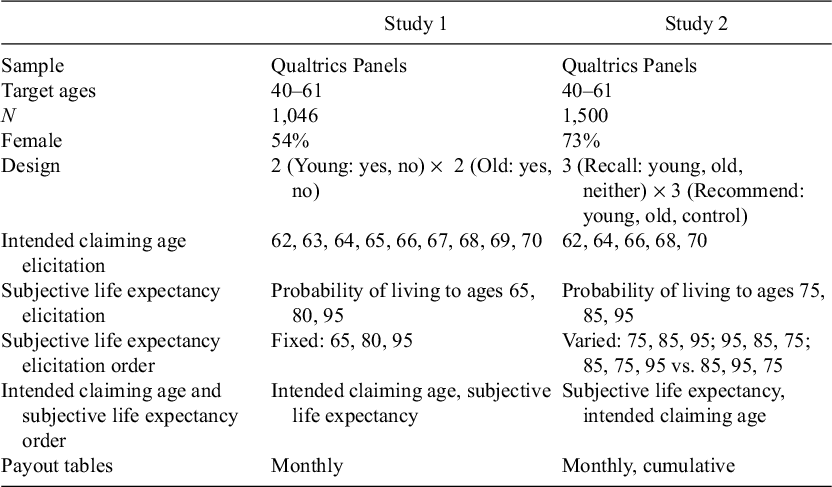
We hypothesized that recalling someone who had lived long after retirement, as compared to recalling someone who had died soon after retirement, would make longer longevity more salient and lead to later intended claiming. The disentangling of recall and recommendation in Study 2 also offers insight into whether the effect may arise from an unconscious bias (e.g., priming or anchoring) based on recall, or from active consideration of the decision on behalf of another person. Table 1 outlines the key differences between the studies.
Summary of differences between Studies 1 and 2

Table 1. Long description
The table consists of three columns: Category, Study 1, and Study 2.
* Sample: Both studies used Qualtrics panels.
* Target ages: Both studies targeted ages 40 to 61.
* N: Study 1 has 1,046 participants; Study 2 has 1,500 participants.
* Female: Study 1 is 54 percent female; Study 2 is 73 percent female.
* Design: Study 1 used a 2 (Young: yes, no) times 2 (Old: yes, no) design. Study 2 used a 3 (Recall: young, old, neither) times 3 (Recommend: young, old, control) design.
* Intended claiming age elicitation: Study 1 included ages 62, 63, 64, 65, 66, 67, 68, 69, 70. Study 2 included ages 62, 64, 66, 68, 70.
* Subjective life expectancy elicitation: Study 1 asked for the probability of living to ages 65, 80, 95. Study 2 asked for the probability of living to ages 75, 85, 95.
* Subjective life expectancy elicitation order: Study 1 used a fixed order (65, 80, 95). Study 2 varied the order (75, 85, 95; 95, 85, 75; 85, 75, 95 versus 85, 95, 75).
* Intended claiming age and subjective life expectancy order: Study 1 presented intended claiming age then subjective life expectancy. Study 2 presented subjective life expectancy then intended claiming age.
* Payout tables: Study 1 provided monthly tables. Study 2 provided both monthly and cumulative tables.
For both studies, we describe our sampling plan, all data exclusions, all manipulations, and all measures. All data, analysis code, and research materials are available at https://osf.io/zjfpy. Data were analyzed using STATA. Study 2 was pre-registered. Notably, in both studies, participants were pre-screened to be between ages 40 and 61; incidentally, there was a greater gender imbalance in Study 2. Study 1 was conducted in 2017, before pre-registration was common. Individual difference measures collected in Studies 1 and 2 are reported in the Supplementary Material. Studies were approved by the institutional review boards of the University of California, Los Angeles and Duke University.
4. Study 1: Joint effects of recall and recommendation
In Study 1, we ask participants to explicitly reflect upon the implications of longevity for the preferred sequence of SSA benefits (e.g., a sequence of smaller benefits that starts earlier vs. a sequence of larger benefits that starts later) and ask them to generate an example of someone they knew who died either early and/or late in retirement. In both interventions, injunctive normative behavior (Reno et al., Reference Reno, Cialdini and Kallgren1993) was highlighted: Those who die young may regret delaying claiming, while those who die old may regret claiming too early. This study allows us to assess whether the intervention shifted participants’ intended claiming ages and whether it shifted their sensitivity to earlier versus later longevity likelihoods.
4.1. Method
4.1.1. Sampling and design
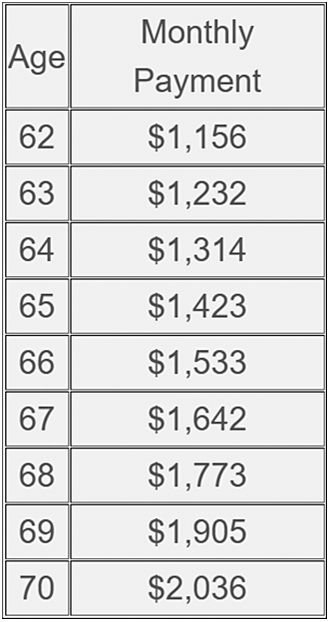
A national sample of adults prescreened to be between ages 40 and 61 was recruited via Qualtrics Panels (N = 1,046, 54% female, M age = 52). The study was conducted in September 2017. Qualtrics Panels recruits high-quality, well-paid research participants from a distribution of U.S.-based adults whose demographics fit reasonably well with national averages. Potential participants who failed an upfront attention check did not proceed in the survey, and the final sample size comprises all participants. Analyses that include subjective life expectancy exclude participants who violate the monotonicity of probabilities (i.e., assign greater probability to living to later ages than to earlier ages). In the control group, participants read basic information about the importance of Social Security and how benefits vary as a function of when individuals choose to claim. In addition, they were shown a table of monthly benefits for each claiming age from 62 (early retirement) to 70 (delayed retirement) for a typical retiree which served as the basis for all treatments. A screenshot of the control condition is provided in Figure 1.
Social Security benefits table, Study 1.

We used an experimental design with four conditions: young, old, young-and-old, and control. In the young condition, participants read: ‘Some people die at a very young age after retiring. Unfortunately, some of these people lose out on money because they waited too long to claim Social Security benefits.’ They then reflected on individuals who died relatively early in retirement, before claiming benefits, and also recommended when such an individual should claim (i.e., an integer age between 62 and 70). They were then required to report the name of someone they knew who died relatively early in retirement to make this abstract situation more concrete. Specifically, they were asked, ‘Now, think of someone you know who died at a very young age after retiring from work. Please write this person’s first name or nickname below.’
In the old condition, participants read: ‘Some people live to a very old age after retiring. Unfortunately, some of these people struggle financially because they claimed Social Security benefits too early and earn low monthly benefits.’ They then reflected on individuals who died relatively late in retirement who claimed relatively early and also made a recommendation for when such an individual should claim. They were then required to report the name of someone they knew who died relatively late into retirement. Specifically, they were asked, ‘Now, think of someone you know who lived to a very old age after retiring from work. Please write this person’s first name or nickname below.’
In the young-and-old condition, participants were exposed to both manipulations, with order counterbalanced. Finally, in the control, neither was salient, and participants proceeded to the claiming choice without considering early or late death.
4.1.2. Intended claiming age
Participants were given the same benefits table that appears in Figure 1, then asked to suppose that they had just turned 60, and to indicate the age they would ‘prefer to start claiming your retirement benefits’. Participants could choose between any integer age between 62 and 70, which reflects the years in which people are able to claim, or could indicate ‘I don’t know’, which then prompted them to report their intended claiming age if they ‘had to decide’.
4.1.3. Subjective life expectancy
We measure subjective life expectancy, which is highly correlated with actuarial life expectancy but likely upwardly biased on average (see Smith et al., Reference Smith, Taylor and Sloan2001, who predict mortality from subjective life expectancy). Similar to the instrument used by Payne et al. (Reference Payne, Sagara, Shu, Appelt and Johnson2013), subjective life expectancies were assessed via converting participants’ subjective probabilities (0 = ‘no chance’, 100 = ‘for certain’) of living to ages 65, 80, and 95 into a single measure as described below. A screenshot of the survey instrument is provided in Figure 2.
Subjective life expectancy survey instrument, Study 1.

Figure 2. Long description
At the top, a sentence reads, The number 0 means no chance and the number 100 means for certain. Below this, a horizontal scale ranges from 0 to 100 in increments of 10. Underneath the scale are three survey items, each consisting of a text prompt on the left and a horizontal slider bar on the right.
* The first prompt is, The chance that I will live to be 65 years old or more is.
* The second prompt is, The chance that I will live to be 80 years old or more is.
* The third prompt is, The chance that I will live to be 95 years old or more is.
Each slider bar has a light blue circular handle positioned at the far left, corresponding to the 0 mark on the scale above.
4.1.4. Individual differences
We included several measures for exploratory purposes. Prior to assessing subjective life expectancy, we asked which part of retirement (early retirement, mid-retirement, and end-of-life) participants thought about and worried most about, and asked for open-ended responses about which factors they found most important in their claiming choices. For those exposed to experimental manipulations, we asked for more details about the person they listed (i.e., age, relationship to the participant).
After assessing subjective life expectancy, we examined several measures that have been shown to correlate with claiming age (see Greenberg et al., Reference Greenberg, Hershfield, Shu and Spiller2023). We assessed participants’ perceived ownership of their SSA benefits (Peck & Shu, Reference Peck and Shu2018; Shu & Payne, Reference Shu and Payne2023) and asked them to what extent they expect SSA benefits to be available by the time they retire (i.e., SSA solvency). To assess loss aversion, participants made 10 choices between pairs of three-outcome gambles (Shu et al., Reference Shu, Zeithammer and Payne2016). To assess intertemporal discounting preferences, participants completed a multiple price list of choices between a sum of money today and a sum of money one year from now (e.g., Harrison et al., Reference Harrison, Lau and Williams2002). For those exposed to experimental manipulations, we asked whether the listed person was real, still living, or not a real person. We also included single-item measures of risk aversion and subjective health, and assessed sociodemographic information including zip code, educational attainment, income, savings, and gender.
4.2. Results
We first examine whether the manipulations affected recommendations. Overall, claiming-age recommendations were higher for the old individual than for the young individual (old: M = 68.35, SD = 2.39, young: M = 63.33, SD = 2.21). This difference was significant among participants in the young-and-old condition, who made both recommendations (old: M = 68.46, SD = 2.22, young: M = 63.37, SD = 2.27, t(256) = 26.38, p < .001), and when comparing participants in the old versus young conditions (old: M = 68.24, SD = 2.54, young: M = 63.29, SD = 2.15, t(516) = 23.95, p < .001). Recommendations did not differ between the young-and-old condition and the old condition (t(513) = 1.02, p = .308), or between the young-and-old condition and the young condition (t(515) = 0.38, p = .706).
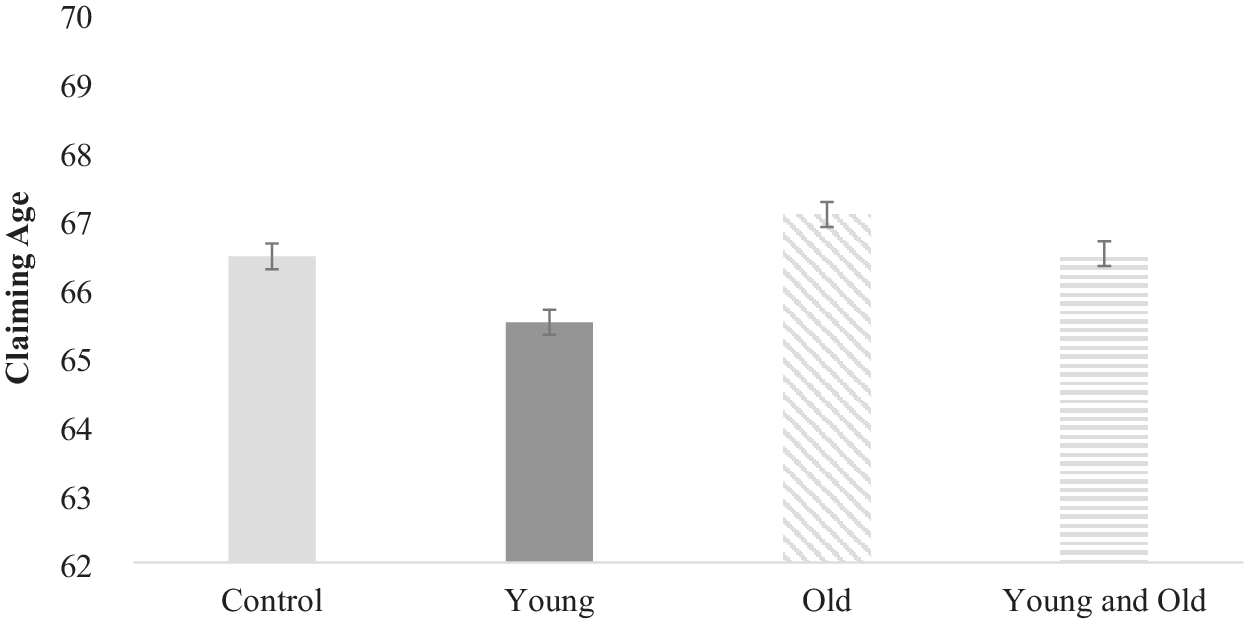
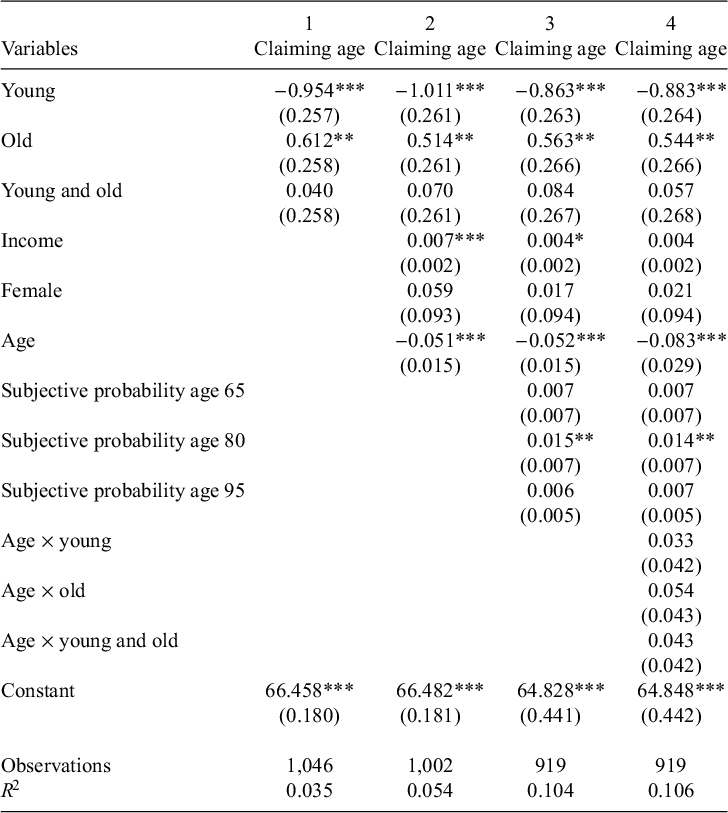
The results of intended claiming age by condition are summarized in Figure 3. Whereas considering someone who died younger decreases intended claiming age, considering someone who died older increases intended claiming age. We first consider the effects of condition on intended claiming age using three models: main effects of conditions, main effects of conditions plus demographic covariates, and main effects of conditions with demographic covariates and probabilities used to assess subjective life expectancy. Additionally, we report interactions between conditions and age. The regression results are summarized in Table 2.
Intended claiming age by condition, Study 1.
Note: Error bars represent standard errors. The young-and-old condition collapses on two orders that were counterbalanced.

OLS regression of intended claiming age, Study 1

Table 2. Long description
The table presents O L S regression results for claiming age across four specifications.
Header: The columns are numbered 1 through 4, all with the dependent variable Claiming age.
Variables and Coefficients (Standard Errors in parentheses):
- Young: -0.954*** (0.257) in Model 1; -1.011*** (0.261) in Model 2; -0.863*** (0.263) in Model 3; -0.883*** (0.264) in Model 4.
- Old: 0.612** (0.258) in Model 1; 0.514** (0.261) in Model 2; 0.563** (0.266) in Model 3; 0.544** (0.266) in Model 4.
- Young and old: 0.040 (0.258) in Model 1; 0.070 (0.261) in Model 2; 0.084 (0.267) in Model 3; 0.057 (0.268) in Model 4.
- Income: 0.007*** (0.002) in Model 2; 0.004* (0.002) in Model 3; 0.004 (0.002) in Model 4.
- Female: 0.059 (0.093) in Model 2; 0.017 (0.094) in Model 3; 0.021 (0.094) in Model 4.
- Age: -0.051*** (0.015) in Model 2; -0.052*** (0.015) in Model 3; -0.083*** (0.029) in Model 4.
- Subjective probability age 65: 0.007 (0.007) in Models 3 and 4.
- Subjective probability age 80: 0.015** (0.007) in Model 3; 0.014** (0.007) in Model 4.
- Subjective probability age 95: 0.006 (0.005) in Model 3; 0.007 (0.005) in Model 4.
- Age times young: 0.033 (0.042) in Model 4.
- Age times old: 0.054 (0.043) in Model 4.
- Age times young and old: 0.043 (0.042) in Model 4.
- Constant: 66.458*** (0.180) in Model 1; 66.482*** (0.181) in Model 2; 64.828*** (0.441) in Model 3; 64.848*** (0.442) in Model 4.
Summary Statistics:
- Observations: 1,046 (Model 1); 1,002 (Model 2); 919 (Models 3 and 4).
- R-squared: 0.035 (Model 1); 0.054 (Model 2); 0.104 (Model 3); 0.106 (Model 4).
Significance levels: *** p < .01, ** p < .05, * p < .10.
Note: Standard errors in parentheses. *** p < .01, ** p < .05, * p < .10. The control condition is the omitted category. Income is reported in thousands of $. Income and age are mean-centered; female is contrast-coded (1 = female, −1 = male). Specification 3 includes only those whose subjective life expectancy probabilities did not violate monotonicity.
Compared to the control condition, considering someone who dies relatively young in retirement reduces intended claiming age by 11 months (B = −.954, SE = .257, p < .001; Table 2, specification 1), while considering someone who lives until old age increases intended claiming age by 7 months (B = .612, SE = .258, p = .018; Table 2, specification 1). Considering both someone who dies young and someone who dies old had no effect on intended claiming age relative to the control (B = .040, SE = .258, p = .875; Table 2, specification 1). Although we did not have a priori predictions about the effect of the young-and-old condition, the null effect is informative. If the two manipulations operated independently—that is, additively—but in opposite directions, we would expect a near-zero effect on intended claiming age, which is what we observe. This pattern suggests that both the young and old manipulations prompt deliberation in similar ways but push judgments in competing directions. When people engage with both manipulations, the independent effects of each are therefore neutralized.
Results are not substantively different when controlling for income, sex, and age (Table 2, specification 2), and held when we control for subjective life expectancy probabilities (Table 2, specification 3). In addition, we tested whether age moderates the effects of the three conditions, and found that it does not (Table 2, specification 4). Note that in models in which we include subjective life expectancy probabilities, 87 participants who violate monotonicity of probabilities have undefined subjective life expectancies and are therefore not included. As a robustness check, if we instead use a dichotomous measure of early claiming—that is, whether participants chose to claim at age 64 or below—as the dependent variable in analogous logistic regressions, the results are consistent with those presented. Analyses are provided in Table S1 in the Supplementary Material. Results are similar when excluding participants who initially responded ‘I don’t know’ before indicating their intended claiming age (see Table S2 in the Supplementary Material).
We next examine the manipulations’ effects on subjective life expectancy estimates to better understand whether they affect subjective life expectancy alongside intended claiming age. Regression results can be found in Table S3 in the Supplementary Material. To compute subjective life expectancies, we fit the elicited probabilities of living until ages 65, 80, and 95 to a Weibull distribution (see Greenberg et al., Reference Greenberg, Hershfield, Shu and Spiller2023; Payne et al., Reference Payne, Sagara, Shu, Appelt and Johnson2013); this imputes subjective life expectancy in years. Specifically, for each respondent, we constructed a single summary measure that accounts for these three elicited probability estimates, assuming a 100% chance of being alive at the respondent’s current age and a 0% chance of surviving to age 130, which we believe is a reasonable upper bound (122 is currently the oldest recorded age). Using these inputs, we estimated parameters for a Weibull model that smooths over these estimates. Note that subjective life expectancy is undefined for participants who assigned 0% probability to all ages. This model yielded an individual-level measure of subjective life expectancy, defined as the age at which the model predicted a 50% probability of being alive.
We then examine the effects of the manipulations on this subjective life expectancy and on each individual probability estimate, with and without the demographic covariates listed above. Overall, considering someone who died younger marginally decreases subjective life expectancy by approximately two years, but there are no effects of the old or young-and-old conditions on subjective life expectancy (Table S3 in the Supplementary Material, specifications 1–2). Both the young and the young-and-old conditions decrease the subjective probability of living to age 65, but considering only someone older has no significant effect on this probability (Table S3 in the Supplementary Material, specifications 3–4). There is some evidence that considering someone older might increase the subjective probability of living to age 95, but the evidence is mixed (Table S3 in the Supplementary Material, specifications 7–8). None of the conditions affects the subjective probability of living to age 80.
4.3. Discussion
Our results indicate that a norm-guided intervention that considers someone who dies older in retirement increases intended claiming age, whereas one that considers someone who dies younger in retirement decreases it. Overall, the difference in intended claiming age between the two interventions is approximately 18 months. Results hold even when controlling for demographic characteristics such as income, sex, and age. Moreover, the results are similar when controlling for subjective life expectancy probabilities, which themselves are not substantially affected by the interventions. Since subjective life expectancies are not consistently affected, this suggests that the impact of the recall and recommendation manipulations on intended claiming is mediated by another mechanism. We explore potential explanations in the next study.
5. Study 2: Disentangling the effects of recall and recommendation
It is possible that, in Study 1, simply recalling a sample individual acts as a prime or anchor for the later claiming intention decision for the self. Attending to a specific, personally known individual may also introduce other mechanisms—such as psychological closeness to that person, the ease (vs. difficulty) of generating an exemplar, or negative emotional reactions to imagining that person’s financial circumstances—that confound understanding whether the effect is driven by recommendation. However, based on prior research, it is also possible that making a recommendation for another person may go beyond anchoring and encourage greater focus on trade-offs in the decision. Study 2 aims to differentially unpack the effect of the recall and recommendation components of this process intervention in a fully crossed experimental design.
5.1. Method
The methods, analyses, and hypotheses for this study were pre-registered (https://aspredicted.org/v5g5-7trr.pdf).
5.1.1. Sampling and design
A national sample of adults prescreened to be between ages 40 and 61 was recruited via Qualtrics Panels (N = 1,500, 73% female, M age = 53). The study was conducted in May–June 2019. As in Study 1, potential participants who failed upfront attention checks did not proceed in the survey, and analyses including subjective life expectancy excluded participants who violated monotonicity of probabilities. The design of Study 2 differed from that of Study 1 on four important dimensions. First, whereas Study 1’s interventions combined recall and recommendation, Study 2 aimed to separate these two effects. Second, Study 2 used slightly different elicitations. In particular, it relied on a slightly different measure of intended claiming age, requested subjective probabilities of living to different ages, and presented those probabilities in two different orders. Third, subjective life expectancy measures were collected prior to the intended claiming age decision. Finally, more extensive background information was provided to participants, including average life expectancy and related distributional information for the overall U.S. population (see Beshears et al., Reference Beshears, Choi, Laibson, Madrian and Zeldes2014).
This study followed a 3 (recall: young, old, neither) × 3 (recommend: young, old, control) × 3 (subjective life expectancy order: increasing, decreasing, neither) between-subjects design. In the young-recall condition, participants were asked to think of someone they knew who died at a very young age after retiring, and to indicate the person’s first name and age. In the old-recall condition, participants were asked to think of someone they knew who lived to a very old age after retiring, and to indicate the person’s first name and age. The neither-recall condition served as a control in which they were not asked to recall any individual at all.
In the old-recommend and young-recommend conditions, participants were told that they would be giving a recommendation to a friend who lived to a very old or young age, depending on condition. Participants in the old-recommend condition were told that some people die at a very old age after retiring, and that some struggle financially because they claim too early. Participants in the young-recommend condition were told that some people die at a very young age after retiring, and that some lose out on money because they wait too long to claim benefits. In each of these conditions, participants were then given a cumulative benefits tableFootnote 1 outlining lifetime benefits for different ages of death and claiming ages, and asked to indicate the age they would recommend that the person they know start claiming benefits (ages 62, 64, 66, 68, and 70). The neither-recommend conditions served as a control in which they were not asked to make any recommendations at all. Note that recall and recommendation conditions were orthogonal: participants in the three recommendation conditions may have been assigned to the old-recall condition, the young-recall condition, or neither.
5.1.2. Subjective life expectancy
Subjective life expectancy was elicited as in Study 1, with several key differences. First, in this study, participants were given the opportunity to revise their probability estimates. After choosing a probability on a slider between 0 and 100, participants saw which probability they indicated and were asked whether they were satisfied with their response. Those who clicked ‘No, I want to go back and change my response’ instead of ‘Yes, I am satisfied with my response’ could then revise their estimates. Second, whereas participants in Study 1 were asked their subjective probabilities of living to ages 65, 80, and 95 after indicating intended claiming age, participants in this study were asked their subjective probabilities of living to ages 75, 85, and 95 before indicating intended claiming age. Finally, the order of the probability elicitation was fully randomized. Participants in the increasing-order condition indicated their probabilities for ages 75, 85, and 95; those in the decreasing-order condition indicated them for ages 95, 85, and 75; and those in the neither-order condition started with age 85, then responded to 75 and 95, with the order of the latter two counterbalanced.
5.1.3. Intended claiming age
Participants were given the cumulative benefits table that appeared in the recommendation manipulations. As in Study 1, all participants were asked to imagine that they had turned 60, and to indicate the age they would ‘prefer to start claiming your retirement benefits’. Participants in this study had to choose between ages 62, 64, 66, 68, and 70, without the option to indicate ‘I don’t know’.
5.1.4. Individual difference measures
After the claiming decision, as in Study 1, participants indicated which part of retirement (early retirement, mid-retirement, and end-of-life) they thought most about and worried most about and then wrote in an open-ended way which factors they found most important in their claiming choices. Similar to Study 1, we assessed participants’ perceived ownership of their SSA benefits, their perceptions of SSA solvency, loss aversion (with gains and losses counterbalanced), intertemporal discounting, and subjective health. Unlike Study 1, we assessed risk aversion using the item that appears in the German Socioeconomic Panel (Dohmen et al., Reference Dohmen, Falk, Huffman, Sunde, Schupp and Wagner2011) and included three measures that assessed financial risk tolerance. For those exposed to experimental manipulations, we asked whether the person listed was a real person, was in fact still living, or was actually not a real person. All participants provided detailed sociodemographic information including zip code, educational attainment, income, savings, gender, and marriage information.
5.2. Results
Although not pre-registered, we first consider whether the manipulations affected recommendations. As in Study 1, in aggregate, claiming-age recommendations were higher for the old individual than for the young individual (old: M = 68.59, SD = 2.25, young: M = 62.57, SD = 1.54, t(982) = 49.02, p < .001). Recommendations for the young individual were similar across the three recall conditions (recall control: M = 62.51, SD = 1.39; recall old: M = 62.62, SD = 1.71; recall young: M = 62.60, SD = 1.52; recall control vs. recall old: t(338) = −0.62, p = .535; recall control vs. recall young: t(341) = −0.59, p = .556; recall old vs. recall young: t(313) = 0.06, p = .949). For recommendations for the old individual, participants in the recall-control condition reported slightly higher recommendations (M = 68.82, SD = 2.10) than those in the recall-old condition (M = 68.36, SD = 2.34; t(328) = 1.86, p = .064). The recall-control condition also did not differ from the recall-young condition (M = 68.58, SD = 2.30; t(317) = 0.96, p = .338), and the recall-old and recall-young conditions did not differ from each other (t(319) = −0.84, p = .399).
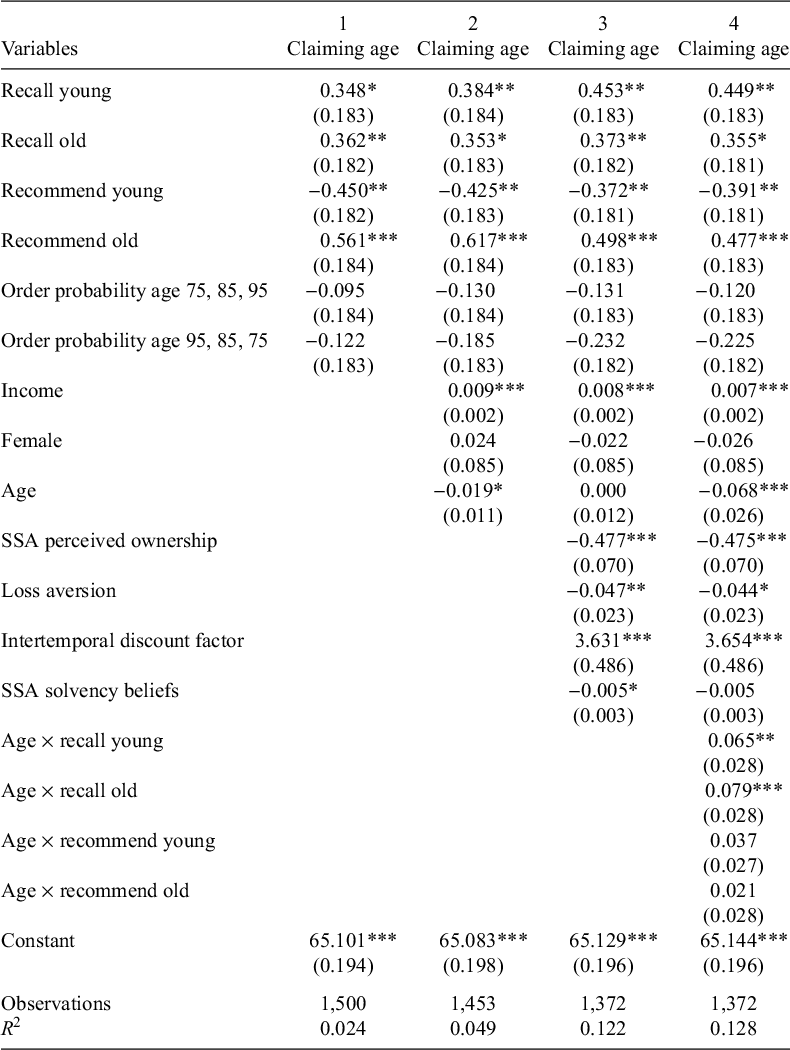
As pre-registered, we consider the effects of conditions on intended claiming age using three models: main effects of conditions, main effects of conditions plus demographic covariates, and main effects of conditions with demographic covariates and four psychologically based individual difference measures (i.e., perceived ownership of SSA benefits, loss aversion, intertemporal discount factor, perceptions of SSA solvency). As an exploratory analysis, we also assessed whether age moderates the effects of the two recall and two recommendation conditions. There were 120 participants who violated monotonicity in subjective life expectancies; these participants were excluded from all analyses involving subjective life expectancy. The regression results are summarized in Table 3.
OLS regression of intended claiming age, Study 2

Table 3. Long description
A table with five columns. The first column lists Variables, and columns 1 through 4 represent different regression models for Claiming age.
* Recall young: Coefficients range from 0.348 to 0.449 across models 1 to 4, all significant at p < .10 or p < .05. Standard errors are consistently around 0.183.
* Recall old: Coefficients range from 0.353 to 0.373, significant at p < .10 or p < .05.
* Recommend young: Negative coefficients from -0.450 to -0.372, all significant at p < .05.
* Recommend old: Positive coefficients from 0.477 to 0.617, all highly significant at p < .01.
* Order probability age 75, 85, 95: Non-significant negative coefficients around -0.1.
* Order probability age 95, 85, 75: Non-significant negative coefficients around -0.2.
* Income: Significant positive coefficients of 0.009, 0.008, and 0.007 in models 2, 3, and 4 respectively (p < .01).
* Female: Non-significant coefficients ranging from 0.024 to -0.026.
* Age: Significant negative coefficient in model 2 (-0.019, p < .10) and model 4 (-0.068, p < .01).
* S S A perceived ownership: Significant negative coefficients of -0.477 and -0.475 in models 3 and 4 (p < .01).
* Loss aversion: Significant negative coefficients of -0.047 and -0.044 in models 3 and 4.
* Intertemporal discount factor: Highly significant positive coefficients of 3.631 and 3.654 in models 3 and 4 (p < .01).
* S S A solvency beliefs: Significant negative coefficient of -0.005 in model 3 (p < .10).
* Interaction terms (Age times Recall/Recommend): Only Age times recall young (0.065, p < .05) and Age times recall old (0.079, p < .01) are significant in model 4.
* Constant: Highly significant values around 65.1 for all models.
* Observations: 1,500 in model 1, decreasing to 1,372 in models 3 and 4.
* R-squared: Increases from 0.024 in model 1 to 0.128 in model 4.
Note: Standard errors in parentheses. *** p < .01, ** p < .05, * p < .10. The omitted category is the control with the order of subjective life expectancy probabilities starting with the probability of reaching age 85. Income is reported in thousands of $. Income and age are mean-centered; female is contrast-coded (1 = female, −1 = male).
Overall, compared to the control condition, recommending for an older person has a significant positive effect on intended claiming age, and recommending for a younger person has a significant negative effect on intended claiming age across all three pre-registered specifications (Table 3, specifications 1–3). However, the effects of recalling an older person and recalling a younger person are both positive (Table 3, specifications 1–3). Although not pre-registered, post hoc tests comparing coefficients indicate that while the coefficients for recommending for an older person and recommending for a younger person are significantly different (all ps < .001), the coefficients for recalling an older person and recalling a younger person are not (all ps > .6).
Although not pre-registered, we tested whether age moderates the effects of conditions. Notably, age did not interact with either recommendation condition, but it interacted positively both with recalling an older person and recalling a younger person (Table 3, specification 4). Note that we did not pre-register the inclusion of condition interactions, but analogous models that include them yield no significant interaction effects (see Table S4 in the Supplementary Material). Moreover, results are similar if we exclude participants whose subjective life expectancy probabilities violated monotonicity (see Table S5 in the Supplementary Material) or if we instead use ordered logistic regressions (see Table S6 in the Supplementary Material). As in Study 1, if we instead use a dichotomous measure of early claiming (i.e., age 64 or below) as a dependent variable in analogous logistic regressions, the results are similar. These analyses are presented in Table S7 of the Supplementary Material.
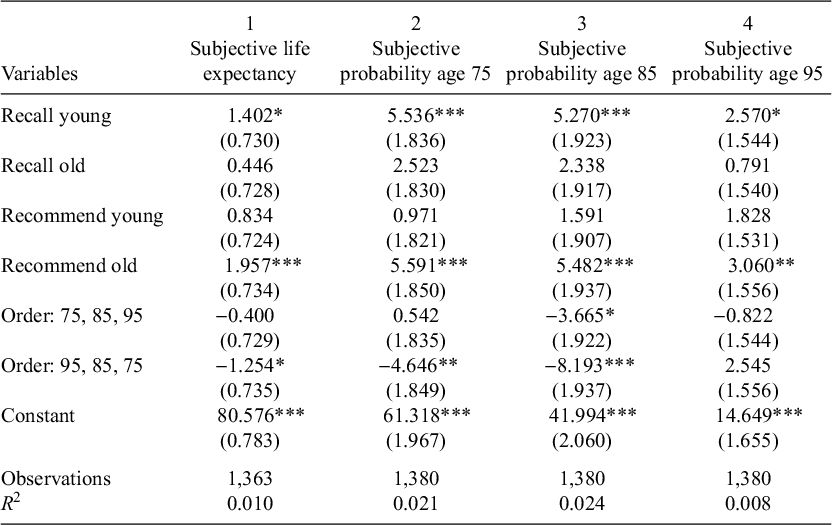
We next examine the effects of the manipulations on subjective life expectancy estimates relative to the control condition. The regression results are summarized in Table 4. To compute subjective life expectancies, we fit elicited probabilities of living until ages 75, 85, and 95 to a Weibull distribution, as in Study 1 (see Payne et al., Reference Payne, Sagara, Shu, Appelt and Johnson2013). Overall, compared to the control condition, recommending for an older person significantly increases subjective life expectancy, while recommending for a younger person does not significantly affect subjective life expectancy (Table 4, specification 1). Interestingly, in line with the above results for intended claiming age, recalling a younger person marginally significantly increases subjective life expectancy; recalling an older person does not significantly affect subjective life expectancy (Table 4, specification 1). The effects of recommending for an older person and recalling a younger person appear to be driven by the subjective probabilities of reaching the younger ages of 75 and 85 (Table 4, specifications 2 and 3) to a greater extent than the subjective probabilities of reaching age 95 (Table 4, specification 4). These results are very similar when controlling for demographic covariates (i.e., age, sex, and income). Post hoc models with condition interactions yield no significant interactions (see Table S8 in the Supplementary Material).
OLS regression of subjective life expectancy and probabilities, Study 2

Table 4. Long description
The table consists of five columns and sixteen rows. The first column lists Variables, while columns 1 through 4 represent different dependent variables: Subjective life expectancy, Subjective probability age 75, Subjective probability age 85, and Subjective probability age 95.
Key findings include:
* Recall young: Positive coefficients across all models, most significant in Model 2 (5.536) and Model 3 (5.270) at p < .01.
* Recall old: Non-significant positive coefficients ranging from 0.446 to 2.523.
* Recommend young: Non-significant positive coefficients ranging from 0.834 to 1.828.
* Recommend old: Highly significant positive coefficients in all models, peaking in Model 2 (5.591) and Model 3 (5.482) at p < .01.
* Order 75, 85, 95: Negative coefficient in Model 3 (-3.665, p < .10).
* Order 95, 85, 75: Significant negative coefficients in Model 1 (-1.254, p < .10), Model 2 (-4.646, p < .05), and Model 3 (-8.193, p < .01).
* Constant: Highly significant across all models, starting at 80.576 in Model 1 and decreasing to 14.649 in Model 4.
Bottom rows indicate:
* Observations: 1,363 for Model 1 and 1,380 for Models 2 through 4.
* R-squared: Values range from 0.008 to 0.024.
Standard errors are provided in parentheses below each coefficient.
Note: Standard errors in parentheses. *** p < .01, ** p < .05, * p < .10. The omitted category is the control with the order of subjective life expectancy probabilities starting with the probability of reaching age 85. All specifications include only those whose subjective life expectancy probabilities did not violate monotonicity.
5.3. Discussion
The results of Study 1 suggested that decisions about intended claiming age for SSA benefits could be affected by as much as 18 months through norm-guided interventions that asked participants to both recall and recommend such decisions to others. In Study 2, we aimed to separate the effects of recall from the effects of recommendation by using a fully crossed design that manipulated both tasks independently. We found that the norm-guided recommendations displayed a pattern consistent with the Study 1 patterns; participants who recommended for someone who died older also intended to claim later for themselves, while participants who recommended for someone who died younger intended to claim earlier for themselves. The effects of recall did not show the same pattern. Recall of either someone who died older or someone who died younger increased the intended claiming age relative to the control of not recalling anyone.
Interestingly, although age did not moderate the effects of recommendations on intended claiming age, it positively moderated the effects of recall. Older participants showed stronger positive effects of the recall manipulation on intended claiming age than younger participants. One possible interpretation is that the recall task was more affectively engaging than the recommendation task, and thus, may have had a greater impact on those closer to retirement (i.e., those closer to age 61 than age 40). This pattern is consistent with socioemotional selectivity theory, which suggests that as people perceive time horizons as more limited, emotionally meaningful goals become more salient (Carstensen, Reference Carstensen2021; Carstensen et al., Reference Carstensen, Isaacowitz and Charles1999).
Furthermore, in contrast to the lack of effects observed in Study 1, we find a more nuanced set of effects on subjective life expectancies. In Study 2, the independent manipulations of recalling someone who died younger and of recommending for someone who died older both increase subjective life expectancies. Manipulations of order for how life expectancy probabilities were collected yielded non-significant effects on intended claiming age and inconsistent effects on subjective life expectancies.
6. General discussion
Findings from two high-powered experiments conducted through national survey panels demonstrate that making a norm-guided recommendation for another regarding retirement income influences one’s own choices. In particular, recommending for an older person—compared to a control—has a significant positive effect on intended claiming age, whereas recommending for a younger person has a significant negative effect. Importantly, these findings result primarily from recommendations, and not from merely recalling someone who retires at an older versus a younger age. Substantively, this work suggests that heterogeneity in claiming decisions (e.g., Brown et al., Reference Brown, Kapteyn and Mitchell2016; Knoll et al., Reference Knoll, Appelt, Johnson and Westfall2015; Liebman & Luttmer, Reference Liebman and Luttmer2015) may be driven, in part, by whom individuals implicitly consider when making choices for themselves.
This research enhances our understanding of financial decision making and SSA claiming in particular. Similar to other financial choices, SSA claiming is influenced by myriad economic and psychological factors (De La Rosa et al., Reference De La Rosa, Sharma, Tully, Giannella and Rino2021; Greenberg & Hershfield, Reference Greenberg and Hershfield2019; Shu & Payne, Reference Shu and Payne2023; Shu & Shu, Reference Shu and Shu2018). In this domain, prior research has focused on the roles of framing and information, and effects have been rather small (Greenberg et al., Reference Greenberg, Hershfield, Shu and Spiller2023; Knoll et al., Reference Knoll, Appelt, Johnson and Westfall2015). We contribute to this discourse by spotlighting an effective social-psychological intervention in which individuals are influenced by the recommendations they make to others facing similar choices. Moreover, the intervention is easier to implement than traditional injunctive-norm interventions that instruct people on what they ‘should’ do. Our participants generate their own normative benchmarks through the guided recommendation process rather than depending on an outside source to give them direction.
Of greater theoretical importance is the notion that people’s own choices may change as a function of recommending choices to others. While related work has examined how people make choices for or take advice from others, this research is among the first to suggest that giving advice, in the form of a norm-guided recommendation, to a concrete other has important effects on one’s own decisions. Indeed, considering and recommending an older (vs. younger) person in one’s life encourages people to claim benefits later (vs. earlier). It is possible that asking oneself what another person ought to do may serve as a component query of what the optimal choice would be for oneself (Weber et al., Reference Weber, Johnson, Milch, Chang, Brodscholl and Goldstein2007). If so, these findings suggest that considering and making a recommendation may play a role in preference construction (Payne et al., Reference Payne, Bettman and Johnson1993).
It is also insightful to learn about interventions that do not consistently work. Prior research on the effects of priming might predict that recall of individuals who died early versus those who died later in retirement would differently affect choices (for claiming) and judgments (of life expectancy) of participants (Sela & Shiv, Reference Sela and Shiv2009). Instead, we find an intriguing pattern: recall of both young and old individuals tends to increase intended claiming age, with inconsistent effects on subjective life expectancy. This result for recalling the young is puzzling because anchoring on a short lifespan should favor early claiming, and sadness from recalling a deceased loved one should increase impatience (Lerner et al., Reference Lerner, Li and Weber2013), leading to early claiming. Disentangling these and other processes could represent a fruitful avenue for future research.
Future research should further explore why such interventions may be effective. First, if the interventions had operated by shifting subjective life expectancies, we would have expected the interventions’ effects on subjective life expectancy to mirror their effects on intended claiming age, and the claiming effects to be attenuated when controlling for subjective life expectancy. We observe neither, suggesting that the norm-guided recommendations affect intended claiming age through a different channel. Second, it is possible that affective reactions (e.g., anticipated regret, negative feelings about losing out financially, sympathy) contribute to the effects of recommending for another on intended claiming age. In Study 2, where recall and recommendation were manipulated orthogonally, the effects of recommendation emerged controlling for recall condition, with no significant interactions. Moreover, recalling someone who died young increased intended claiming age, in contrast to what an account based on affect toward the recalled individual might predict. Because affective processes may still operate within the recommendation process, future research could measure emotional responses directly to tease apart these mechanisms.
The recommendation intervention is straightforward, costless, and fast, making it relatively simple to embed at relevant decision points. For example, financial advisors could begin claiming conversations by asking clients what they would recommend to a friend before turning to the client’s own choice; retirement claiming calculators and SSA webtools could incorporate a brief recommendation exercise before eliciting users’ intentions. Because interventions tend to be most effective when delivered ‘just in time’ (Fernandes et al., Reference Fernandes, Lynch and Netemeyer2014), such touchpoints would likely be most valuable in the years approaching eligibility at age 62. Yet because our evidence concerns intended claiming age, whether the effect translates to consequential field settings should be further tested.
This research has some important limitations. First, like other behavioral studies, the studies reported in this paper recruit from web-based subject pools, which may not be fully representative or attentive. Second, both studies rely on intended rather than actual claiming age. Although intended claiming age has been shown to be a strong predictor of actual claiming age (Brown et al., Reference Brown, Kapteyn and Mitchell2016) and has been commonly employed in past work, the reported effects of our interventions may be diminished or amplified in the context of actual claiming choices and demand effects cannot be definitively ruled out.
We note that our findings should not be interpreted as household-level claiming advice. Although most Americans claim early, recent estimates suggest that delayed claiming would benefit the vast majority of American households, and that substantial lifetime discretionary spending is lost as a result of early claiming (Altig et al., Reference Altig, Kotlikoff and Ye2023). Nevertheless, the optimal claiming age is heterogeneous: it varies with health, expected longevity, liquidity constraints, marital status, and myriad unobservable factors. Delay is therefore not welfare-improving for every household, even if estimates suggest that it is in aggregate, and we remain cautious about normative statements that delayed claiming is the optimal choice in every situation. Interventions such as those studied here must be considered in the context of efforts to target those most likely to benefit.
7. Conclusion
Two high-powered experiments demonstrated that making a norm-guided recommendation for another person influences one’s own choices in a retirement income benefits choice context. Making a recommendation for a person who lived to a very old age after retiring significantly increases intended claiming age, while doing so for a person who died at a very young age after retiring significantly decreases it. This research demonstrates that recommending to others may be a powerful intervention for one’s own decision making.
Supplementary material
The supplementary material for this article can be found at http://doi.org/10.1017/jdm.2026.10054.
Data availability statement
Raw data, code, study materials, and pre-registration available at https://osf.io/zjfpy.
Acknowledgments
This research was supported by a grant from the U.S. Social Security Administration (SSA) as part of the NBER Retirement Research Consortium (#RRC08098400-09). The findings and conclusions are solely those of the authors and do not represent the views of SSA, any agency of the Federal Government, the NBER Retirement Research Center, the Center for Retirement Research at Boston College, and the University of Michigan Retirement Research Center .
Funding statement
This work was supported by the NBER under Grant #RRC08098400-09.
Competing interest
The authors declare none.



 Open access

