Political economy literature has paid much attention to studying the effects of government economic regulations on investment, employment, innovation, productivity and economic growth.Footnote 1 There still is no consensus, however, on what kinds of regulations create the most favourable outcomes. On the one hand, effective regulatory regimesFootnote 2 are considered essential in preventing market failures.Footnote 3 On the other, state intervention comes at a social and economic cost that may undermine investment, entrepreneurship and output growth.Footnote 4 Research on institutional foundations of economic governance has added corruption to the mix of political factors that shape the business environment and has investigated linkages between government regulations and corruption.Footnote 5 While analytically distinct, official regulatory policies pursued by the government are often conflated with unofficial regulatory burden emanating from corruption and red tape. Empirically, much of the cross-national research on regulations relies on governance measures that make government regulatory policy and its implementation virtually indistinguishable.Footnote 6 Without differentiating the effects of regulation per se and how they are applied by bureaucratic agencies, the search for the ‘right’ regulatory approach becomes much more complicated. Since the implementation of economic policy largely depends on the incentives and resources available to the state bureaucracy, this study attempts to disentangle the effects of regulatory policy from those of regulatory implementation in shaping the microeconomic business environment that is central to investment, productivity, innovation, and other factors affecting growth in economic efficiency, output, and the general well-being of society.Footnote 7
I start with the premise that the regulatory environment is shaped not only by state regulatory policy or the content of regulatory regimes but also by the discretionary power of bureaucrats entrusted with the application of rules and regulations.Footnote 8 Bureaucratic discretion allows civil servants entrusted with the application of economic regulation to alter the extent of regulatory burden experienced by economic agents.Footnote 9 When bureaucrats are constrained to apply rules and regulations in a consistent and predictable manner, official regulatory policies should directly translate into the regulatory burden experienced by economic actors. In contrast, when civil servants are able to exercise discretion in applying rules and regulations, the actual regulatory policies become less important in shaping the business environment. Instead, bureaucratic incentives and preferences become more important in shaping the business climate. This research builds on the insights of the long-established tradition in the study of bureaucratic behaviour that stresses agents’ discretion as a crucial factor influencing socio-economic outcomes.Footnote 10 This perspective enriches the institutional approach to the issue of economic governance, contributing to the debate about institutional underpinnings of economic performance. It adds to the work that investigates the ways in which political institutions condition the effects of regulatory policy on economic performance by incorporating an important bureaucratic dimension shared by various political regimes.Footnote 11
I test my theoretical proposition using cross-sectional data covering 119 developing and developed countries with different political systems. The analysis demonstrates that the patterns of bureaucratic authority in exercising regulatory enforcement condition the economic effects of state regulatory involvement. Under high levels of bureaucratic discretion, state regulatory involvement has no effect on the local business environment. Low levels of bureaucratic discretion, however, tend to accentuate the link between light regulatory burden and a business-friendly economic environment.
Regulations And The Business Environment
Broadly defined, economic regulations are ‘historically specific configurations of policies and institutions, which structure the relationship between social interests, the state, and economic actors in the multiple sectors of the economy’.Footnote 12 Traditionally, economists analysed regulations as redistributive and rent-generating arrangements that serve a set of particularistic benefits at the public's expense, create inefficiencies and hurt growth.Footnote 13 Neo-liberal economists posit that lower taxes and less regulation tend to provide stronger investment incentives and economic growth, concluding that the state should withdraw from the economy for optimal economic outcomes.Footnote 14 The empirical research, however, remains inconclusive. While a number of studies find a positive effect of light regulation on productivity, investment, employment and workers’ training,Footnote 15 deregulation is found to be negatively associated with innovation.Footnote 16 Other studies fail to find statistically significant effects of a lighter regulatory burden on productivity and growth, or find these results specific to certain economic sectors, development strategies and a country's proximity to the technological frontier.Footnote 17
Unlike the neo-liberal tradition, the literature on transaction cost economics and varieties of capitalism stresses the benefits of regulatory institutions. State regulatory institutions can promote non-market modes of economic co-ordination, minimize transaction costs, constrain opportunism and reduce uncertainty in the business environment.Footnote 18 Regulations that promote co-ordination may come at the cost of higher tax rates and more stringent regulatory standards, but offer tangible benefits of improved stability and efficiency. Furthermore, the study of the regulatory underpinnings of market economies stresses government economic policy as having a profound effect on incentives and opportunities faced by private economic actors.Footnote 19 Scholars continue exploring the ways in which well-designed regulatory regimes help attract investment and defy the predictions of the race to the bottom argument.Footnote 20
Although they present opposing assessments of the net effect of state regulatory involvement, approaches advocating the positive and negative effects of economic regulations concentrate on the analysis of state policies that define the nature of regulatory involvement. Implicitly, the theories often assume that policies are carried out the way their makers intended, or they ignore policy implementation. The literature on state capacity and governance, however, has challenged this assumption.Footnote 21 It has identified issues of institutional performance as the central problems of public policy and economic development.Footnote 22 While a number of empirical studies find that unconstrained bureaucracy undermines property rights, increases unpredictability and generally destabilizes the business climate,Footnote 23 other research stresses the benefits of bureaucratic autonomy and capacity to provide public goods.Footnote 24 Although different in their assessment of the role of the state bureaucracy, these studies clearly demonstrate that the bureaucratic mechanisms of policy implementation are not only important but also independent from the content of economic policy.
In fact, if bureaucratic corruption reflects the quality of bureaucratic enforcement, there does not exist a strong correspondence between the nature of regulatory involvement and quality of policy implementation. A comparison of the Transparency International Corruption Perception Index and the World Bank Doing Business data shows that Thailand, for instance, has a significantly lighter regulatory burden than Germany, but a much more corrupt bureaucracy. Sweden and Georgia in 2010 had roughly similar official regulatory burden, ranking eighteenth and eleventh in the world on the ease of doing business. At the same time, Sweden was ranked as the fourth cleanest government among 178 countries by Transparency International, while Georgia was sixty-eighth. Although Japan has twice the number of entry regulations as Saudi Arabia, it has a cleaner government. On a 10-point scale (with high values indicating little corruption), the corruption perception index for Saudi Arabia in 2010 was 4.7 versus Japan's 7.8. Yet, in other countries, the extent of the regulatory burden coincides with the level of corruption. Singapore is the world leader in bureaucratic probity and light regulatory burden, while Ukraine's regulatory regime is heavy-handed and corrupt. These examples show that regulatory practices should not be lumped together with their enforcement mechanisms.
By concentrating on the analytical distinction between the official content of state regulatory involvement and the way rules and regulations are applied by civil servants, this article investigates the conditions under which regulatory policy is more likely to affect the economic environment. This leads to a more nuanced theory, specifying how regulatory policy (economic regulations) and its implementation (bureaucratic environments, including corruption) interact in shaping the business environment. My arguments are consistent with the theories that trace bureaucratic rent-seeking to the content of the regulatory regime,Footnote 25 as well as with the more benign approaches to bureaucratic autonomy.Footnote 26 Although the empirical evidence presented below supports the notion that capricious bureaucracy does not enforce economic policy in a uniform and predictable fashion, I do not find consistent evidence to support the notion that bureaucratic discretion exacerbates regulatory hurdles. This opens opportunities for alternative interpretations and calls for more research.
Bureaucratic Discretion, Policy Implementation And The Business Environment
Regulatory policy implementation varies in the extent of the centralization of regulatory authority and the delegation of regulatory responsibility.Footnote 27 A centralized regulatory regime involves tight control by higher-level bureaucrats, with little variation in regulatory practices across policy and geographic jurisdictions. Low-level bureaucrats in such systems have little discretion over the application of rules and regulations. This ensures a uniform application of rules to different industry practitioners. The delegation aspect captures the separation between the rule-making and rule-implementation functions of regulatory agencies.Footnote 28
This classification captures two important aspects of bureaucratic regulatory oversight: the uniformity in rule application and the extent of bureaucratic influence over the content of the regulatory regime. Although these two characteristics are analytically distinct, both can be analysed as influencing the amount of discretionary bureaucratic power or the leeway in defining and enforcing regulatory proscriptions. Although politicians draw the content of regulatory regimes, bureaucratic agencies are often responsible for designing an enforcement mechanism. They pass bylaws that specify details of regulatory activities and design specific procedures for monitoring compliance.
The literature provides several reasons for vesting regulatory agencies with discretionary powers.Footnote 29 First, high levels of discretion may give agencies necessary flexibility and incentives to adopt policy to changing circumstances. When bureaucrats share politicians’ policy preferences, bureaucratic discretion should enhance, rather than inhibit policy effectiveness. Paradoxically, the literature concludes that when policy preferences of politicians and civil servants align, bureaucrats have little incentive to develop specialized expertise that would lead to effective policy implementation. On the one hand, discretion should enhance policy outcomes, particularly when politicians and bureaucrats share the same set of policy preferences. On the other hand, discretionary powers create a disincentive to develop bureaucratic expertise, and hence inhibit effective policy implementation. Although the institutional theory suggests a trade-off between commitment (political control) and flexibility (discretion) of policy-implementing institutions, there is no clear set of theoretical expectations about the effects of discretionary bureaucracy on policy outcomes.Footnote 30
In this article, I adopt the view that in the sphere of economic regulation ‘Regulatory agencies impose costs and benefits tailored to individual firms through their discretionary enforcement activities.’Footnote 31 The organization of regulatory oversight, bureaucratic red tape and the fragmentation of regulatory authority have a considerable impact on the final regulatory cost to the firm. By designing regulatory by-laws, creating red tape and transferring the monitoring costs to the regulated entities, bureaucratic agencies may increase the firms’ regulatory compliance costs. Although such additional administrative costs are often necessary to ensure consistent rule enforcement, from the standpoint of economic agents, these add up to an overall increase in the cost of regulatory compliance. A business paying 5 per cent of its profit for an operating licence and 1 per cent of its profit in processing fees faces exactly the same regulatory cost as a business paying a 1 per cent operating fee and a 5 per cent processing fee.Footnote 32
Under limited bureaucratic discretion, bureaucratic rule-enforcing authority is restricted to the consistent application of existing regulations. The bureaucrats may not alter regulatory procedure or introduce rule-clarifying by-laws. The system is not immune to corruption, in so far as the bureaucrats may withdraw the enforcement of regulatory standards in exchange for bribes and favours. However, the economic actors’ willingness to pay bribes rests on the expectation of economic gains associated with forgone regulatory obligations. Therefore, the upper limits of the potential bribe are given by the official costs of regulatory compliance. If bribery becomes too expensive, the regulated entity prefers regulatory compliance over collusion with the bribe-taking agency. Political and legal limitations on a bureaucratic agency's autonomy make it impossible for the bureaucrat to manipulate a firm's official regulatory environment to extort larger bribes.
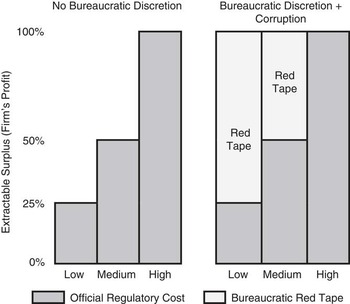
Ultimately, the maximum cost of doing business under a regulatory agency with limited discretionary power is set by the official costs of regulatory compliance. If firms and bureaucrats do not strike illicit deals, the official regulatory compliance costs are paid. If corruption prevails, bureaucrats cannot charge bribes exceeding the official costs of regulation; otherwise, firms may prefer paying the official regulatory costs. The left-hand-side graph in Figure 1 illustrates the relationship between the official regulatory intervention and the maximum cost of doing business through legal compliance or corruption. Under limited bureaucratic discretion, the maximum bribe extractable by a corrupt bureaucrat from a non-compliant firm cannot exceed the official cost of regulations.
Regulatory regimes and the cost of bribery: theoretical expectations

It can be seen that increased discretionary power of bureaucratic agencies in interpreting and applying regulatory policy gives rise to increased costs of regulatory compliance and an unfavourable business climate.Footnote 33 This happens for two reasons. First, if bureaucrats are entrusted with designing the details of the regulatory policy, they can deliberately manipulate the business environment and extort higher bribes.Footnote 34 Second, bureaucratic discretion generally reduces predictability in the application of regulatory procedures, making companies more vulnerable to the whims of public officials. While this second facet of the negative effect of bureaucratic discretion is equally plausible, in what follows, I concentrate on the first facet, which implies deliberate manipulation of regulatory enforcement on the part of the bureaucrats in an attempt to extort bribes and favours.
Under regulatory regimes enforced by a discretionary bureaucratic agency, the cost of regulatory compliance reflects not only the official regulatory policy but also the cost of bureaucratic red tape. When bureaucrats create additional red tape, they alter firms’ regulatory environments, leading to higher prices for bribery and compliance.Footnote 35 As the right-hand side of Figure 1 shows, the cost of bureaucratic red tape becomes part of the regulatory compliance cost faced by the regulated company. As discussed above, the higher the regulatory compliance costs, the higher the bribe bureaucrats can charge non-compliant firms. By increasing the cost of regulatory compliance faced by the firm, bureaucrats push up the upper limit of the market bribe they can charge for regulatory non-compliance. Assuming the bribery is not effectively deterred, discretionary powers allow the bureaucrats to increase the potential pay-offs of corruption by the predatory practice of escalating the costs of the regulatory burden.
Post-communist countries that have experienced the diminished ability of their political authorities to control ‘subversive’ state regulatory institutions provide multiple examples to illustrate the logic of bureaucratic extortion emanating from discretionary power. In the early 1990s, high rates of tax evasion, a large ‘shadow’ economy and collusion between businesses and tax authorities plagued Russia's transitional economy. Domestic and international observers often blamed this on high taxes and complicated compliance procedures. In 1995, amid failing tax collection and a growing budget deficit, the Russian government introduced a simplified taxation mechanism aimed at increasing state revenue, improving the business climate and stimulating domestic investment.Footnote 36 Local governments were given the power to interpret and apply the law. Discretionary bureaucratic powers in designing specific mechanisms of the new tax system often led to considerable administrative abuse. In St Petersburg, for instance, authorities imposed an $8,500 fee on businesses willing to switch to the simplified taxation mechanisms.Footnote 37 For many small businesses, this cost would not cover the benefits extended by the federal government under the simplified taxation regulations. Because of bureaucratic discretion, the more liberal taxation mechanism hardly made any difference for a large number of small businesses.
In a similar vein, starting in 2002, Russia introduced a series of regulatory reforms aimed at addressing the notoriously high number of business regulations. It was expected that the move would lead to bureaucratic probity. Despite documented progress in reducing the number of regulatory procedures, corruption has continued to grow in recent years. According to one study that monitored the progress in implementing deregulatory reforms, local regulatory authorities continue to violate many guidelines spelled out in the laws. Some of the findings were that ‘registration for about half of the firms takes longer time than the prescribed five days; 38% of firms are required to obtain licenses that are not required by the law; and inspections … are administered more frequently [than] is allowed.’Footnote 38 The study also reported that following the de-regulatory initiatives, a larger share of firms resorted to bribes compared to the pre-reform period. The literature provides other examples of how predatory bureaucracy can subvert well-intentioned policies of political elites. Anecdotes, however, are no substitutes for theory. The following section formalizes my arguments and derives testable implications about the effects of bureaucratic discretion on corruption and the business environment.
Theoretical Argument And Hypotheses
Here I present two models of regulatory arrangements characterized by discretionary and limited bureaucratic power in interpreting regulatory norms. These allow me to derive testable implications for the empirical investigation. First, consider a theoretical model that has three players: a firm F, a low-level bureaucrat B, and his political principal P. All are assumed to be rational utility maximizers. The firm maximizes the difference between revenues and costs: IF = r−c where IF is income, r is total revenue, and c is total cost, and operates under the total budget constraint set by 0 ≤ IF = r−c. The cost c is disaggregated into production cost cp and regulatory cost cr. The firm may choose to comply with the existing regulations at a cost of cr or bribe the bureaucrat and pay b instead of cr.Footnote 39 Under these strategies available to the firm, it maximizes income IF as defined below:Footnote 40


The bureaucrat's income is derived from his/her salary and any bribe b he/she might receive as a ‘side payment’ from the firm. Provision of such ‘additional’ bureaucratic services does not entail any direct monetary costs. The bureaucrat chooses to be honest or corrupt; and a corrupt bureaucrat sets the amount of bribe b to charge the firm in exchange for overlooking regulatory violations. If the firm and the bureaucrat engage in corrupt behaviour, both face anti-corruption measures pf, reflecting the probability of a fine p and the amount of the fine f. The bureaucrat maximizes income IB, where s is salary:


The politician's utility function reflects the internalized costs of production externalities, revenue generated by regulatory involvement (taxes, tariffs, and licensing fees), and social welfare produced by the firms’ reinvested profits.Footnote 41 The politician decides on the level of regulatory restrictions cr and on the composition of anti-corruption measures pf. All variables are assumed to be non-negative and p ∈ (0;1). The politician announces regulatory regime and anti-corruption measures, and the bureaucrat proposes a bribe, b. The firm chooses comply or bribe. Compliance will be chosen over bribery if and only if cr < b + pf. The bureaucrat is corrupt whenever IB(corrupt) > IB(honest), or

To entice the firm into corrupt behaviour, the bureaucrat must offer a bribe such that IF(bribe) > IF(comply), or

Notice from Condition 2 that if there is such cr that satisfies cr < pf, then the necessary and sufficient condition for the firm to bribe rather than comply is b < 0. The bureaucrat, however, will be honest rather than offer a negative bribe, and so for cr < pf, the firm complies, and the bureaucrat is honest. Combining Conditions 1 and 2, we find that b will never exceed cr. It also can be seen that when the cost of compliance cr increases, so does the cost of bribery. At the same time, anti-corruption measures pf reduce the cost of bribery and ensure compliance.
The nature of interactions between political authorities, bureaucracy and the private sector, however, changes when the bureaucratic agencies can influence the cost of regulatory compliance through discretionary enforcement practices, red tape creation and extortion. To model this, I allow the bureaucrat to augment the initial regulatory regime imposed by the politician cr by creating red tape, τ; the final cost of regulatory compliance amounts to

Now the bureaucrat chooses  and b′. τ is the bureaucrat's private information, and the firm observes
 , but not cr. The bureaucrat's and the politician's utility functions are the same as in the previous model. The firm, however, now pays the augmented cost of compliance
 . The bureaucrat's utility from bribery is maximized by maximizing
 . The bribe is b′ < cr +
 −pf, which is higher than b in Condition 2. Now the politician cannot deter bribery by pf > cr, because the firm's utility function now depends on
 , and for all cr < r−cp, the bureaucrat can set
 . To deter bribery, the politician has to set pf > cr +
 , which, given the bureaucrat's incentive to maximize τ (subject to the firm's total profit constraint), translates to pf ≥ r−cp. Only these very strict anticorruption measures deter bribery, so the bureaucrat is no longer interested in creating red tape, and the firm complies. Under the low-persecution regime (pf < r−cp), the bureaucrat increases the cost of compliance to the highest level sustainable by the firm. The bureaucrat prefers bribery and thus always sets
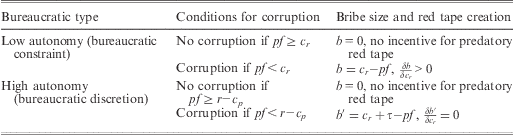
 when pf < r−cp, but stays honest otherwise. Table 1 summarizes the theoretical expectations for high and low levels of bureaucratic discretion.
Summary of Theoretical Expectations
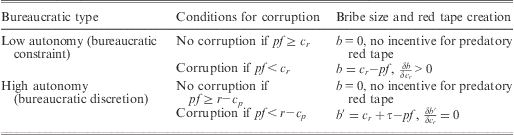
When comparing two regulatory regimes, the following implications stand out. On the one hand, under a limited bureaucratic discretion regime-more regulation, ceteris paribus, generally leads to a higher bribe schedule. This is because the regulatory cost restricts the bribing capacity of the bureaucrat. When bureaucrats are restrained in their rule-application capacity, high-cost regulatory regimes are more prone to bribery, because at higher compliance costs, it is easier to satisfy a bureaucrat's bribing criteria. On the other hand, in bureaucratic regimes with limited discretionary power, low levels of regulation should produce less corruption.
In contrast, under the autonomous bureaucracy model, the politician-imposed regulatory costs have no effect on the levels of bribery (unless the politician is able to extract the firm's entire surplus). Because the bureaucrat decides on the final cost of compliance, the official regulatory regime has little effect on bureaucratic and firm strategies. If a strict anti-corruption regime does not deter a bureaucrat from corruption, she attempts to extract the firm's entire available surplus by escalating the cost of compliance. Low-cost official regulatory regimes, therefore, will be augmented by high-cost red tape, and the size of the bribe will never be pushed below the bureaucrat's reservation level by the leniency of the official regulatory regime. The politician has a limited ability to deter bribery by manipulating regulatory costs; higher compliance costs to the firm increase the probability of choosing corruption, regardless of whether such costs are official or bureaucratically imposed.
Two sets of hypotheses emerge. First, depending on the nature of bureaucratic power in interpreting the content of regulatory norms, we have different expectations with regard to the relationship between official regulatory policy and bribery. Under a regulatory bureaucracy with limited discretionary powers in interpreting and enforcing regulatory norms, we should observe a positive relationship between the extent of regulatory involvement and the cost of corruption. In other words, when the bureaucracy cannot create red tape to alter the cost of regulatory compliance, the cost of corruption should parallel the official costs imposed by the state's regulatory policy. Corruption, therefore, should be contained under a relatively light regulatory burden, but should be more rampant under heavy regulations. These expectations, however, should not hold true for bureaucrats who have ample discretionary powers in interpreting and applying regulations. There, regardless of the official cost of regulation, bureaucratic predation may lead to high levels of bribery. In other words, discretionary bureaucratic powers should render the official regulatory costs irrelevant in predicting the extent of corruption.
Hypothesis 1: When bureaucratic discretion is low, the official regulatory burden has a direct positive effect on the cost of corruption. When bureaucratic discretion is high, the cost of corruption will not depend on the official level of regulatory burden.
Second, under a discretionary regulatory agency, the official cost of regulatory compliance does not necessarily reflect the actual regulatory hurdles imposed on businesses. Under a discretionary bureaucracy, the overall quality of the business climate should reflect the fact that, in addition to the official costs, unofficial hurdles are likely to become part of the regulatory environment. Therefore, we should expect the relationship between official regulatory policy and the quality of the business environment to be tenuous at best. Bureaucrats are likely to augment the official regulatory policy, whether it is light or heavy, to reflect their perverse incentives. At the same time, when regulatory agencies do not have discretionary power to alter the regulatory burden experienced by firms, we should observe a direct relationship between the official cost of regulatory compliance and the business climate.
Hypothesis 2: When bureaucratic agencies do not have discretionary power in applying economic regulations, high regulatory burden has a negative effect on the quality of the business climate. The official costs of regulatory compliance do not affect the quality of the business environment under high levels of bureaucratic discretion.
The model also predicts that, ceteris paribus, compliance is easier to achieve in more orderly societies (those with a high level of law enforcement). Increasing costs of anti-corruption measures help deter bribery; therefore, I include rule of law measures in the empirical analysis.
Data And Analysis
To test hypotheses about the conditioning effects of bureaucratic discretion on the cost of corruption and the business environment, I analyse a cross-section of 119 countries, covering diverse sets of political institutions and various levels of economic development (Appendix A lists the countries included in the analysis). The institutional, economic, and political diversity of the analysed sample offers a number of advantages. First, the argument advanced here does not presuppose a specific configuration of economic and political institutions; rather, it should be universally applicable. Unless empirically evaluated against a diverse sample of countries, the theoretical contributions of this article will remain limited. Second, although bureaucratic actors may have different sources of constraint and preferences in different institutional, political and economic circumstances, the arguments of this article concentrate on a single dimension – bureaucratic discretion. As detailed below, I follow an empirical strategy to incorporate diverse de jure and de facto sources of discretionary bureaucratic power to facilitate cross-national comparison of bureaucratic power. Third, the political and economic diversity of analysed countries helps avoid selection bias. Selection on the political regime variable, for instance, may decrease variation across per capita incomes, bureaucratic capacity and strength in political controls.Footnote 43 Sample heterogeneity serves as an additional guarantee that the empirical results are not the product of selection on relevant institutional, political or economic variables that may affect the regulatory outcomes.
The dependent variables – cost of corruption and quality of the business environment – are operationalized with the Heritage Foundation and the World Economic Forum indices gauging business-related corruption and microeconomic environment. The Heritage Foundation Freedom from Corruption Index is based primarily on the Transparency International Corruption Perception Index (CPI), which measures the level of corruption in 180 countries. For countries not covered by the CPI, the Heritage Foundation computes comparable measures using the US Department of Commerce Country Commercial Guide; the Economist Intelligence Unit Country Commerce, Country Profile, and Country Report; and other official sources. The original 10-point CPI scale is converted into a scale ranging from 0 to 100, where 100 represents the maximum freedom from corruption.
To assess the economic effects of regulations, I concentrate on measures of the microeconomic environment rather than on indicators of economic performance that ultimately reflect a favourable business climate. This choice is driven by methodological concerns. Since there are strong reasons to believe that regulatory policy is affected by macroeconomic performance, endogeneity becomes a problem.Footnote 44 To mitigate this problem, I avoid using indicators of economic performance (growth, productivity, investment) and concentrate on microeconomic aspects of the business environment.Footnote 45 To minimize the neo-liberal bias against regulations, I use the Business Competitiveness Index (BCI) computed by the World Economic Forum as the primary measure of favourable business climate. Accommodating the notion that state regulatory involvement may constitute a business asset rather than a liability, the Global Competitiveness Report has added infrastructure, macroeconomic stability, health, education, skill levels, technological readiness, business sophistication and innovation to the standard mix of market-friendly policies and institutions.
The methodology of aggregating across these different dimensions does not follow a one-size-fits-all approach. Instead, it attempts to weight different aspects of the business environment differently, as ‘they will matter differently for different countries, depending on their particular starting conditions or stage of development’.Footnote 46 Departing from the subjective expert-based and survey-based ratings, the BCI introduces a number of ‘hard’ data measures to evaluate the quality of the labour force, infrastructure, research and development, and macroeconomic stability. The BCI ranks national competitiveness on a scale ranging from 0 to 6, with high values corresponding to greater competitiveness and a more favourable business environment. This reflects the average levels of operational and strategic sophistication of companies operating in a given country and the overall quality of the national business environment, taking into account the effects of national wealth and the composition of the economy.
As a robustness check, this article also uses a more traditional (neo-liberal) operationalization of the overall favourability of the business environment: the Heritage Foundation Index of Economic Freedom, which ranges from 0 to 100, with a higher number corresponding to more economic freedom.
Conceptual issues and the scarcity of reliable data create difficulties in measuring independent variables. Few cross-national measures of bureaucratic organization that would allow one to gauge levels of bureaucratic autonomy in interpreting economic regulations have world-wide coverage. In fact, most of the existing research on the economic effects of regulation is carried out using data on advanced capitalist countries or using sub-national (industry-level) data.
Measurement of the official regulatory burden is further complicated by the fact that the most widely used measures of regulatory quality and regulatory burden are perception-based. Survey responses of business leaders and country experts, however, are likely to reflect the actual level of regulatory burden experienced by businesses. This, according to the argument advanced in this article, comprises the official costs of regulatory policy (the variable of interest) as well as the unofficial costs, including the cost of the red tape created by bureaucrats in order to extort more bribes. Most perception-based measures of regulatory burden do not allow for the differentiation of these official and unofficial costs. To capture the extent of regulatory burden attributable solely to official regulatory policy, I turn to data measuring the number of regulatory procedures faced by businesses around the world. The Doing Business Project by the World Bank is the source of data on the number of regulatory procedures involved in (1) starting a business, (2) dealing with construction permits, (3) registering property, (4) paying taxes, (5) trading across borders and (6) enforcing contracts.Footnote 47 Following the research methodology pioneered by Djankov et al.,Footnote 48 the World Bank identifies the number of regulatory procedures from official government publications, reports of development agencies and government web pages, which makes the data reflective of the official, rather than unofficial, regulatory practices. I use a count of regulatory procedures in different lines of business, as well as the measures of time and monetary costs of regulatory compliance from the 2006 Doing Business database to obtain similar results.
On the conceptual level, the task of measuring bureaucratic discretion has to take into account the fact that political regime type, degree of federalism, and diversity of public sector management strategies may potentially bias our measures of bureaucratic quality. For this analysis, I chose to use the Global Integrity (GI) country-level ranking of the effectiveness of supreme audit institutions as a proxy for bureaucratic autonomy.Footnote 49 Since bureaucratic discretion may originate from different institutional, economic and political factors, the GI ranking of the effectiveness of the supreme audit institution, auditor general or equivalent agency takes into account a range of potentially relevant sources of constraint. The GI report assesses the effectiveness of the supreme audit institution based on whether (1) it is legally protected from political interference; (2) citizens have legal rights to access its reports; (3) in practice, the head of the agency is protected from removal without relevant justification; (4) the agency has a professional, full-time staff; (5) agency appointments support the independence of the agency; (6) the agency receives regular funding; (7) it makes regular public reports; (8) the government acts on the findings of the agency; (9) the agency is able to initiate its own investigations; and (10) citizens can access audit reports within a reasonable time period and (11) at a reasonable cost. GI aggregates across these components and produces the overall effectiveness score, which in my analysis serves as a proxy for low levels of bureaucratic discretion in other bureaucratic agencies.
The original measure of audit effectiveness was collected for twenty-five countries in 2004. In what follows, I use the 2006 data, as it has wider coverage and ranges from 0 to 6.3 points. I created a dummy variable, coded 1, if a country's rating exceeded the world's mean value of 4.7 points (high audit corresponds to low discretion), and 0 otherwise. This binary variable captures the extent of bureaucratic restraint (low discretion) in interpreting and amending official regulatory directives.Footnote 50
I use a control variable to capture the possible effect of law enforcement in deterring corruption, the rule of law index,Footnote 51 which measures levels of confidence in rule-enforcing and legal institutions, including the quality of contract enforcement, the police, and the courts. The expectations follow from the theoretical model: effective law enforcement should deter corruption and improve the overall quality of the business environment, irrespective of the levels of discretionary bureaucratic powers. Formal model presented above details how this measure should affect bribery. All regression models control for the level of economic development using GDP per capita data for 2006 from the Penn World Table.Footnote 52 The independent variables are measured with one-year lags.
Hypotheses 1 and 2 specify the effect of official regulatory costs to be conditional on the level of bureaucratic discretion. To test these propositions, I use ordinary least squares with interacted variables. Converting an ordinal audit measure into a binary variable facilitates interpretation. Substantive results, however, do not change when a continuous measure of audit effectiveness is used instead. The theoretical arguments suggest the following regression specifications:


where corruption is the Freedom from Corruption score, BC is business climate, audit is a dummy variable for constrained discretionary bureaucratic powers, reg is the number of regulatory procedures in a given country, GDP is per capita gross domestic product, and RL is the Rule of Law index.Footnote 53 Note that if audit = 0, then


If audit = 1,


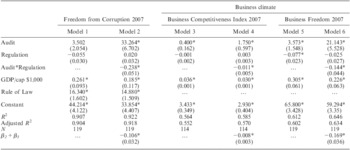
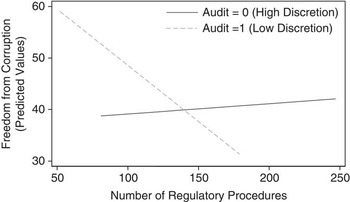
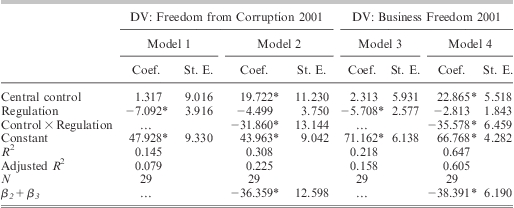
Table 2 presents the results of the above regression specifications and models without the interactive terms. The first model regressed measures of bureaucratic discretion and official regulatory burden on the Freedom from Corruption Index without interactions. It shows that bureaucratic discretion has no statistically significant effect on corruption. At the same time, it supports the neo-liberal contention that the number of regulations has a negative effect on freedom from corruption. The rule of law has a positive effect.Footnote 54 When the measure of regulatory burden is interacted with bureaucratic discretion, we observe a more nuanced picture. The effectiveness of the supreme audit institution (used as a proxy for low bureaucratic discretion) becomes a strong predictor of a corruption-free environment. When bureaucratic discretion is high (audit = 0), regulatory burden has no effect on corruption. When bureaucratic discretion is low (audit = 1), regulatory burden has a significant negative effect on freedom from corruption. In other words, heavy regulatory burden leads to more corruption. Jointly, (β2 + β3) equal −0.106, with a standard error of 0.032, producing a negative effect statistically significantly different from zero. The effect of one standard deviation increase in regulatory procedures results in a 3.35-point drop on the Freedom from Corruption Index. Figure 2 plots the predicted values for the dependent variable from Model 2 against the number of regulatory procedures for discretionary and limited bureaucracy cases, holding all the other controls at their mean values. It can be seen that the solid line representing cases of high bureaucratic discretion is nearly horizontal, reflecting no relationship, while the dashed line for low discretion regimes declines in the number of procedures.
Effects of Regulations and Bureaucratic Discretion on Corruption and Business Climate

*Significant at 0.05 level or better.
Effects of regulations on corruption

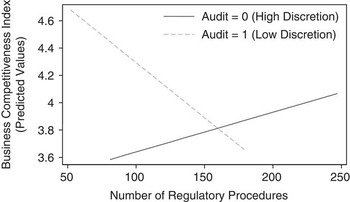
Moving to the second dependent variable, business climate, we find that the regression model with the omitted interaction effects indicates a significant positive effect of audit institutions on the business climate, while the effect of regulatory burden appears unrelated to the quality of the business environment. After an appropriate interaction term is introduced in Model 4, the effects of regulatory burden remain insignificant under high-discretion bureaucratic regimes (audit = 0), but have a negative statistically significant effect in the low-discretion systems (audit = 1). Jointly, (β 2 + β 3) equal −0.008, meaning that one standard deviation increase in regulation leads to a 0.25-point decrease in the six-point Business Competitiveness Index. This is a substantively large effect that is statistically significant at the 0.05 per cent confidence level. Figure 3 illustrates these effects with predicted values from Model 4 plotted against regulatory burden for low- and high-discretion cases and holding the control variables at the means.
Effects of regulations on business competitiveness

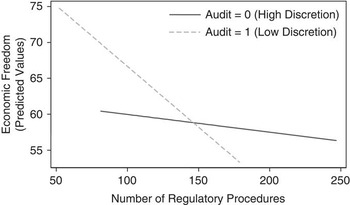
Employing an alternative measure of the business environment – the Heritage Foundation Index of Economic Freedom – leads to similar results (Columns 5 and 6 in Table 2). In the model that includes the interaction term, regulations have no effects on the business environment under a high-discretion bureaucratic environment. In the low-discretion environment, however, the effects of regulations are statistically significant from zero and negative. One standard deviation increase in regulatory procedures under a disciplined bureaucracy leads to a 5.35-point decrease in the 100-point Economic Freedom Index. Figure 4 plots the predicted values for economic freedom under low-discretion and high-discretion regimes, holding the control variables at their means.
Effects of regulations on business freedom

Overall, the analysis is consistent with the theory that bureaucratic discretion conditions the relationship between regulatory policy and regulatory burden experienced by businesses. Controlling for the effects of law enforcement, a more interventionist regulatory policy translates into heavier corruption pressures in systems with limited bureaucratic discretion. Under a high level of bureaucratic discretion, by contrast, we observe no relationship between the extent of official regulatory involvement and the level of corruption. Similarly, regulatory intervention affects the overall quality of the business environment only when bureaucrats have limited discretionary power in interpreting and carrying out regulatory policies. When such powers are not restricted by oversight institutions, the extent of official regulatory involvement is not a good predictor of the spread of corruption or the quality of the business environment.
Conclusion
The effects of regulations on economic performance and growth constitute a highly debated topic in political economy literature. While arguing over the direction of such effects, the proponents of welfare-enhancing and welfare-reducing views of economic regulation generally agree on the underlying mechanisms connecting state regulatory practices to economic outcomes. Regulatory regimes are believed to affect the nature of economic co-ordination, security of property rights, domestic and foreign investment, competition and time horizons of economic actors, thus shaping the business environment. While theoretical arguments distinguish regulatory policies from the institutional mechanisms of their implementation, empirical accounts often assume that policies are carried out the way they are designed by their political makers. Building on the literature that emphasizes a separate and non-trivial effect of regulatory enforcement, this article identified bureaucratic discretion as an important institutional factor that conditions the effects of regulatory policy on the business environment. It argued that by allowing regulatory bureaucracy to interpret regulatory frameworks freely and to apply them differentially, bureaucratic discretion makes the official regulatory policy a largely irrelevant factor in shaping the business environment.
This article makes a twofold contribution. First, it contributes to the theoretical exploration of institutional underpinnings of economic development and offers empirical evidence supporting the notion of complementarity between economic institutions.Footnote 55 Second, by concentrating on the role of policy implementation, rather than policy making, this article enriches the study of economic consequences of political institutions,Footnote 56 and it contributes to the research on the effects of good governance.Footnote 57 Specifically, the results are similar to the Loayza et al. study that found the quality of governance to have a conditioning effect on regulatory policy.Footnote 58 Unlike Loayza et al., who argue that good governance reduces the negative effects of stringent regulations, this article suggests that a specific component of regulatory enforcement – bureaucratic discretion – makes the official regulatory policies an irrelevant factor in shaping the business environment.
The interactive relationship between regulatory policy and its enforcement means that any attempts to redefine the economic role of the state should be highly attentive to the institutional mechanisms employed in economic policy implementation as well as to the incentives these institutions create for bureaucratic, political and business actors. The empirical analysis presented in this article suggests that the hands-off approach to economic regulation is likely to lead to a favourable business environment only under a public bureaucracy possessing limited discretionary power. This should caution against reform proposals advocating a hands-off approach as a panacea to economic hardship.
The article has proposed a theoretical explanation suggesting that high autonomy and low bureaucratic accountability create informational asymmetries that result in poor regulatory enforcement. One should recognize, however, that other causal mechanisms may produce the same outcomes. An alternative view has been that bureaucratic autonomy is an institutional asset.Footnote 59 Such a benign interpretation of bureaucratic discretion is generally consistent with this article's empirical finding that high levels of bureaucratic discretion (or autonomy) may mitigate a negative effect of cumbersome regulatory procedures. If bureaucratic autonomy (discretion) is used wisely, one might argue, it can diminish the onerous effects of regulatory burden. More research is needed, however, to analyse the interplay between economic institutions and public bureaucracies in high-discretion regimes and explore the plausibility of alternative interpretations.
Several aspects of this analysis deserve further consideration. First, economic policy may be endogenous to institutional arrangements.Footnote 60 If politicians are aware of the nature of regulatory enforcement, they may not only consider institutional means of limiting bureaucratic discretionFootnote 61 but could also formulate regulatory policies in ways that make them least vulnerable to bureaucratic discretion. This means that in order to understand the process of policy implementation, we should consider the effects of the bureaucratic institutional environment on economic policy making. At the same time, sceptical voices challenge the notion of institutional constraints on policy choices, attributing the latter to non-institutional variables.Footnote 62 Perhaps the middle ground between strict institutional determinism and policy voluntarism is closer to reality. The extent to which policy formulation remains separated from policy implementation largely depends on the type of political system, specificities of constitutional design, and the nature of political conflict. Although the underlying structure of bureaucratic institutions is likely to affect policy making in any type of political context, the theoretical argument of this article suggests that much can be learned from the analytical separation of political (policy making) and bureaucratic (policy implementation) functions.
Second, the results presented here have important implications for special interests politics literature. Increasingly, studies of lobbying shift the analytical focus from the policy making to the implementation side of regulatory regimes. Research has shown that regional and bureaucratic authorities often become the object of influence and a source of favourable regulatory treatment.Footnote 63 This article offers one potential explanation for interest groups targeting policy implementation rather than policy making. Under a discretionary bureaucracy, the focus of special groups’ political strategies is likely to shift from open interactions with elected officials to illicit interactions with bureaucrats. The interactive nature of regulations and the discretionary realm investigated in this article opens a new perspective on the issues of lobbying and influence. Moreover, the nature of bureaucratic discretionary power is likely to affect the structure of preferences over the exact composition of official regulatory policy. It is easy to imagine a situation when special interests’ priorities shift from the official regulatory burden to the procedural and implementation-related elements of regulatory regimes. Clearly, more research is needed to address these political implications.
The final caveat is that, in the pursuit of greater generalizability of its theoretical claims, this article underplayed the specific details of institutional arrangements that give rise to bureaucratic discretion. By concentrating on a single mechanism of policy implementation and adopting a regime-neutral notion of discretion that combines restraints originating from the political control of bureaucracy, public accountability and bureaucratic resources (staffing, esprit de corps, funding, etc.), I tried to distinguish discretionary bureaucratic power from other political, economic and institutional variables implicated in governance effectiveness. Although this bird's eye approach to policy implementation enables us to compare societies with different types of political regimes, relationships between branches of government, levels of economic development and technological sophistication, it necessarily entails certain limitations. Most importantly, it does not allow for the evaluation of specific institutional mechanisms of bureaucratic constraint. This latter task, however, is crucial for arriving at a better understanding of institutional design and building better mechanisms of public governance. It is possible, however, to disaggregate the empirical measures used in this article into various components and to examine their separate effects on policy outcomes. This, however, would constitute a separate and differently theorized research programme. Future research should strive to design research strategies to capture specific details of bureaucratic constraint relevant under different political and economic conditions and link them to the regulatory outcomes.
Appendix A: Countries Included In The Empirical Analysis

Appendix B: Alternative Operationalization Of Discretion
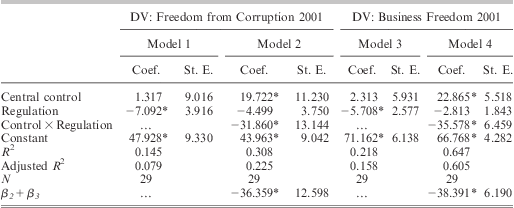
The following analysis (Table A1) checks the robustness of this article's findings against a different operationalization of bureaucratic discretion. It uses data from Rauch and Evans covering Argentina, Brazil, Chile, Colombia, Dominican Republic, Ecuador, Egypt, Greece, Hong Kong, India, Israel, Kenya, Korea, Malaysia, Mexico, Morocco, Nigeria, Taiwan, Pakistan, Peru, Philippines, Portugal, Singapore, Spain, Sri Lanka, Thailand, Tunisia, Turkey, and Uruguay.Footnote 64 Based on an expert survey, Rauch and Evans measure the average ability of national bureaucratic agencies to implement ‘ideas and policies initiated by bureaucratic agencies … in the face of opposition from other parts of the bureaucracy’. A score of 2 or more is coded as a strong central bureaucracy and is used as a proxy for low-discretion regimes. Regulations are operationalized with the 1999 Djankov et al. measure of time-weighted costs of entry regulation.Footnote 65
Robustness Analysis: Effects of Regulations and Bureaucratic Discretion on Corruption and Business Climate
*Significant at 0.05 level or better (1−tailed test). DV = Dependent variable.