INTRODUCTION
Rhodnius prolixus (Hemiptera: Reduviidae) is an important vector for Trypanosoma cruzi (Kinetoplastida: Trypanomomatidae), the etiologic agent of Chagas disease and one of the main causes of cardiac lesions in Latin America (WHO, 2008). This blood-feeding insect is a hemimetabolous bug that undergoes incomplete or partial metamorphosis (Wigglesworth, Reference Wigglesworth1959, Reference Wigglesworth1954). Some insects are able to lay a mass of eggs equivalent to half of their body mass, and usually more than 95% of the eggs produced are viable (Papaj, Reference Papaj2000). Therefore, studies regarding aspects of egg's structure and function could result in novel approaches to population control of disease vectors.
In oviparous insects, such as R. prolixus, the process of embryogenesis occurs totally disconnected from the maternal body. During oogenesis, insect eggs accumulate various nutrients to be used as substrates for embryogenesis and maintenance of newly hatched eggs. In triatomines, besides proteins, carbohydrates and lipids, oocytes need other components such as heme and calcium. Once fertilized, the egg is laid and embryo development is initiated. Some aspects of protein metabolism and carbohydrate distribution during R. prolixus embryogenesis have been previously described. Yolk mobilization starts on the third day of embryogenesis (Fialho et al. Reference Fialho, Silveira, Masuda and Silva-Neto2002). Significant oscillations of glucose content during embryogenesis were previously observed in different arthropods and also correlate with glycogen metabolism (Yamazaki and Nusse, Reference Yamazaki and Nusse2002; Moraes et al. Reference Moraes, Galina, Alvarenga, Rezende, Masuda, da Silva Vaz and Logullo2007; Vital et al. Reference Vital, Rezende, Abreu, Moraes, Lemos, Vaz Ida and Logullo2010; Fraga et al. Reference Fraga, Ribeiro, Lobato, Santos, Silva, Gomes, da Cunha Moraes, de Souza Menezes, de Oliveira, Campos and da Fonseca2013).
Understanding how cells receive and integrate multiple signals is a major challenge in cell and developmental biology. Although glycogen synthase kinase-3 (GSK-3) is but one among more than a thousand distinct serine/threonine kinases present in the mammalian genome, this enzyme has attracted attention due to its role in a diverse range of cellular processes and its positioning at a nexus of several signalling pathways that are important in cancer and other human diseases. In Drosophila, GSK-3/shaggy not only controls energy metabolism by inactivation of glycogen synthase, but also regulates wingless (Wnt) signalling by controlling β-catenin/armadillo (reviewed in Brembeck et al. Reference Brembeck, Rosario and Birchmeier2006) and Myc stability (Acebron et al. Reference Acebron, Karaulanov, Berger, Huang and Niehrs2014). Thus, GSK-3 displays a dual function integrating metabolic cascades and signalling pathways.
A pathway critical to intercellular communication is the Wnt/β-catenin pathway (Baron et al. Reference Baron, Rawadi and Roman-Roman2006; de Lau et al. Reference de Lau, Barker and Clevers2007). Proper regulation of the Wnt signalling pathway is essential for normal brain development as it promotes proliferation and inhibits differentiation of pluripotent cells (Cole, Reference Cole2013). The central component of the Wnt/β-catenin signalling pathway is a protein complex assembled around the scaffold protein Axin. The key components of the active complex include interactions between Axin, GSK3β, CK1α (casein kinase 1), APC (Adenomatous Polyposis Coli), and β-catenin. GSK3-mediated phosphorylation triggers β-catenin destabilization and proteossomal degradation. Upon stimulation of Wnt receptor, this multi-protein complex is disrupted, β-catenin accumulates and can translocate to the nucleus in order to interact with several transcriptional factors leading to transcription of Wnt targeted genes associated with cell fate regulation (Polakis, Reference Polakis2007). Thus, GSK-3 displays a central role for Wnt/β-catenin signalling.
Studies have revealed the multiple roles of GSK-3 with widely different functions, from glycogen metabolism, to fruit fly segmentation and slime mold differentiation, initially causing perplexity. However, in Aedes aegypti it was demonstrated that glucose and glycogen levels are closely correlated to activity and transcription levels of GSK3 during embryogenesis. These results suggested a highly conserved role of GSK3 on glycogen metabolism during arthropod embryogenesis (Vital et al. Reference Vital, Rezende, Abreu, Moraes, Lemos, Vaz Ida and Logullo2010). Recently, Fraga et al. (Reference Fraga, Ribeiro, Lobato, Santos, Silva, Gomes, da Cunha Moraes, de Souza Menezes, de Oliveira, Campos and da Fonseca2013) have shown that GSK-3 gene silencing in the Red flour beetle Tribolium castaneum reduced oviposition as well as egg hatching rate. Moreover, GSK-3 silenced eggs in T. castaneum showed higher glycogen content than their respective control (Fraga et al. Reference Fraga, Ribeiro, Lobato, Santos, Silva, Gomes, da Cunha Moraes, de Souza Menezes, de Oliveira, Campos and da Fonseca2013).
To confirm the hypothesis that GSK-3 is important for glycogen regulation and embryonic pattern in several insects, we used R. prolixus as model to study the GSK-3 pathway and its possible roles during embryogenesis.
Over the past years two major advancements have been important to enable to investigate the role of GSK-3 during R. prolixus embryogenesis. First, the sequencing of R. prolixus genome has opened new possibilities to easily obtain gene sequences. Second, recent developmental biology studies with new fixation methods have enabled the observation of R. prolixus embryogenesis in great detail, including the comparison of wild-type and RNAi treated embryos (Lavore et al. Reference Lavore, Pagola, Esponda-Behrens and Rivera-Pomar2012, Reference Lavore, Esponda-Behrens, Pagola and Rivera-Pomar2014; Berni et al. Reference Berni, Fontenele, Tobias-Santos, Caceres-Rodrigues, Mury, Vionette-do-Amaral, Sorgine, Nunes da Fonseca and Araujo2014).
Thus, in the current study we investigated the importance of GSK-3 for R. prolixus embryogenesis and oogenesis. First, we demonstrate that glycogen contents are closely correlated with activity and transcription levels of GSK3 during embryogenesis. Second, we show that knockdown of GSK-3 affects the transcriptional levels of effectors associated with neuron development, poorly studied in invertebrate models: β-catenin, Notch receptor and cyclic-AMP-response-element-binding protein (CREB). Third, GSK-3 knockdown or inhibition lead to impaired oogenesis and early embryogenesis, suggesting that GSK-3 is essential for both processes.
MATERIAL AND METHODS
Ethics statement
All animal care and experimental protocols were conducted in accordance with the guidelines of the Committee for Evaluation of Animal Use for Research (Federal University of Rio de Janeiro – Nupem/CCS) and the protocols were approved by CCS-UFRJ under register MACAE023-04/16.
Animals
A colony of R. prolixus was kept in an incubator (FT 1020 model) at 28 °C and 70–80% relative humidity at the Núcleo em Ecologia e Desenvolvimento Sócio-Ambiental de Macaé – UFRJ and they were fed on heparinized rabbit blood at 21 days intervals through an artificial feeder at 37 °C (Garcia et al. Reference Garcia, Mello, Azambuja and Ribeiro1994). This colony was first started with insects from a colony at Instituto de Bioquímica Médica Leopoldo de Meis – UFRJ. The insects used in this study were blood fed adult females. Unless otherwise stated, eggs were collected daily during oviposition period (around 7–9 days after bloodmeal) and kept under the same conditions described above until analysis or hatching (usually, 12–14 days after oviposition).
Embryo fixation techniques
Embryos were collected at different time after oviposition (7-, 9- and 11-day-old eggs). Embryo fixation followed the previously described method (Berni et al. Reference Berni, Fontenele, Tobias-Santos, Caceres-Rodrigues, Mury, Vionette-do-Amaral, Sorgine, Nunes da Fonseca and Araujo2014). Using this method, the embryo and the yolk are separated from the chorion, facilitating manual dechorionation without damage of the embryonic tissue. After fixation, the embryos were counterstained with 4’−6-diamidino-2-phenylindole (DAPI) (1 µg µL−1) and photographed using a fluorescent stereomicroscope (Leica M 205) as described in Berni et al. Reference Berni, Fontenele, Tobias-Santos, Caceres-Rodrigues, Mury, Vionette-do-Amaral, Sorgine, Nunes da Fonseca and Araujo2014.
Egg homogenates
Egg homogenates were prepared by grinding eggs (80 mg mL−1) in 20 mm phosphate sodium buffer, pH 7·4. Then, homogenates were centrifuged at 200 × g for 10 min to pellet insoluble eggshell fragments. Supernatant aliquots were assayed. In order to determine the content of glycogen and total protein, mean weight of eggs of each age used was estimated. Egg homogenates for total protein and enzymatic activities determination were prepared in the presence of the following protease inhibitors: 1 µ m phenylmethylsulfonyl fluoride (PMSF) and 1 mm benzamidine (Sigma Aldrich).
Determination of protein content
Samples of 7-, 9- and 11-day-old eggs were homogenized in 20 mm phosphate sodium buffer (PBS) pH 7·4. The protein content of samples was determined according to Bradford, Reference Bradford1976, using bovine serum albumin as standard.
Glycogen content
Egg homogenate (7, 9 and 11 days after oviposition) aliquots (30 µL) were mixed with 20 mm sodium acetate, pH 4·8 and incubated with 1 unit of α-amyloglucosidase (Sigma Chemicals) for 4 h at 40 °C. Released free glucose was detected with a commercial kit for glucose enzymatic determination (Glucox1, Doles, Inc.) at 510 nm. Endogenous glucose was subtracted from control conditions (without α-amyloglucosidase addition). Glycogen content was determined using a standard curve submitted to the same conditions (Moraes et al. Reference Moraes, Galina, Alvarenga, Rezende, Masuda, da Silva Vaz and Logullo2007).
Double-stranded RNA (dsRNA) synthesis
A 799-bp PCR specific product for R. prolixus GSK-3 was obtained using oligonucleotide primers containing T7 promoter sequences (lower case letters) for in vitro transcription of dsRNA. Primer sequences for R. prolixus were as follows: GSK3F (5’-taatacgactcactatagggAGGCCCGGATAGGCCATTAG-3’) and GSK3R (5’-taatacgactcactatagggCTCAGCAGGAGTTCTCGCTC-3’). Briefly, two successive PCRs were performed; the first to amplify Rp-GSK3 from the cDNA and the second PCR added T7 promoter sequences at both ends. The amplicons generated were purified by gel filtration in an S-400 spin column (Amersham) and a 2 µg aliquot was used for in vitro transcription of dsRNA using the T7 RiboMAXTM Express RNAi System (Promega). BLASTn against the R. prolixus genome did not detect unrelated sequences similar to the selected regions (VectorBase). An unrelated dsRNA specific for Escherichia coli maltose-binding protein (dsMal) (Gene ID: 948538) was used as control for off-target effects of dsRNA (Litmus28i-Mal, New England Biolabs).
GSK3 silencing using dsRNA
The dsRNA solution (5 µg 2 µL−1) was injected into adult females’ hemocoel using a Hamilton syringe. The insects used in the experiments were previously fed twice on rabbit blood and injected 21 days after last bloodmeal. Insects were fed on rabbit blood 4 h after dsRNA injection. Egg samples of RNAi treated females were collected from specific days (7-, 9- and 11- days after oviposition for eggs). Control insects were injected with equivalent amount of 100 mm PBS pH 7·4 or an unrelated dsRNA for E. coli maltose-binding protein (dsMal) (Litmus28i-Mal, New England Biolabs).
RNA extraction and cDNA synthesis
Total RNA was extracted from R. prolixus at different embryonic developmental stages (7, 9, 11 and 14 day after oviposition) using TRIZOL reagent (Invitrogen, Carlsbad, CA). RNA was treated with RNAse free TURBO™ DNAse (Ambion, Life Technologies), and cDNA was synthesized from 2 µg total RNA using High Capacity cDNA Reverse Transcription Kit (Applied Biosystems) according to the manufacturer's instructions.
Real-time-quantitative polymerase chain reaction (RT-qPCR) analysis
To detect GSK-3 expression and Wnt pathway in the presence or absence of dsGSK-3, real-time PCR was carried out using cDNA preparations from each group. The samples were assayed on Applied Biosystems StepOne™ platform. Reactions were carried out in a total volume of 15 µL with 0·5 µm primer (final concentration). Specific primers to GSK-3, β-catenin, CREB and Notch are shown in Supplementary Table 1. The reference gene amplification of elongation factor-1 (EF-1) and ribosomal 18S (18S) were carried out with the primers shown in Supplementary Table 1 (Majerowicz et al. Reference Majerowicz, Alves-Bezerra, Logullo, Fonseca-de-Souza, Meyer-Fernandes, Braz and Gondim2011). Gene relative expression was assayed with the Comparative Ct (2−ΔΔCt) method and a validation assay was performed where serial dilutions are assayed for the target and reference genes. The standard curves were generated using five serial dilutions of the sample cDNA that reached exponential amplification at the earlier cycle (Livak and Schmittgen, Reference Livak and Schmittgen2001). Samples of 7-day-old egg were used as calibrators to obtained RT-qPCR results.
Administration of GSK-3β inhibitors by artificial feeding
Rabbit blood was collected in heparinized tubes (Roche) and used to feed females. Alsterpaullone dissolved in 1% dimethyl sulfoxide (DMSO) was mixed up to rabbit blood (6 nM, final concentration) and fed to the insects. Control groups were fed on blood containing 1% DMSO (v/v). The biological parameters analyzed were the number of engorged bugs, weight of bugs, as well as total number of eggs laid and hatched. The relative reductions of egg hatching were normalized by the values obtained from bugs fed with blood containing 1% DMSO. Three independent experiments were performed.
Sequence analysis
Nucleotide sequence identity was performed using the BLAST program (GenBank, NCBI). Amino acid alignment and analysis of GSK3 similarity from selected species were performed using the Clustal W multiple sequences alignment program (Thompson et al. Reference Thompson, Higgins and Gibson1994). The presence of conserved patterns was determined using InterProScan (Zdobnov and Apweiler, Reference Zdobnov and Apweiler2001). Accession numbers for the genes analysed were: EF1, RPRC015041; 18S, GenBank ID: AJ421962·1; Rp-GSK3, GenBank ID: RPRC000333-PA, Rp-β-catenin GenBank ID: RPRC003617-RA, Rp-CREB GenBank ID: RPRC009923-RA and Rp-Notch GenBank ID: RPRC008058-RA (VectorBase).
Statistical analysis
Comparisons between groups were made by the non-paired Student's t test with a 95% confidence interval or using one-way analysis of variance (ANOVA), followed by Newman–Keuls multiple comparison post test (GraphPad Prism) and, in this case, a difference of P < 0·05 was considered to be significant.
RESULTS
Effects of GSK-3 inhibition by artificial feeding
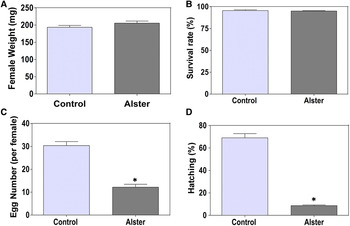
To evaluate the role of GSK-3 in embryogenesis, adult females were artificially blood-fed with an ATP-competitive inhibitor of GSK3, alsterpaullone. The weight and survival of females after blood meal were not significantly different (P > 0·05) between control and treated groups (control group: 190 ± 18·65 mg; alsterpaullone-treated: 205 ± 19·04 mg), indicating that the administration of a chemical inhibitor did not interfere neither with the feeding behaviour nor the insect survival (Fig. 1A and B, respectively). However, significant reduction in oviposition (38·7%) was observed in alsterpaullone-treated females, when compared with control groups (females treated with 1% DMSO) (Fig. 1C). Additionally, hatching rate dropped from about 70% in control group to 5% after alsterpaullone treatment (Fig. 1D).
Alsterpaullone effects via artificial feeding – Female insects were blood fed with 1% DMSO alone (control – gray bar), or 1% DMSO plus alsterpaullone (dark gray bar). After bloodmeal, individual parameters were determined for each group (Insect weight, (A) Survival rate, (B)). (C) Number of egg per female, as determined at 12 days after meal; (D) Hatching rate, as determined at 25 days after oviposition. Results are expressed as mean (±s.e.m.) of 2 independent experiments. *P < 0·05 (compared with control) (non-paired Student's t-test). Each group contained 25 females. DMSO, dimethyl sulfoxide.

Effects of GSK-3 silencing in females bugs, oviposition and embryo development
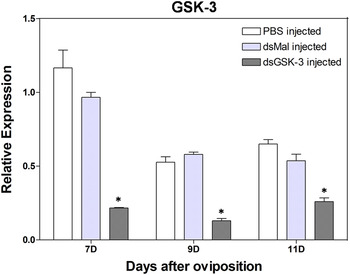
Rhodnius prolixus GSK-3 transcription was silenced by GSK-3 knockdown. Rhodnius prolixus were injected with dsGSK-3, dsMal or PBS, and subsequently submitted to blood feeding. qPCR analysis was performed to determine GSK-3 silencing in eggs collected 7, 9 and 11 days after oviposition (Fig. 2). For all time points analyzed, we normalized mRNA levels to two reference genes, which revealed similar variation patterns (see Methods for details) (Majerowicz et al. Reference Majerowicz, Alves-Bezerra, Logullo, Fonseca-de-Souza, Meyer-Fernandes, Braz and Gondim2011). These two reference genes have been shown to be the most stable ones during embryogenesis (Berni et al. Reference Berni, Fontenele, Tobias-Santos, Caceres-Rodrigues, Mury, Vionette-do-Amaral, Sorgine, Nunes da Fonseca and Araujo2014). Injection of dsGSK-3 decreased the GSK-3 transcription level in eggs of R. prolixus. This effect was more evident on days 7 and 9 after oviposition (above 60%), when compared with eggs from females injected with unrelated dsRNA (dsMal) or PBS (Fig. 2). This effect was less pronounced on day 11 after oviposition (above 40%) (Fig. 2). We used the 799 bp fragment of R. prolixus GSK-3 (Supplementary Fig. 1) to perform a BLAST search against R. prolixus and Apis mellifera sequences available in the NCBI database, and the equivalent fragment of GSK-3 from Anopheles gambiae and Drosophila melanogaster was compared against all possible targets in their respective genomes with the dsCheck (Naito et al. Reference Naito, Yamada, Matsumiya, Ui-Tei, Saigo and Morishita2005) and DEQOR (Henschel et al. Reference Henschel, Buchholz and Habermann2004) programs. These analyses showed that the chance for off-target effects was significantly lower in comparison with the specific effect of RNAi knockdown.
GSK3 relative expression during R. prolixus embryo development. GSK-3 relative expression was determined in eggs obtained from females injected with PBS (white bar), dsMal (gray bar) or dsGSK-3 (dark gray bar) prior to blood feeding. Laid eggs were collected and analysed on the days indicated after oviposition. RT-qPCR analyses were performed using comparative Ct (2−ΔΔCt) method and normalized against EF-1 and 18S genes expression level. The value of experimental group injected with PBS (7 days after oviposition) was set to 1 for each comparison and used as calibrator. The transcript levels of GSK-3 were decrease compared with those of R. prolixus injected with PBS and dsMal (around 60%) in all day analysed. *P < 0·05 (One-Way ANOVA and post test Newman–Keuls). Each group contained 25 females. GSK3, Glycogen synthase kinase 3.

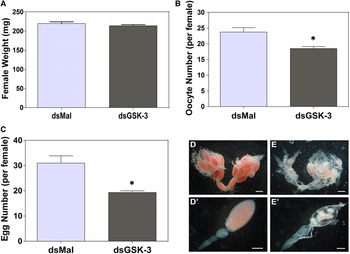
In R. prolixus females injected with dsGSK-3 the average weight gain after feeding was not significantly different (P < 0·05) in comparison with control group (dsMal: 238 ± 24·15 mg; dsGSK-3 group: 223 ± 25·79 mg), indicating that the presence of dsRNA did not interfere on insect feeding behaviour (Fig. 3A). Rhodnius prolixus females display a telotrophic ovary composed by two hemi-ovaries. Each hemi-ovary is formed by seven structures, named ovarioles, depicted in Fig. 3D. A wild type female of R. prolixus is able to produce around 40–42 eggs in 15 days after a single bloodmeal (Atella et al. Reference Atella, Gondim, Machado, Medeiros, Silva-Neto and Masuda2005). In order to address the function of GSK-3 in adult R. prolixus females, insects were injected with either a 799 bp dsRNA fragment derived from R. prolixus GSK-3 (dsGSK3, 5 µg insect−1), or unrelated dsRNA (dsMal), and blood fed for 4 h after injection. Oogenesis and oviposition phenotypes were strongly affected.
GSK3 RNAi effects in R. prolixus oogenesis. Females were injected with dsMal (gray bar) or dsGSK-3 (dark gray bar) and blood fed. After bloodmeal, Insect weight (A) was determined for individual females from each group. Five females were dissected for oocyte number (B) and egg number (C) determination, 4 and 12 days after bloodmeal, respectively; (D) ovaries from females injected with 5 µg dsMal; (E) ovaries from females injected with 5 µg dsGSK-3; (E) Mature oocytes of female R. prolixus 4 days after blood feeding; (D’) Oocyte from a female injected with dsMal; (E) Oocyte from a female injected with dsGSK-3; (D,E,D’) and (E’) ovaries and oocytes at 4 days after blood feeding; (Scale bars: D and E = 1 mm; D’ and E’ = 0,5 mm). The results are the mean and standard deviation of three independents experiments. *P < 0·05 (non-paired Student's t Test). GSK3, Glycogen synthase kinase 3.

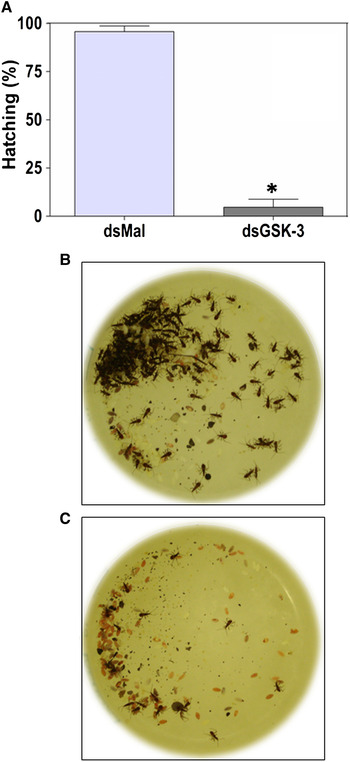
Treatment with dsGSK3 reduced significantly both oocyte (29·1% reduction) and egg numbers (20% reduction) (Fig 3B and C, respectively), when compared with the negative control. Moreover, ovaries and eggs from dsGSK-3 injected females exhibited an atypical external appearance, with a modest presence of embryo formation under a stereomicroscope (Fig. 3E and E’), in comparison with the eggs from control groups (Fig. 3D and D’). Eggs from females injected with dsGSK-3 also exhibited delayed hatching (Fig. 4A) which indicates that embryo development was affected (Fig. 4C). While nymphs were totally visible 25 days after oviposition in the control group, those obtained from dsGSK-3 injected females presented an undifferentiated aspect (Fig. 4B and C, respectively). Small proportions of GSK-3 knockdown eggs in each egg batch do develop beyond cleavage stages (Fig. 5 dsGSK-3 – middle and right panels), and seem to undergo anatrepsis, a process where the wild-type embryo transiently inverts its anterior-posterior organization, when the head can be observed at the posterior region of the egg (Fig. 5 control – left panel, stage 4 in Berni et al. Reference Berni, Fontenele, Tobias-Santos, Caceres-Rodrigues, Mury, Vionette-do-Amaral, Sorgine, Nunes da Fonseca and Araujo2014).
Effects of dsGSK3 on hatching. (A) Egg hatching from females injected with dsMal (gray bar) or dsGSK-3 (dark gray bar) and blood fed. After bloodmeal, laid eggs were maintained as described in Methods. 25 days after the start of oviposition hatching rate was observed, under a stereomicroscope, for eggs obtained from females injected with dsMal (B) or dsGSK-3 (C). The results depicted in A are the mean and standard deviation from three independents experiments. *P < 0·05 (non-paired Student's t Test).

GSK3 RNAi affects embryogenesis and germ band formation Left-Control embryo- DAPI staining of an embryo from female injected with dsMal (control) at stage four, structures can be identified such as Head, Thorax, GZ and serosa can be identified. Middle and Right panels GSK-3 RNAi embryos - DAPI staining of two independent embryos from females injected with dsRNA against R. prolixus GSK3. In the middle panel, although a large anterior structure can be identified, probably corresponding to an enlarged head, the posterior GZ (growth-zone) is absent. In the right panel the embryonic tissue is concentrated at the posterior region and some embryonic tissue (emb) can be observed at the middle of the egg. All embryos are approximately at stage 4, according to Berni et al. Reference Berni, Fontenele, Tobias-Santos, Caceres-Rodrigues, Mury, Vionette-do-Amaral, Sorgine, Nunes da Fonseca and Araujo2014. Asterisk denotes groups of cells which have detached from the large embryonic tissue. H, head, T, thorax and GZ, growth zone. Ser, serosa; GSK3, glycogen synthase kinase 3.

Egg glycogen content depends on GSK3 activity
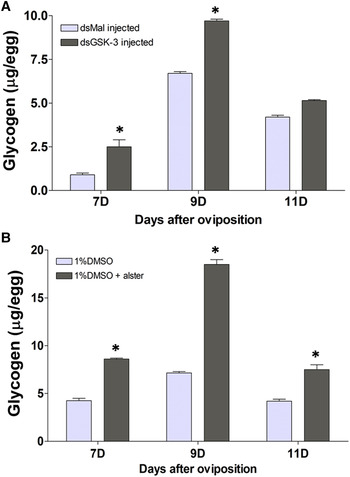
Eggs obtained from female insects treated with either dsRNA or alsterpaullone were used for glycogen content determination and compared with control treatments. The results demonstrate that a general trend favours an increase in glycogen content when GSK3 is either chemically inhibited or gene silenced, especially starting from 7 days after oviposition. The total amount of glycogen increased from 6·6 to 9·8 µg egg−1 at 9 days after oviposition in insects injected with dsGSK3 (Fig. 6A). However, the major increase in carbohydrate reserves occurred when insects were artificially blood-fed with alsterpaullone. The total amount of glycogen increased significantly from 7·0 to 18·0 µg egg−1 and from 4·8 to 7·5 µg egg−1 at 9 and 11 days after oviposition, respectively (Fig. 6B).
Glycogen levels during R. prolixus embryogenesis. (A) GSK3 gene silencing with RNAi – females were injected with dsMal (gray bar) or dsGSK-3 (dark gray bar) and fed on blood afterward. (B) Chemical inhibition by alsterpaullone – female insects were fed on blood supplemented either with 1% DMSO alone (gray bar), or 1% DMSO plus alsterpaullone (dark gray bar). The glycogen content in egg was enzymatically determined as described in Methods, at the days indicated after oviposition. Data represent mean ± s.e.m. (n = 4). *P < 0·05 (One-Way ANOVA and post test Newman–Keuls). Each group contained 25 females. GSK3, glycogen synthase kinase 3; DMSO, dimethyl sulfoxide.

Effects of GSK-3 silencing in Wnt pathway
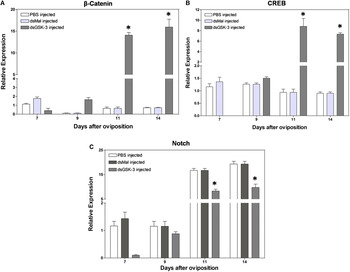
The serine/threonine kinase GSK-3 is a highly conserved enzyme that regulates protein turnover, systemic metabolism, growth control, proliferation, embryonic development and other processes (Cross et al. Reference Cross, Alessi, Cohen, Andjelkovich and Hemmings1995; Cohen and Frame, Reference Cohen and Frame2001; Van Noort, et al. Reference Van Noort, Meeldijk, Van der Zee, Destree and Clevers2002; Papadopoulou et al. Reference Papadopoulou, Bianchi and Bourouis2004). To determine if GSK-3 regulates Wnt pathway we knocked down GSK-3 function in R. prolixus females and analyzed relative expression of β-catenin, CREB and Notch in eggs from 7, 9, 11 and 14 days after oviposition. For all analysed genes, day 7 presents the GSK-3 physiological expression normally lower (around 10%) in relation to the days 11 and 14 after oviposition (Fig. 7A, B and C). Interestingly, in females injected with dsGSK-3, a strong increase in β-catenin transcription level (94,6%) was observed in eggs, if compared with eggs from females injected with PBS (5,3%) or unrelated dsRNA (6,5%) 11 and 14 days after injection (dsMal) (Fig. 7A). Furthermore, we observe that CREB expression was significantly upregulated (90%) in the days 11 and 14 after oviposition when compared with PBS (9,3%) or dsMal (6,7%) injected insects (Fig. 7B). However, results showed a decrease in the amount of Notch transcripts over time (53,1%) (Fig. 7C).
Influence of GSK3 gene silencing in Wnt pathway during R. prolixus embryogenesis. Females were injected with dsMal (gray bar) or dsGSK-3 (dark gray bar) and blood fed. Laid eggs were analysed on the days after ovipostion indicated. Relative expression of (A) β-catenin, (B) CREB and (C) Notch were determined by RT-qPCR, using EF-1 as reference gene and with the comparative Ct (2−ΔΔCt) method. *P < 0·05 (compared with R. prolixus injected with dsMal) (One-Way ANOVA and post test Newman–Keuls). Each group contained 25 females. GSK3, glycogen synthase kinase 3.

DISCUSSION
Oocytes are specialized cells for storage of macromolecules. In the hematophagous insect R. prolixus, studies on oogenesis have been focused mostly on protein and lipid metabolism and mobilization (Oliveira et al. Reference Oliveira, Gondim, Guedes and Masuda1986; Gondim et al. Reference Gondim, Atella, Kawooya and Masuda1992; Melo et al. Reference Melo, Valle, Machado, Salerno, Paiva-Silva, Cunha, de Souza and Masuda2000). During oogenesis, female insects deposit lipids, proteins, carbohydrates and mRNAs that are to be used as substrates for embryogenesis and maintenance of newly hatched larvae. Particularly in oviparous species the egg must contain all nutrients required for embryo development since it is enclosed and isolated from the environment. Substances present in hemolymph cross the follicle basement membrane and, going through the extracellular space that separates the epithelial cells of the follicles, reach the oocyte surface (Ziegler and Van Antwerpen, Reference Ziegler and Van Antwerpen2006) to form the yolk. Proteins and lipids are produced by extra ovarian organs and sequestered by the developing ovary (Raikhel and Dhadialla, Reference Raikhel and Dhadialla1992; Canavoso et al. Reference Canavoso, Jouni, Karnas, Pennington and Wells2001), while glycogen is synthesized in the ovary itself (Ramamurty, Reference Ramamurty1968; Katagiri et al. Reference Katagiri, Ando and Yamashita1998).
The data presented here suggest that embryogenesis is compromised by unusual increase in glycogen content (Figs 4 and 6) due to inhibition of GSK-3 activity. Interestingly, our group observed previously that GSK-3 inhibition during embryogenesis in different species correlates with increased glycogen content in eggs, and compromises hatching (Fabres et al. Reference Fabres, De Andrade, Guizzo, Sorgine, Paiva-Silva Gde, Masuda, Vaz Ida and Logullo2010; Fraga et al. Reference Fraga, Ribeiro, Lobato, Santos, Silva, Gomes, da Cunha Moraes, de Souza Menezes, de Oliveira, Campos and da Fonseca2013; Fernandes et al. Reference Fernandes, Martins, Costa, Pacidônio, Abreu, Vaz, Moreira, Fonseca and Logullo2014). Egg fixation followed by nuclear DAPI observation (Berni et al. Reference Berni, Fontenele, Tobias-Santos, Caceres-Rodrigues, Mury, Vionette-do-Amaral, Sorgine, Nunes da Fonseca and Araujo2014) provided important hints into GSK-3 function during embryogenesis. First, severely affected GSK-3 eggs display defective early cleavages, probably due to improper yolk deposition and egg formation, as previously described for the knockdown of GSK-3 in other insect species (Fraga et al. Reference Fraga, Ribeiro, Lobato, Santos, Silva, Gomes, da Cunha Moraes, de Souza Menezes, de Oliveira, Campos and da Fonseca2013). In A. aegypti embryos, for example, we observed that GSK-3 activity was directly related to GSK-3 transcript levels. Furthermore, GSK-3 activity was inversely related to glycogen content in the interval of 5–15 h after oviposition, suggesting that glycogen accumulation in eggs can be regulated by GSK3 activity during cellular blastoderm formation and germ band extension (Vital et al. Reference Vital, Rezende, Abreu, Moraes, Lemos, Vaz Ida and Logullo2010). In R. (Boophilus) microplus, glucose metabolism during embryogenesis is initially maintained by the mobilization of glycogen from maternal origin. After cellular blastoderm formation, gluconeogenesis accounts for a significant amount of the glucose consumed by the embryo (Moraes et al. Reference Moraes, Galina, Alvarenga, Rezende, Masuda, da Silva Vaz and Logullo2007). This period is characterized by elevated gluconeogenesis due to phosphoenolpyruvate carboxykinase (PEPCK) activity. Additionally, glycogen reserves are restored and kept elevated until prior egg hatching (Campos et al. Reference Campos, Moraes, Facanha, Moreira, Valle, Abreu, Manso, Nascimento, Pelajo-Machado, Lenzi, Masuda, Vaz Ida and Logullo2006; Moraes et al. Reference Moraes, Galina, Alvarenga, Rezende, Masuda, da Silva Vaz and Logullo2007). Moreover, GSK-3 regulation of glygogen metabolism in Aedes fluviatilis embryos also influences its host/symbiont interaction with Wolbachia pipientis (Fernandes et al. Reference Fernandes, Martins, Costa, Pacidônio, Abreu, Vaz, Moreira, Fonseca and Logullo2014).
In order to understand egg glycogen metabolism and the embryo formation, we evaluated the involvement of GSK-3 on the physiological aspects of R. prolixus oogenesis and embryogenesis. R. prolixus feeds exclusively on blood, and each meal is slowly digested. These insects are adapted to resist periods of up to some weeks until the next bloodmeal. During its life cycle, any energy requiring processes such as molting, adult gonadal and reproductive growth, vitellogenesis, muscular activity, and fasting, lead to increased metabolism. Mobilization of carbohydrate is an important feature for its prompt use as energy fuel. Regulation of carbohydrate reserves has been studied in several insect species, and there is considerable variation in regulatory mechanisms (Gade and Auerswald, Reference Gade and Auerswald2003). In R. prolixus, as oogenesis occurs, oocytes store glycogen to be used during embryonic development (Santos et al. Reference Santos, Mariano, Rosas-Oliveira, Pascarelli, Machado, Meyer-Fernandes and Gondim2008; Mariano et al. Reference Mariano, Santos, Gonzalez, Feder, Machado, Pascarelli, Gondim and Meyer-Fernandes2009). In order to evaluate the role of GSK-3 on carbohydrate metabolism we performed gene silencing and confirmed the involvement of this enzyme on glycogen metabolism control during embryogenesis (Fig. 6A). Additionally, the group of paullone compounds, in particular kenpaullone and alsterpaullone, are widely used in various experimental settings as GSK-3 inhibitors (Eldar-Finkelman and Martinez, Reference Eldar-Finkelman and Martinez2011). In this case, an increasing of glycogen content was also observed when GSK-3 was chemically inhibited by the use of alsterpaullone (Fig. 6B).
Although GSK-3 plays a key role in glycogen metabolism (Grimes and Jope, Reference Grimes and Jope2001), cell survival and proliferation (Tullai et al, Reference Tullai, Chen, Schaffer, Kamenetsky, Kasif and Cooper2007), little is known about the transcriptional programs regulated by GSK-3. GSK-3 is an essential kinase for the specification of cell fate in early embryos, within the canonical Wnt signalling pathway (Ferkey and Kimelman, Reference Ferkey and Kimelman2000). Wnt genes are important regulators of embryogenesis and cell differentiation in vertebrates and insects (Ruiz-Trillo et al. Reference Ruiz-Trillo, Roger, Burger, Gray and Lang2008; Schierwater et al. Reference Schierwater, Eitel, Jakob, Osigus, Hadrys, Dellaporta, Kolokotronis and DeSalle2009). In D. melanogaster, shaggy (GSK3) is required for distinct developmental regulations. Recruitment of β-catenin by Axin greatly facilitates β-catenin phosphorylation by GSK-3 in vitro and in vivo (Liu et al. Reference Liu, Li, Semenov, Han, Baeg, Tan, Zhang, Lin and He2002). In mammalian systems, GSK3 has been shown to phosphorylate Notch (Foltz et al. Reference Foltz, Santiago, Berechid and Nye2002; Espinosa et al. Reference Espinosa, Ingles-Esteve, Aguilera and Bigas2003), and interactions between Notch and shaggy in Drosophila have been reported (Heitzler and Simpson, Reference Heitzler and Simpson1991; Ruel et al. Reference Ruel, Bourouis, Heitzler, Pantesco and Simpson1993). Here we have investigated the modulation of Wnt pathway by analysis of the abundance of mRNAs encoding β-catenin, CREB and Notch in eggs obtained from female insects treated with or without dsGSK3. GSK3 knockdown was shown to stimulate β-catenin and CREB gene transcription, though it induces a decrease in Notch (Fig. 7). Liu et al. (Reference Liu, Li, Semenov, Han, Baeg, Tan, Zhang, Lin and He2002) measured the β-catenin phosphorylation status upon Wnt treatment, observing no effect on CK1α-mediated phosphorylation, but strong inhibition of GSK3-mediated phosphorylation. These results led to the conclusion that Wnt inhibits GSK3, but not CK1α, mediated β-catenin phosphorylation. Though the mechanisms underlying the Wnt pathway in R. prolixus remain unclear, our results point to an essential role for GSK-3 during oogenesis (Fig. 3) and embryogenesis (Fig. 4), as well as for glycogen distribution during embryo development (Figs 5 and 6). These are the first observations that GSK-3 regulates developmental genes in R. prolixus, in addition to its role in carbohydrate metabolism.
RNA interference (RNAi) is an evolutionarily conserved process through which dsRNA induces the silencing of cognate gene expression (Bernstein et al. Reference Bernstein, Caudy, Hammond and Hannon2001; Carthew, Reference Carthew2001). RNAi results in the degradation of dsRNA and of any mRNA present in the organism with high sequence similarity with the dsRNA trigger (Bernstein et al. Reference Bernstein, Caudy, Hammond and Hannon2001). A pivotal step involved in the use of the dsRNAs is the determination of which genes, if any, share significant sequence identity with the proposed sRNAi in order to predict specificity and off-target effects. The use of RNAi in the characterization of metabolic pathways in insects was first reported by Aljamali et al. (Reference Aljamali, Sauer and Essenberg2002) and rapidly became a widely used gene-silencing technique for functional genomics (de la Fuente and Kocan, Reference de la Fuente and Kocan2006a ; Kocan et al. Reference Kocan, Zivkovic, Blouin, Naranjo, Almazán, Mitra and de la Fuente2009). The reduction in oviposition and hatching with silencing of R. prolixus GSK-3 expression (Fig. 4) or alsterpaullone (Fig. 1), suggest that suppression of GSK-3 expression and/or activity is responsible for the biological effects observed in treated insects. Previous reports using systemic RNAi responses in ticks after injection of dsRNA into unfed ticks, and the corresponding gene silencing occurred in multiple tick tissues (de la Fuente et al. Reference de la Fuente, Almazán, Blas-Machado, Naranjo, Mangold, Blouin, Gortazar and Kocan2006b ; Nijhof et al. Reference Nijhof, Taoufik, de la Fuente, Kocan, Vries and Jongejan2007). Nijhof et al. (Reference Nijhof, Taoufik, de la Fuente, Kocan, Vries and Jongejan2007) and Kocan et al. (Reference Kocan, Manzano-Roman and de la Fuente2007) demonstrated the effect of systemic RNAi on tick progeny when dsRNA injected in the hemolymph of fully engorged female ticks caused silencing in the next generation larvae. Additionally, eggs from GSK-3 dsRNA-injected females presented an altered appearance when compared with negative control, demonstrating the effect of GSK-3 silencing in insect development (Fig. 5), which correlates with the abnormalities observed in embryos from dsGSK-3 injected females (Fig. 5). Fraga et al. (Reference Fraga, Ribeiro, Lobato, Santos, Silva, Gomes, da Cunha Moraes, de Souza Menezes, de Oliveira, Campos and da Fonseca2013) studied the same effect in the beetle Tribolium castaneum embryos and showed an increase in the total glycogen concentration after GSK-3 knockdown. This silencing affected the beetle oviposition rate and egg viability. In R. prolixus, embryo viability was greatly reduced after GSK-3 knockdown (Fig. 4).
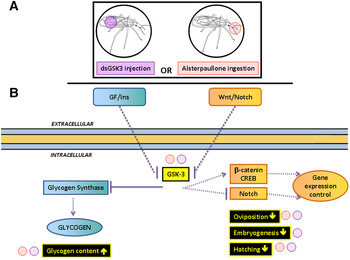
Ongoing GSK-3's role in carbohydrate metabolism regarding embryogenesis has been extensively demonstrated not only in vivo but also in vitro (Abreu et al. Reference Abreu, Calixto, Waltero, Della Noce, Githaka, Seixas, Parizi, Konnai, Vaz Ida, Ohashi and Logullo2013) by our group, which appears to be somehow conserved in different arthropods. A schematic model is proposed for GSK-3 action during R. prolixus embryogenesis (Fig. 8), and how its inhibition affects glycogen metabolism and embryo development (Fig. 6A and B). We believe that the result of this study contributes relevant information covering different aspects of insect physiology. These data are likely to prompt further studies on the GSK-3 involvement during arthropod embryo formation, metabolism and transcriptional program. These and further functions for GSK-3 remain to be uncovered and are the subject of ongoing research.
Schematic model of GSK-3 roles during R. prolixus embryogenesis. (A) Panel depicts the experimental design to promote GSK-3 inhibition via RNAi mediated gene silencing (purple dots) or chemical inhibitor (red dots). (B) Panel depicts GSK-3 regulated processes during R. prolixus embryo development: BLUE (left side) refers to carbohydrate metabolism; ORANGE (right side) refers to transcriptional regulation of cell fate genes. Black boxes indicate the effects observed for each treatment of GSK-3 inhibition (yellow box). Dotted line: multi-step process; Solid line: one-step process. GF/Ins, growth factors or insulin pathways; Wnt/Notch, wingless or notch pathways; GSK3, glycogen synthase kinase 3.

SUPPLEMENTARY MATERIAL
The supplementary material for this article can be found at http://dx.doi.org/10.1017/S0031182016001487.
ACKNOWLEDGEMENTS
We would like to thank Simone Gomes for technical assistance.
FINANCIAL SUPPORT
This work was supported by CNPq (Conselho Nacional de Desenvolvimento Científico e Tecnológico, Brazil), FAPERJ (Fundação de Amparo à Pesquisa do Estado do Rio de Janeiro), both awarded to C.L.