Exposure to early severe psychosocial deprivation as a result of institutional care is associated with persistent externalizing psychopathology (Rutter et al., Reference Rutter, Beckett, Castle, Colvert, Kreppner and Mehta2007). The role of the caregiving environment in the development of externalizing psychopathology has previously been established (Shaw, Owens, Giovannelli, & Winslow, Reference Shaw, Owens, Giovannelli and Winslow2001). In children who experienced institutional rearing, the elevated risk for externalizing psychopathology is thought to be the consequence of the extreme deviation of the early caregiving relationship from expected norms. The regimented schedule, rotating caregivers, and lack of individualized attention to children's needs are considered key components of the institutional environment that contribute to the elevated risk, presumably through the impact on the child's neurobiological development (Sheridan, Drury, McLaughlin, & Almas, Reference Sheridan, Drury, McLaughlin and Almas2010; Zeanah et al., Reference Zeanah, Egger, Smyke, Nelson, Fox and Marshall2009). In the English and Romanian Adoptee Study, signs of hyperactivity positively correlated with the severity of deprivation in postinstitutionalized children (Kreppner, O'Connor, & Rutter, Reference Kreppner, O'Connor and Rutter2001). Externalizing behavior, unlike internalizing behavior, appears to be particularly resistant to subsequent improvements in the caregiving environment, suggesting that other factors are involved in recovery (Cicchetti, Reference Cicchetti2013; Zeanah, Reference Zeanah, Narrow, First, Sirovatka and Regier2007). Child-specific factors, including genetic variation, likely add to the differential adaptation of children to significant changes in the early caregiving environment (Drury et al., Reference Drury, Theall, Smyke, Keats, Egger and Nelson2010, Reference Drury, Gleason, Theall, Smyke, Nelson and Fox2012; Gunnar et al., Reference Gunnar, Wenner, Thomas, Glatt, Mckenna and Clark2012). In longitudinal studies of less extreme atypical caregiving environments, differential sensitivity to changes in the caregiving environment (Belsky, Hsieh, & Crnic, Reference Belsky, Hsieh and Crnic1998; Bradley & Corwyn, Reference Bradley and Corwyn2008) and moderation of this sensitivity by genotype (Bakermans-Kranenburg, van IJzendoorn, Mesman, Alink, & Juffer, Reference Bakermans-Kranenburg, van IJzendoorn, Mesman, Alink and Juffer2008) have been reported in relation to externalizing psychopathology.
Differential Susceptibility
One possible model that explains individual differences in both initial vulnerability and later recovery from negative early experiences is differential susceptibility theory (DST; Ellis, Boyce, Belsky, Bakermans-Kranenburg, & van IJzendoorn, Reference Ellis, Boyce, Belsky, Bakermans-Kranenburg and van IJzendoorn2011; van IJzendoorn et al., Reference van IJzendoorn, Bakermans-Kranenburg, Belsky, Beach, Brody and Dodge2011). DST proposes that “susceptibility,” or plasticity genes, act in a “for better or worse” manner in response to environmental differences (Belsky et al., Reference Belsky, Jonassaint, Pleuss, Stanton, Brummet and Williams2009; Belsky & Pleuss, Reference Belsky and Pleuss2013; Hankin et al., Reference Hankin, Nederhof, Oppenheimer, Jenness, Young and Abela2011; Owens et al., Reference Owens, Goodyer, Wilkinson, Bhardwaj, Abbott and Croudace2012; Simons et al., Reference Simons, Lei, Beach, Brody, Philibert and Gibbons2011; van IJzendoorn, Belsky, & Bakermans-Kranenburg, Reference van IJzendoorn, Belsky and Bakermans-Kranenburg2012). In negative environments, these putative risk/susceptibility genotypes would be associated with the most negative outcomes. However, divergent from diathesis–stress models, these same genotypes, in supportive/enriched environments, are expected to predict the most positive outcomes (Bakermans-Kranenburg & van IJzendoorn, Reference Bakermans-Kranenburg and van IJzendoorn2011; Belsky, Bakermans-Kranenburg, & van IJzendoorn, Reference Belsky, Bakermans-Kranenburg and van IJzendoorn2007; Belsky & Pleuss, Reference Belsky and Pleuss2013; Belsky, Pluess, & Pleuss, Reference Belsky, Pluess and Pleuss2009). Nonsusceptible genotypes, in contrast, are predicted to be relatively resistant to environmental contexts and demonstrate little difference in outcomes between positive and negative environments.
Consistent with this hypothesis, evidence for DST in response to early caregiving and the parent–child relationship continues to grow (Belsky & Beaver, Reference Belsky and Beaver2011; Knafo, Israel, & Ebstein, Reference Knafo, Israel and Ebstein2011; Manuck, Flory, Ferrell, & Muldoon, Reference Manuck, Flory, Ferrell and Muldoon2004; Sonuga-Barke et al., Reference Sonuga-Barke, Oades, Psychogiou, Chen, Franke and Buitelaar2009). While a significant number of cross-sectional studies have corroborated the DST, randomized controlled trials (RCTs), which examine the impact of defined caregiving changes in the same individual, offer the most stringent scientific approach. Three previous studies, to date, have examined DST within an RCT framework (Bakermans-Kranenburg, van IJzendoorn, Pijlman, Mesman, & Juffer, Reference Bakermans-Kranenburg, van IJzendoorn, Pijlman, Mesman and Juffer2008; Drury, et al., Reference Drury, Gleason, Theall, Smyke, Nelson and Fox2012; Kegel, Bus, & van IJzendoorn, Reference Kegel, Bus and van IJzendoorn2011). One of these studied DST within randomized trials of a psychotherapeutic intervention; one study examined DST within an RCT of a parenting intervention. Only one study has explored DST within the context of a RCT of foster care placement (Drury et al., Reference Drury, Gleason, Theall, Smyke, Nelson and Fox2012).
5-HTTLPR Short–Short (S/S) as a Susceptibility Genotype
The 5-HTT protein, encoded by the 5-HTT gene, contributes to the regulation of serotonin in the central nervous system. The variable number tandem repeat length polymorphism located in the 5′ regulatory region (5-HTTLPR) has been extensively studied in relation to the interaction between early adversity and the development of psychopathology (Bogdan, Agrawal, Gaffrey, Tillman, & Luby, Reference Bogdan, Agrawal, Gaffrey, Tillman and Luby2014; Cicchetti & Rogosch, Reference Cicchetti and Rogosch2012; Karg, Burmeister, Shedden, & Sen, Reference Karg, Burmeister, Shedden and Sen2011). Neurobiological and molecular evidence indicates that this polymorphic variant impacts expression levels of the transporter, affects the developmental trajectory of serotonin neurotransmission, influences underlying neurobiological constructs related to externalizing psychopathology (e.g., negative emotional response to stress), and contributes to individual differences in responsiveness to the caregiving environment (Barr et al., Reference Barr, Newman, Becker, Champoux, Lesch and Suomi2003; Canli & Lesch, Reference Canli and Lesch2007; Champoux et al., Reference Champoux, Bennett, Shannon, Higley, Lesch and Suomi2002; Hariri & Holmes, Reference Hariri and Holmes2006; Homberg & Lesch, Reference Homberg and Lesch2011; Lesch et al., Reference Lesch, Balling, Gross, Strauss, Wolozin and Murphy1994; Philibert et al., Reference Philibert, Sandhu, Hollenbeck, Gunter, Adams and Madan2008; van IJzendoorn & Bakermans-Kranenburg, Reference van IJzendoorn and Bakermans-Kranenburg2012).
Although the majority of studies have examined this gene in relation to internalizing disorders, a number of studies have also explored the relation between the 5-HTTLPR genotype and externalizing disorders (Cicchetti & Rogosch, Reference Cicchetti and Rogosch2012; Davies & Cicchetti, Reference Davies and Cicchetti2013). Direct genetic effects of the 5-HTTLPR, as well as Gene × Environment (G × E) interactions, on externalizing behaviors such as impulsivity, aggression, and defiance have been reported (Aslund et al., Reference Aslund, Comasco, Nordquist, Leppert, Oreland and Nilsson2013; Douglas et al., Reference Douglas, Chan, Gelernter, Arias, Anton and Poling2011; Nobile et al., Reference Nobile, Giorda, Marino, Carlet, Pastore and Vanzin2007; Simons et al., Reference Simons, Lei, Stewart, Beach, Brody and Philibert2012; Vaske, Newsome, & Wright, Reference Vaske, Newsome and Wright2012). In these studies, individuals with the short allele, defined as either S/S individuals or with S–long (S/L) and S/S individuals grouped together, depending on the specific study, demonstrate lower self-control, higher risk behaviors, higher activity levels, lower attentiveness, increased impulsivity, and elevated disregard for rules (Auerbach, Faroy, Ebstein, Kahana, & Levine, Reference Auerbach, Faroy, Ebstein, Kahana and Levine2001; Brody, Beach, Philibert, Chen, & Murry, Reference Brody, Beach, Philibert, Chen and Murry2009; Kendler, Gardner, & Prescott, Reference Kendler, Gardner and Prescott2003; Kreek, Nielsen, & LaForge, Reference Kreek, Nielsen and LaForge2005; Rutter et al., Reference Rutter, Dunn, Plomin, Simonoff, Pickles and Maughan1997; Suomi, Reference Suomi2004). Complex associations among the S/S genotype, sex, and externalizing behaviors have been seen in other studies that suggest gender differences are also important. In a high-risk subset of children enrolled in the Iowa Adoption cohort (Cadoret et al., Reference Cadoret, Langbehn, Caspers, Troughton, Yucuis and Sandhu2003), sex of the child resulted in a differential effect of the S/S genotype on externalizing behaviors. Additional risks influencing outcomes that were associated with biological factors in the parent were implicated in this study, highlighting yet another level of complexity in G × E studies. The S/S genotype has also been associated with DST to high-risk externalizing behaviors in a RCT of a parenting intervention in rural African American youths (Brody et al., Reference Brody, Beach, Philibert, Chen and Murry2009). In that study, S/S youths with enhanced caregiving demonstrated the lowest progression to high-risk behavior over the course of 29 months. However, youths with this same genotype, in the nonintervention group, demonstrated the highest progression to high-risk behavior (substance use, sexual intercourse, etc.) over a similar time period.
A recent meta-analysis suggested that the short allele, and the homozygous S/S genotype in particular, is associated with increased responsiveness to the environment, in both a negative and a positive manner, dependent on the implied valence of the environment (van IJzendoorn et al., Reference van IJzendoorn, Belsky and Bakermans-Kranenburg2012). However, racial and developmental differences regarding which allele functions as the susceptibility allele have also been suggested (Davies & Cicchetti, Reference Davies and Cicchetti2013; Sulik et al., Reference Sulik, Eisenberg, Lemery-Chalfant, Spinrad, Silva and Eggum2012). As such, analyses within specific developmental time periods, well-defined racial groups, and with carefully characterized environmental differences are needed to disentangle these interactions (van IJzendoorn et al., Reference van IJzendoorn, Bakermans-Kranenburg, Belsky, Beach, Brody and Dodge2011).
The Bucharest Early Intervention Project (BEIP)
BEIP is the first RCT of alterations in the caregiving environment for children with a history of early institutional care (Zeanah et al., Reference Zeanah, Nelson, Fox, Smyke, Marshall and Parker2003). Children from six institutions across Romania were randomized to either continued institutional care (care as usual group [CAUG]) or placement in high-quality foster care (foster care group [FCG]) between 6 and 31 months of age. Consistent with unbiased randomization, no baseline differences in any measures have been found between the CAUG and the FCG (Smyke et al., Reference Smyke, Koga, Johnson, Fox, Marshall and Nelson2007). Unlike adoption studies of children exposed to early institutional care, the BEIP created, within Romania, a new foster care system for study participants. The BEIP foster care placements included considerable support for the social workers overseeing the foster parents, support for the foster care parents themselves, including guidance about interventions for problem behaviors, and encouragement of parents to commit fully to their foster children. Differing from typical foster care in the United States, 87% placement stability was demonstrated over the course of the intervention within the BEIP (Nelson, Fox, & Zeanah, Reference Nelson, Fox and Zeanah2014). The positive impact of BEIP foster care, across child developmental domains, including brain structure and function, psychological, attachment, cognitive, and physical growth, has been previously reported (Bos, Fox, Zeanah, & Nelson, Reference Bos, Fox, Zeanah and Nelson2009; Fox, Almas, Degnan, Nelson, & Zeanah, Reference Fox, Almas, Degnan, Nelson and Zeanah2011; Johnson et al., Reference Johnson, Guthrie, Smyke, Koga, Fox and Zeanah2010; Nelson et al., Reference Nelson, Zeanah, Fox, Marshall, Smyke and Guthrie2007; Sheridan et al., Reference Sheridan, Drury, McLaughlin and Almas2010; Sheridan, Fox, Zeanah, McLaughlin, & Nelson, Reference Sheridan, Fox, Zeanah, McLaughlin and Nelson2012; Vanderwert, Marshall, Nelson, Zeanah, & Fox, Reference Vanderwert, Marshall, Nelson, Zeanah and Fox2010). The cross-domain positive impact, high placement stability, and lack of baseline differences between the two groups indicate that BEIP foster care represents a significant positive change to the caregiving environment.
The impact of the S/S genotype on outcomes in Romanian children with a history of institutionalization has been examined in two previous studies (Drury et al., Reference Drury, Gleason, Theall, Smyke, Nelson and Fox2012; Kumsta et al., Reference Kumsta, Stevens, Brookes, Schlotz, Castle and Beckett2010). In both studies, children with the S/S genotype appeared to demonstrate the greatest susceptibility. In the first study, Kumsta et al. (Reference Kumsta, Stevens, Brookes, Schlotz, Castle and Beckett2010) reported that children with the S/S genotype who were adopted into UK families from Romanian institutions and who experienced no additional adverse life events between 11 and 15 years of age appeared to benefit preferentially from enhanced caregiving, demonstrating decreased symptoms of attention-deficit/hyperactivity disorder (ADHD) during that time period. Children with the same background and the S/S genotype, but exposed to additional adverse life events between 11 and 15 years of age, demonstrated no decrease in ADHD symptoms. In the second study, children with the S/S genotype who were raised since early infancy in Romanian institutions, independently and in combination with the methionine allele of brain-derived neurotrophic factor, demonstrated differential susceptibility to foster care placement in relation to disinhibited reactive attachment disorder (Drury et al., Reference Drury, Gleason, Theall, Smyke, Nelson and Fox2012). Together, these studies suggest that within this population (i.e., previously institutionalized Romanian orphans), and with the defined exposure of institutional care (as opposed to alternative types of negative early caregiving experiences), the S/S genotype confers heightened susceptibility. The existing evidence from previous studies, coupled with extant molecular and neurobiological data, offers significant support for hypotheses testing differential susceptibility, the 5-HTTLPR S/S genotype, and externalizing.
The randomized longitudinal design of the BEIP study permits direct testing of intervention group status as a moderator of externalizing behavior over the course of early development, and provides a unique opportunity for testing of DST in response to well-defined alterations in the early caregiving context. We tested the hypothesis that externalizing scores are responsive, in a “for better or worse” manner, to the interaction among genotype (S/S), time, and intervention group (i.e., FCG or CAUG). We predicted that genotype would not be associated with externalizing behavior at baseline. Subsequently, we hypothesized that, over time, children with the S/S genotype in the CAUG would have the highest externalizing, while children with this same genotype, but randomized to the FCG, would demonstrate significant decreases in externalizing behavior (Aguilera et al., Reference Aguilera, Arias, Wichers, Barrantes-Vidal, Moya and Villa2009; Nederhof et al., Reference Nederhof, Bouma, Riese, Laceulle, Ormel and Oldehinkel2010; Wichers et al., Reference Wichers, Kenis, Jacobs, Mengelers, Derom and Vietnick2008).
Methods
Participants
Participants were enrolled in the BEIP (Zeanah et al., Reference Zeanah, Nelson, Fox, Smyke, Marshall and Parker2003), a RCT of foster care as an alternative to institutional care. The study sample, with inclusion and exclusion criteria, has been described elsewhere (Nelson et al., Reference Nelson, Zeanah, Fox, Marshall, Smyke and Guthrie2007; Zeanah et al., Reference Zeanah, Egger, Smyke, Nelson, Fox and Marshall2009). Briefly, participants included 136 abandoned children living in institutions in Bucharest, Romania, at the time of initial assessment between 6 and 30 months of age. Following baseline assessments, 68 of the children (33 males, 35 females) were randomly assigned to the CAUG and 68 (34 males, 34 females) to the FCG. Children were excluded from the study for medical reasons, including diagnosed genetic syndromes, significant evidence of fetal alcohol syndrome, or microcephaly. The foster care network was created and supported by the project as an intentional alternative to institutional care (Smyke et al., Reference Smyke, Koga, Johnson, Fox, Marshall and Nelson2007). Greater detail about the ethical issues and study design are described elsewhere (Millum & Emanuel, Reference Millum and Emanuel2007; Nelson et al., Reference Nelson, Fox and Zeanah2014; Zeanah, Fox, & Nelson, Reference Zeanah, Fox and Nelson2012; Zeanah et al., Reference Zeanah, Nelson, Fox, Smyke, Marshall and Parker2003).
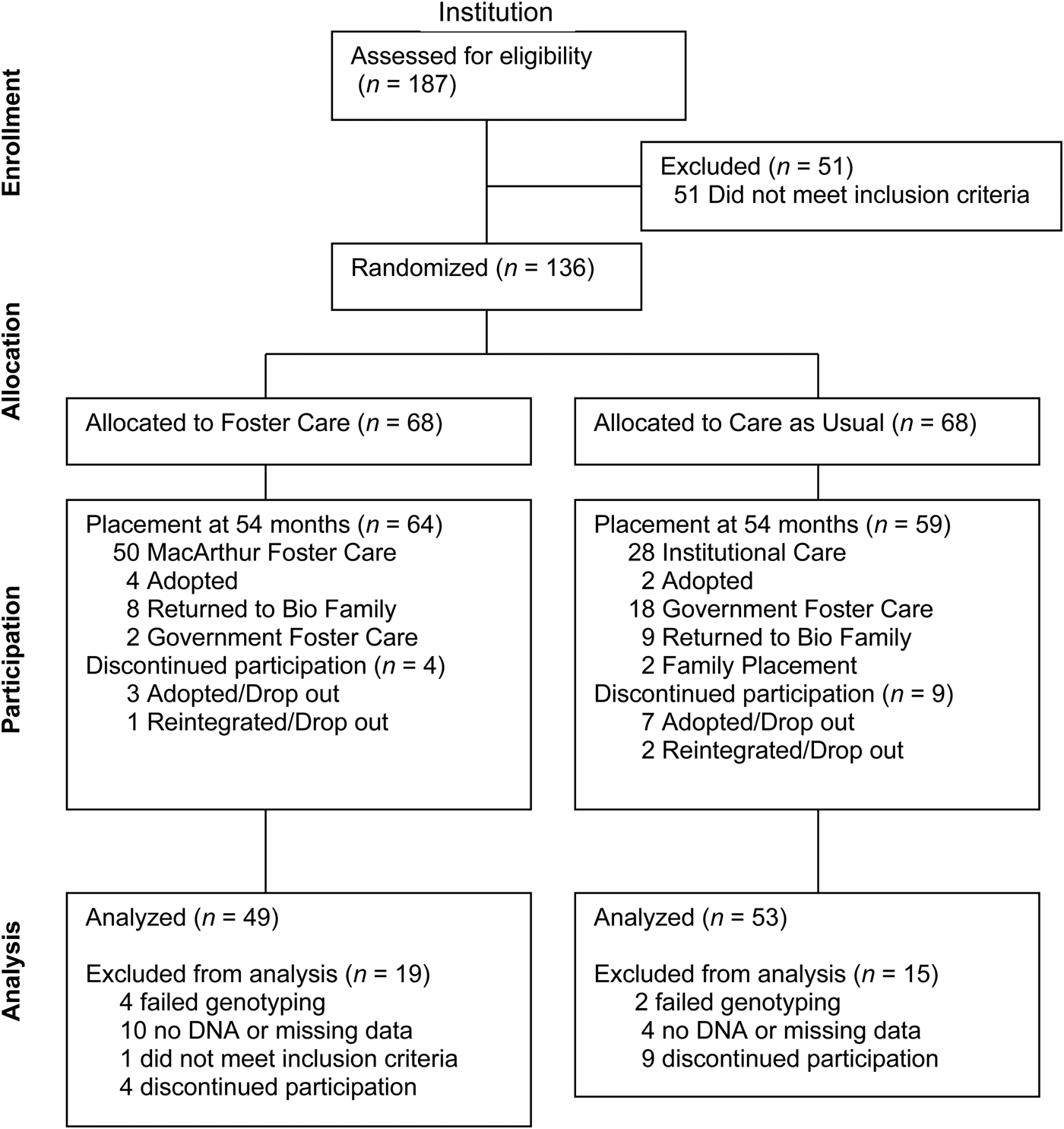
Following randomization, all subsequent decisions regarding placement were made by the Romanian National Authority for Child Protection in accordance with Romanian law, with the agreement that no child removed from an institution and placed in project-supported foster care would be returned to an institution. Over the 4 years of the project, there was considerable movement within the groups. Figure 1 depicts placement at 54 months and flow of participants, including reasons participants were not included in final sample. All analyses follow intent to treat, so that children are analyzed within their originally assigned group regardless of placement at 54 months of age becaue this is expected to provide the most stringent statistical approach. Psychopathology data and genotype data were available for 102 children.
Consort diagram.

Measures
Externalizing behavior
Baseline, 30 months, and 42 months
The Infant Toddler Social Emotional Assessment (ITSEA; Carter, Briggs-Gowan, Jones, & Little, Reference Carter, Briggs-Gowan, Jones and Little2003) is a 195-item caregiver-report questionnaire used to assess problem behaviors and competencies in children greater than 12 months of age. The ITSEA was administered to caregivers/parents at baseline, 30 months, and 42 months of age. For the present study, we used the externalizing domain score, which comprises activity/impulsivity, aggression/defiance, and peer aggression. Both the Preschool Age Psychiatric Assessment (PAPA; see below) and the ITSEA measures were obtained from foster mothers for children in foster care. For children in institutions, an institutional caregiver, who was considered the child's favorite caregiver by staff consensus, or, if the child had no favorite, a caregiver who worked with the child regularly, reported on the child's behavior at each time point.
54 Months of age
Psychiatric morbidity at 54 months of age was assessed using the PAPA. The PAPA is a semistructured psychiatric interview assessing caregiver report of child behavior and emotional scores. Test–retest reliability of the PAPA is comparable to structured psychiatric interviews used to assess older children and adults (Egger et al., Reference Egger, Erkanli, Keeler, Potts, Walter and Angold2006). The PAPA 1.3 was translated into Romanian, backtranslated into English, and assessed for meaning at each step by bilingual research staff. The BEIP lead interviewer was trained in administration of the PAPA by the group who developed the measure, and he subsequently trained other Romanian interviewers. The reliability of the PAPA in this population is described in detail elsewhere (Zeanah et al., Reference Zeanah, Egger, Smyke, Nelson, Fox and Marshall2009). For this study, total externalizing score, a composite measure of symptoms of conduct disorder, oppositional defiant disorder, and ADHD, was utilized.
Genotyping
DNA was extracted from MasterAmp buccal swabs using Epicentre Biotechnologies MasterAmp DNA extraction solution following manufacturer's recommendations. 5-HTTLPR (rs4795541) allele status was determined using standard polymerase chain reaction methods and gel electrophoresis with careful attention to magnesium concentrations. Variation of magnesium levels from 1 to 2 mM did not result in genotype differences as has been previously demonstrated in other studies (Yonan, Palmer, & Gillian, Reference Yonan, Palmer and Gillian2006). All samples were run in triplicate, with known controls. Samples with inconsistent triplicates were repeated. Genotype was tested to confirm Hardy–Weinberg equilibrium (p = .96, N = 102). 5-HTTLPR genotype frequencies were 0.47 for the short allele and 0.53 for the long allele. Genotyping failed on six individuals for whom DNA was obtained (three CAUG, three FCG), and seven samples required replication of genotyping for confirmation of genotype. No significant differences in group, ethnicity, or externalizing scores were found between those with and without genotype or DNA.
Human subjects
The study was approved by institutional review boards at Boston Children's Hospital/Harvard Medical School, Tulane University, the University of Maryland, and by the local commissions on child protection in each sector of Bucharest. The proposed study was reviewed by institutional review boards in the US institutions of the three principal investigators and, in 2002, by an ad hoc ethics commission appointed by Romanian officials (Zeanah et al., Reference Zeanah, Nelson, Fox, Smyke, Marshall and Parker2003).
Data analysis
Bivariate associations were examined among genotype, group, and demographic characteristics (i.e., sex and ethnicity). Linear mixed modeling (LMM) in SPSS (version 20) was used to examine the effect of 5-HTTLPR genotype (S/S vs. S/L vs. L/L) on externalizing scores from the ITSEA, across three time points (baseline, 30 months, and 42 months). This method models individual change over time, explores systematic differences in change, and examines the effects of key variables (i.e., 5-HTTLPR genotype) on differences in the rate of growth. LMM is an appropriate approach when studying individual change because it creates a two-level hierarchical model that nests time within individuals, and can flexibly accommodate missing data. As such, individuals were included in the analyses even if externalizing scores were missing at one or more time points. LMM specifying a random intercept and random and fixed effects for slope (wave of assessment) was performed. The relationships among 5-HTTLPR genotype, intervention group, and model parameters (i.e., initial status and linear growth) were estimated after statistically controlling for the effects of sex and ethnicity.
Univariate analyses of covariance were used to examine the effect of 5-HTTLPR group, intervention group, and their interaction on externalizing at 54 months, statistically controlling for sex, ethnicity, and baseline externalizing.
Given that meta-analytic findings indicated the greatest susceptibility with S/S individuals (van IJzendoorn et al., Reference van IJzendoorn, Belsky and Bakermans-Kranenburg2012), all analyses were repeated with a dummy variable (i.e., 5-HTTLPR group: S/S genotype vs. S/L genotype and L/L genotype) as a predictor.
Results
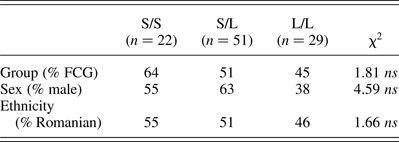
A total of 102 individuals provided both genetic data and externalizing scores for at least one time point. The 5-HTTLPR genotype was unrelated to intervention group or demographic variables (including sex and ethnicity; see Table 1). In addition, the association between 5-HTTLPR genotype and externalizing scores at any time point did not reach statistical significance (i.e., baseline, 30 months, 42 months, 54 month, ps = .09–.94). Genotype frequencies were not significantly different from previously reported genotypes in Romanian children adopted in the United Kingdom from institutions. Specifically, our genotype frequencies were 27% S/S, 51% S/L, and 22% L/L, and in the Kumsta et al. (Reference Kumsta, Stevens, Brookes, Schlotz, Castle and Beckett2010) study the reported genotype frequencies were 24% S/S, 48% S/L, and 28% L/L, suggesting no differences in overall allele frequencies between these two studies.
Demographics by 5-HTTLPR genotype
Note: FCG, Foster care group.
Correlations were run to examine whether externalizing scores were associated across time points over time in all individuals as well as within each intervention group (FCG and CAUG; Table 2). For each time point, both in the complete sample and within intervention group, scores were positively correlated to scores from follow-up periods immediately preceding and following, suggesting developmental continuity between assessments.
Correlation matrix and descriptive statistics for externalizing scores by time point
Note: FCG, Foster care group; CAUG, care as usual group; MOA, months of age.
†p < .10. *p < .05. **p < .01. ***p < .001.
Intervention Group × 5-HTTLPR Genotype on externalizing trajectory from baseline to 42 months
5-HTTLPR individual genotype analysis (S/S vs. S/L vs. L/L)
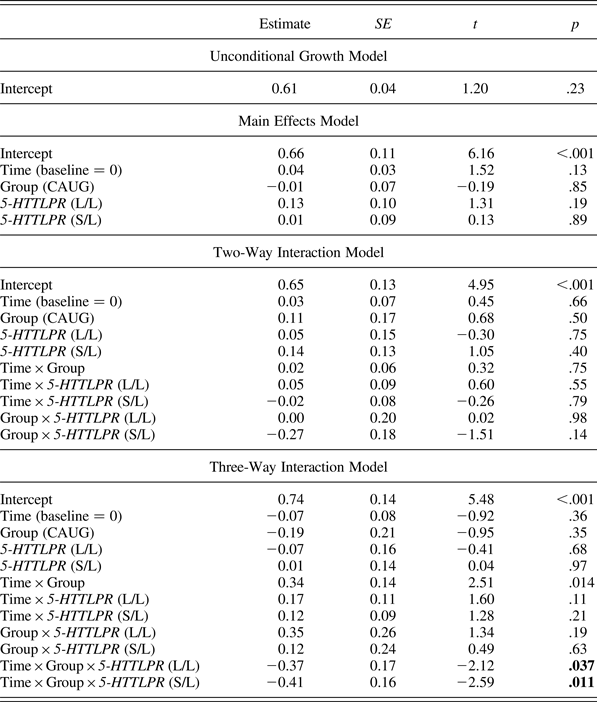
Estimates from the unconditional growth model, the main effects model, the two-way interaction model, and the three-way interaction models are shown in Table 3. The only significant predictor of externalizing in the main effects model was sex, F (1, 77.80) = 5.10, p = .03, such that boys had higher externalizing scores than did girls. No other variable, including genotype, was a significant direct predictor of externalizing.
Summary table of the mixed effects model for the three genotype model predicting externalizing scores
Note: Covariates are not presented. CAUG, Care as usual group.
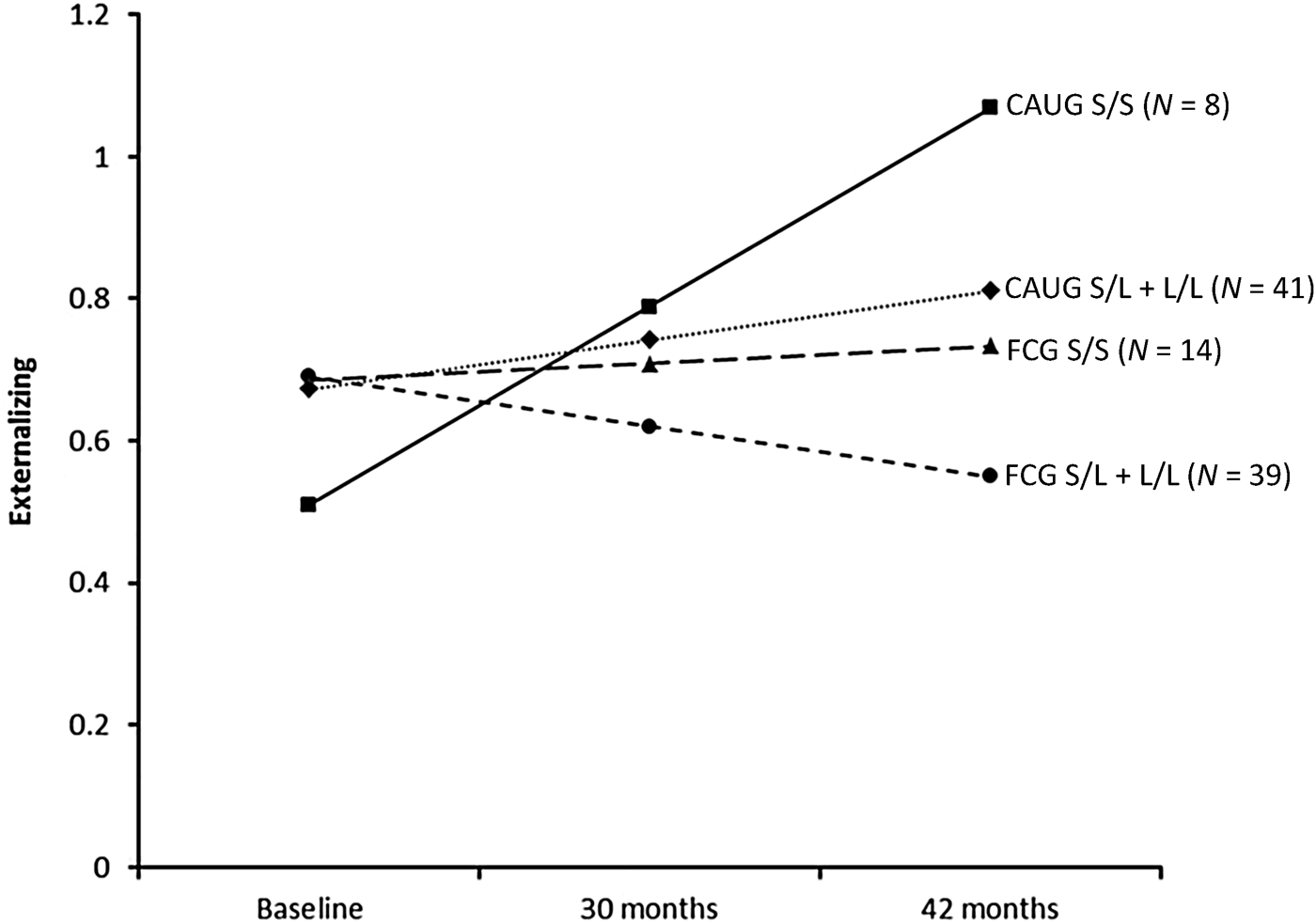
The three-way interaction (5-HTTLPR × Intervention Group × Time) significantly predicted externalizing scores, F (2, 78.25) = 3.47, p = .04. Post hoc analyses within each genotype revealed that there were no significant Intervention Group × Time interactions for individuals with either the S/L or the L/L genotype. At baseline, among individuals with the S/S genotype, there was no difference between CAUG and FCG on externalizing scores, F (1, 13.05) = 0.68, p = .43. However, for individuals with the S/S genotype, there was a significant Group × Time interaction, F (1, 13.64) = 5.89, p = .03, such that over time the trajectory of externalizing scores significantly differed between the two groups. Specifically, in the CAUG, the trajectory of externalizing scores increased, while within the FCG, externalizing scores declined.
5-HTTLPR grouped genotype analysis (S/S vs. S/L + L/L)
Given the variable categorization of genotype across previous studies, and our initial findings suggesting the effects are driven by individuals with the S/S genotype, we further examined externalizing scores collapsing across other genotypes to test directly whether S/S individuals significantly differed from those with either the S/L or the L/L genotype (i.e., S/L + L/L). Findings were largely unchanged. No significant direct effects of genotype, intervention group, and time or two-way interactions were detected. A significant three-way interaction for 5-HTTLPR genotype, intervention group, and time predicting externalizing scores was found, F (1, 80.40) = 6.75, p = .01. Once again, no significant effects were found in children with the long allele. However, in children with the S/S genotype, there were significant differences such that children in the CAUG demonstrated increased trajectory of externalizing scores, while those within the FCG demonstrated decreased scores (see Figure 2).
Externalizing scores across time by intervention group and 5-HTTLPR genotype (S/S vs. S/L and L/L). CAUG, Care as usual; FCG, foster care group.
Intervention Group × 5-HTTLPR Genotype on externalizing at 54 months
5-HTTLPR individual genotype analysis (S/S vs. S/L vs. L/L)
At 54 months of age, a structured psychiatric interview, the PAPA, was used to measure psychopathology. Because a different measure was used to obtain externalizing scores at this time point, the interaction of Intervention Genotype × Intervention Group at 54 months of age was directly examined. Neither genotype, F (2, 75) = 0.32, p = .72, partial η2 = 0.01, nor intervention group, F (1, 75) = 0.001, p = .97, partial η2 < 0.001, were significantly associated with externalizing scores. Again, there was a significant effect of sex, F (1, 75) = 6.74, p = .01, partial η2 = 0.08, such that boys had significantly higher externalizing scores than girls.
Univariate covariant analysis testing the interaction of 5-HTTLPR Genotype × Intervention Group interaction at 54 months, with sex, ethnicity, and externalizing score at baseline as covariates, revealed a significant interaction effect, F (2, 73) = 6.89, p = .002, partial η2 = 0.16. Post hoc analyses determined that the interaction was driven by intervention group differences within children with the S/S genotype. Within children with the S/L and L/L genotypes, no differences in mean externalizing scores were found between CAUG and FCG. However, within children with the S/S genotype, those in the CAUG had significantly higher mean externalizing scores than S/S individuals in the FCG. Group status predicted 49% of the variance in externalizing scores at 54 months, over and above the effects of sex, ethnicity, and baseline externalizing score, F (1, 11) = 15.84, p = .002, partial η2 = 0.59.
5-HTTLPR grouped genotype analysis (S/S vs. S/L + L/L)
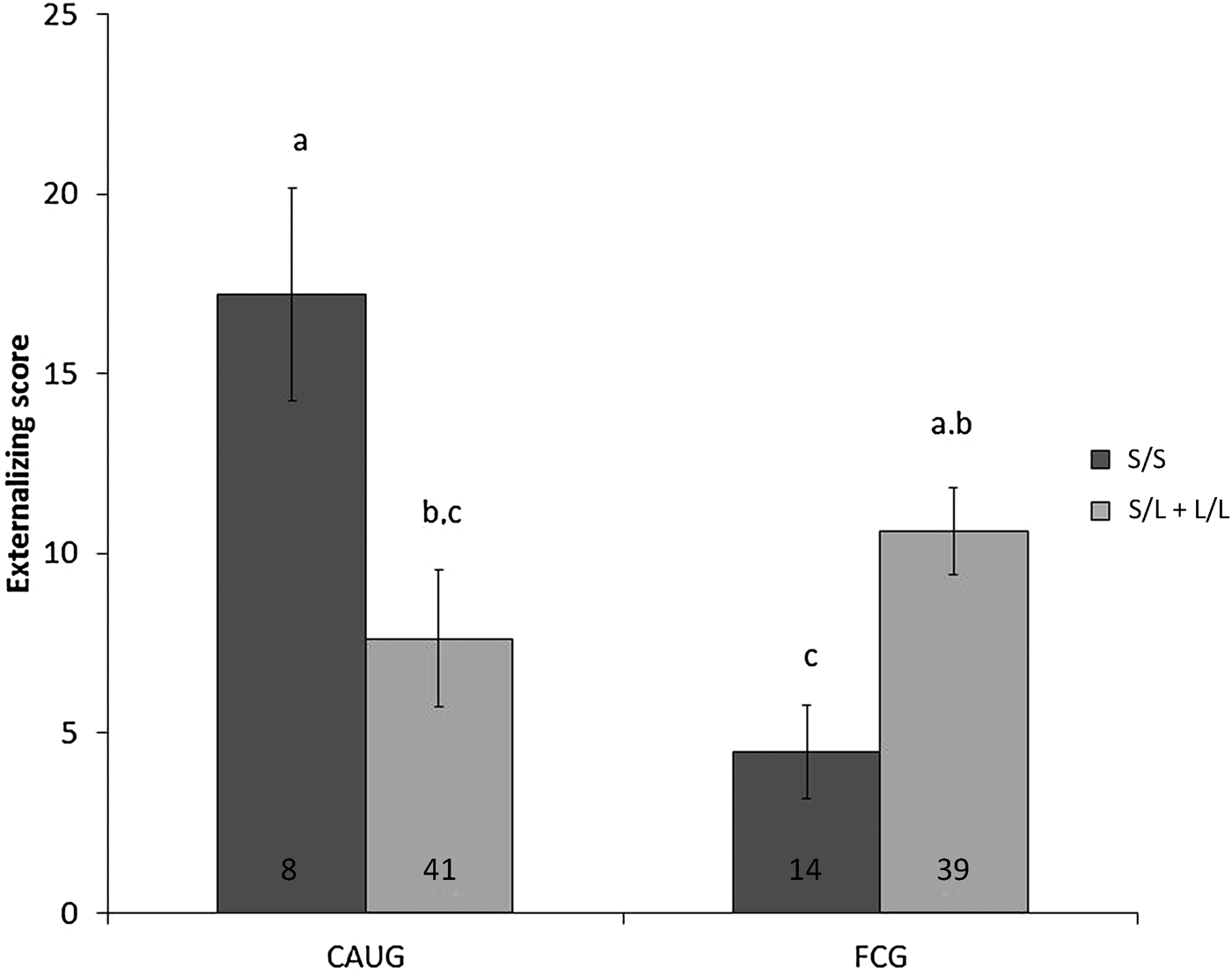
The collapsed long allele genotype produced a significant Genotype × Intervention Group interaction at 54 months of age, F (1, 74) = 14.03, p < .001, partial η2 = 0.16 (Figure 3). Post hoc tests conducted within genotype indicated that there was no effect of intervention group within S/L + L/L individuals, F (1, 60) = 2.56, p = .12. Yet, as noted above, intervention group was a significant predictor of externalizing scores within the S/S individuals. To further establish DST directly, we tested the effects of genotype within each group. There was a significant direct effect of genotype in both the CAUG, F (1, 31) = 5.84, p = .02, partial η2 = 0.16, and the FCG, F (1, 40) = 6.62, p = .01, partial η2 = 0.14. However, these effects were in different directions, that is, in a for better or worse manner. Specifically, S/S genotype was associated with higher externalizing scores at 54 months in the CAUG and lower externalizing scores in the FCG. CAUG individuals with the S/S genotype had an average externalizing score that was 3.97 points higher than the long carriers from the CAUG. Within the FCG, S/S individuals had an average externalizing score that was 4.95 points lower than long carriers within the FCG. The observed interactions between intervention group and genotype remained significant regardless of inclusion of baseline scores.
Externalizing scores at 54 months by intervention group and 5-HTTLPR genotype (S/S vs. S/L and L/L). CAUG, Care as usual; FCG, foster care group. Columns with the same letter do not significantly differ from one another using a least significant difference post hoc test (p > .05).
Discussion
Our findings, within the RCT design of the BEIP study, indicate that the interaction of 5-HTTLPR genotype with intervention group status predicts the trajectory of externalizing scores from baseline to 42 months and externalizing scores at 54 months in a manner consistent with differential susceptibility. Specifically, in the negative environment (i.e., continued institutional care) the S/S genotype predicts the highest externalizing scores, while in the positive environment (i.e., foster care placement) the S/S genotype is associated with the lowest externalizing scores. In contrast, for individuals with at least one long allele, the interaction of genotype and group status, within and across intervention group, was not a significant predictor of externalizing. Because the majority of prior studies of DST have been correlational or cross-sectional, the use of baseline, prerandomization measures, a RCT design, and longitudinal data analysis add substantial strength to the findings in this study (van IJzendoorn & Bakermans-Kranenburg, Reference van IJzendoorn and Bakermans-Kranenburg2012). Prior studies of genetic differential susceptibility that focused on the parent–child relationship have also been limited by the potential of genotype–environment correlation (i.e., the fact that genetic factors related to parenting may exist in the biologically related children, influence directly their response to the parenting environment, and therefore confound the effect of the intervention). The use of nonbiologically related individuals as caregivers in both settings (i.e., foster parents and institutional caregivers) permits the isolation of the genetic contribution to differential susceptibility to child-specific genetic variation. Alternative approaches to circumvent this confounder (randomization based on both intervention group and susceptibility marker, i.e., genotype) can also be used to delineate DST in studies examining parenting or caregiving interventions in biologically related individuals (van IJzendoorn & Bakermans-Kranenburg, Reference van IJzendoorn and Bakermans-Kranenburg2012).
A recent meta-analysis by van IJzendoorn et al. (Reference van IJzendoorn, Belsky and Bakermans-Kranenburg2012) revealed that the short allele, and particularly the S/S genotype, served as the susceptibility moderator specifically in samples that were predominantly Caucasian. Acknowledging that examples of both short carrier grouping (S/L with S/S), and long carrier grouping (S/L with L/L) can be found in the literature (van IJzendoorn et al., Reference van IJzendoorn, Belsky and Bakermans-Kranenburg2012), our primary analyses did not collapse across genotype groups. Only after S/L and L/L were found to have similar outcomes, that differed significantly from the S/S group, were secondary analyses performed using long carrier grouping (i.e., S/L + L/L). Our results show that the S/S genotype has the greatest susceptibility, consistent with the meta-analytic results.
Our analytic approach was designed to specifically test DST. At baseline, we confirmed no differences, by group or genotype, in externalizing, supporting the effectiveness of the randomization procedure. Next, consistent with DST, no effect of the environment (group) or genotype (5-HTTLPR) were demonstrated. Within the RCT of defined positive and negative environments (i.e., well-supported foster care and institutional care), significant differences in externalizing among children with the S/S genotype, in a for better and worse manner, were found. Trajectory analyses from baseline to 42 months of age found a significant Genotype × Intervention Group × Time interaction driven by differences within in S/S genotype, and culminating in differing trends in externalizing over time based on the group status. At 54 months, S/S children had significantly lower externalizing scores if randomized to the FCG, yet they had the highest externalizing scores if randomized to the CAUG. In addition, we demonstrated that individuals with the S/L or L/L genotypes, presumably the less susceptible or sensitive genotypes, did not differ in externalizing regardless of intervention group. The absence of significant difference in individuals with the nonsusceptible genotypes (i.e., S/L and L/L) provides an additional level of evidence for DST (Belsky, Pluess, & Widaman, Reference Belsky, Pluess and Widaman2013). Although previous studies, including our own, suggested that externalizing scores were relatively resistant to alterations of the caregiving setting following early institutional care, these current findings demonstrate that a subset of children, defined by the S/S genotype of the 5-HTTLPR, may be particularly sensitive to early caregiving and demonstrate substantial improvement when provided with enhanced caregiving.
In determining the specific phenotypes and genotypes appropriate for DST analysis, it is critical to consider that direct genetic effects may be absent or minimal, and developmental differences may be present (Belsky et al., Reference Belsky, Bakermans-Kranenburg and van IJzendoorn2007; Ellis, Boyce, Belsky, Bakermans-Kranenburg, & van IJzendoorn, Reference Ellis, Boyce, Belsky, Bakermans-Kranenburg and van IJzendoorn2011). Consistent with this, in both our previous study of differential susceptibility for disinhibited social behavior and the current study focused on externalizing, no direct effect of genotype was present (Drury et al., Reference Drury, Gleason, Theall, Smyke, Nelson and Fox2012). In addition, although there is evidence of both increasing (Lavigne et al., Reference Lavigne, Gibbons, Christoffel, Arend, Rosenbaum and Binns1996) and decreasing (Gilliom & Shaw, Reference Gilliom and Shaw2004) externalizing behavior during this developmental time period (early childhood), little is known about the trajectory of externalizing scores in children who experienced institutional care. Thus, careful attention to the influence of genetic variation across developmental time points is needed. One previous study, of children enrolled in the English and Romanian Adoptee Study, examined the longitudinal association among the 5-HTTLPR, institutional care, and psychopathology (Kumsta et al., Reference Kumsta, Stevens, Brookes, Schlotz, Castle and Beckett2010). The interaction between institutional care and the 5-HTTLPR genotype was associated with emotional problems, at ages 11 and 15, but a differential interaction existed for those children exposed to additional negative life events in the intervening time period. These studies suggest that the interaction between genetic variants and institutional care is relevant for long-term child outcomes, and the effect of this interaction may vary across development.
Although the mechanism underlying the persistence of externalizing behavior in postinstitutionalized children remains poorly defined, our findings suggest that externalizing psychopathology is, in part, the consequence of the adverse early caregiving environment interaction with serotonergic pathways. Higher rates of aggression are found among institutionalized children, and aggressive, or more dominant, children appear to get more adult attention and resources (Sturge-Apple, Davies, Martin, Cicchetti, & Hentges, Reference Sturge-Apple, Davies, Martin, Cicchetti and Hentges2012). In the setting of institutional care, unresponsive caregiving in children is associated with decreased serotonergic turnover (van Goozen, Fairchild, Snoek, & Harold, Reference van Goozen, Fairchild, Snoek and Harold2007). Because evidence suggests that caregiving influences the development of serotonergic neural pathways underlying aggression and physiologic reactivity to both negative and positive emotions, the early caregiving found in the institutional settings may lead to strengthening of these circuits and persistence of these behaviors. However, in S/S children, where serotonergic neurotransmission is putatively more plastic, the responsive caregiving found in BEIP foster care may lead to the significant decrease in these behaviors because these circuits were less strongly defined and therefore more responsive to caregiving changes, prior to foster care placement as a consequence of decreased serotonergic tone.
Additional considerations and limitations
Limitations to this study exist. The most significant limitation to this study is sample size and the subsequent challenges associated with statistical power. Although this remains the largest RCT of foster care compared to continued institutional care ever conducted, the issue of sample size is an inescapable limitation. To address sample size issues, we used longitudinal data and a well-defined a priori hypothesis based on the existing cell biology and neuroscience literatures. Of note, our findings overlap significantly with previous studies of this genetic variant in postinstitutionalized children, who, while not part of a randomized trial, experienced similarly significant alterations in caregiving (Kumsta et al., Reference Kumsta, Stevens, Brookes, Schlotz, Castle and Beckett2010). Differential susceptibility to externalizing behaviors has previously been demonstrated in adopted children and other populations, and while not exact replications, these studies demonstrate additional convergence with our results (Brody et al., Reference Brody, Beach, Philibert, Chen and Murry2009; Cadoret et al., Reference Cadoret, Langbehn, Caspers, Troughton, Yucuis and Sandhu2003; Nobile et al., Reference Nobile, Giorda, Marino, Carlet, Pastore and Vanzin2007; Simons et al., Reference Simons, Lei, Stewart, Beach, Brody and Philibert2012; Zimmermann, Mohr, & Spangler, Reference Zimmermann, Mohr and Spangler2009). Larger replications in other at-risk populations, with clearly defined environmental changes, are needed. Another prominent limitation is the substantial change in child placements over the course of the study. Although designed as an RCT, significant movement between groups occurred over the course of this study as ethical and legal reasons precluded interference with these decisions. Although examination of specific movement across caregiving environments (i.e., percent time in institutional care) would be potentially interesting, we believe our approach represents the most statistically stringent analysis. Further, the goal of this analysis was to specifically test DST, and therefore we leveraged the RCT design in our analytic approach. We demonstrated that there were no significant differences in children with the nonsusceptibility genotypes (i.e., S/L and L/L) across environments. We demonstrated that within both the high- and low-risk environmental groups the effect of the S/S genotype was significant. Most critically, this effect is inverted depending on the environment; that is, the S/S genotype is significantly more negative in the negative environment and significantly more positive in the positive environment (Belsky et al., Reference Belsky, Pluess and Widaman2013; Roisman et al., Reference Roisman, Newman, Fraley, Haltigan, Groh and Haydon2012). Taken together these findings are most consistent with DST.
We did not correct for potential population stratification, where baseline differences in allele frequencies between ethnic groups may result in Type I or Type II errors in genetic association studies. However, for population stratification to present a statistical problem, two conditions need to be met: a significant difference in allele frequencies between ethnicities must be present and differences in outcome between ethnicities must exist (Hutchison, Stallings, McGeary, & Bryan, Reference Hutchison, Stallings, McGeary and Bryan2004). In the present study, neither of these conditions was present. The ancestry informative markers genotype panel, often used in G × E studies to account for genetic admixture, is not expected to be able to distinguish between our two most common ethnicities in this study, Romanian and Rroma. As such, ethnicity was included as a covariate in all analyses. In addition, we examined only the short and long alleles of the 5-HTTLPR. Additional polymorphism in the 5-HTTLPR (rs25531), as well as methylation status, may further influence the functional aspects of the 5-HTTLPR; however, these variants are not available in this data (van Ijzendoorn, Caspers, Bakermans-Kranenburg, Beach, & Philibert, Reference van Ijzendoorn, Caspers, Bakermans-Kranenburg, Beach and Philibert2010). Although we cannot address potential differences due to methylation, the categorization of S/S homozygotes in the secondary analysis minimizes the potential effect of this variant. It is also important to note that other single nucleotide polymorphisms exist within the 5-HTT gene, with varying levels of functional significance, suggesting that the ability to capture the full range of genetically determined variation in the function of the 5-HTT remains more complicated than the short versus long allele or the rs25531 (Nakamura, Ueno, Sano, & Tanabe, Reference Nakamura, Ueno, Sano and Tanabe2000; Uher & McGuffin, Reference Uher and McGuffin2008).
Finally, different measures of externalizing behavior were used: the ITSEA and the PAPA. Although these measures are different, the independent reliability of both measures is substantial and there was significant correlation between the ITSEA 42-month measurement and the PAPA 54-month assessment. In addition, our statistical approach was designed to minimize any effect of incorporating different measures. The consistent finding across two different measures of externalizing behavior could additionally be considered an analytic strength.
Conclusion
In conclusion, our results offer convincing support for a model of genetic differential susceptibility to the caregiving context for externalizing behaviors. The concept that the genetic makeup of an individual child can influence response to changes in the caregiving environment offers an extension to previous theories of risk and resilience and enhanced insight into the biological underpinnings of the developmental trajectory of externalizing in children with a history of early institutional care.