


INTRODUCTION
The city of Gabii was regarded in antiquity as a significant cultural and religious centre with deep historical roots. According to ancient sources, it was the site where the legendary first king of Rome, Romulus, and his brother, Remus, acquired Greek learning and martial training.Footnote 1 Its cultural prominence is further underscored by institutions such as the cinctus Gabinus, a distinctive method of girding the toga to leave the hands free during ritual performance, and the ager Gabinus, a designated mode of land use for specific augural practices.Footnote 2
Only 20km east of Rome, the city’s period of greatest prominence occurred during the Middle Republic, when it reached its peak in both population and geographic extent (fig 1).Footnote 3 As Rome expanded in influence and size, however, Gabii seems to have experienced a decline.Footnote 4 Dionysius of Halicarnassus captures this trajectory in a passage that reflects both the city’s former stature and its diminished status in the Augustan period:
πόλις ἦν ἐκ τοῦ Λατίνων γένους Ἀλβανῶν ἀπόκτισις ἀπέχουσα τῆς Ῥώμης σταδίους ἑκατὸν ἐπὶ τῆς ϵἰς Πραίνϵστον φϵρούσης ὁδοῦ κϵιμένη: Γαβίους αὐτὴν ἐκάλουν: νῦν μὲν οὐκέτι συνοικουμένη πᾶσα, πλὴν ὅσα μέρη πανδοκϵύϵται κατὰ τὴν δίοδον, τότϵ δὲ πολυάνθρωπος ϵἰ καί τις ἄλλη καὶ μϵγάλη. τϵκμήραιτο δ̓ἄν τις αὐτῆς τὸ μέγϵθος καὶ τὴν ἀξίωσιν ἐρϵίπια θϵασάμϵνος οἰκιῶν πολλαχῇ καὶ τϵίχους κύκλον, ἔτι γὰρ ἕστηκϵν αὐτοῦ τὰ πλϵῖστα.
It was a city of Latin people, a colony of the Albans, located 100 stadia from Rome along the road that leads to Praeneste. They called it Gabii. Today, not all parts of the city are still inhabited, but only those near the road, those parts that serve as inns along the thoroughfare; however, at that time it was as large and populous as any city. One can judge its size and importance by observing the ruins of the buildings in many places and the circuit of the walls, much of which is still preserved.Footnote 5
Map of the archaeological area of Gabii and its surroundings. Plan updated and prepared by the Gabii Project. Inset: plan of the sanctuary of Juno and the excavated northern third of the forum of imperial Gabii (aka ‘Hamilton’s Forum’). Plan: created by the Gabii Forum Project.

Fig 1. Long description
Panel A: A detailed map of the archaeological area of Gabii and its surroundings. The map shows various areas under excavation by different institutions, including the University of Michigan Kelsey Museum and the Soprintendenza di Roma. Key areas are labeled, such as the Eastern Sanctuary, areas to Tibur, and areas to Praeneste. The map also indicates the extent of the ancient site and the estimated maximum population. Panel B: An inset plan of the sanctuary of Juno and the excavated northern third of the forum of imperial Gabii, also known as Hamilton's Forum. The plan includes detailed layouts of structures such as the theater, temple of Juno, domus, and forum. The plan is oriented with a compass rose and includes a scale for distance measurement.
This perception of Gabii’s decline is echoed repeatedly in ancient sources, from Cicero to Horace.Footnote 6 Yet this seemingly straightforward narrative becomes more complicated in light of the extraordinary discovery made by the antiquary Gavin Hamilton in the late eighteenth century: more than thirty imperial-era sculptures, many life-sized, were unearthed within and around a monumental public space now colloquially referred to as ‘Hamilton’s Forum’.Footnote 7 Remarkably, the sculptures span a chronological range from the first century to the mid-third century ad, the very period during which Gabii is traditionally thought to have been in decline or even abandoned.Footnote 8
Although Hamilton’s discoveries made a considerable impression in the eighteenth century, the perception of Gabii’s desolate imperial period has persisted into modern scholarship. In part, this derives from the uncertainty surrounding the provenance of many statues attributed to Gabii, a consequence of their antiquarian discovery. A reexamination and reintegration of antiquarian archives, records and correspondences with the site’s modern archaeological and sculptural data, however, can clarify and in some cases reaffirm the discovery of certain sculptures at Gabii, while also raising the possibility of incorporating previously unrecognised works into the corpus. In doing so, the image of imperial Gabii as an abandoned city gives way to one of a reduced community that remained civically and religiously active well into the imperial period.
HAMILTON AT GABII
In 1792, Hamilton entered into an agreement with Prince Marcantonio Borghese to excavate on his land just outside of Rome.Footnote 9 Although this was Hamilton’s second excavation campaign at Gabii, it was by far the more successful of the two.Footnote 10 Hamilton began his exploration of the site most fortuitously, almost immediately discovering the aforementioned ‘publick space’ in the late spring of 1792. Impressed by the monumentality of the discovery, he described the finds in detail in a letter to his client and friend:
Dear Sir
I am just got up after an Ague of 3 weeks and somewhat weak, nevertheless I cannot help putting pen to paper and to give you some account of my proceedings at the Cava of Gabio, the exact spot of which is now decided by the interesting inscriptions I found in that place, to the great joy of all antiquarians. Here my good fortune begun with the discovery of the two fine busts of Septimius Severus and Geta. I next got into the publick place ornamented with a portico, pedestals and statues of the Decurioni and other magistrates of the Gabini, with the inscriptions on the pedestals. What offered next was a very large architrave and frize with a very long and curious inscription on it, signifying that the palace was built by Polycarpus for the memory of Domitia daughter of Domitius Corbulonus. There is likewise the donation of this palace with all the statues and other valuable things to the city of Gabio but on certain conditions, I have found fragments of at least two hundred statues, but so mutilated that I have only been able to save 22 statues chat are good and worthy restoring besides ocher curious things of different kinds and small statues heads &c. I have three statues in armour all Imperial that go much beyond anything of the kind hitherto seen, a drapery figure of a woman uncommonly fine, a statue of Claudius and one of Germanicus in fine preservation, a statue of Diana quite new and very fine in particular the head, but what you would have coveted most is a small bust of Marcus Agrippa size of life, the finest extant. All these fine things go to the Prince Borghese who builds a place for their reception at the Villa, with the title of the Museo Gabino, and his resolution is much applauded by the publick, I must now tell you that the city of Gabio was just half way from Rome to Palestrina near the Gate of Castiglione in the tenuta di Pantano di Borghese.Footnote 11
As noted, many of the sculptures discovered by Hamilton were restored and transported to the Borghese estate in Rome for display in the newly established Museo Gabino.Footnote 12 Much of our knowledge of this early museum and its collection derives from Borghese’s principal curator, Ennio Quirino Visconti, who studied, illustrated and catalogued its holdings in I Monumenti Gabini della Villa Pinciana.Footnote 13 The museum, however, was short-lived: in 1807, most (but not all) of the collection was acquired by Napoleon and became one of the foundational assemblages of the nascent Musée Napoléon – now the Musée du Louvre – where many of the pieces remain on display.Footnote 14
The Louvre assemblage is often taken to represent the sculptural corpus of imperial Gabii within modern scholarship, yet it comprises only slightly more than half of the sculptures attributed to the site. Not all the sculptures were transferred to Paris. Some remained at the Borghese estate, others were sold to the Vatican Museums and still others were retained by Hamilton for sale to his patrons and colleagues. In addition, several pieces were uncovered contemporaneously by another antiquary, the mosaicist Andrea Volpini (1756–1812), working on behalf of the Marquis Azzolini.
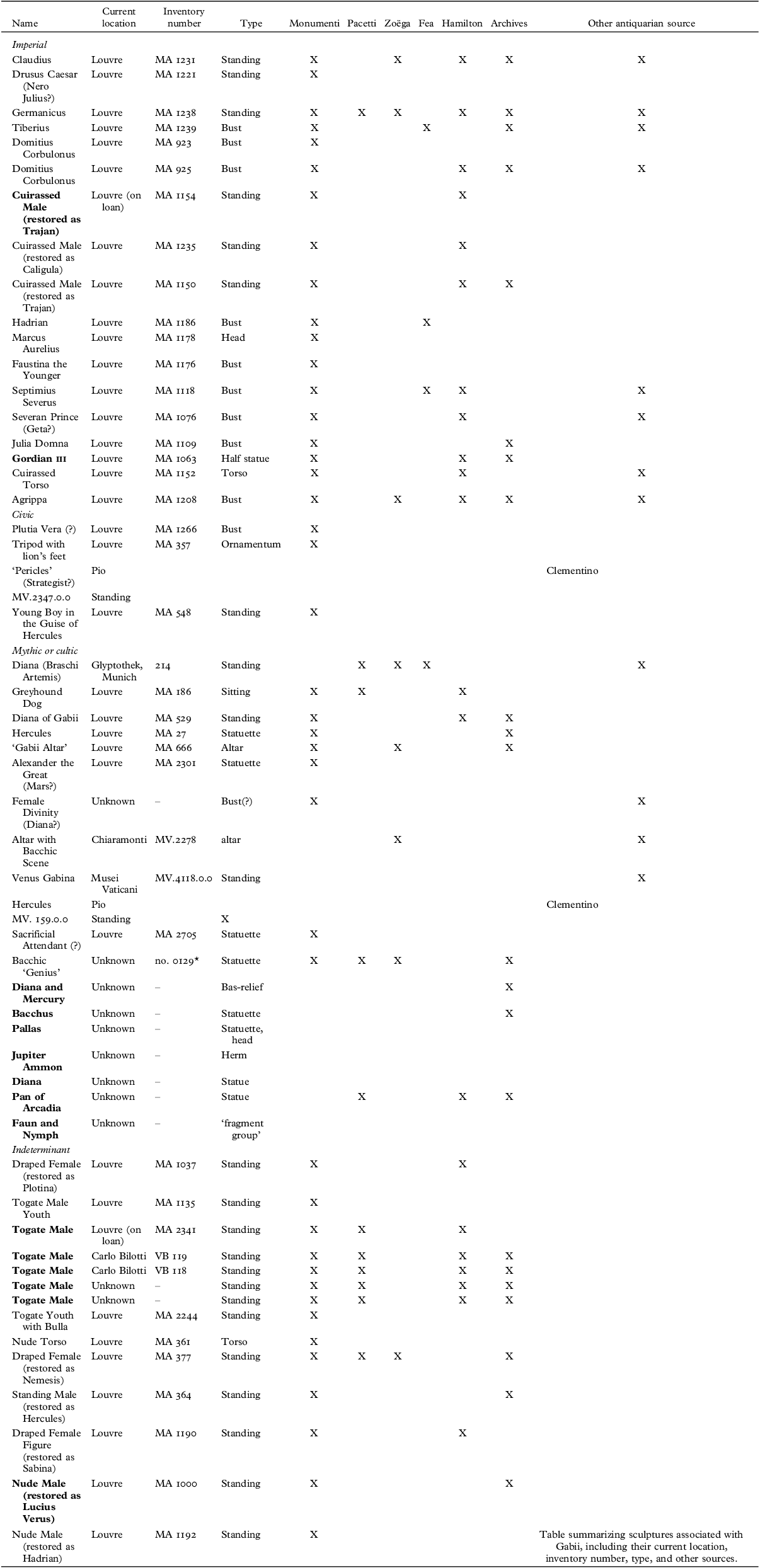
A summary of the sculptures associated with Gabii is presented in table 1. Although a complete analysis and contextualisation of these sculptures remain to be undertaken, their association with Gabii is at least acknowledged, owing in large part to Hamilton’s correspondence and Visconti’s curatorial efforts. In some cases, however, the provenance of individual pieces remains less than certain, and additional sculptures have yet to be recognised as part of the Gabine corpus. One category of evidence that has not been fully exploited for this purpose is the archival documentation from the Borghese collection, currently in the Vatican Apostolic Archives. Several of these records detail the financial transaction with individual sculptures, particularly in relation to their evaluation, transport and/or restoration, and thus provide indirect confirmation of material coming from Gabii. This is not to suggest that the documents themselves are unknown or have not been consulted;Footnote 15 rather, they have not been systematically employed to confirm and expand the sculptural record of the site. Document 5426:1370, in particular, preserves a detailed inventory of sculptures discovered at Gabii, some of which that have not previously been recognised as part of the site’s assemblage; a comprehensive account of Gabii’s imperial sculpture must therefore incorporate this list.
Summary of the sculptures associated with Gabii.

Table 1. Long description
The table presents a summary of sculptures associated with Gabii, detailing their current location, inventory number, type, and other sources. It includes columns for name, current location, inventory number, type, and various sources such as Visconti’s Monumenti, Pacetti, Zoega, Fea, Hamilton, Archives, and other antiquarian sources. The table lists multiple sculptures with their respective details, such as Claudius, Drusus Caesar, Germanicus, and others. Each row provides specific information about the sculptures, including whether they are standing, busts, torsos, or other types, and their current locations like the Louvre or unknown. The table also includes references to various sources that acknowledge the association of these sculptures with Gabii.
*Catalog number from Martinez Reference Martinez2004. Since the object was intended for transfer to the Louvre, it is included within that corpus, though it never received an inventory number, suggesting that it never arrived.
All figural sculptures attributed to Gabii that were discovered before the nineteenth century. Sculptures with no definable characteristic (ie ‘alabaster bust’) are not included. Sculptures that are discussed in archival document 5426:1370 are bold.
In what follows, I first establish a methodological framework to clarify both the manner and limits within which such archival material may be reintegrated into the archaeological landscape of a city such as Gabii. I then examine archival document 5426:1370 and reassess its lesser-known contents, situating them within the broader archaeological and cultural context of imperial Gabii. This analysis brings forth further consideration of the public space discovered by Hamilton as well as possible connections of some of the mythic sculptures to Gabii’s social and cultic heritage.
METHODOLOGY
Fortunately, the scale, significance and excitement surrounding Hamilton’s discoveries at Gabii generated commentary from multiple sources, each offering a different vantage point. In addition to Hamilton’s letters, Visconti’s catalogue and the Borghese archives, there are accounts from other antiquaries who either worked on the sculptures or visited the site. Together these sources provide complementary strands of evidence, though none is complete on its own.
Yet such evidence raises an important methodological concern: how should we assess and interpret data filtered through antiquarian practices? Modern archaeological methodology has long emphasised that excavation irreversibly alters the contexts it investigates and is inherently unrepeatable.Footnote 16 This axiom underscores the unique privilege – and therefore responsibility – borne by the excavator: since the moment of discovery cannot be reproduced, only they are capable of recording the secure context, documenting the precise arrangement, condition, location and associations before removal. Once disturbed, the original context is irretrievably lost. This places immense weight on excavation reports and documentation, as all subsequent interpretations depend on these accounts.
Even in modern excavations, there is no such thing as a perfect report.Footnote 17 Constraints of time, funding and personnel inevitably limit completeness. The scholarly approach to archaeology, centred on due diligence and the purposeful stewardship of information, is largely a development of the past century.Footnote 18 Excavations before the twentieth century, therefore, have the same issues of incomplete records compounded by an entirely different set of priorities. For Hamilton and his contemporaries, the motivation was not academic (though it was, to some extent, intellectual) but driven primarily by financial gain and social prestige.Footnote 19 Yet it was these men who occupied the privileged role of first excavators. The evidence they left behind, however imperfect, remains indispensable.
In light of this, it is necessary to adopt a wider aperture when considering what constitutes acceptable evidence for understanding the original contexts of sites first excavated by antiquaries. In this regard, Lucas’ framework of displacement is particularly useful.Footnote 20 Lucas argues that a more productive way to conceptualise excavation is not as ‘destruction’, but as a process of informational deposition or even transformation. That is, the contextual information of an excavated area is not necessarily obliterated, but rather reconfigured into the records of those who conducted or oversaw the work, or who possessed first- or second-hand knowledge of it. Such an approach is analogous to the analysis of ‘legacy data’ whereby records from earlier (yet still modern) excavations are retrospectively studied and integrated with modern datasets.Footnote 21
Such ‘transmuted data’ are not equivalent or even neutral and should not be evaluated in the same manner, especially in regard to antiquarian records. Determining the reliability of a given account requires attention to the author’s motives and the external pressures they may have faced. A published work might be shaped by expectations to impress an audience, leading to exaggeration or deliberate vagueness, whereas private letters may be more candid.Footnote 22
Perhaps the most reliable accounts are those created for internal use, where the motivation to exaggerate is minimal or even counterproductive. Central to the current study, the Borghese estate documents are focused on financial accounting rather than public consumption or promotion. They detail what was discovered and where, how it was valued, and what payments were owed to sculptor-restorers or excavators such as Hamilton. By their nature, these records prioritise accuracy over embellishment. Their primary limitation lies not in credibility, but in the occasional vagueness or prescriptive nature of the identifications they assigned to sculptures.
A recurring issue across all of these accounts, therefore, is this antiquarian tendency to assign identification to sculptures, often with more confidence than modern scholars would allow. In some cases, this poses little issue: the sculpture in question can be clearly matched to a known work. For instance, while the bust Hamilton labels as ‘Geta’Footnote 23 may or may not represent the ill-fated prince, the Severan youth currently in the Louvre is unquestionably the piece he was referencing, allowing modern scholars to debate its actual identification.
The problem becomes more complex with lost works. When Hamilton mentions a ‘Pan of Arcadia’,Footnote 24 it must be asked if this is correct. Was it really a representation of Pan, or might it have been a faun or satyr instead? Antiquaries often seem uncomfortable leaving a statue unnamed, yet there are cases where they refrain from offering a more alluring attribution. Notably, Hamilton repeatedly attempts to sell a statue of a ‘young girl’ from Gabii without assigning it a more prestigious identity.Footnote 25 In such instances, a modest label may well reflect a more accurate interpretation. The challenge, then, is how to evaluate the other, more assertive identifications that were made.
We could, of course, play it safe and discard all early identifications assigned to these sculptures, avoiding the risk of building upon uncertain foundations. Yet such caution has its own cost, for it forecloses interpretive possibilities that those labels, however imperfect, may still generate. Just as excavation can be understood as transforming contexts into records rather than simply destroying them, so antiquarian identifications can be treated as displaced claims, a first attempt at interpretation produced by those who assessed the material first hand.
Rather than approaching the attributions as either reliable facts or errors to be discarded, therefore, this study treats them as provisional hypotheses. These early attributions remain valuable starting points for further inquiry. Their plausibility can then be evaluated against independent and contextual evidence, including surviving sculptures, archival documentation and the spatial logic of the site. Moreover, the original assignment may indicate visible characteristics that can provide insight (eg the ‘Pan of Arcadia’ might not be Pan, but it likely did have rustic attributes). Even when individual identifications remain uncertain, exploring their implications can sharpen our questions about what kinds of religious, political or social display were possible at Gabii, and can help guide future archival and archaeological investigations.
Within this methodological framework, the Borghese archival document 5426:1370 and its sculptural inventory can be assessed. By evaluating the descriptions preserved in the document alongside Hamilton’s correspondence, Visconti’s catalogue and the surviving sculptures, it becomes possible to reconsider which objects may plausibly belong to the Gabine corpus and, in turn, what they reveal about the civic and religious landscape of imperial Gabii.
THE BORGHESE ARCHIVES AND GABII
The document analysed here comprises four pages and is dated 30 October 1793, a year and half from the start of Hamilton’s dig at Gabii. The first page outlines the payment owed to Hamilton by Prince Borghese regarding antiquities not only from Gabii, but also from a nearby excavation at Monte Porzio. Among the items purchased by the prince are the half-statue of Gordianus Pius (better known as Gordian iii), three marble heads and various unidentified statues, columns and marbles.Footnote 26 The document also records what Hamilton owed the prince, including one-third of the value of antiquities recovered from the excavation near the ‘Osteria di Finocchio, detta di Gabbi’.Footnote 27 Additionally, a separate agreement entitled the prince to one-third of the value of any lead discovered.Footnote 28
The next three pages provide more details concerning the nature of the finds at the excavation at ‘Gabbi’. The list, originally in Italian, is summarised as follows:
-
1. Two heads smaller than life-size in true profile and in bas-relief: one representing Diana and Mercury, both very fragmentary but of good sculpture.
-
2. A statue of Apollo of very poor workmanship.
-
3. A small head of Pallas.
-
4. A small statuette of Bacchus, one palm high.
-
5. A white marble bowl, fragmented.
-
6. Some fragments of an alabaster bust.
-
7. A nearly life-sized statue of an unknown young woman and with her head, but very fragmentary.
-
8. Another statue of Diana missing the head and both arms and the rest in poor condition.
-
9. A statue of a man with a goat skin draped over [his shoulders], of good workmanship, without a head and without a base, with the feet and portions of the arms … it is very broken.
-
10. A mediocre male bust.
-
11. A herm of Jupiter Ammon, very mediocre.
-
12. A fragment group of a Faun and a Nymph, [one?] figure approximately one palm high, very incomplete and of mediocre workmanship.Footnote 29
-
13. A very distinctive bust of Gordian Pius, holding a parazone in his hand with a blade attached and of exceptionally fine workmanship, missing a piece of the right arm with the hand.Footnote 30
At this point, the document turns to the financial arrangement between Hamilton and Prince Borghese regarding the antiquities listed above, as well as others found at Monte Porzio. The inventory continues but notes that the following items were discovered ‘at another time’, suggesting they may have been recovered from another location. Nevertheless, the text affirms that they still derive from ‘the aforementioned excavation’ – that is, Gabii.Footnote 31
-
14. Four pieces of mediocre alabaster column.
-
15. A fragment of a draped statue of coarse marble.
-
16. A draped figure without head or arms, three palms high, mediocre workmanship.
The end of the document outlines an additional agreement between the two parties, in which Prince Borghese purchased three marble heads from Hamilton to be used in restoring three previously mentioned statuesFootnote 32 from Gabii: one consular figure, one of Trajan and a nude figure to which the head of Lucius Aelius (more commonly known as Lucius Verus) was affixed.Footnote 33
A review of these identified statues, along with those whose current whereabouts remain unknown, will contribute to a fuller reconstruction of the sculptural programme at Gabii, thereby offering deeper insight into the socio-cultural landscape of a city long presumed to have been deserted during the imperial period.
RECONTEXTUALIZING THE CIVIC AND IMPERIAL FINDS
Of the finds listed in this document, four are already associated to Gabii: the half-statue of Gordian iii, the statue of Trajan, the statue of Lucius Verus and most likely the consular figure. All except the Gordian iii, which was said to have been found in a villa, appear to align stylistically with other known sculptures that Hamilton reports finding in the public space known as ‘Hamilton’s Forum’.Footnote 34 Moreover, the language of the document suggests that these sculptures were discovered before the objects in the primary list, which would align with the chronology of Hamilton discovering the public space early in his second campaign at Gabii in 1792.
The torso of Gordian iii attracted enthusiasm from the antiquaries involved in the Gabii excavations and is referenced twice in the archival document, where it received the highest appraised value among all the finds. Now housed in the Louvre, the sculpture was discovered at Gabii in remarkably well preserved condition.Footnote 35 Despite Visconti having described the statue as preserving both arms and hands,Footnote 36 the document acknowledges that it was ‘missing a piece of the right arm with the hand’.Footnote 37 The left hand, resting on the hilt of a sword, has also been restored; however, vestiges of the ceremonial dagger, a parazone (Latin: parazonium), mentioned in the document appear to have survived. Additionally, the statue was originally a full-length figure that was reworked into a faux torso bust – likely by the Borghese sculptors – to conform to contemporary tastes.
According to Visconti, the half-statue of Gordian iii was discovered not within the forum area of Gabii, but in a villa situated nearby, alongside two columns of rosso fiorito (a vibrant red alabaster).Footnote 38 The precise location of this villa remains unclear. However, a recent topographic survey and archaeological reassessment by Lorenzo Quilici around the Lake Castiglione crater offers potentially valuable context. In his 2022 preliminary report, Quilici identifies at least ten possible villa sites along the lake’s western ridge, with three to five of these exhibiting occupation into the imperial period.Footnote 39 While no definitive identification can yet be made, further excavation and analysis may help clarify whether one of these villas corresponds to the site where Hamilton discovered the half-length statue.Footnote 40
Two statues from Gabii have been identified as representations of Trajan. The first (Louvre acc. no. MA 1154) is unlikely to be the one mentioned in this document. According to Visconti, the statue’s body was discovered at Gabii without its head and was originally restored with a head of Marcus Aurelius. Since the statue referenced in the archival list was restored with a head of Trajan from the outset, it is reasonable to conclude that it refers to a different example.Footnote 41 The statue in question, therefore, must be the cuirassed standing figure (Louvre acc. no. MA 1150) that currently bears a restored head of Trajan. Although now associated with the optimus princeps, the statue was most likely not conceived to represent him in its original context; stylistic analysis suggests that the body dates to the Flavian period.Footnote 42
The statue of ‘Lucius Aelius’ referenced in the document is most likely Louvre acc. no. MA 1000, a heroic nude figure with a mantle draped over the left arm. Restored by Vincenzo Pacetti, the statue was fitted with a head likely dating to the Antonine period, though it is no longer identified as Lucius Verus,Footnote 43 whereas the body cannot be dated more precisely than to the imperial period. Visconti notes that the statue was discovered in a highly fragmentary state, missing significant portions of its arms and legs, and was subsequently restored with a parazonium, a typical attribute in heroic or imperial iconography.Footnote 44
Both the statue of Trajan and the heroic nude would have been well suited to the ‘public space’ uncovered by Hamilton and later published by Visconti.Footnote 45 This area, the subject of renewed study in recent years, offered ample room for the display of full-scale sculpture such as these.Footnote 46 Hamilton also reported the discovery within this complex of a room he termed an ‘Augustearia’ near which he found a large architrave dedication for the Temple of the Domus Domitiae together with statues of other imperial figures, including ‘Caracalla and Geta’.Footnote 47
The verification of the cuirassed statue’s association with Gabii is significant. The Temple of the Domus Domitiae, dedicated to Domitia Longina, wife of the emperor Domitian, represents one of the few temples erected in honour of a non-deified woman and appears to have constituted a prominent feature of the imperial public space at Gabii. Despite this, no securely identified Flavian portraits have been recovered, thus the evidence of this cuirassed statue therefore supports that such representations were present and were likely installed in connection with the temple.
Although the heroic nude is headless and its subject cannot be securely identified, it accords thematically with several other statues attributed to Hamilton’s excavation at Gabii. Stylistically, it parallels the fully nude sculpture restored as Hadrian.Footnote 48 Likewise, it would be well suited within the context of the more well known Julio-Claudian statuary group, which comprises three semi-nude heroic statues of Germanicus, Claudius and Drusus Caesar.Footnote 49 The confirmation of these statues, and the likelihood of their shared context, supports the conclusion that this public space served as a focus for the imperial cult, extending well beyond the confines of the one temple in honour of Domitia.
As for the consular statue mentioned in the document, it could plausibly align with any one of the five togate statues discovered by Hamilton at Gabii. Of these, only one receives individual attention in Visconti’s catalogue and is the only example currently in the collection of the Louvre.Footnote 50 According to Visconti, its head is not original, making it a possible match for the statue referenced in the document.Footnote 51 The other four togate statues offer additional possibilities: two are currently unaccounted for, while the remaining two are housed in the Carlo Bilotti Museum on the Borghese estate in Rome.Footnote 52 Both of these statues are without their original heads as well and could likewise be candidates for the restoration described in the archival record.
The ‘consular statue’, whichever sculpture it might be, is likely one of the figures referenced as decurioni by Hamilton in the aforementioned letter. During his dig, Hamilton discovered at least seven inscriptions, three of which commemorate prominent male citizens: Titus Flavius Aelianus, Aulus Plutius Epaphroditus and Marcus Iulius Zoticus.Footnote 53 While stylistic analysis dates these statues earlier than the inscriptions, the presence of both nevertheless clarifies the forum’s role as a space of public commemoration. Hamilton’s description, reinforced by the inscriptions and the archival document, indicates that the area continued to honor distinguished citizens and magistrates well into the third century AD.
Confirming the provenance of these statues strengthens our understanding of the character of the public space of imperial Gabii. The square clearly combined honorific and religious commemoration as an expression of the city’s civic identity. Situated along the route connecting Rome with Tibur and Praeneste (see fig 1), the forum would have been encountered by travellers moving through the region and likely offered the Gabines an opportunity to display their asserted relevance within the socio-political and cultic realities of the time. In this context, the monumental display of the forum may have stood in marked contrast to the more deserted stretches of the city encountered farther along the road.Footnote 54 The forum thus emerges as a testament to the efforts of a diminished yet still active community to assert its presence within the imperial landscape.
Since the imperial sculptural discoveries have been both numerous and historically significant, they have largely dominated discussions of the city’s imperial period. As a result, the religious landscape has received comparatively little attention.Footnote 55 Incorporating the sculptures recorded in the archival document into the Gabine assemblage, however, brings several mythological figures into clearer view and encourages a renewed consideration of their possible significance at Gabii.
THE CULTIC LANDSCAPE OF IMPERIAL GABII
The present locations of the remaining statues recorded in the archival document are unknown. Nevertheless, the descriptions allow them to be provisionally situated within the broader corpus of the city’s sculpture and topography. While the absence of the physical works necessarily renders any conclusions tentative, disregarding this evidence risks obscuring patterns that may illuminate cultic priorities of Gabii.
Among the mythological pieces recorded are a statue of Apollo, a small head of Athena (listed as Pallas), a statuette of Bacchus, a statue of Diana, a relief of Diana and Mercury and a herm of Jupiter Ammon – only the second herm attested at Gabii.Footnote 56 The inventory also includes a headless statue described as a man wearing a goat-skin pelt.
The possible presence of Apollo within the sculptural assemblage is noteworthy, as it would be the only visual example of the god known from the city. If the statue did indeed represent the divinity, it could support the hypothesis of a temple of Apollo existing at Gabii. Although no physical evidence of such a temple has been archaeologically confirmed, Livy references a temple of Apollo in the city being struck by lightning.Footnote 57 Various attempts have been made to locate the temple within the city, with some suggesting that it might be the so-called Temple of Juno, although this has very little substantiated evidence.Footnote 58 Nevertheless, Apollo’s presence at Gabii would be particularly fitting alongside the multiple representations of his sister, Diana, known from the site.
The head of Athena and the herm of Jupiter Ammon are harder to place. No literary or archaeological evidence attests to cults of either deity at Gabii. Their inclusion may instead reflect private or imported devotions, eclectic collecting practices or participation in a broader syncretic framework, such as the cult to the Dii Consenti, which may have been active at Gabii.Footnote 59
As for the remaining items mentioned, a notable concentration of nature-associated deities becomes apparent. When considered alongside other antiquarian and archaeological evidence, the material suggests that Gabii maintained a strong orientation toward such divinities, particularly the goddess Diana and the god Bacchus. In light of the city’s environmental features, such as its famed waters and more rustic character, together with religious spaces such as the temple-theatre sanctuary, the recurrence of these two deities within the sculptural record may reflect a thematic presence that invites further investigation.
Diana
The fragmentary statue of Diana mentioned in the archival document, if correctly identified, would mark the third – possibly fourth – statue of Diana uncovered at Gabii. There are two statues of Diana with confirmed provenances at Gabii. The first is the ‘Diana of Gabii’, which was discovered by Hamilton himself and is unlikely to represent the piece listed in the archival document as it was notable for preserving its original head (fig 2).Footnote 60 The most well-known sculpture from Gabii, this Diana is thought to be an emulation of a Praxitelean original and is remarkably well preserved.Footnote 61 The second is the much celebrated Braschi Artemis (fig 3). This statue likewise cannot be the one mentioned as it was discovered by the mosaicist Andrea Volpini, who excavated on behalf of Cardinal Romualdo Braschi (the nephew of Pope Pius vi) between 1792 and 1794.Footnote 62 This statue was restored by Vincenzo Pacetti (according to his personal journal, he was its principal restorer) and was acquired by Duke Luigi Braschi-Onesti in 1811.Footnote 63 Now housed in the Glyptothek in Munich, the Braschi Artemis is exceptionally well preserved and combines both classical and archaising features, making it stand out among the Gabii assemblage as particularly fine and valuable.Footnote 64
The Diana of Gabii. Paris, Louvre, acc. no. MA 529. Photo: author.

Braschi Artemis. Munich, Glyptothek, acc. no. 214. Photo: © Staatliche, Glyptothek München, reproduced with permission.

Beyond these more securely identified examples, further references point to the possible existence of another statue of Diana, although the evidence is considerably less secure than for those discussed already. In a letter to Charles Townley in 1778, Hamilton describes discovering a Diana ‘the size of the Venus of Medicis’ within a ‘ruin [that] was antiently [sic] cold baths from which perhaps the inhabitants got the name frigidi Gabii’.Footnote 65 In a subsequent letter of 6 May 1778, Hamilton expresses disappointment with the statue’s visage after it had been cleaned. Rather than sending the sculpture to Townley, he initially resolved to send a cast of the head first, but ultimately sent an illustration instead.Footnote 66 A drawing preserved in the Townley archive, captioned ‘head of a statue of Diana found 1778 by Mr. Gav[in] Hamilton at the Lago di Castillione amongst ruins of antient baths. The antient inhabitants of that country were called Frigidi Gabii [sic]’, is likely a facsimile of the illustration sent by Hamilton (fig 4).Footnote 67 This rendering closely resembles the testa di deità illustrated by Visconti in Monumenti (fig 5), suggesting that Hamilton retained the original sculpture and that it was later incorporated into the Borghese collection. Footnote 68 As Hamilton described the original discovery as the size of a standing statue, it is possible that the surviving bust once formed part of a full-scale figure. The original composition may have contained attributes that led Hamilton to identify it as Diana, but in the absence of further description this designation must remain speculative.
Drawing of the head of Diana discovered by Hamilton at Gabii. Drawn by Charles Townley, 1779. British Museum, London, acc. no. 2010.5006.1857. Image: © The Trustees of the British Museum. Shared under a CC BY-NC-SA 4.0 licence, reproduced with permission.

‘Head of a (female) Deity’ illustrated by Ennio Q Visconti. Tab. 10, no. 21.

The two sculptures with securely attested provenance, the Diana of Gabii and the Braschi Artemis, on their own have long led scholars to suspect the existence of a cult dedicated to the goddess in the city.Footnote 69 The addition of one or possibly two further statues, together with the low-relief fragment depicting the goddess with Mercury, only strengthens this possibility and suggests, at the very least, a particular devotion to Diana at the site.
To date, no such physical evidence for a sanctuary or shrine of Diana has been uncovered, yet the goddess’ prominence at Gabii may relate to the city’s famed waters. As reflected in Townley’s caption above, Gabii was renowned for its baths and cold springs in the imperial period. In his Epistles, Horace refers to Gabii’s frigida rura, ‘cold countryside’, as a possible destination for the sick, implying that the city’s waters were sought for their medicinal qualities.Footnote 70 Centuries later, Porphyry, in his commentary on Horace, explains that the water drawn from Gabii was known as aqua Gabia.Footnote 71 Juvenal likewise remarks that distinguished poets were known to lease bathhouses at Gabii (balneolum Gabiis), suggesting the city was a place for leisure as well as convalescence.Footnote 72
Archaeological and epigraphic evidence confirms the importance of these waters. Beyond the substantial Lake Castiglione, around which Gabii is situated, excavations conducted by the Soprintendenza Speciale di Roma uncovered a bath complex in the 1990s and 2000s located less than 200m from the forum excavated by Hamilton along the Via Gabina.Footnote 73 In addition, an inscription discovered by Hamilton (now lost) recorded the construction of an aqueduct financed under Hadrian for the city of Gabii.Footnote 74 These physical testaments underscore the extent to which water-related infrastructure formed defining features of the city’s landscape.
Diana’s association with fresh springs and water sources is well attested. Beyond her literary connections to springs and nymphs, such as in the myth of Actaeon,Footnote 75 this relationship is most clearly expressed at the sanctuary dedicated to the goddess at Aricia, a temple-theatre complex situated along the shores of Lake Nemi. The lake, known in antiquity as the speculum Dianae (‘mirror of Diana’), has been interpreted as possessing deep symbolic resonance, reflecting the anciently perceived affinity between the moon, identified with Diana, and bodies of fresh water.Footnote 76 The baths located within the sanctuary precinct at Aricia are likewise understood to have held ritual significance, most likely connected to the goddess’ healing functions.Footnote 77 Epigraphic evidence further attests to Diana’s association with springs. A private dedication from northern Italy records the consecration of a spring, or possibly a fountain, on the dedicant’s own land.Footnote 78 Even more explicitly, an inscription from Ulubrae in Latium commemorates the dedication of an altar, sacred groves and a spring to the goddess.Footnote 79
The convergence of literary, archaeological and epigraphic evidence suggests that Diana’s prominence at Gabii was consistent with broader patterns in Roman religious landscapes. Given the city’s prominent baths, hydraulic infrastructure and proximity to Lake Castiglione, her association with water and healing provides a plausible explanation for her prominence within the site. This orientation toward nature-related divinities such as Diana becomes even clearer with the recurring presence of Bacchus and his rustic retinue within the sculptural record.
Bacchus
The statuette mentioned in the archival document would have fit well within the context of several other attestations objects relating to Bacchus or Bacchanalian elements more broadly. One such figure, presumably discovered by Hamilton, was described by Visconti as genio bacchico, a fragmentary statuette interpreted as Bacchic on account of a band of ivy and grape clusters encircling its waist.Footnote 80 It is unlikely that the Bacchus statuette cited in the document is identical to the Bacchic genius, since the latter is referenced in another archival document with notably different language (as un sedente putto). Footnote 81 The evidence therefore points to the existence of two distinct Bacchic statuettes.
Bacchus is frequently accompanied by other mythic entities such as Silenus, Pan, Silvanus, fauns and satyrs, all of whom are well attested at Gabii. The archival document notes a sculpture group of a miniature faun and nymph as well as a statue of a man clad in a goat-skin pelt. Although there is no further trace of the former, the latter is most plausibly the Pan of Arcadia first referenced by Hamilton in a letter to Townley in 1793.Footnote 82 In a later letter to William Petty, Hamilton elaborated, describing the figure as ‘in human shape and the head the same as the young Fawn with small horns’, holding a syrinx (Pan pipes) and draped in a goat skin.Footnote 83 Other accounts from Visconti and Pacetti, however, indicate that the statue was furnished with a non-original head. Footnote 84 It may not be possible to determine whether it really was the rustic god Pan, but the repeated mention of the syrinx and goat skin firmly situate the sculpture into the nature pantheon associated with Bacchus.
In addition to the Pan of Arcadia, the Bacchus statuette and the faun sculptural group, Hamilton also reports the discovery of two reliefs, one depicting a pair of fauns and the other showing Silenus with a faun.Footnote 85 Aside from these testimonies, no further traces of such figural reliefs from Gabii are known. Although several of the attestations of these rustic divinities derive from antiquarian sources, their cumulative number nevertheless invites consideration of the role of Bacchus and his retinue within the religious landscape of the city.
As suggested by the literary sources discussed above, Gabii’s reputation in the imperial imagination was somewhat liminal. Rather than a fully urbanised centre, it was characterised as frigida rura. In this light, the predominance of rustic divinities within the sculptural record is not unexpected. A further, complementary explanation may lie in the thematic suitability of Bacchus, whose close association with Dionysus, the god of theatre, invites consideration of the temple-theatre complex at Gabii as a possible context for such imagery (fig 6).
Aerial view of the temple of Juno with the top crest of the cavea visible. Photo: Gabii Project.

The so-called sanctuary of Juno was first systematically excavated in the 1950s by the Escuela Española de Historia y Arqueología en Roma. The complex comprises a temple and theatre with a cavea and scaena frons. During this excavation, several architectural elements bearing Bacchic imagery were uncovered.Footnote 86 Among these finds was a fragmentary pinax identified as showing Dionysos leaning on a satyr, as well as at least four antefixes interpreted as representing Bacchus or related figures such as Silenus or a satyr.Footnote 87 Additionally, an eros was more recently uncovered by the Louvre team in 2016 during their excavation of the theatre’s scaena frons. Only the lower portion of the figure is preserved, yet it clearly depicts an eros (or putto?) riding a hippocampus or centaur and wearing a nebris (fawn pelt), suggesting it once was part of a larger composition related to a Bacchic procession (fig 7). Footnote 88
Fragmentary eros riding a hippocampus and wearing a nebris. Photo: Christian Décamps, Louvre.

Of course, the objects reviewed here may not all have represented Bacchus directly, but they likely bore attributes connected to the deity’s broader sphere of influence. While it remains impossible to determine whether the items mentioned in the document were spatially associated with the theatre, the convergence of evidence from independent sources suggests that Bacchic imagery formed part of a broader thematic pattern, one well suited to the character of the sanctuary where rustic cult and spectacle intersected.
CONCLUSIONS
Although antiquarian records rarely meet the standards of modern archaeological documentation, they remain valuable, and at times indispensable, sources of evidence when approached critically and in conjunction with surviving material and contextual data. As demonstrated here, correspondence, archival inventories and the antiquarian catalogues can preserve displaced information about discoveries whose original contexts are otherwise lost. When evaluated against independent evidence, such records can help confirm the provenance of certain sculptures and may introduce previously unrecognised works into a city’s corpus.
Applied to Gabii, this approach helps clarify the provenance of several imperial and civic statues long associated with the site. These works in turn provide further insight into the composition and function of the monumental public space uncovered by Hamilton, where imperial portraits and honorific statues formed part of a carefully articulated civic expression, especially in terms of honouring and worshipping imperial figures.
Finally, the mythological sculptures recorded in the archival document present a different but equally valuable line of evidence. Although their original findspots are no longer known, their descriptions allow them to be provisionally situated within the broader sculptural assemblage of the city. In doing so, they offer a point of entry for reconsidering the cultic landscape of Gabii and the possibility of a nature-focused set of priorities within the cultic life of its inhabitants.
Taken together, the evidence demonstrates that the antiquarian records can be reintegrated into the modern conception of a city’s sculptural landscape for cities such as Gabii, and that they may serve as a vital source for reconstructing the civic spaces and religious life of a city, even where the original contexts of the discoveries have been lost.
ABBREVIATIONS AND BIBLIOGRAPHY
Abbreviations
- Cicero
-
Pro Planc. Marcus Tullius Cicero, Pro Plancio
- CIL
-
Corpus Inscriptionum Latinarum: https://cil.bbaw.de/en/
- Dion
-
Hal. Ant.Rom. Dionysius of Halicarnassus, Roman Antiquities
- Horace
-
Epist. Quintus Horatius Flaccus, The Epistles
- Livy
-
Titus Livius, History of Rome
- Louvre
-
Musée du Louvre, Paris
- Ovid
-
Met. Publius Ovidius Naso, The Metamorphoses
- Plut
-
Vit.Rom. Plutarch, Life of Romulus
- Porph
-
ad Hor. Epist. Pomponius Porphyrio note on Horace’s The Epistles
- Juvenal
-
Sat. Decimus Junius Juvenalis, The Satires
- Varro
-
Ling. M Terentius Varro, On the Latin Language



 Open access

