Introduction
Medications with anticholinergic effects are known to be associated with cognitive decline in older adults (Bottiggi et al. Reference Bottiggi, Salazar, Yu, Caban-Holt, Ryan, Mendiondo and Schmitt2006). The prescription of these medications is thus particularly troubling in those with pre-existing cognitive impairment or dementia. In fact, this patient group experiences a ‘triple anticholinergic hit’: (a) age-associated decline in cholinergic transmission, (b)’local’ loss of acetylcholine due to the dementing process and (c) an additional iatrogenic insult – the anticholinergic burden (Tune & Egeli Reference Tune and Egeli1999). Anticholinergic drug prescribing in combination with acetylcholinesterase inhibitor (AChEI) drug therapy is counterintuitive given the directly opposing action of these medications, which may reduce or eliminate the cognitive benefits gained (Lu & Tune Reference Lu and Tune2003). Prior studies have shown a high incidence of co-prescribing in the general population (Roe et al. Reference Roe, Anderson and Spivack2002; Reppas Rindliscbacher et al. Reference Reppas-Rindlisbacher, Fischer, Fung, Gill, Seitz, Tannenbaum, Austin and Rochon2016) and in an acute hospital setting (Schulz et al. Reference Schultz, Takeshita, Goebert, Takeshita, Lu, Guilloux and Higa2017), but this has not been assessed specifically in a Psychiatry for Later Life (PLL) cohort.
The anticholinergic burden as a concept is well defined as the accumulated effect of concomitant medications with anticholinergic effect – be they side effects or directly related to the pharmacological mechanism of action. Focus should be on total burden, given pharmacokinetic and pharmacodynamic variability (Moore & O’Keefe Reference Moore and O’Keefe1999) which is in part due to unpredictable increases in permeability of the blood–brain barrier in the older patient (Cardwell et al. Reference Cardwell, Hughes and Ryan2015). A study of anticholinergic use and cognitive impairment in community-dwelling and institutionalised older people (n = 13 400) found the greatest cognitive decline in those with a baseline Mini Mental State Examination (MMSE) in the range 26–30 (Fox et al. Reference Fox, Richardson, Maidment, Savva, Matthews, Smithard, Coulton, Katona, Boustani and Brayne2011). Cholinergic antagonists given during challenge studies have even been shown to produce deficits in those who are not cognitively impaired at baseline (Tune & Egeli Reference Tune and Egeli1999). A recent large case control study in a general practice sample (Richardson et al. Reference Richardson, Fox, Maidment, Steel, Loke, Arthur, Myint, Grossi, Mattishent, Bennett and Campbell2018) found that long-term exposure to anticholinergic medication (most consistently antidepressants, antiparkinson and urological anticholinergic medications) increased the likelihood of later developing dementia by 17% for those with an ACB score greater or equal to 2, with a dose-response effect for medications classed as having definite anticholinergic action. This is concerning given previous research has shown that patients with dementia (from a generalised community sample) may have a higher anticholinergic burden than those without dementia (Mate et al. Reference Mate, Kerr, Pond, Williams, Marley, Disler, Brodaty and Magin2015).
Of the many scoring tools available to estimate the degree of anticholinergic burden, the most frequently used is the ACB Scale (Boustani et al. Reference Boustani, Campbell, Munges, Maidment and Fox2008), which segregates groups of medications based on degree of evidence of anticholinergic activity. Possible anticholinergics are given a score of 1 and definite anticholinergics are allocated either a score of 2 or 3, with a total score of 3 or more (or one single agent with a score of 2 or more) deemed clinically significant. Each definite anticholinergic may increase the risk of cognitive impairment by 46% over 6 years (Campbell et al. Reference Campbell, Boustani, Limbil, Ott, Fox, Maidment, Schubert, Munger, Fick, Miller and Gulati2009), and each one point increase on the ACB score is associated with a 0.33 point decline in MMSE score over 2 years (Fox et al. Reference Fox, Richardson, Maidment, Savva, Matthews, Smithard, Coulton, Katona, Boustani and Brayne2011). Alternative scoring systems include the Anticholinergic Drug Scale (Carnahan et al. Reference Carnahan, Lund, Perry, Pollock and Culp2006) which is comprised of 117 medications, the Anticholinergic Risk Scale (Rudolph et al. Reference Rudolph, Salow, Angelini and McGlinchey2008), comprising 49 medications and the Anticholinergic Loading Scale (Sittironnarit et al. Reference Sittironnarit, Ames, Bush, Faux, Flicker, Foster, Hilmer, Lautenschlager, Maruff, Masters, Martins, Rowe, Szoeke and Ellis2011), a composite scale combining anticholinergic activity (measured as an atropine equivalent) and clinician opinion. A recent review of anticholinergic scoring tools (Salahudeen et al. Reference Salahudeen, Duffull and Nishtala2015a) commented on the collective downfall of these tools: that they assume the anticholinergic burden to be linear and additive. They noted discrepancies between drugs included on different scoring tools and suggest there may be potential to underestimate the true anticholinergic burden present (Salahudeen et al. Reference Salahudeen, Hilmer and Nishtala2015b). Indeed, a comparison of anticholinergic scales found hugely disparate anticholinergic exposure rates between nine different scales used to calculate the individual burden in a large cohort (n = 537 387) ranging from 22.8% to 55.9% (Salahudeen et al. Reference Salahudeen, Hilmer and Nishtala2015b). On foot of this review, Salahudeen et al. proposed a composite list for clinicians which included 195 medications, in contrast to the 88 drugs on the list of medications for use with ACB tool (Salahudeen et al. Reference Salahudeen, Duffull and Nishtala2015a). This presents a very large additional group of drugs identified as having anticholinergic activity from other cited studies (selected using specific inclusion/exclusion criteria). We postulate that this could represent a significant underestimation of anticholinergic burden as currently calculated by the ACB scoring tool.
We aimed to (i) examine the anticholinergic burden experienced by a group of patients with dementia attending a PLL service. In addition, given evidence suggesting antagonistic effects between AChEIs and anticholinergics and greater functional decline with their co-prescription (Sink et al. Reference Sink, Thomas, Xu, Craig, Kritchevsky and Sands2008), we aimed to (ii) examine concomitant prescription of these agents. Lastly, (iii) we aimed to use the ACB tool to estimate the anticholinergic burden for our patient cohort and compared medications included on that scale with those included on a recently published composite list (Salahudeen et al. Reference Salahudeen, Duffull and Nishtala2015a) of medications with anticholinergic effects.
Methods
This study was undertaken in a specialist catchment-based urban PLL service linked to Tallaght University Hospital, Dublin, Ireland, serving a population of 31 000 and accepting referrals from general practitioners and hospital consultants for patients over the age of 65. The multidisciplinary team comprises a consultant-led team of healthcare professionals including old age psychiatrists, clinical nurse specialists, psychiatric nurses, occupational therapists and social workers. The service is linked with a general tertiary referral hospital and provides a liaison service for inpatients in addition to providing specialist opinion to nursing homes in the catchment area. A retrospective review of the medical charts of 90 patients with a diagnosis of dementia as per recorded International Classification of Diseases (ICD) codes referred to and seen by the PLL service over a consecutive period of 4 months was undertaken. These patients were identified from electronic data recorded during weekly meetings where new referrals to the service were discussed, and a multidisciplinary consensus diagnosis of dementia was made. The chart review was carried out by R.F. who recorded demographic data (see Table 1) as well as current medications and MMSE score (as listed at time of referral). Thus data collected included: name and date of birth (anonymised with a unique patient identifier and stored securely), location (home/nursing home/liaison/other), education level, type of dementia (ICD code), MMSE score and medication list (including prescription of AChEI). The ACB score was calculated for each patient by allocating a score to each medication as per the ACB tool (score of 1 for possible anticholinergic action and a score of either 2 or 3 for each definite anticholinergic) and summing these scores to a total ACB score for each patient. Any missing or incomplete data were recorded as such. Ethical approval was sought and granted by Research and Ethics Committee, Tallaght University Hospital.
Characteristics of total study population (n = 66)

Data to be analysed were entered into SPSS version 22 for analysis. Results are reported as mean +/− standard deviation. Groups were compared by use of independent samples t-test and/or one-way ANOVA for continuous variable and Chi squared test for categorical data, and correlations were assessed by Pearson’s correlation coefficient.
Results
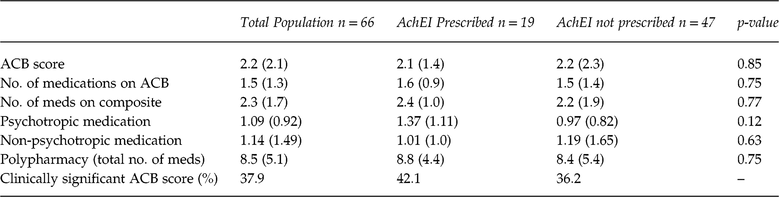
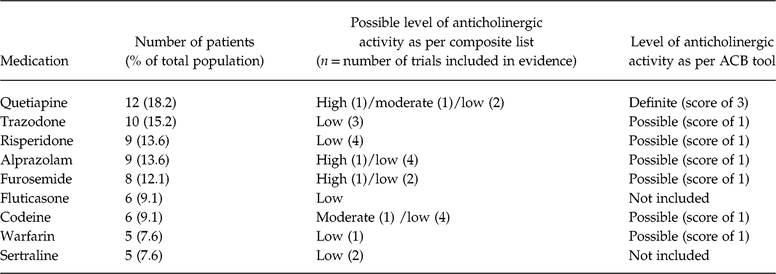
Baseline demographics of the study population are outlined in Table 1. The study sample consisted of 29 women (43.9%) and 37 men (56.1%) after exclusion of 24 from the original cohort due to missing data or incorrect ICD code. 33.3% (n = 22) were hospital inpatients, 39.4% (n = 26) were community dwelling and 27.3% (n = 18) were in residential care. The mean patient age at time of data collection was 80.2 years (range = 65–97, SD = 6.3). 16.7% (n = 11) had been diagnosed with Alzheimer’s dementia (AD), 15.2% (n = 10) with mixed AD/vascular dementia, 21.2% (n = 14) with vascular dementia, 9.1% (n = 6) with other dementias (Lewy body dementia, Parkinson’s disease dementia and Pick’s disease) and 37.9% (n = 25) with an unspecified dementia. 28.8% (n = 19) were on an acetlycholinesterase inhibitor (either rivastigmine or donepezil). 78.8% (n = 52) had a recent MMSE performed, with a mean score of 11.9 (range = 0–28, SD = 7.4), the remainder having been assessed using a different cognitive tool (primarily Montreal Cognitive Assessment) or declined cognitive testing. The majority (53.0%, n = 35) had completed second level education with 24.8% (n = 23) and 12.1% (n = 8) completing primary and tertiary Levels, respectively. The mean number of prescribed medications was 8.5 (range = 0–23, SD = 5.1) (see Table 2) with a mean ACB score of 2.2 (range = 0–9, SD = 2.1). Of note, 37.9% (n = 25) had a clinically significant ACB score (greater than or equal to 3, or prescribed a single agent with anticholinergic score of 2 or higher – as defined by the ACB scoring tool). Further analysis revealed 10.6% (n = 7) of patients to be on at least one single medication with an individual ACB anticholinergic rating of 3. The most commonly prescribed drugs listed on either scale as having anticholinergic activity were quetiapine (18.2%, n = 12) and trazodone (15.2%, n = 10) (See Table 3). There was an equal contribution of non-psychotropic (mean no. of medications = 1.09, SD = 0.92) and psychotropic prescribing (mean no. of medications = 1.14, SD = 1.49) to the overall number of medications with purported anticholinergic activity prescribed (as identified by the composite list of anticholinergics) (see Table 2).
Results for total population and results compared between groups (prescribed/ not-prescribed AChEIs) by independent samples t-tests

Data are presented as means (standard deviations) except where specified.
Most common medications with anticholinergic activity (based on ACB tool (Boustani et al. Reference Boustani, Campbell, Munges, Maidment and Fox2008) and composite list (Salahudeen et al. Reference Salahudeen, Hilmer and Nishtala2015b) as prescribed to a PLL cohort of patients with a diagnosis of dementia

Of those prescribed an AChEI (n = 19), 42.1% (n = 8) were on rivastigmine (includes both oral and transdermal preparations) and 57.9% (n = 11) were on donepezil. 42.1% of all patients prescribed AChEIs had a clinically significant ACB score, with an average ACB score for the total group of 2.1. This did not significantly differ from those not prescribed an acetlycholinesterase inhibitor (ACB score 2.2, p = 0.85). 7.6% (n = 5) were prescribed at least one single medication with an ACB anticholinergic rating of 3, concurrently with their AChEI, and all patients on AChEIs were on at least one possible anticholinergic medication.
A significantly greater number of medications with anticholinergic activity were identified using the composite list (mean no. of medications per patient = 2.3, SD = 1.7) compared to the number identified using the traditional ACB scale (mean no. of medications per patient = 1.5, SD = 1.3), p = 0.001.
Discussion
We demonstrated a significant anticholinergic burden amongst patients with dementia attending a specialist PLL service. Quetiapine was the most commonly prescribed medication with significant/definite anticholinergic activity. However, there was an equal contribution of non-psychotropic and psychotropic prescribing to the overall number of medications with anticholinergic activity used by our population of dementia patients. This tallies with a large retrospective cohort study of medication profiles in community dwellers with mild cognitive impairment and dementia showing that cardiovascular medications contributed the highest burden to the ACB score (46%), followed by psychotropics (20%) and bladder antimuscarinics (13%) (Green et al. Reference Green, Reifler, Boyd, Weffald and Bayliss2018). As could be expected in a cohort of patients attending psychiatric services, given their multiple psychiatric and physical comorbidities, our patients experienced a greater anticholinergic burden when compared to community-based studies; a much larger cohort (n = 537 387) of older community-dwelling patients in New Zealand (Salahudeen et al. Reference Salahudeen, Hilmer and Nishtala2015 b) had a mean ACB score of 0.33 versus 2.2 in our cohort. The PRIME study (n = 967) (Cross et al. Reference Cross, George, Woodward, Ames, Brodaty, Homäki and Elliott2016) reported 11.7% of their similarly aged cohort having clinically significant ACB scores versus our finding of 37.9%. Those who have seen a psychiatrist, neurologist or urologist in the past year (Reppas-Rindlisbacher et al. Reference Reppas-Rindlisbacher, Fischer, Fung, Gill, Seitz, Tannenbaum, Austin and Rochon2016) are indeed at greater risk of having a high anticholinergic burden. This particularly resonates with our cohort of patients attending tertiary psychiatry services including inpatients seen by our liaison service but under the care of another physician, and highlights the contribution of multiple prescribers to the anticholinergic burden. Of note, the level of polypharmacy was high in our population with 8.5 medications per patient (SD 5.1), and at least one patient prescribed a total of 23 medications.
In our study, a significantly greater number of medications with potential/possible anticholinergic activity were identified by the composite list as compared to the ACB tool, suggesting that the true anticholinergic burden experienced by patients may be underestimated by the use of the ACB tool alone. It is also important to note the variability in classification of level of anticholinergic activity across the two tools; for example, quetiapine is differentially classified as low, moderate and high activity by the evidence referred to on the composite scale, but as a definite anticholinergic on the ACB scale (see Table 3). We should also acknowledge, on the other hand, the potential to overestimate the anticholinergic burden by inclusion of medications with possible anticholinergic action (ACB score 1) which have only in vitro evidence of muscarinic antagonism. For example, trazodone is deemed to have possible anticholinergic on the ACB, but is used frequently in elderly populations due to its low propensity to cause anticholinergic adverse effects clinically (Faglioni et al. Reference Fagiolini, Comandini, Dell’Osso and Kasper2012). Overestimation of the clinical import of possible anticholinergics could result in discontinuation of potentially beneficial treatment, and we acknowledge the clinical dilemma this poses.
There was no difference in anticholinergic burden between groups prescribed and not prescribed AChEIs in our patient group, indicating that these medications are being prescribed without discontinuation of potentially inappropriate medications with anticholinergic activity. Indeed, a recent study shows that there is an association between anticholinergic burden and early discontinuation of AChEIs (Efjestad et al. Reference Efjestad, Ihle-Hansen, Hjellvik and Blix2017). Another group showed that only 31% of those newly prescribed donepezil first discontinued their anticholinergics (Roe et al. Reference Roe, Anderson and Spivack2002) Our data are comparable with international studies; in a large Swedish population-based study (Johnell & Fastbom Reference Johnell and Fastbom2008), anticholinergic drug prescribing was shown to be 23% more common amongst cholinesterase inhibitor users than non-users. One might postulate that the increased rate of anticholinergic prescribing in these patients may be related to a prescribing cascade; for example, increased use of anticholinergics to manage cholinesterase inhibitor-associated urinary incontinence (Gill et al. Reference Gill, Mamdani, Naglie, Streiner, Bronskill, Kopp, Shulman, Lee and Rochon2005).
The clinical import of the anticholinergic burden in the elderly population is clear; a recent Irish study showed that an increased number of potentially inappropriate medications (primarily anticholinergics) in an elderly community-dwelling population increased health care utilisation (both GP visits and A&E attendances) (Moriarty et al. Reference Moriarty, Bennett, Cahir, Kenny and Fahey2016). While in this study, we have focused on the cognitive implications of a clinically significant anticholinergic burden, the physical effects of anticholinergics are well known. A large community-based cohort study has noted poorer physical function amongst anticholinergic and sedative users (n = 3075) (Hilmer et al. Reference Hilmer, Mager, Simonsick, Cao, Ling, Windham, Harris, Hanlon, Rubin, Shorr, Bauer and Abernethy2007); this has been quantified as a one unit increase in the anticholinergic burden (as calculated using the ACB scale) being significantly associated with one or more new impairments in subjects instrumental activities of daily living (Koyama et al. Reference Koyama, Steinman, Ensrud, Hillier and Yaffe2014). Anticholinergic burden is also strongly associated with increased hospitalisation rates in patients with dementia (Watanabe et al. Reference Watanabe, Fukatsu and Kanemoto2018). It is also worth considering the anticholinergic burden in the context of those with diagnosed dementia, particularly those with behavioural and psychological symptoms of dementia (BPSD). A study evaluating the impact of a reduction in anticholinergic burden by at least 20% in those with dementia with BPSD found this resulted in a significant decrease in frequency and severity of BPSD as measured by the neuropsychiatric inventory (Jaïdi et al., Reference Jaïdi, Nonnonhou, Kanagaratnam, Bertholon, Badr, Noël and Mahmoudi2018).
We demonstrated a sizeable anticholinergic burden amongst patients with dementia attending a specialist PLL service. The true anticholinergic burden experienced by patients may be underestimated by the use of the ACB score alone, although the clinical significance of this finding is unclear. Our study is limited by small sample size, convenience sampling and retrospective design. However, this is to our knowledge the only study on anticholinergic burden relating specifically to those attending PLL services. We hope that this study will lead to increased awareness of the likely additive effect of potentially anticholinergic medications amongst prescribers of both psychotropic and non-psychotropic medications, particularly in those with dementia and ameliorate the rate of concomitant AChEI and anticholinergic prescription.
Acknowledgements
Authors thank staff members in PLL, Sheaf House, Exchange Hall, Tallaght, Dublin 24, Ireland.
Financial support
RF was awarded the Dr Henry Cooke Drury Student Research Fellowship in 2016. This research received no specific grant from any funding agency, commercial or not-for-profit sectors.
Conflict of interest
RMV has no conflicts of interests to disclose. RF has no conflicts of interests to disclose. NG has no conflicts of interests to disclose.
Ethical standards
The authors assert that all procedures contributing to this work comply with the ethical standards of the relevant national and institutional committee on human experimentation with the Helsinki Declaration of 1975, as revised in 2008. The authors assert that ethical approval for publication of this study has been provided by their local ethics committee.