Procalcitonin has received attention in recent years as a novel biomarker used to distinguish infectious processes from other forms of inflammation. The assay has attracted particular discussion for use in patients whose differential diagnoses contain high-risk and high-cost bacterial infections, particularly sepsis and respiratory illness. Procalcitonin has the potential to be more accurate than other clinical signs and tests such as identifiable bacteremia, leukocytosis, and C-reactive protein.Reference Wacker, Prkno, Brunkhorst and Schlattmann1, Reference Uzzan, Cohen and Nicolas2 While normally synthesized at undetectable levels by the thyroid, ubiquitous procalcitonin production occurs in extra-thyroid tissues during the inflammatory response to bacterial infection. Procalcitonin levels peak quickly during infection and decline rapidly thereafter, making the test potentially useful for guiding the initiation and de-escalation of antimicrobial therapy. Preliminary studies, most significantly the PRORATA trial, have demonstrated that procalcitonin-guided antimicrobial prescription results in multiple-day reductions in antimicrobial duration of treatment without causing a concurrent increase in mortality.Reference Nobre, Harbarth and Graf3–Reference Bouadma, Luyt and Tubach8 Meta-analyses support these conclusions.Reference Wacker, Prkno, Brunkhorst and Schlattmann1, Reference Soni, Samson and Galaydick9–Reference Prkno, Wacker, Brunkhorst and Schlattmann11
In an era of concerns for cost control and increasing bacterial resistance, procalcitonin testing protocols may have the potential to reduce antimicrobial costs, duration of antimicrobial therapy, and the adverse sequelae associated with antimicrobial use.Reference Soni12 Previous research into procalcitonin-guided therapy has demonstrated that intense utilization of broad-spectrum antimicrobials may result in adverse events associated with antimicrobial use, whereas a decline in antimicrobial treatment duration could, in turn, reduce or prevent adverse outcomes.Reference Jensen, Hein and Lundgren13, Reference Feazel, Malhotra and Perencevich14 Despite positive evidence regarding procalcitonin use, hospital adoption is not universal. Decision makers will likely note that procalcitonin testing is a significant expenditure, which may or may not be offset by gains in decreased antimicrobial utilization.
While more than a decade of research has investigated procalcitonin’s utility in various disease states, robust disease-specific cost analyses are relatively lacking. To our knowledge, a cost-effectiveness study regarding the direction of sepsis-related antimicrobial therapy via a procalcitonin-guided treatment algorithm that considers the benefits of adverse event avoidance has not been published. This model builds on previous procalcitonin cost-effectiveness models, including studies of its use in lower respiratory tract infection and on Canadian and Brazilian analyses that considered more limited variables in the sepsis setting.Reference Smith, Wateska and Nowalk15–Reference Deliberato, Marra and Sanches18 Our analysis aims to provide decision makers further information to consider when evaluating the use of procalcitonin in their health systems.
Methods
We performed both cost-minimization and a cost-utility analyses from the hospital perspective to assess the cost-effectiveness of a procalcitonin-guided treatment algorithm compared with standard care in patients admitted to the intensive care unit (ICU) with suspected bacterial infections and sepsis in the United States. Our study was deemed exempt from review by our institutional review board. We created a decision analytic model (DATA, Tree Age Software, Williamstown, MA) and populated the model with publically available information including outcomes associated with procalcitonin-guided treatment, common adverse events associated with of broad-spectrum antimicrobial use [ie, C. difficile infection (CDI) and nephrotoxicity], and relevant cost variables. The base-case model was based, in part, on the PRORATA trial, a multicenter, prospective, parallel-group, open-label trial to assess the benefit of procalcitonin to help inform prescribers about starting, continuing, or stopping antibiotics in ICU patients with suspected bacterial infections.Reference Bouadma, Luyt and Tubach8 To our knowledge, this is the largest trial published to date in this patient population.
Model Design
Our model, shown in Figure 1, followed a hypothetical cohort of 10,000 adult patients admitted to an ICU with suspected bacterial infection and sepsis. Inclusion and exclusion criteria matched those described in the PRORATA trial and included patients admitted with suspected infections who were not receiving antimicrobials or those who received antimicrobials for <24 hours.Reference Bouadma, Luyt and Tubach8 Patients were excluded for the following reasons: pregnant, expected ICU stay <3 days, bone-marrow transplant recipient, or chemotherapy-induced neutropenia (<500 neutrophils per mL), infection requiring long-term antimicrobials (eg, infective endocarditis), or a simplified acute physiology score (SAPS II) >65.
Decision analytic model comparing empiric treatment strategies in intensive care unit (ICU) patients with suspected bacterial infections and sepsis.

All patients were presumed to receive empiric antimicrobials at the start of each treatment arm. In the standard care arm, patients with suspected bacterial infection and sepsis did not undergo procalcitonin testing, and they were presumed to receive broad-spectrum antimicrobial therapy (vancomycin and cefepime) for the duration of therapy and to experience CDI and antimicrobial-related nephrotoxicity at baseline rates. In the procalcitonin arm, patients underwent procalcitonin testing, and antimicrobial therapy was initiated or discontinued based on test results and the treatment-related algorithm described by Bouadma et al.Reference Bouadma, Luyt and Tubach8 We set the base-case quantity of procalcitonin assays ordered per septic episode at 7, which corresponded closely to the protocol described in the aforementioned trial.Reference Bouadma, Luyt and Tubach8 Patients whose prescribers were “nonadherent” to the procalcitonin algorithm were assessed the cost of procalcitonin testing, while outcomes associated with antimicrobial use matched the standard-of-care group. No clinical efficacy difference was assumed between treatment groups (ie, length of stay, mortality differences, or readmission rates) because numerous studies have found no differences in these important measures.Reference Bouadma, Luyt and Tubach8–Reference Prkno, Wacker, Brunkhorst and Schlattmann11 Likewise, the cost of treating the baseline suspected bacterial infection or sepsis was considered equivalent between groups in our base case for the same reason. Variations in sepsis-related treatment costs, other than adverse events, were analyzed in our sensitivity analysis through variations in ICU stay and daily cost of septicemia.
Model Variables
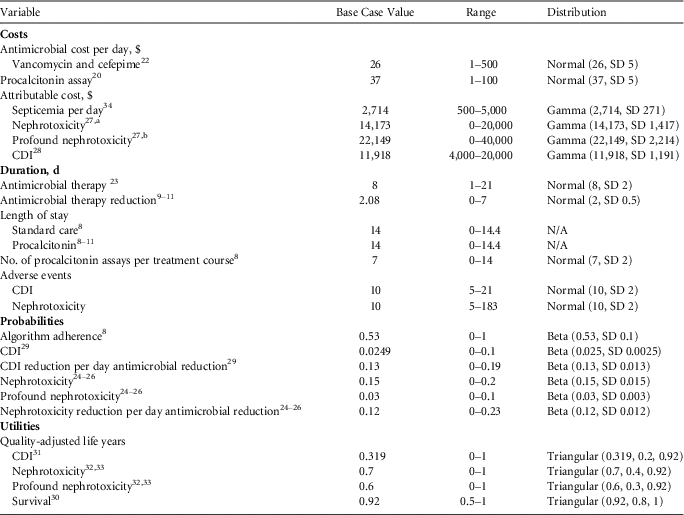
All model variables are provided in Table 1. The base-case probability of prescriber adherence to the algorithm (53%) was obtained from results reported in the PRORATA trial.Reference Bouadma, Luyt and Tubach8 We analyzed compliance rates ranging from 0 to 100% in our sensitivity analyses.
Decision Analytic Model Variables
NOTE. SD, standard deviation; CDI, Clostridium difficile infection.
a Nephrotoxicity is defined as an serum creatinine (SCr) increase ≥0.5 mg/dL.
b Profound nephrotoxicity is defined as an SCr increase of 50% to a minimum peak of 2.0 mg/dL.
All costs were adjusted for inflation to 2014 dollars via the Consumer Price Index for Medical Care Services.19 The cost of a single procalcitonin assay ($37) was obtained from the Clinical Diagnostic Laboratory Fee Schedule published by the Centers for Medicare and Medicaid Services, and the overall cost of testing was varied widely in our sensitivity analyses to account for variations in the cost to obtain and implement the test.20 Current Surviving Sepsis Guidelines recommend empiric antimicrobial therapy against all likely pathogens for septic patients; at most institutions, this empiric therapy includes vancomycin for possible methicillin-resistant Staphylococcus aureus (MRSA).Reference Dellinger, Levy and Rhodes21 We utilized the wholesale acquisition costs for our standard empiric antimicrobial regimen (cefepime plus vancomycin), and this cost varied between US $1 and $500 in the sensitivity analysis to account for variations in antimicrobial treatment and dosing regimens, as well as the cost associated with the time required for healthcare personnel to prepare, administer, and monitor the antimicrobial therapy.22 The baseline duration of antimicrobial therapy was set at 8 days and we assumed a 2-day reduction of antimicrobial therapy in the procalcitonin. This 2-day reduction corresponded to the decrease in duration of antimicrobial therapy from multiple procalcitonin trials.Reference Soni, Samson and Galaydick9–Reference Prkno, Wacker, Brunkhorst and Schlattmann11, Reference Chastre, Wolff and Fagon23
We assumed that 15% of all patients would develop antimicrobially induced nephrotoxicity, defined as an increase in serum creatinine ≥0.5 mg/dL.Reference Elyasi, Khalili, Hatamkhani and Dashti-Khavidaki24–Reference van Hal, Paterson and Lodise26 Of these patients, 3% experienced profound nephrotoxicity (increase in serum creatinine by 50% to a minimum peak of 2.0 mg/dL).Reference van Hal, Paterson and Lodise26 Cano et alReference Cano, Haque and Welch25 reported an odds ratio of 1.12 (95% CI, 1.02–1.23) for the occurrence of nephrotoxicity for each additional day of vancomycin therapy. Due to a decrease in antimicrobial exposure, we assumed that the incidence of nephrotoxicity was reduced by 12% per day of antimicrobial reduction in patients whose prescribers were compliant with the procalcitonin algorithm. The incremental costs of nephrotoxicity and profound nephrotoxicity were based on an analysis by Chertow et al.Reference Chertow, Burdick and Honour27
The cost per case of C. difficile was estimated from a 2009 Healthcare Cost and Utilization Project.Reference Lucado, Gould and Elixhauser28 The probability of the development of CDI was based on a 2014 report by Fridkin et al,Reference Fridkin, Baggs and Hagan29 who found that 2.5% of hospitalized patients exposed to antibiotics developed CDI. They reported that a 30% reduction in broad-spectrum antimicrobial exposure would result in a 26% reduction in the CDI rate. Our model utilized both the initial incidence and the subsequently reduced CDI rates associated with reduced broad-spectrum antimicrobial use from this report. We assumed that a reduction in overall antimicrobial use would correlate with a 13% decrease in CDI incidence per day of antimicrobial use.
We utilized a 1-year time horizon in our model; we assigned patients in both treatment arms a slightly decreased quality of life during and following their sepsis episodes.Reference Angus, Linde-Zwirble and Clermont30 Patients who experienced an adverse event associated with antimicrobial use were assigned a quality-of-life estimate corresponding to CDI, nephrotoxicity, or profound nephrotoxicity.Reference Stranges, Hutton and Collins31–Reference Wyld, Morton, Hayen, Howard and Webster33 We are unaware of a validated utility value for CDI; therefore, we substituted a utility value for chemotherapy-related diarrhea.Reference Stranges, Hutton and Collins31 Sensitivity ranges were intentionally set between 0 and 1 to analyze uncertainty in utility measures.
Univariate sensitivity analyses examined the robustness of our model. We analyzed in detail several variables including prescriber adherence to the treatment algorithm and the impact of our adverse event assumptions on overall results. We also performed a probabilistic sensitivity analysis via 10,000 Monte Carlo simulations.
Results
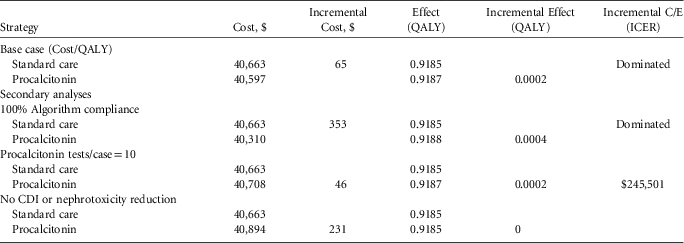
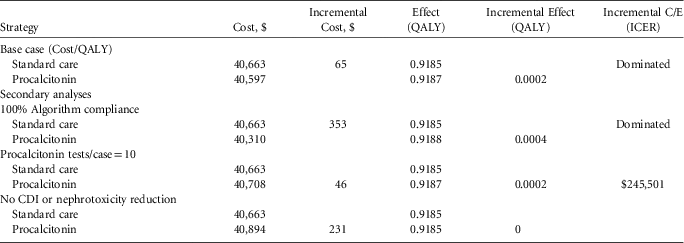
The results of our base-case and other secondary analyses are shown in Table 2. Our model found that use of a procalcitonin algorithm dominated standard care in that it was both more efficacious and less costly. The incremental effectiveness gained via procalcitonin use vs. standard care was 0.0002 QALYs gained at a cost savings of $65. Results of the probabilistic Monte Carlo sensitivity analysis over 10,000 iterations of our model demonstrated a 67.3% probability that utilization of a procalcitonin algorithm would be cost-effective at a willingness-to-pay threshold of $0 per QALY, a 69.4% probability at $50,000 per QALY, and a 71.1% probability at $100,000 per QALY.
Results in ICU Patients with Suspected Bacterial Infection and SepsisFootnote a, b
NOTE. ICU, intensive care unit; QALY, quality-adjusted life years; C/E, cost-effectiveness; ICER, incremental cost-effectiveness ratio; CDI, Clostridium difficile infection.
a Calculations for cost-effectiveness were performed by taking the incremental cost (difference between costs of compared strategies) divided by the incremental effectiveness (difference between the effectiveness of the compared strategies).
bResults rounded to the nearest Dollar or QALY.
One-way sensitivity analyses revealed that our results were affected by several major variables, including algorithm adherence, quantity and cost of procalcitonin assays, days of antibiotic reduction, and several indices of antimicrobially induced nephrotoxicity. Alterations in these variables were able to produce situations in which procalcitonin testing became more expensive than standard care when the willingness to pay threshold was set to $0. Procalcitonin testing was more expensive than standard care when algorithm adherence was <42.3% or when the duration of antimicrobial therapy was decreased by <1.6 days. The number and cost of procalcitonin assays impacted results if ≥9 procalcitonin assays were ordered per patient or if the cost per test was >$46. With regard to renal outcomes, procalcitonin testing was an additional cost when the probability of antimicrobially induced nephrotoxicity was <11.2%, when the overall cost of nephrotoxicity was <$10,420, or when the nephrotoxicity reduction was <8.9% per day of antimicrobial reduction. No other variable within our predefined sensitivity ranges, including CDI reduction, utility estimates (including those for CDI or nephrotoxicity), or the daily cost of antimicrobial therapy, had the potential to increase the overall costs in the procalcitonin arm past those of the standard care arm.
Similar results were noted when our willingness-to-pay threshold was increased to $50,000 per QALY. Procalcitonin testing was no longer cost-effective at this threshold when algorithm adherence was <41.1%, when the days of antimicrobial reduction were <1.5, or when ≥10 procalcitonin tests were ordered per patient. When the number of procalcitonin tests ordered was increased to 10, the incremental cost per QALY gained increased to $245,501. Again, nephrotoxicity rates also impacted results when the baseline rate was <10.8%, when the cost of treating nephrotoxicity was <$9,885, or when the nephrotoxicity reduction was decreased from 12% to 8.5% per day of antimicrobial use.
Our base-case model predicted a 0.3% absolute risk reduction and 12% relative risk reduction in the cases of CDI and a 1.8% risk reduction (12% relative-risk reduction) in antimicrobially induced nephrotoxicity through the use of a procalcitonin-guided treatment algorithm. The number of patients needed to treat to prevent 1 case of CDI was 315; the number needed to prevent 1 case of nephrotoxicity was 56. Absolute adverse event avoidance increased to 0.6% for CDI and 3.4% for antimicrobially induced nephrotoxicity when algorithm compliance increased to 100% (12% and 23% relative-risk reduction, respectively).
Algorithm adherence has the potential to be altered through a number of mechanisms including prescriber education and antimicrobial stewardship program oversight. When physician adherence was 100%, standard care was again dominated. The incremental effectiveness gained by procalcitonin use was $353 saved per 0.0004 QALYs gained. Under this scenario, antimicrobial reductions (<0.8 days), procalcitonin assay cost (>$87), variations in the nephrotoxicity reduction (<0.6%), the probability of nephrotoxicity (<4.1%), and the overall cost of nephrotoxicity ($3,423) changed results at a willingness-to-pay threshold of $0.
When our adverse event assumptions were negated (ie, no CDI reduction or nephrotoxicity reduction with decreased antimicrobial use), the decrease in antimicrobial costs alone did not offset the increased cost of procalcitonin testing. In this case, there were no QALY differences between treatment arms. Overall costs in the procalcitonin arm were $231 higher ($40,663 vs $40,894) than those of standard care at 53% algorithm compliance and $207 higher ($40,663 vs $40,870) with 100% compliance. When analyzing each adverse event individually, overall treatment costs were $27 lower in the procalcitonin arm when we analyzed a scenario without CDI reduction while nephrotoxicity reduction remained at base-case levels. Conversely, results dramatically shifted in favor of the standard care arm when we negated only the assumption of a nephrotoxicity reduction and kept CDI reduction at base case rates. Under this scenario, the overall cost of care was $193 higher in the procalcitonin arm with an incremental cost per QALY gained of $3,923,245.
In addition, at our base-case daily cost of antimicrobial therapy ($26), no decrease in the duration of antimicrobial therapy was able to offset the increased cost of testing without nephrotoxicity or CDI reductions. A threshold analysis revealed that the daily cost of antimicrobial therapy must be >$244 per day to demonstrate a financial advantage for procalcitonin testing with base-case algorithm compliance without a combined reduction in adverse events. This number was slightly higher than, yet likely supports, results reported by Heyland et al.Reference Heyland, Johnson, Reynolds and Muscedere17 In their cost-minimization analysis in the critical care setting, the point at which the cost of testing equaled the cost of antibiotics saved was Can$148 (range: Can$59–Can$297).
Discussion
The model demonstrated in this study predicts that the use of a procalcitonin-guided treatment algorithm to de-escalate antimicrobial therapy in ICU patients with suspected bacterial infection and sepsis is cost-effective and reduces overall treatment-related costs under base-case assumptions. Implementing a procalcitonin-guided treatment algorithm for ICU patients with suspected bacterial infection and sepsis may increase a patient’s quality of life while saving $65 per patient with moderate treatment algorithm compliance. If these results are used to guide changes in real-world clinical practice, they could translate into significant improvements in patient care in individual hospitals or health systems for the 750,000 cases of sepsis treated annually in the United States.Reference Angus, Linde-Zwirble and Lidicker35 On the other hand, hospital costs could increase significantly without a corresponding improvement in patient quality of life if algorithm adherence is low, if a large number procalcitonin tests are ordered, or if a decrease in antimicrobial use does not correspond to our projections for decreased adverse events.
For example, physician nonadherence to the treatment algorithm decreased the potential for a reduction in the duration of antimicrobial therapy, a reduction in antimicrobially associated adverse events, and thus, cost savings associated with procalcitonin use. Because physician adherence rates reported in the literature vary widely (from 30% to 80%), maintenance of adequate physician adherence should be a key focus of institutions seeking to maximize the potential benefits of procalcitonin testing.Reference Nobre, Harbarth and Graf3, Reference Albrich, Dusemund and Bucher36 Incorporation of antimicrobial stewardship team surveillance expertise with a procalcitonin-guided treatment algorithm in ICU patients with suspected bacterial infections and sepsis has not been reported and may further enhance the value of procalcitonin-guided treatment algorithm integration.
We assumed daily procalcitonin testing to reflect the treatment algorithm used in the PRORATA trial. While not specifically stated in the trial, we inferred that a total of 7 assays would be ordered per course.Reference Bouadma, Luyt and Tubach8 Our model predicted that when 1 or 2 additional tests were ordered per patient (9 or 10 total), the use of a procalcitonin-guided treatment algorithm was no longer cost-effective at the thresholds examined. Given these results, some level of procalcitonin testing stewardship may be necessary, and treatment-related algorithms may benefit from clear testing recommendations. Reports on the impact of alternative testing algorithms that reduce (or increase), the overall number of tests are relatively lacking. One recent analysis indicated that it may be possible to test procalcitonin every 24 hours to 72 hours, potentially reducing testing costs while providing similar antimicrobial reduction benefit.Reference Schuetz, Raad and Amin37Reducing the number of tests utilized while maintaining similar reductions in antimicrobial duration would strengthen results of our analysis in favor of procalcitonin testing.
Our study has several limitations, including the use of a European trial (PRORATA) to model an analysis from the U.S. hospital perspective, which reduces generalizability.Reference Bouadma, Luyt and Tubach8 Perhaps the key limitation is that our base-case model draws heavily on the assumptions that a reduction in antimicrobial duration will have a positive impact on a patient’s quality of life and that a decrease in overall healthcare costs will result from averting adverse events. These assumptions were combined with limited and inconsistently defined data regarding procalcitonin use in our patient population. Because the precise correlations between antimicrobial use and both nephrotoxicity and CDI are uncertain, and based on projections and published reports, the reduction in adverse antimicrobial effects conferred by procalcitonin-guided treatment algorithms may vary according to factors such as institution, the choice of broad-spectrum antimicrobials, and the baseline institutional rates of CDI or antimicrobially induced nephrotoxicity.
The incidence of antimicrobially induced nephrotoxicity and nephrotoxicity reduction, in particular, drove the results of our study. Nephrotoxicity rates related to vancomycin are quite variable in the literature, though vancomycin nephrotoxicity is better characterized than that of broad-spectrum beta-lactams. We felt that a base-case nephrotoxicity rate of 15% was an appropriate estimate because patients with suspected bacterial infections and sepsis tend to receive the most intensive antimicrobial therapy and often have comorbidities that put them at greater risk for renal failure. Additionally, the combined use of vancomycin and some commonly used broad-spectrum beta-lactams results in increased rates of nephrotoxicity when compared with vancomycin alone.Reference Burgess and Drew38 Our model predicted that the baseline rates of antimicrobially induced nephrotoxicity must be >11% and that decreased antimicrobial use through procalcitonin testing must provide some level of reduced nephrotoxicity to be cost-effective.
The link between decreased antimicrobial use and CDI reduction is increasingly supported in the literature. We utilized the report from Fridkin et al,Reference Fridkin, Baggs and Hagan29 which stated that a 30% reduction in broad-spectrum antimicrobial exposure would result in a 26% reduction in the CDI rate. Supporting this assumption are real-world clinical practice analyses investigating the impact of antimicrobial stewardship programs. Malani et alReference Malani, Richards and Kapila39 reported that a 25.4% reduction in antimicrobial utilization led to approximately a 50% reduction in the odds of developing CDI. Feazel et alReference Feazel, Malhotra and Perencevich40 also reported a significant CDI risk reduction (52%) in their systemic review and meta-analysis of antimicrobial stewardship literature. Despite this well-documented correlation, our model predicted that no measure of CDI reduction was able to offset the increased cost of procalcitonin testing without a combined measure of decreasing nephrotoxicity. Under this scenario, procalcitonin-testing increased costs and was decidedly not cost-effective, with an incremental cost per QALY well beyond common willingness-to-pay thresholds.
The lack of quality utility estimates is another limitation of our study, though one with a minimal impact on results. Although our model estimated only minor QALYs gained through procalcitonin use, it is important to note that utility values fitting our definitions of nephrotoxicity and short-term dialysis were not available and estimated using values found for patients undergoing hemodialysis. Similarly, no validated utility value for CDI exists, and in our model, we substituted values for chemotherapy-related diarrhea, as demonstrated in a previous cost-effectiveness analyses.Reference Stranges, Hutton and Collins31 Despite the uncertainty in utility estimates, variation of utilities used in the model did not impact results.
Another limitation is that we did not attempt to account for the effect of decreased antimicrobial utilization on the emergence of antimicrobial resistance, nor did we account for antimicrobially induced adverse events other than CDI or nephrotoxicity. Both of these variables were felt to be difficult to quantify, with limited lines of evidence, and ultimately beyond the scope of our analysis. Incorporating the financial and patient-specific benefits of decreased antimicrobial resistance and additional decreases in antimicrobially related adverse events through shorter courses of therapy would likely prove highly beneficial for patients in our procalcitonin arm.
In conclusion, the results of our model predict that procalcitonin-guided antimicrobial use is cost-effective in adult ICU patients with suspected bacterial infection and sepsis. However, without proper algorithm adherence, disciplined testing, or a correlation between proper algorithm adherence and adverse event avoidance, institutional costs could increase considerably. Our discussions on sensitivity should improve the generalizability and usefulness of our study for decision makers analyzing procalcitonin implementation and their own “willingness to pay” for potentially improved antimicrobial stewardship within their health systems.
Acknowledgments
Financial support: None reported.
Potential conflicts of interest: Both authors report no conflicts of interest relevant to this manuscript.