Introduction
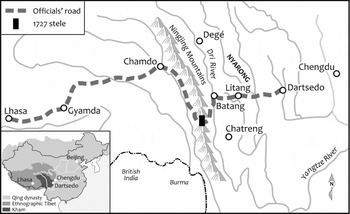
As the twentieth century opened, the Kham region of ethnographic TibetFootnote 1 was a quintessential borderland,Footnote 2 an expansive series of high mountains and narrow river valleys situated between and coveted by both central Tibet and Sichuan Province. By 1727 a stone stele placed much of the region's territoryFootnote 3 within the western boundary of Sichuan Province as most of the Tibetan plateau—including Lhasa—had been incorporated into the Qing empire (see Figure 1). At the start of the twentieth century, however, Kham remained a complex patchwork of relatively independent polities, effectively beyond the direct administrative reach of Qing officials in either Chengdu or Beijing—and equally beyond Lhasa's direct control. In the first two decades of the century, concerted efforts from both east and west sought to transform the structure of authority in Kham, seeking either to replace or to co-opt local kings, princes, lamas, and other lay rulers. Steeped in two millennia of imperial expansion and incorporation, the policies implemented by the Qing and, later, Republican Chinese governments were not new, yet their ultimate goals were transformed in the early twentieth century by the arrival of newly globalizing norms of authority. The efforts of Chinese and Sichuanese officials, though influenced by these new norms, nevertheless remained frustrated by the old—a bifurcated structure of authority which for centuries had equally stymied sporadic efforts by Lhasa officials to exert direct temporal authority in Kham.
Location of Kham and the 1727 stele in the Qing empire.
Source: Debbie Newell.

Why were Chinese efforts to exert unquestioned authority in Kham largely unsuccessful and what were the subsequent ramifications? This article will focus on the challenge to Qing and, later, Republican Chinese officials in the early twentieth century as they sought either to manipulate or to overturn this bifurcated structure of authority, a structure which first began to crystallize with the establishment of Qing garrisons in Kham two centuries earlier.Footnote 4 At that time, the implementation of long-established frontier policies followed in the soldiers’ wake, including the investiture of local rulers, the theoretical imposition of rules of succession tied to the local establishment of Confucian schools, and the acceptance of military obligations to defend the empire's fringes from external threat. The first section of this article explores the emergence of this bifurcated structure of authority, divided between the spiritual and the temporal, in the intersection of these Chinese policies with Lhasa's increasing struggle to convert its limited spiritual influence over the monasteries and people of Kham into temporal authority over its myriad rulers. The realities of this structure forged a tenuous accommodation of shared rule among both the Lhasa and Sichuan governments and local Khampa monasteries and lay rulers which persisted until the first years of the twentieth century.
The second section examines how a shift towards notions of ‘absolute authority’, particularly among Sichuanese officials and gentry, rendered accommodation of shared rule unacceptable, and the growing perception that legitimate authority rested exclusively in the temporal realm rendered the bifurcated structure untenable. Wrought by absolutist conceptions of two newly globalizing norms—territoriality and sovereignty—this shift prompted a reinvention and augmentation of old imperial frontier policies in Kham during the first two decades of the twentieth century. This occurred even as Lhasa officials continued efforts resuscitated only decades earlier, in the mid-nineteenth century, to once again convert spiritual into temporal authority. Although I focus primarily on the Chinese endeavour to exert unquestioned authority on the eastern plateau, the discussion also sheds light on the Lhasa government's own ambitions in Kham and the influence of absolutist understanding of these two norms. This influence on Tibetan policies is most noticeable in the decade following the 1912 establishment of the Republic of China and the departure of the last Qing imperial resident (amban) from Lhasa.
This article then introduces the concept of infrontier imperialism to explore how absolutist conceptions of territoriality and sovereignty frustrated early-twentieth century Chinese efforts to undermine the Dalai Lama's spiritual influence on Kham society, intended to shatter the bifurcated structure of authority. Infrontier imperialism encompasses a comprehensive array of military, political, economic, and acculturative policies enacted in the borderland to effect state-building and the incorporation of the territory and its people. I argue that the successful implementation of acculturative policies, such as colonization and the establishment of schools, was essential both to strengthen implementation of an old imperial policy known as gaitu guiliu (改土歸流)Footnote 5 and to ensure the long-term incorporation of Kham into the Chinese state. While Chinese officials perceived the success of gaitu guiliu, which sought to preclude Tibetan influence on temporal authority in Kham, the acculturative policies, intended to undermine the Dalai Lama's spiritual authority, ultimately floundered. Influenced by absolutist conceptions of territoriality and sovereignty, Chinese policies in the early twentieth century situated legitimacy exclusively in temporal authority. This fostered a shift in focus among Chinese officials, particularly after 1912, away from the transformation of Kham internally towards justification of Chinese sovereignty over Kham externally. But the persistence of the bifurcated structure and with it the pre-eminent influence of the spiritual ultimately frustrated the Chinese endeavour, leaving the struggle for authority in Kham between the spiritual and the temporal, between Tibetan and Chinese officials, largely unresolved, even to this day.
Kham in orbit
A Tibetan proverb from the time of the Tibetan empire (seventh to ninth centuries) states, ‘The king's [secular] law is a yoke of gold; religious law is a silken thread.’Footnote 6 This refers to the close relationship between temporal and spiritual rule, the fusion of which subsequently evolved to become the ideal form of governance in Tibet: chos srid zung ‘brel.Footnote 7 Beginning in the mid-seventeenth century, this was a model personified by the Dalai Lama, but one which describes the central Tibetan government in Lhasa for only brief periods since. Though often divided at the local level across ethnographic Tibet, this ideal nonetheless remained powerful—and symbiotic, the lay ruler often exchanging lavish patronage for monastic and, through the monks’ spiritual influence, also popular acknowledgement of his temporal authority, the comforting and sublime enlightenment of the silken thread easing popular submission to the golden yoke. The threads of investiture and recognition which from the seventeenth century bound many of the khenpo (abbots) and trülku (reincarnate lamas) of Kham to the Gelukpa monasteries of central Tibet rendered their monasteries potential conduits through which the Dalai Lama could assert spiritual influence in Khampa society and also the means by which the Lhasa government could seek to extend temporal authority to the eastern plateau in the twentieth century.
Yet before these silken threads could be cast eastward, both local temporal authority and the spiritual authority resident in the powerful monasteries of competing schools of Tibetan Buddhism had to be quashed. In 1639 the Khoshot Mongol prince, Güshri Khan began converting or razing monasteries across Kham as part of an 18-month campaign to defeat opponents of the Fifth Dalai Lama. By 1642, he had returned to his base in Amdo, the region of ethnographic Tibet north of Kham, with the title chökyi gyelpo, ‘Dharma king’,Footnote 8 a recognition by the Fifth Dalai Lama that he was the protector of Tibet and the unifier of the Dalai Lama's spiritual and temporal authority on the plateau, particularly from Lhasa eastward to Dartsedo (Kangding 康定). A decade later, it was in this lively frontier town, nestled in the rising mountains between Kham and Sichuan Province, that competition for authority over Kham with the recently established Qing rulers would commence. And it was from Dartsedo roughly two-and-a-half centuries later that the Qing and then Republican governments of Sichuan Province would launch military campaigns similar to, though far less successful than, those of Güshri Khan.
Once acknowledged as temporal ruler of Tibet in 1642, the Fifth Dalai Lama acted swiftly to assert his authority over the polities of Kham in both the spiritual and temporal realms. In the latter, the Dalai Lama acknowledged the already extant authority of lay rulers in such important polities as Batang (巴塘), Litang (理塘), and Chakla, and despatched officials from Lhasa on reconnaissance and tax-collecting missions. In 1648, two officials took a house-by-house census of the population across Kham as far east as Dartsedo and collected taxes from landholders, ultimately filling 56 volumes with detailed records. In 1679, Lhasa officials again ventured into the easternmost regions of Kham, this time tasked with reducing the burden of local taxation, mediating local feuds, even resettling areas previously abandoned by the local population.Footnote 9 Most of these officials were but temporary inhabitants of the region, however, tax commissioners sent exclusively to the Kingdom of Chakla were the only Lhasa officials despatched to Kham on a long-term basis.
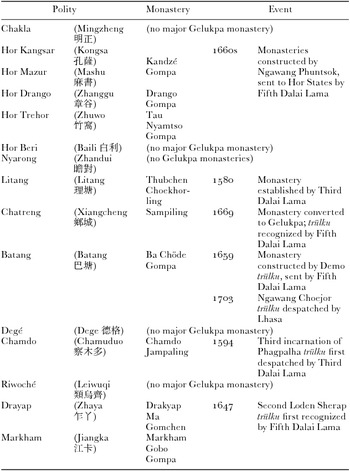
More lasting, though not universal, were the Fifth Dalai Lama's efforts to imbue his authority in the spiritual realm, as shown in Table 1. He appointed khenpo to and recognized trülku in existing monasteries, many converted to the Gelukpa school by Güshri Khan, and pursued an ambitious plan of new monastery construction. For example, a dream is said to have inspired the Dalai Lama to despatch Ngawang Phuntsok, descendant of a petty Mongol ruler, on an ambitious mission in the 1660s to erect monasteries in the Hor states of northeastern Kham. He ultimately established some 13 in total, at one of which he is even said to have founded his own reincarnation line.Footnote 10 Perhaps most indicative of Lhasa's relative success in the spiritual realm was the steady flow of Khampa monks seeking advanced training at the great Gelukpa monasteries of central Tibet and its exclusive authority into the late nineteenth century to appoint khenpo to head the major Gelukpa monasteries of Kham. Considering also the central role played by the monasteries in the local economy, as banks, money-lenders, and guarantors of the lucrative tea trade, Lhasa's influence in the spiritual realm, the silken threads stretching into the monasteries of Kham, could extend far beyond the praxis of religion to influence local holders of temporal authority as well. Yet in polities which lacked a significant Gelukpa presence, such threads were easily frayed, and Lhasa's attempts to extend a golden yoke rebuffed.
Major Gelukpa monasteries in Kham.
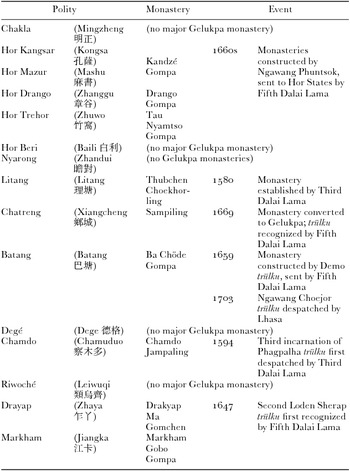
Prior to the advent of Güshri Khan, there were few large monasteries belonging to any of the four schools of Tibetan Buddhism situated in eastern Kham. Yet in the latter half of the seventeenth century, the Gelukpa was neither the only school to establish new or to convert old monasteries in the region, nor was it universally successful in overshadowing the influence of the other three schools.Footnote 11 According to a Tibetan geography, the Gelukpa monasteries in Chakla, for instance, were far less influential than in such other Kham polities as Litang or the Hor states. Whereas the rulers of Chakla sought to eschew Lhasa's interference for much of the Qing era, since the time of Ngawang Phuntsok, those of the Hor states tended towards closer ties with Lhasa. And in Nyarong (Zhandui 瞻對), which would become perhaps the greatest thorn in the Dalai Lama's Kham side, and Degé (Dege 德格), the most independent of the Kham polities, there were no Gelukpa monasteries of any significance.Footnote 12 Thus even within a bifurcated structure, we can find competition in the spiritual realm between different schools and in the temporal realm between the perceived interference of the Lhasa government and local rulers and monasteries. It was the strong aversion in Chakla to Lhasa's efforts in the temporal realm which provided the first opportunity for the newly established Qing government to extend its influence onto the plateau, further complicating the bifurcated structure.
In 1652 the unwelcome intrusion of a tax commissioner despatched by Lhasa compelled the king of Chakla to pledge his allegiance to the Qing emperor. For this, he was invested with the title Mingzheng pacification commissioner (明正宣慰使司), receiving his seal in 1666.Footnote 13 The king's subsequent cessation of tax payments to Lhasa incurred a military response from the Fifth Dalai Lama in 1671 which succeeded in regaining the king's allegiance to Lhasa and acceptance of a new commissioner.Footnote 14 Conflict returned to Dartsedo, however, as the king again became entangled with the new commissioner's meddling in local affairs, a dispute which culminated in the king's murder at the hands of his nemesis in 1700. The Qing Court's reaction in support of its invested tusi (土司) was swift as an army despatched from Sichuan killed the commissioner and quelled the unrest he had fomented in other corners of the kingdom. By the following year jurisdiction over the whole of Chakla territory was returned to the king's wife.Footnote 15 For the Dalai Lama, the events in Chakla ended the Lhasa government's only exercise of direct administrative authority in a polity of eastern Kham until the despatch of another official to Nyarong in the mid-nineteenth century. For the Qing government, the subsequent unquestioned allegiance of the ruling family of Chakla provided its first significant foothold on the plateau—the first success in what would evolve into an endeavour to extend Qing authority over the polities of Kham largely in the temporal realm.
Qing efforts began in earnest two decades later in the wake of unrest in Lhasa and the campaign to eliminate the influence of the Zunghar Mongols from Tibet, which resulted in the appointment of an amban to oversee the weakened Tibetan government. In 1727 the Qing erected a stone stele in a pass in the Ningjing Mountains, dividing Kham in three (see Figure 1). It was located a few miles northeast of Nandun (南墩), a village at the junction of two roads, one heading south towards Lijiang in Yunnan, the other east towards Batang. Roughly translated, the inscription proclaimed to all travellers that those lands to the east of the stele belonged to Sichuan, those to its south belonged to Yunnan, and those to its west belonged to the ‘land of burning incense’ ruled by the Dalai Lama.Footnote 16 With this single etched stone, the Yongzheng emperor symbolically ended the Dalai Lama's tenuous claim to temporal authority over polities east of the stele. This was perhaps tacitly acknowledged in Lhasa with the installation of a teji (governor) the very same year to oversee only those polities in western Kham, and more overtly as the lay rulers in eastern Kham once invested with titles by the Fifth Dalai Lama reverted to hereditary succession with little concern for obtaining the Dalai Lama's imprimatur.Footnote 17 At the same time, the Yongzheng emperor initiated his own wave of investitures.
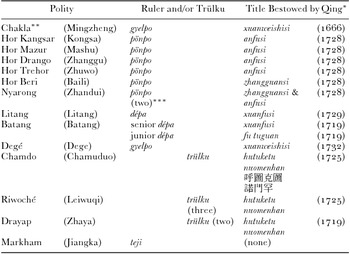
Beginning with the two dépa (governors) of Batang, even before the stele's erection, the Qing emperor invested the lay rulers of eastern Kham with tusi titles and extended the ecclesiastical title nuomenhan (諾門罕) to the monastic rulers of several important polities in western Kham, as shown in Table 2.Footnote 18 To reinforce the temporal authority presumably gained through these investitures and to ensure the unencumbered flow of communication and traffic between Chengdu and the amban in Lhasa via Dartsedo, the Qing established garrisons along the southern road, also known as the ‘Officials’ road’. Thus, after 1727 we see the simultaneous emergence of competition between Beijing and Lhasa for influence over the lay rulers and monasteries of Kham, but perhaps most significantly, a struggle between the temporal and spiritual conduits of power, between yokes of gold and threads of silk.
Qing titles bestowed on local rulers and trülku in some of the major polities of Kham.

*The relative ranks of tusi titles from high to low are as follows: xuanweishisi (宣慰使司); xuanfusi (宣撫司); anfusi (安撫司); zhangguansi (長官司).
**Chakla's ‘capital’, Dartsedo, was designated a sub-prefect (廳) in the Qing territorial bureaucracy in 1730 with the appointment of a sub-prefectural official (通知) under the supervision of Yazhou District (雅州府) in Sichuan Province.
***Between 1728 and approximately 1848, the pönpo of Upper and Lower Nyarong (上下瞻對) held the titles zhangguansi and anfusi, respectively. After 1866, however, there were no Qing-invested rulers in Nyarong (see below).
The resulting lattice-like structure of authority, marked by tusi investiture and khenpo appointment, spanning great distances across which communication and transport was rendered slow and cumbersome by the plateau terrain, resembles the galactic polity model advanced by Stanley Tambiah for the Buddhist polities of ‘early modern’ Southeast Asia.Footnote 19 He describes such a polity visually as ‘a galactic picture of a central planet surrounded by differentiated satellites, which are more or less “autonomous” entities held in orbit and within the sphere of influence of the center’.Footnote 20 Most important for maintaining this sphere of influence, and reflective of its intrinsic religious character, is the enactment by the central government's paramount leader of ‘cosmic rites and his role as the validator of his satellites’ credentials’.Footnote 21 This performative aspect is replicated in the satellites as indicative of the regional ruler's acceptance of that authority and demonstrative of his active inclusion in the larger polity.
Fundamentally, the galactic polity is a system of concentric circles representing centre–periphery relations. The ‘central planet’ in the case of the Tibetan world is Lhasa and its immediately surrounding regions which fall directly under its control. Beyond this lies a circle of provinces ruled by teji, trülku, or others appointed by the Dalai Lama, though not necessarily despatched from Lhasa. At the outer rim of this galactic polity float the polities of eastern Kham—what Tambiah refers to as independent ‘tributaries’, pulled since the actions of Güshri Khan in the mid-seventeenth century into Lhasa's sphere of influence. Less than a century later, after the erection of the border stele in the Ningjing Mountains in 1727 and the inclusion of Dartsedo in the Qing bureaucracy in 1730, these polities found themselves simultaneously pulled into the Qing sphere of influence.Footnote 22 Suggesting that the relationship of both the Lhasa and Qing governments to the myriad polities of Kham east of the stele each resembles a galactic polity illuminates the nearly two centuries long competition for authority between the Dalai Lama and the Qing emperor as well as the relative independence of eastern Kham evident as late as 1904.
The galactic polity, like the ideal form of central governance in Tibet noted above, is premised on the fusion of the spiritual and the temporal in a single ruler, a ruler who not only unifies the various regions of the polity through his lay administration, but who also mediates between the temporal and spiritual worlds on behalf of his followers. As we have seen, however, such unity did not always hold in polities where the Dalai Lama's temporal influence was limited and the competition between monasteries and lay rulers for pre-eminent authority was as apparent as the fundamental—and often simultaneous—synergy between them. It was the pervasiveness of this complex interaction between the temporal and the spiritual in Kham that stymied Lhasa's efforts to exert temporal authority, especially after 1727, and ultimately stood as the greatest impediment to nearly 200 years of both Qing and then Republican efforts to establish unquestioned authority there.
If we conceive of the Dalai Lama's authority as existing on overlapping planes in a bifurcation of the galactic polity model into discrete spiritual and temporal realms, the frustrations of the Tibetan and especially the Chinese governments in eastern Kham come into clearer relief. In highlighting shifting spheres of influence in the outermost circle, often prompted by local succession disputes, and the symbolic power of the 1727 stele to foreclose Lhasa's temporal ambitions in eastern Kham, a bifurcation of the galactic polity model presages the single, temporal realm in which Beijing and Chengdu would seek to assert their authority. In contrast, though complicated by the presence of powerful monasteries from competing schools of Tibetan Buddhism in polities such as Chakla and Degé, the spiritual authority of Gelukpa monasteries, and often through them that of the Dalai Lama, over the lay rulers and commoners east of the stele remained strong. Thus this bifurcation of the model affords comparison of the effectiveness in the spiritual and temporal realms of transmitting and realizing authority and the resulting expression of allegiance to the Lhasa government, particularly in the face of Qing and, later, Republican Chinese incursion in the early twentieth century. Exemplifying the performative aspect of the galactic polity model, influence in the spiritual realm both before and after 1727 could be an essential prerequisite to the exercise of temporal authority.
Perhaps cognizant of this, even before the stele's erection, the Qing government, in addition to bestowing explicitly ecclesiastical titles on trülku in western Kham, began to patronize major monasteries throughout the region, from Thubchen Choekhorling in Litang to Chamdo Jampaling in Chamdo (Changdu 昌都). The former actions, though, represented merely an extension of the temporal as no trülku east of the stele, where the polities were ruled by laymen, received similar titles. And, as shown in Table 2, the titled trülku west of the stele simultaneously held spiritual and temporal authority in their polities, both affirmed by the Dalai Lama. Though records are scarce regarding tribute paid to Beijing or soldiers provided to aid in border defence by these invested rulers, it seems that, in this regard, both expectation and provision was greater from the purely temporal rulers of eastern Kham than from the spiritual rulers of western Kham.Footnote 23 An example of the latter actions is Qing patronage of Thubchen Choekhorling, the largest monastery east of the stele. Until the early twentieth century, the Qing annually provided its monks with robes and sandals and more than 500 taels of silver plus rations comprised of more than 14,700 litres of highland barley, more than 6,600 litres of wheat, 454 heads of yak, and 878 kilograms of yak butter.Footnote 24
This level of patronage to the monastery, perhaps duplicated on a smaller scale elsewhere in Kham, is unsurprising due to its location along the Officials’ road at the geographic centre of eastern Kham, its status as the largest Gelukpa monastery in the region (at that time housing nearly 6,000 monks), its close relationship with Lhasa, and, perhaps most important, its influence on the Litang dépa. However, robes and yak were insufficient to compete with the spiritual influence purchased by Lhasa when hosting Khampa monks for study and despatching khenpo to head their monasteries. The spiritual allegiance to the Dalai Lama of many Gelukpa trülku across Kham, and perhaps to a lesser extent those of competing schools, was unwavering, the silken thread linking them with Lhasa stronger than any title bestowed by the Qing. Even if the 1727 stele had thwarted the Lhasa government's efforts to extend the Dalai Lama's temporal authority into Kham, his influence via monasteries on rulers and society often remained significant—and significantly out of reach for the Qing.
It seems undeniable that the power of the monastery and its head lamas often exceeded that of the lay rulers in certain polities. On a visit in the 1890s French explorer, Fernand Grenard, observed, ‘We now see the complex nature of a political situation that hides itself under an apparent homogeneity: two aristocracies, one of which is lay, enfeebled and subordinate, but nevertheless exists; the other religious and itself divided into a score of monastic orders, of which four or five are important.’Footnote 25 Within this perhaps exaggerated description rests an astute observation regarding the day-to-day influence of the monasteries on the lives of the people of Kham, recognized also by American diplomat and explorer, W. W. Rockhill during his travels. ‘Although the greater part of K’amdo is not under their direct rule,’ he observes, ‘[the lamas] are everywhere the de facto masters of the country. In their hands is nearly all the wealth of the land, acquired by trading, donations, money-lending, and bequests.’Footnote 26 Samuel notes that control over people, rather than control over territory, is a consistent theme in descriptions of Tibetan polities, whether referencing taxation or the extraction of labour power, and also an intrinsic dimension of the galactic polity.Footnote 27
The fundamental question to arise from this bifurcation of the galactic polity model is whether influence over monasteries or rulers was a more effective means of ruling the myriad polities of Kham. That is, if the apparent pre-eminence of the spiritual over the temporal could then equate to enhanced authority of the Dalai Lama over the local populace, and thereby indirect influence in the temporal realm. From the advent in early eighteenth century Chakla of Qing competition for authority in eastern Kham to its early twentieth century manifestation, almost exclusively in the temporal realm, both the efficacy and the extent of the Dalai Lama's uneven influence in the spiritual realm would be tested, as would allegiance to the Lhasa government of those Khampa polities housing major Gelukpa monasteries. The results would resonate throughout the twentieth century and beyond.
Shifting notions of authority
We can see that the Qing and Tibetan governments, by necessity, pursued different goals regarding the exercise of authority on the eastern plateau. Since Güshri Khan's victorious sweep across Kham, the Lhasa government had actively sought to exert influence in both the spiritual and temporal realms, as demonstrated by the census and the despatch of tax commissioners to Chakla as well as the recognition of trülku, khenpo, and (at least initially) also dépa in the myriad polities. Yet after 1727, as spiritual and temporal authority remained relatively integrated in western Kham, east of the stele, authority was bifurcated even more so than before. As the Dalai Lama faced increased resistance to his efforts to convert spiritual influence over some of the monasteries into temporal influence over local rulers, the Qing seemed content to pursue authority in the temporal realm alone, extending their own golden yoke of investiture, supported by ever-weakening garrisons, confident perhaps in the demonstration of authority through the age-old loose rein structure. Thus, throughout the nineteenth century, the Qing and Tibetan governments continued to accept shared rule in eastern Kham, not merely between themselves, but increasingly with the local monasteries and independent-minded lay rulers. The aftermath of a challenge to both Qing and Tibetan rule in the mid-nineteenth century, though, not only epitomized the different expectations and goals of each, but also presaged a subsequent shift in perception among Sichuanese officials that would render shared rule unacceptable and the bifurcated structure untenable
In 1850, the ruler of Nyarong, Gönpo Namgyel, began a 12-year campaign to unite the polities of Kham under his rule. Initially, both the Qing and Lhasa governments ignored repeated appeals for assistance and protection from the kings of Chakla and Degé, respectively. In 1863 the Lhasa government finally despatched an army to eliminate the ‘Enemy of the Faith’ and restore order in eastern Kham. Some reports suggest that the Qing also gathered soldiers in the same year to attack Nyarong, but these forces played at most only a minor role in Gönpo Namgyel's ultimate defeat two years later.Footnote 28 Following its resounding victory, Lhasa requested 170,000 taels from the Qing government as reimbursement for the campaign, slightly more than half the total estimated costs. Unwilling, or, perhaps more likely, unable to pay this sum from either Qing coffers or the treasury of Sichuan Province, the Tongzhi emperor instead bestowed the entire Nyarong territory on the Dalai Lama in an 1866 edict.Footnote 29 With this, the Lhasa government, which had confined its ambitions in the temporal realm to the west of the 1727 stele, regained a foothold in eastern Kham. As was the case in Chakla more than two centuries earlier, however, not a single Gelukpa monastery stood in the polity to which the Dalai Lama would despatch a chikhyap (commissioner). The chikhyap, accompanied by a khenpo and another administrator, pursued dual goals of implementing effective administration in Nyarong itself and replanting the seeds of the Lhasa government's temporal authority east of the stele to again complement the still significant, though not universal, spiritual influence of the Dalai Lama.
Indeed, in spite of holding Qing tusi titles, the king of Degé and the rulers of the five Hor states voluntarily submitted a bond swearing their allegiance to the Lhasa government. Together, they made eight pledges to Lhasa, among which they bound themselves to ‘never disobey the Chi-kyab's orders, nor show ourselves ungrateful, or in any way prove unworthy of the favours heaped on us’.Footnote 30 Beyond pledging to conform to the principles of the bond, the king of Degé, historically suspicious of Lhasa interference, went further. In a separate, attached document he submitted his polity for the first time to Lhasa's temporal authority. ‘Especially for me, the Degé Chief myself, and all the subjects of Degé, including monasteries and lay people, rely wholly for the present and future on the Ganden Phodang government, whom we regard as our liege lord, having power of life and death, wealth and property, to give or to take. . .’.Footnote 31 Taken together, the stipulations of these two documents, in addition to the 1866 ‘Regulations Promulgated by the Tibetan commissioner in Nyarong to the Degé King’Footnote 32 suggest the establishment of considerable influence over the northern polities of eastern Kham in the temporal realm by the Lhasa government via the Nyarong chikhyap. However, this was still not exclusive authority as these rulers did not renounce their Qing-invested titles.
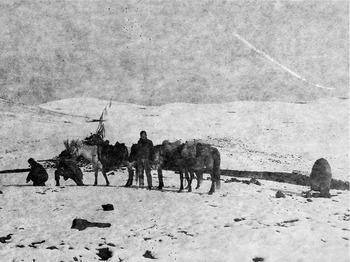
These documents reaffirmed Lhasa's long-standing goal of extending its spiritual authority into the temporal realm, particularly in such polities as Degé, which lacked major Gelukpa monasteries. The resolution of the crisis also reiterates the different perception of the linkage between territory and authority held by the Qing government, which though ostensibly ceding territory to Lhasa undoubtedly perceived little change in its authority since the Dalai Lama himself was seen as a tributary subordinate to both the amban and the emperor. By contrast, the Tibetan government, marked by a stronger—though not yet absolute—conception of territoriality, vigorously protected the borders of its jurisdiction from illegitimate incursion, whether preventing foreigners from crossing the Himalayan border with British India or crossing the border point marked by the stele. The important distinction between proper transit by Qing officials, merchants, and soldiers and the improper transit of foreigners at the latter boundary was made clear to British diplomat and explorer, Alexander Hosie, in 1904. On a specially arranged visit to the stele, he found a row of Tibetan soldiers facing an equal row of Khampa soldiers under Qing command crowding the pass on either side of the border stone, the former determined to prevent even his glancing at the face of the stone in Tibetan territory as the latter were nervously uncertain just how the Tibetan soldiers would act.Footnote 33
Members of Disciples of Christ Batang mission visiting the 1727 stele in the Ningjing Mountains, circa 1918.
Source: Records of the Division of Overseas Ministries, Disciples of Christ Historical Society.

Several decades after the defeat of Gönpo Namgyel and the return of a Lhasa commissioner to Kham, conflict between the chikhyap and the king of Chakla once again elicited a response from the Qing government. The response signalled the first influence on a Sichuan official of the newly globalizing norms of sovereignty and territoriality, and thus the first shift in perceptions of Kham and Tibet. In 1896 the governor-general of Sichuan province, Lu Chuanlin, had already been agitating at Court to remove the chikhyap from power and implement the old imperial policy gaitu guiliu to assert direct rule in Nyarong. Lu seized the opportunity presented by the conflict to occupy Nyarong, forcing the chikhyap to flee for Tibet. A year later, he resolved a succession dispute in Degé by imprisoning all parties before petitioning the throne for permission to carry out bureaucratization in both Nyarong and Degé. This had not been implemented in Kham since 1730 when Dartsedo was designated a sub-prefecture in the Qing territorial bureaucracy. Despite Lu's impassioned arguments for initiating direct Qing rule in these two polities, and perhaps across the whole of eastern Kham, and at the urging of the Dalai Lama, who was troubled by that very prospect, the Qing Court, equally troubled by apparent Russian intrigue in Lhasa and the ramifications of upsetting the Dalai Lama, ordered the restoration of authority in Nyarong to the Lhasa government and the return of the tusi title to the king of Degé.Footnote 34
The extension of Qing authority through investiture was most effective when possession of imperial tusi titles carried acculturative influence, whether among their subject populations or with the rulers of neighbouring polities, embodied in the performative submission of local rulers to the political centre in the galactic polity model. Even though these titles were imbued with the ethical and political mores of a Confucianism that still pervaded the Qing bureaucracy into the early twentieth century, imperial expediency often meant that no more than a nominal acceptance of these principles was a stipulation for investiture. Thus while the Qing's relationship with the tusi of Kham perhaps resembled the outer rim of the galactic polity model, it simultaneously reflected the bifurcation of the model proposed here. Qing investiture, unaccompanied by an emphasis on acculturation through Confucianism, effected only tenuous realization of authority in the temporal realm and no real influence in the spiritual. The performative link in the spiritual realm was particularly important in Kham where the temporal ruler's power often paled before that of the local khenpo or trülku, not just in spiritual matters.
Indeed, the Lhasa government's failure to exert temporal authority in two polities—Chakla and Nyarong—where the Gelukpa faith held little or no influence over the spiritual lives of its inhabitants and rulers, suggests the necessity of wielding influence in the spiritual realm simultaneously with efforts to effect authority in the temporal. Though the Qing government did attempt to co-opt at least the monastery in Litang, and perhaps others, through material support for the monks concurrently with the bestowal of titles on the polity's dépa, this was ultimately insufficient to enhance Qing strategy in the temporal realm, the investiture of tusi backed by military garrisons effecting but a superficial veneer of authority. Lu Chuanlin had recognized this weakness, and in 1900 published A Draft Record of the Plan for Zhandui,Footnote 35 a collection of his memorials and other writings recommending the bureaucratization of Nyarong. This work would greatly influence Qing officials in both Beijing, and especially Chengdu, as they came to re-envision authority in Kham under the influence of two globalizing norms—territoriality and sovereignty.
These norms were forged during what Charles Maier describes as a ‘border craze’ which gripped the states of Europe in the mid-seventeenth century.Footnote 36 The heightened concern for the ambiguity of frontiers was not restricted to European rulers, however, as demonstrated by the 1689 Treaty of Nerchinsk between the expanding Qing and Russian empires. Rather, this concern developed as expanding polities of varying types and sizes came into closer and more intense contact with each other across the globe. Unlike imperial Chinese perceptions of the frontier as a ‘fence’ that secured the polity against external danger, this burgeoning boundary simultaneously looked inward, territorially constraining, while also intensifying authority, exercised by a polity's central government in its once more-loosely administered borderlands.Footnote 37 And as access to and exclusive control over natural resources grew in importance to governments around the world in the wake of the Industrial Revolution, the exercise of a government's legitimate and absolute authority—sovereignty—within the bounded space defined by territoriality was perceived as essential.
Yet the exercise of sovereignty remained a largely unrealized ideal, even in Europe, until growing attention to territoriality in the late eighteenth and nineteenth centuries bound the concept with the emerging nation-state form.Footnote 38 Indeed, Maier asserts that territoriality in the nineteenth century, influenced by the Industrial Revolution and the concomitant transformation of technologies of governance, was no longer concerned only with boundaries, but even more so with what happened within those boundaries.Footnote 39 Thus the borderlands came to be seen no longer as a space ruled by locals who were loosely managed by a distant central government, epitomized by tusi and the galactic polity model. Rather the borderlands became a space bounded by the exclusive and absolute authority of the centre. This was effectively what Lu Chuanlin advocated in 1900, not merely for Kham east of the stele but for the whole of Tibet: ‘If we can sufficiently restrict access to Tibet, then the English will be willing to acknowledge that Tibet is subordinate to our authority. Under the law of states, countries do not invade each other, thus we can use this to resist the Russians.’Footnote 40
Implicit in Lu's ‘law of states’ is the ideal conception of sovereignty deployed in the nineteenth century to legitimate the global territorial fruits of European imperialism.Footnote 41 It was this conception which influenced the adoption by Chinese officials, particularly in Sichuan Province, of a notion of ‘absolute authority’ as the convergence of territoriality and sovereignty exclusively in the temporal realm and prompted the reinvigoration of old imperial policies now premised on a hardened boundary enveloping the plateau and their unquestioned authority within it. Where these old policies once accommodated the ambiguity of shared rule in eastern Kham, in the early twentieth century they were implemented to establish exclusive authority, to preclude the influence of local monasteries in a bifurcated structure, and to obliterate Lhasa's largely unencumbered, competing authority in the spiritual realm. But before such transformed policies could be contemplated, perceptions of Kham and Tibet had to shift.
Even during Lu's tenure in Sichuan, Kham and the whole of Tibet were perceived as only a vast fence protecting the western frontier, sealing the ‘back door’ of Sichuan. Referring to a proverb from the Warring States era, an author in the earliest periodical published in Sichuan wrote in 1898, ‘The lands of Sichuan and Tibet are like lips and teeth. Teeth without lips will shiver; Sichuan without Tibet will tremble.’ Later he added, ‘If the fence of Sichuan were to crumble, the disasters from the western lands would be unspeakable.’Footnote 42 In the decade that followed publication of this article, this older notion of the plateau as but an inert, two-dimensional fence was toppled by a new conception of Kham and Tibet in the minds of Qing officials as a vibrant, three-dimensional territory that could continue to protect the empire only if it—and its inhabitants—were treated like those of neidi (内地).Footnote 43 An opinion piece in The Sze-chuen Magazine, republished in 1908 in two parts in the Chongqing newspaper, The Universal Progressive Journal, reveals this shift. First reflecting on earlier perceptions of Tibet, the author writes, ‘Every day the western territory is a desolate, cold and sterile land . . . The land is just like a field of stones, the people just like so many marionettes. Obtaining this land does not extend the territory of the country, and absorbing these people does not strengthen the military. We receive only annual tribute and annually return gold seals.’Footnote 44 By article's end, though, he presents a new perception: ‘As to Tibet, its soil is merged with that of Sichuan, its politics related. Speaking of Sichuan, it could simply be stated that Tibet is a part of Sichuan.’Footnote 45
It should be remembered that the eastern part of Kham at this time was already part of Sichuan, at least on Qing maps. And for Lu, this region was the key to Tibet. ‘How to control Tibet?’ he asks in his book. ‘It is said one must start from the Dartsedo borderlands.’Footnote 46 And in 1907 that is where Zhao Erfeng (趙爾豊), the newly minted Sichuan-Yunnan frontier commissioner (川滇邊務大臣), influenced by the newly globalizing norms of territoriality and sovereignty, did start his endeavour. The founding of schools, the migration of people, commercial and industrial policies—all were implemented under absolutist conceptions of these norms that presumed exclusivity. Yet it was this presumption that obfuscated for both the Qing and Republican governments the realities of their incomplete implementation. The resultant inability to weaken the spiritual realm of the bifurcated structure of authority would ultimately undermine the final stage of Kham's incorporation into the Chinese state—establishing a province.
Asserting authority in Kham
One of Zhao's memorials to the throne during his first year as frontier commissioner demonstrates the global influence on his Kham endeavour. ‘Examining each country's opening of distant wastelands, for instance England in Australia, France in Madagascar, the United States in the Philippines, and Japan in Hokkaido, all first constructed inns and used benefits to attract settlers, who then hastened to these places like rushing to market.’Footnote 47 In the rhetoric of other Sichuanese officials the migration of settlers from Sichuan was also akin to the nineteenth-century conquest of the American West and the repopulation of Sichuan in the first decades of the Qing.Footnote 48 The various transformative endeavours undertaken by Zhao, and continued by his Republican Chinese successors—from exploiting natural resources to managing local commerce, from building schools and training teachers to reclaiming wastelands and enticing settlers from neidi—all shared similar characteristics with these distant actions, yet were tempered by the geographic and societal contours of the plateau. The endeavour was at once the legacy of two millennia of Chinese imperial frontier policies, focused on expansion and defence, and also distinctly influenced by the globalizing norms of territoriality and sovereignty. Familiar policies confronted new technologies of rule and shifting perceptions of territory, culminating in a new goal unfamiliar to earlier eras. This goal—global acknowledgement of Chinese sovereignty over Kham and Tibet—was even more central to the legitimacy of the Republican government's authority in the southwest than that of its Qing predecessor.
The final two sections of this article will employ infrontier imperialism to explore the early twentieth century policies of the Qing and Republican Chinese governments to undermine the spiritual realm in the bifurcated structure of authority in Kham, ultimately fostering the region's incorporation as a province into the Chinese state. Although these sections will focus on Chinese efforts at state-building that was influenced by absolutist conceptions of territoriality and sovereignty, the Lhasa government's adoption of these norms, particularly after the fall of the Qing empire in 1912 and the intensification of policies to augment spiritual with temporal authority in Kham, are essential to understanding both Chinese and Tibetan frustrations and their confrontation then—and now.
Infrontier imperialism results from a state's efforts to expand its governmental authority into geographic borderlands often stretching across its and a neighbouring state's territory, but divided by a mutually acknowledged boundary. The ‘infrontier’ is the section of the borderland which lies within the boundary of a given state, but which is often administered by arrangements different from that state's governmental structure, a situation which these processes seek to change. This may be the result of the recent inclusion of the infrontier in the state's territory or transformation in the state's government, perhaps influenced by new norms of governance. As the infrontier is often situated quite far from the state's capital, this impetus for incorporation frequently derives from political or commercial interests in nearby regions, the people of which may have a closer affinity with or understanding of the situation in the borderland. Derived from a close examination of the Qing and Republican Chinese endeavours to exert exclusive temporal authority in Kham during the first two decades of the twentieth century and its ramifications, this concept is applicable to exploration of similar efforts in the borderlands of expanding states elsewhere in the world.
Infrontier imperialism unfolds in three stages. In the Chinese context the policies of each stage have an imperial pedigree stretching at least as far back in history as the Yuan dynasty (1271–1368). The first stage was centred on the implementation of gaitu guiliu (bureaucratization) in the aftermath of the removal of local rulers by armies despatched from neidi, commonly referred to in Chinese documents as ‘pacification’. The numerous endeavours comprising the second stage included policies focused on transforming all aspects of borderland society, acculturating the people and enmeshing the land and its products—animal, vegetable, and mineral—into the economy and territory of the state. Implementation of these policies often occurred simultaneously with the first stage, though typically only following in the army's wake. The conversion of the borderlands into a territorial division of the state's bureaucracy, a province in the Chinese context, represents the final stage. Establishment of a province, too, is directly descended from imperial frontier policies, but is also the endeavour most deeply implicated in the transformative influence engendered by absolutist conceptions of territoriality and sovereignty.
After Kham was divided by the 1727 stele, the entire borderland—and eastern Kham in particular—became a contested space, coveted by both the Lhasa and Qing governments. The Lhasa government exerted spiritual authority on polities and rulers, particularly through Gelukpa monasteries, but could claim no significant temporal authority even after a chikhyap returned to Nyarong in 1866. After the erection of the stele, the Qing government's investiture of local rulers with tusi titles extended a measure of temporal influence, but, as shown above, this was weakened by the local power of both monasteries and independent-minded Khampa rulers. Thus from the perspective of the Qing and later Republic of China governments, the portion of Kham east of the stele can be considered the ‘infrontier’ of the borderland as it was situated within an administrative boundary of Sichuan Province but not directly administered as part of its territorial bureaucracy.
The most significant of first stage endeavours—bureaucratization—began in 1907 under the auspices of Frontier Commissioner Zhao, who had earned the moniker ‘butcher of Kham’ for his violent quelling of a Khampa revolt sparked by a small Chinese farming settlement in the Batang Valley in 1904. For the next four years, Zhao and his frontier force of some 3,000 soldiers removed, often ruthlessly, the rulers of polities across Kham on both sides of the stele, drew boundaries, and established nearly 30 new administrative divisions under Sichuan Province, mostly counties, stretching from Dartsedo in the east to Gyamda (Jiangda 江達) in the west. A mere 250 kilometres from Lhasa, Gyamda was not part of indigenous geographical conceptions of Kham but would mark the westernmost boundary of Xikang (西康), the Chinese designation for the entire region, for the next four decades. Bureaucratization, the implementation of which resembles the core aspects of territoriality and sovereignty, was last implemented on such a large scale in the early eighteenth century as Yunnan Province stretched its boundaries and its authority southward to encompass Sipsong Panna (Xishuangbanna 西双版纳). But that authority was not absolute as many local Tai rulers retained their rule.Footnote 49
Seeking to avoid a similarly ambiguous result to bureaucratization in Kham, Zhao ranked the installation of a civil magistrate as among the most important of his 43 ‘Regulations for the Reconstruction of Batang’ (巴塘善後章程),Footnote 50 a document which served as the model for much of his endeavour across Kham. However, a Court memorial from May 1911 suggests that no county by that time was, nor would be, administered by a civil magistrate.Footnote 51 Instead, the military officers initially installed by Zhao remained in control as late as 1912. Reflecting parliamentary preparations that were ongoing in Sichuan and the rest of neidi as part of the Qing's New Policies (新政), and perhaps also the influence of popular sovereignty as a new technology of rule, another of Zhao's regulations mandated elections for village heads.Footnote 52 Presented as a means to undermine the influence of monasteries on local temporal rulers, it is, however, unclear if any such elections took place.
Whereas such policies from the first stage of infrontier imperialism were intended to sever the indirect influence local monasteries exerted over Qing-invested dépa in the temporal realm, many of those grouped under the second stage, arguably the most integral to the ultimate success of the overall endeavour, targeted all facets of the monasteries’ authority over Khampa society in the spiritual realm. Zhao hoped that undermining the legitimacy of monks and lamas would snap the Dalai Lama's silken thread of spiritual influence in Kham, thus ensuring absolute Qing authority over the newly established administrative units in western Sichuan. The monks and lamas were decried by Qing officials as the most nefarious impediment to the success of their endeavour. Offering an impression typical of the time, Sichuan governor-general, Zhao Erxun (趙爾巽), Zhao Erfeng's elder brother, wrote: ‘The Tibetan barbarians are not educated. Professing Buddhism is already an established custom. They are bewildered and ignorant without knowledge and follow all that the lamas say. Therefore the lamas are able to use their religion, in the light of day for the attainment of benevolent goals, and in the shadows to spread evil schemes.’Footnote 53 Indeed, Sichuanese officials routinely believed that Khampas would favour the policies of Zhao and his successors if only they could be freed from the influence of the monks.
Thus two types of policies were implemented, those directed at the monasteries and the monks themselves and those directed at society at large. Among the former, Zhao reached back to a regulation first proposed in the eighteenth century to limit the population of all monasteries to 300 monks.Footnote 54 Another policy, the primary goal of which was the strengthening of the Sichuan tea industry and its crucial trade with Tibet, tangentially targeted the primary source of monastery funds for their ‘evil schemes’. In 1910 Zhao oversaw the establishment in Dartsedo of a monopoly tea company under joint government and private auspices—the Merchants Frontier Tea Joint Stock Company Limited (商辦邊茶股份有限公司). The company not only brought all Chinese tea producers together, but also established sales and trans-shipment offices in towns along both the northern and southern roads through Kham.Footnote 55 The other significant source of monastery control over the local economy—its landholdings—was addressed in several regulations concerned with the transfer of absolute temporal authority to the newly appointed Qing officials. Lamenting the indirect influence of the monasteries on temporal authority, Zhao wrote, ‘The Tibetans don't understand [that they are the emperor's people]. For those who believe that they are subjects of the tusi, they are muddled and laughable, for those who proclaim that they are subjects of the lamas, they are even more absurd and don't realise the situation.’Footnote 56 Hoping to un-‘muddle’ the minds of Khampa commoners cultivating fields owned by the monasteries, Zhao admonished the monks not to interfere in their personal affairs.
The policies of the second stage directed at society sought to incorporate the Khampas into both the Chinese state and nation. Of the former, policies included the expansion of mining operations; the establishment of such industries as a tannery in Batang and silkworm farms in several polities; the increased minting of a silver coin, the zangyuan (藏圓); and even research into the construction of a railway directly linking Chengdu with Lhasa. Two of the most important of the latter policies, which were the dual centrepieces of the acculturative efforts initiated by Zhao and tenuously resuscitated by his Republican era successors, were the founding of schools and the establishment of farming colonies. Unlike most prior imperial efforts to establish farming colonies in borderlands, which were focused primarily on the defence of new territory, Zhao appealed for commoners from neidi rather than soldiers. These settlers, who numbered some 4,000 by late 1911, in theory provided the Khampas with model, un-‘muddled’ imperial subjects loyal to the local Qing official. Due to space constraints, I cannot address each of these numerous policies, but will briefly discuss the founding of schools, the acculturative aspects of which were potentially most effective in undermining the influence of the monasteries, thus moulding the Khampas into subjects of the emperor and later citizens of the Republic of China.
Confucian schools, like military colonies, had been a feature of imperial borderland policy for centuries. Zhao's schools, and especially the curriculum, however, were different, adding such subjects as geography and history to the cultivation of moral character. In 1907 there were only two elementary schools in Kham for more than 60 students, both Khampa and Han, but by 1911 there were more than 300 at all levels with more than 9,000 students.Footnote 57 This was impressive growth, yet, with most schools established in only four towns, their limited geographic distribution, and thus the relatively tiny audience for their lessons, was insufficient either to significantly weaken the societal influence of monasteries or undermine their spiritual legitimacy. Using textbooks specially commissioned by the Frontier Educational Affairs Bureau (關外學務局) in Chengdu, the curriculum was crafted to do just that. Volume 13 of one such book, entitled Frontier Mandarin Textbook (關外官話課本), written in the vernacular, included the following passage: ‘The Emperor is the master of our China. What we eat, the clothes we wear, and the houses in which we live, the plots where we cultivate our crops, all are the Emperor's.’Footnote 58 While an unremarkable sentiment to a student in Chengdu, its emphasis on the emperor's universal ownership of everything and the unity of an entity called ‘China’ (中國), which included them, would have resonated differently among Khampa students, many of whom were not children.
Lessons in another textbook used in the Mandarin schools, Three Character Rhymes of the Western Lands (西垂三字韵語), portrayed an equally new perception of the Khampas’ present and past, offering a re-evaluation of their customs in the context of Confucian cultural mores.
You are very far away and lack knowledge. By going to school, you will understand the great meaning, which essence is in two phrases, loyalty to country (國) and respect for Confucius.
Local Tibetans transformed into Chinese will sincerely respect their relatives and the people will be enlightened.
Believing in the lamas and addicted to their religion, monks are increasing daily and their progeny cannot continue. Monks could return to secular life to have sons and grandsons, seek practical benefits, and shelter their kinfolk.Footnote 59
While the last passage sought to undermine the propensity of the young men of Kham to join monasteries, seduced by what Qing officials assumed to be the carefree life of a monk, all three reflect the influence of a globalizing force on Zhao's endeavour which often accompanied the norms of territoriality and sovereignty, one on the rise in Qing China in the early twentieth century—nationalism.
Attendance in the schools was compulsory for Khampa boys and girls above the age of seven, but sources do not distinguish between Khampa and Chinese in their attendance figures. Zhao used both monetary incentives and penalties to encourage attendance,Footnote 60 but French explorer, Pierre Bons d’Anty, on a visit to Batang in 1908, observed, ‘The measure is very unpopular and provokes resistance, thus most officials prefer to close their eyes. Those families that can pay the fine represent “paper recruits,” so to speak, in the government school and their children continue to study in the Lamasery.’Footnote 61 Nevertheless, Zhao proudly reported the success of his educational endeavour in a 1910 memorial, gushing, ‘Students of eight or nine years of age all are very courteous when they see other people, and when asked about their responsibilities, they know that they should be loyal subjects and love their country.’Footnote 62
But perhaps most heartening for Zhao, and indicative of one small success in weakening the influence of the monasteries, was the story of a woman named Adron reported in a 1910 Sichuan Officials’ Gazette article. When a school opened its doors near her small village north of Batang town, the ‘deeply superstitious’ follower of Buddhism was curious, often listening to the teacher from outside the makeshift classroom. After observing several lessons, she abandoned Buddhism for the teachings of Confucius, even donating her very large house to serve as the school. It was this last act that particularly pleased Zhao who, on hearing of it, immediately despatched an official to personally hang a plaque, similar to those awarded to supportive merchants, on which he had written the words ‘A Woman who Respects the Teachings of Confucius’ (女界尊儒). The following year during a convocation at a primary school in Batang, she was still on the frontier commissioner's mind. ‘This woman's insight is greater than any man’s,’ he proclaimed to the gathered students and parents. ‘It is obvious that the people's intelligence is slowly awakening.’Footnote 63 But one Adron did not make 10,000, nor did her spurning of Buddhism signal the desired collapse of the influence of monasteries on Kham society in the spiritual realm.
These policies, grouped under the first two stages of infrontier imperialism, reflect the influence on Sichuanese officials of absolutist conceptions of the norms of territoriality and sovereignty; the shift in perceptions of Kham from a distant, two-dimensional fence protecting Sichuan and the empire to a three-dimensional territory with clearly defined boundaries surrounding resources; and a population integral to both. The penultimate policy of the third stage—conversion of the borderlands into a province—similarly reflects this shift and, like Zhao's schools, also the transformation of old imperial policies wrought by these norms. From its origins in the Yuan dynasty, the province, the highest level of civil bureaucratic organization, had been linked with the policy of gaitu guiliu. Zhao's implementation of bureaucratization in the early twentieth century, the cornerstone of the first stage of infrontier imperialism and indeed of the entire endeavour, came to be focused inward, binding each Kham polity as an administrative unit to Sichuan and replacing their invested rulers with civil officials from the central bureaucracy. By contrast, implementation of the third stage came to be focused outward, seeking global recognition of first the Qing and later the Republican Chinese governments’ absolute authority over a clearly delineated territory comprising these newly defined units. Absolutist conceptions of territoriality and sovereignty presumed that such recognition would end what was perceived as external interference in Kham, thus precluding competition for authority in either the temporal or spiritual realms from both the British and the Dalai Lama.
Initial proposals to establish a province in Kham appeared several times during Zhao's four years as frontier commissioner, but policies to achieve such a goal were implemented in earnest only in the early Republican era, at a time when the accomplishments of the policies grouped under the second stage of infrontier imperialism were unravelling. The successful implementation of these acculturative policies provided a crucial link between the inward focus of bureaucratization and the outward goal of establishing a province, simultaneously strengthening both. The power of these policies—establishing schools and colonies, expanding commerce and industry—to undermine the influence of the monasteries in the spiritual realm was essential to shattering the bifurcated structure of authority in Kham. This in turn would strengthen the legitimacy in the temporal realm of newly installed civil officials, thereby stabilizing the new province and facilitating the lasting integration of its territory and people into the state and nation.
Authority frustrated
As suggested above, often the impetus for incorporating the borderlands came not from a state's political centre, instead deriving from either political or commercial interests in nearby regions. When Zhao was named frontier commissioner by the Qing Court in 1907, his mandate was restricted to the reconstitution of military garrisons in Kham and did not even include the implementation of bureaucratization.Footnote 64 However, influenced by the shift in perceptions of Kham among local Sichuanese officials and merchants, which lay behind Lu Chuanlin's book, and his own understanding of borderlands, which was revealed by his comparative reference to the policies of the British in Australia and the Japanese in Hokkaido, Zhao proposed and received Qing approval—but no additional funds—for a far more ambitious endeavour: the range of economic, industrial, and acculturative policies comprising many of his 43 regulations for Batang.
As the situation on the plateau began to stabilize by 1911, the merchants and gentry of Sichuan, many of whom were members of the recently established Sichuan Provincial Assembly, began to pay more attention to Kham. One of their most significant initiatives was the founding early that year of a Tibet Statistical Society (藏衛調查會) to report on social and economic conditions in Kham and Tibet. Indeed, British consul-general, W. H. Wilkinson, observed that the Society's fundamental objective was to be ‘the exploitation of Tibet in the interests of the Ssuch’uan gentry’.Footnote 65 This objective would only intensify in the aftermath of the province's declaration of independence from the Qing emperor in November and the subsequent founding of the Great Han Sichuan Military Government (大漢四川軍政府).
In March 1912 the new government established an Office for Managing the Frontier (籌邊處), which was explicitly tasked with continuing Zhao's borderland policies and overseeing the incorporation of Kham into Sichuan's provincial administration. Reflecting the most successful of Zhao's policies—the aforementioned dual centrepieces grouped under the second stage of infrontier imperialism—one of the Office for Managing the Frontier's four units was the Department for Colonisation (殖民司), which oversaw a Plantation Section (墾治科) and an Education Section (學務科).Footnote 66 In the summer of 1913, under the auspices of the Office for Managing the Frontier, the Sichuan Branch of the Agricultural Society (墾植協會四川支部) proposed sending 10,000 settlers to Kham.Footnote 67 Yet none went.
In addition to colonization, officials in the new Sichuan government and the Office for Managing the Frontier believed as strongly as Zhao had in the power of education to transform the Khampas, and in the benefits to the province of the endeavour. ‘The native Tibetans are steadfast and valiant in character, they can labour through bitterness, they deeply love to sing and dance, and they like battles of courage. Certainly they possess the qualities of a military man,’ remarked Sun Shaoqian, a soldier who participated in the Western Expedition of 1912–13. ‘If civilisation and education were again to enter Tibet, then they would be thoroughly transformed into citizens of the military government.’Footnote 68 Zhang Yi (張毅), frontier commissioner in 1915, proposed opening 150 schools by 1916 with a targeted student population of 10,000 by 1919.Footnote 69 Yet no new schools were founded.
In the months before the Office for Managing the Frontier was established, the collapse of Qing rule and the execution of Zhao in Chengdu (before he was able to return to Kham in his old role as frontier commissioner) led to the crumbling of Chinese authority. The military officials he had installed to oversee the newly created administrative units until the appointment of civil officials found themselves under siege, and the farming settlements established over the previous four years had effectively disappeared. Scattered reports suggested both the flight and slaughter of colonists.Footnote 70 And by 1915, scarcely 30 of the once more than 300 government schools remained, nearly all in eastern Kham and none with dedicated buildings.Footnote 71 The Western Expedition, let by Yin Changheng (尹昌衡), the first Republican-era successor to Zhao as frontier commissioner, was a Sichuan-financed military campaign to reassert provincial authority across Kham, both east and west of the 1727 stele, and, as Sun suggests, to resuscitate Zhao's acculturative endeavours.
Yet, since these early days of Sichuan officials’ triumphant return to Kham, the best intentions, and most detailed plans of future frontier commissioners, such efforts to undermine the influence of monasteries in the spiritual realm and integrate the Khampas into the province withered. Indeed, on a trip to Chamdo in 1917, the British consul general in Dartsedo, O. R. Coales, reported,
Traces of attempts to encourage trade, educate the Tibetans and improve communications are occasionally noticed. They invariably date from the time of Chao Erh-feng and are now neglected or abandoned. For example, one passes along a minor road; bridges and cuttings are seen, which have evidently been constructed with care; they are now broken down and impassable. An enquiry elicits the reply that the road was opened by Chao Erh Feng as a short cut, but is now out of repair and disused. One's attention is called to a small village. O, there Chao Erh-feng opened a school; it is now closed. One sees a large leather factory at Batang. It was started by Chao Erh-feng, but is now closed. And so on, till one gets wearied of what Chao Erh-feng did do and what his successors don’t.Footnote 72
And the Office for Managing the Frontier itself, hampered by financial difficulties and the instability of the provincial government, was disbanded by early 1914. This coincided both with an outward shift in focus in Chengdu and Beijing and with the final rounds of negotiation among British, Tibetan, and Chinese plenipotentiaries at the Simla Conference in British India. In February, proposals to convert the Kham borderlands into a separate province circulated among Sichuan officials.Footnote 73 Yet, as these policies, grouped under the second stage of infrontier imperialism—the most important of Zhao's endeavours—continued in disarray, despite Republican efforts at resuscitation, the cornerstone of policies grouped under the first stage—the bureaucratization of the myriad polities of Kham nominally implemented by Zhao and initially reinstated by Yin Changheng—also began to unravel.
During his four-year tenure as frontier commissioner, Zhao had been careful to ensure that an accretion of successful military actions first set a stable foundation for subsequent policies in the temporal realm. Thus because by mid-1911 his soldiers were spread quite thinly across Kham, bureaucratization had not yet been implemented in any polity west of the stele except Chamdo. By contrast, his successors in the Republican era were too quick to presume success in the temporal realm, well before their armies had ensured stability throughout Kham.
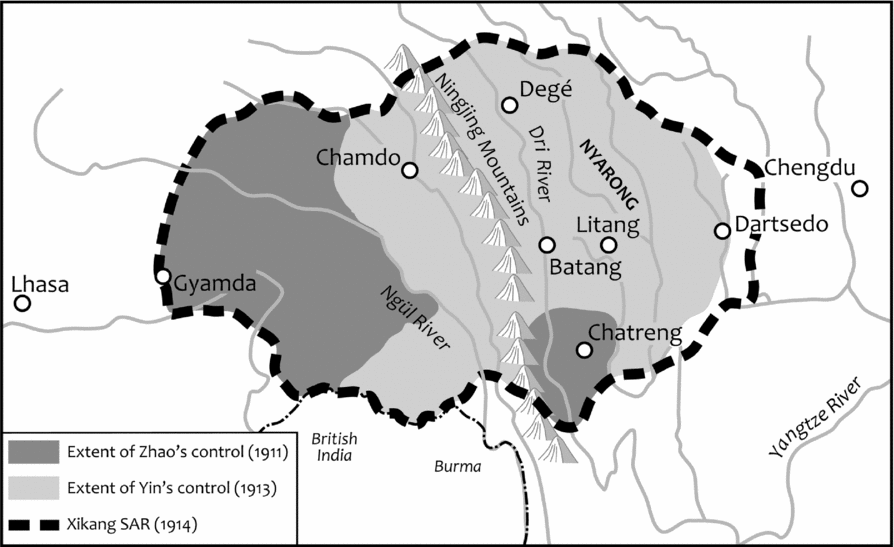
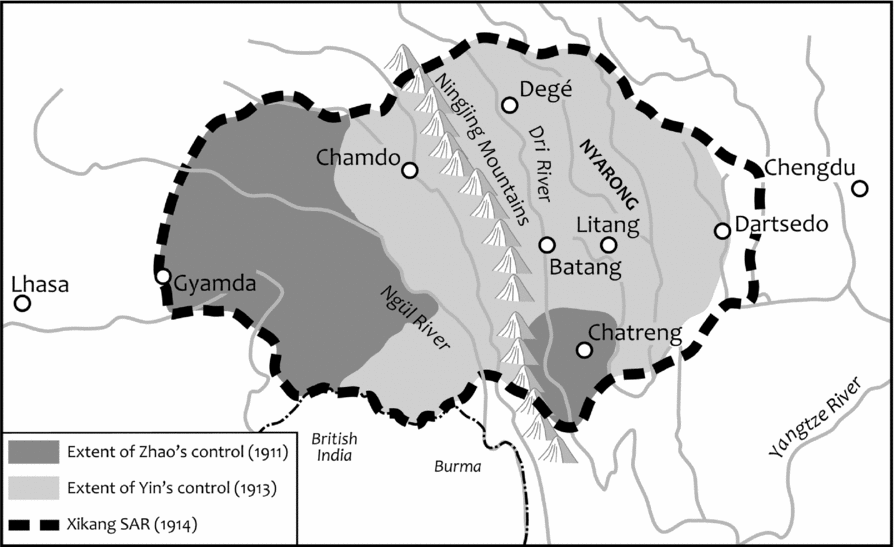
By early 1913, Yin's Western Expedition had stretched Sichuan's military presence to Gyamda which was as far west as Zhao had sent his own frontier force three years earlier. Yet by mid-year, a Tibetan army comprising thousands of increasingly better trained soldiers commanded by the Kalon Lama Chamba Tendar, council minister in Lhasa and newly appointed governor of Kham, had pushed the Chinese east to the Ngül River, where a stalemate would hold until 1917.Footnote 74 In spite of this, in June 1914 the Republican government in Beijing officially established the Xikang Special Administrative Region (西康特別行政區)Footnote 75 encompassing the entirety of Zhao's earlier territorial exploits and Yin's initial successes (see Figure 3). Although roughly one-third of its territory was beyond effective Chinese civil or military control, the new Xikang Special Administrative Region was duly divided into 30 administrative units, a civil official was assigned to each, including Gyamda, newly renamed Taizhao Prefecture (太昭府), the existence of which swiftly became but a figment of bureaucratic documentation. Like several of his compatriots, the civil official assigned to Taizhao was unable to assume his post.Footnote 76 As part of the first stage of infrontier imperialism, this action should have laid the groundwork for the third stage, the eventual declaration of a province. Xikang Province would finally appear on Republican Chinese maps in 1939.
Borders of Xikang Special Administrative Region, 1914. Source: Debbie Newell.
As noted above, numerous proposals to establish a province in Kham pre-date the establishment of the Xikang Special Administrative Region. Two from the end of the Qing era both demonstrate the influence of absolutist conceptions of sovereignty and territoriality and the outward focus of policies grouped under the third stage of infrontier imperialism. In mid-1911, before departing from Kham, Zhao asserted, ‘Kham and Tibet are the Emperor's domain, and ours to manage. It would be exceedingly difficult for foreigners to interfere as we are neither expanding our territory nor bursting through its borders . . .With danger on all sides, certainly we must establish a province, otherwise [Kham] cannot be controlled and Tibet cannot be saved.’Footnote 77 With the Dalai Lama already in exile in British India by 1910, the danger referred to was simply British influence in Tibet, an influence which could be defeated only by attaining global recognition of Chinese sovereignty over Kham and Tibet. In August 1911, Fu Songmu, Zhao's immediate successor, reiterated these ideas in a comprehensive memorial which never reached Beijing, but would be published a year later as A Record of Province Building in Xikang, then serialized in 1913 in Eastern Miscellany, a Shanghai magazine, during the initial stages of the Simla Conference.Footnote 78
Zhao's articulation of the global perils necessitating the establishment of a province strongly informed the Presidential Order issued on 12 April 1912 which proclaimed Tibet to be equal in status with the provinces of neidi, a move that sought to legitimate the Republic of China as the natural inheritor of the territorial extent of the former Qing empire. A five-point telegram despatched by the Republic of China's Ministry of Foreign Affairs to the representatives of Japan, England, and Russia, following Britain's proclamation of opposition to the Presidential Order, evinces one of the expected results of the establishment of a province and the perceived power of absolutist notions of sovereignty and territoriality—the preclusion of foreign influence on local affairs. Points three and five state:
3. As regards the territories of Manchuria, Mongolia, and Tibet, the Republic of China has the freedom to act under sovereignty, and foreigners may not intervene. . .
5. The current resistance against the Republic of China by Mongolia and Tibet is impermissible under international law, and foreigners may not aid the instigation of those Mongolians and Tibetans fostering chaos.Footnote 79
Note that in the latter, Tibet's opposition to its inclusion in the Republic of China is conflated with foreign influence, much as resistance to Qing rule in eastern Kham before 1912 had been equated with the ‘external’ influence of the Dalai Lama via local monasteries. Britain's opposition to the Order and the relationship that had evolved between the governments of British India and Tibet after the Dalai Lama's flight in 1910 in part prompted the opening of the Simla Conference in October 1913.
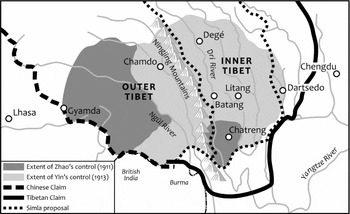
The Simla Conference is perhaps best known for the delimitation of a boundary between British India and Tibet, which sparked a century of boundary disputes between the Chinese and Indian governments.Footnote 80 But more central to the Conference were negotiations over the limits of China's sovereignty in Kham. The resulting line proposed the establishment of an ‘inner’ and an ‘outer’ Tibet, the Republican Chinese government possessing sovereign authority in the former but only suzerain authority in the latter (see Figure 4). Although the Chinese plenipotentiary never signed the Simla Accord, this distinction defined Sino-Tibetan relations, and British influence on them, for at least the next decade. It also demonstrated the pervasive influence of the norms of territoriality and sovereignty on both the Chinese and Tibetan governments and the impetus for the former's shift to an outward focus in its Kham policy. Figure 4 shows the territorial claims to sovereignty over the entirety of Kham presented by each government in January 1914. Neither claim corresponded to the military or political reach of either at the time.
Chinese and Tibetan territorial claims at the Simla Conference of 1914 and the proposed division between Inner Tibet and Outer Tibet. Source: Debbie Newell.

Documentary evidence for the Chinese claim rested exclusively in the temporal realm and included material relating to Zhao's bureaucratization of the polities of Kham both east and west of the 1727 stele; a bill passed by the House of Senators of the National Assembly in 1912 listing the Chinese names of the administrative units in Kham, then designating the eighth division of the parliamentary election district of Sichuan Province; and the aforementioned Presidential Order.Footnote 81 The territorial claim corresponded both to the greatest extent of Zhao's and Yin's military manoeuvres in Kham and to the western boundary of the Xikang Special Administrative Region, which would not be established officially until barely a month before the Conference's incomplete conclusion in July 1914. The timing of the establishment of the Xikang Special Administrative Region suggests that the impetus was largely external, though also related to the weakening of Chinese authority even within the parts of Kham where the Republican government had retained a significant military presence. As suggested by Zhao in his 1911 memorial and evincing the influence of absolutist conceptions of territoriality and sovereignty, the central government perhaps presumed that global legitimation of its rule in Kham would result ipso facto in an end to the Dalai Lama's external challenge in the spiritual realm, thereby strengthening Chinese authority in the temporal realm. The Xikang Special Administrative Region was the first step.
The Special Administrative Region was characterized in the early years of Republican China as an evolutionary stage in the establishment of provinces in the borderlands, an administrative structure that improved frontier security in the short term and strengthened central authority. The Xikang Special Administrative Region was one of four established by the Republican government in 1914 in borderland regions threatened with encroachment from neighbouring states or empires. The other three—Rehe (熱河), Chaha’er (察哈爾), and Suiyuan (綏遠)—occupied a contiguous stretch of territory corresponding with much of today's Inner Mongolia. All were converted into provinces in 1928.Footnote 82
The formation of the Xikang Special Administrative Region seems to have fostered a perception among officials in both Chengdu and Beijing that acculturative policies were no longer essential to incorporating Kham and its people into the Chinese state and nation. Indeed, the corresponding shift in the central government's focus to the outward policies of the third stage of infrontier imperialism gradually resulted in the curtailment of efforts to resuscitate Zhao's acculturative policies, even in the face of periodic entreaties from frontier commissioners more attuned to the local situation. Thus after 1912 the monasteries, whose influence in the spiritual realm had only been weakened, not eliminated, by the incomplete implementation of these policies, came to support the Lhasa government's reinvigorated efforts in Kham to exert authority in both the spiritual and temporal realms.
Documentary evidence for the Tibetan claim at the Simla Conference rested in both the temporal and spiritual realms and included mid-seventeenth century rent rolls from Degé, records of the contemporaneous census taken in the king of Chakla's domain, noted above, and edicts from and correspondence between the Dalai Lama and both lay rulers and khenpo across Kham. In total there were 90 documents of varying ages, amounting to several hundred pages.Footnote 83 The territorial claim corresponded to the greatest extent of the activities of the Dalai Lama's commissioners in the mid-seventeenth century, the eastern boundary of which was (and still is) similar to the geographic extent of Tibetan communities in Kham. These were the communities over which the Kalon Lama was granted both civil and military authority when he was named governor of Kham—the entirety of Kham—by the Dalai Lama in early 1913.
His appointment, well before the Simla Conference opened, signified the Lhasa government's repudiation of the 1727 stele as a marker constraining its efforts to exert authority over the myriad polities of Kham in the temporal realm, which had been tacitly acknowledged by the naming of a teji, noted above, to administer the polities of western Kham in the wake of its erection.Footnote 84 This act thus reflected the increasing influence of the norms of territoriality and sovereignty among Tibetan officials. Tsepon W. D. Shakabpa further suggests that the appointment was indicative of the Dalai Lama's determination on his return to Lhasa in January 1913 to ‘clear the hostile Chinese out of Kham’.Footnote 85 Perhaps voicing the Dalai Lama's and his own frustration with the military stalemate, in 1915 the Kalon Lama reportedly despatched a letter to the people of Nyarong, and perhaps other polities as well, announcing his plan to evict the Chinese from Kham, advising them to revolt immediately or face severe rebuke from the Tibetan army.Footnote 86
However, according to the British consular officer in Dartsedo, Eric Teichman, the tri-partite Simla Agreement, signed by only the Tibetan and British representatives, prevented Tibetan soldiers from attacking unless the Chinese were to break the truce first. Interestingly, the Kalon Lama's letter echoed a rumour that had circulated in Dartsedo more than a decade earlier. ‘In 1903 the Dalai Lama issued an ultimatum to the King of Chiala threatening to take from him and the Chinese by conquest all the territory west of the Tung valley. . .’ Referring to the Younghusband Expedition's arrival in Lhasa in early 1904, adventurer, E. H. Wilson, continued, ‘[F]rom what I saw and heard there it was plain that the British were unwittingly pulling China's “chestnuts from the fire.”’Footnote 87 Thus even before the advent of Zhao Erfeng in Kham, the Lhasa government, perhaps equally influenced by the norms of territoriality and sovereignty and then shifting perceptions of Kham among Sichuanese officials, considered aggressive action, undoubtedly through the Nyarong chikhyap, to exert authority in the temporal realm.
That opportunity finally came in 1917 when, according to Teichman, the Chinese attacked the Tibetan army at Byayül (Jiayuqiao嘉玉橋).Footnote 88 Their resounding defeat was the result of several factors, perhaps not least the Tibetan soldiers’ extensive use of rifles firing ‘lightning magazine bullets’ (達姆彈), which exploded on impact.Footnote 89 The subsequent ease with which the Kalon Lama's force pushed eastward, though, was perhaps facilitated even more by the weakened state of Chinese authority in the temporal realm and the concomitant failure to resuscitate Zhao's acculturative policies even in those parts of Kham with a significant Chinese military presence. Their incomplete implementation had failed to undermine the influence of the monasteries and, through them, the Dalai Lama in the spiritual realm, leaving intact the bifurcated structure of authority in Kham. Thus even as the Republican government continued its outward focus on securing global acknowledgement of Chinese sovereignty over Kham by seeking to establish a province—the penultimate policy of the third stage of infrontier imperialism—the policies comprising the first two stages lay in tatters.
This situation was reaffirmed by the Chamdo and Rongpatsa (Rongbacha 絨垻岔) agreements of 1918, tri-partite negotiations conducted between the Kalon Lama and local Chinese military officials, both with the participation of Teichmann. Though presumably authorized by Frontier Commissioner Chen Xialing (陳遐齡) and the Beijing government, the negotiations and the resulting agreement were quickly disavowed by both. In addition to thoroughly reversing the territorial gains of Zhao and his successors since 1907, two provisions placed strict limits on the number and geographic location of Chinese soldiers and effectively codified the bifurcation of authority in Kham. Although provision 11 explicitly barred the stationing of Chinese armies in either Nyarong or Chatreng (Xiangcheng 鄉城) ‘so long as the natives of those districts remain peacefully within their own borders and abstain from raiding other parts’, if the people of either polity were to cause trouble, Tibetan authorities were barred from interfering in whatever actions were deemed necessary to restore peace by the Chinese. This seemed to be the result of a compromise regarding proper authority in Nyarong, which Tibetan officials in Lhasa asserted should remain under the Dalai Lama's direct temporal authority in spite of the final departure of the chikhyap at Zhao's behest in 1911. The fifth provision stated:
It is agreed that the control of all monasteries in the districts governed by China, as well as the right of appointing high Lamas and other monastic functionaries, and the control of all matters appertaining to Buddhism, shall be in the hands of the Dalai Lama, Chinese authorities not interfering in any way therein. But the Lamas, on the other hand, shall not interfere in the authority of the Chinese officials.Footnote 90
This provision negated efforts by Zhao and his successors to undermine Lhasa's influence through the monasteries on the spiritual realm, ceding the hearts of the Khampas to the Dalai Lama even as it strengthened the authority of civil magistrates in the temporal realm in the polities of eastern Kham still deemed under Chinese rule.
Indicative of the tenuous success of bureaucratization, under the agreements, monasteries were explicitly barred from intervening in the exercise of civil authority by Chinese officials in those polities over which Sichuan retained jurisdiction. Yet as the year-long armistice mandated by the agreements neared its end in autumn 1919, without Beijing either acquiescing to the terms or opening further negotiations, Chen, fearing a renewal of hostilities, took a dramatic step. Returning seals confiscated by Zhao in 1911, he reinstated the tusi titles of the lay rulers of three of the Hor States, as well as the headman of Rongpatsa, asking them to help raise an army of local men to stand with his frontier force if the Kalon Lama's soldiers were to attack.Footnote 91 Such reinstatement of titles harking back to the imperial era seems to have been quite common in subsequent years as tusi are identified on maps of Kham into the early 1950s. It is also a stark demonstration of the persistence of the bifurcated structure of authority, reinvigorated rather than shattered by the ultimate shift outward of the Chinese endeavour. In privileging the temporal, these policies came to neglect the acculturative efforts initiated by Zhao and sporadically advocated as necessary by his successors in Kham.
Conclusion
At the start of the twentieth century, a bifurcated structure of authority persisted in the Kham region of ethnographic Tibet, fostering a tenuous shared rule between the Qing and Lhasa governments. For nearly 200 years the silken threads of spiritual authority emanating from Lhasa stretched across many of the region's myriad polities, competing with the golden yokes of exclusively temporal authority extended to its lay rulers by the Qing government. However, the influence of two newly globalizing norms—territoriality and sovereignty—on conceptions of authority, first among Qing and Republican Chinese officials and later among officials in Lhasa, rendered accommodation of the bifurcated structure untenable. Unable to compete effectively in the spiritual realm, in the first two decades of the twentieth century Chinese officials sought instead to weaken the silken threads linking the Dalai Lama with the monasteries of Kham, thus undermining Lhasa's corresponding indirect influence on local rulers, and ultimately shattering the bifurcated structure. The Thirteenth Dalai Lama, however, sought to compete in both realms, especially following his return to Lhasa in 1913. Already possessing significant spiritual authority in Kham, he sought to expand his authority in the temporal realm just as his predecessors had done, this time through the assertive governance and military actions of the Kalon Lama. Like the Chinese influenced by territoriality and sovereignty to aspire to absolute authority in Kham, but, unlike the Chinese, able to actualize authority in both the spiritual and temporal realms, and thus able to work within the bifurcated structure, the Lhasa government proved more successful in Kham during this time.
Acculturative policies were essential to support the Chinese endeavour to shatter the bifurcated structure, thus effecting the primacy of the temporal realm—and of Chinese authority—in Kham. Yet absolutist conceptions of territoriality and sovereignty, particularly after the establishment of the Republic of China, fostered a nearly exclusive emphasis on the temporal and a concomitant shift away from acculturation towards the outward goal of establishing a province in order to secure global acknowledgement of Chinese sovereignty over Kham. Epitomized by the establishment of the Xikang Special Administrative Region, built on the perceived success of bureaucratization in Zhao's time, it would seem that these officials expected the swift collapse of all internal challenges to their rule once the absolute barrier against intervention by external forces was raised. The Chamdo and Rongpatsa agreements of 1918, however, would demonstrate that claims of sovereignty could neither sever the silken threads still extending from Lhasa nor thwart the extension of new golden yokes. The acculturation of Khampa commoners remained essential to weaken the local power of monasteries and thus undermine Lhasa's authority in both the spiritual and temporal realms. As such, policies such as colonization and the establishment of schools provided a crucial link between the inward focus of bureaucratization and the outward goal of demonstrating sovereignty by establishing the Special Administrative Region and, ultimately, a province. The inability of the Chinese to effectively implement acculturative policies, both in Zhao's time and afterwards, to shatter the bifurcated structure of authority inhibited the incorporation of the Khampas into the Chinese nation. And the corresponding weakening of bureaucratization hindered the incorporation of the myriad polities of Kham into the Chinese state. This laid the foundation for opposition that would manifest in both the early decades of the twentieth century—and the twenty-first.