Introduction
The most recent round of Afrobarometer survey data shows that only 33 percent of respondents from the total sample of sub-Saharan African states claim a national identity exclusively (Round 7: 2016–2018). The complexity of effective nation-building can be attributed to a number of factors, including competition for state resources (Englebert Reference Englebert2009) and the uniquely African version of state formation that introduced European-style states through colonialism and the imposition of borders on top of already existing social and political communities (Herbst Reference Herbst2000). This article is part of a broader research agenda that challenges the conventional wisdom about the relative dearth of viable nations in Africa by exploring the cases of Tanzania and Kenya and explaining why Tanzania has been able to build a functional nation where other African countries have been less successful. In conjunction with this broader question, it is necessary to ask how the nation is imagined, who is doing the imagining, and in what types of spaces the state is articulating its vision of the nation.
As Tanzanian elites built a nation in an ethnically diverse place, they had to strategize about how best to deal with a variety of potentially competitive sub-nationalisms. They did so by working actively to depoliticize ethnicity through the use of language policy, public education, and national service programs. The post-independence state has historically used its ability to make and enforce policy in areas such as education and economic development to ease the growing pains of an incredibly diverse national community; it has based the distribution of resources on the performance of Tanzanian-ness and commitment to ujamaa socialism, rather than relying on a system of ethnic patronage, and framed conscientious citizenship as the rejection of exploitation and an active fight against the common national enemies of ignorance, poverty, and disease (Aminzade Reference Aminzade2013; Brennan Reference Brennan2006, Reference Brennan2012). While the Kenyan government also provides funding for schools and museums, the messaging funneled through these spaces is less clear in terms of who the state imagines a Kenyan to be and how individuals should understand themselves within a broader national community. Further, because of the way that postcolonial policies unfolded in Kenya, subnational ethnic identities were not pushed out of the discursive arena of identity formation and the practice of party politics (Elischer Reference Elischer2013). Where the Tanzanian government deliberately marginalized ethnic identity by excluding more “traditional” elites from power, Kenya structured its distributive and electoral politics around ethnic communities, meaning that citizens became claimants on ethnic elites and were able to use those connections as avenues of access to state resources.
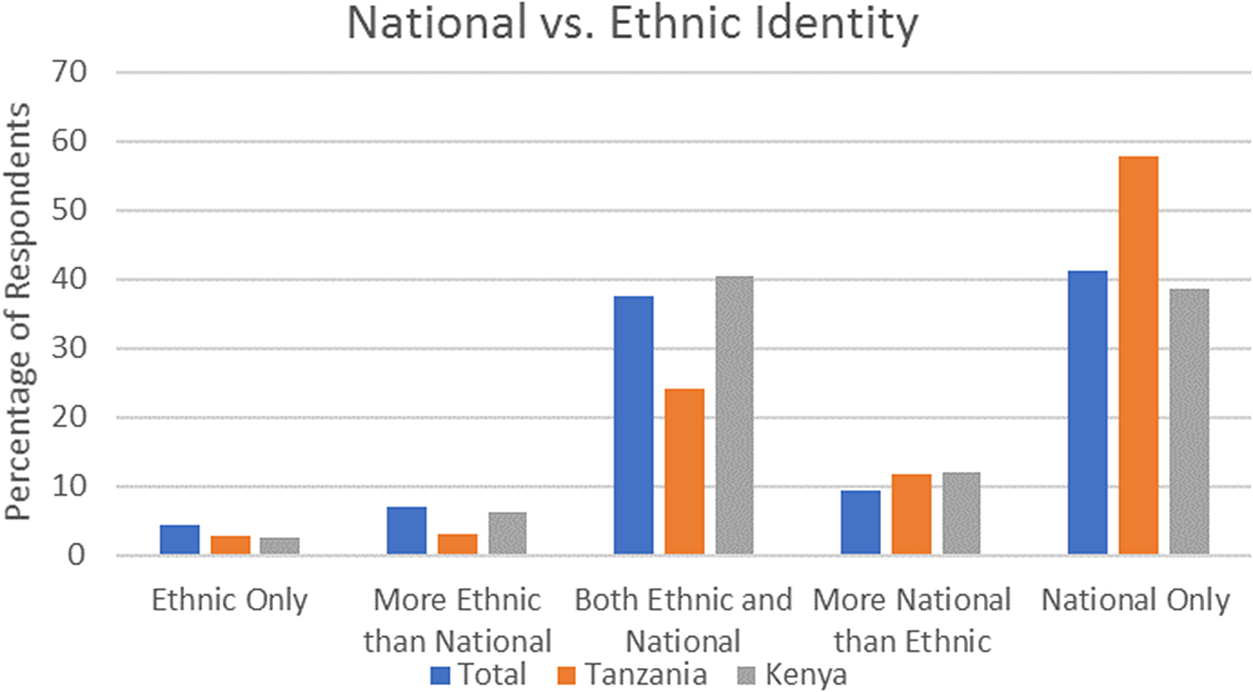
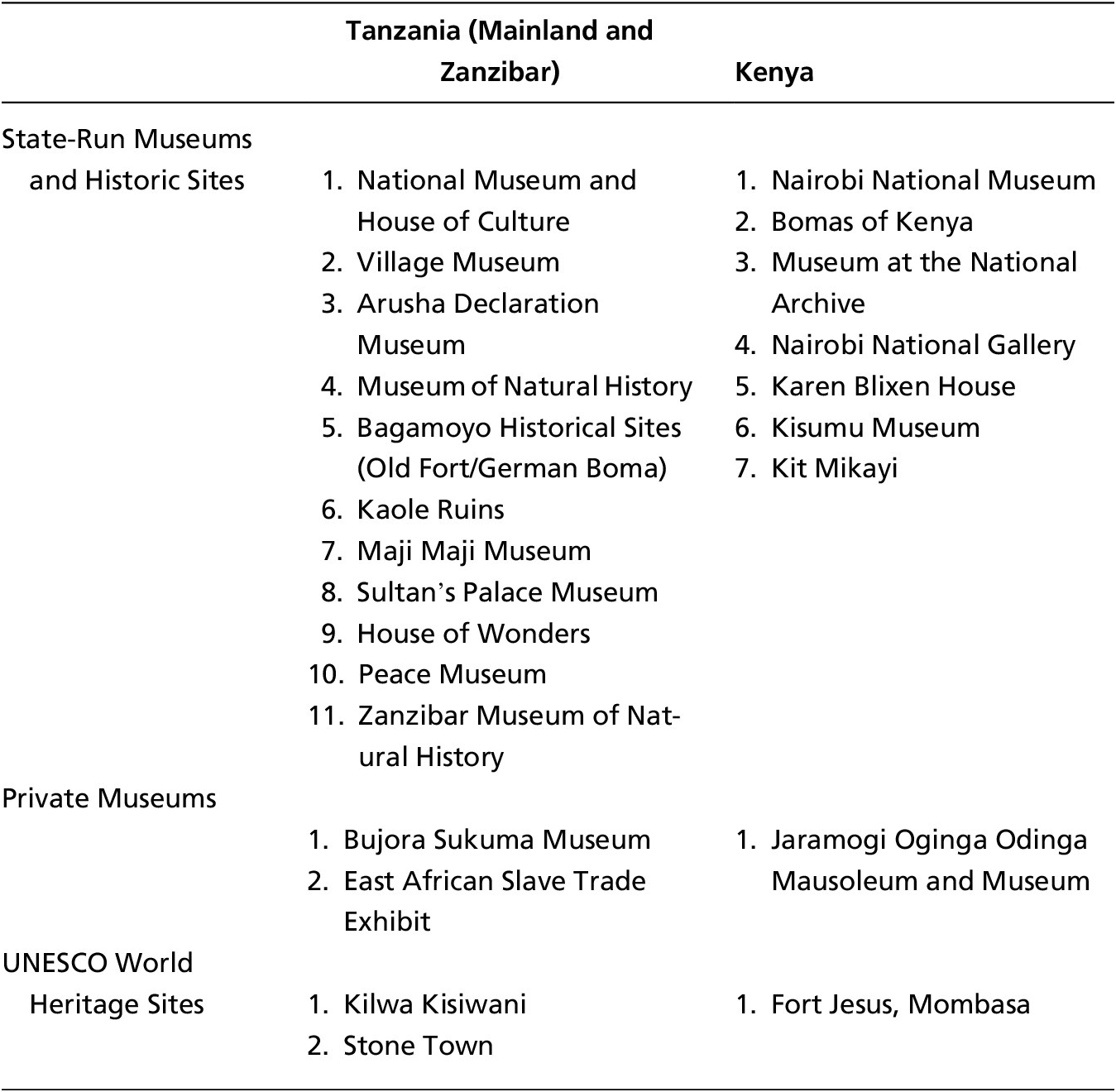
The frequency with which Tanzanian respondents claimed a “national identity only” is significantly higher than responses from the Kenyan sample, and from the sample of all sub-Saharan African countries included in round six of the Afrobarometer survey (see Figure 1). This project looks at a selection of museums in both countries that speak directly to issues of nationhood and identity-making. Throughout the course of ten months of dissertation fieldwork, I visited and cataloged the contents of exhibits at two dozen museums and historic sites in Dar es Salaam, Nairobi, and a number of other sites in Kenya, mainland Tanganyika, and Zanzibar. Because of limitations in terms of space for discussion in this article, only a portion of the sites visited will be discussed, although the entirety of the body of data is considered in constructing the official national narratives that are articulated in the contents of these museums and historic sites (see Table 1).
Ethnic and National Identity in Tanzania and Kenya

List of Museums Visited in Tanzania and Kenya

Eugen Weber (Reference Weber1976), Eric Hobsbawm (Reference Hobsbawm, Hobsbawm and Ranger1983), Benedict Anderson (Reference Anderson1983), and Edward Miguel (Reference Miguel2005) have all located the work of nation-building as occurring in the spaces of interaction between the state and society. Hobsbawm argues that the “invention of tradition” includes the construction of monuments, the singing of anthems, and the flying of national flags; these nationalist signals, though, will not take root unless they are presented in a way that ordinary citizens are prepared to listen to (Hobsbawm Reference Hobsbawm, Hobsbawm and Ranger1983:263). Anderson, too, is interested in how nation-building efforts are channeled through state institutions. His discussion of museums is particularly instructive; he argues that the contents of these places teach the myth and history of a community and facilitate the collective remembering and forgetting, through classification and logoization, that is integral to imagining a shared community. These dynamics play a role in commemorating both shared glory and trauma by establishing a set of common experiences, myths, and symbols that make communities more cohesive and willing to mobilize (Kaufman Reference Kaufman2001). Harcourt Fuller (Reference Fuller2010) identifies similar processes in the use of political iconography and “symbols of nationhood” in postcolonial Ghana. As humans, we are both participants in and tellers of stories about ourselves and our histories, and the distinction between events that actually unfolded and the telling of that history is not always clear (Trouillot Reference Trouillot1995). Historical narratives, according to Michel-Rolf Trouillot, necessarily make claims on the truth, but there is a line to be negotiated between fact and fiction in the way communities come to terms with their histories.
State-operated museums serve both as a space and as an activity; they provide an opportunity for the state to present a snapshot of its vision of the nation. The official designation of “national museum” lends credibility and gravity to sites’ contents because of what the space means and signals to visitors and curators. Museums also serve a pedagogical function, in that visitors are doing identity work in museums, as viewers, consumers, and negotiators of the state’s imagining of the nation. These places serve as sites of nation-building, not because of how many people pass through them, but because they are officially recognized spaces where the state and its affiliated actors are able to exercise control over the narrative and present visitors with their vision of the nation. Museums, then, are centrally located within this discourse about fiction, history, and how to remember the past (Macdonald Reference Macdonald, Macdonald and Fyfe1996; Rounds Reference Rounds2006).
Museum spaces are places that “through their displays and day-to-day operations… inevitably raise questions about knowledge and power, about identity and difference, and about permanence and transience” (Macdonald Reference Macdonald, Macdonald and Fyfe1996:2). If museums are sites of negotiation between power, identity, and nation, as organized by the state, the material content of these places and the ongoing interpretive work done by both curators and visitors is of central importance to the nation-building project. The trappings of officialdom lend significance to state museums as space and symbol, and the collected objects within document a human community situated territorially and temporally. These spaces are designated with meaning because of their visibility and importance as pieces of state infrastructure, but also by the things that they hold inside: “The building contains representatively everything in the state territory—and in this way becomes itself a symbol of a power relationship” (Prosler Reference Prosler, Macdonald and Fyfe1996:35). Peter Schmidt and Roderick McIntosh suggest that such spaces can be “mortuary and government shrine,” (Reference Schmidt, McIntosh, Schmidt and McIntosh1996:7) indicating the centrality of serving as repositories of memory and politically important narrative to the function of state-affiliated museum spaces. Museums represent a pivotal intersection between “cultural production and consumption, and between expert and lay knowledge” (Macdonald Reference Macdonald, Macdonald and Fyfe1996:4); the museum is authoritative and legitimating, both as a space and as an actor, and that legitimacy has been implicated in the construction of the modern nation-state. While museums serve as touchstones that indicate how communities remember their pasts, the added layers of the exclusion of peripheral histories and selective forgetting are also of importance (Anderson Reference Anderson1983). In some ways, absence is just as indicative of boundaries of belonging as is presence in an exhibit and speaks to both the inclusionary and exclusionary dynamics embedded in building a national community.
In interrogating the inclusive and exclusive dynamics of memory-making in museums, it is essential to reckon with the colonial origins of many African museums. In both Nairobi and Dar es Salaam, the flagship national museums of Kenya and Tanzania were originally colonial museums, built to document and display the material of the colony’s natural world and the culture of its imperial subjects. The Nairobi National Museum originated in 1910 and moved to its current site in 1929 with support from the colonial government. Other sites, such as the Kisumu Museum in 1980, became national museum sites after independence. Similarly, the museum system in Tanzania began with a national museum established in the 1930s by the colonial government. Other sites in the national network of museums were founded by the government following independence, including the Village Museum in 1967, the Arusha Declaration Museum in 1977, and Natural History Museum in 1987. While museums “are now widely understood as secular sites of contestation and representation, and as places where groups vied with each other to define and redefine ‘themselves’ as nations,” (Kaplan Reference Kaplan and Macdonald2006:187) the museums of the colonial period did not reflect autonomous Tanzanian and Kenyan struggles to define the national self. Traditionally, the museum has been treated as a
“cabinet of curiosities”…the storeroom of a nation’s treasures, providing a mirror in which are reflected the views and attitudes of dominant cultures, and the material evidence of the colonial achievements of the European cultures in which museums are rooted.
(Simpson Reference Simpson2001:1)Annie Coombes addresses the function of colonial museums by describing them as “popular educators” (Reference Coombes1988:64) that appealed to public interest while simultaneously working to further the imperial project. She further identifies a tension between the position in museum space of colonial subjects as simultaneously at the “primitive” end of an evolutionary spectrum, according to colonial era curators, and as having culture worthy of preservation. According to Moira Simpson (Reference Simpson2001), these power relationships are being revisited; in the cases at hand, rather than a European elite reckoning with representation of the colonial “Other,” we see the reclamation of museum space by the former subjects of British colonial rule. These sites are useful discursive spaces for the purposes of this study because they have been under independent state control for decades and provide snapshots of what state-affiliated entities are saying about the nation, even if this broad discourse is happening, at least partially, within inherited spaces connected to colonial domination.
Sharon Macdonald locates the original mission of museums as doing the work of “culturing the public” in the aftermath of revolution and the advent of nationalist mobilization in Europe. While the work of curation and identity-making in museums was not carried out in identical ways in all nation-states, models of museums were “widely exported…recast with more local histories, politics, and aesthetics” (Macdonald Reference Macdonald2003:2). These efforts to constitute local publics were built largely on cultivating a sense of shared experience beyond social relationships, focused on a common cultural repertoire and a sense of shared history. Keeping that in mind, the purpose of capturing snapshots of museum exhibit content has been to document the content of nationalism as told by the state, even as we recognize that museums are often used as tools to perpetuate hegemonic narratives produced by society’s most powerful actors. Ivan Karp and Steven D. Lavine argue:
All exhibitions are inevitably organized on the basis of assumptions about the intentions of the objects’ producers, the cultural skills and qualifications of the audience, the claims to authoritativeness made by the exhibition, and judgments of the aesthetic merit or authenticity of the objects or settings exhibited.
(Reference Karp and Lavine1991:11–12)This article contributes a discussion of museum sites in Tanzania and Kenya with an eye to the above argument; the states in question are gearing exhibit content toward domestic audiences, and the museums are claiming authority as state-sanctioned sites to be the official narrative-makers and meaning-articulators of their collections. The primary differences between museum narratives in Kenya and Tanzania are found in the ways these narratives have taken shape in terms of their consistency, clarity, and inclusivity.
Museum Sites
The museum sites discussed in this article were selected because of their accessibility from either Dar es Salaam or Nairobi and their status as either government-affiliated or privately run museums. While mostly focusing on museums maintained by the government, the inclusion of museums that are administered by private groups or international organizations serves the purpose of highlighting differences in messaging and narrative construction between types of museums. When visiting these museums, my primary purpose was to behave as a consumer of the exhibits and record what information the museum presented when educating viewers about the nation. This meant mostly treating the museum as experience, photographing exhibit content, and observing other visitors and museum employees at each site.
In addition to the participant-observation component of exhibit consumption, I conducted interviews with experts who either currently worked as curators at museums or had worked with museum staff during their careers as academics. My interview protocol for these interlocutors included questions about the purpose of museums in Tanzanian and Kenyan societies and the content of exhibits in the museums. Further, these interlocutors were asked about what, if anything, museum staff and exhibit designers hoped visitors would learn about the nation while they were in the museum space. Generally, these discussions revolved around issues of preserving national history and the ways that the memory of historically important moments captures and communicates something important about national values and identity. While most of these experts are, or were formerly, affiliated with the network of national museums in Tanzania and Kenya, one respondent was the curator of a privately run museum that focuses on locally oriented history and culture.
One curator who has worked in multiple national museums in Tanzania told me that the policy of the museum system in Tanzania is to create a culture of visiting museums, so that people will understand their history and return to their roots. Part of this mission is to reach children through schools and class trips so that they can understand the importance of museums and, when they become adults, pass on that culture of museum-visiting to their own children. He says that, today, domestic visitation is high, specifically among school children on curricular “study tours.” The mission of museums as pedagogical spaces is to be keepers of history, to preserve the evidence of that heritage for the people of Tanzania:
The essence of the national museum and the objective of the national museum is to collect historical and ethnographic or cultural material and to preserve them as evidence of what happened or what was happening in a society…Memories, education. You educate the people about what happened, what was there…We as a museum, the system we are using is not ours….In order for a culture to exist, it must be exercised, expressed, practiced by the original bearers of the culture, using the same materials….We have to design our own way of making sure that we are preserving their culture, they are practicing it so that we can bring foreign[er]s to show them that this is how we keep things.
(Interview, Dar es Salaam, November 2017)In the view of this respondent, museums should go even further to create an interactive experience for their visitors; there should be ways that visitors can practice their culture in museum spaces, rather than simply look at it behind glass. He argues that exhibit-making in the Western tradition is falling short of deep engagement with Tanzanian audiences; his vision is for a more immersive and multi-sensory experiences for visitors. Part of this goal has been put into practice at Songea’s Maji Maji museum, through the museum staff’s encouragement of locals to use the museum grounds as a sacred space, although this ideal remains an aspirational program for the majority of Tanzanian national museum sites.
This conversation, and others conducted with practitioners within the museum systems, highlights an argument for paying attention to what is going on in museums and to the content of their exhibits; the people who organize these exhibits and make careers in the museum system have lofty goals for the kind of identity work that can be done in the museum space. These interlocutors bridge an analytical gap between the museum as place and the museum as pedagogical exercise. The interviews suggest that not only is the official mission of the national museum to educate citizens about their historical and cultural heritage, but it is also the goal of the practitioners who staff their galleries and plan their exhibits. The vision of the interlocutors I spoke with was not just static preservation, but also education. And not just education in the most basic sense, but rather education about what that cultural and historical inheritance means for Tanzanian and Kenyan identity and values. In short, the curators and museum directors who were interviewed said that their work is not only about preserving material culture or keeping a historic record, but it is also about fostering pride in national achievements and helping create solidarity through the memory of shared experiences. In reflecting on the utility of memorializing the Maji Maji anti-colonial conflict in early twentieth-century Tanganyika, one curator argued:
We need heroes first and foremost because our heroes help define the limits of our aspirations. We largely define our ideals by the heroes we choose, and our ideals—things like courage, honor, and justice—largely define us…The history of Maji Maji teaches us about Tanzania, its values and its priorities. No wonder, the Maji Maji war was, by all means an honorable undertaking. It therefore deserves a dignified commemoration by anyone who cares for human dignity, respect, and equality. The Maji Maji war is a very important sign of Tanzanians’ resistance to foreign domination…[The visitors learn] patriotism, which was the basis and fundamental slogan for fighting against the domination of colonial powers.
(Interview, Songea, September 2017)In this sense, preserving memory helps to define heroes, to foster pride in a shared past, to illustrate values, and to communicate broader ideas about community aspirations.
The Kenyan experts who were interviewed during the course of this research agreed with this study’s argument that the story told in Kenyan national museums is disjointed and confusing. One interlocutor, an archaeologist and former museum curator, said that this is, at least in part, because Kenya’s more controversial moments in history have never been addressed directly; he went on to suggest that grappling with this difficult history could be accomplished in museum spaces if curators were given the opportunity to do so unencumbered by politics. At the heart of this disjuncture between history and its exhibition is the political salience of ethnicity and the controversial place of ethnicity within the experience of independence. He argues:
Older generations of historians wrote history through the eyes of the colonizer, meaning that they further propagated propaganda related to Mau Mau, for example… This is an issue of identity; the above-mentioned historians were Luo, so they think if Kenya accepts Mau Mau as having brought independence, there will be no place for Luo in Kenyan history, and the Kikuyu will be entitled to more.
(Interview, Nairobi, April 2018)In short, it is not an easy thing to tell the Kenyan story in a way that is inclusive to all communities or that does not have stakes for prominent politicians and community leaders. Because of these conditions, it is not surprising that there is quite a lot of push and pull about how history should be remembered, and how those memories should be displayed in the museum space. One curator’s suggestion is to confront the tension of the past directly, to “invite Kenyan historians to work together to write Kenya’s history, to let Kenyans know not to be hostages of the past” (Interview, Nairobi, April 2018). If Kenyans are going to struggle with the past, in other words, let them do it in a museum.
In addition to figuring out how best to address the more painful moments of Kenya’s past, these museums must strategize about how to handle ethnic diversity, while simultaneously communicating a vision of a single nationality. One curator proposed that material cultural artefacts should have the ethnic categorization removed entirely from exhibit cases.
The exhibit should not be too ethnicity-specific; [it] should focus on the nation, not on different communities in the nation…These exhibits play to certain audiences…[They] still address European curiosity about Kenya to attract tourism, which explains the ways that objects are ethnically typed.
(Interview, Nairobi, April 2018)Another of the curators I discussed this issue with, though, argued that the inclusion of ethnic labels on the artefacts on display fosters a sense of pride for viewers at seeing themselves represented in the display on Kenyan culture; in short, “don’t treat ethnicity as a problem” (Interview, Nairobi, April 2018). In essence, he is suggesting that, like the identity cobbled together in Tanzanian museums, there is value in showing the objects related to ethnic communities, and in recognizing their communal ownership, but situated more fully under the umbrella of “Kenyan” culture (Interview, Nairobi, April 2018). This tension between the people designing exhibits embodies a central question for how to teach Kenyan culture, and these polar opposite responses show how consensus has not been reached on how to deal with these issues in a museum space. One interlocutor, a former member of the board of the Nairobi National Museum, suggested maximum inclusivity as a solution. He argues that the museum has a duty to memorialize all historic eras and the contributions of all groups:
Kenyan museums should recognize opposition leaders and important individuals as a block; don’t compare them, because that causes division. Instead, they should be commemorated side by side in a “Hero’s Corner”…[They] should also represent all communities because all have made contributions…[Ethnicity] is political. We should represent material cultural objects as representing different communities. Being called Kenyan objects instead of, for example, Luo objects, doesn’t make sense. This should celebrate diversity, encourage linguistic and cultural diversity and differences between ethnic groups.
(Interview, Nairobi, April 2018)With these conversations dealing with themes of representation and identity in mind, this article looks at four components of master narratives produced by the state in national museums, and then uses a more limited selection of privately-run museums to highlight their significance. The four components are social composition, leadership and political history, community values, and preserved silences in exhibit spaces.
The Official Narrative: Tanzania
Taken together, the state-run museum sites in Tanzania offer us a detailed picture of the official imagining of the nation. We are able to identify the touchstone events and people at the core of the story of Tanzania and pinpoint important values and components of Tanzanian-ness through the telling and retelling of that story. Pivotal events such as the achievement of independence, the experience of ujamaa, and the purported success of multiparty politics and presidential succession inform the ways that Tanzanians think about their national community. By taking the official pedagogical efforts of these museums as a larger whole, we can identify a few primary elements in the Tanzanian story.
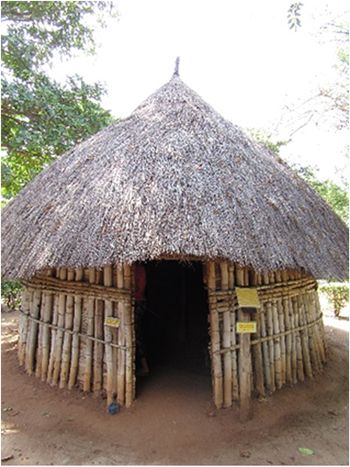
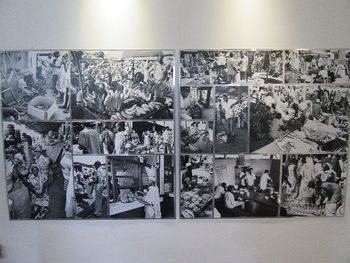
There is no question that, in the exhibit spaces of national museums, ethnic inclusivity is a point of emphasis within the Tanzanian national narrative. While an acknowledged part of social life, ethnicity is treated as a background condition in official narratives; it is a fact that people in Tanzania belong to ethnic communities, but those potentially divisive cleavages are made less sharp in museum rhetoric by treating diversity as a quintessential part of the experience of Tanzanian citizens. There are a number of nation-building policies that contributed to the sidelining of ethnic salience and local authority in deference to the central state; incorporating this sense of “many communities, one nation” into museums is among those policies. Others are the legal marginalization of local “traditional” authorities, a Swahili language policy, and the relocation of citizens to other parts of the country through education and national service initiatives. One museum space that highlights unity through ethnic heterogeneity is the Village Museum in Dar es Salaam; through the display of reconstructed “traditional” homes, it is clear that the museum is meant to portray a diversity of ways of life from a variety of ethnic communities. Replicas of traditional homes, as seen in Figure 2, make up the primary exhibit; they are arranged together in an open, unified space that communicates that all of these groups equally belong in the Tanzanian nation. Similarly, in other museums, we see the commemoration of founding fathers and notable early independence leaders, but no obvious discussion of their ethnic origins. This omission is important in that it is their Tanzanian-ness on display; of course they have kabila, the Kiswahili word for ethnicity, but it is not central to their status as influential historical figures. Further examples of this unity in diversity dynamic are apparent in the National Museum and House of Culture’s ethnography gallery, exemplified in the broad-brush photo-based approach to displaying “national culture,” as shown in Figures 3 and 4. As may be seen in these images, photographs of everyday cultural practices are situated alongside one another and clustered according to activity rather than by ethnic community of origin. There are sections, for example, on market activities, basket weaving, pottery making, and hair braiding. The captions do provide viewers with a sense of the geographic location of the activity, but there is not much significance attached to the ethnic origin of the practices portrayed.
Exterior of a house display in the Village Museum, Dar es Salaam.

Panel of photos in the ethnography gallery at the National Museum and House of Culture in Dar es Salaam. This set is captioned “Different activities at Mwanza Market.”

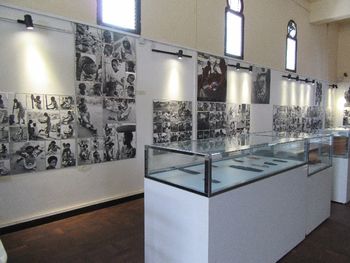
Display area in ethnography gallery with photographs and cases with limited display of material culture.

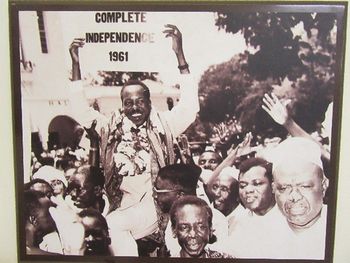
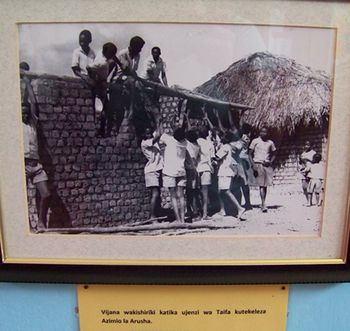
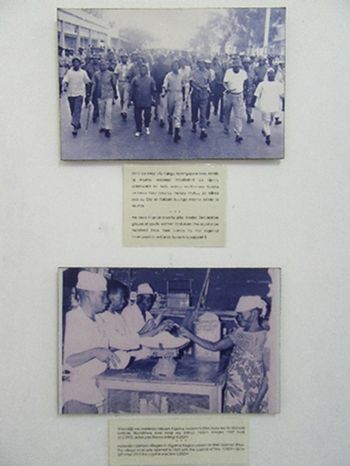
A second component of the narrative put forth by the state is the standard timeline of events presented in each site. While, of course, we might see some variation based on the focus of the specific museum site, there is a consistent set of events that shows up in just about every retelling of the national story. Among these are the achievement of independence, the experience of ujamaa socialism, the union with Zanzibar, and the implementation of multiparty politics in the early 1990s. While there are doubtless other events we could include, these are the core events that turn up most often and have important narrative contributions to make in the service of articulating national values. The perseverance of Tanganyika African National Union (TANU) members and the singular role of first president Mwalimu Julius Nyerere in the legal transition from colonial territory to independence in 1961 is showcased in a way that celebrates their efforts and positions the ruling party immovably at the center of the national story. Figure 5, for example, positions Nyerere as a primary bringer of independence and larger-than-life participant in the Tanzanian national story. The period of ujamaa implementation is remembered in photographs in the Arusha Declaration Museum of citizens marching with Mwalimu Nyerere in support of the Arusha Declaration and young men building a structure as part of ujamaa efforts. They are, both literally and figuratively, building the nation, as seen in Figures 6 and 7. There are no discussions of coerced villagization or the risks associated with dissent during this time period; in short, there is no space for self-criticism in the state’s telling of history. The celebration of socialism in these museums is not so much a commemoration of successful policy as it is an explanation and an example of the values associated with the nation; generosity and self-reliance, community and hard work.
Julius Nyerere campaigning for independence.

Photo of youths “building the nation” on display in the Arusha Declaration Museum, Tanzania.

Photographs from the history exhibit at the National Museum in Dar es Salaam. The top photo shows people marching in support of ujamaa, led by Julius Nyerere; the bottom image shows citizens participating in cooperative efforts in an ujamaa village.

The union between mainland Tanganyika and Zanzibar is remembered primarily because it set the contours of the contemporary Tanzanian state. This episode is often portrayed as a mutually beneficial policy put in place by Nyerere and Abeid Amani Karume, president of Zanzibar, following the revolution on the archipelago in 1964. While not factually incorrect, this portrayal does not do much to consider the tension inherent in the union between the mainland and a region that still considers itself, in many ways, autonomous. This simplification of the story obscures a more complicated reality that challenges the coherence of the nation by incorporating a distinct subnational identity into the contours of the state. Chama Cha Mapinduzi (CCM), the ruling party, and its predecessor, TANU, show up at every point in the national narrative, but visitors are not meant to interrogate the fact that, until relatively recently, they were legally the only ones allowed to be there.
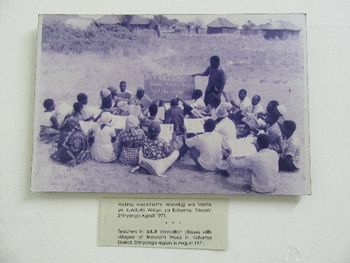
A third component of the state narrative is that these state-curated exhibits are meant to teach visitors about the values that are associated with the nation, about where they, as citizens, come from and where they aspire to go. The recollection of national heroes’ stories is meant to teach audiences about the premium placed on freedom and the importance of sacrifice in achieving it. The memory of ujamaa teaches visitors about community, generosity, and self-reliance, all expressed through a socialist philosophy that is uniquely Tanzanian. Most of the policy accomplishments memorialized in these spaces are a call back to the primary enemies of the nation designated in post-independence rhetoric: poverty, ignorance, and disease. In Figure 8, we see a photograph of a meeting of an adult education class, part of the postcolonial government’s plan to eliminate illiteracy and to implement a Swahili language policy. Here, the state is positioned as a benevolent entity working for the improvement of education, nutrition, and healthcare for all citizens. It also speaks to norms and values of good citizenship; those citizens who conscientiously did their duty to fight the common enemies were contributing appropriately to national well-being and development. Memory in museum spaces of the Kagera War, Tanzanian support of liberation movements beyond their borders, and political leadership in the region all speak to the Tanzanian nation’s commitment to the values of political freedom and pan-African liberation.
A meeting of an adult literacy class that was part of nation-building efforts.

Finally, in exploring museum spaces, it is necessary to also consider the silences, or the things that are left out in the process of remembering and forgetting that happens in museums. One of the primary silences in Tanzanian museums is the silence surrounding race. Although they comprise a small percentage of the overall population, Tanzanians of Arab and Indian descent have been very present in the social and economic life of the country since independence. The ambiguity of their position in the national community is reflected in the ways that their stories are marginal to the story of Tanzania, as told in national museums. At independence, there was much discussion over who should be considered fully sharing in Tanzanian citizenship, and those discourses continue today. In the museums under discussion, there is relatively little reckoning with the varied contributions of Tanzanians of non-African ancestry. Relatedly, a second omission silences recollection of the failures and abuses of the state following independence. There is no room for self-criticism in the museum space, so there is no discussion of the economic fallout that followed the implementation of ujamaa or the repressive measures that Nyerere and his government took to silence critics and coerce citizens into cooperation with the state’s developmentalist strategies (Schneider Reference Schneider2004).
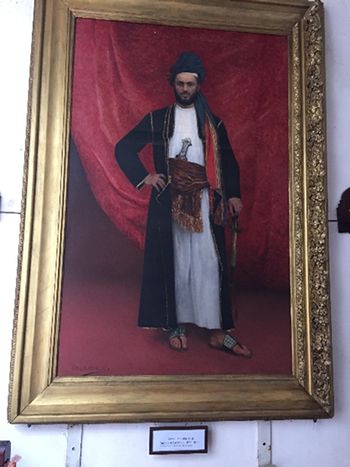
The state-run museums in Zanzibar also maintain significant silences regarding how they address, or fail to address, the archipelago’s relationship with the mainland. Rather than presenting that history in their exhibit spaces, the museums in Stone Town reminisce about the former glory of Zanzibar under the sultanate and present the artistic, cultural, and intellectual accomplishments of their community as separate from those of the mainland. Figure 9, for example, captures a portrait of a former sultan displayed in the Sultan’s Palace Museum in Stone Town. This image is part of a collection that communicates nostalgia for the glory of the Zanzibari past through the display of what was once an opulent home of the ruling class. This silence extends to discussing the 1964 revolution and violent overthrow of the sultanate and the underlying racial complexities of Zanzibar’s contemporary history. In fact, a museum has been built inside of a memorial commemorating fifty years since the 1964 revolution, but this site was not open during my multiple trips to the archipelago. When I discussed it with locals, many expressed skepticism about the contents of the museum because of the contentious history surrounding the revolution and its aftermath.
Portrait of Seyyid Majid b. Said, Sultan of Zanzibar from 1856 to 1870, on display at the Sultan’s Palace Museum. Stone Town, Zanzibar.

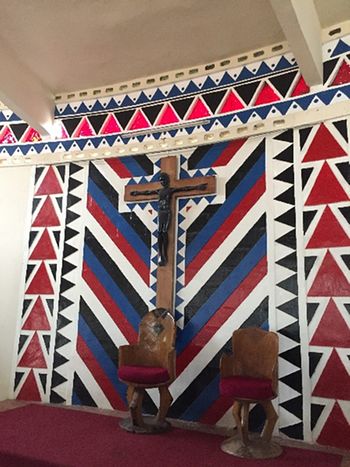
While the cohesiveness of the narrative is clear among state-run museums on the mainland, it is illuminating to look at one contrasting space: the Bujora Sukuma Museum. The Bujora Sukuma Museum is privately administered and displays an ethnic pride that does not denigrate other ethnicities, but it does celebrate itself with relatively little reference to the multiethnic nation. The curator put it best when he said that visitors to the museum would learn little about the country “Tanzania” but would learn about Tanzanian people in the sense that Sukuma are Tanzanians. This does not deviate entirely from state messaging about many ethnicities, one nation, but does highlight the degree to which an independently administered museum can emphasize its local context and ethnic heritage where a national museum is less able to do so. Figure 10 shows the unique fusion between Sukuma and Roman Catholic iconography found at this museum site; this blend was strategically used by missionaries to attract new converts and currently serves as a unique repository for the preservation and celebration of Sukuma artistic traditions.
Mixture of Catholic and Sukuma imagery inside the church sanctuary at the Bujora Sukuma Museum. Bujora, near Mwanza, Tanzania.

The Official Narrative: Kenya
One professor at the University of Nairobi told me that, in Kenya, “nationalism is made up of nations—Luo nation, Kikuyu nation, Kamba nation, etc.” (Interview, Nairobi, April 2018). He went on to say that, much as was argued above in the case of Tanzania,
The idea is unity in diversity; Kenyans are happy together if people stick to their own communities and retain their own culture. The different groups interact in public places, but the nation is made up of small nations that have been brought together.
(Interview, Nairobi, April 2018)Not only is he suggesting that Kenya is an artificial construct populated by distinct nations within a single state, but that ethnic identity is political in that it is a signal to citizens indicating who is looking out for them in the public sphere. This signaling, though, is contextual and, at times, being a Kenyan can be a more valuable identity than claiming membership in the Kikuyu nation, for example. The illustration he used was a pie to represent sharing in the nation’s resources:
The Kenyan nation only comes in terms of employment, jobs, money, political power, the sharing of resources. Sometimes [access] is framed in terms of tribe, but the nation is over everybody, so that is the biggest pie to be shared by everybody. Nationalism is context-specific, then, depending on how one is justifying one’s access.
(Interview, Nairobi, April 2018)To do justice to these identity-making dynamics, one interlocutor, another professor at the University of Nairobi, argues for a multi-tiered museum system. He argues that his ideal system would
have national as well as community museums; [he] would want to show in communal museums the folklore and legendary people from different groups, as well as identify sacred spaces and shrines. The community should have autonomy over how they decide to show these things. This would show the nations of Kenya, before they became Kenya.
(Interview, Nairobi, April 2018)This representation of the importance of ethnicity in public life was borne out by the content of museum exhibits in reference to the first component of the master narrative: social composition.
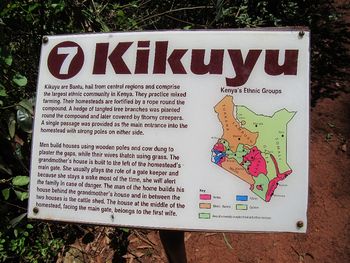
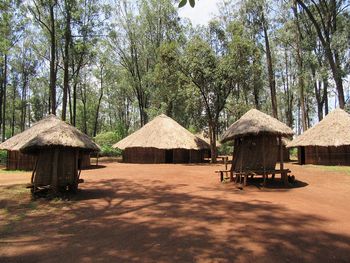
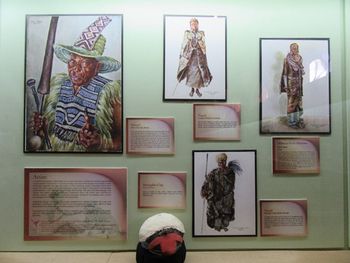
The narrative produced in these spaces focused a great deal on presenting portrayals of different ethnic groups alongside one another. While not unlike what was done in Tanzania, the ethnic communities portrayed in these spaces come across as more segmented and distinct from one another in the national arena. For example, the Bomas of Kenya is a museum space quite like the Village Museum in Dar es Salaam, but the homesteads presented in Kenya are separate from one another and have distinct boundaries, rather than being grouped as individual houses in a larger Tanzanian compound. The homesteads in this museum are presented as individual experiences, with different homestead areas representing distinct ethnic traditions cordoned off with hedges, rather than as parts of an integrated whole. Figures 11 and 12 show the exhibit space representing traditional Kikuyu residential structures and the accompanying placard with background information on the ethnic community and the exhibit’s physical structures. There is further evidence of this in the way that cultural artefacts and portraiture are presented in the national museum in Nairobi. In Figure 13, for example, we see an excerpt from the “Peoples of Kenya” exhibit that shows a selection of portraits showcasing ethnically distinct attire. Arguably, this method of exhibition highlights diversity, which does both the work of showing the complexity of cultural tradition in Kenya and of distinguishing between unique ethnic groups, at the cost of presenting a more cohesive portrait of a “Kenyan” community.
Informational placard at the entrance to the Kikuyu homestead exhibit at the Bomas of Kenya. Nairobi, Kenya.

Kikuyu homestead display, Bomas of Kenya. Nairobi, Kenya.

Display from Joy Adamson’s “Peoples of Kenya” Exhibit, Nairobi National Museum.

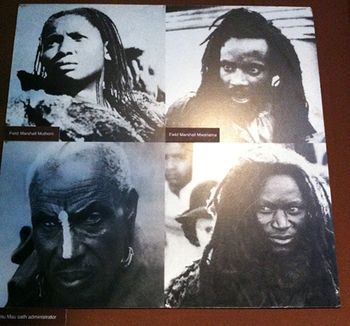
A second component of the narrative put forth in museums is concerned with the ways that the Kenyan story is displayed in terms of political leadership and historical trajectories. The independence experience is crucial as the foundation of independent Kenya’s history, but also because it is a contentious and formative moment for Kenyan identity. The independence experience created “zones of those who fought and those who didn’t” (Interview, Nairobi, April 2018). Mau Mau history is very much tied to Kikuyu history because this conflict revolved around their effort to throw off the oppression of colonialism and reclaim the land that citizens had been alienated from. Figure 14, found in the Nairobi National Museum’s history gallery, shows photographs of Mau Mau leaders and militants, a part of the exhibit that, according to one interlocutor, would never have been allowed on display until relatively recently because of the controversial nature of the conflict and its memory. While there is some dispute over whether Mau Mau was meant to be a conflict to reclaim land for the Kikuyu or a war for Kenyan independence, one interlocutor argued that those who participated are proud of their contribution and see that moment in history as giving them a claim to the independence moment. Others who did not participate do not feel the pride in this part of history because this was not their struggle: “the interpretation of the independence experience revolves around who did and who did not participate” (Interview, Nairobi, April 2018).
Portraits of Mau Mau field commanders and oath administrators from the History of Kenya Exhibit, Nairobi National Museum.

This grappling with the contention surrounding Mau Mau history is a relatively recent phenomenon; it had been the policy of the government to gloss over this difficult episode in favor of political expediency. One scholar whom I interviewed in Nairobi said that the first president of an independent Kenya, Jomo Kenyatta, made a choice at independence to embrace historical amnesia in the interest of moving forward as a country because, if one group were allowed to claim a monopoly on independence credentials, other ethnic communities would be alienated. In other words, a certain degree of forgetting was necessary to “smooth things over” (Interview, Nairobi, April 2018). Although today the exhibit space recognizes Mau Mau, their faces are rightly far from the only ones included in the history display. What is absent, though, is a normative stance presented to viewers about the importance of these people in the life of the nation. While the history presented is a linear guide through the life of Kenya prior to and after independence and includes a variety of important people, it is not clear from experiencing the exhibit who the heroes and founding fathers of the nation are.
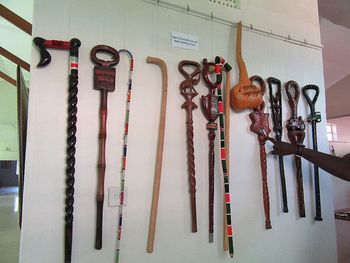
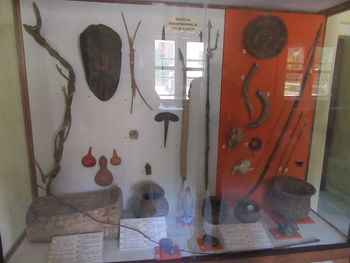
The story of the nation from a non-Kikuyu perspective can be quite different. While there have been shifting political coalitions in Kenya, the Luo people have historically been political competitors of the Kikuyu, and the story told in their museums and communities is a departure from the Kikuyu version. In one interview, a historian told me that the Luo version of independence is a story of betrayal. The narrative presented at the Jaramogi Oginga Odinga museum and mausoleum is one in which the elder Odinga played a role equal to that of Jomo Kenyatta, the first president of Kenya, in ushering in independence from a legal perspective. Figures 15 and 16 show some of the content of this museum space, with Figure 15 being a photograph of the many walking sticks accumulated by Odinga in the course of his lengthy political career, some of which have his political experience incorporated into their decorations.
Odinga’s collection of walking sticks, on display with other personal items in the museum at his homestead. Bondo, outside of Kisumu, Kenya.

Collection of artefacts in the Hall of Luo heroes at the Jaramogi Oginga Odinga Museum in Bondo, Kenya.

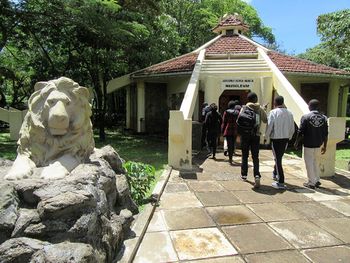
Figure 16 shows a display of material objects that belonged to notable Luo religious and medical practitioners; this exhibit celebrates the cultural contributions of the Luo community, of which Odinga was a member. In recounting Odinga’s political contributions, the museum experience points to the fact that he insisted on the release of Jomo Kenyatta from prison before elections could be held as evidence of his commitment to a fair and inclusive independence process. Figure 17 captures the exterior of Odinga’s mausoleum, which is situated in the center of his former homestead, where some of his family members still reside. The mausoleum is a museum unto itself, because within its walls are photographs and placards that memorialize Odinga’s long political career, testifying to his status as a father of the nation. His subsequent ouster from KANU because of a split from Kenyatta is framed as a betrayal of the Luo community: “They don’t feel part of Kenya, part of Uhuru…[They] have felt bitterness” (Interview, Nairobi, April 2018). This distinctly ethnic and regional pride is evident in multiple museum sites in Kisumu, an epicenter of the Luo community in Kenya. These sites highlight this disjuncture: they commemorate Luo culture and Luo contributions to the social and political life of the Kenyan state and recollect the injustices felt by the Luo people throughout the recent history of the nation. Contestation is not just between ethnic communities, though.
Exterior of Jaramogi Oginga Odinga’s mausoleum. Bondo, Kenya.

According to Karega Munene (Reference Munene2011), community museums curated by Mau Mau veterans and their families are filling a gap between the story told by the state and the stories as they are remembered by participants and their families. These spaces are also actively engaged in healing and reconciliation efforts, something that the state has not fully embraced. There was a good deal of discussion during key interviews about the devolution of regional museums from the national museum system. When I visited museums relatively far afield from Nairobi and asked how their sites were administered, most reported that they still had ties to the central museum system, even though they were theoretically supposed to be exerting their independence. One scholar expressed some concern about this, arguing that allowing local museums autonomy might lead to a sort of Balkanization of identities. Another historian, though, argued that the devolution of authority over museums is essentially democratic and creates space for local control of narratives and the preservation of different identities. This outsourcing of the telling of the national story is instead, according to this scholar, about empowering people to provide their own narratives, rather than undermining a centrally-oriented national identity (Interviews, Nairobi, April 2018).
The history gallery in the Nairobi National Museum is an interesting example of the second component of the national narrative. The purpose of this gallery is to tell the story of Kenyan history, but it does so in a way that has less consistent messaging than the Tanzanian museum system. While the history exhibit covers all of the main events in Kenyan history, it fails to give the viewer a sense of who the founding fathers are or what the displayed events say about the Kenyan community and its values. This museum does do a better job than the Tanzanian museum system at being self-reflective and at creating space in the exhibit for episodes in history that are controversial or indicative of social conflict. For example, there is exhibit space dedicated to discussing the tumultuous period leading up to the advent of multiparty politics; they even display names and photographs of people who were imprisoned or assaulted for their efforts to push for democratic reform. This type of governmental self-criticism, or at least the remembering of the more politically sensitive moments in history, is not on display in Tanzania.
The third component, national values, is not clearly addressed in the selection of Kenyan national museums included in this project. In the Nairobi National Museum, there are some placards that address issues such as culture, religion, and self-help efforts, but all of these only tangentially discuss national values. The “Kenyan Identity” placard, for instance, talks about the meaning of the national flag and lists things such as the currency, loyalty pledge, and “rich cultural, natural, and historical heritage” as the ties that bind Kenyans together (Nairobi National Museum 2018). The placard cites Sessional Paper Number 10 (Government of Kenya 1965) as an effort to create national values but does not go into any detail about what those values are and how they translate into the rest of the exhibit space. In essence, the value component is missing most obviously from the national museum, but neither does it coalesce in other sampled museum sites.
Finally, there are some important silences in the national museum system in Kenya. Perhaps one of the more obvious instances is in the discussion of Mau Mau history and the independence experience. As mentioned above, it has lately been included in the history gallery at the flagship national museum, but scholars who were interviewed for this project argue that there has not been a real reckoning with that history in a serious way. Further, more recent abuses of power on the part of the government as well as more contemporary episodes of electoral violence have been left out of the telling of the story, which was a particular point of contention in discussions I had with a museum guide at the Kisumu Museum. While it is suggested above that there is more room for self-criticism in Kenyan museums than there is in Tanzanian ones, it does not extend to the most recent democratic turmoil and violence. Where Tanzania’s museums are largely silent about the complexities of race in their national community, Kenya’s national museum does not avoid the topic of race and the contributions of Kenyans of Arab and Indian descent. The narrative in Kenya arguably veers quite far in the other direction; it includes different races and a wide variety of ethnic communities, providing some autonomy at the local level to museum curators. This opens the door to a diversity of narratives, and it aligns with a broader African identity, particularly in the eclectic display of African artistic and cultural objects in the Nairobi National Gallery and the museum at the National Archive. Taken together, all of these things produce a relatively unclear Kenyan national narrative, as it is presented in state-run museums.
Conclusion
The purpose of this article has been to argue that museums serve as pedagogical spaces in the Tanzanian and Kenyan nation-building projects, providing sites of connection between state messaging and societal consumption of nationalist imagery. This study has sought to catalogue the actual content of these museum sites and analyze the narratives within their exhibits as pieces of state-led nationalist discourse. At the most fundamental level, government-operated museums are uncontested spaces of state messaging, giving us a clear articulation of the official imagining of the nation. The mission of these places is to educate citizens about their national heritage, and the curators whom I interviewed saw engagement with and education of everyday citizens as a primary goal of their work as individuals and as institutions.
From this discussion, we can see that there are two distinct types of narratives coming out of the museums in Tanzania and in Kenya. The Tanzanian narrative is clear, concise, dominant, and relatively static. The Kenyan narrative is more convoluted, with greater space for contestation and more opportunities to adapt to suit elites as power changes hands. The national network of Tanzanian museums gives a clear vision of who Tanzanians are, what they value, and how they use their history to articulate a vision of the future, according to the state. The contrast cases presented in the museums on the Zanzibar archipelago not only suggest the frayed edges of a national imagining that has trouble stretching to align with the boundaries of state, but also highlight the strengths of the national narrative more broadly. While the museums in Zanzibar do show that not all parts of the state are fully integrated into the nation, they also help us to see what the government is doing well on the mainland. The Bujora Sukuma Museum and the ruins at Kilwa Kisiwani also show the strength of the national narrative by providing alternative, if not directly contentious, perspectives on Tanzanian identity and history. These are important sites because, although they provide information that is not represented in the state-run museums, they are not in direct competition with the official story. This shows the dominance of the state-articulated narrative in the discursive arena surrounding the question of identity. The narratives that emerged in the course of these museum visits includes an identification of important figures and events in history, as well as crucial national values, which aligned clearly with the official version: Tanzanians are community-oriented and generous, and they value democracy; furthermore, they are shaped as a national community by their independence and socialist experiences. The Tanzanian government has articulated a clear vision of the nation that is multiethnic, monolingual, and articulated through government programs related to education, language, and national service. Museums serve as an approximation of this official imagining of the nation, and the interviews conducted confirm the intentionality of government strategies of nationalist proliferation.
The Kenyan story, on the other hand, is presented as something more complicated, contested, and convoluted. One reason for this is that local museums, while still affiliated with the national museum system, have greater autonomy in Kenya. The interlocutors with whom I spoke in Nairobi said that this had to do with official legal efforts to give local museums more opportunities to control exhibit content. When I spoke to museum employees at different, more remote, sites, they said that these sites were still run as outlets of the national museum system. This ambiguity explains some of the disconnects between the exhibits shown at local museums, in Kisumu for instance, and the national narrative presented in the capital. One of the most important facets of this central-local disconnect in museum content is a focus on local history and local people at the expense of presenting a centralized, coherent national story. This is only one complicating factor, though. Even in the national museum in Nairobi, there is a lack of clarity in communicating national history and values, which stands in contrast with the national museum in Dar es Salaam. Although there is an exhibit space for Kenyan history, for example, it is difficult for the viewer to learn a clear narrative that gives an unambiguous account of who are the heroes, who are the villains, and which are the moments in history to hold up as the defining experiences of all Kenyans.
Of course, the study of museums cannot give us a comprehensive account of nation-building efforts in Tanzania and Kenya, but it can serve as a starting point for recording the official rhetoric of Tanzanian-ness, and of Kenyan-ness. While this article has argued that the relative success of the nation-building projects in Kenya and in Tanzania is connected to the types of narratives that are told about their respective nations, it is also important to consider how these narratives have been produced historically and continue to be reproduced today. Based on my comparative historical approach to a broader research agenda, my argument is that the relative violence of the independence experience sets the stage for subsequent policy trajectories; these things, taken together, shape the kinds of stories that are told in each context (Gorham Reference Gorham2019). As these narratives are packaged and produced by the state, they are either rejected or they are adopted and reproduced. Of course, narratives adapt and are altered over time to varying extents, but their acceptance by citizens will influence how much they change over time.
In Tanzania, the independence experience was gradual and peaceful, which allowed the state to articulate and encourage a relatively inclusive vision of the nation; ujamaa policy, for all of its faults, served to reinforce this understanding of the nation and the roles and responsibilities of its citizens. Kenya, on the other hand, experienced a violent civil conflict prior to independence. Because Kenyans were brutalized and killed on both sides of the conflict, it was not a unifying experience, and the legacy that was created would be difficult to emerge from with a unified understanding of who was truly a Kenyan. If anything, this experience likely solidified ethnic difference and fostered contestation of who had ownership of the independence effort. The significance of ethnicity in political and social life has remained important for Kenyans, which means that the national identity had other identities to contend with for importance in citizens’ lives. Further, the more capitalist nature of Kenyan political economic policy meant that citizens did not necessarily have to position themselves as Kenyans to make appeals for representation and resources. These trajectories produced diverging outcomes in terms of narrative and nationalist identities, and then the telling and retelling of those national stories feed back on one another. This means that stories may change over time, or they may become deeply ingrained and create an environment in which alternatives are difficult to imagine. It is the role of museums to shape these stories and to allow them to achieve their purpose in the lives of the citizens as well as of the nation.
Acknowledgments
Thank you to Ben Smith, Sebastian Elischer, Charlie Cobb, Peter Schmidt, Pierre Englebert, Aaron King, Dragana Svraka, Hye Ryeon Jang, Amanda Edgell, Karla Mundim, and Ross Cotton, all of whom provided valuable feedback on early versions of this project. Finally, I appreciate the support and guidance of friends and colleagues in East Africa, including, but not limited to, Miriam Ntuah, Arnold Gawasike, Bertram Mapunda, Philip Maligisu, Karega Munene, Ephraim Wahome, Adams Oloo, Alexander Makulilo, Prosper Lobuva, and Peter Mlimahidala.