Process management principles, as one of the approaches to industrial management, may be used for improving the quality and efficiency of health care (9;10;12), although the applications may be limited (1). Several elements from process management approaches, nevertheless, can be applied in health care, particularly to hospital work. Tracking the progress of patients during the preoperative process with aid of barcode and local area network technology is used to identify bottlenecks and areas of high variation in the care of surgery patients (7), and more efficient presurgery care has been achieved by means of lean thinking (6), which means structuring things so that the enterprise does nothing but add value, and does that as rapidly as possible. Many studies have resulted in eliminating waste and minimizing delays in operating rooms (OR) and units. The methods have included scheduling patients based on historical durations and grouping of patients according to need of resources (3;5) as well as efforts to minimize the time patients spend in the OR through the establishment of an induction room (8;11).
Applications of the process approach to health care have focused on nonacute patients or on applications of some particular management technique (3;5–8;11). Urgent surgical care poses a different managerial process challenge: Demand is unpredictable and comes often urgently, variation of cases is high, work load fluctuates sharply, and the planning process itself is more challenging. In this study, we have applied process development techniques to urgent surgery care.
METHODS
Data for process description and analysis were collected from the hospital's databases, from three detailed follow-up measurement periods, and from personnel interviews. Demand was analyzed to examine the predictability of urgent admissions. The patient process in the hospital was modeled by identifying different patient flow options and by time analysis of the various phases of care and the delays between them.
General process analysis tools and process reengineering were used to develop the process. Process was described (Figures 1 and 2) and measured (Table 1) to identify the bottlenecks. The care process was developed on the basis of the Deming cycle (2) or the Plan-Do-Check-Act (PDCA) cycle. The PLAN phase consisted of interviews and of analysis of data obtained from the hospital databases, and appropriate metrics were defined. In the DO phase, the proposed changes were tested and the test results were analyzed. The proposal for improving the care process was made in the CHECK phase, as dictated by the experience from the test period. In the ACT phase, the process was reassessed with the proposed metrics and continuous improvement followed. The duration of the follow-up measurement period was 3 months, and it was carried out one year after the baseline measurement period.

The main phases of the urgent surgery care process. The numbers refer to measures (Table 1).

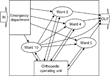
The original patient flow of urgent orthopedic patients(fourth quarter of 2002).

The results of the changes were verified by comparing the metrics (Table 1) between the last quarter of 2002 (baseline) and of 2003 (after process development). In addition to the metrics, the delay before first start of surgery, the overtime hours, and the distribution of the operations during different shifts were assessed.
For statistics, the means and standard deviations of the metrics was used. The normality of distributions was estimated using Anderson–Darling tests. The t-test for independent samples, or the Mann–Whitney U-test was used for calculation of the statistical significance of distribution difference, depending on the normality of the data.
TÖÖLÖ HOSPITAL
The Töölö Hospital is the main trauma unit (level I equivalent) of the Helsinki University Central Hospital (HUCH). The catchment population for trauma patients is 1.4 million. The average number of urgent orthopedic operations has been 5,000 per annum in recent years. This study includes orthopedic patients who need urgent surgical care, defined as a need for an operation within 0–7 days of admission to the hospital.
The orthopedic operating unit consists of four ORs and a recovery room. The urgent operations are performed mainly in OR3 and OR4, whereas OR1 and OR2 are allocated for elective surgery.
Process Analysis (Plan)
Applied process metrics (Table 1) were defined first. The idea of the metrics was that they measure the performance of the entire patient care process and that they are generally applicable to any unit that cares for patients needing urgent surgical care. Waiting time before surgery and lead time in hospital are the most important metrics for surgical trauma patients. Nonoperative time and raw utilization indicate if any change in primary metrics originates from change in operative effectiveness. Measuring efficiency in this way (Table 1) ensures that decreased lead times are not based on increased resources.
The main phases of the process are illustrated in Figure 1. The metrics indicated that the surgery process was a bottleneck (data not shown). Although the mean waiting time before surgery was quite long (41.5 hours), the average nonoperative time in the operating room was still no less than 91 minutes.
A remarkable part of the nonoperative time consisted of wasted time (e.g., patient arrived late, surgeon arrived late [4]). Some patients arrived at the operating unit even more than 30 minutes late, partly because the theater personnel were unaware of where the patient was coming from. Extra phone calls were often required to establish the location of the patient. In addition, the exact trigger for inviting the next patient to the OR from the ward was unclear: in 25 percent of cases the next patient was called too late and in more than 30 percent of cases the surgeon was called too late to the OR.
The original patient flow is shown in Figure 2. The emergency department had no clear operative procedure for moving the patients forward. This finding resulted also in unnecessary phone calls and unnecessary transporting of patients between the wards. Because patients could be located in any of the wards, the preoperative examination of the patients was unnecessarily time consuming for the anesthesiologists and surgeons.
Developing the Process (Do)
The following changes were implemented during first three quarters of year 2003 to (i) anesthesia induction, (ii) guidance, and (iii) patient flow.
- In the new process of OR3, the induction of anesthesia was performed outside the OR, while the previous operation was still ongoing. The goal of moving one phase of the process away from the critical path was to decrease the throughput time of the OR. The benefits of the reduced nonoperative time in the OR exceeded the investments needed for an additional anesthesia team. In practice, the anesthesia team was established by reallocating, not increasing, the resources of the operating unit.
- The guidance of the process was reorganized. The nurse coordinator was given the task to call in the patient and the surgeon. Information about the progress of the operation is used for timing the invitation of the next patient. Special attention was paid to the start of the first operation of the day. The operations were allocated so that shorter operations were performed in OR3 and longer operations in OR4. The less-demanding (standard) operations were scheduled to start first.
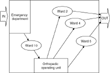
- Patient flow was transformed so that the ward located closest to the operating unit was named as the primary preoperative ward for orthopedic trauma patients (Ward 10 in Figure 3). All postoperative care was given in the remaining wards.

Patient flow of urgent orthopedic patients after changes in patient process (fourth quarter of 2003). Ward 10 was named the primary preoperative ward for orthopedic trauma patients.
RESULTS (CHECK)
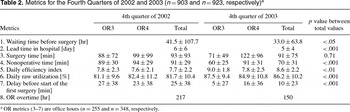
A total of 903 and 923 urgent operations were performed in the last quarters of 2002 and 2003, respectively. The main results before and after process enhancement are shown in Table 2.

The average waiting time decreased by 20.5 percent (p<.05), mainly because of improved throughput of the operating unit. The average lead time decreased by 16.4 percent (p<.001).
The allocation of operations changed significantly: the average surgery time decreased by 17 minutes in OR3 (p<.01) and increased by 23 minutes in OR4 (p<.01). The nonoperative time decreased by 23.1 percent (p<.001), largely because the process was changed in OR3. In OR3, the nonoperative time decreased by 32.6 percent (p<.001). The efficiency increased by 9.7 percent (p<.01), because the out-put increased, while the resources remained unchanged.
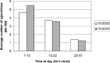
The raw utilization increased by 7.9 percent in OR3 and 3.0 percent in OR4. The improved efficiency reduced the need for overtime use of ORs by 22 hours per month, despite slightly more operations. In the fourth quarter of 2003, 18 percent (p<.01) more surgeries was conducted during office hours than in the fourth quarter of 2002 (Figure 4) because of the increased efficiency.

Average number of starts of surgeries in weekdays in the fourth quarters of 2002 and 2003 (IV/2002 and IV/2003, respectively). n = 595 in 2002 and n = 637 in 2003.
DISCUSSION (ACT)
This study shows that the efficiency of an urgent surgery unit can be improved by application of process management techniques. Although a stochastic nature of demand does complicate process management in this setting, variation of demand is not totally unpredictable. Managing variation is a challenging task for a trauma unit, but it can be done with process analysis tools, as shown here.
The surgical process in the OR was easily identified as an bottleneck. This is a common finding in hospitals. In previous studies, it has been shown that the cycle time of an OR can be reduced if separate rooms for induction of anesthesia and surgery are available (8;11). This finding was also the case in our study. However, the cycle time alone is not a valid indicator of efficiency, because reduced cycle times can be achieved easily by increasing resources. In the present study, we estimated the efficiency of the OR as output related to input.
The improved performance in the latter study period was achieved without adding resources to the operating unit as whole. Reallocation of the operating unit resources allowed us to move the induction of anesthesia outside the OR.
Although the present study focuses on process measurements, the lead times of trauma patients also have medical consequences in terms of morbidity and mortality. Some preoperative time is, of course, needed for preoperative evaluation (medical imaging, laboratory and medical examinations), but unnecessary waiting is harmful. A surgical delay of 3 days approximately doubled the mortality of hip fracture patients during the first postoperative year (13). In this case study, the focus was on process outcomes, but the medical outcomes also need to be taken into account in further studies.
There were some organizational and cultural factors restraining the development process, for example, better reallocation of the resources would have improved the total results. Reallocation of personnel resources is indeed a major challenge for management in improving the efficiency in hospitals. The development potential is much greater than what already has been achieved.
The traditional management system in hospitals is based on a ward-focused (functional) approach. In hospitals, often only single metric (utilization or changeover time of OR) is considered. This strategy leads to suboptimized performance in the different units, and the total process flow is not optimal.
A process-oriented approach is an efficient tool for better performance of surgical care. However, the application of these methods may be limited in, for example, conservative treatment or psychiatric care, where the value-adding and non–value-adding phases of the care process are more difficult to separate or to measure.
CONCLUSIONS
The industrial management approach can improve the efficiency of urgent surgical care by reducing the waiting times and lead times. To avoid the risk of suboptimization, the performance of the surgical process should be measured from the medical as well as from the patient process perspective with considerations of resource use and utilization.
POLICY IMPLICATIONS
In this study, we applied process metrics and management tools to urgent surgery care. The use of process metrics helps in managing the patient process. The performance of hospitals should be monitored continuously from different perspectives to enable the transparency between hospitals and the decision makers.
CONTACT INFORMATION
Paulus Mikael Torkki, MSc (Tech), (paulus.torkki@tkk.fi), Researcher, Antti Ilmari Alho, MSc (Tech), (antti.alho@tkk.fi), Project Manager, Antti Veikko Peltokorpi, MSc (Tech), (antti.peltokorpi@tkk.fi), Researcher, Department of Industrial Engineering and Management, Helsinki University of Technology, Otaniementie 17, 02150 Esposo, Finland
Markus Ilmari Torkki, MD, PhD, (markus.torkki@ dextra.fi), Orthopedic Consultant, Department of Orthopedics and Traumatology, Helsinki University Central Hospital, Topeliuksenkatu 5 00260 Helsinki, Finland
Pentti Ensio Kallio, MD, PhD, (pentti.kallio@hus.fi), Chief of Orthopedic Department, Pediatric Orthopedics, Helsinki University Central Hospital, Stenbäckinkatu 11, 00290 Helsinki, Finland
We are indebted to the physicians and nurses at Töölö Hospital for their contributions to this study. This study was supported by National Technology Agency of Finland and Instrumentarium Ltd. We attest that each named author contributed to both the conception/design and analysis/interpretation of the project and the writing of the paper; each has approved the version being submitted; and the content has not been published nor is being considered for publication elsewhere. Ethics approval was not required for this study.