

1. INTRODUCTION
When households face income shocks, they resort to various mechanisms to smoothen consumption. Households that are not insured against such shocks often rely on savings, sale of assets, labor substitution, or borrowing (Morduch, Reference Morduch1995; Flores et al., Reference Flores, Krishnakumar, O’Donnell and van Doorslaer2008). Labor substitution often involves children engaging in the labor market to varying degrees [Sauerborn et al. (Reference Sauerborn, Adams and Hien1996)]. Morbidity shocks, depending on severity and duration, may affect the income of the household in two main ways: (1) through a reduction in productivity and hence income generated for the same number of hours worked, and (2) through medical costs leading to a possible reduction in disposable income [Gertler and Gruber (Reference Gertler and Gruber2002)]. This paper proposes to study the impact of parental health shocks on child work and the role of health insurance in this relationship. With health insurance, individuals may be more likely to seek care when needed and will be less likely to pay large out-of-pocket sums to settle the bills incurred as a result of their seeking care [Flores et al. (Reference Flores, Krishnakumar, O’Donnell and van Doorslaer2008); Saksena et al. (Reference Saksena, Antunes, Xu, Musango and Carrin2011)].
Child work in and of itself might not necessarily be a bad thing as it can help with the development of children, providing them with the skills and experiences needed to succeed in the future [ILO-IPEC (2013)]. However, types of work that are dangerous or that keep children away from school are detrimental to their health and welfare [ILO-IPEC (2014)]. The International Labour Organization estimates that roughly 58.6% of children between the ages of 5 to 17 are engaged in agricultural work, with 25.4% being engaged in non-domestic services work (ILO-IPEC, 2013). The number of children defined as being in child labor has decreased from 245.5 million in 2002 to 167.25 million by 2012. Of this, roughly 85 million are classified as doing hazardous work, that is, work that threatens their health and development. Sub-saharan Africa remains the region with the highest incidence of child labor with one in every five children engaged in the activity [ILO-IPEC (2013)].
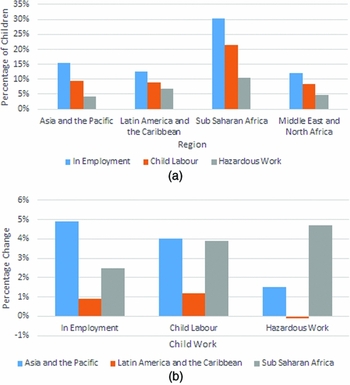
Figure 1 shows the trends in child work across regions and time. The region of Sub-Saharan Africa had the highest percentage of its children estimated to be engaged in child work in 2012, with as many as 11% engaged in hazardous child work compared to about 5% in the other regions. In terms of trends between the year 2008 and 2012, it is interesting to note that the largest fall in hazardous child work occurred in Sub-saharan Africa with a fall of about 5%.
Child work trends. (a) Child work across regions in 2012. (b) Trends in child work (2008–2012).

Studies on the relationship between child labor and health has generally focused on the negative effect of child labor on the health of the child, with a shift in focus on the health impact of the worst forms of child labor. However, while a direct link can be made on the effect of child labor on child health, other health variables have the potential to influence child labor. It is well known that parental variables influence the child’s time, it therefore stands to reason that the health of the parent would affect child labor in one way or another.
In this respect, the focus has generally been on parental mortality and its effect on child labor. Several studies have investigated both the impact of parental death (due to ill health or otherwise) and of income shocks on child labor and household consumption. For example, in their study of the impact of parental death caused by the Indian Ocean tsunami, Cas et al. (Reference Cas, Frankenberg, Suriastini and Thomas2014) find that, depending on the age of the child, he/she takes on some of the responsibilities of the deceased parent. They find that over a longer term, a male child who lost at least one parent is more likely to be engaged in an economic activity than one whose parents survived. A similar effect is found for older female children though they are more likely to be engaged in household work if at least one parent died. Younger children are on the other hand protected from the negative impacts of the death of a parent. It is important to not only deal with the effects of parental death but also the effects of health shocks. Such health shocks do not necessarily imply the death of an adult and, for this reason, might have different consequences.
One of the first studies on this subject was by Bazen and Salmon (Reference Bazen and Salmon2010) in Bangladesh, which shows that a father being chronically ill has no effect on the child’s participation in income-generating activities, while a sudden health shock to the father has a positive effect. A study by Dillon (Reference Dillon2013) in northern Mali, finds that health shocks to adult men increases children’s participation in child care and the hours they spend on household enterprises, both of which are activities that keep the adults close to home. A more recent work by Alam (Reference Alam2015) in rural Tanzania provides evidence of an effect of mother’s illness on child work through an increase in household work. These studies generally do not assess the impact of health insurance affiliation on the relationship between parental health shocks and child labor. Two recent works have attempted to fill this gap. Landmann and Frölich (Reference Landmann and Frölich2015) analyze the expansion of a health and accident insurance scheme in Pakistan and find a negative effect of health insurance affiliation on child labor outcomes. Liu (Reference Liu2016) investigates the impact of a health insurance reform in rural China and shows that a severe health shock to either the head of the household or the spouse increases child work (defined as child employment).
In this paper, we conduct an empirical analysis – using data from Rwanda – to investigate the role played by health insurance in determining child work decisions following parental health shocks. We implement a propensity score matching technique combined with hurdle models. We distinguish between (1) a health shock to the mother and to the father, (2) sudden health problems and chronic illnesses, (3) three different forms of child work (market work, family business, and domestic work), (4) the affiliation or non-affiliation to health insurance. Our work differs from the studies described above in that it investigates how the effects of the health shock will vary based on the gender of the parent facing the shock and also on the type of work activity under consideration. Though our data is cross-sectional, its main advantage is on the ability to jointly estimate the child work participation decisions and, for children who work, the decisions on the time devoted to each work activity. Previous results point to a potential substitution effect not only between education and child work but also between the different types of child work. We seek to analyze how health insurance affiliation affects these latter types of substitution effects. Our empirical results show that health insurance does protect children against child work in the presence of parental health shocks. In addition, there is a substitution effect not only between the parent and the child on the labor market, but also between the time the child spends on the different work activities. We also show that this effect depends on the gender of the sick parent.
2. ECONOMETRIC ANALYSIS: THE CASE OF RWANDA
In Rwanda, while health insurance for the formal sector and private health insurance existed in the early 2000s, workers in the informal sector were often excluded from these protection schemes [Chuhan-Pole and Angwafo (Reference Chuhan-Pole and Angwafo2011)]. In response to this, the mutual health insurance (MHI) scheme was expanded. The goal of the expansion was to create access to quality health services, especially for those who were underserved, including the poor and vulnerable.
2.1. Data
We use data from the Third Integrated Household Living Conditions Survey (EICV3), a cross-sectional survey representative of the Rwandan population conducted in 2010/2011 [NSIR (2011)]. The study is conducted on 3,001 adolescents aged 13–18 years, i.e. of secondary school age. As we are interested in studying the effect of parental health shocks, we only keep data on children of monogamous household heads, for which both parents are in the household and are not disabled. The analysis does not include the children for which both parents reported a health problem during the past two weeks of the survey in order to fully disentangle the effect of a health shock to the mother from that of a health shock to the father. The outcomes of interest are whether a child engages in any of the three activities (namely, market work, family business, and domestic work) and for how many hours per week. As child work takes different forms, three dependent variables are used in the different model specifications: (1) the number of hours worked on market work, (2) the number of hours worked in the family business, and (3) the number of hours spent on domestic work. In all the analyses, children are divided into two groups based on whether both parents are affiliated to the MHI scheme. The explanatory variables include the determinants of child work as found in the literature [see for instance Basu (Reference Basu1999) or ILO (2004)]. These include characteristics of the children (age, proportion of siblings, gender, children’s own health problems), of the parents (age, formal education, health problems), and of the household (size, rurality, living conditions, health problems of other members).
2.2. Econometric Methodology
Matching
The aim of this study is to investigate the role played by health insurance in the relationship between parental health shocks and child work. Hence, we need to run our analyses on two different samples of children based on whether both parents are MHI affiliated or not insured. Prior to the exploratory analysis, we propose to implement a propensity score matching method to adjust for pre-treatment observable differences between the group of treated (insured) and the group of untreated (uninsured). In a first step, we estimate the propensity score of the treatment (whether both parents have health insurance) on the set of explanatory variables described in the data section, without the variables related to parental health shocks. This is done using a probit model. The analysis of the balancing property is restricted to all treated plus those controls in the region of common support. Second, we implement a kernel matching procedure using the propensity scores (the conditional treatment probability) estimated in the first step. Three outcome variables are specified: (1) the number of hours spent on market work, (2) the number of hours spent on the family business, and (3) the number of hours spent on domestic work. Hence, the matching technique reduces to the minimum common number of observations with non-missing values on all outcomes.
Regression model
Once the children are matched based on whether both parents are MHI affiliated, we implement a hurdle model in which the count dependent variables – the number of hours worked in the three activities – are assumed to be bounded. We then compare the results for insured and uninsured households. Note that all specifications include the same set of explanatory variables, and use the weights given to the matched observation from the propensity score matching scheme described above. The Cragg linear hurdle regression [Cragg (Reference Cragg1971)] implemented here examines separately the determinants of the decision on whether to engage in child work and that on the time spent working. More precisely, for each dependent variable, two equations are estimated jointly: A probit equation determining the likelihood to engage in child work, and a linear regression determining the number of hours worked. Note that hurdle models assume that the residuals of the hurdle equation and the outcome equation are uncorrelated.
2.3. Results
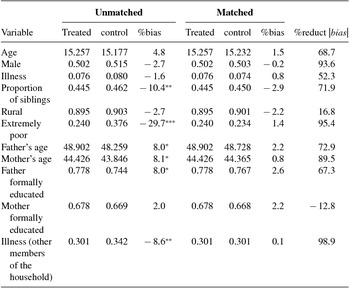
The results of the matching are shown in Table 1 and in Table A1 of the appendix. The latter table presents the balancing diagnostics of the matching model. It shows that most of the biases that exist before matching are controlled for and therefore no longer significant after matching. Weighting the regressions with the propensity scores will address possible imbalances in the estimates due to selection bias. Results from the average treatment effects show a significant effect of parental MHI affiliation on the hours the child spends on market work (Table 1). There is no average significant difference when it comes to family business and domestic work however. Thus, the hours a child spends on market work are on average higher for children with uninsured parents compared to those with MHI affiliated parents.
Results: Average treatment effect on treated

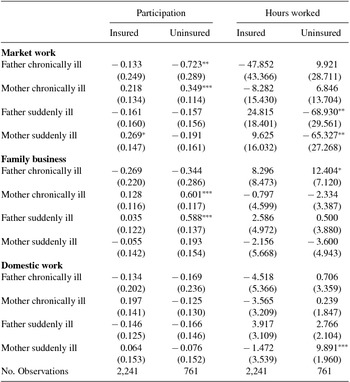
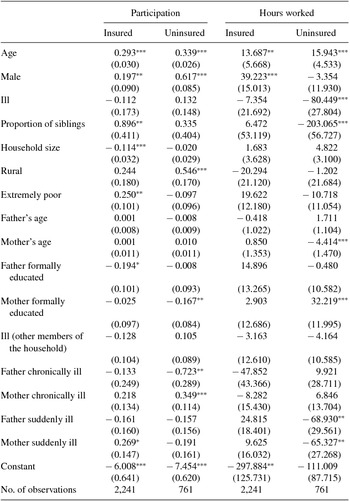
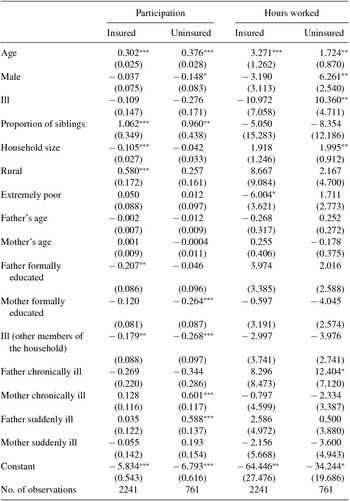
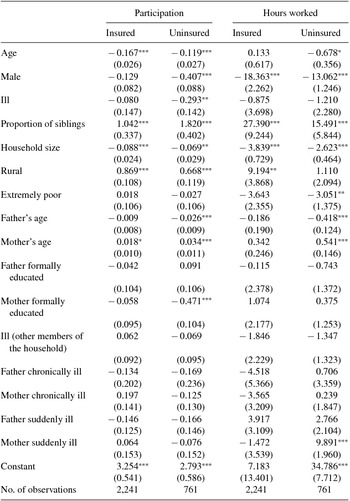
A summary of the results for the hurdle regressions is displayed in Table 2. The full tables of results can be found in the appendix (Table A2 to A4). In summary, we analyze the effects of parental health shocks on child work, disentangling between (1) a health shock to the mother and to the father, (2) sudden health problems and chronic illnesses, (3) three different forms of child work (market work, family business, and domestic work), (4) households being affiliated to the MHI and those not having any insurance.
Summary of results of the Hurdle model

Notes: *p < 0.10, **p < 0.05, ***p < 0.01. Standard errors in parentheses.
Estimator: Cragg hurdle regression.
The main goal of health insurance is to guarantee a better coverage and access to healthcare services. This paper shows that health insurance has an additional desirable but indirect effect of preventing child work that often results from the occurrence of parental health shocks. Here, the difference between insured and uninsured households is striking. There is no significant effect of parental health shocks on child work for insured households. The only significant effect for the insured is an increase in the participation in market work when the mother is suddenly ill.
We now present the results for chronic illness. An uninsured father being chronically ill appears to reduce the probability that the child will be engaged in market work while having no significant effect on their participation in the other activities. In terms of hours worked, we find that it increases the number of hours spent on the family business for those who are engaged in this activity. Hence, a father being chronically ill leads to a substitution effect by reducing the child’s participation in market work, while increasing the number of hours the child spends on the family business. Turning to the mother, results suggest that having a chronically ill mother increases the child’s participation in market work and family business, without impacting the number of hours worked for those already engaged in these activities. Again, no effects are found if the mother is MHI affiliated.
When we focus on sudden health shocks, results show that a sudden health shock to the father does not impact the child’s participation in market work, but highly reduces the number of hours worked for the children who are already engaged in such activities. Another important feature is that a sudden health shock to the father increases the child’s participation in family business. We find no significant effect on either participation or hours spent on domestic work irrespective of the father’s insurance status. The father facing a sudden health shock appears to lead to a substitution between market work and family business for the uninsured while not having an effect on the insured. When we focus on the sudden maternal health shocks we find no effect on the participation of the child in any of the work activities. It however leads to a decrease in the number of hours the child spends on market work while increasing the number of hours the child spends on domestic work.
To summarize, we generally find insignificant effects of parental health shocks on child work, when the parents are insured. For the case where they are uninsured, we find evidence of different substitution effects depending on the gender of the sick parent and on the duration of illness:
-
(i) A father being chronically ill lowers the child’s participation in market work, while increasing the number of hours the child spends in the family business.
-
(ii) A mother being chronically ill increases the child’s participation in market work and in the family business.
-
(iii) A sudden health shock to the father lowers the number of hours the child devotes to market work, while increasing the family business participation.
-
(iv) A sudden health shock to the mother lowers the number of hours the child devotes to market work, while increasing the number of hours devoted to domestic work.
3. PATHWAYS OF IMPACT
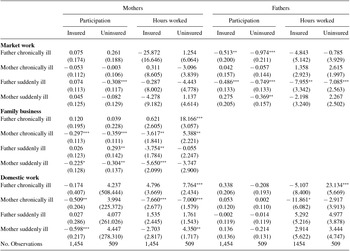
We now discuss our results for uninsured parents in light of related empirical studies. To this effect, we run several hurdle regressions to study the effect of a parent’s health shock on their labor market decisions and those of their spouse. Table 3 displays the results for the main variables of interest.Footnote 1 Note that there are no results concerning the father’s participation in family business because they appeared less likely to be engaged in these activities.
Pathways of impact

Notes: *p < 0.10, **p < 0.05, ***p < 0.01. Standard errors in parentheses. Estimator: Cragg hurdle regression.
Regarding the father, we found that his being chronically ill lowers the child’s participation in market work, while increasing the number of hours the children engaged in family business spend in this activity. This seems to suggest that there is a substitution effect between market work and family business. Now, if we look at Table 3, we notice that when the father is chronically ill, his market participation decreases, while the hours of those engaged in domestic work seem to increase. On the other hand, the mothers’ hours spent on both family business and domestic work increase. Hence, both the child and the mother appear to focus their work on family related activities. One explanation could be that, as the father is chronically ill, there is a need to have someone at home to take care of him, so children drop out of activities that take them away from home. To compensate for the double income loss, the mother devotes more of her time to business activities that generate income while keeping her close to home. These activities may allow her to be flexible in terms of her time use.
Shifting attention to sudden illness, we have found that a health shock to the father lowers the number of hours children devote to market work, while increasing their family business participation. Table 3 shows that in such a case the father reduces his participation in market work, and for those who keep working, the number of hours also reduces. Likewise, the mother reduces her participation in market work, while increasing her participation in family business. Here, the substitution effect we previously observed in the case of a chronic health problem of the father seems to also be at work. However, the mechanism is different. While in the first case, the chronic illness prevents the child from engaging in market work, the short-term nature of the sudden illness implies that the child does not have to completely drop out of the market. A reduction in their time spent on market work appears to be sufficient. Their presence in the household is however still needed, and so is the income that they generate. Therefore, it is not surprising that we observe an increase in their participation in family business. It is also not surprising that we observe a similar trend for the mother, who completely drops out of the market to take up family business which is often close to home and flexible time-wise.
Recall that, using data from Bangladesh, Bazen and Salmon (Reference Bazen and Salmon2010) find that a father being chronically ill has no effect on the child’s participation in income generating activities, while a sudden health shock to the father has an increasing effect. Although they combine all income generating activities, we differentiate between market work and family business. This differentiation brings to fore a trade-off between these two income generating activities. Note that the work of Bazen and Salmon (Reference Bazen and Salmon2010) focused on children between the ages of 5 to 14. Our results are in line with with those of Dillon (Reference Dillon2013), who finds that in northern Mali, health shocks to adult men increases children’s participation in child care and the hours they spend on household enterprises, both of which are activities that keep them close to home. Altogether, these results are not found when the parents have a MHI. In fact, we find that health shocks to the father has no significant effect on the child’s participation in any of the work activities under consideration. No effects are also found for the number hours of the children who are already engaged in such activities.
Turning our attention to the mother, we showed that when she is chronically ill, the child’s participation in both market work and family business increase. From Table 3, there appears to be no effect on the father’s work activities. However, there is a decrease in the mother’s participation in family business. For those who remain in these activities, the number of hours worked increases. In addition, there is a decrease in the number of hours the mother spends on domestic work. Here, there seems to be no substitution effect.
Finally, we have shown that in the case where the mother faces a sudden health shock, it lowers the number of hours children devote to market work, while increasing the number of hours they devote to domestic work. The mother reduces her participation in family business while increasing her number of hours spent on domestic work, as shown in Table 3. The father’s participation in market work appear to decrease, but unfortunately we are not able to study what happens in the case of his participation in family business, as fathers appear less likely to be engaged in such activities.
Our latter results are in line with those of Alam (Reference Alam2015), who, in a study on rural Tanzania, finds that a mother’s illness has no significant effect on the number of hours children spend on market work, but leads to an increase in their hours spent on domestic work. This latter effect is also found by Dillon (Reference Dillon2013) for child care activities. Alam’s (Reference Alam2015)) lack of effect for market work is most likely related to the fact that he does not take the duration of illness into consideration and he combines market and family business activities. In the later case, should the health shocks lead to opposing effects, they may cancel out, leading to an insignificant effect, as observed in Alam (Reference Alam2015).
Finally, recall that, in a study on rural China, Liu (Reference Liu2016) finds that a severe health shock to either the head of the household or the spouse increases child work (defined as child employment). Because we carry out a more refined analysis, Liu’s (Reference Liu2016)) results are not in line with ours. Indeed, we consider three types of child work activities. In addition, while he focuses on the share of employed children within the household, we focus on the probability of a given child working in the three different activities and the number of hours worked in each.
4. CONCLUSION
This paper investigates the effect of health insurance on the relationship between parental morbidity and child work decisions. Using data from Rwanda, we implement a propensity score matching technique combined with hurdle models, allowing to estimate both the child work participation and, for children who work, the time devoted to work. We distinguish between: (1) a health shock to the mother and to the father, (2) sudden health problems and chronic illnesses, (3) three different forms of child work (market work, family business, and domestic work), and (4) the affiliation or non-affiliation to health insurance. Empirical results reveal that the difference between insured and uninsured households is striking. There is (almost) no significant effect of parental health shocks on child work for insured households. On the other hand, parental health shocks have a substantial influence on child work when households do not have health insurance. Parental health shocks result in substitution effects not only between the parent and the child on the labor market, but also between the time the child spends on the three different types of work. In addition, these substitution effects depend heavily on the gender of the sick parent.
Altogether, our paper provides novel insights about the mitigating effect of health insurance on the relationship between parental health shocks and child work. Measuring direct and indirect effects of extending health insurance coverage is a key issue, especially in the current debate on reforms seeking to achieve Universal Health Coverage (UHC). The main goal of health insurance is to guarantee better coverage and access to healthcare services. This paper shows that health insurance has an additional desirable but indirect effect of preventing child work that often results from the occurrence of parental health shocks.
APPENDIX
Descriptive statistics

Results of the Hurdle model: Market work

Results of the Hurdle model: Family business

Results of the Hurdle model: Domestic work