Introduction
In general, legumes are considered to produce seeds with physical dormancy (PY) (Riggıo-Bevilacqua et al., Reference Riggıo-Bevilacqua, Roti-Mihelozzı and Modenesi1989; Auld, Reference Auld1996; Lopez et al., Reference Lopez, Devesa, Ruiz and Ortega-Olivencia1999) and orthodox storage behaviour (Bewley, Reference Bewley1979; Weber et al., Reference Weber, Borisjuk and Wobus2005). The literature suggests that many tropical legumes produce seeds with PY (Baskin and Baskin, Reference Baskin and Baskin1998). However, some tropical species produce seeds with physiological dormancy (Sautu et al., Reference Sautu, Baskin, Baskin, Deago and Condit2007), physiological epicotyl dormancy (Jayasuriya et al., Reference Jayasuriya, Wijetunga, Baskin and Baskin2010, Reference Jayasuriya, Baskin, Baskin and Fernando2012a,b) or non-dormancy (Ramdeo, Reference Ramdeo1970; Teketay, Reference Teketay1998; Kumar et al., Reference Kumar, Radhamani, Singh and Varaprasad2007; Sautu et al., Reference Sautu, Baskin, Baskin, Deago and Condit2007; Jayasuriya et al., Reference Jayasuriya, Baskin, Baskin and Fernando2012a). Further, while most legumes produce orthodox seeds, some species have non-orthodox seed storage behaviour (Pritchard et al., Reference Pritchard, Haye, Wright and Steadman1995; Dickie and Pritchard, Reference Dickie, Pritchard, Black and Pritchard2002; Sautu et al., Reference Sautu, Baskin, Baskin and Condit2006; Nazario et al., Reference Nazario, Ferreira and Reboucas2008; Saba et al., Reference Saba, Anilkumar, Sham, Salim, Jesudass, Mohanan and Krishnan2008; Pereira et al., Reference Pereira, Santan and Ranal2009; Jayasuriya et al., Reference Jayasuriya, Wijetunga, Baskin and Baskin2010, Reference Jayasuriya, Wijetunga, Baskin and Baskin2012b). Thus, although we know the kinds of dormancy and seed storage behaviour in tropical legumes, no attempt has been made to determine how these two seed traits are associated with each other. The purpose of our study was to investigate the kinds of dormancy and storage behaviour in 100 species of native and introduced tropical Fabaceae in Sri Lanka and to categorize the species into groups based on combinations of these two traits.
Seed storage behaviour has been categorized into two main groups: recalcitrant and orthodox (Roberts, Reference Roberts1973; Hong and Ellis, Reference Hong, Ellis, Engels and Toll1996; Walters, Reference Walters2000). Orthodox seeds are desiccation tolerant and can survive at moisture content (MC) < 0.1 g g− 1, i.e 10% MC (dry mass basis) (Pammenter and Berjak, Reference Pammenter and Berjak1999; Berjak, Reference Berjak2006). Further, orthodox seeds are not chilling sensitive and thus can be stored for long periods at low MC (Hong and Ellis, Reference Hong, Ellis, Engels and Toll1996; Pammenter and Berjak, Reference Pammenter and Berjak1999; Walters, Reference Walters2000; Ellis et al., Reference Ellis, Mai-Hong, Hong, Tan, Xuan-Chuong, Hung, Ngoc-Tam and Le-Tam2007). In contrast, recalcitrant seeds are sensitive to dehydration and chilling (Roberts, Reference Roberts1973; Pammenter and Berjak, Reference Pammenter and Berjak1999; Berjak, Reference Berjak2006). Hong and Ellis (Reference Hong, Ellis, Engels and Toll1996) stated that recalcitrant seeds with tropical origin cannot survive < 15% MC (fresh mass basis) or at temperatures < 10°C. An intermediate category of storage behaviour was introduced by Ellis (Reference Ellis1991) for seeds requiring storage conditions intermediate between those for recalcitrant and orthodox seeds.
Considering all of these definitions, Hong and Ellis (Reference Hong, Ellis, Engels and Toll1996) developed methods to assess the storage behaviour of seeds. If seeds are freely available, they recommend using an extensive series of experiments to identify the storage conditions precisely. However, if seeds are not so freely available, as is the case for most recalcitrant species, they recommend using at least three drying experiments and two chilling experiments to determine storage behaviour. This protocol has been developed further by Pritchard et al. (Reference Pritchard, Wood, Hodges and Vautier2004), in which only 100 seeds are used to determine storage behaviour.
Fresh intact non-dormant seeds of Fabaceae (fully developed embryo) imbibe water and germinate (root and shoot emergence) usually within a few days, whereas dormant seeds: (1) imbibe but do not germinate without pretreatment, e.g. afterripening, cold stratification, gibberellic acid (physiological dormancy, PD); (2) imbibe and radicle emerges with or without a delay, but in either case epicotyl emergence is delayed for several weeks following radicle emergence (physiological epicotyl dormancy sensu Jayasuriya et al., Reference Jayasuriya, Wijetunga, Baskin and Baskin2010); or (3) do not imbibe due to a water-impermeable seed (or fruit) coat [physical dormancy (PY) or physiological + physical dormancy (PY+PD)]. If seeds with a water-impermeable seed coat are scarified and then imbibe and germinate immediately, they have physical dormancy, whereas if scarified seeds imbibe and do not germinate without treatment, they have physical + physiological (combinational) dormancy. Thus, fresh seeds of Fabaceae species may be non-dormant or have physiological dormancy, physiological epicotyl dormancy, physical dormancy or combinational dormancy (PY+PD). All Fabaceae species examined to date have well-developed embryos at maturity and thus do not have either morphological dormancy or morphophysiological dormancy (Baskin and Baskin, Reference Baskin and Baskin1998, Reference Baskin and Baskin2004).
Materials and methods
Seed collection
Germination units (seeds or fruits, hereafter referred to as seeds) were collected from at least five randomly selected individuals from 91 native and introduced species throughout Sri Lanka; from at least five individuals from six introduced species in the Royal Botanical Garden, Peradeniya, Sri Lanka; and from one individual of three introduced species in the Royal Botanical Garden. Seeds were put in polythene bags and transported to the Department of Botany, University of Peradeniya. Experiments were initiated within 2 weeks from the date of collection, and they were conducted in the Department of Botany, University of Peradeniya.
Seed storage behaviour
The purpose of these experiments was to determine the storage behaviour (orthodox, intermediate or recalcitrant) of the seeds. We used the protocol developed by Hong and Ellis (Reference Hong, Ellis, Engels and Toll1996) for determining seed storage behaviour with only a small supply of seeds.
Seed moisture content
At least 15 fresh seeds from each species were weighed individually with a digital chemical balance to the nearest 0.0001 g, oven dried at 110°C and reweighed at 24-h intervals until they had reached a constant mass. Seed moisture content (MC) was calculated on a fresh mass basis. Seeds of the six species with a high MC (see Results) were subjected to seed drying and seed storage experiments.
Effect of drying on seed viability
Three samples, each consisting of three or five replicates of 15 seeds, were weighed and air dried in 9-cm-diameter open Petri dishes at ambient laboratory conditions (c. 25°C, 70% RH). Samples were reweighed at 1-week intervals until MC had reached 30, 20 or 10%. Target weight of the seeds at the desired moisture content was calculated using the following formula suggested by Hong and Ellis (Reference Hong, Ellis, Engels and Toll1996):
 $$\begin{eqnarray} \end{eqnarray}$$
where IMC is initial moisture content; DMC, desired MC; and ISW, initial seed weight in grams.
When seeds reached the targeted weight, they were placed on filter papers moistened with distilled water or a 100 ppm gibberellic acid (GA3) solution (for Derris trifoliata and Saraca asoca only) and incubated at ambient laboratory conditions (c. 25°C, artificial fluorescent light + diffuse sunlight through windows for about 10 h d− 1, 70% RH). Seeds were checked for germination (radicle emergence) at 2-d intervals for 30 d, after which non-germinated seeds were dissected and the embryos checked for viability. White, firm embryos were considered to be viable.
Effect of low-temperature storage on seed viability
Four samples, each consisting of three or five replicates of 15 seeds, were placed in sealed Ziplock bags and stored at − 1°C or 5°C for 1 or 2 months. The Ziplock bags remained closed throughout the storage periods. After the storage period, seeds were placed on tissue papers moistened with distilled water (or a 100 ppm GA3 solution for D. trifoliata and S. asoca seeds) in 9-cm-diameter Petri dishes and incubated at ambient laboratory temperature and light conditions. They were checked for germination at 3-d intervals for 30 d, after which non-germinated seeds were cut open and embryo viability determined (as above).
Kinds of seed dormancy
The purpose of these experiments was to determine whether seeds are non-dormant or dormant, and if they are dormant, to determine the class of dormancy (sensu Baskin and Baskin, Reference Baskin and Baskin2004).
Imbibition
Twenty-five intact seeds and 25 manually scarified seeds were weighed individually to the nearest 0.0001 g, using a digital chemical balance, and placed separately on moistened tissue papers in Petri dishes. Seeds were retrieved after 2, 5, 7 and 24 h, at 1-d intervals for 7 d and then at 7-d intervals for 28 d (or until all the manually scarified seeds had germinated), reweighed and returned to the Petri dishes.
Germination
Four samples of three or five replicates of 15 non-treated fresh or manually scarified seeds were incubated on filter papers moistened with distilled water in 90-mm-diameter Petri dishes in light/dark (as described above) and in darkness at ambient laboratory temperature for 30 d. Darkness was provided by wrapping Petri dishes with aluminium foil. Light/dark-incubated seeds were checked for germination at 2-d intervals, while germination of dark-incubated seeds was checked only after 30 d to avoid exposing the seeds to light during the germination test. Radicle and shoot emergence was the criterion for germination.
Gibberellic acid treatment
The gibberellic acid (GA3) treatment was conducted for seed lots that did not germinate during the regular germination test. Four samples each of three or five replicates with 15 intact or manually scarified seeds were incubated in light/dark under ambient laboratory conditions on filter papers moistened with 100 or 500 ppm GA3 in 90-mm-diameter Petri dishes. Seeds were checked for germination at 2-d intervals for 30 d. Radicle and shoot emergence was the criterion for germination.
Analysis of data
A polynomial regression curve was fitted (using Sigma Plot statistical software; Sigmaplot for windows version 10.0, Dundas software Ltd, ©wpcubed GmbH, Germany) to seed moisture vs. germination percentage in the drying experiment. Data collected from the germination experiments, low-temperature storage treatments and GA3 treatments were analysed by one-way analysis of variance (ANOVA) procedure using SAS statistical software (SAS Institute Inc., Cary, North Carolina, USA). Imbibition data were compared by a pooled t-test procedure using the Excel statistical software. Percentage data were arcsine transformed prior to analysis.
Results
Seed storage behaviour
Seed moisture content
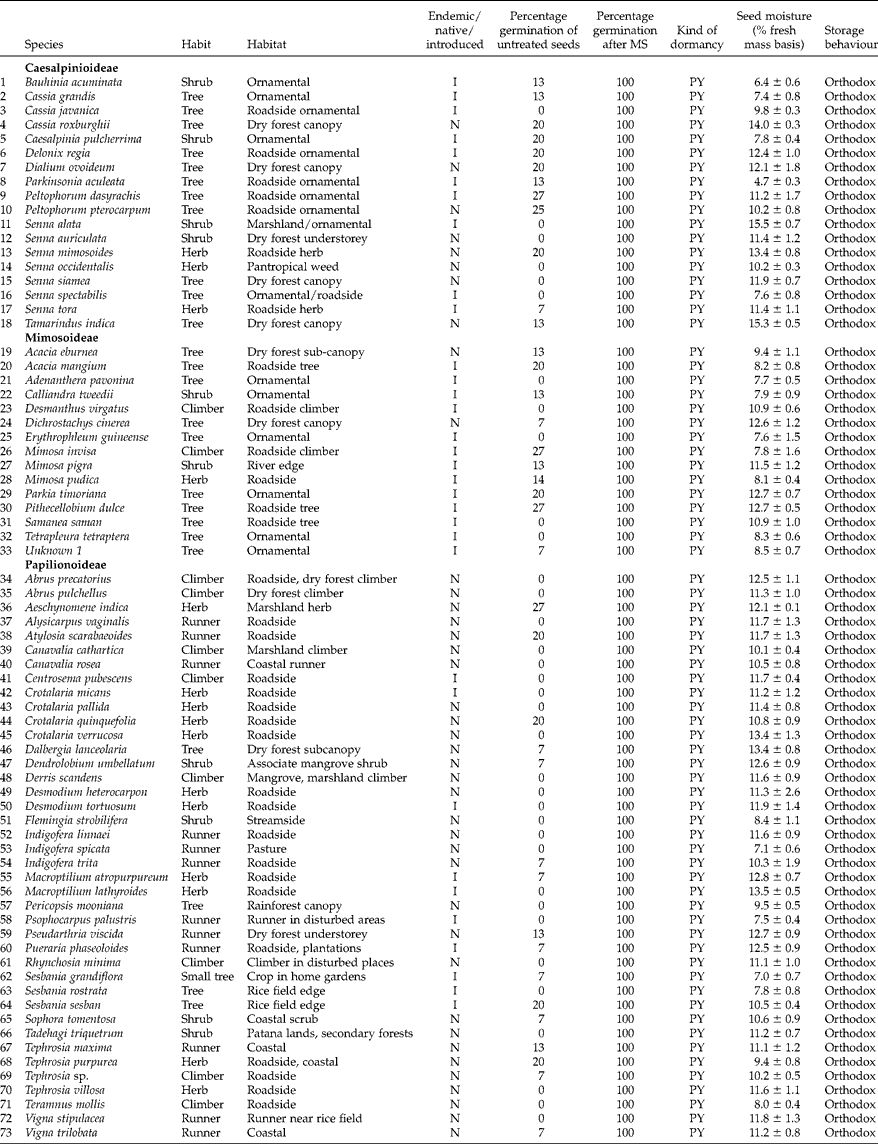
Fresh seeds of six of the 100 species tested, Brownea coccinea, Cynometra cauliflora, Derris trifoliata, Humboldtia laurifolia, Pongamia pinnata and Saraca asoca, had >>15% MC (range 29.8–57.1%). Seeds of 92 of the other 94 species had an MC < 15%; MC of Senna alata was 15.5% and that of Tamarindus indica 15.3% (Tables 1–4).
Germination, dormancy and storage behaviour of seeds of 73 Fabaceae species assigned to the first seed germination–storage behaviour category. E, endemic; I, introduced; MS, manual scarification; N, native; PY, physical dormancy. Zero to 27% of seeds are non-dormant, and the others have PY

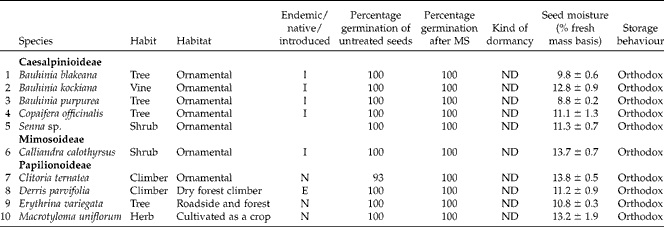
Germination, dormancy and storage behaviour of seeds of ten Fabaceae species assigned to the second seed germination–storage behaviour category. E, endemic; I, introduced; MS, manual scarification; N, native; ND, non-dormant. Ninety-three to 100% of the seeds are non-dormant, and the others have PY
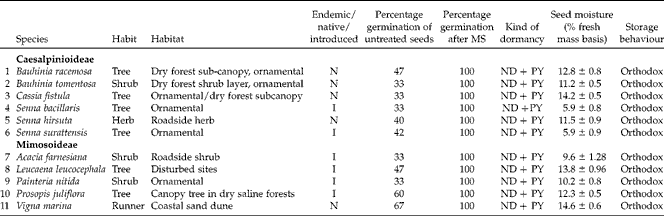
Germination, dormancy and storage behaviour of seeds of 11 Fabaceae species assigned to the third seed germination–storage behavior category. E, endemic; I, introduced; MS, manual scarification; N, native; ND+PY, non-dormant + physical dormancy. Thirty-three to 67% of the seeds are non-dormant, and the others have PY
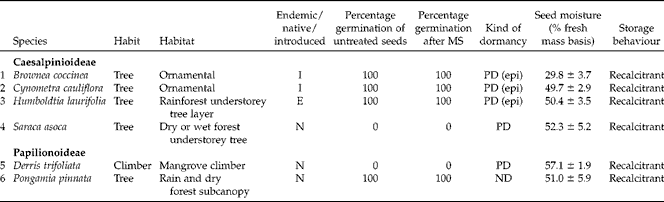
Germination, dormancy and storage behaviour of seeds of six Fabaceae species assigned to the fourth, fifth and sixth seed germination–storage behaviour categories.a E, endemic; I, introduced; MS, manual scarification; N, native; ND, non-dormant; PD, physiological dormancy; PD (epi), physiological epicotyl dormancy
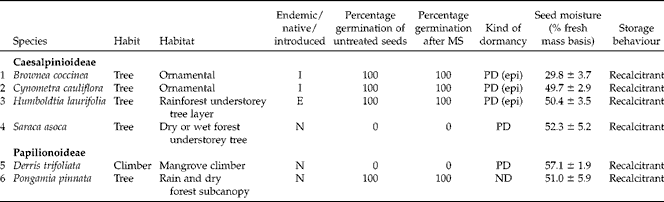
a The fourth germination–storage behaviour category includes only Pongamia pinnata (non-dormant recalcitrant); the fifth Brownea coccinea, Cynometra cauliflora and Humboldtia laurifolia (physiological epicotyl dormancy, recalcitrant); and the sixth Derris trifoliata and Saraca asoca (physiological dormancy, recalcitrant).
Effect of drying on seed viability
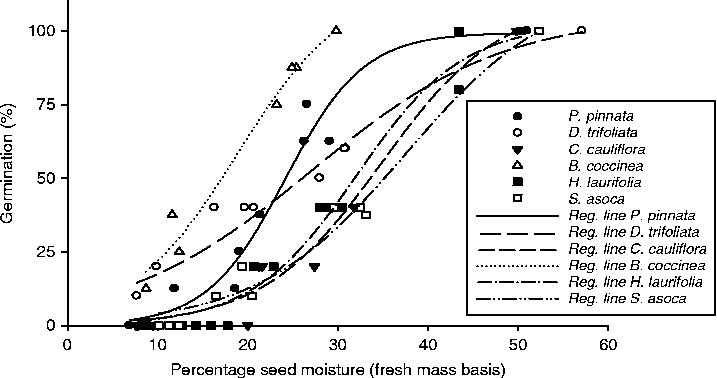
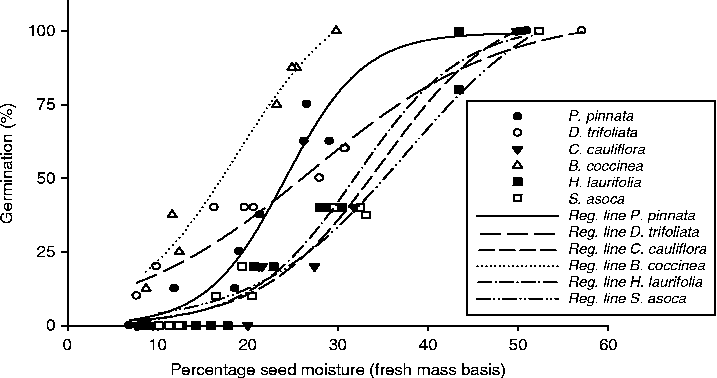
This experiment and the following one were conducted only for seeds of the six species with MCs of 29.8–57.1%. None of the seeds of C. cauliflora, H. laurifolia or S. asoca and only 10% and 4% of those of D. trifoliata and P. pinnata, respectively, germinated when dried to < 10% MC. However, about 25% of the seeds of B. coccinea germinated when they were dried to 12.5% MC (Fig. 1). Seeds that did not germinate rotted and died during the germination test. Germination of all six species had a significant sigmoidal (four-parameter) relationship with seed moisture content.
Germination of Pongamia pinnata, Derris trifoliata, Cynometra cauliflora, Brownea coccinea, Humboldtia laurifolia and Saraca asoca seeds dried to different moisture percentages.
Effect of low-temperature storage on seed viability
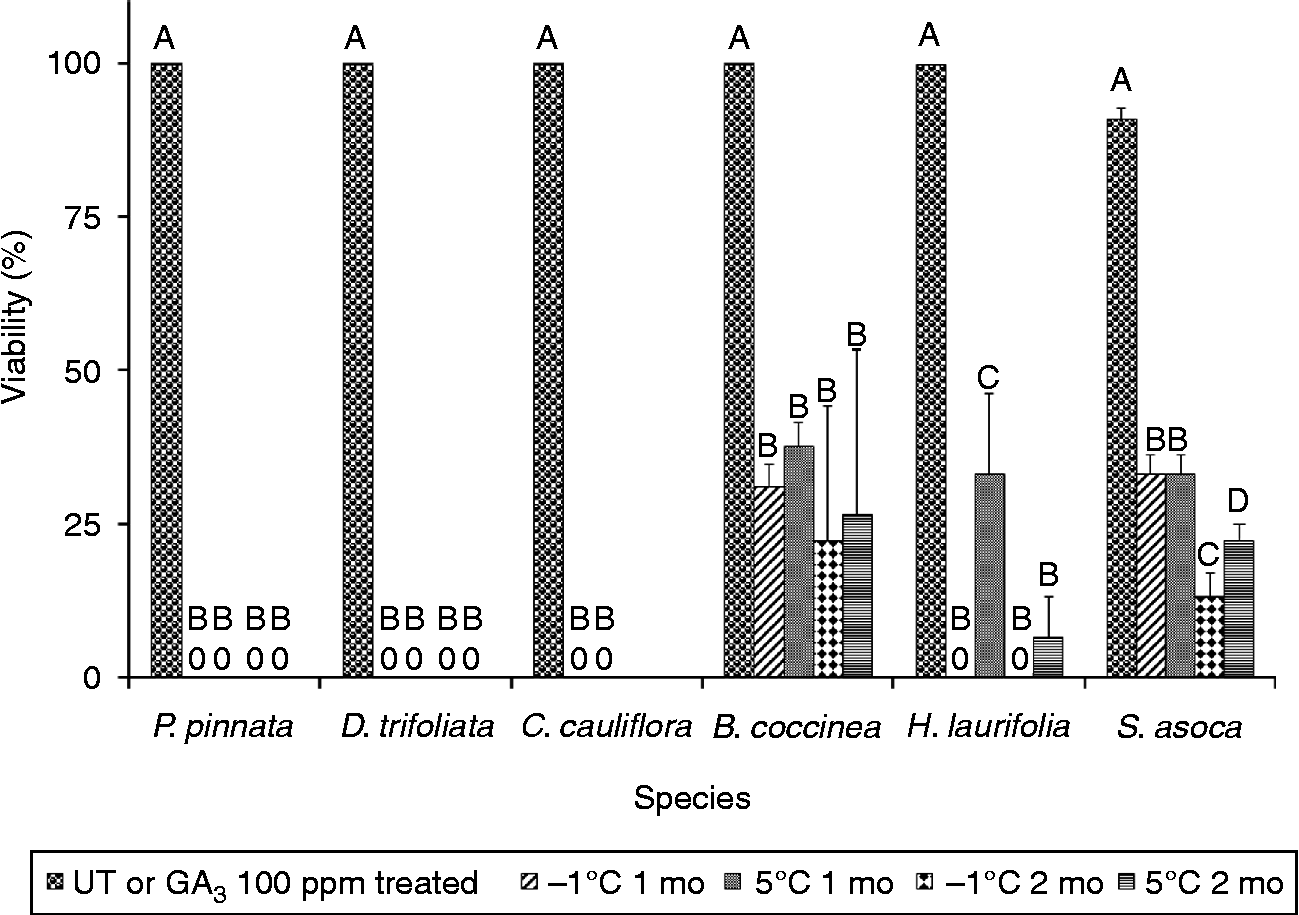
More than 90% of the fresh non-treated seeds of B. coccinea, C. cauliflora, H. laurifolia and P. pinnata and of those of D. trifoliata treated with 100 ppm GA3 germinated (Fig. 2). Although only 15% of the S. asoca seeds germinated on filter papers moistened with 100 ppm GA3, about 90% of the embryos in the non-germinated seeds were white and firm (viable). No seeds of D. trifoliata or S. asoca tested with 100 ppm GA3 germinated after storage at − 1 or 5°C for 1 or 2 months. No seeds of C. cauliflora germinated after 1 month storage at − 1°C, while 26% of those stored at 5°C for 1 month did so. No seeds of H. laurifolia stored at − 1°C for 1 or 2 months germinated, while 33.3 and 6.7% of those stored at 5°C for 1 or 2 months, respectively, germinated. More than 30% of B. coccinea seeds stored at − 1 or 5°C for 1 month and >20% of those stored for 2 months germinated on filter papers moistened with distilled water. Only about 5% of the S. asoca seeds stored at − 1 or 5°C for 1 month germinated on filter papers moistened with 100 ppm GA3, and 70% of the non-germinated seeds rotted within a few days. Further, none of the S. asoca seeds stored at − 1 or 5°C for 2 months germinated on filter papers moistened with 100 ppm GA3, and 78% and 87%, respectively, of them rotted within a few days. The remaining S. asoca seeds in both of these experiments had white and firm embryos. Non-germinated seeds of all the other species rotted and died within a few days.
Viability (germinated seeds + seeds with white, firm embryos after a 30-d germination period) of Pongamia pinnata, Derris trifoliata, Cynometra cauliflora, Brownea coccinea, Humboldtia laurifolia and Saraca asoca seeds stored at − 1 or 5°C for 1 or 2 months. Different uppercase letters indicate significant differences between treatments within a species. Error bars are ± 1 SD. UT, non-treated intact.
Kinds of seed dormancy
Imbibition
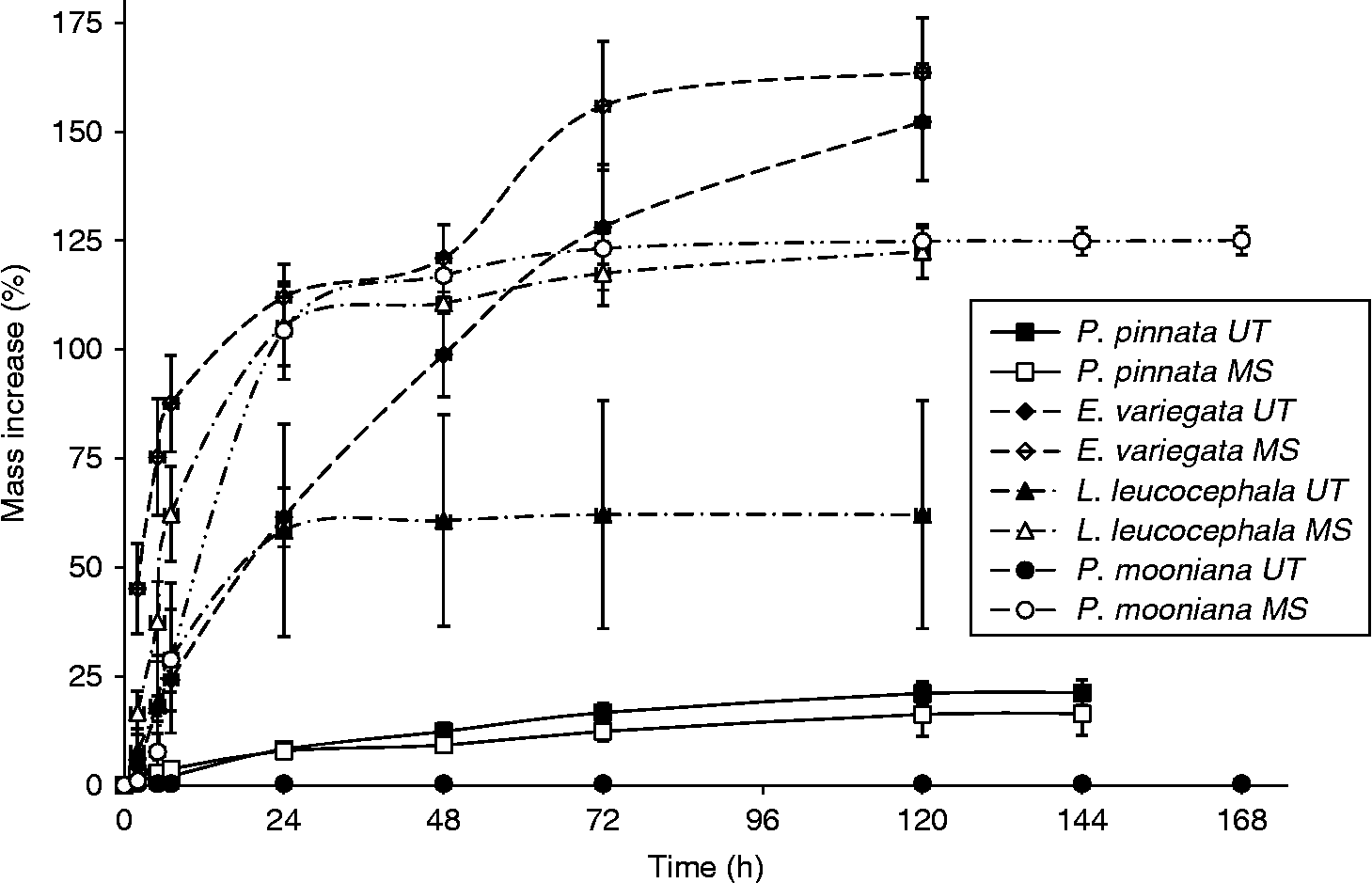
The mass of non-treated intact and of manually scarified seeds of B. coccinea, C. cauliflora, D. trifoliata, H. laurifolia, P. pinnata (Fig. 3) and S. asoca increased < 75% during imbibitions, and that of the ten species in Table 2 >100% (P>0.05). The mass of non-treated fresh seeds of the 11 species in Table 3 increased 50–100%, while that of manually scarified seeds increased >100% during imbibition (P< 0.05). The other 73 species, in Table 1, showed a different pattern: mass of non-treated intact seeds increased < 50% (usually very little) and that of manually scarified seeds increased >100% during imbibition (P< 0.05) (data not shown, except for P. mooniana in Fig. 3).
Mass increment of non-treated and manually scarified seeds of Pongamia pinnata, Erythrina variegata, Leucaena leucocephala and Pericopsis mooniana during imbibition at ambient laboratory temperature. Error bars are ± 1 SD. MS, manually scarified; UT, non-treated intact.
Germination
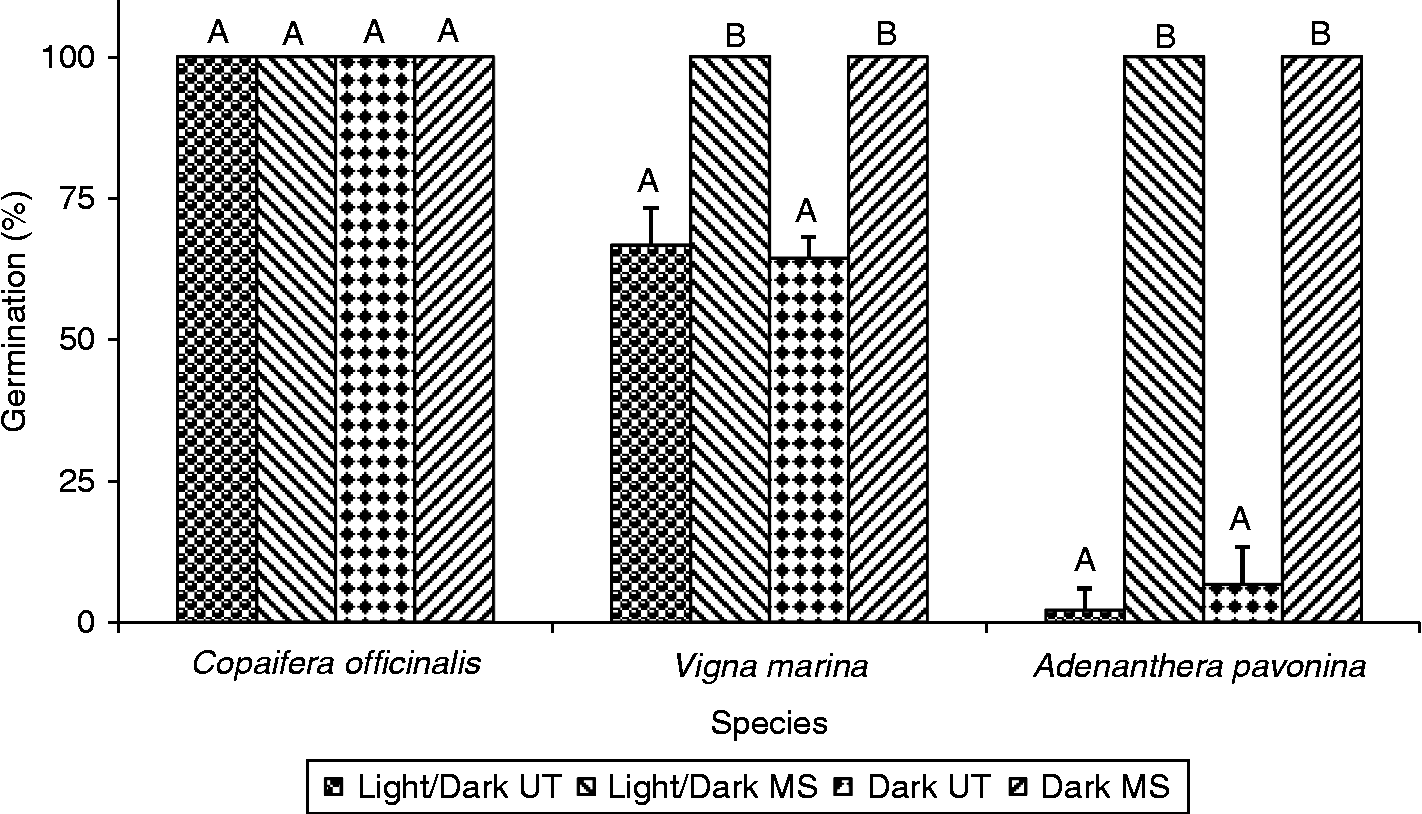
No seeds of 35 of the 73 species listed in Table 1 (also see Fig. 4 for Adenanthera pavonina) germinated without manual scarification, while 38 germinated to 7–27%. Manually scarified seeds of all 73 species germinated to 100% in < 30 d. The non-treated and manually scarified seeds of the ten species listed in Table 2 (also see Fig. 4 for Copaifera officinalis) germinated to 93–100%. The non-treated seeds in the 11 species listed in Table 3 (also see Fig. 4 for Vigna marina) germinated to 33–67% in < 30 d, while manually scarified seeds germinated to 100%.
Germination of non-treated and manually scarified seeds of Copaifera officinalis, Vigna marina and Adenanthera pavonina at laboratory temperature in light/dark or dark. Different uppercase letters indicate significant differences between treatments within a species. Error bars are ± 1 SD. MS, manually scarified; UT, non-treated intact.
Of the six species with high fresh-seed MC (Table 4), D. trifoliata and S. asoca did not germinate (0%) with or without manual scarification, whereas the other four species germinated to 100% with and without manual scarification. In treated and non-treated seeds of B. coccinea, C. cauliflora and H. laurifolia, radicle emergence occurred within 30 d of incubation, while there was a delay of 77 ± 14, 38 ± 4 and 52 ± 4 d, respectively, in shoot emergence.
Gibberellic acid treatment
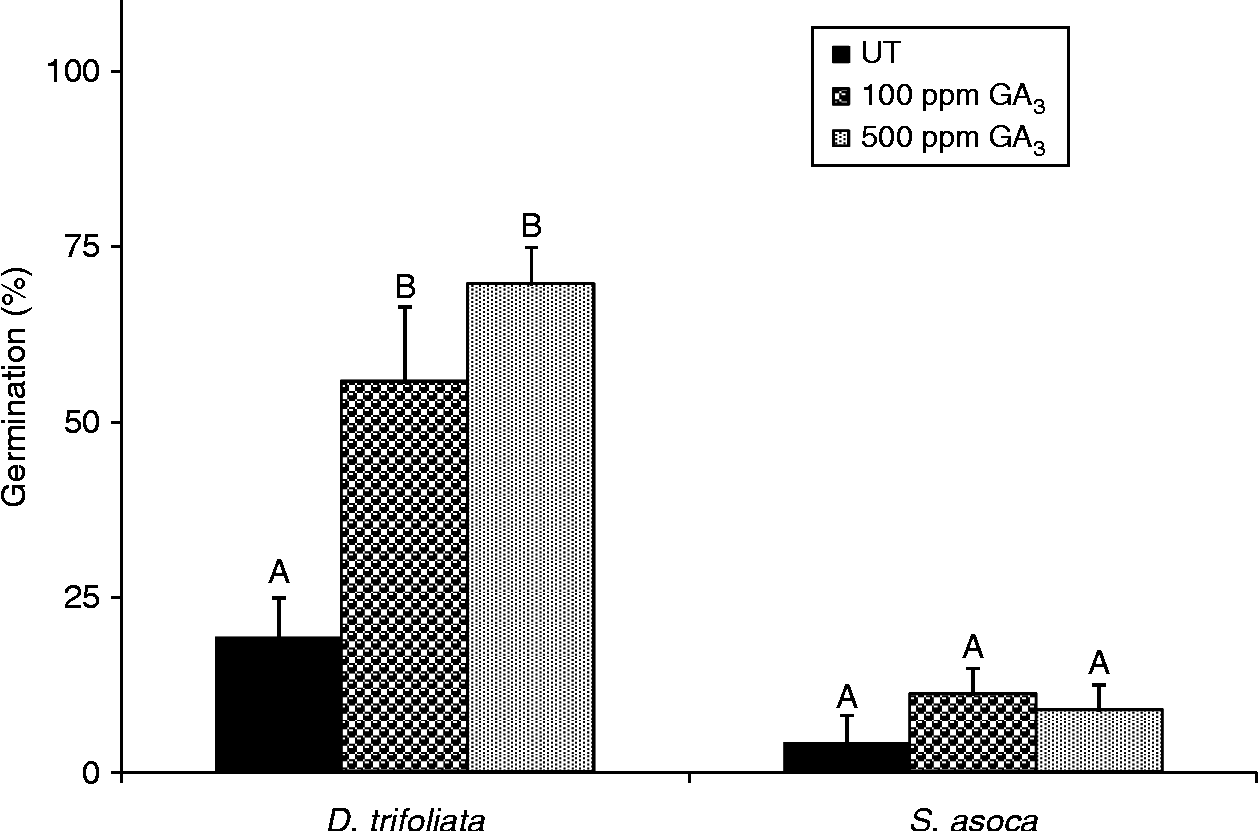
This treatment was conducted for D. trifoliata and S. asoca, in which seeds germinated to low percentages even after manual scarification. Only 19% of the non-treated intact seeds of D. trifoliata germinated, whereas those treated with 100 and 500 ppm GA3 germinated to 55 and 69%, respectively (Fig. 5). Germination of GA3-treated seeds differed significantly from each other and from that of non-treated seeds (F= 73.66, P< 0.001). Intact seeds of S. asoca germinated to only 5%, and those treated with 100 and 500 ppm GA3 germinated to only 11% and 5%, respectively, in < 30 d (Fig. 5). Germination of non-treated and GA3-treated seeds did not differ from each other (F= 2.34, P= 0.177).
Germination of non-treated and gibberellic acid (100 or 500 ppm) treated seeds of Derris trifoliata and Saraca asoca at ambient laboratory temperature and light conditions. Error bars are +1 SD. Different uppercase letters indicate significant differences between treatments within a species. GA3, gibberellic acid; UT, non-treated intact.
Discussion
Our study revealed six germination and storage behaviour patterns among the 100 Fabaceae species. MC of fresh seeds of six species (B. coccinea, C. cauliflora, D. trifoliata, H. laurifolia, P. pinnata and S. asoca) were elevated (29.8 to 57.1%) at harvest, while that of the other 94 species was < 16%. Further, seeds of these 94 species germinated to high percentage without any treatment or after manual scarification, GA3 treatment or manual scarification + GA3 treatment, showing that they are viable at low seed MC. Thus, it can be concluded that the seed storage behaviour of these 94 species is orthodox.
MC–viability curves for C. cauliflora, H. laurifolia, P. pinnata and S. asoca resemble the typical desiccation tolerance curves for recalcitrant species (Hong and Ellis, Reference Hong, Ellis, Engels and Toll1996), while the curves for seeds of B. coccinea and D. trifoliata fall between those typical for recalcitrant and intermediate seeds. Hong and Ellis (Reference Hong, Ellis, Engels and Toll1996) stated that recalcitrant seeds with tropical origin can only be stored at temperatures >10°C. Further, B. coccinea and S. asoca seeds germinated to about 30% after they were stored at − 1°C and 5°C. Only < 10% of the seeds of C. cauliflora, D. trifoliata, H. laurifolia and P. pinnata survived after 2 months' storage at − 1 or 5°C.
We did not open the Ziplock bags to ventilate the seeds during low-temperature storage or check seed MC following storage. It seems unlikely that they were killed by build-up of toxic metabolic products in the bag. Even at high MC, respiration rates should have been very low at − 1°C and at 5°C. However, since there was no control for the seeds in the unopened bags, the possibility that toxic metabolic products accumulated and contributed to death of the seeds cannot be ruled out. Further, it seems very unlikely that the seeds would have lost water to a low MC in sealed bags at low temperatures. Considering the results of both the drying and low-temperature storage experiments, we conclude that seeds of C. cauliflora, D. trifoliata, H. laurifolia and P. pinnata are recalcitrant, while those of B. coccinea and S. asoca are non-orthodox in storage behaviour (closer to recalcitrant than to the orthodox category on the continuum). Thus, seeds of six species are non-orthodox and 94 orthodox.
Seeds of the 94 species for which MC was < 16% can be divided into three categories with respect to proportions of those with PY and ND. The first category contains 73 species that produce orthodox seeds, a high percentage of which have PY (Table 1). The mass of scarified seeds of most of these species increased >100% during imbibition, but except for the low percentage that were non-dormant it increased very little or not at all for intact non-treated seeds (data not shown). Thus, they have water-impermeable seed coats, i.e. PY. Germination experiments confirmed that these species have PY only and not (PY+PD). Zero to 27% of the seeds were non-dormant, and the other portion had PY. Seeds of 55 of the species germinated to 0–15% and 35 of these to 0%.
The second category includes 10 species that produce non-dormant orthodox seeds (Table 2). The mass of both manually scarified and intact seeds increased >100% (data not shown), showing that they do not have water-impermeable seed coats. Further, 93–100% of manually scarified and of intact seeds germinated, thus they are non-dormant. In this category, seeds of Macrotyloma uniflorum have previously been reported to be non-dormant (Chauhan et al., Reference Chauhan, Tomar, Badoni, Singh, Ali, Debarati, Rawat and Nautiyal2009), as have different species in two other genera in our study: Clitoria javitensis (Garwood, Reference Garwood1983) and Copaifera aromatica (Sautu et al., Reference Sautu, Baskin, Baskin, Deago and Condit2007).
The third category includes 11 species that produce orthodox seeds: 33–67% of the seeds are non-dormant and the others have PY (Table 3). The mass of manually scarified seeds increased >100% during imbibition (data not shown), and they germinated to 100%; thus the seeds have PY and not (PY+PD). An increase in mass of about 50–100% in non-treated intact seeds is the result of 33–67% of the seeds in the seed lot imbibing during the 30-d period (data not shown). The other seeds in the seed lots did not imbibe at all, showing that they have PY. Several other investigators have also reported a significant proportion of non-dormant seeds in seed lots of Fabaceae species with PY (e.g. Busse, Reference Busse1930; Morley, Reference Morley1958; Morrison et al., Reference Morrison, Auld, Rish, Porter and McClay1992).
Seeds of the six species that are recalcitrant can be assigned to three other germination–storage categories (Table 4). The percent mass increase in both intact and manually scarified seeds of B. coccinea (3.8, 7.9), C. cauliflora (9.4, 18.1), D. trifoliata (72.9, 68.1), H. laurifolia (6.5, 9.2), P. pinnata (21.2, 16.4) and S. asoca (44.3, 56.1) seeds was similar. Thus, seeds do not have water-impermeable coats, i.e. they do not have PY. However, they imbibe a relatively small amount of water compared to scarified orthodox species of Fabaceae, because seed MC at dispersal is very high and thus they do not require much additional water to become fully imbibed.
Intact and manually scarified seeds of P. pinnata germinated to 100% (radicle and shoot emergence) within 30 d. Thus, seeds of this species are non-dormant and, as discussed earlier, they are recalcitrant. Based on these results, P. pinnata seeds were assigned to a fourth germination–storage behaviour category: seeds non-dormant and recalcitrant (Table 4). Ramdeo (Reference Ramdeo1970) and Kumar et al. (Reference Kumar, Radhamani, Singh and Varaprasad2007) also showed that P. pinnata seeds are non-dormant. However, Kumar et al. (Reference Kumar, Radhamani, Singh and Varaprasad2007) concluded that P. pinnata seeds are orthodox. In our study, the MC–viability curve for seeds of P. pinnata resembles a curve for recalcitrant seeds, and no seeds germinated after they were stored at low temperature, clearly showing that they are recalcitrant.
During the germination process in seeds of B. coccinea, C. cauliflora and H. laurifolia, there is a significant delay in shoot emergence following root emergence. Jayasuriya et al. (Reference Jayasuriya, Wijetunga, Baskin and Baskin2010, Reference Jayasuriya, Wijetunga, Baskin and Baskin2012b) described this dormancy strategy as a new kind of seed dormancy, i.e. physiological epicotyl dormancy. Thus, the recalcitrant seeds of these three species are assigned to a fifth germination category: seeds with physiological epicotyl dormancy and recalcitrant (Table 4). Presently, this kind of germination–storage behaviour in Fabaceae is known to occur only in tropical species in the subfamily Caesalpinioideae (Jayasuriya et al., Reference Jayasuriya, Wijetunga, Baskin and Baskin2010, Reference Jayasuriya, Wijetunga, Baskin and Baskin2012b).
D. trifoliata and Saraca asoca, which have nonorthodox seeds with PD, were assigned to a sixth germination–storage behaviour category: seeds with physiological dormancy and recalcitrant (Table 4). Only a few non-treated or manually scarified seeds of these two species germinated (radicle emergence) within 30 d. Thus, it can be concluded that they are dormant. GA3 significantly increased the germination percentage of D. trifoliata seeds, indicating that they have non-deep physiological dormancy (non-deep PD). However, GA3 treatment did not increase the germination percentage of S. asoca seeds, suggesting that they might have deep PD (see Baskin et al., Reference Baskin, Baskin, Yoshinaga and Thompson2005). This suggestion is supported by the study of Singh et al. (Reference Singh, Warrier, Anandalakshmi, Sivakumar, Sivalingam, Mahadevan and Chevanan2005), who reported that seeds of this species required about 150 d for germination.
Two of six Bauhinia species (B. racemosa and B. tomentosa) are native to Sri Lanka, and the other four (B. acuminata, B. blakeana, B. kockiana and B. purpurea) have been introduced. Seeds of both native species have PY to varying degrees, while three of the four introduced ornamental species are non-dormant. Seeds of most Bauhinia species that have been studied were reported to have PY, e.g. B. ungulata (M. Alves et al., Reference Alves, Dornelas, Bruno, Andrade and Alves2000), B. divaricata (A. Alves et al., Reference Alves, Dornelas, Bruno, Andrade and Alves2000, Chavez et al., Reference Chavez, Cruz-Landero, Guerra-Santos, Guevara, Gelabert, Cruz-Magana, Nunez-Lara and Brito2011), B. monandra (M. Alves et al., Reference Alves, Dornelas, Bruno, Andrade and Alves2000), B. rufescens (Hashim, Reference Hashim1990; Aseidu et al., Reference Aseidu, Asare-Bediako and Buah2011) and B. thonningii (Mwase and Mvula, Reference Mwase and Mvula2011). Corner (Reference Corner1951) includes drawings of cross-sections of seed coats of some Bauhinia species with a well-developed palisade layer, which suggests that seeds have PY (B. picta and B. variegata) and others with no palisade layer, indicating water-permeable seed coats (B. flemmifera and B. purpurea). A similar situation was observed in the two Calliandra species in our study. Seeds of C. tweedii have PY (our first germination category), while those of C. calothyrsus are non-dormant (our second germination category). A significant portion (40%) of fresh intact seeds in the C. calothyrsus seed lot had germinated after 2 weeks of incubation. For about 2 weeks, this proportion of seeds did not imbibe, showing that they have PY initially, which was broken during the 2-week incubation period. Seeds of C. fasciculata have been reported to be non-dormant (Oliveira-Silveira et al., Reference Oliveira-Silveira, Fernandes and Fernandes2005) and those of C. tetragona to have PY (Ekasari, Reference Ekasari2009). Reddy (Reference Reddy1988) reported that seeds of C. surinamensis have PD.
Seeds of 10 of the 11 Senna species in our study had PY; those of the unidentified ornamental Senna species were non-dormant. Seeds of most Senna species that have been studied had PY (Teketay, Reference Teketay1996; Baskin et al., Reference Baskin, Nan and Baskin1998; Delachiave and Pinho, Reference Delachiave and Pinho2003; Lacerda et al., Reference Lacerda, Filho, Goulart, Ribeiro and Lovato2004). The Senna species with non-dormant seeds in our study is an ornamental. Thus, non-dormancy may have been selected during domestication of this species. Although Erythrina variegata seeds in our study were non-dormant, E. brucei, E. burana (Teketay, Reference Teketay1994), E. crista-galli (Galetto et al., Reference Galetto, Bernardello, Isele, Vesprini, Speroni and Berduc2000) and E. lysistemon (Teketay, Reference Teketay1996) have been reported to have PY. However, Sautu et al. (Reference Sautu, Baskin, Baskin, Deago and Condit2007) reported that seeds of E. fusca are non-dormant. Comparative seed-coat anatomical studies are needed to better understand dormancy vs. non-dormancy in seeds of Bauhinia, Calliandra and Erythrina species. However, the three Derris species (D. parvifolia, D. scandens and D. trifoliata) included in our study also differed in kind of dormancy: ND, PY and PD, respectively, the ecological significance of which has been discussed by Jayasuriya et al. (Reference Jayasuriya, Baskin, Baskin and Fernando2012a).
In conclusion, we identified non-dormancy and physiological, physiological epicotyl and physical dormancy among seeds of the 100 Fabaceae species studied. However, a high percentage of the species have seeds with physical dormancy. Physiological epicotyl dormancy in Fabaceae has been documented only in tropical caesalpinioid species. Seed storage behaviour is orthodox in a high percentage of tropical Fabaceae species in Sri Lanka. The percentage of Fabaceae species producing non-orthodox seeds in Sri Lanka (6) is slightly higher than that of Fabaceae species producing non-orthodox seeds worldwide (1.4; Dickie and Pritchard, Reference Dickie, Pritchard, Black and Pritchard2002). Six germination–storage behaviour patterns were identified among the seed lots of the 100 Fabaceae species investigated in this study.
Acknowledgements
We thank Dr D.S.A. Wijesundara, Director General, Department of Botanic Gardens, Sri Lanka, for allowing G.J. and A.S.T.B.W. to collect seeds of Fabaceae species in the Royal Botanic Gardens, Peradeniya, Sri Lanka. A grant (RG/2011/34/S) from the University of Peradeniya provided financial assistance for collecting seeds of mountain species of Fabaceae.