Introduction
High quality gametes are those that present high survivability during incubation (eggs and/or embryo) and larval growth until first feeding. In other words, they have the ability to generate viable offspring, which reach the adult stage in a better condition for commercialization (Kjorsvik et al., Reference Kjorsvik, Mangor-Jensen and Holmefjord1990; Pavlov & Emel´yanova, 2000; Barnes et al., Reference Barnes, Sayler and Cordes2003; Barnes & Durben, Reference Barnes and Durben2004; Bonnet et al., Reference Bonnet, Fostier and Bobe2007; Bobe & Labbé, Reference Bobe and Labbé2010).
Bromage & Cumaranatunga (Reference Bromage, Cumaranatunga, Muir and Roberts1988), Kjorsvik et al. (Reference Kjorsvik, Mangor-Jensen and Holmefjord1990), Bromage (Reference Bromage, Bromage and Roberts1995), Nordeide (Reference Nordeide2007), and Bobe & Labbé (Reference Bobe and Labbé2010) point out that management and selection of broodstock is the key to obtaining viable or good quality gametes, as both quality and fertilization potential vary at an individual level and as a function of several factors related to the broodstock. These factors include nutrition, feeding, physical and chemical parameters of the water, genetics, age of the broodstock and characteristics of the gametes, especially those related to ageing (over-ripeness) associated with the period of residence in the reproductive tract or the period between spawning (or egg extraction) and fertilization. The environmental conditions in which fertilization and incubation are carried out are also important. Other factors involved in determining egg quality are those related to the chemical composition (Giménez et al., Reference Giménez, Estévez, Lahnsteiner, Zecevic, Bell, Henderson, Piñera and Sanchez-Prado2006), the dimensions of the perivitelline space (Finn, Reference Finn2007) and semen quality (Kjorsvik et al., Reference Kjorsvik, Mangor-Jensen and Holmefjord1990).
Kjorsvik et al. (Reference Kjorsvik, Mangor-Jensen and Holmefjord1990) and Brooks et al. (Reference Brooks, Tyler and Sumpter1997) point out that gonadal growth, fecundity, and egg and spermatozoa viability are very susceptible to environmental conditions, being affected by factors such as temperature, stress and particularly nutrition (Mansour et al., Reference Mansour, McNiven and Richardson2006). Feeding restrictions generally reduce total fecundity, and they can delay maturation and decrease the proportion of mature fish. Additionally, changes in the composition, weight and size of the eggs seem to be affected significantly by different feeding levels; the effects of feeding on the composition of the vitelline sac is of particular importance for larval quality (Bobe & Labbé, Reference Bobe and Labbé2010).
Some quality criteria are used by researchers to determine egg quality in fish: size, shape, transparency, chorion and coelomic fluid aspects, distribution and volume of lipid droplets, floatability rate, fertilization percentage, morphology of the first blastomeres, hatching survivability, larval survivability at the time of vitelline absorption and the biochemical composition of eggs and larvae (Piper et al., Reference Piper, McElwain, Orme, McCaren, Flowler and Leonard1982; Kjorsvik et al., Reference Kjorsvik, Mangor-Jensen and Holmefjord1990; Bromage et al., Reference Bromage, Bruce, Basavaraja and Rana1994; Kjorsvik, Reference Kjorsvik1994; Brooks et al., Reference Brooks, Tyler and Sumpter1997; Shields et al., Reference Shields, Brown and Bromage1997; Mansour et al., 2000; Pavlov & Emel´yanova Reference Pavlov and Emel´yanova2008; Sink & Lochmann, 2000; Vassallo-Agius et al., Reference Vassallo-Agius, Watanabe, Yoshizaki, Satoh and Takeuchi2001; Thorsen et al., Reference Thorsen, Trippel and Lambert2003; Mylonas et al., Reference Mylonas, Papadaki, Pavlidis and Divanach2004; Avery & Brown Reference Avery and Brown2005; Penney et al., Reference Penney, Lush, Wade, Brown, Parrish and Burton2006; Moran et al., Reference Moran, Smith, Gara and Poortenaar2007; Avery et al., Reference Avery, Killen and Hollinger2009; Bobe & Labbé, Reference Bobe and Labbé2010; Effer et al., Reference Effer, Sanchez, Ubilla, Figueroa and Valdebenito2012; Valdebenito et al., Reference Valdebenito, Sánchez, Effer and Ubilla2012; Effer et al., Reference Effer, Sanchez, Ubilla, Figueroa and Valdebenito2013a).
Below we review some of the main factors that affect gamete quality in farmed fish. We show that these are principally associated with management decisions within the control of the producer, and also some of the indicators most often used for determining quality.
Factors determining gamete quality in fish
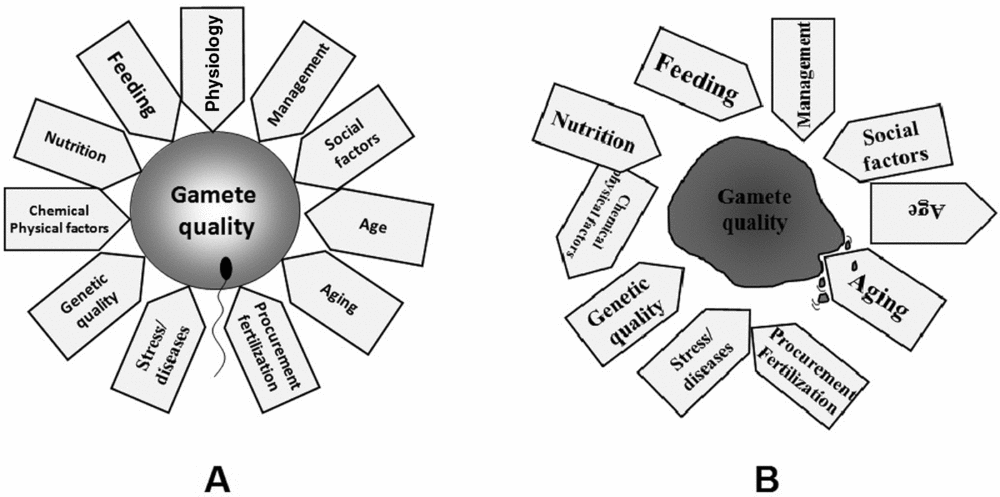
The quality of the gametes produced by a broodstock is the result of multiple factors, both genetic and nutritional, including final and proximate factors (Fig. 1). When the balance between any of these factors is upset, gamete quality may be reduced (Fig. 1B).
Factors that determine gamete quality in fish. Balanced (A); and unbalanced (B).

Females
Some of the main factors affecting female gamete quality in farmed fish are discussed here.
Over-ripeness (ageing)
The negative consequences on offspring of ageing in both male and female gametes have been demonstrated in numerous vertebrate species (Billard, 1980; Tarín et al., Reference Tarín, Pérez-Albalá and Cano2000). In fish, the term ‘over-ripeness’ or ‘ageing’ is used to refer to this problem and it is a frequent phenomenon in species that do not spawn naturally in farming systems, such as salmonids. Under artificial farming conditions the oocytes of salmonids are ovulated, but are not spawned into the environment. This situation becomes a problem for fish farmers as they must manually extract the male and female gametes and then carry out artificial fertilization. When they become over-ripe, the eggs suffer a series of morphological (Fig. 2) and biochemical changes that translate into a progressive loss of quality or viability (Springate et al., Reference Sprigate, Bromage, Elliott and Hudson1984; Barnes et al., Reference Barnes, Hanten, Sayler and Cordes2000b, Reference Barnes, Sayler and Cordes2003; Mansour et al., 2000; Barnes & Durben, Reference Barnes and Durben2004; Bobe & Labbé, Reference Bobe and Labbé2010). Teratogenic effects may be observed in fish and amphibians, such as dorsal and lateral asyntaxia, duplication or absence of organs, e.g. micro- or acephalia (Tarín et al., Reference Tarín, Pérez-Albalá and Cano2000), or increased spontaneous triploidization with an increase of temperature after ovulation (Aegerter & Jalabert, Reference Aegerter and Jalabert2004). As over-ripening of the eggs occurs inside the reproducer, the time between ovulation and the moment of extraction and fertilization is of great importance.
Oocytes of apparently good quality (A) and over-ripe (B, arrows) of rainbow trout (O. mykiss) before fertilization. Over-ripe Atlantic salmon (S. salar) eggs in the abdominal cavity of a female (C, arrows); and after hydration (D, arrows).
The over-ripeness rate is dependent on temperature (Gillet, Reference Gillet1991; Mansour et al., Reference Mansour, Lahnsteiner, McNiven and Richardson2008). The optimum period for spawning varies in different fish species; for example, in rainbow trout and silver salmon it is 4–10 days after ovulation at 10°C (Gordon et al., Reference Gordon, Klotins, Campbell and Cooper1987; Bromage et al., Reference Bromage, Bruce, Basavaraja and Rana1994). The latter author determined that eggs fertilized within 3 days after ovulation present a higher survivability than eggs fertilized 4–6 days after ovulation. He also points out that rainbow trout eggs that have been retained within the body for more that 12 days can be fertilized, but their embryo survivability is low. Similar results are reported for the same species by Bonnet et al. (Reference Bonnet, Fostier and Bobe2007), in which eggs retained in the abdominal cavity for 16 days after ovulation presented an embryo survivability of 37%, compared with 93% in a control group. Similarly, Barnes et al. (Reference Barnes, Hanten, Sayler and Cordes2000b) determined in Chinook salmon (Oncorhynchus tshawytscha) that eggs with noticeable over-ripeness present a survivability of 30% to the ‘eyed egg’ stage, whereas in eggs that were not over-ripe this percentage was 50%.
A review by Kjorsvik et al. (Reference Kjorsvik, Mangor-Jensen and Holmefjord1990) reported that over-ripe turbot (Scophthalmus maximus) eggs contained more lipids of all groups, especially phospholipids, than viable eggs.
It is therefore very important to check ripeness in the reproducer regularly in order to detect ovulation as early as possible, as over-ripeness can be a significant cause of viability loss of the eggs, particularly for salmonids (Bromage & Cumaranatunga, Reference Bromage, Cumaranatunga, Muir and Roberts1988).
Nutrition and feeding
Size of the ration
Kjorsvik et al. (Reference Kjorsvik, Mangor-Jensen and Holmefjord1990) and Bromage (Reference Bromage, Bromage and Roberts1995) point out that nutrition can affect the size, weight and composition of the egg. Kjorsvik et al. (Reference Kjorsvik, Mangor-Jensen and Holmefjord1990) stated that feeding restrictions generally reduced total fecundity, inhibiting gonadal maturation and decreasing the proportion of mature fish in species such as brown trout (Salmo trutta), rainbow trout (O. mykiss) and cod (Gadus morhua). Springate (Reference Springate1990) and Carrillo & Zanuy (Reference Carrillo and Zanuy1995), in studies of rainbow trout (O. mykiss) and sea bass (Dicentrarchus labrax) broodstock, determined that groups fed with a complete ration compared with females fed with a half ration presented changes in their fecundity; the most significant effects in the half ration feeding group were a decrease in the size of the egg and an increase in relative fecundity. Another important effect in the variation of ration size and components was an increase in the levels of follicular atresia in pre-spawned fish that could partially explain the alterations in fecundity and egg size. Kjorsvik et al. (Reference Kjorsvik, Mangor-Jensen and Holmefjord1990) concluded that the fecundity and the condition factor of farmed fish were respectively 2.5 and 1.5 times higher than those of wild cod (G. morhua) of the same size.
Fatty acids requirements
Carrillo & Zanuy (Reference Carrillo and Zanuy1995) and Brooks et al. (Reference Brooks, Tyler and Sumpter1997) pointed out that egg quality and embryo survival rate in teleost fish were affected by the content of polyunsaturated fatty acids (PUFA), particularly n-3 including docosahexanoic acid (DHA) and eicosapentanoic acid (EPA).
It has been found that when the level of n-3 PUFA (particularly DHA) is increased in the diets of S. aurata broodstock, the percentage of morphologically normal eggs increased. The incorporation of fatty acids into the eggs significantly improved the larval survivability after vitelline absorption (Fernández-Palacios et al., Reference Fernández-Palacios, Izquierdo, Robaina, Valencia, Salí and Vergara1995; Izquierdo et al., Reference Izquierdo, Fernández-Palacios and Tacon2001), however excessive levels of n-3 highly unsaturated fatty acids (HUFA) produced hypertrophy of the vitelline sac in larvae and a decrease in larval survival (Fernández-Palacios et al., Reference Fernández-Palacios, Izquierdo, Robaina, Valencia, Salí and Vergara1995). It has been determined that a diet with low levels of essential fatty acids (EFA) increased the number of lipid droplets in sea bream (Fernández-Palacios et al., Reference Fernández-Palacios, Izquierdo, Robaina, Valencia, Salí and Montero1997) and Japanese sea bream eggs (Watanabe et al., Reference Watanabe, Arakawa, Kitajima and Fujita1984a), thus indicating the importance of EFA for the normal development of eggs and embryos of these species.
Sea bream eggs of the highest quality have a higher content of total n-3 fatty acids, where DHA and EPA are included (Izquierdo et al., Reference Izquierdo, Fernández-Palacios and Tacon2001). Likewise, Watanabe et al. (Reference Watanabe, Takeuchi, Saito and Nishimura1984b, in Kjorsvik et al., Reference Kjorsvik, Mangor-Jensen and Holmefjord1990) evaluated two diets in Japanese sea bream broodstock, one of which contained high quantities of corn oil (EPA deficient); they found that the percentage of floating eggs, the incubation rate and the final production of eggs were significantly reduced when compared with the control diet. On the other hand, in sea bass (D. labrax) a clear relationship was observed between the composition of lipids in the diets and the results of spawning; it was found that if the broodstock ingested low levels of PUFA of the n-3 series there was a marked reduction in fecundity and egg viability compared with specimens treated with a more balanced diet. In some marine species like turbot, flounder or sea bass, low egg quality correlated with a high content of total lipids, just as in the freshwater species Coregonus albula (Kjorsvik et al., Reference Kjorsvik, Mangor-Jensen and Holmefjord1990).
Vitamins
Ascorbic acid has been shown to play an important role in salmonid reproduction (Eskelinen, Reference Eskelinen1989), especially for vitellogenesis (Sandnes, Reference Sandnes1991). Sandnes et al. (Reference Sandnes, Ulgenes, Braekkan and Utne1984), Dabrowski & Bloom (Reference Dabrowski and Bloom1994), and Izquierdo et al. (Reference Izquierdo, Fernández-Palacios and Tacon2001) demonstrated that vitamin C is an essential nutrient and that deficiency of this vitamin in the diet resulted in eggs presenting considerably higher mortalities than eggs from females fed with vitamin C-enriched diets. Vitamin C deficiency also leads to a reduction in spermatozoa concentration and motility during and after the spawning period (Sandnes, Reference Sandnes1991). This author demonstrated that rainbow trout broodstock fed with a diet that contained an ascorbic acid supplement produced an increase in the survivability at incubation, as compared with trout fed without the vitamin C supplement. The works of Sandnes et al. (Reference Sandnes, Ulgenes, Braekkan and Utne1984) and Eskelinen (Reference Eskelinen1989) demonstrated the positive effects of ascorbic acid on egg hatching.
Another nutrient that plays an important role in fish reproduction is vitamin E, so much so that the vitamin E requirements in rainbow trout broodstock are more than eight times higher than in young specimens (Bloom & Dabrowski, Reference Bloom and Dabrowski1995). Watanabe et al. (Reference Watanabe, Lee, Mizutani, Yamada, Satoh, Takeuchi, Yoshida, Kitada and Arakawa1991) studied the effects of increasing vitamin E in the diet (above 200 mg/kg) in P. major, and found that it improved the percentage of floating eggs, the incubation rate and the percentage of normal larvae. Vitamin E deficiencies in ayu (Plecoglossus altivelis), carp and Red Sea bream diets produce a decrease in the viable egg and hatching rates.
Other vitamins, such as A and D, are also readily incorporated by fish into the egg, but their roles in reproductive processes are still unclear.
Protein requirements
In Nile tilapia (Oreochromis niloticus) Al-Hafedh et al. (Reference Al-Hafedh, Siddiqui and Al-Salady1999) compared fish fed with different percentages of protein in the diet (25, 35, 40 and 45%) to determine whether the influences on maturation were significant. They found that when fed with 45% protein, the males matured at 14 weeks, while males fed with 20–40% protein matured at 16 weeks. In females, the number of eggs increased with the concentration of protein in the diet. Relative fecundity was significantly higher for fish that had been fed with 25–35% protein, than in fish fed with 40–45% protein in the diet.
In rainbow trout, Watanabe et al. (Reference Watanabe, Takeuchi, Saito and Nishimura1984b) demonstrated that diets with 10% lipids and a low level of proteins (30%) produced gametes of better quality than fish fed with high levels of protein (57%); and they also demonstrated that when the protein is reduced from 57 to 30%, quality is significantly improved.
The origin of the proteins is a factor in determining gamete quality. For rainbow trout, proteins of vegetable origin (soy and corn) reduced fecundity, while groups of Red Sea bream fed with pellets based on cuttlefish meal produced gametes with higher viability and hatching percentage than fish fed with pellets based on fish meal.
Carbohydrate requirements
Washburn et al. (Reference Washburn, Frye, Hung, Doroshov and Conte1990; in Brooks et al., Reference Brooks, Tyler and Sumpter1997) determined that rainbow trout broodstock fed with a low carbohydrate diet experienced a decrease in relative fecundity, and their eggs present a lower survival rate to the ‘eyed egg’ stage and during incubation.
Nature of the diet
Harel et al. (1994; in Brooks et al., Reference Brooks, Tyler and Sumpter1997) found that broodstock fed with natural diets produced eggs of higher quality compared with fish fed with commercially formulated diets. In sea bream, for example, fish fed with fresh squid produced eggs that were three times more viable than fish fed with commercial diets based on wheat gluten. Sea bass fed with artificial diets that contained high protein levels always produced gametes of low viability and hatching rates compared with broodstock fed with a natural, fish-based diet (Cerdá et al., Reference Cerdá, Carrillo, Zanuy, Ramos and De la Higuera1994). Various authors report that fresh diets, even though they have good reproductive effects, are not used for industrial production (e.g. of salmon) because they generate problems related with availability and sanitary conditions. The latter in particular increase the risk of spreading disease.
Pigments
In salmonids, the mobilization of carotenoids and their transportation from the muscle tissue to the skin and gonads during gonadal maturation supports the hypothesis that these pigments have an important reproductive function, as in other animals. High concentrations of astaxanthin in the eggs of Atlantic salmon and other salmonids suggested a role as a pro-vitamin A, and in protecting the skin during the initiation of first feeding. Carotenoids are also a source of pigments for chromatophores, facilitating respiration and providing resistance to high temperatures and ammonium. Although producers regularly demand well pigmented salmonid eggs, there are a few studies that relate high contents of carotenoid pigments with gamete viability (Torrissen, Reference Torrissen1989), and this finding is corroborated by the authors’ years of experience with salmon producers (Fig. 3). It has been found that once a critical concentration of pigments is reached within the egg, there is no linear correlation between this value and gamete quality. However, in Japanese bream, carotenoids produce a positive effect on egg fertility and decreased malformations in embryos and larvae (Watanabe et al., Reference Watanabe, Arakawa, Kitajima and Fujita1984a). In Seriola quinqueradiata, astaxanthin facilitated spawning and improved egg quality, and in Pseudocaranx dentex it improved the condition of the broodstock and total fecundity, but not gamete quality (Vassallo-Agius et al., Reference Vassallo-Agius, Watanabe, Yoshizaki, Satoh and Takeuchi2001). Work done in rainbow trout by Toledo (Reference Toledo1994) showed that, in normal farming conditions, good survivability is achieved with a minimal concentration of pigments (10 mg/kg). Significant differences have not been found in the quality of gametes obtained from broodstock fed with diets that contained natural or artificial pigments.
Rainbow trout oocyte (O. mykiss) with different concentrations of carotenoid pigments, but all of similar quality.
Broodstock management
As good management and broodstock selection are fundamental for obtaining highly viable gametes, the main factor responsible for variation in gamete quality is the fish farmer. The principal environmental factors that determined egg and larva quality are temperature, salinity and photoperiod. It has been found that during the spawning period of the Atlantic cod (G. morhua) and haddock (Melanogrammus aeglefinus), the diameter of the egg was larger during the half of the spawning season when the water temperature decreased, pointing to the existence of a reverse relationship between egg diameter and temperature in these two species.
In rainbow trout (O. mykiss) temperatures close to those required for growth (approximately 15°C) are suitable for gametogenesis. For spawning, however, an environment with temperatures lower than 10°C is essential, otherwise the oocytes produced will be over-ripe, and follicular atresia will be massive (Estay, Reference Estay1988).
Smith et al. (Reference Smith, Dwyer and Piper1983) demonstrated that specimens of cutthroat trout (Salmo clarki), held in creek water with a daily thermal variation of approximately 8°C produced gametes of better quality, less atresia and easier spawning than individuals held in spring water with low daily thermal variations (±2°C).
Stress
Bromage et al. (Reference Bromage, Jones, Randall, Trush, Davies, Springate, Duston and Barker1992) and Brooks et al. (Reference Brooks, Tyler and Sumpter1997) reported that prolonged exposure of the broodstock to stress (e.g. confinement and the densities used in captivity) is a key factor that can commonly have negative effects on reproductive processes, such as the generation of oocyte atresia (Valdebenito et al., Reference Valdebenito, Paiva and Berland2011), the final consequence of which is the production of low viability offspring. Schreck et al. (Reference Schreck, Contreras-Sanchez and Fitzpatrick2001) found that in fish subjected to reasonable stress during the complete vitellogenic phase, there is no effect on the average size of eggs, even though they may be more heterogeneous. Campbell et al. (Reference Campbell, Pottinger and Sumpter1994) demonstrated that, in rainbow trout, the chronic stress of confinement first affected hormonal secretions, raising cortisol levels and lowering some sexual steroids. A similar result is reported for S. trutta and S. gairdneri, which presented delayed gonad development in males and females (Sumpter, Reference Sumpter, Iwama, Pickering, Sumpter and Schreck1997). Vitellogenin, an essential component for oocyte growth, also presents very low values in specimens submitted to mechanical stress. A secondary consequence of this treatment was the presence of smaller eggs and lower survival rates among the offspring as compared with control groups. (Campbell et al., Reference Campbell, Pottinger and Sumpter1994). According to these authors, environmental stress, and especially nutritional stress, may affect fecundity and gamete quality, as eggs have different tolerance thresholds to stress factors at different stages of development (Westernhagen, Reference Westernhagen, Hoar and Randall1988 in Kjorsvik & Holmefjord, Reference Kjorsvik, Holmefjord, Bromage and Roberts1995).
Age of the fish
In farmed fish that do not spawn spontaneously, the age at which they reproduce is a decision that must be taken by the fish farmer and is therefore considered to be a management issue. As in many vertebrates, the quality of the gametes produced by fish generally reduces with age. Nevertheless, the gamete quality of second spawning has been found to be better than that of first spawning in rainbow trout (Bromage & Cumaranatunga, Reference Bromage, Cumaranatunga, Muir and Roberts1988), inanga (personal observations) and sea bass. Brooks et al. (Reference Brooks, Tyler and Sumpter1997) indicated that, in rainbow trout, the female produced a greater number of eggs, and of better quality, during the second spawning season than the first. Similarly, Bromage & Cumaranatunga (Reference Bromage, Cumaranatunga, Muir and Roberts1988) point out that survival to ‘eyed egg’ among eggs ovulated from a second season was significantly higher than among eggs of females in their first spawning (75 versus 58%).
In the Chilean salmon industry, sanitary regulations require each reproducer to be diagnosed for the presence of pathogens that produce diseases like bacterial kidney disease (BKD), salmonid rickettsial syndrome (SRS), infectious pancreatic necrosis (IPN) and infectious salmon anaemia virus (ISAv). This forces the producers of Atlantic salmon to kill their fish after the first spawning, and in some companies this is also done with trout. The farmers must therefore work with specimens of iteroparous species that do not produce the best quality when they mature early, as in trout (at 2 years of age). It is therefore desirable to delay maturity of the females until the third year, or to try to achieve bigger sized females by their first spawning.
Male gamete quality indicators in fish
The quality of semen in farmed fish can also affect embryo viability, as it may directly influence the fertility of the eggs (Estay et al., Reference Estay, Cerisola and Téllez1994a) or present genetic incompatibility with the female (Nordeide, Reference Nordeide2007). Some of the macroscopic characteristics of semen can be used as quality indicators. In rainbow trout, for example, good quality semen is whitish or slightly pink in colour and has a milky consistency; if the consistency is watery or lumpy, its use is not recommended. Sanchez-Rodríguez & Billard (Reference Sanchez-Rodríguez and Billard1977), Billard (Reference Billard1988), Aas et al. (Reference Aas, Refstie and Gjerde1991) and Estay et al. (Reference Estay, Díaz, Neira and Fernández1994b) described other macroscopic characteristics that can also be used as indicators of semen quality, such as sperm density, motility and seminal plasma composition.
As in female fish, in males the quality of the gametes produced is directly related with feeding, physiology, management (stress), genetics, environmental conditions, etc., although males tend to be more resistant than females to adverse farming or feeding conditions. Estay (Reference Estay1988) demonstrated in rainbow trout that constant temperatures close to 16°C impede the formation of viable gametes in females. However, males can generate spermatozoa with normal motility and fertility.
Some of main indicators used to determine semen quality in fish are described below.
Motility
Sperm motility potential in fish is normally acquired during the passage of the spermatozoa through the sperm duct (Morisawa & Morisawa, Reference Morisawa and Morisawa1986), and flagellar activity will only initiate when the sperm come into contact with an aqueous medium where fertilization will occur (Cosson, 2000, Reference Cosson2010; Alavi & Cosson, Reference Alavi and Cosson2005, Reference Alavi and Cosson2006; Valdebenito et al., Reference Valdebenito, Fletcher and Fernandez2009). Motility is assessed using different scales that relate the number of moving spermatozoa with the intensity and duration of movement (Sanchez-Rodríguez & Billard, Reference Sanchez-Rodríguez and Billard1977; Aas et al., Reference Aas, Refstie and Gjerde1991). Although sperm motility is widely used for evaluating semen quality, these two variables do not always correlate positively, and various software are now generally available (CASA: Computer Assisted Sperm Analysis) to provide a more objective assessment of motility (Cosson, 2000; Cosson et al., Reference Cosson, Groison, Suquet, Fauvel, Dreanno and Billard2008). In commercial fish production, motility measured by traditional means remains the most frequently used indicator of semen quality (Billard, Reference Billard1990; Perchec et al., Reference Perchec, Cosson, Cosson, Jeulin and Billard1996; Alavi et al., 2000; Cosson, 2000, Reference Cosson2010; Effer et al., Reference Effer, Figueroa, Augsburger and Valdebenito2013b), however, as mentioned above, this parameter does not always correlate well with fertility (Valdebenito et al., Reference Valdebenito, Fletcher and Fernandez2009). Tuset et al. (Reference Tuset, Dietrich, Wojtczak, Stowínska, Monserrat and Cieresko2008) found a negative correlation in salmon semen between fertility and the linear velocity (LVT) of the spermatozoon, however, a positive correlation was found between fertility and the curvilinear velocity (CVT) (r = 0.53).
Spermatocrit
Spermatocrit is the percentage of semen occupied by spermatozoa. The higher the value, the higher the sperm density (Bouck & Jacobson, Reference Bouck and Jacobson1976), increasing the possibility of fertilization (Valdebenito, unpublished data). In salmonids, the spermatocrit of a good quality male is between 10–20%. Lower values indicate a lower number of spermatozoa and lower fertility of the semen.
Aas et al. (Reference Aas, Refstie and Gjerde1991) demonstrated in Atlantic salmon that repeated extraction of semen every 2 weeks reduced the spermatocrit, sperm density and fertility. The semen of males that are re-used during the same spawning season should therefore be properly evaluated, as is done in rainbow trout farms.
Composition of seminal plasma
The seminal plasma of fish regularly contains fewer proteins than that of higher vertebrates. It has a varied ionic composition (mainly K+, Na+, Cl−, Ca2+, Mg2+) and a low composition of other components, such as hormones and pheromones, cholesterol, glycerol, vitamins, free amino acids, sugars, citric acid, lipids (Ciereszko, Reference Ciereszko, Alavi, Cosson, Coward and Rafiee2008) and antioxidant enzymes (catalase, superoxide dismutase, glutathione reductase) (Lanhsteiner & Mansour, Reference Lahnsteiner and Mansour2010; Lahnsteiner et al., Reference Lahnsteiner, Mansour and Plaetzer2010). Certain components of seminal plasma have shown a moderate correlation with quality, namely osmolarity, sodium concentration, potassium, glucose, pH, lipids and aspartate aminotransferase activity, lactate dehydrogenase and β-d-glucuronidase (Ciereszko et al., Reference Ciereszko, Glogowski, Dabrowski, Tiersch and Mazik2000). Lahnsteiner et al. (Reference Lahnsteiner, Berger, Weismann and Patzner1998) found that pH, β-d-glucuronidase activity and total lipids of rainbow trout seminal plasma, were good biomarkers of sperm quality when they were included in a multiple regression.
Oxidative stress, reactive oxygen species (ROS) and antioxidants
Oxidative stress generated by ROS is one of the main factors that damaged sperm quality in fish. It is found in individuals that have been exposed to unfavourable environmental contaminants or management conditions at the fish farm, e.g. hypoxia or hyperoxia due to the use of ozonification during production (Livingstone, Reference Livingstone2003). Another potential oxidizing agent is hydrogen peroxide, which is frequently used for sterilising tools at the fish farm or as an oxygen supplement for the transportation of live fish (Taylor & Ross, Reference Taylor and Ross1988).
Some low-molecular-weight substances present in the seminal plasma of fish have an important role as antioxidants. In rainbow trout, low levels of vitamin C are associated with high percentages of abnormal embryos in the offspring (Ciereszko et al., Reference Ciereszko, Dabrowski, Lin and Liu1999a). Likewise, the presence of vitamin E in seminal plasma is associated with improved quality. The inclusion of vitamins C and E (trolox C), at a dosage of 0.018 g/100 ml and 0.1 g/ml respectively, in an artificial sperm diluent for rainbow trout, will prolong seminal quality (motility and fertility) for 17 days when stored at 4°C (Ubilla & Valdebenito, Reference Ubilla and Valdebenito2011).
Uric acid is an important antioxidant. High concentrations of this acid have been found in the seminal plasma of teleost fish, indicating a potential role in protecting the spermatozoa against the action of ROS (Ciereszko et al., Reference Ciereszko, Dabrowski, Kucharczyk, Dobosz, Goryczko and Glogowski1999b, Lahnsteiner & Mansour, Reference Lahnsteiner and Mansour2010; Lahnsteiner et al., Reference Lahnsteiner, Mansour and Plaetzer2010).
Plasma proteins
Mochida et al. (Reference Mochida, Kondo, Matsubara, Adachi and Yamauchi1999) reported the presence of a sperm immobilizing factor in the seminal plasma of tilapia (Oreochromis niloticus). However, it is unknown whether proteins with similar functions exist in other fish.
Proteolytic activity has been determined in the seminal plasma of numerous species of fish (Kowalski et al., Reference Kowalski, Glogowski, Kucharczyk, Goryczko, Dobosz and Ciereszko2003). The possible functions of these proteases are related to the regulation of spermatogenesis by the activation of pro-enzymes and pro-hormones, stimulation of sperm motility and metabolism, and the removal of immature or damaged spermatozoa. This factor is especially important at the end of the reproductive season when residual spermatozoa must be eliminated (Lahnsteiner, Reference Lahnsteiner2003). Proteolytic activity also increased during pathological processes.
Anti-trypsin activity has been identified in the seminal plasma of teleost fish such as cod, rainbow trout and carp (Dabrowski & Ciereszko, Reference Dabrowski and Ciereszko1994). Although its specific function is unknown, the authors speculate that it would defend the spermatozoa from proteolytic attacks, thus facilitating prolonged storage in the sperm duct, and also in in vitro storage.
Egg quality indicators in fish
Some of the most commonly used indicators to determine female gamete quality in farmed fish are described below.
Morphology
In fish, the spawned mature oocyte (telolecithal) is made up of a big mass of yolk that occupied most of the volume of the egg, and of a thin peripheral layer called the cortical lamina, which is found between the nucleus and other cellular organelles (Pavlov & Emel´yanova, Reference Pavlov and Emel´yanova2008). The plasma membrane is protected externally by the chorion. Before activation, the chorion is considered to be a flaccid, collapsed structure on the membrane of the oocyte. The chorion can present one (as in salmonids) or more (in Acipenseridae or sturgeons) orifices (micropyles) that look like craters, where the spermatozoa penetrate during fertilization. After fertilization, the cortical alveoli break and release their contents, creating the perivitelline space (Balinsky, Reference Balinsky1975; Pavlov & Emel´yanova, Reference Pavlov and Emel´yanova2008), and at the same time the chorion suffers a series of structural changes, hardening to protect the embryo from possible aggression or damage that it may suffer during incubation; the diameter of the egg varied slightly. One or more lipid droplets can be observed that play an important role in larval survival (Sink & Lochmann, Reference Sink and Lochmann2008). These lipid droplets are responsible for maintaining egg floatability (in marine fish) during incubation, and act as an energy reserve and final nutrition for the larva, once the egg yolk has been consumed (Estévez, Reference Estévez1992; Estay et al., Reference Estay, Cerisola and Téllez1994a; Vassallo-Agius et al., Reference Vassallo-Agius, Watanabe, Yoshizaki, Satoh and Takeuchi2001; Bobe & Labbé, Reference Bobe and Labbé2010).
During fertilization and egg activation, the cortical reaction takes place in all teleost eggs, whether fertilized or not (Kjorsvik et al., Reference Kjorsvik, Mangor-Jensen and Holmefjord1990; Pavlov & Emel´yanova, Reference Pavlov and Emel´yanova2008). If amphimixis occurs, it would be followed by cleavage, a series of rapid mitotic divisions of the blastodisc into numerous cells called blastomeres (Balinsky, Reference Balinsky1975; Arrau et al., Reference Arrau, Bustos, Hoecker and Ramos1981; Kunz, Reference Kunz2004; Avery et al., Reference Avery, Killen and Hollinger2009, Akiyama et al., Reference Akiyama, Tero and Kobayashi2010) that decrease in size with each successive division. In fish, the large volume of the egg yolk restricted cleavage to a small area of the cytoplasm on the animal pole (partial segmentation). In un-pigmented eggs such as those of inanga (G. maculatus), the first big blastomeres are easily visible (Benzie, Reference Benzie1968). Various authors (Kjorsvik et al., Reference Kjorsvik, Mangor-Jensen and Holmefjord1990, Reference Kjorsvik, Hoehne-Reitan and Reitan2003; Bromage et al., Reference Bromage, Bruce, Basavaraja and Rana1994; Brooks et al., Reference Brooks, Tyler and Sumpter1997; Shields et al., Reference Shields, Brown and Bromage1997; Avery & Brown, Reference Avery and Brown2005; Penney et al., Reference Penney, Lush, Wade, Brown, Parrish and Burton2006; Moran et al., Reference Moran, Smith, Gara and Poortenaar2007; Pavlov & Emel´yanova, Reference Pavlov and Emel´yanova2008; Avery et al., Reference Avery, Killen and Hollinger2009, Hamoutene et al., Reference Hamoutene, Lush, Drover and Walsh2009, Bobe & Labbé, Reference Bobe and Labbé2010; etc.) point out that other good morphological indicators of egg quality during the first stages of development are symmetry of the initial blastomeres, transparency and distribution of the lipid droplets, size of the perivitelline space, and changes of egg diameter after fertilization (Fig. 4).
Fertilized inanga (G. maculatus) oocytes, with developed perivitelline space with blastodiscs (black arrows); and unfertilized, with the absence of perivitelline space and blastodisc (white arrow).
The cortical reaction plays an important role in gamete quality. Kjorsvik et al. (Reference Kjorsvik, Mangor-Jensen and Holmefjord1990) and Estévez (Reference Estévez1992) described that in good quality eggs, in species like cod (G. morhua), sea bass (D. labrax) and turbot (S. maximus), the cortical reaction is complete, the perivitelline space is more developed, and after cleavage the eggs are more transparent, perfectly spherical and with symmetrical blastomeres. On the other hand, in poor quality eggs, the cortical reaction is incomplete, the perivitelline space is absent or under-developed (Fig. 4) and cleavage is incomplete (Pavlov & Emel´yanova, Reference Pavlov and Emel´yanova2008), which may cause a low increase in egg diameter after fertilization.
For many species the ‘normal’ early blastomere is of regular size and shape (Fig. 5), although this is not the case for the wolf fish (Anarhichas lupus L.), which has unequal blastomeres during the first divisions (Pavlov & Moksness Reference Pavlov and Moksness1994). Furthermore, Avery et al. (Reference Avery, Killen and Hollinger2009) related abnormal morphology of the blastomeres in the first cleavages of Gadus morhua with larval quality, finding that embryos with abnormal cleavages presented higher embryo mortality in comparison with normal eggs; Shields et al. (Reference Shields, Brown and Bromage1997) used blastomere morphology as a quality evaluation tool for Hippoglossus hippoglossus eggs. Another possible morphological indicator is the percentage of deformed embryos and larvae (Brooks et al., Reference Brooks, Tyler and Sumpter1997; Bonnet et al., Reference Bonnet, Fostier and Bobe2007; Bobe & Labbé, Reference Bobe and Labbé2010), although this characteristic may be more closely related with contamination studies than with egg quality studies. The possible morphological alterations of the first undifferentiated cells of the embryo invariably affect subsequent viability and development. The type of morphology of these cells has been used in contamination studies, and it has become a more sensitive parameter for the evaluation of survivability (Kjorsvik et al., Reference Kjorsvik, Mangor-Jensen and Holmefjord1990). This author has demonstrated in various toxicological studies that highly abnormal eggs do not complete embryogenesis, which suggested that these abnormal blastomeres generally corresponded to eggs of low viability; this parameter will therefore allow egg viability or quality to be evaluated (Kjorsvik et al., Reference Kjorsvik, Mangor-Jensen and Holmefjord1990; Shields et al., Reference Shields, Brown and Bromage1997; Bobe & Labbé, Reference Bobe and Labbé2010). Likewise, Vallin & Nissling (Reference Vallin and Nissling1998) incubated cod eggs of regular and irregular aspect, finding that, on average, the survival rate during incubation was less for irregular eggs (35%) than regular eggs (80%); this situation would suggest that oocyte morphology can be a direct indicator of egg viability. In salmonids, asymmetries are frequently observed in the first blastomeres (Effer et al., Reference Effer, Sanchez, Ubilla, Figueroa and Valdebenito2012, Reference Effer, Sanchez, Ubilla, Figueroa and Valdebenito2013a; Valdebenito et al., Reference Valdebenito, Sánchez, Effer and Ubilla2012), and preliminary observation suggested that they are associated with low embryo survival.
Coho salmon (O. kisutch) blastodiscs with normal (A) and abnormal (B) cleavages. Magnification ×56.
Egg size
Although it is known that big eggs produce larger larvae, the use of egg size as a criterion for evaluating egg quality in farmed fish is controversial. Bromage et al. (Reference Bromage, Jones, Randall, Trush, Davies, Springate, Duston and Barker1992) indicated that, in rainbow trout, this factor seems to have no relevance for egg quality. However, Kamler (Reference Kamler2005) and Kjorsvik et al. (Reference Kjorsvik, Mangor-Jensen and Holmefjord1990), pointed out that variation in diameter seems to be one of the most important criteria in the determination of egg quality for fish.
Intraspecific variability of egg size is associated with age, size, physiological condition of the female, spawning times and variations in environmental conditions (Baynes & Howell, Reference Baynes and Howell1996). A factor that influences both fecundity and egg size is diet (Bromage, Reference Bromage, Bromage and Roberts1995). In rainbow trout broodstock fed with half the normal ration (0.35% of body weight per day), the number and size of the eggs is reduced, compared with fish fed with 0.7% of body weight per day. Another important factor that influenced the number and size of eggs is the size of the female. In salmonids, as the size of the fish increases, the total fecundity and diameter of the eggs produced also increased and, as a consequence, the females displayed a lower relative fecundity (Bromage & Camaranatunga, Reference Bromage, Cumaranatunga, Muir and Roberts1988; Estay et al., Reference Estay, Díaz, Neira and Fernández1994b, Reference Estay, Díaz, Neira and García1997, Reference Estay, Vergara and Diaz1999, Reference Estay, Noriega, Ureta, Martín and Colihueque2004). This finding has been demonstrated in African sharptooth catfish (Clarias gariepinus) and in the studies of Pavlov & Moksness (Reference Pavlov and Moksness1994) in wolf fish, and Schreck et al. (Reference Schreck, Contreras-Sanchez and Fitzpatrick2001) in rainbow trout (O. mykiss). Schreck et al. (Reference Schreck, Contreras-Sanchez and Fitzpatrick2001) pointed out that, apart from these results, fecundity can also be associated with the age of the fish, even though in some species this effect may be quite small or non-existent, while in other species it seems to be highly significant. Thus, the effects of age on the number of eggs produced is considered to be inconsistent among all the species studied (Wootton, Reference Wootton1979 in Cerdá, Reference Cerdá1993).
The effects of egg size on survivability during the incubation period are controversial. Authors such as Barnes et al. (Reference Barnes, Hanten, Cordes, Sayler and Carreiro2000a), suggested that small eggs have poor survivability, while others (Estay et al., Reference Estay, Cerisola and Téllez1994a; Kjorsvik et al., Reference Kjorsvik, Hoehne, Reitan and Rainuzzo1998) maintained that size did not affect egg quality, as small eggs presented similar fertilization rates to large eggs. Large eggs may produce bigger rainbow trout fry at first feeding, but if they are in poor quality water, stressed or with inappropriate feeding, they may suffer higher mortalities than smaller fry. Sac fry produced from large eggs have better survivability in periods of starvation, but if the same management conditions are provided in the hatchery, both small and big eggs will present the same survival rates (Gisbert et al., Reference Gisbert, Williot and Castelló-Orvay2000). We conclude that small eggs are not of lower quality than big eggs, as survivability is not affected by egg size, but by the different state of maturity, in other words, survivability is an effect of over-ripeness rather than of egg size.
It is known that egg size and larva size are correlated (Baynes & Howell, Reference Baynes and Howell1996; Gisbert et al., Reference Gisbert, Williot and Castelló-Orvay2000). Beacham et al. (Reference Beacham, Withler and Morley1985) and Baynes & Howell (Reference Baynes and Howell1996) determined in chum salmon (O. keta), coho salmon (O. kisutch) and common sole (Solea solea) that larvae with bigger yolk volume come from bigger eggs and reach a larger size than larvae produced from smaller eggs; however this size advantage is generally reduced after first feeding, as occurs in Siberian sturgeon (Acipenser baeri) (Gisbert et al., Reference Gisbert, Williot and Castelló-Orvay2000) and in Atlantic salmon (Salmo salar), where it is observed that smaller specimens are capable of growth at the same rate as initially larger fry.
Number of lipid droplets
The information available on the lipid droplets present in eggs is limited. However, the number and distribution of the lipid droplets can be used to evaluate egg quality in fish, especially marine species. For example, in Japanese sea bream (P. major), normal farmed eggs have a diameter of 0.66 to 1.03 mm and contain a lipid droplet of 0.25 mm; eggs that possessed more than one droplet presented abnormal development (Watanabe & Kiron, Reference Watanabe, Kiron, Bromage and Roberts1995). In whitebait or inanga (G. maculatus) no relationship was found between the number of visible lipid droplets in an egg and its fertility (unpublished data by the authors).
Floatability
In species with pelagic eggs, gamete quality is associated with the floatability produced by the lipid droplet contained in its cytoplasm. Non-viable eggs precipitate after contact with water, so they can be eliminated easily and do not enter incubation systems. This quality parameter has been used in various species such as the Japanese Red Sea Bream (Watanabe et al., Reference Watanabe, Arakawa, Kitajima and Fujita1984a), sea bass and sea bream (Fernández-Palacios et al., Reference Fernández-Palacios, Izquierdo, Robaina, Valencia, Salí and Vergara1995), and turbot (Liewes, Reference Liewes1984).
Factors that affect semen quality in fish
Some of the factors that affected the composition and quality of seminal plasma in fish are seasonality, temperature, nutrition, stress, toxic agents, hormonal stimulation, contamination, and cold storage or cryopreservation (Ciereszco, Reference Ciereszko, Alavi, Cosson, Coward and Rafiee2008). Below we review some of these factors that can alter semen quality in productive processes.
Seasonality
Seasonality can significantly affect the composition of seminal plasma in fish, particularly at the end of the breeding season. During this period, there is a reduction in the concentration of proteins and the anti-proteinase activity of rainbow trout semen (Ciereszko et al., Reference Ciereszko, Liu and Dabrowski1996, Reference Ciereszko, Wasow, Dobosz, Goryczko and Glogowski2004). Similarly, the levels of vitamin C and sodium, potassium and chlorine ions are lower. This inability to maintain the composition of seminal plasma is related to low fertilizing capability of the spermatozoa at the end of the season, associated with gamete ageing.
The photo-thermal manipulations that are applied daily in fish farming activities produced significant changes in the semen quality of rainbow trout, from both normal and reversed-sex males (neomales), including reductions in sperm density, pH, osmolarity and motility patterns (Dabrowski et al., Reference Dabrowski, Ciereszko, Ciereszko, Toth, Christ, Saidy and Ottobre1996; Ciereszko et al., Reference Ciereszko, Dabrowski, Ciereszko and Ottobre1998). This problem is frequently observed in salmonid males farmed under artificial light and salinity conditions (only in freshwater), generating maturity and semen quality problems in males.
Temperature
The composition of seminal plasma may change as a function of farming temperatures. In carp farmed in cold water, there was an increase in the sodium concentration and pH, while potassium levels decreased. The sperm concentration of cold water specimens was half that of those farmed in warmer waters (Emri et al., Reference Emri, Marian, Tron, Balkay and Krasznai1998). The glucose levels in seminal plasma of Arctic charr (Salvelinus alpinus) farmed in cold waters were almost double those of groups farmed in warm waters (Atse et al., Reference Atse, Audet and Noue2002). In work done on sturgeon by Williot et al. (Reference Williot, Kopeika and Goncharov2000), higher parameters of sperm motility were determined in specimens farmed at 10°C than in those maintained at 17.5°C; the low motility parameters were associated with high osmolarity and low seminal plasma pH. Robles et al. (Reference Robles, Cabrita, Cunado and Herraez2003) found semen of better quality in rainbow trout of winter maturity than in groups that matured during spring. In this same species, Estay (Reference Estay1988) found that males farmed in water at a constant temperature of 16°C during the whole year produced semen with a viability similar to that of males farmed in temperatures lower than 10°C during the spawning season, concluding that rainbow trout males are more eurythermal than females in achieving full sexual maturity.
Salinity
Although the function of salinity may be species specific, in amphibiotic species salt water can improve semen quality. In the case of salmonids, salinity is classified as ‘gametic’ by Harden-Jones (Reference Harden-Jones1968), based on the strict need of salmonids to carry out fertilization and embryo development in freshwater. Currently however, production from broodstock of Atlantic (Salmo salar) and coho salmon (Oncorhynchus kisutch) is carried out exclusively in freshwater in a number of countries to avoid contagion with diseases associated with sea water (in Chile this is a health authority requirement). The results are still variable (low percentages of maturity are frequently observed, the males produce little semen and the females present varying percentages of follicular atresia) (Fig. 6).
Characteristics of Atlantic salmon broodstock raised solely in fresh water in southern Chile. (A) Broodstock tank. (B) Ovary with atretic follicles. (C) Four-year-old male showing evident signs of maturity. (D) Preparation of testicular macerate.
Atse et al. (Reference Atse, Audet and Noue2002) demonstrated that Arctic charr specimens kept in sea water improve their semen quality (sperm density, glucose concentration and seminal plasma osmolarity). In Atlantic salmon, Haffray et al. (Reference Haffray, Fostier, Normant, Faure, Loir, Jalabert, Maisse and Legac1995) found significant differences in the osmolarity of seminal plasma from specimens raised in salt water (347 mOsm/l), compared with those cultivated in freshwater (265 mOsm/l). However, specimens kept in salt water have also shown low fertility, as demonstrated in this species by Maisse et al. (Reference Maisse, Billard, Cosson, Labbe, Loir, Le Gac and Fierville1998). In brown trout (Salmo trutta fario), no significant differences were found in semen parameters of specimens kept in salt or freshwater. At this time, the Chilean salmon industry is close to the implementation of a regulation that would impede the return of broodstock (or their gametes) that have been farmed in seawater, to freshwater. This situation generated the problem of the salinity cycles that salmonids require during their life cycles, as generating them artificially generated a very high cost for the producer, and potentially a serious environmental impact due to the high contents of salt that fish farm effluents would contain during a certain period of the year. These salinity cycles are important for the synchronization of hormonal cycles that regulate sexual maturity in salmonids (Ueda, 1990; Onuma et al., Reference Onuma, Sato, Jodo, Davis, Ando, Ban, Fukuwaka and Urano2005), and are probably the cause of the frequent maturity problems observed in salmonid broodstock kept permanently in freshwater, such as the low percentage of mature specimens and – in females – follicular atresia in large numbers of ovaries.
Presence of sperm duct
In salmonids, spermatozoa acquire the ability to move during passage through the sperm duct (Morisawa & Morisawa, Reference Morisawa and Morisawa1986), where the pH of the seminal plasma and the concentration of bicarbonate ions increase, allowing the potential for flagellar activity to be generated (Morisawa & Morisawa, Reference Morisawa and Morisawa1988) by the increase in intracellular concentrations of cAMP (Morisawa et al., Reference Morisawa, Ishida, Okuno and Morisawa1993). These basic principles during the acquisition of sperm motility potential in salmonids are applied to the use of maturation solutions (which possess a high pH and high concentrations of sodium bicarbonate) for spermatozoa from reversed-sex specimens (neomales) that lacked sperm ducts. These individuals were characterized by presenting high sperm density and low levels of sperm motility (Geffen & Evans, Reference Geffen and Evans2000). This situation may result in seminal plasma contamination due to the liberation of somatic cell contents during testicle maceration. For this reason, in semen extraction from neomales, instead of macerating the testicle, a few superficial cuts should be made before the tissue is introduced into a sperm diluent to facilitate the liberation of spermatozoa only from those cells that have completed spermatogenesis.
Hormone stimulation
In many species of farmed fish, captivity impeded the formation of an adequate volume of semen, and a small volume with high density is frequently produced. Hormone stimulation (e.g. with GnRHa or pituitary extracts) is a common aquaculture practice that improved semen availability, increasing the volume of semen produced and the sperm concentration (Zohar & Mylonas, Reference Zohar and Mylonas2001). Hormone therapies increased the availability of the hormone 17α,20β-dihidroxy-4-pregnen-3-one (17α,20β-P), known as the ‘maturity inducing hormone’. This hormone induced an increase of seminal plasma pH levels, and consequently the development of the potential for sperm motility. In salmon farming this is a common practice, especially for Atlantic salmon as even though the males are of large size, the volume of semen produced is small. Hormone therapies have noticeably improved sperm functionality in this species from the point of view of volume produced and semen quality obtained.
Contamination with exogenous hormones
Industrial and domestic discharges frequently contain numerous chemicals with a similar structure to estradiol. These contaminants act as xenoestrogens, causing feminization in male fish, or rather a decrease in their reproductive functionality, including changes in motility, morphology and fertility (Kime & Nash, Reference Kime and Nash1999; Gill et al., Reference Gill, Spiropoulos and Moss2002; Jobling et al., Reference Jobling, Coey, Whitmore, Kime, Van Look, McAllister, Beresford, Henshaw, Brighty, Tyler and Sumpter2002). This finding indicated that broodstock of farmed fish in areas contaminated with these chemicals may produce semen of poor quality and fertility.
Semen contamination
Contamination of the semen with mucus, faeces, blood, water or urine noticeably affects the quality and composition of seminal plasma in fish. The most effective way to obtain semen without these contaminants is to use a catheter or cannula (when the anatomy of the fish allows), and to avoid the use of abdominal massage (stripping) (Glogowski et al., Reference Glogowski, Kwasnik, Piros, Dabrowski, Goryczko, Dobosz, Kuzminski and Ciereszko2000; Ciereszko et al., Reference Ciereszko, Wasow, Dobosz, Goryczko and Glogowski2004). For example, the level of superoxide ions in rainbow trout semen extracted through a cannula is significantly lower than in semen obtained through abdominal massage (Valdebenito, unpublished data).
The risk of semen contamination increased with storage time, and as the concentration of contaminants increases. Low concentrations of blood during storage for 5 days did not significantly affect motility of protein concentrations in rainbow trout semen (Ciereszko et al., Reference Ciereszko, Wasow, Dobosz, Goryczko and Glogowski2004).
Faecal matter is potentially dangerous due to the introduction of bacteria into the semen. These microorganisms are the main problem during semen storage in fish (Stoss & Refstie, Reference Stoss and Refstie1983; Jenkins & Tiersch, Reference Jenkins and Tiersch1997), reducing viability by altering the composition of seminal plasma and accelerating the production of ROS.
Urine is the principal contaminant of semen because the sperm duct and the urinary tract open onto the external environment very close together, making contamination inevitable when extracting semen through abdominal massage. According to Rana (Reference Rana, Bromage and Roberts1995), this contamination is the main variation factor in the individual fertility of males of different species of fish. The effects of urine on sperm physiology are different for marine fish than freshwater fish. In the latter, urine is hyposmotic (18 mOsm/kg for carp) in relation to seminal plasma and its effect is similar to water contamination, in other words it could activate sperm motility and reduce intracellular levels of ATP (Poupard et al., Reference Poupard, Paixon, Cosson, Jeulin, Fierville and Billard1998). In marine fish, urine is almost isosmotic with seminal plasma and its effects are less noticeable from an osmotic point of view.
Nutrition
Sandnes et al. (Reference Sandnes, Ulgenes, Braekkan and Utne1984), Sandnes (Reference Sandnes1991), Dabrowski & Bloom (Reference Dabrowski and Bloom1994), Dabrowski & Ciereszko (Reference Dabrowski and Ciereszko2001) and Izquierdo et al. (Reference Izquierdo, Fernández-Palacios and Tacon2001) have demonstrated that vitamin C is an essential nutrient, and that a deficiency of this vitamin in the diet reduced the concentration and motility of spermatozoa during the spawning period. Vitamin E, together with vitamin C, plays an important protective role for spermatozoa during spermatogenesis until fertilization, reducing the risk of peroxidation of the lipids, which is detrimental to sperm motility (Ciereszko & Dabrowski, Reference Ciereszko and Dabrowski1995). Mansour et al. (Reference Mansour, McNiven and Richardson2006) pointed out that adding α-tocopherol to the broodstock diet reduced the peroxidation of the lipids in semen and increased the antioxidant potential of seminal plasma.
In general, freshwater fish require diets rich in fatty acids of the 18:2(n-6) and 18:3(n-3) series. However, marine species require more elongated and unsaturated fatty acids of the n-3 (20:5 and 22:6) series in their diets (Takeuchi & Watanabe, Reference Watanabe1982; Watanabe, Reference Watanabe1982), and the composition of the diets affects the lipid composition of the semen when the essential requirements for these nutrients are met (Asturiano et al., Reference Asturiano, Sorbera, Carrillo, Zanuy, Ramos, Navarro and Bromage2001). However, rainbow trout produced a preferential retention of some of the PUFA in such a way that the more specific and essential components are maintained on the spermatozoa membranes (Labbé et al., Reference Labbé, Maisse, Muller, Zackowski and Loir1995). This situation would explain why in sea bass the motility and fertility of the spermatozoa were not affected by the diets of the broodstock (Asturiano et al., Reference Asturiano, Sorbera, Carrillo, Zanuy, Ramos, Navarro and Bromage2001). Supplementation of sea bass diets with fatty acids prolonged the spermiation period, increased sperm density and the volume of semen produced (Asturiano et al., Reference Asturiano, Sorbera, Carrillo, Zanuy, Ramos, Navarro and Bromage2001). The incorporation of the amino acid tryptophan in the diets of Plecoglossus altivelis produced an early start of the spermiation period (Akiyama et al., Reference Akiyama, Shiraishi, Yamamoto and Unuma1996).
In the productive practice of fish farms, increasingly specific diets are used for broodstock. However, differentiated diets for males and females do not yet exist. In the Chilean salmon industry at least, the use of fattening diets for broodstock is becoming less and less frequent.
Antinutritional factors
Raw materials obtained from plants to substitute proteins and oils of animal origin in the diets of carnivorous fish contain a great variety of antinutritional substances. Studies of the effects of these on fish reproduction have concentrated on gossypol and phytoestrogens.
Gossypol is a contaminant present in the cotton plant that has been described as a potent non-steroidal contraceptive for males. It inhibits in vitro sperm motility in European perch (Ciereszko & Dabrowski, Reference Ciereszko and Dabrowski2000) and reduced the fertilizing capability of sea lamprey spermatozoa (Rinchard et al., Reference Rinchard, Ciereszko, Dabrowski and Ottobre2000). Feeding fish with cotton seed flour leads to a gradual accumulation of gossypol in the tissue. Prolonged feeding of trout with low levels of this contaminant in the diets reduced the fertility of their spermatozoa (Rinchard et al., Reference Rinchard, Lee, Czesny, Ciereszko and Dabrowski2003).
Phytoestrogens, such as genistein and daidzein, are endocrine disrupters that present oestrogen activity in vitro and in vivo, as they possess a similar chemistry to oestrogen. Soy flour, which is regularly used as a source of protein for fish diets, is rich in genistein. Feeding rainbow trout with diets enriched with this phytoestrogen showed an accelerated testicular growth and a decrease of sperm motility and density (Bennetau-Pelissero et al., Reference Bennetau-Pelissero, Breton, Bennetau, Corraze, Le Menn, Davail-Cuisset, Helou and Kaushik2001). Phytoestrogens caused feminization of the males in Japanese medaka (Oryzias latipes), and the production of vitellogenin in sea bream males (Kiparissis et al., Reference Kiparissis, Balch, Metcalfe and Metcalfe2003; Pollack et al., Reference Pollack, Ottinger, Sullivan and Woods2003). Some beneficial effects of phytoestrogens have been described in the reproductive function of human spermatozoa, due to their antioxidant effects (Sierens et al., Reference Sierens, Hartley, Campbell, Leathem and Woodside2002). Not only can these contaminants be incorporated into the body tissue of fish through the diet, but they are also found dissolved in the water due to discharges from industrial cellulose processing plants.
Stress
Stress to the broodstock can generate alterations in fish semen quality. Campbell et al. (Reference Campbell, Pottinger and Sumpter1992, Reference Campbell, Pottinger and Sumpter1994) demonstrated that repetitive stress on rainbow and brown trout reduced the volume of semen produced and the quality of the offspring. Furthermore, stress can lead to dilution of plasma in freshwater fish. Allyn et al. (Reference Allyn, Sheehan and Kohler2001) found that this dilution also generated a reduction of seminal plasma osmolarity in white bass (Morone chrysops), and can activate sperm motility in up to 10–25% of the spermatozoa before they come into contact with an aqueous medium. This finding demonstrated that stress can provoke early activation of motility in fish spermatozoa that is equivalent to the effects of water or urine contamination.
Brood stock management
Management conditions, like farming density and the number of times that semen is extracted in the reproductive season, are factors that can modify broodstock quality. Aas et al. (Reference Aas, Refstie and Gjerde1991) determined that repetitive semen extraction every 2 weeks in Atlantic salmon reduced sperm density and fertility.
Management of semen in vitro
The conditions under which semen is stored in vitro determine its quality. Numerous authors (Morisawa & Morisawa, Reference Morisawa and Morisawa1986; Estay et al., Reference Estay, Díaz, Neira and Fernández1994b; Jenkins & Tiersch, Reference Jenkins and Tiersch1997; Ingermann et al., Reference Ingermann, Robinson and Cloud2003; Labbé et al., Reference Labbé, Blesbois, Leboeuf, Martoriati, Guilloet, Stradaioli and Magistrini2003; Valdebenito et al., Reference Valdebenito, Fletcher and Fernandez2009, etc.) have identified the following determining factors of salmonid semen quality during storage: absence of light; low temperatures (≈2°C); pH close to 8.5; low bacterial, CO2 and stress loads; adequate oxygen levels; and reduced traumatic activities for the spermatozoa (Fig. 7).
Cold storage (2–4°C) of Atlantic salmon semen in southern Chile. (A) Refrigerator with semen containers. (B) Contaminated semen (green) after 5 days in storage.
Cryopreservation of fish semen (Fig. 8) is being used more and more frequently in fish farming. Semen quality is regularly found to be reduced after thawing, although standardised protocols for the cryopreservation of salmonids exist in which the fertility is not significantly lower than that of fresh semen (Cabrita et al., Reference Cabrita, Sarasquete, Martinez-Paramo, Robles, Beirao, Perez-Cerezales and Herraez2010; Tiersch, Reference Tiersch, Tiersch and Green2011; Figueroa et al., Reference Figueroa, Risopatrón, Sánchez, Isachenko, Merino, Valdebenito and Isachenko2013).
Cryopreservation protocols for salmonid semen in southern Chile. (A) Extraction of semen from coho salmon. (B) Handling liquid nitrogen. (C) Storage of straws in liquid nitrogen. (D) Straws during freezing using ‘in situ’ system. (E) Programmable system for freezing semen.
Ageing
Some plasma components are indicators of semen ageing. Lahnsteiner et al. (Reference Lahnsteiner, Weismann and Patzner1997) determined an increase in glycerol, fatty acids and triglycerides levels during in vitro storage of semen. Enzymes such as lactate dehydrogenase and aspartate aminotransferase were negatively correlated with semen quality in rainbow trout (Babiak et al., Reference Babiak, Glogowski, Goryczko, Dobosz, Kuzminski, Strzezek and Demianowicz2001). Berríos et al. (Reference Berríos, Valdebenito and Ubilla2010) demonstrated that in rainbow trout semen, during in vitro storage at 4°C, the levels of superoxide ions increase, and the mitochondrial membrane potential and plasma membrane stability decrease.
High-molecular-weight components that are present in seminal plasma, such as some enzymes (catalase, superoxide dismutase, glutathione peroxidase, etc.) (Lahnsteiner & Mansour, Reference Lahnsteiner and Mansour2010; Lahnsteiner et al., Reference Lahnsteiner, Mansour and Plaetzer2010), play an important role in reducing the oxidative stress that spermatozoa face during their residence in semen during in vivo or in vitro storage. Among the components of spermatozoa that are most sensitive to oxidative stress are DNA and the mitochondria. DNA fragmentation by the action of ROS resulted in permanent damage to the offspring, as has been demonstrated in human spermatozoa (Tarín et al., Reference Tarín, Pérez-Albalá and Cano2000). In fish, ROS increase significantly during cold storage due to the proliferation of opportunist bacteria, which are observed in the semen after a few days in storage (Fig. 7).
Lahnsteiner et al. (Reference Lahnsteiner, Mansour and Berger2004) found that semen plasma proteins prolonged the viability of rainbow trout spermatozoa by evaluating motility. This situation would help improve sperm physiology during storage.
As mentioned above, during in vitro storage of rainbow trout semen, protein concentration, anti-proteinase activity, and the levels of vitamin C, sodium, potassium and chorine all decrease (Ciereszko et al., Reference Ciereszko, Liu and Dabrowski1996).
Age of the broodstock
In fish, as in many domestic animals, the quality of male reproducers is affected by age, although less noticeably than females. In salmonids, premature maturation of males starting from 1 year of age is frequent (Fleming, Reference Fleming1998), however these young specimens presented high fertility and in the wild they could fertilize from 11–40% of the eggs (Jordan & Youngson, Reference Jordan and Youngson1992); in productive processes they could be used to efficiently fertilize in the absence of late mature males (unpublished work from the authors). Vuthiphandchai & Zohar (Reference Vuthiphandchai and Zohar1999) determined that Morone saxatilis males at advanced ages (12 years) produced semen of lower quality and less resistant to storage than semen produced by young males (1–3 years of age). However, 3-year-old males produced the highest sperm density.
Conclusions
Gamete quality in farmed fish is the result of a group of factors, ranging from environmental to genetic, the interaction of which determined their ability to develop into an individual able to survive under farm conditions. One of the most important factors is over-ripeness or gamete ageing, especially in the females of species such as salmonids in which spawning does not occur spontaneously. Proper farming conditions will be prejudiced and the high genetic quality of the females will be reduced if eggs are extracted after they have lost their viability. As long as all these factors are adequately considered, viable offspring will be obtained that are capable of producing the new generations necessary to continue with further production cycles safely and profitably.
Acknowledgements
This investigation was financed under FONDEF projects D06I1020 and D10I1064, FONDECYT project N° 1120705 and a MINEDUC project, with the collaboration of the Research and Post-graduate Studies department of Universidad Católica de Temuco. The authors thank the following fish farms for their cooperation: Troutlodge Chile S.A., AquaGen Chile and Belén del Sur.