This commentary discusses the target article from the point of view of a cognitive-developmental theory of intelligence. We first examine whether the P-FIT model is consistent with psychometric and developmental models of intelligence. Then we show the limitations of the P-FIT model and raise questions that must be answered to ameliorate these limitations.
Mapping the P-FIT model onto a PSY-DEVO model. The target article claims that general intelligence is distributed over a wide network of brain areas (see Fig. 1 of the target article) that serve different functions and are associated with different stages in information processing. Individual differences in the volume, quality, efficiency, and connectivity of the neuronal ensembles involved, and the underlying white matter, are associated with individual differences in general IQ. This architecture is generally consistent with the architecture of intelligence as suggested by psychometric (Carroll Reference Carroll1993; Jensen Reference Jensen1998; Gustafsson & Undheim Reference Gustafsson, Undheim, Berliner and Calfee1996) and development research (Demetriou Reference Demetriou2006; Demetriou et al. Reference Demetriou, Christou, Spanoudis and Platsidou2002; Demetriou & Kazi Reference Demetriou and Kazi2006), hereafter called the PSY-DEVO model.
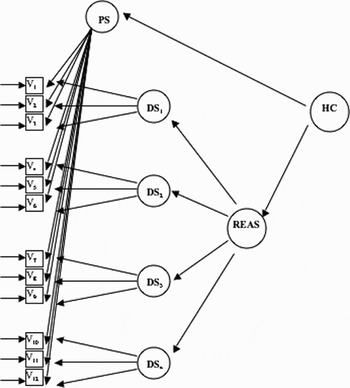
Abstract representation of the psychometric-developmental architecture of the mind. PS represents a set of first-order factors standing for processing efficiency and capacity. DS represents domain-specific factors standing for different domains of thought. REAS represents second-order factors standing for inductive and deductive reasoning. HC represents factors standing for hypercognitive self-monitoring and self-regulation processes. V stands for observed variables.

Our Figure 1 summarizes this model. The model involves four kinds of factors: (1) A set of first-order factors (PS) standing for content-free processes common to all cognitive tests, such as processing speed, inhibition, and working memory. These processes define psychometric g (Jensen Reference Jensen1998) and fluid intelligence (Blair Reference Blair2006). (2) A set of first-order domain-specific factors (DS) standing for specialized mental abilities, such as spatial, categorical, verbal, numerical, causal, and social reasoning. (3) A set of second-order factors (REAS) standing for reasoning processes. (4) A set of higher-order hypercognitive factors (HC) standing for processes used to monitor, regulate, and coordinate the processes underlying all the other factors.
In developmental time this architecture remains fairly stable, but the state of the processes and their interrelations change. Specifically, speed of processing increases, efficiency of inhibition and executive control improves, working memory expands, inferential processes become increasingly complex and abstract, and awareness and self-regulation of mental processes become increasingly refined and effective (Demetriou et al. Reference Demetriou, Christou, Spanoudis and Platsidou2002; Demetriou & Kazi Reference Demetriou and Kazi2006). Changes in speed and inhibition efficiency pave the way for working memory expansions and development in inferential processes. However, dynamic patterns of change vary with life phase. In childhood, development of reasoning depends extensively on the development of processing efficiency (55% of variance) and working memory (13% of variance), and a part of it (24% of variance) depends on changes that are specific to it (Demetriou et al. submitted; Mouyi Reference Mouyi2007). However, changes in reasoning in adolescence and adulthood are associated with changes in self-awareness (circa 40%) rather than in efficiency (Demetriou & Kazi Reference Demetriou and Kazi2006).
Mapping the P-FIT onto the PSY-DEVO model suggests some interesting isomorphisms. Specifically, the sensory areas involved in the P-FIT model are more related to the domain-specific factors of the PSY-DEVO model. The parietal areas of the P-FIT model are related to the inferential and meaning-making processes applied on domain-specific content of the PSY-DEVO factors. The frontal areas of the P-FIT model are related to working memory, attention, and executive control of the PSY-DEVO model. Finally, the anterior cingulate of the P-FIT model is related to hypercognitive intentional planning and conscious selection of responses in the PSY-DEVO model. Changes in the state and interrelations of processes in the PSY-DEVO model are associated with changes in brain volume, myelination, connectivity, and neuronal pruning of the P-FIT model. These isomorphisms support Jung & Haier's (J&H's) conclusion that empirical evidence justifies detailed explorations of individual differences in the brain. Despite this optimism, however, a feeling of “so what?” remains after reading the target article, because very little is said about issues that are important for cognitive and developmental science. In the next subsection we formulate some of these issues.
Questions for a NEURO-PSY-DEVO model. It is noted, first, that there is more to the brain bases of general intelligence than is specified in the P-FIT model. According to Osherson et al. (Reference Osherson, Perani, Cappa, Schnur, Grassi and Fazio1998), even very general inferential processes, such as inductive and deductive reasoning, are served by different neural networks (frontal gyrus and the right insular cortex for inductive reasoning and associative visual areas; the right superior parietal lobule and thalamus and the right anterior cingulate for deductive reasoning). Even the same type of reasoning, such as deductive reasoning, activates different networks depending upon the information to be integrated (Goel et al. Reference Goel, Buchel, Frith and Dolan2000). Specifically, content-based propositions activate temporal (BAs 21/22) and frontal regions (BAs 44, 8, 9). Formal propositions activate occipital (BAs 18, 19), left parietal (BA 40), bilateral dorsal frontal (BA 6), left frontal (BAs 44, 8, 10), and right frontal (BA 46) regions. Moreover, both types of reasoning share a common network in the bilateral basal ganglia, right cerebellum, bilateral fusiform gyri, and left prefrontal cortex. Therefore, depending upon the type of information to be processed, reasoning is both a linguistic syntactic system and a mental model system, which both draw upon an underlying logical interpreter.
How does each of the various networks involved at the successive stages of processing do its own job (e.g., in terms of rate coding)? How do the networks interact with one another (e.g., in terms of temporal coding)? How are they integrated into a final solution (e.g., in terms of synchronization)? What is the equivalent of the developmental patterns noted above in the organization and functioning of the brain networks involved? The research reviewed in the target article does not answer these questions. Moreover, it does not speak about what is truly general and what is truly specific in both the brain and the mind. Specifically, how much of psychometric g is associated with general brain qualities (i.e., sheer total brain volume, overall physical state of neurons and neurotransmitters, connectivity, etc.) and how much is accounted for by the fact that the brain regions specified in the P-FIT model are always engaged in cognitive processing? What are the specific networks serving the specialized reasoning domains specified in the PSY-DEVO model? For some domains (i.e., verbal, spatial, and numerical reasoning), the P-FIT model is reasonably informative. With regard to others (i.e., social, causal, and categorical reasoning), it is silent.
Also, common processes, such as executive control, planning, or response selection, specified in the PSY-DEVO model, depend on recurring patterns of coactivation of the associated regions specified in the P-FIT model. How is this neuronal dialogue orchestrated and executed? How are variations of it subjectively differentiated so that intentional decisions can be made in advance which can then be tested so that some of them are selected and others rejected? What other regions, in addition to those specified in the P-FIT model, are involved when processing surfaces to consciousness? Does awareness emerge from particular networks, such as those specified in the P-FIT model, or does it result from particular coactivation patterns that may involve alternative networks? In conclusion, the grand neuro-cognitive-developmental theory of intelligence to come would have to integrate brain maps with functional and subjective maps of mental functions into a common landscape.