Introduction
Migraine is one of the most common conditions in the world. Studies report that 18 per cent of women and 6 per cent of men in the USA suffer with migraine.Reference Stewart, Lipton, Celentano and Reed 1 Migraine is a complex neurological disorder, in which headache is but one of the symptoms.Reference Johnson 2 Although the majority of migraine sufferers do have headache, migraine can also occur without headache. Under the International Headache Society classification, this is described as migraine aura without headache. 3 Particularly in middle-aged or older adults, the aura may occur in the form of a symptom such as vertigo and become the predominant feature of the migraine attack, with little or no headache.Reference Solomon 4 Because of this, the diagnosis of migraine can be challenging.
Benign paroxysmal positional vertigo (BPPV) is the most common cause of vertigo in adults, and accounts for 50 per cent of all dizziness in adults. Frequently, the diagnosis can be made based on the patient's history and physical examination alone. In patients with BPPV, otoconia are displaced from their usual position within the utricle and migrate into one of the semicircular canals. Otoconia are small crystals of calcium carbonate derived from the utricle. They are not able to move into the canal system from a healthy utricle. The utricle may be damaged by head trauma, infection or other disorders of the inner ear (such as vestibular neuritis and Ménière's disease), or may degenerate because of advanced age.
Few articles in the literature specifically address the epidemiological relationship between migraine and BPPV.Reference Vuković, Plavec, Galinović, Lovrencić-Huzjan, Budisić and Demarin 5 , Reference Lempert, Leopold, von Brevern and Neuhauser 6 Identifying an increased prevalence of BPPV associated with migraine could help increase awareness of this pathological association and lead to modification of treatment protocols, thereby improving patient care. As such few articles exist that specifically address the relationship between migraine and BPPV, with most of them using small patient populations, we utilised our access to a large volume of patients in order to assess the epidemiological association between migraine and BPPV.
Materials and methods
This study proposal was approved by the Christiana Care Health System Institutional Review Board. The study population consisted of 501 patients, who were seen in our 2 balance centre clinics between January 2009 and March 2011. Each patient interview involved a detailed history, followed by a comprehensive neurological physical examination, including Dix–Hallpike testing utilising infrared video goggles.
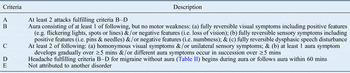
The diagnosis of BPPV was made if the patient exhibited characteristic positional nystagmus during the examination. Laterality and recurrence of the BPPV were also recorded. International Headache Society criteria were used for the diagnosis of migraine with or without aura (Tables I and II respectively). 3
International Headache Society diagnostic criteria for migraine with aura 3

International Headache Society diagnostic criteria for migraine without aura 3

Patient demographics, pertinent history, physical examination findings and subsequent diagnosis were recorded in a database. The data were then analysed to determine the percentage of patients diagnosed with BPPV that also met the International Headache Society criteria for a diagnosis of migraine. Further analysis was conducted to determine the percentage of patients diagnosed with BPPV and migraine who exhibited bilateral BPPV and recurrent BPPV.
Chi-square tests, t-tests and one-way analysis of variance were used to compare the characteristics of patients with and without migraine. Logistic regression was used to assess the association between BPPV (the dependent variable) and migraine, after adjusting for age and sex. Interactions between age and migraine, or sex and migraine, were also examined. Data were analysed using Statistical Analysis System software, version 9.2 (SAS Institute, Cary, North Carolina, USA).
Results
Of the 501 patients seen in our 2 balance centre clinics over a 2-year period, 212 (42.3 per cent) were diagnosed with BPPV, and 236 (47.1 per cent) with migrainous vertigo. Ménière's disease was apparent in 11 patients (2.2 per cent), and probable Ménière's disease in 15 patients (3.0 per cent). The prevalence of vestibular neuronitis was 4 per cent (19 patients). Eight patients (1.6 per cent) had dizziness associated with neuromuscular disorders and 20 patients (4.0 per cent) had musculoskeletal disorders.
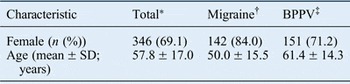
Tables III through VIII describe the patient characteristics in the entire population (n = 501). Tables IX to XII describe the patient characteristics after excluding patients with migrainous vertigo (n = 265).
Patient demographics

*n = 501; † n = 169; ‡ n = 212. BPPV = benign paroxysmal positional vertigo; SD = standard deviation
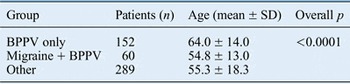
Age comparisons

SD = standard deviation; BPPV = benign paroxysmal positional vertigo
Characteristics of patients with migraine

*n = 169; † n = 332; ‡ n = 212 (migraine n = 60; no migraine n = 152). OR = odds ratio; CI = confidence interval; SD = standard deviation; BPPV = benign paroxysmal positional vertigo
Associations with active migraine defined as one year prevalence

*n = 91; † n = 11. OR = odds ratio; CI = confidence interval; SD = standard deviation; BPPV = benign paroxysmal positional vertigo
Characteristics of patients with any headache

*n = 300; † n = 201; ‡ n = 212 (all headaches n = 107; no headaches n = 105). OR = odds ratio; CI = confidence interval; SD = standard deviation; BPPV = benign paroxysmal positional vertigo
Characteristics of patients with migrainous vertigo and BPPV

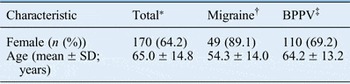
*n = 236; † n = 265. BPPV = benign paroxysmal positional vertigo; OR = odds ratio; CI = confidence interval; SD = standard deviation
Characteristics of population after excluding patients with migrainous vertigo

*n = 265; † n = 55; ‡ n = 159. BPPV = benign paroxysmal positional vertigo; SD = standard deviation
Age comparisons after excluding patients with migrainous vertigo

Groups (1) versus (2) = p < 0.05; groups (2) versus (3) = not significant; groups (1) versus (3) = p < 0.05. SD = standard deviation; BPPV = benign paroxysmal positional vertigo
Characteristics of patients with migraine after excluding patients with migrainous vertigo

*n = 55; † n = 210; ‡ n = 159 (migraine n = 38; no migraine n = 121). OR = odds ratio; CI = confidence interval; SD = standard deviation; BPPV = benign paroxysmal positional vertigo
Associations between all headaches and BPPV after excluding patients with migrainous vertigo

*n = 102; † n = 163; ‡ n = 159 (all headaches n = 68; no headaches n = 91). BPPV = benign paroxysmal positional vertigo; OR = odds ratio; CI = confidence interval; SD = standard deviation
As shown in Tables III and IV, when comparing the age of patients with only BPPV to that of patients with BPPV and migraine, or other causes of dizziness, the BPPV group (mean ± standard deviation (SD) = 64 ± 14.0 years) was significantly older than the other two groups (54.8 ± 13.0 years (p < 0.05) and 55.3 ± 18.3 years (p < 0.05), respectively). When comparing the BPPV and migraine group with the other causes of dizziness group, no significant difference was found.
Table V shows that migraine patients were considerably (84 per cent vs 16 per cent) more likely to be female, and this holds up across age groups. Migraine patients were also more likely to be younger (mean ± SD = 50.0 ± 15.5 years vs 61.8 ± 16.3 years, p < 0.0001). Overall, patients with migraine were less likely to have BPPV than those without (odds ratio = 0.65 (95 per cent confidence interval (CI) = 0.44–0.96), p = 0.028). This association disappeared when controlling for age and sex (p = 0.208). When looking only at the total group of BPPV patients, we found no association between recurrent or bilateral BPPV and migraine.
When analysing only patients with migraine (Table VI), there was no association between age or gender for those noted to have active migraine (defined as one year of prevalence) versus those without. Those patients with active migraine were less likely to have BPPV than those without (odds ratio = 0.18 (95 per cent CI = 0.05–0.75), p = 0.01), although this became less significant when adjusted for age and gender (odds ratio = 0.24 (95 per cent CI = 0.058–1.007), p = 0.0511).
When considering headache in general (Table VII), we again found that headache patients were more likely to be female. This did not change when adjusting for age. Headache patients were again more likely to be younger too (mean ± SD = 52.8 ± 16.0 years vs 65.4 ± 15.5 years, p < 0.0001). In the entire group, headache patients were less likely to have BPPV than those without (odds ratio = 0.51 (95 per cent CI = 0.35–0.73), p = 0.0002). This held up when controlling for age and sex (p = 0.0062). Again, when looking only at BPPV patients, no association was apparent between recurrent or bilateral BPPV and headache.
When analysing the subgroup with migrainous vertigo (Table VIII), we again observed that patients with migrainous vertigo were more likely to be female, although this association became non-significant when controlling for age. Younger patients were more likely to have a migrainous vertigo diagnosis (mean ± SD = 49.8 ± 15.7 years vs 65.0 ± 14.8 years, p < 0.0001). Migrainous vertigo patients were much less likely to have BPPV than those without migrainous vertigo (odds ratio = 0.19 (95 per cent CI = 0.13–0.29), p < 0.0001), and this association remained after controlling for age and sex (p < 0.0001).
As seen in Tables IX and X, when excluding patients with migrainous vertigo alone, we again observed an association between migraine and sex, as well as age. We found that patients with migraine and BPPV (mean ± SD = 55.6 ± 11.8 years) were significantly younger than those with BPPV only (66.9 ± 12.5 years, p < 0.0001) and those with other non-migrainous vertigo (66.1 ± 16.8 years, p < 0.0001).
When considering migraine patients without migrainous vertigo (Table XI), we again found no significant association between BPPV and migraine; however, there was a trend toward significance (odds ratio = 1.64 (95 per cent CI = 0.87–3.10), p = 0.122). There was no significant association between recurrent or bilateral BPPV and migraine.
Finally, we considered the subset of patients who have headaches but do not have migrainous vertigo (Table XII). Again males were much less likely to have headache (odds ratio = 0.29 (95 per cent CI = 0.16–0.51), p = 0.0001), and this held up when adjusting for age. Younger patients were again much more likely to have headache (mean ± SD = 58.9 ± 14.4 years vs 68.8 ± 13.7 years, p < 0.0001). Benign paroxysmal positional vertigo was noted to have a higher prevalence in the headache group (odds ratio = 1.58 (95 per cent CI = 0.95–2.65)), although this finding was not statistically significant (p = 0.08). No association was observed between headache and bilateral or recurrent BPPV.
Discussion
Recognition of an association between migraine and vertigo dates back almost 150 years, from the early days of clinical neurology. The English physician Edward Liveing reported that 6 of 60 patients with migraine had spontaneous attacks of vertigo.Reference Liveing 7 , Reference Boenheim 8 Since then, only a few articles in the literature have specifically addressed the epidemiological relationship between migraine and vertigo.Reference Ishiyama, Jacobson and Baloh 9 – Reference Neuhauser, Leopold, von Brevern, Arnold and Lempert 17 These articles have reported that 26–33 per cent of patients with migraine experience true episodic vertigo. This was found to be three times more common than in controls.Reference Ishiyama, Jacobson and Baloh 9 , Reference Kayan and Hood 10 , Reference Kuritzky, Ziegler and Hassanein 13 In addition, several case series have reported a high prevalence of migraine, with 30–50 per cent of patients presenting with vertigo.Reference Aragones, Fortes-Rego, Fuste and Cardozo 15 – Reference Neuhauser, Leopold, von Brevern, Arnold and Lempert 17 Although migraine has long been associated with vertigo, few articles exist in the literature that specifically address the epidemiological association between the two.
When headache is not the prominent feature, the diagnosis rests on other symptoms, such as photophobia, phonophobia, scintillating scotoma, loss of vision, numbness and/or dysphasic speech disturbance. These symptoms require precise questioning because most patients will not necessarily volunteer the relevant information. Occasionally, the association of migraine and vertigo only becomes apparent after monitoring symptoms in a daily headache journal, such as the ones provided to our patients.
Benign paroxysmal positional vertigo is the most common cause of vertigo in adults, and the most common vestibular disorder in patients presenting to dizziness clinics.Reference Neuhauser, Leopold, von Brevern, Arnold and Lempert 17 – Reference Honrubia, Baloh, Harris and Jacobson 19 Migraine and vertigo are common in the general population, with a lifetime prevalence of about 16 per cent for migraine and 7 per cent for vertigo.Reference Lempert and Neuhauser 20 Because of this, a concurrence of the two conditions can be expected in about 1.1 per cent of the general population by chance alone. However, recent epidemiological evidence suggests that the actual co-morbidity is 3.2 per cent.Reference Neuhauser, Radtke, von Brevern, Fedmann, Lezius and Lempert 21 A population-based study showed that individuals with migraine were much more likely to have vertigo and vertigo with accompanying headache than individuals without migraine (H Neuhauser et al., unpublished data).
Vertigo has been found to be two to three times more common in patients with migraine than in headache-free controls.Reference Vuković, Plavec, Galinović, Lovrencić-Huzjan, Budisić and Demarin 5 , Reference Kuritzky, Ziegler and Hassanein 13 Moreover, migraine was found to be two times more common in patients with BPPV than in controls.Reference Lempert, Leopold, von Brevern and Neuhauser 6 , Reference Aragones, Fortes-Rego, Fuste and Cardozo 15 – Reference Neuhauser, Leopold, von Brevern, Arnold and Lempert 17 , Reference Lee, Sohn, Jung, Cho, Lim and Yi 22 This may be explained by the previously mentioned fact that dizziness and vertigo, as experienced in syndromes such as BPPV, can become the predominant features of a migraine attack with or without a headache.
The mechanism for the vestibular symptoms and signs associated with migraine are not well understood.Reference Savundra, Carroll, Davies and Luxon 16 Vasospasm of the labyrinthine arteries is a possible mechanism, as vasospasm is a documented occurrence with migraine. Monocular vision loss caused by vasospasm of the ophthalmic artery occurs with migraine, and episodes of monocular visual loss can be prevented with antispasmodic agents.Reference Winterkorn, Kupersmith, Wirtschafter and Forman 23 Benign paroxysmal positional vertigo is a recognised consequence of ischaemic damage of the inner ear, presumably due to release of otoconia from the macular membrane.Reference Hemenway and Lindsay 24 Although vasospasm definitely occurs with migraine, it may be caused by a pre-existing metabolic disorder. The vasospasm associated with the classic visual aura of migraine is almost certainly secondary to a primary neuronal metabolic depression.Reference Lauritzen 25 Lending to these findings, vasospasm in the inner ear might also be the result of a primary metabolic abnormality in the inner ear itself. Peripheral vestibular abnormalities observed on electronystagmography examinations are more common in patients with migraine than in control groups.Reference Savundra, Carroll, Davies and Luxon 16 , Reference Cutrer and Baloh 26 In all probability, patients with migraine suffer recurrent damage to the inner ear due to vasospasm or some other mechanism that predisposes them to recurrent bouts of BPPV.Reference Ishiyama, Jacobson and Baloh 9
The results of our entire sample suggest that, in this population of patients with dizziness, patients with active migraine are less likely to have BPPV, as they are more likely to have migrainous vertigo. However, after excluding the patients with migrainous vertigo, patients with migraine seem to be more likely to have BPPV, although this association is not statistically significant in our data likely because of the small sample size. There was a significant association between all headaches and BPPV when excluding those patients with a diagnosis of migrainous vertigo.
We found that 26 per cent of the patients diagnosed with BPPV in our balance centre clinics also met the International Headache Society criteria for a diagnosis of migraine. This finding is comparable to previous literature reporting that 26–33 per cent of patients with migraine experience true episodic vertigo, which was three times more common than in controls.Reference Ishiyama, Jacobson and Baloh 9 , Reference Kayan and Hood 10 , Reference Kuritzky, Ziegler and Hassanein 13 We also found that of the 26 per cent diagnosed with BPPV and migraine, 38 per cent had recurrent BPPV and 33 per cent had bilateral BPPV. Similarly, one study also identified an increased prevalence (77 per cent) of patients with BPPV and migraine who also had recurrent bouts of BPPV.Reference Ishiyama, Jacobson and Baloh 9 This supports the speculation that patients with migraine undergo recurrent damage to the inner ear, which predisposes them to both bilateral and recurrent bouts of BPPV.
-
• Benign paroxysmal positional vertigo (BPPV) accounts for approximately 50 per cent of vertigo cases
-
• Migraine headache is associated with vertigo; however, few studies have examined the relationship between BPPV and migraine
-
• A single-institution retrospective review of 501 patients was performed
-
• Migraine and migrainous vertigo were more common in younger patients and females; BPPV was more common in females and older patients
-
• Migraine patients were less likely to have a BPPV diagnosis; when excluding migrainous vertigo patients, headache or migraine patients seemed more likely to have BPPV
-
• Recurrent and bilateral BPPV appeared more common in patients with migraine without migrainous vertigo
It is our hope that by confirming an increased prevalence of BPPV associated with migraine, awareness of the pathological association will grow, helping both practitioners and patients. Practitioners will be more inclined to ask detailed questions during history taking, and be more likely to treat migraine when present in patients with recalcitrant BPPV, thus promoting and improving patient care.