Introduction
Aphids are worldwide agricultural pests, which cause economic damage to many crops, directly by feeding activity and indirectly by transmitting plant viruses (Blackman & Eastop, Reference Blackman and Eastop2000, Reference Blackman, Eastop, van Emden and Harrington2007). Aphid life cycles often combine sexual and asexual reproduction (cyclical parthenogenesis), a characteristic that affects the genetic variability observed in aphid populations and their success as agricultural pests (Loxdale & Lushai, Reference Loxdale, Lushai, van Emden and Harrington2007; Simon et al., Reference Simon, Stoeckel and Denis2010). In addition to the reproductive complexity, the heteroecious cycle of some aphid species involves seasonal alternations between unrelated primary (woody) and secondary (herbaceous) hosts (Blackman & Eastop, Reference Blackman and Eastop2000). At present, the main aphid management practice used in agriculture worldwide is chemical control (Dewar, Reference Dewar, van Emden and Harrington2007). However, many aphid species have developed resistance to various chemical groups of insecticides (Foster et al., Reference Foster, Devine, Devonshire, van Emden and Harrington2007). The development and evolution of insecticide resistance in aphid pest populations is not only associated with the insecticide itself but also with the complexity of their annual life cycle and several other aspects of the agroecosystem (e.g., Fenton et al., Reference Fenton, Malloch, Woodford, Foster, Anstead, Denholm, King and Pickup2005; Zamoum et al., Reference Zamoum, Simon, Crochard, Ballanger, Lapchin, Vanlerberghe-Masutti and Guillemaud2005; Kasprowicz et al., Reference Kasprowicz, Malloch, Pickup and Fenton2008). Thus, the interplay between the complexity of aphid reproductive modes, dispersal and the evolution of insecticide resistance are still poorly understood (van Toor et al., Reference van Toor, Malloch, Anderson, Dawson and Fenton2013).
The green peach aphid Myzus persicae (Sulzer) (Hemiptera: Aphididae) is known to have different insecticide resistance mechanisms. Metabolic resistance based on enhanced activity and expression of different enzymes has been characterized (Field & Devonshire, Reference Field and Devonshire1998; Field et al., Reference Field, Devonshire and Forde1988; Puinean et al., Reference Puinean, Foster, Oliphant, Denholm, Field, Millar, Williamson and Bass2010; Silva et al., Reference Silva, Bacigalupe, Luna-Rudloff and Figueroa2012a ). In addition, four target site mutations conferring insensitivity to insecticides have been also described: (i) knock-down resistance (kdr) and super-kdr mutations in the sodium channel confer resistance to pyrethroids and DDT (Martínez-Torres et al., Reference Martínez-Torres, Foster, Field, Devonshire and Williamson1999; Eleftherianos et al., Reference Eleftherianos, Foster, Williamson and Denholm2008), (ii) modified acetylcholinesterase (MACE) confers resistance to dimethyl-carbamates and triazamate (Moores et al., Reference Moores, Devine and Devonshire1994; Nabeshima et al., Reference Nabeshima, Kozaki, Tomita and Kono2003), (iii) rdl mutation in the gamma aminobutyric acid (GABA) receptor confers resistance to cyclodienes (Anthony et al., Reference Anthony, Unruh, Ganser and Ffrench-Constant1998) and (iv) a mutation in the nicotinic acetylcholine receptor subunit b confers resistance to neonicotinoids (nAChR β1; Bass et al., Reference Bass, Puinean, Andrews, Cutler, Daniels, Elias, Paul, Crossthwaite, Denholm, Field, Foster, Lind, Williamson and Slater2011; Puinean et al., Reference Puinean, Elias, Slater, Warren, Field, Williamson and Bass2013).
The green peach aphid has an annual life cycle, in which one sexual generation on peach, Prunus persica L. (Rosaceae) (primary host), where sexual overwintering eggs are produced in autumn, alternates with many asexual (all-female) generations during spring–summer on various herbaceous hosts (secondary hosts) (Blackman & Eastop, Reference Blackman and Eastop2000, Reference Blackman, Eastop, van Emden and Harrington2007). In areas with mild winters, however, asexual genotypes that have completely or partially lost the ability to reproduce sexually can overwinter successfully on secondary hosts maintaining asexual lineages all year round. Thus, populations of the green peach aphid on spring–summer crops can be composed of a pool of genotypes coming from different origins: new recombinants migrating from peach trees and older asexual lineages coming from winter secondary hosts (Margaritopoulos et al., Reference Margaritopoulos, Tsitsipis, Goudoudaki and Blackman2002; Blackman & Eastop, Reference Blackman, Eastop, van Emden and Harrington2007). Several studies have shown that the green peach aphid populations are genetically more diverse in areas where sexual reproduction occurs than in areas where asexual reproduction predominates (Wilson et al., Reference Wilson, Sunnucks, Blackman and Hales2002; Fenton et al., Reference Fenton, Malloch, Navajas, Hillier and Birch2003; Guillemaud et al., Reference Guillemaud, Mieuzet and Simon2003a ; Blackman et al., Reference Blackman, Malarky, Margaritopoulos and Tsitsipis2007). The intense chemical control is a strong selection pressure that can substantially affect the genetic diversity and structure of the green peach aphid populations (Guillemaud et al., Reference Guillemaud, Mieuzet and Simon2003a ; Zamoum et al., Reference Zamoum, Simon, Crochard, Ballanger, Lapchin, Vanlerberghe-Masutti and Guillemaud2005; Anstead et al., Reference Anstead, Mallet and Denholm2007). In addition, insecticide resistance in the green peach aphid is associated with fitness costs (reviewed by Fenton et al., Reference Fenton, Margaritopoulos, Malloch and Foster2010; Silva et al., Reference Silva, Jander, Samaniego, Ramsey and Figueroa2012b ), because in the absence of insecticide selection, the resistant genotypes are at a considerable disadvantage (Foster et al., Reference Foster, Harrington, Dewar, Denholm and Devonshire2002; Fenton et al., Reference Fenton, Malloch, Woodford, Foster, Anstead, Denholm, King and Pickup2005; but see Castañeda et al., Reference Castañeda, Barrientos, Cortes, Figueroa, Fuentes-Contreras, Luna-Rudloff, Silva and Bacigalupe2011). Therefore, the frequency of a certain resistance mechanism in the green peach aphid populations on crops in temperate regions is expected to follow cyclical dynamics, probably corresponding to alternating periods of intense insecticide selection in spring and summer and counter selection of resistant genotypes in fall and winter (Foster et al., Reference Foster, Denholm and Devonshire2000, Reference Foster, Harrington, Dewar, Denholm and Devonshire2002; Fenton et al., Reference Fenton, Margaritopoulos, Malloch and Foster2010). Spatial and/or temporal variation in different selection factors, including host availability during different stages of the aphid's life-cycle are also expected to affect clonal composition and genetic diversity (Vorburger, Reference Vorburger2006). Likewise, because in heteroecious populations the sexual phase occurs on the primary host, a higher genetic variability is expected for those populations (Wilson et al., Reference Wilson, Sunnucks, Blackman and Hales2002; Guillemaud et al., Reference Guillemaud, Mieuzet and Simon2003a ), resulting in increased chances to reach the end of the season with higher genetic diversity and frequency of alleles conferring insecticide resistance mechanism. However, the dynamic of both the genetic diversity and insecticide resistance during the growing season in populations of the green peach aphid on its primary and secondary hosts it remains poorly understood, particularly at a farm-scale (van Toor et al., Reference van Toor, Malloch, Anderson, Dawson and Fenton2013).
It is worth mentioning that evidence of overwintering eggs and a holocyclic life cycle have been reported for the green peach aphid in Central Chile (Zúñiga, Reference Zúñiga1969). Consistent with this information, Fenton et al. (Reference Fenton, Margaritopoulos, Malloch and Foster2010) found a high genetic diversity and no deviation from Hardy–Weinberg equilibrium in a small sample of the green peach aphid from potatoes in Central Chile, thus suggesting that sexual reproduction may occurs in this zone. Insecticide resistance conferred by kdr, super-kdr and MACE, has been also reported in Chilean populations of M. persicae mostly from secondary hosts (Castañeda et al., Reference Castañeda, Barrientos, Cortes, Figueroa, Fuentes-Contreras, Luna-Rudloff, Silva and Bacigalupe2011; Silva et al., Reference Silva, Bacigalupe, Luna-Rudloff and Figueroa2012a ; Fuentes-Contreras et al., Reference Fuentes-Contreras, Silva, Bacigalupe, Foster, Unruh and Figueroa2013). Hence, in the present study, the genetic diversity measured with neutral markers, along with the prevalence and temporal variation of different insecticide resistance markers, were characterized in the green peach aphid samples collected from peach orchards and sweet-pepper fields (Capsicum annum var. grossum L.). Both crops are heavily attacked by this pest aphid in Central Chile and mainly controlled with synthetic insecticides. The specific aims of this study were to characterize the genetic diversity and the insecticide resistance profile of the green peach aphid samples collected from peach and their companion uncultivated weeds throughout the growing season in order to compare the genetic structure and insecticide resistance profiles early and late in the season. A parallel study in a nearby sweet-pepper field (crop which is a secondary host of the green peach aphid), which was also subjected to insecticide applications and contained companion uncultivated plants as well, was also performed for comparative reasons. This will help us to establish to what extent the green peach aphids from weedy plants represent a source of individuals dispersing to crops. This will also provide a farm-scale view of the temporal and spatial dynamic of green peach aphid dispersal and the development of insecticide resistance within a growing season.
Materials and methods
Aphid samples
Samples of the green peach aphid were collected from a peach orchard in Quinta de Tilcoco (34°21′6.71″S, 70°53′53.26″W) and from a sweet-pepper field in Rengo (34°24′34″S, 70°52′35″W). The two sampling sites were approximately 7 km apart and located in the O'Higgins Region in Central Chile. The peach orchard included a plot of about 3 ha with about 2800 trees, whereas the sweet-pepper field was of 1.5 ha with about 60,000 plants. In the peach orchard, four metamidophos (organophosphate), three imidacloprid (neonicotinoid) and two thiamethoxam+chloranthraniliprole (neonicotinoid+diamide) sprays were performed during the season to control aphids and other pests. Three-lambda cyhalothrin (pyrethroid) and two imidacloprid (neonicotinoid) sprays were used against aphids in the sweet-pepper field. In addition, two cartap hydrochloride (nereis toxin) and three flubendiamide (dimaide) sprays were used against other pests in the sweet-pepper field (see supplementary table S1 and S2).
The collections were conducted monthly from September 2010 to July 2011. Approximately five wingless and winged individuals were collected from 20 randomly selected plants during each sampling occasion. To avoid the collection of individuals from the same asexual lineage, the distance between each sampled peach tree and pepper plant was about 20 and 5 m, respectively. All sampled aphids were identified as female M. persicae following specific taxonomic keys (Blackman & Eastop, Reference Blackman and Eastop2000). Since aphid populations in both crops are chemically controlled, the dates of applications and type of insecticide used were recorded (see table S1 in supplementary data). In addition, samples of the green peach aphid were also collected from the predominant weed species in each sampling site. These weeds were growing either around the drip line or between individual trees. Sampled weeds belonged to Asteraceae, Brassicaceae, Malvaceae, Solanaceae and Amaranthaceae, where the green peach aphid has been described to develop (Blackman & Eastop, Reference Blackman and Eastop2000). Also, samples were taken from some tomato plants, Solanum lycopersicum L., that sprouted from the previous year in the sweet-pepper field. A total of 649 aphids were collected in the field using a paintbrush and stored in 95% ethanol.
Aphid genotyping and identification of resistance mutations
All 649 aphids were genotyped using six microsatellite loci (Myz2, Myz3, Myz9, Myz25, M35 and M40), which have been described and used extensively for M. persicae (Wilson et al., Reference Wilson, Sunnucks, Blackman and Hales2002; Fuentes-Contreras et al., Reference Fuentes-Contreras, Figueroa, Reyes, Briones and Niemeyer2004; Malloch et al., Reference Malloch, Highet, Kasprowicz, Pickup, Neilson and Fenton2006; Vorburger, Reference Vorburger2006; Margaritopoulos et al., Reference Margaritopoulos, Skouras, Nikolaidou, Manolikaki, Maritsa, Tsamandani, Kanavaki, Bacandritsos, Zarpas and Tsitsipis2007; Kasprowicz et al., Reference Kasprowicz, Malloch, Pickup and Fenton2008; Silva et al., Reference Silva, Bacigalupe, Luna-Rudloff and Figueroa2012a ). Genomic DNA (gDNA) was obtained using the ‘salting-out’ method (Sunnucks & Hales, Reference Sunnucks and Hales1996). Genotyping of individuals was performed using the M13 labelling technique with fluorescent dyes described by Schuelke (Reference Schuelke2000) followed by automated fragment analysis by Macrogen Inc. (Korea). Allele sizes were determined using GENEMARK version 1.3 (Borodovsky & McIninch, Reference Borodovsky and McIninch1993). We assessed the presence of null alleles using MICRO-CHEKER version 2.2.3 software (Van Oosterhout et al., Reference Van Oosterhout, Hutchinson, Wills and Shipley2004) and estimated their frequency according to Brookfield (Reference Brookfield1996) as implemented in GENEPOP version 3.2A. The identification of insecticide resistance mutations was performed using the TaqMan assay in a STRATAGENE MX 3000 (Agilent Technologies, Santa Clara, CA) thermocycler. The kdr and super-kdr mutations were identified according to Anstead et al. (Reference Anstead, Williamson, Eleftherianos and Denholm2004), while MACE according to Anstead et al. (Reference Anstead, Williamson and Denholm2008).
Data analysis
Distinct multilocus genotypes (MLGs) were discriminated using the software GenClone 2.0 (Arnaud-Haond & Belkhir, Reference Arnaud-Haond and Belkhir2007), which allowed assigning specimens with identical allele composition to a given MLG. The genetic diversity of the samples was assessed with clonal diversity index (P d =G/N), clonal heterogeneity indices (D*, adapted Simpson's index) and clonal evenness index (ED*, Simpson's evenness index). The distribution of replicates among MLGs was analysed using the Pareto's power law distribution. The power slope (–β) was derived as the slope of the fitted log–log regression equation between the inverse cumulative frequency of specimens belonging to a given MLGs in the whole sample vs. the observed number of specimens in each MLGs (Arnaud-Haond et al., Reference Arnaud-Haond, Duarte, Alberto and Serrão2007). The probability that replicates of the same MLG are products of different sexual reproductive events was calculated using P SEX statistic as implemented in MLGsim 2.0, an updated version of MLGsim (Stenberg et al., Reference Stenberg, Lundmark and Saura2003) facilitated by Dr Aniek Ivens.
The data-set included both unique and multicopy MLGs. However, subsequent analyses were made using only one copy of each MLG, because clonal ‘amplification’ is not equal over all genotypes and can lead to deviations from the Hardy–Weinberg equilibrium within samples, thus distorting the estimates of allele frequencies (Halkett et al., Reference Halkett, Plantegenest, Prunier-Leterme, Mieuzet, Delmotte and Simon2005; Sunnucks et al., Reference Sunnucks, De Barro, Lushai, Maclean and Hales1997 have proposed first this approach). Allele frequency, expected (H Exp) and observed (Ho) heterozygosities, deviations from Hardy–Weinberg equilibrium, and linkage disequilibrium were analysed using the exact tests implemented in GENEPOP version 3.2a (Raymond & Rousset, Reference Raymond and Rousset1995). Αllelic richness (R s =number of alleles independent of sample size) was calculated using FSTAT version 2.9.3.2 (Goudet, Reference Goudet1995). An analysis of molecular variance (AMOVA) was performed in order to compare samples between sampling sites [peach (P) and sweet-pepper (C) fields] and between hosts within sites [P and weeds in the peach field (WP)]; C and weeds in the sweet-pepper field (WC). Two additional AMOVAs were performed to test for genetic differentiation throughout the season (spring–summer, SS; autumn–winter, AW; September–March and March–May, respectively) and host (crops and weeds) in each site. Thus, in the peach field compared groups were PSS, PAW, WPSS and WPAW, whereas in the sweet-pepper field groups were CSS, CAW, WCSS and WCAW. Genotypes grouped according to the sampling periods was also performed. AMOVA analyses were performed using ARLEQUIN version 3.5 (Excoffier & Lischer, Reference Excoffier and Lischer2010). In addition, pairwise F ST differentiation tests among samples were performed based on 1000 permutations of MLGs.
Genetic analyses without defining a priori groups were subjected to a Bayesian clustering and admixture analysis as implemented in STRUCTURE version 2.3.2 (Pritchard et al., Reference Pritchard, Stephens and Donnelly2000). The number of population (K) tested ranged from 1 to 10, with 10 runs per each K, 100,000 burn-in and 106 Monte Carlo Markov Chain iterations. The determination of the number of genetic clusters was based on the ΔK criterion of Evanno et al. (Reference Evanno, Regnaut and Goudet2005) using Structure Harvester (http://taylor0.biology.ucla.edu/structureHarvester/). The genotypic diversity index, frequencies of MLGs carrying different insecticide resistance mutations and allele frequencies of kdr, super-kdr and MACE among samples were compared using χ2 test. When necessary, multiple proportions were compared using the Marascuilo procedure implemented in XLSTAT-pro 7.5 (Addinsoft, New York, USA) software. Non-random association between pairs of insecticide resistance mutations was estimated using the exact tests implemented in GENEPOP version 3.2a (Raymond & Rousset, Reference Raymond and Rousset1995).
Results
Distribution of genotypes and genetic diversity
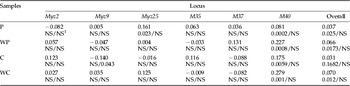
All six microsatellite loci were polymorphic with a mean number of alleles ranging from 6.3 to 7.0 per sampling site. No evidence for null alleles was found in the six loci using MICRO-CHECKER software. The global heterozygocity test revealed a significant deficiency in the overall sample (table 1), with locus M40 showing the highest deviation (heterozygote deficit). In addition, the Brookfield (Reference Brookfield1996) method revealed very low frequencies of null alleles (table 2). Sampling sites exhibited similar population genetic parameters, although the samples collected on peach trees showed the highest genetic diversity (P d and D* indices, table 2). Eight, six, 10 and 13 out of 15 pairs of loci were in significant linkage disequilibrium in the samples from peach (P), weeds in the peach orchard (WP), sweet-pepper (C) and weeds in sweet-pepper field (WC), respectively.
FIS values of single and multilocus probability tests for deviations from Hardy–Weinberg equilibrium for M. persicae. P=samples from peach; WP=samples from weeds in the peach orchard; C=samples from the sweet-pepper field; WC=samples collected from weeds in the sweet-pepper field.

1 Probabilities for heterozygote deficit and heterozygote excess, NS=not significant.
Population genetic parameters. Number of aphids analysed (N), number of multilocus genotypes (G), clonal diversity index (P d=G/N), clonal heterogeneity indices (D*, adapted Simpson's index), clonal evenness index (ED*, Simpson's evenness index), slope of Pareto distribution (β), mean number of alleles (n), proportion of null alleles (A n ), allelic richness (R s, number of alleles independent of sample size), heterozygosity expected (H EXP) and heterozygosity observed (H O) and inbreeding coefficient (F IS) over all loci.

1 For definitions of samples see table 1.
2 Note that MLGs in each sample could include genotypes shared with the other samples.
3 Probabilities for heterozygote deficit and heterozygote excess in brackets. NS=not significant.
The genotyping of 649 individuals allowed the identification of 202 MLGs. Considering both sites, a total of 50 MLGs were collected more than once, which accounted for 76.6% of the aphids examined. The Pareto distribution of MLGs showed that the peach sample exhibited the steepest slope (high β value), indicating a high evenness with MLGs having comparable numbers of specimens. By contrast, the other samples showed lower slopes indicating skewed distributions, with a few large MLGs bearing many replicates and many small MLGs. The P SEX values and the corresponding statistical P values suggested that all replicates of each multicopy MLG derived from asexual reproduction (data not shown).
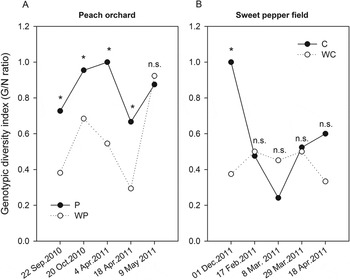
Across the whole season, (table 2) the peach sample had the highest the genetic diversity. The genotypic diversity index was significantly higher in P samples than in WP samples during the season (fig. 1a), except during late the season (9th May, 2011). The genotypic diversity in the C samples was higher than in WC samples only earlier in the season, while no significant differences were found in the second part of the summer (fig. 1b).
Diversity (P d) of M. persicae genotypes in the two sampling sites during time. Dates plotted were those including data for both sites and hosts. Asterisk indicates significant difference (P<0.05) followed k proportions test using Marascuilo procedure.

Six MLGs were the most common (>5% of the total MGLs; G25, G29, G84, G154, G178 and G201), accounting for 47.3% of the aphids examined (table 3). Five of these MLGs were found in WP, C and WC samples, and only one (G178) was found in all sampling sites. All these six genotypes were collected during autumn–winter, which might suggest they were asexual lineages.
Details of the six most common genotypes found in the study. N=number of aphid characterized as a certain genotype and in parentheses the frequency of each genotype in the total sample. AW=autumn–winter.

1 For definitions of samples see table 1.
Genetic differentiation among populations
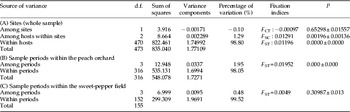
AMOVA showed a lack of differentiation among sampling sites but significant differences among hosts within sites and within hosts (table 4A). The pairwise F ST was significant between the following pairs of samples: P vs. WP, P vs. WC and C vs. WC (P=0.0005, P=0.0001 and P=0.0283, respectively). The AMOVA examining the levels of genetic variation through the season (spring–summer, SS vs. autumn–winter AW periods) in each site, revealed significant differentiation between sampling periods only in the peach orchard (table 4B, C). In this site, significant F ST values between SS and AW periods in both P and WP samples were found (P=0.021 and 0.0001, respectively).
Analyses of molecular variance of M. persicae comparing samples at different levels.

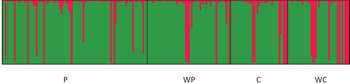
The Bayesian analysis of population genetic structure revealed that the best partition of the dataset was two genetic clusters as the modal value of ΔK (Evanno method) was at K=2. In addition, the LnPPD values (posterior probability) reached a plateau at K=2–4, but K=2 seems to be the best solution in order to avoid unjustified over-splitting of the data, albeit these two genetic clusters were not associated with sites or hosts (fig. 2). The mean membership coefficients for the samples P, WP, C and WC to clusters 1 and 2 were: 0.872, 0.880, 0.813, 0.732 and 0.128, 0.120, 0.187, 0.268, respectively. The individuals were assigned to each cluster when their proportion of ancestry in a cluster was >80%, otherwise they were considered as admixed. This empirical threshold was determined after analysing the distribution of mean ancestry coefficients of the individuals. Thus, cluster 1 contained the main part of the MLGs from the four samples, whereas cluster 2 was constituted only by 20 MLGs and six MGLs were admixed between the two clusters.
Admixture clustering plots of the four M. persicae samples from Central Chile. Number of genetic clusters, K=2; Cluster 1=green colour, Cluster 2=red colour. Each aphid is represented as a vertical bar partitioned into K segments. The lengths of each segment are proportional to the estimated membership coefficients of the aphid in each of the two K clusters. The plot is based on results from admixture ancestry and independent allele frequency models. Peach (P) weeds in site A (WP); crops (C) and weeds in site B (WC).

Insecticide resistance mutations
The three resistance mutations analysed in this study (kdr, super-kdr and MACE), had different prevalence in the MLGs of M. persicae from both sampling sites and host-plants. Considering the whole sample, most of the MLGs were heterozygous for the kdr mutation (RS), whereas for super-kdr and MACE the susceptible genotypes (SS) were predominant (table 5). Across all samples, the locus pair kdr and super-kdr and kdr and MACE were both in linkage disequilibrium (χ2=infinity, P<0.002 and χ2=36.8. P<0.0001, respectively), whereas super-kdr and MACE were in linkage equilibrium (χ2=14.3, P=0.075). The linkage disequilibrium between pairs of loci in each sampling site showed that the three loci of resistance mutations were in linkage equilibrium only in samples from peach trees (table 1).
Percentage of MLGs exhibiting different insecticide resistance genotypes and the frequency of the R allele (f(R)) for the three mechanisms evaluated in Central Chile during September 2010–July 2011.

1 For definitions of samples and season see table 1.
2 Proportions within a column followed by a different letter are significantly different according to k proportions test using Marascuilo procedure.
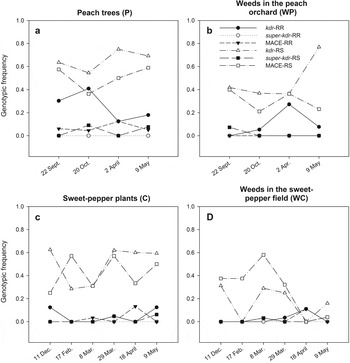
MLGs collected from peach trees showed higher frequencies of RS for kdr and MACE than on their contiguous weeds during the season (fig. 3a), although in weed samples RS kdr increased at the end of the season (AW). The frequency of RR kdr was higher early in the season on peach trees (fig. 3a), whereas the opposite was observed for samples from weeds in the peach orchard (fig. 3b). In the sweet-pepper samples, kdr and MACE genotypes were also predominantly RS, with a few changes during the season (fig. 3c). This pattern was initially similar in the weeds in the sweet-pepper field but with a sharp decrease of both RS kdr and RS MACE towards the end of the season (fig. 3d).
Frequency of genotypic RR and RS for the three insecticide mechanisms genotypes throughout the season in the two field and its samples. Peach (P) and weeds in site A (WP); crops (C) and weeds in site B (WC).

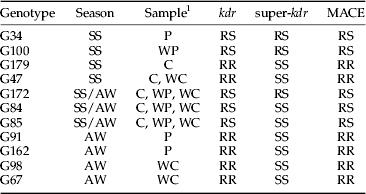
Some MLGs carried more than one resistance mechanism (table 6). Two MLGs (G179 and G47) found early in the season were RR for kdr and MACE mutations. One MLG was found only in C and the other in C and WC. Two other MLGs (G91 and G162) with similar profiles were collected at the end of the season on peaches (table 6). In addition, two MLGs (G98 and G67) with similar profiles were found exclusively in autumn on WC. There were also RS genotypes for all the three mechanisms (kdr, super-kdr and MACE), mostly found early in the season. However, genotype G172 seems exceptional because it was RS for all the three resistance mechanisms and was collected in samples C, WP and WC in both seasons (SS and AW). Different profiles were found in the six commonest genotypes, where the S allele for the three mechanisms was most frequent (table 3). Only one predominant MLG, G84, exhibited R alleles for kdr and MACE but in the RS form (table 3).
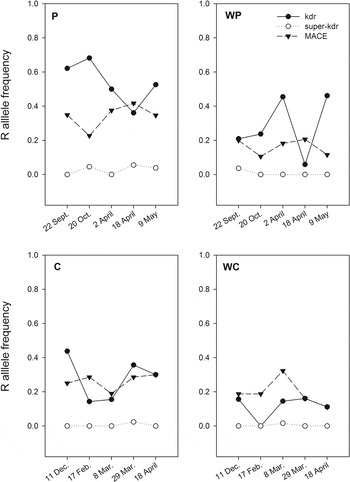
Variation in the frequency of R allele for the three insecticide resistance mutations genotypes throughout the season in the two fields and its samples. Peach (P) weeds in site A (WP); crops (C) and weeds in site B (WC).

Details of genotypes with more than one insecticide resistance mutation sorted by the collection season. SS: spring–summer; AW: autumn–winter.

1 For definitions of samples see table 1.
Discussion
Distribution of genotypes and genetic diversity
A global view of our results is that the genetic composition of the green peach aphids collected in a peach orchard and a sweet-pepper field in Central Chile constitutes predominantly one genetic cluster in Central Chile. This global lack of genetic differentiation of the green peach aphid may be the result of different non-exclusive processes. On the one hand, because samples were collected from close localities (7.2 km apart), thus sharing similar agroclimatic conditions, high inter-crop migration may have been taking place (Irwin et al., Reference Irwin, Kampmeier, Weisser, van Emden and Harrington2007). The central valley in the O´Higgins region of Central Chile is a rather flat area covered extensively by several crop species, reaching up to 80,000 ha (Aguayo et al., Reference Aguayo, Pauchard, Azócar and Parra2009). This area includes many hosts where the green peach aphid can develop (mostly members of Compositae, Cruciferae, Cucurbitaceae, Solanaceae, Chenopodiaceae and Rosaceae), which may facilitate the colonization via stepping-stone dispersal and possibly the development of a metapopulation structure (Massonnet & Weisser, Reference Massonnet and Weisser2004, Loxdale et al., Reference Loxdale, Schoefl, Wiesner, Nyabuga, Heckel and Weisser2011). On the other hand, the genetic similarity between both sampling sites may be a consequence of the relatively recent introduction of M. persicae to Chile (Artigas, Reference Artigas1994), and not enough time has passed for the local populations to reach genetic differentiation. Nevertheless, compared with other studies, the level of genetic diversity found in our study (combining samples from peach and sweet-pepper) appears to be moderate.
We found 202 MLGs out of 649 individuals that were genotyped. To our knowledge, the lowest genetic variation for M. persicae has been described in Scotland, where only 21 different MLGs out of 1497 individuals studied were identified from suction traps and secondary hosts sampling (Kasprowicz et al., Reference Kasprowicz, Malloch, Pickup and Fenton2008). In Greece, 16 M. persicae MLGs accounted for 49.0% of the 482 clonal lineages examined in several hosts, although on peaches this variation was the highest, with 72 unique MLGs out of the 74 aphid lineages examined (Blackman et al., Reference Blackman, Malarky, Margaritopoulos and Tsitsipis2007). In addition, a high percentage (∼68%) of unique MLGs was found on herbaceous crops in main peach-growing region in the North, where the common MLGs predominated in non-peach-growing regions, especially in the south. This pattern was correlated to differences in life cycles in the different regions of Greece (Blackman et al., Reference Blackman, Malarky, Margaritopoulos and Tsitsipis2007). The pattern in Greece is somewhat different with that in Central Chile as we observed a low percentage of MLGs on pepper in a peach-growing area. Some studies on samples from herbaceous crops reported similar or lower MLG diversity compared with that found on herbaceous crops in Central Chile. Zamoum et al. (Reference Zamoum, Simon, Crochard, Ballanger, Lapchin, Vanlerberghe-Masutti and Guillemaud2005) identified only 16 MLGs among 255 individuals (from oilseed rape; mostly asexual lineages) in France. A total of 72 different MLGs were identified from 365 individuals from various secondary hosts in Australia (Vorburger, Reference Vorburger2006). In New Zeland, a study found 23 MLGs out of 72 lineages genotyped from secondary hosts (van Toor et al., Reference van Toor, Foster, Anstead, Mitchinson, Fenton and Kasprowicz2008, Reference van Toor, Malloch, Anderson, Dawson and Fenton2013). In Spain, a recent study described 289 different genotypes out of 630 individuals, including samplings from secondary and the primary hosts (Sanchez et al., Reference Sanchez, La-Spina, Guirao and Cánovas2013). It is worth noting that differences in the genetic diversity estimations might be due to the use of different sampling methods and number of microsatellite loci. However, differences in breeding system invested by the aphid populations should also be taken into account as this substantially affects genotypic variability.
Previously, Fenton et al. (Reference Fenton, Margaritopoulos, Malloch and Foster2010) studied a small sample of 13 individuals from a potato field in Chile, identifying ten MLGs at six loci. The larger sample analysed in our study allows us to confirm that the genetic diversity of Chilean population of the green peach aphid sampled from peach is similar to that reported in France by Fenton et al. (Reference Fenton, Margaritopoulos, Malloch and Foster2010), Australia (Wilson et al., Reference Wilson, Sunnucks, Blackman and Hales2002) and Greece (Blackman et al., Reference Blackman, Malarky, Margaritopoulos and Tsitsipis2007). In our work, we also found that the M40 locus displayed a heterozygote deficit, a result that is more in line with that of the populations from Southern France included in that study. The potato samples of the green peach aphid in Fenton et al. (Reference Fenton, Margaritopoulos, Malloch and Foster2010) were possibly originated from adjacent peach plantations, since they were collected in the Aconcagua valley (Colina) where stone-fruits are regularly cultivated. Notably, both the studies support the notion that locus M40 may be linked with insecticide resistance and therefore being continuously selected (Fenton et al., Reference Fenton, Margaritopoulos, Malloch and Foster2010), although direct evidence for this correlations have not yet found.
Sexual and asexual lineages in Central Chile
The finding that genetic diversity (e.g., number of unique MLGs vs. multicopy MLGs and genotypic diversity) was higher on peach (table 2), suggests that on this host the predominant reproductive mode was sexual. In contrast, the fact that only the six most common multicopy MLGs accounting for the 47.3% of the studied sample, which were also mostly present late in the season and during winter, suggest that these six lineages are obligately parthenogenetic lineages. The replicated MLG's in the whole sample were probably asexually produced, as confirmed by the low P SEX values. Five of these most common multicopy MLGs (G154, G29, G84, G201 and G25) were found on all secondary hosts (WP, C and WC; table 3). This segregation may be underlying the small but significant genetic differentiation between peach trees and the nearby weeds (table 4), despite the short distance between them (ca. 50 m). In addition, a small but significant genetic differentiation within hosts at each sampling site, as well as within-season, was confirmed (table 4). Such differentiation could be due to different sub-populations: one composed by sexual lineages on peach trees and the other by obligate parthenogenetic lineages on secondary hosts such as sweet-pepper and weeds, with restricted gene flow between them. It is interesting to note that in the sweet-pepper field there was also genetic differentiation between the crop and the weeds (table 4B), indicating that even among secondary hosts, M. persicae exhibited some degree of restricted gene exchange, a possible indication of host-associated lineages. Nevertheless, the small F ST values among sites, hosts and seasons found in this farm-scale study may be also the result of the relatively low number of loci.
The AMOVA and F ST analyses that considered a temporal scale [early and late in the season (SS and AW, respectively)] provided further information about the spatial–temporal dynamic of M. persicae at the farm-scale. It was found that SS and AW samples from peach trees and from weeds within this orchard exhibited differentiation, thus suggesting some degree of ‘isolation by time’ during the season. This could be associated with the observation that early in the season, aphids from peach trees exhibited a larger genotypic diversity than those from its associated weeds (fig. 1a). That difference was not evident late in the season when both groups converged to similar, but increased genetic diversities. This was mostly due to the increase in the genotypic variability on weeds in the fall because genotypic diversity was comparable between peach samples collected in spring and autumn (fig. 1a) (P d for pooled samples in spring and autumn: 0.836 vs. 0.838). Another factor that could account for the genetic differentiation between spring and autumn samples in peach, is that autumn samples consisted of sexual genotypes from various genetic pools (i.e., aphids migrate from hosts away from the studied orchard). The enrichment in the genotypic diversity on weed samples through the season could be attributed to the relaxation of the insecticide applications in the orchard after spring and to the migration from different genetic pools. The lack of genetic differentiation late in the season (table 4B) is congruent with genotypic diversity data, suggesting that M. persicae from peaches and weeds progress throughout the season to comprise a single population. A similar difference in the degree of genetic differentiation between early and late season samples has been reported for Aphis glycines (Orantes et al., Reference Orantes, Zhang, Mian and Michel2012), which also alternates among primary (Rhamnus spp.) and secondary (Glycine max) hosts. Other studies with anholocyclic aphid species such as Sitobion miscanthi and Tuberculatus quercicola have described a lack of differentiation within the season (Wang et al., Reference Wang, Shen, Gao and Zhang2008; Yao & Akimoto, Reference Yao and Akimoto2009).
In the sweet-pepper field, only the samples of M. persicae collected early in the season exhibited a higher genotypic diversity than those from its associated weeds, which afterward was generally low (fig. 1b). This could be related to the intensive use of pesticides by growers in Chile (Fuentes-Contreras et al., Reference Fuentes-Contreras, Basoalto, Sandoval, Pavez, Leal, Burgos and Muñoz2007, Reference Fuentes-Contreras, Silva, Bacigalupe, Foster, Unruh and Figueroa2013), which could reduce the genetic diversity by selecting those insecticide resistant genotypes throughout the growing season. In our study sites, the insecticide applications were more frequent during early and mid-spring (early in the season), and become less frequent during summer, with none just before harvest. Clonal selection throughout the season might be occurring after the migration of numerous genotypes from peach (and/or weeds) to herbaceous crops decreasing the diversity at the end of the season. Our estimations of the genetic diversity suggest that early in the season, a large number of M. persicae lineages are produced from overwintering eggs on peaches, which initially proliferate asexually on peach trees and subsequently disperse to secondary hosts. In contrast, M. persicae lineages from uncultivated secondary hosts probably consist mostly of a few asexual lineages that are able to overwinter on these hosts and proliferate asexually during spring–summer, with some sexual genotypes returning to peach trees in autumn. The interplay between pest management programmes undertaken in both crops and the particularities of the life cycle of M. persicae are producing a dynamic within-season turnover of genotypes on the primary and secondary hosts. The possibility to track the spatiotemporal variation of insecticide resistance alleles in this system gave us some insights about how the insecticides are modulating the genetic structure of M. persicae.
Dynamics of insecticide resistance mutations during the growing season
The higher frequency of R alleles for kdr and MACE resistance mechanisms in the peach orchard, particularly on peach trees (table 6), suggest a strong selection for these alleles in the peach orchard surveyed. A similar situation with high frequency of kdr and MACE resistance alleles in green peach aphid samples from peach orchards in Central–Southern Italy have been reported (Criniti et al., Reference Criniti, Mazzoni, Cassanelli, Cravedi, Tondelli, Bizzaro and Manicardi2008). It is noteworthy that the insecticide sprays were not the same in both peach and sweet-pepper orchards. The peach orchard applications included organophosphates, neonicotinoids and a diamide, while applications including pyrethroids, neonicotinoids, nereis toxin and a diamide were performed in the sweet-pepper field. Furthermore, in our study the presence of kdr and MACE, followed a similar trend during the season, particularly the RS genotypes on peach trees (fig. 3a). This is also in agreement with previous studies showing linkage disequilibrium between different insecticide resistance mechanisms (Devonshire et al., Reference Devonshire, Field, Foster, Moores, Williamson and Blackman1998; Foster et al., Reference Foster, Denholm and Devonshire2000; Criniti et al., Reference Criniti, Mazzoni, Cassanelli, Cravedi, Tondelli, Bizzaro and Manicardi2008; Castañeda et al., Reference Castañeda, Barrientos, Cortes, Figueroa, Fuentes-Contreras, Luna-Rudloff, Silva and Bacigalupe2011). Interestingly, in our study, linkage disequilibrium was observed only in samples from secondary hosts and not from peach trees. Linkage disequilibrium among resistance mechanisms was also not found in the green peach aphid samples from peach trees in southern France by Guillemaud et al. (Reference Guillemaud, Brun, Anthony, Sauge, Boll, Delorme, Fournier, Lapchin and Vanlerberghe-Masutti2003b ). The linkage we observed in herbaceous hosts is similar to what occurs in Central–Southern Italy, where milder winter promotes the asexual reproduction and along with insecticide selection pressure favour a combination of resistance alleles (Criniti et al., Reference Criniti, Mazzoni, Cassanelli, Cravedi, Tondelli, Bizzaro and Manicardi2008). On the other hand, in our study the frequency of RR kdr was higher early in the season on peach trees and the opposite was observed in samples from weeds in the peach orchard. A higher frequency of kdr alleles in peach orchards sprayed with pyrethroids has been reported in the south of France, although in autumn and summer (Guillemaud et al., Reference Guillemaud, Brun, Anthony, Sauge, Boll, Delorme, Fournier, Lapchin and Vanlerberghe-Masutti2003b ). However, in our study the higher frequency of kdr alleles may not be explained exclusively by the insecticide sprays in the peach orchard during the season. The insecticide resistance profiles alone can be misleading in predicting aphid survival, as with green peach aphid genotypes on potato crops following the application of different insecticides (van Toor et al., Reference van Toor, Malloch, Anderson, Dawson and Fenton2013).
Unexpectedly, in the green peach aphids from the sweet-pepper field the frequency of resistance alleles was lower than in samples from the peach field, particularly in aphids collected from the associated weeds (fig. 3d). In addition, the S alleles for the three resistance mechanisms were more frequent in the sweet-pepper field, particularly on weeds late in the season (fig. 3d). The latter could be the result of a lower effect of insecticide sprays, but this is less likely because there were ten different applications. In a recent study, Silva et al. (Reference Silva, Jander, Samaniego, Ramsey and Figueroa2012b ) showed that sensitive genotypes (SS) of the green peach aphid in Chile exhibited the higher transcriptional plasticity and performance in sweet-pepper than the RR genotypes. It is also likely that linkage disequilibrium between this mutation and other insecticide resistance mechanisms, mainly those based on metabolic resistance (e.g., those mediated by esterases, cytochrome P450 and eventually glutathione S transferases), are also participating in shaping the genetic structure of aphid populations (Devonshire et al., Reference Devonshire, Field, Foster, Moores, Williamson and Blackman1998; Silva et al., Reference Silva, Jander, Samaniego, Ramsey and Figueroa2012b ).
The six most common asexual MLGs found in our study exhibited a low frequency of insecticide resistance alleles (table 3). For example, genotype G178, which was found in all samples in the AW season, was SS, SS and RS for kdr, super-kdr and MACE, respectively. The other five most common genotypes also carried mostly susceptible alleles and were found on WP, C and WP, but not on peach trees. In contrast, Zamoum et al. (Reference Zamoum, Simon, Crochard, Ballanger, Lapchin, Vanlerberghe-Masutti and Guillemaud2005) studying the genetic variability and the insecticide resistance genes in samples of the green peach aphid that were collected in oilseed rape Brassica napus L. (Brassicaceae) crops in France in the mid-autumn, reported one frequently detected genotype, which combined two insecticide resistance mechanisms. The intensification of both insecticide treatments and oilseed rape cultivation may have favoured a few genotypes (Zamoum et al., Reference Zamoum, Simon, Crochard, Ballanger, Lapchin, Vanlerberghe-Masutti and Guillemaud2005). The susceptibility to insecticide resistance of the most common genotypes in Chile on secondary hosts is possibly the result of admixture between resistant sexual genotypes on peach trees and susceptible genotypes and functional parthenogens (that produce a few sexuals) from secondary hosts. Indeed, the low genetic differentiation between samples from peach and weeds in the peach orchard found at the end of the season suggest that aphids from weeds may contribute some genotypes to the sexual phase that takes place on peach in autumn and thus, new asexual genotypes (functional parthenogens) could be created. This could be the case of super-kdr RS genotypes, found in higher frequency on weeds of the peach orchard at the end of the season and thus might play some role in the restoration of resistant genotypes which will emerge during the next season. Another possible explanation might be that the six most common genotypes are associated mostly with weeds where they do not receive direct insecticide sprays (except from spray drift), and thus might also have some performance advantages compared to the resistant genotypes.
The supplementary materials for this article can be found at http://www.journals.cambridge.org/ber.
Acknowledgements
This work was funded by Fondecyt 1100746 to CCR and CCF. JARR acknowledges fellowships for PhD studies granted by Organización de Estados Americanos (OEA) and Comisión Nacional de Investigación Científica y Tecnológica (CONICYT), Chile. JTM received support from MEC 80112012 (CONICYT) grant to perform a research visit to Universidad de Talca, Chile.