Introduction
Vishwakarma—literally “All-Maker” or “Maker of the Universe”—is a deity in the Hindu and Buddhist pantheon of gods and celestial beings.Footnote 1 Recalled in myth for making emblematic weapons and marvelous dwellings for the gods, he has long been honored in the homes and domestic workshops belonging to India's hereditary artisan castes. Over the past 150 years, Vishwakarma has moved beyond craft workshops and into public view. In many parts of India, shops of manufacture or repair hang a calendar image of Vishwakarma to be used in daily, monthly, and annual worship (pujas) in which the tools of livelihood are ritually honored and allowed to rest. The god's presence and worship now extend, too, into workplaces associated with the country's infrastructural systems and networks: factories, railroads, engineering and design schools, IT firms, industrial parks, and central and state-level Public Works Departments. The grand annual puja observance known as Vishwakarma Jayanti is gazetted as a public holiday in several Indian states, and Prime Minister Narendra Modi's government has celebrated Vishwakarma as the patron deity of labor, technology, and its “Skill India” and “Make in India” initiatives. The epithets that have attached to Vishwakarma—maker of the universe, divine craftsman, architect of the gods, lord of industry, god of labor, god of machinery, god of technology, god of engineers, and even the “Make in India” god—invite us to look at the ways Vishwakarma worship has conjoined divinity, technicity, and labor.Footnote 2 Such diverse characterizations also make plain our need to explore the ways this deity has been brought into public view, and to understand some of the social and political interests his worship has served.
In a previous publication (Narayan and George Reference Narayan, George, Jacobsen and Myrvold2018), we put forward some provisional thoughts about what Vishwakarma worship might tell us about religion, society, and technology. We continue that line of inquiry here, but now draw on some of the ethnographic fieldwork and historical research we have had an opportunity to pursue since our earlier study. While Vishwakarma worship stirs the imaginative and sociopolitical sensibilities of devotees and participants in myriad and perhaps unforeseen ways, honoring a god associated with tools and machines plays a part in crafting a public realm around the sanctification of technology and technicity. As one hereditary Gujarati carpenter who ran a flour mill said to us, “All gods have their moment. Vishwakarma's moment has now come because he is the ‘technical devatā’ [the technology god]. For this era of technology, we need him.”
Here we consider how Vishwakarma worship has become more visibly public and note the revelatory drama, force, and intensity of the theophany and technophany at its core. Theophany—the making visible of a god or gods—anticipates or answers to a politics of congregation and a politics of veneration. The arrival of the god into the world heralds and gathers together, however fleetingly, a public (or sub-public) whose aspirations, interests, and sensibilities pivot on companionship with the deity's presence and display. Sustaining that public thus stands as a central and recurrent spiritual and political pursuit. Technophany summons a public as well, heralding a community in which technē (crafting, fabricating, or making) is an exalted activity and public concern. Having first encountered the term “technophany” in Gilbert Simondon's (Reference Simondon2009) essay on “Technical Mentality,” we apply it here to contexts in which technical consciousness, activities, objects, ensembles, and beings—and the social relations between them—are both sacralized and made visible. To better understand and capture the fullness of technophany—and Vishwakarma worship—we look not just to technology, tools, machines, and technical instrumentalities, but to technicity as well. Drawing broadly from readings of Martin Heidegger (Reference Heidegger, Emad and Kalary2006), Bruno Latour (Reference Latour1987, Reference Latour1993, Reference Latour2005), and Simondon (Reference Simondon, Malaspina and Rogove2017), we think of technicity as the capacity for technology to make things happen, to shape and enable the manner in which human beings and nonhuman things—especially technical things—come to exist, interact, gather, and complete one another within their encompassing lifeworlds. As such, technicity points to some of the most basic, mutually shaping relationships between human society and “societies” of technological objects and ensembles. Technophany makes technicity and technē visible and wondrous, while grounding them in the cosmos.
In the pages that follow, we show how the deification of technicity appears as a distinctive feature of Vishwakarma worship and trace how the figure of Vishwakarma has become especially salient with the rise of industrial capitalism in India. Although we caution that Vishwakarma worship does not have an intrinsic or immutable politics, we find that it does lend itself for use as a public, political resource. We begin with a presentation of ethnographic and visual culture materials to make our case about the deification of technicity in public-facing devotional pujas to Vishwakarma. We then review a few works in the fields of art history and labor history to show how their portrayals of Vishwakarma characteristically tie him to artisanal or peasant technical capacities—capacities that these studies regard as incompatible with, and even as a foil for, industrial capitalism and technology. Those portrayals fall wide of the mark, we believe, owing to the way the writers think of industrial technicity relative to its artisanal forerunners or to its place in industrial labor.
We go on to show how hereditary artisans transformed themselves into skilled technicians and carried their patron deity, Vishwakarma, into the mechanized workplace. Alongside the growing significance of the artisan-technicians in the industrial economy, there were further developments: For the very first time, devotees built public temples dedicated to Vishwakarma and organized puja festivals in the factories and city streets. Unions, meanwhile, took an interest in the god as a divine patron of the labor movement. Following a look at those developments, we briefly consider how Vishwakarma pujas summon various communities into public view and render visible to them the technological wonders, mysteries, and contingencies shaping human life in the everyday world. To bring our discussion to a close, we return to the rubric of theophany and technophany to reflect on religion, technology, and politics in India's broader public.
Making Technicity Visible in Vishwakarma Worship
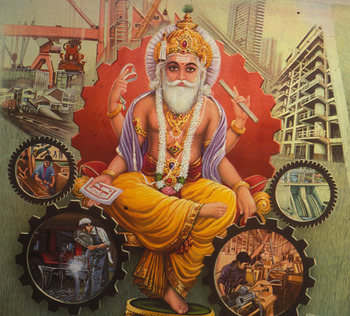
The exaltation of technicity and modern industrial technologies in India is captured in a portrait of Vishwakarma painted by Yogendra Rastogi in the early or mid-1970s (see figure 1), a time when the legacy of Nehruvian state industrial development still held sway in India. The bearded, white-haired deity sits on a throne equipped with a large cog-shaped backrest and holds his emblematic tools: the gaj (ruler or measuring stick), the sūtra (here, a measuring cord), the śilpaśāstra (or craft manual), and the kamandal (containing holy water to bless building sites). Beneath Vishwakarma, three chakra-like cogs frame images of men at work, their sleeves rolled up, backs bent, and faces turned to the task at hand. They are skilled workers: two carpenters in a woodshop smooth the surface of a board with hand planes; a welder uses an acetylene torch; and a machinist operates a cutting or milling machine tool. A fourth cog frames the picture of a hydroelectric dam. The deity and the cogs showing scenes of fabrication or infrastructural prowess together occupy the “front” of the image.Footnote 3 Above and behind them loom high-rise buildings, industrial cranes, hoists, pulleys, warehouses, and a rail and marshalling yard. While Rastogi was painting from the city of Meerut in North India, the industrial ground behind this divine figure might be an imagined industrial anywhere and everywhere in India (or beyond). Throughout the painting, technicity is on display.
Vishwakarma. Painting by Yogendra Rastogi, early or mid-1970s. Photograph courtesy of Christopher Pinney.

Such a portrait of Vishwakarma typically would adorn a calendar hung in a craft or manufacturing workshop and likely be honored in small ways each day, perhaps with joined palms, incense, a lamp, and the gift of a flower. The workers and the workshop as a whole would thus enjoy the deity's solicitude and take inspiration from him as they proceeded with the tasks at hand. The small-scale craft, fabrication, and repair shops that we have visited in Assam, Gujarat, Himachal Pradesh, Karnataka, and West Bengal—and which make up part of India's “informal economy”—invariably hosted the deity in portrait form. On specific, regionally observed dates, these shops also held a Vishwakarma puja to bless hand-tools, power-tools, and the entire milieu of the workplace. At such times, the presiding portrait and all metal tools and machines would be anointed by hand with tilaks—marks of red kumkum powder. Workers participating in the puja would likely be blessed with tilaks on their foreheads, too.
Notwithstanding the variety of Vishwakarma ritual observances with respect to their scale and timing, the day known as Vishwakarma Jayanti in eastern India appears to be growing in popularity across regions as part of the calendar of ceremonies devoted to the god. Gazetted as a government-acknowledged public holiday in many of the states to the east, it falls on the last day of Kanya (or Bhadra) Sankranti, usually September 17.Footnote 4 This date also happens to be Prime Minister Modi's birthday, a coincidence that has not been lost on celebrants or the Modi government. In 2018, we had the chance to spend Vishwakarma Jayanti touring various workplaces in Guwahati, Assam. A morning visit to the Guwahati Indian Oil Refinery—built in 1962 as India's first public sector refinery—gave us special insight into the relationship between technology and ceremonies honoring the god.
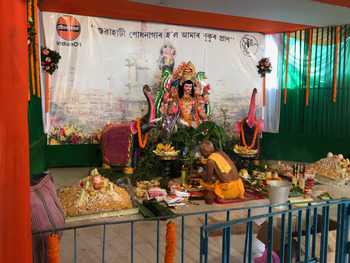
We arrived at the refinery as a pandit and assistant began to arrange puja materials on the main pandal altar not far from the refinery's main gate (see figure 2). A young mustachioed Vishwakarma figure flanked by clay elephants was the focal center of the altar.Footnote 5 A huge screen printing of the oil refinery hung in the background. Union leaders and event organizers gave us a genial welcome and talked about the day's celebrations and the planning that went into them. One of the organizers even described Vishwakarma as the “technocrat god.” The altar beside us was built as the altar for the refinery as a whole. Because refinery operations could not be shut down in their entirety without extensive disruption to production and to pipeline distribution operations, organizers arranged for the puja at this altar to be run for twenty-four hours, to cover three shifts of workers. Organizers had set up a nearby stage, too. Plans called for musicians, singers, and dancers to appear there later during the day's festivities, and for officials to make speeches and award presentations.
The main Vishwakarma pavilion and altar at the Indian Oil Refinery, Guwahati, Assam, being prepared for Vishwakarma Jayanti ceremonies (September 17, 2018). Photograph by Ken George.

But in addition to the observances at the main refinery altar, we were told of fifteen more altars within the refinery complex, each with a murti (icon) of Vishwakarma, and each with plans for a separate unit-based puja in which the god would be worshipped and the technical apparatuses blessed. These fifteen altars corresponded to the fifteen technical units of the refinery: the crude distillation unit, the geothermal unit, the hydrogen generation unit, the sulfur recovery unit, the mechanical engineering unit, and so on. Refinery managers and officials paid for food, material, and event costs for all sixteen of the pujas. Such support was embraced among management as outreach and corporate good will to the community of employees. The cost and selection of the murtis, however, were fully in the hands of the technicians and employees in any given technical unit, not the refinery managers—suggesting to us a visceral, darshan-based identification between the god, the technical workers, and the technical ensembles making up each refinery unit or milieu.
In the course of our fieldwork since 2017, we have come across a good number of parallel cases. A young naval architect who works for the Indian Navy submarine unit at the Visakhapatnam Naval Dockyard in Andhra Pradesh described to us the 2017 Vishwakarma Jayanti ceremonies at her place of work. She told us that seventy unit colleagues took part in observances—the whole workshop staff—and that it was the technicians who organized and presided over the puja.Footnote 6 At the National Institute of Design (NID) in Ahmedabad, it is the technical workshops—largely staffed by hereditary artisans—that perform Vishwakarma pujas, not the deans or faculty. Ashoke Chatterjee, former director of the NID and a former engineer as well, further recalled the Vishwakarma pujas in rail and bus yards in the Kolkata of his youth and early career in the 1950s and 1960s, telling us that the pujas aimed to bless the whole atmosphere of the workplace. Or consider the electrical substation that we visited at the Indian Institute of Technology in Guwahati, where staff removed their year-old Vishwakarma murti and consecrated a new one for placement in the control room, where the deity would preside over the smooth functioning of the campus power grid for the coming year.Footnote 7 Amid a festive gathering with food for staff, students, and administration, a substation supervisor observed us taking photographs and remarked, “Vishwakarma. He is the god of infrastructure!”
These workplace puja observances underscore for us how Vishwakarma worship belongs not just to devotees or hereditary artisans, but to techno-social ensembles—groups of workers, technicians, machines, techniques, and apparatuses associated with specific productive or infrastructural tasks. This worship takes place as a techno-religious activity specific to the technical ensembles needed for manufacture or infrastructural operation. We would go so far as to suggest that the work of worship—and even the god himself—should be seen as part of technicity and technical assemblage, rather than as something external or extraneous to them. Worship—in all its materiality and performativity—is here one of the animating features of technological activity, or technicity. Seen in this light, then, the placing of tilak marks on the god, the machines, and the devotees in a shop or factory is but one example of intimate techno-religious integration across the productive work milieu. The representation of Vishwakarma given residence in the workplace dwells there as a divine and protective companion for the human and the nonhuman members of the techno-social entourage.
Vishwakarma and Artisanal Technicity
Our recent fieldwork reveals that Vishwakarma worship and its deification of technicity are spread widely through both the informal and formal sectors of the Indian industrial economy—wherever technicians or specialists are needed for manufacture, fabrication, design, maintenance, repair, construction, or infrastructural operation. How long has this been the case? When did Vishwakarma become such a widespread and congenial figure in Indian industrial capitalism?
Ironically, the earliest Anglophone scholarly work of influence describing Vishwakarma depicted the god as a foil to industrial capitalism. The Ceylonese Tamil-English art historian Ananda Kentish Coomaraswamy introduced Vishwakarma in his Reference Coomaraswamy1908 book Medieval Sinhalese Art, and again in The Indian Craftsman (Reference Coomaraswamy1909). Aligned with John Ruskin, William Morris, the Arts and Crafts movement, guild socialism, and the Indian nationalist aspirations of the Swadeshi movement, Coomaraswamy (Reference Coomaraswamy1908, 78) enshrined Vishwakarma as the “patron deity of arts and crafts.” This was a time when the “Indian craftsman” was a deeply cathected figure—emblematic of the economic and artistic decline of the country under British imperialism, and avatar of India's possible rescue and future promise.Footnote 8 Coomaraswamy's romantic and fervent ethicopolitical aim was to recuperate India's well-being and independence through a recuperation of traditional craft arts in a struggle against machine-age industrial capitalism.Footnote 9
Working in Sri Lanka with his British wife, Coomaraswamy learned that Vishwakarma was the mythical ancestor of traditional hereditary artisans. “The Indian craftsman,” he wrote, “conceives of his art not as the accumulated knowledge of the ages, but originating in the divine skill of Viśvakarma and revealed by him” (Coomaraswamy Reference Coomaraswamy1908, 79). He went on to claim that:
[t]he reality of things exists in the mind, not in the detail of their appearance. This inward inspiration, upon which the Indian artist is taught to rely, appearing like the small voice of a god, that god was conceived of as Viśvakarma. He may be thought of as that part of Divinity which is conditioned by a special relation to artistic expression. In another way again, he may be conceived of as the sum total of consciousness of individual craftsmen of all ages and places composing a “group soul” of a higher order of consciousness. (79)
We do not have the space to address all the features of this passage or Coomaraswamy's broader work that give us pause. Perhaps most challenging are his focus on, and deification of, traditional artisanal technicity alone. Coomaraswamy's readers thus met in Vishwakarma a deity aligned to the anti-industrial agenda of the international Arts and Craft movement. In his foreword to The Indian Craftsman, C. R. Ashbee, the British designer, architect, and luminary of the Arts and Crafts movement, underscored this point, writing that “I never heard of the god Viśvakarma, the god of the Arts and Crafts, before I learned of him from Dr. Coomaraswamy. . . . Who knows, perhaps Viśvakarma is the god for whom we in the West, in our spiritual reawakening, are in search; possibly he can help us!” (Ashbee Reference Ashbee and Coomaraswamy1909, xv).
In his oft-cited passage quoted earlier, and in his work more broadly, Coomaraswamy curbs the world-making venture of culture (or technē) by largely excluding or dismissing the emerging technical realities of the early twentieth century. Correspondingly, he treats hereditary artisans as artists oriented to a fading or bygone technical era, rather than as ingenious craftsmen capable of expanding their technical repertoire and adopting a future orientation compatible with industrial manufacture. And we note, too, that he interiorizes reality and intuition, assigning them residence “in the mind” rather than in worldly material practice. Thus, he conjures Vishwakarma as a god whose “small voice” bestows the artisans with a “group soul” and inspires them—both individually and collectively—to “artistic expression.”
Coomaraswamy's views do not quite fit with what we have come to know about hereditary artisans and Vishwakarma's devotees in manufacture and repair shops as they pursue their work. We did not learn about artisans hearing Vishwakarma's voice, but rather about their own murmured or silent prayers and mantras addressed to the god. Popatlal Mistry, an aged hereditary carpenter who had worked for decades making darkroom photographic enlargers, told us how in the past, when faced with a problem to be solved, an artisan would take off his turban, place it beside his knee, murmur an invocation to Vishwakarma, and find the calm and insight to proceed with work.Footnote 10 Popatlal's son Prakash, a welder by trade with long years of work at a furniture factory, talked about his own prayers to his hereditary grandfather god when challenged with fabricating unusual contraptions and construction modules. It was never prayer alone, but prayer in the context of studying the materials, dynamics, and measurements that would best serve the task.
An early twentieth-century Gujarati Vishwakarma Purana also points to the importance of active technical touch and encounter, asserting that a hereditary artisan's intuitive and problem-solving “third eye,” granted by Vishwakarma, will open as soon as the artisan grasps in hand a footrule and measuring cord (Surajram Reference Surajram1926, 309). As Jayantibhai, a hereditary carpenter and maintenance foreman at an Ahmedabad gold refinery told us, “Vishwakarma has given us this promise: ‘Whatever work you want to do, if you are stuck, when you can't see any kind of solution, at this time remember me. My third eye will immediately open and immediately your work will be done.’”
Coomaraswamy (Reference Coomaraswamy1908, 79) observed that “Viśvakarma is not worshipped by craftsmen or others with offerings or ritual, but is often referred to in charms and songs connected with building operations, where he is invoked to ward off disasters and assist craftsmen.” It seems that Vishwakarma pujas were not in practice in turn-of-the century Ceylon, and Coomaraswamy (Reference Coomaraswamy1908, 79) found no material iconography of Vishwakarma, no woodblock portraits, nor chromolithographs that might have been used—as they are today—in puja gatherings; the image of the god that he includes in his book was commissioned to a craftsman who worked from an ancient text describing religious iconography. Writing again about the god a decade later, Coomaraswamy (Reference Coomaraswamy1917, 42) would say that “there scarcely exists a formal cult of Vishwakarma.”Footnote 11
Coomaraswamy (Reference Coomaraswamy1908, 63) was aware that some of the artisans and their caste organizations identified as “Viśwa Brahmins,” and not as śudras, and he even mentions the Viśvakarma Kulābhimāna Sabhā (Association for Vishwakarma Family Pride) of Madras, with the hope that its members might document their own history. It is worth pausing to consider the “Vishwabrahmin” artisan associations, for they also brought Vishwakarma into the public eye, but by way of the courts. Hereditary artisans from South India appear to have led the way in lodging these cases in the colonial courts, where, like other low and middle castes that pursued “Sanskritization” (Srinivas Reference Srinivas1956), they spurned a śudra identity and claimed a caste status on a par with Brahmins, whether as “Vishwakarma Brahmins,” “Vishwabrahmins,” or “Panchala Brahmins.” Starting with the landmark Chittoor Adalat Case of 1818, which affirmed the Vishwabrahmins’ right to serve as their own priests for life-cycle rituals (over the objections of local Brahmins), artisans fought a series of court cases to secure legal recognition of their Brahmin-like caste status (Brouwer Reference Brouwer1995, 40–43; Reddy 1997; Saberwal Reference Saberwal1976). These judgments also included the right to ritually install and worship images in temples linked to higher castes, and to identify themselves in colonial censuses as a kind of Brahmin. These successful judgments, along with troves of other Vishwakarma-related scriptural material, were collected, translated and republished in regional languages, and circulated among Vishwakarma-related communities across Ceylon and India throughout the late nineteenth and early twentieth centuries.Footnote 12
In short, Coomaraswamy's anti-industrial romanticism and his veneration of the traditional craft arts likely may have led him to miss the artisans’ broader technical and political aims in the industrializing colonial economy. That same outlook also led him to miss Vishwakarma's connection to the sorts of industrial technology that caused him such dismay. Had he looked to the urban mills, railways, and manufacturing shops where artisans were increasingly finding work and making a livelihood, he might have discovered that Vishwakarma was attached to machines as well.
Vishwakarma in the Jute Mills
Vishwakarma's association with machines has made a more recent appearance in the ethnographic and historical studies of industrial capitalism in the jute mills of twentieth-century West Bengal. The work of Dipesh Chakrabarty merits special consideration, as his pioneering research on labor politics in and around Kolkata includes prominent, if brief, mention of Vishwakarma. Chakrabarty's (Reference Chakrabarty2000, 72–96) broadest and most compelling aim was to understand the challenges in bringing religiosity to bear—and to life—in the secular framework and abstract categories of a Marxist, universal labor history. Driving that pursuit was his recognition that in Indian society “human activity . . . is often associated with the presence and agency of gods or spirits in the very process of labor” (Chakrabarty Reference Chakrabarty2000, 76). He took as his example not Vishwakarma worship, but the “worship of tools” (hathiyar puja), giving it mention in his 1989 study, Rethinking Working Class History.Footnote 13 Indeed, recollecting his own experience as a child in Kolkata witnessing machine- and tool-focused ceremonies at a small “engineering factory” during the 1950s, Chakrabarty surmises that worshipping “machine-tools seems to have been widespread among factory workers in eastern India” (Chakrabarty Reference Chakrabarty1989, 90). He invokes Vishwakarma for the first time a decade later, in Provincializing Europe (Reference Chakrabarty2000, 77), when revisiting the working-class worship of machinery and tools as depicted by Daniel Houston Buchanan in 1934. As we have noted in prior publications (Narayan and George Reference Narayan and George2017, Reference Narayan, George, Jacobsen and Myrvold2018), Vishwakarma worship in the workplace invariably involves darshan with the god and the blessing of tools and machines; tool and machine worship, however, need not always demand mention or veneration of Vishwakarma. Reviewing the source material from Buchanan's Reference Buchanan1934 account, we find no mention of Vishwakarma or a day dedicated to him; only mention of how machines and tools are honored in factories and mills during the festival of Diwali (Buchanan Reference Buchanan1934, 409). These details notwithstanding, Chakrabarty's account of Vishwakarma-cum-tool-worship now forms a canonical treatment of religiosity in the industrial workplace.
Chakrabarty (Reference Chakrabarty1989, 89) argues that managers and workers had scant knowledge of technical processes in the jute mills. About workers he writes:
The worker did not come to terms with the machine on the basis of even an elementary understanding of its principles. . . . In fact the worker's relationship to the machine, instead of being mediated through technical knowledge, was mediated through the North Indian peasant's conception of his tools, whereby the tools often took on magical and godly qualities. A religious outlook rather than “science” determined this relationship (89).
Chakrabarty here sets religious consciousness well apart from technical consciousness, according religiosity a role in labor, but not in technicity or alert technical activity. As may already be clear, our research has led us to take a different view: Gods and spirits, we think, ought to be reckoned as part of technical activity and technical consciousness.Footnote 14 Depicting, as he does, a worker in the abstract, in the singular, and in isolation from others, can also obscure both the way in which different kinds of workers form diverse, hierarchical, and task-specific teams, and the way in which workshops and factories are themselves sociotechnical ensembles. As the anthropologist Adam Sargent (Reference Sargent2020) has observed in his recent look at the politics of work in the New Delhi construction industry, skilled and semi-skilled workers are careful to distinguish themselves from, and avoid identification as, common laborers. These trade workers “actively construe and orient to” material exposures and technical processes, making distinctions among themselves to “control the conditions and effects of their work” (Sargent Reference Sargent2020, 77, 78). Returning to the jute industry of the 1930s, we doubt that its mill workers uniformly lacked technical knowledge of machines, and wonder whether the industry's technically skilled workers might have possibly used Vishwakarma puja to distinguish themselves ritually from the mills’ unskilled laborers.
The 1934 Buchanan report cited by Chakrabarty points to that sort of diversity and offers some detail that especially intrigues us, in that it prefigures some of the techno-organizational ritual logics we ourselves witnessed among the technical units of the Guwahati Indian Oil Refinery nearly nine decades later. Buchanan (Reference Buchanan1934, 409) notes that it was the mechanics among the “factory hands,” and not other sorts of workers, who organized and conducted the ceremonies and sacrifices he described. He notes, too, that separate altars were set up “by the mechanics [from] each of the four or five departments in [a] mill” (409). These departments each had tasks, tools, and machines unique to their place in jute production: batching, preparing, spinning, weaving, and finishing (247). The mechanics would place the tools and emblems of their departmental work on their altar, and then heap it with decorations and sweets. Buchanan concluded his remarks on workplace religiosity by saying that “the factory and the power-machine”—both of which are technical ensembles—“have been readily adopted and given due place in religious ceremony” (409). This primary report, then, suggests not only that the factory ensemble has been made a part of the cosmos or cosmic milieu via the ceremonies, but also that the figure of the mechanic-technician—who has a penetrating familiarity with the workings of technical ensembles—has a special discerning authority and understanding of what the machine and the factory need from, and must give to, the cosmos.
Here, then, is a hint that it was not a broad and undifferentiated “North Indian peasant religious outlook” that informed such ritual practices on the factory floor, but rather the caste-specific religious observances of hereditary artisans and skilled workers who had found work in industrial settings. Writing in 1996 and drawing on the research he had conducted in the jute mills since the 1970s, historian Ranajit Das Gupta (Reference Das Gupta1996, 30) remarks that:
. . . Vishwakarma puja was never a widely prevalent practice among the jute mill workers. This puja was and even now is prevalent only or mainly among the “mistris” [or master craftsmen], mechanics and fitters of the mechanical department. . . .
In short, Das Gupta suggests that Vishwakarma puja was peculiar to master craftsmen and technicians, many of whom, we surmise, had roots in hereditary artisan castes. Leela Fernandes's research in some ways echoes Das Gupta's account of this puja. She notes that Vishwakarma Puja is a significant festival for particular working-class Hindu communities, though she does not say who those particular communities are. We suspect she may be referring to the mechanics and mistrīs of the artisan castes. “When the festival was being planned,” she observes,
management stipulated that the puja would be limited to the mechanical department of the factory. . . . The unions, however, insisted on the construction of several images of the god. . . . Eventually, six separate shrines were constructed in the factory by separate groups of workers affiliated with each union. . . . On the day of the festival a large shrine was constructed next to the shop floor. . . . Meanwhile, five smaller shrines were constructed in the mechanical department. (Fernandes Reference Fernandes1997, 103–4; Fernandes Reference Fernandes1998, 55–56)
Fernandes goes on to argue that during the puja the “worship of machinery” (though not of Vishwakarma per se) reversed the alienation of workers from the means of production.
These Kolkata labor histories were drafted before India's national government formalized the annual Vishwakarma puja on September 17 as Vishwakarma Jayanti, and, as one would expect from works in the Marxist tradition, all of them foreground labor and class consciousness.Footnote 15 Framing analysis around labor commonly compelled historians and others to see religiosity as something exterior to and thus disruptive of labor, or as an arena of anti-managerial, working-class sentiment. Chakrabarty, of course, argues that we must guard against imposing rigid conceptual categories onto our description of human practices and find ways to admit work and worship as inseparable experiences. Our review of the jute mill studies prompts us to further add that we avoid imagining religion and technology as ontologically distinct modalities of life, and look to workplaces and workers—like artisans, technicians, and engineers—for clues as to how a sacralized technicity might mediate our being in and with the world.
The Movement of Hereditary Artisans into Industry
Who were these mistris, these master craftsmen, who in all likelihood were the first to bring Vishwakarma onto the workshop and factory floor? India's hereditary artisans had for many centuries moved from one place to another in search of work, whether on their own initiative or at the invitation of patrons (Brouwer Reference Brouwer1995, 220; Ramaswamy Reference Ramaswamy1985, Reference Ramaswamy2004).Footnote 16 Indeed, historians link the emergence of a corporate Vishwakarma caste identity (involving hereditary carpenters, masons, blacksmiths, braziers, and goldsmiths) to medieval South Indian temple towns, the places that offered new economic opportunities and status for artisans who made temples, sculpted sacred images, and crafted associated ritual objects (Appadurai Reference Appadurai1974; Ramaswamy Reference Ramaswamy1985, Reference Ramaswamy2004; Reddy 1997, 678–80). While some artisans were based in villages—where their traditional practices of manufacture were deeply ritualized (Brouwer Reference Brouwer1995)—their skills and networks were not confined to village horizons. Though their traditional livelihoods suffered under British colonial policies guiding markets and manufacture in the nineteenth century, the artisans were in no way hesitant to move again, to find work and to advance their skills in the industrial shops and yards springing up in India. It would be no surprise if they were among those Indians heeding the public call of Pune educator M. M. Kunte in 1884 to embrace “the art of mechanization”:
. . . [T]here is no option but to follow and spread widely the art of mechanization. If you want to eat, be a machinist. If you want to win freedom, you have to learn to be a machinist. If you want to live as luxuriously as our rulers, you have to run the machines.Footnote 17
Not to be left behind by the technological innovations of the nineteenth century, these artisans were among the earliest to take advantage of mechanical tools and machines, new forms of energy, the demand for urban construction, and the advent of railways, steamships, irrigation works, and road building (cf. Sarkar Reference Sarkar2013).
Here let us summarize a few broad takeaways from our research interviews with hereditary artisans in Gujarat, our review of Gujarat's District Gazetteers, and our reading of historians’ accounts of industrialism and the informal economy in Gujarat from 1850 through the 1990s (Breman Reference Breman1996, Reference Breman1998; Derbyshire Reference Derbyshire, Macleod and Kumar1995; Haynes Reference Haynes2012; Kerr Reference Kerr1997; Roy Reference Roy2006, Reference Roy2008; Streefkerk Reference Streefkerk2006). Drawn by the burgeoning demand for construction in the later decades of the nineteenth century, large numbers of artisans migrated to cities and towns—Bombay, Karachi, and Ahmedabad and smaller hubs like Surat and Rajkot—as well as to the colonies that Britain was developing in East Africa. Railways had significant need for the skills of carpenters and smiths, as did the region's textile mills, which usually operated their own maintenance and repair shops. Construction as well as industrial maintenance and repair were thus the key arenas in which the artisans found work. The breakdown and exhaustion of imported machinery was a pressing concern for owners and managers of the mills and factories; the expense and delay in getting spare parts and replacements from the United Kingdom and Europe posed threats to production and profits. Hereditary artisans in time became leading fabricators of spare parts and replacement machines. Joint families in the artisan castes—especially the carpenters (suthārs) and smiths (lohārs)—were among the first generation to launch Gujarat's industrial enterprises and led the state's informal manufacturing economy (Streefkerk Reference Streefkerk2006). Jobbers recruiting mechanics and repairmen for industrial mills would also hire among clusters of skilled artisans. The Gujarat materials thus make it clear that a significant group of India's industrial workers were hereditary artisans who carried into the workshop and onto the factory floor a technical and increasingly expert knowledge of machines, machine tools, and precision measurement.
Hereditary artisans also took a role in promoting technical education at the dawn of the twentieth century. The Viśvakarma Kulābhimāna Sabhā, mentioned in passing by Coomaraswamy, was formed in Madras in 1903 to promote the interests of hereditary artisans “on intellectual and industrial lines” and to improve “the arts and sciences peculiar to them by opening industrial schools and workshops” (Thurston Reference Thurston1909, 123). In Gujarat, T. K. Gajjar, a member of the Suthar carpenter caste of Surat, rose to become a leading industrial chemist, prominent in developing, distilling, and manufacturing color dyes for India's textile industries. In addition to founding the Alembic Chemical Works, he also founded the Kala Bhavan technical institute in 1890 in the princely state of Baroda.Footnote 18 Grounded in techniques of assembly and repair, carpentry, and mechanical drawing learned in the caste workshops of his youth, Gajjar's goal for the professional training of others was to turn hereditary artisans into modern technicians. Through the course of several decades, Kala Bhavan's emphasis on mechanical technology turned out a flow of technicians skilled in the fabrication, maintenance, and repair of engines, water works, boilers, machines, and machine tools—in short, the kinds of technicity required by industrial rather than artisanal systems.
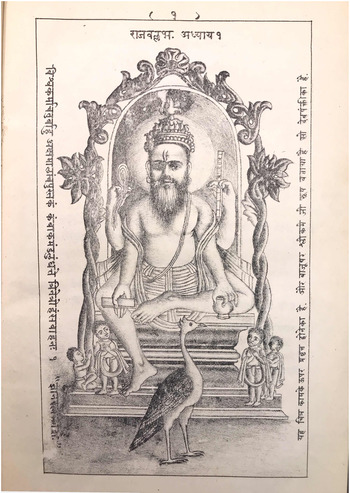
We have yet to find a published account definitively linking Vishwakarma puja to the early waves of artisans who found work in the industrial sector. It cannot be accidental that around the time that Kala Bhavan was established with the patronage of the Maharaja of Baroda Sayaji Rao II, this royal patron also commissioned the Gujarati translation of the Rājvallabh, a famed fifteenth-century architectural manual and treatise composed by a sutradhār, or master builder. The text emphasizes that Vishwakarma is the source of all such technical knowledge and contains a page showing a “working image” of Vishwakarma with a third eye and four sons around him (see figure 3). On the left side of the page is a mantra describing Vishwakarma's form; on the right side are instructions: “This image should dwell above in the place of work, and the figure described in the verse on the other side is a line (pankti) composed by the gods.”Footnote 19 Here is one way artisan-technicians may have carried Vishwakarma into the workplace. Indeed, a contemporary museum carpenter showed us a version of this image of Vishwakarma from the Rājvallabh that he carried on his smartphone. Stained with age and smoky incense offerings, this had once been in worship by an ancestor.
Vishwakarma with a “third eye,” surrounded by his four sons and his mount, the swan. From the Rājvallabh (1891).

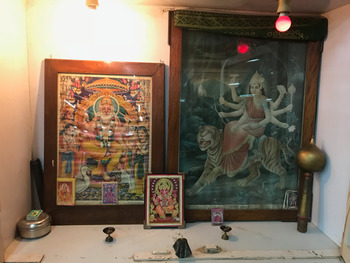
An aging hereditary carpenter who had been hired to organize the technical workshop at the National Institute of Design in the mid-1960s recalled to us how he had brought a print of Vishwakarma into the workshop. Gautam Sarabhai, then director of the NID, “who didn't even let you put in a nail without his permission,” demanded to know what this poster was. “You are a designer,” the carpenter replied in Gujarati, “Vishwakarma is the Big [motā-motā] Designer of the Universe.” Hearing the god introduced in these terms, Sarabhai agreed to let the print remain on site, and to this day, that Vishwakarma image presides over all the work in the NID workshop (see figure 4).
A portrait of Vishwakarma (left) in the shrine cabinet located in the Technical Workshop, National Institute of Design, Ahmedabad, August 2018. Photograph by Ken George.

Vishwakarma Temples and Public Ceremonies
To our knowledge, the first public mandir or temple devoted to Vishwakarma anywhere in India (besides a chaitya hall at Ellora) was consecrated in 1901 in Kutch; it was built by a family of hereditary carpenters who worked as contractors in Bombay.Footnote 20 Another was built nine years later in Phagwara, Punjab, by an hereditary carpenter who had made his fortune as a contractor in Simla (Saberwal Reference Saberwal1976, 18). By the 1930s, artisans from manufacturing enterprises and fabrication shops across Gujarat had built Vishwakarma temples in the towns of Dakor, Jamnagar, Rajkot, and Surat, and in the enclave of carpenters in the Raipur neighborhood of Ahmedabad. Today's hereditary artisans report that there are over 280 Vishwakarma temples in Gujarat alone, a number not surprising for what is probably India's most deeply industrialized state. Elsewhere, the Public Works Department and large state industrial enterprises like the Bharat Heavy Electricals Limited in Hyderabad would in the 1960s and 1970s hire hundreds of hereditary artisans who would go on to build Vishwakarma temples on or near company grounds.Footnote 21 Not just places of worship for the deity from whom they claim descent, such temples are gathering and networking hubs for urban members of Vishwakarma artisan castes, halls where caste members can find clients, business partners, and marriage prospects for their sons and daughters. These temples are also home to caste welfare and educational associations; venues for political mobilization ahead of state and national elections; and distribution centers for Vishwakarma pamphlets and purānas, compiled and published under the sponsorship of family-owned manufacturing and construction enterprises.
“Going public” with Vishwakarma pujas is of course a political gesture. Unions have played no small part in promoting the pujas as a way finding favor and patronage not just from factory owners, but from political parties and their leaders, too, be it in Kolkata (Fernandes Reference Fernandes1997) or Varanasi (Kumar Reference Kumar1988). As far back as the early 1980s, a number of unions pressed the central Indian government to establish September 17, Vishwakarma Jayanti, as a national labor day (Kumar Reference Kumar1988, 207; Varghese K. Reference Varghese K.2003, 4800–4801). Prominent among them was the Bharatiya Mazdoor Sangh (BMS), which already had been mobilizing workers with appeals to Hindu nationalism and recruiting them to projects of capitalist development (Upadhyay Reference Upadhyay2018). Formed in 1955 by a cadre of right-wing RSS (Rashtriya Swayamsevak Sangh) members, and today claiming more than seventeen million members nationwide, the BMS union adopted Vishwakarma as its patron deity, said by one of the union founders to be the “origin of all laboring and industrial classes” and associated with self-sacrifice and productivity for the nation (Upadhyay Reference Upadhyay2018, 84–85).Footnote 22 In other efforts that would further associate the god with industrial workers, the BMS set up the Vishwakarma Labor Training Institute (Vishwakarmā Shramik Shikshā Sansthā) in Nagpur, Maharashtra, in 1982, and published two monthly magazines, the Vishwakarmā Chetnā (“Vishwakarma Consciousness”), in Hindi, and the Vishwakarmā Sanket (loosely, “The Vishwakarma Messenger”), in English, “to keep [its] cadres well-informed about news and views on various issues of the contemporary national scenario” (Vishwa Samvad Kendra–Gujarat n.d., 4). BMS union literature even refers to the informal economy of “self-employment” as the “Vishwakarma Sector”—a “people's sector” of family-based enterprises that the union (to one's astonishment) purports to be free of alienation and exploitation (Bharatiya Mazdoor Sangh n.d., 20–21). Unsurprisingly, members of left-leaning unions and working communities can find the BMS appropriation of Vishwakarma troubling. As a “theoretical-minded” member of the All Kerala Gold Workers Union once remarked to George Varghese K., the Hindutva reframing of Marxist working-class ideology in symbols “painfully disinterred from those recesses of Indian history marked by Brahminic oppression and cruelty” made Vishwakarma “a hapless victim of this reactionary exhuming” (Varghese K. Reference Varghese K.2003, 4801).
There is evidence, meanwhile, that the earliest public celebrations were located in public institutions. Writing about Varanasi, Nita Kumar (Reference Kumar1988, 207–8) traces public Vishwakarma pujas back to the 1940s in the Banaras Waterworks, the Engineering College, and Banaras Hindu University, and to the 1950s in the Indian Railways’ Diesel Locomotive Works and the city's first Vishwakarma temple. Over the years, these Varanasi pujas came to include processions through city streets, with devotees carrying figures of Vishwakarma for immersion in rivers. At the time of her fieldwork in 1982, state-run telephone, electricity, and railway offices ran the largest festivals, followed by factories engaged in the fabrication, distribution, and repair of machine and motor parts. Kumar's examples thus suggest something other than the pursuit of patronage as a political aim of these Vishwakarma pujas. The theophany of Vishwakarma—his being revealed to the general public and most especially to devotional caste and working-class publics and counter-publics in the Hindu fold—has been also, and no less than, the display of his place in the technical ensembles (and technological wonder) of India's factories, refineries, and fabrication shops.Footnote 23 Theophany, here, is also technophany—the making visible of technicity within the aura of the sacred.
Since the 1990s, hereditary artisans have let many of their earlier claims to Brahminical status fall away, realigning themselves, instead, around affirmative action opportunities made available by successive governments to those designated as “Other Backward Castes.” A growing concern among the artisans working across formal and informal sectors of the industrial economy is to find recognition from political parties as a reliable vote block. As part of community-building efforts and an interest in public visibility, Vishwakarma caste halls and temples have been built and public religious “Shobha Yatra” processions have been undertaken—with Vishwakarma images or people dressed in Vishwakarma costume moving through public roads amid music on loudspeakers. Since the early 2000s, daylong and weeklong Vishwakarma storytelling events, or kathās, have drawn large crowds of hereditary artisans from the industrial sector, with professional storytellers accepting invitations from organizations around India.
In December 2017, we attended a seven-day kathā organized by the Mewada Suthar community in Ahmedabad. A member of this community had met a Gujarat-based storyteller in Haridwar, to the north, and gotten the idea that such a gathering would help with fund-raising for education programs and outreach to caste youth. Roughly 2,000 to 2,500 people of different artisan caste backgrounds attended these afternoon storytelling sessions, and community leaders from other caste groups in Gujarat and adjoining states made guest appearances, too.
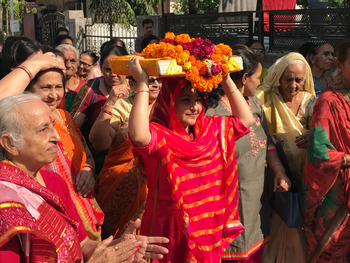
The event began with the Vishwakarma Purana wrapped in cloth being brought from a sponsor's home in procession, carried on different women's heads as men and women in festive attire walked and danced (see figure 5). The book was ceremonially welcomed into a huge, pink-and-white circus tent festooned with streamers and carried to the raised dais arranged for the storyteller, musicians, and an enormous full-color image of Lord Vishwakarma, his sons, and his daughters. A master of ceremonies then led the group—women on one side, men on the other, with right hands raised forward and arms rigid and parallel to the ground—in a collective pledge to vote in state elections two days later. Though a political party was not named, in subsequent days the saffron tint of Hindutva and the BJP (the Bharatiya Janata Party) became increasingly evident at the kathā in allusions to the rāshtra dharm—“the national religion”—and in the choice of guest speakers.
Women from the Mewada Suthar caste of hereditary artisans carrying the Vishwakarma Purana in procession along city streets to the site of the Vishwakarma Katha, at Mirchi Medan, Ghodasar, Ahmedabad, December 12, 2017. Photograph by Ken George.

The storyteller extolled Vishwakarma as the “god of science” (vigyān) needed for these times, and also as the “technical kā devatā,” the “god of technology” who would bring abundance to the workshops and factories of this world. Even as praises were sung and many mythological stories were retold in Gujarati, the storyteller sometimes alluded to technological issues with English terms. He explained, for example, that though Brahma might be the original creator, Vishwakarma “manufactured” the universe along with the “spare parts.” With storytelling now available on television, he assured us, science was now clarifying religion. On the final day, even as election results were appearing on smartphones, the storyteller exhorted listeners to work together as a unified group of Vishwakarma's “family,” using the force of an estimated 1.4 million members to gain political clout.
Conclusion
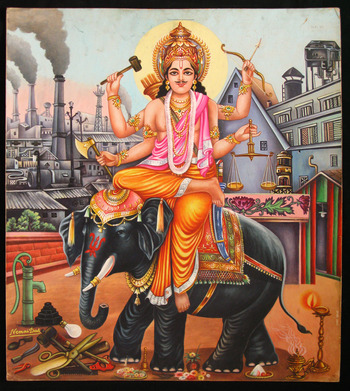
We close with a calendar portrait of Vishwakarma created by artist Nemai Das (see figure 6). This visually brings together many of the points we have raised about the deification of technicity in Vishwakarma worship. The image shows the god in a realm of technological wonder and in a posture of readiness to see and be seen by his devotees in moments of worship. In the foreground is an array of puja materials used to honor the god: a bell, an oil lamp, burning incense, a coconut, and gift offerings of flowers, sweetened foods and fruit. Some artisanal tools are heaped to the left awaiting anointment: shears, a mallet, a hand saw, a chisel, and a trowel. Beside them: a hand pump, measuring weights, and light bulb. Behind Vishwakarma stretches an industrial world of factories, towers, conveyor belts, rooftop tanks, lamp posts, workshop sheds with roofs of corrugated metal, and chimneys belching smoke and steam. A lonely green tree peeks out between an industrial shed and a masonry wall.
Vishwakarma. Painting and print by Nemai Das. Probably mid-1970s. Photograph courtesy of Priya Paul and the Priya Paul Collection.

Worship of the god as he is pictured here is a way for artisans, mechanics, technicians, engineers, and other devotees to acknowledge and show gratitude for the technical world in which they have found a livelihood. The picture plainly reveals a god to the publics gathered before it; theophany is one of its aims. This display of technology and technicity, however, likely does no more than stir the intuitions of a broad public about the wondrous fabrications and familiar hand tools that frame the god. It is those who know and who have experienced Vishwakarma's divine companionship in the course of technical activity and livelihood who are most deeply receptive to the technophany before them. We can name them again: the artisan, mechanic, technician, and engineer. Their experience of technicity has acquainted them with the limits of their expertise, mastery, and control. So, too, has it acquainted them with the vulnerability and exhaustion of every manufacture and design; they understand maintenance and repair as forms of care. Yet we should imagine, as well, their smiles of gratification, pride, and delight when their skills and ingenuity have brought to life a successful fix or workaround, an unforeseen or elegant solution to a technical problem, or a new way of coaxing materials together into productive new designs and configurations.
If all consciousness, religious or technical, is as Simondon (Reference Simondon, Malaspina and Rogove2017) would have it, a universe-fashioning and demiurgic activity, we might think of the cosmos as the ambient encompassing milieu in which tools, machines, workplaces, collectivities of workers and technicians, technical objects and technical ensembles all must work and find compatibility. Technicity, Simondon asserts, mediates our being with and in the world. Accordingly, he commends the technician to us as the figure who grasps technicity and who “would be like a sociologist or psychologist of machines, living in the midst of this society of technical beings as its responsible and inventive consciousness” (Simondon Reference Simondon, Malaspina and Rogove2017, 19). Should we be surprised, then, to find technicians leading the way in organizing Vishwakarma pujas in the techno-socially distinct shops and subunits of jute mills, construction sites, factories, shipyards, oil refineries, rail yards, electrical stations, and the Public Works Department? As Vishwakarma's pre-eminent devotee and representative, the technician knows worship as a kind of technical activity, and understands Vishwakarma as a divine component of the technical assemblages we call machines, factories, or infrastructures. Under the hand and eye of the technician, Vishwakarma pujas appear attuned to collectivities and ensembles of technical workers and objects, and directed toward aligning, or bringing into correspondence, the workshop or factory floor with the primordial universe-making wisdom of the deity. The idea is to align “universe-making” endeavors—however worldly or mundane—across all levels of the cosmos and within the reach of Vishwakarma. Such pujas ask India's various publics to acknowledge that this god and his worship are part of everyday technical activity and accomplishment.
We have argued in this article that the rise of public Vishwakarma worship in India has been coincident with the rise of industrial capitalism in that country. Taken as a group, India's hereditary carpenters, masons, and metalsmiths felt the lure of industrial technologies early on, and we have suggested ways in which these artisanal castes, their technical skills, their rites, and their traditional ancestral deity, Vishwakarma, have made their historical entry into the urbanized industrial fold. Their movement out of household-based craft workshops and into mechanized industrial settings followed upon their success in advancing caste status in the colonial courts and censuses. The emerging industrial order offered expanded horizons in cities and towns for pursuing a livelihood in which these artisans could apply both old and new-found technical skills and sensibilities. With that, Vishwakarma worship came into broader view, whether in the factory and railyard or in the caste-oriented Vishwakarma temples springing up in urban industrial hubs. Devotees began seeing themselves and their technical sensibilities being seen in public.
The rise of public Vishwakarma worship is not the work of hereditary artisans alone, however. Neither has it flourished largely owing to Nehruvian-era hiring practices, or to calculated concessions made by industrial managers to workers from the artisan castes. As we have shown, state industries, national unions, and the national government have played a big part in expanding the public visibility of Vishwakarma worship. These entities aim to mobilize and command the allegiance of India's industrial workers and technicians irrespective of their caste background. Drawing from Vedic, epic, and Puranic sources, they identify Vishwakarma with technical skill and labor, and thereby assert and celebrate the mythic underpinnings of India's vaunted technological prowess.
The expansion of Hindu nationalist sentiments and agendas across industries, unions, and governing parties has encouraged the uptake of the September 17 Vishwakarma Jayanti as a public festival and national Labor Day. But that is not everywhere the case. Innumerable repair shops, manufacturers, Public Works Departments, and state governments—as in Gujarat and Himachal Pradesh—ignore the September 17 festival, and find Vishwakarma devotees continuing with other days for his public and domestic worship. And more than a few unions have pushed back against adopting Vishwakarma Jayanti as their “Labor Day,” preferring instead the May 1 International Labor Day. Again, we find no intrinsic or immutable politics in Vishwakarma worship, but a capacity to lend itself for use as a public, political resource for mobilizations of different kinds. For this reason, we must also entertain possibilities for his political deification as an oppositional figure who might break with industrial capitalism, its technical regimens, its problematic regard for labor, and its indifference to environmental ruin. For now Vishwakarma is in congenial accord with the country's industrial order.
Acknowledgments
We gratefully acknowledge research support from the American Institute of Indian Studies, the Australian Research Council (Discovery Project Award DP170104212), the National Endowment for the Humanities (#RA-235170-16), and the United States–India Education Foundation Fulbright-Nehru fellowship program. We also extend our sincere thanks to our many hosts and interlocutors who discussed aspects of Vishwakarma worship with us during our fieldwork in India (2017–19). Special thanks go to Arupjyoti Saikia and Moumita Sen for helping us with our fieldwork in Assam and West Bengal; to our research assistant, Hardik S. Siddhpura, for his devoted help and insights; and to Priya Paul and Christopher Pinney, who kindly gave us permission to publish images of Vishwakarma from their respective collections of prints and artwork.
Early versions of this article were presented to the workshop on “Gods in the Public Sphere,” convened at the Centre for Studies in Social Sciences, Kolkata; the Australian National University Anthropology Seminar Series; the South Asia Program at Cornell University; the Department of Religious Studies at the University of North Carolina at Chapel Hill; the South Asia Studies Program at the University of Pennsylvania; the 2018 Biennial Meeting of the Asian Studies Association of Australia; and the 2019 Annual South Asia Conference at the University of Wisconsin–Madison. We thank the many workshop, seminar, and conference organizers and participants for their helpful comments and insights.
Further thanks go to Greg Bailey, Aditya Balasubramanian, Laura Bear, Jan Brouwer, Dipesh Chakrabarty, Assa Doron, Sean Downes, Anthony Lovenheim Irwin, Geri Malandra, Projit Mukharji, Leela Prasad, Sumathi Ramaswamy, Adam Sargent, Moumita Sen, Renny Thomas, Matt Tomlinson, and two anonymous JAS manuscript reviewers for their supportive remarks and critical suggestions as we worked on this article.
Author Bios
Kenneth M. George is Professor of Anthropology in the ANU College of Asia and the Pacific at the Australian National University. Kirin Narayan is Professor of Anthropology and South Asian Studies in the ANU College of Asia and the Pacific at the Australian National University.