INTRODUCTION
The polychaete assemblage represents one of the major components of the intertidal macrofaunal communities and forms the basic chains of the food web of the wetland ecosystem. In a subtropical wetland, for example Mai Po mudflat of Hong Kong, they are the dominant group in terms of both abundance and biomass, and play an important role in the matter transformation and energy flow of the ecosystem through different trophic levels. More than 25% of the total species and 50% of the total biomass in the mudflat are dominated by polychaetes (Shen et al., Reference Shen, Zhou, Lai and Gu2006); one numerically dominant species, Neanthes glandicincta, could solely account for 19% of the total annual macrobenthic production in the Mai Po wetland ecosystem with a relatively high turnover rate (Shin, Reference Shin2001). Being a major food source for shore birds, the reductions in the abundance and biomass of benthic infauna could have a major negative impact on the ecological value of the site as a feeding ground for the migratory birds and, thus changes in the species diversity and individual abundance of macrobenthic community (mainly polychaete assemblage) are the subject of much of work conducted on the Mai Po mudflat related to the conservation of the birds (Anderson & McChesney, Reference Anderson, McChesney and Lee1999; Cha, Reference Cha and Lee1999; Qiu, Reference Qiu and Lee1999; Shin, Reference Shin2001). Therefore, it is necessary to quantitatively compare the present results with those of previous surveys on the same mudflat in Mai Po to elucidate the long-term environmental impact on the benthic infaunal community.
The Mai Po Inner Deep Bay Ramsar Site is located at the north-western part of the New Territories and remains the largest wetland in Hong Kong. It is an internationally important over-wintering and natural refuelling station for more than 100,000 migratory waterfowls passing through Hong Kong along the East Asian–Australasian Flyway (Young & Melville, Reference Young, Melville and Morton1993). This site has a shallow bay with extensive intertidal mudflats backed by a well-developed mangrove forest, man-made tidal shrimp ponds, fishponds and reed beds. The mudflat is also bounded by two principal rivers, with the Shenzhen River to the north and the Shan Pui River to the south-west. During the last three decades, due to the rapid building up of human population, urbanization and industrialization in the New Territories of Hong Kong and, particularly, in Shenzhen of mainland China, discharges from these two rivers containing various types of domestic, industrial and livestock wastes and agrochemicals into the area were estimated about 2 million tonnes each year (Neller & Lam, Reference Neller, Lam, Yeung and Chu1994; Yu et al., Reference Yu, Lan, Yen and Leung2000). As a result, water quality in the Inner Deep Bay has deteriorated during recent years, with dissolved oxygen levels in the bottom waters falling to below 1% during the summer of 1996. The levels of BOD5, Escherichia coli and nutrients also indicate serious organic pollution (EPD, 1998). Moreover, the Deep Bay estuary is moderately contaminated with chromium but is seriously contaminated with copper and zinc (Anon, Reference Anon1994a, Reference Anonb). Due to the continuous environmental deterioration, habitat quality in Mai Po marshes has decreased and organisms living in this area are under the cumulative effect of the anthropogenic pollutions including both organic and toxic contaminants. Pollution is now a very serious threat to the long-term ecological condition of the whole area.
However, variations of subtropical polychaete communities in response to human intervention and environmental stress have not been well understood or reported as in temperate regions, especially for Hong Kong's wetlands. Macroinvertebrates have long been used as indicators of the ecosystem health and changes in the structure of communities can be employed to reflect the unfavourable changes in the habitat quality (Pearson & Rosenberg, Reference Pearson and Rosenberg1978; Gray & Pearson, Reference Gray and Pearson1982; Belan, Reference Belan2003; Gray, Reference Gray2003; Vassallo et al., Reference Vassallo, Fabiano, Vezzulli, Sandulli, Marques and Jørgensen2006; Blanchet et al., Reference Blanchet, Lavesque, Ruellet, Dauvin, Sauriau, Desroy, Desclaux, Leconte, Bachelet, Janson, Bessineton, Duhamel, Jourde, Mayot, Simon and de Montaudouin2008; Callier et al., Reference Callier, Fletcher, Thorp and Fichet2009). Due to their high species richness, high biomass and density, and their sensitivity or high tolerance to both pollution and disturbance, polychaetes are chosen as the potential indicators instead of the whole macrofaunal community to evaluate the environmental quality (Mendez et al., 2002; Tomassetti & Porrello, Reference Tomassetti and Porrello2005; Cardoso et al., Reference Cardoso, Bankovic, Raffaelli and Pardal2007). Therefore, the question posed by the present study was whether polychaete communities will change under a variation of environmental regimes? The objectives were to address the variations of polychaete assemblages under the impacts of changing environmental conditions in subtropical areas and to assess the environment quality using the selected indicators instead of the whole macrofaunal community. If using this taxon alone is sufficient to capture the main temporal signals in the broader macrofaunal assemblage and for the estuary as a whole, this would also help to reduce the time and effort in the ecological monitoring programme to get a more cost-efficient result.
MATERIALS AND METHODS
Study area
The survey area covers approximately 3.4 km2 and is bounded by the Shenzhen River to the north and the Shan Pui River to the south-west. It is a shallow soft-bottom mudflat with a maximum tidal range from 0 to 2.8 m and characterized by strong seasonal changes in physical and chemical variables such as monsoon and freshwater discharges. It is drastically influenced by the South-west Monsoon in summer from May to September and the North-east Monsoon in winter from October to April (Morton & Wu, Reference Morton and Wu1975; Morton & Blackmore, Reference Morton and Blackmore2001). Moreover, this area is located at the lower part of the Pearl River Delta and receives a rich supply of sediment materials with high concentration of clay and organic matter contents from the Pearl River (Hills et al., Reference Hills, Zhang and Liu1998). This, together with Shenzhen River and nearby streams, discharges annually about 2 million tonnes of various types of wastes and wastewater containing domestic, industrial and livestock wastes, and agrochemicals into this area (Neller & Lam, Reference Neller, Lam, Yeung and Chu1994).
Field sampling design
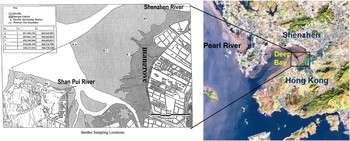
Polychaetes sampling was conducted quarterly in August, November, February and May from 2002 to 2004. The positions of the four sampling stations, A, B, C and D, were determined by the Global Position System and were located on the onshore (A, B) and offshore (C, D) transect of the mudflat (Figure 1). Station A is close to the Shenzhen River; Station B is on the edge of mangrove forest. Station C is approximately in the centre of the mudflat and Station D is located at the intersection point of the two rivers along the offshore transect. According to the species–area effect, more smaller samples would result in greater coverage of the sample site, a better estimate of spatial dispersion and a greater number of degrees of freedom for statistical analysis. Therefore, at each station, 15 replicates of surface sediment were randomly taken using a cylindrical core sampler of 10 cm internal diameter to a depth of 10 cm at low tide for extraction and analysis of polychaetes.
Mai Po Inner Deep Bay wetland and sampling locations (A, B, C and D).

Sample treatment
The sediment core samples were washed immediately with tap water through a 0.5 mm sieve for polychaete extraction. The retained materials were collected, fixed in 10% neutralized formaldehyde and stained with 0.01% (w/v) rose Bengal for at least 24 hours. Then the polychaetes were sorted manually under a dissecting microscope in the laboratory, identified to species level and enumerated. Moreover, biomass was determined by measuring the preserved wet weight for all individuals of each species within each replicate of the 15 core samples of each station.
Additional sediment samples were also taken at each station for analysis of particle size distribution (PSD) and total organic carbon (TOC). According to conventional methods, grain size analysis was measured by wet-sieving and the sedimentation method. The sieving method was used to analyse particles over 63 µm and the sedimentation method was used to analyse particles smaller than 63 µm. TOC was determined by analysing an air-dried sediment sample after removal of inorganic carbonates by acidification in Solid Sample Module SSM-5000A and TOC-5000A (Shimadzu, Japan). Technique details were described earlier by the Laboratory of Environmental Toxicology (2003) and Lai et al. (Reference Lai, Shen and Gu2005).
Data analysis
Biological properties included the following: total abundance, number of species (species richness (S)), Shannon–Wiener diversity (H′ (log2)), Pielou's evenness (J) and taxonomic distinctness analysis (using presence/absence data). Since it involved multiple species in relation to environmental conditions, the dataset was analysed using a multivariate approach which was sensitive in discriminating between sites/samples based on rank data with a minimum loss of information and the analysis was performed with software PRIMER v6 for windows (Plymouth Routines In Multivariate Ecological Research). Replicate core data were pooled from each station with total coverage of the sampling area up to 0.12 m2 at each station and the total abundance transformed into densities, standardized as the number of individuals per unit area. Multivariate analyses were used to detect any seasonal and spatial differences in the species composition of the Polychaeta assemblage and to assess which taxon mainly contributed to the temporal and spatial differences. Similarity matrices were constructed using Bray–Curtis similarity because it does not derive similarity from conjoint absences (Clarke & Warwick, Reference Clarke and Warwick1994). Relationships between stations were visualized using non-metric multidimensional scaling (nMDS) ordination supplemented with cluster analysis (species abundance data were used, after square root transformation). This ordination plot is a visualization of a 2-factor analysis of similarities (ANOSIM; Clarke & Warwick, Reference Clark and Warwick2001) crossed between sites and sampling dates. This procedure allowed us to test for significant differences in polychaete community structure between sampling periods using average site values and between sites using average sampling date values. Each ANOSIM procedure entailed the use of 999 permutations. Following a cluster analysis, the species having the greatest contribution to the division of samples into cluster were determined using the similarity percentage program (SIMPER) (Clarke & Warwick, Reference Clarke and Warwick1994). Moreover, combined k-dominance plots for species biomass and numbers (abundance–biomass comparison (ABC)) were also used to detect any possible disturbance. BIO-ENV and correlation analysis was also run between the polychaetes assemblages and abiotic variables (PSD and TOC) to detect the significant effect of environmental factors on the benthic community.
RESULTS
Sediment characteristics
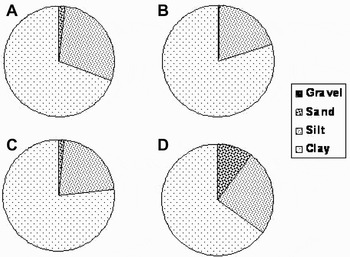
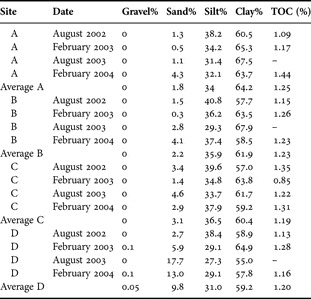
Sediments in the onshore stations were highly homogeneous and typically comprised very fine clay and silt which accounted for nearly 98% of the composition, especially at Stations A and B, while at offshore Station D, relatively high content of medium sands (9.8%) were observed (Table 2; Figure 2). Besides the PSD, other parameters showed no significant variations among different sites, including the concentration of total organic carbon (Table 2), pH and redox potential (data not shown).
Particle size distribution of the sediment at each Station (A–D) with the sand content increased from onshore Stations A–C to offshore Station D. Sediments in the former typically comprised very fine clay and silt, especially at Station B, while relative high content of medium sands occurred at Station D.

Species composition and community structure of polychaetes
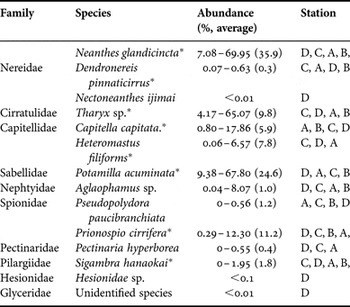
A total of 14 species belonging to 10 families of Polychaeta was recorded during the study period from August 2002 to May 2004 (Table 1). Among them, 11 species in 8 families were recorded from Station A, 9 species in 7 families from Station B, 11 species in 8 families from Station C and 14 species in 10 families from Station D. For the survey area as a whole, the dominant species were mostly the two large polychaetes: Nereidae Neanthes glandicincta Southern, 1921 and Sabellidae Potamilla acuminata Moore & Bush, 1904 which accounted for 34.4% and 30.2% of the total abundance, respectively. The next important species included several small body-size organisms: Cirratulidae Tharyx sp., Capitellidae Capitella capitata Fabricius, 1870 and Spionidae Prionospio cirrifera Wirén, 1883, which have been reported as important pollution-tolerant or opportunistic species worldwide.
A list of polychaete species recorded at Mai Po mudflat from August 2002 to May 2004.*, occurred at previous surveys also.

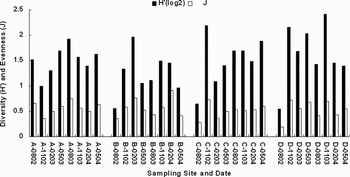
The Shannon–Wiener diversity (H′ (log2)) ranged between 0.54 and 2.4 with a mean of 1.5 across the whole mudflat during the study period. Pielou's evenness (J) also varied significantly from 0.37 to 1.67 with a mean of 0.54 (Figure 3). The species diversity increased with the distance from the onshore with the lowest values at Station A (the Shenzhen River mouth) and Station B (the mangrove fringe) to the highest values at the subtidal Station D. Correspondingly, the gravel content of PSD also increased along the transect from intertidal Stations A/B towards subtidal Station D (Table 1; Figure 3). Taxonomic diversity (Δ) ranged from the lowest at Station B (46) to the highest at Station D (55) and taxonomic distinctness (Δ+) also continued to rise with the increasing distance from the Shenzhen River mouth from the lowest at Station B (73.6) to the highest at Station D (74.2), but less steeply.
The Shannon–Wiener diversity (H′ (log2)) and Pielou's evenness (J) of each sampling event during the two-year study period.

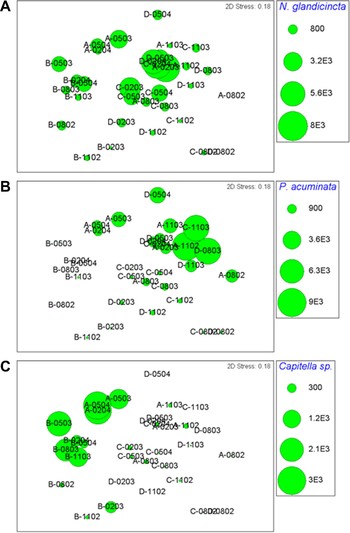
Along the transect/PSD gradient, the communities were also clustered into two distinct groups (I and II) (Figure 4), and the ANOSIM confirmed the significant difference between the communities of different site as well (Global R: 0.474, P < 0.01, N = 32, permutation: 999). Group I included all the samples from Stations B and A in May 2003, 2004 and February 2004, and these two stations are located near the Shenzhen River mouth and mangrove edge. Group II included the remaining samples, in particular from Stations C and D, which are far away from the river mouth and mangrove forest. Dissimilarities between these stations were also visualized by the 2-dimensional MDS ordination plot (Figure 5). Considerable numbers of Capitella capitata occurred only at Group I Stations (A and B), which were near the Shenzhen River mouth and mangrove forest (Table 2; Figure 5). On the contrary, the abundance of N. glandicincta decreased opposing the gradient from D/C (Group II) to A/B. For P. acuminata, a suspension-feeder, the highest density occurred at subtidal stations which contained much coarse gravel component along the Shenzhen River, especially at Station D. So the species contributing the greatest to the division of samples into two different clusters were C. capitata, P. acuminata, Tharyx sp. and N. glandicincta (SIMPER, 70% cutoff).
Classification of sampling stations. Station codes are given with an extension for date of sampling. Main groups are indicated by number (I, II).

Non-metric multidimensional scaling (MDS) ordination superimposing by three individual species: Neanthes glandicincta (A), Potamilla acuminata (B) and Capitella capitata (C). Stress = 0.18. Station codes are given with an extension for date of sampling. E3 = 103.

Sediment characteristics of Mai Po mudflat in different seasons.

–, no data available.
Community analysis and pollution impact
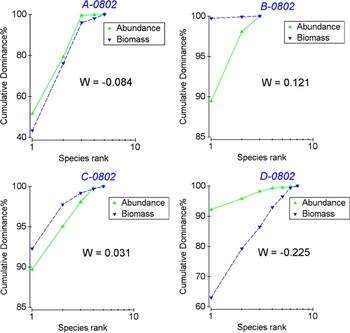
The ABC curves plotted for each sampling event at each station showed a general ‘moderately’ to ‘gross’ disturbed community on most parts of the Mai Po mudflat (Figure 6). Nearly half of the W measures (42%) were lower than 0.1 and almost all (92%) were below 0.2. Particularly at Station B, due to very low species diversity with only 3 to 5 species at each time, the ABC curves showed very high dominance which indicated the very poor quality of the sediment around this area.
The abundance–biomass comparison (ABC) curves of selective sampling events from August 2002. Station codes (A, B, C and D) are given with an extension of the sampling date (year, month).

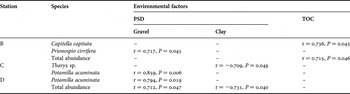
The best variable combination involved both PSD and TOC, and the rank of the single abiotic variables which best grouped the samples was silt > clay > sand > TOC (BIO-ENV results). Correlation analysis also indicated that both PSD and TOC played significant roles in regulating the distribution and abundance of the polychaete assemblages among the stations (Table 3). At Station B, the TOC had a significant positive effect on the abundance of Capitella (P = 0.037, N = 8) and total abundance of polychaetes (P = 0.046, N = 8). Significant correlations (at P < 0.05 with positive coefficients) were also found for the abundance of P. acuminata and total abundance of polychaetes with sediment gravel component at Stations C and D (Table 3). However, clay content had a significant negative effect on the abundance of Tharyx and total abundance of polychaetes (Table 3).
Significant correlation coefficients observed for the abundance of polychaetes with environmental factors. PSD, particle size distribution; TOC, total organic carbon; N = 8.

–, not significant.
DISCUSSION
Environmental stress at the Mai Po mudflat
Mai Po wetland has experienced pollution perturbations from nearby rivers. A control site was initially chosen to compare with the current sampling stations. However, this site also exhibited a typical feature of an impacted community (Figure 6). Because of this, current results were compared with those of previous surveys on the same mudflat to elucidate the temporal environmental impact on the community structure and composition.
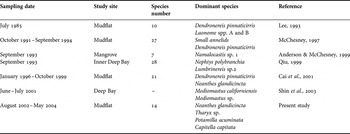
A total of 14 polychaete species were recorded in the present study and this was much lower than those of previous records, e.g. 27 species by McChesney (Reference McChesney1997), and 21 species by Cai et al. (Reference Cai, Lin and Liu2000, Reference Cai, Lin and Li2001a, Reference Cai, Zhen, Lin, Ma, Gao and Lin2001b) (Table 4: the sampling size of both: the core diameter (10 cm ID) and replicate were identical). A big problem, however, was found when comparing the records by different researchers because of the taxonomic position of each species. Due to the difficulty to identify a species at or below species level for most ecological scientists, most species were classified at the genus level and many species ID in different literatures may be actually from the same species. Caution must be taken for comparison of the species composition, especially for the close related species from the same genus. Nevertheless, despite the confusion in taxonomy, there was still some evidence of the difference in species number and richness between habitats. For example, the highest species number was recorded from Inner Deep Bay (subtidal or deep water) and the lowest was found in mangrove forest (Anderson & McChesney, Reference Anderson, McChesney and Lee1999). In the mudflat, species were lost rapidly over the time from 27 species in 1991–1994 to 14 species in 2002–2004. The decline of species richness should be one of the strong signals of changes in habitat quality over the past ten years and the continuous pollution from human activities around this area could be one major reason (Chiu, Reference Chiu1992; McChesney, Reference McChesney1997; Shin et al., Reference Shin, Wu, Huang and Shin2003).
Polychaete species collected by different researchers at Mai Po mudflat or related areas including Deep Bay and mangrove forest.

Besides the decline in species richness, another important change was in the species composition of the polychaete assemblages. Firstly, the dominant species changed over time (Table 4) and these dominant species covered different functional feeding types, e.g. deposit-feeding and filter-feeding, which were the adaptive strategy to different habitats (Fauchald & Jumars, Reference Fauchald and Jumars1979; Weston, Reference Weston1990; Snelgrove et al., Reference Snelgrove, Blackburn, Hutchings, Alongi, Grassle, Hummel, Kong, Koike, Lamshead, Ramsing and Solis-Weiss1997). Consequently, the changes in the dominant species over the time could be a reflection of the transformation of the habitat quality in the study area. Secondly, the rare species were lost rapidly. For example, more than 13 species documented in the previous surveys, were not found during the current study period, and 8 of them could be regarded as rare species, having a low abundance and/or small distribution range-size (Gaston, Reference Gaston1994). There were also 4 rare species observed in our samples and compared with the more abundant ones, rare species were subjected to disturbance and environmental stress in general (Cao et al., Reference Cao, Larsen and Thorne2001). The high variation in the frequency of rare species may imply either a high turnover of rare species or an incomplete sampling of the rare species at each time. However, little information was available on this subject from Mai Po mudflat or even throughout the world. In most cases, the rare species or taxa were omitted from the data analysis and their contribution to the community or ecological study remained unclear. More intensive sampling studies using both ecological and molecular methods are needed to resolve the distribution patterns of rare species in the studied area.
Furthermore, it was noted that one of the dominant species Dendronereis pinnaticirris Grube, 1878 (Polychaeta: Nereididae) in an early finding became rare or extinct as shown in our survey. Dendronereis pinnaticirris is approximately 180 mm in length and 5.5 mm in width, and an errant carnivore (Wu et al., Reference Wu, Sun and Yang1981). It was probably the largest species of polychaetes living in the Mai Po mudflat with an average density of 837 individuals.m−2 in a previous report (Cai et al., Reference Cai, Zhen, Lin, Ma, Gao and Lin2001b), but in our results, less than 10 individuals were collected during the study period. Since sampling size, both the core diameter (10 cm ID) and replicate were identical, the sampling size effect could be excluded from the contributing factors for the differences observed. It has also been reported that prey of water birds had a negative effect on the abundance of D. pinnaticirris (Cai et al., Reference Cai, Lin and Liu2000). However, the predation pressure of birds would not likely cause the extinction of any particular species. Therefore, based on the decreased species richness/diversity and the extinction of dominant species, it is reasonable to conclude that pollution is a persistent factor in the study area during the past decades and the ecosystem is under the threat of environmental stress.
Impacts of sediment composition and total organic carbon
In the Mai Po mudflat, polychaetes formed distinct assemblages along the intertidal gradient of increasing sediment grain size towards the subtidal (also along the river mouth towards the deep bay). Sediment composition has been demonstrated here to affect the distribution of polychaete species or the whole community. Actually, the animal–sediment relationship has been well documented elsewhere and the temporal–spatial distribution patterns of benthic infauna were strongly associated with the sediment properties including both physical and chemical parameters (Alongi, Reference Alongi1987; Dittmann, Reference Dittmann1998, Reference Dittmann2000; Brasil et al., Reference Brasil dos, Claudia, da Silva and Henrique2000). One common generalization is that deposit-feeders are more abundant in muddy habitats and suspension-feeders dominate sandy habitats (reviewed in Snelgrove & Butman, Reference Snelgrove and Butman1994) and our results support the validity of this generalization. The large filter-feeding Sabellidae Potamilla acuminata was densely distributed along the subtidal Station D in summer/autumn seasons where the sand and gravel component increased along the river flow. It has also been demonstrated that sedimentation has a remarkable effect on the abundance and distribution of this species (Anon, Reference Anon1994a, Reference Anonb). Such a phenomenon indicated that physical factors including sedimentation and PSD played important roles in the distribution of the annelids in the Mai Po mudflat since these factors have also been shown to be important in regulating the abundance and the biomass of deposit feeders (Rossi et al., Reference Rossi, Como, Corti and Lardicci2001 and references therein). Therefore, sediment type could be regarded as the primary determinant of infaunal species distribution, but not the sole one.
In addition to the sediment composition, organic carbon was another proposed causative factor which might influence the polychaete assemblages. The high number of Capitella at Station B might be attributable to a positive effect of TOC at this site because Capitella have been widely used as an organic pollution indicator (Pearson & Rosenberg, Reference Pearson and Rosenberg1978; Warwick & Clarke, Reference Warwick and Clarke1993; Méndez, Reference Méndez2002). However, the low species richness and diversity, and low abundance of polychaete assemblages could not be attributed to the TOC alone since the concentration of TOC at all four stations showed no significant difference among them. No single mechanism has been able to explain patterns observed across the whole mudflat, which indicates the complexity of the ecosystem and further factors had to be considered. For example, tannins derived from mangrove roots and leaves could inhibit and regulate the benthic assemblages (Alongi, Reference Alongi1987). Physical factors like anoxia level in the sediment also played an important role. However, the complex inter-relationships among these variables are poorly understood (Snelgrove & Butman, Reference Snelgrove and Butman1994).
Polychaetes as indicators in habitat assessment
Firstly, several pollution tolerant or opportunistic species have been recorded as numerically high at Mai Po sediment during the study period, including C. capitata, Tharyx sp. and P. cirrifera. Capitella have been widely used as an organic pollution indicator (Warwick & Clarke, Reference Warwick and Clarke1993; Méndez, Reference Méndez2002) and Tharyx has also been demonstrated to be an indicator of different degrees of organic pollution produced mainly by domestic sewage (Belan, Reference Belan2003). They were highly opportunistic and could respond rapidly to environmental perturbations. Their reproductive strategies enabled them to build up large populations over very short time periods (Hutchings, Reference Hutchings1998). It was a typical feature of impacted community with high density of opportunistic species occurring in the ecosystem. Therefore, the occurrence of a high number of opportunistic species indicated that the benthic infaunal community of Mai Po mudflat was under pollution disturbance especially at Station B, which was dominated by a high density of Capitella. Moreover, the community at Station A showed much more variations in species composition among the different seasons, suggesting a clear transition in habitat quality or environmental factors especially in February and May of 2004.
Secondly, in the cluster analysis, two distinct groups were separated which related to environmental gradient, especially the sediment granulometry. Group I was a disturbed zone and contained much more silt and clay, including Stations A and B. This zone was located along the edge of the mangrove and close to Shenzhen River estuary. It was an area of anoxic sediment and characterized by low number of species, low diversity and high dominance by Capitella. Group II was the less impacted area and contained much coarse composition in sediment substrate, including Stations C and D. This zone was located in subtidal area and was dominated by the large suspension-feeder Potamilla acuminata. Moreover, taxonomic diversity (Δ) and distinctness (Δ+) also continued to rise with the increasing distance from the Shenzhen River mouth with the lowest at Station B to the highest at Station D, indicating a biodiversity loss near the perturbed stations.
Thirdly, the ABC curves also detected apparent disturbance of stressed community at almost all sites during the course of this study. The ABC plot was originally designed to detect pollution effects on macrobenthic fauna in subtidal waters, and then widely used for intertidal monitoring and other physical and biological disturbances (Warwick, Reference Warwick1986; Warwick & Pearson, Reference Warwick and Pearson1987). In this case, this method was evident to be useful to elucidate the impact of environmental factors on the polychaete or whole community at Mai Po mudflat.
In summary, our results indicated that polychaete assemblages were advantageous for them to be used as appropriate indicators in assessing environmental perturbations alone instead of the whole benthic community. They could easily provide statistically valid sampling in the field study and covered a wider range of physiologies and feeding types to allow a balanced assessment of ecosystem and community process. This result benefits the environmental monitoring programme and is very important for making management decisions on the protection of the environment.
CONCLUSIONS
This study examined the distribution and variations of a polychaete community with environmental perturbations. Both temporal and spatial variations were observed through species density and composition. The communities at onshore Stations A and B were largely dominated by the global opportunistic species Capitella capitata. While the large species Neanthes glandicincta decreased with the increasing pollutant along the Shenzhen River from offshore Stations C/D to onshore Stations A/B. Sediment composition and total organic carbon were significantly related to the spatial distribution and abundance of polychaete assemblages with deposit-feeders more abundant in muddy habitats and suspension-feeders dominated sandy habitats. Based on the results, the conclusion was drawn that the community of Mai Po mudflat was under cumulative disturbance derived from both freshwater inputs and the nearby mangrove forest.
ACKNOWLEDGEMENTS
This study is part of the Baseline Ecological Monitoring Program for the Mai Po and Inner Deep Bay Ramsar Site supported by the Agriculture, Fisheries and Conservation Department (AFCD) of the Hong Kong SAR Government. We would like to thank the team members in our Laboratory of Environmental Toxicology of the University of Hong Kong and the field working group of AFCD at Mai Po for logistic support on sampling transport and assistance. Any opinions, findings, conclusions or recommendations expressed in this publication do not reflect the view of the Government of Hong Kong Special Administrative Region.