Introduction
Behavioral and psychological symptoms of dementia (BPSD) cover a wide spectrum of non-cognitive manifestations of dementia. Up to 60% of community-dwelling older adults and more than 80% of nursing home residents exhibit BPSD (Testad et al., Reference Testad, Aasland and Aarsland2007; Zuidema et al., Reference Zuidema, Derken, Verhey and Koopmans2007). In Chinese older adults, BPSD, including irritability and dysphoria, were present in up to 37% of Alzheimer's disease (AD) patients (Mok et al., Reference Mok, Chu, Chung, Chan and Hui2004). Conventional antipsychotics have been widely prescribed for the treatment of BPSD. Systematic reviews on antipsychotics performed in the 1990s showed that they had an 18% benefit over placebo for symptomatic management of BPSD (Schneider et al., Reference Schneider, Pollock and Lyness1990; Lonergan et al., Reference Lonergan, Luxenberg and Colford2002). However, conventional antipsychotics have substantial adverse effects and atypical antipsychotics have been widely prescribed for the treatment of BPSD since the 1990s. They have the advantage over conventional agents of producing fewer extrapyramidal symptoms.
A meta-analysis in 2005 showed that atypical antipsychotics might be associated with increased mortality in the first six months of prescription when compared with placebo (Schneider et al., Reference Schneider, Dagerman and Insel2005). The US Food and Drug Administration (FDA) thus issued a “black box” warning on the labels of all atypical antipsychotics, which described this risk and advised that the atypical antipsychotics were not approved for use in older adults with dementia. Another meta-analysis published in 2005 suggested that conventional antipsychotics were at least as likely as atypical antipsychotics to lead to increased mortality among older adults with dementia and BPSD in the first six months of prescription (Wang et al., Reference Wang2005). The FDA therefore also issued a warning on conventional antipsychotics based on this finding.
Subsequent observational studies have showed controversial results. Some showed that both conventional and atypical antipsychotics can lead to increased mortality, while others showed that neither conventional nor atypical antipsychotics were associated with higher mortality (Raivio et al., Reference Raivio, Laurila, Strandberg and Tilvis2007; Trifiro et al., Reference Trifiro, Verhamme, Ziere, Caputi, Stricker and Sturkenboom2007; Kales et al., Reference Kales2008; Bronskill et al. Reference Bronskill2009; Liperoti et al., Reference Liperoti2009; Nordon et al., Reference Nordon2009; Simoni-Wastila et al., Reference Simoni-Wastila, Ryder, Qian, Zuckerman, Shaffer and Zhao2009; Rossom et al., Reference Rossom, Rector, Lederle and Dysken2010). No study has previously focused on the association between the use of antipsychotics and mortality in Chinese older adults. In order to address these controversies, we conducted an 18-month prospective cohort study in a group of older adults with dementia living in nine nursing homes in Hong Kong. The aim was to investigate the relationship between continuous use of antipsychotics and mortality as well as hospitalization.
Methods
Research setting
The study design was an 18-month prospective cohort study conducted from July 2009 to December 2010. Baseline data collection and patient assessment were performed from April 2009 to June 2009 and the patients were followed from July 2009 to December 2010. The study was performed in nursing homes in the Hong Kong Central & Western and Southern Districts. In 2009, the population in Hong Kong Western and Southern District was approximately 530,000 and there were over 70 nursing homes caring for more than 6000 older adults. Many of these older adults living in Care and Attention (C&A) homes were frail, had limited mobility and advanced medical diseases, making it very inconvenient for them to attend medical and psychiatric outpatient clinics (Luk et al., Reference Luk, Chiu and Chu2009). In view of this, outreach services by geriatricians and psychogeriatricians have been provided in Hong Kong since 1994. The Hong Kong West (HKW) Community Geriatric Assessment Team (CGAT) and Psychogeriatric Team (PGT), including geriatricians and psychogeriatricians, provide outreach services for the older adults in nursing homes of Hong Kong Western and Southern District. More than 3000 older adults were under their management in 2009.
Nine C&A homes, with a combined resident population of 2500 older adults, in Hong Kong Central & Western and Southern Districts were chosen for this study. They were all run by government or non-profit charitable organizations with standardized caregiver to older adult ratio and facilities and hence were able to provide comparable quality of care. In 2009, 812 older adults were under the care of HKW CGAT and PGT. Inclusion criteria were age 65 years or above, living in one of the nine selected nursing homes, and being followed up by HKW CGAT and/or PGT. In addition, to be included in the study, older adults needed to be diagnosed as having dementia either by geriatricians or psychogeriatricians based on Diagnostic and Statistical Manual of Mental Disorders, 4th edition criteria (DSM-IV). The exposed group included older adults who had been taking conventional or atypical antipsychotics for more than six months. The control group included older adults who were not taking conventional or atypical antipsychotics in July 2009. Older adults were excluded if they had taken antipsychotics for less than six months or if they were diagnosed to have advanced malignancy prior to the start of this study in July 2009.
Data collection
Baseline demographic data including gender and age were collected by reviewing the Hospital Authority Computer Management System (CMS). The CMS holds records of comorbidity standardized on the basis of the International Classification of Disease, 9th revision, Clinical Modification (ICD-9-CM). CMS also has records of hospitalization, medication use, laboratory results and/or death for all patients who are registered in the system. All patients who are receiving follow-up by CGAT and PGT are registered on the system.
The number and types of comorbidity on the basis of ICD-9-CM were quantified using the Charlson Comorbidity Index (CCI) (Charlson et al., Reference Charlson, Pompei, Ales and MacKenzie1987; Schneeweiss et al., Reference Schneeweiss and Maclure2000). Cognitive status was assessed using the Chinese version of the Abbreviated Mental Test (AMT) (Chu et al., Reference Chu, Pei, Ho and Chan1995). Comorbidity status was collected from CMS. The functional status of the patients was assessed by the Barthel Index 20 (BI(20)) (Mahoney et al., Reference Mahoney and Barthel1965; Torres et al., Reference Torres Moreno and Fernandez Duque2010). Two doctors from HKW CGAT performed updated AMT and updated BI(20) on all screened patients for the purpose of this study from April 2009 to June 2009. They were blind to the antipsychotics exposure status during assessment. Hospital admissions documented in CMS between July 2008 and June 2009 were recorded as “admission in preceding year”. Any history of schizophrenia and depression was collected from CMS.
The timing of this study coincided with the pandemic of Influenza A (H1N1) 2009 in the community, with vaccination being available from December 2009. Since pandemic influenza could contribute to deaths and hospitalization, vaccination status was documented as a possible confounder. In addition, vaccination status for seasonal influenza and Pneumococcus were also recorded from the patients’ records.
The clinical status of patients was monitored from July 2009 to December 2010 from the CMS and all-cause hospitalizations were recorded. These included all hospitalizations except scheduled clinical admissions. Mortality of patients and cause(s) of death were also recorded.
Antipsychotics exposure including the types and dosages used were examined using the information in the CMS. Antipsychotics were classified as atypical and conventional antipsychotics. Atypical antipsychotics included risperidone, olanzapine and quetiapine; conventional antipsychotics included haloperidol, sulpiride and chlorpromazine. Any changes in dosage, withdrawal or newly started antipsychotics during the 18-month study period were recorded. For patients who were prescribed as antipsychotics on an “as needed” basis, the actual amounts of drug taken were recorded with the help of caregivers in nursing homes. For patients whose antipsychotics were being stopped or newly started, they were regarded as “censored” during survival analysis and were removed from the total number of the respective groups.
Primary and secondary outcomes
Primary outcomes were mortality rate and rate of all-cause hospitalization per year over 18 months. Secondary outcomes were other risk factors that could predict mortality and hospitalization.
Ethics
The study protocol was approved by the Institutional Review Board of the University of Hong Kong/Hospital Authority Hong Kong West Cluster.
Sample size calculation
The sample size was calculated with reference to the study published in 2009 (Ballard et al., Reference Ballard2009). In that study the survival rate at 18 months was 58% in the exposure group and 74% in the withdrawal group. The difference in proportion was 0.16. The package “Power Analysis and Sample Size 2008 (Windows version 2008)” was used in sample size calculation. It showed that a group sample size of 170 and 340 would be able to achieve 95% power to detect a difference in proportion of 0.16 between the null hypothesis and the alternative hypothesis using a two-sided χ2 test with continuity correction and a significance level of 0.05.
Statistics
The Statistical Package for Social Sciences (Windows version 18; SPSS Inc, Chicago) was used in statistical analysis. Continuous valuables were expressed as either mean ±standard deviation of the mean (mean ±SD) if they are normally distributed or as a median with interquartile range if their distribution is skewed. Independent t test was used to compare the change of continuous variables of two different groups if the variables were normally distributed. Mann-Whitney test was used to compare the change of continuous variables of two different groups if the distribution of the variable was skewed. χ2 test and Fisher's exact test were employed to compare categorical variables. Variables with a significant association with mortality to a value of p<0.05 on univariate analyses were entered into the final multivariate analysis. Age, gender, CCI, BI(20), AMT score, vaccination status for Influenza A (H1N1) 2009, seasonal influenza and Pneumococcus were considered as covariates. Binary logistic regression and ordinal regression was used for multivariate analysis of mortality and hospitalization respectively. Odds ratios with 95% confidence intervals were used to estimate the association between the independent factors of mortality. Kaplan-Meier curves were constructed to illustrate the cumulative rate of mortality between the two groups during the 18-month follow up. Statistical significance was inferred by a two-tailed p value of 0.05 or less.
Results
Patient characteristics
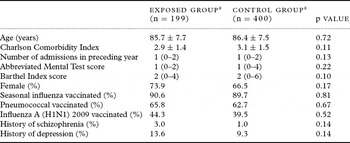
A total of 812 patients were screened, of whom 599 met the inclusion criteria for participation in the study. At the start of the study in July 2009, 199 patients had been taking antipsychotics for more than six months (exposed group) while 400 patients were not taking antipsychotics (control group). For the exposed group, 91.1% (181/199) were taking conventional antipsychotics and 8.9% (18/199) were taking atypical antipsychotics. Haloperidol was the most commonly prescribed conventional antipsychotic and quetiapine was the most commonly prescribed atypical antipsychotic. For the exposed group, 89.9% (179/199) were taking low dose antipsychotics (≤2 mg haloperidol daily or ≤100 mg quetiapine daily) and 10.1% (20/199) were taking high dose antipsychotics. Four patients were prescribed antipsychotics on an “as needed” basis, prescriptions for all other patients were for regular use. For the four patients prescribed “as needed”, the caregivers reported that they were all taking the medications regularly because of need for symptomatic control of BPSD. Over 18 months, 19 patients had their dosage of antipsychotics changed: eight had their antipsychotics stopped completely and 11 had the dosage increased. In the non-exposed group, 11 were started on antipsychotics during the course of our study. These patients were regarded as censored during statistical analysis.
There was no significant difference in age, gender, CCI, AMT score, BI(20), vaccination status (for Influenza A (H1N1) 2009, seasonal influenza and Pneumococcus), admission in the preceding year, history of schizophrenia and history of depression between the exposed and control group. (Table 1)
Baseline characteristics of the studied subjects

a Data are mean ± standard deviation if valuable are normally distributed or median (interquartile range) if the distribution of valuable are skewed.
Comparison of mortality between exposed group and control group
After exclusion of censored cases, in the exposed group, 6.6% of patients (13/198) died within six months, 17.0% (33/195) died within 12 months and 25.0% (48/191) died within 18 months. In the control group, 7.3% (29/396) died within six months, 18.2% (71/391) died within 12 months and 28.2% (110 of 389) died within 18 months. No statistical difference for crude mortality was found between the exposed group and control group by using the log-rank test and χ2 test. (Figure 1)
18-month survival according to current use of antipsychotics by using Kaplan Meier curve.

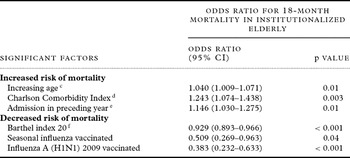
Multivariate analysis using binary logistic regression was performed to identify independent predictors for mortality at 18 months. Increasing age, more admissions in the preceding year and higher CCI predicted higher mortality at 18 months. Vaccination of seasonal influenza, vaccination of Influenza A (H1N1) 2009 and higher BI(20) score predicted lower mortality at 18 months. Exposure to antipsychotics did not predict mortality. (Table 2)

a Multivariate analysis by using binary logistic regression.
b Hosmer and Lemeshow Test: p = 0.512. It indicates that the model has a good calibration. The predicted probability of the event is close to that observed.
c For every 1 year increase in age.
d For every 1 point increase in Charlson's Comorbidity Index.
e For every episode increase in acute hospital admission in preceding year.
f For every 1 point increase in Barthel index.
Comparison of the rate of hospitalization between the exposed group and control group
A total of 9394 person-months were monitored. Median rate of hospitalization for acute conditions in the exposed group was 56 (interquartile range (IR): 0–111) per 1000 person-months while that of the control group was 111 (IR: 0–222) per 1000 person-months. The rate of hospitalization for acute conditions in the exposed group was significantly lower than that of the non-exposed group by Mann-Whitney Test (p<0.001). (Table 3)
Comparison for rate of hospitalization for acute condition according to current exposure of antipsychoticsa

a Comparison by Mann-Whitney test.
b Data are median and interquartile range.
Multivariate analysis was done by using ordinal regression to identify factors with independent predictive value on hospitalization for acute conditions. Increasing age, more admissions in the preceding year, higher CCI and male sex predicted an increased rate of hospitalization. The results showed that current usage of antipsychotics, vaccination of Influenza A (H1N1) 2009 and higher BI(20) predicted fewer episodes of hospitalization.
Discussion
This prospective cohort study suggested that continuous use of antipsychotics for more than six months among institutionalized Chinese older people with BPSD was not associated with increased mortality. This finding was consistent with many retrospective observational studies, which compared mortality between current users and non-users of antipsychotics. Although there were other studies showing an association between antipsychotics and increased mortality, those studies focused mainly on new users who had been prescribed antipsychotics for less than six months. This study is the first prospective cohort study to investigate the association between continuous use of antipsychotics for more than six months and mortality in institutionalized Chinese older people with BPSD.
An important question has arisen from our study. Although continuous use of antipsychotics for more than six months is not associated with increased mortality in institutionalized older people with BPSD, why would we prescribe antipsychotics when there is evidence that it may increase short-term mortality? The most important reason is the lack of a suitable alternative. Non-pharmacological managements are the recommended way of treating BPSD but many of these management programs – e.g. distraction techniques, one-to-one attention, psychotherapy and validation therapy – require adequate manpower (DeYoung et al., Reference DeYoung, Just and Harrison2002; Bird et al., Reference Bird, Jones, Korten and Smithers2007; Tondi et al., Reference Tondi, Ribani, Bottazzi, Viscomi and Vulcano2007). Manpower is often limited in the nursing homes of Hong Kong. The mean number of staff per 100 residents is less than 20 in most residential care homes for the elderly (Tang et al., Reference Tang2010). Because many residents may have BPSD, non-pharmacological management can be difficult to provide effectively – and inadequately managed BPSD can be dangerous. In addition, inadequately managed BPSD may increase caregiver stress levels and may cause drug-related incidents. Appropriate use of antipsychotics in indicated patients has considerable benefits when non-pharmacological managements fail or cannot be carried out owing to limited resources: (i) adequate control of physical aggression and agitation may reduce the chances of older people harming themselves, their caregivers or others in their vicinity; and (ii) adequate control of BPSD may produce a less stressful working environment for caregivers and a better environment for older people through improving their relationship with caregivers. Therefore, antipsychotics are usually prescribed after careful clinical assessment by geriatricians or psychogeriatricians if non-pharmacological management is inadequate or difficult to execute.
One may ask why it is important to establish the relationship between continuous use of antipsychotics and mortality. A common clinical difficulty faced by geriatricians and psychiatrists is the recurrence of behavioral problems upon withdrawal of antipsychotics (Bridges-Parlet et al., Reference Bridges-Parlet, Knopman and Steffes1997; van Reekum et al., Reference van Reekum2002). It is more common when there is inadequate non-pharmacological support or when the antipsychotics are stopped prematurely. The findings from this study can provide reassurance to the geriatricians and psychogeriatricians in prescribing antipsychotics in nursing homes that they may withdraw antipsychotics when there is adequate non-pharmacological support and the patient is clinically stable.
This study showed that the exposed group had a lower rate of hospitalization, which is consistent with the finding from Raivio et al. (Reference Raivio, Laurila, Strandberg and Tilvis2007). There are a number of possible reasons. First, patients on antipsychotics are less agitated so they have a lower chance of physical injury. Secondly, adequately treated patients may cause less stress for their caregivers and will be less likely to be sent to hospital for management of trivial medical problems. In view of limited public hospital resources, this finding is important as adequately managed BPSD may reduce unnecessary hospital admission. Some might argue that the reduction in physical complaints may result in delayed clinical presentation or even increase mortality. However, this study demonstrated that there was no significant difference in mortality between the exposed group and control group.
Although this study suggested that continuous use of antipsychotics for BPSD for more than six months was not associated with increased mortality among institutionalized Chinese older people with BPSD, antipsychotics must be prescribed cautiously. There are many possible cardiac, metabolic and neurological risks for antipsychotics. Conventional antipsychotics are associated with a prolonged QT interval in ECG and may precipitate arrhythmia (Sicouri et al., Reference Sicouri and Antzelevitch2008). Antipsychotics may also cause weight gain and increase the risk of diabetes and dyslipidemia (Amiel et al., Reference Amiel, Manguria, Ganguli and Newcomer2008). Conventional antipsychotics and high doses of atypical antipsychotics are associated with an increased risk of extrapyramidal side effects. In view of these possible adverse effects, it must be emphasized that antipsychotics should only be prescribed if non-pharmacological management is inadequate or is difficult to execute. Thus, it should only be prescribed after careful clinical assessment by geriatricians or psychogeriatricians. Regular monitoring of a patient's clinical status and regular review of indications for prescribing antipsychotics by geriatricians or psychogeriatricians are necessary.
This study has several strengths. A thorough search of MEDLINE indicates that it is the first prospective cohort study to investigate the association between continuous use of antipsychotics for more than six months and mortality in Chinese nursing home residents with BPSD. This study obtained a definite diagnosis of dementia for all subjects, which was performed by geriatricians or psychogeriatricians based on DSM-IV criteria. In the present study, medication prescription was recorded carefully. Any changes (withdrawal or addition) of antipsychotics were documented and censored if indicated. In addition, clarification with caregivers on the pattern of medication intake for patients who were prescribed antipsychotics on an “as need” basis was done. This prevented over- or underestimation of outcomes. We reviewed each hospital admission over 18 months thereby preventing overestimation of hospital admission due to scheduled clinical admissions. In addition to the medical status of each patient, functional status and frailty were also documented. Frailty is an important confounding factor that is often overlooked in multivariate analysis. Sample size calculation was performed and the sample size in this study (599) was adequate to provide enough statistical power to detect any difference between the groups. Finally, vaccination status for pandemic influenza A (H1N1) 2009 and seasonal vaccination during data collection and multivariate analysis were included. Our results showed that both (H1N1) 2009 and seasonal influenza vaccination were important predictive variables for mortality and this signified the importance of their inclusion.
This study had several limitations. The CCI was quantified based on ICD coding in CMS; however, under-coding is common in clinical practice. In addition, the large variability in disease severity within a given disease (e.g. heart failure) may not be able to be captured by CCI. Under-coding and the possibility of under-staging of disease severity by CCI may contribute to underestimation of comorbidity status of a significant proportion of frail elderly. However, the possibility of under-coding and under-staging should be present in all three groups, as the bias contributed by it is non-differential in nature. We focused our study on patients living in nursing homes in HKWC only and did not include privately operated nursing homes. The caregiver to elderly patient ratio was significantly higher in nursing homes run by the government and non-profit making organizations. The facilities were also better. This selection bias prevents generalization of the results of this study to all nursing home residents in Hong Kong. This study mainly focused on all-cause mortality and rate of all-cause hospitalization, and so adverse effects of continuous use of antipsychotics on cardiac, metabolic, neurological system and cognitive status were not observed. It therefore cannot provide a complete picture of the risk of continuous use of antipsychotics. In addition, the samples included in our study were institutionalized elderly, the frailest elderly group with multiple comorbidity and poor functional status, whose mortality rate was almost 10% within one year. This also prevents generalization of our findings to elderly people living in the community. Up to 90% of patients included in our study were taking low doses of antipsychotics, which might explain the finding that antipsychotics were not associated with higher mortality. This prevents generalization of our findings to older adults taking higher doses of antipsychotics.
Conclusions
This 18-month inter-specialty prospective cohort study suggested that continuous use of antipsychotics for more than six months in institutionalized Chinese older people with BPSD was not associated with increased mortality. It provides reassurance to the geriatricians and psychogeriatricians who prescribe them for indicated patients in nursing homes. In addition, appropriate use of antipsychotics in BPSD patients can lead to decreased hospitalizations. However, antipsychotics should only be prescribed after careful clinical assessment by geriatricians or psychogeriatricians. Regular monitoring of each patient's clinical status and regular review of indications for prescribing antipsychotics by geriatricians or psychogeriatricians are necessary.
Conflict of interest
None.
Description of authors' roles
Dr T.C. Chan designed the study, collected the data, analyzed data and wrote the paper. Dr J.K.H. Luk designed the study, supervised the data collection and assisted in writing the paper. Dr Y.F. Shea collected the data and assisted in writing the paper. Dr K.H. Lau designed the study, supervised the data collection and assisted in writing the paper. Dr K.K. Yu supervised the data analysis and assisted in writing the paper. Dr H.W. Chan supervised the data collection and assisted in writing the paper. Professor L.W. Chu designed the study, supervised the data analysis and assisted in writing the paper.