BACKGROUND James Kenny
Discovery
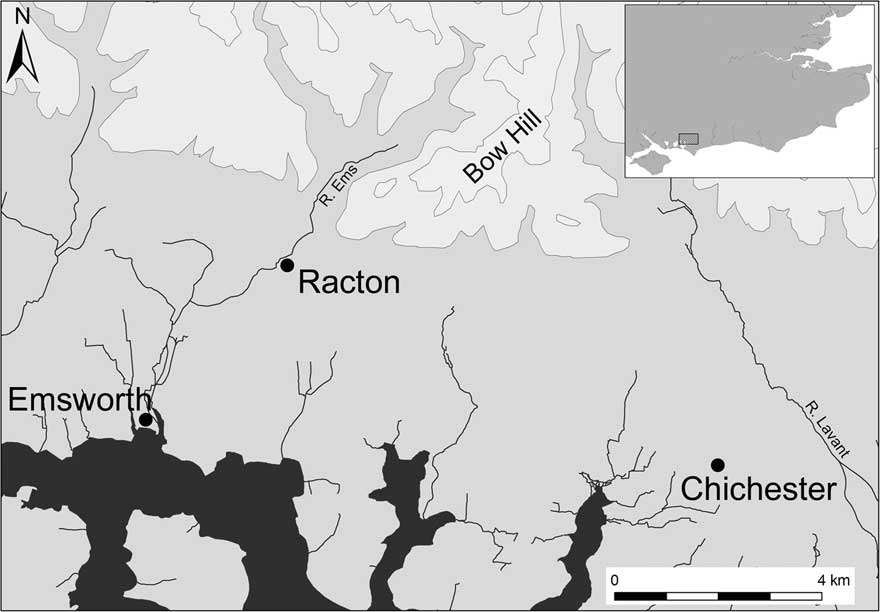
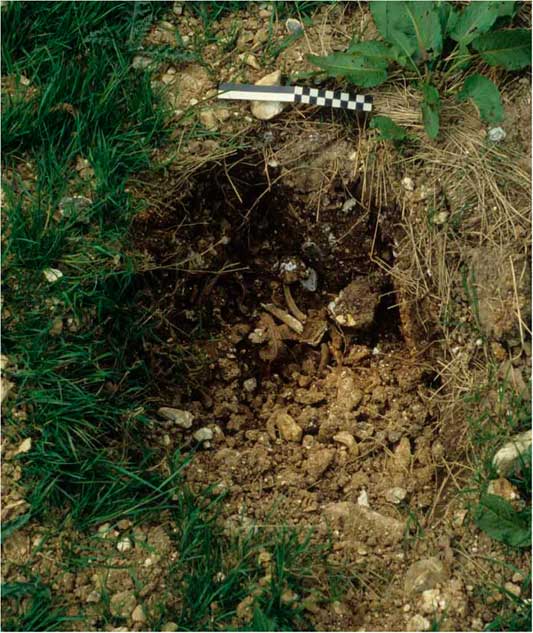
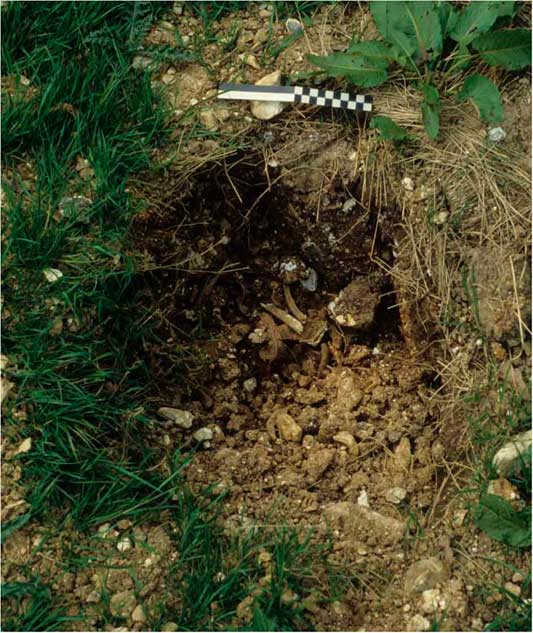
In April 1989 a metal detectorist brought a copper-alloy object and some bones to Havant Museum for identification. He had found the artefacts buried near the edge of a field near Racton, in West Sussex (fig 1). The finds were quickly recognised as including a human mandible and a dagger of Early Bronze Age type. The dagger had two small rivets attached near to the hilt-line, and a further three rivets had been found loose close by. As the site was within Chichester District, the information was passed to Chichester Museum, which alerted Chichester District Archaeology Unit (CDAU). With the co-operation of the landowner, CDAU inspected the find-spot and excavated it in May and June of the same year. When first visited, the location was still marked by the hole dug by the finder. It was approximately 0.45m in diameter and 0.4m deep, with loose spoil, including bone fragments visible at its base and on the ground surface around it (fig 2). The loose spoil in the hole and its vicinity were scanned with a metal detector and a further twenty-one small copper-alloy rivets were recovered. A brief report on the burial was published shortly after the discovery and the finds deposited with Chichester Museum (now The Novium), but no further work was contemplated due to the absence of any post-excavation funding.Footnote 1
Location map for the Racton dagger-grave. Map: James Kenny.

The finder’s excavation hole; bones are showing in the bottom. Photograph: James Kenny.
Location
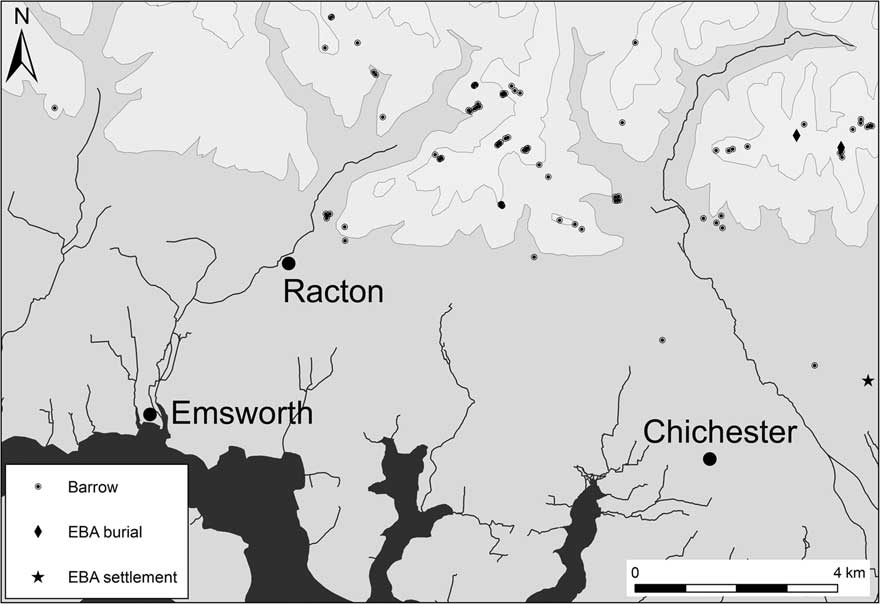
The site lies at the edge of a field near to the base of a gentle slope dominated by the sweeping curve of Bow Hill. The slope continues down towards the alluvium-filled valley of the River Ems, which drains water from the downland to the north. The river – now a shallow stream no more than 4m across – runs about 200m to the north west, where an ancient crossing-place is located at Ell Bridge.Footnote 2 The river then flows into Chichester Harbour at Emsworth, about 4km to the south west. The site lies at a height of c 30.5m above Ordnance datum (OD) on Quaternary head deposits (clay, silt, sand and gravel) overlying the Lewes nodular chalk formation of the upper coastal plain. The nearest surface chalk occurs as a drift deposit c 370m to the north east. Bow Hill is noted for its Bronze Age settlement, cross-ridge dykes and barrow cemetery (fig 3). The nearest known possible Bronze Age funerary monuments are a group of ring-ditches visible as cropmarks in drought conditions on the south-west facing slope of Walderton Down, about 1 km to the north east. The field in which the find was made seems to have been created around the middle of the twentieth century, having been shown as woodland on maps between the second half of the eighteenth century and 1912.Footnote 3 Place names indicate that it was formerly part of a deer park formed in the sixteenth century, and it is shown thus on maps of the period.
Evidence for Early Bronze Age barrows, burials and settlements in the region around Racton. Map: James Kenny.

Excavation
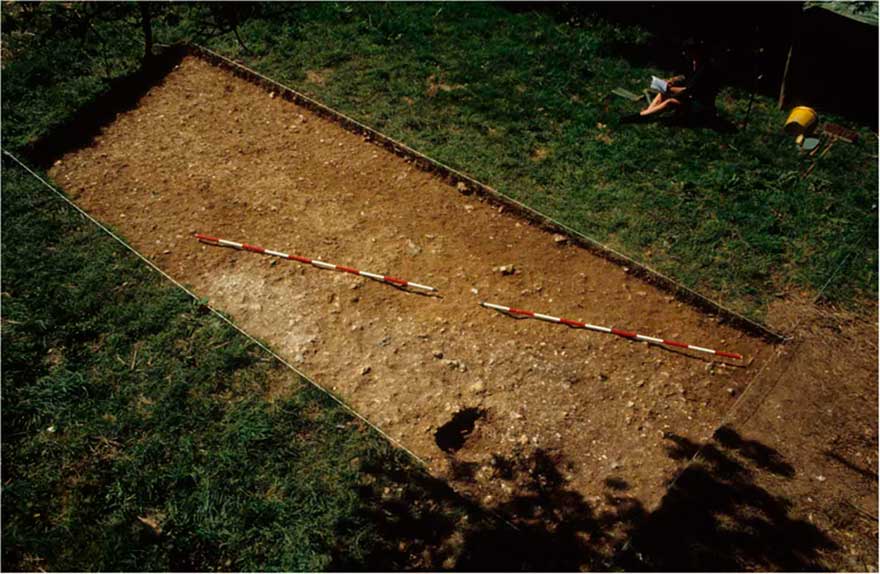
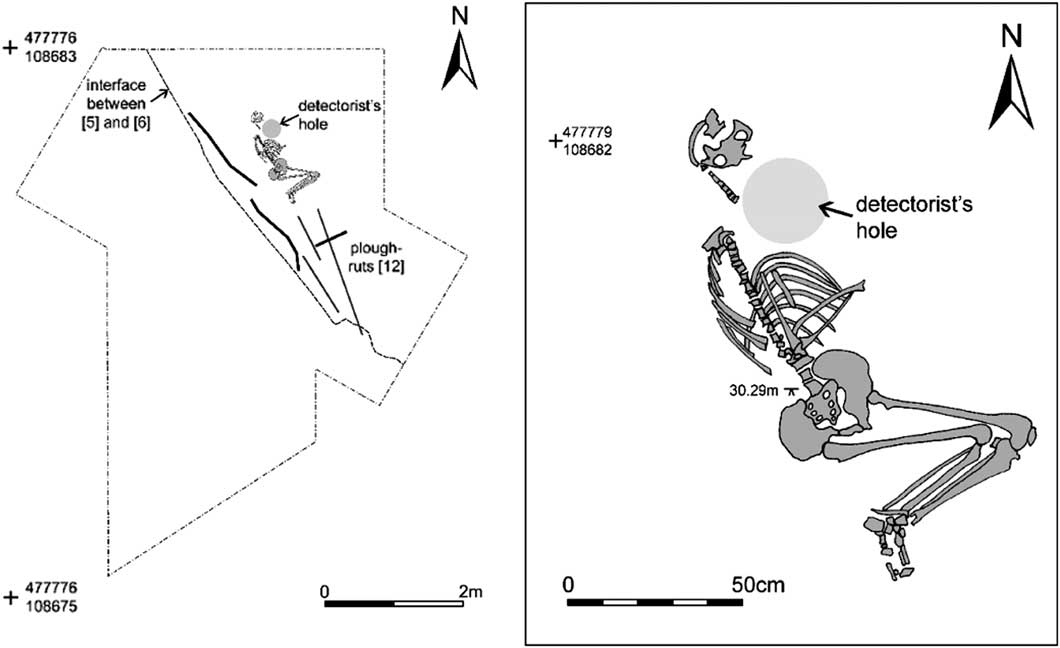
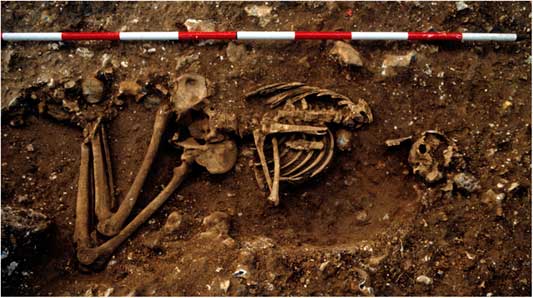
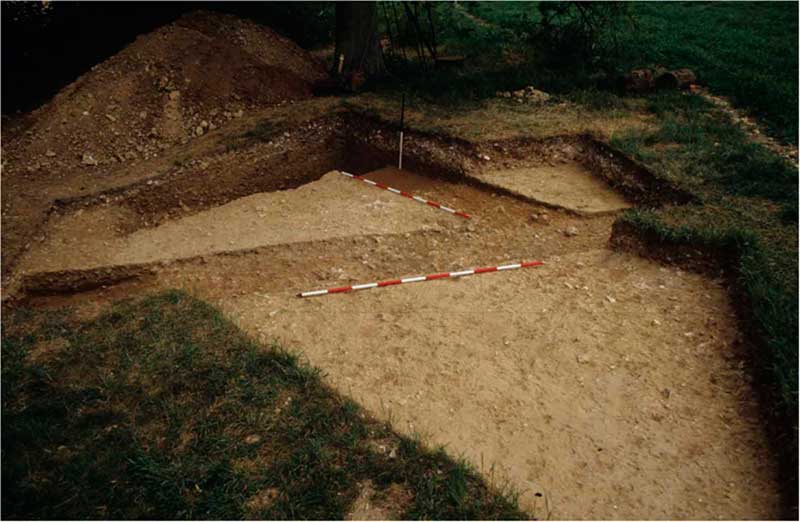
There was no sign of any mound at the find-spot and archaeological excavation revealed only a relatively shallow stratigraphy. Beneath c 0.2m of topsoil [context 1] was a flinty, brown, silty soil [4] containing modern finds and cut by a wheel- or plough-rut [2]. Beneath this were two contexts: in the area of the burial was a c 0.2m thick layer [6] rich in large fragments of flint and chalk and cut by further plough-ruts [12]; most of the trench to the west meanwhile had a light-brown, silty soil [5], also c 0.2m thick, which yielded a Neolithic asymmetric arrowhead. The boundary between the two contexts was approximately a straight line running north west to south east (figs 4 and 5). The burial [7], an almost complete crouched inhumation lying on its left side with head (along the spinal axis) oriented north-north-west, lay beneath a layer of flint and chalk [6] and on top of a light-brown soil [9] containing fragments of worked flint, including a possible arrowhead (figs 5 and 6). Layer 9 overlaid a series of geological features and varied in thickness between c 0.05m and 0.25m, the greater depth being the filling of a possible slumped solution hole. No further artefacts were found in association with the burial, while the location of the detectorist’s hole indicated the original position of the dagger and rivets to be in front of the upper part of the ribcage, perhaps close to the right hand. The skull appeared to have rolled away from the rest of the skeleton following inhumation, presumably into a space provided by a slightly larger coffin or chamber.
The surface of contexts [5] and [6] from the north; the skeleton was revealed under the chalky and flinty deposit in front of the ranging poles [6], to the left of and behind the finder’s hole. Photograph: James Kenny.

Plans of the trench and skeleton; the dashed line represents the boundary between contexts [5] (to the south west) and [6], which covered the skeleton [7] and was cut by the plough-ruts [12]; note this is after the original north–south rectangular trench seen in figure 4 had been extended in various directions. Drawing: James Kenny.

The skeleton in situ. Photograph: James Kenny.

It seems likely that the recorded plough-ruts date only from relatively modern times, perhaps as modern agricultural machinery carved further into a headland. Despite some damage, all the stratigraphy below layer [4] is probably of greater antiquity. An original burial mound cannot be ruled out, but there is no evidence for anything substantial. No trace of an encircling ditch was found despite extending the excavation trench to a maximum of 6m from the skeleton. The fact that the deposit [6] immediately above the burial was rich in chalk and flint, presumably brought from a little distance away, is nevertheless suggestive of some marker material. Its relationship to layer [5] is uncertain, but its extent – at least 6m on the north-west to south-east axis – makes it unlikely to be the fill of a shallow burial pit cut through the pre-existing soil of layer [5]. The more likely alternative is that the burial was placed on the contemporary land surface (possibly stripped of turf) and that the flints and chalk were piled up to form a small mound over it (fig 7). Given its extent and the straight-edge boundary with context [6], layer [5] probably represents an accumulation of colluvium building up against a plough-truncated edge of the mound. This would also be consistent with the alignment of the plough-ruts [12]. The Late Neolithic arrowhead would thus be in a secondary context.
View of the trench at completion of excavation from the south west; all the rear section walls show the ‘mound’ of flinty/chalky material [6]; the burial was in front of the left-hand end of the further horizontal ranging pole. Photograph: James Kenny.

THE REMAINS OF RACTON MAN IN SITU Garrard Cole
Disposition of the bones
With the exception of the skull, the skeleton appears from the site records to have been well articulated (figs 5 and 6). The ribs on the uppermost, right-hand side of the body had slumped downwards towards the underlying soil surface. The uppermost half of the pelvis (right side) had also slumped, rolling backwards and exposing the inner surface. The inner surfaces of both sides of the pelvis have irregular post-deposition marks consistent with flints falling or being pressed into their surface. The right femur has remained in articulation with the pelvis despite the rotation. The sacrum and lumbar vertebrae have also rotated as a block. The skull, which was heavily fragmented, was discovered out of anatomical position, its base marked by the foramen magnum having rotated almost to the top – that is, the skull had rolled onto its cap. There were no clear marks on the base of the skull consistent with decapitation, but the absence of the cervical vertebrae precludes knowing whether there had been a decapitation through the neck.
The relationship of the remains to the enveloping deposits
If a body is immediately enveloped by soil after burial, the skeletal elements remain locked in position with the exception of minor movement due to the decomposition of fleshy components. However, if a body is buried in a void, such as the interior of a coffin or chamber, then the skeletal elements will be free to move under the force of gravity once the interconnecting ligaments have decomposed; the uppermost elements will fall towards the lowermost and to the base of the burial chamber.Footnote 4 The disposition described above is consistent with such movement. The movement of the skull is also consistent with resting on a pillow or pad of organic material that has decomposed, leaving the skull to roll away from the body, assuming the chamber was sufficiently large. Since there was no archaeological evidence for animal burrows running through the grave, the evidence favours the burial having been placed in a chamber made of organic material, such as wood or wicker. The decomposition of the chamber resulted in the overlying flint- and chalk-rich layer coming into contact with the skeletal remains, now devoid of soft tissue (that, too, having decomposed).
OSTEOLOGY OF THE SKELETAL REMAINSFootnote 5 Garrard Cole
Age, sex and stature
The excavated remains are those of a single individual. The pubic symphysis was estimated to represent a developmental age of 35 years or older,Footnote 6 while the auricular surface was considered to represent a developmental age of 50–9 years.Footnote 7 The dentition showed extensive occlusal wear. The wear pattern of the molars was flat, suggesting a coarse diet associated with farming rather than the sloping wear pattern more commonly associated with hunter-gatherer diets. The Miles method for dental tooth wear assessment suggests an age of 35–40 years. As this method is based on the tooth wear of Anglo-Saxon populations eating a coarse diet, it might underestimate the developmental age for individuals from the Bronze Age if their diet was less coarse, as appears to be the case here.Footnote 8 In combination, these factors suggest the individual was at least 35 years old at death, and possibly more than 50 years old.
The skull was heavily fragmented, so many of the sexually dimorphic features were not observable; those that were, demonstrated characteristically male features. The pelvis had a narrow sub-pubic angle, a narrow pubic shape and a narrow sciatic notch. The auricular surface was not elevated and it lacked a pre-auricular space. The sacrum had a marked longitudinal curvature. These observations are again characteristically male features.
The diameters of radial heads were measured to be about 21.5mm, and the average diameter of the left and right femoral heads is 51.8mm. The radial heads are rather small, falling in the range normally associated with a possible female. The femoral heads are large, definitely in the range associated with males. Overall, therefore, the individual was assessed to be male.
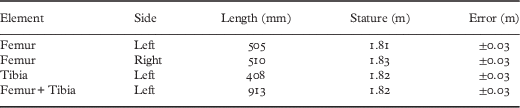
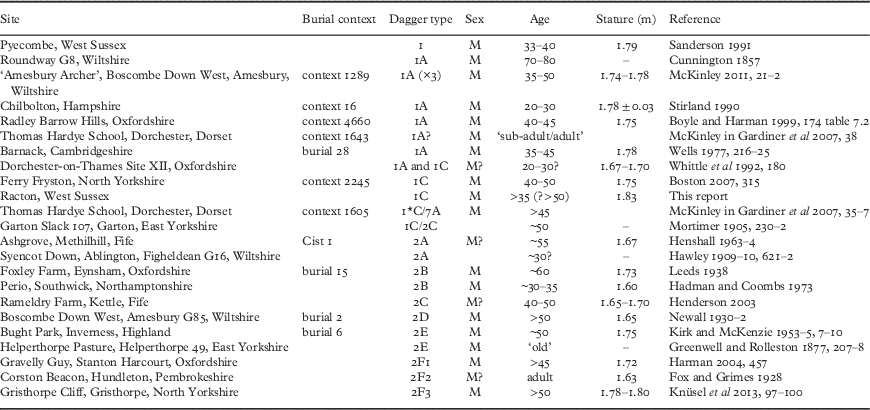
An estimate for the stature at age-of-death was derived from measurements of the femur and tibia, giving a best estimate of 1.82±0.03m (72 ins±1in.) (table 1). While a large number of inhumations accompanied by daggers have been recorded, few of the reports include estimates of stature and the comparative sample is consequently quite small (table 2). The average for the estimates listed is 1.73m, with a standard deviation of 6cm. It is clear that the individual from Racton is at the upper end of the range of this small sample of males of this period – he was a very tall man for his time.
Stature estimates for Racton Man

Comparative age, sex and stature data for selected inhumation burials with daggers and knives of Series 1 and 2

Injuries
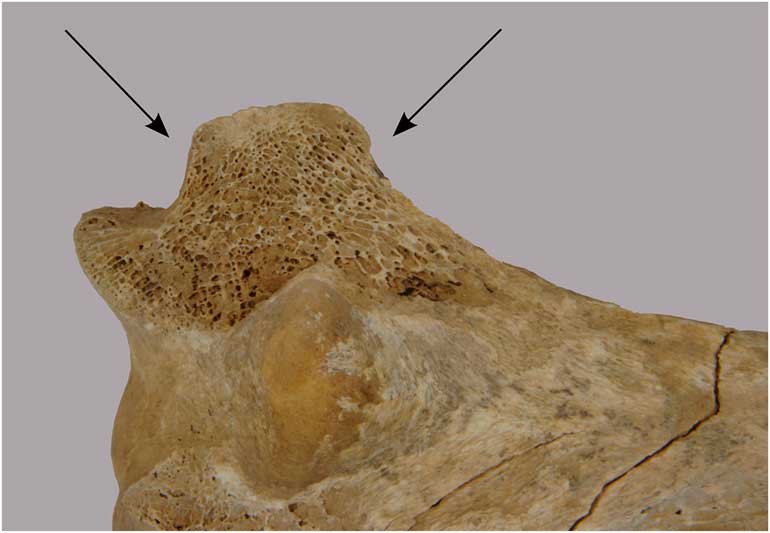
Perhaps the most important evidence to emerge from the skeletal study was of trauma that the individual had suffered during his life. There is a well-healed rib fracture to one of the mid ribs on the individual’s right-hand side. When soil mass found loosely adhering to the posterior surface of the medial epicondyle of the right humerus was separated from the bone, evidence was revealed for sharp-force trauma (fig 8). No corresponding evidence was found on the proximal end of the ulna at the olecranon process. When the two are in normal articulation, it is possible to cut the humerus in this manner without affecting the ulna when the elbow is flexed at about 100 degrees. This is consistent with a cut made by a sharp thin-bladed weapon while the arm was raised in a manner to protect the face or the head. The wound showed no signs of healing so it was clearly sustained peri-mortem (that is, at about the time of death). The detached fragment of bone was not present in the recovered remains.
The cut surface on the posterior of the medial epicondyle of the right humerus. Photograph: Garrard Cole.

A similar mark was observed on the surviving fragment of right scapula. This appears to have truncated the inferior margin of the glenoid and cut into the blade of the scapula. This may again be the result of a thin sharp-bladed weapon stabbing or slicing into the left axilla (armpit), but is less conclusive than the sharp-force trauma at the elbow because there was no sign of the other fragment of scapula. Moreover, stabbing a blade into the axilla with arm raised would possibly be expected also to leave a cut mark on the head of the humerus.
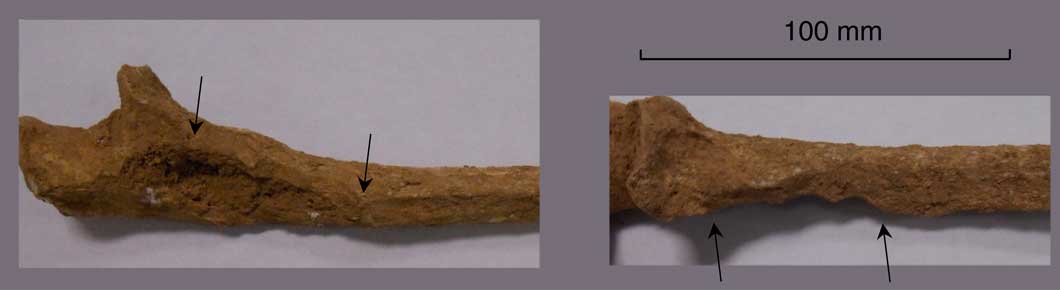
Finally, the proximal shaft of the right ulna has several unusual scalloped notches through the interosseous margin (fig 9). They were covered by soil deposits so they are clearly peri-mortem, made while the bone was still fresh. The marks are not consistent with gnawing by rodents or carnivores. There are no corresponding marks on the proximal radius. Post-deposition modification seems unlikely, given the humerus, ulna and radius were found in correct anatomical position during excavation, but they remain unexplained.Footnote 9
Peri-mortem scalloped notches on the right ulna. Photograph: Garrard Cole.

Racton Man exhibited a number of non-metrical traits such as a suprascapular foramen, a possible tri-partite patella and a bowed inferior margin of the mandible. These traits may have a loosely defined genetic component, but their significance only becomes truly apparent when repeatedly present in large assemblages. Low-grade degradation of the spine, including lipping, laminal spurs, surface osteophytes and compression of apophyseal facet margins, are inevitable changes consistent with increasing age and activity. The facet compression arises from joint space reduction as the intervertebral disks lose their resilience and thickness with increasing age.
Racton Man’s healed rib fracture clearly occurred some time before his death and there was no specific evidence to suggest it was not due to an accident. The other evidence for trauma tells a different story. The individual was clearly involved in some form of a fight shortly before his death. The sharp-force blow to the right elbow is consistent with a slicing cut by a sharp-bladed weapon. The fragment of bone removed along with the surrounding soft tissue may have been lost at the place of injury if the soft tissue was completely severed. The cut would have amputated the ulna nerve, paralysing the ulna side of the arm and the little finger side of the hand. He may also have suffered a sharp-force blow into the right arm pit. Such a blow could have severed the axillary nerve, effectively paralysing the shoulder and possibly severing the axillary artery which would have resulted in significant, possibly fatal, blood loss. In close one-to-one combat, these blows may have followed in quick succession. Experimental evidence using copper-alloy blades of appropriate composition has confirmed that work-hardened edges are capable of cutting timber,Footnote 10 and there is no doubt that they could inflict mortal injury on a human.
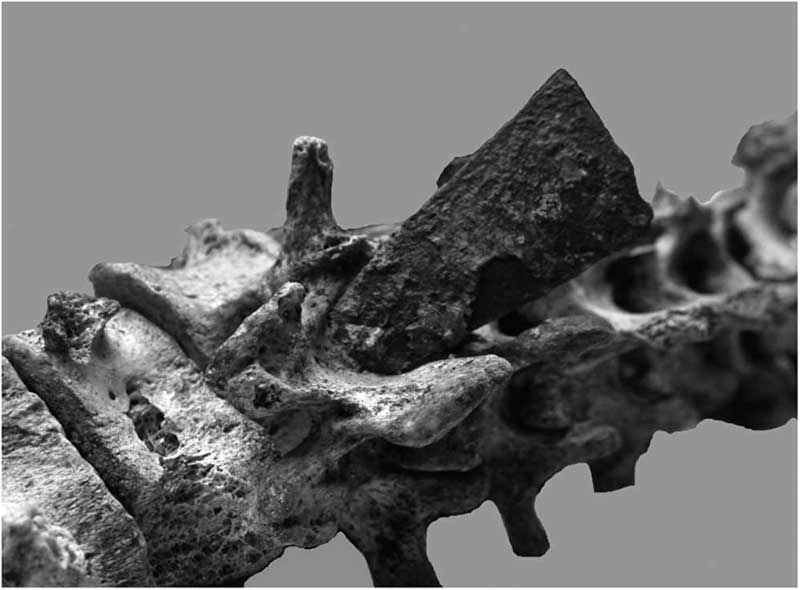
Positive evidence for injury caused by metal blade weapons is scarce for the Chalcolithic and Bronze Ages. Reports from two French sites have revealed evidence for the use of copper-alloy blades in hand-to-hand combat. Guilaine and Zammit note that ‘a metal blade was discovered among the remains of an individual in the Baumes-Chaudes cave, in Lozère’.Footnote 11 This blade may have been embedded in soft tissue, probably muscle, at the time of death. In another case, the tip of a copper-alloy blade was found embedded in a lumbar vertebra in the spine of one individual from Pas-de-Joulié at Trèves, in Gard, also in southern France.Footnote 12 The blade would have passed through the strong muscles of the lower back. Their subsequent spasm appears to have prevented withdrawal of the blade, leaving the tip embedded (fig 10). The individual clearly survived this injury for some time as the vertebrae encompassing the blade tip show signs of remodelling.
Copper-alloy blade tip embedded in lumbar vertebra from Pas-de-Joulié at Trèves, Gard; after Vaquer and Remcourt 2012.

ISOTOPIC EVIDENCE FOR MOBILITY AND DIETFootnote 13 Janet Montgomery and Mandy Jay
Where was Racton Man from?
Isotope analysis of Racton Man’s skeletal remains was undertaken for the purpose of investigating mobility, diet and environment. Tooth enamel was analysed for strontium, oxygen and carbon isotope ratios; collagen from dentine in the same tooth was extracted for radiocarbon dating and the production of carbon and nitrogen isotope ratios. Lead analysis of the tooth enamel was also undertaken, but the analysis failed, possibly because the amount of lead present was very low. The isotope ratio data have been put into the context of other available data for Britain and are discussed here for the purposes of interpreting the likelihood of individual mobility, together with aspects of diet and subsistence strategy.Footnote 14
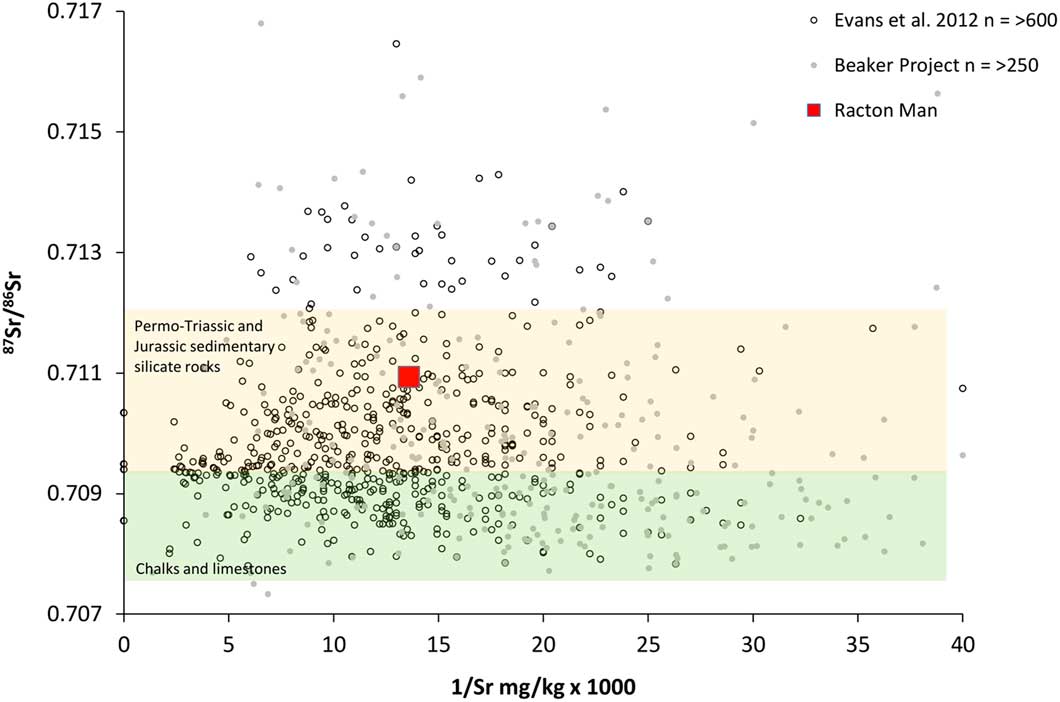
Table 3 presents the isotope ratio data and sample details. The strontium isotope ratio from the enamel is plotted in fig 11 with the strontium concentration, alongside comparative data from multi-period sites from across Britain and from Early Bronze Age burials from across Britain.Footnote 15 The figure differentiates between the range of values which might be expected for chalks and limestones, and for older sedimentary silicate rocks. Racton Man would be expected to produce isotope ratios in the former group if he had spent his childhood consuming a diet based on crops from the chalk downland immediately to the north of the site. However, his ratio falls above this chalk range and is more consistent with older silicate rocks. There is currently no evidence to support a value of 0.7109 being characteristic of humans originating from south-eastern Britain. Given the values currently obtained for humans from the London Clay, the coastal plain Quaternary head deposits of clay, silt, sand and gravel on which the burial was directly found are unlikely to produce values significantly above 0.710. Similarly, the Cretaceous deposits of clay, sand and sandstone from the Weald area to the north east would not be expected to produce this higher value. For example, seven Anglo-Saxon individuals from Ringlemere in Kent in a geologically comparable region of Chalk and Quaternary brick earth produced values that were all below 0.710,Footnote 16 and of nineteen of a similar date from Eastbourne in East Sussex, only two were significantly above 0.710 and it is likely that these were migrants.Footnote 17
Strontium isotope ratio and concentration for Racton Man compared with multi-period data from Britain (Evans et al Reference Elliott and Grime2012) and other Early Bronze Age burials from Britain (Beaker People Project, unpublished data, see Jay et al Reference Henshall2012). Racton is on the boundary between chalk and younger deposits, so that an individual growing up there might be expected to fall in the toned band at the bottom of the chart. Graph: Janet Montgomery.

Isotope ratio data (sample: right mandibular M2)

* The δ18O values for carbonate have been converted to phosphate values using the equation from Chenery et al Reference Case2012 in order to compare them with other published data sets. Similarly, the drinking water value has been calculated using the equation from Chenery et al Reference Case2012, based on Daux et al Reference Cunnington2008 (equation 6).
The factors controlling the amount of strontium in enamel are complex, with some, such as health status and age, being physiological and intrinsic to the individual, while others derive from the composition of ingested foods. Because strontium and calcium metabolism are inter-related, the amount of calcium in the diet is also relevant. In omnivores, such as humans, most ingested strontium appears to derive from the plant part of the diet rather than animal-based foods. Reported strontium concentrations for modern human skeletal and dental tissues are typically 50–300 ppmFootnote 18 and archaeological human enamel in Britain exhibits the same range of values as modern humans: ie 105+/−138 ppm (2sd) with a median value of 84 ppm.Footnote 19 At 74 ppm, the value for Racton Man is within the expected range for Britain in the Chalcolithic to Early Bronze Ages.
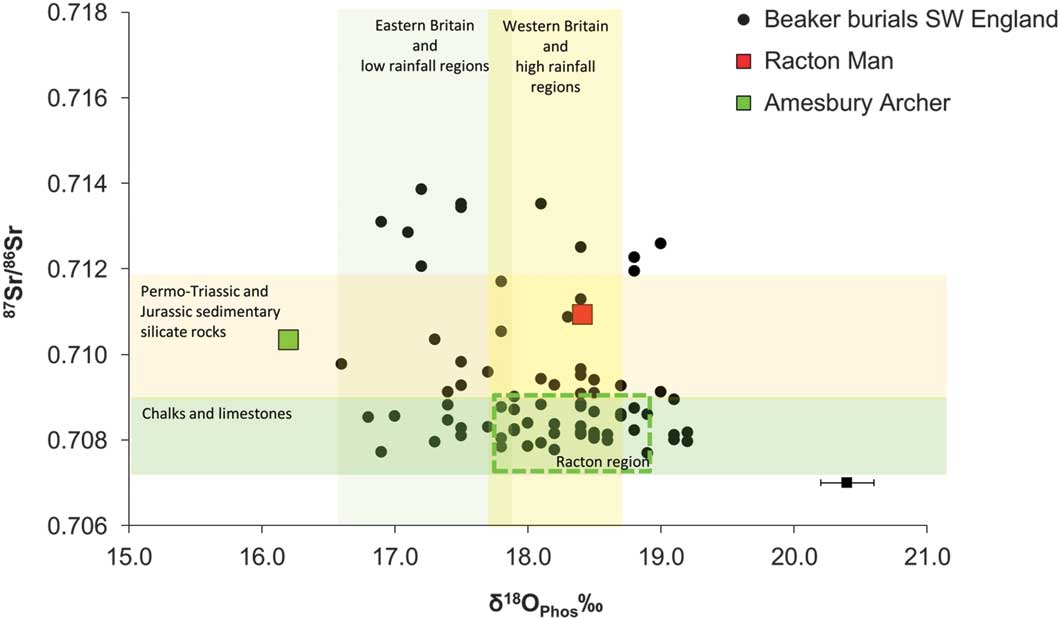
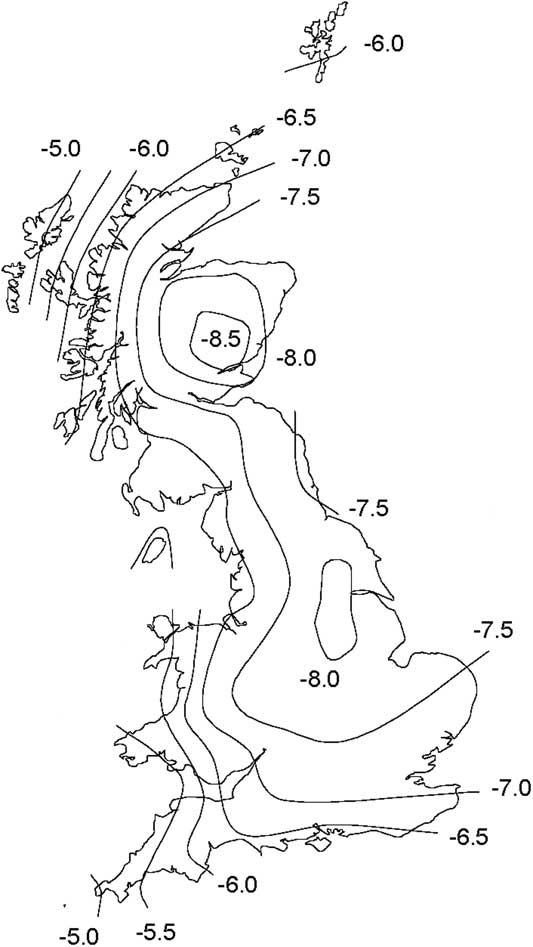
Strontium and oxygen isotope ratios are plotted in fig. 12 alongside comparative data from southern English Chalcolithic and Early Bronze Age burials.Footnote 20 The δ18O values for carbonate have been converted to phosphate values using the equation from Chenery et al in order to compare them with other published data sets.Footnote 21 Again, the chart highlights the differentiation between geologies relevant to the strontium data, and it also shows oxygen isotope ranges which have been observed from British multi-period analyses and which differentiate between eastern Britain (lower rainfall) and western Britain (higher rainfall).Footnote 22 The split between eastern and western ranges for oxygen should be used tentatively, since there are issues relating to biases in the data set which might suggest that climate change has had an effect over time and which require further research,Footnote 23 but the range in its entirety provides a comparative for Britain as a whole. The oxygen isotope ratio for Racton Man falls within the overall British range, and well within the suggested higher rainfall range for ‘western Britain’ (which includes most of the south coast – see fig 16 for general contour patterns).
Strontium and oxygen isotope ratios for Racton Man compared with the Amesbury Archer (Fitzpatrick Reference Evans, Atkinson, O’Connor and Green2011) and other Early Bronze Age burials from south-west and southern central England (Beaker People Project, unpublished data, see Jay et al Reference Henshall2012). The Racton δ18O value plotted here has been calculated as a phosphate value, for the purposes of comparison with the other data sets, using the equation from Chenery et al Reference Case2012. The δ18O ranges shown for lower and higher rainfall regions are taken from Evans et al Reference Elliott and Grime2012 and shown to 1 sd. Graph: Janet Montgomery.

The use of empirical δ18Ophosphate and δ18Ocarbonate data sets, rather than conversions to drinking water values, is preferred for current research, although many published studies have used drinking water conversions. Using the equation from Chenery et al, the δ18Ovsmow value converts to a drinking water value of −5.4‰.Footnote 24 Although this calculation is often done to allow comparison with modern mapping of groundwater values for Britain and Europe, the value must be used with caution because there are a number of different conversion equations in use and the production and interpretation of drinking water values can be controversial. The main reason for this relates to the associated error inherent in the calculations, which is probably at least 1.5‰ at the 95 per cent level and may be as high as 3‰.Footnote 25 In the case of the Racton study, the calculated value can be compared with the groundwater map from Britain produced by Darling et al, as reproduced in figure 16.Footnote 26 Given the level of associated error and the fact that the lower groundwater values are found in the east of Britain, the value obtained in this manner is not inconsistent with a location in southern England.
The impact of diet
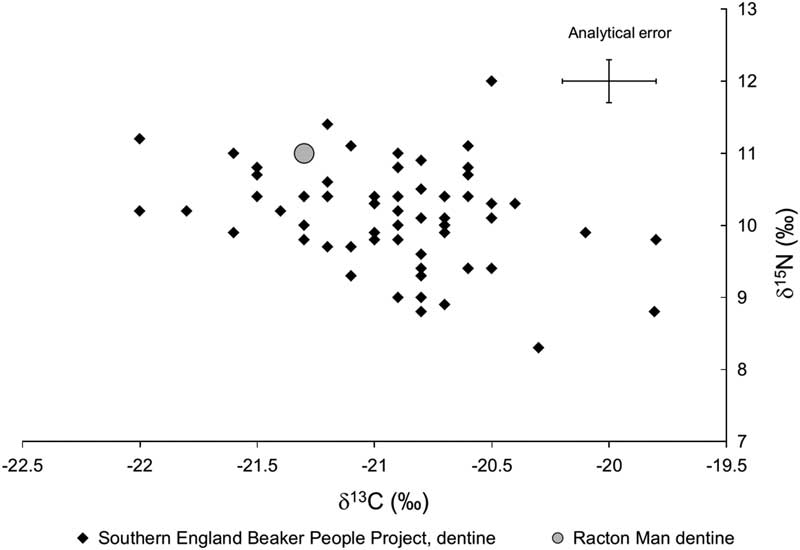
Figure 13 plots the δ13C and δ15N values from the dentine collagen in the context of other dentine values from Chalcolithic and Early Bronze Age individuals from southern Britain.Footnote 27 There is some evidence from the unpublished comparative group that dentine values during this period do not equate directly with bone collagen values, so that it is important to compare the Racton values with dentine rather than bone.Footnote 28 In general, however, the Racton isotope ratios compare well with the other data produced for individuals from this time period and general region and are suggestive of an individual consuming foods within the terrestrial C3 food chain, with a significant level of animal protein in the diet.
Dentine collagen carbon and nitrogen isotope ratios for Racton Man compared with other Early Bronze Age burials from southern England (Beaker People Project, unpublished data, see Jay et al Reference Henshall2012). The analytical error reflects 1 sd for the Racton sample itself (analysed at SUERC), the error being lower for the other data shown. Graph: Mandy Jay.

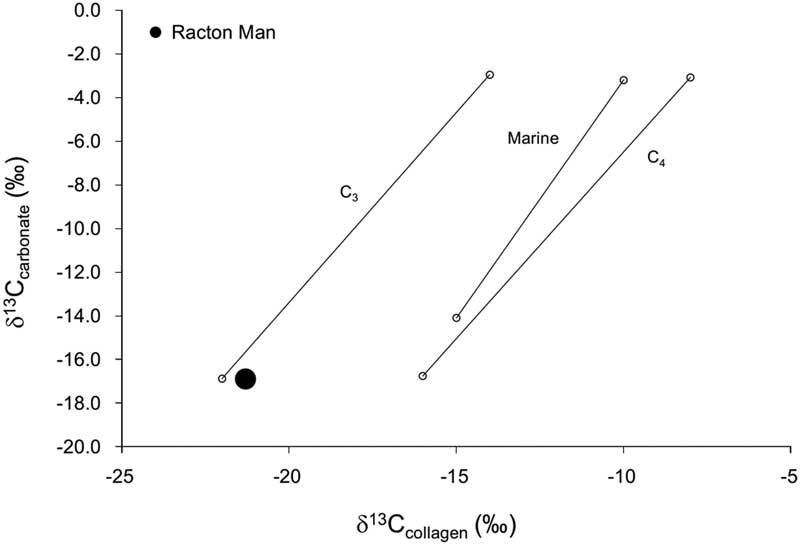
The δ13C value from the enamel carbonate, at −16.9‰, is in line with the dietary interpretation produced from the collagen data. This value reflects the carbon isotope ratio of whole diet, rather than being restricted to the protein element which is indicated from the collagen data. Figure 14 shows the collagen and carbonate values plotted alongside theoretical regression lines based on varying levels of C3, C4 and marine diets in experimental animal studies.Footnote 29 As would be expected for this period in British prehistory, the data for Racton Man fit the theoretical position for a purely terrestrial C3 diet, without a significant marine component and without the presence of C4 plants in the food chain.
Dentine collagen and enamel carbonate δ13C values for Racton Man compared with theoretical correlations between values based on varying levels of C3, C4 and marine diets in experimental animal studies. Equations for regression lines from Kellner and Schoeninger Reference Hoare2007. Graph: Mandy Jay.

Origin and diet conclusions
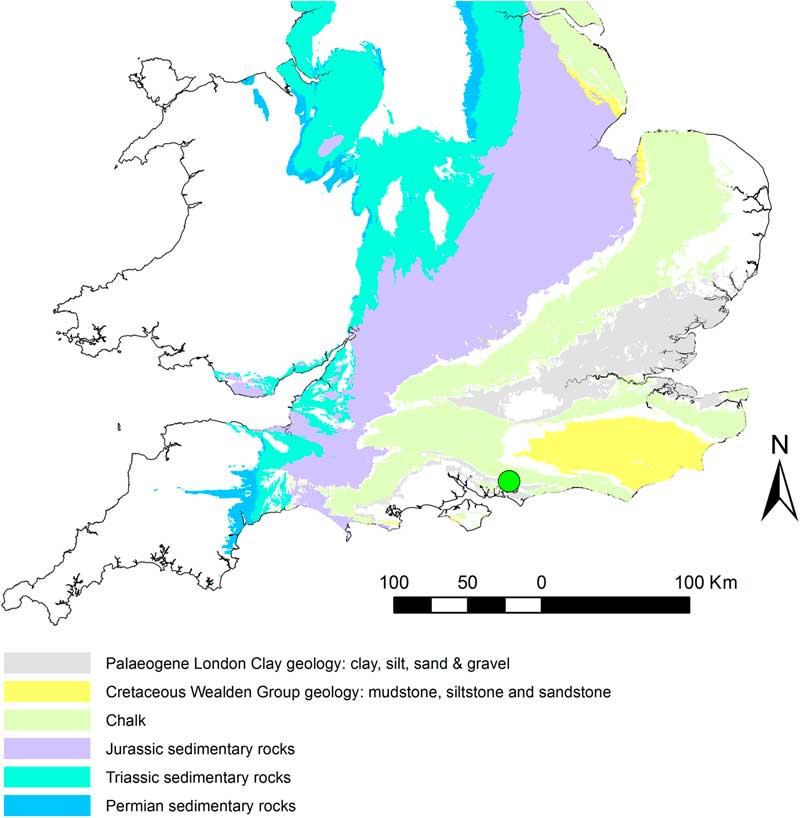
The combined multi-isotope data are consistent with origins in England, although a childhood spent elsewhere in Europe and beyond cannot be ruled out since there will be a range of locations which can be matched to the isotope ratios obtained. The strontium isotope ratio suggests that this individual did not live as a child, during the period of his enamel formation, on the chalk geology in the region of Racton, or on any other area of chalk or limestone geology. This ratio suggests a region of older silicate sedimentary rocks, such as Jurassic or Permo-Triassic, which tend to be found primarily to the north and west of Racton (fig 15). It would also be consistent with some drift deposits, such as loess. In interpreting these data, it is assumed that an Early Bronze Age individual would be consuming foodstuffs from the locality of his residence with no significant contribution from afar. The signal obtained from the enamel relates to childhood and reflects the geology of the region where this individual grew up, rather than where he lived as an adult, so he may have moved following childhood, or he may have been buried some distance from where he lived.
Racton (green circle) in the context of generalised geology. If Racton Man originated in England, then the most likely regions would be to the west and north west of the site, probably in some of the areas shaded lilac, turquoise and blue. Map: based on DiGMapGB-625, with the permission of the British Geological Survey.

The oxygen isotope ratio is not inconsistent with the place of burial, near the south coast of England, and is high enough to rule out much of central, eastern and northern Britain, as well as northern Europe. However, this does not prove he was brought up locally for the δ18O value is also consistent with the region of older silicate sedimentary rocks to the west and north west of Racton (figs 15 and 16).
Contour map of δ18O values for modern groundwaters in Britain, after Darling et al Reference Corfield2003.

The δ13Ccarbonate, δ13Ccollagen and the collagen δ15N values (−16.9‰, −21.3‰ and 11.0‰ respectively) are all consistent with other dentine data available for this time period in the region of southern Britain. The diet is based on a terrestrial C3 foodchain containing a significant level of animal protein and no indication of C4 or marine foods. Carbon isotope values such as these could have been obtained from anywhere in Britain, or from Continental European sources where the climatic regime was similar, although a significantly warmer or drier climatic environment is likely to have produced slightly higher δ13C values.
THE DAGGER AND ITS HILT FURNISHINGS Stuart Needham
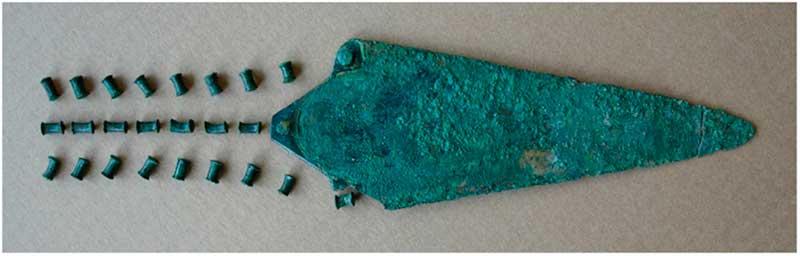
The metalwork associated with the burial comprises a dagger blade with two rivets in situ and a third rivet hole broken across, plus twenty-four loose rivets, one of which is presumably from the broken hole (fig 17).Footnote 30 It appears that the lower part of the blade had been slightly bent in antiquity, but the missing and unretrieved corner of one of the shoulders probably results from more recent damage. A wide-omega hilt-line, which marks the bottom end of the former organic hilt, is preserved in the corroded surface of both faces. These lines indicate that at least the lower part of the hilt was present in the grave.
The dagger blade and associated rivets; the rivet arrangement is not that ultimately preferred. Photograph: Stuart Needham.

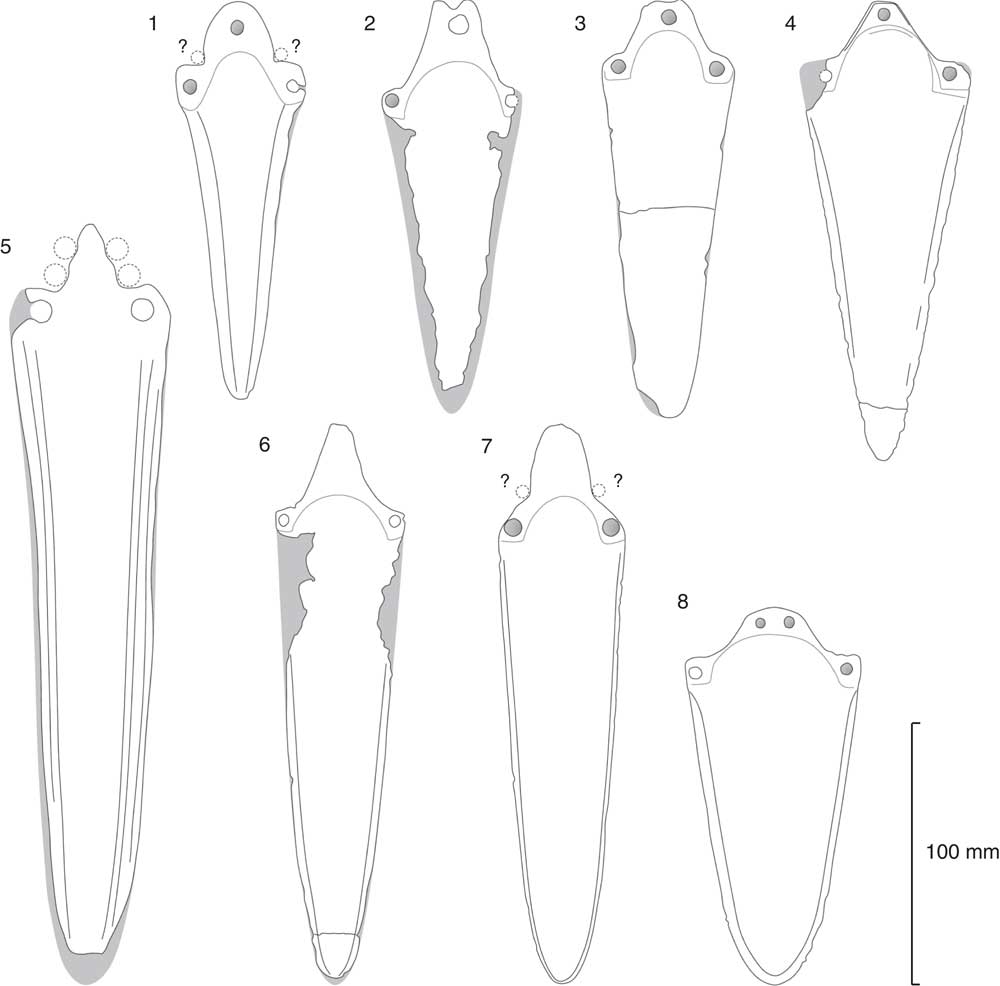
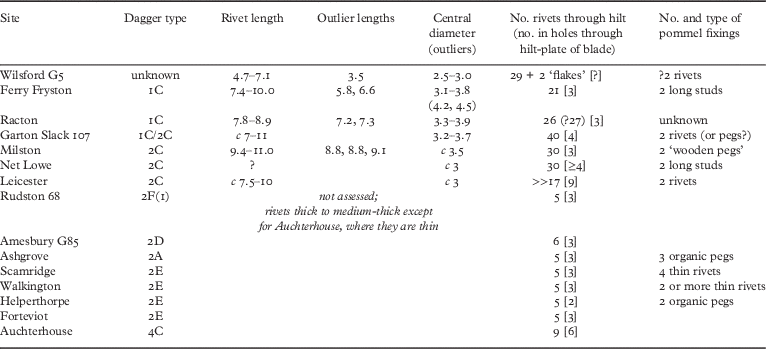
The dagger blade, including its short trapezoidal tang, is 176mm long and would have been about 65mm wide at the shoulders (currently 55.5mm wide) (fig 18 (4)). The blade is flat in cross-section with a maximum thickness of 2.2mm. It is triangular in shape, converging towards an acute tip. Weakly defined edge bevels survive alongside both edges; they are about 1.5mm thick and 4mm to 5mm broad for most of the blade, tapering out towards the top. The shoulders are pronounced with near-horizontal upper edges. Despite the large number of rivets present in the grave, only three of these were used to secure the blade to the hilt: a single rivet hole perforates the top of the tang and two others perforate the shoulders. The rivets are fairly consistent in morphology and shank diameter (3.4–3.9mm); minor variations are noted in table 4. Lengths vary from 7.2mm to 8.9mm, the variation being significant in terms of their individual positions through a hilt, which was not quite parallel-faced.
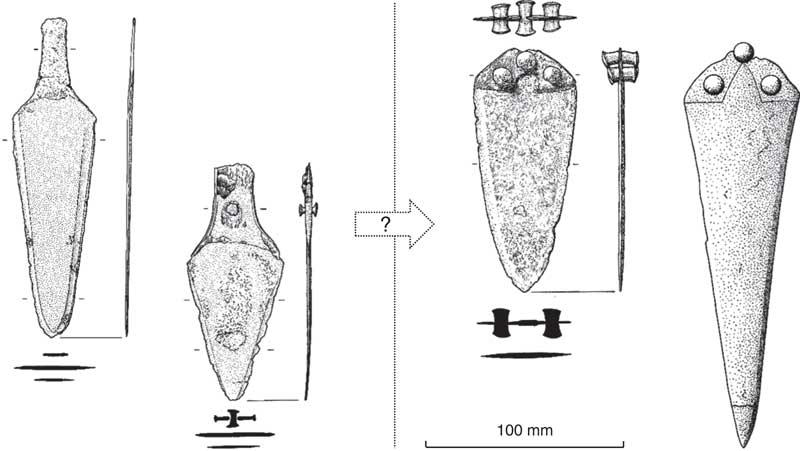
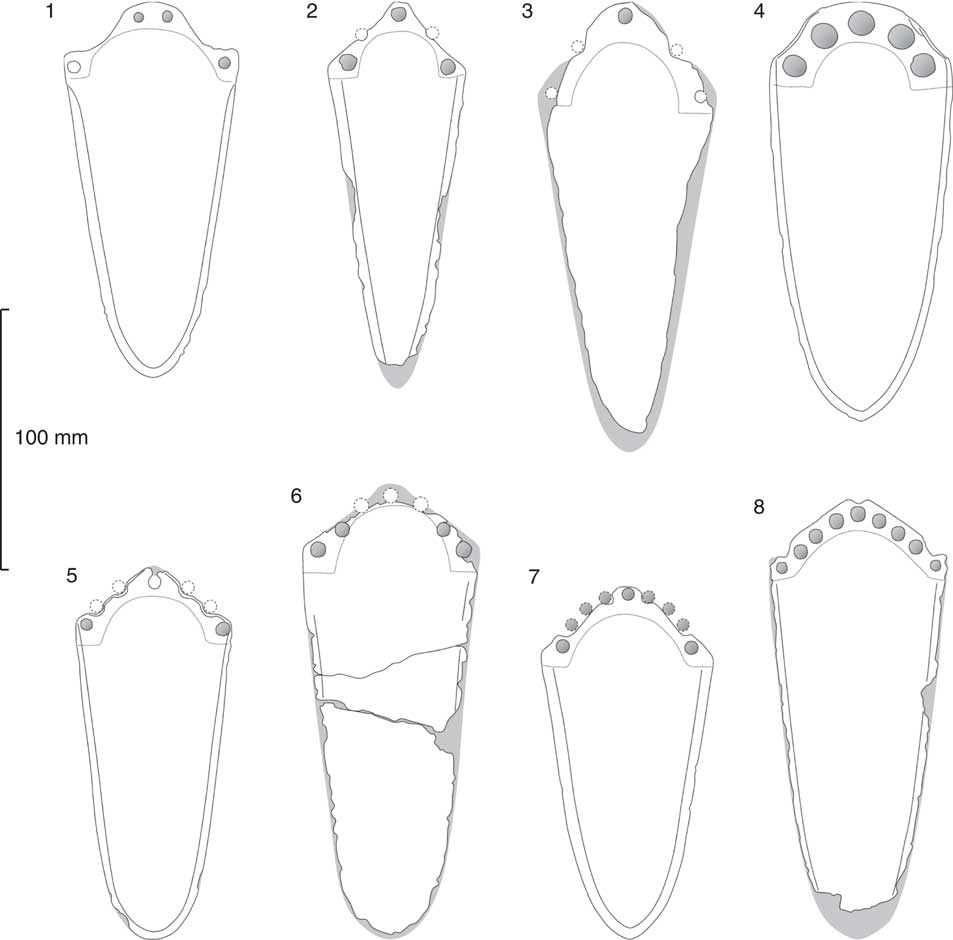
(1–7) Dagger blades of Type 1C Ferry Fryston: (1) Gragan West, Co Clare; (2) Standlow, Derbyshire; (3) Ferry Fryston, West Yorkshire; (4) Racton, West Sussex; (5) Killaha East, Co Kerry; (6) Derrynamanagh, Co Galway; (7) Massingham, Norfolk; and (8) the intermediate 1C/2C blade from Garton Slack, East Yorkshire; scale 33 per cent. Drawing: Stuart Needham.

Dimensions and features of the Racton rivets

THE METAL COMPOSITION OF THE DAGGER BLADE AND RIVETS Mary Davis and Stuart Needham
The dagger blade and rivets were analysed qualitatively rather than quantitatively, hence the actual readings obtained are not published as they would give a false sense of accuracy. Nevertheless, useful results can be obtained on the alloy composition and impurities present at levels above about 0.1 per cent.Footnote 31
The blade was analysed in three areas, all on face 1, in high, middle and low positions, while each of the rivets was analysed at a single spot. Tin was consistently recorded at levels suggesting a regular tin-bronze (for example, tin at 10±3 per cent). The actual readings varied, some being quite high, probably due to tin enrichment at the surface. After the copper and tin, arsenic gave the highest levels and can be described as a major impurity. The rivets gave a fairly coherent range of readings and it is likely that they contain in the region of 1.5–2.5 per cent of arsenic, while the blade contained less, probably less than 1.0 per cent. The other elements tested for were only present at much lower levels. Antimony, bismuth and zinc were all detected at low levels, estimated to be around 0.1 per cent or a little more, in virtually all of the measurements for both blade and rivets. Slight traces of silver were detected in twelve of the twenty-six rivets, and nickel was only detected in three of those twelve. These two elements were undetected in remaining rivets and the blade and are probably present at most at very low levels.
The ‘regular’ level of tin in all the metal components involved in the Racton dagger distinguishes its composition from that of one of the close parallels from Ferry Fryston, which contained only 3 per cent tin.Footnote 32 The impurity suite is also relatively consistent for all components, especially the set of rivets. Arsenic is the only major impurity and the relatively low levels of antimony and silver rule out this having the classic signature of Irish Ross Island metal (‘A-metal’), in which both are typically present at between 0.1 and 1.0 per cent.Footnote 33 Similarly, it cannot be identified as ‘Bell Beaker-metal’ (‘BB-metal’) because, although that can have very low levels of antimony and silver, even the low-nickel variant has nickel ranging from about 0.05 per cent to 0.5 per cent.Footnote 34 The Racton impurity suite may be described as ‘arsenic-only’, ie arsenic is the only principal impurity.Footnote 35 This is a composition type that is well known at this date in western Continental Europe, but has only occasionally been found in objects from Britain. Two of the few examples in Britain are among the three copper blades in the Amesbury Archer’s grave.
The one difference between blade and rivets that can be considered a reliable indication of the actual composition is the lower arsenic content of the former; it is possible this may result from the melting and working history of the metal in that component, rather than indicating metal from a different source or circulation pool.
THE PLACE OF THE RACTON DAGGER AND RIVET-STUDDED HILTS IN THE COPPER–BRONZE DAGGER SEQUENCE
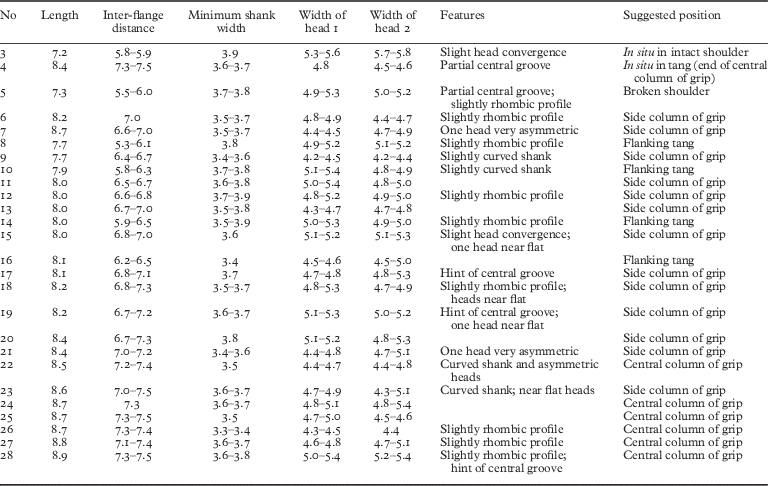
The very angular shouldered butt with projecting trapezoidal tang seen at Racton is only occasionally matched among early flat daggers and has only recently been recognised as a particular type, named after the 2003 discovery at Ferry Fryston, North Yorkshire (see fig 18).Footnote 36 However, this type relates to others in a relatively fast-moving evolution in dagger design during the course of the transition from copper to bronze. Archetypal daggers of the Chalcolithic (Period 1) and the earliest Bronze Age (Period 2) are very different in the manner of their hilting and a key question is how this came about. Classic copper daggers are tanged and lack rivets (Type 1A).Footnote 37 Classic early bronze daggers are butt-riveted; that is, they have broad and shallow hilt-plates perforated by holes to allow riveting to the base of the hilt (fig 19). In the past this looked like a fairly sudden change and, a few intermediate examples notwithstanding, one possible explanation is that the butt-riveted style was introduced to Britain and Ireland from the Continent and thereby supplanted the earlier tanged style.Footnote 38 More recently, an internal evolution has been favoured,Footnote 39 building on the former recognition that the addition of rivets to otherwise standard tanged daggers (Types 1B and 1C) might be a chronological change.Footnote 40 Type 1C Ferry Fryston, now including the Racton dagger, has a pivotal place in the sequence, not least because two examples have proved to be of bronze rather than copper.
Classic examples of, left, tanged copper daggers (Series 1; Period 1) and right, butt-riveted bronze daggers (Series 2; Period 2). From left to right: Sutton Courtenay, Oxfordshire (after Kinnes Reference Kenny1994, A18); Sittingbourne, Kent (after Kinnes Reference Kellner and Schoeninger1985, A13); Figheldean G16, Wiltshire (after Kinnes Reference Kenny1994, A20); Lid Low, Staffordshire (after Gerloff Reference Gardiner, Allen, Powell, Harding, Lawson, Loader, McKinley, Sheridan and Stevens1975, pl. 8 no 80). Scale 25 per cent.

Although both 1B and 1C daggers have rivets, the distinction between them is important due to other changes in form. Tangs tend to become proportionally squatter, but much more consistent is the adoption of a new shaping to the hilt base; where it overlaps the blade, the hilt is given a broad-omega shape, contrasting with the arcuate (or bow-shaped) lines almost invariably found on Types 1A and 1B daggers and knives (see fig 19).Footnote 41 Another feature of 1C daggers is that the top edge of the shoulders are usually horizontal and can even be slightly upturned (see fig 18). This part of the blade is, of course, concealed in the finished weapon and the hilt itself is very unlikely to have followed the same line; to do so would leave extremely thin spurs linking the shoulders to the main handle. There may, therefore, be another reason for the shoulder shape, and this is explored further below.
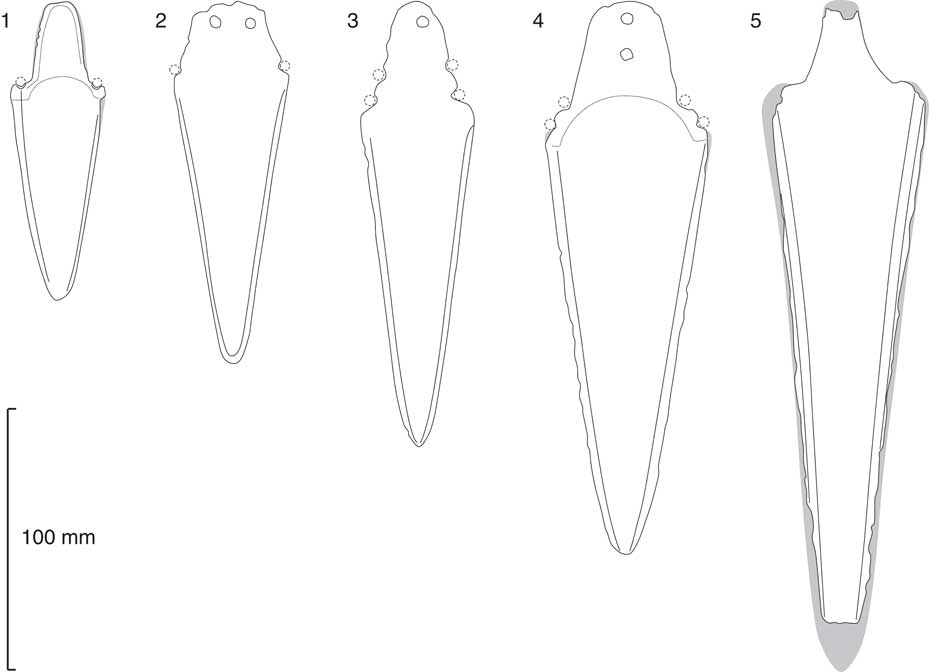
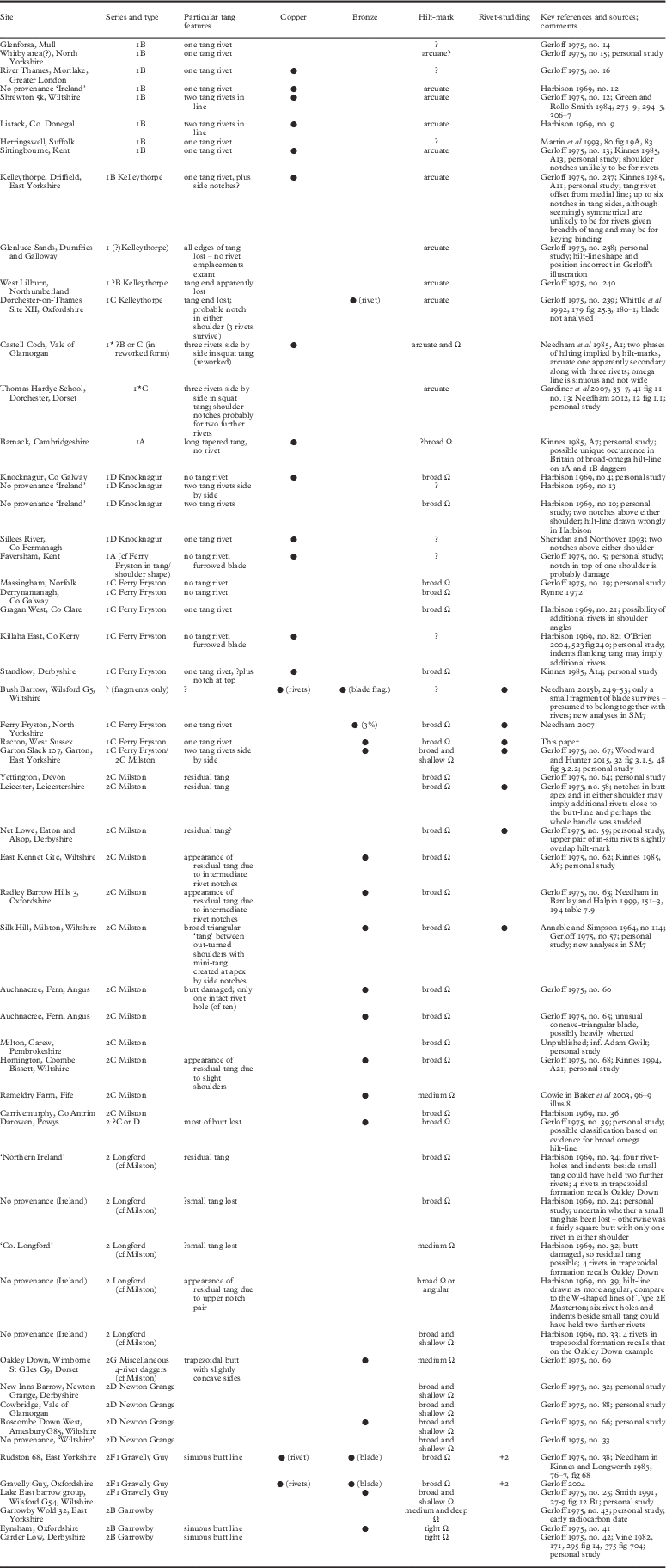
Of the seven extant examples of Type 1C Ferry Fryston daggers, four now come from Britain and three from Ireland (table 5). Four more tanged daggers, all from Ireland, seem to be closely related, but have notches instead of holes at the shoulders, which nevertheless seems to indicate the presence of rivets there. In three cases, rivet holes also perforate the tang, and in the two cases where a hilt-mark survives, they are of the broad-omega form (fig 20). There are grounds, therefore, for seeing these as very closely connected to the 1C daggers and in table 5 they are listed as Type 1D Knocknagur (not previously defined).Footnote 42
(1–4) Dagger blades of Type 1D Knocknagur: (1) Knocknagur, Co Galway; (2) No provenance (Ireland); (3) Sillees River, Co Fermanagh; (4) No provenance (Ireland); and (5) related dagger from Faversham, Kent (no original notches present); scale 33 per cent. Drawing: Stuart Needham.

Critical details of daggers and knives relevant to the Racton implement and discussed in the text (all daggers/knives of Types 1B, 1C, 1D, 2C and 2D are listed; others included have one or more attributes that relate to these types)

Notes: 1* – transitional implements with wide, shallow tangs which can alternatively be categorised as ‘butt-riveted’ daggers (Series 2) or knives (Series 7). Type Kelleythorpe (not previously named) refers to Gerloff’s ‘projecting butt knives’ (1975, nos 237–240). These are grouped together as a type despite the fact that rivet presence and placing may vary, hence 1B or 1C (and hypothetically even 1A if future intact examples certainly lack rivets).
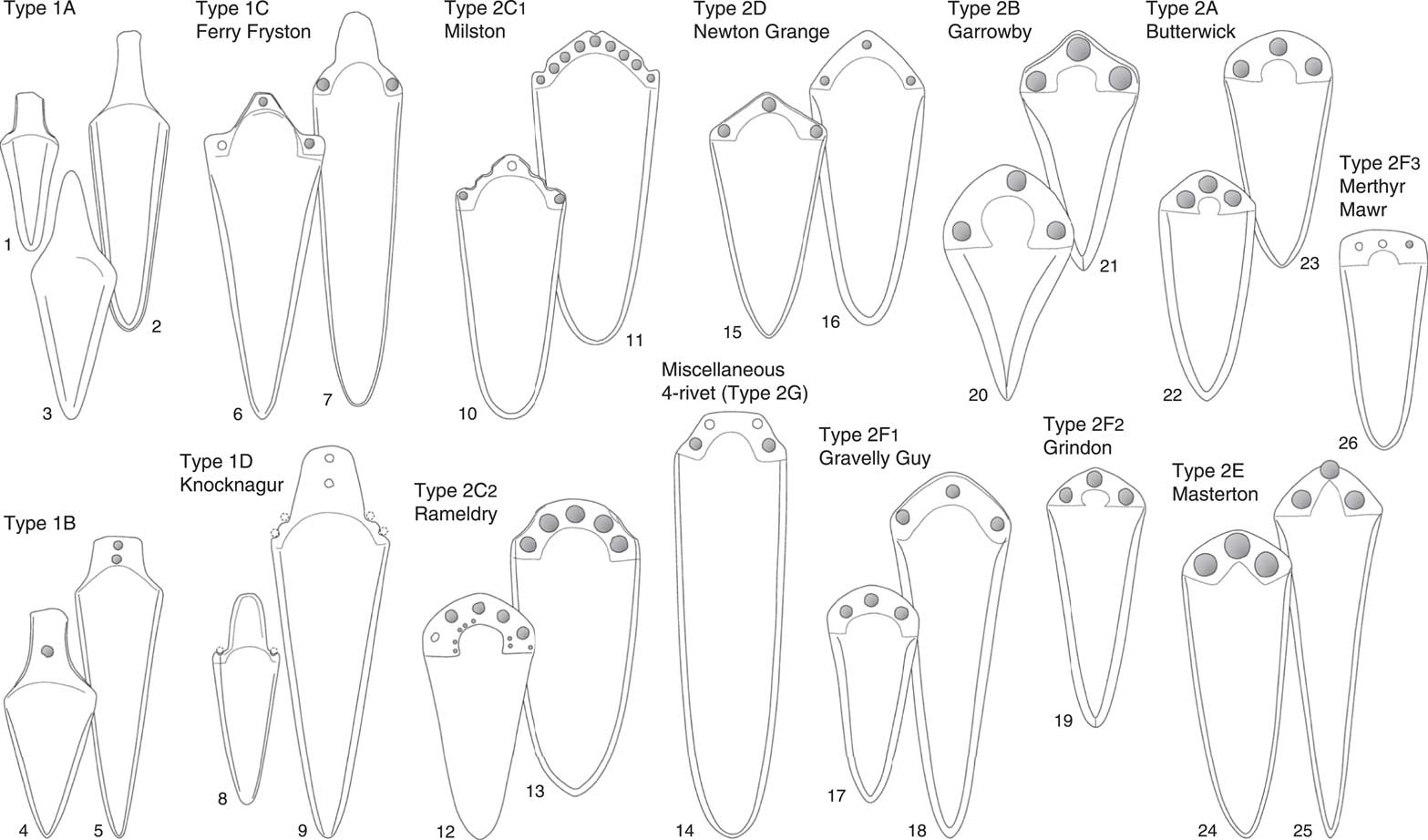
The very short length of the Racton tang introduces another important connection, this time with examples of the succeeding Series 2 bronze daggers. It has not been appreciated before that some of Gerloff’s Type Milston daggers (now Types 2C1 Milston and 2C2 Rameldry)Footnote 43 retain some legacy of the tang. This is most obvious on the Garton Slack 107 dagger (see figs 18 (8) and 21 (1)) on which the tang is sufficiently distinct that it could just as easily be regarded as a Type 1C dagger; this merely emphasises the gradational change between these types, especially as its tang is not trapezoidal and its broad linguate blade is better matched among Type 2C (fig 21). A tang is also likely on the badly corroded Yettington blade, but here it is effectively created by two notches halfway along the sides of the butt (fig 21 (3)); these notches are surely deliberate, probably to allow additional rivets through the hilt components. The Net Lowe example has one intact shoulder and it is probable that there was originally a central projection in order to give some provision for rivet attachment there; however, this is likely to have been very short given the thinness of the metal at the break (fig 21 (6)). Further examples with echoes of the short-tang-plus-shoulder-rivets format are those from Leicester, Homington, East Kennet and Radley 3 (figs 21 (2, 4, 5 and 8)).Footnote 44
Selected dagger blades of Type 2C Milston/Rameldry: (1) Garton Slack, East Yorkshire; (2) Radley 3, Oxfordshire; (3) Yettington, Devon; (4) Homington, Wiltshire; (5) East Kennet, Wiltshire; (6) Net Lowe, Derbyshire; (7) Milston, Wiltshire (butt as revealed by radiography); (8) Leicester, Leicestershire; scale 33 per cent. Drawing: Stuart Needham.

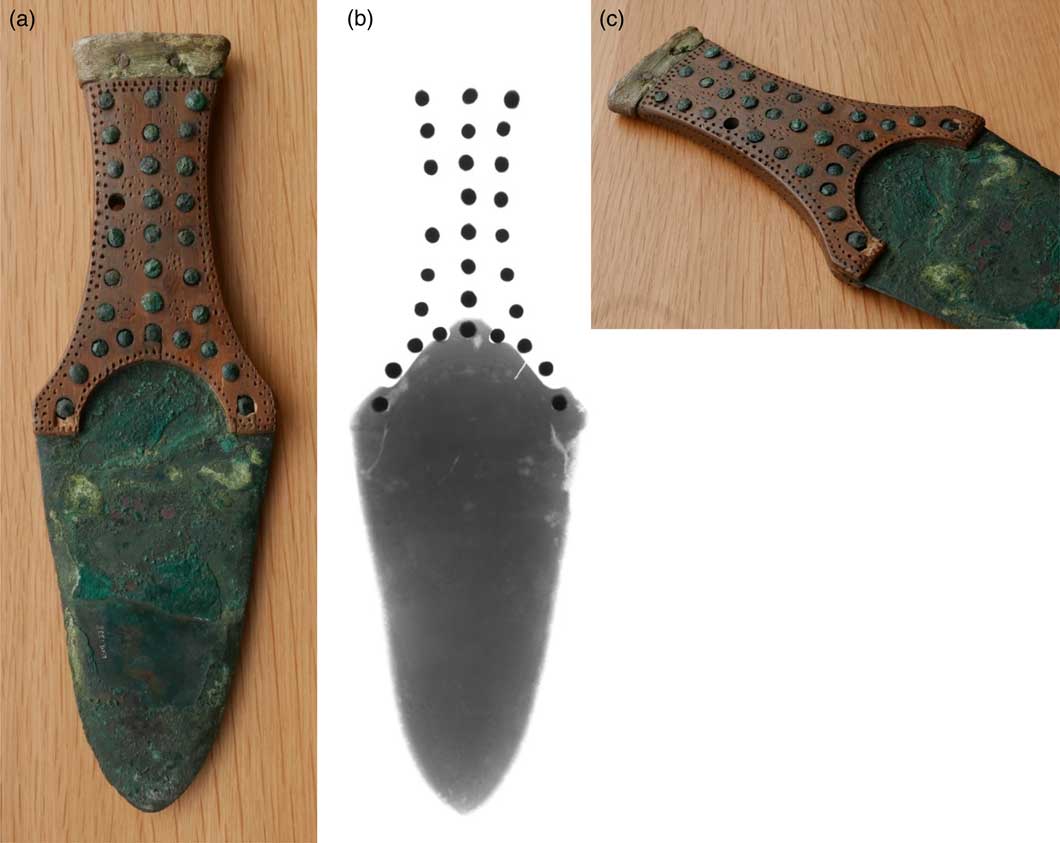
The butt of the Milston example itself is currently concealed by a hilt reconstruction (fig 22 (a)), almost certainly the one commissioned by William Cunnington soon after the original decayed after excavation.Footnote 45 Cunnington may then have been about the only knowledgeable person to see the hilt-plate, and his descriptionFootnote 46 is instructive:
The blade of the dagger is flat, two edged and without ornament. It is 5 inches long, where it joins the wood it is
 $$2^5\!/\!_8$$
inches broad, the whole length of the handle and blade is near
 $8^1\!/\!_2$
inches. See plate 54
fig 1
where it is drawn full size. The handle of this was of wood and little more than a quarter of an inch thick, and tipped with bone. Fastened to the blade by three brass rivets; and ornamented by 27 more, all of which passed through the wood which was ornamented with double indentations etc. The whole was in good preservation when taken out of the barrow, but notwithstanding all my care the handle of wood had parted into several pieces when I reached home – however having made a drawing of the whole when first taken out of the barrow and having all the pieces left, I have with the assistance of an ingenious joiner put another wooden handle exact in every respect to the former; and in which I have placed all the brass rivets and the top of the bone with its two rivets of wood (being now quite firm).
The Silk Hill, Milston dagger: (a) photograph of the blade mounted in an early nineteenth-century hilt reconstruction based on the decayed remains observed by William Cunnington; (b) radiograph of dagger, revealing the butt form for the first time in two centuries; (c) detail of the hilt reconstruction also showing the side decoration. Images: (a) and (c) Stuart Needham; (b) Gabrielle Flexer, Wiltshire and Swindon History Centre.

Cunnington put an arc of nine rivets around the butt in the restoration, so if only three were attaching the blade, this suggested that the other six were set within notches or longer indents in the butt-line.Footnote 47 It was important to confirm the shape of the butt-line and radiography was undertaken (fig 22 (b)).Footnote 48 This revealed a very broad-based trapezoidal tang flanked by small shoulders; a rivet notch indents both sides of the apex of the tang (fig 21 (7)).
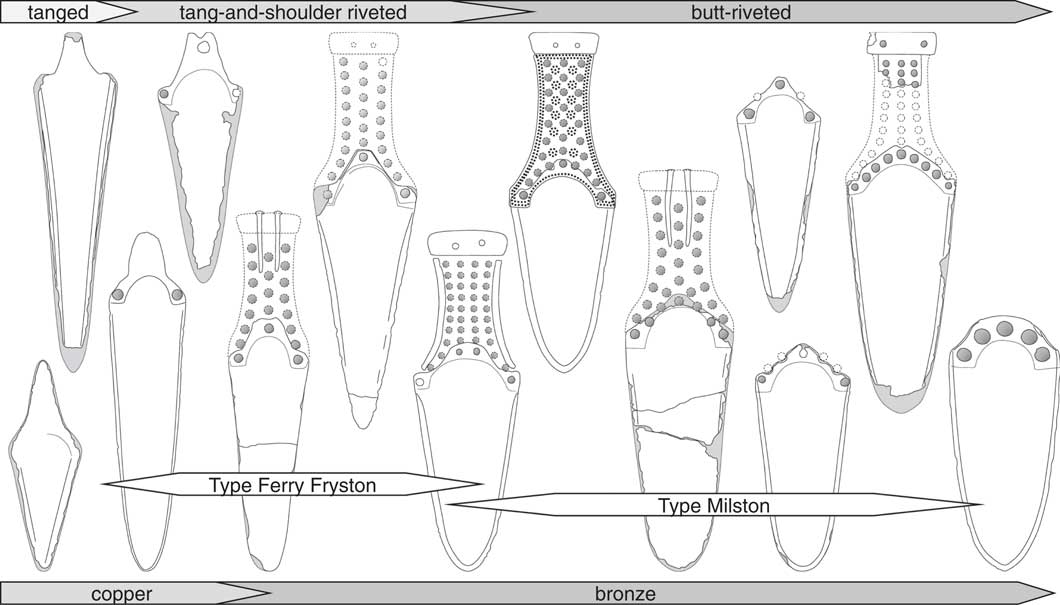
Both Piggott and GerloffFootnote 49 thought Milston daggers should overlap the Wessex Culture because they linked the rivet-studded examples to the gold-stud decorated pommel on one of the daggers from Bush Barrow, the archetypal ‘Wessex 1’ grave group. This is at best a superficial resemblance using a very different technique,Footnote 50 and the connection between late tanged daggers and 2C1 Milston daggers is strengthened by two further factors. First, the Milston type accounts for most of the Series 2 daggers that retain the broad-omega hilt-line. The majority of other Series 2 daggers have either tight-omega or angular hilt-lines (see figs 19 and 24).Footnote 51 Second, it is the Milston type alone that continues the multi-studding of hilts seen first on the 1C daggers from Ferry Fryston and Racton and the intermediate 1C/2C example from Garton Slack (fig 23). It is perhaps not without coincidence that these three are made of bronze rather than copper, even though they are formally classed as ‘tanged’ daggers. Taken together, these various typological, technological and stylistic connections suggest strongly that there was a relatively steady, and probably speedy, progression from tanged daggers of Types 1A/1B to Type 1C, and then to Type 2C, 2D and 2F1 before the inception of other Series 2 types (fig 24). In the course of this progression, copper gave way to bronze and the fashion for rivet-studded hilts came and went (see fig 23 and table 5).

Examples of daggers (and knives) representing Series 1 and Series 2. Minor damage to outlines has been ‘restored’ for the sake of morphological clarity; examples based on: (1) Chilbolton, Hants; (2) Sutton Courtenay, Oxon; (3) Barnack, Cambs; (4) Sittingbourne, Kent; (5) Listack, Co Donegal; (6) Racton, West Sussex; (7) Massingham, Norfolk; (8) Knocknagur, Co Galway; (9) ‘Ireland’; (10) East Kennet, Wilts; (11) Leciester, Leics; (12) Rameldry, Fife; (13) Homington, Wilts; (14) Oakley Down, Dorset; (15) Newton Grange, Derbys; (16) Amesbury G85, Wilts; (17) Wilsford G54, Wilts; (18) Gravelly Guy, Oxon; (19) Grindon, Staffs; (20) Garrowby Wold, East Yorks; (21) Carder Low, Derbys; (22) Figheldean, Wilts; (23) Litlington, Cambs; (24) Wormhill, Derbys; (25) Warslow and Elkstones, Derbys; (26) Merthyr Mawr, Glamorgan. Scale approximately 30 per cent. Drawing: Stuart Needham.

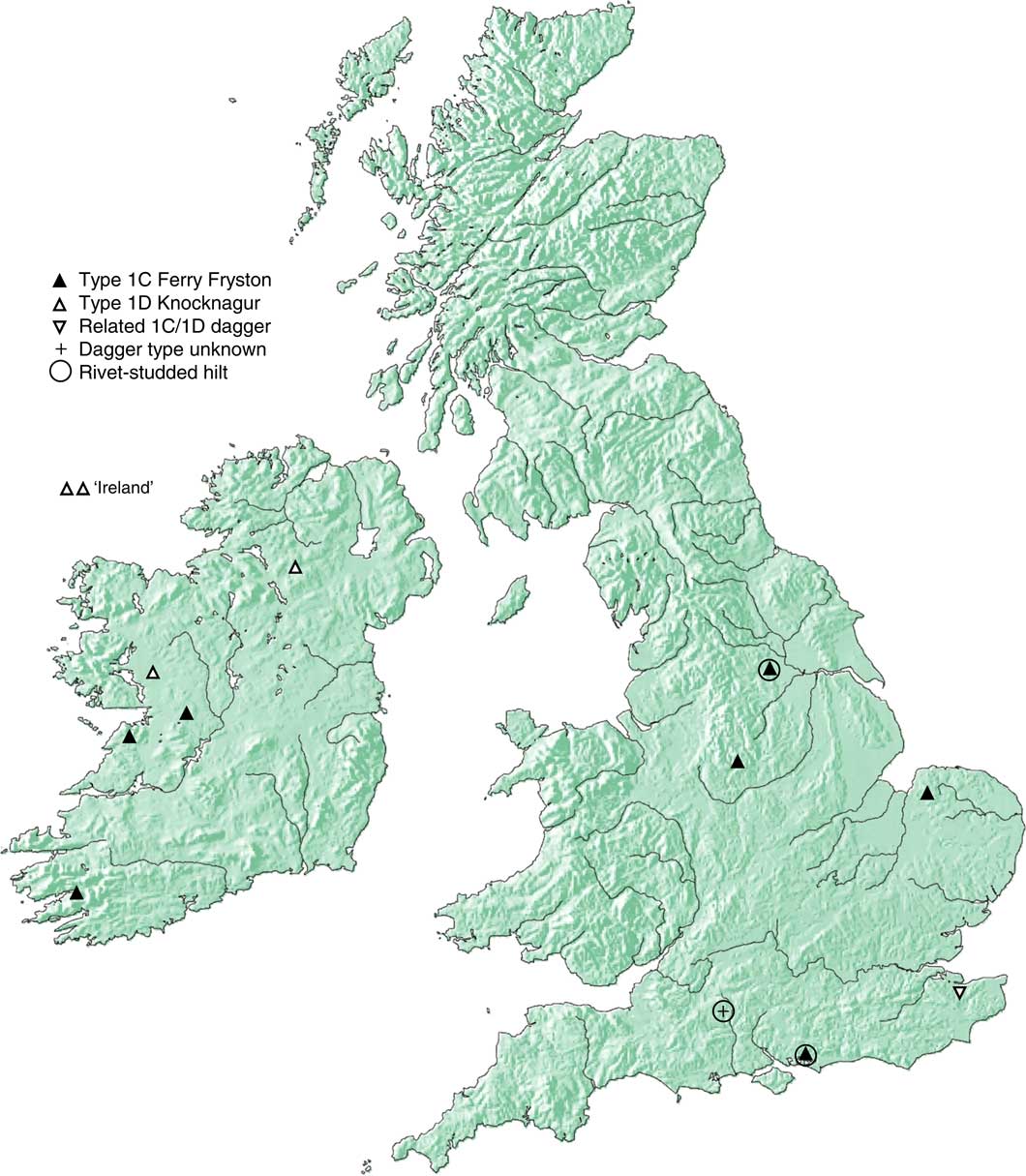
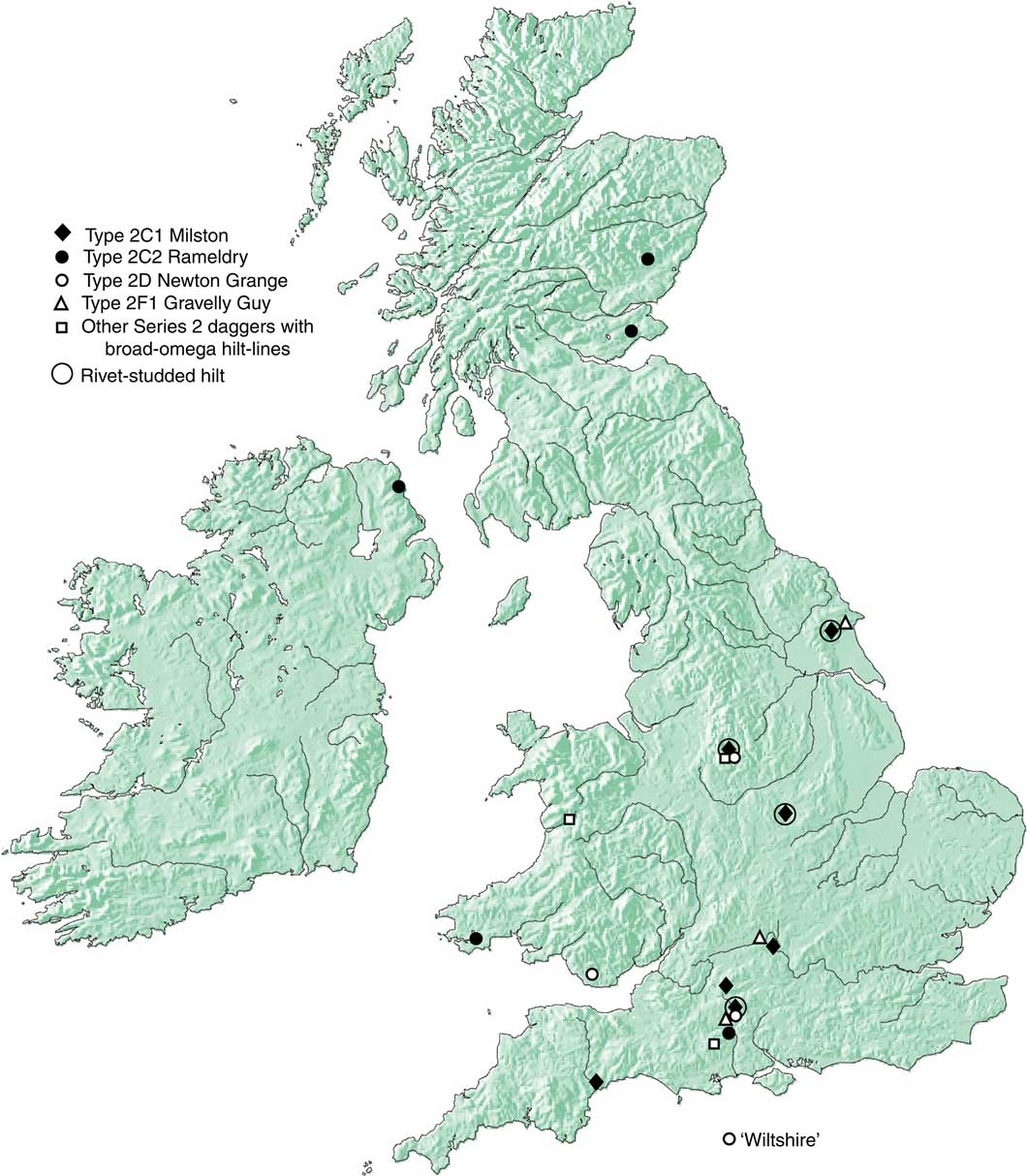
As far as can be ascertained from the maps of recovery for the various types, the main regions responsible for these innovations were the south-eastern quarter of Britain as far west as the Peak District and central Wessex, and western Ireland (fig 25). In Britain, Type Ferry Fryston daggers lie between Yorkshire and Sussex, with the closely related Faversham example in Kent. Taking the main successor types together – 2C1 Milston, 2C2 Rameldry, 2D Newton Grange, 2F1 Gravelly Guy and a few related daggers (fig 24) – we see both consolidation and, possibly, allowing for their greater numbers, expansion to new areas: central Wessex and the Upper Thames Valley, south-western Britain, east-central Scotland and even a single example on the Antrim coast (fig 26). It is noteworthy that Type 2C2 Rameldry daggers occur in the north and west relative to Type 2C1 Milston. The three Irish finds of Type Ferry Fryston daggers lie in the south-western quarter of the island. Two Type Knocknagur finds are further north, but two others lack provenances (see fig 25).
Map of recovery for Type 1C Ferry Fryston and Type 1D Knocknagur daggers in Britain and Ireland. The closely related blade from Faversham is also plotted, but not other late examples of tanged daggers and knives. Drawing: Stuart Needham.

Map of recovery for Type 2C1 Milston, Type 2C2 Rameldry, Type 2D Newton Grange and other Series 2 daggers with broad-omega hilt-lines in Britain and Ireland. NB potential contemporary Irish types either have poor provenances or a different hilt-line shape (see table 5). Drawing: Stuart Needham.

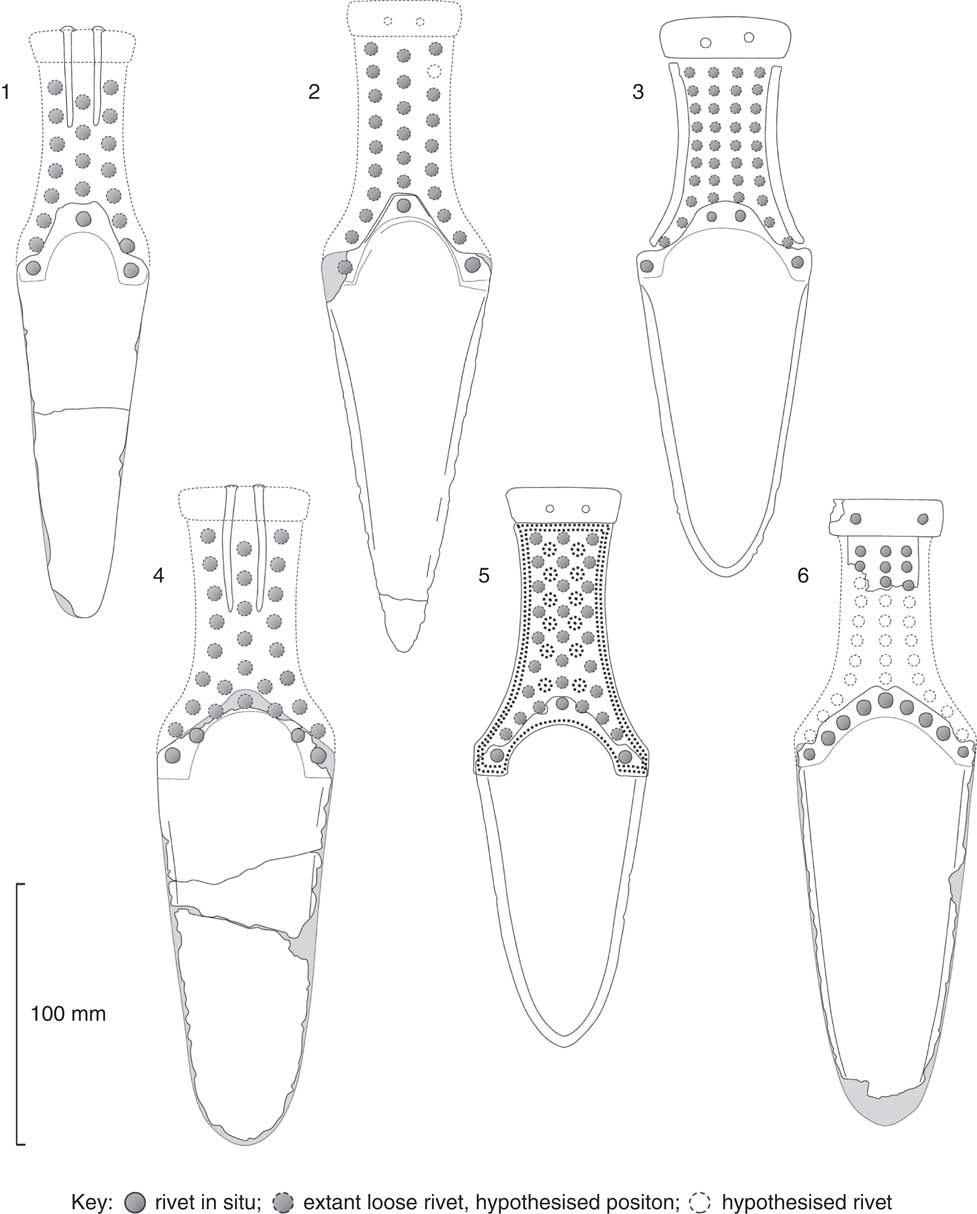
Suggested rivet formations for rivet-studded hilts: (1) Ferry Fryston; (2) Racton; (3) Garton Slack; (4) Net Lowe; (5) Milston; (6) Leicester; scale 33 per cent. Drawing: Stuart Needham.

The phase of multiple rivet-studding of hilts seems, therefore, to be quite short-lived and to belong to the very beginning phase of bronze alloying. This may have been contained within the earlier half of Period 2 (including any transition phase), thus c 2200–2050 bc. Some eight daggers belonging to notionally later styles do have two or three surplus rivets, these presumably being the last legacy of the rivet-studded hilt tradition (table 6).Footnote 52
Summary details of rivet sets used for rivet-studding hilts

Note: the Ballyenahan set is excluded here – see SM5 and fig 34.
The set of rivets from Bush Barrow (Wilsford G5) might well indicate that rivet-studding was first developed within a copper-working tradition; new surface analyses have shown that the rivets are all of unalloyed copper; however, a small fragment, which may be from the associated blade, proved to have tin added to copper with a very similar impurity pattern.Footnote 53 More suggestive are the implications of various hilt-plate forms. It is obvious that on Type 2C1 Milston daggers there was a general desire for the multiplication of rivets both to attach the blade and ornament the hilt. In a number of cases the blade-fixing rivets were set in notches as well as holes.Footnote 54 Type 1D Knocknagur daggers likewise employ notches; these are assumed to indicate the positions of rivets at the shoulders and, on the Sillees River example (see fig 20 (3)), a little higher as well. This raises the further possibility that additional rivets were sometimes set further adrift from tangs, thus leaving no notches as witness to their existence. The recovery of the Irish examples accidentally and outside of burial contexts could easily account for the non-recovery of small loose rivets.Footnote 55
In the case of Type 1C Ferry Fryston daggers, the marked indentations of butt-lines, on the examples from Gragan West and Killaha East at least (see figs 18 (1 and 5)), again strongly imply allowance for additional rivets. And again it is feasible that multiple rivets sometimes flanked tangs without impinging on them, particularly where tangs were sharply tapered, as at Standlow or Derrynamanagh (see figs 18 (2 and 6)), thus recalling the conjectured arrangements of studding rivets at Racton and Garton, and the corrosion-attached position of one of the rivets at Ferry Fryston (see next section). Given the unnecessarily complex shapes of many of the butt-lines on all three types (1C, 1D and 2C1), shapes that would have been concealed in the hilted weapon, it seems entirely possible that multi-studding was more frequent than appears from the recovered record and it is not impossible that it started on late copper daggers.
RECONSTRUCTING RIVET FORMATIONS ON THE HILT AND ITS PARALLELS
The consistency of all twenty-six rivets from Racton supports their belonging to a single set rather than there having been a second object in the grave, and since a few contemporary daggers are known to have had rivet-studded hilts, this can be assumed to be the explanation here, too. For a long time there were only four antiquarian finds known: those from Silk Hill, Milston, Wiltshire; from Garton Slack 107, East Yorkshire; from Net Lowe, Eaton and Alsop, Derbyshire; and probably that from Leicester.Footnote 56 These have been added to more recently by the dagger-grave excavated at Ferry Fryston, North Yorkshire, and by the recognition that the set of thirty-three rivets from the Bush Barrow grave group (Wilsford G5, Wiltshire) probably also derived from a rivet-studded dagger hilt.Footnote 57 Finally, there is a set of seventeen rivets from a grave at Ballyenahan, Co. Cork,Footnote 58 but these were not associated with a dagger or knife blade and there are differences from the British examples (see table 6).
The best evidence for rivet arrangement still comes from two of the earliest finds, those from Milston and Garton Slack. The hilt furnishings of the latter, moreover, provide the best empirical evidence for the overall shape of the hilt and its length.Footnote 59 The most informative of subsequent discoveries is that from Ferry Fryston, excavated in 2003, although the hilt of the dagger had fragmented and become somewhat disarranged early in its time in the ground. There is reasonable confidence that all rivets were recovered and overall it was deduced that there would have been three columns of rivets, the two outer ones splaying towards the blade in order to flow towards the shoulder rivets (fig 27 (1)).Footnote 60 With the number of rivets available at Ferry Fryston it is almost impossible to get the rivets lining up across all the columns; this may contrast with alignment in approximate rows at Garton Slack and partially at Milston (fig 27 (3) and (5)). The other three sites are inadequately recorded and it is only really possible to conjecture a formation for Net Lowe because of the survival of some rivets in the hilt-plate and the fact that the pommel was fixed using two vertical long-shanked studs, a fixing method otherwise seen only at Ferry Fryston. The arrangement preferred here (fig 27 (4)), sees a doubling up of the lines of rivets coming down the shoulders, an arrangement also favoured for the Leicester dagger (fig 27 (6)).
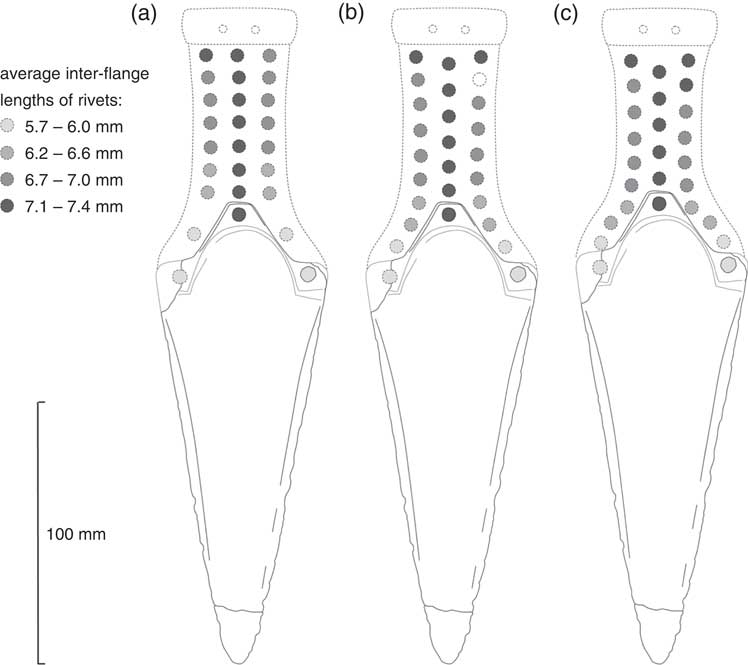
The total disturbance of the Racton rivets means their original format can again only be conjectured; moreover, we cannot be totally confident that all the rivets were recovered. Nevertheless, the features and disposition of the rivets attaching the blade, plus information drawn from the parallels, allow some reasonable deductions to be made. It is natural to envisage three columns of rivets running down through the hilt-plate to terminate in the tang and shoulder rivets. While Garton Slack is recorded as having four columns, the best reconstructions of all other rivet sets are in three columns. The reconstructions for both Ferry Fryston and Garton Slack have two rivets flanking either side of the tang and something similar seems likely at Racton. If there was only one rivet per side, this would leave twenty-one rivets for the hilt above the tang – these could form seven rows in three columns (fig 28 (a)). However, this gives a rather unsatisfactory marked change of rivet spacing between the grip and the shoulders. It is more likely perhaps that two or three rivets flanked the tang. If two, then the remaining twenty rivets could have been disposed in staggered formation, in which case one would be missing (fig 28 (b)). If aligned instead in rows, then again a change in spacing results. Three rivets either side of the tang not only allows for reasonably even spacing throughout, but also requires no additional rivets to those recovered (fig 28 (c)).Footnote 61 The Racton reconstruction with three tang-flanking rivets develops a more evenly spaced rivet arc around the butt, such as is seen at Milston and Leicester, and perhaps also Garton Slack and Net Lowe (fig 27 (3) and (4)). Either this or the two tang-flanking rivets format is plausible when seen against the transformations taking place in dagger design at this time. Indeed, it appears that this was the key design dilemma for the rivet-studded style – how to conjoin harmoniously the essentially vertical columns down the grip with a smooth arc of regularly spaced rivets around the hilt-line.
Alternative reconstructions of the Racton rivet-studded hilt; (a) single rivets flanking tang and no rivets missing; (b) two rivets flanking tang, one rivet missing; (c) three rivets flanking tang, none missing; scale 33 per cent. Drawing: Stuart Needham.

RADIOCARBON DATING
Part of the dentine from the tooth used for isotopic analysis by Montgomery and Jay was sent on to the Scottish Universities Environmental Research Centre for radiocarbon dating. The result returned was 3826±33 bp (SUERC−55526), calibrating to 2455–2145 cal bc (95.4 per cent probability) or 2335–2205 cal bc (68.2 per cent probability; calibration using OxCal4, all dates rounded to nearest five years and gaps in overall ranges ignored); δ13C relative to VPDB was measured at −21.3‰, δ15N relative to air at 11.0‰, and C/N ratio (Molar) at 3.2. This result confirmed the early date suspected for the type of dagger and will be discussed in conjunction with other relevant dates in the next section.Footnote 62
CONCLUSIONS
The immediate burial context
Racton Man was buried on his left-hand side in a flexed position, a rite typical of males in this period. The disposition of the skeletal remains gave some important clues to the immediate burial context. The skeleton had deflated and the skull had probably rolled away from it while still in a void. The implication is that the corpse’s flesh had had time to decay before a wooden container in turn decayed, thus bringing any overlying material down onto the corpse’s remains. Wooden containers and biers are relatively well documented for the Chalcolithic and Early Bronze Age. Perhaps most commonly reported are tree-trunk coffins, their massiveness leaving traces discernible even to some of the less-careful of past excavators. These have been fully reviewed recently by Parker Pearson et al, while plank-lined graves and constructed wooden chambers were more briefly introduced.Footnote 63
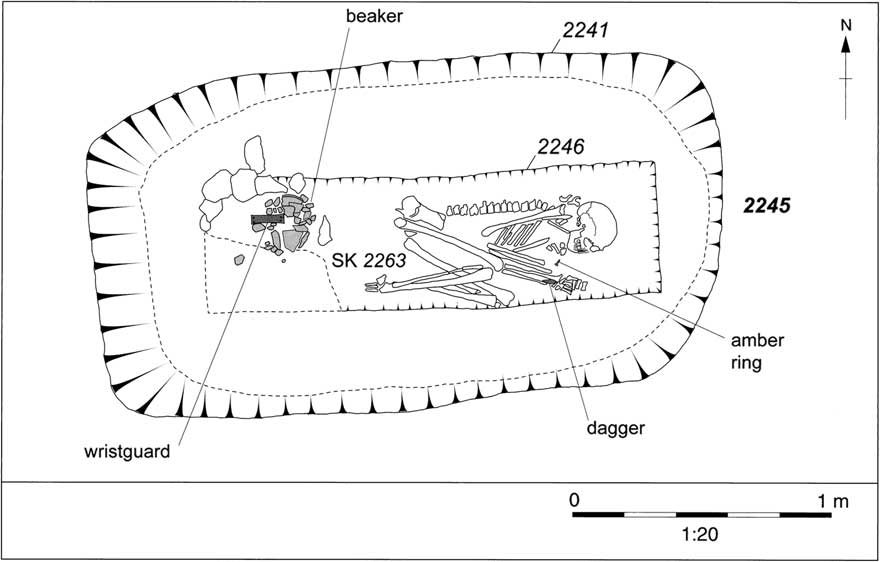
It is most likely that the inferred container at Racton was of box-like character rather than being a hollowed tree-trunk segment. This is known to have been the case in the Ferry Fryston grave with its very similar dagger (fig 29). Box-like containers may be far less substantial than hollowed tree-trunks, but the craftsmanship involved would be more exacting;Footnote 64 they provide a direct organic parallel for the stone-slab cists typical of northern Britain. While it is not clear that tree-trunk burial in Britain precedes the twenty-second century bc, plank-built containers are increasingly being documented from early in the Chalcolithic and may have represented a tradition brought from the Continent by pioneer Beaker communities.Footnote 65 They continued to be used until well beyond the date of the Racton burial.
Ferry Fryston burial 2245, West Yorkshire; the tightly contracted body was placed in a coffin, which had decayed but survived as soil stains; this was set into a cut grave (after Brown et al Reference Bray2007, fig 10).

Evidence for plough damage of the enveloping deposits means it is possible that a mound originally covering the Racton burial had been largely levelled. Nevertheless, the distinctive stony layer directly over the burial is very likely to be a remnant of mound make-up (see fig 7), not only truncated across the top, but also on the south-west side to within a metre of the burial. Insofar as the excavation trench allowed it to be seen, there was no evidence for a lot of redistributed stony material and the covering would seem to have been of rather modest volume.
Physique, health, mobility and diet
Racton Man was a robust male, exceptionally tall at about 1.83m (6ft). His estimated age at death of about 45 years or older puts into context the evidence for degradation of the spine of a kind typically found in older individuals. He also had limited dental disease. Two anatomical features may be congenital: his left patella may be tri-partite and the inferior margin of the mandible has a distinct downwards curvature.
The potential of bone isotope studies to shed light on patterns of mobility and dietary intake has been fully grasped by prehistoric archaeology in recent years with interesting results in such cases as the Amesbury Archer and the Boscombe Bowmen, indicating long-distance movement between childhood and adulthood.Footnote 66 A larger-scale study resulting from the Beaker People ProjectFootnote 67 offers additional insights into the movements and food consumption of the individuals buried during the Chalcolithic and Early Bronze Age along with Beaker pots; this suggests that the long-distance travel of the Amesbury Archer and the Boscombe Bowmen was exceptional rather than the norm. It is this background that is necessary to ‘calibrate’ the Racton results and it allows Racton Man to have been brought up in southern Britain, although most likely not in the immediate region around the burial site; environmentally similar regions on the Continent are not ruled out either. Carbon and nitrogen isotope ratios, both from the collagen and the carbonate, indicate a diet based on terrestrial C3 protein, with a significant level of animal protein, and they are again consistent with an environmental background in southern England during this period. Whatever his background, this individual was equipped with one of the most striking symbols of elite insular culture at this time – one of the earliest bronze daggers to have been found in Europe.
The Racton burial in its regional setting
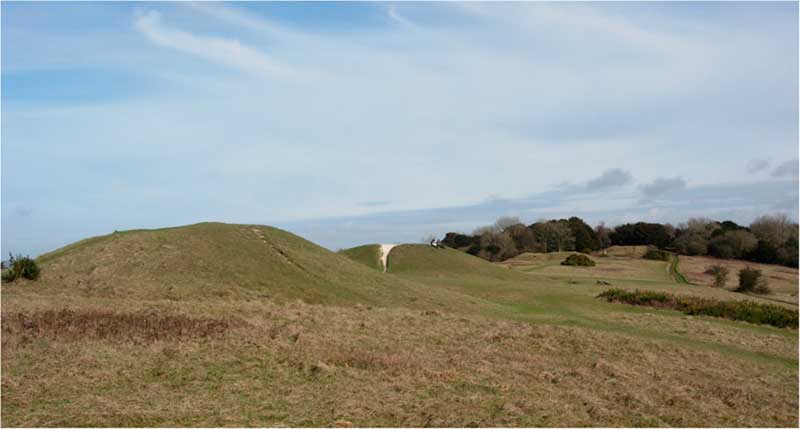
The Racton dagger-burial contributes significantly to the regional picture for the Early Bronze Age. It helps to bolster the evidence, that has been growing for some years, that there was significant off-chalk occupation in this part of West Sussex and Hampshire during the Bronze Age. This cannot be reviewed in any depth here, but a range of evidence, including structures. burnt mounds and artefact finds, has steadily accumulated for the coastal plain, although specifically Early Bronze Age evidence is still rather thin, perhaps because burial mounds have been levelled by centuries of agricultural activity. Barrows survive better or, where ploughed out, have a better chance of being revealed by cropmarks on the chalk downlands to the north (see fig 3). There is, therefore, undoubtedly a strong bias from north to south.Footnote 68 The large concentration of barrows to the north east sit on the prominent southern end of Bow Hill and its flanks. At the centre, standing at almost 200m od, is the fine group known as the Devil’s Humps, commanding superb views across all of the coastal landscape (fig 30). To judge from the evidence elsewhere in Britain, this barrow-scape would probably have developed over the centuries following the life of Racton Man.
The Devil’s Humps on Bow Hill, which overlooks Racton and the coastal plain. Photograph: Stuart Needham.

Dagger-burials are a familiar part of the Chalcolithic and Early Bronze Age funerary record, although they are represented in only a tiny minority of all burials. They occur widely across Britain, but with variable density; they are not particularly common in western Sussex and the adjacent part of Hampshire. The nearest dagger-grave of comparable date to Racton is that from Pyecombe, over 50km to the east.Footnote 69 The dagger was apparently of copper, but only survived as a stain; it accompanied a crouched inhumation along with a beaker, stone bracer and bone pommel, datable to c 2300–2150 bc (late Period 1). A badly corroded and damaged dagger blade, which accompanied a cremation deposit, comes from West Meon Hut, over 20km to the north west, and may be of Period 2.Footnote 70 Again of uncertain form due to corrosion is the butt-riveted dagger recovered from an inhumation grave at Bishop’s Waltham, some 25km west-north-west of Racton.Footnote 71 The remaining dagger-graves from the region are somewhat later as they contain Camerton–Snowshill type daggers (Period 4; c 1800–1550 bc). Well to the east are examples from Chanctonbury Hill and Hove, the latter being part of a well-furnished grave with a stone battle-axe, amber cup and perforated whetstone in a log coffin.Footnote 72 Much more recently, a fragmentary bronze dagger has been excavated from Barrow 11 on Petersfield Heath on the opposite side of the Downs from Racton and 14km distant.Footnote 73
The elaboration of daggers at the copper/bronze transition
The chronological position of the rivet-studding phenomenon is intriguing. It appears that it was first developed on a dagger style, Type Ferry Fryston, that bridges the transition between copper- and bronze-working. It was certainly a feature of some daggers at the very dawn of bronze alloying in these islands and could have been first conceived towards the end of the copper-working milieu. Either way, it is clear that it was part of a process of elaboration in dagger design that coincides closely with the advent of bronze alloying. The process started with the development of a more stylishly shaped hilt ending in a broad-omega line at the blade, and this was tied closely to the riveting of shoulders and tangs. There were also changes at the top end of the hilt: from surviving examples it would appear that pommels made in more durable materials – bone and allied materials – increased. Pommels also changed from tanged forms,Footnote 74 where the tang was either an integral part of the pommel or was created by vertical studs or plates, to socketed forms.Footnote 75 The tang on the Leicester dagger’s pommel was a separate plate of metal sandwiched between two bone components (fig 27 (6)), while at Garton Slack two strips of bronze were evidently sandwiched between two hilting plates along their sides (fig 27 (3)).Footnote 76
While the potential complexity of sandwich hilts might have necessitated multiple fixings at top and bottom (and perhaps in between), this can only account for some degree of multiplication in riveting and the extremes to which this technique is taken in the rivet-studded group surely reflect a desire to maximise the ornamental value. These were becoming quite showy pieces of weaponry aimed at maximising the aesthetic effect not only in the rivet pattern and hilt shape, but also in the combination of the materials employed. The transition from copper to bronze is, therefore, marked by an improvement in the metal hardness thanks to the skill of the metalworkers and by other ways of proclaiming craft skill. It is, thus, a step forward from metal being valued for its rarity and novelty to metal being valued as a versatile medium for display, especially when used in conjunction with other valued materials.
The earliest bronze
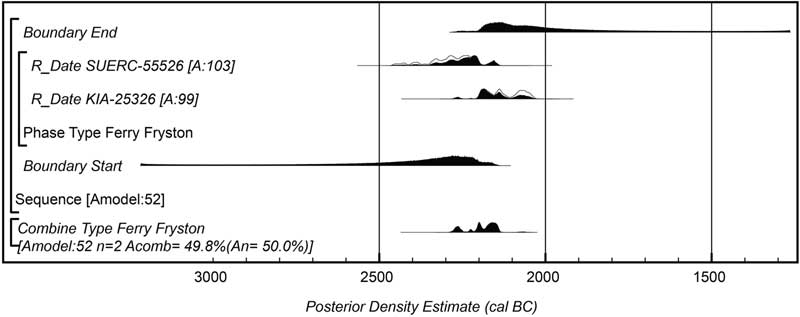
The early radiocarbon date obtained for the Racton burial inevitably raises the question of the origins of bronze metallurgy in Britain. A high-integrity radiocarbon determination has also been obtained for the Ferry Fryston burial in which the dagger shares both the same type of blade and the rare phenomenon of a rivet-studded hilt (fig 31). Although the two determinations are not particularly close, they are not incompatible with the assumption that these two daggers were produced close in time to one another and, if they were closely contemporary, the most likely dating would be the earlier half of the twenty-second century.Footnote 77
Probability distributions (CAL BC) for Type 1C Ferry Fryston daggers (Ferry Fryston and Racton) as a phase (above) and as near-contemporary deposits (below). Graph: Peter Marshall, using OxCal v.4.2.

There are now twenty-two other dates for early bronze artefacts in Britain and Ireland, mostly obtained for daggers because their burial context offers good opportunities for dating.Footnote 78 Series 2 daggers with associated radiocarbon dates have been evaluated using Bayesian statisticsFootnote 79 and, setting aside some clear outliers,Footnote 80 they come out clearly later than Type 1C Ferry Fryston. A more refined analysis, which separates dates associated with typologically early Series 2 daggers,Footnote 81 gives a better absolute chronology to the dagger evolution outlined above and these evaluations, based on Bayesian modelling, give an important corrective. It has been accepted for some time that bronze-working began around the twenty-second century bc,Footnote 82 but it had been assumed that this involved classic bronze butt-riveted daggers (Series 2) from the start, whereas it now seems that even stylistically early examples, notably Type 2C1 Milston, may not appear until later in that century. Instead, it is a late form of tanged dagger (1C Ferry Fryston) that attests to the first bronze technology between about 2200 and 2150 bc.
The extent to which late copper artefacts are contemporary with the earliest bronze is not evaluated here. However, copper and bronze artefacts are rarely found together and there is also a very strong correlation between a particular type of axe, dagger or halberd and one or other metal. Exceptional associations, such as the bronze rivet for a tanged knife (blade unanalysed) in the same grave as a copper, tanged dagger at Dorchester-on-Thames, Oxfordshire,Footnote 83 do little more than demonstrate the obvious: that there must have been some period of overlap in the use of these metals, however long or short. The same could explain the use of copper rivets to attach the bronze dagger blades from Rudston 68, East Yorkshire, and Gravelly Guy, Oxfordshire;Footnote 84 both are typologically early in Series 2 (see table 5). The same combination is now possible for the presumed early dagger at Bush Barrow.Footnote 85 It would hardly be surprising if the availability of tin at the very beginning of bronze-working was a little erratic, but in archaeological terms, and when viewed at the Continental scale, it is striking how rapidly regular supplies of tin for alloying were secured across the whole of Britain.
In a recent article, Peter Bray has hypothesised that alloying with tin was practised from earlier in Britain, during the Chalcolithic,Footnote 86 and that tin-bronze products of that era were recycled and kept in circulation so that they are essentially absent from the archaeological record.Footnote 87 This is certainly theoretically tenable given that alloying to make bronze has been found to occur in parts of western Europe during the Bell Beaker phase, broadly contemporary with the British Chalcolithic.Footnote 88 In general, Bray believes that recycling in Chalcolithic Britain was minimal, so his hypothesis depends on society having consistently selected out the alloyed metalwork for special treatment. Yet, if the ‘metalleity’ (Bray’s term) of the Chalcolithic was such that the idea of recycling was simply not recognised as a modus operandi, as Bray argues, then it is hard to see why bronze artefacts would have been treated differently. Moreover, if bronze was rare and was seen to have enhanced value relative even to copper, then its potential importance for ritual deposition would be great.
We should not rule out the possibility of future finds of bronze appearing in pre-2200 bc contexts. However, historically more poignant is the point at which social, economic and technological conditions were right to promote a sudden upsurge in the ‘need’ for bronze, this in turn triggering the systematic search for tin. Copper and early bronze artefacts show clear morphological divisions and reasonably clear succession, so a few earlier-existing bronzes would no more undermine the validity of a phase of overwhelming copper use than a few later copper imports from the Continent can erase the very different ‘metalleity’ of Britain and Ireland’s first phase of bronze.
Where do the earliest insular bronzes – daggers, axes and halberds – come from? The very earliest styles in each category are distinctly insular and interpretable as developments of pre-existing copper forms (fig 32). The metal itself was also largely insular, continuing the dependence on Ross Island copper from Co. Kerry that had overwhelmingly dominated supply during the Chalcolithic.Footnote 89 Even minor metal inputs to the system – mainly ‘Bell Beaker-metal’ – were continuations of patterns established during the Chalcolithic. So there was no marked change in copper supply at this horizon of first alloying, just minor deviations and intrusions.Footnote 90 On circumstantial grounds, the tin must also have had insular origins and plenty of past scholars have called attention to the abundance of tin resources in the south west of England.Footnote 91 The recognition of abundant cassiterite (tin ore) in south-west English streams and rivers may have been a consequence of regular stream-panning for gold in the region from the Chalcolithic onwards.Footnote 92
Earliest bronze metalwork types (daggers, halberds and axes) in Britain and their typological antecedents in copper (shaded). Drawing: Stuart Needham.

Bray’s hypothesis makes the important distinction between early occurrences of tin-bronze as a minority metal and the establishment of a full-blown bronze-working tradition. Chris Pare has brought out this distinction with clarity at a pan-European scale and shown that the latter does not always follow quickly, or even steadily, from the former.Footnote 93 He argues cogently for the switch to bronze being as much a social decision as a technological advance.Footnote 94 Given the small-scale occurrence of bronze in parts of western Europe during the Bell Beaker phase, along with Britain’s participation in the Beaker network, it is eminently likely that the know-how first came from the Continent and, perhaps, as a minor part of the package that introduced copper metallurgy to these islands. Whatever the ultimate source of this innovation, credit must go to insular metalworkers across the islands of Britain and Ireland for grasping the technological and cultural opportunity so wholeheartedly, consistently and rapidly at a particular point in time. On the evidence reviewed here it can be suggested that the consistent use of bronze, and with it a new socio-technological age, lifted off from about 2200–2150 bc. Aside from the Type Ferry Fryston daggers, the most easily identified bronze types in the vanguard are Type Dunnottar axes in northern BritainFootnote 95 and Type Auchingoul halberds, also in the north (see fig 32).Footnote 96
The Racton grave was not only in the vanguard on account of its ‘earliest’ bronze (fig 23), but, also contextually, as a dagger-only grave. Piggott long ago perceived some importance in the shift from graves that had daggers alongside a standard set of grave goods, including a Beaker, to those no longer accompanied by a pot,Footnote 97 and this appears to be a change that again evolved at around the beginning of bronze use, although it was not sudden.Footnote 98 Piggott was keen to link the phenomenon of pot exclusion from the grave to Continental influences, just as, indeed, he derived butt-riveted insular daggers from blades in middle Europe.Footnote 99 This derivation no longer looks necessary. The latest evaluation of the beginning date for Bronze A1, which features the first butt-riveted knives and daggers, is c 2150 bc, Footnote 100 and it may be that butt-riveting was developing in tandem in the different regions as a result of continuing contacts via the Rhine and the intervening seaways. Nevertheless, there is little on the near-Continent to compare with the fine bronze British and Irish daggers of the twenty-second century. It can now be ventured that the insular sequence had a motor force of its own, which led to the rapid adoption of bronze, to the rapid development of butt-riveted daggers and knives, to a peculiarly insular form of hilt ornamentation and, when it came to the accompaniments for senior male burial, to the progressive move away from the Beaker package (in its well-furnished form) to the ‘dagger-grave’.
Injury and death
The most unexpected and potentially far-reaching evidence to emerge from the study of the Racton burial relates to injuries he suffered close to the time of his death. The right arm had been subjected to sharp-force trauma, certainly on the elbow and possibly also in the armpit. The former is consistent with a slicing cut to the elbow from a sharp blade while the arm was raised and bent to protect the head from an oncoming blow. The less-conclusive evidence towards the shoulder could easily have been caused by a similar blade weapon, stabbed into the armpit. Since there are no signs of healing, these could represent injuries sustained in combat or an assault shortly before Racton Man’s death. Given the nature of such an attack, the opponent would need to have been of roughly equal stature.
Clear causes of injury or death are rare in prehistoric archaeology. A couple of cases of flint arrowhead tips embedded in the corpse are about the best that can be mustered across Britain for the Chalcolithic to Early Bronze Age.Footnote 101 Nevertheless, there are a number of other records of skeletal injuries, some of which may well have contributed to the deaths of the individuals concerned.Footnote 102 It is intriguing that among these injuries, a high proportion are arm injuries: for example, a forearm parry fracture at Chilbolton, Hampshire; a healed upper arm fracture at Liffs Low (Beaker burial), Derbyshire; healed forearm fractures at Pyecombe, East Sussex, Barnack, Cambridgeshire, and Fordington Farm, Dorset; an extensive wound to the left wrist at Callis Wold 23, East Yorkshire, which the recipient survived; and a possible upper arm injury at Tallington, Lincolnshire. At Court Hill, Somerset, a left humerus chopped right through was interpreted as the probable cause of death, and a burial at Amesbury, Wiltshire, had suffered the same fate, but also lacked its right arm, skull and mandible. Burial 11 at Staxton Beacon, East Yorkshire, had a major weapon injury to the left shoulder.Footnote 103 Taken together, these begin to look significant, particularly since leg injuries seem to be negligible by comparison. There are also several skull injuries of varied kinds. All but one of the skeletons is sexed and all are males. Thorpe saw such injuries as evidence that recipients were ‘killed in the course of small-scale conflicts, whose bravery was then recognised by a prestigious burial’.Footnote 104 It may now be possible to venture more on the particular social context of some conflicts.
Despite the focus on aesthetics above, discussion of the early metal daggers sooner or later has to come back to the question of their efficacy as weapons. Edge hardness aside, the question about the effectiveness of daggers is essentially the same for all early daggers (Series 1 and 2), whether of copper or bronze,Footnote 105 since they comprise thin flat blades lacking any strengthening. This has led Roger Mercer to argue that these blades were ineffectual as daggers from a strictly technical point of view.Footnote 106 Scrutiny of functionality should, though, take account of the mode of combat for which they were designed rather than being based on modern expectations. Chalcolithic and Early Bronze Age daggers need not have been designed for all-purpose violence or for ‘warfare’, as defined by Mercer.
Neither does that mean they functioned solely as ceremonial display objects, for while it is hard to escape the conclusion that daggers were highly prized objects in the early metal age, they also had keenly sharpened edges and were unlikely to have been purely symbolic accoutrements. Drawing from the Racton evidence, it is possible to see them as weapons serving a particular mode of combat that itself may connect with the elitist association of daggers at this time, if status was at times being achieved through codified confrontation. Pursuing this line of thought, it may be pertinent that Racton Man was no longer a young man. If leadership was sometimes contested through inter-personal combat, then age could well militate against a title defender who was faced with a younger potential usurper. It is worth noting the case of Early Bronze Age burials in Slovakia and Moravia where a number of injuries have been identified, most often suffered by older males.Footnote 107 Such ideas about how supreme leadership was established are bound to be speculative, but codified combat-contested leadership does have the potential to explain why implements that, to the modern mind, are poorly designed as weapons actually continued to be important for some centuries. At the same time, it may explain why so many of the dagger-accoutred males of this era have been found to be well-built individuals and often of a good age. Even among his peer-group Racton Man would have stood tall.
ACKNOWLEDGEMENTS
Virtually nothing of the profile of Racton Man would have been known without the landowner’s permission to excavate back in 1989; we are grateful for his continued support and interest. James Kenny also wishes to thank the excavation team drawn from Chichester Archaeological Unit. Successive curators at The Novium – Anooshka Rawden and Amy Roberts – were central to the smooth and successful running of the project and also helped to attract financial support from the South Downs National Park Authority’s Sustainable Communities Fund to cover the costs of certain specialist analyses and aspects of display. Alison Sheridan kindly assisted with obtaining the radiocarbon date and Peter Bray is thanked for checking for additional relevant metal analyses. The principal author is grateful to Mary Davis for stepping into the breach to analyse the Racton dagger and its rivets. Radiographic and metal analyses of the crucial parallels from Milston and Bush Barrow were made possible through the kindness of David Dawson, Lisa Brown and the Trustees at the Wiltshire Heritage Museum, Devizes. Gabrielle Flexer, of the Wiltshire and Swindon Heritage Centre, revealed Milston’s long-concealed butt-line and Patrick Quinn, of the UCL Institute of Archaeology, generously put his laboratory facilities and equipment at our disposal.
SUPPLEMENTARY MATERIAL
For supplementary material accompanying this paper, visit https://doi.org/10.1017/S0003581516000688.
ABBREVIATIONS AND BIBLIOGRAPHY
Abbreviations
- SM
-
Supplementary Material; refers to the appendices, figures and tables that are to be found in the file of supplementary material published with the online version of this paper (https://doi.org/10.1017/S0003581516000688).