Nomenclature
-
 $({x_D},{y_D})$
-
the coordinate of defender
-
$({x_A},{y_A})$
-
the coordinate of attacker
-
$({x_T},{y_T})$
-
the coordinate of target
-
${v_D}$
-
the vehicle velocity of defender
-
${v_A}$
-
the vehicle velocity of attacker
-
${a_D}$
-
the lateral acceleration of vehicle defender
-
${a_A}$
-
the lateral acceleration of vehicle attacker
-
$a_D^{\max }$
-
the max lateral acceleration of vehicle defender
-
$a_A^{\max }$
-
the max lateral acceleration of vehicle attacker
-
${r_D}$
-
the minimum turning radius of defender
-
${r_A}$
-
the minimum turning radius of attacker
-
$d$
-
the distance between the collision point and the designated target T


Greek symbol
-
${\gamma _D}$
-
the heading angle of defender
-
${\gamma _A}$
-
the heading angle of attacker
-
${\vartheta _D}$
-
the change in heading angle of the defender
-
${\vartheta _A}$
-
the change in heading angle of the attacker


1.0 Introduction
In both the pursuit-evasion scenario and the target-attacker-defender three-body scenario, when accurate knowledge of the opponent’s current and future manoeuvering states is available, the optimal guidance law is undoubtedly the best [Reference Mishley and Shaferman1]. However, while the opponent’s current state can be confirmed to some extent, predicting the future manoeuvering state is extremely challenging. Therefore, different ‘optimal guidance laws’ emerge based on different prediction methods. Trajectory prediction methods for moving targets are broadly classified into two categories: data-driven and behaviour-driven. Data-driven approaches primarily include the Kalman filter method [Reference Manoharan and Baliyarasimhuni2], Hidden Markov Model (HMM) methods [Reference Mathew, Raposo and Martins3], and deep learning methods [Reference Min, Kim and Park4]; behaviour-driven approaches mainly encompass dynamic model-based methods [Reference Bahdanau, Cho and Bengio5] and intent recognition methods [Reference He, Li and Lyu6]. If we assume the individuals are self-interested intelligent agents, their future manoeuvering states can be predicted based on the current states of both interacting parties and the target, thereby facilitating the development of differential game guidance laws. Clearly, this represents a behaviour-driven prediction methodology. Due to different optimisation criteria, the current differential game guidance laws mainly consist of the norm differential game (NDG) with the terminal miss distance as the cost function [Reference Turetsky and Shinar7, Reference Shinar, Glizer and Turetsky8], and the linear quadratic differential game (LQDG) that considers both terminal miss distance and energy consumption [Reference Liang, Li, Wu, Zheng, Chu and Wang9–Reference Chao, Wang, Wang and Yang11]. Additionally, researchers have attempted to leverage the advantages of both approaches by designing new guidance laws [Reference Turetsky, Weiss and Shima12, Reference Liang, Wang, Liu and Liu13].
NDG guidance laws have the advantage of focusing on striking the target by quickly adjusting the direction with maximum lateral acceleration and aiming for precise hits. However, due to constantly operating under the burden of maximum lateral acceleration, it becomes challenging for long-duration flights. Therefore, this guidance law is more suitable for application in the terminal guidance phase. Currently, the research on the application of NDG in pursuit-evasion two-body game scenarios has reached a relatively mature stage. However, the study on the TAD game problem is still not sufficiently developed. One important aspect of this research is predicting the terminal miss distance based on the zero effort miss (ZEM) modeling method. The benefit of this method is that it allows obtaining state-based feedback guidance laws through equation derivation. However, this prediction is linearised around the collision triangle, which leads to a certain level of accuracy loss, especially during a certain period after the mid-to-terminal guidance transition.
To address the inherent accuracy limitations of existing approaches, the differential game problem can be alternatively investigated through multiple analytical perspectives. From a geometric perspective, the state space can be partitioned into two mutually exclusive regions through algebraic or geometric analysis: (1) the attacker’s winning region (target capture) and (2) the target/defender’s winning region (target escape or attacker interception). The proposed model explicitly correlates manoeuver strategies with the dynamic evolution of these winning regions, thereby enabling the derivation of optimal control policies and their associated trajectories [Reference Zha, Chen, Peng and Gu14, Reference Liang, Deng, Peng, Li and Zha15]. This concept can be extended to cooperative multi-missile engagements, where the core objective is to translate numerical superiority into spatial coverage dominance. In this framework, guidance laws should be designed to simultaneously maximize the capture domain while minimizing escape opportunities [Reference Yan, Kuang, Zhu and Yuan16–Reference Su, Li and Chen18].
Alternatively, the guidance problem can be transformed into an optimisation problem. For example, by describing the state information of the target using dynamic distribution, the guidance problem can be transformed into a coverage dynamic distribution problem [Reference Ma, He, Wang, Zhang, Yao and Huo19]. The parameter design problem for mid-to-terminal guidance handover in multiple missile collaboration can be transformed into an optimisation problem [Reference Wang, Yao, He and Liu20]. Instead of considering the predicted interception point as a single point, it can be described as a region with a probability density function [Reference Yang, Liu and Yao21]. Instead of minimisng the miss distance, the optimisation problem is formulated to maximise the interception probability [Reference Dionne, Michalska and Rabbath22].
Certainly, the geometric analysis mentioned above can be combined with the transformation of the guidance problem. In cases where the target state cannot be accurately determined, the predicted target state can be represented in the form of a probability density function, and the likelihood of it entering the capture interval can be calculated [Reference Cevher and Leblebicioğlu23]. The probability of successful interception can be described by the coverage range of the predicted interception region, and this probability can be used as a constraint [Reference Wang, Liu, Yao and He24] or objective function [Reference Zhou and Lei25] to transform the guidance problem into an optimisation problem. While geometric model-based approaches offer intuitive solutions for trajectory planning, they suffer from critical limitations such as scenario-specific applicability and the inability to derive real-time state feedback control laws, which require further refinement.
Since the optimal trajectory (Dubins path) for an individual moving at a constant speed with a maximum turning radius in planar motion coincides with the NDG trajectory, many scholars have attempted to use this method to achieve precise coverage of an individual’s future motion trajectory. The Dubins path planning method was first proposed by L. E. Dubins in 1957 to solve the problem of optimal (shortest path or minimum time) trajectory planning between two points in a plane under maximum curvature constraints [Reference Dubins26]. This method or its improved versions are now widely applied in trajectory planning for automobiles, unmanned aerial vehicles (UAVs), robots, and other fields [Reference Askari, Mortazavi, Talebi and Motamedi27–Reference Jha, Chen and Shima30]. Some scholars have also extended its application to scenarios involving aircraft and missiles, which can be regarded as constant-speed motion with a minimum turning radius [Reference Manyam, Casbeer, Von Moll and Fuchs31–Reference Yan, Hao, Zhang and Yang33]. While these methods perform well in static or dynamic pursuit-evasion games, most have not been extended to multi-agent cooperative tasks. Ref. (Reference Yan, Kuang, Zhu and Yuan16) discusses the case of multiple agents cooperatively pursuing a single target. This paper attempts to draw on existing Dubins path-based models for two-body (or multiple pursuers/evaders) scenarios and further extend the application to a three-body TAD scenario. For application scenarios involving multiple attackers, multiple targets and multiple interceptors, the problem can be systematically addressed by first resolving the target assignment problem [Reference Manoharan, Thakur and Singh34], followed by decomposing it into multiple TAD sub-scenarios as studied in this work.
The ultimate goal of trajectory planning is to derive a state feedback control law. However, obtaining an analytical solution based on the aforementioned model (which is non-convex and difficult to transform) remains challenging. Currently, the primary approaches to address this problem involve neural networks and their improved variants [Reference Hartmann, Shiller and Azaria35, Reference Galyaev, Medvedev and Nasonov36], though certain limitations persist, such as poor scalability to large-scale data environments and occasional erroneous training outcomes [Reference Nayak and Rathinam37].
This paper aims to resolve these issues. Specifically, we address the problem of NDG design in the TAD three-body game scenario, based on geometric analysis and problem transformation. The subsequent structure of the paper is as follows: In Section 2, we simplify and ignore some parameters based on the analysis of the actual situation. On this basis, we establish the individual’s motion equation and derive the equal time line for both the defender and attacker using the reachable set frontier of Dubins. We transform the objective function of NDG from a geometric perspective and obtain an optimisation model without linearisation operations. In Section 3, we design and train a BP neural network model to solve the optimisation problem to meet the requirement of quick response. We detect and extrapolate the abnormal outputs of the BP neural network. In Section 4, we verify the performance of the proposed algorithm through numerical simulation and compare it with the conventional NDG. Finally, we conclude in Section 5.
2.0 Models and differential game problem formulation
2.1 Assumptions
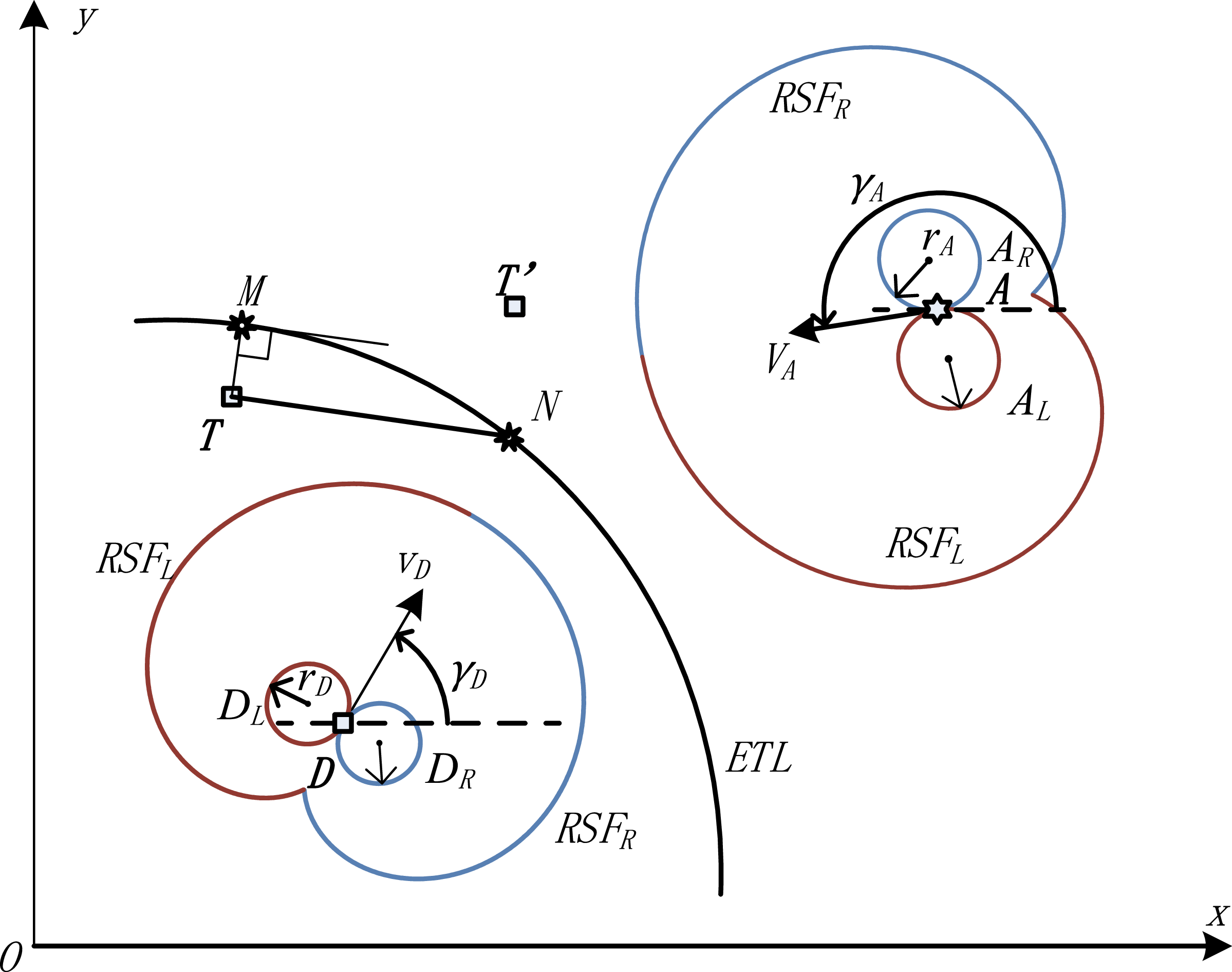
Figure 1 illustrates the pursuit-evasion dynamics of the TAD engagement. The attacker (A) aims to reach the target (T) while avoiding interception by the defender (D). Both A and D are constrained by their maximum lateral accelerations, which dictate their minimum turning radii. These radii define the tightest possible Dubins paths they can follow.
Engagement geometry.

In this Cartesian inertial coordinate system, the entities involved are denoted as follows:
 $T\left( {{x_T},{y_T}} \right)$
for the target,
 $\;A\left( {{x_A},{y_A}} \right)$
for the attacker, and
 $D\left( {{x_D},{y_D}} \right)$
for the defender, each with their corresponding velocities (
 ${v_T}$
,
 ${v_A}$
,
 ${v_D}$
), maximum accelerations (
 ${a_T}$
,
 ${a_A}$
,
 ${a_D}$
), and the heading angles (
 ${\gamma _T}$
,
 ${\gamma _A}$
,
 ${\gamma _D}$
).
Within a time interval Δt, the reachable sets of A and D are bounded by their right and left reachable set frontier (RSF). These frontier represent the farthest points each agent can reach while executing maximum-effort right (RS) or left (LS) turns. The intersection of these RSFs forms the equal-time line (ETL), which marks collision points where A and D arrive simultaneously. The virtual target (M), defined as the closest point on the ETL to T, determines the Nash equilibrium interception strategy.
To simplify the theoretical analysis, the following assumptions are made:
-
(1) Target, attacker and defender are assumed to be mass points.
-
(2) Gravity and air resistance’s impacts are disregarded.
-
(3) The speed of target T is significantly slower than that of the attackers and defenders.
-
(4) Given the limited fuel capacity of the attacker, it is impractical to consider multiple engagement rounds in aerial combat scenarios. Thus, the heading angle of the attacker can be constrained within practical bounds based on mission-specific requirements.
-
(5) Each individual’s speed remains constant.
-
(6) The missile autopilot control system is theoretically flawless, excluding any time delays.
-
(7) The attacker or defender can accurately acquire critical state variables (including their own) from all participating agents in the game-theoretic interaction, such as real-time coordinates, maximum acceleration and heading angles.
-
(8) The damage caused to the target being dependent solely on the terminal miss distance of the attacker.
2.2 Equations of motion
According to Hypothesis 3, the velocity and acceleration of target T can be disregarded when juxtaposed with the high-speed flying attacker and defender. Consequently, our attention will be directed exclusively towards the motion and constraints of the defender (D) and the attacker (A), both moving at a constant speed.
The equations governing the motion and constraints for the defender (D) can be articulated as follows:
 \begin{align}\left\{ {\begin{array}{*{20}{c}}{{{\dot x}_D} = {v_D}\cos {\gamma _D}}\\{{{\dot y}_D} = {v_D}\sin {\gamma _D}}\\{{{\dot \gamma }_D} = {a_D}/{v_D}}\end{array}} \right.\end{align}
 \begin{align}\left| {{a_D}} \right| \le a_D^{\max }\end{align}
Similarly, the motion equations and constraints of attacker A are expressed as:
 \begin{align}\left\{ {\begin{array}{*{20}{c}}{{{\dot x}_A} = {v_A}\cos {\gamma _A}}\\{{{\dot y}_A} = {v_A}\sin {\gamma _A}}\\{{{\dot \gamma }_A} = {a_A}/{v_A}}\end{array}} \right.\end{align}
 \begin{align}\left| {{a_A}} \right| \le a_A^{\max }\end{align}
In this context,
 ${v_D}$
and
 ${v_A}$
represent the flight velocity, while
 ${\rm{\;}}{\gamma _D}$
and
 ${\gamma _A}$
denote the heading angles. Additionally,
 ${a_D}$
and
 ${a_A}$
refer to the lateral acceleration of the defender and attacker, with their maximum values constrained by
 $a_D^{\max }$
and
 $a_A^{\max }$
. The minimum turning radius can be determined as follows:
 \begin{align}{r_D} = v_D^2/a_D^{\max }\end{align}
 \begin{align}{r_A} = v_A^2/a_A^{\max }\end{align}
When consistently applying the maximum reverse accelerations
 $a_D^{\max }$
and
 $a_A^{\max }$
to the defender and attacker, tangential circles with radii
 ${r_D}$
and
 ${r_A}$
are formed, denoted as circles
 ${D_L}$
,
 ${D_R}$
,
 ${A_L}$
and
 ${A_R}$
. These tangential circles are illustrated in Fig. 1.
2.3 Reachable set frontier (RSF) and equal-time line (ETL)
In accordance with Dubins path theory, the reachable set frontier for both the defender and attacker within the time interval [t, t+
 $\Delta$
t] can be delineated through an infinite set of path endpoints belonging to {RS, LS}. Stated differently, the curve that minimises the time to reach a specific point must necessarily fall withsin the set {RS, LS}. The axially symmetric nature of the reachable set frontier under RS and LS paths, centred on the initial point with the velocity vector as the axis of symmetry, leads to the subdivision of the reachable set frontier into two components: the right reachable set frontier
 $RS{F_R}$
and the left reachable set frontier
 $RS{F_L}$
, which are illustrated in Fig. 1.
Assuming the initial coordinates of defender is
 $\left( {{x_{D0}},{y_{D0}}} \right)$
and the heading angle is
 ${\gamma _D}$
, then any point
 $RS{F_R}\left( {{x_{DR}},{y_{DR}}} \right)$
on the reachable set frontier curve in the right half-plane satisfies:
 \begin{align}\begin{array}{c}{{x_{DR}} = {{\tilde x}_{DR}}\sin \left( {{\gamma _D}} \right) - {{\tilde y}_{DR}}\cos \left( {{\gamma _D}} \right) + {x_{D0}}}\\{{y_{DR}} = {{\tilde x}_{DR}}\cos \left( {{\gamma _D}} \right) + {{\tilde y}_{DR}}\sin \left( {{\gamma _D}} \right) + {y_{D0}}}\end{array}\end{align}
where,
 \begin{align}\begin{array}{l}{{\tilde x}_{DR}} = \left( {{v_D}\Delta t - {r_D}{\vartheta _D}} \right) \times \sin {\vartheta _D} + {r_D} - {r_D}\cos {\vartheta _D}\\{{\tilde y}_{DR}} = \left( {{v_D}\Delta t - {r_D}{\vartheta _D}} \right) \times \cos {\vartheta _D} + {r_D}\sin {\vartheta _D}\end{array}\end{align}
Any point
 $RS{F_L}\left( {{x_{DL}},{y_{DL}}} \right)$
on the reachable set frontier curve in the left half-plane satisfies:
 \begin{align}\begin{array}{c}{{x_{DL}} = {{\tilde x}_{DL}}\sin \left( {{\gamma _D}} \right) - {{\tilde y}_{DL}}\cos \left( {{\gamma _D}} \right) + {x_{D0}}}\\{{y_{DL}} = {{\tilde x}_{DL}}\cos \left( {{\gamma _D}} \right) + {{\tilde y}_{DL}}\sin \left( {{\gamma _D}} \right) + {y_{D0}}}\end{array}\end{align}
where
 \begin{align}\begin{array}{l}{{\tilde x}_{DL}} = \left( {{v_D}\Delta t + {r_D}{\vartheta _D}} \right) \times \sin {\vartheta _D} - {r_D} + {r_D}\cos {\vartheta _D}\\{{\tilde y}_{DL}} = \left( {{v_D}\Delta t + {r_D}{\vartheta _D}} \right) \times \cos {\vartheta _D} - {r_D}\sin {\vartheta _D}\end{array}\end{align}
where
 ${r_D} = {v_D}^2/a_D^{\max }$
, is the radius of the trajectory circle. The change in heading angle
 ${\vartheta _D}$
represents the angular change from time t to t + Δt, defined as
 ${\vartheta _D}{\rm{ = \;}}{\gamma _D}(t + \Delta t) - {\gamma _D}(t)$
. This parameter is constrained within the range [
 $ - \vartheta _D^{\max }$
,
 $\vartheta _D^{\max }$
], with positive values denoting right turns and negative values indicating left turns. Moreover,
 $\vartheta _D^{\max } = \min \left[ {\vartheta _D^*,\vartheta _D^{**}} \right]$
depending on the flight duration
 $\Delta$
t. Specifically:
When
 $\Delta t \le 2\pi {r_D}/{v_D}$
,
 $\vartheta _D^{\max } = \vartheta _D^* = {v_D}\Delta t/{r_D}$
.
When
 $\Delta t \gt 2\pi {r_D}/{v_D}$
,
 $\vartheta _D^{\max } = \vartheta _D^{**}|{v_D}\Delta t - {r_D}(\vartheta _D^{**}/2) = - \tan (\vartheta _D^{**}/2)$
.
where
 $\vartheta _D^{**}$
representing the angle reached when the right and left asymptotes are closed to intersect.
Similarly, for attacker, any point
 $RS{F_A}\left( {{x_{AR}},{y_{AR}}} \right)$
on the reachable set frontier curve in the right half-plane satisfies:
 \begin{align}\begin{array}{*{20}{c}}{{x_{AR}} = {{\tilde x}_{AR}}\sin \left( {{\gamma _A}} \right) - {{\tilde y}_{AR}}\cos \left( {{\gamma _A}} \right) + {x_{A0}}}\\{{y_{AR}} = {{\tilde x}_{AR}}\cos \left( {{\gamma _A}} \right) + {{\tilde y}_{AR}}\sin \left( {{\gamma _A}} \right) + {y_{A0}}}\end{array}\end{align}
where
 \begin{align}\begin{array}{l}{{\tilde x}_{AR}} = \left( {{v_A}\Delta t - {r_A}{\vartheta _A}} \right) \times \sin {\vartheta _A} + {r_A} - {r_D}\cos {\vartheta _A}\\{{\tilde y}_{AR}} = \left( {{v_A}\Delta t - {r_A}{\vartheta _A}} \right) \times \cos {\vartheta _A} + {r_A}\sin {\vartheta _A}\end{array}\end{align}
Any point
 $RS{F_L}\left( {{x_{AL}},{y_{AL}}} \right)$
on the reachable set frontier curve in the left half-plane satisfies:
 \begin{align}\begin{array}{*{20}{c}}{{x_{AL}} = {{\tilde x}_{AL}}\sin \left( {{\gamma _A}} \right) - {{\tilde y}_{AL}}\cos \left( {{\gamma _A}} \right) + {x_{A0}}}\\{{y_{AL}} = {{\tilde x}_{AL}}\cos \left( {{\gamma _A}} \right) + {{\tilde y}_{AL}}\sin \left( {{\gamma _A}} \right) + {y_{A0}}}\end{array}\end{align}
where
 \begin{align}\begin{array}{l}{{\tilde x}_{AL}} = \left( {{v_A}\Delta t + {r_A}{\vartheta _A}} \right) \times \sin {\vartheta _A} - {r_A} + {r_A}\cos {\vartheta _A}\\{{\tilde y}_{AL}} = \left( {{v_A}\Delta t + {r_A}{\vartheta _A}} \right) \times \cos {\vartheta _A} - {r_A}\sin {\vartheta _A}\end{array}\end{align}
The ETL is defined as the locus of points where the defender and attacker simultaneously arrive when following relaxed Dubins paths, as illustrated in Fig. 1. The ETL between the defender and the attacker can be determined when the necessary conditions (the initial coordinates, initial velocities and maximum lateral accelerations of both attacker and defender) are known; however, it cannot be explicitly quantified in relation to time or changes in heading angles.
The points
 $\left( {{x_{ETL}},{y_{ETL}}} \right)$
on the ETL are formed by the initial intersection of the RSF between the defender and attacker in the temporal dimension. According to formulas (7), (9), (11) and (13), there are four possible cases of ETL, namely, intersection of defender ’s
 $RS{F_R}$
and attacker ’s
 $RS{F_R}$
; intersection of defender ’s
 $RS{F_R}$
and attacker ’s
 $RS{F_L}$
; intersection of defender ’s
 $RS{F_L}$
and attacker ’s
 $RS{F_L}$
; intersection of defender ’s
 $RS{F_L}$
and attacker ’s
 $RS{F_R}$
. The following formula can be used to represent it.
 \begin{align}\left( {{x_{ETL}},{y_{ETL}}} \right) = f\left( {{v_D},{v_A},a_D^{\max },a_A^{\max },{\gamma _D},{\gamma _A},{x_{D0}},{y_{D0}},{x_{A0}},{y_{A0}}} \right)\end{align}
2.4 Target-defender-attacker differential game problem
In this section, we first derive the system’s terminal states through Dubins path analysis of differential games under optimal solutions. Using these terminal states as the objective function, the optimal manoeuvering strategies for attackers/interceptors obtained via inverse derivation are demonstrated to form a Nash equilibrium solution for the differential game problem.
The differential game problem is first formulated. In accordance with Assumption (8) and differential game theory, the flight strategies of the defender and attacker depend solely on the attacker’s terminal miss distance from the target. Defenders anticipate that attackers will adopt the most unfavourable strategy for defenders and formulate its own defense strategy based on this assumption, aiming for the most advantageous position. Attackers follow a similar approach. This can be expressed using the following equation:
 \begin{align}\left\{ {\begin{array}{*{20}{c}}{S_D^* = \begin{array}{*{20}{c}}{\arg \max }\\{{S_D},S_A^*}\end{array}(d)}\\[2pt]{S_A^* = \begin{array}{*{20}{c}}{\arg \min }\\{S_D^*,{S_A}}\end{array}(d)}\end{array}} \right.\end{align}
In the above equations,
 ${S_D}$
refers to the motion strategy of defender D. Similarly,
 ${S_A}$
represents the motion strategy of attacker A, and the variable d indicates the distance between the point of collision (where attacker A and defender D intersect) and the designated target T.
The conventional method for solving differential games involves representing the objective function as a function of control variables through a certain linear transformation. This approach then leads to a feedback form for the control variables by optimising the objective function. The advantages of this method include obtaining analytical solutions and fast computation, but it also has the disadvantage of potential precision loss during the transformation process, leading to inaccurate predictions. We now analyse this problem from a geometric perspective and the terminal state of the system is then predicted.
Firstly, if the attacker can reach the target earlier than the defender, it indicates that the target lies between the attacker and the ETL (e.g. point T’ in Fig. 1). In this case, the attacker’s optimal manoeuvering strategy follows a Dubins path with the target as its endpoint. This also implies that the defender has already failed to intercept the attacker from the initial state, unless the attacker deviates from its time-optimal path. The criterion for determining defender failure is given by:
 \begin{align}\Delta {t_{AT}} \le \Delta {t_{DT}}\end{align}
where
 $\Delta {t_{AT}}$
and
 $\Delta {t_{DT}}$
denote the minimum-time trajectories of the attacker and defender to the target, respectively.
Since this condition is typically evaluated at the initial stage, the target’s coordinates can be substituted into the left-hand side expressions of Equations (7), (9), (11) and (13). Swarm intelligence algorithms such as Particle Swarm Optimization (PSO), Bird Flocking Algorithm or Artificial Bee Colony (ABC) can be employed to estimate the minimum time. For faster computation, the method presented in Section 3.2 may also be used. As this problem can be regarded as a special case of the subsequent discussion, detailed elaboration is omitted here.
In all other cases, based on the defender’s RSF theory mentioned above, the optimal manoeuvering strategy for the defender must result in a Dubins path targeting a specific point on the RSF (points inside the RSF are suboptimal since shorter paths always exist to reach them). Moreover, since the defender can only intercept the attacker by estimating the attacker’s state information, such as the heading angle, velocity, coordinates and acceleration, and given that the defender solely considers pursuit dynamics, this scenario constitutes a norm-type differential game problem, for which the NDG guidance law is optimal. For the attacker, given the defender’s most disadvantageous manoeuvering strategy, their most favourable manoeuvering strategy is to reach the target vicinity as quickly as possible before being intercepted by the defender, thereby minimising the terminal miss distance. Similarly, such a path is also necessarily a Dubins path.
In summary, the terminal state point predicted by the optimal solution of Equation (16) must lie on the curve formed by the intersection of the two RSFs, referred to as the ETL. Furthermore, since the attacker’s objective is to minimise the terminal distance to the target T, the problem can be reformulated as finding the point on the ETL closest to T (denoted as Point M in Fig. 1), which corresponds to the interception point predicted under the optimal solution of Equation (16).
To better describe the predicted terminal point M, we use the change in heading angles
 ${\vartheta _D}$
and
 ${\vartheta _A}$
as control variables. Specifically, based on the current heading angle value, the corresponding equations are selected from (7)/(9) and (11)/(13), forming four combinatorial pairs: (7)&(11), (7)&(13), (9)&(11), and (9)&(13). By coupling the selected equations and algebraically eliminating the temporal variable
 $\Delta$
t, the relationship between parameters
 ${\vartheta _D}$
and
 ${\vartheta _A}$
at the ETL endpoint can be derived as follows:
 \begin{align}{\psi _{ETL}}\left( {{\vartheta _D},{\vartheta _A}} \right) = 0\end{align}
where
 ${\vartheta _D} \in \left( {\Delta {\vartheta _{D\min }},\Delta {\vartheta _{D\max }}} \right)$
,
 $\;{\vartheta _A} \in \left( {\Delta {\vartheta _{A\min }},\Delta {\vartheta _{A\max }}} \right)$
.The detailed formulation of this equation is provided in Appendix A.
Finally, by solving for the terminal state, the same optimal solution as in Equation (16) is obtained, which corresponds to the Nash equilibrium solution. Based on the above analysis, we have obtained an equivalent constraint optimisation problem model from the perspective of plane geometry, which is equivalent to Equation (16):
 \begin{align}&{\rm{minimize\, }} {} J = {\left[ {{x_T} - {x_{ETL}}\left( {{\vartheta _D},{\vartheta _A}} \right)} \right]^2} + {\left[ {{y_T} - {y_{ETL}}\left( {{\vartheta _D},{\vartheta _A}} \right)} \right]^2}\nonumber\\&{\rm{subject\, to\, }} {} {\psi _{ETL}}\left( {{\vartheta _D},{\vartheta _A}} \right) = 0\nonumber\\ &\qquad {} {\vartheta _D} \in \left( {\Delta {\vartheta _{Dmin}},\Delta {\vartheta _{Dmax}}} \right)\nonumber\\ &\qquad {} {\vartheta _A} \in \left( {\Delta {\vartheta _{Amin}},\Delta {\vartheta _{Amax}}} \right)\end{align}
Definition 1.
The optimal solution
 $\;\left( {\vartheta _D^*,\vartheta _A^*} \right)$
that satisfies Equation (19) is the Nash equilibrium solution.
Proof. We employ a proof by contradiction.
Assume that
 $\;\left( {\vartheta _D^*,\vartheta _A^*} \right)$
is not a Nash equilibrium strategy set, and the true Nash equilibrium strategy is denoted as
 $\;\left( {{{\vartheta '}_D},{{\vartheta '}_A}} \right)$
(where
 $\;\left( {\vartheta _D^*,\vartheta _A^*} \right)$
and
 $\;\left( {{{\vartheta '}_D},{{\vartheta '}_A}} \right)$
are not identical). Let
 $\;{d^*}$
be the distance from the collision point to the target T under
 $\;\left( {\vartheta _D^*,\vartheta _A^*} \right)$
, and
 $\;d'$
the distance under
 $\;\left( {{{\vartheta '}_D},{{\vartheta '}_A}} \right)$
.
When the defender’s strategy
 $\vartheta _D^*$
shifts to
 ${\vartheta '_D}$
while the attacker’s strategy
 $\;\left( {\vartheta _D^*,\vartheta _A^*} \right)$
remains unchanged, at time Δt, the defender reaches point N in Fig. 1, and the attacker reaches point M. Since no interception occurs, the attacker can move closer to T, resulting in
 $\;d' \le \;{d^*}$
. However, if
 ${\vartheta '_D}$
is indeed an equilibrium strategy favoring the defender, we should have
 $\;d' \geqslant \;{d^*}$
, leading to a contradiction.
Similarly, if the attacker’s strategy shifts from
 $\;\left( {\vartheta _D^*,\vartheta _A^*} \right)$
to
 $\;\left( {{{\vartheta '}_D},{{\vartheta '}_A}} \right)$
while the defender’s strategy remains at
 $\vartheta _D^*$
, the collision occurs at N with
 $d'{\rm{ = }}TN \geqslant TM = {d^*}$
.Yet, the attacker’s deviation toward equilibrium should favour the attacker, implying
 $d' \le {d^*}$
, which again contradicts the assumption.
The initial assumption is false. Thus,
 $\;\left( {\vartheta _D^*,\vartheta _A^*} \right)$
must be a Nash equilibrium strategy set.
Definition 2.
The virtual target is defined as the interception point derived from the Nash equilibrium strategy
 $\;\left( {\vartheta _D^*,\vartheta _A^*} \right)$
for the engagement between the attacker and defender.
Using the virtual target as the NDG tracking objective enhances conceptual clarity while enabling existing guidance design methodologies.
Due to the complexity of this model as a non-convex optimisation problem, it is challenging to transform it into a convex optimisation model or use pattern search methods for optimisation.
3.0 Solving nash equilibrium using bp neural network and designing a guidance law for state feedback differential game
For the nonlinear and non-convex optimization problem shown in Equation (19), it is not possible to obtain an analytical solution. In order to achieve a balance between rapid response and relatively accurate results in engineering applications, the model can be trained using neural network methods to approximate the true function. However, training the model requires a large number of training and testing samples. Therefore, we employ a random enumeration approach to provide input data and utilise the offline iteration and approximation of output values through multiple iterations of the PSO.
3.1 The datasets used for training and testing in neural network
The variables required to solve this model are the target coordinate
 ${\rm{\;}}\left( {{x_T},{y_T}} \right)$
, defender coordinate
 $\left( {{x_D},{y_D}} \right)$
, attacker coordinate
 $\left( {{x_A},{y_A}} \right)$
, defender velocity
 ${v_D}$
, attacker velocity
 ${v_A}$
, maximum defender acceleration
 $a_D^{\max }$
, maximum attacker acceleration
 $a_A^{\max }$
, defender flight path angle
 ${\gamma _D}$
and attacker flight path angle
 ${\gamma _A}$
. The outputs are the Nash equilibrium solution
 $\;\left( {\vartheta _D^*,\vartheta _A^*} \right)$
, the virtual targets coordinate
 ${\rm{\;}}\left( {{x_v},{y_v}} \right)$
and terminal miss distance d obtained from the Nash equilibrium.
-
(1) The random enumeration approach for generating input data involves the following steps:
-
• Parameter Range Definition: The bounds of each input variable (e.g. coordinates, speeds, heading angles) are predefined based on mission-specific constraints (e.g.
${x_D} \in $
[0, 4000],
${a_A} \in $
[2g, 5g]). -
• Random Sampling: Within these bounds, a set of input parameters is stochastically generated to cover diverse engagement scenarios.
-
-
(2) PSO-based optimisation:


The PSO algorithm is relatively mature and exhibits good adaptability when dealing with nonlinear and non-convex optimisation problems.
Each sampled input set is fed into the PSO algorithm, By considering a set of change in heading angle
 $\left( {{\vartheta _D},{\vartheta _A}} \right)$
as basic particles and using the negated terminal miss distance (d) as the fitness function, it is possible to iteratively obtain the Nash equilibrium solution
 $\left( {\vartheta _D^*,\vartheta _A^*} \right)$
based on the aforementioned input variables. Subsequently, virtual target
 ${\rm{\;}}\left( {{x_v},{y_v}} \right)$
and terminal miss distance d can be derived.
-
(3) Dataset construction:
The resulting pairs of inputs (sampled parameters) and outputs (optimised solutions) form the training dataset for the neural network proxy model.
This approach ensures broad coverage of the state space while leveraging PSO to approximate globally optimal solutions.
However, the PSO algorithm may still converge to local optima even after adopting mitigation strategies, such as adjusting initial particle distributions, tuning learning factors and performing multiple iterations with outlier filtering, resulting in inherent biases in the training dataset.
3.2 Establishing a virtual target proxy model based on BP neural network
Neural network based on the error back propagation (BP) algorithm can effectively approximate a nonlinear function with arbitrary precision by storing quantitative information distribution among individual neurons.
According to the hypothesis, the target coordinate
 $\left( {{x_T},{y_T}} \right)$
, defender speed
 ${v_D}$
, attacker speed
 ${v_A}$
, maximum defender acceleration
 $a_D^{\max }$
and maximum attacker acceleration
 $a_A^{\max }$
can be considered constant values. Therefore, for a specific performance of the defender and attacker, the neural network’s proxy model does not need to include the aforementioned variables as input variables. Instead, the other six variables that change over time should be included in the input of the neural network proxy model. These variables are defender coordinate
 $\left( {{x_D},{y_D}} \right)$
, attacker coordinate
 $\left( {{x_A},{y_A}} \right)$
, defender flight path angle
 ${\gamma _D}$
and attacker flight path angle
 ${\gamma _A}$
.
The proposed back propagation neural network architecture consists of two hidden layers, each containing 10 neurons, designed through empirical optimisation during preliminary trials. The input layer accepts six real-time state variables:
 $X = \left[ {{x_D},{y_D},{x_A},{y_A},{\gamma _D},{\gamma _A}} \right]$
. The output layer generates two parameters:
 $Y = \left[ {{x_v},{y_v}} \right]$
.
The structure of the BP neural network is shown in Fig. 2.
Architecture diagram of the BP neural network.

The back propagation neural network employs a gradient descent training algorithm [Reference Rumelhart, Hinton and Williams38] (TRAINGD) to mitigate premature convergence risks associated with rapid descent methods like Levenberg-Marquardt. The network architecture utilises the hyperbolic tangent sigmoid activation function in its two hidden layers to model nonlinear relationships, while the output layer adopts a linear activation function for regression tasks. Training is executed with a learning rate of 0.01, a momentum coefficient of 0.9. The mean squared error (MSE) serves as the primary performance metric.
 \begin{align}e = \frac{1}{{3N}}\sum\limits_{i = 1}^N {[\! \mathop {(\! \mathop x\nolimits_v^* \mathop { - x}\nolimits_v \!)}\nolimits^2 + \mathop {(\! \mathop y\nolimits_v^* \mathop { - y}\nolimits_v \!)}\nolimits^2 + \mathop {(\! \mathop d\nolimits^* - d)}\nolimits^2 } ]\end{align}
In the equation,
 $x_v^*$
,
 $y_v^*$
,
 ${d^*}$
represents the value obtained after estimating the trained model,
 ${x_v}$
,
 ${y_v}$
, d represents the actual value, and N represents the number of training iterations for a maximum of 100,000 epochs, with early stopping triggered if validation loss plateaus for 100 consecutive iterations.
The training dataset comprises 100,000 samples generated via PSO, covering predefined operational ranges for coordinates (
 ${x_T},{y_T},{x_D},{y_D},{x_A},{y_A} \in \left[ {0,4000} \right]$
) and speeds (
 ${v_D},{v_A} \in \left[ {300,{\rm{ 5}}00} \right]$
), accelerations (
 ${a_D},{a_A} \in \left[ {2g,{\rm{ }}5g} \right]$
), the heading angles (
 ${\varphi _D} \in \left[ {{\rm{0}},{\rm{ }}\pi {\rm{/2}}} \right]$
and
 ${\varphi _A} \in \left[ {\pi ,{\rm{ 3}}\pi {\rm{/2}}} \right]$
). Input data is normalised to zero mean and unit variance prior to training. The dataset is partitioned into training (80%), and testing (20%) subsets. Post-training, a relaxation factor (λ = 1) is applied to filter anomalous outputs, and a Holt linear trend model is integrated to compensate for sequential prediction outliers, as defined in Equations (21)–(24).
3.3 Eliminating abnormal outputs and using the Holt linear trend model for prediction
After BP neural network training, there were significant deviations between the actual output values and predicted values at certain points. In order to avoid these anomalous data affecting the guidance system, the corresponding predictions should be removed and supplemented. As the defender or attacker’s manoeuver is continuous, their virtual targets would also be continuous. Hence, a slack factor is introduced to limit the validity threshold of the output values and remove any exceptional predictions.
 \begin{align}\sqrt {\mathop {(\! \mathop x\nolimits_v^n - \mathop x\nolimits_v^{n - 1} \!)}\nolimits^2 + \mathop {(\! \mathop y\nolimits_v^n - \mathop y\nolimits_v^{n - 1} \!)}\nolimits^2 } \le \lambda (\! \mathop t\nolimits_n - \mathop t\nolimits_{n - 1} \!)\end{align}
The determination of the relaxation factor λ can be considered as a variant of the L2 regularization approach [Reference Hastie, Tibshirani and Friedman39]. We employ a conventional five-fold cross-validation strategy with candidate values λ = {0.001, 0.01, 0.1, 1, 10}. Given the role of λ in eliminating anomalous data post-training, the selection process is integrated with the subsequent Holt linear trend model and evaluated on a time-dependent training dataset involving interactions between an attacker using DP-NNDG and a defender applying the NDP guidance law. Notably, excessive λ values may fail to suppress outliers effectively, while insufficient λ risks removing valid data points.
To supplement the excluded output portion, the Holt linear trend model [Reference Levine, Stephan, Krehbiel and Berenson40] is employed to predict the current output using the preceding outputs with higher credibility:
 \begin{align}\mathop {x}\nolimits_n = \mathop l\nolimits_{n - 1} (x) + h\mathop b\nolimits_{n - 1} (x)\end{align}
 \begin{align}\mathop l\nolimits_{n - 1} (x) = \alpha \mathop x\nolimits_{n - 1} + (1 - \alpha )(\! \mathop l\nolimits_{n - 2} + \mathop b\nolimits_{n - 2} \!)\end{align}
 \begin{align} b_{n-1}(x)=\beta(l_{n-1}(x)-l_{n-2}(2))+(1-\beta)b_{n-2}(x) \end{align}
Equation (22) represents the forecast equation, while Equation (23) represents the level equation, which denotes the estimated level. Equation (24) represents the trend equation, which denotes the estimated trend. α is the smoothing parameter for the level, β is the smoothing parameter for the trend and n represents the number of iterations.
3.4 Differential game guidance law and chattering suppression design with a virtual target as the objective
After obtaining the virtual target
 $({x_v},{y_v})$
using the BP neural network, another problem to be solved is how to reach the target following the Dubins path. One solution is to use the following differential game guidance law:
 \begin{align} a_{i}= \left\{\begin{array}{c} a^{\max}_{i} \bullet sign(ZEM_{iT}),\,t_{go \gt 0}\\0,\,t_{go}\leq 0 \end{array}\right.\end{align}
In this case, i represents either the defender or the attacker, and
 $ZE{M_{iT}}$
represents the zero effort miss of individual i to the virtual target. However, when an individual deviates towards the virtual target, its acceleration command will continuously change direction near ZEM = 0, resulting in system chattering issues. To avoid this problem, a saturation function method is used to modify the aforementioned guidance command:
 \begin{align} a_{i}= \left\{\begin{array}{c} a^{\max}_{i} \bullet sign(ZEM_{iT}), \,ZEM_{iT}\gt\Delta\\[3pt]a^{\max}_{i}\bullet\frac {ZEM_{iT}}\Delta, \,ZEM_{iT}\leq\Delta\end{array}\right.\end{align}
The modified guidance command is continuous, and therefore the control system is also continuous.
Initial state parameters

Computational efficiency comparison of PSO and BP neural network

Definition 3. The Dubins Path-Neural Network Differential Game (DP-NNDG) is a methodology designed to forecast the terminal outcomes of a game by leveraging the geometric principles of Dubins paths.
This approach integrates neural network methodologies to swiftly predict results, as previously discussed.
4.0 Simulation and analysis
4.1 Initial state
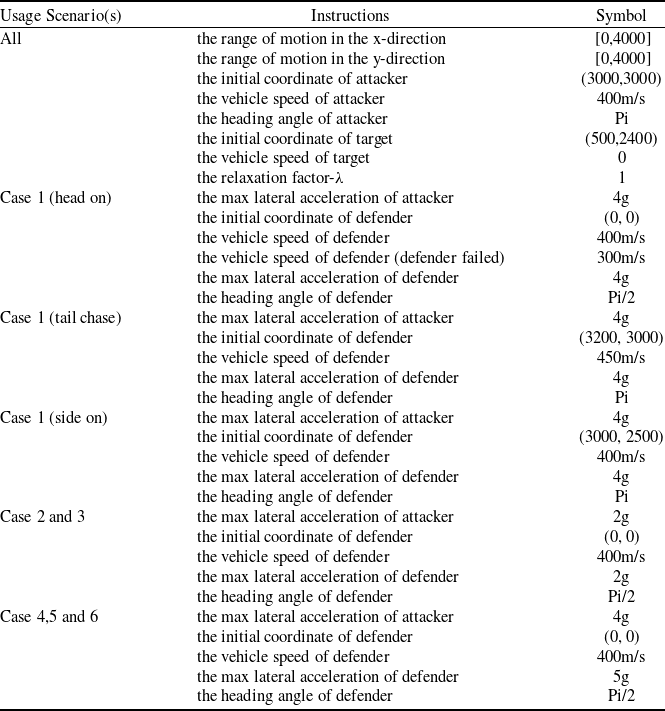
The simulation’s initial state parameters are presented in Table 1.
4.2 Training and exception elimination
To create a training dataset, one m sets of input and output data were randomly generated. After three m training iterations, a back propagation (BP) neural network model was obtained. Multiple sets of simulation results are obtained by applying the trained neural network model and combining with the anomaly elimination technique of Holt linear trend model described in Section 3.3.
-
(1) To intuitively demonstrate the computational efficiency advantage of the BP neural network method over the PSO algorithm, we randomly generated 1,000 sets of basic state parameters within the bounds defined in Table 1. For each method, the average computation time and its variance were recorded. As summarised in Table 2, the results show that the BP neural network achieves approximately a 12-fold improvement in computational speed compared to the PSO algorithm, while also exhibiting significantly greater stability.
4.3 The predictive impact of the DP-NNDG guidance law
-
(1) The DP-NNDG trajectory in four scenarios
Based on the initial state parameters specified in Case 1 of Table 1, the DP-NNDG guidance law is applied to generate trajectories corresponding to four defensive outcomes: head-on interception, head-on (defender failed), tail chase and side-on engagement, as illustrated in Fig. 3.
-
(2) The DP-NNDG in an ideal condition
Case 1: Trajectory simulation results under four different scenarios. (a) is head on(attacker failed), (b) is also head on (defender failed), (c) is tail chase and (d) is side on.

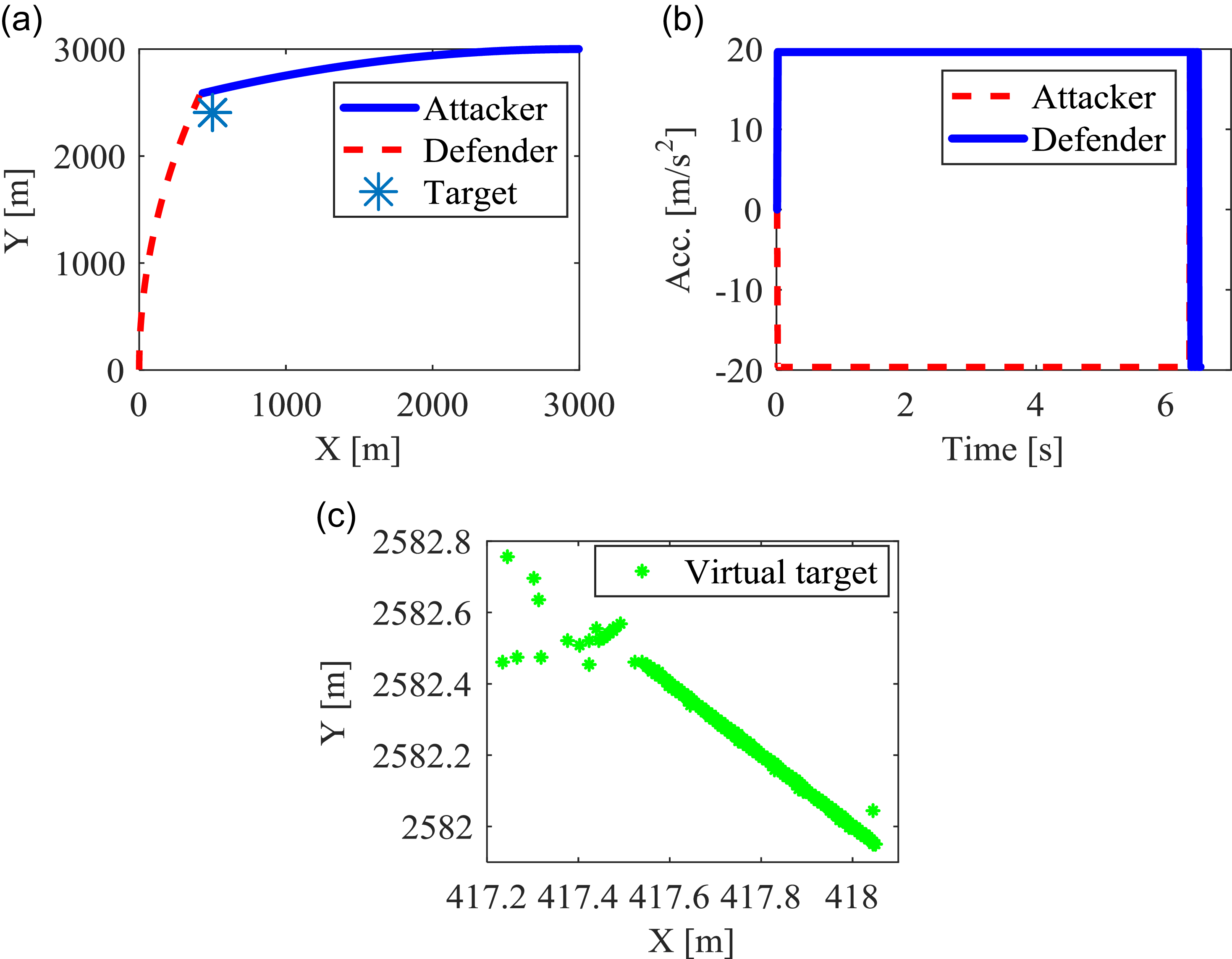
Assuming both the attacker and the defender have identical maximum accelerations (2g), and employ DP-NNDG as the guidance law in TAD three-body game, the simulation results are depicted in Fig. 3. On one hand, throughout this game scenario, as both the attacker and defender adhere to the DP-NNDG guidance law, their flight trajectories generally align with the initial predictive outcomes, with no significant deviations observed during the intermediate stages. On the other hand, the predicted outcomes of the virtual targets during the game process are derived from DP-NNDG, theoretically ensuring consistent virtual target results. Therefore, the distribution of virtual targets reflects the predictive accuracy of DP-NNDG under these conditions.
Remark 1. While the DP-NNDG method demonstrates empirical robustness in simulations, formal stability guarantees for the neural network training process remain an open challenge.
The virtual targets obtained by DP-NNDG are concentrated within a 1 cubic meter range (c). From an engineering perspective, such prediction accuracy is already sufficient.
However, as observed in Fig. 4(c), the distribution of virtual targets exhibits an approximately linear pattern except for divergence at the endpoints. This phenomenon can be attributed to two primary factors: (1) the application of the DP-NNDG guidance law yields suboptimal control performance with tolerable deviations; (2) the discrete nature of individual flight trajectory simulations introduces cumulative errors, ultimately resulting in the behaviour demonstrated in Fig. 4(c).
-
(3) DP-NNDG considering a first-order autopilot
Case 2: Without considering the delay of the autopilot. Attacker: DP-NNDG (
 $a_A^{\max } = 2g$
); Defender: DP-NNDG (
 $a_D^{\max } = 2g$
). (a) is trajectory, (b) is acceleration and (c) is virtual target.

More practically speaking, a first-order autopilot is considered for both attacker and defender [Reference Nobahari and Nasrollahi41].
 \begin{align} {\dot a}_A & = - 1\big/{\mathop \tau \nolimits_A } + 1\big/\mathop\tau \nolimits_A \mathop u_A \nonumber\\{\dot a}_D & = - 1\big/ \mathop \tau \nolimits_D a_D + 1\big/\mathop \tau \nolimits_D \mathop u_D \end{align}
In this study,
 $\mathop \tau \nolimits_A $
and
 $\mathop \tau \nolimits_D $
represent the temporal coefficients for the attacker and defender respectively, while
 $\mathop u\nolimits_A $
and
 $\mathop u\nolimits_D $
denote the command inputs of the attacker’s and defender’s autonomous driving systems. It is assumed that both parties have the same maximum acceleration (2g) and employ DP-NNDG as the guidance law in the TAD three-body game, as depicted in Fig. 5. Due to the inertia of the autonomous driving systems, neither party can manoeuver according to the results predicted by the DP-NNDG method, leading to discrepancies between subsequent and preceding state predictions. Nevertheless, the predicted outcomes appear to exhibit temporal regularity, with the movement of virtual targets on the plane approximating a straight line (d). As the final state approaches, the magnitude of predictive variations gradually diminishes until they converge. This phenomenon arises because minor perturbations among the attacker, target and defender within a large spatial range can result in significant changes in terminal states, whereas the reverse is not easily achieved.
-
(4) Comparison of DP-NNDG and NDG Performance
Case 3: Considering the delay of the autopilot. Attacker: DP-NNDG (
 $a_A^{\max } = 2g$
); Defender: DP-NNDG (
 $a_D^{\max } = 2g$
). (a) is trajectory, (b) is acceleration, (c) is acceleration command and (d) is virtual target.

NDG transforms the three-body pursuit-evasion problem of TAD into two sets of chase-escape problems, AT and DA, for resolution, with the challenge lying in determining the attacker’s manoeuvering strategy. Currently, a widely adopted approach involves determining the attacker’s manoeuvering strategy through a weighted combination of two sets of coefficients. For Case 4 simulations: (1) both groups of pursuit and evasion coefficients for the attacker are assumed to be equal; (2) a first-order autopilot is considered for both attacker and defender; (3) the simulation results presented in Fig. 6 demonstrate a terminal miss distance of 95.89 meters between the attacker and target.
Case 4: Considering the delay of the autopilot. Attacker: NDG (
 $a_A^{\max } = 4g$
); Defender: NDG (
 $a_D^{\max } = 5g$
). (a) is trajectory, (b) is acceleration and (c) is acceleration command.

Case 5 adopts the attacker guidance strategy of DP-NNDG from Case 4 while keeping other conditions unchanged. Simulation results are shown in Fig. 7, indicating a terminal miss distance of 77.75 meters. Comparing Case 4 and Case 5, the implementation of DP-NNDG in Case 5 significantly reduces the attacker’s terminal miss distance by 18.14 meters. This demonstrates that DP-NNDG outperforms NDG notably in this scenario.
Case 5: Considering the delay of the autopilot. Attacker: DP-NNDG (
 $a_A^{\max } = 4g$
); Defender: NDG (
 $a_D^{\max } = 5g$
). (a) is trajectory, (b) is acceleration, (c) is acceleration command and (d) is virtual target.

In Case 6, based on Case 5, the guidance strategy of the defender was also set to DP-NNDG, with all other conditions remaining identical to Case 5. The simulation results, depicted in Fig. 8, show a terminal miss distance of 85.40 meters. Comparing Case 6 with Case 5, the adoption of DP-NNDG guidance strategy by the defender resulted in an increase of 7.65 meters in the attacker’s terminal miss distance. This indicates a clear performance advantage of DP-NNDG over NDG in this scenario.
5.0 Conclusions
In this paper, we analyse the Nash equilibrium states of TAD three-body game from a geometric perspective. The point on the equal time line that is closest to the target, derived from Dubins path, represents the virtual target point at the Nash equilibrium state. Therefore, the game problem is transformed into a non-convex, nonlinear optimisation problem with equality constraints. To solve this problem quickly, we improve the prediction results based on the training model of the BP neural network, using techniques such as the relaxation factor method and Holt linear trend model for individual exceptional outputs. We also improve the guidance law using the saturation function method to ensure smoother trajectories. It should be noted that the convergence of the BP neural network algorithm used cannot be theoretically proven as it is empirical in nature.
Case 6: Considering the delay of the autopilot. Attacker: DP-NNDG (
 $a_A^{\max } = 4g$
); Defender: DP-NNDG (
 $a_D^{\max } = 5g$
). (a) is trajectory, (b) is acceleration, (c) is acceleration command and (d) is virtual target.

The simulation results demonstrate that the proposed DP-NNDG method performs well in solving the optimisation problem presented in this paper. Although the predicted outcomes differ from the final results when considering models with autonomous driving system delays, the DP-NNDG guidance law still outperforms the traditional NDG guidance law under these conditions.
Furthermore, there are still some issues to be addressed and researched in the model and methods proposed in this paper. For example, for target with significant manoeuverability, as a common party with the defender, there are challenges in predicting their manoeuvering strategies and the Nash equilibrium state of the system. Additionally, incorporating target state information raises concerns about the prediction accuracy of the BP neural network. Furthermore, the lack of information on the opponent’s performance (velocity, acceleration) poses difficulties in fast prediction of the Nash equilibrium state.
Appendix A
-
1.
$ - \vartheta _i^{max} \le {\vartheta _i} \lt 0$
and
$0 \le {\vartheta _j} \le \vartheta _j^{max}$


 \begin{align*}{\psi _{ETL}}\left( {{\vartheta _i},{\vartheta _j}} \right) & = {\kern 1pt} \left\{ \begin{array}{l}\left[ \begin{array}{l}{r_i}{\vartheta _i}\cos \left( {{\vartheta _i} - {\gamma _i}} \right) - {r_i}\sin \left( {{\vartheta _i} - {\gamma _i}} \right)\\[3pt] - {r_i}\sin {\gamma _i} + {x_{i0}}\end{array} \right]\cos \left( {{\vartheta _j} - {\gamma _j}} \right){v_j}\\[15pt] + \left[ \begin{array}{l}{r_j}{\vartheta _j}\cos \left( {{\vartheta _j} - {\gamma _j}} \right) - {r_j}\sin \left( {{\vartheta _j} - {\gamma _j}} \right)\\[3pt] - {r_j}\sin {\gamma _j} - {x_{j0}}\end{array} \right]\cos \left( {{\vartheta _i} - {\gamma _i}} \right){v_i}\end{array} \right\}\sin \left( {{\vartheta _j} - {\gamma _j} - {\vartheta _i} + {\gamma _i}} \right)\\[10pt] & \begin{array}{c} - \left\{ \begin{array}{l}\left[ \begin{array}{l}{r_j}\cos \left( {{\vartheta _j} - {\gamma _j}} \right) + {r_i}\cos \left( {{\vartheta _i} - {\gamma _i}} \right)\\[3pt] - {r_j}\cos {\gamma _j} - {r_i}\cos {\gamma _i} + {y_{j0}} - {y_{i0}}\end{array} \right]\\[15pt] + \tan \left( {{\vartheta _j} - {\gamma _j}} \right)\left[ {\left( \begin{array}{l}{r_j}\sin \left( {{\vartheta _j} - {\gamma _j}} \right)\\[3pt] + {r_j}\sin {\gamma _j} + {x_{j0}}\end{array} \right)} \right]\\[15pt] + \tan \left( {{\vartheta _i} - {\gamma _i}} \right)\left[ \begin{array}{l}{r_i}\sin \left( {{\vartheta _i} - {\gamma _i}} \right)\\[3pt] + {r_i}\sin {\gamma _i} - {x_{i0}}\end{array} \right]\end{array} \right\}\left[ \begin{array}{l}\cos \left( {{\vartheta _j} - {\gamma _j}} \right){v_j}\\[3pt] - \cos \left( {{\vartheta _i} - {\gamma _i}} \right){v_i}\end{array} \right]\cos \left( {{\vartheta _j} - {\gamma _j}} \right)\cos \left( {{\vartheta _i} - {\gamma _i}} \right)\end{array}\\[3pt] \end{align*}
 \begin{align*} {x_{ETL}} & = \left\{ \begin{array}{l}\left[ \begin{array}{l}{r_j}\cos \left( {{\vartheta _j} - {\gamma _j}} \right) + {r_i}\cos \left( {{\vartheta _i} - {\gamma _i}} \right)\\[3pt] - {r_j}\cos {\gamma _j} - {r_i}\cos {\gamma _i} + {y_{j0}} - {y_{i0}}\end{array} \right]\\[15pt] + \tan \left( {{\vartheta _j} - {\gamma _j}} \right)\left[ {\left( \begin{array}{l}{r_j}\sin \left( {{\vartheta _j} - {\gamma _j}} \right)\\[3pt] + {r_j}\sin {\gamma _j} + {x_{j0}}\end{array} \right)} \right]\\[15pt] + \tan \left( {{\vartheta _i} - {\gamma _i}} \right)\left[ \begin{array}{l}{r_i}\sin \left( {{\vartheta _i} - {\gamma _i}} \right)\\[3pt] + {r_i}\sin {\gamma _i} - {x_{i0}}\end{array} \right]\end{array} \right\}/\left[ \begin{array}{l}\tan \left( {{\vartheta _j} - {\gamma _j}} \right)\\[3pt] - \tan \left( {{\vartheta _i} - {\gamma _i}} \right)\end{array} \right]\\[10pt] {y_{ETL}} &= \left\{ \begin{array}{l}\left[ \begin{array}{l}{r_j}{\vartheta _j}\sin \left( {{\vartheta _j} - {\gamma _j}} \right) + {r_j}\cos \left( {{\vartheta _j} - {\gamma _j}} \right)\\[5pt] - {r_j}\cos {\gamma _j} + {y_{j0}}\end{array} \right]\sin \left( {{\vartheta _i} - {\gamma _i}} \right){v_i}\\[20pt] + \left[ \begin{array}{l}{r_i}{\vartheta _i}\sin \left( {{\vartheta _i} - {\gamma _i}} \right) + {r_i}\cos \left( {{\vartheta _i} - {\gamma _i}} \right)\\[5pt] - {r_i}\cos {\gamma _i} - {y_{i0}}\end{array} \right]\sin \left( {{\vartheta _j} - {\gamma _j}} \right){v_j}\end{array} \right\}/\left[ \begin{array}{l}\sin \left( {{\vartheta _i} - {\gamma _i}} \right){v_i}\\[5pt] - \sin \left( {{\vartheta _j} - {\gamma _j}} \right){v_j}\end{array} \right]\end{align*}
-
2.
$ - \vartheta _i^{max} \le {\vartheta _i} \lt 0$
and
$ - \vartheta _j^{max} \le {\vartheta _j} \lt 0$


 \begin{align*}{\psi _{ETL}}\left( {{\vartheta _i},{\vartheta _j}} \right) &= \left\{ \begin{array}{l}\left[ \begin{array}{l}{r_j}\cos \left( {{\vartheta _j} - {\gamma _j}} \right)\\[4pt] - {r_j}\cos \left( {{\gamma _j}} \right) - y_j^0\end{array} \right]\sin \left( {{\vartheta _i} - {\gamma _i}} \right){v_i}\\[15pt] - \left[ \begin{array}{l}{r_i}\cos \left( {{\vartheta _i} - {\gamma _i}} \right)\\[4pt] - {r_i}\cos {\gamma _i} - y_i^0\end{array} \right]\sin \left( {{\vartheta _j} - {\gamma _j}} \right){v_j}\\[15pt] - {r_j}{\vartheta _j}\sin \left( {{\vartheta _i} - {\gamma _i}} \right)\sin \left( {{\vartheta _j} - {\gamma _j}} \right){v_i}\\[5pt] + {r_i}{\vartheta _i}\sin \left( {{\vartheta _j} - {\gamma _j}} \right)\sin \left( {{\vartheta _i} - {\gamma _i}} \right){v_j}\end{array} \right\}/\left[ \begin{array}{l}\sin \left( {{\vartheta _j} - {\gamma _j}} \right){v_j}\\[4pt] - \sin \left( {{\vartheta _i} - {\gamma _i}} \right){v_i}\end{array} \right]\\[10pt] &- \left\{ \begin{array}{l}\left\{ \begin{array}{l}\left[ \begin{array}{l}{r_j}\cos \left( {{\vartheta _j} - {\gamma _j}} \right)\\[4pt] - {r_j}\cos \left( {{\gamma _j}} \right) - y_j^0\end{array} \right]\cos ({\vartheta _j} - {\gamma _j})\\[18pt] - \left[ \begin{array}{l}{r_j}\sin ({\vartheta _j} - {\gamma _j})\\[4pt] + {r_j}\sin {\gamma _j} - x_j^0\end{array} \right]\sin \left( {{\vartheta _j} - {\gamma _j}} \right)\end{array} \right\}\sin \left( {{\vartheta _i} - {\gamma _i}} \right)\\[40pt] - \left\{ \begin{array}{l}\left[ \begin{array}{l}{r_i}\cos \left( {{\vartheta _i} - {\gamma _i}} \right)\\[4pt] - {r_i}\cos {\gamma _i} - y_i^0\end{array} \right]\cos ({\vartheta _i} - {\gamma _i})\\[18pt] - \left[ \begin{array}{l}{r_i}\sin ({\vartheta _i} - {\gamma _i})\\[4pt] + {r_i}\sin {\gamma _i} - x_i^0\end{array} \right]\sin \left( {{\vartheta _i} - {\gamma _i}} \right)\end{array} \right\}\sin \left( {{\vartheta _j} - {\gamma _j}} \right)\end{array} \right\}/\sin \left( {{\vartheta _j} - {\gamma _j} - {\vartheta _i} + {\gamma _i}} \right) \end{align*}
 \begin{align*}{x_{ETL}} = \left\{ \begin{array}{l}\left[ \begin{array}{l}{r_j}\sin \left( {{\vartheta _j} - {\gamma _j}} \right)\\[4pt] + {r_j}\sin {\gamma _j} - x_j^0\end{array} \right]\cos ({\vartheta _i} - {\gamma _i}){v_i}\\[15pt] - \left[ \begin{array}{l}{r_i}\sin ({\vartheta _i} - {\gamma _i})\\[4pt] + {r_i}\sin {\gamma _i} - x_i^0\end{array} \right]\cos ({\vartheta _j} - {\gamma _j}){v_j}\\[15pt] - {r_j}{\vartheta _j}{v_i}\cos ({\vartheta _j} - {\gamma _j})\cos ({\vartheta _i} - {\gamma _i})\\[5pt] + {r_i}{\vartheta _i}{v_j}\cos ({\vartheta _j} - {\gamma _j})\cos ({\vartheta _i} - {\gamma _i}){v_j}\end{array} \right\}/\left[ \begin{array}{l}\cos ({\vartheta _j} - {\gamma _j}){v_j}\\[4pt] - \cos ({\vartheta _i} - {\gamma _i}){v_i}\end{array} \right]\end{align*}
 \begin{align*}{y_{ETL}} = \left\{ \begin{array}{l}\left[ \begin{array}{l}{r_j}\cos \left( {{\vartheta _j} - {\gamma _j}} \right)\\[4pt] - {r_j}\cos {\gamma _j} - y_j^0\end{array} \right]\sin \left( {{\vartheta _i} - {\gamma _i}} \right){v_i}\\[15pt] - \left[ \begin{array}{l}{r_i}\cos \left( {{\vartheta _i} - {\gamma _i}} \right)\\[4pt] - {r_i}\cos {\gamma _i} - y_i^0\end{array} \right]\sin \left( {{\vartheta _j} - {\gamma _j}} \right){v_j}\\[10pt] - {r_j}{\vartheta _j}\sin \left( {{\vartheta _i} - {\gamma _i}} \right)\sin \left( {{\vartheta _j} - {\gamma _j}} \right){v_i}\\[5pt] + {r_i}{\vartheta _i}\sin \left( {{\vartheta _j} - {\gamma _j}} \right)\sin \left( {{\vartheta _i} - {\gamma _i}} \right){v_j}\end{array} \right\}/\left[ \begin{array}{l}\sin \left( {{\vartheta _j} - {\gamma _j}} \right){v_j}\\[4pt] - \sin \left( {{\vartheta _i} - {\gamma _i}} \right){v_i}\end{array} \right]\end{align*}
-
3.
$0 \le {\vartheta _i} \le \vartheta _i^{\max }$
and
$ - \vartheta _j^{\max } \le {\vartheta _j} \lt 0$


 \begin{align*}\begin{array}{c}{\psi _{ETL}}\left( {{\vartheta _i},{\vartheta _j}} \right) = \left\{ \begin{array}{l}\left[ \begin{array}{l}{r_j}{\vartheta _j}\cos \left( {{\vartheta _j} - {\gamma _j}} \right) - {r_j}\sin \left( {{\vartheta _j} - {\gamma _j}} \right)\\[4pt] - {r_j}\sin {\gamma _j} + {x_{j0}}\end{array} \right]\cos \left( {{\vartheta _i} - {\gamma _i}} \right){v_i}\\[15pt] + \left[ \begin{array}{l}{r_i}{\vartheta _i}\cos \left( {{\vartheta _i} - {\gamma _i}} \right) - {r_i}\sin \left( {{\vartheta _i} - {\gamma _i}} \right)\\[4pt] - {r_i}\sin {\gamma _i} - {x_{i0}}\end{array} \right]\cos \left( {{\vartheta _j} - {\gamma _j}} \right){v_j}\end{array} \right\}\sin \left( {{\vartheta _i} - {\gamma _i} - {\vartheta _j} + {\gamma _j}} \right)\\[40pt] - \left\{ \begin{array}{l}\left[ \begin{array}{l}{r_i}\cos \left( {{\vartheta _i} - {\gamma _i}} \right) + {r_j}\cos \left( {{\vartheta _j} - {\gamma _j}} \right)\\[4pt] - {r_i}\cos {\gamma _i} - {r_j}\cos {\gamma _j} + {y_{i0}} - {y_{j0}}\end{array} \right]\\[15pt] + \tan \left( {{\vartheta _i} - {\gamma _i}} \right)\left[ {\left( \begin{array}{l}{r_i}\sin \left( {{\vartheta _i} - {\gamma _i}} \right)\\[4pt] + {r_i}\sin {\gamma _i} + {x_{i0}}\end{array} \right)} \right]\\[15pt] + \tan \left( {{\vartheta _j} - {\gamma _j}} \right)\left[ \begin{array}{l}{r_j}\sin \left( {{\vartheta _j} - {\gamma _j}} \right)\\[4pt] + {r_j}\sin {\gamma _j} - {x_{j0}}\end{array} \right]\end{array} \right\}\left[ \begin{array}{l}\cos \left( {{\vartheta _i} - {\gamma _i}} \right){v_i}\\[4pt] - \cos \left( {{\vartheta _j} - {\gamma _j}} \right){v_j}\end{array} \right]\cos \left( {{\vartheta _i} - {\gamma _i}} \right)\cos \left( {{\vartheta _j} - {\gamma _j}} \right)\end{array}\end{align*}
 \begin{align*}{x_{ETL}} = \left\{ \begin{array}{l}\left[ \begin{array}{l}{r_i}\cos \left( {{\vartheta _i} - {\gamma _i}} \right) + {r_j}\cos \left( {{\vartheta _j} - {\gamma _j}} \right)\\[4pt] - {r_i}\cos {\gamma _i} - {r_j}\cos {\gamma _j} + {y_{i0}} - {y_{j0}}\end{array} \right]\\[15pt] + \tan \left( {{\vartheta _i} - {\gamma _i}} \right)\left[ \begin{array}{l}{r_i}\sin \left( {{\vartheta _i} - {\gamma _i}} \right)\\[4pt] + {r_i}\sin {\gamma _i} + {x_{i0}}\end{array} \right]\\[15pt] + \tan \left( {{\vartheta _j} - {\gamma _j}} \right)\left[ \begin{array}{l}{r_j}\sin \left( {{\vartheta _j} - {\gamma _j}} \right)\\[4pt] + {r_j}\sin {\gamma _j} - {x_{j0}}\end{array} \right]\end{array} \right\}/\left[ \begin{array}{l}\tan \left( {{\vartheta _i} - {\gamma _i}} \right)\\[4pt] - \tan \left( {{\vartheta _j} - {\gamma _j}} \right)\end{array} \right]\end{align*}
 \begin{align*}{y_{ETL}} = \left\{ \begin{array}{l}\left[ \begin{array}{l}{r_i}{\vartheta _i}\sin \left( {{\vartheta _i} - {\gamma _i}} \right) + {r_i}\cos \left( {{\vartheta _i} - {\gamma _i}} \right)\\[4pt] - {r_i}\cos {\gamma _i} + {y_{i0}}\end{array} \right]\sin \left( {{\vartheta _j} - {\gamma _j}} \right){v_j}\\[15pt] + \left[ \begin{array}{l}{r_j}{\vartheta _j}\sin \left( {{\vartheta _j} - {\gamma _j}} \right) + {r_j}\cos \left( {{\vartheta _j} - {\gamma _j}} \right)\\[4pt] - {r_j}\cos {\gamma _j} - {y_{j0}}\end{array} \right]\sin \left( {{\vartheta _i} - {\gamma _i}} \right){v_i}\end{array} \right\}/\left[ \begin{array}{l}\sin \left( {{\vartheta _j} - {\gamma _j}} \right){v_j}\\[4pt] - \sin \left( {{\vartheta _i} - {\gamma _i}} \right){v_i}\end{array} \right]\end{align*}
-
4.
$0 \le {\vartheta _i} \le \vartheta _i^{max}$
and
$0 \le {\vartheta _j} \le \vartheta _j^{max}$


 \begin{align*}{\psi _{ETL}}\left( {{\vartheta _i},{\vartheta _j}} \right) = \left\{ \begin{array}{l}\left\{ \begin{array}{l}\left[ \begin{array}{l}{r_i}\sin ({\vartheta _i} - {\gamma _i})\\[4pt] - {r_i}\sin {\gamma _i} - x_i^0\end{array} \right]\cos ({\vartheta _j} - {\gamma _j})\\[15pt] + {r_i}{\vartheta _i}\cos ({\vartheta _j} - {\gamma _j})\cos ({\vartheta _i} - {\gamma _i})\end{array} \right\}{v_j}\\[30pt] - \left\{ \begin{array}{l}\left[ \begin{array}{l}{r_j}\sin ({\vartheta _j} - {\gamma _j})\\[4pt] - {r_j}\sin \left( {{\gamma _j}} \right) - x_j^0\end{array} \right]\cos ({\vartheta _i} - {\gamma _i})\\[15pt] + {r_j}{\vartheta _j}\cos ({\vartheta _j} - {\gamma _j})\cos ({\vartheta _i} - {\gamma _i})\end{array} \right\}{v_i}\end{array} \right\}/\left[ \begin{array}{l}\cos ({\vartheta _j} - {\gamma _j}){v_j}\\[4pt] - \cos ({\vartheta _i} - {\gamma _i}){v_i}\end{array} \right]\end{align*}
 \begin{align*}{x_{ETL}} = \left\{ \begin{array}{l}\left\{ \begin{array}{l}\left[ \begin{array}{l}{r_i}\sin ({\vartheta _i} - {\gamma _i})\\[4pt] - {r_i}\sin {\gamma _i} - x_i^0\end{array} \right]\cos ({\vartheta _j} - {\gamma _j})\\[15pt] + {r_i}{\vartheta _i}\cos ({\vartheta _j} - {\gamma _j})\cos ({\vartheta _i} - {\gamma _i})\end{array} \right\}{v_j}\\[30pt] - \left\{ \begin{array}{l}\left[ \begin{array}{l}{r_j}\sin ({\vartheta _j} - {\gamma _j})\\[4pt] - {r_j}\sin {\gamma _j} - x_j^0\end{array} \right]\cos ({\vartheta _i} - {\gamma _i})\\[15pt] + {r_j}{\vartheta _j}\cos ({\vartheta _j} - {\gamma _j})\cos ({\vartheta _i} - {\gamma _i})\end{array} \right\}{v_i}\end{array} \right\}/\left[ \begin{array}{l}\cos ({\vartheta _j} - {\gamma _j}){v_j}\\[4pt] - \cos ({\vartheta _i} - {\gamma _i}){v_i}\end{array} \right]\end{align*}
 \begin{align*}{y_{ETL}} & = \left\{ \begin{array}{l}\left[ \begin{array}{l}{r_i}\cos \left( {{\vartheta _i} - {\gamma _i}} \right)\\[4pt] + {r_i}\cos \left( {{\gamma _i}} \right) - y_i^0\end{array} \right]\cos ({\vartheta _i} - {\gamma _i})\sin \left( {{\vartheta _j} - {\gamma _j}} \right)\\[15pt] + \left[ \begin{array}{l}{r_i}\sin ({\vartheta _i} - {\gamma _i}) - {r_i}\sin {\gamma _i}\\[4pt] - {r_j}\sin {\gamma _j} + {r_j}\sin ({\vartheta _j} - {\gamma _j})\\[4pt] - x_j^0 - x_i^0\end{array} \right]\sin \left( {{\vartheta _j} - {\gamma _j}} \right)\sin \left( {{\vartheta _i} - {\gamma _i}} \right)\\[20pt] - \left[ \begin{array}{l}{r_j}\cos \left( {{\vartheta _j} - {\gamma _j}} \right)\\[4pt] + {r_j}\cos {\gamma _j} - y_j^0\end{array} \right]\cos ({\vartheta _j} - {\gamma _j})\sin \left( {{\vartheta _i} - {\gamma _i}} \right)\end{array} \right\}/\\[4pt] & \qquad \left[ {\cos ({\vartheta _i} - {\gamma _i})\sin \left( {{\vartheta _j} - {\gamma _j} - {\vartheta _i} + {\gamma _i}} \right)} \right]\end{align*}