I. INTRODUCTION
Iijima,Reference Iijima1 a Japanese scientist discovered new carbon structures; namely, carbon nanotubes (CNTs), which are made of either single- or multilayered graphite chip coils. The C–C covalent bonds in the CNTs are the most stable chemical bonds in nature. As a result, CNTs have high strength, great toughness, high thermal stability, low density, and are resistant to strong acid and alkali.Reference Baughman, Zakhidov and de Heer2, Reference Milne, Teo, Amaratunga, Legagneux, Gangloff, Schnell, Semet, Thien and Groening3 Furthermore, because a large number of unpaired electrons move along the wall, CNTs have both metallic conductivity and semiconductor properties.Reference Ericson, Fan, Peng, Davis, Zhou, Sulpizio, Wang, Booker, Vavro, Guthy, Parra-Vasquez, Kim, Ramesh, Saini, Kittrell, Lavin, Schmidt, Adams, Billups, Pasquali, Hwang, Hauge, Fischer and Smalley4
Research on the preparation and properties of CNTs as well as their applications in various fields has become an important subject, and has made remarkable progress. Several techniques such as the arc discharge, laser ablation, and chemical vapor deposition (CVD) have been used in the production of CNTs.Reference Mi, Lin, Mao, Li and Zhang5, Reference Wei, Li and Ju6 However, only the CVD technique has gained significant recognition and application because of its easy operation and the possibility of continuous production of CNTs depending on the carbon source.Reference Qiu, Li, Wang, Sun and Zhang7–Reference Iyuke, Mamvura, Liu, Sibanda, Meyyappan and Varadan9 Various modes of the CVD technique that exist include the microwave CVD, horizontal fixed bed catalytic CVD, and the rotary tube. Recently, we introduced the swirled floating catalyst chemical vapor deposition (SFCCVD) mode,Reference Iyuke, Mamvura, Liu, Sibanda, Meyyappan and Varadan9 which was more successful than the microwave or the fixed bed catalytic CVD modes, as can be seen in Table I.Reference Iyuke, Mamvura, Liu, Sibanda, Meyyappan and Varadan9–Reference Varadan and Xie13 In our previous studies with the SFCCVD mode, our carbon source was acetylene gas,Reference Afolabi, Abdulkareem, Iyuke and van Zyl Pienaar14 however, currently there are very dearth reports on the use of other carbon sources with this mode of CVD reactor. The search for new alternative carbon sources are being explored daily to meet the increasing demand of CNTs as a result of their versatile applications and to optimize the cost. The current SFCCVD is one of the reactors that can be optimized with various carbon sources to produce CNTs. Therefore, this work discusses the production of multiwalled carbon nanotubes (MWCNTs) from xylene using the SFCCVD mode.
Comparison of the quantity of MWCNTs produced from different techniques and carbon sources.Reference Iyuke, Mamvura, Liu, Sibanda, Meyyappan and Varadan9–Reference Varadan and Xie13

II. MATERIALS AND METHOD
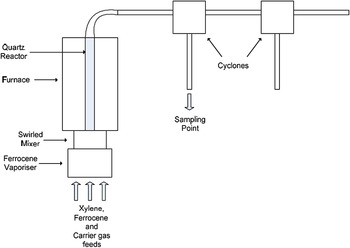
The paraphernalia in Fig. 1 illustrates the setup of the SFCCVD. It is made of a vertical silica plug flow reactor inside a furnace. Gases flow into the reactor with the aid of a system of valves and rotameters through a swirled coiled mixer, which leads the catalyst from the vaporizer to the reactor. The upper part of the reactor is connected to a condenser, which leads to two delivery cyclones where the CNTs are collected.Reference Iyuke, Mamvura, Liu, Sibanda, Meyyappan and Varadan9, Reference Afolabi, Abdulkareem, Iyuke and van Zyl Pienaar14 At the beginning, the reactor was vented consecutively with nitrogen and argon for 10 min each, while keeping all the other valves closed, to flush out contaminants and to ensure that there were no leakages. The temperature of the vaporizer was set at 350 °C to vaporize the xylene-ferrocene mixture above their boiling points. Feed materials and carrier gases were supplied to a vaporizer after which the vaporized feed materials were uniformly blended with the aid of a swirled coiled mixer to give optimum catalyst-carbon source interaction. Prior to the commencement of the experiment, it was necessary to obtain the starting conditions for CNT production; hence, a number of trial runs were carried out. Lower temperatures were first considered in the reactor with varying carrier gas flow rate. At the lowest temperature (850 °C) at which CNT growth was noticed, the carrier gas (argon) flow rate was optimized to observe the effect of carrier gas flow rate on CNT growth (Fig. 4). The optimum carrier gas flow rate was found to be 634 mL/min. This flow rate was used throughout this work. In this study, xylene was used as the solvent for the catalyst and also acted as the main carbon source. Xylene and ferrocene were mixed prior to injection and the concentration of ferrocene used was 0.01 g per mL of xylene.Reference Li, Zhang, Ci, Shah, Wolfe, Kar, Talapatra and Ajayan15The reactor temperature ranged from 800 to 1200 °C. In every run, 50-mL xylene gas was used together with a xylene/ferrocene mixture injected into the reactor by means of a burette. To investigate the effect of adding hydrogen (H2) to the carrier gas feed, H2 was added to argon (Ar) in the ratio of 1:7 at 950 °C. The crude pristine MWCNTs produced were purified by treating them with 30% HNO3 by gentle vortexing for 2½ h. The products were filtered, washed repeatedly with distilled water until a pH of 7 was reached, and were dried at 80 °C in a hot air oven overnight. The dried samples were then analyzed using transmission electron microscopy (TEM) and Raman spectra.

III. RESULTS AND DISCUSSIONS
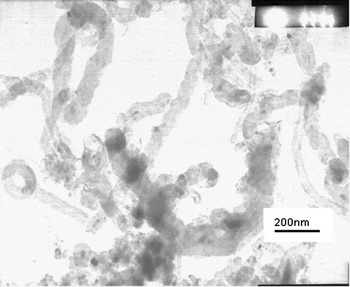
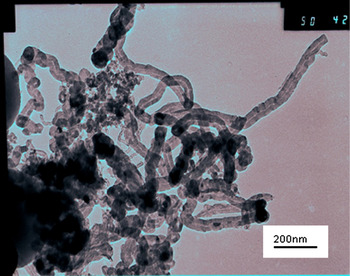
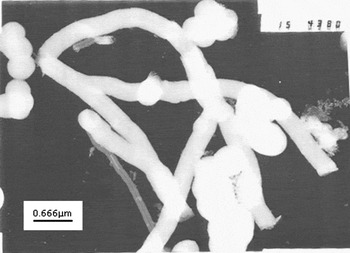
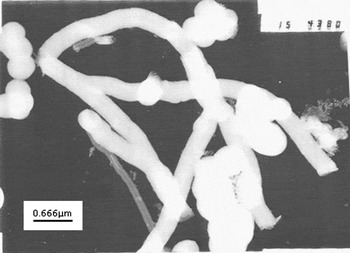
The production of nanotubes in an SFCCVD reactor depends on the reaction conditions such as temperature, pressure, catalyst levels, reactant concentrations, and morphology. These reaction conditions can vary throughout the reactor.Reference Sinnott, Andrews, Qian, Rao, Mao, Dickey and Derbyshire16Table II depicts the effects of temperature on the amount of MWCNTs produced in our study. It was found that an increase in temperature increased the amount of CNTs produced. Although at 800 °C there were no CNTs produced (other than amorphous carbon), a very small amount of CNT was produced at 850 °C. This is because at low temperatures (i.e., <850 °C), the diffusion rates of iron and carbon were low, preventing the MWCNTs to nucleate and grow from the iron particles, but resulted in the formation of amorphous carbon,Reference Kunadian, Andrews, Mengüç and Qian17 as shown in Fig. 2. This implies that below 850 °C, the production of MWCNTs from xylene/ferrocene mixture is unfavorable. At 850 °C, deposited materials were becoming more pronounced in the formation of MWCNTs, as shown in Fig. 3. The furnace temperature at 950 °C produced well-aligned MWCNTs, as depicted in Fig. 4. This is because at 950 °C, the carbon clusters and iron catalyst clusters resulted in high surface diffusion rates. In fact, between 900 and 1000 °C, the MWCNTs were observed in both the reactor and reactor exhaust. This is caused by the increase in growth rate of CNTs with increase in temperature.Reference Kim, Kim, Jung, Bae, Park, Choi and Choo18 However, above 1000 °C there was also a decrease in the amount of CNTs produced as a result of short reaction time caused by the deactivation of catalyst sites, which occurs at a high temperature.Reference Yu, Chen, Totdalb, Zhao, Dai, Yuan and Holmen19 Furthermore, the present findings showed that between 900 and 1000 °C, with an optimal production at 950 °C (Table II), MWCNTs were well aligned. This differs from earlier reports by Jacques and coworkersReference Jacques, Villain, Rao, Andrews, Derbyshire, Dickey and Qian20 where they also described the production of MWCNTs at 725–775 °C, with an optimal production at 725 °C. Their product had more nanoball-like (100 nm long) structures at 750 °C. Our results were similar to those previously reported by Vivekchand et al.Reference Vivekchand, Cele, Deepak, Raju and Govindaraj21 where they produced MWCNTs from the mixture of xylene and ferrocene by pyrolysis at furnace temperature in the range of 800–1000 °C.
TEM images of amorphous carbon at 800 °C.

TEM images of MWCNTs at 850 °C reactor.

TEM images of MWCNT in reactor at 950 °C.
Effect of temperature on the amount of CNT formed.

This study differed from the earlier studies by Jacques et al.Reference Jacques, Villain, Rao, Andrews, Derbyshire, Dickey and Qian20 where they described an optimum production of MWCNTs from a catalytic decomposition of xylene/ferrocene mixture at 230 °C vaporization temperature. Temperatures below 230 °C had lower production rates, whereas temperatures above 230 °C generated more amorphous carbon. They argued that the effect of lower temperatures may be related to partial gasification of the feed stream and subsequently different flow characteristics due to the hydrogen/catalyst pairs. In our study, though we were using a high preheated temperature at 350 °C, the amorphous carbon (Fig. 2) was only obtained at a reaction temperature of 800 °C.
When the volume of the reactants (xylene and ferrocene) was doubled at a reactor temperature of 950 °C, more CNTs were produced as shown in Table II. This is because an increase in feed volume resulted in increased production of catalyst particles and carbon atoms that invariably increased the amount of CNT production. Table II also shows the influence of hydrogen on the amount of CNT produced. As can be seen from Table II, with the introduction of hydrogen as one of the carrier gases, the amount of CNTs produced increased in the reactor by more than twice the amount produced at double reactor volume feed. Kunadian et al.Reference Kunadian, Andrews, Mengüç and Qian17 also made a similar observation when they prepared MWCNTs from xylene using the fixed bed CVD mode. This is because hydrogen has a strong influence in the gas-phase decomposition rate of ferrocene, Eq. (1)

In the absence of hydrogen, ferrocene dissociation occurs only at 827–927 °C (i.e., 1100–1200 K) while its reduction occurs at temperatures as low as 400 °C (i.e., 673 K) in the presence of hydrogen, Kuwana and Saito.Reference Kuwana and Saito22 Furthermore, in the absence of hydrogen the deactivation of the catalyst occurs.Reference Yu, Chen, Totdalb, Zhao, Dai, Yuan and Holmen19
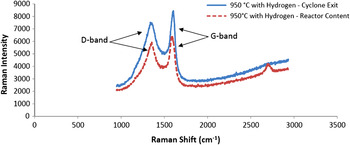
Raman spectra of CNTs produced (Fig. 5) showed similar intensities for both the dispersive disorder-induced D-band (1353.1 cm−1) and its second-order related harmonic G-band (1580.3 cm−1). This strongly supports the fact that MWCNTs were produced and were similar to intensities observed earlier by Afolabi et al.Reference Afolabi, Abdulkareem, Iyuke and van Zyl Pienaar14
Raman spectra for both the reactor exhaust and reactor contents at 950 °C hydrogen-to-argon ratio of 1:7.

In addition, it is interesting to note that differences existed when using a xylene/ferrocene mixture with different gaseous carbon sources. For example, acetylene produced no carbon materials at 850 °C despite the presence of hydrogen,Reference Afolabi, Abdulkareem, Iyuke and van Zyl Pienaar14 while xylene in this study produced small amounts of carbon nanomaterials even in the absence of hydrogen. Furthermore, above 1000 °C acetylene produced a mixture of diamond films and CNTs,Reference Afolabi, Abdulkareem, Iyuke and van Zyl Pienaar14 whereas in this study produced no diamond films.
IV. CONCLUSION
The production of CNTs from a mixture of xylene and ferrocene using the SFCCVD mode was successfully carried out. It was found that increasing the reactor temperature and the volume of the feed increased CNT production. The mixture of hydrogen and argon gases as carrier gases further increased the amount of CNT produced. Xylene/ferrocene mixture produced more MWCNTs at 950 °C with H:Ar (1:7) as the carrier gas. The results from this study show that the use of an SFCCVD with xylene-ferrocene mixture could serve as a good source for continuous and large-scale production of CNTs.
ACKNOWLEDGMENTS
The authors acknowledge the financial support from the National Research Foundation (NRF) focus areas (NRF Nanotechnology flagship program, and Department of Science and Technology (DST)/NRF Centre of Excellence). The student bursaries provided by the University of the Witwatersrand, Johannesburg are much appreciated.