Introduction
Nephrotic syndrome is one of the most common primary glomerular diseases in children. On the basis of its responsiveness to oral steroids, NS can be clinically classified as steroid-sensitive nephrotic syndrome (SSNS) and steroid-resistant nephrotic syndrome (SRNS). There is no satisfactory explanation as to why some nephrotic syndrome (NS) patients respond to steroids and others do not. Genetic factors have been involved in the response to steroid treatment, in addition to histopathology. Some studies have reported that polymorphism -173 G to C macrophage inhibitory factor (MIF) gene (rs755622) is associated with conferring susceptibility to the resistant steroid.Reference Berdeli, Mir and Ozkayin 1 , Reference Vivarelli, D’Urbano, Stringini, Ghiggeri and Caridi 2 These results emphasize screening of MIF genotype at disease onset to identify patients requiring more aggressive therapeutic approach.Reference Vivarelli, D’Urbano, Stringini, Ghiggeri and Caridi 2
A recent study indicated that the rarer allele MIF -173*C is associated with higher expression of MIF in vitro and increased serum MIF levels in vivo, but no information is available regarding increased serum MIF levels in SRNS patients based on the allele they have. The main source of MIF in renal cells is derived from the glomerulus, mainly podocyte and tubular epithelial cells. The role of MIF in triggering kidney damage occurs in two ways: first, by stimulating the formation of many inflammatory mediators (IL-1B, TNF-α, IL-6, nitric oxide, reactive oxygen species) and second by working toward a glucocorticoid antagonist. If the glucocorticoid effect does not work on kidney cells as a result of an increase in MIF, then kidney damage process will continue. It is characterized by persistant proteinuria, even after a full dose steroid therapy in NS patients.
Previous studies have described about an associated allele MIF -173*C with SRNSReference Berdeli, Mir and Ozkayin 1 , Reference Vivarelli, D’Urbano, Stringini, Ghiggeri and Caridi 2 ; nevertheless, various studies have not clearly explained whether the polymorphism -173 G to C MIF gene as a risk factor for individuals with SRNS is associated with increased levels of serum MIF. The aim of this study was to investigate the association between single nucleotide polymorphism of MIF gene -rs755622 and serum MIF concentrations in NS patients.
Methods
Study groups
This case–control study was conducted in three groups. We analyzed 120 children consecutively, consisting of three groups (steroid-resistant, steroid-sensitive and normal healthy children) between November 2011 and September 2012.
All individuals who participated in the study were recruited through the hospital and their urinary albumin creatinine ratios (UACR) were obtained to determine their proteinuria status. The control group was recruited from three municipality schools, where students underwent routine urinalysis screening. All the subjects, when recruited to the study, filled in a questionnaire concerning demographic data and medical history. Interviewees were asked the estimate average frequency of relapse in NS patients based on the medical records of the year preceding the interview.
Each hospital was selected based on having NS patients of a similar age range, similar vision and mission for managing NS and an appropriate system for transporting samples to the laboratory. The ‘well-child’ group was recruited from unrelated individuals, based on clustering, stratification and, finally, consecutive sampling. After the study subjects were identified, patient data were coded and labeled to anonymize study participants from the outset.
Steroid resistance was defined as a failure to achieve complete remission following 6–8 weeks of daily 60 mg/m2 steroid treatment or following 4 weeks of daily 60 mg/m2 steroid treatment and administration of three pulses of methylprednisolone at a dose of 1 g/1.73 m2 on alternate days, given over 6 h. On the basis of steroid responsiveness, patients were grouped into initial non-responders (primary steroid resistance) and late non-responders (secondary steroid resistance). 3
SSNS patients were defined as NS patients who went into remission after standard steroid treatment. Complete remission was defined as the absence of edema and a protein-to-creatinine ratio <200 µg/mg creatinine or proteinuria <3–5 mg/kg/24 h or based on reagent strip (Albustix) negative findings or trace findings for 3 consecutive days. Partial remission was defined as the absence of edema and a protein-to-creatinine ratio <330 µg/mg creatinine or proteinuria between 5 and 50 mg/kg/24 h. 3
Healthy children were defined those aged <18 years, with confirmed normal renal function [normal estimated glomerular filtration rate (eGFR)] and UACR values <150 µg/mg creatinine.
Subjects were included into the study if they were aged between 1 and 17 years, with normal renal function confirmed by the SchwartzReference Schwartz, Haycock, Edelmann and Spitzer 4 formula (eGFR variations according to age, sex and body proportion, based on National Kidney Foundation Kidney Disease Outcomes Quality Initiative guidelines,Reference Hogg, Furth and Lemley 5 follow-up period ⩾1 year), who did not have any systemic illness (such as lupus nephritis or Henoch schoenlein purpura nephritis) and with the appropriate parental informed consent. Patients and controls were excluded if they had proteinuria (transient, orthostatic or non-renal), were in an unstable clinical condition or were undergoing angiotensin-converting enzyme inhibitor or angiotensin receptor blocker drug treatment. The study protocol and the informed consent procedure were both approved by the Ethics Board, Medical Faculty and Sumatera Utara University, Indonesia.
Data collection
A well-trained doctor interviewed and enrolled the study subjects using a questionnaire/health examination to gather demographic and clinical data. The clinical records of SSNS and SRNS cases were reviewed. The study parameters included age, sex, body weight and height, spot UACR, serum MIF and genotype MIF -173 G to C polymorphism.
Determination of genotype MIF -173 G to C polymorphism
Genomic DNA was extracted and purified from peripheral blood using a Wizard® Genomic DNA Purification Kit (Promega). Genotype MIF -173 G to C polymorphism was determined by polymerase chain reaction restriction fragment length polymorphism (PCR-RFLP) method and enzymatic digestion with Alu I. PCR reactions were carried out in a final volume of 50 µl, which contained 100 ng of genomic DNA, 1× PCR buffer, 1.7 mM MgCl2, 0.2 mM dNTP, 0.2 µM primers and 1 U Taq DNA polymerase (Promega, USA), using the following thermal cycling conditions: at 95°C for 10', then 35 cycles of 95°C for 45'', 60°C for 45'', 72°C for 45'' and a final extension step at 72°C for 7'. The primers and annealing condition are shown in Table 1.
The primers and annealing conditions are as follows

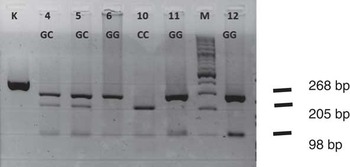
The digested PCR products were visualized in ethidium-bromide-stained 3% agarose gel using an ultraviolet camera (Fig. 1).
Determination of the rs755622 genotype by polymerase chain reaction amplification and restriction analysis. When the nucleotide G is present, an Alu I restriction site is created. Lane 6, 11, 12: homozygous GG (205 and 98 bp). Lane 4, 5: heterozygous GC (268, 205 and 98 bp). Lane 10: homozygous CC (205 bp). Lane M: DNA marker.

A total of 58 samples detected by the PCR-RFLP were also confirmed by direct sequencing on an ABI PRISM 3700 DNA analyzer. Genomic DNA extraction and PCR-RFLP were carried out in the medical laboratory of Sumatera Utara University and Jogjakarta, Indonesia. Cases and controls were interspersed throughout the batches to reduce the possibility of batch effects.
Determination of serum MIF concentrations
Serum MIF concentrations were measured using commercial enzyme-linked immunosorbent assay at an analytical sensitivity of 1 ng/ml. The intra-assay coefficient of variation (CV) was 5%, and the inter-assay CV was 7%. Proteinuria was expressed as the spot urine ratio of protein to creatinine. The study subjects and their parents visited the laboratory in the morning (between 08.00 and 10.00). Cases and controls were interspersed throughout the batches to reduce the possibility of batch effects. The samples were run randomly in duplicate. Intra-sample CV for the measurements of MIF level in serum was 0.9% and inter-sample measurements differed by 5%. All tests were performed according to standard protocols and established guidelines. 6 These serum MIF values were measured in Prodia Laboratory, Jakarta, Indonesia.
Statistical analysis
Descriptive analysis was performed as appropriate, and normally distributed variables were expressed as mean±s.d. The genotype frequencies for each polymorphism were tested for deviation from the Hardy–Weinberg equilibrium (HWE) using Fisher’s exact test and it was applied for the control group only.
Association of MIF genotypes with categorical variables representing steroid resistance and level of serum MIF was investigated using Fisher’s exact test. All the analyses were performed using the Statistical Package for Social Sciences for Windows (version 10.0). A P value <0.05 was considered to be significant.
Results
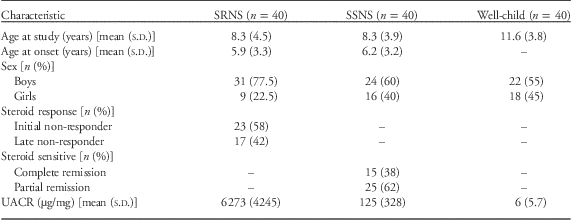
A total of 120 children were recruited, consisting of 40 SRNS, 40 SSNS and 40 well-child subjects. The clinical data of all study subjects are shown in Table 2. There were 77 boys and 43 girls, with a gender ratio of 1.8. The mean duration of follow-up was 2.4 years for SRNS and 2.1 years for SSNS. All the participants were Indonesians and there were no relatives among them.
Demographic characteristics and UACR level of the study subjects

UACR, urinary albumin creatinine ratio; SSNS, steroid-sensitive nephrotic syndrome; SRNS, steroid-resistant nephrotic syndrome.
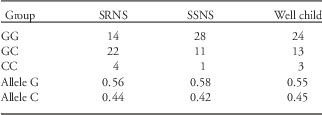
A total of 120 samples from the Indonesian population were obtained. The genotype frequencies did not deviate from the expected value by HWE. The frequencies of the -173 G/C genotype in patients and healthy subjects is shown in Table 3.
Frequencies of the -173 G/C genotype in patients and healthy subjects

SSNS, steroid-sensitive nephrotic syndrome; SRNS, steroid-resistant nephrotic syndrome.
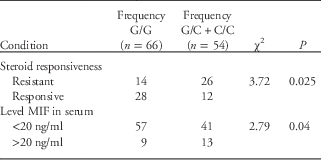
In order to study the association of -174 G to C polymorphism with clinical steroid resistance, we performed non-parametric analysis to evaluate the difference in the distribution of steroid resistance among genotypes. Owing to the low number of homozygous individuals for the C allele, the genotype was merged with heterozygous subjects for the categorical analysis. According to this dominant model (GG v. GC+CC), C homozygous subjects were affected more by steroid resistance compared with their C-carrier counterparts. In the present study, we observe a trend toward an association between genotypes and serum MIF disturbances (Table 4).
Frequency distribution of the MIF -174 G/C genotypes in different conditions according to a dominant model

Discussion
Numerous studies have been conducted to investigate polymorphism -173 in the MIF gene in NS patients.Reference Berdeli, Mir and Ozkayin 1 , Reference Vivarelli, D’Urbano, Stringini, Ghiggeri and Caridi 2 However, our study is the first time to examine the relationship between the frequencies of the -173 G to C polymorphism of the MIF gene and the levels of serum MIF. Polymorphism of the MIF gene has been related to an increase in cytokine concentrations. The cytokine macrophage MIF is an important component of the early proinflammatory response of the innate immune system. Consistent with an important role for MIF in human sepsis, functional polymorphisms in the MIF gene promoter have recently been shown to influence the susceptibility to the severity of and outcome of many infectious diseases.Reference Yende, Angus and Kong 7 , Reference Renner, Roger and Bochud 8 This condition influences individual response to steroids. Although the NS is not contagious, some patients can be superimposed with infectious diseases. In the present study, any NS patient with the real systemic illness had to be excluded. Nevertheless, the state of occult infection could not be denied.
The roles of genetic variation in individual susceptibility to disease and response to treatment have been described for a long time.Reference Shastry 9 Phosphorylated receptor glucocorticoids in podocytes interfere with the glucocorticoid receptor binding. Activation of the phosphorylated receptor glucocorticoid is regulated by proinflammatory cytokinesReference Che and Zhang 10 such as cytokine MIF.Reference Mathieson 11 The C allele is associated with the development of end-stage renal disease; therefore, MIF plays a role in disease progression.Reference Berdeli, Mir and Ozkayin 1 , Reference Vivarelli, D’Urbano, Stringini, Ghiggeri and Caridi 2 Early genotyping of the MIF -173 G to C polymorphism could guide in identifying a patient with steroid resistance, together with increasing serum MIF levels.
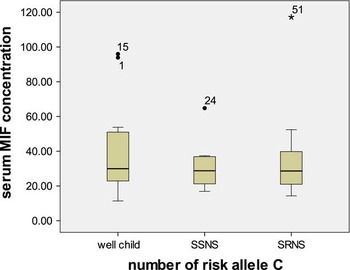
In the present study, although the levels of serum MIF analyzed were significantly higher in the SRNS group (Table 5), an association between C allele and increased levels of serum MIF has not been documented (Fig. 2). These may be associated with the sample size. In another study, in subjects with the C allele, higher concentrations of circulating MIF were noted, related with response to glucocorticoid drugs.Reference Donnely and Bucala 12 Cytokine MIF has proinflammatory, enzymatic and hormonal activities. This cytokine is induced by low concentrations of glucocorticoid and then acts to counter regulate the inflammatory action of glucocorticoid. MIF secretion is suppressed at higher glucocorticoid concentrations.Reference Petrovsky, Socha and Silva 13 This is central to determining chronicity, especially in SRNS patients.Reference Lan 14 These higher MIF levels will maintain hypothalamic–pituitary axis activation. Hence, these activities will reduce the number of glucocorticoid receptors in nuclear cells. Ultimately, although higher endogenous and exogenous corticosteroids are noted in circulation, glucocorticoid effects to reduce proteinuria are limited.Reference Van Rossum and Lamberts 15
Association between serum MIF concentration and number of risk allele C. SSNS, steroid-sensitive nephrotic syndrome; SRNS, steroid-resistant nephrotic syndrome.

Serum MIF levels among study groups

SSNS, steroid-sensitive nephrotic syndrome; SRNS, steroid-resistant nephrotic syndrome.
MIF has unique glucocorticoid counter-regulatory activity, suggesting a role for this cytokine in blunting the efficacy of steroid therapy.Reference Calandra and Roger 16 , Reference Rice, Tesch and Cao 17 Higher MIF concentrations obscure the effects of corticosteroid.Reference Donnely and Bucala 12 In addition to the factors highlighted in our study, higher MIF concentrations in circulation are related to steroid resistance. In the circulation, higher MIF concentrations influence the influx of macrophages into the vascular glomerular and interstitial endothelium. These findings were confirmed by the correlation between the influx of macrophages, albuminuria and renal function. An inflammatory process occurred, although eGFR was >90 ml/min/1.73 m2.Reference Murea, Register and Divers 18 Higher MIF levels from the circulation can result in systemic organ injury through proinflammatory effects.Reference Berdeli, Mir and Ozkayin 1 , Reference Vivarelli, D’Urbano, Stringini, Ghiggeri and Caridi 2 Although SRNS patients present heterogeneous histopathological findings, our data indicate a relationship between cytokine MIF concentration and corticosteroid sensitivity in NS.
To our knowledge, this is the first study reporting an association between serum MIF concentration and the risk of the SRNS, despite eGFR being >90 ml/min/1.73 m2. A concentration of systemic MIF, when found in pediatric subjects, can represent a clinical condition. The reduced MIF concentration in the steroid-resistant group strongly supports the introduction of a novel therapy, preventing or improving nephropathy (thus slowing progression to end-stage renal disease).
The findings of this study contribute to advance the understanding of the developmental origins of health and disease as described below. Functional polymorphism in the MIF gene determines the concentration of cytokines. Therefore, the resulting inflammatory response would continue so that the effect of unresponsiveness steroid therapy will occur. This genetic variation plays a role in individual susceptibility to disease and response to treatment. If the steroids work is limited, the steroid resistance is not only based on the histopathological effects but also on the genomic effects.
Our conclusion of a possible association between MIF genotype and level MIF in serum must be tempered by the methodological limitations of this exploratory study. When interpreting any genetic association study, several epidemiological limitations potentially leading to false-positive findings should be considered, including inadequate sample size, selection of control groups, multiple testing and population stratification. First, we did not evaluate a control population of racially/ethnically matched individuals who were admitted to the hospital. With regard to these concerns, the strengths of our study include a relatively small population of NS patients, but had a follow-up for >1 year that reduces the selection bias inherent in case–control studies. Second, our patient identification and selection prevented the inclusion of those with benign or progressive disease based on histopathology. As we are aware, there is a difference in the mechanism of SRNS due to genetic mutation and non-genetic forms.
In conclusion, this study noted elevated circulating serum MIF levels and higher frequency of -173 C allele of the MIF gene in SRNS patients. Taken together, the present data indicate that in the Indonesian population the presence of the G allele can confer a protective effect, whereas the presence of the C allele implies an increased risk for steroid resistance.
Acknowledgments
The authors thank Rusdidjas (Professor MD), Rafita (Professor MD), Dahler Bahrun (MD), Rosmayanti (MD), Muhammad Nur (MD), Afdal (MD), Syafruddin Harris (MD), Hertanti (MD), for collecting NS patients; Mardiah, Budi Lestari and all persons in Prodia for laboratory preparation.
Financial Support
This study was supported by the Hibah Bersaing Fund from the Ministry Education, Republic of Indonesia. Contract number: 1082/UN5.1.R/KEU/2014.
Conflicts of Interest
None.
Ethical Standards
Ethics committee Medical Faculty University of Sumatera Utara, Indonesia, approval of this research by the grant number: 275/KOMET/FK USU/2011.