After the American Revolution, domestic and international politics and culture followed many unexpected paths, and one of these was a vigorous traffic in agricultural and garden seed. Formal commercial trade in seed was limited. Instead, early American agronomists sought out plants that would fit in all of North America's climatic and geographical niches, growing them and sharing them with friends, while farmers usually collected seed from their own harvests to be planted during the next year.Footnote 1 During his trips abroad, Benjamin Franklin would send back varieties of turnips, cabbage, oats, barley, and beans. George Washington asked merchants overseas to send him “the best kind” of wheat, beans, barley, and oats, and as early as 1823 agricultural groups such as the South Carolina Agricultural Society asked the navy to collect seed that they could distribute to its members.Footnote 2 The national government officially began acquiring and distributing seed in 1836 when the Commissioner of Patents, Henry Leavitt Ellsworth, started collecting foreign varieties from American officials and then distributing them to farmers through congressmen and agricultural societies. He did this first without a budget, but in 1839 secured the first congressional appropriation for this work—one thousand dollars—an amount that was again allocated in 1842.
Over the next several decades, investment by the national government in collecting and disseminating seed became commonplace. Distribution also became a focal point for widespread popular and political disagreement over the country's developing vision for its national government, and in particular for the role of government in democracy. Controversy and tension dogged seed distribution as it grew throughout the 1840s and 1850s. By 1861 the Patent Office distributed more than two million packages of garden and flower seed.Footnote 3 The purpose of these distributions, as well as those by agricultural groups, quickly became muddled; sometimes the goal was to test and spread new seed, but often the plan was to replace seed that farmers were already using. For instance, the Wisconsin State Agricultural Society spent six hundred dollars in 1855 on “the purchase of a new, carefully selected wheat, Golden Drop, to replace the hopelessly dirty and mixed seed commonly sown.”Footnote 4 The uncertainty of purpose—whether it was to support farmers and their current methods or to foster change in seed and crops—increased when the United States Department of Agriculture, dubbed the People's Department by Abraham Lincoln, was formed in 1862 and took over Patent Office seed duties.Footnote 5
The USDA sent free seed to addresses provided by congressmen, a duty that took most of its time and resources. Seed and its distribution represented many of the concerns of American life—independence, assistance, industry, science, and politics—such that the question of free seed became part and parcel of Gilded Age and Progressive Era discourse. In particular, seed highlighted the contested role the national government played in the development of science, as well as in public programs, economic development, and forms of federal assistance. The varied interests and the ways in which these constituencies envisioned government and political economy in democracy—how government interacted with, and even “served,” or did not “serve,” the people—made free seed distribution a unique place of intersection for multiple governing priorities.
The limited scholarship on congressional seed distribution has unfortunately overlooked this broader perspective. Historians have focused either on the conflict between scientific and local knowledge in seed distribution or on the pandering that seems implicit in the process—thereby overlooking how essential these very tensions were to fleshing out competing visions of the role of government in democracy. According to historian Daniel Carpenter, congressional distribution was “the dominant federal agricultural program of the nineteenth century.”Footnote 6 It drew criticism—as a form of time-consuming graft—to match its size. Carpenter argues that, for most of its existence, “the seed distribution program was funding not scientific discovery but sustenance gardening and crop expansion.” In turn, Deborah Fitzgerald highlights political motives that made seed distribution “a way for Congressmen to enhance their images by appearing sympathetic to agricultural interests in their districts.”Footnote 7 A. Hunter Dupree offers a similar review, calling the distribution “that old scandal,” and saying that “no part of the government's scientific program had been so notorious for so long.”Footnote 8 Finally, Jack Kloppenburg argues that while the program started as an effort to improve the lives of farmers, over time it transformed into an “institutional impediment to the expansion of private enterprise in the seed business.”Footnote 9 While individually valid, each of these interpretations-cum-critiques only partially explains why congressional seed distribution persisted for so long, and why it found such strong support and opposition. Furthermore, the implication that it was graft alone also implies that the end of the program was the fairly simple result of Progressive Era reform. By contrast, in this article I argue that seed distribution reveals the competing visions of America and its democracy that permeated the Gilded Age and Progressive Era.
In particular, controversy over congressional seed distribution highlighted tensions over the place of government in political economy and science, in farms and gardens, in science and business. With the debates came seemingly black and white questions such as whether the government should give away seed. The answer depended, however, on disparate national visions of the future and of the role the government should play in American society. Spending on education, experiment, and distribution expanded to the point that the USDA dominated the federal budget while also becoming a more significant part of farmers’ lives. Francis Fukuyama has argued that in the 1910s the Department went from being “a seed-distribution agency to a forward-looking, science based organization.”Footnote 10 Here I argue that seed distribution was essential not only to that transformation in terms of science, but also to encapsulated controversies over the purpose of government in the United States.
Seed distribution magnified tensions and revealed different agendas for national political culture. Through seed distribution it is clear that government support of scientific commercial agriculture was by no means a foregone conclusion. In this sense, modern America was partially formed by and emerged from controversy over free seed and its place in governmental institutions.Footnote 11 Congressional seed distribution highlighted how the government related to science, bureaucracy, graft, tradition, dependence, reproduction, and independence. As commercial agriculture became more established, friction remained around whom the government was serving and whether small farmers, sharecroppers, or tenants could continue to succeed; and what role children and women could have in America's agricultural future and its relationship to larger government structures. These tensions emerged in different responses to the quality of seed from the government and industry. The seed industry and its congressional advocates criticized seed distribution most vocally, while individual farmers, gardeners, and their representatives tended to support free seed.
I argue that congressional seed distribution developed into a program that expressed two different goals—one, political connection with constituents; and the other, improvement of agriculture—but that these existed in a much broader political conversation about government, democracy, and the people, as well as a host of related cultural, scientific, and political issues of the time. For instance, many Americans believed that government involvement in agriculture was wrong, an interference that compromised farmer independence—politically, commercially, and on the land—as well as the agrarian ideal. The development of technology such as germination and varietal tests threatened local knowledge, and free seed limited the growth of the seed industry. Supporters of the program, however, believed that congressional distribution encouraged agricultural expansion either through new crops or through the adoption of science and technology, and sometimes through both. I argue that in the Gilded Age and Progressive Era, the USDA used congressional distribution to tap into each of these concerns to create a new way of seeing science and technology among farmers and politicians while also creating room for the fledgling seed trade of the nineteenth century to become the modernized behemoth seed industry of the twentieth century. It also crystalized a role for the government in the nation's science, political economy, and public systems of support.
In particular, the USDA, primarily through the Bureau of Plant Industry, reorganized seed distribution in a way that created farmer agency, comfort with new technology and science, and clarity of purpose. Secretaries and Bureau chiefs leveraged appropriations and technology to help farmers exercise their independence in a new way, by choosing to use the educational programs and the quality seed endorsed by the Bureau. Through this process “book farming”—often maligned in the nineteenth century—increasingly became an option that farmers would embrace, especially through the selecting of clean, appropriate varieties of seed. The USDA did this by isolating the scientific goals—shared knowledge about seed—from the political goals—giving seed to as many constituents as possible. Congress came to understand the difference more slowly than farmers; representatives continued to budget for the distribution of common seed until the 1920s, when what Carpenter has called the “seed pork largesse” finally ended.Footnote 12
PATERNALISM, SCIENCE, AND POLITICS: EARLY CONGRESSIONAL SEED DISTRIBUTION
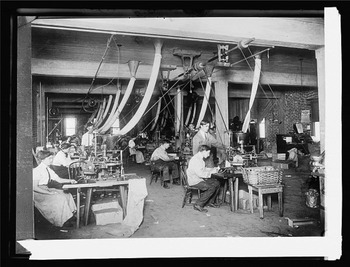
In the first several decades of distribution, political motivation was consistently mixed up with the quality of free seed. In the Patent Office, Ellsworth, who was from Connecticut, pursued the interest he and many others shared in developing the West—in particular in “New Connecticut,” now known as Ohio—by supporting the expansion of agriculture. The Whigs, and later the Republicans, focused more on applying science to agriculture, but they debated its purpose as well as how it should advance—should the USDA be focused on practical results; or should it be more fundamental, more pure? Embedded in this were general concerns about the role of government in democracy. During the Civil War, Republicans increasingly began to urge the Department away from fundamental scientific concerns and instead toward practical application of science and cultivation, with the distribution of free seed as one means to that end.Footnote 13 Members of the House could distribute seed in a variety of ways—by sending it, using franking privilege, directly to individuals in their districts, or by sending packages to party committeemen or the local postmaster. In either case, the Department of Agriculture was to provide varieties that would match local conditions, direct them to the location specified by the congressman, and attach the politician's name. This process took money, people, space, and time; by the Progressive Era the national government annually distributed 135 train car loads of bulk seed that, when packaged, amounted to 40,000,000 small seed packets (see Figure 1).Footnote 14 Given the real potential that free seed could influence voters, citizens, and other politicians, the press scrutinized—and condemned—congressional distribution. Many of the critiques focused on claims of quality as well as the defensibility of a project that did not seem to support scientific agriculture. While the seed mattered, these also were claims about a different quality: the quality of the government, and whether or not it should simply give things to the people.
Seed distribution, Department of Agriculture [between 1916 and 1917] LC-F82- 1730 [P&P] Library of Congress Prints and Photographs Division Washington, DC 20540 USA. Also available online at

By 1867, government seed distribution was censured “in and out of Congress,” in particular because seed often at best was “ordinary,” or worse, not tested for North American conditions.Footnote 15 Early Commissioners of Agriculture tried to improve the process and the seed. Horace Capron, Commissioner of Agriculture in 1867, started by asking farmers to experiment with new seed and report back, thus emphasizing intellectual gains over simple material production.Footnote 16 Capron's effort failed, however, in part because of a common point of resistance—the opposition of farmers to “book farming”—as well as what Carpenter has summarized as the expectation that the USDA should be a “clerical servant of American farmers” that would “cater to the distributive wishes of the nation, most visibly in the pork-style distribution of common seeds.”Footnote 17 Capron's successor, Frederick Watts, decided not to ask. Instead, he forced the issue: the Department would test seed, implementing quality standards and testing procedures for germination rates and contamination. If farmers accepted free seed, they would accept this form of agricultural technology, along with the scientific scrutiny of the land-grant establishment.Footnote 18
Thanks to Watts's initiative, farmers had more space to recognize quality seed and the role of experiment and technology in cultivation, increased access to new and alternative plants, greater interest in seed dealers, and more crops useful to newly settled areas of the country.Footnote 19 As a result, congressional seed distribution gained some outright support, if not universal acclaim. One farmer in 1888 lauded the program for making excellent seeds accessible to “the masses of people,” at the same time criticizing “the exorbitant prices charged for them by unscrupulous dealers.”Footnote 20 But for others the seeds and their distribution remained an easy vehicle for criticizing the USDA specifically and government involvement in citizens lives more generally. One farmer noted that from his free packet of “wheat” seed he had grown four different types of wheat, as well as barley, oats, and rye. He was probably relieved that his package of turnip seeds simply did not germinate. Another critic believed that the “government seed shop ought to be abolished now and forever; it is a travesty on agriculture.” For him, “A man that has got sense enough to plant seeds, plants the kind he wants, not what other men think he wants.”Footnote 21 The contest over seeds was also a contest over proper governing.”
William Gates Le Duc, Commissioner of Agriculture from 1877–1881, explicitly attached the issue of seed to the nation's broader economic development by emphasizing not only germinal and varietal purity, but also value in terms of dollars and goods. He opposed the purchase of common garden seeds, a practice that had become necessary to scale the program up as the appropriations grew. He also wanted to place stations throughout the country that would test the seeds and grow them for distribution.Footnote 22 Despite the ongoing quality issues, Congress rejected Le Duc's proposal while substantially increasing the appropriation to $75,000 in 1884, and then more than doubling it less than ten years later, to $160,000 in 1893. This drew more skepticism about congressional motives. In 1884, Vick's Illustrated Magazine accused the nation of “silence and tacit acquiescence” that allowed “this farce of a free seed distribution.” Seed distribution, Vick's argued, was “prostituted by aspiring politicians;” the process was “despicable,” “debasing,” and simply “patronage and political corruption.”Footnote 23 Free seed threatened, for many, the moral order, political economy, and the legal foundation of the government. Some even asserted that the USDA itself, let alone free seed, was unconstitutional.
SUPPORTING THE SEED TRADE—AND IMPROVING THE QUALITY OF SEED
Political attitudes were not the only arena for argument. While the public argued over quality of seed and moral implications, seed firms and USDA scientists argued over the competition that free seed might present to the industry. Seed firms opposed the distribution as a direct threat to their business. However, Nelson Klose has argued that congressional distribution also attracted the “farmer's attention to the utility of fresh plant stocks and a variety of crops.”Footnote 24 This advantage highlighted the other function of the USDA—to distribute knowledge. Since farmers usually grew their own seed, they may not have seen the importance of trying new stock; the persistent distribution of seed in the nineteenth century helped to change these attitudes and facilitated not only new ways of thinking about crops, but also a viable and stable seed industry. The trade did not see it this way, though, especially after seed became a commodity, and it continued to oppose free seed of any kind. Seedsmen regularly criticized congressional seeds—this “most iniquitous form of Government paternalism”—by promoting stories, some about seed that sold to the “government seed shop” instead of being thrown away, and others about seed that was sold to the government for several times its value. The ASTA (American Seed Trade Association) also argued that it was “as much an established legitimate business as manufacturing or trading in any product or merchandise,” and the government “has no moral right to interfere with this or any other legitimate business interest by a free political distribution of garden seeds, spades, shovels.”Footnote 25
Questions regarding the legitimacy and morality of free seed resonated with J. Sterling Morton, who became Secretary of Agriculture in 1893 and for the next four years tried to eliminate congressional distribution entirely. He believed seed distribution compromised politicians by allowing them to buy votes and compromised farmers because it allowed them to bypass independent work and decision making when they accepted seed. In the tradition of the Gold Democrats, Morton argued that government was too big, and that there were moral as well as constitutional problems with the USDA and congressional distribution. He also emphasized harm to the seed trade, asserting that free seed had “outlived its usefulness” so that “its further continuance is an infringement of the rights of citizens engaged in legitimate trade pursuits.”Footnote 26 Morton believed that “seed firms would get plants into the hands of the growers two or three years ahead of the government” and, according to Klose, “repeatedly defended the commercial seed firms from governmental competition.” On top of this, according to plant explorer David Fairchild, the “farming papers were full of jokes about Congressional Seed Distribution.”Footnote 27 Mockery of Congress and governmental institutions was common with seed distribution, even though many actually favored the practice.”
Morton wanted no part in the punch line. He was determined to create a smaller government that would not be compromised by “gratuitous distribution” of seed, a goal that fit with his larger reputation for cutting expenses—he capped the salaries of women in the USDA by arguing that no woman was worth more than $1,200, and he also moved telephones out of offices and into corridors. Naturally, the appropriation of $135,400 for “Purchase and Distribution of Valuable Seed” drew his cost-cutting eye.Footnote 28 In contrast to his predecessor, who had spent all but $491 of the allocation, Morton began to leave thousands unexpended. While the 1894 appropriation was also $135,400, Morton expended only $119,719. Next year Congress allocated more—$165,400—but Morton expended only $120,545. He followed a similar pattern in 1896—Congress increased the appropriation to $185,400, and Morton expended only $126,476.87. He left $60,000 unspent.Footnote 29 To justify his lack of spending, Morton invoked the experiment stations established by the Hatch Act in 1887 that were, he argued, particularly suited to testing new varieties of plants and seeds.Footnote 30 While this move would not have pleased all at the ASTA—at the annual convention in 1896 seedsman John Pearce had attacked experiment stations for “busying themselves working up new and fancy ideas” that ignored the seed industry—it did serve Morton's goal to reduce spending.Footnote 31 Morton also had noticed that the scale of seed distribution interfered with quality. Seeds all had to be tested, but in 1895 he found that because there were so many seeds, few of the tests could be completed before the mailing of the seed. When the results came in, he found fraud and low germination rates, but too late—the seed had already gone on to farmers.Footnote 32 The argument that the government could not serve a large population supported Morton's broader political agenda: to create governmental institutions minimal in their impact on people's lives.
These rational arguments failed to convince Congress to end seed distribution; sarcasm, dismissive commentary, and political maneuvering were no more successful. In addition to not spending a large percentage of his budget, Morton tried insult—“this popular dissemination is regarded altogether as a gratuity”—as well as critique—“unwieldy, unnecessary, and extravagant.” Finally, after consulting with the Department of Justice, Morton purchased no seed for distribution in 1896, arguing that he could not secure the “valuable seed” required by the appropriation. Congress rebuffed him by passing a joint resolution ordering the Department to resume the work. They also mandated exact percentages and deadlines—five-sixths of seeds purchased would be reserved for Congress to distribute between January and April. For the next year, 1897, Congress appropriated $150,000, $35,000 less than the previous year, but $25,000 more than Morton had ever spent on the distribution. He expended all but $7,177.Footnote 33
“WE ARE OUR OWN MASTERS NOW”
Morton's chance to end “gratuitous” seed by way of simple refusal was quashed when William Jennings Bryan replaced Cleveland as the incumbent party's nominee for president in the 1896 election. His Republican opponent William McKinley won handily. McKinley proceeded to appoint James Wilson as Secretary of Agriculture and with him brought pragmatic attention to science and popular needs to government institutions. This is particularly evident in free seed.Footnote 34 Like Morton, Wilson wanted to end congressional distribution, but he chose to attack through positive means, declaring “I am not going to get into loggerheads with Congress as my predecessor did.”Footnote 35 Wilson avoided conflict when he put the Assistant Secretary of Agriculture J. H. Brigham in charge of all congressional distribution and divided the appropriation for valuable seed into three administrative units: the Seed Division for vegetable, flower, and field seed; the Section of Seed and Plant Introduction for foreign seed; and the Division of Chemistry for sugar-beet seed.Footnote 36 He also worked with, rather than rejecting, allotted funds. For instance, in 1898, the USDA was able to direct $20,000 of the full $130,000 appropriation to foreign seed, the first in a series of efforts that segregated common garden seed from new and valuable seeds and plants. This required compromise. The USDA included “seed” in the section title to placate Congress, but pleasing Congress in this way allowed Wilson and his staff to explicitly direct money toward new seed. They embraced the power of the institution and the funds that came with it.Footnote 37 Spending followed the plan, and of the $130,000 appropriated, $70,978 went to congressional seed, $18,320 for “rare and valuable foreign seeds,” and $2,366 to sugar beets.Footnote 38
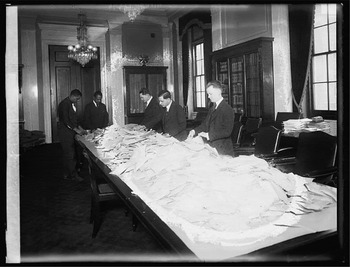
That same year, Chief of the Seed Division R. J. Whittleton used a new tactic when he reported on distribution to the House Committee on Agriculture: he acknowledged the implications of scale. In particular, he explained that the “enormous amount of seed” as well the four-month, January to April, time line dictated for sending it, forced the Department to use commercial seed in what was “but a plain business proposition.”Footnote 39 Over the next few years, Wilson elaborated on Whittleton's point, while also courting the favor of the House and Senate. He promised that seed distribution would be “carried out to the letter,” and consolidated the work in the newly established Bureau of Plant Industry.Footnote 40 However, he also made it clear that the large quantity of seed packets (see Figure 2), what Wilson called “the conditions under which we work,” forced the Seed Division to choose readily available varieties that would grow anywhere in the country. Because of this, he explained, distributing common seed “does not accomplish the ends for which the law was originally framed.” In 1903, he asked that “some change be made” so the Department could focus on “new and rare sorts” of seed and plants.Footnote 41
Seed distribution, Senator Penrose's office Available online at

Over the next few years, plant scientist and Bureau Chief Beverly T. Galloway attempted to move further toward new, rare, and useful crops.Footnote 42 The allocation of $20,000 to foreign seeds and plants reflected this agenda, but aside from this small congressional concession, Galloway struggled to reduce the fund for common seed. In 1901, the appropriation as a whole had increased to $170,000, and the increase went entirely to congressional seed and salaries. In 1902 the full appropriation jumped by $100,000 to a total of $270,000, where it stayed for 1903.Footnote 43 The Bureau also offered “choice” and “special” garden and flower varieties to Congress. To Galloway's chagrin, these options mystified senators and representatives, who chose not to distribute them, instead leaving them in the hands of the Seed Division—evidence, he found, that garden seed distributed through Congress would fail to circulate new varieties. Novel farm varieties, however—like Sumatra tobacco, Turkestan alfalfa, and the “cottons that some bright man has developed somewhere and that have particular value”—went to good use. Common garden and novel field seed came from the same appropriation, although Galloway accidentally, but clearly, separated them in testimony to the House Committee on Agriculture when he described field crop innovations as “outside of the purely Congressional seed work.” He realized his error and immediately recovered, explaining that these were congressional seeds, but not “within the category of garden seeds.” This slip, however, and Galloway's clarification were helpful; they showed Congress the difference between readily available common seed and the knowledge that came with novel field crop varieties, as well as the potential usefulness in separating them.Footnote 44 The distinction also highlighted the multiple positive roles that government can play in democracy, from distributing goods and services to increasing knowledge.
The Bureau emphasized the shared information and technology part of its work by way of bulletins, in-person farmer education by way of experiment stations and farmer's institutes, and access to testing.Footnote 45 This distribution of knowledge also chipped away farmer reservations about book farming while supporting the independence—and what then might have been construed as moral advantage—that came with buying seed commercially. These three methods of knowledge distribution grew rapidly. In 1905, Wilson emphasized how the Department educated farmers about testing seed through “publications giving descriptions and drawings of weed seeds and the seed of our economic plants” that “warned of the adulterants frequently found in field seeds and … the general quality of those in the trade.”Footnote 46 In-person education grew through widespread farmer's institutes, which by 1903 were in forty-one states.Footnote 47 Finally, the USDA emphasized seed quality, providing seed testing on demand and through funds appropriated to test grass, clover, and alfalfa for contamination and to publish the names of unreliable dealers; and supporting seed certification as a means to ensure purity in terms of variety, adulterants, and germination.Footnote 48
The Bureau of Plant Industry also increasingly used congressional appropriations as a means to respond to unique conditions such as arid regions—through drought-tolerant varieties—and pest challenges like the boll weevil—through early maturing cotton—causes especially dear to Southern Democrats. By appealing to these emergencies, the BPI was able to reframe the program, and the work of government, in a way that was acceptable to former critics in the South. Free seed became acceptable as long as it was in the interest of science—and in the interest of successful agriculture in the face of calamity. When Galloway and Seaman Knapp went to Kaufman County, Texas, in 1903, for instance, they found residents “in a state of panic” about the boll weevil and in need of support for changes that, while necessary, seemed to be “an expensive gamble” for any individual farmer on his or her own. In the North, congressmen wanted to aid in the development of crops such as sugar beets. By capitalizing on these needs Galloway pursued what Carpenter called a “brilliant exercise in bureaucratic entrepreneurship” by sharing knowledge and technologically evaluated seed with farmers.Footnote 49 This work also created stronger interest in the seed trade, where farmers could purchase new varieties, overall expanding the government's role in the growing knowledge and political economy. While congressional distribution of common seed continued without much adjustment, Galloway had begun to isolate that project from preferred innovations. He also successfully reorganized the Seed Division so that it no longer worked through contractors—thus embracing the business methodology proposed by Whittleton—so that in 1906 he could confidently assert, “We are our own masters now.”Footnote 50 But the mastery had limits. Despite Galloway and Wilson's preference, free seed continued to serve another constituency, the one that wanted free seed for gardens, and critics continued to focus on the financial burden of the program. In 1905, The Outlook called free seed “misdirected and pernicious paternalism,” simple “claptrap, country, political engineering and log-rolling” and “a cheap bid for favor” that “should be abandoned.”Footnote 51
A NEW PLAN: DISTRIBUTION BY THE USDA RATHER THAN CONGRESS
Wilson and Galloway's opposition to free garden seed was no secret, and the Committee on Agriculture in the House of Representatives tried to support change by including no provision for congressional seed distribution in HR 18537, the Agricultural Appropriation bill for the fiscal year ending in 1907.Footnote 52 Taken by surprise, the seed industry rushed evidence and witnesses to Washington to convince the Senate Committee on Agriculture and Forestry to stand with the House and not add seed to the budget. Burnett Landreth, head of the ten-person delegation, testified that free seed was “a trust in opposition to the interest of the seed trade.” He also objected to the seed itself, which was “the commonest things which our fathers and grandfathers had.”Footnote 53 Seedsman Henry Hathaway from Rochester, New York, also invoked ancestors. About fifty years earlier, Hathaway explained, his grandfather had received government-issued seed with a different purpose, uncommon varieties “that we, as farmers, knew nothing about and had never heard of.” The seed came with a request to track if and under what conditions they flourished. In his family, “the sheets containing these questions were religiously taken care of”—literally. They were stored in the family Bible, and in the fall they were returned to the Department.Footnote 54
The Bureau of Plant Industry endorsed Landreth's position against free seed, noting that the office already provided seed and experts to guide farmers as well as education about “pure seed investigations, the quality of commercial seeds, their adulterants, and simple methods of testing their purity and vitality.” In the 1906 annual report, Wilson also highlighted the Bureau of Plant Industry's campaign for education about good seed—what Assistant in Physiology C. P. Hartley called “proper methods of seed selection and cultivation”—by arguing that “the corn crop per acre can be increased by one-half within a quarter of a century,” and that production could go even higher. For this sort of success, “No wizard's services are needed,” Wilson testified, “just education,” education that the USDA and the Bureau were in a position to provide. Hartley also showed how good seed increased profit as well as production by tripling, quadrupling, or even quintupling yields. For Wilson, new social conditions, in particular a decrease in the size of the farming population made these yields, and the Department's responsibility to educate about how to reach them, even more important. As he put it, “the farmer will not fail the nation if the nation does not fail the farmer.”Footnote 55 His approach to government required agricultural science and education for national growth.
Congress reversed itself by reintroducing and voting in the free seed appropriation for 1907. Galloway increased the pressure to change the program in 1908, first by reintroducing Wilson's 1903 request to shift the program back to valuable seed. Then he made his pitch: should Congress, “in its judgment,” believe that “the time has come to make a change,” the Department was ready with a plan. Galloway outlined a strategy that first would end “free distribution of ordinary seed” and second would expand the second and third duties of the Bureau, “disseminating rare and uncommon things grown in this country and disseminating rare and uncommon things secured abroad.”Footnote 56 He proposed that congressmen identify experimentally inclined farmers and send their names to the Bureau, who would screen the farmers, provide seed, educate them about cultivation, and help collect results (see Figure 2). He also wanted to keep sending seeds to children, maintaining the unusual part of congressional distribution that he favored. The recipients, twelve- to fourteen-year-old schoolboys, kept “records of different kinds of seed, trying to get hold of new things to plant on their little plots.” Galloway appreciated this experimental mindset and was happy that “the boys are beginning to think about these things.” Committee Chair James W. Wadsworth agreed, highlighting a contemporary social concern: the effort to stabilize rural population known as the Country Life Movement (see Figure 3). For him, this school program might “turn the drift back from the cities to the country in a few years.”Footnote 57 Galloway agreed, “That is what we hope to do,” but by distributing seed through his Bureau rather than through congressmen.Footnote 58
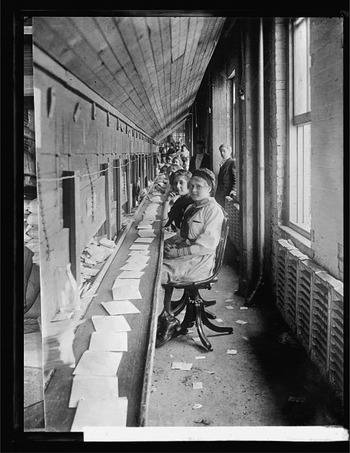
Women preparing seed for distribution sometime in 1916 or 1917. Seed distribution, Department of Agriculture.[between 1916 and 1917], LC-F82- 1725 [P&P] Library of Congress Prints and Photographs Division Washington, DC. 20540 USA available online at

Despite cordial hearings, long-standing division between those who favored and those who opposed distribution was unmistakable. For instance, when Republican Franklin Brooks from Colorado asked, “Did you ever know of a practical advantage that came to the agriculturalists of the country by the distribution of lettuce, radishes, onions, and beets?,” Galloway responded to the irony with a gentle, “You are asking me that question?” Brooks reconsidered with a bit of laughter, saying “No; I will withdraw that.” But Brooks's question indicated the sentiment of others, like Southern Democrat John Lamb of Virginia, who argued that since the Department received one thousand requests for seed a day, people must appreciate the program. Wadsworth dismissed Lamb, along with the possibility of real value in the distribution by curtly remarking that “it shows they like to get something for nothing.” Galloway, however, emphasized the public relations problem of any free seed. Since demand exceeded supply, congressmen left many constituents disappointed, thus compromising the entire enterprise. His proposal—with seventy-three specific plans to use the redirected funds—would relieve Congress of two burdens, distribution and criticism, and, he argued, therefore would be much more satisfying to constituents, Congress, and the USDA. The budget—and the work of the government—needed to support “what is best for the whole country.” Iowa Republican Gilbert N. Haugen disagreed on the basis of the program's low cost. He calculated that free seed accounted for one dollar out of seventy-two appropriated for agriculture, and he believed that it was not reasonable to cut such a small amount if so many wanted the seed, thus articulating another way to construe the purpose of the USDA and the national government. Charles Scott, a Republican from Kansas, followed the same line of reasoning, asking, apparently with surprise, “The mere fact that the people want the seed and ask for it does not necessarily lead to the deduction that the country is benefited by the distribution?”Footnote 59
Galloway saw no benefit, and he marshaled a great deal of agitation and evidence to his side. Seedsmen, agricultural papers, granges, and agricultural colleges presented days of testimony and pages of letters, many replicating the previous Senate testimony and all opposing congressional distribution. Garden seed was the particular target, but 10 percent of the distribution was flowers, which Lamb advocated because “They go to every pretty young woman in my district I can get them to.” The seed industry persevered, suggesting “other things that they could at least try,” such as nitrogen-gathering bacteria. The enthusiastic Lamb jumped in—“I will send out all I can get.” The Department, however, was well ahead of this proposal and was already distributing the bacteria directly to farmers, intentionally bypassing the problematic Lamb and his colleagues who, thanks to the value they placed on the personal touches of governing, were, for Galloway, a big part of the seed distribution conundrum.Footnote 60 Many on the committee did approve a more experimental approach in theory, but in practice they too wanted that relationship with constituents. Southern Democrat Ezekiel S. Candler of Mississippi, for instance, was willing “to join thoroughly in this experiment work, but I must confess I am not willing to leave the other off.” He was not alone.Footnote 61 Rather than accept Galloway's plan, Congress increased the appropriation slightly to $242,920 for the fiscal year ending in 1907, of which foreign seed was to account for $35,781.Footnote 62
In the next annual report, Secretary Wilson had no choice but to tell a familiar story: “The work of securing, packeting, assembling, and mailing the seed for Congressional purposes was carried on the same as in in past years.” He noted that “this work is now so systematized that it goes along smoothly,” emphasizing that this was true “despite the large quantities of seed that must be secured and sent out.”Footnote 63 The Bureau also emphasized efficiency under the load. When discussing the 1909 appropriation, Galloway did not ask the Committee on Agriculture to end distribution. Instead, he emphasized how the Seed Division provided equivalent quotas and quality even though Congress had diverted some of the appropriation away from common seed to valuable foreign and domestic seed.Footnote 64
This argument about efficiency was helpful when, for the fiscal year ending in 1913, Galloway and Wilson added a new means of separating congressional seed: they successfully included specific provision for valuable drought-resistant crops, exploiting the success for foreign seed and early maturing cotton. Building on this expanding base of valuable crops, the next year Galloway proposed officially to separate new, foreign, and rare seed from the appropriation for congressional seed distribution. Galloway explained that the drought-resistant seed, like foreign seed and plant introduction, had been “carried under the appropriation for the purchase and distribution of valuable seed.” However, the work was “so intimately connected with our scientific investigations” that the Bureau decided to budget it not as “an adjunct to or as a proviso in the seed item,” but instead “to let it stand by itself.” He wanted a distinct appropriation: “New and Rare Seed.” Lamb, who was now chair of the committee, warned that the proposal was “going to create a great deal of inquiry and criticism on the floor … and of course it will be stricken out.” Galloway understood why; he responded that the proposal had “no bearing on the congressional seed distribution whatever.”Footnote 65 The proposal made it through the committee and Lamb presented “New and Rare Seed” to the House, but it failed to go further.Footnote 66 Wilson left office in spring 1913, with a much more scientifically oriented Department, Congress, and farmer base, but also with Congress's ability to distribute free common seed to farmers and home gardeners, men, women, and children, intact.
Wilson and Galloway had gone far to isolate the “clerical” duty of seed distribution from education about and access to good seed (see Figure 4). Wilson's successor David Houston elevated Galloway to Assistant Secretary and continued the fight.Footnote 67 In his budget proposal for the fiscal year ending June 30, 2015—his first—Houston omitted the item for congressional seed promising “the substitution of constructive work in the securing and distributing of new and valuable seeds and plants,” such as drought-resistant varieties that farmers would test and reproduce, as well as cost savings.Footnote 68 As had happened so many times, Congress again reintroduced the item, but with a nod to the Department's request. It adopted the proposal to separate “New and Rare Seeds” from “Purchase and Distribution of Valuable Seeds.” This new category included not only the drought-resistant seeds and foreign seed sub-appropriation that started in 1898, but also the method Galloway proposed in 1906: congressmen suggested names of “up-to-date farmers who are interested in making tests of new crop plants and are equipped to do so”; the Department verified the ability and interest and sent seed. The separation indicated, according to the Department of Agriculture, that Congress wanted to “make this distribution apart and distinct from the regular distribution of vegetable and flower seeds known as the congressional seed distribution.”Footnote 69
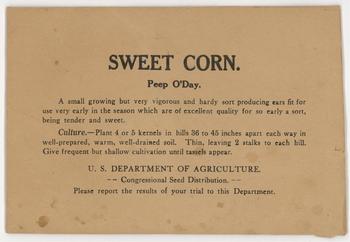
Sweet Corn Seed Packet, 4/21/1923, from
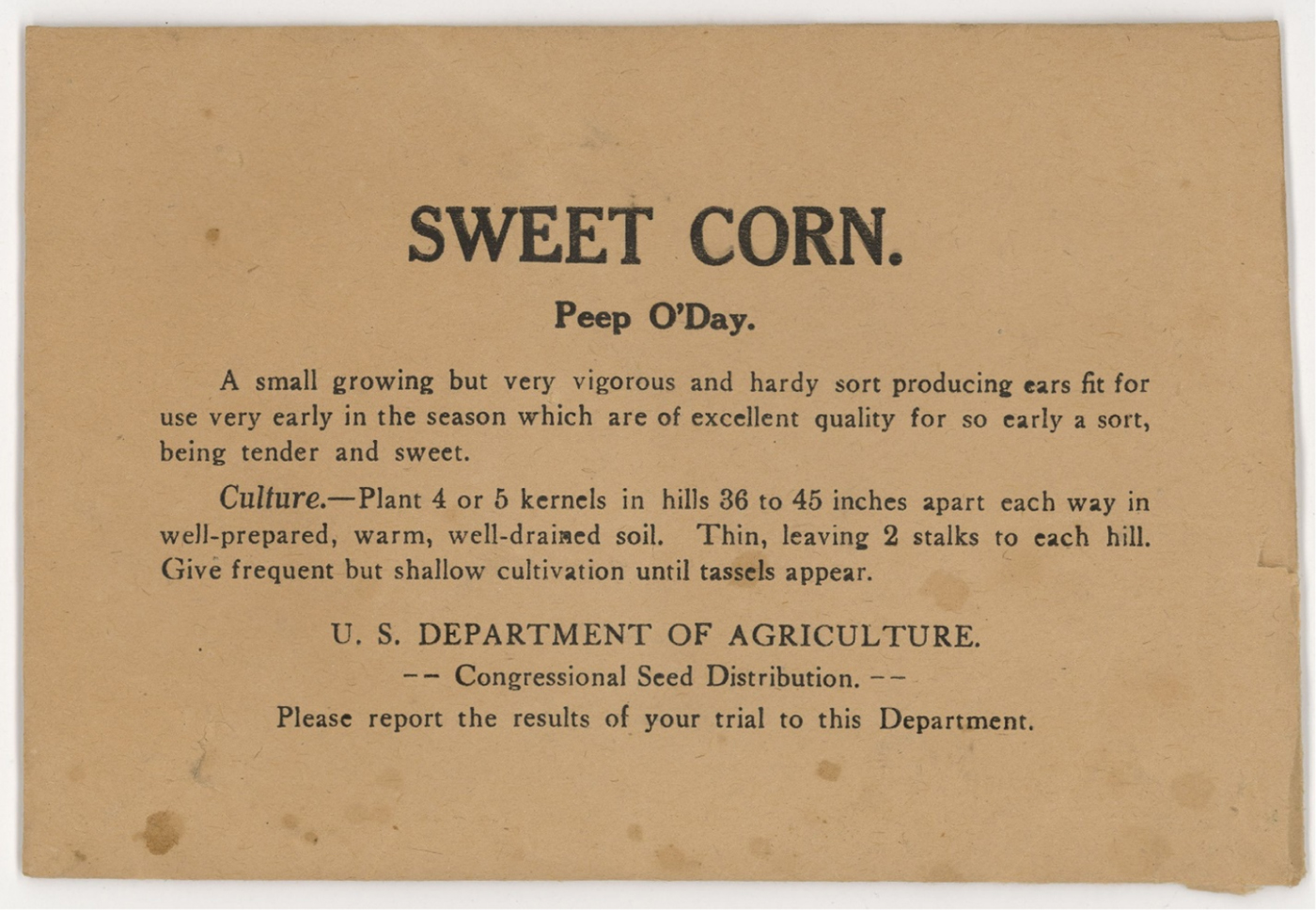
Following this shift in resources, the Department was better able to pursue the experiment, asking farmers to try seed; report to the USDA; and then, if the seed was useful, to purchase it through dealers.Footnote 70 Although the seed industry seemed to support this approach, it also continued to emphasize politics, especially the Senate's effort to try to eliminate—in 1916—or at least reduce—in 1917—congressional seed appropriations.Footnote 71 Seed World editor Waldon Fawcett followed an old theme when he argued that the seeds “are either fed to the chickens or are consigned to the wastebasket,” an improvement over the burning of one hundred square feet of congressional seed in Woodside, Long Island, a decade earlier.Footnote 72 Despite these efforts, in 1918 Congress distributed 11,165,709 packages of vegetable and 2,188,818 of flower seed, each containing five packets (see Figure 3); and by 1919 the appropriation had not decreased, but instead, Seed World reported with consternation, grew by half.Footnote 73 Fights about congressional seed occurred annually, and the funding of garden and flower seed continued at constant rates.Footnote 74 Nevertheless, the Department emphasized transmission of knowledge over distribution of seed through circulars that publicized “new and rare crops, improved strains of staple crops, and high-grade seed of crops to be considerable promise,” and through invitations to farmers “to use the seed for the production of stocks for future plantings.” This work, according to Chief of the Bureau William A. Taylor, provided “gratifying results.”Footnote 75
Throughout this period, opponents continued their dismissive rhetoric. The gardening press criticized Congress for insisting on free common seed and for “keeping the distribution in their own hands.”Footnote 76 More than waste, Randolph Nelson of the American Seedsman called congressional distribution a “threadbare farce” that had reached new heights when the House accused the seed industry of selling a bad product that Congress needed to counter with free common seed. He could only laugh—“bless our sense of humor.”Footnote 77 Seed World added intentional forms of nonsense, publishing a joke letter addressed to Washington Congressman Johnson in which the author requested seed, books, a typewriter, “the farm account book from the Department of Agriculture,” and a gasoline tractor.Footnote 78 Finally, the Chicago stage offered a “satire in one act,” with “Congressman Andy” stumping for office based on his “avowed ability to pack and mail seeds as well as anybody on earth.”Footnote 79
EXPERIMENTAL AGRICULTURE AND THE END OF CONGRESSIONAL DISTRIBUTION
Edwin Meredith became Secretary when Wilson moved Houston to Secretary of the Treasury, but his tenure was a short thirteen months. When Republican Warren Harding took office, he replaced him with Henry C. Wallace who presided over the demise of free common seed. In his first report, however, in 1921, Wallace could only note that congressional seed distribution “stands as it did last year.” The ongoing disagreements were well known. In 1922, Washington correspondent for Seed World Clarence Linz reported that “All is now set for the annual fight between the Senate and the House of Representatives (in which the latter always wins).” He announced that his prediction was correct in the next issue.Footnote 80 However, Seed World also noted that one unnamed congressman had sent out his portion of seed specifically when he thought they would most help him for reelection. When his opponents discovered his tactic, they used it to defeat him. Broader reform was starting to penetrate the politics of seed distribution, suggesting that the tide might turn even on the floor of Congress.Footnote 81
In the winter of 1922 the House committee again cut the distribution of common seeds from the 1923 appropriation. Taylor, now under his third Secretary of Agriculture and witness to years of seed fights, hoped the change would stick but remained cautious. For instance, since congressional seed was out of the proposed budget, Minnesota Republican Sydney Anderson objected to an appropriation for the executive assistant for distribution. Taylor, however, was unsure, explaining that he was “awaiting the final determination of Congress” because he “had several experiences with the seed distribution within my short life and recollection.” He did not want to lose this “able and useful man” if Congress reinstated the budget. Anderson acquiesced, but only conditionally: “Well, if the seed distribution goes out, then this place ought to go out.”Footnote 82 A sense of contingency also prevailed in the press. Seed World noted the absence of common seed distribution but warned its readers that “that does not mean that the free seeds farce will not be prevented. Congress will take care of that matter, as usual.”Footnote 83 Six months later, Seed World announced that representatives had “run true to form,” following “the procedure of former years”; the House, from the floor, reintroduced the appropriation. Seed World also correctly predicted that the Senate would object, but the House would prevail and keep seed in the budget.Footnote 84 On April 10, 1922, the Senate opposed the addition by a vote of 30 to 31, but the House insisted. In a second vote three days later, the appropriation was reinstated 29 to 24.Footnote 85
A similar debate occurred in the next year's Committee on Agriculture hearings for the 1924 appropriation: again, the committee left out seed distribution, and again Taylor worried about losing a position.Footnote 86 There also was increased rancor. When Taylor emphasized the need for economy, Anderson was accusing: “you are going to economize here at the expense of we Congressmen, are you?” He instead asked Taylor if Congress, “in its wisdom, should conclude that this was a desirable item to continue,” would the same appropriation would result in the same quota of seed? Taylor agreed that it would. With reappropriation, each member would receive a quota of twenty thousand packages of vegetable and two thousand packages of flower seed.Footnote 87
Anderson had reputable backing for his hope about congressional “wisdom.” The appropriation debates for 1924 took place in winter 1922–1923, precisely when Scientific American ran an article about free seed. The author, George H. Dacy, was a former member of the Seed Division turned freelance writer who acknowledged that “Uncle Sam's annual free seed party” was ridiculed as “cheap, impure, and generally ‘no account.’” Despite this, he argued that there were benefits to this mode of governance. Requests had increased, along with a huge return of millions of dollars on the investment.Footnote 88 Dacy's article was not entirely positive—he explained that the USDA opposed the distribution. However, “annually Congress overrides the recommendations of the department,” subsequently adding the appropriation “in answer to the hundreds of thousands of letters which pour in from the highlands of Appalachia, the wildernesses of Maine, the deserts of Arizona, the cut-over lands of Wisconsin and Michigan, and where not in the United States.” Although the USDA found itself thwarted, it responded with the best possible product, the “only source” from which “the amateur and professional gardeners, farmers, and suburbanites here, there, and everywhere” could secure “such superior seed.” Dacy was arguing, in short, that free seeds represented a valuable public service as well as a good product, and that Americans had learned through this program that quality mattered when it came to seed—so much so that they grew $192,000,000 worth of crops from the $360,000 appropriation. Free seed not only may have legitimized “book farming,” but also turned it, along with higher production and quality products in farming, into a social obligation equal in importance to individual independence. Congressional advocates cited Dacy in the 1924 debates.Footnote 89
Anderson favored Dacy's interpretation, but it was not enough to fight the rising tide of opposition to the distribution of common garden seed that now was completely distinct from new and rare seed.Footnote 90 After years of lobbying Congress, in January of 1923 the seed trade cautiously voiced the hope that “the men in Congress will give ‘Free Seeds’ such a death blow this year that this political graft will never be revived.”Footnote 91 They could be optimistic; once again, despite Anderson and Dacy's position, the Agricultural Appropriation bill made it through both the House and Senate committees and went to the floor of the House without “Purchase and Distribution of Valuable Seed.” Following the pattern of years past, Charles Carter, Democrat from Oklahoma, moved that Congress amend the budget to include the appropriation of the previous years. After a complex set of parliamentary dance steps—a point of order, an appeal, a motion to table, a vote, a motion to reconsider, and another vote—the House left free seed out.Footnote 92 The Senate concurred. Free congressional seed never made its way back into the budget.
But it was not for lack of trying, as the ASTA expected.Footnote 93 Kentucky Republican John Langley jumped back into the debates the next year with HR 602, the Langley-Free Seed Bill. Supporter motives included the usual: farmer requests, sharing knowledge, and historical precedent. But unique arguments ranged more widely, from domestic tranquility—when John E. Raker from California argued that free seed encouraged “wives to take care of gardens and of their husbands”—to the class loyalty implicit in Mississippi Representative Percy Quin's invocation of obligation to “the great mass, the inarticulate mass, that are never heard.” Quin promised to “vote for the field seed, the garden seed, and the flower seed and every other kind of seed I can to go out to the people” no matter the public consequences, inviting the press to “make all the fun of me they please.”Footnote 94 Free seed, according to these varied perspectives, was part of what they believed was the correct and proper form of government in democracy: one that cared for the voiceless, for wives and husbands, for women and children.
Ralph F. Lozier of Missouri was far less amenable to the ridicule that Quin seemed to relish. In an acerbic back and forth with J. N. Tincher of Kansas, who emphasized the benefits of free seed, specifically kafir corn and “Soudan” grass, Lozier agreed that congressional seed once may have been useful. However, in recent years most of the distribution “represents species of grain and species of seeds that are as old as our civilization.” For him, “farmers are an intelligent body of people” who opposed free seed because it “furnishes no real substantial help to the people.” This emphasis on farmer knowledge was an important shift that endorsed USDA work of the past decades. Lozier certainly meant to argue that farmers are intelligent in general, but with access to the work of the USDA work over the past twenty-five years farmers also had become more aware of the benefits of new seed methods. In response, Tincher rhapsodized about head lettuce, with crunch and flavor that he experienced only because he had planted this novel variety of free seed. Lozier agreed to a point—he also enjoyed head lettuce—but he would not give way: “it is not justified to continue the sending out of the common, ordinary seeds and grains.”Footnote 95 Eventually, Tincher began to understand the opposing argument, asking if “the practical application of it has destroyed the theoretical value of it.” Scaling up seed distribution prevented the distribution of new and unique varieties, especially when Congress wanted to send familiar seed. The USDA could send out a lot of seed, or it could send out unique seed (see Figure 4), but it could not do both. If both were desirable, the case implied, government needed to work with industry to accomplish the goals of a democracy. Charles B. Ward of New York added personal experience—“I got some white carrots. Who wants white carrots?” They met the fate commonly attributed to congressional seed—“I fed them to the horses.” Despite their desire to provide a personal touch in the form of the perfect gift of seed, representatives could not assure that everyone got what they wanted. Lozier added the problem of politics, noting that seed distribution “has had the effect of making Representatives in Congress cheap,” and was easily tainted with accusations of electioneering. After this heated debate, HR 602 never made it out of committee, and efforts to revive free garden seed seemed at an end. To celebrate, Seed World created two satirical congressmen “Dumm” and “Dummer” to lament the passing of the age.Footnote 96
The congressional fight lingered a bit, but with a twist. In winter 1924–1925, when Taylor testified before the Committee on Agriculture, he found himself in the opposite position of Galloway about twenty years earlier. When the committee began to consider the budget for “New and Rare Seed,” Texas Congressman James Buchanan asked, “Doctor Taylor, have you ever seen any good come out of this work?” Unlike Galloway, who had been asked this question about common seed twenty years before, Taylor—with regard to free new and rare seed—could enthusiastically respond “yes, sir; it is a very great and substantial benefit.” Unlike the days when this seed was lumped with free congressional seed in the appropriation for “Purchase and Distribution of Valuable Seed,” the Chief of the Bureau of Plant Industry could be a strong advocate; he provided a history of the transformation away from free congressional seed to this method of having the Bureau oversee the distribution. Buchanan grumbled at the history, but his opposition did not stand up to Taylor's support for the newly clarified and solely budgeted form of free seed—new and rare, and with it the growth of an industry that was meant to satisfy the people's need for access to new agricultural products generally as well as common seed.Footnote 97
Twenty-five years earlier, plant explorer and head of the Office of Foreign Seed and Plant Introduction David Fairchild had complained that the “farming papers were full of jokes about the Congressional Seed Distribution and it was, of course, just a species of graft.”Footnote 98 Most historians who have considered congressional distribution, including Carpenter, Fitzgerald, and Dupree, have agreed, and of course it is true that Congress was motivated by politics. However, this article highlights the other concerns that were embedded in the time period, such as how best to maintain the American independence that many believed was essential to the country's character and the country's future in the face of extraordinary change in terms of industry, as well as geography, demographics, and science. The USDA used free seed as a mechanism to grapple with that change, isolating the politics of graft from the distribution of knowledge. With its own careful maneuvers, the USDA made congressional distribution another method of easing farmers, congressmen, and the seed trade into the scientifically and technologically informed agriculture and industry that characterized the twentieth century. Free seed, under the management of the USDA in the early twentieth century, became a species of innovation. This work created political structures and popular support for agricultural sciences with implications that extended well beyond the farm, the USDA, and the Capitol Building, and into industry, education, public aid, and science—where arguments over the purpose of government in democracy long played out along the themes articulated in the debates over free seed.
EPILOGUE
As the country approached its bicentennial, House Democrat James Burke of Massachusetts made a brief stab at the revival of free garden seed. In July 1973—apparently unaware that this was also the fiftieth anniversary of the defeat of congressional distribution—Burke introduced HR 9468 to fund garden seed for three years with an annual budget of six million dollars. The bill went to the House Committee on Agriculture, which recommended an amended version to the House on November 27, 1974. When the House failed to act, Burke reintroduced it the next year as HR 280—he also called it the “bicentennial seed bill”—and it went to the Subcommittee on Domestic Marketing and Consumer Relations of the Committee on Agriculture, but after a round of debates, the bill never made it out the committee.Footnote 99 Burke was persistent—he reintroduced the bill two more times—but reviving garden seed proved impossible.
Before it died, however, the bill stimulated debate reminiscent of the history of congressional distribution and at the same time hinted at the changed political and industrial landscape. In particular, the committee debates revealed little awareness of the early themes of patronage or purity. Still, the economic, cultural, and environmental spirit of the 1970s resonated with early twentieth-century concerns such as getting boys to experiment with seed, pretty girls to have flower seed, and wives to care for their husbands. Sponsors emphasized community gardening, the “back-to-the-soil movement,” and the ways that “Nature's lessons” could reduce juvenile delinquency, tranquilizer use, and the stress of “artificial society.” Charles Carney of Ohio hoped that “inflation gardens” would emerge as one solution to the high cost of food.Footnote 100 The USDA's representative, Raymond Scott, dismissed these ambitious goals along with the bill, in part by presenting a history of seed distribution that emphasized that the Department had in the past “encouraged farm and city people alike” to create Victory gardens during wartime but had “made no distribution of seeds.”Footnote 101 The ASTA joined the USDA in familiar opposition to distribution; both sent representatives to oppose the bill, and in the process demonstrated that Burke and his co-sponsors did not know their history. When Massachusetts Republican Margaret Heckler asked Burke why Congress had stopped distributing seeds in the 1920s, Burke admitted that he did not know the answer, instead offering an incorrect guess: perhaps seed distribution had ended because of surplus agricultural production and subsidies to pay farmers not to produce food. His colleague from Iowa, Republican Chuck Grassley, however, came closer to the truth. He proposed that congressional seed distribution was not intended to start gardens, “even though it may have served that purpose,” but “to do research and the distribution of the latest seeds” in lieu of private sector work in this area. Distribution was “to get the news out to the public.”Footnote 102
While Grassley's history better matched the early half of the program, Burke's bill better represented what congressional distribution became in the Progressive Era: free common garden seed. By the 1970s, there was no longer a need to distribute knowledge or reliable seed, or to fight the sixty-one years of tradition that had sustained congressional seed distribution until it was left out of the appropriation in 1923. But there was also no institutional need to support gardening as a form of agriculture. Gardening, in fact, now came under the purvue not of the USDA, but of the Department of the Interior's Bureau of Outdoor Recreation—much to the outrage of Representative Brown, who seemed incredulous that the Department of Agriculture was not at all involved in projects involving gardening.Footnote 103 The industrialization of agriculture, however, had relocated concerns about food production away from the individual family and toward the industry that agriculture became during the Gilded Age and Progressive Era. These great seed debates helped to shift perceptions about American democratic governance away from free distribution in agriculture and toward the expansion of knowledge and scientific change.