CHD is the most common congenital anomaly in newborns and has been the major cause of infant death.Reference Bouma and Mulder1 The aetiology of CHD remains largely unclear. It was estimated that only approximately 15% cases of CHD can be explained by chromosomal aneuploidies and defects in single genes.Reference Bouma and Mulder1 In recent decades, maternal nutrition during pregnancy has been confirmed to be related to cardiac development in offspring.Reference Liu, Joseph and Luo2 As an example, accumulating evidence has demonstrated that periconceptional folic acid supplementation is an effective intervention strategy to decrease the risk of CHD development in their offspring.Reference Leirgul, Gildestad and Nilsen3,Reference Czeizel, Vereczkey and Szabo4
Recently, several studies reported that vitamin D plays a key role in cardiac development during the embryonic period.Reference Kwon5,Reference Hlaing, Garcia, Contreras, Norris, Ferrini and Artaza6 Data from cell assay and a zebrafish model revealed that vitamin D can promote cardiac differentiation by modulating the Wnt signalling pathway, and the lack of the vitamin D receptor can lead to cardiac laterality defects.Reference Kwon5,Reference Hlaing, Garcia, Contreras, Norris, Ferrini and Artaza6 Furthermore, it has also been reported that vitamin D deficiency is prevalent in children with CHD.Reference Graham, Taylor and Zyblewski7 Serum level of vitamin D is mostly influenced by sun exposure and diet.Reference Jin, Wang and Wu8,Reference Yun, Chen and He9 Cod liver oil is an important source of dietary vitamin D in China.Reference Jin, Wang and Wu8,Reference Yun, Chen and He9 It has been reported that low ambient ultraviolet radiation B level is prevalent in many areas of China, especially during winter months, which would restrict the acquisition of vitamin D from sun exposure.Reference Jin, Wang and Wu8,Reference Yun, Chen and He9 In addition, approximately 74.9% of Chinese pregnant women might be vitamin D deficient, and cod liver oil has been recommended as a good vitamin D supplement.Reference Yun, Chen and He9,Reference Cortese, Riise and Bjørnevik10
Based upon the above, we speculate that vitamin D supplementation through cod liver oil ingestion around the periconceptional period could be another nutritional intervention strategy to decrease the risk of developing CHD. However, to date there is little epidemiological evidence to establish this relationship. In the present study, it was hypothesised that maternal use of cod liver oil during the periconception period is negatively associated with the development of CHD in their offspring. We examined and verified our hypothesis based on a hospital-based case–control study in which the association of cod liver oil use alone, or the joint use with folic acid supplementation, with the incidence of CHD was respectively evaluated.
Materials and method
Study design and subjectspatients
A hospital-based case–control study was conducted in Shanghai Children’s Medical Center through June 2016 to December 2017. Sample size was estimated by the following calculations:Reference Jekel11
 $$\eqalign{ n = {\bigg\{ [{Z_{1 - {\alpha \over 2}}}\sqrt {2\overline P\left( {1 - \overline P} \right)} + {Z_\beta }\sqrt {{P_1}\left( {1 - {P_1}} \right) + {P_0}\left( {1 - {P_0}} \right)} ]/ }\cr \hskip 12 {({P_1} - {P_0})\bigg\} ^2} \cr \overline P = ({P_1} + {P_0})/2 \cr {P_1} = (OR \times {P_0})/(1 - {P_0} + OR \times {P_0})} $$
In formulas, P
0 = proportion of events in the control group, OR = odds ratio of events, P
1 = proportion of events in the case group,
 ${\overline P}$
= proportion of events in total,
 ${Z_{1 - {\alpha \over 2}}}$
= value of the standard normal distribution corresponding to 1 −
 ${a\over 2}$
, and
 ${Z_\beta }$
= value of the standard normal distribution corresponding to β.
In our preliminary study, 24.0% of pregnant women used cod liver oil supplements. Compared to those mother who did not use cod liver oil as supplements, odds ratio for the risk of offspring CHD was 0.432 in mothers who used cod liver oil supplements. Therefore, 0.24 and 0.432 were taken as the estimates of P0 and odds ratio of events, respectively. In total, 214 cases versus 214 controls were calculated to be the minimum sample size to achieve appropriate statistical power (α = 0.05, β = 0.1). In this study, 262 children with severe CHD, along with 262 control children without any birth defects, were enrolled. The detailed information of the case–control study has been described elsewhere.Reference Zhao, Zhao and Xia12
The CHD diagnoses were based on the codes of the International Classification of Diseases, the Tenth Revision, Clinical Modification. A team of experts, including paediatric cardiothoracic surgeons and fetal ultrasonologists, evaluated and ensured the accuracy of the final diagnosis. Severe CHD in this study included tetralogy of Fallot (n = 97, 37.0%), transposition of the great arteries (n = 32, 12.2%), functional single ventricle (n = 23, 8.8%), pulmonary atresia (n = 17, 6.5%), single atrium (n = 10, 3.8%), atrioventricular septal defect (n = 10, 3.8%), tricuspid atresia (n = 9, 3.4%), total anomalous pulmonary venous connection (n = 8, 3.1%), double-outlet right ventricle (n = 6, 2.3%), hypoplastic left heart syndrome (n = 6, 2.3%), congenital mitral stenosis (n = 6, 2.3%), persistent truncus arteriosus (n = 6, 2.3%), interrupted aortic arch (n = 6, 2.3%), and others (n = 26, 9.9%) with reference to the classification of previous studies.Reference Yeh, Chen and Lu13 All the sampled children with severe CHD survived after birth and were younger than 2 years old.
The children in the control group were recruited from the children admitted into the same hospital during the same period when the cases were recruited. Among the 262 controls, 132 came from paediatric respiratory medicine, 91 from paediatric general surgery, and 39 from paediatric gastroenterology. Similar to the cases, all children in the control group were younger than 2 years old.
Children with any of the following conditions were excluded from the study: (1) cases with other congenital deformities except CHD, such as Down syndrome, 22q11.2 microdeletion, Noonan syndrome, Williams syndrome, Marfan syndrome, and so on; (2) death of the mother; (3) mother diagnosed with mental disorders; and (4) inability to locate the mother for interview.
Measures
Information on socio-demographic characteristics and parental health-related behaviours was retrospectively collected through the Parental Behaviours and Environmental Exposure Questionnaire, a self-made questionnaire used in our previous study.Reference Zhao, Zhao and Xia12 For both cases and controls, only those mothers who signed the informed consent were invited to fill out the questionnaires whilst in hospital.
In this study, maternal folic acid and cod liver oil supplementation were evaluated by two items in the Parental Behaviours and Environmental Exposure Questionnaire. One was regarding maternal folic acid supplementation: “how often did you take folic acid supplements around the periconceptional period?”, and the other one was related to cod liver oil supplementation: “how often did you take cod liver oil capsules around the periconceptional period?”. Periconceptional period was defined as during 1 month before pregnancy and throughout the gestation. The responses to the two questions were rated on a three-point scale: “occasionally/never” for <1 day per week on an average, “frequently” for 1–3 days per week on an average, and “almost always” for ≥4 days per week on an average. To implement the propensity score matching analysis and explore the additive interaction between folic acid and cod liver oil, maternal folic acid supplementation was classified as two categories: regular folic acid supplementation if the responses were “frequently” or “almost always”, and none if the response was “occasionally/never”; and maternal cod liver oil supplementation was classified as two categories: regular cod liver oil supplementation if the responses were “frequently” or “almost always”, and none if the response was “occasionally/never”.
Potential confounding variables
Maternal ethnicity was categorised as Han ethnicity versus others; maternal age at delivery was grouped into two categories: <35 years old versus ≥35 years old; maternal educational level was grouped into three categories: middle school and below, high school, and college and above; marital status was categorised as married versus unmarried/divorced/widowed; residence was categorised as urban versus suburban/rural; maternal pre-pregnancy obesity was grouped into two categories: yes versus no (obesity was defined as body mass index ≥28;Reference Zhou14 body mass index was calculated as weight in kilograms divided by height in meters squared, based on pre-pregnancy height and weight), multiple birth was grouped as yes versus no; family history of CHD was grouped as yes versus no; infant gender was categorised as male versus female; maternal pre-pregnancy diabetes (defined as pre-gestational diabetes, yes versus no) and/or maternal pre-pregnancy hypertension (defined as pre-gestational hypertension, yes versus no); maternal smoking (defined as smoking before and/or during pregnancy, yes versus no); and maternal drinking (defined as drinking before and/or during pregnancy, yes versus no).
Statistical analysis
Statistical description was made by using percentages for categorical variables, and the chi-square test and Fisher’s exact test were employed to compare the difference between cases and controls.
To identify the relationship of maternal folic acid and cod liver oil supplementation with the risk of CHD, the odds ratio and 95% confidence intervals were calculated through univariable and multivariable logistic regression models. Adjustments were made in the multivariable logistic regression models. Model A was adjusted for demographic and obstetric characteristics. Model B, based on model A, was further adjusted for maternal health indicators and behaviours, including pre-pregnancy diabetes/hypertension and smoking/drinking. To reduce the interference with each other within those taking folic acid and cod liver oil, model C was further adjusted for folic acid or cod liver oil supplementation on the basis of model B. To examine the combined effect of the two supplementations, the relative excess risk was used to evaluate the additive interaction.
Furthermore, the present study adopted a propensity score method for matching, to reduce potential selection bias and to balance demographic differences and other confounding variables.Reference Austin15 A multivariable logistic regression model was developed to estimate the propensity score for mothers who used cod liver oil supplementation or not. All the potential confounding variables related to CHD, including maternal ethnicity, maternal age at delivery, maternal education, marital status, residence, maternal pre-pregnancy obesity, multiple births, infant gender, family history of CHD, pre-pregnancy diabetes, hypertension, smoking/drinking, and folic acid supplementation, were included in the logistic regression model for minimising the confounding effects and estimating the independent impact of cod liver oil. In this propensity-score-matched analysis, mothers who did not use cod liver oil supplementation were matched 1:1 to mothers who used cod liver oil supplementation. The propensity score matching was based on a greedy nearest neighbour-matching algorithm on propensity score with a calliper equalling to 0.1. Standardised mean difference was applied to examine the balance of covariate distribution between mothers who used, and those who did not use, cod liver oil supplementation.Reference Zhang, Kim and Lonjon16 A standardised mean difference smaller than 0.1 can be considered to be balanced between the two groups.Reference Zhang, Kim and Lonjon16 Meanwhile, a multivariable conditional logistic regression was applied in the matched data.
We conducted the propensity score and additive interaction analyses using R version 3.5.1 (The R Foundation for Statistical Computing). All other analyses were performed with the Statistical Package for the Social Sciences (SPSS Statistics v23.0; IBM, Chicago, Illinois, United States of America). Statistical significance level was set at p value <0.05.
Results
The characteristics of the sample
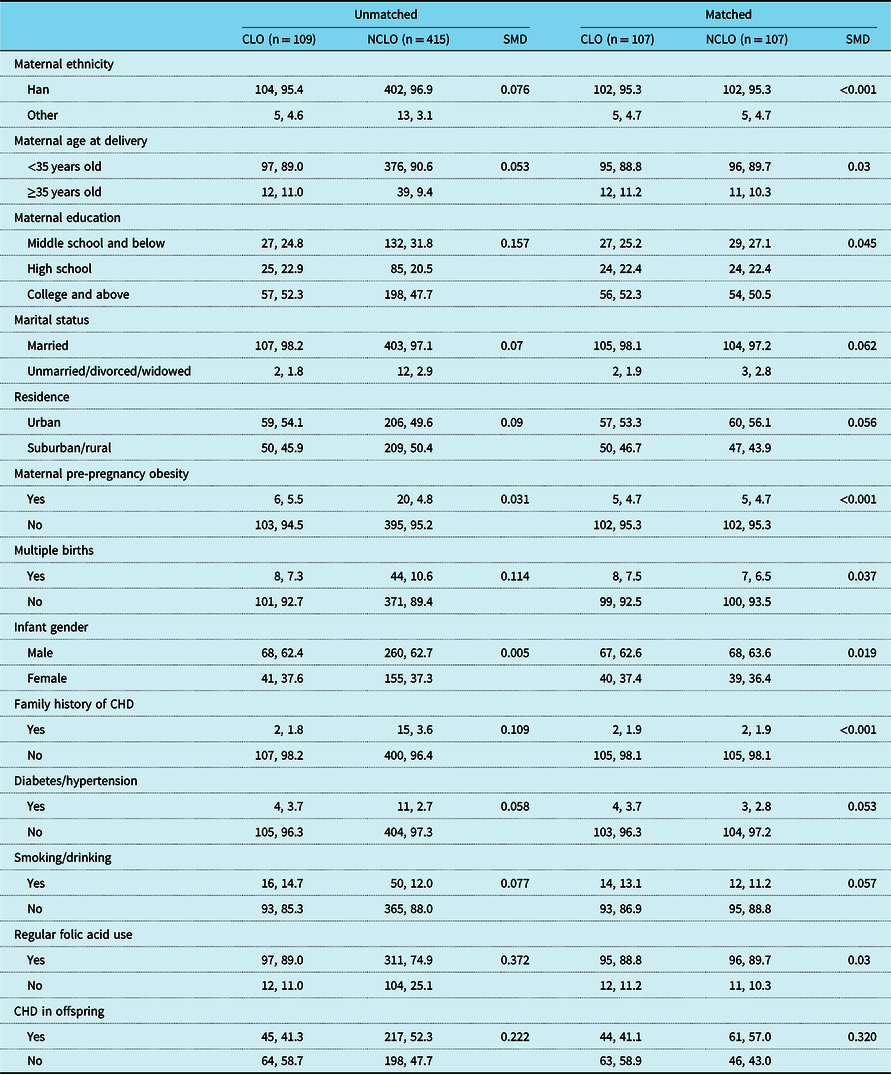
Table 1 summarises sample characteristics by mothers who used or not used cod liver oil supplementation. The standardised mean difference of variables, including maternal education level, multiple births, family history of CHD, regular folic acid use, and CHD in offspring, was greater than 0.1 before propensity score matched. These covariates were well balanced after further propensity score matching (all standardised mean difference <0.1). In addition, the description of sample characteristics by cases versus controls was shown in supplemental materials (Supplementary Table S1).
The description of sample characteristics of CLO and NCLO (n, %)

CLO = mothers who used cod liver oil; NCLO = mothers who did not use cod liver oil; SMD = standardised mean difference
The associations of cod liver oil and folic acid with severe CHD
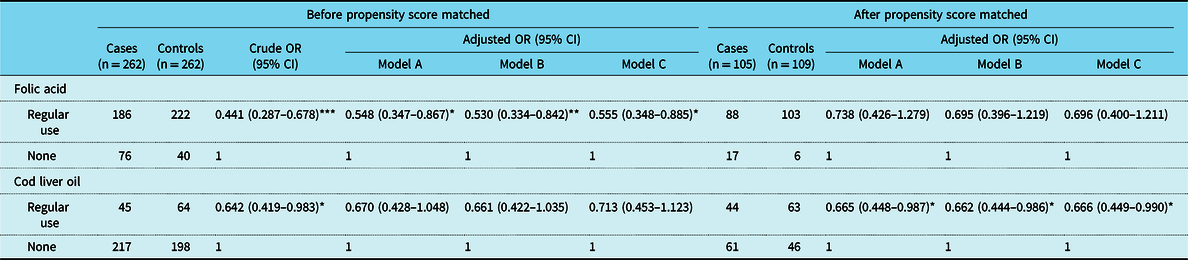
Table 2 explores the associations of cod liver oil and folic acid supplementation around the periconceptional period with CHD in offspring. Before propensity score matching, it was found that regular folic acid supplementation (odds ratio = 0.441, 95% confidence intervals: 0.287–0.678) and cod liver oil supplementation (odds ratio = 0.642, 95% confidence intervals: 0.419–0.983) around the periconceptional period were negatively associated with severe CHD. After controlling for demographic and maternity characteristics, regular folic acid supplementation remained negatively associated with severe CHD in the final full adjusted model (odds ratio = 0.555, 95% confidence intervals: 0.348–0.885). Moreover, the possible dose–response associations of folic acid or cod liver oil supplementation during the periconceptional period with severe CHD in offspring were examined in supplemental materials (Supplementary Table S2). A significant dose–response trend was shown for both folic acid and cod liver oil use; however, after being adjusted for confounding variables, the trend only existed for folic acid.
Associations of maternal folic acid and cod liver oil supplementation during periconceptional period with severe CHD in offspring

Model A: adjusted for maternal ethnicity, maternal age at delivery, maternal education, marital status, residence, maternal pre-pregnancy obesity, multiple births, infant gender, and family history of CHD
Model B: based on model A, further adjusted for pre-pregnancy diabetes/hypertension, and smoking/drinking
Model C was based on model B, further adjusted for folic acid or cod liver oil supplementation
95% CI: 95% confidence intervals; OR: odds ratio
* p value <0.05
** p value <0.01
*** p value <0.001
After propensity matching, a total of 107 matched pairs were obtained, in which folic acid was well balanced. Regular cod liver oil supplementation around the periconceptional period was still negatively associated with severe CHD (odds ratio = 0.666, 95% confidence intervals: 0.449–0.990) within the matched pairs.
The combined effects of cod liver oil and folic acid on severe CHD
The combined effects of cod liver oil and folic acid supplementation on CHD are shown in Table 3. The odds ratio of using folic acid supplementation alone was 0.461; however, when cod liver oil and folic acid supplementation were used simultaneously, the odds ratio decreased to 0.327. After controlling for demographic and maternity characteristics, the decreasing trend was still there, similarly after propensity score matching. The relative excess risk due to interaction was significant (relative excess risk due to interaction = 0.810, 95% confidence intervals: 0.386–1.235) after propensity score matching, indicating there was a positive additive interaction between cod liver oil and folic acid.
The combined effects of maternal cod liver oil and folic acid use during the periconceptional period on the risk of severe CHD in offspring

Model A: adjusted for maternal ethic, maternal age at delivery, maternal education, marital status, residence, maternal pre-pregnancy obesity, multiple births, infant gender, and family history of CHD
Model B: based on model A, further adjusted for pre-pregnancy diabetes/hypertension, and smoking/drinking
95% CI = 95% confidence intervals; OR = odds ratio; RERI = relative excess risk due to interaction
* p value <0.05
** p value <0.01
*** p value <0.001
Discussion
The present study, for the first time, explored the associations between maternal use of cod liver oil, a kind of vitamin D supplement, during the periconceptional period and the offspring’s risk of CHD. Of note is that an interaction of regular cod liver oil and folic acid supplementation and the risk of CHD was identified. This study provides epidemiological evidence to confirm that vitamin D might be involved in embryonic heart development.
A systematic review reported that the global incidence of CHD has approximately increased 15 times, from 0.6‰ during 1930–1934 to 9.1‰ in 1995, based on 114 studies worldwide over the past 60 years.Reference van der Linde, Konings and Slager17 In China, this rising trend similarly exists, and the prevalence of CHD among newborns has reached up to 11.1‰.Reference Qu, Liu and Zhuang18 Therefore, CHD has been a crucial public health challenge all around the world and in China as well. Growing attention should be focused on preventive measures to face up to this challenge, and maternal nutritional supplements could be a practical candidate. For instance, folic acid supplementation during the periconceptional period was a common traditional way to prevent neural tube defects.Reference Liu, Joseph and Luo2,Reference Mao, Qiu and Zhao19–Reference Viswanathan, Treiman and Kish-Doto21 In recent years, a consensus has been reached that folic acid supplementation during pregnancy could decrease the risk of offspring’s CHD, and it has been recommended as a nutritional supplement for preventing CHD.Reference Liu, Joseph and Luo2,Reference Mao, Qiu and Zhao19–Reference Viswanathan, Treiman and Kish-Doto21 In the present study, the protective effect of gestational folic acid supplementation on the risk of offspring’s CHD was similarly identified.
Cod liver oil is a rich source of vitamin D.Reference Mai, Langhammer and Chen22 Studies on embryo development have suggested that vitamin D is essential for normal embryonic development in vitro.Reference Wang, Huang and Castillo23–Reference Sunde, Turk and DeLuca26 To the best of our knowledge, there have been three experimental studies in animals and two epidemiological studies evaluating the impact of cod liver oil supplementation during pregnancy on the growth and development of the fetus.Reference Stene, Ulriksen, Magnus and Joner27–Reference Joshi, Rao, Girigosavi, Daware, Kale and Hegde31 Although the information is still limited, the available evidence supports that maternal intake of cod liver oil during pregnancy, in general, has a beneficial effect on the fetus.Reference Stene, Ulriksen, Magnus and Joner27–Reference Joshi, Rao, Girigosavi, Daware, Kale and Hegde31 For example, a prospective cohort study among 436 healthy women found that maternal intake of cod liver oil in early pregnancy was associated with a higher birthweight, after adjusting for the length of gestation and other confounding factors.Reference Olafsdottir, Magnusardottir, Thorgeirsdottir, Hauksson, Skuladottir and Steingrimsdottir28 As far as we know, to date our study is the only population-based study to explore the association between maternal cod liver oil supplementation and the development of CHD in their offspring. We found that regular cod liver oil use during the periconceptional period was inversely associated with the risk of severe CHD after propensity-score-matched analysis, in which selection bias has been balanced. Our findings suggest the possibility that maternal cod liver oil use might be involved in the embryonic cardiac development and has prompted us to consider the health effect of maternal cod liver oil use and to rethink prevention strategies for CHD. The potential biological mechanism proposed supports our findings. The crucial component of cod liver oil, vitamin D, was found to play an important role in the promotion of cardiac differentiation and maturation through the modulation of the Wnt signalling pathway in cell models.Reference Kwon5,Reference Hlaing, Garcia, Contreras, Norris, Ferrini and Artaza6 The impairment of vitamin D receptor could cause heart defects in the zebrafish embryo.Reference Kwon5,Reference Hlaing, Garcia, Contreras, Norris, Ferrini and Artaza6
More importantly, in the present study, we offer evidence that maternal regular cod liver oil supplementation during the periconceptional period might to some extent strengthen the protective effect of folic acid on the risk of developing severe CHD. The biological mechanisms of the combined effects are not clear. It may be explained by the regulation of folate transport systems.Reference Eloranta, Zair, Hiller, Hausler, Stieger and Kullak-Ublick32,Reference Alam, Hoque, Finnell, Goldman and Bendayan33 The reduced folate carrier and the proton-coupled folate transporter are two major folate transport systems, which operate as antiporter exchanging folates with intracellular organic phosphates and, therefore, are responsible for folate transport and absorption in the intestines, respectively.Reference Zhao and Goldman34–Reference Qiu, Jansen and Sakaris36 Previous studies have found that vitamin D could increase the expression and activity of the reduced folate carrier and the proton-coupled folate transporter, resulting in enhanced intestinal absorption of folates and cellular folate uptake.Reference Eloranta, Zair, Hiller, Hausler, Stieger and Kullak-Ublick32,Reference Alam, Hoque, Finnell, Goldman and Bendayan33 The protective effect of folic acid on CHD development has been confirmed to be dose-dependent.Reference Mao, Qiu and Zhao19 Therefore, our present findings could be of potential clinical significance.
To the best of our knowledge, this is the first study to focus on the possible impacts of maternal vitamin D supplementation on the risk of CHD in offspring. A negative association between maternal vitamin D supplementation in the periconceptional period and the development of severe CHD was identified. Furthermore, we provide evidence that vitamin D could to some extent enhance the protective effect of folic acid on the risk of severe CHD. In this case–control study, the sampled children were younger than 2 years old, which helped to control recall bias. In addition, to reduce potential selection bias and minimise confounding effects, propensity score matching was applied. The consistent results give strengthened evidence that maternal cod liver oil supplementation might play a beneficial role in embryonic cardiac development.
Several limitations should be acknowledged in interpreting the results. First, information on nutritional supplements was not detailed enough. The concentration of vitamin D in the cod liver oil supplements was hard to ascertain, given multiple different products available in China. The same is true for folic acid supplementation. Not knowing maternal dosage means that we were unable to further investigate a possible dose–response relationship. Second, the sample size was too limited for further stratified analyses. Third, recall bias is inevitable in a case–control study. Fourth, cod liver oil contains both vitamin A and vitamin D, so it was hard to eliminate the possible effect of vitamin A. A number of studies have proven that vitamin A also plays a role in cardiac development.Reference Stefanovic and Zaffran37,Reference Feng, Zhao, Hong, Shan, Shi and Cai38 However, previous data have suggested the prevalence of vitamin A deficiency in Chinese pregnant women was quite low.Reference Yang, Chen, Liu, Yun, Piao and Yang39 Fifth, circulating 25-hydroxyvitamin D was not assessed in this retrospective study, and thus it was not possible to show actual vitamin D status. However, our findings still could extend an insight into the association between vitamin D and embryonic heart development from the epidemiological perspective. Sixth, information on the specific time in gestation when the mothers took cod liver oil supplements was not collected, so that identification of the effect window was unavailable. Finally, there is the possibility of other not identified potential confounding factors, even though a wide range of confounders have been taken into account.
In conclusion, the findings of our study provide epidemiological evidence for the relationship of maternal cod liver oil supplementation with the development of severe CHD in their offspring, and the concurrent use with folic acid could to some extent enhance this protective effect. The study supports the important role of vitamin D in embryonic heart development. The findings also should be of clinically significance when considering a new strategy for preventing the development of severe CHD.
Acknowledgements
We gratefully acknowledge the persons who took the time to participate in our study. Collected data: Dr. Qihua Fu, Yimei Ma, Sha Sha, Department of Shanghai Children’s Medical Center, Shanghai Jiao Tong University School of Medicine.
Financial support
The study was funded by grants from the National Natural Science Foundation of China (81874266, 81673183), key project from Shanghai Municipal Science and Technology Commission (18411951600), the Science and Technology Funds from Pudong New Area, Shanghai (PKJ2017-Y01), the Research Funds from Shanghai Jiao Tong University School of Medicine (20170509-1), and the Scientific Research Development Funds from Xinhua Hospital, Shanghai Jiao Tong University School of Medicine (HX0251).
Conflict of interest
None.
Ethical standards
The ethical application and consent procedure of this study were approved by the Ethics Committee of Shanghai Jiao Tong University School of Medicine (Approval number: SJUPN-201717).
Supplementary material
To view supplementary material for this article, please visit https://doi.org/10.1017/S1047951120002280