





Introduction
Pyridate, developed in the late 1970s and marketed globally since the early 1980s (Cheroux Reference Cheroux1981; Klomp and Diskus Reference Klomp and Diskus1984; Roberts and Bond Reference Roberts and Bond1983), has been applied to grass crops such as corn (De Prado et al. Reference De Prado, Sanchez, Jorrin and Dominguez1992; Gaillardon et al. Reference Gaillardon, Guichaoua, Gasquez and Scalla1989), cereals (Burghardt et al. Reference Burghardt, Friedmann, Schreiber and Riederer2005; Lindner and Ruckendorfer Reference Lindner and Ruckendorfer1983), and sorghum (Wicks et al. Reference Wicks, Martin, Haack and Mahnken1994), suggesting it has the potential for use on turfgrass, although it has not been documented. Pyridate is absorbed more rapidly by young leaves and seedlings, yet selectivity in corn versus broadleaf weeds relies not on absorption or translocation, but on the formation of stable, less toxic conjugates in corn compared to labile ones in weeds such as common lambsquarters (Chenopodium album L.) (Gaillardon et al. Reference Gaillardon, Guichaoua, Gasquez and Scalla1989). Similar metabolic selectivity occurs in chickpea (Cicer arietinum L.) (Gimenez-Espinosa and De Prado Reference Giménez-Espinosa and De Prado1998). Against grassy weeds, pyridate applied at 1 to 2 kg ha−1 left annual bluegrass (Poa annua L.) unaffected and caused only nonlethal necrosis in perennial ryegrass (Roberts and Bond Reference Roberts and Bond1983). Pyridate also reduced Texas panicum [Urochloa texana (Buckley) R. Webster] and southern crabgrass [Digitaria ciliaris (Retz.) Koeler] control when it was mixed with sethoxydim (Grichar Reference Grichar1991), suggesting that it is tolerated by many grass species.
Pyridate has been used since 1981 on corn (Zea mays L.) crops to control triazine-resistant broadleaf weeds (Cheroux Reference Cheroux1981; Klomp and Diskus Reference Klomp and Diskus1984; Solymosi and Lehoczki Reference Solymosi and Lehoczki1989) because it exhibits negative cross-resistance, kills atrazine- and cyanazine-resistant Amaranthus spp. more effectively than wild-type Amaranthus (De Prado et al. Reference De Prado, Sanchez, Jorrin and Dominguez1992), and enhances control of atrazine- and glyphosate-resistant kochia [Bassia scoparia (L.) A.J. Scott] (Dhanda et al. Reference Dhanda, Kumar, Geier, Currie, Dille, Obour, Yeager and Holman2025; Wicks et al. Reference Wicks, Martin, Haack and Mahnken1994). Despite sharing a photosystem II inhibition mechanism with triazine-based herbicides (Székács Reference Székács, Mesnage and Zahler2021), pyridate’s efficacy against resistant weeds may stem from less efficient detoxification by these species (Gimenez-Espinosa and De Prado Reference Giménez-Espinosa and De Prado1998), a vulnerability possibly linked to photosynthetic alterations from prior resistance evolution (Gressel and Evron Reference Gressel and Evron1992).
When applied alone (e.g., not combined with other postemergence herbicides), pyridate does not control mature weeds, with sicklepod [Senna obtusifolia (L.) Irwin & Barneby] and Palmer amaranth (Amaranthus palmeri S. Watson) control at only 71% and ≤60%, respectively, when applied at 1.0 to 1.5 kg/ha (Grichar Reference Grichar1997a, Reference Grichar1997b; Hicks et al. Reference Hicks, Wehtje and Wilcut1990). However, tank mixes amplify its effect, particularly with auxin herbicides (Edenfield et al. Reference Edenfield, Colvin, Brecke, Shilling and McLean2001a; Grichar Reference Grichar1997a; Hicks et al. Reference Hicks, Wehtje and Grey1998), glyphosate (Dhanda et al. Reference Dhanda, Kumar, Geier, Currie, Dille, Obour, Yeager and Holman2025), and mesotrione (Campagna et al. Reference Campagna, Fabbri, Paganelli and Venturi2020). Synergy between photosystem-inhibiting herbicides and 4-hydroxyphenylpyruvate dioxygenase inhibitors has also been documented for other herbicides (Brewer et al. Reference Brewer, Askew and Askew2022a, Reference Brewer, Craft and Askew2022b; Willis et al. Reference Willis, Askew and McElroy2007). Sulfentrazone, which inhibits protoporphyrinogen oxidase, is widely used on turfgrass systems either alone or in combination with other herbicides to control troublesome sedge and broadleaf weeds (Brosnan et al. Reference Brosnan, Armel, Klingeman, Breeden, Vargas and Flanagan2010). Because sulfentrazone is often used in combination with turfgrass products, its combined use with pyridate warrants evaluation to determine turfgrass tolerance. Given rising herbicide resistance in turfgrass systems (Allen et al. Reference Allen, Ervin, Frisvold, Brosnan, McCurdy, Bowling, Patton, Elmore, Gannon, McCarty, McCullough, Kaminski, Askew, Kowalewski, Unruh, McElroy and Bagavathiannan2022; Bowling et al. Reference Bowling, McCurdy, De Castro, Patton, Brosnan, Askew, Breeden, Elmore, Gannon, Goncalves, Kaminski, Kowalewski, Liu, Mattox, McCarty, McCullough, McElroy, McKeithen, Osburn, Rogers, Rutland, Tang, Taylon, Unruh, Vargas and Bagavathiannan2024; McCurdy et al. Reference McCurdy, Bowling, de Castro, Patton, Kowalewski, Mattox, Brosnan, Ervin, Askew, Goncalves, Elmore, McElroy, McNally, Pritchard, Kaminski and Bagavathiannan2023; Rutland et al. Reference Rutland, Bowling, Russell, Hall, Patel, Askew, Bagavathiannan, Brosnan, Gannon, Goncalves, Hathcoat, McCarty, McCullough, McCurdy, Patton, Unruh and McElroy2023) and common use of herbicides known to be synergized by herbicides like pyridate (De Prado et al. Reference De Prado, Sanchez, Jorrin and Dominguez1992; Dhanda et al. Reference Dhanda, Kumar, Geier, Currie, Dille, Obour, Yeager and Holman2025; Goddard et al. Reference Goddard, Willis and Askew2010), its safety to turfgrass should be assessed. Therefore, we conducted studies to evaluate pyridate’s effects on visible injury, digitally assessed green cover, and dark green color index (DGCI) across seven turfgrass species over eight weekly assessments.
Materials and Methods
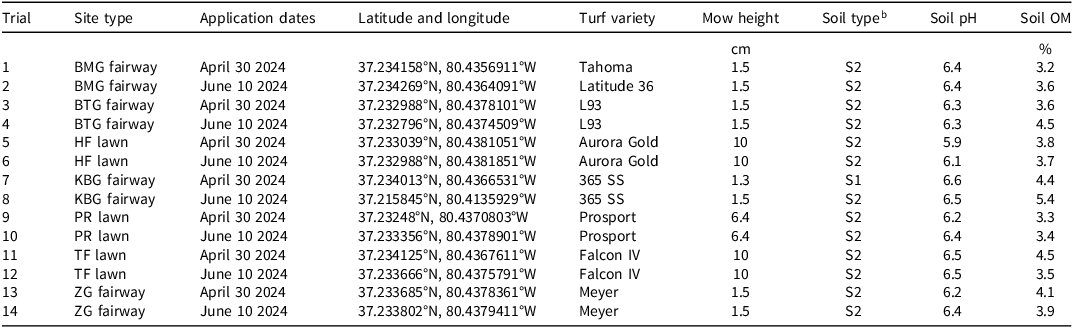
Fourteen field experiments were conducted in spring and summer 2024 to assess the tolerance of seven turfgrass species to pyridate (Table 1). Studies followed a randomized complete block design with four spatial replications, conducted at two distinct trial sites per species, separated by location and season. Application dates, turf varieties, and soil edaphic variables are detailed in Table 1. Plots measured 1.2 m × 1.8 m. Pyridate was applied at 350, 700, or 1400 g ha−1 alone, or combined with sulfentrazone (350 g ae ha−1 pyridate + 280 g ae ha−1 sulfentrazone or 700 g ae ha−1 pyridate + 560 g ha−1 sulfentrazone) all with 250 mL L−1 of a nonionic surfactant (Induce; Helena Chemical, Collierville, TN). Rates were chosen based on an assessment of existing production agriculture literature (Dhanda et al. Reference Dhanda, Kumar, Geier, Currie, Dille, Obour, Yeager and Holman2025; Wicks et al. Reference Wicks, Martin, Haack and Mahnken1994). Herbicides were applied using a CO₂-pressurized hooded boom sprayer with two 6503 flat-fan nozzles (TeeJet Technologies, Glendale Heights, IL) spaced 36 cm apart, calibrated to 374 L ha−1 at 4.8 km h−1. Bermudagrass, creeping bentgrass, Kentucky bluegrass, and zoysiagrass were mowed three times weekly, while fine fescue, perennial ryegrass, and tall fescue were mowed once weekly, at heights listed in Table 1. For each of the two trials, herbicides were applied to all turfgrass species within a 2-h time frame and ambient temperature was 23 ± 1 C for Trial 1 and 28 ± 1 C for Trial 2.
Turfgrass variety, management, and edaphic variables of research experiments to evaluate the effect of pyridate doses and mixtures on turfgrass tolerance. a

Table 1. Long description
The table presents data on fourteen field experiments conducted in spring and summer 2024. It includes details such as trial site type, application dates, latitude and longitude, turf variety, mow height, soil type, soil pH, and soil organic matter percentage. The table has 14 rows and 8 columns. Column headers are Trial, Site type, Application dates, Latitude and longitude, Turf variety, Mow height, Soil type, Soil pH, and Soil OM. Row 1: Trial 1, BMG fairway, April 30 2024, 37.234158N, 80.4356911W, Tahoma, 1.5 centimeters, S2, 6.4, 3.2 percent. Row 2: Trial 2, BMG fairway, June 10 2024, 37.234269N, 80.4364091W, Latitude 36, 1.5 centimeters, S2, 6.4, 3.6 percent. Row 3: Trial 3, BTG fairway, April 10 2024, 37.232988N, 80.4378101W, L93, 1.5 centimeters, S2, 6.3, 3.6 percent. Row 4: Trial 4, BTG fairway, June 10 2024, 37.232796N, 80.4374509W, L93, 1.5 centimeters, S2, 6.3, 4.5 percent. Row 5: Trial 5, HF lawn, April 30 2024, 37.233039N, 80.4381051W, Aurora Gold, 10 centimeters, S2, 5.9, 3.8 percent. Row 6: Trial 6, HF lawn, June 10 2024, 37.232988N, 80.4381851W, Aurora Gold, 10 centimeters, S2, 6.1, 3.7 percent. Row 7: Trial 7, KBG fairway, April 30 2024, 37.234013N, 80.4366531W, 365 SS, 1.3 centimeters, S1, 6.6, 4.4 percent. Row 8: Trial 8, KBG fairway, June 10 2024, 37.215845N, 80.4135929W, 365 SS, 1.5 centimeters, S2, 6.5, 5.4 percent. Row 9: Trial 9, PR lawn, April 30 2024, 37.23248N, 80.4370803W, Prosport, 6.4 centimeters, S2, 6.2, 3.3 percent. Row 10: Trial 10, PR lawn, June 10 2024, 37.233356N, 80.4378901W, Prosport, 6.4 centimeters, S2, 6.4, 3.4 percent. Row 11: Trial 11, TF lawn, April 30 2024, 37.234125N, 80.4367611W, Falcon IV, 10 centimeters, S2, 6.5, 4.5 percent. Row 12: Trial 12, TF lawn, June 10 2024, 37.233666N, 80.4375791W, Falcon IV, 10 centimeters, S2, 6.5, 3.5 percent. Row 13: Trial 13, ZG fairway, April 30 2024, 37.233685N, 80.4378361W, Meyer, 1.5 centimeters, S2, 6.2, 4.1 percent. Row 14: Trial 14, ZG fairway, June 10 2024, 37.233802N, 80.4379411W, Meyer, 1.5 centimeters, S2, 6.4, 3.9 percent.
a Abbreviations: BMG, bermudagrass; BTG, creeping bentgrass; HF, hard fescue; KBG, Kentucky bluegrass; OM, organic matter; PR, perennial ryegrass; TF, tall fescue; ZG, zoysiagrass.
b Soil taxonomy: S1, Duffield silt loam (fine-loamy, mixed, active, mesic, Ultic Hapludalfs)–Ernest silt loam (fine-loamy, mixed, superactive, mesic Aquic Fragiudults) complex; S2, Groseclose-Urban land complex loam (clayey, mixed, mesic Typic Hapludults); S3, Wheeling sandy loam (fine-loamy, mixed, active, mesic Typic Fragiudalfs).
Aerial images of all trials were collected weekly for 8 wk after treatment and analyzed with TurfAnalyzer software (Green Research Services, Fayetteville, AR) to quantify green cover percentage and DGCI (Richardson et al. Reference Richardson, Karcher and Purcell2001). Turf injury was visually assessed at each interval. Response variables underwent ANOVA using the GLM or MIXED procedures in SAS software (v. 9.3; SAS Institute, Cary, NC). To normalize variance, we excluded zero values (e.g., plots with no measurable response for visual estimates) and, if necessary, applied an arcsine square-root transformation. Treatments were fixed effects; experimental runs and blocks were random effects. Treatment mean squares were tested against the treatment-by-run interaction mean square (McIntosh Reference McIntosh1983). Means were separated using a Fisher protected LSD test (α = 0.05) and reported by run if treatment-by-run interactions were significant; otherwise, means were pooled across runs. Transformed data were back-transformed for presentation.
Results and Discussion
Visible Turf Injury
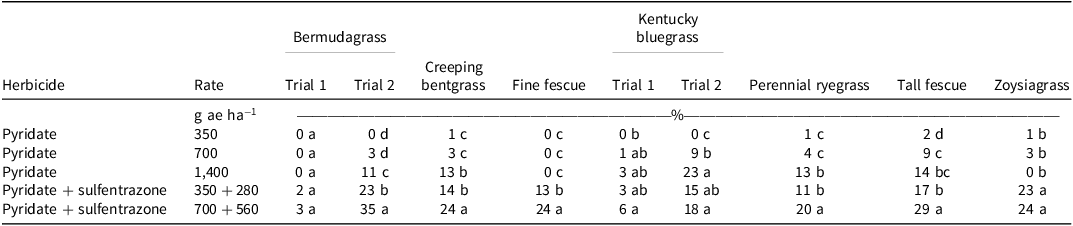
Treatments significantly affected visible turf injury across all seven species at 7 d after treatment (DAT) (P ≤ 0.0163; Table 2), but not at 14 DAT (P ≥ 0.1801). Trial-by-treatment interactions were significant for bermudagrass and Kentucky bluegrass at 7 DAT (P ≤ 0.0022) and for bermudagrass and tall fescue at 14 DAT (P ≤ 0.0245); however, injury assessed at 14 DAT remained below 13%, and was deemed biologically negligible (data not shown). Beyond 14 DAT, no injury persisted (data not shown). In Trial 1, bermudagrass exhibited no injury at 7 DAT, but Trial 2 recorded 11%, 23%, and 35% injury from applications of pyridate (1,400 g ha−1), pyridate (350 g ha−1) + sulfentrazone (280 g ha−1), and pyridate (700 g ha−1) + sulfentrazone (560 g ha−1), respectively (Table 2). This disparity likely stemmed from dry soil conditions before Trial 2, followed by morning irrigation and midday herbicide application at 28 C, versus 23 C in Trial 1 (data not shown), suggesting that leaf hydration and heat amplified the crop injury. Although temperatures on the day of treatment and 1 wk after treatment were similar between trials (25/12 and 27/13 C high/low), Trial 1 had 6 of 8 d that were either mostly cloudy or overcast compared with 3 of 8 d in Trial 2, which likely reduced foliar uptake of herbicide and subsequent injury. Likewise, less rain fell in the week following treatment in Trial 2 (0.03 cm) compared with 1.5 cm of rain during Trial 1. Since turfgrass was irrigated to prevent wilt, the environmental interaction was likely caused by warm, moist conditions from the pretreatment irrigation in Trial 2 and predominately sunny conditions, which could have increased herbicide absorption and activity compared with conditions in Trial 1. Although it is speculative, increased injury in warm, moist environments is consistent with enhanced foliar uptake of other light-dependent herbicides under similar conditions, including pyridazinones (Goddard et al. Reference Goddard, Willis and Askew2010; Shaner Reference Shaner2014) and diphenyl ethers (Fadayomi and Warren Reference Fadayomi and Warren1976). Kentucky bluegrass followed a similar pattern of environmental conditions with subsequent injury, with 15% to 23% injury recorded from these treatments in Trial 2 (Table 2).
Herbicide treatment effects on turf injury 7 d after treatment for four turfgrass species averaged over two trial sites. a

Table 2. Long description
A table comparing herbicide treatment effects on turf injury across different grass species. The table has 7 columns and 6 rows, including headers. Columns are labeled: Herbicide, Rate, Bermudagrass, Creeping bent-grass, Fine fescue, Kentucky bluegrass, Perennial rye-grass, Tall fescue, Zoysiagrass. Row 1: Herbicide, Rate, Bermudagrass, Creeping bent-grass, Fine fescue, Kentucky bluegrass, Perennial rye-grass, Tall fescue, Zoysiagrass. Row 2: g ae ha-1, Trial 1, Trial 2, Trial 1, Trial 2. Row 3: Pyridate, 350, 0 a, 0 d, 1 c, 0 c, 0 b, 0 c, 1 c, 2 d, 1 b. Row 4: Pyridate, 700, 0 a, 3 d, 3 c, 0 c, 1 ab, 9 b, 4 c, 9 c, 3 b. Row 5: Pyridate, 1,400, 0 a, 11 c, 13 b, 0 c, 3 ab, 23 a, 13 b, 14 bc, 0 b. Row 6: Pyridate + sulfentrazone 23 a, 350 + 280, 2 a, 23 b, 14 b, 13 b, 3 ab, 15, ab, 11 b, 17 b. Row 7: Pyridate + sulfentrazone, 700 + 560, 3 a, 35 a, 24 a, 24 a, 6 a, 18 a, 20 a, 29 a, 24 a.
a Means followed by the same letter within each column are not statistically different based on a Fisher protected LSD test (α = 0.05). Visible control is based on a visually estimated reduction in perceived healthy weed tissue.
The other five species, including creeping bentgrass, fine fescue, perennial ryegrass, tall fescue, and zoysiagrass, responded consistently across trials. Injury to creeping bentgrass ranged from 13% to 14% with pyridate at 1,400 g ha−1 or the low pyridate + sulfentrazone mix, escalating to 24% when higher rates of pyridate + sulfentrazone were applied (Table 2). Creeping bentgrass was injured by HPPD-inhibiting herbicides more than other cool-season turfgrasses in other studies (Brewer et al. Reference Brewer, Willis, Rana and Askew2017). Perennial ryegrass and tall fescue mirrored this trend. Fine fescue and zoysiagrass tolerated all pyridate rates (0% injury) but exhibited 13% to 24% injury with sulfentrazone admixtures (Table 2).
Injury faded by 14 DAT after all treatments, suggesting rapid turf recovery, aligning with pyridate’s short residual activity (Edenfield et al. Reference Edenfield, Colvin, Brecke, Shilling and McLean2001b) and general safety to grasses (Grichar Reference Grichar1991; Roberts and Bond Reference Roberts and Bond1983). Pyridate has caused transient phytotoxicity to perennial ryegrass (Roberts and Bond Reference Roberts and Bond1983) but did not harm Texas panicum or southern crabgrass (Grichar Reference Grichar1991). Pyridate’s safety to crops like corn, peanut (Arachis hypogaea L.), and chickpea stems from rapid metabolism into less toxic conjugates (Gaillardon et al. Reference Gaillardon, Guichaoua, Gasquez and Scalla1989; Gimenez-Espinosa and De Prado Reference Giménez-Espinosa and De Prado1998) and more rapid photosynthetic electron transport inhibition in broadleaves compared to grasses (Gimeenez-Espinosa et al. Reference Gimeenez-Espinosa, Jiménez-Díaz and Prado1995).
Sulfentrazone caused greater damage to turfgrass, as has been reported in other studies. For instance, an application of sulfentrazone + halosulfuron injured warm-season turfgrasses and reduced sod tensile strength when used at 210 to 840 g ai ha−1 (McCullough et al. Reference McCullough, De Barreda, Reed, Yu and Waltz2014). Newly sprigged bermudagrass was also injured by admixtures of sulfentrazone with metsulfuron or quinclorac (Godara et al. Reference Godara, Koo, Wright-Smith and Askew2024). In a study of ways to control false green kyllinga (Kyllinga gracillima Miq.) in a cool-season turfgrass mixture, sulfentrazone was the only herbicide that injured turfgrass (Elmore et al. Reference Elmore, Patton, Tuck, Murphy and Carleo2019).
Digitally Assessed Turf Green Cover
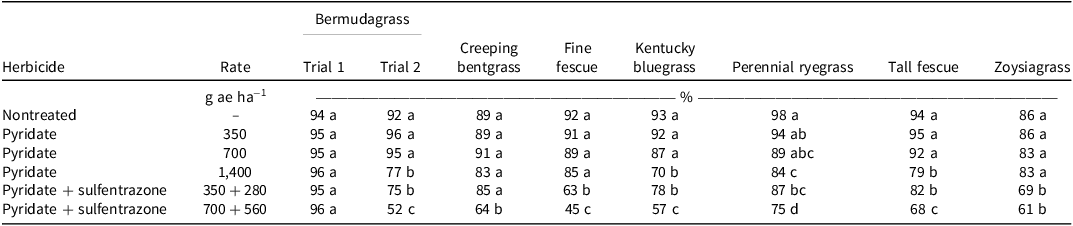
Treatments significantly reduced green cover across all turf species at 7 DAT (P ≤ 0.0016), with a trial-by-treatment interaction only for bermudagrass (P ≤ 0.0224). Beyond 7 DAT, treatment effects dissipated (P ≥ 0.2162). In Trial 1, bermudagrass maintained 94% to 96% cover across treatments at 7 DAT (Table 3), but in Trial 2, pyridate at 1,400 g ha−1 and the low-rate pyridate + sulfentrazone mix decreased cover to 75% to 77%, while the high mix reduced it to 52% (Table 3). For the other six species, treatment responses were consistent across trials, with the high pyridate + sulfentrazone rate causing the greatest cover loss in creeping bentgrass, fine fescue, Kentucky bluegrass, perennial ryegrass, and tall fescue. Plots treated with pyridate at 700 g ha−1 or less matched nontreated cover for all species, while a dose of 1,400 g ha−1 significantly reduced cover only in Trial 2 with bermudagrass, Kentucky bluegrass, perennial ryegrass, and tall fescue (Table 3).
Herbicide treatment effects on digitally assessed green cover 7 d after treatment for four turfgrass species averaged over two trial sites. a

Table 3. Long description
A table comparing herbicide treatment effects on green cover for different turfgrass species. The table has 8 columns and 8 rows, including headers. Columns are labeled as Bermudagrass, Creeping bent-grass, Fine fescue, Kentucky bluegrass, Perennial rye-grass, Tall fescue, and Zoysiagrass. The first column lists herbicide treatments and rates. Row 1: Nontreated, Rate: g ae ha^-1, Trial 1: 94 a, Trial 2: 92 a, 89 a, 92 a, 93 a, 98 a, 94 a, 86 a. Row 2: Pyridate 350, 95 a, 96 a, 89 a, 91 a, 92 a, 94 ab, 95 a, 86 a. Row 3: Pyridate 700, 95 a, 95 a, 91 a, 89 a, 87 a, 89 abc, 92 a, 83 a. Row 4: Pyridate 1,400, 96 a, 77 b, 83 a, 85 a, 70 b, 84 c, 79 b, 83 a. Row 5: Pyridate 350 + sulfentrazone 280, 95 a, 75 b, 85 a, 63 b, 78 b, 87 bc, 82 b, 69 b. Row 6: Pyridate 700 + sulfentrazone 560, 96 a, 52 c, 64 b, 45 c, 57 c, 75 d, 68 c, 61 b.
a Means followed by the same letter within each column are not statistically different based on a Fisher protected LSD test (α = 0.05). Digital green cover is based on a percentage of pixel count of weeds, which was manually desaturated, versus the surrounding plot area.
Pyridate has not been previously evaluated in turfgrass, but agronomic studies showed no effects on annual bluegrass and transient phytotoxicity to perennial ryegrass, yet cover was not assessed (Roberts and Bond Reference Roberts and Bond1983). Although several studies have reported that sulfentrazone injures various turfgrass species (Elmore et al. Reference Elmore, Patton, Tuck, Murphy and Carleo2019; Godara et al. Reference Godara, Koo, Wright-Smith and Askew2024; McCullough et al. Reference McCullough, De Barreda, Reed, Yu and Waltz2014), only a few have reported turfgrass cover reductions. Patton et al. (Reference Patton, Trappe, Richardson and Nelson2009) measured over 50% cover reduction at 14 DAT when sulfentrazone was applied at 280 g ha−1 on seedling seashore paspalum, while Godara et al. (Reference Godara, Koo, Wright-Smith and Askew2024) did not observe a reduction in sprigged bermudagrass cover at the same sulfentrazone rate and timing.
Dark Green Color Index
The DGCI was significantly altered by treatments at 7 DAT for all species except perennial ryegrass (P ≤ 0.0050), with no trial interactions (P ≥ 0.3422) or effects beyond 14 DAT. Pyridate at 350 g ha−1 preserved DGCI across species (Table 4). At 700 g ha−1, it slightly lowered DGCI only in bermudagrass, while an application of 1,400 g ha−1 reduced it for all grasses except zoysiagrass (Table 4). The high pyridate + sulfentrazone mix affected DGCI the most, which is consistent with injury and cover trends (Tables 2 and 3).
Herbicide treatment effects on dark green color index 7 d after treatment for four turfgrass species averaged over two trial sites. a

Table 4. Long description
The table presents data on the dark green color index (DGCI) for different turfgrass species under various herbicide treatments. It includes six columns: Herbicide, Rate (g ae ha⁻¹), Bermudagrass Index (0-1), Creeping bentgrass Index (0-1), Fine fescue Index (0-1), Kentucky bluegrass Index (0-1), Tall fescue Index (0-1), and Zoysiagrass Index (0-1). The table has eight rows, each representing a different herbicide treatment or nontreated condition. The herbicides listed are Nontreated, Pyridate at different rates (350, 700, 1,400 g ha⁻¹), and combinations of Pyridate with sulfentrazone at different rates (350 + 280, 700 + 560 g ha⁻¹). Each row provides the DGCI values for Bermudagrass, Creeping bentgrass, Fine fescue, Kentucky bluegrass, Tall fescue, and Zoysiagrass. Notable trends include the significant alteration of DGCI by treatments at 7 days after treatment (DAT) for all species except perennial ryegrass. Pyridate at 350 g ha⁻¹ preserved DGCI across species, while higher rates and combinations with sulfentrazone reduced DGCI, consistent with injury and cover trends.
a Means followed by the same letter within each column are not statistically different based on a Fisher protected LSD test (α = 0.05).
We found no studies in the literature to have evaluated the effects of pyridate or sulfentrazone on DGCI, but trends in the current study (Table 4) tended to mirror those of visible injury (Table 2) and digitally assessed green cover (Table 3), which were supported by the literature. It should be noted that the DGCI is calculated exclusively for the portion of each digital image falling within a user-defined “green” threshold, set at a hue of 56 to 105 degrees, saturation of 30 to 100, and brightness of 15 to 80 in the Field Analyzer software (Karcher and Richardson Reference Karcher and Richardson2003). Thus, DGCI will not always align perfectly with visible injury or cover and should be used in tandem with but not directly compared to them (Godara et al. Reference Godara, Koo, Wright-Smith and Askew2024; Hinson et al. Reference Hinson, Askew, Godara and Goatley2025). For example, a herbicide that causes necrosis to 75% of plants in a plot (but leaving 25% healthy due to poor coverage), can produce a DGCI similar to the nontreated control, because only the remaining green tissue is analyzed. In contrast, a herbicide that causes uniform mild chlorosis across the canopy keeps most pixels within the green threshold but reduces their saturation and darkness, resulting in a substantially lower DGCI. These discrepancies are herbicide-specific and depend on the type of injury.
This study demonstrates that seven turfgrass species showed tolerance to pyridate at rates up to 700 g ha−1, while higher rates (1,400 g ha−1) and sulfentrazone admixtures exacerbated injury and cover loss that manifested differently depending on trial conditions for bermudagrass and Kentucky bluegrass. DGCI trends mirrored these effects, reinforcing pyridate’s safety to grasses at lower rates and sulfentrazone’s broader phytotoxicity, consistent with prior agronomic and turfgrass research. These findings suggest that pyridate could be a viable option for selective weed control in turfgrass systems when used at moderate rates, although sulfentrazone combinations require caution due to transient turfgrass damage. Further research should explore optimal application conditions and susceptible turfgrass weeds to refine management strategies.
Practical Implications
Seven turfgrass species showed tolerance to pyridate applied at rates up to 700 g ha−1 under a range of field conditions, indicating its potential for use in selective weed control in turfgrass systems. Transient turf injury and reductions in green cover occurred at higher rates of pyridate and when tank-mixed with sulfentrazone, particularly under warm and moist conditions. These results suggest that pyridate could be integrated into turfgrass weed management programs at moderate rates.
Photosystem II inhibitors such as atrazine and simazine have limited use in turfgrass systems and are subject to increasing regulatory and environmental scrutiny. Pyridate, a Group 6 herbicide (as categorized by the Weed Science Society of America), inhibits photosystem II at a different binding site, providing an additional site of action that turfgrass managers can use to diversify their chemical weed control programs. Results from this study indicate that pyridate could provide turfgrass managers with a postemergence herbicide option for a variety of turfgrass species, with transient, acceptable injury levels under favorable environmental conditions. Available weed-control data from production agriculture studies indicate that pyridate may control sedges, an economically valuable use in turfgrass. Further evidence of tank-mixture synergies in production crops suggests that pyridate may be a viable option for use on turfgrass systems. Future research should address pyridate’s effectiveness for key turfgrass weeds, especially yellow nutsedge and false green kyllinga. Careful consideration of application rate, turfgrass species, and environmental conditions is essential to minimize turfgrass injury and maintain acceptable turfgrass quality.
Acknowledgments
We thank Jason Ratcliff, superintendent at the Virginia Tech Campus Course, and John Hinson, manager of the Turfgrass Research Center for facilities support.
Funding
This research was funded by Albaugh, LLC.
Competing Interests
Bret Corbett is employed by Albaugh, LLC, and was involved in the initial design of these experiments and data interpretation. The experiments were all conducted independently at Virginia Tech University.


 Open access

