

1. Introduction
Social scientists have noted the inverse relationship between family income or socio-economic status and family size both within and across countries. Although economic theory labels a good for which demand falls as income rises as “inferior,” economists have devoted a great deal of energy to developing models to explain this association between income and children that do not rely on the assumption that children are inferior goods. The dominant theory in this debate is referred to as the “quantity-quality trade-off” [Becker and Lewis (Reference Becker and Lewis1973), Becker and Tomes (Reference Becker and Tomes1976)] and a number of researchers have provided empirical evidence of the existence of such a trade-off with quality measured as either education or health [e.g. Lee (Reference Lee2008), Li et al. (Reference Li, Zhang and Zhu2008), Rosenzweig and Zhang (Reference Rosenzweig and Zhang2009), Ponczek and Souza (Reference Ponczek and Souza2012)]. Other researchers, however, find little empirical evidence of such a trade-off (e.g. Angrist et al. (Reference Angrist, Lavy and Schlosser2010), Millimet and Wang (Reference Millimet and Wang2011), Peters et al. (Reference Peters, Rees and Hernández-Julián2013)].
The quantity-quality trade-off recognizes that parents maximize utility by allocating time across a number of uses in combination with making expenditures on a variety of goods. Consumption choices include the demand for “child services” comprised of both the number of children and their quality. Child quality may be defined across a number of dimensions including educational attainment and achievement, social adeptness, health, and successful adult outcomes such as earnings, and/or stable family formation. Regardless of the measure of child quality, the general consensus is that its production at the family level can be both goods- and time-intensive. In the original development of the model, Becker and Tomes (Reference Becker and Tomes1976) suggest that both the quantity and quality of children enter parents’ utility functions. Inherent in the decisions to produce and consume these two child characteristics, Becker and Tomes explicitly recognize that the price of child quality is increasing in child quantity and vice versa. More specifically, an additional child is more expensive the greater is the chosen level of child quality. This theory provides a plausible explanation for the negative relationship between income and the number of children and empirical support is investigated by testing the relationship between family size and investments in children.
A difficulty in addressing the quantity-quality trade-off empirically is accounting for the simultaneity of the quality and quantity decisions. For example, well-educated parents may prefer to have fewer children because their education leads to higher wages and a higher opportunity cost of children; they are also more likely to have a strong preference for high quality. In this situation, a spurious correlation between quality and number of children exists due to heterogeneity across households.
Estimating a causal relationship between quality and quantity requires exogenous variation in one or the other. Researchers have addressed this in a number of ways, most typically by using the unanticipated birth of twins as exogenous variation in family size or using the sex composition of the first two children as an instrument for family size [e.g. Angrist et al. (Reference Angrist, Lavy and Schlosser2010), Li et al. (Reference Li, Zhang and Zhu2008), Rosenzweig and Zhang (Reference Rosenzweig and Zhang2009), Millimet and Wang (Reference Millimet and Wang2011), Ponczek and Souza (Reference Ponczek and Souza2012)]. Both of these approaches exploit plausibly exogenous variation in family size, however each has its limitations. For example, the twins strategy can only provide estimates of the effect of having two children instead of one under the assumption that there is nothing inherently different about having twins.
To conduct analyses with larger sample sizes that are not limited to twins, many researchers have relied on sex-preferences and the randomly assigned sex of the first child or first two children to generate exogenous incentives for the birth of a second or third child. For example, Lee (Reference Lee2008) uses data from South Korea and estimates models that use the sex of the first child as an instrument for family size. The validity of this instrument relies on the consistent finding that parents in many Asian countries prefer sons to daughters and if the first child is not a son are more likely to have a second child. In these countries, the sex of the first child should be a good predictor for the probability of having a second child or even for the total number of children. Using this strategy, Lee reports evidence suggesting a quantity-quality trade-off.
Relying on the gender of the first-born child as an instrument for family size may introduce another form of bias. This strategy may not be appropriate in countries where sex-selective abortion or other mechanisms for altering sex ratios at birth are commonplace because the sex of the first child is not random. The sex ratio at birth for most countries lies between 103 and 107 [CIA (2014)]. China and India are among a handful of countries in which the sex ratio at birth is above 110 and South Korea is just at the top end of the range at 107. These high sex ratios suggest that the sex of the first child may not be random for some individuals. Furthermore, using a first-born girl as the instrument for family size may conflate estimates of the impact of family size on education with the impact of son-preference on education decisions. For example, a girl without siblings is most likely born to parents without a strong son preference. These same parents may provide high levels of education for their daughters. In contrast, a first-born daughter with a sibling is more likely born to parents who are trying for a son. In that case, they may invest less in their daughter's education. More education in smaller families may result more from low son preference than from a true quantity-quality trade-off.
In this paper, we exploit a different source of exogenous variation in family size to shed additional light on the quantity-quality trade-off. The One-Child Policy in China (hereafter referred to as the OCP) has had a dramatic impact on Chinese fertility. China's total fertility rate, which can be thought of as the mean number of children born per woman, decreased from 2.9 in 1979 to 1.7 in 2004 [Hesketh et al. (Reference Hesketh, Lu and Xing2005)]Footnote 1. We examine how the OCP affected the educational attainment of Chinese migrants to the USA. This strategy allows us to examine the impact of an exogenous reduction in the family size of an individual's family of origin (resulting from the OCP) on that individual's educational attainment in adulthood. Focusing on Chinese migrants is also advantageous because access to higher education in China is regulated through a nationwide entrance exam and province-specific quotas. This limits parental discretion when investing in child quality. In order to interpret the impact of the OCP on education as a quantity-quality effect it must be the case that Chinese migrants to the USA who were born after the OCP experienced a larger drop in their fertility than did migrants from other countries in the control group. An analysis focused on migrants is novel, and although it provides estimates only for a select sample of individuals, this strategy provides a test of the quantity-quality trade-off in the absence of fertility restrictions on children as they move into adulthood themselves.
The paper proceeds as follows. We first describe the OCP and discuss research that has used it to identify the quantity-quality trade-off using data from China. We then discuss our data and empirical strategy and make the case for examining the quantity-quality trade-off using data from Chinese immigrants. Finally, we describe our results, present sensitivity analyses, and discuss the implications of our findings.
2. Background
2.1 Brief overview of China's OCP
China's OCP was formally introduced in 1979 and was intended to be a short-term measure that would help the country move to a small family culture [Hesketh et al. (Reference Hesketh, Lu and Xing2005)]. At the time, the Chinese government saw smaller families and lower population growth as essential components of a plan to increase economic growth. The OCP was actually the culmination of a series of policies targeting the creation of a small family culture. Starting in 1970, Chinese couples were urged to have only two children. Beginning in 1972 the Chinese government instituted a policy aimed at delayed childbearing with longer spacing between births – the “Later, Longer, Fewer” policy [Settles et al. (Reference Settles, Sheng, Zang, Zhao, Chan and Chan2013)]. This policy urged couples to have children when they were older, space them further apart and have fewer of them. Economic incentives were provided to families who spaced the birth of their children at least 4 years apart [Islam and Smyth (Reference Islam and Smyth2015)]. Although the formal one-child restrictions were introduced in 1979, Qian (Reference Qian2009) argues that if this 4-year birth spacing law was enforced the OCP policy should be binding for those born in 1976 and after. In our empirical work, we define the transition period as 1970–1978 and the post-OCP period as beyond 1979. We do, however, test the sensitivity of our results to these cutoffs.
The OCP is enforced at the local level by a system of rewards, penalties and fines that can vary widely. The OCP also depends on virtually universal access to contraception and abortion. In 2001, 87% of all married women in China reported using contraception compared to about 33% in most developing countries [Hesketh et al. (Reference Hesketh, Lu and Xing2005)].
The OCP only fully applies to a subset of the Chinese population. Ethnic Han Chinese (who comprise about 92% of China's population) living in urban areas or who are government employees must strictly adhere to the OCP and within this group the policy is firmly enforced with only few exceptions [Islam and Smyth (Reference Islam and Smyth2015)]. Some relaxation of the policy occurred in 1985. In rural China, where the majority of the population still resides, a second child sometimes has been allowed after 5 years, particularly if the first is a girl, a reflection of the strong son preference in China [Hesketh et al. (Reference Hesketh, Lu and Xing2005), Islam and Smyth (Reference Islam and Smyth2015)]. Exceptions also have been allowed if a first-born child is disabled, if the parents work in highly dangerous occupations or if both parents are themselves from one-child families.
2.2 Empirical evidence of a quantity-quality trade-off under the OCP
We are aware of only three studies that use the OCP as exogenous variation in family size to identify a quantity-quality trade-off. Qian (Reference Qian2009) studies exogenous changes in family size caused by the relaxation of China's OCP. She estimates the causal effect of family size on the school enrollment of the first child. Using regional and time variation in China's relaxation of its OCP for rural families as well as multiple births, Qian estimates the effects of increased family size on child education. Her somewhat surprising results suggest that the relaxation of the OCP increased the school enrollment rate of first-born children. She suggests that this occurs because of economies of scale in schooling; e.g. children from the same family can share textbooks and clothing.
In contrast to the findings of Qian (Reference Qian2009) both Rosenzweig and Zhang (Reference Rosenzweig and Zhang2009) and Liu (Reference Liu2014) find support for the quantity-quality trade-off in China. Specifically, in their analysis of the Kunming district in China, Rosenzweig and Zhang (Reference Rosenzweig and Zhang2009) use twin births and the relaxation of the OCP as their measure of exogenous family size and find that educational attainment and child health decline for earlier-born children in response to the birth of an additional sibling.
Finally, Liu (Reference Liu2014) uses a similar identification strategy as Qian (Reference Qian2009) and Rosenzweig and Zhang (Reference Rosenzweig and Zhang2009) but in addition to increased eligibility for an exception after relaxation of the OCP as an instrument for number of children, Liu also uses the level of regional fines for unsanctioned births and an interaction between the two as exogenous determinants of fertility. He finds that additional children in a family significantly reduce child height in support of the existence of a quantity-quality trade-off. Liu also examines education outcomes and finds only weak evidence that increased quantity lowers quality as measured by educational attainment.
The mixed results from these prior studies do not provide conclusive evidence that reduced fertility leads to additional education in China, particularly when examining educational outcomes beyond secondary schooling. Changes in child quality in response to increases in child quantity may result from the fact that decisions about educational attainment are made in the context of expectations about marriage and fertility. These other considerations are likely to be affected by the OCP, and are expected to be particularly salient for educational decisions made for and by female children. With the OCP still in place, it is plausible that increased educational attainment is in response to the anticipation of restricted fertility for the child. In particular, since children born in the OCP environment may, as adults, be subject to the same policy, their parents may base their education investment decisions for these children on an expectation of their child's low fertility. For example, parents who have a daughter may expect that she would only have one child and as a result, invest heavily in her education knowing that she would experience low fertility. To eliminate this possibility, we analyze a sample of Chinese born men and women who migrated to the USA and we observe their educational attainment in an environment where their fertility as an adult is unconstrained by policy.
3. Data and method
We use data from the American Community Survey (ACS) for the years 2009–2014Footnote 2. These data are well-suited for our analysis for several reasons. First, the ACS contains information on country of birth, date of migration and citizenship status as well as education, age, and year of birth thus facilitating our identification strategy. Second, the large sample allows us to focus on immigrants from specific countries of interest.
Our econometric strategy is to estimate a difference-in-difference model comparing migrants born before and after the OCP in 1979 in China to those born before and after 1979 in other East Asian countries. To that end, we estimate the following econometric model:
 $${\rm} y_{ibcm} = \alpha + ({\rm Pos}{\rm t}_b \times C_c)\gamma _1 + X_{ibcm}\gamma _2 + \eta _b + \phi _c + \lambda _m + \theta _{c \times m} + \varepsilon _{ibcm},$$
where y ibcm is a measure of educational attainment for person i born in year b in country c, who migrated to the USA in year m Footnote 3. We examine three educational outcomes: having at least attended college, at least completing college, and the number of years of education attained.
Postb is a binary variable equal to 1 if the individual was born after 1979 when the OCP became effective in China. C c is a binary indicator that an individual was born in China and 0 if they were born in one of our control group countries, so Postb × C c is our treatment indicator – having been born in China after the implementation of the OCP. We omit those who are born abroad of American parents because their parents would not be subject to the exogenous shock to family size created by the OCP. X ibcm is a vector of individual-specific controls including age and its square, marital status and years in the USA. We also control for citizen status, distinguishing between those who are foreign-born naturalized citizens and those who are foreign born but not citizens.
To implement the difference-in-difference strategy, we control for year-of-birth and country-of-birth fixed effects. The coefficient of primary interest, γ 1, is the effect of being born in China after the implementation of the OCP.
The Cultural Revolution in China ended just before the OCP was enacted. Starting in 1966 and lasting for about a decade, this movement had a tremendous impact on the educational system in China [Andreas (Reference Andreas2009)]. In the early months of the Cultural Revolution, schools and universities were closed. Primary and middle schools later gradually reopened, but all colleges and universities were closed until 1970, and most universities did not reopen until 1972. University entrance exams were canceled and not reinstated until 1977. Because our outcome of interest is education, the timing of the Cultural Revolution, ending just as the Later, Longer, Fewer policy was starting, might confound our results. To address this, (and to capture changes in migration policy in the USA over time as well as variation in migration drivers by country of origin) we also include migration cohort fixed effects and the interaction of migration cohort with country-of-birth fixed effects.
Because our data span the years 2009–2014, individuals born after the OCP in our sample are at most 34 years old. We examine the education decisions of males and females aged 24–40 years to allow sufficient time for them to have completed a college education. Individuals born after 1979 (Post-OCP) are aged 24–34 during our sample period while those born in the transitional period between 1969 and 1978 range in age from 30 to 40 during our sample period between 2009 and 2014. Thus, in our baseline model individuals in our sample were born between the years 1969 and 1990. We limit ourselves to a relatively narrow age range to avoid confounding effects of the OCP with changes in migrant cohort quality [Borjas (Reference Borjas1985)].
As noted above, the OCP was formally introduced in 1979 after a transition period which was marked by a call to voluntarily delay marriage and reduce family size with the Later, Longer, Fewer policy. To minimize the range of birth cohorts and ages, we limit our pre-OCP time frame to those born between 1969 and 1978, and the post OCP period to those born after 1979. Because the policy became effective in 1979 we exclude those born in 1979 from our sample.
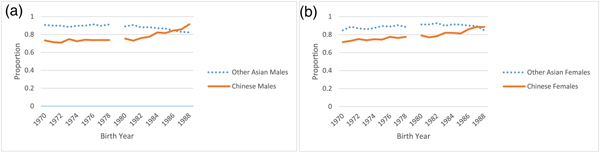
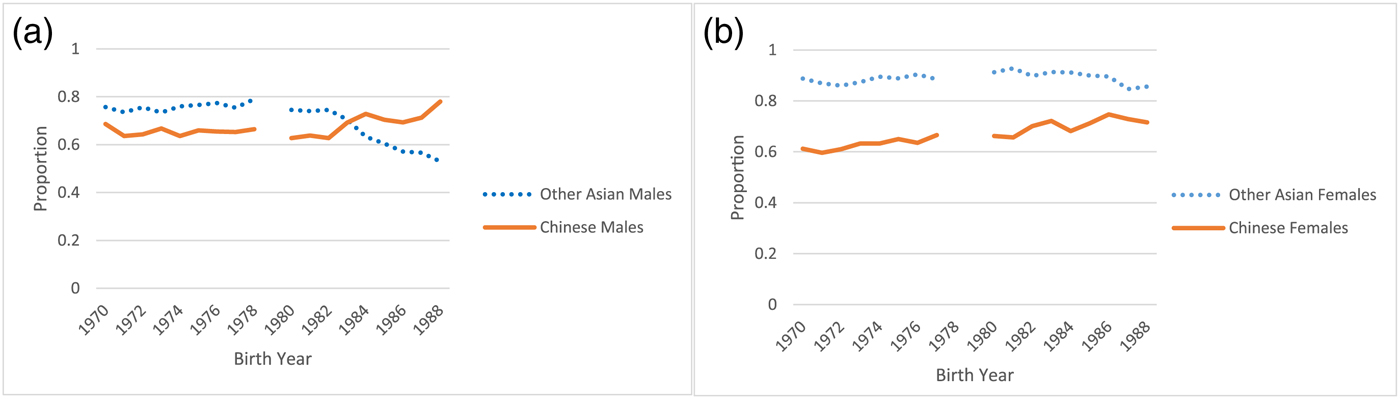
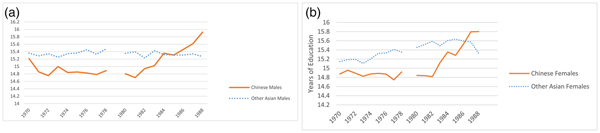
Our control group consists of migrants born in other East Asian countries who were not subject to the OCP. This includes individuals born in Hong Kong, Taiwan, Japan, and South KoreaFootnote 4. In our specification checks, we also introduce India as a control group as we detail below. An appropriate control group should be similar to the treatment group in terms of observable characteristics and also exhibit similar pre-treatment trends in the outcome variable(s) of interest (i.e. educational attainment). Figures 1–3 depict average educational attainment for individuals by birth year for our treatment and control groups. For both males and females the treatment and control groups exhibit similar trends for individuals born prior to the OCP in 1979, although the levels are higher for other East Asians compared to Chinese migrants. Despite these similarities we will test the sensitivity of our estimates by directly controlling for pre-OCP treatment trends. As seen in the figures, the post-1979 trends diverge dramaticallyFootnote 5. It is important to stress that our identification strategy is predicated on the assumption that the OCP is binding prior to migration and ultimately results in fewer children even for those who migrate to the USAFootnote 6. However, we cannot tell whether the migrants in our sample came from an urban or a rural area in China thus we cannot know for sure if their parents would have been subject to the strictest OCP restrictions while they were in ChinaFootnote 7.
(Colour online) (a) Proportion Attended College by Birth Cohort – Males (b) Proportion Attended College by Birth Cohort – Females.

(Colour online) (a) Proportion Graduated College by Birth Cohort – Males (b) Proportion Graduated College by Birth Cohort – Females.

(Colour online) (a) Average Years of Education by Birth Cohort – Males. (b) Average Years of Education by Birth Cohort – Females.

4. Results
4.1 Descriptive statistics and baseline model
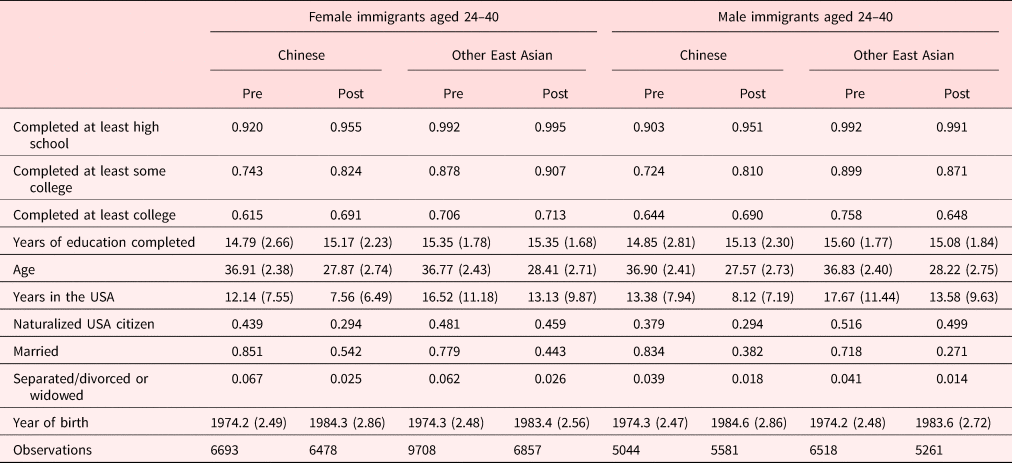
Table 1 presents the means of outcome and control variables by treatment and control group status before and after the OCP for men and women. We conduct all of our analyses separately by gender. The first four columns of Table 1 are the means for female migrants by birthplace and birth cohort (born pre- and post-OCP). The next four columns are the same information for male migrants. Comparing Column 1(5) to Column 3(7) allows us to compare the pre-treatment characteristics of Chinese to other East Asian migrants. In the pre-period, for both men and women, other East Asian immigrants have more education than their Chinese counterparts, have been in the USA longer, are more likely to be citizens and are less likely to be married. In columns 2(6) and 4(8), we see similar differences in the post-period with respect to years in the USA and citizenship status. However, both immigrant Chinese men and women now have a much smaller gap in years of education compared to their East Asian counterparts.
Sample means

Standard deviations of continuous variables in parentheses.
From Table 1 we can calculate unadjusted difference-in-differences estimates which foreshadow the parametric results to come. We see that on average Chinese men born after 1979 have 0.28 more years of education than Chinese men born before the OCP. In comparison, East Asian migrant men born post-OCP have 0.52 fewer years of education on average compared to those born before the OCP. This leads to a difference-in-differences estimate of a 0.80 larger increase in education for Chinese vs. East Asian male migrants. A similar calculation for women reveals a smaller education advantage of 0.38 which still favors Chinese-born womenFootnote 8.
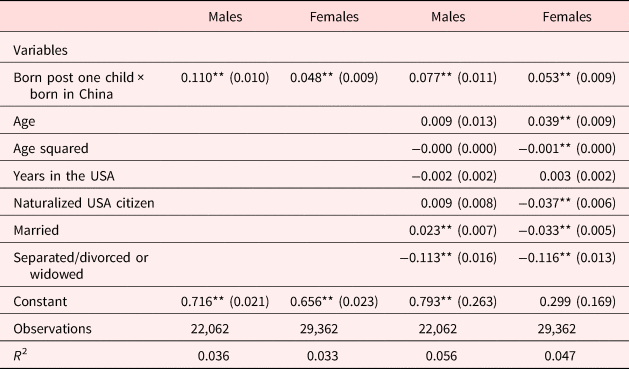
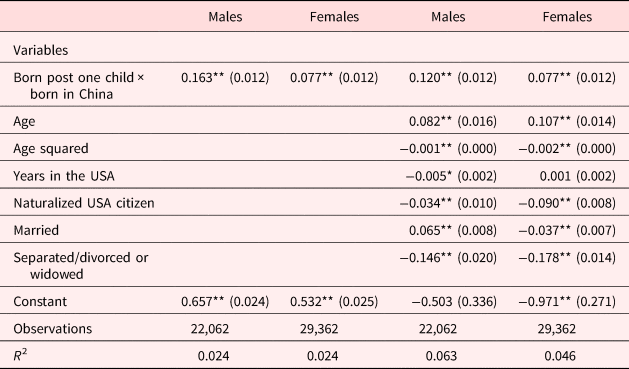
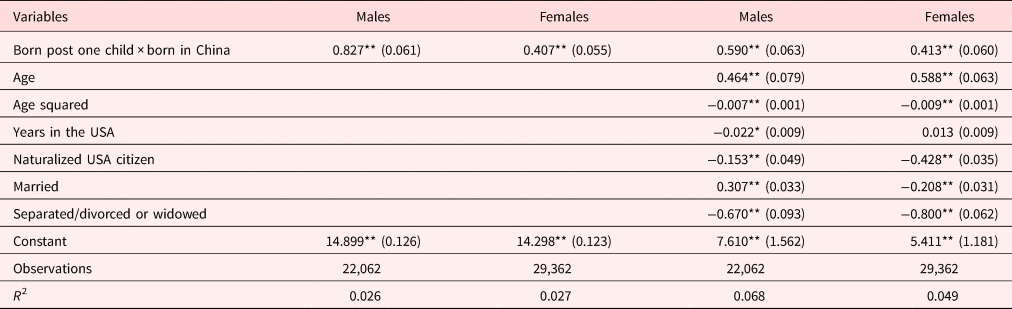
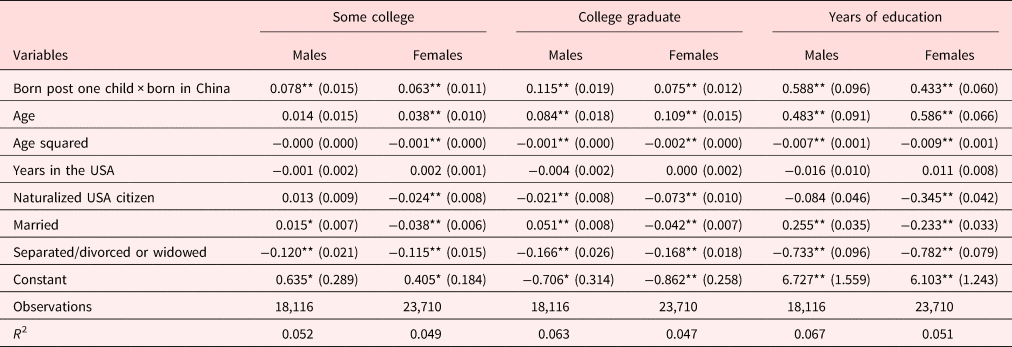
Tables 2–4 present the results of our estimation of equation (1) above. Each table is a different educational outcome as described earlier. For each outcome, we estimate two models separately by gender. The first is a model that only controls for birth-country and birth-year fixed effects and the second model adds the full set of controls. Because ordinary least squares standard errors are known to be biased downward in this type of application, all standard errors are bootstrapped.
Determinants of education-completed at least some college: China vs. other East Asian countries

**p < 0.01, *p < 0.05 Bootstrapped standard errors in parentheses. Columns 1 and 2 control for birth year and birth country. Columns 3 and 4 include a full set of controls including birth year, birth country, entry cohort fixed effects, and entry cohort by birth country fixed effects.
Determinants of education-completed at least college: China vs. other East Asian countries

**p < 0.01, *p < 0.05 Bootstrapped standard errors in parentheses. Columns 1 and 2 control for birth year and birth country. Columns 3 and 4 include a full set of controls including birth year, birth country, entry cohort fixed effects, and entry cohort by birth country fixed effects.
Determinants of education-years of education completed: China vs. other East Asian countries

**p < 0.01, *p < 0.05 Bootstrapped standard errors in parentheses. Columns 1 and 2 control for birth year and birth country. Columns 3 and 4 include a full set of controls including birth year, birth country, entry cohort fixed effects, and entry cohort by birth country fixed effects.
Our results reveal that being born after the OCP exerted a positive and significant impact on educational attainment of Chinese migrants to the USA compared to other East Asian migrants that is consistent with the quantity-quality trade-off. In Tables 2–4 we see that no matter the measure of education, compared to other East Asian migrants, men and women who migrated from China and were born in the post-OCP period obtained significantly more education. The effect is larger for men than for women and is statistically significant at the 1% level for both groups. Adding the full set of covariates tends to attenuate the coefficients for the men while leaving those of the women either unchanged or slightly larger. In all cases, estimates remain statistically significant.
The magnitudes of these estimates are meaningful in that from the fully specified models shown in Tables 2–4, for men, there is a post-OCP increase of the probability of attending college of nearly eight percentage points and an increased probability of completing college of over 12 percentage points. The effects for women are slightly smaller, a five percentage point increase in attending college and a nearly eight percentage point increase in completing college. Overall, our analyses indicate an increase of 0.59 (0.41) of a year of education for men (women) that substantially narrows the education gap between migrants from China and their other East Asian migrant counterpartsFootnote 9.
In the next section, we conduct a number of specification checks including controlling for possible differences in pre-trends across our treatment and control groups, allowing for differences in behavioral responses in the pre- and post- periods, and constructing a wider window for the OCP to account for the Later, Longer, Fewer policy. In addition, we extend our analyses to groups of migrants restricted by the timing of and age at migration. We also falsify the timing of the OCP.
4.2 Specification checks
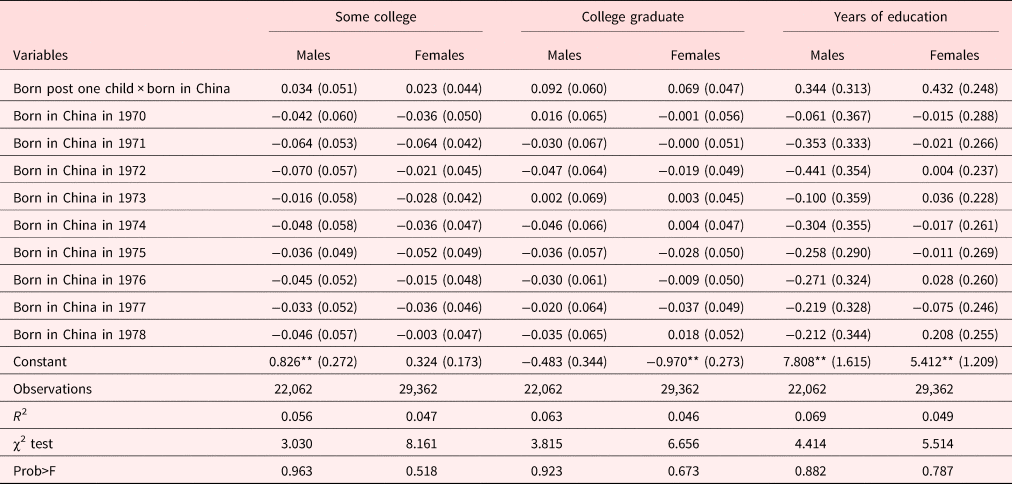
The key assumption underlying any successful difference-in-differences strategy is that the outcome of interest in the treatment and the control groups would follow the same trend over time if not for the treatment. Specifically, in our case, we would be concerned if Chinese immigrants born before the OCP already displayed a trend in their educational attainment which was significantly different from that of our control group (other East Asian migrants) for all birth cohorts prior to the implementation of the OCP. In that instance, it would be difficult to conclusively attribute the change in our outcome variable to the policy change itself. Although visual examination of the pre-trends presented in Figures 1–3 provides some evidence of parallel pre-trends, to formally examine whether our estimates are confounded by differences in pre-treatment trends we control for these trends directly in the model. In specifications shown in Table 5 we re-estimate the fully-specified models presented in Tables 2–4 but include interactions between being born in China and each birth-year in our sample prior to 1979Footnote 10. We find that these interactions are never individually significant nor are they jointly significant as evidenced by the p values shown in the table. The point estimates on the difference-in-differences coefficients are smaller for men and virtually unchanged for women, although the standard errors are much larger in these models. These larger standard errors mean our coefficients of interest are no longer significant though they are still positive and of an economically meaningful magnitude. Importantly, these results suggest that that pre-existing trends in educational attainment are not driving our results. Because the pre-trends are never individually or jointly significant, as is typical we do not include them in the remainder of our models.
Chinese vs. other East Asian countries: controlling for pre-trends

**p < 0.01, *p < 0.05 Bootstrapped standard errors in parentheses. All models include a full set of controls including birth year, birth country, entry cohort fixed effects, and entry cohort by birth country fixed effects.
Another important specification check concerns the timing of the OCP. As noted earlier, the precursor to the OCP was the Later, Longer, Fewer policy and as Qian (Reference Qian2009) notes, one can effectively think of the OCP as beginning in 1976. To see how sensitive our results are to the changing social norms regarding family size that were being implemented during this time period, we drop individuals from our sample who were born in 1976, 1977, 1978 or 1979 resulting in a comparison of those born between 1970 and 1975 (pre-OCP cohorts) to the post-OCP cohorts born after 1979. The results from this change in specification are presented in Table 6. Once again, the results are remarkably similar to the fully-specified baseline models in Tables 2–4 in magnitude and statistical significance.
China vs. other East Asian countries-expanded gap accounting for later, longer fewer policy

**p < 0.01, *p < 0.05 Bootstrapped standard errors in parentheses. These models delete individuals born between 1976 and 1979 inclusive. All models include a full set of controls including birth year, birth country, entry cohort fixed effects, and entry cohort by birth country fixed effects.
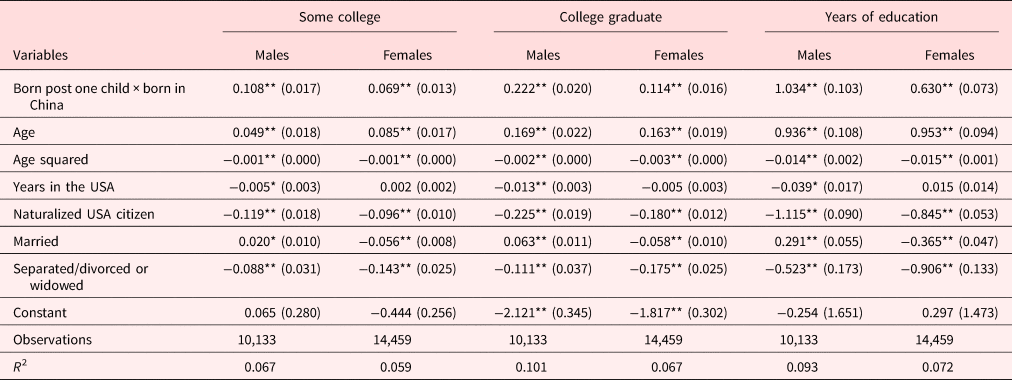
Immigration rules have changed over time in the USA. While we control for this in our model by including migrant cohort-by-country fixed effects, to be sure that our educational differences are not driven by differing policies on who can migrate to the USA, we re-estimate the fully-specified baseline models shown in Tables 2–4, restricting our sample to those who have migrated to the USA within the past 10 years. Our justification for this specification is that these more recent migrants face approximately the same immigration policies. These results are presented in Table 7 and our coefficients of interest are, if anything, somewhat larger in magnitude and still positive and significant when compared to our baseline results in Tables 2–4.
China vs. other East Asian countries: recent migrants

**p < 0.01, *p < 0.05 Bootstrapped standard errors in parentheses. All models include a full set of controls including birth year, birth country, entry cohort fixed effects, and entry cohort by birth country fixed effects. Sample consists of individuals who migrated to the USA within 10 years of the survey year.
Because the theoretical explanation of the quantity-quality trade-off focuses on investment decisions made by parents, we also estimate models limiting the sample to those who migrated between the ages of 10 and 17 (inclusive). This also ensures that their education was completed in the USA. By examining outcomes for individuals who migrated after the age of 10 we attempt to exclude individuals whose parents left China to have more children than allowed under the OCP. Individuals who migrated before the age of 18 were likely to be accompanied by their parents. This increases the likelihood that parents were influential in decisions regarding educational attainment. Because this sample is limited to individuals who migrated before adulthood, they completed their education in the USA. This has the added advantage of allowing us to better separate the influence of family size from other economic or educational reforms in different native countries. Estimates for the samples migrating between the ages of 10 and 17 are presented in Table 8. Our results are, once again, remarkably similar to our baseline results. In addition, even if those parents who chose to migrate to the USA after the OCP are those most interested in having additional children, to the extent that increased fertility dampens the demand for education, the bias introduced by this sample selection should work against finding significant increases in education for post-OCP birth cohorts as we find here.
China vs. other East Asian countries: migrated as children

**p < 0.01, *p < 0.05 Bootstrapped standard errors in parentheses. All models include a full set of controls including birth year, birth country, entry cohort fixed effects, and entry cohort by birth country fixed effects. Sample consists of individuals who migrated to the USA between the ages of 10 and 17 inclusive.
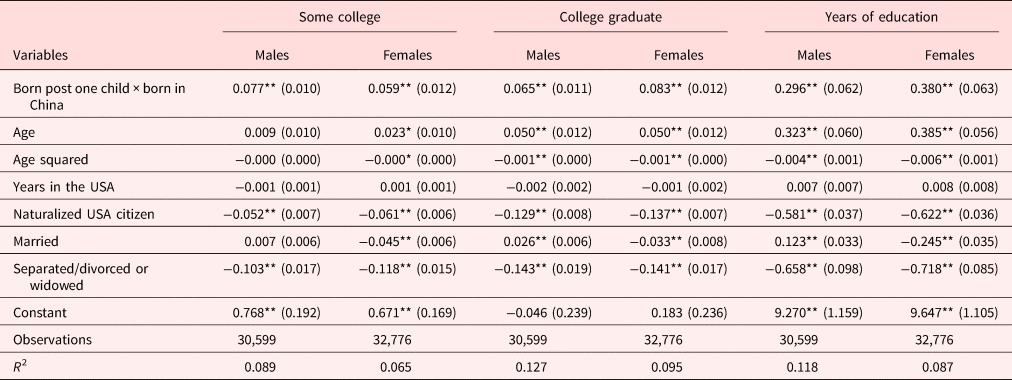
To test the robustness of our results, we then consider India as an alternate control group and we present these results in Table 9. Although India was experiencing declining fertility over the same period, it did not adopt a formal policy regarding fertility like that of China in 1979. We see a significant positive effect of the OCP on the educational attainment of Chinese migrants compared to Indian migrants in the post-OCP period. The point estimates are smaller but still statistically significant indicating that although China and India each experienced declining fertility over the relevant periods, differences in educational attainment for cohorts born before and after the introduction of the OCP in China are larger than differences in educational attainment for the same cohorts in India. This suggests that the sharper break in fertility associated with the OCP in China translated into significant increases in education among Chinese-born men and women who migrated to the USAFootnote 11.
Determinants of education: India as control group

**p < 0.01, *p < 0.05 Bootstrapped standard errors in parentheses. All models include a full set of controls including birth year, birth country, entry cohort fixed effects, and entry cohort by birth country fixed effects. Our control group now consists only of migrants from India.
4.3 Falsification test
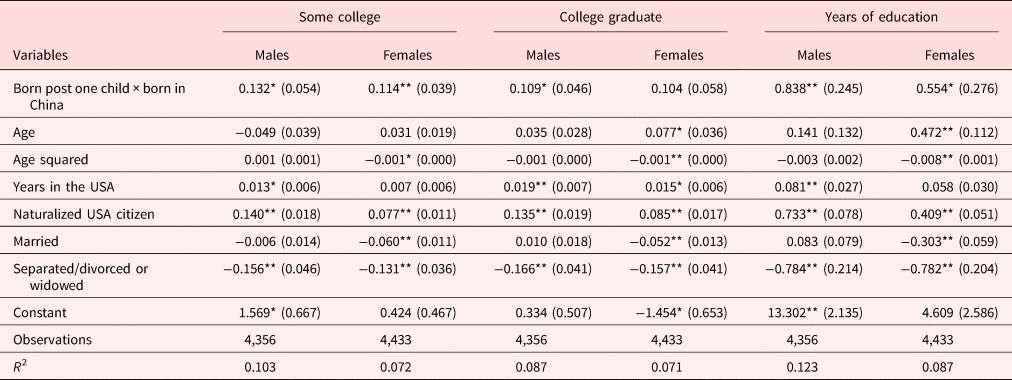
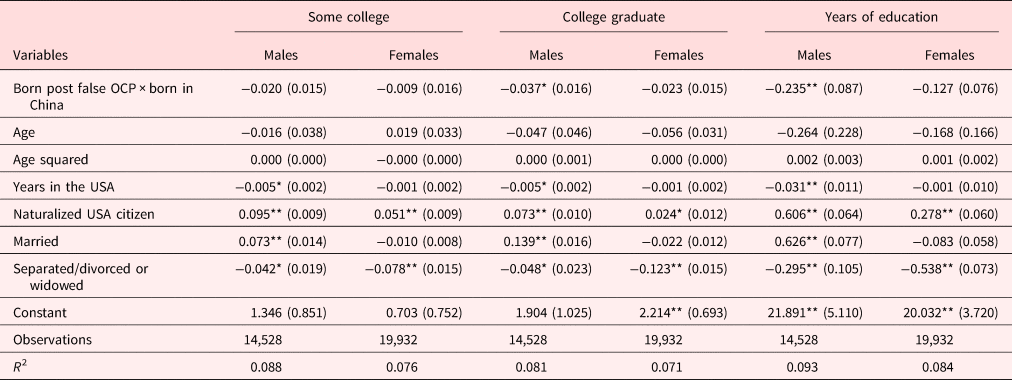
We perform one last specification check where we falsify the timing of the OCP to add empirical support to the hypothesis that the OCP is driving our results. Specifically, we drop from our sample anyone born after 1970 and we classify those born after 1965 as born in our false OCP time frameFootnote 12. Similar to our preferred specification, we want to avoid confounding the effects of our false OCP with changes in cohort quality and so we now limit our age range to those between the ages of 39 and 50. The results of this falsification test are presented in Table 10. We see that the coefficients become negative and most are not statistically significant. We interpret these estimates as indicating that there is no positive effect on education of being born in an era where there was no OCP. These results give us confidence that our earlier results are capturing the effect of smaller family size on educational investment.
China vs. other East Asian countries: falsified policy timing

**p < 0.01, *p < 0.05 Bootstrapped standard errors in parentheses. All models include a full set of controls including birth year, birth country, entry cohort fixed effects, and entry cohort by birth country fixed effects. We falsify the OCP to be 1965 thus the “pre OCP” period in this analysis is from 1960 to 1964. The “post OCP” period is from 1966 to 1970.
5. Conclusion
In this paper, we use exogenous variation in fertility caused by China's OCP to test the quantity-quality trade-off hypothesis. Using data from 6 years of the ACS, our approach is novel in that we focus on migrants from China to the USA and use a similar sample of migrants from other East Asian countries as a control group.
Examining migrants to the USA when using the OCP as exogenous variation in family size is advantageous over other papers that use the OCP as exogenous variation in family size but analyze the behavior of individuals in China because our strategy provides a test of the quantity-quality trade-off in the absence of fertility restrictions on children as they move into adulthood themselves. Because our empirical strategy involves estimating educational attainment for (young) adults born in China and East Asia who migrated to the USA, one concern with our empirical strategy if we hope to interpret our estimates as indicators of a causal effect of family size on child quality, is that the estimates may be biased due to endogeneity. The source of the possible endogeneity arises from the fact that there are three decisions that are potentially made simultaneously. Parents (or young adults, depending on the age at the time of migration) are making two decisions to invest in human capital – migration and educational attainment. We address this concern by conducting difference-in-differences analysis; we use other East Asian migrants as a control group. To the extent that migration alters or is correlated with the education decision, our estimates should net out this bias.
We find evidence of a quantity-quality trade-off. Our results show that individuals born after the OCP who migrated from China to the USA obtained more education than their counterparts who migrated from other East Asian countries without an OCP. Specifically, male Chinese immigrants born after the OCP in China are 12 percentage points more likely to attend college and obtain nearly 0.6 more years of education than their East Asian counterparts. The results for women are similar, although somewhat smaller. Female Chinese immigrants are nearly eight percentage points more likely to complete college and obtain 0.4 more years of education than similar female immigrants from East Asia. Our results are robust to numerous specification checks and to a falsification test.
China's concerns about a fertility rate that is well below replacement level, coupled with a declining workforce and a rapidly aging population led them to relax their OCP in 2015 [BBC (2015)]. Although educational attainment in China has recently risen dramatically, our research suggests that subsequent fertility increases may result in declining parental investments in education.
Acknowledgements
The authors thank Deborah Cobb-Clark, Daniel Hamermesh, Jessica Hardie, Jie Ma, David Ribar, Massimiliano Tani, Sabrina Terrizzi and Yang Wang for helpful comments on earlier drafts.
Conflict of interest
The authors declare that they have no conflict of interest.