


Pericopes on the cities of refuge to which an unintentional manslayer may flee appear in two places in the Pentateuch: in Numbers 35 and Deuteronomy 19.Footnote 1 The accepted scholarly position assigns the pericope in Numbers to the Priestly sourceFootnote 2 and the pericope in Deuteronomy to the Deuteronomic source. Various attempts have been made to determine the chronological relationship between these pericopes by a careful examination of their details.Footnote 3 This article will demonstrate that the details of these pericopes and the differences between them emerge from the differing internal logic of each text, and therefore each should be examined independently, without reference to the connections between them.Footnote 4 In Numbers, the purpose of the cities of refuge is to remove the unintentional manslayer from the land, while in Deuteronomy it is to protect the murderer from the blood-avenger. As will be shown, the details of the law and the style of each pericope are precisely suited to its particular tendency. Finally, further insights will be gained by expanding the focus and examining the significance of these pericopes in the larger context of the books in which they are situated.Footnote 5
“No blood-guilt” or “He did not incur the death penalty”
The key point for understanding the differing details of these pericopes may be found in the verses addressing the “blood” of the slayer.
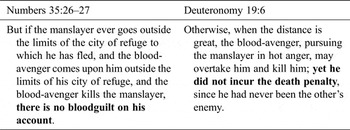
Numbers states that if the unintentional manslayer leaves the city of refuge, the blood-avenger may kill him, because “there is no bloodguilt on his account.” The pronoun “his” refers to the manslayer; not to the blood-avenger,Footnote 6 and it means that his blood is permitted. One who kills him has not shed blood, because “there is no bloodguilt.”Footnote 7 It would be unreasonable for such a severe outcome to be the result of nothing more than leaving the city, in punishment for nothing more than that departure. As will be established below, the concept underpinning this pericope is that the basic penalty of the unintentional manslayer is death. Despite this, the sentence is suspended if he flees to a city of refuge; if he leaves the city, the basic penalty again becomes enforceable.
Conversely, the pericope in Deuteronomy makes the opposite assumption. Verses 6–7 specifically establish the reason for the commandment to set aside three cities, using an internal quote from the beginning of the pericope (verse 2). Its concern is that the blood-avenger might pursue the manslayer and kill him before he reaches the city of refuge because “the distance is great.” This result, the killer's death at the hand of the blood-avenger, is unjust because the killer “did not incur the death penalty.” It is necessary to prevent his death because he did not kill his fellow out of hatred (“since he had never been the other's enemy”).Footnote 8
Accordingly, in Numbers the “unintentional” manslayer is liable to death and his blood is permitted, but his flight to the city of refuge prevents implementation of the sentence, whereas the “unwitting” manslayer in Deuteronomy is not liable to death and his flight to the city of refuge is intended to ensure the implementation of this ruling. Indeed, Deuteronomy specifies that killing the manslayer is not a service of justice, conducted with due consideration, but rather a consequence of the “hot anger” of the blood-avenger, who is unable to distinguish between the unintentional and the intentional.Footnote 9
“Provide” or “Set Aside”
Moreover, the differing instructions given for designating cities of refuge at the beginning of each pericope reflect this distinction:

Whereas Numbers calls for “providing” (NJPS)Footnote 10 cities, and does not make the effort to clarify how exactly these cities are to be selected, Deuteronomy commands the intentional allocation of the cities, requires an organized infrastructure of roads leading to them, or their size (“surveyFootnote 11 the distances”) and equidistant distribution (“divide into three parts”). It seems that these specifications emerge from the concern that the unintentional manslayer be able to reach a city of refuge quickly, before being caught by the blood-avenger. Thus, these commands enable the principal intention of the pericope in Deuteronomy: preventing the killing of the unintentional manslayer. Since Deuteronomy does not consider the manslayer liable to a death sentence, there is a mandate to minimize the obstacles that might prevent him from reaching the city (“when the distance is great,” Deuteronomy 19:6) to ensure that he arrives speedily, and is not murdered by the blood-avenger.Footnote 12 Conversely, Numbers is apathetic to the distance between the cities and the quality of the roads, because facilitating the flight of the manslayer is not a matter of its concern. This can be justified by the fact the basic penalty for anyone who has shed blood is death. If he does not reach the city of refuge and is killed by the blood-avenger, it would not be a travesty of justice. Despite this world view, Numbers establishes the cities of refuge as a means of commuting that sentence.
Adding Cities
Another expression of Deuteronomy's purpose is evident in an innovative law found in this pericope: “And when the Lord your God enlarges your territory, as He swore to your fathers, and gives you all the land that He promised to give your fathers—if you faithfully observe all this Instruction that I enjoin upon you this day, to love the Lord your God and to walk in His ways at all times—then you shall add three more towns to those three” (verses 8–9). According to the internal logic of this pericope, which aims to protect the unintentional manslayer from the blood-avenger, territorial expansion requires allocating additional cities of refuge.Footnote 13 Indeed, the text continues by demanding three more cities be set aside, justifying this by the need to prevent the killing of the manslayer because his blood is innocent: “Thus blood of the innocent will not be shed, bringing bloodguilt upon you in the land that the Lord your God is allotting to you” (verse 10).
It is the people's obligation to ensure the accessibility of the cities to any unintentional manslayer so that they do not bear guilt for his death at the hands of the blood-avenger. Numbers is apathetic to this concern; if the unintentional manslayer is killed it is not a perversion of justice because “there is no bloodguilt on his account.”
Purpose of the Cities
It further appears that the different defining purposes for which the cities were allocated reflect the tendencies of the pericopes. In Numbers, the purpose of the city is “so that anyone who kills a person unintentionally may flee there” (Numbers 35:15) while in Deuteronomy the stated purpose is “so that any manslayer may have a place to flee” (Deuteronomy 19:3).
The difference is conspicuous. While Numbers limits the purpose of the cities solely to unintentional manslayers, Deuteronomy extends their purpose to cover all manslayers. Later in the pericope Deuteronomy does distinguish between one who flees “to one of these cities and lives” (verse 5) and one who flees there and “dies” (verses 11–12), distinguishing between an unwitting manslayer, whom the city protects from the blood-avenger, and the intentional murderer, whom the elders of his city remove from the city to which he fled, and hand over to the blood-avenger, who may then kill him.
On the other hand, Numbers understands that intentional murderers will also flee to the cities of refuge, and therefore requires that a trial be held: “in such cases the assembly shall decide between the slayer and the blood-avenger” (Numbers 35:24) based on the laws stated above (verses 17–23) that outline the distinctions between intentional and unintentional murder, “so that the manslayer may not die unless he has stood trial before the assembly” (verse 12). This comes to teach that a murderer may either be executed after the trial, or the assembly may save the manslayer from the blood-avenger and return him to his city of refuge (verse 25). In this case, there would seem to be no difference between the two books. In the final analysis, only unintentional manslayers remain in the cities of refuge. Why then do each of these pericopes define the purpose of the cities differently?
It seems that the difference may be found in the basic assumptions of the two books. While Deuteronomy assumes that any manslayer is innocent until proven guilty, Numbers assumes that all shedders of blood are liable to the death penalty until their lack of intent can be proven. Therefore, the city in Deuteronomy is intended to protect any manslayer based on the presumption of innocence, but it is the duty of the elders of his city, who know the circumstances of the case, to expel intentional murders from the city (verse 12). Conversely, Numbers imposes on the assembly the duty to judge between the murderer and the blood-avenger and to save the unintentional killer by restoring him to the city (verses 24–25). It seems that the assembly removes all manslayers from the city for trial; therefore, the threat of death dangles over the heads of all. Only after the trial does the assembly restore an unintentional manslayer to the city of refuge, thereby saving him from the blood-avenger. This means that the threat of death hovers over all manslayers, and it is the responsibility of the assembly to save them from death by restoring them to the city of refuge.Footnote 14
Act and Intention
The difference in the basic assumptions of the two pericopes relating to the innocence or guilt of the unintentional manslayer is also reflected in the books’ differing foci, on the act itself or on the intention. Numbers focuses on the act and its result; therefore, the basic penalty of someone who spills blood is death. Conversely, Deuteronomy focuses on intention, and therefore someone who sheds blood is considered innocent until malicious intent is proven.
The sentences relating to the murderer in Numbers 35:16–23 distinguish between the intentional murderer and unintentional manslayer, while the parallel verses in Deuteronomy distinguish between an intentional murderer (Deuteronomy 19:11–12) and an unwitting killer (Deuteronomy 19:4–5).

This table divides the sentences relating to the murderer in Numbers into three paragraphs. In the first paragraph (verses 16–19), the very act of striking the victim with an iron object, stone tool, or wooden tool defines the act as murder, without any need to establish intent. In the second (verses 20–21) and the third paragraph (verses 22–23), the act itself (pushing, throwing something, striking with the hand, or dropping a stone object) does not define the act as murder, making it necessary to investigate the manner in which it was done. If the act was one of hatred, pursuit, or enmity, the act is murder; absent hostility, pursuit, or visibility, the act is ruled unintentional. This is summarized in the following table:

The cases in the second and third paragraphs clearly define the common denominator of the actions in the first paragraph. The three actions meet two conditions: (1) a blow struck by direct contact (not throwing) and (2) using an object (not bare hands). It seems that direct contact between the object held in the hand of the killer and the body of the victim are the factors that define the act as murder, without the need to establish the intention behind the blow. The physical contact between the body and the object that intensifies the blow negates the possibility of defining the act as unintentional, or as a blow that did not intend to kill. If the act lacks one of these components, or does not involve the use of an object (pushing or striking with the hand) or the object was not in the hand of the perpetrator (it was thrown), the act is ambiguous, and is defined by the manner in which it was done (with or without enmity, etc.).
Deuteronomy lacks a parallel to the first paragraph that supplies factual information (a blow struck by an object held in the hand) as a clear indication of intentional murder. It seems that facts alone are insufficient for establishing malicious intent. Conversely, it describes a factual instance in which the circumstances are sufficient to define the case as unwitting manslaughter. According to the simple meaning of the text, if a woodcutter is working in a grove and the ax-head dislodges a piece of wood from the tree and strikes another person, causing his death,Footnote 17 the factual circumstances are deemed sufficient to definitively establish that there was no intention to kill. Whereas the facts of a case cannot be sufficient to establish intent, they can establish that there was no intent to kill.
It is may be that a parallel to the case of the woodcutter in Deuteronomy can be found in Numbers 35:22: “or hurled any object at him unintentionally.” In both cases a flying object causes death, but the parallel concretizes the difference between the pericopes. Numbers links throwing an object without pursuit and hitting with a hand, taking care to add, “though he was not an enemy of his and did not seek his harm” in order to define this action as unintentional. In any case of injury, it is necessary to eliminate the possibility of intentionality through an explicit investigation. Conversely, we have seen that Deuteronomy finds it sufficient to describe the facts in order to determine that this was a case of unwitting killing.
In the case of direct physical contact (“one who has killed another …” Deuteronomy 19:4), Deuteronomy, unlike Numbers, requires ruling if the blow was struck with hatred and intention (verse 11) or unwittingly (verse 4). Despite the directness of the blow, the act cannot be defined as intentional murder without determining the mens rea that accompanied it.Footnote 18
Ransom or Mercy for the Murderer
The pericope in Numbers concludes with two warnings regarding accepting a ransom or commuting a murderer's sentence: “You may not accept a ransom for the life of a murderer who is guilty of a capital crime; he must be put to death. Nor may you accept ransom in lieu of flight to a city of refuge, enabling one to return to live on his land before the death of the priest” (verses 31–32). It seems that the two warnings not to commute the sentence of the willful murderer in return for a ransom come in response to the compromise put forth in Numbers that permits commuting the death penalty of an inadvertent murderer.Footnote 19 In Numbers, the distinction between unintentional and intentional manslaughter is blurred, since the original sentence of the unintentional manslayer was also supposed to be death (“there is no bloodguilt for him”). However, since it is possible to commute the death sentence of the unintentional killer with exile in the city of refuge, the issue of commuting death sentences more generally arises. Therefore, the text must state explicitly that it is impossible to commute the sentence of an intentional murder in return for ransom. Simultaneously, the possibility of commuting the sentence of the unintentional manslayer must also be addressed. Given that his punishment may be commuted to exile, could ransom also be considered an alternative, permitting him to leave the city? In response to that possibility, Numbers explicitly places limits on the commutation and specifies that it cannot be expanded to include options other than the city of refuge.
Deuteronomy is also concerned about mitigating the sentence of a murderer, but relates only to the intentional murderer: “If, however, a person who is the enemy of another lies in wait for him and sets upon him and strikes him a fatal blow and then flees to one of these towns, the elders of his town shall have him brought back from there and shall hand him over to the blood-avenger to be put to death; you must show him no pity. Thus you will purge Israel of the blood of the innocent, and it will go well with you” (verses 11–13).
The basic concept that any manslayer is considered innocent unless intention is proven courses in the veins of the judges even in the case of an intentional murder, towards whom they might, in some circumstances, also feel mercy. Clearly, there is no need to warn about mitigating the sentence of an unintentional manslayer because “he did not incur the death penalty” (Deuteronomy 19:6). Moreover, the language used in Deuteronomy is different from that of Numbers. Instead of the concern that ransom be accepted instead of punishment, Deuteronomy is concerned about mercy for the murderer (“do not pity him”). This wording is consistent with the basic point of origin in Deuteronomy, which does not consider exile to a city of refuge a commuted sentence. Therefore, the possibility of further commuting the sentence is not considered. Rather, the text expresses anxiety over the possibility of having pity on a murderer's life.
The Land as Divine Dwelling Place
Why does Numbers allocate cities of refuge for an unintentional murderer, even though the basic penalty should be death? The simple answer is that it is necessary to distinguish between unintentional and intentional murder, but this answer requires further deliberation. The basic assumption of Numbers appears at the end of the pericope: “If anyone kills a person, the manslayer may be executedFootnote 20 only on the evidence of witnesses.… You shall not pollute the land in which you live; for blood pollutes the land, and the land can have no expiation for blood that is shed on it, except by the blood of him who shed it. You shall not defile the land in which you live, in which I Myself abide, for I the Lord abide among the Israelite people” (verses 30–34).
The statement “and the land can have no expiation for blood that is shed on it, except by the blood of him who shed it” is reminiscent of the basic principle set down early in human history, “Whoever sheds the blood of man, by man shall his blood be shed” (Genesis 9:6). However, in Genesis the blood of the killer must be spilled by force of law, whereas here the purpose is purgation. The only way to avenge the blood of the murderer is to purge the blood of the murder victim. However, these verses have an additional emphasis; the verses repeatedly stress that purgation is not required for the person but rather for the land.Footnote 21 The blood of the murder victim whose murderer has not been put to death “pollutes” and defiles the land. Only the blood of the murderer can compensate for this harm to the land. Just as the blood of the murder victim defiles the land, so the blood of the murderer purifies it.Footnote 22 The end of the pericope states why it is necessary to purify the land from the defilement caused by manslaughter: the Lord abides in the land, and the place where the divine presence resides must remain pure.
Expiation by blood is the foundation on which all the sacrificial laws in Leviticus are constructed. Sprinkling the sacrificial blood on the horns of the altar and other places in the tabernacle is the most fundamental action in the sacrificial process. As Milgrom very carefully noted,Footnote 23 this sprinkling was intended basically to purge the shrine of the defilement caused by the sinner's act.Footnote 24 The greater the person's sin, the deeper the damage penetrates the shrine, requiring that the blood be sprinkled farther within the tabernacle. Once a year, on Yom Kippur (the “Day of Atonement” or “Purgation”), there was a general purgation process for the tabernacle “of the uncleanness and transgression of the Israelites, whatever their sins; and he shall do the same for the Tent of Meeting, which abides with them in the midst of their uncleanness” (Leviticus 16:16). In this purgatory rite, blood was sprinkled on the innermost section of the tabernacle “over the cover and in front of the cover” (Leviticus 16:15), with the goal of preventing the Lord's glory from leaving the tabernacle. Human sin defiles the tabernacle, where the Lord's presence dwells, and the sacrifices were intended to atone for the Sacred from that defilement.
Similarly, if the land where the Lord abides becomes defiled by manslaughter, it must be purged, but the severity of the crime means that animal blood is insufficient; rather, the blood of the killer himself is required: “and the land can have no expiation for blood that is shed on it, except by the blood of him who shed it” (Numbers 35:33). Even the blood of the victim of unintentional manslaughter defiles the land and must be purged, but the law does distinguish between unintentional and intentional killers, and permits commuting the original sentence of the unintentional manslayer to exile in a city of refuge. However, as we have seen, if the manslayer leaves the city of refuge, his original sentence applies and “there is no bloodguilt for him” (Numbers 35:27).
“Unintentionally” and “unwittingly”
This claim is also supported by the linguistic difference in the terms that Numbers and Deuteronomy use to describe the act of manslaughter. While Numbers refers to the manslayer as one “who has killed a person unintentionally” (Numbers 35:11, 15), Deuteronomy speaks of “one who has killed another unwittingly” (Deuteronomy 19:4). The term “unintentional” only appears in the Pentateuch in sacrificial sections of Leviticus and Numbers.Footnote 25 Therefore, the cities of refuge must be understood within this conceptual context. Just as the sacrificial blood purges the Sacred, where the Lord dwells, when it is contaminated by sin, the blood of the murderer purges the land, where the Lord abides, when it is contaminated by manslaughter. Just as the laws of sacrifice distinguish between unintentional and intentional sins, and the unintentional sinner is not punished, rather the punishment is commuted to a sacrifice, so too is unintentional manslaughter distinguished from murder, and the killer's punishment can be commuted to exile in a city of refuge.
In that case, how do we understand the role of the cities of “refuge” in Numbers? This term appears only in Numbers,Footnote 26 and it seems that it should be understood as meaning that the manslayer is transferred to a place outside of the land where the Lord abides. At the end of the pericope, the text warns against commuting this punishment to ransom, “Nor may you accept ransom in lieu of flight to a city of refuge, enabling one to return to live on his land before the death of the priest” (Numbers 35:32) and similarly “after the death of the high priest, the manslayer may return to his land holding” (Numbers 35:28). From these verses, it seems that by going to the city of refuge, the manslayer leaves the land. Conversely, leaving the city of refuge is returning to the land. If so, removing the unintentional manslayer from the land where the Lord abides is not an act of purgation, but rather one of removing the source of contamination.Footnote 27
Similarly, expelling people with various types of impurity from the camp supplants purging the Sacred with sacrificial blood. The sacrifices on Yom Kippur purge the Sacred not only of the Israelites’ sins but also of their impurities (Leviticus 13:16), because an impure person who remains in his impurity defiles the sanctuary (Numbers 19:13, 20).Footnote 28 Therefore, impure people are expelled from the camp where the Lord abides (Numbers 5:2–3).
Conversely, in Deuteronomy, the Lord dwells in heaven, not on earth; therefore the sanctuary is described as “the site where the Lord your God will choose to establish His name” rather than His actual residence.Footnote 29 Deuteronomy also mandates fewer sacrifices than Leviticus and Numbers.Footnote 30 For the current discussion, it is significant that the only sacrifices mentioned in Deuteronomy are burnt offerings, peace offerings, and sacrifices (zevaḥim); the sin (or purification) and guilt offerings are not mentioned. Atonement for sin is not achieved through sacrifice but rather through confession and repentance.Footnote 31 If the Lord does not abide in the land, there is no need to purge the Sacred of sins’ effects; the divine presence cannot leave a place where it never was. The only instance of anything resembling a purification offering found in Deuteronomy is the beheaded heifer, but even in that case the purgation is not for the land or the Sacred but rather for the people of Israel (Deuteronomy 21:8–9):Footnote 32 “Absolve, O Lord, Your people Israel whom You redeemed, and do not let guilt for the blood of the innocent remain among Your people Israel. And they will be absolved of bloodguilt. Thus you will remove from your midst guilt for the blood of the innocent, for you will be doing what is right in the sight of the Lord.” This language indeed resembles the concluding section of the pericope on the cities of refuge in Deuteronomy (19:13) “you must show him no pity. Thus you will purge Israel of the blood of the innocent, and it will go well with you.”
Whereas executing the murderer in Numbers is intended to purge the land of the blood that was spilled on it, thereby allowing the divine presence to remain, in Deuteronomy execution of the (intentional) murder is intended to cleanse the people of the innocent blood in its midst.Footnote 33
When Cities Are Allocated
The differences in phrasing relating to when the obligation to allocate cities of refuge takes effect sharpens the distinction between the pericope that focuses on the land and the one that considers the people to be the foundational concern of the commandment.

Whereas Numbers specifies that the duty to assign cities becomes applicable upon crossing the Jordan, Deuteronomy delays that obligation until after the wars have ended and the people are settled in cities and houses. In other words, while Numbers considers crossing the geographical boundary of Canaan (the Jordan River) to be the critical moment that requires designating cities of refuge, Deuteronomy delays that moment until the people are settled.
The rabbis considered the allocation of three cities in the land of Canaan a necessary condition for those in Transjordan to begin accepting manslayers, “As long as the three in ’Ereẓ Yisra'el were not yet chosen, the three on the other side of the Jordan did not afford refuge, as it said (Numbers 35:15): They shall be six cities of refuge—until all six of them afford refuge simultaneously” (M. Makkot 2:4). This understanding is consistent with the spirit of the pericope in Numbers, where the principal concern is preventing the divine presence from leaving the land. However, in the process of harmonizing the pericopes, the rabbis also applied this law to Deuteronomy 4:41–43, and ruled that the cities set aside by Moses in Transjordan were not yet operational, but Moses allocated them “in order to make the commandment beloved.”Footnote 35
Nonetheless, this interpretation contradicts the spirit of the text in Deuteronomy, which strives to facilitate the unintentional manslayer's flight to the city in order to save him from the anger of the blood-avenger. Therefore, the quicker the cities are established, the better. From the perspective of Deuteronomy, Moses allocated three cities in Transjordan so that they would be able to accept manslayers from the moment of their designation. Only because of the conditional clauses in Numbers did the rabbinic tradition require that cities in Transjordan not function prior to the allocation of their counterparts in Canaan.
Moreover, it may be that Numbers does not mention adding additional cities of refuge when the borders of the land expand, because its main concern relates specifically to the Land of Israel as the place where the Lord abides, making the purpose of the cities inapplicable to conquered areas beyond the borders of the land. Therefore, Transjordan ought to be considered a land where the Lord abides.Footnote 36 Conversely, it follows that territorial expansion does not necessarily require allocating additional cities to which a manslayer may flee.
Death of the High Priest
This may also be the key for understanding a law that appears only in Numbers, which requires the unintentional murderer to dwell in the city of refuge until the death of the high priest: “… and there he shall remain until the death of the high priest who was anointed with the sacred oil” (verse 25). “For he must remain inside his city of refuge until the death of the high priest; after the death of the high priest, the manslayer may return to his land holding” (verse 28).
Many interpretations have been offered to explain this law,Footnote 37 but the very connection between this pericope and the laws of the sanctuary is proven by the presence of the high priest in the text. In light of our previous claims, it seems that the death of the high priest cleanses the land of the blood that had been spilled on it. Since only blood can expiate for bloodshed, the death of the high priest serves as a replacement for the death of the unintentional manslayer, purging the land and permitting the return of the manslayer.Footnote 38
Deuteronomy, conversely, lacks a parallel to this law, and there is no indication of the time when the manslayer may leave the city. This also seems consistent with the purpose of this pericope, which does not require setting a time when an unwitting manslayer would be allowed to depart. Since the entire purpose of the city is to protect him from the blood-avenger (“in hot anger” Deuteronomy 19:6), the unintentional manslayer would be able to leave the city whenever the anger of the blood-avenger has subsided. The basic foundation of the entire pericope is that the unwitting manslayer “did not incur the death penalty” (Deuteronomy 19:6) and his stay in the city is intended to protect, not punish him. Once the danger passes, the manslayer may leave the city without any need to remain longer.Footnote 39
Resident Alien and Citizen
Against the background of the basic distinction between the pericopes, it is possible to interpret another law that appears in Numbers but not in Deuteronomy. Numbers specifies that the cities of refuge are also open to resident aliens who reside among the people of Israel: “These six cities shall serve the Israelites and the resident aliens among them for refuge …” (Numbers 25:15). Based on the simple meaning of the text, a resident alien is a non-Israelite who lives and resides in the landFootnote 40 for an extended period (even permanently), unlike the stranger who is passing through and remains for only a short period. Since the focus of the pericope in Numbers is the land where the Lord abides, resident aliens dwelling in the land are also included in the commandment regarding the cities of refuge. If they spill blood, they defile the land and must be removed to a city of refuge, because this is the land where the Lord abides: “for blood pollutes the land. …You shall not defile the land in which you live, in which I Myself abide” (Numbers 35:33–34).Footnote 41
This law continues the line characterized by the holiness aspect of Leviticus and Numbers. According to the simple meaning of these books, “The alien and the citizen are both obligated to keep the Torah's commandments; the fact of living in the Holy Land demands fulfillment of cultic, religious obligations. …”Footnote 42 One law, one statute, and one instruction shall apply to both the citizen and the alien residing in the land. The concept at the foundation of this focus on holiness is that all who dwell in the Land of Israel are required to keep the laws emerging from the manifestation of the divine presence in the Israelite camp or the Land of Israel. Reviewing all mentions of “aliens” in Leviticus and Numbers yields a long list of laws and edicts that include the citizen and the alien in the same category: “You shall have one standard for stranger and citizen alike” (Leviticus 24:22).Footnote 43
The words that Leviticus and Numbers use for Israelites and strangers living in the land provide further linguistic evidence for this perspective. An Israelite is a “citizen” while the non-Israelite who lives in the land is a “resident alien.”Footnote 44 The phrase “citizen of the land” means “a plant of the land,” a person for whom the land is “the earth from which he sprouted and grew.”Footnote 45 Unlike the citizen, the alien simply sojourns in the land but is not planted in it, while the resident only lodges upon it. Despite his long-term presence in the land “the resident alien did not have the right to own land.”Footnote 46 The common denominator in all of these terms is that they are based on the person's connection to the land, which is, according to this aspect, the source of his obligation to the commandments. The Israelite citizen is seen as someone rooted in the land, apparently because of his ownership thereof, while aliens and residents are not considered to be fully attached to the land, because they do not own the ground on which they dwell.
Deuteronomy, conversely, addresses the Israelite in the second person and does not refer to the resident or alien in any of its laws regarding the unwitting killer. Since the principal concern of Deuteronomy is the people of Israel, the obligations imposed upon the stranger living among the Israelites go unmentioned. In Deuteronomy, apparently, observing the commandments does not emerge from dwelling in the land but rather from familial connections to the people of Israel, and from the covenant between the people and the Lord. The foreigner is not included in these familial relationships; although he may live among the Israelites, this does not obligate him to observe the commandments.
This concept is also stressed through the terminology used in Deuteronomy. An Israelite is not referred to as a “citizen” but rather as a “brother,” excluding strangers from the fraternal community. The Israelites are children of the Lord,Footnote 47 and therefore they are brothers. Through the force of this fraternal bond they are obligated to the commandments. Their duty to keep the commandments emerges primarily from belonging to the people and from the people's familial relationship. Unlike Israelites, the resident is not a member of the people and does not share in these fraternal bonds; therefore he is not obligated to those commandments that are specific to the “holy people.”Footnote 48 Indeed, it seems that Leviticus and Numbers on one hand and Deuteronomy on the other differ in principle on the foundation for the obligation to the commandments, and this is the origin of their different attitudes towards the resident.
* * * * *
The cities of refuge in Numbers and Deuteronomy have different purposes, and the pericopes present different attitudes towards the unintentional manslayer. In Numbers, the unintentional manslayer defiles the land where the Lord abides by spilling blood on it. The presence of the Lord is punctilious about the behavior of the people living in the land, particularly as regards bloodshed. In order to prevent the divine presence from departing, a manslayer must purge the land with his own blood, just as the Sacred is purged with the blood of sacrifices. When the act was unintentional, the law commands removing the unintentional manslayer from the land where the Lord abides, exiling him to a city of refuge until the land is purged by the death of the high priest. In Deuteronomy, on the other hand, an unwitting killer is untainted, and therefore anyone who kills him spills innocent blood. The Lord, watching from heaven, is concerned primarily with the human heart; if the killing was inadvertent, God considers the killer innocent. Therefore, the unwitting killer goes to the city of refuge to protect himself from the blood-avenger, only until the latter cools off and ceases to be a threat to his life.


