Introduction
Although hospitals have been described as inadequate places for end-of-life care (Reyniers et al., Reference Reyniers, Houttekier and Cohen2014), many deaths occur in hospitals (Håkanson et al., Reference Håkanson, Öhlén, Morin and Cohen2015; Pivodic et al., Reference Pivodic, Pardon and Morin2016). Several studies have indicated difficulties in identifying patients in need of palliative care in acute care hospitals, leading to decisions on end-of-life care being made late in the disease trajectory (Bloomer et al., Reference Bloomer, Moss and Cross2011, Reference Bloomer, Endacott, O'Connor and Cross2013; Reid et al., Reference Reid, Gibbins and Bloor2015). Patient-reported outcome measures (PROM) are standardized questionnaires used for patients to assess their perceived wellbeing and functional status (Dawson et al., Reference Dawson, Doll and Fitzpatrick2010). Using PROM for patients in need of palliative care has been seen to improve communication between patients and healthcare professionals concerning quality of life, and leading to the treatment of symptoms being based on patients’ perceived quality of life to a greater degree (Etkind et al., Reference Etkind, Daveson and Kwok2015). Two top priorities in the Swedish national guidance on palliative care are a dialog with the patient about the intention of care and assessment of pain and other symptoms (National Board of Health and Welfare, 2013). Assessment tools must be relevant to the patients who will use them (Bausewein et al., Reference Bausewein, Daveson and Currow2015; Dawson et al., Reference Dawson, Doll and Fitzpatrick2010). Patients suffering from a variety of diseases can have palliative care needs, so tools must be validated for this patient group. Because such patients are sometimes unable to answer a questionnaire, proxy-reporting options completed by healthcare professionals or the patient's next of kin are useful (Bausewein et al., Reference Bausewein, Daveson and Currow2015).
The Integrated Palliative care Outcome Scale (IPOS) is a validated PROM specifically developed for use with patients in need of palliative care (Schildmann et al., Reference Schildmann, Groeneveld and Denzel2016). It is based on earlier assessment tools that have been widely used for patients suffering from a variety of diseases (Catania et al., Reference Catania, Costantini and Beccaro2013; Schildmann et al., Reference Schildmann, Groeneveld and Denzel2016). Implementation is an active process, designed to achieve a specific change—for instance, the use of evidence-based methods in healthcare (Grimshaw et al., Reference Grimshaw, Eccles and Lavis2012). Important factors in the planning of implementation are the context in which it will occur (Grimshaw et al., Reference Grimshaw, Eccles and Lavis2012; Harvey & Kitson, Reference Harvey and Kitson2015) and the potential need for facilitation to promote change (Harvey et al., Reference Harvey, Loftus-Hills and Rycroft-Malone2002). There is no “gold standard” for how to design adequate implementation support; a common recommendation is to tailor the support to the specific event and circumstances (Antunes et al., Reference Antunes, Harding and Higginson2014; Harvey & Kitson, Reference Harvey and Kitson2015). IPOS has recently been translated into Swedish (Beck et al., Reference Beck, Olsson Möller and Malmström2017) and could contribute to systematic assessment of patients’ symptoms and needs, both in early and late stages of life-threatening diseases. Hence, there is a need to clinically test an implementation strategy (Moore et al., Reference Moore, Audrey and Barker2015). Our study aimed to explore the feasibility of a pilot version of a strategy for introducing IPOS in acute care settings. For comparative reasons it was also tested in a palliative care unit.
Methods
Design
This study has an explorative design using a process evaluation approach as described by Moore et al. (Reference Moore, Audrey and Barker2015). To fulfil the process evaluation, both qualitative and quantitative methods were used.
Settings
Care units were strategically selected. Three acute care units located in an urban area in central Sweden participated: one pulmonary diseases unit and one neurological diseases unit located in the medical department of an acute care hospital, and one gastro-surgery unit at a university hospital. To compare the implementation strategy's feasibility between units carrying out general versus specialized palliative care, a palliative care unit (an inpatient unit and a specialized home care team) at a smaller hospital was included. The neurological unit was the largest with 40 beds, followed by the pulmonary unit with 29 beds. Both received most of their patients from their hospital's emergency unit. The gastro-surgery unit usually had 21 beds, but during the study period only 15–18 beds were available because of a lack of nurses. This unit provided both acute and elective care for patients with upper gastrointestinal diseases often related to cancer. The palliative inpatient unit was the smallest, with 16 beds. The number of patients cared for by the home care team varied depending on the number of nurses on duty and the care burden of the patients. These units received patients through referrals from other caregivers. They also cooperated closely with each other, creating opportunities for the patients to change their place of care.
Description of the implementation strategy
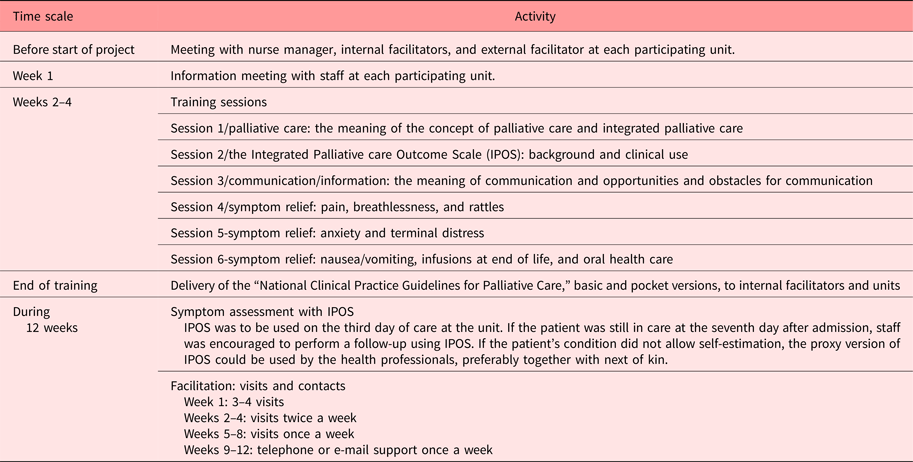
When planning for implementation support, the choice of included components (Rycroft-Malone, Reference Rycroft-Malone2004) in an appropriate number (Squires, Sullivan, Eccles, et al., Reference Squires, Sullivan and Eccles2014) and tailored to the intended context (Baker et al., Reference Baker, Camosso-Stefinovic and Gillies2015) is of importance. To tailor the implementation strategy to the context, an interview study was conducted to identify obstacles and opportunities for implementation of palliative care in acute care settings (Lind, Wallin, Brytting, et al., Reference Lind, Wallin and Brytting2017). The findings contributed to the design of the strategy. A manual for the entire strategy was developed, focusing on leadership (Gifford, Davies, Edwards, et al., Reference Gifford, Davies and Edwards2007), facilitation in the form of internal and external facilitators (Harvey & Kitson, Reference Harvey and Kitson2015), and training sessions regarding IPOS (Antunes et al., Reference Antunes, Harding and Higginson2014; Bausewein et al., Reference Bausewein, Simon and Benalia2011; Boyce et al., Reference Boyce, Browne and Greenhalgh2014) (Table 1). Further, a description of the type of patients who were to be offered assessment using IPOS was compiled (Boyce et al., Reference Boyce, Browne and Greenhalgh2014) (Appendixes A.1, A.2, and A.3). The prevalence of completed IPOS forms in the patients’ records was the outcome measure of the implementation strategy.
Overview of the content in the implementation strategy

Implementation strategy
The nurse managers were asked to identify one to two nurses who could act as internal facilitators and assist them in their role. The assignments of the nurse managers and internal facilitators were to be discussed in meetings with the external facilitator (Appendix A.1). The first author (SL) acted as the external facilitator aiming to support and give feedback to internal facilitators at the units (Stetler et al., Reference Stetler, Legro and Rycroft-Malone2006). The external facilitator's visits to the units were scheduled in the project plan.
The information meeting introduced the project and an information leaflet was distributed. The training course consisted of six sessions, each lasting 15 minutes. The sessions were independent of each other, allowing the units to set their own schedules based on current workload and number of employees. The sessions could be held separately on six occasions or together on fewer occasions. The content was compiled to support professionals in the use of IPOS, including follow-ups with relevant actions based on the Swedish National Clinical Practice Guidelines for Palliative Care (Regional Cancer Center in Cooperation, 2012). Discussions and reflections were encouraged during the sessions and participants received PowerPoint handouts (Appendix A.2). After the training period, the basic and the pocket versions of the clinical guidelines were distributed to the units. The training was to be followed by 12 weeks of clinical use of IPOS.
IPOS
IPOS assesses symptoms and other concerns of patients with palliative care needs. It begins with an open question, “What have been your main problems or concerns over the past three days?” followed by statements about various symptoms answered on a 5-point Likert scale (Beck et al., Reference Beck, Olsson Möller and Malmström2017; Schildmann et al., Reference Schildmann, Groeneveld and Denzel2016). There are two versions of IPOS, one for self-reporting by the patient and one for proxy-estimation by healthcare professionals. The healthcare professionals were expected to use IPOS for patients (≥18 years) with severe chronic diseases (Appendix A.3). If the patient's condition did not allow self-estimation, the proxy version of IPOS could be used by the healthcare professionals. IPOS was to be used on the third day of care at the unit. If the patient was still in care at the seventh day after admission, healthcare professionals were to perform a follow-up using IPOS. The professionals were instructed to discuss the outcome of IPOS and initiate actions in cooperation with the patient and other healthcare professionals. The completed IPOS forms were to be scanned into the patients’ electronic health records or saved in their paper-based records. Because this is, as far as we know, the first study on implementation of IPOS in Sweden, no threshold was set for the number of completed IPOS.
Data collection
An interview guide with open-ended questions was developed focusing on the components in the strategy (Appendix A.4). Interviews were conducted with nurse managers and internal facilitators at all units except the neurological unit, where two of four facilitators were interviewed. The nurse managers at the neurological and pulmonary units were interviewed together in accordance with their preferences. Interviews at all units were conducted with available nurses and assistant nurses during their working shift (two staff members at the neurological unit, four at the pulmonary unit, four at the surgical unit, and six at the palliative unit) and one physician at the palliative unit. Physicians at all acute care settings were invited to interviews but declined. The interviews were conducted in proximity to the units and lasted between 22 and 53 minutes. To allow the participants to speak freely, the interviews were conducted by two of the authors (JS, TB) who had not been involved in the implementation activities. The first author (SL) reviewed patient records to identify patients who reasonably should have been offered to assess with IPOS. The records of such patients were then searched for completed IPOS forms. Healthcare professionals’ experiences of the use of IPOS and additional patient-related data will be reported in a separate paper.
Data analysis
An external person transcribed the interviews verbatim. The first author (SL) initially listened to and read all the interviews and organized them in the NVivo10 software. The interviews were read again, meaning units were marked and inductively coded into categories and if appropriate, into subcategories, as suggested by Elo and Kyngäs (Reference Elo and Kyngäs2008). Thereafter the categories and accompanying subcategories were deductively sorted (Hsieh & Shannon, Reference Hsieh and Shannon2005) based on the main components of the process evaluation: context, implementation, mechanisms of impact, and outcome (Moore et al., Reference Moore, Audrey and Barker2015). Quantitative data from the patient records were analyzed descriptively using IBM SPSS Statistics 22 software.
Ethical issues
The study received ethical approval from the Regional Ethical Review Board in Stockholm (2013/875-31/1, 2015/2197-32). Department managers gave written permission for access to the units and patient records. The participants in the interviews were informed verbally before the interviews and provided written informed consent.
Results
Pursuant to Moore et al.’s (Reference Moore, Audrey and Barker2015) description of process evaluation the results are presented under the headings: context, implementation, mechanism of impact, and outcome.
Context
The qualitative analysis identified a category at the acute care units that was called A need for an improved culture regarding palliative care. Respondents at the neurological and pulmonary units described the cooperation between different healthcare professionals as inadequate, particularly when caring for patients in need of palliative care. Some of the physicians at the pulmonary unit questioned the implementation strategy. The physicians at this unit and the neurological unit did not participate in the study, except for attending some training sessions, claiming that nursing research was of less interest to them. At the surgical unit, the surgeons were present for short periods during the day when not preforming surgery and their time on the unit was described by the nurses as stressful. Interviewees described the objective for care on acute care units as “to cure the patient.” They stated that the definition of palliative care as an integrated part of caring for patients with severe chronic diseases is becoming better known among healthcare professionals, but is still often equated with end-of-life care. Deaths were described as common on the neurological and pulmonary units. Respondents at the surgical unit expected the surgery to extend many patients’ lives, even if the disease–often cancer–would lead to death in the near future.
Implementation
Information meetings
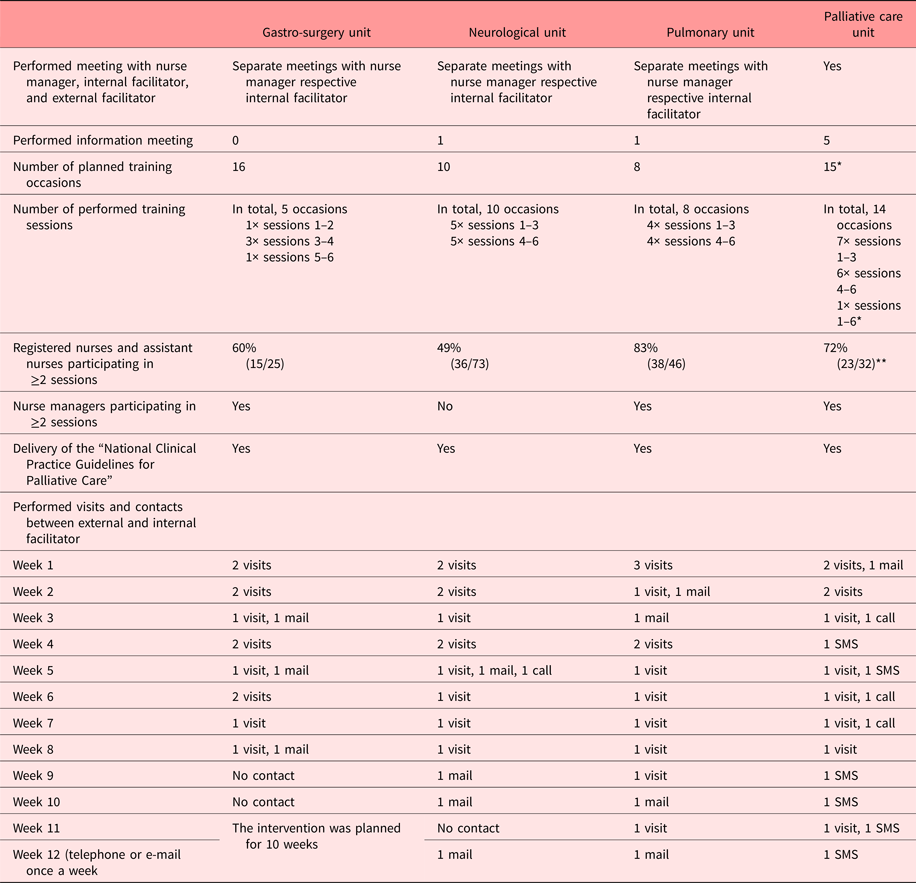
The number of information meetings held varied across units. No meetings were held at the surgical unit. The neurological and pulmonary units each received information once and five meetings were held at the palliative unit. The meetings lasted between 10 and 20 minutes.
Training
All training was provided in close proximity to the units. The number of occasions when training was planned and held varied between the units (Table 2). The training at the surgical unit was planned to be held on 16 occasions, but because of a lack of staff and high workload, only five were held. The duration of training on each occasion at the surgical unit (30 minutes) was perceived as too short. At the neurological unit, training was held on 10 occasions, over 4 weeks. Two physicians participated on one occasion, which covered the first three sessions. The training at the pulmonary unit was held on eight occasions over 2 weeks and was well attended. Five physicians participated on occasions covering the first three sessions. As with the pulmonary unit, the sessions at the palliative unit were well attended. Four of six physicians attended three sessions or more. A specific occasion covering the whole training program was held for nurses and assistant nurses working the night shift; half of them (9/18) participated.
Overview of performed parts of the implementation strategy

* One occasion was specifically for staff working night shift.
** Staff working night shift not included.
The qualitative analysis resulted in the category Different needs for training, with two subcategories, Training related to every day work at the acute care units and Nothing in it for us at the palliative unit. Participants at all acute care units found the content of the training sessions—combining facts, such as treatment of symptoms, with opportunities for reflection—helpful in the care of their patients. They felt the sessions met their need to talk about difficult situations in relation to caring for severely ill patients and stimulated further discussions at the units. Participants at the palliative unit described the sessions as Nothing in it for us—being too basic and lacking new knowledge. At the surgical and the palliative units, participants expressed a need for more knowledge, both theoretical and practical, regarding the IPOS instrument.
Facilitation
Joint meetings with the external facilitator, the nurse managers, and the designated facilitators were only feasible at the palliative unit. At the other units, the meetings were conducted separately with the nurse managers and the facilitators. At the neurological, pulmonary and palliative units, nearly all contacts between the external and at least one internal facilitator were conducted according to the project plan, except for a few visits that were replaced by e-mails because of the facilitators’ work schedules, vacation, and public holidays. At the surgical unit, e-mail contact ceased earlier than planned because of difficulties getting in touch (Table 2). The external facilitators’ visits were planned together with the internal facilitators to fit their work schedule. Despite this, the facilitators did not always have time to meet because of high workloads and, in some cases, their schedules had changed and they were absent.
Mechanisms of impact
The qualitative analysis found six categories that were common to all units that contributed to the results of the implementation: A constantly increasing workload, Constantly on-going changes leading to a feeling of Change fatigue, The importance of the internal facilitator, The impact of nurse managers’ support and Unclear documentation of the IPOS form.
The category A constantly increasing workload was described as having many stressful duties and constantly expanding responsibilities. The patients were severely ill and in greater need of care, often advanced care, than previously. There was a high staff turnover and difficulties in recruiting, primarily nurses. At the surgical unit, the lack of nurses led to a need to hire nurses from external agencies. As a result, the number of beds was reduced, and this was also expected at the pulmonary unit.
Participants described experiencing Constantly on-going changes, initiated both at and organizational level and by the healthcare professionals themselves. Many changes were on-going; some were felt to be ad hoc and poorly evaluated. The projects varied from reorganization and physical relocation of units to repeated evaluations of the healthcare provided. The changes were described as leading to a feeling of Change fatigue, with tiredness and a lack of energy to get involved in the projects as well as difficulties establishing new routines based on proposed changes. Conversely, the healthcare professionals expressed a willingness to develop their care of the patients and therefore also initiated their own projects.
Two categories illustrate the facilitation work: The importance of the internal facilitator and The impact of nurse managers’ support. The internal facilitators at all acute care units expressed an ambition to contribute, but various factors obstructed their intentions (e.g., lack of time, work schedules, vacations), especially at the surgical unit. At the neurological and pulmonary units, the internal facilitators worked as clinical nurses as well as unit managers, whereas those at the surgical and palliative units worked solely as clinical nurses. At the pulmonary unit, both facilitators had clinical experience from working in palliative care units; one of the facilitators at the neurological unit was involved in the palliative network at the medical department. The healthcare professionals at the neurological and pulmonary units perceived the internal facilitators as supportive, providing reminders to use IPOS, identifying patients relevant for IPOS and providing practical support in patient interactions. The facilitators at these units perceived their role in the study as an assignment from the nurse managers, but lacked their support during the implementation of IPOS. This is consistent with the nurse managers’ perceptions about their own involvement. At the surgical unit, both healthcare professionals and facilitators perceived the nurse manager as very supportive and involved in the project. Staff at the palliative unit felt the facilitators’ role was unclear, even though the facilitators themselves described it as supportive and problem-solving–oriented. The facilitator in the home care team switched to another team during the study, which resulted in poor continuity in the interaction between the team's healthcare professionals and the facilitator. The nurse managers at the palliative unit described their role in the study as unclear, feeling uncertain about what to do. At the time of the study, the nurse managers at the palliative inpatient unit and the home care teams were in the process of reorganization.
Unclear documentation of the IPOS form was perceived as a barrier to implementation, particularly regarding the follow-ups at ward rounds with physicians and documentation of previous IPOS assessments. Paper forms often disappeared, and all units expressed a preference for documentation in the patients’ electronic health records. At the palliative unit, a proposal for electronic documentation was developed, but it was not used because it did not meet the requirements.
Outcome
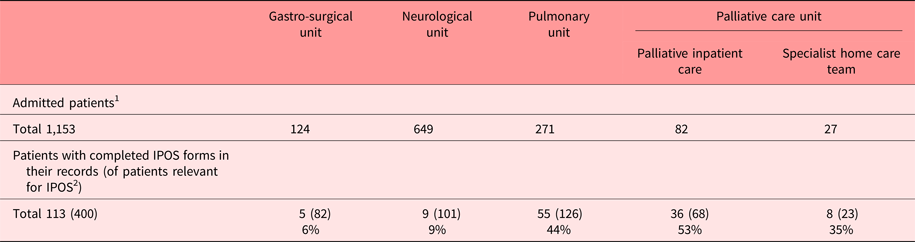
All units except the surgical unit chose to follow the suggested definition of patients suitable to be offered IPOS, the time for use, and 12 weeks of clinical use of IPOS. The surgical unit used IPOS for only 10 weeks because of summer holidays, and defined the main category of patients suitable for IPOS as those coming from the intensive care unit after surgery. They also offered other patients with severe illnesses the opportunity to use IPOS. Two units distinguished themselves with a higher percentage of completed IPOS forms. About half of the patients in the inpatient palliative unit and the pulmonary unit completed IPOS. The percentage for the home care team was 35% and the neurological unit 9%. The surgical unit had the lowest completion of IPOS at 6%. The nurse manager and facilitators at the surgical unit stated that more patients had completed IPOS, but the forms could not be found in the patient records (Table 3).
Prevalence of completed IPOS in the patients’ healthcare records

IPOS, Integrated Palliative care Outcome Scale.
1 Each admission was counted separately.
2 Patients with speech disorder or difficulties with the Swedish language were counted as feasible patients for IPOS because of the possibility of proxy use of IPOS.
Discussion
Little research has been conducted on the implementation of PROM for patients in need of palliative care, particularly those in acute care settings. To our knowledge, this is the first study of IPOS implementation in Sweden. Training is a common component in the implementation of palliative care (van Riet Paap et al., Reference van Riet Paap, Vernooij-Dassen and Sommerbakk2015), although the effects of training on implementation have been found to be mixed (Grimshaw et al., Reference Grimshaw, Eccles and Lavis2012; Wallin, Reference Wallin2009). Nevertheless, training and guidance are regarded as important when introducing PROM in health care (Antunes et al., Reference Antunes, Harding and Higginson2014; Bausewein et al., Reference Bausewein, Simon and Benalia2011). The training was found to compensate somewhat for nurses’ and assistant nurses’ lack of knowledge regarding palliative care at the acute care units. This is consistent with a study by Friedrichsen et al. (Reference Friedrichsen, Heedman and Astradsson2013) in which, just as in our study, only a few physicians participated in the training. That a nurse conducted the training may have contributed to the low participation of physicians. The experienced lack of adequate education concerning IPOS, both theoretical and practical, at the surgical unit and the palliative unit is congruent with earlier identified issues regarding the use of PROM (Boyce et al., Reference Boyce, Browne and Greenhalgh2014). This is important to take into account when planning for future implementation of IPOS.
A prominent contextual factor was the attitudes toward palliative care described at the acute care units. This was not unexpected and was, in a sense, confirmed by the difficulties of involving the physicians in the study. As concluded in other studies (Bloomer et al., Reference Bloomer, Moss and Cross2011; Frey et al., Reference Frey, Gott and Raphael2014; Reid et al., Reference Reid, Gibbins and Bloor2015), healthcare professionals at acute care hospitals need further training in how to recognize dying patients to improve palliative care. Theoretical assumptions for the use of IPOS in the specific context, as described by Greenhalgh et al. (Reference Greenhalgh, Long and Flynn2005) can contribute to an improved design of the strategy. A transformational leadership, able to create good daily working conditions for the employees (Yukl, Reference Yukl2013), has been suggested as contributing to successful implementation (McCormack et al., Reference McCormack, Kitson and Harvey2002). Moreover, facilitation, in the sense of individuals or strategies that make change easier, has recently been further strengthened as a crucial component for implementation (Harvey & Kitson, Reference Harvey and Kitson2016). The number of nurse managers participating in the training and the perceived support from them during implementation differed between the units. Lack of nurses, particularly on the surgical unit, made it difficult for the internal facilitators to perform as planned. Differences in leadership approaches and the facilitators’ ability to contribute to the implementation process may have affected the number of completed IPOS. Nevertheless, no clear association between the prevalence of completed IPOS in relation to nurse managers’ and internal facilitators’ performance was established.
The primary outcome—the prevalence of completed IPOS—varied from 6% to 53% because of several contributing factors. We cannot overlook that additional forms were completed but not saved in the patients’ records. Patients or their next of kin may have been approached but declined to complete IPOS. An important part of palliative care is control of pain and other symptoms (Radbruch & Payne, Reference Radbruch and Payne2009), which requires structured symptom assessment. We consider the low prevalence of completed IPOS at the neurological and surgical units unsatisfactory. On the other hand, the approximately 50% of patients who completed IPOS at the pulmonary and palliative units is higher compared with the findings of an evaluation by the Swedish National Board of Health and Welfare (2016), where the overall frequency of pain assessment during the week before death was 38%. Because pain is an item in IPOS, it is relevant to compare our results with this evaluation. One may assume that the relatively low prevalence of completed IPOS in our study, as well as the low frequency of registered pain assessment in the national evaluation, would likely affect the quality of care at the end-of-life in a similar way. Thus, further efforts to support healthcare professionals in using assessment tools are important.
Healthcare professionals at all units described uncertainty about how to record the completed forms, an ambiguity that may have contributed to the low prevalence of completed IPOS in the patients’ records. The implementation strategy did not define how completed IPOS should be documented; however, we did emphasize the importance of treating IPOS as a medical document. This documentation problem is not surprising and is comparable to other documentation problems in the Swedish healthcare system. The nation's electronic patient health records have been described as a barrier to quality improvement (Swedish Agency for Health and Care Services Analysis, 2016) and as having structural deficiencies (Government Official Reports, 2016; McKinsey & Company, 2016).
Strengths and limitations
The number of participating units was limited but consisted of different types of acute care units and a palliative care unit. Because this was only a feasibility study, the number of units should be sufficient. The clinical implementation was facilitated by one of the authors, which yielded stringency in the implementation across sites. The objectivity in the interviews was enhanced by involving two other authors. However, not all professionals were interviewed and the interviews were performed in pairs or groups, which could have affected their statements. Trustworthiness of the findings was achieved through continuous discussions during the analysis between the first (SL) and the last author (LW). The results were also discussed with the whole research group on several occasions during the preparation of the manuscript.
Conclusions
Our findings imply that the feasibility of this strategy to support implementation of IPOS is questionable. The components of the strategy as well as the impact of the context need to be further explored. A number of improvements would probably make the strategy more effective. The training should be carried out by a physician and a nurse. It is important to engage physicians and nurses as well as assistant nurses in the implementation, particularly as internal facilitators. Additional contacts between the external facilitator, the internal facilitators, and the nurse managers during implementation may improve the nurse managers’ engagement in changing practice. The content of the training filled a gap in knowledge concerning palliative care in the acute care settings, but has to be adapted to suit palliative care settings. Implementation of patient-reported outcome measures, such as IPOS, in acute care settings requires further research.
Acknowledgment
The authors sincerely thank the study participants for generously sharing their time and the Erling-Persson Family Foundation, the Ulrica Cronés Foundation, and the Swedish Society of Nursing for funding the project.
Supplementary material
The supplementary material for this article can be found at https://doi.org/10.1017/S1478951517001158.
Contributions
All authors contributed to the design. JS and TB collected the data. SL and LW analyzed and interpreted the data and SL drafted the manuscript with comments from all authors. Finally, all authors approved the manuscript before submission.
Conflict of interest
The authors declare that there are no conflicts of interest.