Introduction
Sleep disturbance is a common complaint and can have significant impact on individuals’ psychological well-being and quality of life. An earlier epidemiological study (Gislason et al., Reference Gislason, Almqvist, Eriksson, Taube and Boman1988) found considerable variation between countries in the prevalence of sleep disturbances among the general population, with rates ranging from 3% to 42%, a pattern which was confirmed in a more recent review study (Ohayon, Reference Ohayon2002). Some of these variations may partly be explained by between-country differences in socioeconomic and cultural contexts. These reviews, however, were based on studies that varied in their sampling strategies, measure of sleep disturbance, design, and timing of the surveys. Any definitive conclusions about the variation in sleep disturbance between countries, therefore, need to be tempered by these methodological differences.
In an international survey of four countries (France, Italy, Japan and USA), Leger and Poursain (Reference Leger and Poursain2005) found that the prevalence rates of sleep disturbance varied between 6.6% (Japan) and 37.2% (France and Italy). A similar study (Soldatos et al., Reference Soldatos, Allaert, Ohta and Dikeos2005) identified 24% of 35,327 individuals from ten countries from different continents as reporting sleep difficulties (though data collection strategies varied between the ten countries). Another comparative study among three European countries (Sweden, Iceland and Belgium), found the prevalence rates of insomnia and nightmares to vary from 4% to 7% (Jansson et al., Reference Jansson1995). This study was, however, restricted to a particular city from each of the three countries and limited to middle-aged adults (20 to 45 years). Using a broader population group, a multinational study (Chevalier et al., Reference Chevalier1999) found the prevalence rates of sleep disturbance to range from 4% to 22% across five European countries (Belgium, Germany, Great Britain, Ireland and Sweden). A series of studies carried out by Ohayon and colleagues in different European countries confirmed the wide variability in reports of sleep dissatisfaction, though no direct between-country comparisons were made (Ohayon, Reference Ohayon1997; Ohayon et al., Reference Ohayon, Roberts, Zulley, Palombini and Rabb2000; Ohayon and Roth, Reference Ohayon and Roth2001; Ohayon and Zulley, Reference Ohayon and Zulley2001; Ohayon and Partinen, Reference Ohayon and Partinen2002; Ohayon and Smirne, Reference Ohayon and Smirne2002; Ohayon and Reynolds, Reference Ohayon and Reynolds2009). As yet, there are no studies exploring sleep disturbances across both Eastern and Western European countries.
All surveys of sleep disturbance report subjective sleep. Such reports may reflect more than the actual experience of sleep as there may be cultural patterns in “complaining” about poor sleep. The large variation in sleep disturbance across European countries may therefore mirror different propensities to complain about sleep (besides the often different ways in which sleep problems are elicited) such that some countries with apparently low rates of sleep disturbance are simply more stoical. This problem can partly be addressed by comparing differences in sleep disturbance within countries for different social groups. For example, while the absolute rate of sleep disturbance may vary between countries due to cultural reporting factors, changes in sleep patterns across the life course within countries can be more directly compared.
Sleep disturbance reflects multiple influences, including health, psychological and socioeconomic factors. Depressive symptoms and general anxiety represent some of the most consistent psychological variables associated with sleep disturbance across different population groups (Foley et al., Reference Foley, Monjan, Browns, Simonsick, Wallace and Blazer1995; Roberts et al., Reference Roberts, Shema and Kaplan1999; Dregan and Armstrong, Reference Dregan and Armstrong2010). Socioeconomic factors such as traumatic experiences (e.g. victim of crime), social activities (e.g. social networking), economic status (e.g. financial worries), and employment (e.g. job satisfaction) also appear to contribute to sleep complaints (Leger and Poursain, Reference Leger and Poursain2005; Dregan and Armstrong, Reference Dregan and Armstrong2009). The association between physical health with sleep disturbance has also been confirmed in several studies (Jansson et al., 1996; Roberts et al., Reference Roberts, Shema and Kaplan1999; Dregan and Armstrong, Reference Dregan and Armstrong2009). These factors may act independently or interdependently to influence sleep disturbance, suggesting the need to account for multiple factors when attempting to understand the trend and determinants of sleep disturbance across different population subgroups.
Based on his review of epidemiological studies of sleep disturbance, Ohayon (Reference Ohayon2002) suggested a trend towards increased sleep disturbance with age. With respect to cross-country comparisons the evidence is, as yet, rather inconclusive and limited to younger age groups, usually adolescents. Tynjala et al. (Reference Tynjala, Kannas and Valimaa1993), for instance, compared differences in sleeping patterns and sleep disturbances among 40,200 adolescents from 11 European countries. Following a series of bivariate correlations the authors found significant variance in sleeping habits and inability to sleep both between countries and between age groups with greater prevalence rates of sleep disturbance among older adolescents. In another European study of 1,125 older adolescents from four countries (France, Great Britain, Germany and Italy), the authors reported that 25% of the adolescents indicated they had sleep disturbance, a lower rate than that found amongst adult-based studies (Ohayon et al., Reference Ohayon, Roberts, Zulley, Palombini and Rabb2000). Yet one of the few European studies to compare the prevalence rates across different age groups found no association between sleep disturbance and age (Chevalier et al., Reference Chevalier1999).
The aims of the present investigation were to compare both the prevalence of sleep disturbances and its relationship to age among 23 European countries using data from the third round of the European Social Survey (ESS). As a result of recent profound socioeconomic changes in Eastern Europe we expected greater prevalence rates of sleep disturbance among these countries. A further aim was to explore the factors associated with age-related differences in the prevalence of sleep disturbances across European countries. We expected psychosocial well being (e.g. symptoms of depression) and living standards to emerge as the strongest correlates for change in sleep disturbance across age groups.
Methods
Subjects
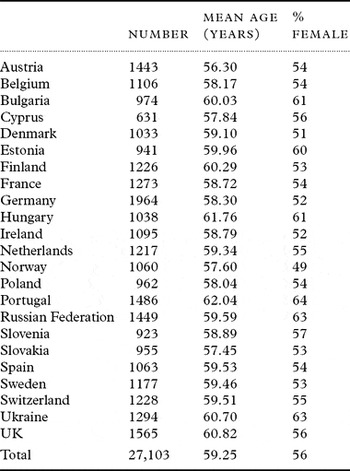
The data were drawn from the third round of the European Social Survey (ESS), a cross-sectional biennial survey of 47,000 individuals aged 15 years old and over from 23 European countries. A random (probability) sample procedure was used to select the study participants. The objective of the ESS is to assess trends in attitudes, behavior and values across different European countries. The data were taken from website http://ess.nsd.uib.no. Respondents from Romania and Latvia (n = 4,099) were not included in the analyses reported here because of the lack of design and sample weighting variables which take sampling probabilities and population size into account. For example, the design weights of the study that correct for differences in the probabilities of sample selection (i.e. over or under representation of specific groups) were missing from these two countries. As the present study is concerned with the relationship between older age and sleep disturbance, including understanding change in sleep disturbance from working age to older age, the analyses were restricted to participants over the age of 40 years. The present analysis is therefore based on the records derived from 27,103 individuals. Demographic (weighted) data for these respondents by country are presented in Table 1.
Demographic data

Weighted results.
Measures
Dependent variables
The dependent variable for the descriptive analyses was based on a single item that asked the respondents to report whether or not their sleep had been restless over the previous week. There were four possible answers: none/almost none of the time, some of the time, most of the time, all or almost all the time. These answers were grouped into a binary variable with the first two answers being coded as 0 (indicative of no sleep problems), whilst the last two answers were coded as 1 and represented having sleep problems. This dichotomization was based on the assumption that the first two answers may refer to the absence of a negative sleep disturbance whilst the last two answers refer to the presence of a sleep disturbance. A similar dichotomization was used in previous studies (Hankins, Reference Hankins2008; Dregan and Armstrong, Reference Dregan and Armstrong2009). An additional dependent variable for use in the multiple regression analyses was developed by calculating the percentage change in the reporting of restless sleep between the 41–65 age group and the 66 and over age group.
Explanatory variables
A backward logistic regression was employed initially to explore those variables more strongly associated with restless sleep reports. Following this analysis, only those variables which appeared in the last regression model were retained. These variables (each measured using a single question) included: general health status (report of health in general), daily activity hampered by illness (restrictions in daily activities caused by any longstanding illness, or disability, infirmity, or mental health problem), gender (male/female), partnership status (present legal marital status), been victim of a crime/burglary in the last 5 years (for respondent or member of their household), area of residence (big city, suburb of a city, small city, village, or countryside), felt depressed over the last week (Likert-type scale on how much of the time during the past week the respondent felt depressed, scores range from 1 (none or almost none of the time) to 4 (all or almost all of the time)), felt anxious over the last week (Likert-type scale on how much of the time during the past week the respondent felt anxious, scores range from 1 (none or almost none of the time) to 4 (all or almost all of the time)), stressful job (how much of the time the respondent found his/her job to be stressful, score range from 0 (none of the time) to 6 (all of the time)), satisfied with the standard of living (level of satisfaction with present standard of living, score range from 0 (extremely dissatisfied) to 10 (extremely satisfied)), number of people living in household (number of regular members of the household, including children), number of hours worked per week (number of paid hours of work over the previous week), education level (highest level of qualification achieved), number of hours spent watching TV (total number of hours of TV watching on an average weekday, scores range from 0 (no time at all) to 7 (more than 3 hours)), worried that income will not be sufficient for later years (opinion on how worried were they, if at all, that their income in old age would not be adequate to cover their later years, scores range from 0 (not worried at all) to 10 (extremely worried)), and frequency of weekly social activities (how often respondent met socially with friends, relatives, or work colleagues, scores range from 1 (never) to 7(every day)). Most of these variables (i.e. symptoms of depression, anxiety, job stress, physical health) are commonly associated with sleep disturbance whilst other variables (i.e. hours of TV watching and victim of crime) represent novel factors in the sleep literature. The inter-correlations between all the study variables are shown in Table S1 published as supplementary material online attached to the electronic version of this paper at www.journals.cambridge.org/ipg.
Statistical analyses
All analyses involved weighted data using third-round (2007) analysis weights to adjust for differences in sample selection strategy across the 23 countries of the ESS. Descriptive statistics were used to identify the weighted prevalence rates of restless sleep reports by country and age group. Simple cross-tabulations were employed to compare differences in the proportion of respondents who reported restless sleep across the 23 European countries. These analyses were concerned with differentiating country-level differences in the restless sleep reports across two age groups: 41–65 year-olds and those aged 66 years and over. The intraclass correlation coefficient was calculated to explore the amount of variance in restless sleep due to country level. The results suggested that only a small amount of the overall variance (6%) in restless sleep was due to between-country variance after adjusting for age and gender.
Subsequent analyses were performed at an individual level in order to identify the main individual-level factors that possibly explained differences in sleep disturbances between the working and older age groups. Cross-tabulations were used to present change in restless sleep reports from the two age groups. Independent t-tests were performed to determine whether the age-related sleep difference measure, calculated by subtracting the mean score for restless sleep for the 41–65 age group from the mean for the ≥ 66 age group and converting the difference into a percentage change from the mean score in the age 41–65 group, was significantly different from zero. This method is not without its problems, and certain assumptions (i.e. no correlations between the change scores with other omitted or unobserved variables) are involved, though it was suggested that in the case of non-equivalent control groups the change scores method leads to more accurate predictions compared to a regressor variable approach (Allison, Reference Allison1990).
To evaluate the association between different background factors with change in reports of restless sleep, multivariate analyses were performed. Standard regressions were carried out on the change variable to assess which characteristics were significantly associated with change in restless sleep reports over the two age groups. In order to avoid some of the problems (e.g. outliers, skew of the distribution) with employing percentage change as the dependent variable, the individuals were grouped into ten categories from 0 to 100 (1 = 0–10, 2 = 11–20, . . . 10 = 91–100). In these analyses the outcome variable was therefore continuous (0 (no change) to 10 (100% change). In the first step of the analyses the means score of restless sleep for the 41–65 age group was entered into the regression. In the second step, all explanatory variables (as listed in Table 2) were added.
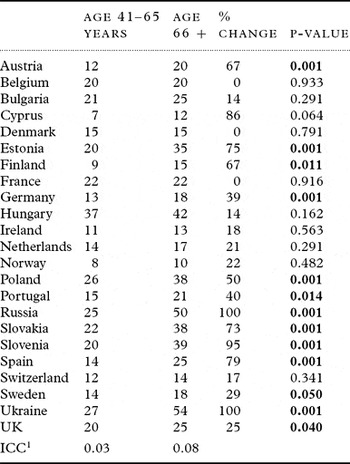
Prevalence rate (%) and change in prevalence rates of restless sleep from the 41–65 to 66+ age groups across 23 European countries (N = 27,103)

1Intraclass correlation coefficient for the between-country variance in sleep disturbance.
Results
Table 2 shows the distribution of restless sleep across countries and the two age groups. In the age group associated with the working population (41–65 years) the highest prevalence of 37% in Hungary was almost five times higher than in some of the countries with the lowest prevalence such as Norway. The wide range of patterns continued into the over 66 age group with both Hungary and Norway holding their relative positions. Yet because these two countries maintained their differential, the percentage changes between working and older age groups was relatively similar, whereas other countries, such as Russia and Ukraine showed a doubling of sleep disturbance across these age groups. Indeed, prevalence of restless sleep in the working age group seemed a poor predictor for the changes which occurred in later life (p = 0.12). Overall, some countries (e.g. Cyprus, Finland, Russia, Spain, Ukraine) showed a significant (p<0.05) increase in the prevalence rate of restless sleep from younger to older age groups while for other countries (e.g. Bulgaria, Denmark, Ireland, Switzerland) the increase was marginal or not at all (e.g. Belgium, Denmark, France). The age- and gender-adjusted intraclass correlation coefficient indicated that the variability was greater among the older (0.08) compared to the working age groups (0.03).
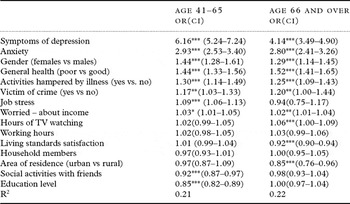
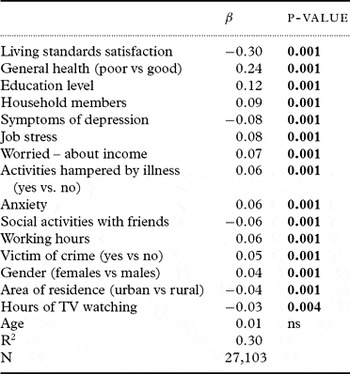
Table 3 shows the correlates for restless sleep for those of working age and older groups. A large number of factors were common correlates for restless sleep in both younger and older age groups with symptoms of depression and anxiety being the most salient, followed by health problems. Increased hours of TV watching, poor living standards and living in urban areas were specific to the older age group. Conversely, limited social activity, low educational level, and high job stress were specific to the younger age groups. Yet, as argued above, these associations might be confounded by a general cultural attitude to reporting sleeplessness. Because of this, Table 4 shows the results of a standard multiple regression analysis between the percentage change of restless sleep across the two age groups as the dependent variable and the explanatory variables. The largest correlates were living standards satisfaction and perceptions of general health, followed by education level, job stress, household size, and worries about income in later years. As can be seen from the table, the highest positive correlation with change in restless sleep reports occurred with respect to health deterioration. For example, compared to respondents without a health problem, respondents with a health problem have a 24% increase in the reports of restless sleep when all other factors are constant.
Adjusted odds ratios for correlates of reporting restless sleep across two age groups (N = 27,103)

Note: The odds ratios (OR) in the table are adjusted for each other. Unless the comparison categories are specified in brackets the correlates are continuous variables.
Adjusted correlates for % change in restless sleep reports from working age (41–65 years) to older age (66 years and over)

The β values are adjusted for each other. Unless the comparison categories are specified in brackets the correlates are continuous variables.
Besides health and psychological circumstances, socioeconomic factors also emerged as important correlates with the change in restless sleep reports. For instance, compared to lack of illness or disability, being hampered by illness or disability was associated with a 6% increase in the reports of restless sleep. Other positive associations were observed with respect to gender (women), being a victim of crime in the past five years, education level, and working hours. Increased hours of TV watching, area of residence, and social activities with friends were negatively associated with change in restless sleep from younger to older age groups.
Discussion
The study has confirmed the very wide variability of sleep disturbance across European countries, ranging from less than 10% in some Mediterranean and Nordic countries to over half of the older population in Russia and Ukraine (Ohayon, Reference Ohayon1997; Chevalier et al., Reference Chevalier1999; Ohayon et al., Reference Ohayon, Roberts, Zulley, Palombini and Rabb2000; Ohayon and Roth, Reference Ohayon and Roth2001; Ohayon and Zulley, Reference Ohayon and Zulley2001; Ohayon and Partinen, Reference Ohayon and Partinen2002; Ohayon and Smirne, Reference Ohayon and Smirne2002). Given the standardized recruitment and measurement procedure across the survey countries this finding suggests substantial differences in sleep patterns across European countries. How are these differences to be explained?
The first explanation is that they are somehow an artifact of the response set of a country's respondents. In other words, there may be a cultural pattern to the ways in which respondents from different countries report their sleep problems with some countries downplaying a “restless” night's sleep whereas others are much more likely to complain (Harvey et al., Reference Harvey, Gregory and Bird2002). The focus of this study into sleep patterns in the older population, however, has enabled the analysis to “control” for any cultural patterning by examining the difference between working and retired ages. If, for example, respondents in any country are more likely to report restless sleep as part of their “cultural repertoire” (Domino, Reference Domino1986; Cote and Bornstein, Reference Cote and Bornstein2003) then any difference in that reporting pattern is likely to represent something more substantive (unless there were major cohort differences in sleep reporting within a country). The different scores reported in Table 1 are notable in not tracking the baseline measure of restless sleep during later working life: Hungary, for example, has the highest level of reported sleep disturbance in the 41–65 age group but this only increases by 14% in the older retired group, whereas Cyprus has only 7% reporting restless sleep at age 41–65, but this almost doubles for the older group.
The difference in sleep disturbance in the older group shows some patterning with geography. Old Soviet bloc countries such as Russia, Ukraine and Estonia show some of the largest differences while several West European countries such as Belgium, France and Denmark show hardly any. The findings for the Eastern European countries could be a reflection of the social stress (i.e. the fundamental socioeconomic and political changes following the fall of communism) that was significant over the past two decades or so. This suggestion is consistent with previous evidence for a link between poor health status with dysfunctional social structures and socioeconomic deprivation in Eastern Europe (Babek et al., Reference Babek, Pikhart, Hertzman, Rose and Marmot1998). But there are clear exceptions. Cyprus, for example, shows a very large increase whereas Hungary and Bulgaria show relatively small ones.
Logistic regression showed the main statistical predictors of restless sleep in the two age groups. The largest coefficients, supporting other research findings, were for anxiety/depression symptoms, and perceptions of general health (Foley et al., Reference Foley, Monjan, Browns, Simonsick, Wallace and Blazer1995; Ohayon and Zulley, Reference Ohayon and Zulley2001; Dregan and Armstrong, Reference Dregan and Armstrong2010). Variation in the distribution of these factors, and others, between countries clearly accounts for much of the variability of reports of restless sleep in these two age groups.
In Table 4, however, which shows the correlates of differences in restless sleep between age groups, some of the predictive factors are less salient, in particular symptoms of depression and anxiety, implying that while these factors predict restless sleep they do not explain the major differences which are observed between younger and older age groups. At the same time, new factors – such as area of residence and satisfaction with living standards – become more prominent. The predictive factors which do emerge to explain different patterns of restless sleep in the older age group also offer an insight into old age itself. The change from working life to retirement and beyond is a period of major transition and the factors associated with restless sleep provide an indicator of the quality of older life.
As might be expected, health (together with being hampered by illness and/or disability) is a prime determinant of changes in sleep disturbance, but anxiety is also important which no doubt reflects the range of adversities faced in old age (Morin et al., Reference Morin, LeBlanc, Daley, Gregoire and Merette2006). The separate risk of “worries about income” indicates one area of concern. Financial security is also reflected in the importance of satisfactory living standards and being able to live in a good neighborhood. The continuing appearance of job stress and working hours as statistical predictors of differences between working life and older age also probably reflects on the degree of financial security enjoyed by older people across Europe and whether they need to continue in the workforce (Dregan and Armstrong, Reference Dregan and Armstrong2009).
Finally, other more general “social” factors figure prominently as correlates of the difference scores between working age and retirement: social activities with friends and not being a victim of crime are both protective of good sleep. These findings reinforce the beneficial effect of positive social networking on aging (Silveira and Ebrahim, Reference Silveira and Ebrahim1998). For instance, participation in social activities might represent a source of emotional and socioeconomic support that increases older people's sense of well-being. Supportive social relationships are likely to be associated with positive mental health outcomes, including healthier sleep routines.
A number of limitations need to be borne in mind. The main weakness of this study is the use of a single-item based measure of sleep disturbance, which meant it was impossible to identify the severity of sleep disturbance, or types of sleep disturbance within subjects who complained of sleep problems. While the use of multiple-item measures is desirable, single-item measures can serve as an indication of the overall magnitude of sleep disturbances in populations. Cappelleri et al. (Reference Cappelleri, Bushmakin, McDermott, Sadosky, Petrie and Martin2009) suggested that there is little benefit in asking respondents multiple questions when the interest of the research is only in overall sleep disturbance, as in the present study. The reliance on self-reported data represents another concern of this study due to the risk of systematic misreporting of information. Self-reported data on sleep disturbance, often limited to a single question, are however the only feasible option for multi-purpose and large population surveys that lack space for longer instruments. Additionally, as individuals tend to underestimate their sleep problems (Carskadon et al., Reference Carskadon, Dement, Mitler, Guilleminault, Zarcone and Spiegel1976), the study results potentially underestimate the actual magnitude of sleep disturbances in a representative sample of older people from across Europe.
Collinearity is a common problem in psychological research. Multicollinearity negatively affects the precision of the estimates of the impact of the correlates on the outcome measure. Leahy (Reference Leahy and Rud2000) endorses the use of a tolerance value (1-R) rather than correlation coefficients to identify multicollinearity, since tolerance takes the interaction effects between correlates into consideration as well as simple correlations. Leahy (Reference Leahy and Rud2000) suggested that a tolerance value less than 0.20 is indicative of multicollinearity. A test of multicollinearity (using variable inflation factor and tolerance measures) on all of the correlates in the adjusted model found no evidence of multicollinearity in the present study (VIF was lower than 5 and the tolerance was over 0.6 for all variables).
To conclude, this paper identifies considerable variation in reports of sleep disturbance across different European countries and shows that while being in an older age group tends to be associated with worsening sleep, in some countries there is no significant deterioration with age. Further, different patterns of sleep disturbance seem to indicate the considerable variability of the aging experience across Europe with health and financial security being the major factors associated with sleep disturbance and presumably of a poorer quality of older life. Finally, change in sleep disturbance with age appears to be influenced by both personal and environmental factors which are amenable to broad public health interventions aimed to reduce their detrimental impact on psychological well-being.
Conflict of interest
None.
Description of authors’ roles
Both authors were responsible with for the statistical design of the study, and wrote and approved the paper. AD accessed the data and was responsible for carrying out the statistical analysis.
Acknowledgments
We would like to acknowledge the SomnIA project which is supported by the New Dynamics of Ageing initiative, a multi-disciplinary collaboration between five UK Research Councils: AHRC, BBSRC, EPSRC, ESRC, and MRC (grant no. RES-339-25-009).