



1 Introduction
Let
 $\mathcal {M}=(M,<, \dots )$
be a first-order expansion of a dense linear order without endpoints. The structure
 $\mathcal {M}$
is said to be o-minimal if every unary definable (with parameters from M) subset of
 $\mathcal M$
is a finite union of open intervals and points. The concept of o-minimality was examined by Knight, Pillay, and Steinhorn (see [Reference Knight, Pillay and Steinhorn8, Reference Pillay and Steinhorn13, Reference Pillay and Steinhorn14]). It should be noted that many important geometric and topological properties of definable sets in o-minimal setting have been investigated in a monograph [Reference van den Dries5].
The structure
 $\mathcal {M}$
is said to be weakly o-minimal if every unary definable (with parameters from M) subset of
 $\mathcal {M}$
is a finite union of open convex sets and points. Since every interval is a convex set, it follows that every o-minimal structure is a weakly o-minimal structure. By a strictly weakly o-minimal structure, we mean a weakly o-minimal structure that is not o-minimal.
Weakly o-minimal structures were introduced by Dickmann in [Reference Dickmann3], and Macpherson, Marker, and Steinhorn proved several fundamental results about them in [Reference Macpherson, Marker and Steinhorn11]. Note that unlike o-minimality, weakly o-minimality is not necessarily preserved under elementary equivalence. Indeed in [Reference Macpherson, Marker and Steinhorn11] the authors demonstrate an example of a weakly o-minimal structure whose full first-order theory is not weakly o-minimal. So, in this context a complete first-order theory
 $ T $
, which expands the theory of dense linear orders without endpoints, is called a weakly o-minimal theory if every model of it is weakly o-minimal.
Weakly o-minimal expansions of ordered groups are divided into non-valuational and valuational structures. A weakly o-minimal expansion of an ordered group is non-valuational structure if it does not have a definable proper non-trivial convex subgroup; otherwise, it is valuational.
Weakly o-minimal non-valuational structures exhibit many key properties of o-minimal structures. For instance, they have the strong cell decomposition property, which ensures the weak o-minimality and non-valuationality of every model of their full theory (see Remark 2.12). Wencel has proved more results within the framework of weakly o-minimal non-valuational structures (see [Reference Wencel16–Reference Wencel19]).
If
 $\mathcal {M}$
and
 $\mathcal {N}$
are o-minimal structures and
 $\mathcal {M}$
is a dense elementary substructure of
 $\mathcal {N}$
, then
 $\langle \mathcal {N}, \mathcal {M} \rangle $
is called a dense pair. A dense pair of o-minimal expansions of ordered groups has been studied by Van den Dries in [Reference van den Dries4]. He gave a description of definable sets in this context. In [Reference Berenstein and Vassiliev2], the authors extended this description to the larger class of all lovely pairs of o-minimal structures, and in particular all dense pairs of o-minimal structures.
In [Reference Baisalov and Poizat1], it is proved that every expansion of an o-minimal structure by convex predicates has weakly o-minimal theory. The weakly o-minimal structure
 $\mathcal {M}_1 = (M, (-\infty , b) \cap M : b \in N \setminus M)$
related to the dense pair
 $\langle \mathcal {N}, \mathcal {M} \rangle $
is called an o-minimal trace. In [Reference Eleftheriou, Hasson and Keren7] it has been proved that o-minimal traces that are expansions of ordered groups do not have definable Skolem functions. Also it is conjectured that no strictly weakly o-minimal non-valuational expansion of an ordered group has definable Skolem functions (see [Reference Eleftheriou, Hasson and Keren7, Conjecture 1.7]).
Here we show (Corollary 2.21) that a weakly o-minimal non-valuational structure
 $\mathcal {M}=(M,<,+, \dots )$
expanding an ordered group admits definable Skolem functions if and only if isolated types in
 $S_{n}^{\mathcal M}(A)$
are dense for every
 $ A\subseteq M $
and
 $ n\in \mathbb {N} $
. On the other hand, by Theorem 4.3 of [Reference Kulpeshov9], we show in Corollary 2.27 that isolated types in
 $S_{n}^{\mathcal M}(A)$
are not dense for any
 $ A\subseteq M $
and
 $ n\in \mathbb {N} $
. Consequently, we prove Conjecture 1.7 of [Reference Eleftheriou, Hasson and Keren7].
2 Main results
We refer the reader to [Reference Marker12] for the relevant definitions and notations about the concept of types that will be used throughout this section.
Notation 2.1. Let
 $\mathcal {M}=(M, \dots )$
be a first-order structure and
 $A\subseteq M$
. The set of all complete n-types over A is denoted by
 $S_{n}^{\mathcal M}(A)$
.
The complete n-type
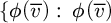 $\{ \phi (\overline {v}): \ \phi (\overline {v})$
is an
 $ \mathcal {L}_{A}$
-formula and
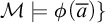 $\mathcal M\models \phi (\overline {a}) \}$
for a tuple
 $\overline {a}\in M^n$
is denoted by
 $\operatorname {\mathrm {tp}}^{\mathcal {M}}({\overline {a}}/{A})$
.
For any
 $ {\mathcal {L}}_A$
-formula
 $\phi (\overline {v})$
the set
 $\{p(\overline {v})\in S_{n}^{\mathcal {M}}(A): \phi (\overline {v})\in p(\overline {v})\}$
is denoted by
 $[\phi (\overline {v})]$
.
Definition 2.2. The structure
 $\mathcal M$
has definable Skolem functions if for every formula
 $\phi (\overline {x},y)$
, there exists a definable function
 $F: M^{\mid \overline {x}\mid }\rightarrow M$
such that
 $\mathcal {M}\models \forall \overline {x}(\exists y \phi (\overline {x},y) \rightarrow \phi (\overline {x},F(\overline {x}))) $
. Also the theory T has definable Skolem functions if every model of it has definable Skolem functions.
Proposition 2.3. If the structure
 $\mathcal {M}$
has definable Skolem functions and
 $m,n\in \mathbb {N}$
, then for each formula
 $\phi (x_1,\dots , x_m, y_1,\dots , y_n)$
there exists a definable function
 $F:M^m\rightarrow M^n$
such that
 $\mathcal {M}\models \forall \overline {x}[ \exists \overline {y} \phi (\overline {x},\overline {y})\rightarrow \phi (\overline {x},F(\overline {x}))]$
.
Proof. This is done by induction on n. The case
 $n=1$
follows from definition. Let
 $\phi (x_1,\dots , x_m, y_1,\dots , y_n,y_{n+1})$
be a formula. By induction assumption there exists a definable function
 $F_1:M^m\rightarrow M^n$
such that
 $$ \begin{align*}\mathcal{M}\models \forall\overline{x} [\exists y_1,\dots, y_n (\exists y_{n+1} \phi(\overline{x},y_1,\dots, y_n,y_{n+1} ))\rightarrow (\exists y_{n+1} \phi(\overline{x},F_1(\overline{x}),y_{n+1}))].\end{align*} $$
There is also a definable function
 $F_2:M^{m+n}\rightarrow M$
such that
 $$ \begin{align*}\mathcal{M}\models \forall\overline{x} \forall y_1,\dots, y_n [\exists y_{n+1} \phi(\overline{x},y_1,\dots, y_n,y_{n+1} ))\rightarrow \phi(\overline{x},y_1,\dots, y_n, F_{2}(\overline{x},y_1,\dots, y_n))].\end{align*} $$
Hence
 $F_3:M^m\rightarrow M^n\times M$
with
 $F_3(\overline {x})=(F_1(\overline {x}), F_2(\overline {x},F_1(\overline {x})))$
is a definable function such that
 $$ \begin{align*}\mathcal{M}\models \forall\overline{x}[ \exists\overline{y} \phi(\overline{x},\overline{y})\rightarrow \phi(\overline{x},F_3(\overline{x}))].\\[-32pt]\end{align*} $$
Lemma 2.4. If the structure
 $\mathcal {M}$
has definable Skolem functions and
 $n\in \mathbb {N}$
, then the isolated types in
 $S_{n}^{\mathcal M}(A)$
are dense for every non-empty set
 $A\subseteq M$
.
Proof. Let
 $A\subseteq M$
and
 $n\in \mathbb {N}$
. Fix the formula
 $\phi (\overline {a},y_1,\dots , y_n)$
such that
 $\overline {a}\in A$
. There is the definable function
 $F: M^{\mid \overline {x}\mid }\rightarrow M^n$
such that
 $\mathcal {M}\models \forall \overline {x}(\exists y_1,\dots , y_n \phi (\overline {x},y_1,\dots , y_n) \rightarrow \phi (\overline {x},F(\overline {x}))) $
by Proposition 2.3. Any formula equivalent to “
 $\overline {y}=F(\overline {a})$
” isolates a type which contains
 $ \phi (\overline {a},y_1,\dots , y_n) $
.
Theorem 2.5. If the structure
 $\mathcal {M}$
has definable Skolem functions and there exists an element
 $a\in M$
such that
 $\{a\}$
is an
 $\emptyset $
-definable set, then the isolated types in
 $S_{n}^{\mathcal M}(A)$
are dense for every set
 $A\subseteq M$
.
Proof. According to Lemma 2.4 it suffices to show that isolated types in
 $S_{n}^{\mathcal M}(\emptyset )$
are dense for each
 $n\in \mathbb {N}$
. Let
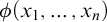 $\phi (x_1, \dots , x_n)$
be an arbitrary formula. Consider the formula
 $\psi (y, x_1, \dots , x_n)= \phi (x_1, \dots , x_n) \wedge y=y $
. By Proposition 2.3 there exists a definable function
 $F: M \rightarrow M^n$
such that
 $\mathcal {M}\models \forall y (\exists x_1, \dots , x_n \psi (y, x_1, \dots , x_n) \rightarrow \psi (y,F(y)))$
. Then
 $\operatorname {\mathrm {tp}}^{\mathcal {M}} (F(a))$
is an isolated type in
 $S_{n}^{\mathcal M}(\emptyset )$
such that
 $\phi (x_1, \dots , x_n)\in \operatorname {\mathrm {tp}}^{\mathcal {M}} (F(a))$
.
Let
 $\mathcal {M}=(M,<, \dots )$
be a first-order expansion of a dense linear order without endpoints. The subset C of M is said to be convex if for all
 $a<b$
in C and any
 $c\in M$
, with
 $a<c<b$
, we have
 $c\in C$
. If additionally
 $C\neq \emptyset $
and
 $\inf C , \sup C\in M\cup \{\pm \infty \}$
then C is called an interval.
Definition 2.6. The structure
 $\mathcal {M}= (M, <, \dots )$
is said to be weakly o-minimal if every unary definable subset of
 $\mathcal {M}$
is a finite union of open convex subsets and points. A theory T that extends the theory of dense linear orders without endpoints is weakly o-minimal if all of its models are weakly o-minimal.
Definition 2.7. Let
 $\mathcal M = (M, <, \dots )$
be a weakly o-minimal structure. A pair
 $\langle C, D \rangle $
is called a cut if the following conditions hold:
-
1) C and D are non-empty subsets in M.
-
2)
 $C\cup D= M$
.
-
3) D has no least element.
-
4)
$C < D$
; that is,
$x<y$
for all
$x\in C$
and
$y\in D$
.



Definition 2.8. Let
 $\mathcal M = (M, <, \dots )$
be a weakly o-minimal structure. A cut
 $\langle C, D \rangle $
is definable if C (equivalently D) is definable in
 $\mathcal {M}$
. The set of all definable cuts in M is called the definable completion of M and is denoted by
 $\overline {M}$
.
By identifying each element
 $a\in M$
with the definable cut
 $\langle (-\infty , a], (a, +\infty ))\rangle $
, we can view M as a subset of
 $\overline {M}$
. Furthermore, we can define an order relation
 $<$
on
 $\overline {M}$
as follows:
 $$ \begin{align} \langle C_1 , D_1\rangle < \langle C_2 , D_2\rangle \Leftrightarrow C_1 \subset C_2. \end{align} $$
With this order relation,
 $(\overline {M}, <)$
becomes a dense linear order set without endpoints in which
 $(M,<)$
is a dense subset.
Let
 $\mathcal {M}=(M, <, +, \dots )$
be a weakly o-minimal expansion of an ordered group
 $(M,<,+)$
. By Theorem 5.1 of [Reference Macpherson, Marker and Steinhorn11],
 $(M,<,+)$
is divisible and abelian. In particular, for any
 $a\in M$
, there exists
 $b\in M$
such that
 $a=b+b$
. We denote this b by
 $\frac {a}{2}$
.
Notation 2.9. If X and Y are subsets of M and
 $a\in M$
we define
 $X+Y$
as the set
 $\{x+y: x\in X, y\in Y\}$
,
 $X-Y$
as the set
 $\{x-y: x\in X, y\in Y\}$
,
 $X+a$
as the set
 $\{x+a: x\in X\},$
and
 $\frac {X}{2}$
as the set
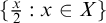 $\{\frac {x}{2}: x\in X\}$
.
Remark 2.10. Let
 $\mathcal {M} = (M, <, +, \dots )$
be a weakly o-minimal expansion of an ordered group
 $(M, <, +)$
. If
 $\langle C_1, D_1 \rangle $
and
 $\langle C_2, D_2 \rangle $
are definable cuts, then we have the following:
-
a) The set
$D_1 + D_2$
is a non-empty definable convex set that is upward closed and has no least element. Consequently,
$M \setminus (D_1 + D_2)$
is a non-empty definable convex set that is downward closed and
$M\setminus (D_1+D_2)< D_1+D_2$
. -
b) The set
$C_1 + C_2$
is a non-empty definable convex set that is downward closed and is a subset of
$M \setminus (D_1 + D_2)$
. -
c)
$C_1+C_2<D_1+D_2.$






We extend the operations of addition and division by 2 to the definable completion
 $\overline {M}$
as follows:
 $$ \begin{align} \langle C_1 , D_1\rangle + \langle C_2 , D_2\rangle= \langle M \setminus (D_1 + D_2) , D_1+ D_2\rangle \end{align} $$
 $$ \begin{align} \frac{\langle C_1 , D_1\rangle}{2}= \langle \frac{C_1}{2} , \frac{D_1}{2}\rangle. \end{align} $$
It is clear that the pair
 $\langle \frac {C_1}{2} , \frac {D_1}{2}\rangle $
and
 $\langle M \setminus (D_1 + D_2) , D_1+ D_2\rangle $
satisfy properties (1–4) of Definition 2.7. So, in weakly o-minimal expansions of ordered groups, the sum of two definable cuts is itself a definable cut. Specifically, in such structures, we know that
 $C_1 + C_2 \subseteq M \setminus (D_1 + D_2)$
and
 $C_1 + C_2 < D_1 + D_2$
. However, we cannot make any general statements about
 $M \setminus ((C_1 + C_2) \cup (D_1 + D_2))$
. In contrast, in weakly o-minimal non-valuational expansions of ordered groups,
 $M \setminus ((C_1 + C_2) \cup (D_1 + D_2))$
is either
 $\emptyset $
or
 $\{\sup (C_1 + C_2)\}$
(see Lemma 2.13). In other words
 $M \setminus (D_1 + D_2)$
can be described in terms of
 $C_1 + C_2$
within weakly o-minimal non-valuational expansions of ordered groups.
Definition 2.11. Let
 $\mathcal {M} = (M, <, +, \dots )$
be a weakly o-minimal expansion of an ordered group
 $(M, <, +)$
. A cut
 $\langle C, D \rangle $
in
 $\mathcal {M}$
is called non-valuational if
 $\inf (D-C) = 0$
. The structure
 $\mathcal {M} $
is called non-valuational if every definable cut in it is non-valuational; otherwise it is called valuational.
It is clear that if
 $\langle C, D \rangle $
is a non-valuational cut, then
 $C+\epsilon \neq C$
for all
 $\epsilon>0$
. Also it should be noted that other criteria for weakly o-minimal non-valuational expansions of ordered groups are given in Lemma 1.5 of [Reference Wencel16]. Specifically, a weakly o-minimal structure
 $\mathcal {M} = (M, <, +, \dots )$
is non-valuational if and only if it does not have a definable proper non-trivial convex subgroup.
Remark 2.12. If
 $\mathcal {M}=(M, <, +, \dots )$
is a weakly o-minimal non-valuational structure, then it has the strong cell decomposition property, and the full theory of
 $\mathcal {M}$
,
 $\mathrm {Th}(\mathcal {M})$
, is also weakly o-minimal by Corollary 2.16 of [Reference Wencel16]. Consequently, every model
 $\mathcal {N}$
of
 $\mathrm {Th}(\mathcal {M})$
has the strong cell decomposition property by Corollary 3.3 of [Reference Wencel19]. Therefore, every model
 $\mathcal {N}$
of
 $\mathrm {Th}(\mathcal {M})$
has the strong monotonicity property by Proposition 1.3 of [Reference Wencel19], implying that
 $\mathcal {N}$
is a weakly o-minimal non-valuational structure by Lemma 1.5 of [Reference Wencel16]. Hence, we can conclude that a model of a complete first-order theory
 $ T $
, which expands the theory of ordered groups is weakly o-minimal non-valuational if and only if every model of it is a weakly o-minimal non-valuational structure. Thus, when we refer to a complete theory as being weakly o-minimal and non-valuational, we mean that every model of the theory is a weakly o-minimal non-valuational structure.
In the rest of the article, we assume that
 $\mathcal {M} = (M, <, +, \dots )$
is a weakly o-minimal non-valuational structure.
Lemma 2.13. Let
 $\langle C_1, D_1 \rangle $
and
 $\langle C_2, D_2 \rangle $
be definable non-valuational cuts. Then
-
a) If the supremum of
$C_1 + C_2$
exists in M, say
$\sup (C_1 + C_2) = a$
, then
$$\begin{align*}M \setminus (D_1 + D_2) = (-\infty, a] = (C_1 + C_2) \cup \{a\}. \end{align*}$$
-
b) If the supremum of
$C_1 + C_2$
does not exist in M, then
$$\begin{align*}M \setminus (D_1 + D_2) = C_1 + C_2. \end{align*}$$




Proof. a) If the supremum of
 $C_1 + C_2$
exists in M, say
 $\sup (C_1 + C_2) = a$
, then it is clear that
 $a<D_1+D_2$
because
 $D_1+D_2$
has no least element. Therefore
 $(-\infty , a]\subseteq M\setminus (D_1+D_2)$
. First we show that
 $M\setminus (D_1+D_2)=(-\infty , a]$
. We claim that
 $t\leq a$
for each
 $t\in M \setminus (D_1 + D_2) $
, and hence
 $M\setminus (D_1+D_2)=(-\infty , a]$
. For contradiction suppose that there exists
 $t\in M \setminus (D_1 + D_2)$
such that
 $a < t$
. By density of
 $(M,<)$
, there exists
 $ s \in M $
such that
 $a < s < t$
. Let
 $ \epsilon _1 = t - s $
. Since
 $ s \in M $
and
 $ t \in M $
, it follows that
 $ \epsilon _1 = t - s> 0 $
, and
 $ \epsilon _1 \in M $
. So,
 $ C_1 + C_2 \leq a < t - \epsilon _1 < t < D_1 + D_2. $
Thus, adding
 $ \epsilon _1 $
to
 $ C_1 + C_2 $
, we obtain
 $$ \begin{align} C_1 + C_2 + \epsilon_1 < t. \end{align} $$
On the other hand, by the non-valuationality of
 $\langle C_1, D_1 \rangle $
and
 $\langle C_2, D_2 \rangle $
, for any
 $\epsilon> 0$
, there exist
 $c_1 \in C_1$
and
 $c_2 \in C_2$
such that
 $d_1 = c_1 + \frac {\epsilon }{2} \in D_1 \quad \text {and} \quad d_2 = c_2 + \frac {\epsilon }{2} \in D_2.$
Thus,
 $d_1 + d_2 \in (C_1 + C_2 + \epsilon ) \cap (D_1 + D_2).$
Therefore, for each
 $\epsilon> 0$
, there exist
 $c_1 \in C_1$
and
 $c_2 \in C_2$
such that
 $t < c_1 + c_2 + \epsilon ,$
by
 $t < D_1 + D_2$
. However, this contradicts (4). Therefore
 $(-\infty , a]=M\setminus D_1+D_2$
.
Now we show that
 $(C_1 + C_2) \cup \{a\}=(-\infty , a]$
. Since
 $ C_1 + C_2 \subseteq M \setminus (D_1 + D_2) $
, it follows that
 $ (C_1 + C_2) \cup \{a\} \subseteq (-\infty , a] $
. Let
 $ x \in (-\infty , a) $
. Since
 $ \sup (C_1 + C_2) = a $
, it follows that there exist
 $ c_1 \in C_1 $
and
 $ c_2 \in C_2 $
such that
 $ x \leq c_1 + c_2 $
. By the downward closedness of
 $ C_1 + C_2 $
, we have
 $ x \in C_1 + C_2 $
. Therefore,
 $ (-\infty , a] = (C_1 + C_2) \cup \{a\} $
.
b) If
 $\sup (C_1 + C_2)$
does not exist in M, then we show that
 $$\begin{align*}M \setminus (D_1 + D_2) = C_1 + C_2. \end{align*}$$
Since
 $C_1 + C_2 \subseteq M \setminus (D_1 + D_2)$
, it suffices to show that
 $M \setminus (D_1 + D_2) \subseteq C_1 + C_2$
.
For contradiction, assume there exists
 $t \in M \setminus (D_1 + D_2)$
such that
 $C_1 + C_2 < t$
. Since
 $\sup (C_1 + C_2)$
does not exist in M, there exists
 $s \in M$
such that
 $C_1 + C_2 < s < t.$
Now, similar to the previous case, this leads to a contradiction. Therefore
 $M\setminus (D_1+D_2)=C_1+C_2.$
Remark 2.14. Let
 $\langle C, D \rangle $
be a definable non-valuational cut, and let
 $a \in M$
. Then, based on the definition of the supremum of a set, we have the following:
-
a) The supremum of the set
$C + a$
exists in M if and only if the supremum of the set C exists in M. Moreover, in this case,
$$\begin{align*}\sup(C + a) = \sup(C) + a. \end{align*}$$
-
b) The supremum of the set
$C + C$
exists in M if and only if the supremum of the set C exists in M. Furthermore, in this case,
$$\begin{align*}\sup(C + C) = 2 \cdot \sup(C). \end{align*}$$


Notation 2.15. In the following fact we write
 $\langle C , D\rangle + a$
as the sum of the cuts
 $\langle C , D\rangle $
and
 $ \langle (-\infty , a] , (a, +\infty ) \rangle $
for each cut
 $\langle C , D\rangle $
and any
 $a\in M$
.
Fact 2.16. Suppose that
 $\langle C , D\rangle $
is a definable non-valuational cut and
 $a<b$
are elements of M. Then
 $\langle C , D\rangle + a= \langle C+a, D+a\rangle $
and
 $\langle C , D\rangle + a < \langle C , D\rangle + b$
.
Proof. If
 $\langle C, D \rangle $
is a definable non-valuational cut such that
 $\sup (C)$
exists in M, say
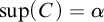 $\sup (C) = \alpha $
, then
 $\alpha \in C$
. Thus,
 $ C + a = (-\infty , \alpha + a] $
by Remark 2.14. Hence,
 $ \langle C, D \rangle + a = \langle C + a, D + a \rangle $
by Lemma 2.13.
Let
 $\langle C, D \rangle $
be a definable non-valuational cut such that
 $\sup (C)$
does not exist in M. Hence,
 $\sup (C+a)$
does not exist in M by Remark 2.14. Therefore the supremum of the set
 $C+(-\infty , a]$
does not exist in M. So by Lemma 2.13, it is enough to show that
 $C+a=C+(-\infty , a]$
. We first show that
 $C+a$
is downward closed. To see this suppose
 $x\in C$
and
 $t< x+a$
. Then
 $t-a<x$
. Since C is downward closed it follows that
 $t-a\in C$
. Therefore
 $t=(t-a)+a\in C+a$
. It is clear that every element
 $x+t$
of
 $C+ (-\infty , a]$
is less than
 $x+a$
. Hence
 $C+ (-\infty , a]\subseteq C+a$
by downward closedness of
 $C+a$
. Also, it is obvious that
 $ C+a \subseteq C+ (-\infty , a]$
. So
 $ C+a = C+ (-\infty , a]$
which shows the equality of cuts
 $\langle C , D\rangle + a$
and
 $\langle C+a, D+a\rangle $
.
If
 $a<b$
, then it is clear that
 $x+a < x+b$
for each
 $x\in C$
. So
 $C+a \subseteq C+b$
by downward closedness of
 $C+b$
. We claim that
 $C + a \neq C + b$
. To see why, suppose
 $C + a = C + b$
. Then,
 $$\begin{align*}C = C + (b - a), \end{align*}$$
which contradicts the non-valuationality of
 $\langle C, D \rangle $
.
Notation 2.17.
-
1) For each cut
$\langle C, D\rangle $
and element
$a\in M$
we write
$\langle C, D\rangle < a $
if
$\langle C, D\rangle < \langle (-\infty , a], (a, +\infty )\rangle $
. Equivalently
$\langle C,D\rangle < a $
if and only if
$x < a$
for every
$x\in C$
. -
2) Let I be an open definable convex set that is neither downward nor upward closed. We define
$\inf I$
as the definable cut
$\langle C_I , D_I\rangle ,$
where
$D_I=\{x\in M: \forall t (t\in I \rightarrow x>t)\}\cup I$
and
$C_I=M\setminus D_I$
. Similarly, we define
$\sup I$
as the definable cut
$\langle C^I , D^I\rangle ,$
where
$ D^I $
is the interior of the set
$ \{x \in M : \forall t \, (t \in I \rightarrow x> t)\}$
and
$C^I=M\setminus D^I$
.










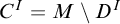
Lemma 2.18. Let I be an open definable non-valuational convex set that is neither downward nor upward closed. Then there are elements s and t in M such that
 $\inf I< s <\frac {\inf I+ \sup I}{2} < t< \sup I$
.
Proof. Let
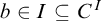 $b\in I\subseteq C^I$
. It follows that
 $C_I+b\subseteq C_I+C^I$
. Fix elements
 $a < b$
in I. For all
 $x, y \in C_I$
we have the following:
 $$ \begin{align*}x+y < x+a < x+b.\end{align*} $$
So by downward closedness of
 $C_I+a$
, Fact 2.16, and the definition of the order relation
 $<$
in
 $\overline {M}$
we have
 $$ \begin{align*}C_I+C_I \subseteq C_I+a \subset C_I+b \subseteq C^I+C_I.\end{align*} $$
So, by Remark 2.14 and Lemma 2.13 we have
 $$ \begin{align} \inf I + \inf I \leq \inf I + a < \inf I + b \leq \sup I + \inf I. \end{align} $$
Similarly we have
 $$ \begin{align} \inf I + \sup I \leq \sup I + a < \sup I + b \leq \sup I + \sup I. \end{align} $$
Since M is dense in
 $\overline {M}$
, it follows that there are elements
 $s'$
and
 $t'$
such that
 $$ \begin{align*}\inf I+\inf I \leq \inf I+a < s' <\inf I+b \leq \sup I+\inf I\end{align*} $$
 $$ \begin{align*}\inf I+\sup I \leq \sup I +a < t' < \sup I+b \leq \sup I+ \sup I.\end{align*} $$
Therefore
 $s=\frac {s'}{2}$
and
 $t=\frac {t'}{2}$
are the desired elements.
For proving the converse of Theorem 2.4 in a weakly o-minimal non-valuational expansion of an ordered group we need the following proposition.
Proposition 2.19. Let
 $ \mathcal {M}=(M,<, +, \dots ) $
be a weakly o-minimal non-valuational expansion of the ordered group
 $ (M,<, +) $
and
 $ A\subseteq M$
. Then the set of realizations of each isolated 1-type in
 $ S_{1}^{\mathcal {M}}(A) $
is finite.
Proof. Let
 $p(x)\in S_{1}^{\mathcal M}(A)$
be an isolated 1-type over A. So there is the
 $\mathcal {L}_{A}$
-formula
 $\phi (x)$
such that for all
 $\mathcal {L}_{A}$
-formulas
 $\psi (x)$
we have
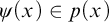 $\psi (x)\in p(x)$
if and only if
 $Th_{A}(\mathcal M)\models \phi (x)\rightarrow \psi (x)$
by Proposition 4.1.11 of [Reference Marker12]. The set
 $$ \begin{align*}\phi^{\mathcal M}(x)=\{ a\in M: \ \mathcal M\models \phi(a)\}\end{align*} $$
is a finite union of open convex subsets and points by weak o-minimality. We show that it does not have a convex component. Otherwise, assume that I is the first infinite convex component of
 $\phi ^{\mathcal M}(x)$
. Without loss of generality assume that I is open. Otherwise we can replace I with its interior. If I is neither downward nor upward closed, then there are the elements
 $a<b$
such that
 $\inf I<a<\frac {\inf I+ \sup I}{2}$
and
 $\frac {\inf I+ \sup I}{2}<b<\sup I$
by Lemma 2.18. So a and b are realizations of
 $p(x)$
. Therefore
 $\operatorname {\mathrm {tp}}^{\mathcal M}({a}/{A})=p(x)=\operatorname {\mathrm {tp}}^{\mathcal M}({b}/{A})$
. Hence the
 $\mathcal {L}_{A}$
-formula
 $\inf I<x<\frac {\inf I+ \sup I}{2}$
is an element of
 $\operatorname {\mathrm {tp}}^{\mathcal M}({b}/{A})$
, contradicting the choice of b. If I is upward closed, we apply the above discussion to the convex set
 $\{x\in M: \frac {\inf I}{2} < x < \inf I\}$
instead of I. If I is downward closed, we apply the above discussion to the convex set
 $\{x\in M: \sup I < x < \sup I + \sup I\}$
instead of I.
Theorem 2.20. Let
 $n\in \mathbb {N}$
and
 $\mathcal {M}=(M,<,+,\dots )$
be a weakly o-minimal non-valuational expansion of the ordered group
 $(M,<,+)$
such that the isolated types in
 $S_{n}^{\mathcal M}(A)$
are dense for every
 $A\subseteq M$
. Then the full first-order theory
 $ \operatorname {\mathrm {Th}}({\mathcal {M}})$
has definable Skolem functions.
Proof. Let
 $\phi (\overline {x},y)$
be a formula. Then
 $[\phi (\overline {x},y)]$
is an open subset of
 $S_{n}^{\mathcal M}(\emptyset )$
. So as the isolated types are dense, there is the isolated type
 $p(\overline {x},y)\in S_{n}^{\mathcal M}(\emptyset )$
that is an element of
 $[\phi (\overline {x},y)]$
. Hence by Proposition 4.1.11 of [Reference Marker12] there is a formula
 $\psi (\overline {x},y)$
such that for each formula
 $\theta (\overline {x},y)$
,
 $\mathcal M\models \psi (\overline {x},y)\rightarrow \theta (\overline {x},y)$
if and only if
 $\theta (\overline {x},y)\in p(\overline {x},y)$
. We claim that
 $\psi ^{\mathcal M}(\overline {a},y)=\{b\in M : \mathcal M \models \psi (\overline {a},b)\}$
is a finite set for each
 $\overline {a}\in M^{\mid \overline {x}\mid }$
. Fix
 $\overline {a}=(a_1,\dots ,a_{\mid \overline {x}\mid })$
and assume that
 $A=\{a_1, \dots , a_{\mid \overline {x}\mid }\}$
. So there is an isolated 1-type
 $r(y)\in S_{1}^{\mathcal {M}}(A)$
such that
 $r(y)\in [\psi (\overline {a}, y)]$
. Since
 $r(y)$
is isolated by some formula
 $\chi (y, \overline {a})$
, so there is
 $b\in M$
such that
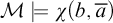 $\mathcal {M}\models \chi (b, \overline {a})$
. Hence
 $ \psi ^{\mathcal M}(\overline {a},y)\neq \emptyset $
and
 $q(y)=\{\theta (y): \mathcal M \models \forall y \psi (\overline {a},y) \rightarrow \theta (y)$
and
 $\theta (y)$
is an
 $\mathcal {L}_A$
-formula
 $ \}$
is a complete 1-type over A isolated by
 $\psi (\overline {a},y)$
. So
 $\psi ^{\mathcal M}(\overline {a},y)$
is a finite subset of M by Proposition 2.19. Let
 $F_{\phi }: M^{\mid \overline {x}\mid }\rightarrow M$
be a definable function such that
 $F_{\phi }(\overline {a})=\min \psi ^{\mathcal M}(\overline {a},y)$
. It is clear that
 $\mathcal M\models \forall \overline {x}(\exists y \phi (\overline {x},y) \rightarrow \phi (\overline {x},F_{\phi }(\overline {x})))$
.
Corollary 2.21. Let
 $n\in \mathbb {N}$
and
 $\mathcal {M}=(M,<,+,\dots )$
be a weakly o-minimal non-valuational expansion of the ordered group
 $(M,<,+)$
. Then the isolated types in
 $S_{n}^{\mathcal M}(A)$
are dense for every
 $A\subseteq M$
if and only if the full first-order theory
 $ \operatorname {\mathrm {Th}}({\mathcal {M}})$
has definable Skolem functions.
Proof. The left-to-right direction follows from Theorem 2.20. The right-to-left direction follows from Theorem 2.5 since the identity element of the group
 $(M, <, +)$
is defined by the formula
 $\phi (x)= \forall y (x+y=y+x=y)$
.
Since every o-minimal expansion
 $\mathcal {M}=(M, <, +, \dots )$
is a weakly o-minimal non-valuational structure, we define a strictly weakly o-minimal non-valuational structure as a weakly o-minimal non-valuational structure that is not o-minimal. Furthermore, a complete theory T is said to be strictly weakly o-minimal non-valuational if it has a model that is strictly weakly o-minimal and non-valuational (equivalently, if every model of T is a strictly weakly o-minimal non-valuational structure).
In [Reference Eleftheriou, Hasson and Keren7] the authors established that certain weakly o-minimal non-valuational structures (o-minimal traces) do not have definable Skolem functions (see [Reference Eleftheriou, Hasson and Keren7, Proposition 2.13]) and conjectured that no strictly weakly o-minimal non-valuational expansion of an ordered group has definable Skolem functions (see [Reference Eleftheriou, Hasson and Keren7, Conjecture 1.7]). We show that a complete strictly weakly o-minimal non-valuational theory T does not have definable Skolem functions.
In [Reference Kulpeshov9] a criterion for the density of isolated types in weakly o-minimal theories is presented. To express this we first recall the following notation from [Reference Kulpeshov9].
Notation 2.22. Let
 $\mathcal {M}=(M, <, +, \dots )$
be a weakly o-minimal structure and
 $A\subseteq M$
. The condition
 $(*)_A$
is defined as follows.
For any convex A-definable set I such that
 $I\cap \operatorname {\mathrm {dcl}}(A)=\emptyset $
and there are
 $a_1, a_2\in I$
such that
 $\operatorname {\mathrm {tp}}({a_1}/{A}) \neq \operatorname {\mathrm {tp}}({a_2}/{A})$
the following holds: for any convex A-definable proper subset
 $I_0$
of I with
 $I\setminus I_0$
convex, the collection of all convex A-definable subsets of I that include
 $I_0$
is not a dense order with respect to inclusion.
Fact 2.23. If T is a weakly o-minimal theory, then the following conditions are equivalent:
-
1) For any
$\mathcal {M}\models T$
and every subset
$A\subseteq M$
, the isolated types of
$S^{\mathcal {M}}_n(A)$
are dense for any
$n\in \mathbb {N}$
. -
2) The condition
$(*)_A$
holds for any
$\mathcal {M}\models T$
and every subset
$A\subseteq M$
.


Proof. See [Reference Kulpeshov9, Theorem 4.3].
Proposition 2.24. Let T be a complete o-minimal theory. Then the condition
 $(*)_A$
holds for any
 $\mathcal {M}\models T$
and every subset
 $A\subseteq M$
.
Proof. Let
 $\mathcal {M}$
be an arbitrary model of T. Assume that
 $A \subseteq M$
and I is an A-definable convex set such that
 $I \cap \operatorname {\mathrm {dcl}}(A) = \emptyset $
, and there exist
 $a_1, a_2 \in I$
such that
 $\mathrm {tp}(a_1 / A) \neq \mathrm {tp}(a_2 / A)$
. Then, there exists a formula
 $\phi (x, \overline {a})$
with
 $\overline {a} \in A$
such that
 $$\begin{align*}\mathcal{M} \models \phi(a_1, \overline{a}) \quad \text{and} \quad \mathcal{M} \models \neg \phi(a_2, \overline{a}). \end{align*}$$
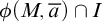
By o-minimality, both
 $\phi (M, \overline {a}) \cap I$
and
 $\neg \phi (M, \overline {a}) \cap I$
are finite unions of points and intervals. Hence, we can write
 $$\begin{align*}I = J_1 \cup J_2 \cup \cdots \cup J_k \cup \{b_1, \dots, b_m\}, \end{align*}$$
where each
 $J_i$
is an open interval that is A-definable, and for each i, either
 $J_i \subseteq \phi (M, \overline {a})$
or
 $J_i \subseteq \neg \phi (M, \overline {a})$
. So there exists
 $b \in I \cap \operatorname {\mathrm {dcl}}(A)$
, which is a contradiction. Therefore, the condition
 $(*)_A$
holds for any
 $\mathcal {M} \models T$
and every subset
 $A \subseteq M$
.
With Proposition 2.24, Fact 2.23, and Corollary 2.21 we have the following result, which is well-known and proven in the context of o-minimality.
Corollary 2.25. Let
 $\mathcal {M}=(M, <, +, \dots )$
be an o-minimal expansion of an ordered group
 $(M, <, +)$
. Then
 $\operatorname {\mathrm {Th}}(\mathcal {M})$
has definable Skolem functions.
In the following, we demonstrate that, unlike in o-minimal theories, the condition
 $(\star )_{A}$
does not hold in strictly weakly o-minimal non-valuational theories.
Theorem 2.26. Let T be a complete strictly weakly o-minimal non-valuational theory, expanding the theory of ordered groups. Then the condition
 $(*)_A$
does not hold for any
 $\mathcal {M}\models T$
and every subset
 $A\subseteq M$
.
Proof. Let
 $\mathcal {M} = (M, <, +, \dots )$
be an arbitrary model of T, and let
 $A \subseteq M$
. Assume that I is a convex A-definable set such that
 $I \cap \operatorname {\mathrm {dcl}}(A) = \emptyset $
, and there exist
 $a_1, a_2 \in I$
such that
 $\mathrm {tp}(a_1 / A) \neq \mathrm {tp}(a_2 / A)$
. Then, there exists a formula
 $\phi (x, \overline {a})$
with
 $\overline {a} \in A$
such that
 $$\begin{align*}\mathcal{M} \models \phi(a_1, \overline{a}) \quad \text{and} \quad \mathcal{M} \models \neg \phi(a_2, \overline{a}). \end{align*}$$
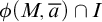
By weak o-minimality and
 $I \cap \operatorname {\mathrm {dcl}}(A) = \emptyset $
,
 $\phi (M, \overline {a}) \cap I$
and
 $\neg \phi (M, \overline {a}) \cap I$
are finite unions of open convex sets. So there exists an A-definable proper subset
 $I_0$
of I such that
 $I \setminus I_0$
is convex and
 $\sup I_0 \notin M \cup \{+\infty \}$
.
If
 $I_1 \subseteq I$
and
 $I_2 \subseteq I$
are convex A-definable sets containing
 $I_0$
with
 $I_1 \subset I_2$
, then the set
 $J = I_2 \setminus I_1$
is a convex A-definable subset of I. Therefore
 $\frac {\inf J + \sup J}{2}$
is a definable non-valuational cut
 $\langle C, D\rangle $
. Therefore, by Lemma 2.18,
 $I_3 = C\cap I$
is an A-definable convex subset of I such that
 $I_1 \subset I_3 \subset I_2$
and
 $I \setminus I_3$
is convex. Consequently, the collection of all convex A-definable subsets of I that include
 $I_0$
is dense. Thus, the condition
 $(*)_A$
does not hold.
With Theorem 2.26, Fact 2.23, and Corollary 2.21 we have the following.
Corollary 2.27. Let
 $\mathcal {M}=(M, <, +, \dots )$
be a strictly weakly o-minimal non-valuational expansion of an ordered group
 $(M, <, +)$
. Then
 $\operatorname {\mathrm {Th}}(\mathcal {M})$
does not have definable Skolem functions.
It is important to explain that Corollary 2.27 might suggest that all strictly weakly o-minimal theories lack definable Skolem functions. However, in [Reference Tari15], the first author demonstrates that there exist strictly weakly o-minimal theories which do not expand the theory of ordered groups and admit definable Skolem functions (see [Reference Tari15, Corollary 3.19]). Also in [Reference Laskowski and Shaw10] the authors claim that the weakly o-minimal expansion
 $\mathcal {M}_1=(\mathcal {M}, R^{\mathcal {M}_1})$
of an o-minimal expansion
 $\mathcal {M}$
of an ordered group, where
 $R^{\mathcal {M}_1}$
defines a valuation cut, admits definable Skolem functions. We believe that there is a gap in the proof of Theorem 4.12 in [Reference Laskowski and Shaw10], as is also noted in footnote 1 of [Reference Ealy and Maříková6]. However, non-existence of definable Skolem functions does not extend to valuational weakly o-minimal structures, as correctly identified by the reviewer. Investigating about definable Skolem functions in valuational structures requires further examination, research, and the development of new methods for these types of structures, which can be considered as a topic for future research.
Acknowledgments
We sincerely thank the reviewer for his/her constructive feedback and valuable insights, which greatly improved the quality of this manuscript.


